




Abstract
Border towns benefit from cross-border movement of goods, services and people. Many suffered setbacks when governments responded to the COVID-19 pandemic by closing borders. We investigated how the lockdown regulations affected the economy of Ladybrand, a small South African town near Lesotho. We found that local planning was not taking advantage of the benefits of a border town economy and was unprepared for border closure. Retail outlets were the hardest hit, followed by the transport, services and health sectors. Dilapidated infrastructure and poor service delivery made it difficult for the town to cope with the effects of the border closure.
Introduction
Border towns can benefit from cross-border movement and economic activity. Closure of a border can do serious damage to the town’s economy. The South African government’s closure of borders in response to the 2020–2021 COVID-19 pandemic badly affected the town of Ladybrand, a small town in the Mantsopa Local Municipality on the Free State Province’s border with Lesotho, close to Lesotho’s capital, Maseru (see Figure 1). This location has historically benefitted Ladybrand in the form of cross-border retail, access to services for Lesotho nationals and employment in Ladybrand for Maseru residents. The COVID-19 lockdown border closure eliminated this locational advantage, and the damage was made worse by the town’s poor economic planning.
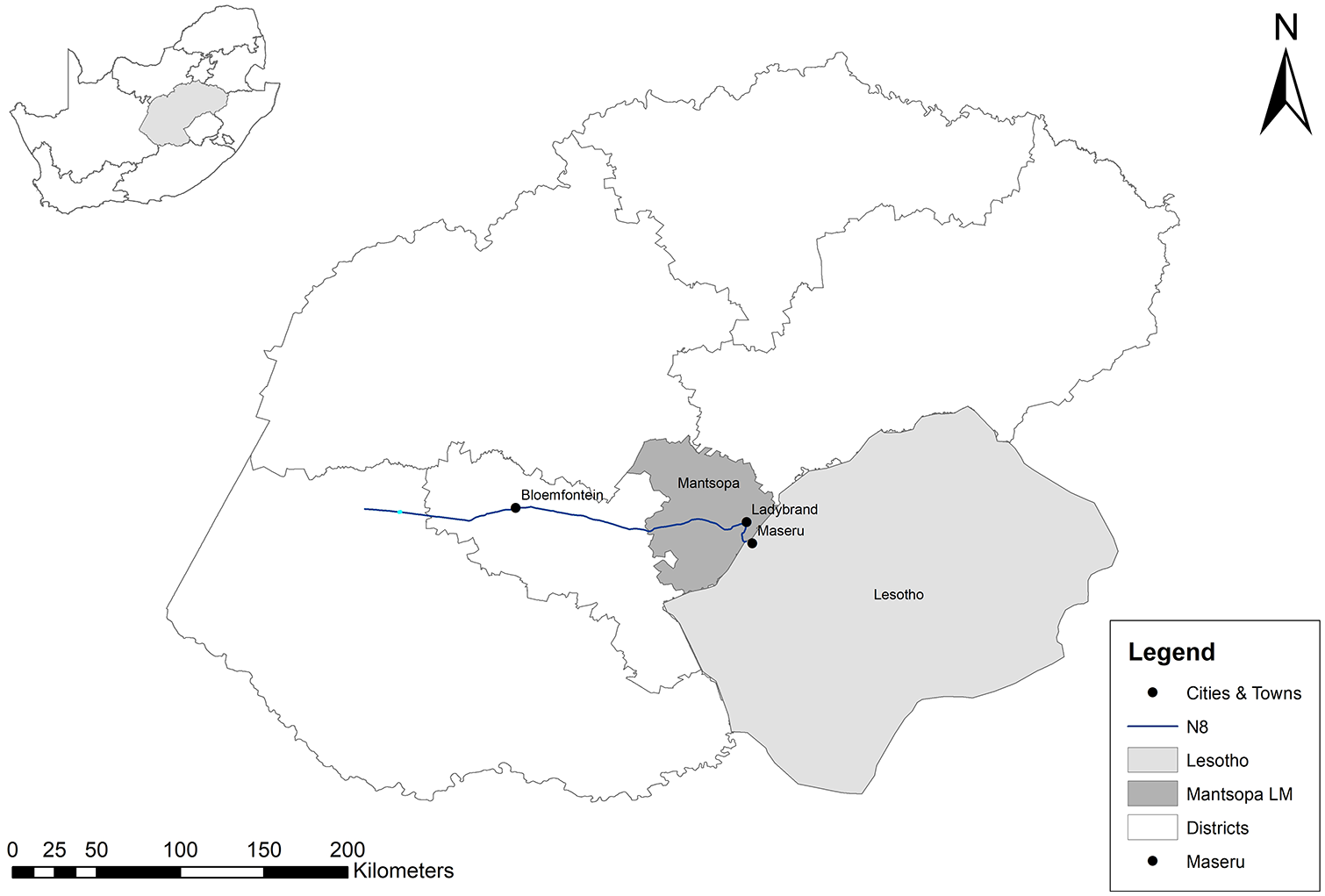
Location of Ladybrand and Mantsopa in South Africa.
Much research has been done on border towns (Buursink, 2001; Nugent, 2012; Prokkola, 2019). Cheaper production processes on one side encourage cross-border movement, but economic change or political instability in one or both countries or conflict between the two makes border towns vulnerable. Governments may close borders because of conflicts without considering the economic implications for these towns, which will be more severe for those that are underdeveloped because of their peripheral location (Prokkola, 2019). Governments may close borders or shut down cities to control the spread of a virus, as they did, for example, during the ‘Spanish flu’ of 1918. During the Spanish flu, border closures were common (Boberg-Fazli et al., 2021), in Australia, leading to cross-border tensions between states and towns (Moir, 2019). The COVID-19 lockdown measures were another such attempt, with the economic damage to border towns only now being revealed (Shakya, 2020; Spenneman, 2022).
We investigated how Ladybrand coped. We found that the border closure and later border crossing restrictions because of COVID-19 testing requirements worsened the town’s economic vulnerability and it may not be able to recover its former prosperity. Our paper contributes to the literature on the vulnerability of border towns in the Global South and the effects of the COVID-19 border closures on border towns.
Literature
Local economic development and small towns
Local economic development originates from various literatures and global processes: globalisation, decentralisation, community development and place-based development. Despite many definitions, Local Economic Development (LED) usually includes references to place or space, participatory development and dialogue, local ownership, sustainability, the use of local resources, references to competitive advantages and the development of key conditions for local economic development (Rodriguez-Pose, 2001; Rogerson, 2009). Consequently, local people must link social and economic development in a specific location. The concept stands in direct contrast to top-down development, sectoral development, central management, a focus on large infrastructure projects and using subsidies and incentives. The potential social and economic value includes local empowerment and engagement, transparency and accountability, improved economic activity based on competitive advantage and improved quality of life and jobs. Despite these broad definitions and values, the concept is contested (Rodriquez-Pose, 2001). Different foci include wealth creation (Bartik, 2003), partnership development and local participation (Helmsing and Egziabher, 2005), an emphasis on sustainable economic development (World Bank, 2001), and local resources and management (International Labour Organisation, 2008).
The first literature on local economic development in South Africa originates from the transitional period from 1990 to 1996 (Nel, 1994). Several policy documents appeared during this phase, including documents from the Urban Foundation and the South African National Civic Organisation (Rogerson, 2009). The inclusion of LED in the South African constitution boosted the concept (Nel and John, 2006). Yet, the successful application of LED is often limited to a few metropolitan areas with small towns struggling to apply it and reap the benefits (Nel and Goldman, 2006).
Although still relatively limited, small town research in South Africa has grown rapidly over the past two decades (Donaldson, 2018, 2023; Donaldson and Marais, 2012; Marais et al., 2018). Although the research covers diverse topics, they are often related to local economic development linked to tourism or mining. Despite a few tourism and retirement success stories (Marais, 2004; Nel and Rogerson, 2007), small town LED has struggled LED in small towns lagging behind other settlement types and prospects are bleak (Nel and Goldman, 2006; Rogerson, 2009). Reasons for this situation include limited resources, high unemployment, institutional and capacity constraints, a focus on statutory compliance, limited understanding of making markets work for the poor, rural decline, the in-migration of people from farms, a project-by-project approach to economic changes in the role of regional services towns as many small towns lose this function (Nel, 2018; Rogerson, 2009). Success has been ascribed to good local leadership and the establishment of local economic development agencies (Lawrence and Rogerson, 2019).
Border towns are an example of a comparative advantage that these towns can use to facilitate local economic development. However, practice and research related to border towns and LED in South Africa is limited.
Border towns
Some comparative research has looked at the variety of types and sizes of border towns and the way they depend on government decisions and cross-country relations (Kolosov and Morachevskaya, 2020; Nugent, 2012; Van Geenhuizen and Rietveld, 2002). Because planners must consider the economic situation in two countries, many border towns have low economic growth and poverty and a workforce mainly in the primary sector (Espara and Donelson, 2008). Mobility restrictions that disturb the migration between border towns can affect economic growth and development.
Nevertheless, border towns can be dynamic places that benefit from the border as a resource (Sohn, 2014). Mexican regions near the US border are examples. Mexican entrepreneurs have set up factories. Targeting the US market, Mexican factories known as maquiladoras employ over 1.2 million people and contribute about 45% of Mexico’s exports to the United States. The maquiladoras have contributed to Mexico’s industrialisation of the border regions. Goods imported or exported through the area are exempted from taxes, boosting cross-border partnerships. However, this economic link is volatile. For example, the devaluation of the Mexican Peso in 1976 affected businesses in San Diego (Puente, 1996). Profits dropped more than 80%, and border towns experienced a rapid decline in sales taxes with severe local consequences (Gerber and Patrick, 2001).
Over the past five decades, the European Union (EU) has connected European countries by introducing an integrated labour market. Consequently, borders have weakened. People can move more freely, and many places have benefitted, such as Basel, Luxembourg, Geneva and the Oresund region (Makkonen, 2015; Sohn, 2014; Timothy et al., 2014). The free movement of people has changed border regions into tourist destinations, with cross-border shopping to find different and sometimes cheaper goods and services becoming a popular leisure activity in the EU countries (Spierings and Van der Velde, 2008; Szytniewski and Spierings, 2016) and Asia (Azmi et al., 2015). One example of benefitting from open boundaries is the Polish town of Slubice on the country’s border with Germany. Slubice has a bazaar near Frankfurt. After the fall of the Berlin Wall and the reintegration of West and East Germany in 1990, bazaar became a point of attraction for German shoppers and the creation of the EU further fostered its economic development. The increase in visitors aided the town’s economic development and created jobs (Szytniewski and Spierings, 2016).
In Africa, where many boundaries resulted from colonialism, regional integration is slow because border towns are often restricted by formal border rules and ongoing border conflicts (Asiwaju, 2012) despite historical informal trade across these borders (Little, 2009). The World Bank (2001) estimates cross-border trade in Africa contributes to income for 43% of Africa’s population. Under COVID-19 regulations, 38 countries closed their borders (Lakeman et al., 2020). However, border closure did little to restrict COVID-19 but affected economies (Emeto et al., 2021). There are examples of prosperous border towns in Africa (Nugent, 2012; Pophiwa, 2017; Sio and Nugent, 2017). One is Goma, city is in the middle of the Great Lakes Region near the Democratic Republic of Congo’s border with Rwanda. Goma is a major trading zone. Although traditionally crucial for trading and migration, linking communities from eastern and central Africa, its economic significance dates mainly from the colonial period. After colonial rule, these links became the backbone of the local economy. Traders, transport providers and students use the border between Gisenyi, in Rwanda, and Goma. Many Goma residents cross the border into Rwanda daily to sell agricultural products in Rwandan markets (Vlassenroot and Buscher, 2009: 5). The closure of the border led to an immediate increase in the prices of fruits and vegetables (World Bank, 2001). The result was that women were hit the hardest because informal trade could not take place (Djankov and Panizza, 2021). Another African example is the Aflao-Kodjoviakope border closure between Ghana and Togo for informal traders. These traders had to join hands with larger logistic firms, but it contributed to an increase of up to 50% in rice, tomatoes and peppers (Luke, 2020). Slower than normal border processing in East Africa has had the same consequences (Luke, 2020).
The mobility of goods, services and people is crucial for border towns. When this mobility is restricted, border town economies suffer.
The COVID-19 border closures
Government responses to the COVID-19 pandemic resulted in increased border control and closure. These measures directly affected the viability of border towns and the residents’ livelihoods. Most countries in Africa closed their borders, resulting in economic decline as cross-border trade became difficult (Gondwe, 2020). As a large part of cross-border trade in Africa is informal (some estimates are at 50%), affecting women and local livelihood, this hurts the survival of people (mostly women) dependent on this trade (Djankov and Panizza, 2021). Sometimes, people bypassed the border controls and kept trading (Djankov and Panizza, 2021). Border closure also affected formal trade, leading ‘to loss of income and jobs as well as the closure of small and vulnerable businesses’ (Obayelu et al., 2020). Where trade did continue, border processing took much longer than in the past. Border closures also occurred in the EU countries, where free border crossing is one of the fundamental EU principles. Paul et al. (2022), for example, describe how the closures affected a cross-border region between Galicia (Spain) and Portugal. The economic sectors most affected were hotels, restaurants and shops (Paul et al., 2022).
Weber (2022) notes that the closure of borders in the Schengen area disturbed the cross-border labour market, weakened supply chains, affected tourism and separated friends and families. Many French residents had to travel further to the nearest French supermarket than they usually would have done to their local Saarland store across the German border. Residents in France and Luxembourg residents complained about the closure of the borders which made living costs higher for people unable to reach German discount outlets. Wøien Meijer and Giacometti (2021) note that some municipalities in the Nordic countries have partnership agreements with neighbouring cities or towns to provide certain public services. Many of these agreements involve significant long-term investments. By closing borders, governments interfered with these regions’ ability to provide strategic services to the public. Some areas, like the Svinesund border region between Sweden and Norway, have considered discontinuing arrangements like providing public services if free movement cannot be guaranteed (Wøien Meijer and Giacometti, 2021).
In South America, Brazilians, Argentinians and Paraguayans cross borders daily to access services in neighbouring border towns. These services include formal education, trading, industrial or labour relations, health services, tourism and religious practices. The closure of borders during the COVID-19 pandemic affected the economic and health sectors (Silva-Sobrinho et al., 2021).
A body of work is emerging on the damage the COVID-19 lockdown measures did to African border towns, particularly to trade and tourism (Ahadu, 2020; Hlovor and Botchway, 2021; Phiri et al., 2021; Wadvalla, 2020). Hlovor and Botchway (2021) note that border closures in Ghana disrupted border regions’ economies and made them more vulnerable. This border closure happened without any input from border communities.
The study site and research method
Ladybrand is a small town in Mantsopa Local Municipality in the eastern Free State, bordered by Lesotho to the east. The main reason for selecting it is that it is situated 18 km from Maseru, the capital of Lesotho. This allows for a daily interaction outside of worker migration patterns between South Africa and Lesotho (Environmental Management Group, 2021; Masiloane, 2021; Nako et al., 2023). Although remotely located like many other border towns, it is easily reached via the N8 (linking Bloemfontein and Maseru) and R26 roads. There is constant movement of people and goods across the border. Many Lesotho nationals go to South Africa to buy supplies and access services.
Ladybrand is the town with the largest population in Mantsopa Local Municipality (the others being Excelsior, Hobhouse and Twee Spruit). It is home to 34% of the total population of Mantsopa and is a service centre for people in Lesotho (Mantsopa Local Municipality, 2019). The 2011 census estimated the town’s population at 20,000 (Statistics South Africa (Stats SA), 2011). The Mantsopa Local Municipality has nearly 50,000 residents with an unemployment rate of 29.2%, with youth unemployment reaching 38.2%. According to the Solidarity Research Institute (2015) found that almost 73% of Mantsopa households earned less than R38,200 per annum and only 8.2% earned more than R153,800. Local economic development (LED) is one of the key priority areas identified in Mantsopa’s 2019–2020 integrated development plan (IDP). The IDP says the municipality wants to improve local trade and investment turnover and create decent employment but it has provided only R2 million per annum for LED initiatives.
For our case study, we conducted semi-structured interviews in June 2021 and examined municipal planning documents and used the South African Revenue Service (SARS) database on employment in Mantsopa. We used a purposive snowball sampling technique to select 14 key informants from Ladybrand: four business owners (one guest house owner and three retail shops) or managers, the LED manager and six councillors from Mantsopa Local Municipality, one customs official at Maseru Bridge, the manager of the local hospital and one school principal.
The interviews were conducted in English and transcribed. We used thematic analysis to code the responses. We accessed the database of information on employees and businesses registered with the South African Revenue Service (Table 1). This information is provided per municipality. A limitation is that it does not record informal employment. But it does help to identify trends in the formal economy.
Number of people employed per sector in Mantsopa Local Municipality, 2014, 2020 and 2021.
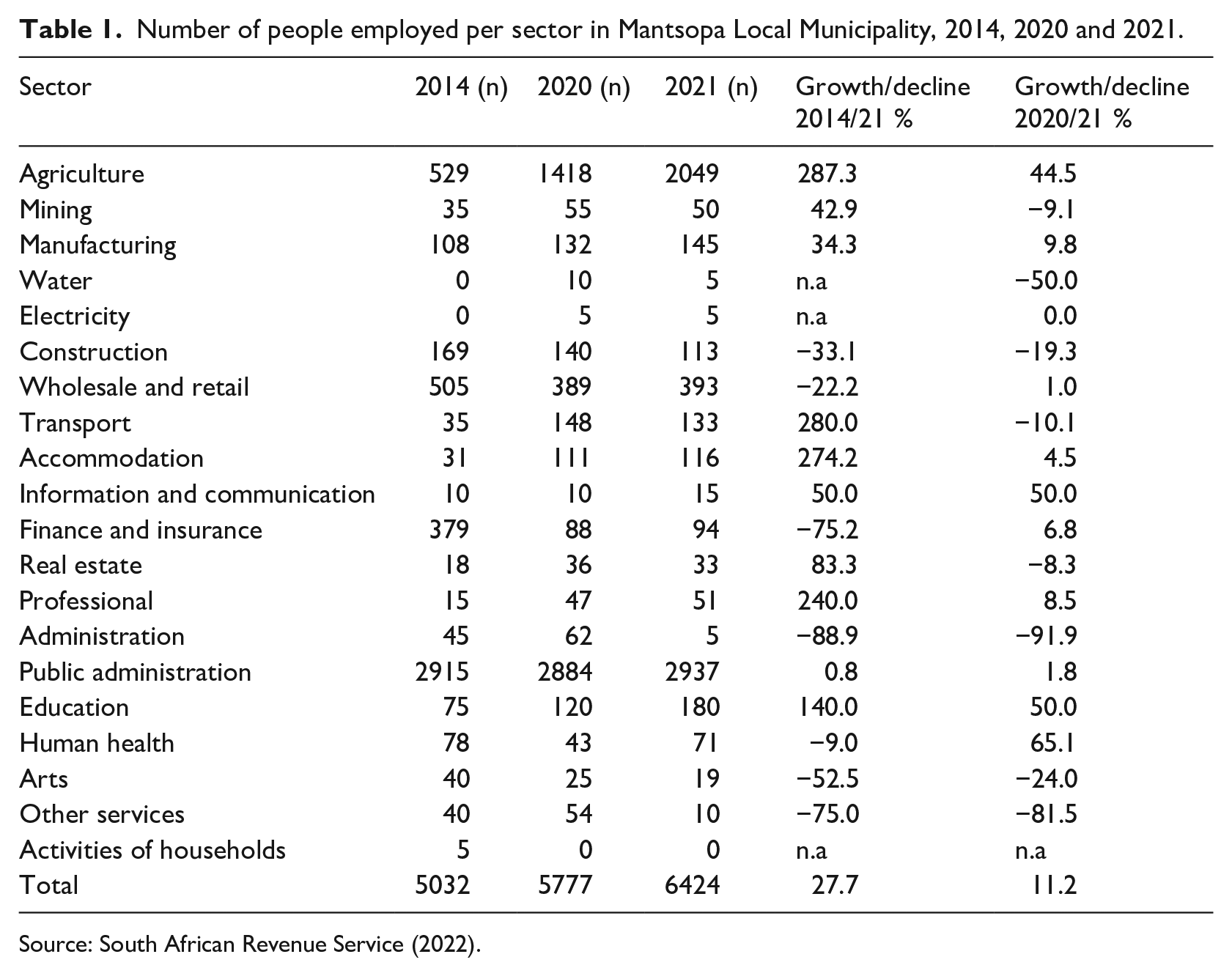
Source: South African Revenue Service (2022).
Findings and discussion
The COVID-19 closure of the Maseru Bridge border post
In 2018, about 3.5 million pedestrians (nearly 10,000 per day) went through the Maseru Bridge border post between Lesotho and South Africa (Kopane, 2018). It is impossible to estimate how many people travel between Ladybrand and Maseru, we think around 20% travel between the two places daily – a sufficiently substantial percentage to cause much hardship when the border was closed. The South African government closed 53 border posts in March 2020 (Business Insider SA, 2021). When it lifted the hard lockdown measures in June 2020, this meant that in principle borders could remain open. However, most land borders (including those with Lesotho) remained closed because the Department of Health did not have staff available to conduct the required COVID-19 tests. The Maseru Bridge border post reopened only in October 2020 and was closed again in January 2021 when COVID cases spiked (Business Insider SA, 2021). It was finally reopened in mid-February 2021, but the COVID-19 lockdown measures still restricted the movement between the two countries by requiring a negative COVID-19 test to cross the border. These tests remained a requirement on the South African side until June 2022. In Lesotho, they were required until October 2022 and the requirement was reinstated in January 2023. In February 2023, the COVID-19 lockdown measures were still affecting movement between the two countries. The long closure periods and the COVID-19 test requirement have severely affected Ladybrand, as it is heavily dependent on free movement via the Maseru Bridge border post. The closure of the border post is a good example of how government policies at the national sphere can affect local economies. The regulations about border closures, as part of the president declaring a state of disaster as of 21 March 2020, destroyed the competitive advantage of Ladybrand’s location (Minister of Transport, 2020).
The effect of the border closure on enterprises and employment in Mantsopa Local Municipality
We wanted to know how the border closure during the COVID-19 lockdown affected the number of tax-paying enterprises and the number of employment people. Between 2014 and 2019, the number of tax-paying enterprises in Mantsopa grew from 216 to 243 (the data distinguish between single and multiple establishments 1 – the figures used here are for the total). No decline was seen in 2020 and 2021, although only one enterprise was added, which means the COVID-19 lockdown measure affected the growth negatively.
Table 1 shows the total employment per economic sector in Mantsopa between 2014 and 2022. Employment trends show an increase in the number of people employed from below 5000 in 2014 to 6327 in 2021. However, the COVID-19 lockdown measures affected sectors differently. Table 1 shows that construction, wholesale and retail, transport, finance and insurance, administration, arts and other services experienced declining employment, probably to a large extent because of the COVID-19 lockdown measures. The declining employment in the wholesale and retail sector is likely to have been caused by the closure of the border post (the effect of people from Lesotho being unable to shop in Ladybrand).
In contrast to the declining employment in the sectors mentioned earlier, an increase was seen in the agriculture, public administration and human health sectors. As was happening elsewhere in the country, the agricultural sector created a substantial number of new jobs. The COVID-19 pandemic meant that more people were employed in health. In contrast to the decline in the administration sector (mostly private), employment in public administration was stable. The Gini coefficient based on wages increased from 0.46 to 0.52 between 2020 and 2021, showing that people at the lower employment scales were the worst affected (South African Revenue Service (SARS), 2022).
Reasons for visiting Ladybrand
For many years, Lesotho nationals have crossed the border to South Africa to access the better shops and services (Viljoen and Wentzel, 2007). Our respondents said things like ‘Ladybrand is doing okay because of its proximity to Lesotho’, but that COVID-19 disrupted this relationship. Some corroborating remarks we heard were the following:
They especially come to the banks. We have very good doctors, so they usually come to the doctors here. Most of the kids are at school here because I think the schools there are mostly full. That’s why they come. There are many people from Maseru that I know who will be coming. When you ask them why they don’t buy from Shoprite in Lesotho, they will say the service there is poor, and the service here is better. We used to get them every weekend. They used to come to Ladybrand for an outing and spend the day. And they used to come and shop, but it is not happening now.
The quotes identify three reasons for crossing to Ladybrand: better services, better shops and recreation. Many Lesotho citizens use South African banks because they fear that Lesotho banks could collapse. Schools in Ladybrand benefit from parents spending money on schooling, including boarding fees. Lesotho nationals found it convenient to buy from the array of shops in Ladybrand on their regular trips to the town to go to the bank or take their children to school. Respondents mentioned consultations with private doctors in Ladybrand. One said that the medical doctors in Ladybrand get the ‘most attraction’. Although Lesotho has a central referral hospital in Maseru, it is under immense pressure because of a shortage of human resources. Serious emergencies must be referred to South Africa. Foreign nationals can access free primary healthcare services in South Africa. It is plainly advantageous to Lesotho nationals to access health services in Ladybrand. Some trips to Ladybrand were recreational, with shopping being partly a leisure activity. But one respondent says, ‘it is not happening now’. Continued restrictions could result in further implications.
Despite these benefits, we found very little evidence in the strategic planning and investment that these issues were important for the municipality. For example, there is little reference of this locational advantage in the discussions with officials or politicians. Where it does surface, there is an inability to strategise about it. Also, there was no pressure from the municipality on the national government to open the border post.
The negative effects of the border closure
The COVID-19 lockdown measures affected trade, transport and tourism, and health and other services. The border closure disrupted the symbiosis between Ladybrand and Maseru. Markets and supply chains were disrupted, businesses closed or scaled down operations and people lost their jobs or livelihoods. Our respondents said the border closure had a detrimental effect on businesses in Ladybrand:
Now that Lesotho nationals can’t cross the border because of Covid-19, business people are complaining. The banks, taxis, hawkers, and shop owners are all complaining. Lesotho has supported the economy of Ladybrand a lot.
One was hopeful that the situation would improve:
Development is okay, but then it’s boosted by Lesotho nationals. We are currently affected by Covid-19, but when the border is open, our economy will perform well.
Others, however, were doubtful that everything would return to the pre-COVID-19 comparative prosperity. Part of this doubt is related to the inability to see the location advantage and develop an appropriate response to ensure these visitors return.
Inadequate planning for local economic development
As highlighted earlier, we think part of the problem has been the inability to acknowledge the locational advantage of Ladybrand and develop appropriate strategies that the town can benefit from its location. A border town’s location means the possibility of benefitting from differences in production costs or services and obtaining new ideas. The Mantsopa Municipality has an LED strategy that is supposed to indicate how to benefit from its location near Maseru. The strategy includes rural development, tourism and small, medium and micro enterprises because the municipality wants to create jobs and fight poverty. The municipality has provided R2 million for LED initiatives, which will increase cumulatively above 3 years (Mantsopa Local Municipality, 2019). However, this amount is inadequate and none helps the town benefit from its locational advantage. Furthermore, there is little evidence of appropriate planning, the use of local resources for economic development, or the council considering the opportunities and risks associated with the town’s border location. The strategy focuses largely on community development, ignoring the value of appropriate economic planning. The following three responses provide an overview of the current state of affairs:
The background of the research isn’t there, or the information coming to the council does not show . . . Maybe it’s the information accessible to the LED office that is not kept up to date. Because when they bring an item to the council, it seems like not enough has gone into it, and it gets sent back. So in five years, we haven’t had any LED projects coming off the ground. I’m going to be honest because I’m an honest person. There’s nothing of that sort taking place. As I speak, I don’t have the most current local economic development strategy because it’s not being taken seriously.
The quotes earlier indicate that local economic development is not a priority and often relates to a few community projects. A community-based approach and linking community development and economic development is not an inappropriate response. However, Ladybrand’s location advantage requires a more focused approach. These interviewees complain about inaction, simplifying local economic development as some form or project. There is no reference in the IDP to the locational advantages of Ladybrand. These views above contradict what has the municipality’s IDP says. One respondent elaborated on the problem:
The difficulty here is that local economic development is not entirely understood in the local municipality space. So it’s difficult for policies to be implemented because there are policies at the provincial and national levels. However, when it comes to local space, it’s so difficult.
The problem’s core lies in whether the LED is appropriately being understood. The interviewee above had doubts. It largely confirms the complexities around understanding LED (see Section ‘Literature’). Furthermore, the respondents doubted whether the right people were being appointed. They say the local government is not sure what its role is compared to the provincial and national spheres of government. The lack of LED in Ladybrand is worsened by poor service delivery and deteriorating infrastructure. The problem is that the deterioration of the infrastructure is not seen as an economic risk for the town. Historically, better infrastructure and services have attracted visitors to Maseru, but because of infrastructure problems, Ladybrand is losing this locational advantage. Tsheola and Mokgokong (2012) emphasise that public services are necessary for establishing an enabling local development environment. Within such an environment, local people can use the opportunities for business partnerships, employment creation, income generation, economic output and tradable market economies and gain the capacity to resist threats. Thus, there is little understanding of strategy and plans to ensure a conducive environment to assist the economic development of a small border town.
To repair the damage done by the lockdown, local governments need innovative ways to promote economic development and foster job creation. They need a competent citizenry to implement policies and propose plans. The respondents regarded the high unemployment rate and skills shortage in Ladybrand as part of the reason for the lack of LED in the town. According to Koma (2012), the local government sphere in South Africa faces numerous challenges and bottlenecks. The problems stem from high poverty and unemployment rates, a shortage of skills required to propel LED, a lack of administrative capacity, and ineffective implementation of policies. In addition, impracticality, limited access to capital and insufficient networking channels prevent entrepreneurship from becoming an answer to unemployment. Two respondents explained how the skills shortage and high unemployment rate affect development:
The big thing is that people have no jobs, which is a big problem. There’s a skills shortage, so send people for skills development and stuff like that, but it starts at the municipality where they have to include the businesses, and we should discuss what is happening. I’d say their qualifications are not suitable for the jobs in demand for people who have gone to school. It all needs to start in schools to expose people to vocation. For example, here in Ladybrand, people’s houses are built by Lesotho nationals. Bricklaying is something the locals could do because it is not difficult.
One of the main reasons for rising unemployment is a lack of skills. The International Labour Office (2010) states that the future prosperity of any region eventually depends on the number of people employed and the level of production they possess. Much literature has shown the link between skills, education, productivity and economic growth. Having a skilled and educated populace in Ladybrand would attract more investment as more businesses would tap into the available skills and create jobs. It would be easier for skilled individuals with original business ideas to fund their proposals.
Finally, respondents were generally concerned about the infrastructure decline. Many thought that the lack of maintenance and water and electricity interruptions would, in addition to the effects of the lockdown, remain long-term stumbling blocks on the road to recovery. An appropriate and holistic place-based strategy remained absent.
Conclusion
The location of Ladybrand near the Lesotho border has had many positive economic spin-offs for the town. The town benefits from Lesotho citizens using the retail environment, education facilities and services like doctors and banks. The closure of international borders due to the COVID-19 lockdown measures meant Lesotho nationals could not cross the border to Ladybrand. At the time of writing, some restrictions remain. We think that even if all restrictions are lifted, returning to pre-lockdown conditions might take time and, in some cases, never occur. There are early indications that the lockdown measure might have changed the behaviours of Lesotho citizens (e.g. buying locally or not placing children in schools in Ladybrand).
The COVID-19 lockdown regulations put added pressure on already stressed local governments and their economies in South Africa. This pressure was worse for border towns where the regulations prohibited the flow of goods, services and people across borders. Ladybrand’s economy was badly affected and it will continue to suffer because its failing local government system aggravates the damage.
Examination of municipal documents showed that the local planning system does not acknowledge the substantial advantage Ladybrand has as a border town. Overall, there is a lack of thinking about how appropriate infrastructure will benefit the town’s economy as a border town. There is little engagement in getting Lesotho citizens back in town. The Mantsopa Local Municipality needs to unlock the economic potential in Ladybrand by fixing the infrastructure and roads, providing constantly available clean water and offering skills training for the local community. This must be done by recognising the competitive benefits of being near the Lesotho border.
The paper further confirms literature that points to capacity and institutional problems in the managing and planning of LED. The border town status of the town provides a competitive advantage that municipal planning and strategies largely ignore. These documents ignore the competitive advantage of Ladybrand and are ignorant of what investments would attract Lesotho citizens to return. In addition, there is little evidence of local participation and empowerment in the current approach to LED. Local leadership also seems absent; at best, there is little understanding of what projects could support the local economy. The project-by-project approach also does not consider the competitive advantage of Ladybrand as a border town. Overall, the lack of leadership has resulted in the inability to benefit from the locational advantage and find mechanisms after COVID to reverse the consequences of COVID regulations. In addition, national planning guidelines can do more to help border towns realise their competitive advantages and be more careful when considering border closures like what happened during COVID-19. For example, a planning toolkit for border towns could be a helpful tool in understanding opportunities and risks for border towns. Furthermore, the essence of such a toolkit should also be integrated with other departments like home affairs. For example, a more careful consideration of the plight of border towns would have meant ensuring enough staff at border posts following the lockdown regulations.
Footnotes
Funding
The author(s) received no financial support for the research, authorship, and/or publication of this article.
