




Abstract
The study aims to unpack the concept of unofficial normalization and how it can facilitate the resolution of interstate conflicts. Drawing on Kriesberg’s typology of conflict management strategies as constructive or destructive, we define constructive unofficial normalization as a new type of coengagement reward inducement in the context of United Arab Emirates (UAE)–Israel relations. Disciplined configurative and heuristic modes of case study analysis are employed. The paper argues that unofficial relations between the UAE and Israel in the decades preceding the Abraham Accords in 2020 was a necessary element in the transition from conflict management to conflict resolution.
Keywords
Introduction
This study explores the influence of unofficial relations or covert relations on the transition from conflict to agreement in protracted interstate conflicts. Most of the work on the fundamentals of resolving interstate conflicts focuses on the transformation from war to peace in violent conflicts. The main objective in this field of research is to gain insights on how to avert the destructive impact of such conflicts (Bar-Siman Tov, 2004, 2010; Kriesberg and Thorson, 1991; Mitchell, 2014; Zartman, 2000). Yet, while the focus on the resolution of violent conflicts is understandable in light of their destructive potential, the question of what influences the transformation from rivalry to peace in conflicts that do not feature interstate violence is still very much understudied.
This paper examines the path that led the United Arab Emirates (UAE) and Israel to a peace agreement as a critical case study in developing a conceptual framework that sheds light on the influence of constructive unofficial relations on the transition from conflict to agreement in protracted but nonviolent interstate conflicts. Since its establishment in 1971, the UAE had been part of the alliance of Arab states that maintained a state of war with Israel (Hitman and Kertcher, 2018: 51). There was never any direct warfare between the UAE and Israel. Israel has always been looking for opportunities to normalize relations with the Arab world, including the UAE (Ravid, 2021: 175), while the Arab alliance to which the UAE belonged had refused to normalize relations with Israel in the absence of a solution to the Palestinian issue. However, since the beginning of the 21st century, the UAE had practiced a dual policy of officially opposing normalization with Israel while increasingly conducting unofficial relations (Black, 2019; Ferzinger and Bahgat, 2020; Hoffman, 2020).
UAE–Israel relations were officially transformed through the mediation of the United States with the signing of the Treaty of Peace, Diplomatic Relations and Full Normalization Between the United Arab Emirates and the State of Israel (U.S. Department of State, 2020) in September 2020. The treaty ended seven decades of animosity between the UAE and Israel. As the first of four peace and normalization agreements known as the Abraham Accords (Kushner, 2022), it represented a landmark in the relations between Israel and Arab states. The agreement between the UAE and Israel has also remained the strongest of the four in terms of policy implementation on the ground (Guzansky and Feuer, 2021). The flourishing of diplomatic, strategic, security, economic, and cultural normalization as a main feature of the new interstate relations is unprecedented; it is very different from the environment that prevailed in the wake of the peace agreements Israel signed with Egypt in 1979 and with Jordan in 1994.
Multiple elements influenced the process that led the parties to sign the Abraham Accords at that specific time, including the effective engagement of the United States as a mediator that captured the right moment and exercised its power and skills to convince the parties to endorse the formula for agreement. However, considering the saliency of the parties’ unofficial relations (though formally in a state of war), we chose to examine the role these relations played in facilitating the transformation dynamic in this conflict. We unpack the meaning and implications of unofficial relations, defining them as “unofficial normalization,” and argue that the decades-long trend of discreet relations between the UAE and Israel across several domains such as security, economic, and sport served as an inducement for both parties to reach an agreement.
The paper includes four sections. In the first part, we review the literature regarding the conditions and processes that facilitate a transition from conflict management to conflict transformation in protracted conflicts, and we point out the gap in the literature. We discuss Kriesberg’s constructive conflict conceptualization and define the concept of “unofficial normalization,” and then pose our research questions. In the second part, we present a historical overview of the UAE–Israel conflict. The third section assesses the influence of unofficial normalization on the transformation of UAE–Israel relations from conflict to agreement. We first lay out the fundamentals of the conflict management processes that took place during the decades prior to the signing of the peace agreement, and we ask which constructive strategies the parties’ pursued in their conflictual relations. Then we explore the factors that influenced the UAE and Israel to sign the official peace agreement in September 2020. In the concluding section, we present our research findings and discuss their implications on constructive and destructive conflict in Asia and Africa.
Theory: the transition to conflict resolution
The resolution of protracted interstate conflicts and the transformation from war to peace have been addressed by scholars as a sequential paradigm in a staged process, albeit not necessarily a linear one (Bar-Siman Tov, 2004; Bar-Tal and Bennink, 2004; Boulding, 1978; Crocker et al., 2007; Crocker et al. 2018; Kacowicz et al., 2000; Ramsbotham et al., 2016). This process moves from a state of war to a preparatory stage of conflict management (Bar-Siman Tov, 2007) and then advances to a pre-negotiation stage. This is followed by negotiation and, if successful, the process then moves on to a formal agreement and peacebuilding. The research literature addresses various factors affecting the resolution of conflicts and the transition from war to peace. The concept of ripeness that relates to timing of the negotiation has gained a central place. It also focused on a mutually hurting stalemate (Zartman, 2000). It reflects on the mediators’ ability to influence the bargaining environment (Vuković, 2016; Zartman and Touval, 1996), the role of a third party (Zartman, 2008), the parties’ perceptions of the formula of agreement as serving their interests (Zartman, 2008), and post-agreement peacebuilding activities (Bar-Siman Tov, 2007; Bar-Tal and Bennink, 2004; Kacowicz et al., 2000; Ramsbotham et al., 2016).
Another focus of studies on the resolution of protracted interstate conflicts is peacebuilding, with scholars studying the structural institutional conditions for maintaining a stable peace (Bar-Siman Tov, 2004; Boulding, 1978; Crocker et al., 2007; Kacowicz et al., 2000). This phase includes intervention, transition, stabilization, normalization, and reconciliation (Bar-Siman Tov, 2004; Bar-Tal and Bennink, 2004; Ramsbotham et al., 2016). Normalization is defined as cooperation across a range of domains, including security, trade, migration, tourism, and cultural and educational interactions. It is treated by scholars as part of the peacebuilding phase that follows a peace agreement. According to this sequential paradigm, official normalization is a strategy designed to make peace even more beneficial for the parties after they have reached a formal agreement (Bar-Siman Tov, 2004: 68; Bar-Tal and Bennink, 2004; Eisenberg and Caplan, 2010: 50; Kupchan, 2010).
Yet, these studies do not address the influence of unofficial relations between the parties in conflict. Furthermore, as noted, the academic discourse focuses on understanding the influence of conflict management strategies in violent interstate conflicts, while the developmental aspect of conflict management in nonviolent conflicts remains understudied.
Constructive conflict management and unofficial relations as a fundamental element of the peace process
We argue that Kriesberg’s (2017) work on the constructive management of social conflicts provides a framework for understanding the role and influence of unofficial relations between antagonists during conflict. Kriesberg notes that conflicts can be waged with various methods and emphasizes that the outcome of conflicts is affected “by the way they are fought.” More specifically, “adversaries act in ways that shape the outcome to be relatively constructive or destructive” (Kriesberg, 2017: 23).
The most powerful strategy for constructive conflict transformation is to offer rewards. This positive inducement is “typically employed to help settle and transform conflicts and to prevent the eruption of destructive conflicts” (Kriesberg, 2017: 111). Rewards involve what Kriesberg defines as “coengagements” (Kriesberg, 2017: 111) that combine to produce a constructive conflict trajectory. This may involve strategies of cooptation, corporate codetermination, and collaboration as a constructive way of waging a conflict (Kriesberg, 2017: 111). Kriesberg (2017) notes that collaboration, which is “a more informal process, between relatively independent parties jointly developing rules and structures to govern their relations and decision making” (p. 112), can prevent “many incipient conflicts [from] erupting destructively and help avert destructive escalations” (p. 112). Kriesberg (2017) stresses that the “strategies that parties and interveners might pursue that can foster constructive waging of conflicts and constructive outcomes cannot be the same for all conflicts” (p. 25). This raises the question of which strategies can best contribute to constructive outcomes in nonviolent protracted conflicts between states.
Based on Kriesberg’s concept of coengagement, this paper develops the concept of “unofficial normalization” and defines it as a comprehensive conflict management inducement strategy between antagonists actors. This loose definition is required since there are no permanent settings in which strategies may encourage the actors to collaborate in a constructive way. The underlying assumption is that parties’ cost–benefit calculations are a gradual process that reinforces the perception of shared non-competitive benefits that eventually lead to the transformation of conflict (Kriesberg, 2017; Kupchan, 2010). These relations can take effect in several domains, such as international and regional organizations that provide an institutional framework to work for a shared goal such as global warming, energy, health, or sport. It can also include dyadic relations on more concrete shared interests that involve direct security and economic issues.
Research design and method
Disciplined configurative and heuristic modes (George and Bennett, 2005) of case-study analysis are applied in this study. The configurative mode is used to describe and explain the case, highlighting the role played by unofficial normalization as a conflict management strategy in the spectrum of elements that paved the way to formal peace agreements. The heuristic mode assists in formulating theoretical implications and highlights the developmental aspect of this conflict management strategy as a basis for future conflict resolution. By applying reflections from Kriesberg’s theory of constructive conflict management, we aim to identify and assess the impact of unofficial relations between antagonists in interstate conflict and the role of such relations in facilitating conflict resolution.
Drawing on Kriesberg’s typology of constructive strategies and his premise that the constructive and/or destructive strategies the parties apply in managing their conflictual relationships influence the conflict trajectory and outcome in different ways, we unpack the meaning and implications of unofficial normalization. The following set of questions are addressed in the case analysis: What was the nature of the issues and goals involved in the UAE–Israel conflict? What were the conflict’s destructive or constructive strategies prior to the signing of the peace agreement? Was unofficial relations and collaborations one of those strategies? If so, what forms did it take? How unofficial relations contributed to the parties’ motivation to sign the agreement?
Historical overview of UAE–Israel relations
Establishing official relations with Arab states has always been one of Israel’s main foreign policy goals (Ravid, 2021: 107–124). However, prior to the Abraham Accords, the UAE adhered to the prevailing paradigm adopted by Arab states: no normalization with Israel without first resolving the Israeli–Palestinian conflict (Friedman, 2022: 181).
Upon its establishment in 1971, the UAE became part of the Arab bloc in the Arab–Israeli conflict. The UAE is a tribal fragmented tribal society politically organized into seven emirates. The UAE aligned its foreign policy with the Arab world (Al-Sharekh and Freer, 2022: 37–45) The UAE’s conflict mode from 1971 to 2004 expressed a strategy of nonviolent, destructive coercive inducements (Kriesberg, 2017: 91) that included boycotts and political and economic sanctions aimed at isolating Israel and supporting the Palestinian cause. The UAE participated in the Arab oil embargo against countries that supported Israel and voted in favor of dozens of UN resolutions condemning Israel (Barakat, 2023: 398). The UAE also played a central role as a donor state in financing the Palestinian Authority in Gaza and the West Bank (Almezaini, 2012; Warren, 2021: 75–76).
The only exception to the UAE’s uncompromising stand against Israel was during the 1990s when the UAE wanted to purchase F-16 fighters from the United States and asked through back channels for Israel not to object. Israel’s prime minister, Yitzhak Rabin, acceded to this request (Ravid, 2021: ch. 4). However, the Second Intifada that erupted in late 2000 closed the door to any progress toward normalization with Arab states. The Arab Peace Initiative, endorsed by the Arab League in 2002, reiterated the demand for resolution of the Palestinian–Israeli conflict as a condition for normalization between Israel and Arab countries (Friedman, 2022: 181).
The Middle East had seen several major transformations in its regional security framework. First, after the first decade of the early 21st century that began with assertive interventions of the United States in the region, there were calls to reduce its security commitments in the region. Second, the inner political instability of the Arab Spring also increased the threat of spillover of radicalism throughout the region. Third, regional powers such as Iran increased their influence in their region through proxies such as the Houthis, Shiite militias in Iraq, and Hizballah in Lebanon. The alliance of Turkey and Qatar was also a factor in reassessing the UAE strategy in the region. These changes encourage new thinking in the UAE and Israel to re-examine their interests in the region (Fulton and Yellinek, 2021: 501–504; Yetim and Numan Telci, 2023: 493–496).
The UAE’s traditional anti-Israeli stance began to crack under the leadership of Mohammed bin Zayed (MBZ), who reconceptualized the UAE’s national security, and financial and foreign policy (Atlantic Council, 2020; Greenblatt, 2022; Traub et al., 2023; UAE, 2010). As the mutual security, geostrategic and economic interests of the UAE and Israel developed, especially considering their opposition to the Obama administration’s approach toward Iran, unofficial relations between the UAE and Israel expanded in several areas, including security and strategic dialogue, trade, agriculture, renewable energy, healthcare, and collaboration in international organizations (Netanyahu, 2022; Ravid, 2021). The perception of mutual interests in cultivating unofficial relations withstood several crises over the years (Ravid, 2021: 129–130; Ulrichsen, 2016b).
In 2017, Prime Minister Netanyahu urged the newly elected President Trump to pursue a strategic alliance in the Middle East, predicting that it would very quickly lead to a formal peace agreement between Israel and the Arab states (Netanyahu, 2022: 527, 556). From 2017 to 2020, Trump’s envoys Jason Greenblatt and Jared Kushner shuttled between Israel, the Palestinians, and Arab countries such as Saudi Arabia, the UAE, Jordan, and Qatar to formulate an Israeli–Palestinian peace deal that could be supported by moderate Arab states (Greenblatt, 2022; Netanyahu, 2022; Ravid, 2021: 185).
From March 2019 to September 2020 a gradual diplomatic dialogue encouraged a public full normalization. From June to August 2020, the Israeli and UAE ambassadors in Washington negotiated indirectly, with the United States acting as an intermediary (Al-Otaiba, 2020; Netanyahu, 2022: 562; Ravid, 2021: 189–194).
On 13 August 2020, the UAE, the United States, and Israel released a joint statement announcing that the UAE would be the first Gulf state to normalize relations with and recognize the State of Israel. Soon afterwards, Bahrain approached the United States to become the second Gulf country to normalize relations with Israel. On 15 September 2020, the Abraham Accords Peace Agreement between Israel and the UAE and Bahrain was signed at the White House.
The normalization process has flourished, with Israel–UAE trade constantly on the rise. Trade between the two countries reached US$1.2 billion in 2021 and soared to US$1.4 billion in the first 7 months of 2022. Almost half a million Israelis have visited the UAE. Israel and the UAE are working bilaterally and multilaterally (e.g. through the Negev Forum) to advance regional security and diplomatic and economic cooperation (Maher, 2022).
Analysis: from conflict to a formal peace agreement
What role did the unofficial relations between the UAE and Israel play in the peaceful resolution of the UAE–Israel conflict? The following analysis is divided into three parts. First, we explain how the conflict mode of unofficial relations between the UAE and Israel, which developed since the first decade of the 21st century in response to both parties’ needs in the domestic and regional levels, helped to build mutual trust. This coengagement inducement of unofficial normalization created the parties’ perception of shared and non-competitive benefits (Kriesberg, 2017; Kupchan, 2010), preparing the ground for an agreement.
The second part analyzes how the shared non-competitive collaboration deepened during the decade prior to the Abraham Accords in five main areas: strategic and security cooperation, economic cooperation, public interactions through global institutions, international sporting events, and joint initiatives in contending with the coronavirus pandemic. The final part explains how the unofficial normalization process helped the American mediator.
Motives for the constructive conflict mode in the 21st century
Mohammed bin Zayed (MBZ) and a close circle of his relatives rose to power in 2004 and pursued a new national security vision of constructive pragmatism for the UAE. The goal was to turn the UAE into the Arab world’s most dynamic economy, with a strong military capability and a mission to promote collaboration instead of confrontation (Atlantic Council, 2020; Esfandiary, 2023). The reconceptualization of the UAE national security was a response to the external and internal challenges facing the small and relatively new state. The spread of radical Islam in the Arab world and Iran’s pursuit of nuclear capabilities and increased influence in the region disrupted the regional security balance and increased the threat perceptions of many actors in the Middle East (Ibish, 2017: 23–24; Rickli and Almezaini, 2017; Salisbury, 2020: 13–17; Warren, 2021: 82–104). The Arab Spring, bolstered by the global call for democratization and improvement of human rights, had wide repercussions for the internal stability of the UAE (Ibish, 2017: 46–47; Shoup, 2022: 18–20; Warren, 2021: 82–104). The UAE was also worried that its alliance with the United States did not sufficiently deter Iran (Al Jazeera, 2012; Salisbury, 2020).
The global financial collapse in 2008 underlined the need for the UAE to diversify its economy (Szalai, 2022), which was largely based on oil production (Ibish, 2017). Under MBZ’s leadership, the UAE also sought to play an active and positive role in the region, “reaffirming its global position” by pursuing cooperation and friendship as a modern state that adheres to a moderate form of Islam (Esfandiary, 2023; UAE, 2010). While the UAE perceived Iran as an existential threat (Ravid, 2021: 136), the new leadership chose not to directly confront it. Instead, the UAE accelerated its purchases of advanced military technologies, primarily from the United States, and endeavored to develop its military capacity and regional strategic cooperation (Ibish, 2017: 19–23; Salisbury, 2020: 13–15).
The UAE soon became one of the most formidable economic and military powers in the Middle East (Ibish, 2017; Norlen and Sinai, 2020; Salisbury, 2020; Ulrichsen, 2016a). At the same time, the UAE’s pragmatic and collaborative approach eroded its traditional pro-Palestinian and anti-Israeli position. Instead of viewing Israel as a threat, the UAE’s leaders began to look at Israel as a partner with shared interests, one that could help the UAE achieve its goals (Blau and Scharf, 2019; Traub et al., 2023). This perception of mutual interests with Israel has withstood several crises, including the cancelation of the UAE’s purchase of military drones from an Israeli company in 2009 and the assassination of a senior Hamas official in Dubai in 2010 (Ravid, 2021: 129–130; Ulrichsen, 2016b).
Israel, like the UAE, was eager to form regional security alliances to combat threats from Iran, terrorism, and regional insurgencies (Norlen and Sinai, 2020). Furthermore, Netanyahu wished to leverage Israel’s economic and technological achievements, along with his personal connections in the international arena, to break the Arab boycott and normalize economic relations with Arab states (Netanyahu, 2022: 497).
Netanyahu substantially expedited collaboration efforts with the UAE and other Gulf states that had secretly begun two decades earlier (Ravid, 2021). He believed that by enhancing Israel’s economic, military, and intelligence power, Arab states would be induced to view it as a potential ally and move toward normalization (Netanyahu, 2022: 497, 566; Ravid, 2021). In his mind, this would also eventually prod the Palestinians toward peace with Israel (Netanyahu, 2022). Thus, the mutual interests of the UAE and Israel led to the development and deepening of unofficial relations (Netanyahu, 2022; Ravid, 2021).
UAE–Israel unofficial relations prior to the Abraham Accords
Strategic cooperation, security, and intelligence collaboration
The seeds of unofficial relations were already planted in 1994 with the secret dialogue in which Israel acceded to the UAE’s request not to veto its purchase of F-16 fighters from the United States (Ravid, 2021: 111–114). In the following two and a half decades, collaboration on strategic and security issues gradually deepened.
The Center for Development and International Trade was established in 2005 as the Israeli Foreign Ministry’s secret office in Dubai, staffed by Israeli diplomats who directly reported to the ministry’s director-general. The office focused on business opportunities, but also worked on policy issues, including weekly meetings with influential UAE officials (Ravid, 2021: 122–125).
In the following years, strategic security issues of mutual concern were discussed by high-level Israeli and UAE officials in secretive meetings held in Washington and in the Middle East in a friendly atmosphere (Ravid, 2021: 130, 133, 189). Netanyahu and MBZ also met secretly in Abu Dhabi in 2018 and 2019 (Ravid, 2021: 189). A major milestone in the security collaboration was the February 2019 Warsaw Conference convened by the United States, which focused on the Iranian threat. The conference was attended by representatives of over 60 countries, including Israel, the UAE, and several other Arab states (Entous, 2018; Kushner, 2022: ch. 28; Ortal, 2021; Ravid, 2020).
Key areas of UAE–Israel security collaboration included intelligence and espionage capabilities and cyber security issues (Gambrell, 2018; The New York Times, 2018; TOI Staff, 2019). Israel supplied the UAE with advanced espionage capabilities and the two countries engaged in joint development of electronic intelligence and spy planes (Blau and Scharf, 2019). Israeli espionage technology was deployed by the UAE for operations against foreign governments in the region and against potential internal threats (Gambrell, 2018; Groll, 2016; Nissenbaum, 2020). Israel has also reportedly supplied arms to the UAE (Benn, 2013).
Beginning in 2010, UAE and Israeli cyber firms (such as the NSO Group) have cooperated in the field of espionage tech (The New York Times, 2018), and the Emirati cyber security company DarkMatter recruited Israelis employees (TOI Staff, 2019). The UAE’s perception of Israel’s cyber capability is reflected in the words of DarkMatter’s founder, Faisal Al Bannai, who stated in early 2018, “The only country in the region that’s strong in cyber-security is Israel. Other than that, it’s blank” (Gambrell, 2018).
In December 2019, a secret trilateral meeting of US and Israeli national security advisors and the UAE’s head of intelligence was held in Washington (Ravid, 2021: 159). The aim of this meeting was to boost cooperation on the Iranian nuclear issue and explore the potential for establishing official relations between Israel and the Gulf states (Ravid, 2021: 159, 154–155).
Public interactions through global institutions
To strengthen its global position, the UAE intensified its involvement in global institutions. In 2009, the UAE competed with Germany to host the International Renewable Energy Agency (IRENA) (Al Lawati, 2009). Israel, hoping to promote normalization with the UAE, decided to support the UAE’s bid to host IRENA. In return, Israel asked for the UAE’s consent to open an Israeli office at IRENA headquarters in Abu Dhabi. The opening of the office was delayed, and the Israeli delegation inaugurated the office only in 2015 (Ravid, 2021: 173–176). Nonetheless, while the UAE maintained its official policy of shunning Israel, Israeli officials began participating in IRENA meetings in Abu Dhabi in 2009 (Waldoks, 2009). Israel’s minister of national infrastructure participated in an IRENA conference in the UAE in 2010 (Ravid, 2021: 175), as did Israel’s minister of water and energy in 2014 (BBC, 2014). In 2015, the Foreign Ministry’s director-general visited the UAE to prepare for the opening of Israel’s IRENA office in Abu Dhabi (Reuters, 2015). In 2018, the Israeli minister of culture and sport visited the largest mosque in the UAE while visiting the country to attend an international sporting event, and the communications minister attended the international Internet Security Conference in Dubai (Ayesh, 2018). In 2019, Israel’s minister of foreign affairs visited the UAE to participate in a UN conference on the environment. In an official statement, he declared that the visit was a part of normalization between the two countries in the fields of high-tech, energy, agriculture, water management, and cooperation vis-a-vis Iran (Barghoti, 2019).
Economic collaboration
Business collaboration between the UAE and Israel already began on a small scale in the 1990s in agriculture, medicine, and water (Ravid, 2021: 118). To circumvent the Arab ban on normalization, much of the trade between the UAE and Israel was conducted through third parties, who relabeled the goods to hide their Israeli connection (Ulrichsen, 2016b: 7–8). 1 The Israeli Center for Development and International Trade in Dubai, operating undercover since 2005, sought to cultivate business opportunities (Ravid, 2021: 122–124). 2 Likewise, the Israeli IRENA office in Abu Dhabi promoted collaboration between the UAE and Israel in a range of fields (Barghoti, 2019). In December 2019, the UAE invited Israel to participate in Expo 2020 Dubai, a 6-month global exposition showcasing the technology and culture of the 192 participating countries. The director-general of Israel’s Foreign Ministry visited the UAE to sign an agreement for an Israeli pavilion at the exposition.
The available data on trade between the UAE and Israel in the decades prior to the Abraham Accords are very limited. However, trade data published by the Israeli Central Bureau of Statistics indicate a substantial increase in trade between 2007 and 2013 (Israel, The Israeli Central Bureau of Statistics 2007-2013) (Table 1).
Israel–UAE trade (in thousands of dollars).
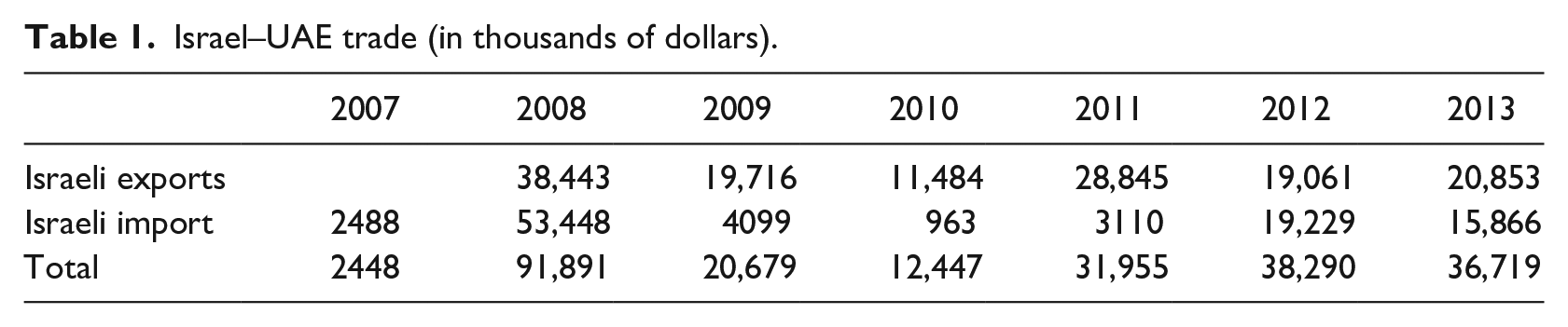
In the wake of the Abraham Accords, bilateral trade soared to nearly US$1 billion (not including tourism and investment) in 2021 (Bauer, 2022). In the following year it soared to US$2.59 billion (UAE, 2024; Wrobel, 2023).
The diamond trade between the UAE and Israel illustrates how mutual interests facilitated undercover collaboration. Israel is a major trade center in the global diamond market (Israel, Ministry of Economy and Industry, 2017; Israel, Ministry of Industry, Trade and Labor, 2009). Following the reorganization of this market in 2002 under the Kimberley Process (2022), the UAE could not become a member of the new trade regime without Israel’s consent. Israel conditioned its consent upon Dubai allowing Israeli diamond traders to operate in Dubai. Wishing to increase its role in the international diamond market, the UAE agreed to Israel’s condition. Thus, for many years, Dubai exported rough diamonds to Israel while Israeli merchants sold their cut diamonds in Dubai. This pre-peace collaboration with the UAE contributed revenue of 367 million shekels to Israel’s diamond trade in 2020. By 2021, the UAE was responsible for a quarter of the world’s diamond exports (Kimberley Process, 2022; Levi Julian, 2010; Shezaf and Donaghy, 2016; Shnidman, 2018).
International sporting events
In 2009, against the backdrop of Israeli military operations in Gaza, the UAE denied entrance to an Israeli tennis player, Shahar Peer, who was slated to participate in the Dubai Open. The World Tennis Association fined the event’s organizers for barring Peer and demanded a commitment to allow Israeli players to participate in the future (UAE Sport, 2022). Thus, in the following years, despite denouncements by other Arab countries, the UAE hosted Israeli athletes, and the Israeli flag was displayed at some of the events. In December 2010, an Israeli swim team attended the 10th FINA World Short Course Swimming Championship held in Dubai and the Israeli flag was displayed (The Jerusalem Post, 2010). In 2017, an Israeli delegation was allowed to participate in an international tournament, but the Israeli flag and national anthem were excluded. Israelis’ judokas participated in the 2018 International Judo Federation Grand Slam (Al Jazeera, 2018) and the Israeli national anthem was played this time (TOI Staff, 2018). In March 2019, Abu Dhabi hosted the Special Olympics and an official Israeli delegation of 80 athletes participated, accompanied by their families (Katzir, 2019). The Israeli anthem was played four times during the games (Ravid, 2021: 188). Israel also sent a delegation to the Robotic Olympics held in the UAE in November 2019 (Heller, 2019).
Collaboration during the COVID-19 pandemic
The COVID-19 pandemic opened more opportunities to expand collaboration. In May 2020, the first direct commercial flights from the UAE landed in Israel with 16 tons of emergency medical supplies to help Palestinians fight COVID-19. Israel and the UAE then announced that researchers in the two countries would work together to study the virus (TOI Staff, 2020). In August 2020, the health ministers of Israel and the UAE “agreed to appoint representatives to lead ties on medical matters” focusing on the pandemic. The two ministers agreed on “joint work in the pharmaceutical industry and medical research, particularly in the field of vaccine trials and treatments for the virus” (TOI Staff, 2020). Several companies subsequently signed deals to jointly develop technologies to combat the pandemic (TOI Staff, 2020).
To sum up, UAE–Israel collaboration developed over the years in accordance with their perceived interests. This unofficial relationship led the UAE to pursue normalization with Israel as a beneficial strategy to its political, security, economic, and soft power national goals. As Ambassador Al Otaiba wrote in June 2020, “We face too many common dangers and see the great potential of warmer ties.” Indeed, the scope of Israel–UAE joint activity already increased significantly in 2019, a year before the Abraham Accords (Ravid, 2021: 188). The UAE’s decision to normalize relations with Israel was “born out of a desire for a much-needed strategic shift and a new pragmatic vision.” This strategic shift also signified the UAE’s understanding that the Arab states’ decades-long ostracism of Israel had failed (Ravid, 2021: 196). In August 2020, the UAE’s minister of state for foreign affairs, Anwar Gargash, noted that “it was only natural that we would look into normalizing [the] relationship. And it was going to happen . . . It was a matter of time” (Atlantic Council, 2020).
Factors that assisted the transformation from unofficial normalization to formal normalization
Why did the UAE decide to take this major step in the summer of 2020, and why was Israel ready to accept the US formula for the Abraham Accords? The basic formula, as outlined by Kushner and Berkowitz in late June 2020, addressed the needs of both the UAE and Israel in calling for formal normalization in return for the suspension of annexation (Kushner, 2022: chs. 14, 31, 51; Ravid, 2021: 220–221).
From the UAE’s perspective, the agreement would encourage the evolution of the unofficial normalization in pursuit of its Vision 2021 strategic agenda. Official normalization with Israel was thus viewed as part of a broad realignment of its foreign policy in support of its economic objectives (Bauer, 2022). Gargash noted in August 2020 that MBZ
felt that this is worth it . . . it is the right thing to do because it will open up the geostrategic space and it will open up also the opportunity space. Especially, as you know, the UAE . . . wants to reaffirm its global position . . . in terms of business, in terms of finance, in terms of logistics. And you can’t do this while maintaining a very sort of exclusivist view of the world. (Atlantic Council, 2020)
It had become clear to the UAE that it could not take economic prosperity for granted. The UAE’s economy contracted by 6% in 2020, led by declines in high-contact sectors such as travel and hospitality. Aiming to protect its role as a regional financial and economic hub (Bauer, 2022; Esfandiary, 2023: 69–72, 87–88), the UAE looked forward to the economic opportunities that official normalization with Israel would bring. As Gargash put it, “This deal is historic for many reasons, not least because of the incredible amount of opportunity for business, scientific, and human exchange and cooperation between the UAE and Israel. But it will also be felt across the Middle East” (Atlantic Council, 2020).
No less important, the agreement was expected to enhance security cooperation against regional threats, especially threats from Iran and its proxies, thus unveiling the hitherto unofficial security ties between Israel and the UAE (Cook, 2020). Besides strengthening the security partnership with Israel against Iran, the agreement was expected to boost the UAE’s relationship with the United States (Atlantic Council, 2020; Fulton and Yellinek, 2021; Norlen and Sinai, 2020). Considering the upcoming US elections in November 2020, the UAE leadership wished to promptly sign military and economic deals with the Trump administration, fearing that a Democratic administration might be less forthcoming (Dekel and Shusterman, 2020). Another tangible interest that was critical in convincing the UAE to sign the Abraham Accords was the US commitment to sell F-35 aircraft to the UAE. Indeed, the agreement included a side letter that confirmed Washington’s readiness to sell F-35s to the UAE. A deal was subsequently signed for 50 F-35 aircraft on 20 January 2021, Trump’s final day as president (Haaretz, 2021)
On top of its national interests, an agreement with Israel offered the UAE a way of stopping Israel’s annexation plan and taking a more active role in addressing the Israeli–Palestinian conflict.
The UAE leadership was concerned that the annexation plan Israel announced in mid-2019 would be an obstacle for achieving its strategic aim of normalization because it would intensify Arab opposition to a UAE–Israel accord (Ravid, 2021: 230). Thus, to free itself from being prisoners of “rhetoric . . . and inaction on the Palestinian issue,” the UAE had to remove the annexation plan from Israel’s agenda and to do this in a manner that would enable Trump and Netanyahu to present this as an achievement (Ravid, 2021: 231). As Gargash said, “We found an opportunity, we grabbed it, we feel that opportunity saves the two-state solution. And at the same time, we are going to carry on with the issue of normalization of the relationship with Israel” (Atlantic Council, 2020).
From Israel’s perspective, the agreement with the UAE opened lucrative markets for Israeli products and services in many areas, ranging from arms, cyber security and command and control systems to agricultural products, desalination, and drip irrigation technology (Norlen and Sinai, 2020; Amit, 2020). The agreement reflected “a significant improvement for Israel’s strategic position in the region” (Guzansky and Feuer, 2021), signaling the potential of a wide regional alliance (Dekel and Shusterman, 2020).
By 2017, Netanyahu was convinced that the developing unofficial relations between the UAE and Israel presented a historical opportunity and that the Arab states in the region had come to view Israel as more of an ally than an enemy. Netanyahu believed this would quickly lead to formal peace agreements with the Gulf states (Netanyahu, 2022: 527–528) and persuade the Palestinians to return to the negotiation table (Ravid, 2021: 185). In 2018 and 2019, Netanyahu worked on an outline of a comprehensive peace plan that included the Palestinians and a wide circle of Arab states (Netanyahu, 2022: 556–560).
Hardliners pressed Netanyahu to proceed with the annexation plan, while his coalition partners and the security establishment opposed this move (Ravid, 2021: 208–213; Netanyahu, 2022: 564). Israel was also under international pressure to refrain from proceeding with the annexation plan. From Netanyahu’s point of view, the US proposal of normalization in exchange for non-annexation came at the right moment, allowing Israel to climb down from the limb (Ravid, 2021: 221).
Conclusion
This study explored the phenomenon of unofficial normalization in protracted interstate conflicts with the aim of assessing the influence of such relations as a conflict management strategy. The conflict mode of the UAE and Israel was used as a case study to demonstrate how constructive strategies such as unofficial relations can facilitate normalization—which in this case, led to the signing of the UAE–Israel peace agreement in September 2020. This finding highlights the developmental feature of conflict management, which has yet to be further empirically assessed in protracted interstate conflicts that do not feature structural violence.
We have shown how the unofficial relations cultivated between the UAE and Israel over the decades served as a necessary condition for the changes in the parties’ cost–benefit calculations regarding the utility of continuing their conflictual relations. The unofficial relations between UAE and Israel reinforced their perceptions of shared non-competitive interests and eventually led to the transformation of the conflict at the official level. This supports Kriesberg’s contention that the constructive and/or destructive strategies that parties apply in managing their conflictual relationships influence the conflict trajectory and outcome in different ways (Kriesberg, 2017: 92, 111–112).
Based on this view of unofficial relations as a conflict management strategy, we identified such strategies as a type of coengagement reward inducement in which the conflict parties establish unofficial interactions in various beneficial areas such as diplomacy, security, economics, trade, and sports. Since the conflict management process observed in UAE–Israel relations occurred in the context of a protracted interstate conflict that had always been nonviolent raises the question of whether this kind of reward inducement might be helpful in other protracted interstate conflicts that do not feature structural violence. This question warrants further research.
Furthermore, notwithstanding the research finding about the necessary and important contribution of unofficial relations to conflict transformation in the UAE–Israel case, we noted that such relations were insufficient to motivate the parties to sign a formal peace agreement. Other factors helped to prod the parties to sign this agreement. One such factor was a regional security transformation. A second factor was the central role the United States played in leveraging the unique circumstances and pushing the parties to embrace the moment for resolving their conflict. After the eruption of the Israel–Hamas war on 7 October 2023, the bilateral relations between Israel and the UAE continued the official normalization with a mixture of increased trade relations (UAE, 2024). For both countries it was a strategic, co-beneficial decision (Cornish et al., 2024).
There is a need to examine how global power struggles such as those between the United States and China, influence conflicts in Africa and Asia through constructive and destructive strategies. Adopting the findings to other case studies may reveal how unofficial and official normalization influences the relations of countries in these continents and will help to identify which shared goals are most important in reinforcement of shared non-competitive cost–benefit calculations. In an ever-increasing global and regional tensions such inquiry also holds policy lessons to encourage stabilization.
Footnotes
Funding
The author(s) received no financial support for the research, authorship, and/or publication of this article.
