




Abstract
Hate speech on social media platforms during electioneering campaign has been institutionalized. The campaign hate-filled rhetoric continues unabated. Some have attributed this phenomenon to access to social media. This study therefore investigates the prevalence of hate speech on Twitter in Nigeria. Twitter API was used to generate data that was later content analyzed. Anchored on the technological determinism theory, the study revealed political periods saw the prevalence of hate speech and political, ethnic, religion and regional-based hate speech are the dominant themes on hate discourse on Twitter. Some regions in Nigeria weaponized Twitter to denigrate others while others used it to promote their agitation but in the process also resort to hate speech. The study argued that Twitter is just a technology in the hand of hate-filled people who used it to promote their bigotry and bile. This study recommends the development of a legal framework for the regulation of hate speech on social media. Also, the utterance of politicians must be guarded, and the electoral acts must be fully implemented.
Introduction
The phenomenon of hate speech in Nigeria used to be associated with electioneering campaigns and politicians. In recent times, its scope has been transmogrified to the everyday sphere of life. People now engage in the spread of dangerous speech from places of worship, community halls, social media forums, professional organization retreats, interest group meetings, and even ethnic and religious leaders. The unguarded utterances of prominent citizens and the arrival of ethnic and religious leaders as the propagators of dangerous speech have strengthened the dissemination of hate speech in social media (Centre for Information Technology and Development (CITAD), 2016; Pate et al., 2017; Virginia and Olanrewaju, 2017). This is evident in the increase in hate speech on social media from 2000 to 6000 from 2014 to 2016 (CITAD, 2016).
Rasaq et al. (2017) opined that it was the Peoples Democratic Party (PDP) versus All Progressive Congress (APC) hate-filled campaign rhetoric of 2015, among other factors that brought the former President, Muhammadu Buhari, to power. The two dominant parties were fervently denigrating each other, persistently ventilating all sorts of hate speeches, and obnoxiously profiling aspirants to instigate conflict and hatred among various groups.
The widespread hate speech experienced by President Buhari’s administration (2015–2019) is the childbirth of the tune and nature of the 2015 political campaign. Opeibi (2009) observed that during the electioneering period in Nigeria, political gladiators were also at the tug of war; dishing out all sorts of inflammatory statements in campaigns, political forums and rallies preceding the election and neglecting the fact that the direction of political discourse during electoral campaigns have an impact on democratic governance. Virginia and Olanrewaju (2017) buttressed this in their study. They observe that the utterances of the two big political parties during and after elections were very inflammatory and hate speech laden capable of causing electoral violence.
However, at the heart of hate speech discourse lies the media. “Soundtrack for genocide” encapsulates the role of radio in Rwanda’s genocide. The UN Internal Commission’s Report on Balkan Wars of 1912 and 1913 which preceded the Rwanda genocide, shows that the real instigators of the long list of killings, murders, massacre, and other mayhem were not the Balkan people but “those who mislead public opinion and take advantage of the people’s ignorance to raise disquieting rumors and sound the alarm bell, inciting their country” (Intervention Report, 2017).
It was the conventional media in those days. Although it is still in play, one cannot discount the power of social media in this regard. Citron and Norton (2011: 147) stated, “The greatest increase in digital hate has occurred on social media sites . . . Digital hate’s prevalence has considerable—and troubling—potential to shape public expectations of online discourse, especially as cyber hate penetrates social media.”
As evidenced by Twitter’s increasing influence, hate speech can be detrimental to people, groups, and society at large (Nemes, 2002), as well as the possibility that the organization of Twitter’s interactions around current and trending events may facilitate the rapid and widespread dissemination of hateful messages (UNESCO, 2015). Yardi and Boyd (2010) emphasized the need “to examine hate speech, along with polarization and extremism, in contemporary online platforms like Twitter” (p. 316). Some researchers have worked on the phenomenon of hate speech on social media (Leonhard et al., 2018; Matamoros-Fernández and Farkas, 2021) and others looked at how to detect hate speech on social media platforms (Warner and Hirschberg, 2012; Yin and Zubiaga, 2021).
This study also explored the proliferation of hate speech on Twitter/X to establish the nexus between social media and the spread of obnoxious content in the Nigerian social media space. Specifically, this research examined how Twitter/X facilitates the dissemination of bigotry and offensive language in Nigeria under the President Buhari administration (2015–2019). The Nigerian Senate has proposed a bill to regulate hate speech on social media, the findings of this study would help in understanding the types, trends, and locations of hate speech on Twitter/X in Nigeria. The study also contributes to the debate on the extent of technological determinism. To this end, the following research questions are developed:
RQ1. What is the trend of hate speech on Twitter/Xi n Nigeria from 2015 to 2019?
RQ2. What are the dominant themes of hate speeches on Twitter/X in Nigeria from 2015 to 2019?
RQ3. Where is the geospatial of hate tweets during the administration of President Buhari from 2015 to 2019?
Debating hate speech
As of 2015, when the United Nations report on hate speech online was published, the phenomenon was still an area of debate without a concrete conclusion on what constituted online hate speech. According to Gagliardone et al. (2015), the emergence of hate speech necessitates a critical examination of some of the tenets upon which civilizations are based. Each civilization must define and list the specific elements that make up hate speech and free speech. Respecting equality and dignity is essential to freedom of expression. For instance, most comparative studies on hate speech have concentrated on the disparity between American and European techniques of controlling hate speech (Bleich, 2013; Rosenfeld, 2012). In comparison to what is tolerated in Europe, the United States offers much more protection for the right to free speech. The distinguishing feature of this approach has come to be its focus on the obvious and immediate threat that needs to be assessed to forbid or punish particular types of expression. Instead, several European nations, like Germany and France, have established a policy forbidding speech form for their external substance and tendency to harm.
Other countries have created distinctive methods to recognize, and silence hate speech, which may vary in how they mix formal law and customary law (Gagliardone et al., 2015). Poets who are frequently accused of writing poems that community elders believe are disparaging of specific people or groups, such as in Somalia, where poetry is a popular medium for exchanging information and ideas, may be barred from creating new work (Stremlau, 2012). The study of hate speech’s role in massacres or big outbreaks of violence like the Rwandan genocide has produced important studies (Kellow and Steeves, 1998; Thompson, 2007). But there has not been any rigorous study of the issue of hate speech and the laws governing it outside of the United States and Europe.
According to Gagliardone et al. (2015), there have been stricter conceptions put up to concentrate on the ability of communication to do harm and produce violent results, such as “dangerous speech” and “fear speech.” Hate speech has also been questioned as being overly broad and susceptible to manipulation. The idea of dangerous speech seeks to isolate acts that are likely to “catalyse or amplify violence by one group against another, even though hate speech may be found in practically any society, even in those where the risk of violence is low” (Benesch, 2012). A paradigm developed by Susan Benesch that can recognize a perilous speech act is based on the personality and fame of the speaker; the audience’s level of emotion; the speech act’s content as a call to action; the historical and social setting in which it takes place and the method utilized to distribute it.
The concept of “fear speech” (Buyse, 2014) now involves language that has the potential to gradually foster a siege mentality and could eventually result in the justification of violent acts as necessary to protect the safety or integrity of a group. The concept of fear speech, which is also founded on the study of mass atrocities, provides a method to comprehend whether the conditions for violence might progressively develop as well as perhaps pinpoint crucial moments where preventive interventions might be most successful.
In addition, there have been some initiatives to go beyond simply classifying, regulating, and developing countermeasures and instead focus on figuring out who the individuals are that incite hatred and why they behave the way they do. Unfortunately, this form of research is still in its infancy, but the Internet and the permanent textual and visual content it permits are expanding the potential for these studies to be conducted (Gagliardone et al., 2015). For instance, Erjavec and Kovačič (2012) examined hostile remarks left in the comments sections of the most visited news websites in Slovenia and were able to speak with several of their writers. Their research methodology has allowed them to identify a variety of speaker types, each driven by different motivations: from the “soldiers” who are affiliated with political parties and non-governmental organizations and routinely use online tools to spread stereotypes and harm the reputations of their rivals, to the “watchdogs” who use hate speech to highlight social issues. This kind of study provides crucial information about the factors that influence some users’ use of strong language. Referring to how “soldiers” defend hate speech, the researchers explain the following: They claim that online hate speech cannot be compared to hate speech in the traditional media, as this is the only possible means of communication in online comments: “This is the only way of communication; otherwise, your voice is simply not heard.” Thus, they justify the use of hate speech in comments as “sharp,” “military,” “the only convincing,” and “the only possible” way of communication, which the “enemies” understand. (Erjavec and Kovačič, 2012: 910)
In another study on hate speech taxonomy during the attack on Charlie Hebdo which created a chance to investigate the topic of violence and hate speech on Twitter/X, Miró-Llinares and Rodriguez-Sala (2016) presented a system to categorize posts that have hate or violent speech in a very specific way. Deadly occurrences are accompanied by interactions that exhibit discernible geographical, chronological, and literary patterns. The analysis shows that the variable that provides greater predictability about the type of message of violence and hate is the tag itself with which the user hashtags the message. This means that the variable that best predicts the type of violence and hate message is the hashtag used in the tweet, for, as it is indicated by the data, users that manifest discriminant hate will use, with a great probability, the tag #StopIslam that has on face value a heavy discriminatory load, while the users that use the tag of the event, #CharlieHebdo, or the supportive #JeSuisCharlie, will express a violent discourse based on gross language to manifest intense anger after a terrorist attack (Miró-Llinares and Rodriguez-Sala, 2016: 413–414).
In essence, this study offers insight into how hate speech on Twitter/X can be dissected and the pattern of hate speech categorized. Also, it gives credence to the importance of language in the determination of what constitutes hate speech and how language can serve as both hate and good speech, especially on Twitter/X.
Data like these resound with a study on “internet trolling” (Buckels et al., 2014; Herring et al., 2002; Shin, 2008), which is the act of purposefully inciting readers’ emotions through derogatory language and distressing content and provides some examples of how the platform might affect the message. Such research aims to gain a deeper knowledge of the distinctive traits and some of the reasons for a rapidly growing occurrence rather than only looking for “solutions.”
The prevalence of hate speech on social media
Hate speech is a form of hostile Internet discourse that targets social groups to disparage, denigrate, or insult their members (Hawdon et al., 2017). As a result, hate speech is seen as a severe example of online rudeness, which is generally understood to be bearing “features of discussion that convey an unnecessarily disrespectful tone” (Coe et al., 2014: 660). No doubt many scholars have defined hate speech (Paasch-Colberg et al., 2021). Some see it as a speech that painstakingly attacks or exposes an individual or group to ridicule or disrepute base based base membership or perceived identity with religion, ethnicity, political, or sexual orientation (Founta et al., 2018; Waseem and Hovy, 2016; Yin and Zubiaga, 2021). This study conceptualizes hate speech as the expressions that advocate incitement to harm (particularly, discrimination, hostility or violence) based upon the target’s being identified with a certain social or demographic group. It may include but is not limited to, speech that advocates, threatens, or encourages violent acts. (Gagliardone et al., 2015: 10)
In Nigeria, hate speech online reflects the complexity of the country. It is mostly centered around politics, religion, tribe, region, and sexual orientation, among others (Ridwanullah, 2021).
Scholars have argued that wherever online dialogues take place, it is inevitable that there will be hate speech. This speech is especially prevalent on social media platforms, where agitation and hostility are common (Matamoros-Fernández and Farkas, 2021; Zhang and Luo, 2019). Schmid et al. (2022) observed that due to a number of its unique qualities, as well as those of social media users, social media platforms appear to be the ideal setting for the dissemination of hate speech. For starters, social media platforms allow hate groups to establish, communicate, and coordinate, even on a global scale, and the resulting clusters of hatred (Johnson et al., 2019) encourage the propagation of hate speech across platforms (Nakamura, 2014). Another reason is that users may become braver and act more recklessly due to their actual or imagined anonymity in social media contexts and other people’s invisibility (Brown, 2018).
Although most social media platforms are aware of the negative effects of hate speech and have procedures in place to regulate these messages, however, the most widely employed techniques are relatively constrained (Yin and Zubiaga, 2021). Vulgarity can be dealt with by keyword filters but hate speech’s nuance cannot (Gao et al., 2017). In contrast, user reporting and other crowd-sourcing techniques are not so efficient. This implies that by the time a hostile post is discovered and removed, it has already had an adverse effect (Chen et al., 2019). Furthermore, Matamoros-Fernández (2017) asserted that social media platforms amplify and construct racist discourse because they are cheap and easily accessible. Their online services (such as comment and share functionalities) work in conjunction with their algorithmic classifiers to amplify hate speech to the point where even uninvolved users are exposed to it.
All these aided the sporadic rise of hate speech on social media platforms.
Although social media platform owners frequently make decisions based on financial concerns rather than priorities for the well-being community (Matamoros-Fernández, 2018), as a result, new regulations limiting racist speech on social media platforms have been put in place in Germany and many other nations. Nevertheless, these regulations only cover a small portion of the necessary countermeasures. It is crucial to comprehend how social media users view hate speech to prepare people for measures against such impoliteness (Rafael, 2021). In response, countries like Nigeria have sponsored legislation the social media. Twitter/X was banned in Nigeria on 5th June 2021, and the ban was lifted on 13 January 2022, after Twitter/X agreed to some set rules by the Nigerian Government, one of which is to have a legal entity in the country (The Guardian, 2022).
In Nigeria, the proliferation of hate speech on social media is aided by the surge in Nigerians’ usage of platforms, such as Twitter/X, and the increase in Internet penetration. The growth in Internet penetration in Nigeria gave rise to the increase in social media usage in the country. As of August 2022, Internet penetration according to the Nigerian Communication Commission (NCC) has hit 44.30% with about 84 million subscribers (Elebeke, 2022). Similarly, according to the National Bureau of Statistics (NBC), the Southwest region has the highest Internet penetration in the country with 41.7 million users, North-Central 26.6, North-West 25.4, South-South 20.8, North-East 13.8, and South-East 13.7 (Umeh, 2022).
It is important to note that Twitter/X is being used by more people globally and its ability to serve as a platform for user-generated content that can deliver swift and prompt information on topics of socioeconomic, political, personal, national, and global interest, among other, has sparked interest in the assessment of Twitter’s “dark side” (Miró-Llinares and Rodriguez-Sala, 2016; Sevasti, 2014; Tufekci, 2017). Sevasti (2014) observed that “hate speech discourses during critical events can lead to the demystification of socio-political actors, as well as to an overall confusion among citizens which might finally result in their political disengagement” (p. 6). The 2015 and 2019 General Elections in Nigeria magnified hate speech into the national discourse. The two leading parties, the All Progressive Congress (APC) and the People’s Democratic Party (PDP), were at each other’s jugular, throwing all sorts of bile during the campaign.
Other related literature
Using a qualitative content analysis method, Abdullahi (2018) studied the tweeting behaviors of two politicians in Kaduna state. The study of the chosen tweets reveals that the politicians are using hate speech even though they are members of the federal legislature and state executive, respectively. Through their tweets, Senator Shehu Sani and Kaduna State Governor Nasir El Rufai encourage hate speech. In addition, according to the study, Twitter/X did not take any action to delete or suspend such handles. Ahmed (2018) examined the Facebook comments on a few chosen media platforms on the Biafra agitations and the Arewa youths’ ultimatum to Igbo inhabitants in the North. The study indicated that the comments were divided along regional and religious lines using the critical discourse analysis method. The report consequently calls for the implementation of a regulatory framework to monitor and police social media material.
The significance of hate speech in the Nigerian elections of 2015 is examined by Ezeibe and Ikeanyibe (2017). The study examined media accounts of hate speeches published by Tell Magazine, Sahara Reporters, the Guardian, Vanguard, Leadership, This Day, Nations, and Premium Times from 2010 to 2015. The research demonstrates that elites use hate speech to gain support along every imaginable line of variety, including ethnicity, geopolitical region, and religion, to maintain or win political power. The study demonstrates how incitement has advanced to the level of an electioneering tactic and makes the case for the serious development of controls and checks to guarantee the sustained eradication of identity politics and enhance democratic consolidation. Similarly, in a study on the use of hate speech in political television campaigns, Fasakin et al. (2017) discovered that there are purposefully sponsored messages on national television that are directed at the candidates and leaders of the then-opposition party, APC, General Muhammadu Buhari and Bola Ahmed Tinubu, respectively. According to the report, these documentaries are filled with hateful and perilous speeches that could spark post-election violence.
Theoretical framework
This paper is anchored on Technological Determinism theory. Harold Innis first used the term in 1950 before Marshall McLuhan popularized it in 1964 (McQuail, 2010). The theory argues that how people in a society think, act, and behave is highly influenced by the type of media technology that is prevalent in that civilization at that specific time. In civilizations where print media predominates, books and other print media, for instance, are said to encourage cause-and-effect thinking since the technology of print necessitates a linear style of presentation, either across or down a page (Innis, 1950). The main contention of this theory is that communication technology is essential to societal growth (McQuail, 2010).
Technology dictates a society’s cultural values, social structure, or history. This view is, however, a reductionist approach. DeFleur and Ball-Rokeach (1982: 185) opined that it is simplistic to adopt McLuhan’s technological determinism without looking at another variable. The assumption that only the medium influences the audience and not the message is an extreme form of determinism. The assumption that a single factor, such as technology, the economy, or chromosomes, can be the only source of social behavior is usually rejected by social scientists. Theory and research advancements that show the impact of psychological and social elements on an individual’s or group’s interactions with the media support this mistrust of single-factor theories (DeFleur and Ball-Rokeach, 1982). Technology, alongside many other variables, shapes economic and cultural change; technology’s influence is ultimately determined by how much power it is given by the people and environment that adopt it (Baran, 2002).
Methodology
This study used quantitative content analysis to examine the manifest text of tweets. This is because content analysis is a “research technique for the objective, systematic and quantitative description of the manifest content of communication” (Berelson, 1952: 147). To justify the suitability of content analysis for Internet-related communication studies, the study aligns with Riffe et al. (2014: 22) idea that “current online content or archived content found on . . . blog posts, tweets and so on may be analyzed . . . .” It is also in line with the summation of Kerlinger (2000: 527) who explains that “content analysis is applied to available materials and materials especially produced for a particular purpose.” On what makes up communication content, Riffe et al. (2014: 23) elaborate that it includes “themes in political speeches, individual blog posts or entire exchanges among Facebook posters . . . as appropriate communication content.” And visual content (tweets inclusive), forms a large part of Internet communication.
To carry out this study, one of the researchers registered as a developer on Twitter/X and was granted academic researcher Twitter/X Application Programming Interface (API) access. A pre-test was conducted with 500 tweets using the hate speech lexicon developed by Dolan et al. (2015) which includes the zoo, almajiri, animal, arne, gara, herdsmen, Kabila, kafir, mola, nyamiri, parasites, PMB, a product of baby factory, yan kudu, and yare. Some hashtags were also used to generate data through the API. The initial dataset contained more than 1 million related tweets. The data were then filtered, and 4000 tweets were selected for final analysis. Tweets mentioning any of the terms were selected based on the year we are sampling. The sample was done purposively as Lacy et al. (2015) had claimed that web data may be chosen for convenient accessibility (for instance, all tweets that can be gathered given that they featured under the same hashtag, that is, #Zoopeople) or purposively because they represent the “natural history” of an event (e.g. all newscasts aired from the first to the last day of the APC presidential campaign).
The study first picked a subset of this sizable dataset made up of tweets that used phrases connected to hate including “Nyanmiri” “Fulani herdsmen” and “Aboki” to customize this work for our investigation of Twitter/X Hate conversations. This first dataset is known as tweets Mentioning Hate. From this subset, the study sample tweets from 29 May 2015 to 29 May 2019, relating to each of the category systems such as religion, politics, region, ethnic group, gender, and disability across each month in 4 years to track sequential shifts in this discourse. The same process was applied to the other categories. The study did not assume that the data will remain consistent over 4 years as previous studies have shown (Buerger, 2021; Ridwanullah, 2021). It rather explicated the changes like conversation as dictated by the event at the time.
Tweets that fall under the selected hashtag and keywords served as the unit of analysis for the study. A coding sheet was utilized to code the content and the final tabulation was done using SPSS. Variables such as trends, dominant themes, and geospatial of hate speech were the variables coded under each category system. Both algorithms and human coders were used. Lacy et al. (2015) argued that debates over reliability could be rendered moot by applications of the algorithmic coder, a computer application that assigns numeric values to attributes of media content based on a set of programmed rules. Despite the efficiency of computer coding, human coding was also used to remove bottlenecks in the translation of some words. To measure the reliability, the researcher adopted Cohen’s kappa formula for calculating the inter-coder reliability with the help of SPSS. Landis and Kosh’s (1977) benchmark for interpreting Cohen’s kappa was adopted <0.00 poor, 0.00–0.20 slight, 0.21–0.40 fair, 0.41–0.60 moderate, 0.61–0.80 substantial, and 0.81–1.00 almost perfect.
In total, 5% of the sample size was used in testing the reliability of the instrument. The results obtained were as follows: Trend 0.63 (substantial) Themes 0.86 (almost perfect) Geospatial 0.59 (moderate).
Result
As argued earlier, politics play a significant role in the proliferation of hate speech in Nigeria (Ezeibe, 2013; Fasakin et al., 2017), in this study, politics has the highest frequency, with 2227 occurrences, or 56.2% of all occurrences, followed by a region with 650 occurrences, or 16.4%, and religion and ethnicity, which are tied at 11.7% each. In total, 75 other people make up 1.9% of the data. A total of 56 people in the gender category make up 1.4% of the data, whereas only 24 people in the disability category make up 0.6%.
RQ1. What is the trend of hate speech on Twitter/X in Nigeria from 2015 to 2019?
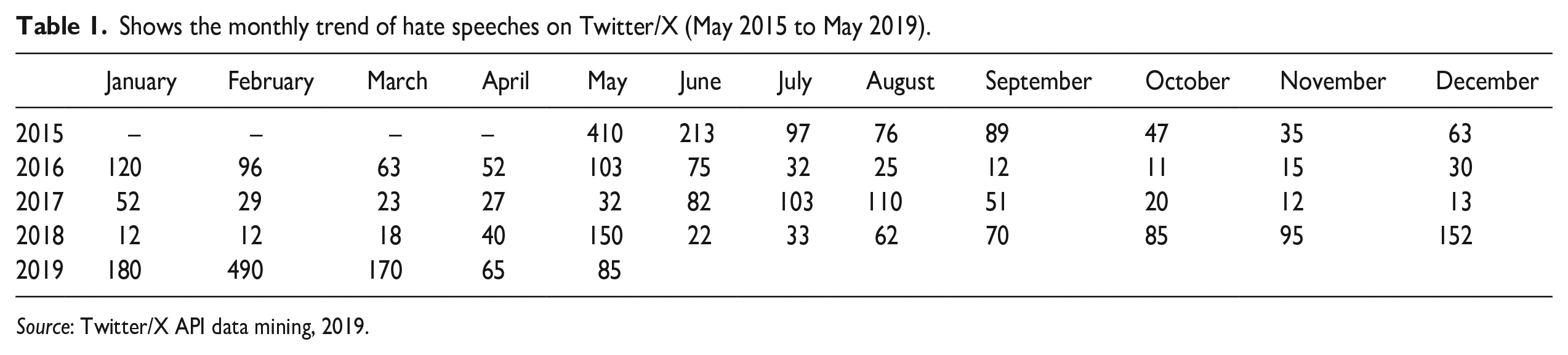
Based on the findings of the study, the trend of hate speech on Twitter/Xin Nigeria under President Buhari’s administration was highest in 2015 and decreased in subsequent years before 2019. This is captured in months in Table 1 and depicted in years in Figure 1 below.
Shows the monthly trend of hate speeches on Twitter/X (May 2015 to May 2019).
Source: Twitter/X API data mining, 2019.
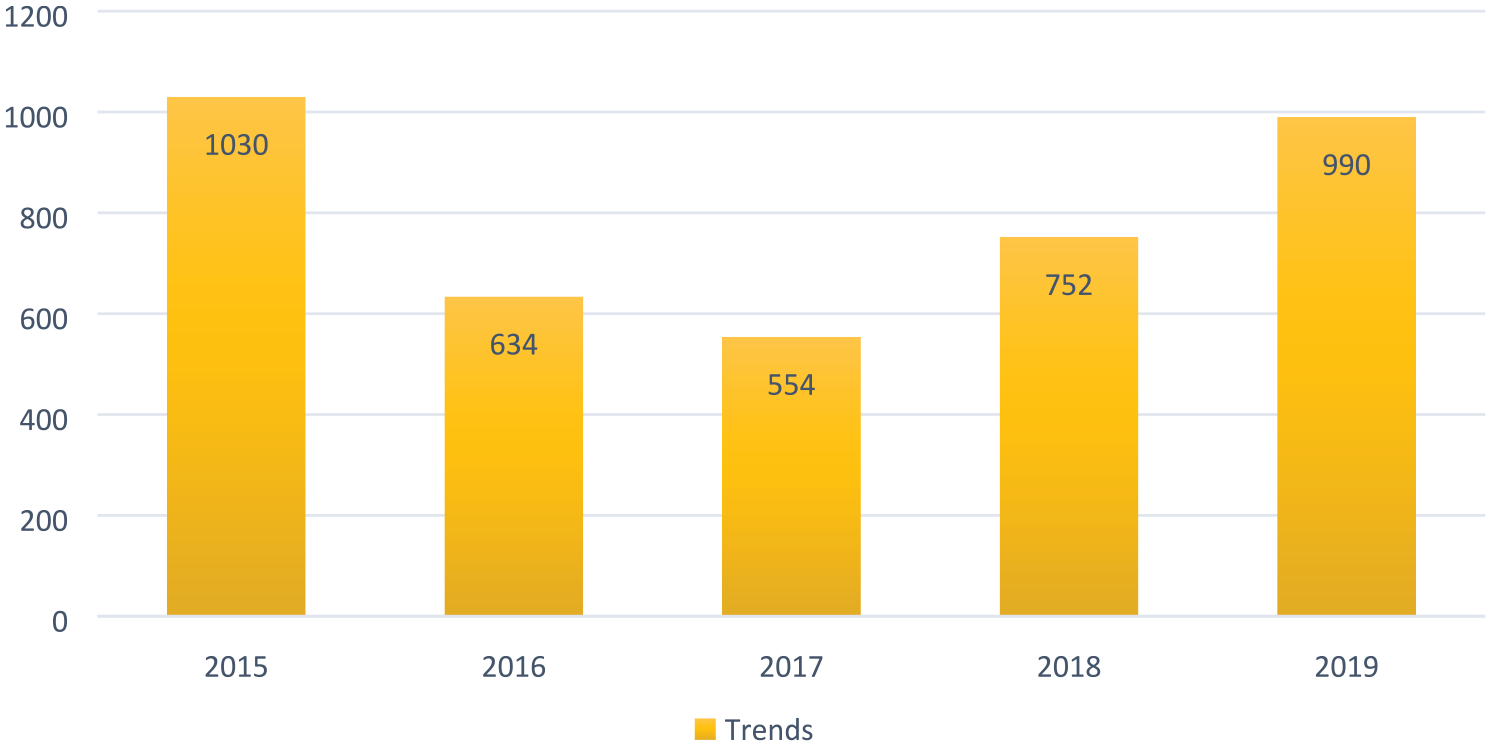
Yearly Trend of Hate Tweets in Nigeria.
The table above shows that hate speech on Twitter/Xin Nigeria in May 2015 when President Muhammadu Buhari was sworn in for his first 4-year tenure was prevalent at 10.3% in comparison with other months during the study. 5.3% was recorded in June, 2.4% in July, 1.9% in August, 2.2% in September, 1.1% in October, 0.8% in November, and 1.5% in December 2015. The finding shows the number declined until September when the figure rose due to national issues such as #Budgetpadding, the increase however did not extend to the following months until December when it rose slightly by 1.6%. By January 2016, hate tweets had increased drastically by 3%, the following 3 months also witnessed a reduction in hate tweets until May when the administration marked 1 year in office at 2.6%. The subsequent months also show a downward reduction of 1.9%, 0.8%, 0.6%, 0.3%, 0.3%, 0.4%, and 0.8% in December. The time series analysis shows that 2017 recorded low cases of hate tweets until July 2.6% and August 2.7% when the President’s ill-health absence became the talk of the town. However, by September with 0.4%, the figure continues to reduce till December with 0.5%, 0.3%, and 0.3%, respectively. The trend of reduction continues through early 2018 as January recorded 0.3%, February 0.3%, March 0.5%, April 1%, and May 3.8%. The number however started peaking in August at 1.6%, 1.8% in September, 2.1% in October, and 2.4% in November. The data show that there was a radical increase in hate tweets from December 2018 at 3.8%, January 2019 at 4.5%, and it peaked in February at 12.3%. There was a swift reduction in the following months, 4.3% in March, 1.6% in April, and 2.1% in May.
The annual trend in hate tweets over the years under consideration is seen above. According to the data, 26% of all hateful tweets were sent in 2015. This is closely followed by 2019 with 25%, 2018 with 19%, 2016 with a record 16%, and 2017 with 14% as the lowest. The year 2015 has the biggest number of tweets, which may represent the type of debate at the time President Buhari took office in his first term. According to the data, there was a decline in the number of hateful tweets between 2016 and 2017. The time frame might be thought of as a quiet phase. The number of incidents was 554 (14%), the lowest in the 4 years under investigation, in part because political campaigns are when most hate-related incidents occur. The figure increased once again (19%) in 2018, the year before the election, as key political gladiators prepare for party primaries and the general election by participating in several political activities. During this time, there were a lot of political activities on Twitter. The fact that 2019 is an election year contributed to the high number of tweets expressing hatred. Twitter’s hate speech trend essentially follows a zigzag pattern, with tweets decreasing before peaking again just before an election.
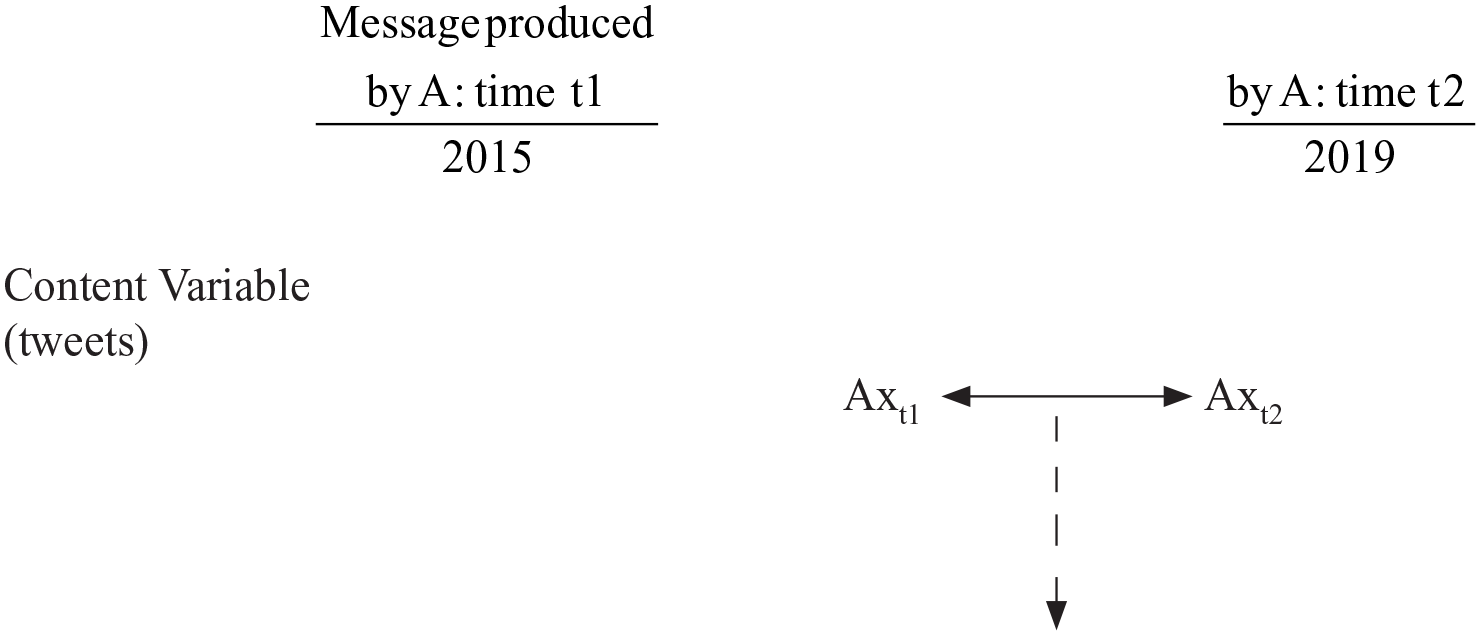
Adopting Ole Holsti’s model in determining the trends in communication content
To establish the trend, the study adopted Ole Holsti’s (1968) categorization of content analytical studies. The formula compares single-source messages using different times and situations. In that regard, using the formula above, the trend is established by comparing tweets from four different times (2015, 2016, 2017, 2018, and 2019) and in two different situations (during the campaign and electioneering period and governance proper).
In 2015 (t1), the study recorded 26%, 16% in t2, 14% in t3, 19% in t4, and 25% in t5. From this analysis, it can be deduced that the trend of hate tweets in t1 was highest when President Buhari assumed office. It was reduced by 10% in t2, 12% in t3, and peaked in t4 compared to the reduction in t2 and t3 by 5% and 11% in t5. This indicates that the trend of hate tweets in Nigeria is directly connected to the electioneering period. The situational analysis shows that the periods when hate tweets rise are before the election, during elections, and immediately after elections. However, after elections, a semblance of normalcy does return, as evident in the low percentage in t2 and t3, recording 16% and 14% respectively compared to other periods.
RQ2. What are the dominant themes of hate speeches on Twitter/X in Nigeria from 2015 to 2019?
Based on the findings of the study, the dominant theme of hate tweets in Nigeria under President Buhari’s administration is political hate speeches. This is depicted in the figure below.
Dominant Themes of Hate Tweets 2015 to 2019.
Source: Twitter/X API data mining, 2019.
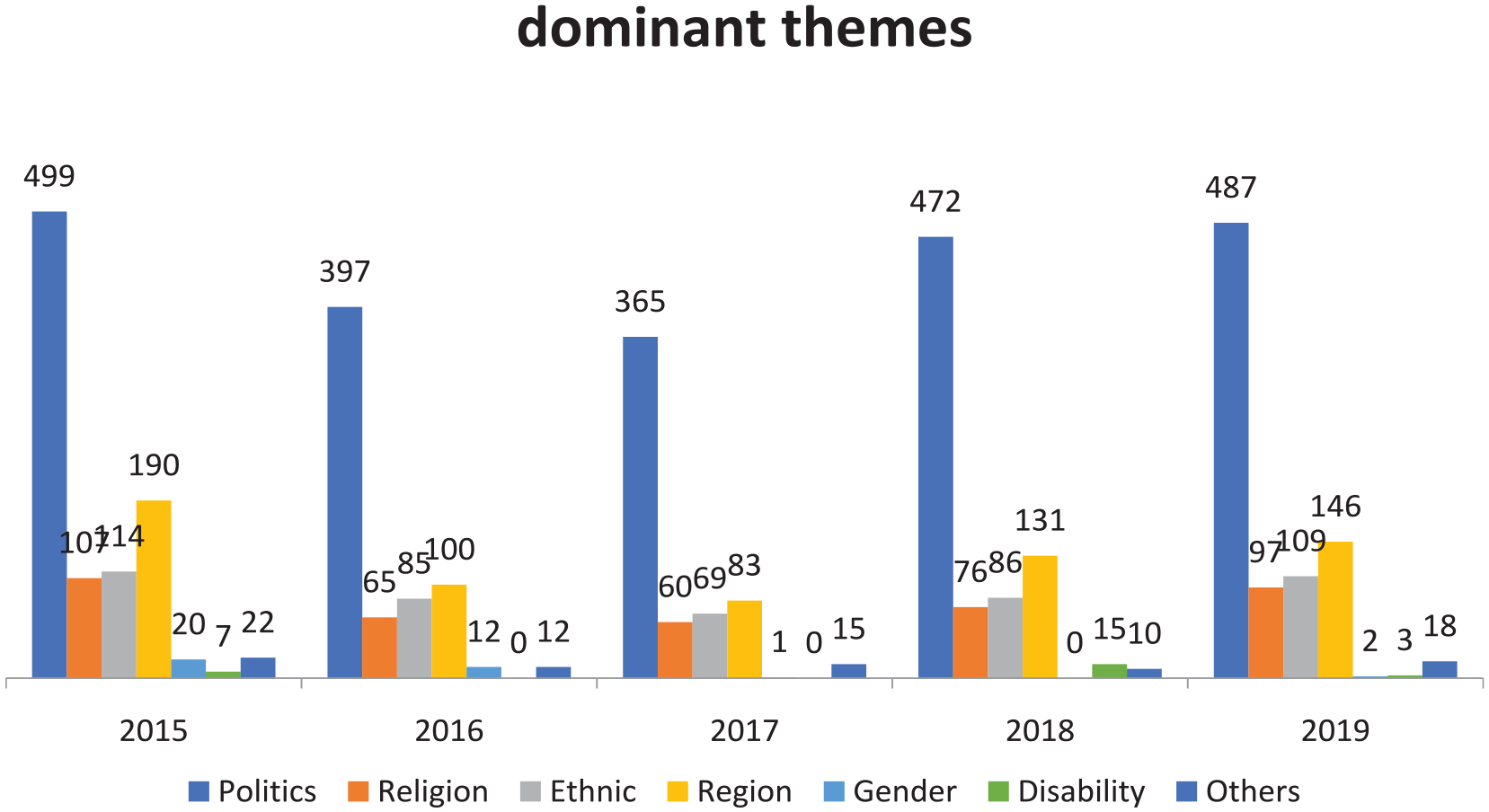
The above figure shows that political hate-based tweets dominated the Twittersphere during the years studied. In 2015, politics recorded the highest scores with 499 (22%), 397 (18%) in 2016, 365 (16%) in 2017, 472 (21%) in 2018, and 487 (22%) of all the categories of tweets analyzed during the study. Regional-based hate tweets come second in the years with 190 (29%) in 2015, 100 (15%) in 2016, regional hate base in 2017 is 83 (13%), 2018 is 131 (20%), and 2019 recoded 146 (22%). The religion theme is the third most dominant theme with 107 (23%) in 2015, 65 (14%) in 2016, 60 (13%) in 2017, 76 (16%) in 2018, and 97 (21%) in 2019. The fourth dominant theme is ethnicity. In 2015, ethnicity recorded 114 (25%), 85 (18%) in 2016, 69 (15%) in 2017, 86 (18%) in 2018, and 109 (24%). Gender-based hate tweet theme comes fifth with 20 (36%) in 2015, 12 (21%) in 2016, 2017 recorded 1 (1.7%), 2018 has zero while 2019 3 (5%). Disability recorded lowest with 7 (29%) in 2015, 15 (62%) in 2018, 3 (12.5%) in 2019, 2016, and 2017 recorded zero disability-based hate.
This is to show that political hate was the dominant theme during the year covered in this study. The data show that discourse on politics was at the forefront of issues driving hate speech on Twitter/Xin Nigeria. Aside from political hate, regional hate tweets also dominate the Twittersphere followed by other types of hate tweets such as religion, ethnicity, gender, and disability, respectively.
RQ3. Where was the geospatial of hate tweets during the administration of president Buhari from 2015 to 2019?
From the data generated, most of the geospatial hate tweets in Nigeria under President Buhari’s administration are southeast, followed by the northwest, and southwest.
Source: Twitter/X API data mining, 2019.
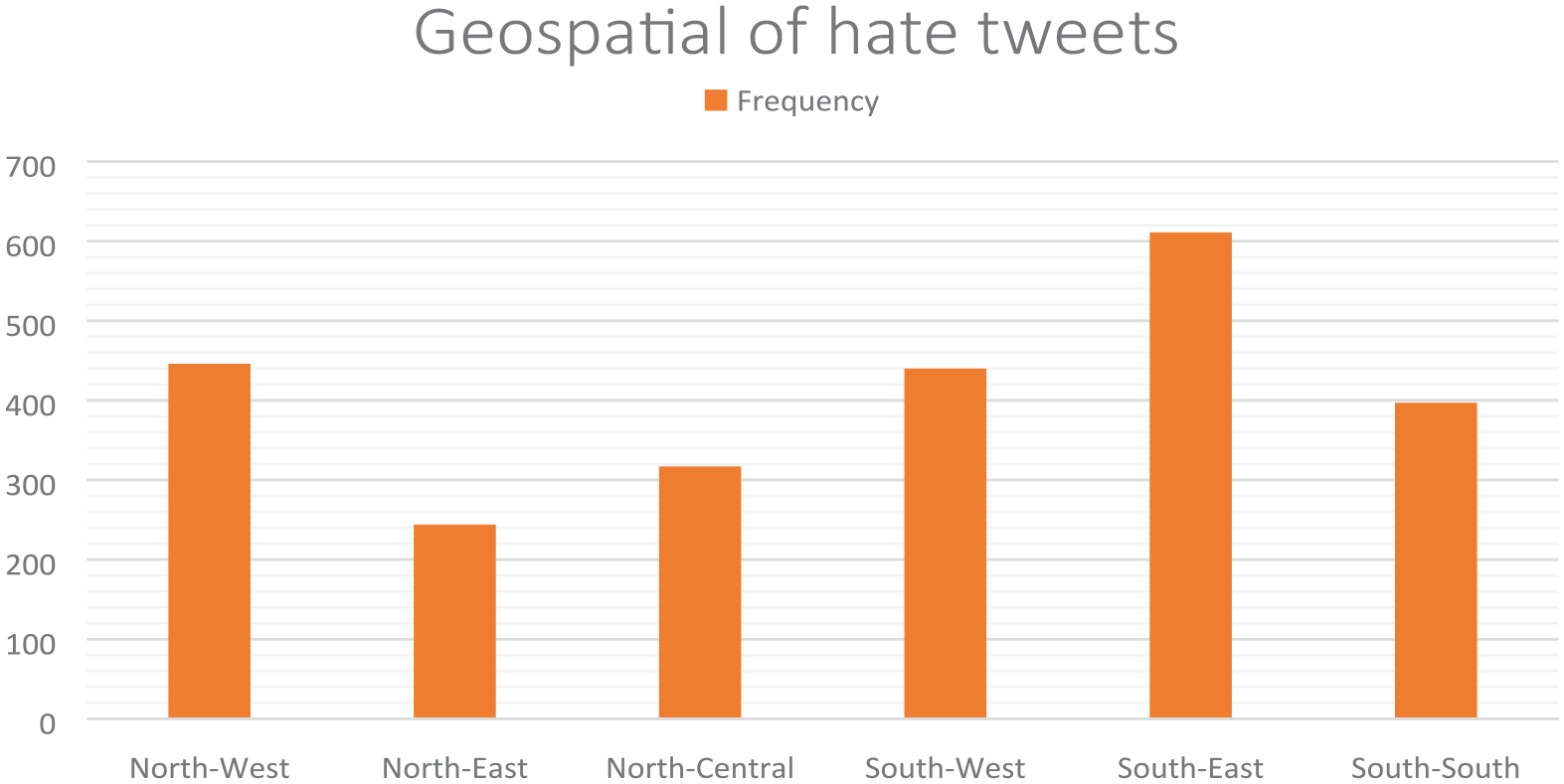
The API data mining process was able to uncover only 62% of the location of the total tweets ultimately studied. It appeared that 38% have multiple layers of security which makes it difficult for the API to mine the location the tweets emanated from. However, from the ones the study could ascertain their locations, findings show that southeast recorded the highest number of hate tweets with 611 accounting for 15.4% of the total tweets analyzed northwest comes second with 446 (11.3%), southwest is the d with 440 (11.1%), south-south has 397 (10%), north-central follows with 317 (8%) while northeast recorded lowest with 244 (6.2%).
The categories of tweets emanating from each region in Nigeria from 2015 to 2019.
Source: Twitter/X API data mining, 2019.
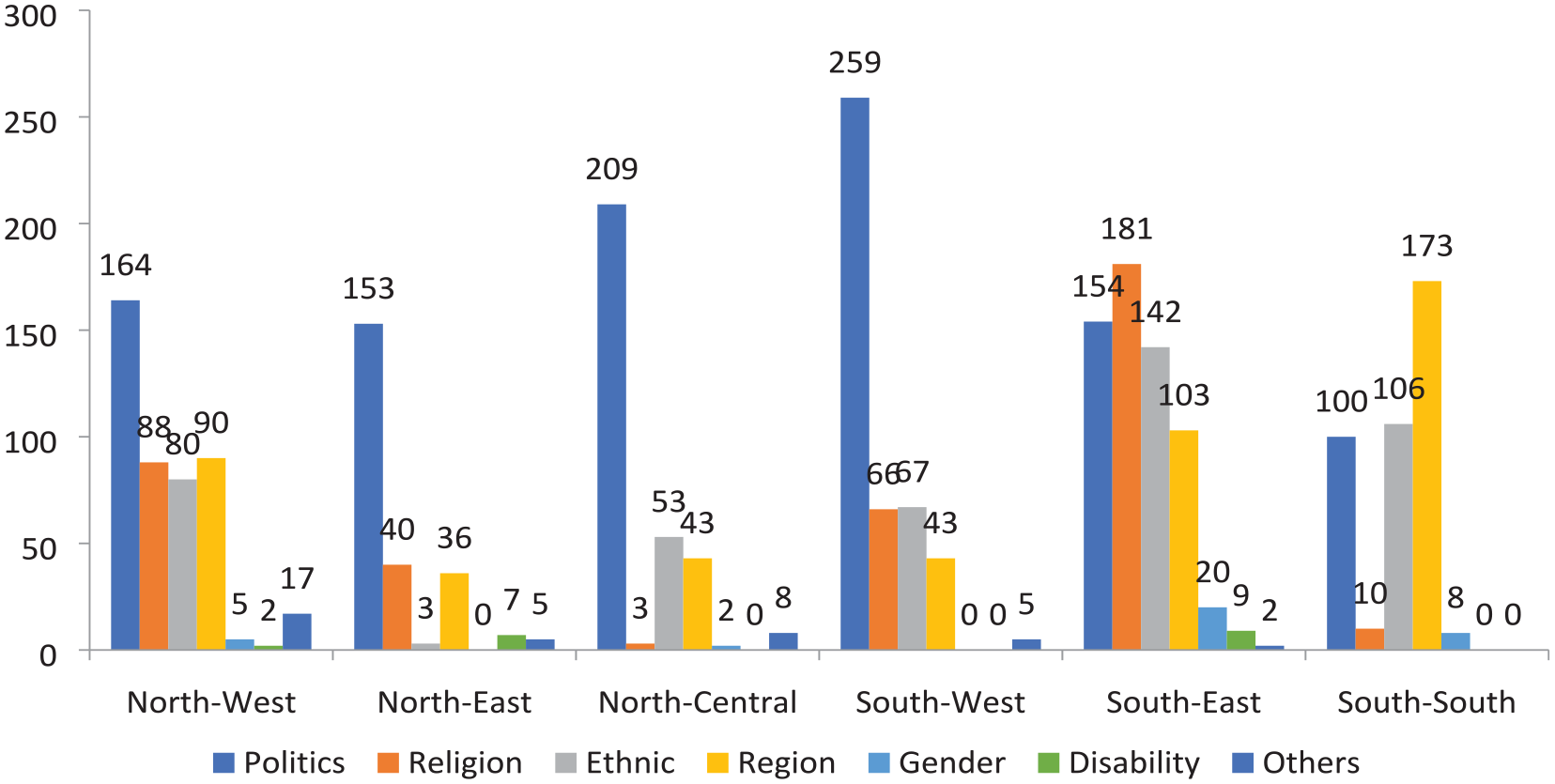
From the figure above, in terms of politically based hate tweets, the southwest dominates with 259 tweets, followed closely by North-Central with 209, the northwest comes third with 163, the southeast has 154, the northeast with 153 and south-south comes last with 100. This shows that at the center of hate tweets emanating from these regions is politics. Southwest specifically concentrated more on politics. Statistics have shown that the southwest has the highest level of Internet penetration in the country, therefore, ranking high in terms of hate tweets is not surprising.
On religious grounds, the study found that the southeast recorded the highest with 181, followed by the Northwest with 88, the Northwest comes third with a frequency of 66, the Northeast with 40, the south-south records 10 while the North-Central has 3. This finding proves that in terms of religious-based hate tweets, the Southeast region leads in comparison with other regions. The Northwest also recorded a large proportion. However, the North Central has minimal religious-based hate tweets.
The finding also indicates that ethnic-based hate tweets are high in the Southeast region compared to any other region during the period studied with 142, this is followed by South-south with 106, the Northwest region record 80, Southwest with 67, Northwest has 53, and the Northeast region recorded the lowest with 3.
In terms of regional-based hate tweets, the South-south region recorded the highest with 173, followed by the Southeast region with 103, the Northwest has 90, the Southwest and North-Central are in a tie with 43 each, while the Northeast recorded the lowest region-based hate tweets.
Gender-based hate tweets were also highest in the Southeast with 20, followed by South-south with a frequency of 8, the Northwest recorded 5 while the other three regions recorded 0. Disability-centered hate was recorded lowest in all the regions. Southeast, however, has the highest number of disability-based hate tweets with 9, followed by the Northeast with 7, the Northwest has 2, and the North-Central, Southwest, and South-south recorded 0. The Northwest region dominates the unspecified category termed others with 17 tweets, North-Central has 8, followed by the Northeast and Southwest with 5, while the Southeast has 2, and the South-south recorded 0.
From the data, it has been established that political hate speech is the dominant theme on Twitter/X in Nigeria as proven in RQ2, the findings of RQ3 show that the Southwest region tweeted more political hate speech than any other region. In terms of religious, ethnic, gender, and disability-based hate speech, the Southeast region dominates with many of the hate tweets emanating from the region being religious, ethnic, gender, and disability-based hate tweets. The South-south region dominates in terms of regional hate speech while the unspecified category is dominated by tweets from the Northwest region. That is to say, the geospatial of political hate speech is the Southwest region, while the Southeast is the epicenter of religious, ethnic, gender, and disability hate speech on Twitter/X.
Discussion of findings
The result of the quantitative data analysis shows that there is a large connection between the findings of this study and other studies. This study aligns with the summation of Rasaq et al. (2017) in their study on hate speech in Nigerian newspapers. They proved that the political campaign was full of bigotry and hate rhetoric. They postulated that during election campaigns and in daily life, politicians utilized the media to incite animosity and promote violence among ethnic and political groupings. This buttresses the findings of this study which show that the trend of hate speech on Twitter/X in Nigeria was fluctuating as daily life events have ways of transforming to either regional, political, ethnic, or religious attacks. It recorded the highest in 2015 during the first year of President Buhari’s administration and in 2019 during the General Elections. While it reduced during the second and third years of the administration before the commencement of electioneering activities in the fourth year. This finding buttressed the finding of Ezeibe and Ikeanyibe (2017) on the trend of hate speech in eight major newspapers in Nigeria from 2010 to 2015.
The study found that hate speech has been catapulted to the rank of an electoral strategy, which explains the increase in election-related violence in Nigeria before, during, and after the vote. The rise in the May 2015 figure (being the post-election period) was the by-product of hate speech during the 2015 general election campaign. This aligned with the summation of Pate et al. (2017) that during the 2015 general elections, obnoxious verbal and non-verbal communication mechanisms were deployed to promote political candidates and denigrate opponents. Political gladiators and their followers used distasteful content to campaign for votes on social media. This study also finds an increment in the occurrence of hate tweets in 2019 due to the general elections. This Buttressed the finding of Umati (2013) on the Kenyan general elections where it was established that the 2 months preceding the election witnessed an increase in online offensive speeches circulated on social media (mainly Facebook and Twitter). Similarly, the finding aligned with the result of Sevasti (2014).
Another objective of this study is to establish the dominant themes of hate speech on Twitter/Xin Nigeria. Affirming the finding of CITAD (2016) that social media instead of being the alternative media through which citizens can dilute Nigeria’s ethnicized pattern of politics, its contents show that it is much more ethnicized than the old media where we have some basic regulatory standards. The study proves that politically based hate speech dominated the Twitter/X space during the time studied. Political hate speech across the 4-year space of this study tops the category of all the tweets analyzed each year. This is partly because major appointments, policy formulation, and decisions of the administration are subjected to political, ethnic, religious, and regional biases. In agreeing with Ahmed’s (2018) findings, the data explain why regional-based hate tweets come second among the dominant themes.
Religion and ethnicity come third and fourth, respectively. Even though there are elements of semblance between this finding and other studies (Johnson et al., 2019; Nakamura, 2014) which stated that race, religion, and class are the prominent reasons victims of hate speech were targeted. It is important to note that while this study focuses on Nigeria alone, other studies are global. As a result, nationality and class categories are not captured in this study as variables. On ethnicity and religious hate tweets, Twitter/X served as a platform for Nigerians to fight their political wars which turned out as an attack on ethnic and religious groups. This is buttressed by other similar findings (Maweu, 2013). The prevalence of hate speech on social media in Nigeria is a result of the ethnicization of politics since the colonial era (Ezeibe, 2013; Nwachukwu et al., 2014). The normalization of hate speech on the Nigerian Twitter/X space, this study argues, is a product of access, imaginary anonymity, and global interactivity provided by the media. This has also been found in other studies (Brown, 2018; Johnson et al., 2019; Nakamura, 2014; Schmid et al., 2022).
Studies on hate speech have slightly gone beyond simply identifying (Yin and Zubiaga, 2021), controlling, differentiating, and tackling mechanisms (Rafael, 2021), and trying to study the motive of hate inciters, and reasons for promoting hate (Chen et al., 2019). These forms of studies are still minimal. The instantaneous and perpetuity of web-based content make it easy to archive and unravel (Gagliardone et al., 2015). In trying to determine the people inciting hatred and the content of their hate, this study found that hate tweets from the Southeast were ethnic, and religion-based. On the way, although, the study is not interested in finding out whether online hate tweets translate to offline attacks, however, with the continuous attack on northerners in the Southeast based on their tribe, religion, and the preconceived notion that the APC (the ruling political party in Nigeria) as a political party is Hausa/Fulani and Muslim party (The Guardian, 2019) by the Southeast people, it is not out of line to establish that the rise in anti-Hausa/Fulani hate crimes since the emergence of President Buhari has been concentrated in the Southeast. This finding also aligns with the study of Müller and Schwarz (2018) in the United States where it was demonstrated that places with significant Twitter/X users have seen a concentration spike in anti-Muslim racist attacks since Donald Trump’s election bid.
This study also corresponds with the tendency of “soldiers” (people recruited to tweet or amplify tweets) from a particular region (South-West, South-East, North-West, and North-Central in that order) to promote hate. And others, North-East and South-south can be classified as the “watchdogs” who in the process of advocating against the anomalies in their regions end up stereotyping other regions (Erjavec and Kovačič, 2012; The Economist, 2017). The South-south agitation for resource control manifested in the high percentage of regional hate tweets recorded in the region while the Boko haram insurgency ravaging the northeast was among the focal point of the issues prompting hate tweets from the region. In essence, the findings of this study have validated the proposition of minimal determinists that technology is a great amplifier of behavior in societies rather than being the singular variable influencing behavior. The result suggests that, although Twitter/X affordances enabled the spread of hate speech, the nature and content of hate reflect the preexisting regional, political, ethno-religious, economic, and communal conflicts that polarized Nigerian society. Hence, it has validated the argument of the minimal determinists that technology alongside other preexisting societal factors influences behavior and society.
Although technology (Twitter/X) is influential in creating a platform for tweets to express hate, Twitter/X is not however the singular factor or causative of hate speech as postulated by extreme determinists like McLuhan. Instead, the technologies provided a smooth level ground for perpetuating the societal inbred hatred as argued by minimal determinists such as DeFleur. Thus, whereas people are inherently hateful, Twitter/X serves as a medium that enables the political actors, party stalwarts and cross-section of the audience to propagate their preexisting hatred, as evident in the studies on conventional media such as newspapers, radio, and television. Those with access to newspaper pages, radio, or TV air slots used that avenue to express hate speeches as evident in numerous studies of hate speech on these platforms (Ezeibe and Ikeanyibe, 2017; Fasakin et al., 2017; Rasaq et al., 2017). Similarly, as established by the studies of Abdullahi (2018), and Ahmed (2018) among other studies focusing on hate speech on social media, the conclusion is that because social media breaks the hegemony of conventional media in terms of ownership, control, access, content creation, regulation, and gatekeeping, among other variables, it has become difficult to tame and gauge content on social media. Therefore, it may be claimed that social networking sites like Twitter/X are hazardous tools in the hands of cruel people due to the access they create. This study supports the paradigm that views technology as one of many elements that drive economic and cultural change; essentially, the degree of impact that technology has depends on the setting and the individuals who use it (Baran, 2002). In essence, Twitter/X has minimal determinism on Hate Speech in Nigeria.
Conclusion
The trend of hate speech in Nigeria shows that the rise of hate speech is predominant during the electioneering period. The political rhetoric of the 2015 campaigns and elections was transferred to a daily trend during President Buhari’s administration. Government appointments, policies, and decisions were seen not from the angle of competence or merit but from the regional, ethnic, and religious prism. Policies were analyzed not based on their merits but because of some superficial criteria which inherently derail a conversation about the quality of the policy to either the region that benefits more from such policy or who is overseeing the implementation of the policy. This translates to why politics is at the center of the hate tweets in the country. Aside from politics, regional-centered hate tweets also dominate even more than ethnic and religious-based hate tweets. Finally, the Southeast region tweets hate content more than any other region. What this proves is that Tweets from that region are more prone to leave their location visible while tweeting hate compared with tweets from other regions.
No doubt, hate speeches are high during the election period. This trend fails to stop even after the election, endangering the quality of conversation around governance and national cohesion. Therefore, this study recommends that The spat of hate speech during a campaign must be drastically reduced to avoid its spillover to governance. The utterances of politicians during elections, despite the availability of guiding principles on electoral campaign language and conduct, are so distasteful, obnoxious, and dangerous to the extent that government policies are not seen for their merits but the ethnic, regional, and religious inclinations of such policies and appointments. The utterances of politicians should be gauged and guarded to ensure the use of dangerous and hateful lexicons is reduced to the barest minimum or eliminated if possible. A campaign should be about issues rather than an appeal to ethnic, religious, or regional sentiments.
The age-old mistrust and resentment between the Southeast and the North are also aggravating the spat of hate speech. Despite the efforts of different governments at the federal level to heal the wounds of the civil war, it seems political rhetoric and regional and religious sentiment during campaigns further scratched the healing wounds, therefore creating a setback. A holistic approach must be taken to ensure a lasting solution to the mutual suspicion between the South and the North.
The stereotyping and profiling of all Fulani ethnic group members as kidnappers, bandits, and criminals by a section of society due to President Buhari’s ethnicity is also increasing the rate of hate speech in Nigeria. Only crimes committed by Fulani herdsmen carry their ethnic profile. Since 2015, it appears all criminals and kidnappers in other regions and ethnic groups have repented, leaving only criminality for one ethnic group. Criminals should be treated based on the crime they commit, not their ethnicity. Ethnic profiling is a precursor to hate.
Twitter/X likes, retweets, and followers are becoming increasingly popular, and many tweets rely on them to validate their influential status. As a result, trending has become a common phenomenon, and the desire to contribute to every trending topic, no matter how demeaning the trending topic, has become imperative. Therefore, influencers should be cautious of the trending hashtags or topics they help promote.
Even though there are relevant sections in the Electoral Acts 2010 to guide the utterance and conduct of elections and campaigns in Nigeria, there is ample evidence from the spat of hate speech to prove that the provisions of the electoral acts are not being adhered to and there is little implementation of the provisions of the act. Therefore, the study recommends the strict and holistic implementation of the provisions in the Electoral Act and meets appropriate sanctions against defaulters.
Despite the provision of freedom of speech in the 1999 constitution, however, because of the silver lining in the wording of free speech, it is sometimes misconstrued and shrouded in hate speech. Gagliardone et al. (2015) have established that the line between free speech and hate speech is blurred. There is therefore a need for a review of the constitution to clearly state what constitutes free and hate speech.
The study also recommends a legal framework for the regulation of hate speech on social media. Although Senator Sabi Abdullahi proposed a bill that sought the establishment of a Hate Speech Commission and the death penalty for those convicted of hate speech (Busari, 2018), this bill was rejected by civil society organizations and citizens as a government ploy to silence dissenting voices and limit free speech. However, globally, nations are developing guidelines to regulate hate speech. Most importantly, social media regulations are being developed in advance of democracies, especially in the wake of the rise of nationalist movements around the globe. Nigeria also needs some form of regulation in the wake of this increase in hate speech. Specifically, conventional media platforms now post content they dare not publish on their conventional media platforms on social media out of fear of regulatory bodies.
Footnotes
Author’s note
Lauratu Umar Abdulsalam is now affiliated to Department of Mass Communication, University of Abuja, Nigeria.
Funding
The author(s) received no financial support for the research, authorship, and/or publication of this article.
