




Abstract
Politicians often deploy analogies to shape public discourse. If picked up by the media, these references to the past can powerfully shape how political events are perceived. This article examines why some analogies became popular through an exploration of the creation and development of the analogy comparing Mangosuthu Buthelezi, the leader of the Inkatha Freedom Party in South Africa, to Jonas Savimbi, the leader of the National Union for the Total Independence of Angola, during South Africa’s transition. Tracing the evolution of the Buthelezi–Savimbi comparison through an analysis of media reports indicates that analogies that possess predictive power are likely to gain traction in public discourse and become effective tools for policy advocacy.
Past events are used as prisms through which to understand present political realities. A prominent example of this type of analogical reasoning is the connection that is often drawn comparing the Cold War between the United States and the Soviet Union, and relations between the People’s Republic of China and the United States today (Khong, 2022). There are two explanations as to why political figures evoke historical analogies. The ‘analytic view’, argues that history is drawn on to make sense of ambiguous policy problems. Scholars working in this vein have explored what type of historical analogies are selected and how they are used in decision-making. An alternative view holds that analogies are primarily for advocacy – references to history are used to justify and sell a pre-existing view to both the policymaker’s colleagues and the public (Khong, 1992; Levy, 1994; Robertson, 1991). While scholars have developed powerful explanations for why and how analogies are used for analysis, there is less understanding of what types of analogies tend to be successful for the purpose of policy advocacy.
This article begins such an exploration by asking why some analogies gain traction in public discourse and others do not? For scholars, understanding the type of analogies that come to dominate the discourse on a subject is important because it offers insight into the intellectual climate in which policy debates occur. For politicians, it suggests how future policy debates can be won by using the prism of the past.
To examine the factors that lead an analogy to adhere in public discourse, I trace the use of the comparison between the leader of the Inkatha Freedom Party of South Africa (IFP), Mangosuthu Buthelezi, and Jonas Savimbi, leader of the Angolan rebel group the National Union for the Total Independence of Angola (UNITA). Analysing media reports from when the analogy between these two leaders first emerged in 1986 until South Africa’s transition to democracy in 1994 sheds light on the characteristics that lead analogies to gain popularity and thus become powerful tools for advocacy. The principal finding is that analogies with prognosticative power – those that include a prediction about how events will unfold – will be more popular than those that do not offer such a forecast.
The article proceeds in five parts. Part 1 assess the theoretical literature on the type of analogies that tend to be recalled. It enumerates five propositions to guide the ensuing analysis of the Buthelezi–Savimbi analogy. Parts 2 and 3 examine the early use of the Buthelezi–Savimbi analogy paying particular attention to what type of parallels were drawn between the two leaders and the purpose of the comparison. Understanding the ‘anatomy’ of the analogy is crucial because it permits an assessment of how changes to this anatomy contributed to the analogies increased currency over time. Part 4 investigates the reasons for the increased use of the analogy from late 1992 until South Africa’s elections in April 1994. Part 5 ties the historical narrative to the theory of analogical reasoning to explain the prevalence of the Buthelezi–Savimbi analogy during the second half of South Africa’s transition.
Historical analogies: for analysis and advocacy
Analogical reasoning is defined as ‘a comparison of some past experience with a current decision problem, so that some important aspect of the past experience can be used as an insight into the current problem’ (May, 1973; Reiter, 1996). This type of reasoning is widespread. As MacMillan (2008) writes, ‘Human beings may not always get the right analogy, but they are almost certainly bound to try to use one’.
Most of the scholarship on analogies in policy making focuses on their ‘analytical’ use – the idea that policy makers draw on analogies from previous situations to help understand current challenges. However, because the ‘cognitive [analytic] and political [advocacy] functions of historical analogies go hand in hand’ (Brandstrom et al., 2004), it is possible to draw on the same set of factors that explain why certain analogies are attractive for analytic purposes to provide insight into which analogies are likely to succeed as tools for advocacy.
Using both cognitive psychology and history, scholars have developed five propositions to explain the type of events that are recalled to construct analogies for analytic purposes: 1
Recent events are fresh in the minds of the policymaker and therefore more likely to be recalled.
Events that share ‘surface commonalities’ with a current challenge are likely to be recalled.
Events, which were consequential on a personal or national level, are more likely to be recalled.
Events which are witnessed firsthand, especially those in which the actor played a role, are vivid and thus more likely to be recalled.
Events that occur early in one’s life are formative and more likely to be recalled.
The Buthelezi–Savimbi analogy offers a test of whether these same propositions explain what type of analogies are effective instruments for policy advocacy.
Tracing the origins of the Buthelezi–Savimbi analogy
The conflict between Inkatha and the African National Congress (ANC) dates back to the late 1970s. Although the ANC supported Buthelezi’s formation of Inkatha in 1975, the relationship between the parties soured due to policy differences over the use of sanctions and violence to force change in South Africa. The ANC also worried that Buthelezi was using Inkatha to build his own ‘personal power base’ (ANC National Executive Committee Report in Gerhart and Glaser, 2010; Jeffery, 1997). The conflict between the ANC and Inkatha played out predominately in the Kwa-Zulu/Natal region where a ‘civil war’ took place throughout the 1980s and early 1990s that cost some 12,000 lives (Mare, 2021). As part of this conflict, the ANC directed a ‘stream of unrelenting hostile propaganda’, towards Buthelezi (Welsh, 2009).
The construction of the Buthelezi–Savimbi analogy began in 1986. In April of that year, leaders of the National Union of South African Students (NUSAS) held a meeting with ANC representatives during which Inkatha was discussed. In a debrief of that meeting the president of NUSAS commented, ‘the ANC regards Inkatha as the UNITA of the future’ (Witness Reporter, 1986).
In November of 1986, John Nkadimeng, a member of the ANC’s National Executive Committee, made the more pointed personal link between the two leaders when he stated:
It is clear that this puppet Gatsha [Buthelezi] is being groomed by the West and the racist regime to become a Savimbi in a future free South Africa. The onus is on the people of South Africa to neutralise Gatsha, the snake which is poisoning the people of South Africa. It needs to be hit on the head.
A broadcast on ANC (1987) Radio in March 1987 continued the comparison:
. . . the apartheid leaders have also resorted to forming vicious death squads known as vigilantes whose deadly task is to physically eliminate all opponents of the apartheid regime [ . . . ] they are called the Inkatha and under the direct control of the South African version of a Savimbi, Gatsha Buthelezi.
These uses of the Buthelezi–Savimbi analogy were for advocacy. By pointing out that like Savimbi, Buthelezi was connected to the West and apartheid government the ANC sought to delegitimise him as a force for change in South Africa.
There is some evidence that this advocacy was effective. In 1989 Nimrod Mkele, a South African psychologist, told the journalist Willem Oltmans (1990):
Intkatha is killing people . . . Buthelezi creates problems for himself. His organisation is committed to the Zulus only, therefore he has painted himself into a political corner . . . By the way, we call Buthelezi sometimes ‘Gatsha Savimbi’. We are fully aware of what he is doing in Natal. In fact, he’s doing there what Savimbi is doing in Angola. He could be a Savimbi. Yes, sir.
Other comparisons between Buthelezi and Savimbi had a more analytic bent. In a 1987 article for the New York Review of Books, Michael Massing (1987) drew a series of comparisons between the leaders of Inkatha and UNITA:
Buthelezi denounces the ANC as a Soviet puppet manipulated by communists. He uses tribal appeals to solidify his ethnic and regional bases. He travels frequently to the United States, Western Europe, and Israel, talking warmly about democracy and free enterprise. Meanwhile, with every passing month, Inkatha is becoming more heavily armed.
Massing concluded, the ‘signs are apparent everywhere’, Buthelezi might pursue ‘the Savimbi option’.
The similarities between Buthelezi and Savimbi were not always noted for negative purposes. The Natal Witness (1990) editorialised, ‘Both Unita and Buthelezi want recognition of their movements as valid national political parties’. The Weekly Mail reported that when Buthelezi visited the United States in 1991 some American lawmakers on the right were ‘feting him as the next Jonas Savimbi fighting the evil forces of communism represented by the African National Congress’ (Gevisser and Koch, 1991).
These early comparisons between Buthelezi and Savimbi rested on three commonalities: (1) both were pro-Western (2) both used tribal appeals to consolidate a regional support base, and (3) both were using violence to achieve political objectives. These similarities prompted only sporadic comparisons. However, as the South African political situation shifted, the power of the analogy waxed.
Powerful new parallels
In July 1991, the Weekly Mail broke the story that Inkatha had received financial support from the South African government ‘for the purpose of organising rallies and other anti-ANC activities . . . ’ (Koch and Harber, 1991). Subsequent reports established that Inkatha fighters had been trained by the South African Defence Force’s (SADF). The scandal became known as Inkathagate. Additional parallels between Inkatha and UNITA emerged out of Inkathagate. It was the SADF’s Chief of Staff Intelligence division that had overseen training programmes for both Inkatha and UNITA fighters (Koch, 1991). And, ‘support for Inkatha was conceived at the same time that military intelligence began to back Renamo 2 and UNITA in the mid-1970s’ (Koch, 1991).
In short, Inkathagate proved what ANC officials had previously alleged: that Buthelezi, like Savimbi, received assistance from the apartheid regime. This created a fourth pillar of support for the Buthelezi–Savimbi analogy. David Newsom (1991), a former a senior official at the US State Department elaborated on the connection:
The fear and suspicion of liberation movements dedicated to the overthrow of the established order is great. The alternative leaders–such as Buthelezi and Savimbi–speak in terms that appeal to those in power. To those favouring the status quo their policies seem more likely to assure a transition to a regime that will protect the interests and privileges of those in power.
The applicability of the Buthelezi–Savimbi analogy was augmented by events in both South Africa and Angola in September and October of 1992. In South Africa, the ANC and NP signed the Record of Understanding. Buthelezi was angered by several aspects of this agreement. It included provisions that the hostels Inkatha supporters stayed in were to be fenced and the ‘cultural weapons’ they carried were proscribed. It also stipulated that an elected constituent assembly would serve as an interim parliament and draft a new constitution (Sisk, 1995). Inkatha had opposed this process for drafting the new constitution for some time. Now, it had been decided without them. Perhaps most importantly, the Record of Understanding signalled a shift in the broader dynamics of the negotiations. O’Malley writes, ‘It drove a wedge between the NP and IFP. The government implicitly acknowledged that the ANC was its partner in a joint process. It left Buthelezi twisting the wind’ (O’Malley, 2007).
Buthelezi describes the Record of Understanding as ‘the ultimate betrayal of the negotiating process’ (Temkin, 2003). He spurned the agreement and formed the COASG alliance (Temkin, 2003). This new formation rejected the negotiating process spearheaded by the ANC-NP. It argued that a broad (not bilateral) process was appropriate (Welsh, 2009). Over the next eighteen months Inkatha attempted to obstruct and overhaul negotiations it viewed as misguided and unrepresentative. As Waldmeir (1997) points out, in the Record of Understanding ‘lay the seed of the final settlement – along with the germ of its near destruction’.
While South African political parties were responding to the new negotiating environment created by the Record of Understanding, those in Angola were eagerly awaiting the results of the country’s election.
After more than fifteen years of civil war, the Bicesse Accords signed in May 1991 by UNITA and the governing Popular Movement for the Liberation of Angola (MPLA) brought a chance for peace. Part of that agreement stipulated that an election be held in the second half of 1992. Voting occurred in late September and by early October the results were clear. In a poll widely seen to be free and fair, the MPLA had soundly defeated UNITA in both the parliamentary and presidential vote. 3 Rather than accept these results, Savimbi decided to return to war (Anstee, 1999; Vines, 2004). Angola was plunged back into devastating conflict. The United Nations estimated that during the most heated phase of the renewed war in the middle of 1993, more than one thousand Angolans died every day (Matloff, 1997).
The events of September and October 1992 added an additional dimension to the Buthelezi–Savimbi analogy – predictive power. Might the dramatic and deadly events in Angola foreshadow a similar scenario in South Africa? Now the analogy seemed not only more apt, it appeared more applicable.
The Savimbi scenario and the South African situation
After Savimbi’s decision to return to war in October 1992 ‘the ghost of Angola’ dominated South Africa’s political discourse (Hanlon, 1993). In one famous example, after the ANC leader Chris Hani was assassinated in April 1993 by white right-wing extremists Nelson Mandela (1993a) told South Africans, ‘We must not let the men who worship war, and who lust after blood, precipitate actions that will plunge our country into another Angola’. In a context in which the comparison between South Africa and Angola was constant, the pre-existing parallel between Buthelezi and Savimbi gained greater traction among both politicians and pundits.
In October 1992 the Weekly Mail ran an editorial titled ‘Dr Mangosuthu Savimbi?’ that pointed out a number of similarities between the two leaders including that they ‘are balking at the realisation that they are not as popular as they had believed’. The piece wondered, ‘So will Buthelezi be our Savimbi, reluctant to accept the consequences of losing?’ . When Buthelezi put forward a draft constitution that granted the Kwa-Zulu and Natal region virtual autonomy from the South African state in December 1992, Hugh Robertson (1992) wrote that Buthelezi’s move towards a ‘separatist regional solution’ suggested that both he and Savimbi are ‘losers who are having inordinate trouble facing up to that fact’ (Nyatsumba, 1992; Welsh, 2009). This type of analysis is indicative of the additional layer added to the Buthelezi–Savimbi comparison after October 1992. Not only did they share the same allies, and a similar type of ethnic support base, it appeared both Buthelezi and Savimbi had the same attitude towards elections – they were welcome only if they were won.
Media commentary was reinforced by members of the ANC and United Democratic Front (UDF). Alan Boesak argued that similar to Savimbi in Angola, Buthelezi in South Africa sought to gain influence through the support of the South African government and the threat of force (Daily Dispatch, 1992). Bantu Holomisa claimed that ‘Like Savimbi, Inkatha wants to ascend the political centre stage through the barbarism of violent bloodshed’ (SAPA, 1992). And Rob Davies labelled Buthelezi and Savimbi as part of the same ‘generic family’. He argued their common role as South African proxies against leftist movements allowed UNITA and Inkatha to potentially spoil the transition in both countries (Koch, 1992).
This increasing number of comparisons between Buthelezi and Savimbi was facilitated (unintentionally) by an unlikely source – Buthelezi himself.
Buthelezi accelerates the analogy
The IFP hoped to shape the formation of the new South Africa in several ways. It wanted the constitution to be drafted by an unelected body that represented the array of South African political parties rather than an elected constituent assembly. It argued for a federal system in which significant power would devolve to provincial governments. And, it sought to preserve the power and prerogatives of the Zulu monarchy (Lyman, 2002; Schar, 2010; Sisk, 1995; Temkin, 2003). After the IFP walked out of the negotiating process it lost an important avenue to advance these objectives. 4 Princeton Lyman, the US Ambassador to South Africa who spent considerable time coaxing Buthelezi to participate in the process, recalls that during this period the IFP leader ‘was feeling more isolated and his rhetoric was becoming more strident’ (Lyman, 2002).
Buthelezi’s increased stridency was exhibited in two regularly repeated talking points that encouraged comparisons between himself and Jonas Savimbi. First, Buthelezi often warned that civil war was likely if the IFP’s demands were not met. And second, he frequently pointed to Angola to illustrate his argument that elections would not settle, and might instead exacerbate, the political situation in South Africa.
Buthelezi often discussed the possibility of civil war in South Africa. Although he did not directly threaten war, the ominous tone of his comments was clear. In June of 1993, after the IFP walked out of the Negotiating Council over its demand for a federal system in post-apartheid South Africa, Buthelezi asserted his party’s continued relevance saying ‘If they [the ANC and NP] go without us it is a recipe for civil war’ (SAPA-Reuter, 1993). In September, Buthelezi warned that that the ANC-NP agreement on the election of an interim government which would also draft the new constitution amounted to ‘prescriptions for civil war’ (SAPA, 1993a). And in December Buthelezi stated that adopting the federal system advocated by Inkatha was the only way of ‘Saving our country from civil war, which is otherwise sure to come’ (SAPA, 1993b). Buthelezi’s frequent references to civil war encouraged the view that like Savimbi, he would be willing to resort to violence. Buthelezi repeated the civil war refrain so often that President FW De Klerk criticised him for ‘constantly mentioning’ the possibility of civil war, because ‘it brings to the fore that possibility’ (Whitfield, 1993). Mandela (1993b) issued a similarly pointed criticism saying, ‘Democracy has no place for talk of civil war. Those who persist with such threats do not care for human life’.
Buthelezi also amplified the comparison between himself and Savimbi by regularly referring to what had happened in the aftermath of the Angolan elections. As the negotiation process wore on in South Africa there was growing ‘pressure to produce positive and tangible results’ such as agreement on the date for elections (Ebrahim, 1998). The ANC hoped setting an election date would demonstrate real progress and inject needed momentum into the negotiations (Sisk, 1995; Waldmeir, 1997). The IFP rejected the rush to set an election date. It wanted to reopen debate on how the constitution would be drafted and approved as well as discuss issues such as the devolution of regional authority (Temkin, 2003). When the ANC and NP reached agreement in early July 1993 that elections would be held the following April the IFP walked out of the negotiation process. To highlight the potential problems that might accompany elections Buthelezi (1993) often pointed to the resumption of civil war in Angola (AFP, 1993; Carlin, 1993; Irish Times, 1994). He told the South African Broadcasting Corporation:
I don’t think that one can say that if there is an election, then there will be no violence, because I see just across our borders here in Angola that . . . the election took place, there were international monitors, but the violence nevertheless took place and got worse than it was before.
The allusion to Angola certainly made the point that elections did not guarantee peace, but it also raised questions as to why Angola’s transition went off track. Umsebenzi (1993), the South African Communist Party’s magazine, had one answer: ‘Buthelezi points to Angola, and his message is clear–he is threatening to play at being Savimbi’.
The spectre of violence
During 1993 and 1994 comparisons between Buthelezi and Savimbi focused primarily on the possibility of electoral violence in South Africa. In November 1993 The New York Times reported:
. . . One of the great preoccupations of South African politics at this precarious moment in its transition is the question of whether Mr. Buthelezi could divert his country from democracy into civil war. [In] Natal, they argue about whether the Inkatha leader will follow . . . the example set by . . . Jonas Savimbi, who lost elections last year and then led his men into the bush (Keller, 1993).
As the date of the elections neared the IFP remained outside the negotiating process and uncommitted to participating in elections. Both South African and international newspapers viewed Buthelezi’s recalcitrance through the lens of Savimbi’s recent actions. Business Day argued that whether Buthelezi decided to ‘commit himself and his party to contesting the election’ would determine if ‘history judges him as an important leader or the Savimbi of South Africa’ (Business Day, 1994). The Times stated that ‘South Africa is playing with electoral fire’. Because Inkatha still resisted participation, it argued, ‘The elections now promise to be even bloodier than had been forecast, with the spectre of Chief Buthelezi as a South African Jonas Savimbi’ (The Times, 1994).
With only eight days remaining before the polls Inkatha ended its election boycott. In return for the IFP’s participation, Buthelezi agreed to a deal that enshrined the Zulu King’s status as a constitutional monarch and gave the King control of a vast swathe of KwaZulu (Lynd, 2021). This last minute agreement did not completely alleviate fears of post-election violence and the Buthelezi–Savimbi analogy persisted. The Independent reported ‘All polls indicate that Inkatha will be defeated by the ANC in Natal, and that the majority of Zulus will not vote for Inkatha. In such circumstances Chief Buthelezi might cry foul in the manner of Jonas Savimbi in Angola’ (Carlin, 1994; Political Staff, 1994).
As it turned out, the results of South Africa’s first democratic elections were (though perhaps not entirely accurate) a ‘designer outcome’ for the preservation of peace (Waldmeir, 1997). The ANC was the clear winner with more than 60% of the vote nationally, but the IFP obtained a respectable 10% of the national vote, and scored a major victory by winning control of the province of Kwa-Zulu Natal. The IFP’s strong showing in the election meant that that it had earned the right to three ministerial positions in the Government of National Unity. Buthelezi was appointed minister of Home Affairs, a position he happily accepted. Though he had demonstrated a propensity for dangerous brinksmanship, the fear that Buthelezi was ‘South Africa’s Savimbi’ never materialised (Nduru, 1993).
In 1999, 5 years after South Africa’s transition, Business Day (1999) ran an editorial about the Angolan war that had restarted yet again. In an ironic reversal of the discussion in South Africa not so long ago, it argued that Savimbi was not an ‘‘Angolan Buthelezi’. Mangosuthu Buthelezi, though he had the power pre-1994, would never have done to SA what Savimbi did to Angola; he was and is a patriot’. During South Africa’s transition many observers had not been so sure.
Explaining the expansion of the Buthelezi–Savimbi analogy
The propositions that explain which analogies are recalled for analytic purposes go some way towards illuminating the popularity of the Buthelezi–Savimbi analogy. The analogy seems to have first emerged from ANC officials. This is not surprising, During the 1970s and 1980s, many ANC leaders worked and trained in Angola. This experience created a familiarity with the Angolan political scene. Some in the ANC experienced the ongoing conflict in Angola firsthand. In 1982, after the MK had formed a number of guerrilla units, these fighters engaged in combat against UNITA. For young recruits, the fight against UNITA was formative. It was also deadly. In total, 99 MK soldiers died while fighting UNITA. The campaign against UNITA (rather than apartheid South Africa) and the casualties suffered during this campaign led to ‘demoralisation’ and even mutinies in several MK camps (Ketelo et al., 2009; Lourenco et al., 2013). The ensuing crisis prompted a wave of soul-searching within the ANC and a commission of inquiry was set up to better understand what had prompted unrest in the camps (Pahad, 2014; Callinicos, 2011; Phakola, 1993). For many ANC members, events in Angola including the fight against Savimbi were fresh in their mind, experienced firsthand and significant on both an individual and party level. If ANC members were looking to other experiences to help understand events in South Africa, Angola was a likely referent.
Issues, events and individuals that share ‘surface commonalities’ are more likely to be compared. From when the Buthelezi–Savimbi analogy first emerged in 1986 until October 1992, its anatomy – the dimensions on which the analogy was based – were fairly stable. Both Buthelezi and Savimbi were pro-West, militant and reliant on a support base mobilised by appeals to ethnic solidarity. A fourth leg the analogy rested on – that both were backed by the apartheid state – was strengthened over time as details emerged that Inkatha had enjoyed support from Pretoria just as Savimbi had.
The existing propositions regarding analogical recall – recency, directness, salience, and surface similarities – explain why the Buthelezi–Savimbi analogy was evoked. They do not, however, explain why it was evoked so much more frequently after October 1992. Table 1 shows the number of instances the Buthelezi–Savimbi comparison was made over two time periods. From when the parallel was first drawn by ANC officials in 1986 until September 1992 when elections in Angola were held and the Record of Understanding was signed. And, from October 1992 until South Africa’s April 1994 elections.
Frequency of the Buthelezi–Savimbi Comparison.
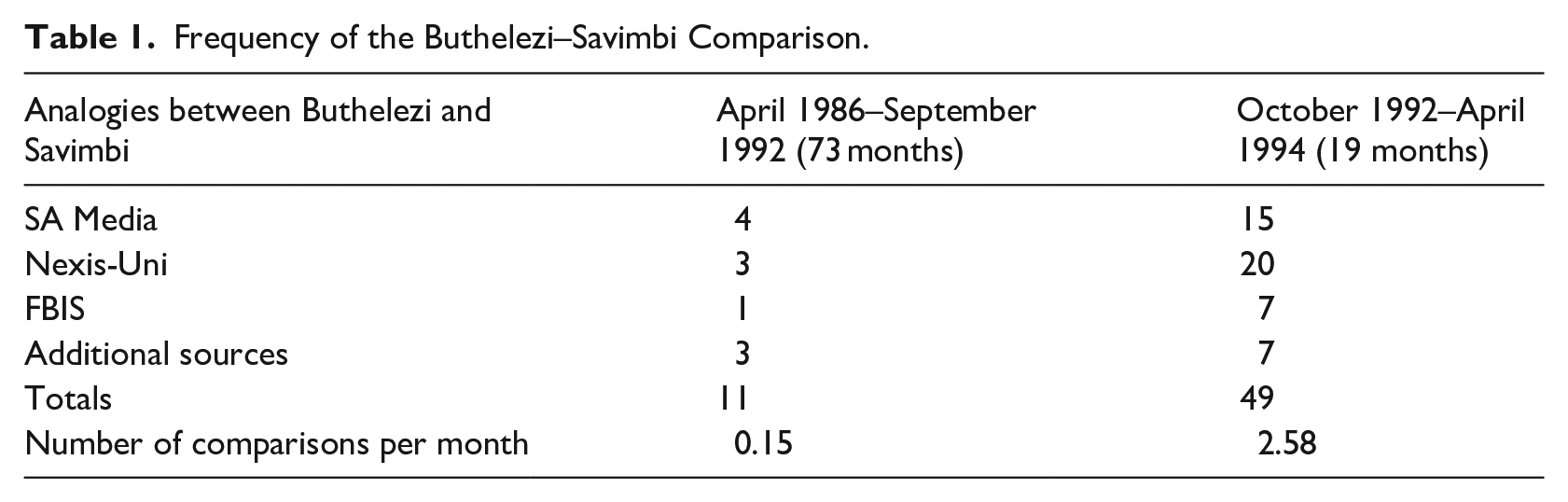
The data search was carried out using four categories of sources. Three databases – SA Media, Nexis Uni and FBIS – as well as a catch-all category that includes books and magazines that have not been digitised. It is directional, not comprehensive, as these databases do not capture all the reports, broadcasts, press conferences, speeches and other medium in which the analogy was drawn. 5 Despite this, it paints a clear picture: after Buthelezi’s resistance to the Record of Understanding and the reignition of the Angolan, civil war comparisons between the two leaders increased dramatically.
The reason for this increase is that after October 1992 the Buthelezi–Savimbi comparison evolved (Guelke, 1999). It was now based on another commonality: they were both sore losers. This new dimension contributed to the expansion of the analogy by endowing it with what Vertzberger (1990) calls ‘predictive inference’. Savimbi had elected to fight rather than accept electoral defeat. Might Buthelezi make a similar calculation? The use of the Buthelezi–Savimbi analogy to peer into what the future might hold for South Africa added to its allure.
The scholarship on analogical reasoning has focused on what characteristics make an analogy attractive for analytic purposes. This study demonstrates that many of these same characteristics also make an analogy a potent tool for advocacy. However, it also suggests that analogies that possess predictive power are more likely to gain popularity than those that do not, and thus become powerful tools for advocacy.
This finding is in line with the broader body of research on how memory operates. Many cognitive psychologists understand memory as a ‘process that serves the needs of planning, problem solving, and understanding’ (Hammond et al., 1991). The view that memory is, in part, ‘functionally’ organised suggests that analogies from past experiences that help to ascertain and avoid potential future problems will be more readily recalled that analogies that do not (Johnson and Seifert, 1992).
A related question regarding analogical reasoning is under what conditions individuals are likely to turn to past experiences to understand present problems. While not the focus of this study, the case of the Buthelezi–Savimbi analogy supports Houghton’s contention that ‘a sense of high risk or uncertainty’ spurs analogical reasoning (Houghton, 1998). After October 1992 Buthelezi’s recalcitrance (which was already a concern) became a burning national problem without an obvious resolution. In these circumstances, the Savimbi analogy abounded.
The influence of the Buthelezi–Savimbi analogy: pervasive, but powerful?
This article has demonstrated how, and argued why, the analogy between Mangosuthu Buthelezi and Jonas Savimbi spread over time. It has not addressed whether this analogy exerted an independent influence on South Africa’s transition process. Discerning the impact of an analogy is difficult. It entails separating the power of events themselves from the perception people have about events. There are three possible avenues for further research that might shed light on how the widespread use the Buthelezi–Savimbi analogy influenced South Africa’s transition.
First, one could compare the growth in usage of the analogy with polling about the IFP and Buthelezi’s popularity. A correlation between the increase in the use of the analogy and a decrease in the popularity of the IFP would suggest that the analogy may have had some effect by painting Buthelezi as a spoiler in the style of Savimbi. Indeed, such a correlation exists. The IFP was polling 13% nationally in October 1992 when the analogy was just beginning to gain traction, but it had dropped to 7% by February 1994 when the analogy was widespread (Johnson and Schlemmer, 1996). However, drawing causal inferences from this correlation should be done carefully. It is very possible that it was Buthelezi’s actual behaviour, for example, his frequent references to civil conflict, that caused his popularity to decrease. This type of behaviour would also account for the increase in comparisons between him and Savimbi. Evidence of this type is suggestive, not definitive.
A second way to gauge the power of the Buthelezi–Savimbi analogy is to interview South African political figures about whether it affected their behaviour. There is some evidence that this occurred. In March 1993 Oscar Dhlomo, Inkatha’s former Secretary-General, commented, ‘Chief Buthelezi does not want to be seen as a Savimbi in the talks’ (Waldmeir, 1993). This suggests Buthelezi was aware of, and keen to avoid, the analogy between him and UNITA’s leader. Another indication of the analogy’s power is that the senior ANC leader, Joe Slovo, spent much of a press conference on 10 April 1994, just a few weeks before the election, explaining why Buthelezi’s lack of external support and bases would prevent him from pursuing the ‘Savimbi Option’ (Bavuma, 1994; SAPA, 1994). Describing Buthelezi as Savimbi suggested he was a spoiler, which helped to discredit him. But it also conveyed the idea that he had the power to spoil. This was more power than the ANC wanted to concede to Buthelezi. That Slovo spent time directly addressing the analogy suggests he believed talk of the ‘Savimbi Option’ was exerting a real influence on political events.
A final way to ascertain the effect of an analogy is to observe whether its content shapes the political narrative. Buthelezi’s repeated claim that the resumption of the civil war in Angola proved that elections were no ‘magic wand’ implicitly accepted that the Angola analogy had become part of South Africa’s political discourse (Sapa-Reuter, 1993). It was an attempt to ‘counterbalance’ the lesson derived from the analogy, but not an argument that the analogy itself was inappropriate (Robertson, 1991). This acceptance suggests the analogy had some clout.
Conclusion
When the ANC first drew the analogy between Buthelezi and Savimbi in 1986, the purpose was advocacy. At this point, the ANC and Inkatha were locked in a double conflict – a low grade civil war in Natal and a battle for international recognition and respect. Describing Buthelezi as Savimbi communicated the idea that Buthelezi was belligerent and beholden to the apartheid state. It was an analogy meant to convey that the two leaders shared a similar political complexion. While the comparison was compelling to ANC members, especially those who had firsthand experience fighting Savimbi and now viewed Buthelezi as a similar threat, it did not gain significant traction in the media.
That changed in October 1992. Because of the evolution of events in both Angola and South Africa, the analogy now not only provided insight into the politics of Buthelezi and Savimbi but also their behaviour during their countries’ transitional processes. A pre-packaged analogy – the Buthelezi–Savimbi comparison – suddenly spoke to the burning concern of how to effect a peaceful transition. The comparison was crude, but for anxious politicians, pundits and ordinary people seeking to understand how events in South Africa might unfold, its crudeness did not make the comparison any less convincing. The result was that the Buthelezi–Savimbi analogy was a prominent feature of South African political discourse during the country’s transition
Footnotes
Author’s note
Christopher Williams is now affiliated to Department of Political Science and International Affairs, University of Mary Washington, USA.
Funding
The author(s) received no financial support for the research, authorship, and/or publication of this article.
