




Abstract
The immediate post-colonial Africa was hitherto noted for incessant military incursions into politics, but the waves of democratisation that swept through Africa from the late 1970s to the 1990s led to the acceptance of liberal democracy as the most desirable political system. Over the past decade, stakeholders in Africa’s democratisation have had to ask whether democracy is being consolidated on the continent. Despite the promise of democracy, most African countries have failed to attain political development beyond what has become the ‘ritualistic’ conduct of elections and political transitions. The inability to institutionalise democracy has become more evident with several military coup d’états in the past 2 years on the continent. Through unstructured interviews, the article historicises military coups, examines their root and immediate causes and explores whether military coups constitute a democratic reversal in Africa. Indeed, consolidating democracy and restoring civilian governments to power have become cumbersome due to the complicit roles of external actors and foreign powers.
Introduction
Over the past decade, scholars and policymakers involved in Africa’s democratisation have had to ask whether democracy is being consolidated on the continent. This is because most African countries have failed to attain political development beyond what has become the ‘ritualistic’ conduct of elections and political transitions. Their inability to institutionalise democracy has become more evident with three attempts at military coups and five successful military interventions in the past 14 months in the Sahel region. Apart from the threats of coups, other signs of the struggles for democracy have been evident in Africa.
The travails to consolidate democracy are conspicuous in several instances. First, there has been an increase in governments of national unity (GNU) whereby the incumbent government refuses to step down after a loss of an election, and to resolve the conflict with the contesting opposition party. Instead, the usual practice is to form a collision government and share government structure. This is evident with a GNU in Zimbabwe’s 2008 election and Lesotho’s three conservative GNUs since 2014, with which the first two failed to reach a 2-year mark beyond their dates of the constitution (Nhengu and Murairwa, 2020). In addition, evident failures in democratic consolidation include the Arab Spring, which started in December 2010. This was characterised by several pro-democratic protests that ended with regime changes in Tunisia, Egypt and Libya; however, not all the movements within the Arab Spring were successful, considering the end goal was to increase democratic practices and the culture of individual freedoms (Salem, 2021). These are just a few examples of the failures of democratic consolidation in Africa, and for this paper, the focus will be on the resurgence of military coup d’états.
The first signal of what was later categorised as an ‘epidemic of coups d’état’ in Africa by the United Nations (UN) Secretary-General António Guterres in October 2021 occurred in Mali in August 2020 leading to the removal of President Ibrahim Boubacar Keïta and the installation of Bah Ndaw. Several military coup d’états followed this in West Africa and the Sahel region, which was viewed as a snowball effect as there were six military coup occurrences between 2018 to 2021 in Chad, Burkina Faso, Mali, Mauritania and Niger. Figure 1 is an illustration of the number of successful military coups within this region from 1960 to 2022.
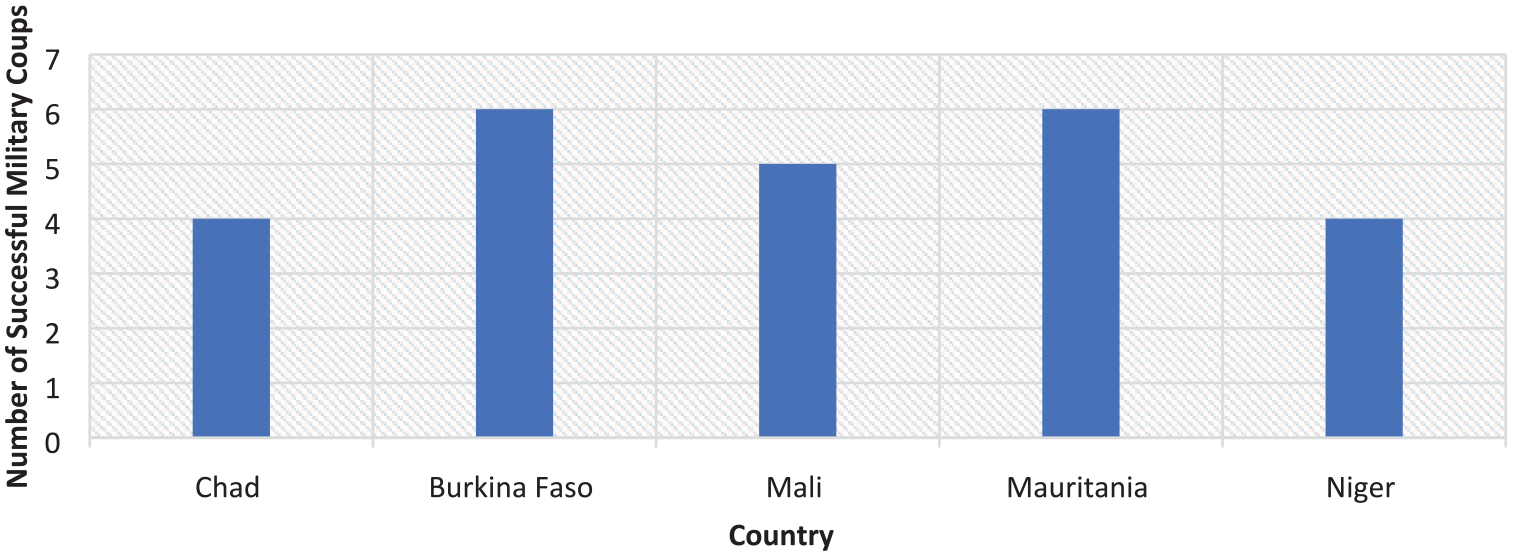
Successful military coup d’états in the western Sahel region from 1960 to 2022.
The history of military coups in sub-Sahara Africa dates back to 1963, with the first military coup occurring in Togo. On 13 January 1963, outside the US Embassy in Lomé, the first president after the country’s independence, President Sylvanus Olympio of Togo, was shot. At the time, he fled from dissatisfied soldiers conducting a coup d’état (Willoughby, 2013) led by Surgent Major Emmanuel Bodjolie. A military coup followed this in Nigeria that began on the 15th of January 1966, led by Major General Nzeogwu, whose soldiers were trained in the United Kingdom (Siollun, 2016). The coup d’état was to end corruption and ethnic rivalry. However, this was not achieved as it exposed the vulnerabilities within state institutions in Nigeria. As a result, Nigeria faced several repressive military governments for 29 years, and democracy was restored in 1999. However, the consolidation of democracy is still yet to be fully realised. Ghana also experienced a successful military coup d’état that began on the 24th of February 1966, led by General Joseph Ankrah. The people of Ghana welcomed this military coup d’état, and it was the end of President Kwame Nkrumah, whom his people once loved for liberation from British autonomy to independence. However, the economic crisis resulting from the power policy implementation of his socialist ideal, among other things, led to his ousting (Harvey, 1966). These three examples of the first sets of successful military coups are linked to poor service delivery, economic constraints and limited civil liberties, which are fundamental to the consolidation of democracy. It has been almost 55 years since these military coups, and they are still occurring for nearly the same reasons they did then.
The article decries the complicit roles of foreign powers in supporting coups and the ineffectiveness of regional institutions to return the military to the barracks. The article is divided into many sections. It starts with a section on the introduction, followed by a discussion of the new trends of coups in Africa and subsequently engages the military–civil relations. The fourth section focuses on the link between coups and democratisation, followed by the role of regional institutions in combating coups and the next section engages the complicity of foreign powers and concludes.
Methodology
The article adopts a qualitative research method through unstructured interviews conducted between April and July 2022. The qualitative method was used in place of the quantitative method due to the social and complex nature of the theme of the paper. Data were collected from face-to-face interactions in Pretoria in South Africa and Lagos in Nigeria, while virtual interviews were conducted with participants in the United States and Conakry in Guinea. The following major actors in the democratic, peace and security architectures of Africa were purposively selected and interviewed based on their expertise and active participation: two university professors; two diplomats (each from Nigeria and South Africa); an expert on peace and security and an academic in Guinea. The participants were granted anonymity as a condition of the interviews and as part of the ethical consideration that guides the research.
Contemporary trends of military coups in Africa (2018–2022)
The Sahel region has been confronted with numerous social, political and economic issues that have proven to be severe. Between 2018 and 2022, the unfolding resurgence of military coups has pointed out the potential of a leadership crisis in the fight against socio-economic failures, terrorism and violent extremism. This section of the paper presents a case study of the six military coups that transpired during this period.
Led by Colonel Assimi Goïta, the Malian military took advantage of public dissatisfaction with the parliamentary election that was reportedly manipulated and the government’s inability to restore order and protect the civilian population from constant attacks by violent local armed groups and Islamic extremists. President Ibrahim Boubacar Keita signified the government’s many failures, ranging from corruption to instability. As a result, when the military coup occurred, several Malians celebrated the August 200 government takeover (Dion and Sany, 2021). In May 2021, nine months after the August 2020 coup, Mali’s military arrested the interim civilian President Ndaw and the prime minister whose appointments the military had overseen. Goïta claimed that the cabinet formed by the civilian leaders violated the terms of Mali’s transition charter and installed himself as president of Mali. The People of Mali saw it as ‘people in power fighting among themselves’. Research released by Afrobarometer (2021) found that 75% of Malians prefer democracy. While the masses are willing to give the military a chance at governance due to their incorruptibility, the lack of clarity in the military’s plan for transition to democracy has raised concerns from civil society groups and the international community. The Goïta-led military initially proposed a February 2022 date for a return to democracy, but this was shifted to 2026. Pressure by regional organisations and the international communities has forced the junta to announce a 24-month transition period for the conduct of elections.
In March 2021, an attempted coup took place in Niger. The attempted military coup was aligned with tensions in the country from a presidential electoral run-off in February 2021. The seating president at the time rejected the outcome but was later persuaded to relinquish power and create history as the first civilian president to peacefully hand over power to another (France 24, 2021a). According to France 24 (2021b), ‘Mohamed Bazoum polled 55.75 per cent of the votes against the incumbent president Mahamane Ousmane who got 44.25 per cent’. However, Ousmane claimed he had won the election by 50.30%, and he contested the electoral outcome in the constitutional court, which was rejected. Two days before the presidential inauguration, a coup attempt occurred to snub the new president. About 137 people were killed in western Niger due to a clash with jihadist groups (The Defence Post, 2021). The African Union (AU), the Economic Community of West African States (ECOWAS), and Algeria condemned the attempted military coup. According to the Algerian Foreign Affairs Ministry, ‘Algeria reiterates its full support for the preservation of the stability and well-being of the brotherly people of Niger with which it maintains historical relations based on friendship, cooperation, solidarity and good neighbourliness’ (Maurouf-Araibi, 2021). The fear of political instability was so high because of Niger’s fight against terrorism and inter-ethnic violence. Any form of instability in Niger would worsen the political turmoil and security crisis that has hit the Sahel region (Interview, academic, April 2022, Conakry).
The third coup in the Sahel region occurred in Chad. In April 2021, President Idriss Deby of Chad, who had ruled for over 30 years, was killed on the battlefield. The military installed his son, General Mahamat Idriss Deby, as an interim president. Chadians began to protest this move and multiple non-governmental organisations, including a cross-section of the political elites referred to this as a ‘military coup d’état’ (Debos, 2021). What made this more concerning was the repressive reaction by security forces, which led to nine civilian deaths. Chad is a heavily militarised state politically, which is rooted in rebellions and suppression of human rights (Debos, 2021). Insecurity in the country has been attributed to the militarisation of the Sahel and the complicit roles of its former colonial power, France. Among many reasons, French interventions, while militarily successful, failed to establish the kinds of state legitimacy necessary to ensure sustainable peace and political stability (Interview, Professor of African Studies, April 2022, United States). France’s endorsement of African political leaders meant they had less incentive to serve their country and develop the state in a manner that caters to the marginalised communities. It also denies the people their right to vote and to stand for elections. Thus, the militarisation of Chad by foreign powers, including France, undermined the efforts to re-establish effective civilian administration (Brachet, 2022).
The spillover effect of the waves of coups in the zone hit Guinea in September 2021, when President Alpha Condé was removed by the military under the leadership of Special Forces commander Mamady Doumbouya. Ironically, Colonel Doumbouya declared the coup the people’s mission and a just intervention (Center for Strategic and International Studies, 2021). This military coup was carried out on the premise that President Condé was developing an autocratic overreach by trying to amend the constitution to run for a third term, leading to eroding democrat norms. Second, the economy had been mismanaged, and poor service delivery was evident through bad roads and dilapidated hospitals. According to the Afrobarometer, 63% of Guineans believed that corruption had increased between 2019 and 2020 (Keulder, 2021). Guinea has failed to fully consolidate its democratic transition, which is evident with the third military coup d’état since its independence in 1958. In support of the posture of the military that they should be seen as a promoter of democracy and protector of the helpless masses, the 2021 coup d’état sparked a wave of celebrations across Guinea (Interview, academic, April 2022, Conakry). This was in disregard to its condemnation by the international community, including ECOWAS which went as far as sanctioning the military leaders behind the coup d’état (Sakor et al., 2021).
Finally, in October 2021, the military under the leadership of General Abdel Fattah Burhan, which sacked Sudanese President Omar al-Bashir in 2019 and installed a civilian–military power-sharing arrangement, struck again and removed civilian Prime Minister Abdalla Hamdok, blaming political infighting and disrespect for democratisation as the cause of the military takeover. The people of Sudan did not welcome this move as days after the coup, there were campaigns of civil resistance against the military junta as they called for the reinstatement of the civilian-led government (Akinfenwa, 2021). Weeks after the coup, the military gave in to domestic and international pressure. It reinstated the prime minister, and despite this, the streets of the capital, Khartoum, were still filled with protesters.
As illustrated above, African countries have had conditions that create a breeding ground for military coups. These conditions include poverty and poor economic performance, repression of individual freedoms, instances of unconstitutional democratic norms and poor service delivery. Often it has been evident that when a country has one coup, that’s a harbinger of more coups, and Figure 1 attests to this notion. While popular uprisings are legitimate and people-led, their success is usually determined by the decision taken by the military (Professor of political economy, April 2022, Lagos).
Civil–military relations
The military, as the institution vested with the authority and power to protect a country from internal and external aggression, is always involved in politics. Thus, there are three ways in which the military has participated in politics: in the discharge of its constitutional roles of providing security, in supporting other groups to remove an illegitimate government and in ruling a country – either directly or indirectly. For instance, in Congo-Brazzaville, the military collaborated with other interest groups, including the trade union leaders and the youth, to remove the illegitimate government of President Fulbert Youlou in 1963 (First, 1970: 18). This was not categorised as a coup; it falls within the first two categories. This study focuses on the third category, which involves direct military intervention in politics through coups.
First (1970: xi) provides a general theory of power for post-colonial African states which explains why they are so vulnerable to army interventions in politics. Understanding the historical and current interactions between the military and political authority is crucial. Historically, the African military has been involved in politics to perform its ‘constitutional role’ with the ‘intention to retire to the barracks once they have purified public life’, as demonstrated in Ghana in 1966 and Sierra Leone in 1968 (Finer, 1974: 6). The armed forces have also hijacked power to perform the ‘guardian role of the military’ by returning power to a civilian administration after a democratic transition. First (1970) maintains that once the political sanctuary or political realm has been violated by coups, the military will always attempt to come back to power.
Janowitz (1964: 5) classified military involvement in politics into two categories: ‘civil–military coalition’ and ‘military oligarchy’. The former refers to military involvement in governance without assuming the top political leadership, exemplified by Nigeria’s Interim Government under Ernest Shonekan from 26 August 1993 to 17 November 1993. The latter describes the post-Shonekan era when the military headed by General Sani Abacha ousted him and directly ruled the country till his death in 1999. Military’s direct intervention in politics, through military coup d’etat, is based on two factors: favourable social conditions such as a ‘latent chronic crisis of legitimacy’ and the existence of the will of the military to intervene (Finer, 1974: 15). Furthermore, First and Finer believe that military interventions are linked to the level of political culture. Thus, ‘the higher the level of political culture, the fewer would be the opportunities for the military, and the less support the military would receive. The lower the level of political culture, the more numerous the opportunities, and the greater the likelihood of public support’ (First, 1970: 13–14).
The resurgence of military coups in the past 2 years highlights the decline in the institutionalisation of democracy. The institution, which in this case is the military, was created to serve and protect the state and is also powerful enough to be a threat to the state, in as much as its role is to protect the state from enemies (Feaver, 1999). However, rhetoric in the media has mainly focused on the military’s renewed efforts to overthrow civilian governments. Indeed, ‘in a democracy, the hierarchy of de jure authority favours civilians over the military, even in cases where the underlying distribution of de facto power favours the military. Regardless of the military’s strength, civilians should remain the political masters’ (Feaver, 1999: 215). In the cases that have been unfolding since late 2018, there is evidence of a higher power in state affairs. These include former colonial powers such as France and economic interests from external actors such as Russia and China. Hence, the major powers’ involvement in training African military personnel has triggered several questions, among which are: Has foreign security sector assistance fuelled the resurgence of coups on the continent? Is the military protecting the interests of foreign sponsors whose business and political influence are threatened by African civilian governments? Is it also essential to consider the military–industrial complex or rethink civil–military relations (CMR)? It is thus pertinent to focus on the relationships between military institutions and the broader society; between military elites and foreign donor countries; between the military and other government bureaucracies and between political elites and different interests within the military.
Indeed, the context in which a state develops its CMR model influences the possibility of military intervention in politics (Interview, expert on peace and security, April 2022, South Africa). It was alleged that most of the officers involved in the Malian army putsch were recently trained in Russia. According to Redondo (2020), the army leaders who participated in the coup d’état visited Russia in January 2022, as part of a training programme arranged by Russian forces. They returned to Mali a few days before the overthrow of President Keita. However, Russian State Duma member, Oleg Morozov, denied the allegations that Moscow was complicit in the military coup (Ramani, 2020). However, France’s exit from Mali and the visibility of the Russian military in Mali and other Sahel countries have strengthened this narrative (Interview, diplomat, June 2022, Lagos). On the 21st of August 2022, the Russian Ambassador to Mali and Niger, Igor Gromyko, met with the military personnel that executed the coup under the National Committee for the Salvation of the People, which raises eyebrows about the involvement of external foreign matter in domestic issues (Ramani, 2020).
Establishing an effective and democratic CMR has also accounted for the military’s participation in several peacekeeping missions on the continent. However, it is unclear whether they have transferred the knowledge derived during training for such missions to their internal operational standards. There is also regional and global militarism among external powers under the guise of combating terrorism. The involvement of foreign powers in Africa’s security sector has impacted the roles of the military in Africa and partly accounts for coups in the Sahel region (Interview, expert on peace and security, April 2022, Pretoria). However, the resurgence of military coups and the seeming legitimacy they enjoyed in countries such as Guinea and Mali could be located in poor governance, exclusive politics, corruption and the illegitimacy of civilian administrations. Civil society organisations have consistently supported citizens’ aspirations for a better life, resulting in increased mass protests against complacent and ineffective civilian governments. This is illustrated by the Black Monday protest in Uganda that occurred in 2013, every first Monday of the month (Essoungou, 2013). A coalition of non-governmental organisations supported the protests. These protests highlight the effects of corruption in Uganda, including the diversion of $15 million into the pockets of public officials (Essoungou, 2013).
Since 2001, there have been more than 80 military coups in Africa. Many of these were patriotic coups, coups in the guise of development or externally sponsored coups. Several were influenced by the neo-colonial powers, as was the case in the Western-sponsored military putsch against the government of President Gaddafi in Libya. According to BBC News (2011), the United Kingdom, the United States and France led the military onslaught that attacked and overpowered Gaddafi’s forces under the guise of enforcing an UN-mandated no-fly zone. Indeed, the United Kingdom and the United States fired more than 110 missiles during the operation, while France attacked pro-Gaddafi military strongholds and the UN-backed forces also supported the Benghazi-led insurgency (BBC News, 2011).
Another explanation for coups in Africa has been the ‘anger of modernity’, which represents the aspirations of both young and older generations to live a First-World lifestyle, failing to acknowledge that they live in the Third World, with Third-World problems (Interview, Professor of African Studies, April 2022, United States). The exposure of the African population to the standards of living of Americans for instance, including the availability of sophisticated social amenities, through the mass media, has become the universal standard to measure the performances of government in Africa (Interview, Professor of African Studies, April 2022, United States). The exportation of liberal democracy to Africa and the promise of accelerated development and exemplary democratic dividends have been a pipe dream in Africa. This has reinforced the call that Western democracy must be retransformed and ‘domesticated’ in Africa to capture the continent’s socio-cultural, political and economic realities. The inability to attain this has led to divisions between the military and civilian administrations, which have engendered coups (Interview, Professor of African Studies, April 2022, United States).
Extended tenure elongations have also been identified as one of the motivations for military coups in Africa. African heads of state have exploited the gap in the Lomé Declaration 1 to remain in power by imposing a caricature of constitutional changes on the people. This is evident in the case of Burundi, where President Pierre Nkurunziza failed to achieve a constitutional amendment for a third term in office and resorted to a self-serving interpretation of the constitution (Omondi, 2014). Another example of term extension is evident in the Democratic Republic of Congo in 2018 when President Azali Assoumani attempted to extend his term limit, and protesters barricaded roads with trees and clashed with soldiers in Comoros (AllAfrica, 2018).
In several cases, the AU has struggled to deal with issues of illegitimate governments resulting in military takeovers. This was the case in Zimbabwe in 2008 when the opposition party, the Movement for Democratic Change, won the election. However, the incumbent government refused to step down. The AU mandated the Former President of South Africa Thabo Mbeki to mediate in the Zimbabwean power crisis, but Pretoria opted for ‘quiet diplomacy’ (Adelmann, 2004). This led to a power-sharing government and negative peace 2 in the country. A similar scenario played out in Sudan and Burkina Faso, where the AU struggled to deal with these illegitimate governments, eventually resulting in the military overthrow of civilian administrations. Former President of Sudan al-Bashir Omar was in power between 1993 and 2019, while Guinean President Alpha Conde was in his third term of office (2010–2021) when the military deposed the two leaders. Faure Gnassingbé Eyadéma, who was elected as the president of Togo, a few months after his father died in 2005, was in his fourth term in office. His father, Gnassingbé Eyadéma, was president from April 1967 to February 2005. Generally, there has been a significant reversal in term limit norms since 2015. According to Sigele and Cook (2021), 13 African countries have overseen the further weakening of term limit restrictions. This threat to the consolidation of democracy has led to political instability. Table 1 illustrates the lack of effective term limits in many African countries.
African leaders that have ruled their countries for over 20 years.
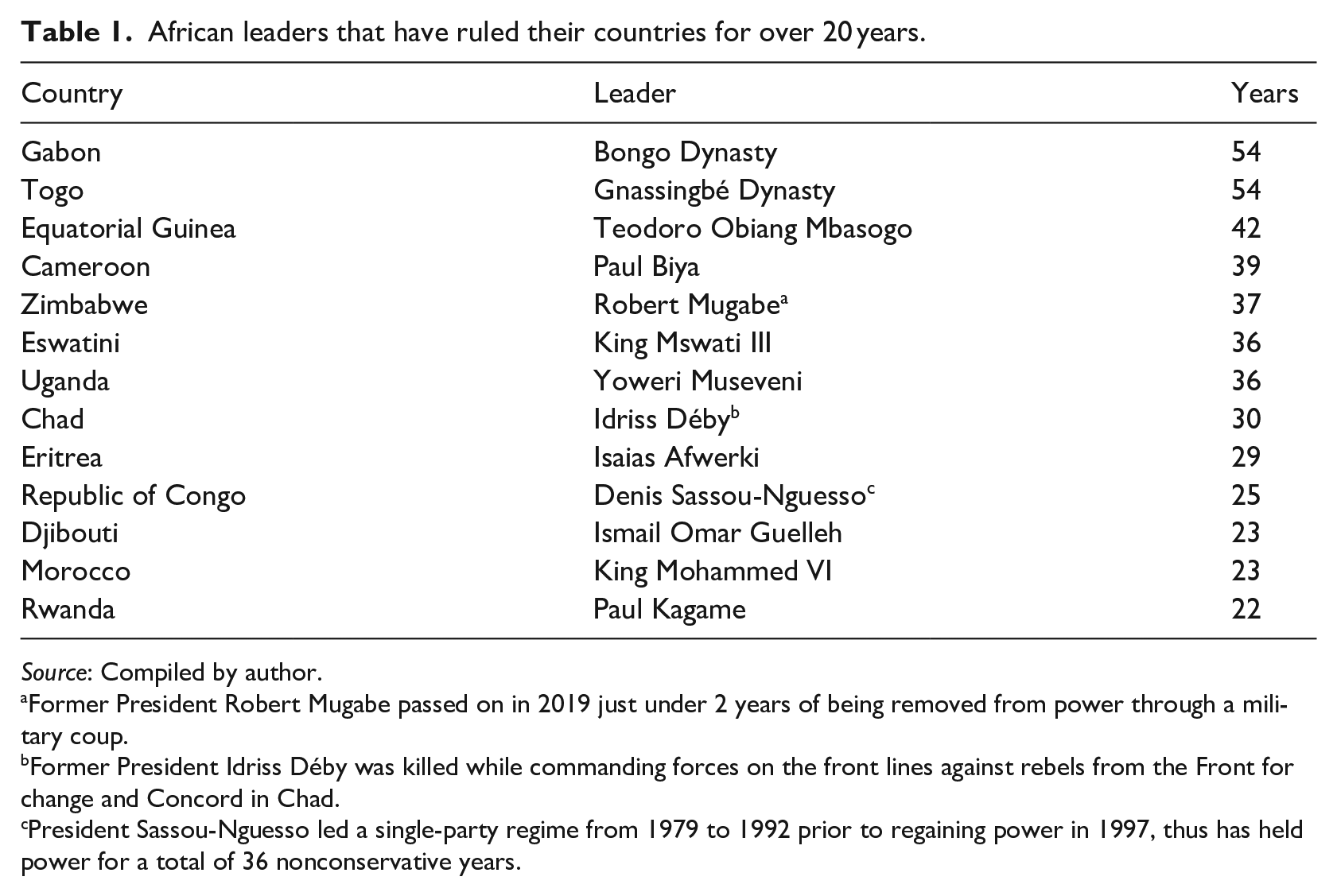
Source: Compiled by author.
Former President Robert Mugabe passed on in 2019 just under 2 years of being removed from power through a military coup.
Former President Idriss Déby was killed while commanding forces on the front lines against rebels from the Front for change and Concord in Chad.
President Sassou-Nguesso led a single-party regime from 1979 to 1992 prior to regaining power in 1997, thus has held power for a total of 36 nonconservative years.
This erosion of term limits compromises the consolidation of democracy and good governance. The loophole on extended tenure has thus played a substantial role in the resurgence of military coups in Africa. While the ECOWAS intervened in the Gambia in 2017 to prevent unconstitutional power extension, other African leaders like Paul Biya of Cameroun have successfully promoted themselves to life president.
Coups as democratic reversals?
There is a tendency among commentators to highlight the number of successful military coups without focusing on the qualitative and quantitative reversals of democracy (Interview, an expert on peace and security, April 2022, Pretoria). The quality of democratic consolidation within a state can be regarded as political development, and the decline of democratic governance is viewed as a qualitative reversal. Furthermore, the total collapse of democracy constitutes a quantitative reversal. From the political economy perspective of development, multiple factors explain democratic reversals in Africa. First, structural challenges, founded on historical factors, have played into the hands of the military actors who have turned the guns against the government they swore to protect (Professor of International Political Economy, April 2022, Lagos). In addition, ethnicity has also been a significant factor under historical factors as it is part of the African colonial legacy. Harkness (2016) states that ethnic conflicts within military institutions have played a crucial role in instigating some military attempts. This has been seen in countries such as Ghana between 1956 and 1966, Nigeria from 1960 to 1967 and Sierra Leone in 1968. Second, the complexity of the post-colonial state, including the intricacies involved in the artificial relationship between the state, economy and society, has broken the organic bond that sustains the state.
In Burkina Faso, the government only has control of 6% of the country’s territory, and the state is facing difficulties with state security due to rebel groups and terrorist groups such as Al-Qaeda and the Islamic State of Iraq and the Levant (Al Jazeera, 2022). In the pre-colonial dispensation, Africa developed a resilient governing structure and a Weberian state of farming, hunting and gathering, which formed the basic patterns of production and appropriation and fostered society’s socio-political sustainability. However, this system did not stand the test of time due to colonialism and the introduction of the capitalist mode of production and economic relations (Professor of International Economy, April 22, Lagos). After that, the attempt to embrace the Western economic and political systems – liberal ideology – has raised several contradictions that continue to stunt sustainable peace and development of the continent (Akinola, 2021). The adoption of liberal democracy in Africa primarily serves the interests of ruling elites and creates weak governmental institutions and unstable governance systems on the continent.
In the 1980s, African states adopted a neo-liberal system with Structural Adjustment Programmes, destabilising their already strained economies. This economic system failed to achieve its purpose of financial stability because of its inability to integrate the productive capacity of African economies effectively. As of 2015, about 50% of the world’s 736 million people in extreme poverty lived in just five countries (Katayama and Wadhwa, 2019). Three of the five African countries include Nigeria (with 98 million people living in extreme poverty), the Democratic Republic of Congo (with 68 million people living in extreme poverty) and Ethiopia (with 35 million people living in extreme poverty). At the same time, the continent’s resource-wealthy countries have recorded a high degree of structural violence, while the high rate of unemployment makes the youth an instrument for violent conflicts (Professor of International Economy, April 22, Lagos). Apart from acute income inequalities, the high youth unemployment rate characterised the three of the largest African economies: South Africa (63.9%), Nigeria (53.4%) and Egypt (26.5%; Macrotrends, n.d.; Trading Economics, n.d.). These factors continue to challenge the ‘Africa Rise’ mantra and provide the enabling environment for military interventions in politics.
Other challenges and unmistakable evidence of a democratic decline in Africa are the unresolved questions of diversity, the politics of identity and exclusion, which have defined the nature of political contestations on the continent. South Africa has played a significant role in trying to provide a haven for international and internal migrants. The Refugee Act of 1998 in South Africa states that, It guarantees to all persons the right to life, and the right to live with dignity, protection of the due process of the laws as well as the right to have access to health care services, sufficient food and water, and social security as well as social assistance (though distinctions are drawn between asylum-seekers and refugees as to the enjoyment of these rights. (Republic of South Africa, 1998)
The economic uncertainty, natural disasters and violent conflict experienced in several African countries became the push factors for immigrating to South Africa, with the highest number of immigrants being just over 4 million between the 2016 and 2019 period (World Bank Group, 2018). As much as the number of migrants has decreased to about 2 million as of 2022, the multiple incidences of xenophobia have persisted. The institutionalisation of anti-immigration and its securitisation in the country led to the formation and evolution of pro-xenophobia groups such as the Operation Dudula in 2021. The anti-migration group has been very active in mass mobilisation for the ‘evacuation’ of foreigners, particularly illegal or undocumented migrants from the country.
Despite this clarity on the status of migrants, a cross-section of the local population and police personnel has attacked foreign nationals who ‘looked’ like undocumented migrants (Mahlatsi, 2022). There are also several anti-foreigner rhetorics by political leaders, such as the leader of the Patriotic Alliance political party, Gayton Mackenzi, who has openly spoken against migrants because he believes they are the main reasons for South Africa’s high unemployment youth rate (Isilow, 2021). While South Africa is noted for violent xenophobia, other African countries such as Ghana and Zimbabwe have displayed subtle forms of xenophobia. The popularity of anti-migration in countries such as South Africa demonstrates the depth of deplorable access to public goods’ effective basic infrastructures and the acute inequality that characterised the socio-economic environment. The futile efforts by many African leaders to attempt to ‘democratise without democracy’, which focuses on regime consolidation and personal enrichment, have left the citizens in a despondent state. The military usually seizes the opportunities presented by such governance gaps and social instabilities to execute military coups. The politicisation of ethnicity and the ethnicisation of politics have sown the seed of discord in several societies to the extent that politics in Africa is strongly associated with ethnic divisions and hostilities (Interview, diplomat, July 2022, Lagos). While ethnicity might not have been the root cause of conflict, African political elites, as evident in Nigeria, have mobilised the people along ethnic lines, thereby using ethnic affiliation to score political points during elections or conflict. The military, as witnessed in Mali, has overthrown civilian administration in such an environment of governance inclusivity and insecurity (Interview, diplomat, July 2022, Lagos).
Africa has suffered under diverse threats, ranging from Boko Haram’s terrorism to local militia, and the political instability brought about by military coups has aggravated the insecurity on the continent. In the 1990s, many African countries tried to demilitarise their politics but failed to depoliticise their militaries (Interview, peace and security expert, April 2022, Pretoria). As a result, several African governments have continued to operate at the mercy of the military. Samuel Huntington’s theory of ‘two turnover tests’ emphasises that if a new democracy survives two turnovers of power, it has effectively consolidated democracy and invalidated it in Africa (Huntington, 1993). Countries like Nigeria that have experienced more than ‘four turnover tests’ are still far from democratic consolidation. The lack of quality leadership on the continent has failed to build responsive and transparent institutions. Peace tends to prevail in countries where the president leaves office after losing an election, demonstrating respect for constitutionalism. This has been evident in a few African countries like Zambia, where President Edgar Lungu relinquished power upon defeat by the leader of the opposition party, Hichilema, in August 2021, without succession disputes. Many other countries in Southern Africa, including South Africa, have experienced stable power transitions. Thus, the Southern African Development Community has witnessed the least military coups due to presidents’ willingness to cede power peacefully after losing presidential elections or through other democratic means.
Regional organisations and the quest for stability
While democracy denotes majority rule, it is usually associated with free and fair elections in the African context. Democracy goes beyond holding elections to entail the creation of opportunities for human security, economic development and social protection. The failure of African states to deliver on the promises of democracy has led to mass disillusionment, political apathy and disconnection of the social contract between the state and its citizens. The World Bank estimates that about 40%, of the African population, lives in poverty, while sub-Saharan Africa accounts for about two-thirds of the poor global population (Schoch and Lakner, 2020). This has been compounded by the millions of people who face personal insecurity from religious extremists and armed groups, especially in the Sahel region.
The Sahel has become the most violent zone in the world. For instance, between January and June 2021, more than 600 civilians were killed in Mali, and from January to March 2022, an estimated 117 people died. Of these, 71 were linked to the Malian armed forces and 36 to armed Islamist groups. In 2020, Chad recorded 196 battle-ready deaths, 45 people died in Sudan and 564 Malians lost their lives in action (Akinola, 2022). In the same period, there were 201 incidents of violence against civilians in the region, 136 battles were recorded and 73 explosions were activated, in 2021. The link between security and development is very evident in Africa, where the proliferation of conflicts has impeded serious attempts at sustainable development. Several African governments have not adopted tangible initiatives to combat poverty and insecurity. Thus, there are high expectations that regional and continental institutions will rescue the region from disorder and insecurity (Interview, diplomat, July 2022, Lagos). Building on the 1980 Lagos Plan of Action, the AU response has focussed on three main projects: Silencing the Guns, the Africa Rise Project and the Africa 2063 initiative.
The Silencing the Guns strategic framework attempts to create conducive conditions for inclusive and sustainable development. The AU aims to silence the guns on the continent by focusing on a widely publicised media campaign to raise public awareness of conflict prevention, peaceful resolution and conflict’s destructive effect on the continental democratic project (Interview, diplomat, July 2022, Lagos). While violent conflicts such as terrorism have threatened the AU’s efforts to maintain peace in Africa, the resurgence of military coups has overshadowed and compounded the quest for security and democratisation of the continent.
The Africa Rise Project, pioneered by former president of South Africa, Thabo Mbeki, aims to mobilise the African intelligentsia to play a critical role in guiding political, artistic or social development in their societies. The failure to silence the guns and African leadership’s inability to manage their diverse cultures due to persistent social instability, structural violence (institutional exclusion and inequality), a lack of cohesion and increased ‘brain drain’ (immigration of highly skilled labour) have scuttled the project. Finally, the Agenda 2063 initiative that has been designed to accelerate development and eradicate poverty by promoting effective governance is also at risk. These schemes have been undermined by state captures, the illicit flow of resources, democratic recession and the process of recolonisation unfolding with the reality of neo-colonialism and the rise of China’s influence in Africa. For instance, in Zambia, President Michael Sata has not been able to govern his state in a manner that fosters development for ordinary Zambians due to his relationship with the Chinese government. There has been an increase in Chinese firms lobbying and threatening to close crucial operations. As a result, the Zambian government backed down on significant tax reforms within the country (Langan, 2017). These tax reforms were sort to better finance service delivery in Zambia; however, this has not changed.
The norms and values of African regional bodies centre on democratic practices. Military coups and military governments are unconstitutional. Hence, any government not elected to power is not recognised by regional organisations such as ECOWAS and the AU. On 01 January 2022, ECOWAS suspended Mali and placed a sanction on the country and its rulers due to the military junta’s attempt to extend the transition period by up to five years (Moderan et al., 2022). The measure was adopted to isolate Mali and weaken its economy while instigating citizens to pressure the government to hold elections. These supranational institutions have several normative frameworks signed and ratified by their member states, for preserving democracy (Interview, expert on peace and security, April 2022, Pretoria). The protocols give regional integration bodies an entry point to intervene when military coups occur or when a constitutional government has been removed. The Lomé Declaration of 2000, which reinforced a commitment to the Charter of the Organisation of African Unity (OAU) and specifically condemned unconstitutional changes of government, should guide the action of the AU when dealing with a military coup (African Union, 2000). The Lomé protocol aimed to consolidate democracy in Africa (AHG/Decl.5 (XXXVI)) and highlighted the understanding of unconstitutional change of government. These include a military coup d’état against a democratically elected government; intervention by mercenaries to replace a democratically elected government; replacement of a democratically elected government by armed dissident groups and rebel movements and refusal by an incumbent government to relinquish power to the winning party after free, fair and regular elections. (African Union, 2000) The Declaration clarified that such illegal governments should not be ‘tolerated and recognised’ by the AU. A weakness is its tolerance of the unconstitutional extension of tenure.
The role of external actors
Since the waves of independence hit Africa from the 1960s to the 1970s, external actors have influenced the continent’s quest for peace and security. In the recent past, western and non-western major powers have been trying to influence the continent’s political landscape. They have also played roles ranging from peacekeeping to creating an environment that compromises developmental democracy (Interview, Professor of International Political Economy, April 2022, Lagos). For instance, China has contributed significantly to peacekeeping missions in Africa, with more than 2000 Chinese peacekeepers in the Sahel region (Leigh, 2021). However, the country’s involvement in the militarisation of Africa is very complex. On the other hand, China’s support for creating economic opportunities on the continent has been very significant. Foreign direct investment increased from $75 million in 2003 to $4.2 billion in 2020 (China Africa Research Initiative, 2021). Unlike the Bretton Woods institutions and their Western sponsors, China’s investment in Africa does not come with a premium on pluralist democracy. Because of this, African autocratic leaders have enjoyed closer relations with Beijing, benefitting from its financial benevolence and expanding its influence over the continent’s resource wealth.
Russia has also invested in Africa’s raw materials, such as magnesium and chromium, and taken a more interventionist approach to shape domestic politics on the continent. Russia has been meddling in Nigeria, the Central African Republic (CAR) and Madagascar’s elections through Facebook and Twitter, favouring incumbent leaders. For instance, in CAR, Russia funded President Faustin Touadera’s electoral campaign in 2020 while simultaneously promoting Russia as an excellent strategic partner (Siegle, 2021). This support by Russia is almost always linked to political leaders who have access to natural resources. As noted by Siegle (2021), Russia has used this approach to enhance its influence with Denis Sassou-Nguesso in the Republic of Congo, Ali Bongo in Gabon, Filipe Nyusi in Mozambique, Andry Rajoelina in Madagascar, Emmerson Mnangagwa in Zimbabwe, Salva Kiir in South Sudan, and Alpha Condé in Guinea, among others.
Russia’s recent role in supporting the military in the Sahel, especially in the Malian case, has been very complicit. Some of the military actors who led the coup in Mali reportedly received training in Russia. This is also the case in the CAR, where Russia’s military regime has received arms and ammunition (Bax, 2021). Furthermore, Paris accused Moscow of exacerbating anti-French sentiment in CAR, as tension built between the French-supported Chad army and the Russia-supported CAR military (Pabandji, 2021). France and other European powers have accused Russia of using its private company, the Wagner Groups, to operate and destabilise the Sahel. The roles of major powers in the Sahel region have made it difficult for African regional bodies to exercise influence over the military. For instance, Russia and China both vetoed the attempt by the UN to take a stance on military coups on the continent. Turkey is also ‘quietly’ cutting through the Sahel, using its Islamic ties. Saudi Arabia has been responsible for the ideological education of leaders of militia groups such as Boko Haram and Al-Shabaab. These actors, consciously or unconsciously, have thus contributed significantly to undermining democratisation on the continent.
On the other hand, the role played by European states and the United States, which is fast declining in the region, has tended to win the support of the civilian population. They provided military support to African governments but are now experiencing hostilities from the military and a cross-section of the population in several Sahel countries such as Mali and Burkina Faso. The military regime in Mali expelled the French Ambassador, leading to the French military contingent leaving the country (BBC News, 2022). In Burkina Faso, a cross-section of citizens blocked the French military contingent during a protest against the French military presence in their country (Africa News, 2022). Since 2013, military assistance by Western states, led by France, has focused on counterterrorism to assist the Sahelian military forces, leading to the establishment of the G5 joint task force (la Force conjointe du G5 Sahel ‘FC-G5S’) in 2017. These foreign troops have also been accused of protecting unpopular civilian regimes in the region at the expense of the civilian populations and military personnel, who continue to be casualties of attacks by local armed groups and Islamic fundamentalists. Over the past few years, the European Union and the United States have invested £2 billion per annum–four times the average annual allocation for humanitarian assistance in the Sahel region.
The African democratisation project has been riddled with complexities and difficulties, which raises questions on whether the liberal model of democracy works for the continent (Interview, diplomat, July 2022, Lagos). There is a significant mismatch between the current democracy fostered by African political elites and what the population expects, hence the tendency for the military to fancy their chances of overthrowing civilian governments and taking up office. However, despite the low supply of democracy, demand remains very high. This is apparent in the last eight surveys by the Afrobarometer in 34 African countries, where 74% of the respondents stated that they preferred democracy over other ideologies (Mattes, 2019). Moreover, youth in Africa have increased political participation through social movements. The power that liberation parties wield is also declining in countries such as South Africa, where the African National Congress (ANC) recorded a significant decline in support in the 2021 local government election. The ANC received 47.9% of the votes in the 2021 election compared to 55.7% in 2016 and 63.6% in the 2011 local government election.
Conclusion
The article has located the place of military coups in African politics. It has presented an overview of military coups in Africa and engages the reasons for their involvement in politics. While the military sometimes sees itself as the defender of democracy, a military coup is unconstitutional, an aberration and impediment to democratisation. Despite the shortcomings of civilian administrations and the turbulent attempt at democratisation, democracy still has a place in Africa. Majority rule has presented Africa with the opportunity to institutionalise strong political institutions and build the material and human resources that are required to lead the masses out of their economic misery and insecurity. Military coups have the tendency to erode the gains of democracy, not only in the Sahel region but in other parts of Africa, due to their spillover effects. Indeed, the resurgence of military coups reflects poor democratic performance, a lack of effective governance, acute greed and corruption among political elites and the underdevelopment of mineral resources and human capacities.
While the regional institutions have been guilty of ineffectiveness in preventing and removing military regimes, the involvement of foreign powers has complicated the interventionists’ environment. Nonetheless, across Africa, keeping the military out of power has become a priority for stakeholders involved in the continental security and democratisation projects. To foster an environment that makes it impossible for the military to overthrow civilian administration, African countries need to create one where governance ensures quality inclusive service delivery to all citizens. Moreover, the politicisation of the military also needs to change. African civil society organisations need to be more critical of the levels of governance within African states. Both the AU and ECOWAS also have a decisive role to play in this regard.
The AU should make consistent use of the instruments it has put in place, such as the Lomé Declaration of 2000 and its Charter of Democracy and Governance of 2007 when dealing with military coups. Military coups should be seen as an aberration and antithetical to the region’s quest for stability and development. All forms of forceful seizure of power or removal of democratically elected governments must attract the same penalties from regional and continental bodies such as ECOWAS and the AU.
African countries need to add term limits to their constitutions and criminalise any attempts at tenure extension. The continent’s supranational institutions should support their member states by adding an institutional code that invalidates third terms for incumbent presidents. Government structures must be more inclusive and provide a space for civil society engagement, including inputs from other sectors such as the military. Depoliticisation of the military and effective security reform must be a top priority of African civilian administrations. This is an essential corollary for keeping the military out of power. African governments need to foster rapid economic transformation that works for the people, driveny the people and is owned by the people. While Western governments have failed Africa in terms of providing the required support structures, states should be wary of new friends such as China, Russia and Turkey. International relations are driven by states’ interests; thus, economic considerations are the main drivers of the new scramble for Africa, from the Horn to the Sahel.
Footnotes
Funding
The author(s) received no financial support for the research, authorship, and/or publication of this article.
