




Abstract
Alter-globalization comprises a set of civil society organizations that refute the methods and consequences of liberal globalization or globalized capitalism. At the same time, these organizations hope to achieve a different form of globalization or global economy than the existing ones. This article intends to shed light on Iran’s foreign and economic policies, which were established on the basis of the non-aligned state ideology. This ideology forced Iran to find a third way that was neither capitalist like the West nor socialist like the East, which allowed Iran’s domestic economic powers not only to concentrate on the main power but also to interfere less in foreign policy affairs. Based on Shia Islamic sources and interpretations, Iran’s unique ideology had to find a way to adopt globalized approaches vis-a-vis internal and regional turmoil. This article concludes that Iran created its own path based on this Islamic interpretation and involved domestic forces committed to the revolution’s ideological path, which, nevertheless, found detours that would let it take part in the globalized economy and, in the end, categorize Iran as an alter-globalized state.
Introduction
Iran is one of the few states that has experienced complex international sanctions for several decades (from 1979 to date). America imposed bilateral sanctions between 1979 and 1995 because of the capture of American hostages, and between 1995 and 2006 following Iran’s clandestine nuclear activities. In addition, multilateral sanctions have been imposed by the United Nations, the United States, the European Union, and other countries. Since 2005 and 2007, respectively, the United States and the European Union have applied additional bilateral sanctions because of the international threat posed by Iran. However, an analysis of these sanctions could not establish a direct link with the causes put forward; instead, they seem to be a policy of “sanctioning the population to punish the regime” (Coville, 2015: 150, 153).
Indeed, in 2002, the Islamic regime’s opponents publicly denounced the clandestine nuclear activities carried out by Iran aimed at enriching uranium for military applications (Le Guelte, 2006: 5). In 2003, Iran’s authorities officially recognized the existence of these activities since the issue worried national and international opinion, given its implications for international security and its impact on the Iranian national economy. In 2005, because of its timid cooperation, Iran was accused of non-compliance with safeguards agreements; as a result, there were economic sanctions after the International Atomic Energy Agency (IAEA, 2005) referred Iran’s nuclear file to the UN Security Council. In 2015, after protracted negotiations, an agreement was reached on this issue, but in 2018, the United States unilaterally decided to withdraw from it. This withdrawal nullified all the commitments between the parties and caused Iran to suffer from the same economic sanctions regime that had already affected its national economy and development. Despite this, Iran has managed to ensure its survival and maintain relative political and economic stability thanks to an economic model inspired by Shia Islamic sources.
In 1979, the revolutionary regime established a new economic model. A decade later, civil society actors worldwide came together to demand the advent of an economic model that differed from the two dominant currents (Caouette, 2008: 155). When considering anti-globalization movements as non-state actors, limited in their actions because of their lack of power and international legitimacy, and Iran as a state actor, endowed with powers and international legitimacy, both are fighting for a common ideal—the emergence of another form of globalization. This article therefore aims to consider the establishment, success, and contribution of the state’s alter-globalization and third way to the Iranian regime’s survival. Furthermore, it aims to highlight the strategies and efforts deployed by Iran to face the globalized economic system—dominated by Western paradigms—that it denounces to ensure its political survival.
In the context of the Iranian Islamic regime, there exists a correlation between ideology, economic model, and the third way. According to this ideology, the ideal leader should possess the qualities of a prophet, philosopher, and legislator. With these capabilities, the leader has the legitimacy to organize and manage human society and command believers in anticipation of the return of the hidden Imam (Delcorde, 2019: 2). In the aftermath of the 1979 Islamic Revolution, led by the marja, the Iranian regime established a new foreign policy that diverged from the pro-Western, liberal, and secular domestic policies of the Shah. As a Shiite Islamic State, Iran believes that Sharia law should govern all aspects of society, including its economic model. This is based on the principles of Shia ideology that result from ijtihad, which is at the very core of the institution of marja. This logic is consistent with Iran’s identity and vision of building its own economic model—Iqtisaduna—instead of adopting models from the East or West. Through its ideology and economic model, Iran has developed a unique third way that prioritizes safeguarding its identity and countering any form of external domination.
This is because globalization is not limited to economic and financial fields but also extends to other areas such as culture and politics, which poses a risk of encouraging foreign interference in internal state affairs (Zaki, 2002: 25). Iran is anxious to preserve its Islamic character and perceives the current globalization as a means of disseminating Western values, which it believes disguises imperialism. As a result, Iran pursues a dual approach of conservative domestic policy and liberal foreign policy, which can be described as a form of limited globalization. Iran aims to be a proud nation that aspires to participate in globalization while also safeguarding its identity and interests. This approach allows Iran to engage in global interactions while maintaining its distinct Islamic character and resisting any attempts at Western cultural hegemony (Angibault, 2018).
The proposed hypothesis can be summarized as follows: the Iranian model is an economic policy tool and a form of alter-globalization used by the Islamic regime to ensure its political survival. The Iranian regime’s third way provides it with benefits and advantages due to the fact that it identifies itself as neither capitalist nor socialist, despite having characteristics of both, which allows it fairly broad room to maneuver. By sustaining its alter-globalism and third way, Iran is trying to influence the globalized economic system from within to ensure its security (Bauchard and Therme, 2007: 14). This study will consider Iran’s ideology, policies, and strategies to demonstrate how the Islamic regime succeeded in establishing and applying its economic model for survival and what it experienced. In fine, it will analyze how Iran’s alter-globalization and third way contributed to the survival of this state under siege.
Methodology
The study’s research process aims to expose two alter-globalism ideologies carried out by heterogeneous actors (state and non-state) and to analyze how Iran has used one of them to convert ideology into politics and action successfully. It will also help explain how a state—Islamic and Shia, besieged and cornered—has survived by using an ideology similar to those defended by many secular supporters in the West. The article begins by examining the literature on alter-globalization to determine its nature and origins, as well as the literature on the third way and the Islamic economy. It will then analyze the alter-globalization and the third way characterizing Iran and the influence of the Islamic economy on the Iranian regime and society. Finally, the influence of the main actors on the Iranian national economy will be briefly outlined prior to the conclusions.
Alter-globalization
Alter-globalization is a new and complex phenomenon to define and does not yet have a consensual scientific definition, just as international terrorism still does not yet have a consensual political definition as wished by the UN (Doucet, 2005: 253). This gap forces any researcher interested in this phenomenon to examine the available scientific literature to find, at best, an explanation that formulates some fragmented definition of what alter-globalism is. Therefore, perspectives on alter-globalization and the third way must first be discussed in order to be able to apply them to the present case study.
The contemporary alter-globalization movement started in the early 1990s in Latin America before it expanded into Europe through demonstrations in opposition to the global economic system, including neoliberalism and the dominant policies resulting therefrom. One of the difficulties with defining alter-globalization is that it seems to comprise a set of civil society organizations that refute the methods and consequences of liberal globalization or globalized capitalism. At the same time, these organizations hope to achieve a different form of globalization or global economy than the existing ones (Fougier, 2012: 28).
Contrary to popular belief, the alter-globalization movement does not oppose globalization because it recognizes the merits of a globalized system that contributes to global economic exchanges and promotes economic development. In this sense, Henry Nau (2019) recalls that “countries choose to join the global economy, and globalization gives them more options” and that “no country has developed in isolation” (p. 491). Instead, what alter-globalization movements dispute is liberal economic management as expressed by privatization, deregulation, and open markets, which, from their point of view, create injustices, inequalities, social insecurity, and so on within states’ populations and between industrialized and so-called third-world states (Ancelovici, 2004: 45–51).
Alter-globalization denounces opposition between morality and self-interest to the extent that the pursuit of individual interests constitutes the basis of the liberal economy, which is catastrophic for humanity. Therefore, it refutes market and state interventionism in the economy beyond liberalism and socialism and instead favors egalitarianism as a fundamental value of autonomy. As such, alter-globalization is the only alternative system providing for peoples’ and states’ economic self-determination (Champeau, 2004: 700–702). In their articles on alter-globalization, Eddy Fougier (2012) and Serge Champeau evoke and stigmatize the “fight” for another character of globalization and economic “egalitarianism” in the activism of the alter-globalist movement, respectively. These observations lead one to consider alter-globalization as an “ideology” that defends a coherent conception of the world and leads to an autonomous political program based entirely on liberalism (Parentau, 2011: 14).
One of the most active civil society organizations in this regard is the Association pour la taxation des transactions financières et pour l’action citoyenne (ATTAC; Association for the Taxation of Financial Transactions and for Citizens’ Action). Its supporters consider the economic imbalances generated by a liberal economy to be maintained by global institutions such as the International Monetary Fund, the World Bank, and the World Trade Organization for the benefit of the most powerful states. These institutions act as supranational bodies exercising influence and power over national governments at the risk of violating national sovereignty (Ancelovici, 2004: 51–52). Such considerations among ATTAC’s members converge with what Zbigniew Brzezinski (2000) wrote about American global supremacy when he argued that the United States has developed a global system of specialized organizations, including financial organizations, since the Bretton Woods Conference in 1944 in order to perpetuate its global hegemony (p. 54).
Regardless of the difficulties not only with overhauling the current globalized system overthrow but also with proposing a radically opposing global economic model, the alter-globalization movement does not hold either political or financial power and lacks the recognized international legitimacy necessary to effect such changes. Therefore, they express themselves during major international meetings in various ways, such as through demonstrations, symposia, acts of insubordination, and so on, to make their voices heard when they cannot effectively and radically change the situation. They aspire to establish a form of globalization other than that which exists to create a middle path between the current form of globalization—which generates inequalities and injustices, according to them—and an ideal system, which is difficult to set up in practice (Bonfiglioli and Bugden, 2006: 115).
The Iranian state’s identity is strongly tied to Islamic ideology, which it must defend in order to maintain its revolutionary regime. However, this cannot be achieved without a strong and stable state structure to support it. Iranian foreign policy links religious principles to liberal secularization through the state’s pragmatism. While Islamic ideology recognizes the obligation to defend the oppressed (Shirdel, 2007b: 15), marginalized by Western neoliberal capitalism, it also recognizes the Iranian state’s obligation to establish social justice. Thus, the defense of the oppressed and the establishment of social justice go beyond ideology and bring together marginalized groups in a pragmatic and secular approach to confront all forms of imperialism. The ultimate goal is to create an alternative form of globalization that promotes social justice and equity for all.
Despite decades of being subject to sanctions, Iran has shown a willingness to engage in negotiations with the West since 2012. However, this shift does not signify a complete embrace of globalization but rather a recognition of the need to exchange with other countries in order to protect its vital interests and strengthen its domestic policy. A pragmatic consensus has emerged among business circles, former Revolutionary Guards, and political and economic authorities in Iran who wish to develop their activities through negotiations with foreign countries. This consensus has formed around Ayatollah Khamenei with the aim of preventing the regime weakening at a time when political conditions in the Middle East have become more conducive to regime change (Hourcade, 2012: 497–499).
The third way
The third way is an alter-globalist sub-ideology considered as the alternative to the current globalized economic system. It aims to be balanced, equitable, and egalitarian both between and within states and operate as a system in which economic power is no longer held by a minority at the expense of the majority. Such a path would lead to states playing genuinely regulatory roles and avoid giving in to international financial organizations and multinational companies (Bonfiglioli and Bugden, 2006: 111). These multinational companies, often singled out despite not constituting the sole cause of exploitation and inequality, as Nau (2019) rightly mentions (p. 489), make states dependent on their investments to the point that they lose their means to act against the capitalist system that governs them and thus see their sovereignty taken hostage.
However, there is some criticism about how the third way evokes the political risk represented by alter-globalization organizations’ leaders. First, their lack of legitimacy is characterized by their self-proclamations and by dangerously heaping discredit on the legitimacy of established democratic institutions by forcefully denouncing everything they do. Second, the populist speeches of some of these organizations may pose a threat to democracies. Third, actions carried out by alter-globalization organizations aim to propose alternatives, but these are not sufficient because denouncing, criticizing, disobeying, and organizing counter-summits and activism do not on their own constitute an effective alternative. Also, considering the improbability of alter-globalists coming to power, an effective system change remains uncertain. However, caution is needed because what seems to be a utopia could become a real global challenge (Champeau, 2004: 705–706).
Another consideration about the third way has been put forward by the alter-globalization writer and co-founder and honorary president of ATTAC, Susan George. When she was interviewed about the alter-globalist ideology and possible alternatives to the current global economic system, she expressed barely concealed concern regarding the chances of arriving at a realistic and feasible alternative: [T]hese are discussions that do not depend on us . . . we don’t know, we are doing what we can in the hope that the end result will be a system quite different from this one . . . political victories are always gradual, fragmented, incomplete. . . .
She concluded by saying: “We must put an end to a system where business law takes precedence over human rights by obtaining the necessary legal arsenal” (Bonfiglioli and Bugden, 2006: 111–112). Here, George expressed her uncertainty about the results of the alter-globalization movement’s goal to find an alternative to the current global economic system and the need to obtain a missing legal framework. This can potentially be provided by Iran. As it is a sovereign state, it is thus an international actor endowed with sovereign power, international legitimacy, and the necessary means to establish and apply an alter-globalization ideology in its domestic and foreign policy through its third-way survival model, much like the USSR did with socialism and the United States with capitalism. The alter-globalist movement lacks international legitimacy and necessary means, yet these are fundamental.
Before concluding this overview of the literature on the alter-globalization movement and the third way, it is important to include another group with similar characteristics and objectives. These are the non-aligned countries, so-called because they have not (publicly) displayed their affiliation to one of the two blocs—East and West—since the beginning of the former Cold War. They also denounce and fight together against the current economic system, which they deem dominant and unjust, and are looking for a different way to establish a fair and balanced trade and economic system between the most and the least industrialized countries.
Michel Rogalski (2006) explains that the resistance of third-world countries to the North-South divide, aggravated by the asymmetry of relationships imposed by globalization, is at the heart of the approach of the non-aligned countries, who want to have more of an impact on the world order. (p. 5)
Most so-called third-world countries were subject to exploitation by the Western powers, including Iran, which led it to join the Non-Aligned Movement (Rogalski, 2006: 3), 1 for which it became the standard bearer.
As this brief literature has shown, non-aligned countries, the alter-globalization movement, and Iran have similarities in their demands and action for a third way. Therefore, can Iran be considered a pioneering state in the promotion of the alter-globalization ideology?
The Islamic economy
Using principles of rational and religious inquiry known as ijtihad, 2 the eminent Shia cleric Ayatollah Muhammad Baqir as-Sadr wrote a book entitled Iqtisaduna (Our Economics). This book offers a comparison between capitalist and Islamic economic models and attempts to demonstrate their functioning. To do this, as-Sadr draws from the Holy Quran and the hadiths of the Prophet Muhammad and imams to show that the Iranian economy’s roots are Islamic. Iqtisaduna proposes an economic model that strives to be different from capitalism and Marxist socialism, a kind of third way based only on Islamic law (Sharia).
Iqtisaduna was written in the 1960s and published by the Islamic revolutionary regime in 1982. In it, the author addressed the fundamental questions comparing capitalism, socialism, and the Islamic economy. It sets out several theories and principles, the main three of which will be briefly considered here.
The first principle is that of dual ownership. As-Sadr considers, on one hand, capitalist society’s belief in the particular and individual form of property, namely, the private property of individuals, and on the other, how socialist society does the opposite insofar as common property is the basic principle applicable to all national wealth. Therefore, as-Sadr considers that Islamic society should not separately apply either the capitalist principle of private property or the socialist principle of common property, because it simultaneously admits different forms of property. This is the principle of dual ownership, which strongly upholds the principles of private property, public property, and the state without being a mixture of the capitalist and socialist models (as-Sadr, 2009: 49–52).
The second principle is that of economic freedom within a limited framework. As-Sadr believes that the economic model proposed in Iqtisaduna grants economic freedom to all individuals within a moral and ethical framework defined by Islamic principles. In contrast to capitalism, which grants individuals endless freedoms, and socialism, which confiscates them, the Islamic economic model advocates a general approach allowing the exercise of individual freedoms within the framework of Islamic values and ideals, thus guaranteeing freedom. Unlike the capitalist and socialist models, the Islamic economy model has the two following advantages: a level of restraint is exerted through self-limitation emanating from the depths of each person because of their healthy morality, and objective limitations are expressed by an external force regulating social conduct thanks to the Islamic law which prohibits certain economic practices, such as usury or monopoly (as-Sadr, 2009: 52–57).
The third principle is that of social justice, which is embodied in Islam and is concerned with the distribution of wealth in society. It has two general principles: solidarity and social balance. As-Sadr’s model supports the application of realism and morality to the Islamic economy, preventing it from suffering from utopia, as was the case with communism, or from any selfish tendency, which is often attributed to capitalism (as-Sadr, 2009: 58–63). The Islamic economy model thus embodies realistic social justice that considers individual needs and a moral guarantee of societal balance based on collective solidarity.
Several researchers and scholars have looked into the themes of alter-globalization, the third way, and the Islamic economy; however, few have looked at Iran’s ideology and strategy to use state alter-globalism and the third way to survive politically and economically. This article thus aims to enrich the literature with a rigorous, scientific, and innovative study. The following paragraphs will be devoted to analyzing Iran’s effective implementation of the ideologies of alter-globalism, the third way, and the Islamic economy for the purposes of survival.
Dual ownership is a constitutional principle that affirms the right of every citizen to create commercial enterprises and to own private property without discrimination. It upholds the values of private property, public property, and state ownership and does not adhere to a strict capitalist or socialist ideology (as-Sadr, 2009: 49–52). However, in practice, access to benefits such as investment credits, state-owned enterprises, and tax exemptions is often limited to those with political connections or influence. The principle was intended to reduce inequalities in private land ownership, and while some revolutionary leaders and the Supreme Leader supported land reforms in 1980 to promote a more balanced distribution of land (Shirdel, 2007a: 119), some observers believe that these reforms did not fully address discrimination and corruption (Shirdel, 2007b: 18–19, 29).
The principle of economic freedom in a market economy is grounded on the fundamental concepts of personal choice, voluntary exchange, freedom to compete, and protection of persons and property (Gwartney et al., 2005: 573). It is most effective when individuals are permitted to make their own choices and engage in voluntary transactions, provided they do not cause harm to others’ person or property (Malek, 2014: 332). However, the Iranian government’s significant intervention and control over the economy, due in part to its central position in the economy, can impede the exercise of true economic freedom. The Iranian government has favored a rentier economy to offset its companies’ lack of competitiveness while also ensuring its control and internal stability and limiting potential foreign influence through globalization (Malek, 2014: 336).
In the Economic Freedom of the World Index’s summary of economic freedom ratings from 1998 to 1999, Iran was ranked 102 out of 123 countries (Gwartney and Lawson, 2003: 417–418). Furthermore, Iran was ranked 119 out of 122 countries for freedom to trade with foreigners (Gwartney and Lawson, 2003: 423). The Heritage Foundation’s Economic Freedom Index for 2023 ranks Iran with a score of 42.2, placing it 169th out of 176 listed states (Heritage Foundation, 2023). It is worth recalling that Iran was a rentier state even before the Islamic Revolution of 1979. 3 Due to the sanctions imposed and the war with Iraq, Iran’s economy lacks development and diversification and has become increasingly dependent on petroleum products. As a result, Iran requires these rents to sustain its legitimacy, existence, and survival (Bina, 2017: 65). The rents fund essential subsidies for food, education, water, fuel, and electricity, which are used by other regimes to gain short-term legitimacy (Solomon, 2020: 3).
The principle of social justice is one of the three primary objectives of the Islamic Revolution, along with democracy and national independence (Amirahmadi, 1989: 92). It was established in response to the unequal development of capitalism in Iran and is enshrined in the post-revolution constitution. The aim of social justice is to reduce the wealth gap between the rich and poor, eradicate poverty, and prevent privatization (Amuzegar, 2007: 60). The Constitution requires the Islamic Republic to establish justice and encourages public participation in societal affairs through sectoral and territorial councils (Amirahmadi, 1989: 104). Furthermore, the government is encouraged to provide free education and basic necessities such as food, clothing, health insurance, housing, employment, and social assistance for pensioners, the unemployed, and the elderly (Iranian Ministry of Culture and Guidance, 1996: ch. 6).
This principle primarily concerns social equality and is aimed at addressing the growing inequality between different social classes through a “first redistribution, then growth” strategy. Its objective is to satisfy basic needs and promote social wellbeing while also ensuring the equitable redistribution of income and national wealth (Shirdel, 2007b: 23). According to this approach, Islam is the religion of the oppressed that rebels against the bourgeoisie (Shirdel, 2007b: 15). To achieve social justice, various mechanisms have been established, such as the direct or indirect transfer of financial capital and distribution. Revolutionary centers and institutions have been created to reduce social inequalities, such as the Jihad-e Sazandegi (Construction Organization), which provides basic services to rural populations, the Bonyad-e Mostazafan (Foundation for the Disenfranchised), and the Komité Emdad (Imam Khomeini Aid Office), which provide services to the rural and urban poor. In addition, the Bonyad-e Maskan (Housing Foundation) helps to build housing. Furthermore, the state has implemented massive nationalization policies relating to private and foreign companies alongside agrarian reform in order to redistribute means of production (Shirdel, 2007b: 26).
By examining how the Islamic economy addresses Iran’s survival needs through the three primary principles of dual ownership, economic freedom, and social justice, it can be inferred that the Iranian government has implemented several mechanisms to operationalize these principles. These mechanisms include access to investment credit, state-owned enterprises, means of production, nationalization, and agrarian reform. However, these benefits are limited to those loyal to and in proximity to the regime. Consequently, while the Islamic regime has strengthened, Iran as a country has weakened.
Iran’s alter-globalization and the third way
The following discussion concerns the Iranian state as an actor in the international system endowed with international legitimacy and sovereign powers, which local alter-globalization organizations do not have. Iran is a state that struggles for survival by confronting Western hegemony through dominant economic models and seeks a dialogue in order to create another system in which states can freely apply socio-cultural, economic, political, and financial policies. This system would be more egalitarian and balanced, like the one sought by the alter-globalization movement and non-aligned states and thus offers an alternative to the current global economic system. More than 40 years after the Islamic Revolution, Iran is seeking to return to the international scene and participate in the globalized economy from which it excluded itself—or from which it has been excluded by some Western states because of the “threat” it represents.
The West’s exclusion of Iran is expressed through embargoes and economic sanctions, but these have not succeeded in overthrowing the revolutionary regime because of the oil revenues it enjoys and its policy on resistance (Houcarde, 2017: 582–584). Nevertheless, resistance to Western hegemony has consequences for Iran’s economy and development and has led it into a dilemma: pursue a revolutionary ideology—strengthening the roots of its power within the country and accepting marginalization—or abandon the regime’s conservative nature in order to benefit “freely” from the advantages of a globalized economy linked to the global liberal system. This struggle can be seen domestically in the opposition between the Islamic regime’s leaders and their supporters, who are busy strengthening and perpetuating Islamic revolutionary ideology for their political survival, and what Njdeh Asisian (2016) describes as the main postmodernist forces. These have emerged since the Pahlavi dynasty’s reign and grown considerably over the past three decades, and today, they face clerics in an attempt to establish a new national identity that is progressive, pluralistic, and secular.
Thus, in addition to the fact that globalization offers openness and connectivity to the world, which plays in their favor, some changes can be observed within Iranian society, such as the emergence of a young population born after the Islamic Revolution, women’s emancipation, and the growing trend of popular anti-religious perception (Asisian, 2016). Speeches and actions from these social and postmodernist forces are perceived as a threat by the clergy, some of whom seem to admit the need for international openness in order to strengthen the national economy, but this is only to maintain their declining domestic political power (Houcarde, 2017: 585). The duality of the conservatives’ policy can be understood as a maneuver intended to allow them to benefit from the advantages both of globalism, thanks to international ties and exchanges, and of the conservative domestic policy they reinforce and maintain.
Attempts to secularize Iranian society were heard again by conservatives during recent violent demonstrations, such as after the announcement of the death of Mahsa Amini. Amini was a 22-year-old student who died on 16 September 2022, in police custody after her arrest for violating the strict dress code in force in Iran, which obliges women to wear an Islamic veil. The subsequent popular and violent demonstrations gave rise, in some places, to attacks against clerics and calls for the Iranian “dictator’s” downfall, suggesting, for a large part of the population, the rejection of a key religious symbol—the Islamic veil (Le Monde, 2022). Therefore, while it is illusory to evoke the secularization of the mullahs’ theocratic regime, recent events in Iran nonetheless support the rejection of religion in favor of secularization. In light of this fact, considered as a threat, the Islamic regime should strengthen its conservative domestic policy—to better face the influence of progressive and secular forces—and strengthen its liberal foreign policy by finding trade partners to benefit from the global economic system’s advantages, which would only increase its domestic power (Le Monde, 2022).
When Iran was faced with the challenge of applying its conservative domestic policy and liberal foreign policy in order to maintain its power and stimulate its economy, the United States decided unilaterally to withdraw from the Iranian nuclear agreement, formally known as the Joint Comprehensive Plan of Action (JCPOA), despite the IAEA inspectors’ report confirming Iran’s fulfillment of all commitments related to the JCPOA. The JCPOA’s implementation implied the de facto cessation of most sanctions against Iran, whether by the United States, the European Union, or the UN, constituting a potentially conducive factor to Iran’s economic recovery and development. However, the US unilateral withdrawal immediately caused the suspension of the JCPOA and the resumption of sanctions against Iran, leading to questions about its real strategy. Was it to support Iran’s reintegration into the globalized market, to bring it back under its domination so as to exploit its raw materials as it did before the Islamic Revolution, or to make it pay the price for resistance to the West?
The resistance evoked by Ayatollah Khamenei under the slogan “Neither East, nor West, but an Islamic State” expressed Iran’s intention to break away from the communist and capitalist influences that subjugated it before 1979 and to establish Islamic law as the basis for all public policies (Saada, 2008: 55). There is also the matter of Iran’s non-aligned stance, which allows it, from this point of view, to present itself to both underdeveloped countries and Western powers alike as the defender of oppressed states, which gives Iran recognition and esteem among non-aligned countries, which perceive Iran as a bulwark against Western domination (Djalili, 2007: 37). However, it also exposes Iran to the fire of some Western powers, which perceive it as a threat to their interests (Rogalski, 2006: 4). Such perceptions may explain Western states’ barely veiled attempts to keep Iran in a difficult economic situation with little favorable to its development; therefore, in order to face them, Iran activated its policy of state alter-globalization. At the international level, Iran tries to reach a consensus with the most powerful states through dialogue in order to create another system in which states can freely apply socio-cultural, economic, political, and financial policies. This way would be more egalitarian and balanced, like the one sought by the alter-globalization movement and non-aligned states.
Unlike the alter-globalism movement—non-state actors, by definition, lack the legitimacy to exercise any sovereignty over a territory and a given population—Iran is a state actor with all related attributes of sovereignty. While there is uncertainty about achieving the aspiration for an alternative and the need to find a missing legal framework seems to constitute a vague hope for the alter-globalism movement, as expressed by Susan George, Iran, for its part, seems to have taken the issue in hand and tried to resolve it. Eager to achieve another form of globalization and aware of its state of drifting caused by its inability to change existing globalized systems, Iran has found and adopted an alternative, sovereign solution suitable (and perhaps not only) to the Islamic world. This is the Islamic economy—Iran’s “third way.”
The Islamic economy and its influence on Iran
After the Islamic Revolution, Iran experienced profound political and economic changes at the national and international levels, including institutionalizing a Shia Islamic ideology and purging values counter to it in the economic policy established by the former regime. Iran functionally holds these ideologies as the fundamental basis of its existence. However, the most effective ideology regarding its economic and foreign policies is the no-aligned states ideology. The other two functioning ideologies (Shia Islamic ideology, which is basically for regional affairs, and the “Islamic revolutionary ideology”) are for domestic needs and political justification.
Indeed, using Iran’s oil revenues, the Shah previously led a clientelist and capitalist policy for the benefit of the United States as well as for rapid industrialization in an approach known publicly as “first growth, then redistribution” (Shirdel, 2007a: 115). However, in turn, the revolutionary regime set up the opposite economic strategy using an approach known publicly as “first redistribution, then growth” (Shirdel, 2007a: 116). This was a kind of Islamic socialism, an Islamic economy, forming a third way between capitalism and socialism (Shirdel, 2007a: 108).
The introduction of the Islamic economic model basis into Iranian economic policy was to the detriment of capitalism and Western imperialism in the early 1980s. The Islamic regime broke gradually with the existing economic system to emancipate itself from the capitalist world, which it considered the primary cause of the impoverishment of its people and underdeveloped third-world countries. In order to legitimize its new economic policy, the Islamic regime introduced some insurmountable measures into the new Iranian constitution aimed at reducing capitalism’s effects on the national economy. For example, Article VI contains some measures aiming to modify the participation of the Iranian economy in the world economy, reduce the state’s dependence on the oil economy, favor South–South economic partnerships at the expense of Western states, and reduce the presence of foreign capital in its national economy (Shirdel, 2007a: 116–117).
In order to guarantee economic self-sufficiency, the Islamic regime began by introducing changes to the oil sector. These measures had the following objectives: to break away from the capitalist world, to move Iran away from an oil-based economy, and to orient it toward an oil-free economy. Therefore, by 1979, Iran had already reduced oil production by almost 75% compared with 1977, unilaterally terminated all contracts with foreign oil companies, and attempted to convince the Organization of the Petroleum Exporting Countries (OPEC) to limit production and raise oil prices, although it was unsuccessful in this attempt (Shirdel, 2007a: 119).
Considering that overhauling the former economic system based on oil dependence destroyed the Iranian economy, revolutionary leaders decided to make agriculture the priority axis of its economic development in order to ensure the state’s economic self-sufficiency and self-centering (Shirdel, 2007a: 120). To do this, Iran put mechanisms in place to improve rural infrastructure, reform education, strengthen research, irrigate drylands, and mechanize agriculture. In addition, aiming to reduce social inequities, the state carried out land reforms in 1980 for a more balanced distribution (Shirdel, 2007a: 121). The new policy increased the state’s role in the economy in terms of land redistribution, equitable distribution of national wealth, and the provision of services for people’s wellbeing (Shirdel, 2007a: 118).
This approach seems to respond to social justice, the third principle of the Islamic economy, as outlined by as-Sadr. In practice, Islamic leaders created structures to improve the standard of living for peasants, ensure the redistribution of national wealth, and reduce the gap between rich and poor. They acted directly through the Jihad-e Sasandegi (Ministry of Reconstruction), which provides rural populations with electricity, basic services, transport, and communication, and the Bonyad-e Maskan (Housing Foundation), which assists populations with housing construction. In addition, Islamic authorities acted indirectly, leading broad policies by nationalizing private and foreign companies (Shirdel, 2007a: 119).
The industrial sector was also concerned with the strategy of change because self-sufficiency and industrial independence were priorities that the Islamic regime set for itself (Shirdel, 2007a: 122–124). Therefore, the state replaced imported consumer products, intermediate goods, and foreign capital with local products. Then, it took measures to protect and develop industries, such as the confiscation and privatization of companies belonging to former dignitaries, protecting local companies by applying low customs tariffs, prohibiting the importation of certain products, exchange rate manipulation, and facilitating financing for local industries (Shirdel, 2007a: 122–124). As for foreign trade, the Islamic regime wanted to reduce its dependence on powerful and dominant Western capitalist states as much as possible. To this end, in addition to the ban on importing some luxury Western products, Iran changed its economic partners to favor South–South trade. It should also be mentioned that foreign participation in the Iranian economy was zero, and despite difficulties caused by the economic policy changes and the Iran–Iraq War (1980–1988), the Islamic revolutionary regime did not contract any external debt at that time (Shirdel, 2007a: 116–117).
In order to understand how as-Sadr’s Islamic economic model influenced Iran, the preceding analysis has exposed some elements of Iran’s new economic policy, leading to the following partial conclusion: the nationalization of key economic tools (companies, banks, insurance and credit institutions, etc.) and the reduction of foreign capital resulting from the new economic policy created adverse effects such as inequality, cronyism, and corruption. After state and parastatal companies and assets were removed from the hands of exiled Shah loyalists and royalists abroad, they were redistributed into those of the new revolutionary elites (Djalili, 2001: 57). This patronage initiated a process and created outcomes that undermined social justice, equality, and self-sufficiency and facilitated state-driven aggregation or capital accumulation from which Iran still suffers.
For example, privatization took place in Iran tentatively, but this primarily exacerbated crony capitalism and enriched state-dependent capitalists and parastatal entities rather than autonomous private actors. By ceding the majority of shares to non-state and private actors, the state wanted to show its commitment to the privatization process. However, this semblance allowed it to control, easily and indirectly, companies formerly privatized through foundations in total contradiction with the stated aims: strengthening non-state and private economic actors and limiting government interference in the national economy (Ramine, 2007: 220). In other words, it is what Jean-François Bayart (2010) unequivocally calls the “sham privatizations of public enterprises” (p. 12).
In the same context, Akbar E. Torbat (2013) pinpoints financial corruption and cronyism involving what he calls the “clergy’s oligarchy” and their family members. He also stigmatizes the impunity of Iran’s legal system; being under the clergy’s control, it is known to punish “little people” quickly concerning minor crimes but turn a blind eye to big legal and financial scandals involving the clergy’s members and their families. From the powerful Larijani brothers to the clan of former Iranian President Akbar Hashemi Rafsanjani, through other influential parastatal groups, no area is spared from corruption and influence peddling. Regarding the judicial, security, and hydrocarbon sectors, Torbat (2013) concluded: “Corruption by the clerics and members of their families is nothing new; it has existed since the 1979 revolution” (p. 2).
In response to criticism of the Islamic economy’s management, Hafas Furqani concedes that the model must first be implemented and tested in society as a doctrine rather than a science. This will allow it to remove anti-values such as corruption because it is a “set of doctrine[s] for the organization of economic life based on Islamic principles” (Furqani, 2019: 68). This assertion is an objective counterargument to the criticisms about anti-values in the Iranian economic model. Without wanting to justify them, it establishes a comparison between as-Sadr, Adam Smith, and Karl Marx and their works and demonstrates that since Iqtisaduna is more recent than The Wealth of Nations (1776) and the first volume of Das Capital (1867), it can improve over time (Furqani, 2019: 67). In practice, it is undeniable that on the economic level, Iran has established a new economic policy based on Islamic economic principles, but it must, with time, learn to face the excesses of its economic model.
However, in terms of its participation in globalization, Iran appears to adopt a hybrid approach, whereby it maintains its conservative domestic policies to preserve its Islamic character and identity while also seeking to engage with other states as partners to ensure the export of its natural resources and establish a presence on the regional and international stage (Pahlavi, 2018: 64). Despite the fact that four of its five main economic partners are neither Persian nor Muslim nor Shiite, they support Iran in order to reduce its diplomatic isolation and bring it into the globalized international system, albeit in a limited manner. This support can be attributed to their desire to see the emergence of an alternative international system to the one currently dominated by the United States and its allies. It is worth noting that the Iranian Constitution expresses caution regarding Iran’s participation in the capitalist world economy and advocates for prioritizing exchanges with other countries in the Global South (Shirdel, 2007a: 116).
In order to rebalance power distribution at the systemic level, Iran has adopted a three-pronged hybrid strategy that involves indirect resistance. This strategy aims to bring the world’s Shia communities around its ideology, the Muslims around Pan-Islamism, and the non-aligned African, Asian, and South American states around anti-imperialist diplomacy (Pahlavi, 2018: 66). Iran’s state alter-globalization activism, third way, aggressive foreign policy, and distrust of regional states have pushed it toward a closer relationship with China, Russia, India, and a diverse group of sub-Saharan African and South American countries. These countries share a desire for a new international system that would spare them from the effects of Western hegemony (Pahlavi, 2018: 68–69). However, Iran is aware of its limits and those of its partners in achieving this goal and, therefore, continues to pursue a hybrid approach that balances its domestic policies with its need for global engagement (Pahlavi, 2018: 73).
Other actors’ influence on Iran’s Islamic economy
Long before the Islamic Revolution, Iran’s economy experienced tremendous upheavals, which continued with the chaos left by the Pahlavi monarchy. Inflation and poverty were followed by the Iran-Iraq war, some periods of massive economic growth, and, currently, international sanctions.
The Iranian economy is based on two fundamental principles. The first is that of Islamic justice, which holds that Islamic law and tradition must ensure a supply of basic needs, employment, and leisure time to all citizens, and therefore, the law forbids taking economic risks and capital aggregation. This principle shows that the state does not prioritize economic growth because it considers all economic activity as subject to God’s will. Consequently, the state pushes all economic players to cooperate not only with the state but also with other Islamic states. The second is the self-reliance principle, which expresses that the state must ensure its economic independence and avoid foreign ownership of its assets. These principles show the centrality of the Iranian economic system (Rosser and Rosser, 2018: 685), which is essentially based on the growth of the internal market to ensure outlets for industrialization in relative autonomy vis-a-vis foreign trade. Iran’s economy is self-centered because it is based on the protection of new industries and the substitution of local production for imports and is governed not by the market but by the state, which imposes its own plans on economic units.
In addition, the Iranian economic system utilizes three main actors to control the national economy. The first is industry. The government holds around 60% of the country’s production, and companies owned by the state must follow production goals decided by the Majles (Islamic Consultative Assemblies). The second is the Bonyads (religious, revolutionary, and charity organizations), which hold approximately 30% of the state’s budget and report directly to Ayatollah Khamenei. The last is the Bazaar. A few years ago, the Bazaar was responsible mainly for import/export operations, but its place in recent years has been taken over by the government (Karbassian, 2000: 623–630; Saeidi, 2004: 480–483).
However, these economic principles have been greatly challenged by domestic powers and, mainly, by foreign and global changes and pressure. Iran had to react to these changes, especially if its will was to survive. Criticizing the influence of some actors in the Iranian economy, Engin Sune sees Iranian economic development through a unique prism. At first glance, his claim that “states are neither absent from the process of globalization nor respond passively to it” could be seen as an obvious assessment of international relations. However, when it comes to Iran, especially when considering its economy as alter-globalized and conservative, Sune (2020) argues, “it is not the state but the domestic social agencies that shape different national policies towards the globalization process” (p. 360).
The structural tension between Iran’s primary principles persuaded it to categorize itself as a non-aligned state until it understood that economic isolation or a religious third way is, ultimately, hard to obtain or implement globally. This led all Iranian presidents, especially Khatami and Rafsanjani, to channel domestic economic powers into global markets while maintaining their commitment to the revolution and the Supreme Leader’s influence. Sune (2020) concludes that Iran’s “political structures prevent the transformation of its State in accordance with the internationalization of its economy” (p. 364). In effect, therefore, there are two different hands that control the Iranian economy: one is the regime’s, and the other is that of the domestic economic powers that are willing to globalize their networking yet can only act as long they are under the state’s control.
Sune suggests a new outlook on the Iranian economic system and divides it into three categories or groups. The first group may be referred to as “state-dependent capitalists. This faction was a product of the early capitalist elements of the Islamic Republic, which created a crony capitalist structure” (Sune, 2020: 364). For Sune, this group, which is controlled by para-governmental powers, actually sees internationalization as an obstacle since it owes its “economic power to the existence of patrimonial and clientele-type relations.”
The second group is “independent capitalists,” who have a strategy of promoting a Western-like neoliberal economy and international integration (Sune, 2020: 365). This capitalist faction is more closely associated with political forces trying to transfer economic power away from the Supreme Leader’s faction, such as the Bonyads and the Islamic Revolutionary Guard Corps.
The third faction is “composed of the regime-dependent factions, which are the associates of para-governmental organizations,” such as the Bonyads. This faction controls a large number of Iran’s industries. Sune (2020) claims that despite this faction’s refusal to internationalize or to be open to foreign economic influence, “the capital under their control is internationalized” and “they are not against cooperation with international capital unless their privileged positions are challenged” (p. 366).
Sune concludes, regarding these three factions, as follows: The transformation of any liberal effort of internationalization into an illiberal initiative proves that integration of Iran into the global economy with a Western-style liberal trajectory is continuously manipulated by the dominant class structures, especially its regime- and state-dependent capitalists. This shows the capacity of the domestic agencies to shape the pressure of internationalization emanating from the international structure. (Sune, 2020: 370)
The current economic situation in Iran can be explained as follows: [T]he continued political repression imposed on Muslim-majority societies by authoritarian regimes has also pushed many of these radicals out of their home bases. One impact of the heightened confrontations between Islamic radicals and their opponents has been the increased suffering of the majority of people in Muslim-majority countries, and the further deterioration of the social, political and economic conditions of their lives. (Rahnema, 2008: 495)
In Sune’s (2020) words, “This capacity of the classes to shape the internationalization process suggests that, contrary to the premises of conventional international relations theories, it is not the State but the classes that are the agents of the international structure” (p. 373).
Trade cooperation between Iran and countries that are not involved in sanctions against Iran
In order to analyze how the Iranian economic model operates the choice of its cooperation partners in globalization and determine whether it is politicized, opportunistic, or motivated by economic needs, we must first consider three factors determining states’ domination in globalization: the benefits that companies or individuals in their societies derive from it, their degree of participation, and the way in which they conduct this global competition. Three groups of states can be distinguished from this perspective: states with high per-capita incomes, such as the United States, United Kingdom, or Japan; those with middle per-capita incomes, such as the countries of Latin America, East Asia, and Southeast Asia, including China; and those with modest per-capita incomes, such as those in sub-Saharan Africa. Taking into account only competition between states, at the global level, countries in the first group carried out approximately 75% of exports, 80% of trade and services, and 80% of direct investments and gained 60% in return between 2000 and 2010 (Redor, 2008).
In order to make a comparison, we must start with states that dominate globalization and have imposed sanctions on Iran to the point of seeing their trade exchanges considerably reduced, for example, the United States, the United Kingdom, and France. The paradox here is that a few decades before the Islamic Revolution, all three states were important economic partners of Iran. For instance, in the 1950s, they benefited from the advantages of their participation in the exploitation of up to 60% of Iran’s oil resources, and the United States granted privileges to the Shah’s regime (Kellner and Djalili, 2006: 334–335), considering him to be their strongest ally in the region (Kellner and Djalili, 2006: 349).
Regarding the United States, if the leading cause of the first sanctions against Iran was the taking of American hostages in 1979, it is the “clandestine” Iranian nuclear program that currently constitutes the leitmotif. However, it was actually the United States that was the first state to have laid the foundation of the Iranian nuclear sector’s development thanks to the “Atoms for Peace” program launched by President Dwight D. Eisenhower in 1953. In addition to this program, which enabled Iran to obtain its first nuclear center equipped with a research reactor operating on highly enriched uranium (Hébert, 2007: 90–91), exchanges between Iran and the United States diversified into other sectors, as stipulated, for example, in the 1962 Agricultural Commodities Agreement signed in Tehran.
However, other emerging states that do not yet dominate globalization have not sanctioned Iran but have developed trade exchanges and cooperation, such as China, Russia, and India. Russia became closer to Iran after the USSR’s collapse in the early 1990s (Therme, 2013: 137). Despite some of their differences, both states have common interests and have been able to develop exchanges in areas not affected by international sanctions, such as the construction and commissioning of the civilian nuclear power plant in Bouchehr in 2011 (Therme, 2013: 141–142). Despite an unfavorable context due to the Western sanctions regime toward Iran, trade exchanges between Russia and Iran amounted to US$37 billion in 2011, making Russia one of the few countries to continue its military cooperation with Iran and which does not seem to be abandoning its economic achievements in the Iranian civil nuclear field (Therme, 2013: 141–142). In addition, since 2014, Russia and Iran have expressed their will to develop bilateral economic cooperation in the fields of energy, infrastructure, and aviation in order to circumvent Western sanctions (Therme, 2022: 18).
Since the formalization of their diplomatic relations in the early 1970s, China and Iran have significantly deepened their exchanges in the economic, energy, security, and political fields. These exchanges have mainly evolved in the trade sectors in general and in hydrocarbons, going from an annual growth of 40%, or US$400 million, in 1994 to US$29 billion in 2008, thus making China the primary economic partner of Iran in Asia and its third largest in the world (Lei and Jun, 2011: 520–521). In 2019, China remained Iran’s largest customer, with 1.8 billion imports of goods from Iran, or 28.9% of its total exports, and Iran’s largest supplier, with 1.9 billion in exports of goods to Iran, or 25.39% of its total imports (Therme, 2022: 18).
Table 1 presents a limited snapshot of trade relations between Iran and other countries with varying levels of involvement in globalization and sanctions on Iran for the years 2019 and 2020. The data reveal that the five primary exporting countries to Iran in 2020, in terms of US dollars, were China (US$8.51 billion), the United Arab Emirates (US$4.53 billion), India (US$2.24 billion), Russia (US$1.52 billion), and Brazil (US$1.16 billion). Notably, none of these countries belong to the first group of states with high per-capita incomes that typically dominate global economic activity.
Overview of Iran and other countries’ economic and trade exchanges.
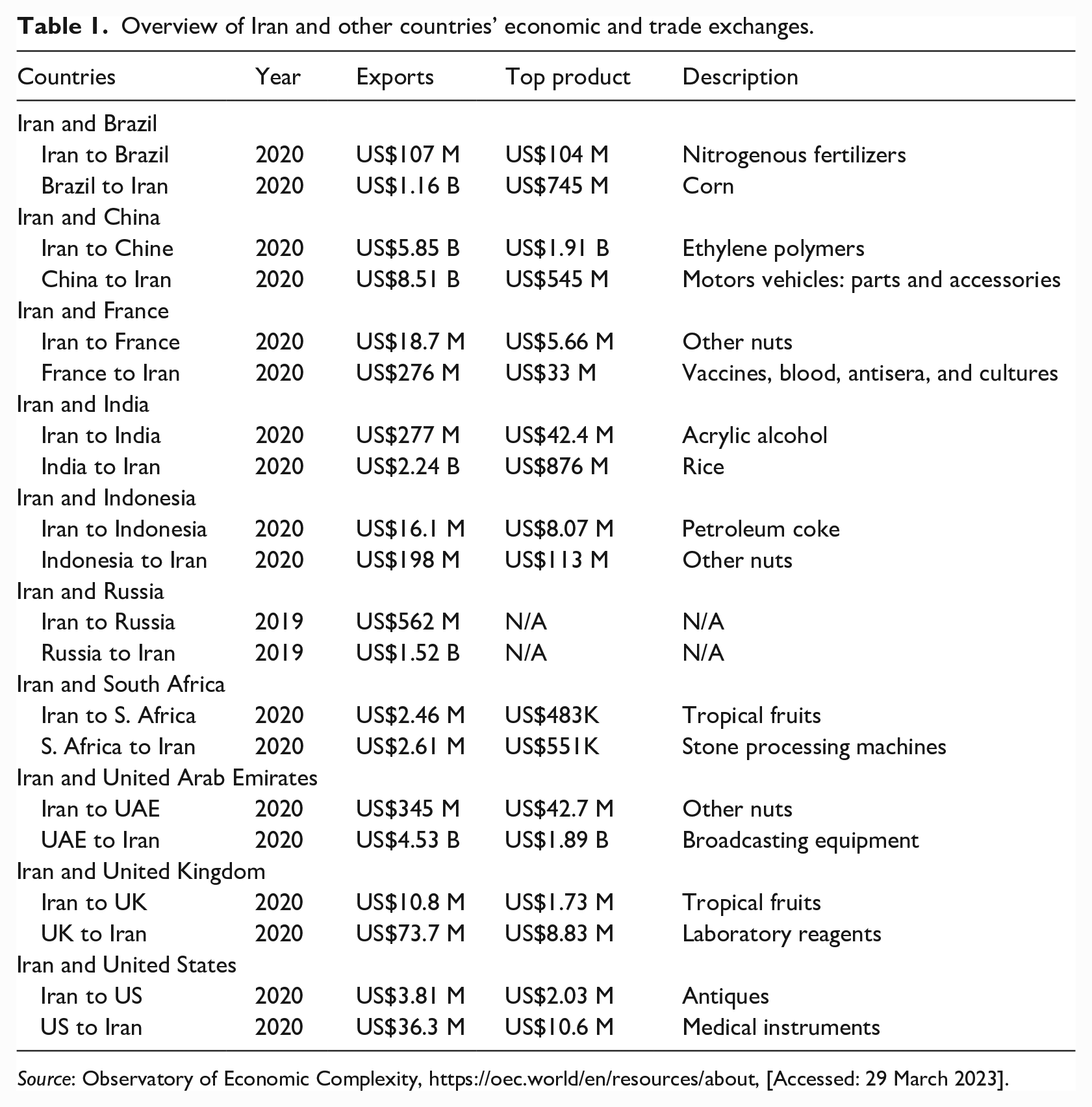
Source: Observatory of Economic Complexity, https://oec.world/en/resources/about, [Accessed: 29 March 2023].
Conclusion
The current global economic system poses problems from which it is difficult to turn away due to the differences between countries producing raw materials and those known as industrialized countries, which value these materials. The financial mechanism as a whole seems to rotate at the whim of powerful states at the origin of its creation, and the race for unlimited gain no longer takes human dignity into account. Populations and governments are trapped in this system, which only benefits those who hold decision-making powers. This article claims, though, that Iran is no different.
Decried by a majority and defended by a minority, the current globalized system dominated by capitalism has created many enemies, who swear by its replacement. It is the (ideal) solution that still poses a problem, rather than the question of its replacement. Similarly to the American and European alter-globalization movements, Iran is pursuing its struggle for a fair and balanced economic model. The apparent process of decolonization appears among the practices denounced by the alter-globalization movement; according to them, it is a simple change of tactics to better conceal the hegemonic practices of certain Western powers.
Like the alter-globalization movement, Iran does not entirely reject globalization; instead, it is trying to find an alternative to the global neoliberal system, which is more in line with re-conquest than autonomy. As was the case during negotiations on its nuclear program, Iran has shown skill in regaining its place in the concert of nations and reinvigorating its domestic economy. However, the US withdrawal from the JCPOA, accompanied by the resumption of economic sanctions, risks reversing this policy as Iran again finds itself strengthened in its position as the defender of oppressed states.
Iran’s alternative to the current economic model, although limited to the Islamic world, could gain more and more prestige due to its resistance to the West and its ideological influence going far beyond its borders. Apart from the Islamic side of the economic model, which advocates the Islamic economy, the alter-globalization movement, and the so-called underdeveloped states can draw inspiration from Iran’s alter-globalism and third way to bolster their own causes. Iran has already surprised the world once; there is nothing to indicate that what seems utopian today cannot shake the world tomorrow as it did after the 1979 Islamic Revolution. Indeed, Iran is not only the regime of the revolutionary theocratic mullahs; it is a multi-millennial culture in the midst of a revival.
Iran’s revolutionary and traditional economic forces, which have been the main engine for the state’s organization since 1979, in parallel to those factors that run its economy nowadays, can be seen as diverse and woven into the new globalized economy. With its alter-globalization and third-way approach, Iran cannot avoid or stop domestic and foreign economic powers from being part of its economy. Nevertheless, when looking closely at the para-governmental organizations’ part in running the economy, it seems that the third way and non-aligned state strategy that the regime adopted in its early years left its mark, especially on domestic economic affairs and their structure, instead of influencing the state to take part in the global economic system.
The dual ownership principle allows citizens to own property and create businesses without discrimination, upholding the values of private, public, and state ownership. However, political connections and influence often limit access to benefits such as investment credits and tax exemptions. Therefore, some observers believe that land reforms in 1980 did not fully address discrimination and corruption. In a market economy, economic freedom is based on personal choice, voluntary exchange, freedom to compete, and protection of persons and property. However, the Iranian government’s control over the economy can limit true economic freedom. Iran has favored a rentier economy to offset its lack of competitiveness and maintain control, resulting in low rankings on the Economic Freedom of the World Index.
The Iranian economy is dependent on petroleum products, leading to the need for rents to sustain its existence and fund essential subsidies for food, education, water, fuel, and electricity. Islamic Revolution in Iran aimed to establish social justice, democracy, and national independence, with a focus on reducing the wealth gap, eradicating poverty, and preventing privatization. The constitution requires the government to provide free education and basic necessities while also promoting public participation in societal affairs. Various mechanisms, such as nationalization policies and agrarian reform, have been implemented to achieve social justice, but these benefits are often limited to those with political connections. As a result, while the regime has strengthened, Iran as a country has weakened.
Footnotes
Funding
The author(s) received no financial support for the research, authorship, and/or publication of this article.
