




Abstract
From 2019 to 2020, Zimbabwe experienced severe food insecurity. This paper explores the causes and drivers of the food crisis, policy, and programming response failures. Informed by primary data gathered through observations and secondary data, it argues that the food insecurity cannot be ascribed to the current agrarian structure alone. Instead, climate shocks, misgovernance of social security, politicization of food assistance, coronavirus disease 2019 (COVID-19) impacts and economic implosion deepened food insecurity. To prevent its recurrence, government must reconsider the land tenure system to promote productivity, support climate resilient agriculture, curb economic implosion, depoliticize social security system, and food transfer programmes.
Introduction
Globally, millions of poor and vulnerable people continue to suffer from acute hunger and consequent malnutrition. While estimates vary, close to 250 million people are acutely food insecure in Africa ‘where the number of undernourished is growing faster than anywhere in the world’ (United Nations (UN), 2020: 1). Some of the acutely food insecure countries are south of the Sahara and include Democratic Republic of Congo where 15.6 million people are in perpetual hunger, 8 million in Ethiopia, 8 million in Zimbabwe, 7 million in South Sudan, 5.9 million in Sudan, and 5 million in northern Nigeria (Global Network Against Food Crises, 2020). There is a gamut of intertwined socio-economic, political, security, and environmental factors that explain this state of hunger in a world awash with surplus food. They include, among others, economic downturn (with impacts on food production and prices), chronic poverty and food price inflation (with effects on food entitlement), inequities in the food system value chain, climate shocks on food production and prices, armed conflicts, and forced internal displacement.
This pervasive state of acute hunger and malnutrition, in some sub-Saharan African countries, suggests limited progress towards achieving some of the interconnected targets of sustainable development goals (SDGs). More specifically, there is high likelihood that the primary aim of SDG 2; Zero Hunger (UN, 2020) will not be realized despite concerted efforts by many countries to fulfil this objective. The fact that an estimated 250 million Africans, and rising, currently do not have access to adequate, safe, and nutritious food means achieving food security and ending hunger, as imagined by SDG 2, remains an elusive goal. While African countries’ specific circumstances vary, Zimbabwe provides an ideal case study for unravelling perpetual national- and household-level vulnerability challenges that make it difficult to achieve food security. In doing so, this paper answers the following research questions: (1) What were the primary causes and drivers of food insecurity in 2019 and 2020? (2) To what extent did coronavirus disease 2019 (COVID-19) exacerbate the food crisis? (3) What policy and programmatic interventions should the government of Zimbabwe implement to avert recurrent food insecurity? In answering these questions, this paper relies on evidence gathered through long-term field observations as well as a predominant review of primary and secondary data sources. Research questions (1) and (2) are explicitly answered in the sub-sections titled ‘food production deficit causes and drivers’ and ‘market drivers of entitlement collapse’ wherein the analytical focus is on the primary causes and drivers of food insecurity. The COVID-19 aggravating effects are also analysed under the ‘market drivers of entitlement collapse’ section. Research question (3), which explores government initiated policy and programmatic interventions, is answered in the recommendations section. Answers to the research questions, and overall critical analysis of the paper, is theoretically framed using Amartya Sen’s (1981) entitlement approach. Some of his well-known arguments on entitlement to food, namely, production, labour, trade, and inheritance-transfer-based entitlement are used to explore, contextualize, and explain the socio-economic, climatic, and political milieu causes, and drivers of national and household food insecurity in Zimbabwe from 2019 to 2020. Political actors and factors are also central to this analysis.
Food insecurity analytical paradigm
To comprehend Zimbabwe’s food insecurity crisis from 2019 to 2020, it is necessary to provide the analytical paradigm that frames food security thinking herein. Food security thinking has evolved, through overlapping paradigms, over the last five decades. The most dominant policy and practice thinking in the 1970s was concerned with food supply (World Food Conference, 1974 cited in Food and Agriculture Organization (FAO), 2006) with governments preoccupied about ensuring adequate availability of world food supplies. There was an inexorable ‘concern with national self-sufficiency’ and maintenance of adequate world food stocks (Maxwell, 1996: 156) to ensure food security. However, this focus on national and global food self-sufficiency, as determinants of food security, was a narrow paradigm. It ‘ignored the fact widespread hunger could and did co-exist with the presence of adequate food supply at the national and international level’ (Maxwell, 1996: 156). This major limitation of the food supply and sufficiency theories necessitated introduction of entitlement and access elements in food security thinking.
In his seminal entitlement approach to famine analysis, Amartya Sen (1981) draws a distinction between aggregate availability or supply of food, and an individual’s access to or ownership of food. He argues that a person’s ability to command food depends on the entitlement relations that govern possession and use in that society. It depends on what he or she owns, what exchange possibilities are offered to him or her, what is given to him or her free, and what is taken away from him or her (Sen, 1981: 154–155). Individuals thus face starvation if their full entitlement set does not provide them with adequate food for subsistence (Sen, 1981, 1984). Despite the entitlement approach’s theoretical weaknesses (see De Waal, 1989; Rangasami, 1985, Bowbrick, 1986, Nolan, 1993 and Fine, 1997 cited in the work of Devereux, 2007), from the early 1980s onwards, it became impossible to seriously reason about food security without making food access central to the debate. Since the 1996 World Food Summit, although conceptual divergences and ambiguities remain ‘about whether the unit of analysis should be the individual or the household’ (Maxwell, 1996: 157), it is accepted, and emphasized herein, that access and entitlement are central elements of food security at household level wherein individuals within these households are the focus. In line with this thinking, this paper argues that ‘food security is a situation that exists when all people, at all times, have physical, social and economic access to sufficient, safe and nutritious food that meets their dietary needs and food preferences for an active and healthy life’ (FAO, 2002). Its weaknesses notwithstanding, this conceptualization of food security approximates an ideal working prism for analysing and understanding Zimbabwe’s food crisis from 2019 to 2020. This is a paradigm that recognizes and balances food supply, demand, entitlement, access and consumption, hence, its relevance and applicability here. Its additional conceptual strength is that it encapsulates the four main dimensions of food security, namely, food availability, access, utilization and stability.
The existential conditions of the 7.7 million Zimbabweans (5.5 million in rural areas and 2.2 million in urban areas) who were food insecure in 2019 (Zimbabwe Vulnerability Assessment Committee (ZIMVAC), 2019) and the 8 million food insecure people in 2020 – in both urban and rural areas –should therefore be understood within the context of the foregoing food security paradigm. In other words, they did not have adequate physical, social, or economic access to food due to a collapse of their entitlements. Sen (1981) articulates their state of hunger in a succinct way when he argues that while there are many complex entitlement relations that govern ownership and access to food, it is possible to identify straightforward ones that are generally accepted in a private ownership market. Among others, these are, (1) trade-based entitlement: one is entitled to own what one obtains by trading something one owns with a willing party (or, multilaterally, with a willing set of parties (2) production-based entitlement: one is entitled to own what one gets by arranging production using one’s owned resources, or resources hired from willing parties meeting the agreed conditions of trade (3) own-labour entitlement: one is entitled to one’s own labour power, and thus to the trade and production-based entitlements related to one’s labour power (4) inheritance and transfer entitlement: one is entitled to own what is willingly given to one another who legitimately owns it, possibly to take affect after the latter’s death (if so specified by him) (Sen, 1981: 2).
Sen’s descriptive (not normative) interpretation of entitlement relations offers theoretically nuanced lens used in this paper to critically analyse the political, social, environmental and economic dynamics that mediate the food insecurity question in Zimbabwe. This entitlement lens, although not perfect, is ideal because it allows this paper to unpack how production, own-labour, trade, inheritance and transfer entitlements progressively collapsed, in 2019 and 2020, culminating in a deepening food crisis in Zimbabwe.
Methodological approach
This paper is informed by empirical evidence gathered by the author through field observations as well as a predominant review of primary and secondary data sources. These observations of a low income urban household monthly food basket were done in Bulawayo and Harare from August to December 2019 and January to March 2020. The food basket observed was conceptualized by the Consumer Council of Zimbabwe (CCZ). This CCZ food basket was observed because it is the standard basket used in food security analysis in Zimbabwe and provides an established reference point for monitoring food price inflation. The findings of these field observations directly mirror those of the CCZ food basket literature discussed hereunder, hence, they are embedded in analysis and not directly cited to avoid repetition. Furthermore, the paper also heavily relies on analysing year-on-year food insecurity data collected by the ZIMVAC, Food and Nutrition Council (FNC) and the largest consumer representative body, the CCZ. The ZIMVAC and FNC, with a national footprint, are the country’s premium food security and livelihoods data gathering and analysis institutions. Their annual datasets are the product of expansive sampling and data collection collaboratively conducted by government departments, government agencies, non-governmental organizations (NGOs) and development partners. In addition to ZIMVAC, FNC and CCZ data, various grey literature and other secondary sources add critical content and rigour to this article. This reliance on ZIMVAC, FNC, CCZ and other literature alongside field observations data means results (from secondary and primary sources) hereunder are presented and critically analysed concurrently since they are in synergy.
Results and analysis
Food production deficit causes and drivers
In answering research question (1) (what were the primary causes and drivers of food insecurity in 2019 and 2020?), the starting point is a disentanglement of the effects of Zimbabwe’s land reform programme. This is important because an analysis of Zimbabwe’s food crisis that does not factor in its land reform programme would be ahistorical and incomplete. As is known, the distributional achievements and limitations of Zimbabwe’s land reform and resettlement from 1980 to 1999 (Kinsey, 1999; Moyo, 1999, 2011) and the changes in land tenure as well as agrarian structure resulting from the fast track land reform programme (FTLRP) from 2000 onwards (Moyo, 2011; Scoones et al., 2010) have been the subject of intense debate. While recognizing its implementation democratic and distributional deficits (Moyo, 2011), many argue that the FTLRP had positive distributional outcomes, across racial lines, leading to the enhancement and diversification of agriculture based rural livelihoods (African Institute for Agrarian Studies, 2009; Scoones et al., 2010, 2012). Indeed, there is abundant empirical evidence that access to land has transformed the livelihoods of many beneficiaries, be they subsistence, medium- or large-scale commercial farmers. Proof of this abounds in the form of many productive farms, run by indigenous black farmers, some of whom produce horticulture for the export market. However, their productivity success is only a small part of otherwise disastrous cereal output nationally.
The main ‘culprits’ largely responsible for this national maize production deficit are the FTLRP medium- and large-scale farm beneficiaries. Over the years, they have failed to produce adequate food and cash crops (Bush, 2007; Hammar and Raftopoulos, 2003; Moyo, 2013) to meet national annual cereal requirements of 1.4 million tonnes. The 2019 and 2020 harvest seasons were no exception to this cereal production deficit. Statistics by the FAO (2020) show that in 2019, 777,000 tonnes of maize, against a national requirement of 1.4 million tonnes, were locally produced. There was a 16.9% increase in the 2020 maize harvest, rising to 908,000 tonnes. Despite this increase, the 2020 harvest was still ‘about 25 percent below the five‑year average although higher than the previous year’s low level’ (FAO, 2020: 1). The maize deficit, and its production and food market-based entitlement, is thus glaring. This directly translated to reduced staple maize meal access for many poor and vulnerable hence the household food gaps.
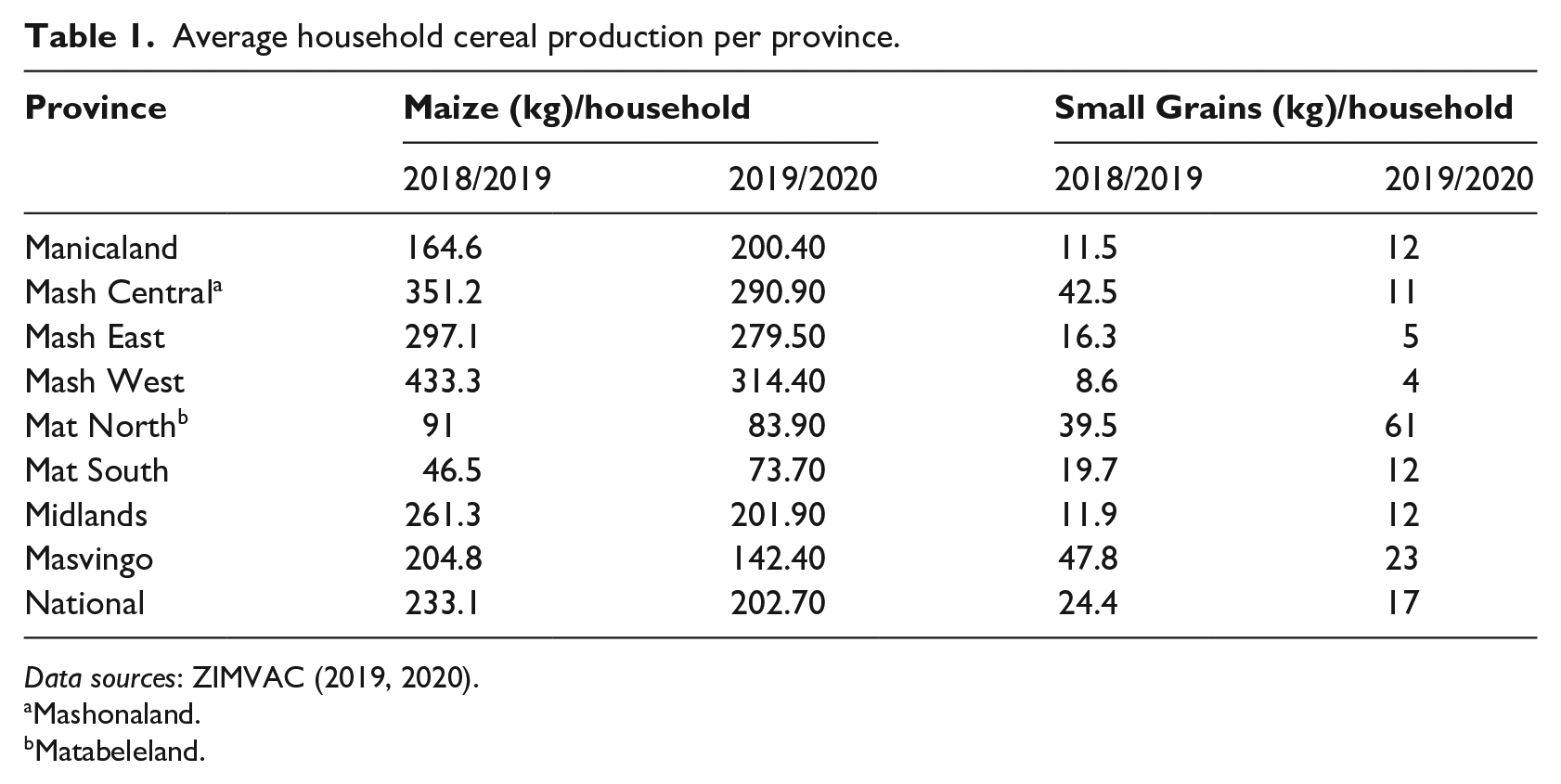
It is important to emphasize that not all medium- and large-scale FTLRP beneficiaries are non-productive. There are many who are experienced, well trained and technically astute in advanced commercial crop production and animal husbandry. Their misfortune is that they are in the business of farming in an agrarian system fraught with economic challenges. This economic mess is partly due to the disorderly and ill-advised direct state intervention in economic affairs and the market since 2000. The resultant poor economic environment characterized by ‘high inflation rates and sustained currency weakness hinders access to agricultural inputs and increases production costs’ (FAO, 2020: 1) thereby negatively affecting their on-farm production capacity and output. Furthermore, despite their technical expertise and commitment to farming, these farmers lack access to agricultural finance or credit that is a key ingredient for material and technical capacitation in any commercial farming venture. Consequently, their best farming efforts have yielded the bare minimum, hence, the failure of the farming fraternity to meet national food requirements. Data by the ZIMVAC (2019, 2020) succinctly demonstrate this national food production decline as shown in Table 1.
Average household cereal production per province.
Data sources: ZIMVAC (2019, 2020).
Mashonaland.
Matabeleland.
These statistics show a national decline in average maize production from 233.1 kilogrammes per household during the 2018/2019 season to 202.70 kilogrammes per household in the 2019/2020 harvest season. Relatedly, there was a decrease in small grains production from 24.4 kilogrammes per household during the 2018/2019 season to 17 kilogrammes per household in 2019/2020. Even the intervention of the government through targeted distribution of state largesse, farming equipment and supplies, at nominal repayment terms, has failed to turn the tide of production failure. The latest such state subsidy programme, Command Agriculture, also failed. Launched in October 2016 by former President Robert Mugabe with an initial three year (2016–2019) budget of US$516 million, Command Agriculture ‘aimed at growing maize on 400 000 ha of land across the country to help combat food insecurity’ (Nkala, 2017: 1). Despite an enthusiastic high uptake by many farmers who met the eligibility criteria on paper, it was hardly surprising that the programme failed to meet its primary food production objectives. This is precisely because many of the beneficiaries were the same privileged, politically connected but inexperienced farmers who have perennially benefitted from state assistance (e.g. under the 2007/2008 Farm Mechanization Programme) but ultimately produce little or nothing.
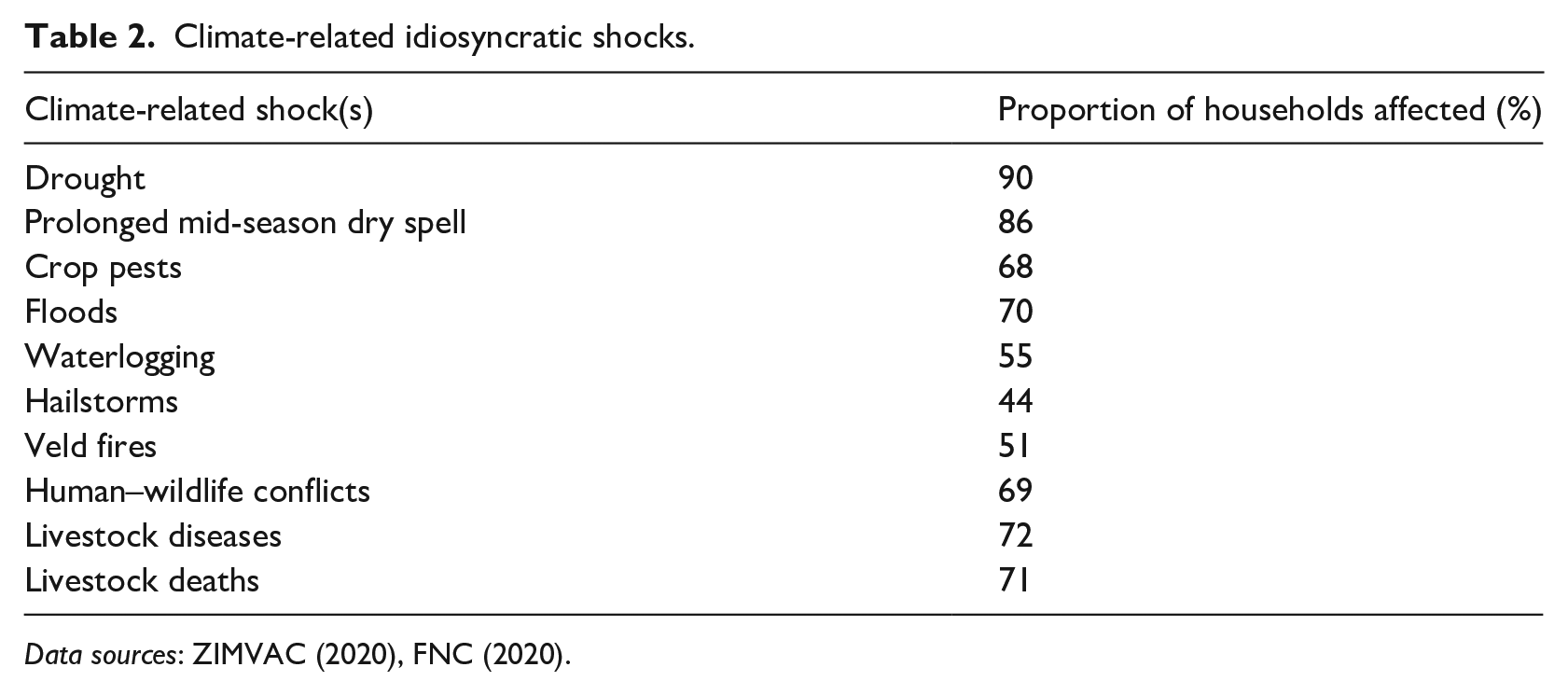
In addition to the above drivers of the production deficit, climate-related idiosyncratic shocks further explain the 2020 food production deficit (Table 2). National-level data by ZIMVAC (2020) and the FNC (2020) aptly capture the impact of these shocks on 2020 food production.
Climate-related idiosyncratic shocks.
Data sources: ZIMVAC (2020), FNC (2020).
Drought (90%), prolonged mid-season dry spell (86%), floods (70%), waterlogging (55%), hailstorms (44%), veld fires (51%) and livestock deaths (71%) are some of the climate shocks that explain the food production deficit, pursuant production and market entitlement collapse. This is precisely because Zimbabwe, like many other countries in the Global South, is disproportionately affected by climate change due to its high dependency on rain fed agriculture, vulnerability emanating from governance failures, policy missteps, limited technical and financial capacity to adapt and build household and community resilience. Over the last few decades, climate change impacts that include low and unpredictable rainfall patterns, unprecedented high temperatures, recurrent droughts and intermittent flooding in different parts of the country have altered the onset, duration and productivity of the crop-planting season leading to a drastic reduction in national net food and cash crop yields (Government of Zimbabwe, 2014, 2016; Moyo and Dube, 2014; Phiri et al., 2019). These climate change impacts also partly account for the slump in staple maize production during the 2019 and 2020 farming seasons. For example, ‘in 2019, Zimbabwe experienced its worst drought in decades, which, in tandem with the impacts of Cyclone Idai . . . created the country’s worst acute food insecurity crisis in 10 years’ (Global Network Against Food Crises, 2020: 196). Similarly, seasonal rainfall was below average during the planting period in November and December 2019 in the main producing provinces, hampering planting operations. The combination of these factors resulted in a contraction in the sown area of the 2020 maize crop (FAO, 2020: 1).
Even though ‘precipitation improved in January and February 2020, reducing seasonal rainfall deficits in some areas, soil moisture levels still remained inadequate in most provinces . . . causing stressed crop conditions and permanent wilting of cereal crops in localized areas’ (FAO, 2020: 1). These successive droughts, in the 2018/2019 and 2019/2020 farming seasons thus compounded to deepen the national food production deficit. This precipitated production entitlement collapse for many rural subsistence and communal farmers largely dependent on own production for food security. Simultaneously, this food production deficit had negative effects on urban food markets where, as discussed further below, prices exponentially increased as consumer demand rose while maize meal remained in short supply.
Furthermore, climate change impacts, particularly droughts and high temperatures, have also decimated the livestock production sector that is an integral element of the rural food system, a store/source of wealth and symbol of socio-cultural prestige for many farmers. Communal and smallholder farmers in agro-ecological regions IV and V (Mugandani et al., 2012; Vincent and Thomas, 1960) in parts of Matabeleland South, Matabeleland North, Midlands and Masvingo provinces have borne the brunt of climate impacts, losing thousands of their livestock in 2019 and 2020. Highly erratic rainfall, high temperatures and droughts in regions IV and V have become more frequent and severe (Mafongoya et al., 2016) compared to previous decades with direct consequences on grazing land and raw water sources for livestock. Even though some farmers have diversified into drought tolerant small livestock husbandry (goats and sheep) as an adaption strategy to climate impacts, the majority remain cattlemen due to its high stock value and long held traditional practices. However, given their susceptibility to and non-tolerance of drought and diminished poor grazing pasture, their cattle died in thousands. For example, by December 2019, 26,000 cattle poverty deaths were recorded in Matabeleland South Province alone (Dube-Matutu, 2020), 6 220 in Matabeleland North (Nsingo, 2019), 4000 in Masvingo and 2040 in Midlands province (Mpofu, 2019). The worst affected were communal and smallholder farmers who, unlike established wealthy commercial farmers, do not have the financial resources to buy supplementary livestock feed and have no individual control or power to sustainably manage village grazing pasture through paddocking. Their limited resource base and vulnerability are thus compounding with climate impacts to deplete their livestock assets. These livestock deaths will have long-term impacts across households, since they do not only affect upcoming season crop farming plans but also affect long-term farming capacity as well.
Market drivers of entitlement collapse
There is also need to explore market drivers of the food insecurity as part of answering research question (1). Such a food market analysis disentangles some of the market-based primary drivers of the food insecurity. Ordinarily, any national food gap is covered by imports by the state or private commodity brokers from world food markets. There are precedents, in 1992, the Zimbabwe government imported adequate maize following a drought and policy failures in managing its Strategic Grain Reserve (Sachikonye, 1992). In similar vein, in the 2019/2020 lean season, to increase food imports by both private corporates and individuals, the government gazetted Statutory Instrument (SI) 247 of 2019 – effective November 2019 until May 2020 (Government of Zimbabwe, 2019). It suspended the requirement for an import permit and import duty for maize grain, mealie meal and wheat flour. Subsequently, another SI, SI 60 of 2020 (Government of Zimbabwe, 2020) abolished the import licence and duty requirements thus opening the market for unrestricted food imports. On the back of these market-linked legal changes, and in an attempt to reduce import costs and transportation bottlenecks, maize imports from around Southern Africa were prioritized by the state. A total of ‘160 000 tonnes were imported from South Africa, an estimated 100 000 tonnes was reported to have been delivered from Tanzania and about 5500 tonnes were sourced from Zambia’ (FAO, 2020: 1). Collectively, this amounted to 265,500 tonnes which was way below equalling the 900,000 tonnes deficit. Even if you factor in private formal and informal imports, the food gap remained very high.
The failure by the government to import adequate cereal requirements can be partly explained by three main reasons. First, Zimbabwe has very limited domestic financial resources and international credit lines partly due to its debt trap from the economic structural adjustment years. One of the chief architects of this neoliberal adjustment induced debt baggage, the International Monetary Fund (2020), confirms that Zimbabwe’s economy is in crisis and has contracted sharply over the last few years because the country cannot access external lines of credit. The country’s international debt, in addition to other factors discussed below, is now an albatross preventing it from accessing credit for domestic needs that include food imports. It has very limited financial capacity to fulfil its human development obligations that include making food available for people to access through different forms of entitlement. Second, the government has skewed priorities when it comes to spending limited foreign currency in the public purse. For example, in 2019 and 2020, it spent millions of scarce American dollars importing expensive top of the range luxury cars for the political elite in the executive, judiciary, security establishment and legislature instead of importing food for poor and vulnerable citizens. This profligacy betrays the government’s misplaced priorities and lack of financial discipline. It also reflects how those in political power are exploiting state resources for their personal extravagances while ordinary citizens languish in poverty and hunger. Third, rent-seeking behaviour and corruption by big business, some with direct links to the ruling elite and their patronage networks, is also a contributory factor to the inability to import adequate food. Big business, especially those with access to grain procurement tenders, are the main culprits in this regard. For example, in an effort to cover the food gap in late 2019, the government of Zimbabwe bought 17,000 tonnes of maize from Tanzania at a price of US$600 per tonne while the standard price in global markets was US$240 (Africa Confidential, 2019). This inflated price is the personification of corruption by big business in connivance with senior state procurement officials in charge of the supply chain management system at the Procurement Regulatory Authority of Zimbabwe (PRAZ). This means PRAZ is a politically exposed entity and a site for corruption and profiteering that benefits unscrupulous business people, senior government officials and their associates at the expense of hungry citizens.
While the state’s failure to import adequate maize directly affected people’s access to it, even of those with money to buy, it is important to remember that there is no direct relationship between food availability and access by all persons. That is why people are sometimes food insecure or starve to death in the presence of abundant food. Sen (1981) aptly captures this when he argues that starvation is the characteristic of some people not having enough food to eat. It is not the characteristic of there being not enough food to eat. While the latter can be a cause of the former, it is but one of many possible causes. (p. 1)
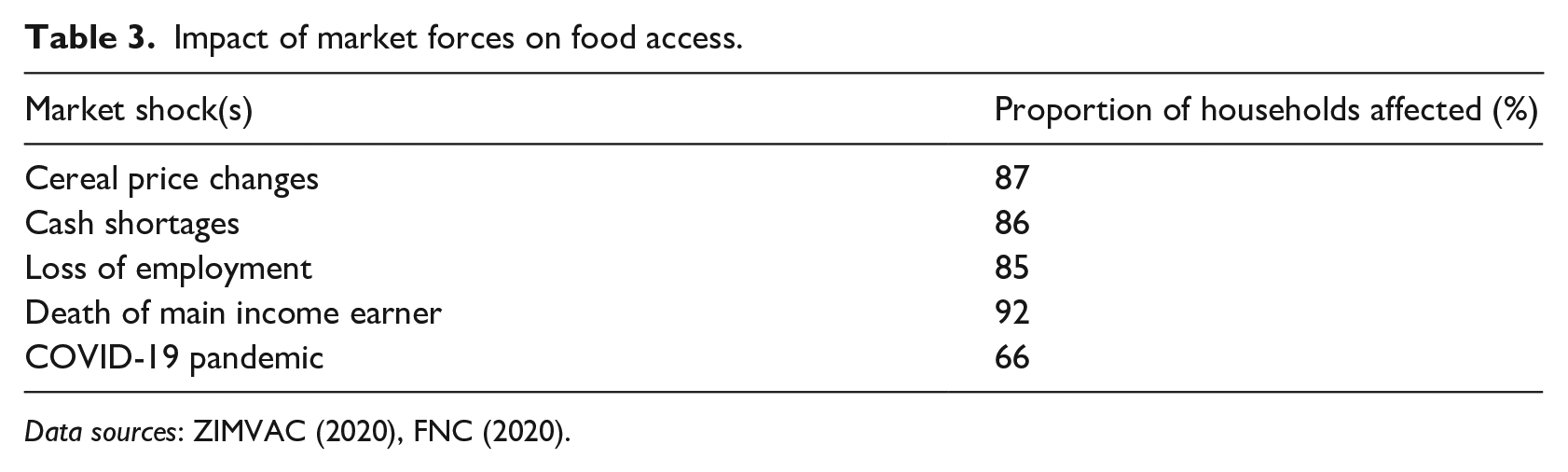
This relationship of a person(s) to food, when available, is mediated by structures of ownership, which determine that individual’s food access. This was evident in Zimbabwe’s food system, wherein despite limited availability of maize meal, many other types of food were available but the majority poor and vulnerable could not access this food. Table 3 adapted from ZIMVAC (2020) and FNC (2020) illustrates market obstacles that curtailed millions of people’s ability to access food at the time:
Impact of market forces on food access.
Data sources: ZIMVAC (2020), FNC (2020).
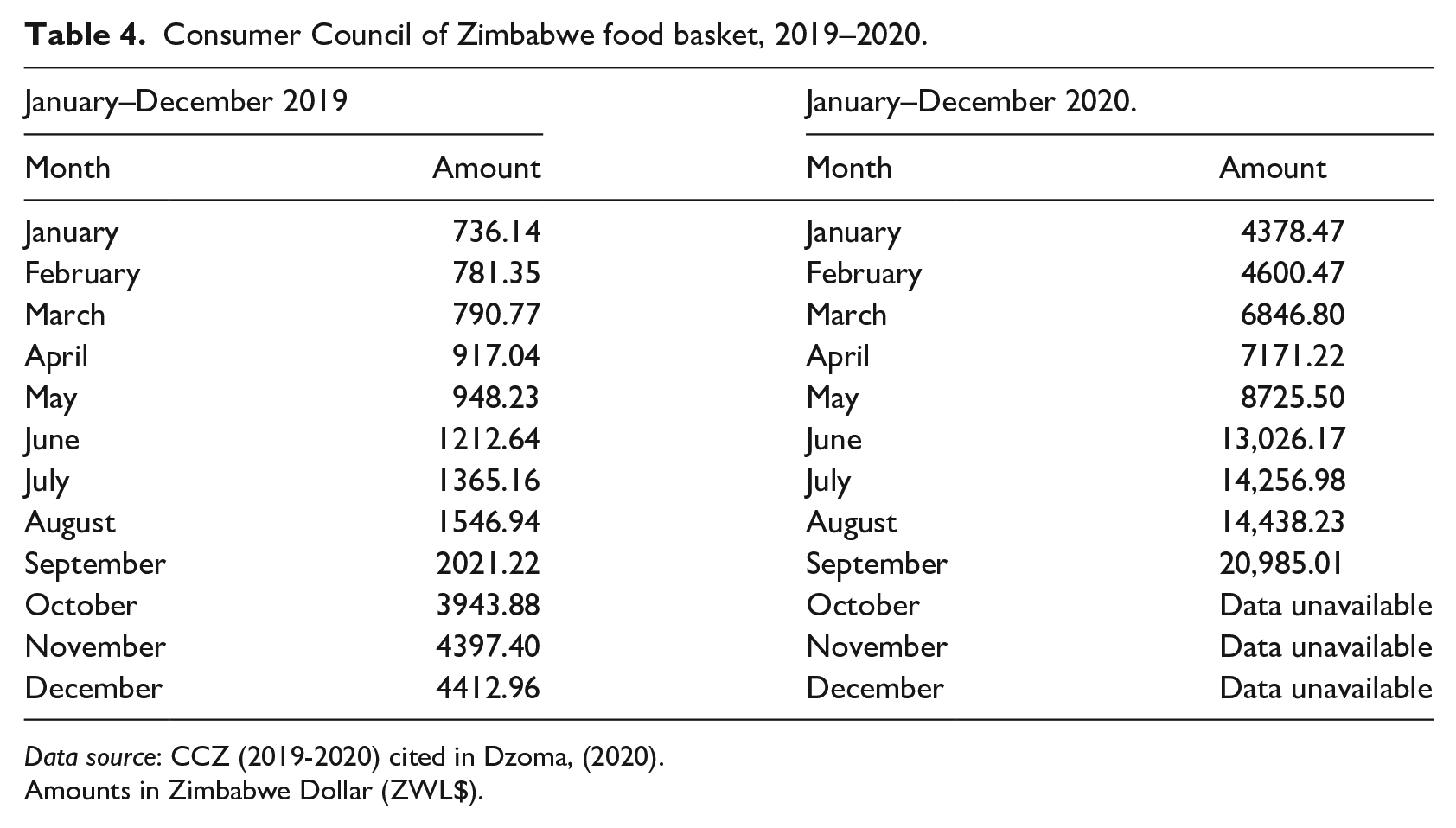
Relying on own-labour and trade-based entitlement, that is, exchanging one’s labour power for income to use for purchasing food was extremely difficult in Zimbabwe’s depressed economy with very limited business and employment opportunities. From 15% in 2019, the economy contracted by 20% in 2020 (Ncube, 2020). The net effect of this was deepening national absolute poverty estimated at 70% (Government of Zimbabwe 2017 cited in World Bank, 2020) and increasing formal unemployment that remains very high, regardless of how it is defined. This economic environment meant the majority could not raise adequate income for basic food commodities. Zimbabwe’s leading consumer group, the CCZ, illustrated this through its monthly monitored prices of a basic low-income food basket for an urban family of six (Table 4). Its statistics show how inflation drove up food prices from January 2019 to September 2020:
Consumer Council of Zimbabwe food basket, 2019–2020.
Data source: CCZ (2019-2020) cited in Dzoma, (2020).
Amounts in Zimbabwe Dollar (ZWL$).
The foregoing food price inflation was due to depreciation of the Zimbabwe dollar (ZWL$). While independent estimates are higher and vary, the official government confirmed year-on-year inflation rate towards the end of 2020, as measured by the consumer price index (CPI), stood at 837.53%, while CPI was 1958.72% (Reserve Bank of Zimbabwe, 2020). The effects of this high inflation (year-on-year and CPI) manifested through massive increases in the food poverty line. With food year-on-year inflation at 976.73% (Reserve Bank of Zimbabwe, 2020), the food poverty line had risen to astronomical levels beyond the reach of majority poor and vulnerable. Consequently, trade-based entitlement for the majority in Zimbabwe collapsed, since they were no longer in a financial position to buy adequate dietary diverse foods.
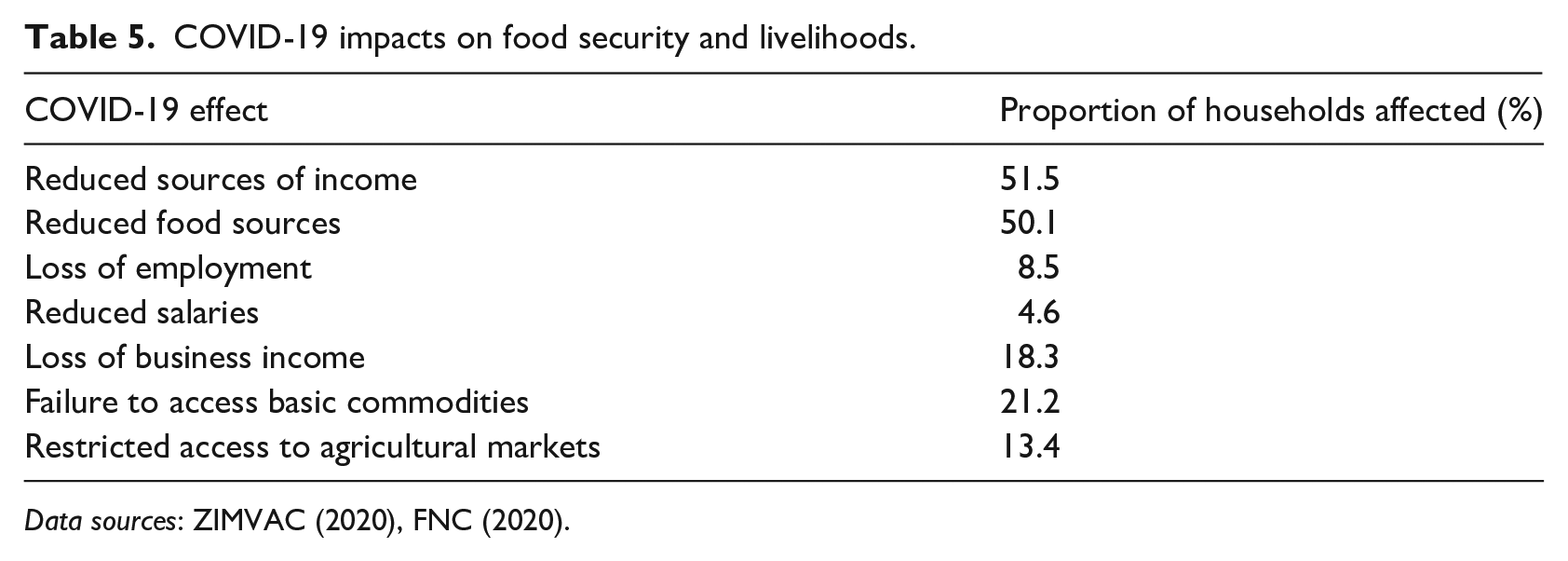
Furthermore, the collapse of market-based food entitlement was exacerbated by the COVID-19 pandemic (Table 5). The COVID-19 pandemic in early 2020 eroded many people’s access to basic food and dietary diversity. The pandemic affected all forms of entitlement to food. National-level quantitative data by ZIMVAC (2020) and FNC (2020) demonstrate this.
COVID-19 impacts on food security and livelihoods.
Data sources: ZIMVAC (2020), FNC (2020).
These COVID-19 effects directly linked to different lockdown-level restrictions ultimately reduced access to food. COVID-19 exacerbated food insecurity through disrupting food import supply chains and agriculture inputs supplies, such as seeds and fertilizers (FNC, 2020: 2). Mthuli Ncube, Zimbabwe’s Minister of Finance and Economic Development, adds that its compound effects negatively affected agricultural production, marketing of farm produce and the informal economy with predictable negative consequences on national and household food security (Ncube, 2020). This COVID-19 food insecurity nexus is corroborated by an assessment conducted by the World Food Programme in 2020. This assessment shows that, due to the lockdown, hunger widened and deepened as the number of food-insecure Zimbabweans living in urban areas increased from 2.2 to 3.3 million (World Food Programme, 2020 cited in the work of Nevill, 2020: 1). Not only did COVID-19 affect local production and market activities, but also disrupted the food system supply chain, including cash and in-kind remittances from neighbouring countries like South Africa, Botswana, Namibia and Mozambique.
From social safety net transfers to aid dependency
Entitlement to food does depend not only on market exchanges and production but also on what the government of the day, as part of its constitutional obligations, freely provides to poor and vulnerable citizens through its social safety nets system, subject to them meeting eligibility criteria. Sen (1981: 2) calls this inheritance and transfer entitlement, which means, ‘one is entitled to own what is willingly given to one another who legitimately owns it’. Under this entitlement, a state social security system may provide a social or food relief grant, a state pension, stipend or some kind of material benefit. The importance of such social security provisions in enabling the indigent, poor and vulnerable to access food becomes even more important in food-insecure conditions, such as what obtained in Zimbabwe from 2019 to 2020.
One of the most expansive government social protection programmes, in terms of number of beneficiaries and geographic scope, is the harmonized social cash transfer (HSCT) programme. The Government of Zimbabwe and international development partners jointly fund it. Beneficiary households receive bi-monthly unconditional cash transfers that vary depending on household size. These range from a minimum of US$10 to a maximum of US$25 per household (Angeles et al., 2018). One of its theoretical assumptions is that the predictable bi-monthly cash disbursement to eligible households allows them to plan and prudently budget for food expenditure (of a balanced diet) throughout the year. The regularity of the cash transfer is also seen as a way of increasing ‘consumption to a level above the food poverty line, improve nutritional status and to help beneficiaries avoid risky coping strategies’ (FAO, 2013: 2). However, in reality, an assessment of the HSCT from 2019 to 2020 shows that its impacts on household food security and consumption behaviour were mixed. On the negative side, the HSCT’s impact at national level, that is, in terms of addressing national food insecurity was largely limited due to a combination of related factors. First, its eligibility criteria limited beneficiaries to food poor and labour constrained households (Angeles et al., 2018; Bhalla et al., 2018). While this criteria was appropriate at HSCT inception, in view of its aim and goals, it means the country’s primary and largest social security programme excluded millions of food-insecure households that did not meet these criteria. They were technically excluded because this programme was not designed for or with them in mind. Relatedly, and second, although recipients gradually increased as per programme roll out plan, the number of beneficiaries remained miniature in a population of 8 million food insecure in 2020.
Parallel to the HSCT, the government through the Department of Social Services, also runs a food transfer programme for poor and vulnerable beneficiaries subject to strict eligibility criteria. The primary focus of state food assistance has historically been the provision of cereals, namely, maize and rice (Ndlovu et al., 2020). Under this food transfer programme, the state is more concerned with providing the most basic food to avert starvation with no interest whatsoever in availing a dignified and dietary diverse food basket. As a result, many of the cereal beneficiaries remained food insecure because they did not have income for buying other nutritionally diverse food items. Furthermore, inconsistent distributions of maize and rice impeded the effectiveness of this government food transfer programme (Ndlovu et al., 2020). This inconsistency in distribution and meagre cereals provided are evidence of a government failing to fulfil its constitutional mandate due to misgovernance and mismanagement. In addition, Ndlovu et al. (2020) argue that the effectiveness of the food transfer system was derailed by factors, such as the unnecessarily long distance to food distribution points, irregular and uncoordinated communication of distribution dates, and a poor beneficiary targeting system. The consequence of these programmatic failures is that many of the governments’ food transfer beneficiaries remained food insecure because some did not make it to the distribution points due to lack of correct information on distribution dates and structural exclusion due to poor targeting.
Furthermore, the politicization of food in poor and vulnerable communities was another impediment to the effectiveness of the state’s food transfer programme. Using food as a political weapon to punish opposition party supporters by ruling ZANU-PF party apparatchik is a long established callous inhumane strategy (Catholic Commission for Justice and Peace in Zimbabwe and Legal Resources Foundation of Zimbabwe, 1997; Human Rights Watch, 2003; Moyo, 2010) that predates the 2019 to 2020 food crisis. The dynamics of this partisan political strategy involves a systematically biased beneficiary registration process, run by local ZANU-PF functionaries in connivance with politically compromised civil servants, which deliberately excludes many non-ZANU-PF members, who happen to be supporters or sympathizers of opposition parties. Hence, the food transfers beneficiary registration, selection and distribution system is always inherently flawed because local ZANU-PF politicians manipulate it. There is evidence that many eligible households, in both urban and rural areas, were denied access to state food transfers on political affiliation grounds in 2019 (Chingono, 2019) and 2020. Civil society organizations embedded in local communities documented numerous such cases at grassroots level (Anti-Corruption Trust of Southern Africa, 2020). This means partisan politics and local power dynamics determined who accesses state food transfers as opposed to verified need. Consequently, not all poor and vulnerable who met social assistance eligibility criteria accessed state food transfers.
Another state-funded transfer programme that dismally failed to fulfil its objectives is the maize meal subsidy programme. The government, as part of welfare efforts to cushion the poor and vulnerable from high food prices, introduced an untargeted roller maize meal price subsidy in the open food market.
The roller maize meal subsidy programme was designed in such a way that Zimbabwe’s Grain Marketing Board (GMB) allocates maize to licenced millers at a subsidised price of ZW$4000 per metric ton. Millers are in turn required to distribute to retailers who will then sell mealie meal to ultimate consumers at a price which is 50% of the market price (Siavhundu, 2020: 1).
Under this system, the government pays ‘licensed millers subsidy amounts commensurate to an agreed extraction rate of 80% after verification that production has taken place’ (Siavhundu, 2020: 2). This subsidy system thus interferes with the market value chain from bulk grain procurement processes (at GMB) right up to retail shop floor level. At inception in December 2019, the subsidized price was set at a ceiling price of ZW$50 for 10 kg of the roller maize meal (open market price was ZW$100) later revised to ZW$70 in February 2020 (Tshili, 2020). As in many other countries before, this price subsidy was plagued by market-related problems that include failure to target and benefit the majority of indigent citizens, limited cost-effectiveness and imposition of an additional burden on taxpayer finances (Alderman, 2002; Moyo, 2010; Sdralevich et al., 2014). In more specific terms, in its economic simplicity, this subsidy system assumed that roller maize meal output from millers would increase, satisfy market demand and permanently lower the price to affordable levels. This approach misread market fundamentals and dynamics because it failed to take into account that in a food system with a shortage of maize meal; its demand would be elastic. Consequently, despite increased roller maize meal output from millers, accumulative elastic demand persisted. Furthermore, the price difference (between the real market price and government fixed retail price) inadvertently created room for corruption, arbitrage and rent-seeking behaviour by grain millers, retailers and speculative individuals. Some were hoarding the subsidized maize meal and diverting it to the black market where it sold for more than double the fixed subsidy price, way beyond the reach of many citizens in hunger. The anticipated welfare benefits of this social assistance were thus undone by manipulation of the subsidy in a supply and demand food market system driven by profit-making not humanitarian goals.
The failure of the state’s social transfer programmes to address household food insecurity inevitably compelled the government to seek, not for the first time, international humanitarian assistance. In response, various humanitarian relief NGOs set up base in the country and established a well-coordinated network of distributing targeted food aid and cash vouchers to the most food insecure. This food aid industry with its skewed power relations (Clapp, 2009; Jaspars, 2018) and embedded geopolitical economic interests (Clapp, 2009) thus became a central player in the food system. Despite their positive contributions, the role of these humanitarian organizations in the Zimbabwean food system is problematic. First, while their aid reduced household food deficits, prevented escalation to acute hunger and malnutrition, it certainly did not address drivers of transitory and chronic food insecurity. This is because, by its nature, life-saving food or cash aid does not intend to address underlying vulnerability and causes of food insecurity. It is essentially designed and funded to ameliorate hunger to prevent ‘death by starvation’. Second, the food aid industry is now embedded in indigent people’s lives, since it has become a central component of the Zimbabwean food system. Many poor and vulnerable are inadvertently dependent on food aid as their main source of food, especially during the peak of the lean season. This food aid dependency syndrome is a direct product of the collapse of their market and production entitlement aforementioned. However, this dependency is not a negative reflection on the inability or laziness of beneficiaries because they are simply victims of the country’s political, economic and climate systems that have compounded to inhibit their agency and ability to feed themselves.
Conclusion and recommendations
Zimbabwe’s food crisis of 2019 and 2020 is explained by a complex combination of political, economic, environmental and agrarian structure factors. Granted, limited food production on commercial farms at the time was one of the primary causal factors. However, we cannot ignore the fact that some of these farmers, despite their expertise and farming capacity, did not produce food at their optimum due to lack of access to adequate agricultural finance or credit both of which are vital ingredients for material and technical capacitation in any commercial farming venture. To address this production impediment (and in response to research question (3)), the government should abolish state-issued 99-year farm leases, as they are largely responsible for many farmers’ inability to access capital. Financial institutions do not recognize these leases hence they are not collateral for credit. The government must replace them with title deeds that are bankable to secure loans for inputs that will boost food production. Relatedly, beneficiary criteria for state subsidized farm inputs and mechanization programmes should be impartial and prioritize farmers with proven capacity to enhance on-farm productivity.
Furthermore, climate change impacts compounded the production deficit. In the absence of effective climate smart agriculture production technology, information and services, recurrent droughts, high temperatures and erratic precipitation patterns deepened the food production shortfall. To avoid recurrence of this, the government in collaboration with development partners and local communities should promote climate resilient agricultural practices. Backed by adequate climate finance and agricultural technical support, these should prioritize production of adaptive food crops, resilient animal husbandry and livelihood diversification under current climate realities.
Inadequate on-farm food production was, however, only a part of a complex food insecurity causal matrix. This is because food security is determined not only by food availability but also, principally, by entitlement and access. At the ‘heart’ of accessing food are labour, trade and transfer entitlements all of which collapsed in Zimbabwe under the debris of economic implosion. The majority poor and vulnerable were thus unable to access adequate dietary diverse food due to chronic poverty, income erosion due to hyperinflation and food price inflation. Furthermore, the poor and vulnerable majority’s entitlements collapse deepened under the impacts of COVID-19 that pushed millions more into poverty following job losses, inability to do precarious work or pursue income-generating activities in the informal economy. To minimize the effect of these market forces on the poor and vulnerable’s access to food, it is incumbent on the government to resolve their contested political legitimacy. Once resolved, a stable political terrain will build market confidence and stabilize the economy. In such an economy, more economic opportunities will emerge, poverty and unemployment reduced thus revitalizing the majority’s labour, trade and transfer entitlements to food.
Finally, for many poor and vulnerable, ‘death by starvation’ was averted due to transfer entitlement by the state and expansive humanitarian food and cash aid. However, the government’s cash transfer programme had rigid eligibility criteria, was underfunded, had limited geographic coverage and its politicization by ZANU-PF apparatchik undermined its effectiveness. In future, the government can learn from these programming shortcomings and instead roll out a nonpartisan, well-targeted and sufficiently resourced food transfer programme. Concurrently, international relief agencies’ food transfer programmes should rethink their programming model; avoid skewed short-termism and preoccupation with advancing their home-country geopolitical, economic and power interests at the expense of the poor, vulnerable and food insecure.
Footnotes
Funding
The author(s) received no financial support for the research, authorship and/or publication of this article.
