




Abstract
Successful conservation in Africa hinges on the perceptions of communities bordering protected areas. It is therefore vital for protected area stakeholders to know the perceptions of neighbouring communities in order to determine the factors that generate or undermine community support for conservation, so that appropriate management interventions can be implemented. Numerous studies consider benefits, but less relate to perceptions regarding both losses/costs and intangible benefits. This paper demonstrates a methodology with which to determine these factors, focusing on Kekana Gardens community, bordering Dinokeng Game Reserve, in Gauteng Province, South Africa. This qualitative study with 13 residents utilised focus group interviews and adapted nominal grouping technique. Six themes emerged, four of which comprise intangible benefits. This methodology can be applied to any community bordering a conservation area, assisting in crafting solutions that benefit both people and parks.
Keywords
Introduction
The success of wildlife conservation in Africa depends on local people’s attitudes towards wildlife (Hariohay et al., 2018). However, the wellbeing of communities bordering protected areas must also be considered and much work needs to be done on how to integrate biodiversity conservation and human wellbeing (Wali et al., 2017). In addition, solutions need to be realistic, taking into consideration the very real constraints faced by protected areas in Africa, which often battle with limited income and few staff.
Progress in this vital integration can be made by investigating perceptions. Yet, perceptions are often not considered as serious evidence (Bennett, 2016). Bennett (2016) maintains that ‘perceptions are an indispensable form of evidence that is useful at all stages of conservation [aiding in understanding] when evaluations of conservation are positive or negative . . .’ (p.7), and can assist in assessing the social impacts of conservation and whether these are generating or undermining support (Bennett, 2016). Knowledge of community perceptions towards the environment is important because it can help to explain behaviour; aids understanding regarding what influences these perceptions; can help in the development of effective benefit sharing programmes; reveals focus areas for education and training initiatives; and assesses the success of community conservation programmes, followed by necessary improvements (Infield and Namara, 2001; Ogunbode, 2013; Snyman, 2014). By knowing perceptions, stakeholders can develop practical interventions that can enhance biodiversity conservation (Gordon-Cummings and Mearns, 2021) as well as improve human wellbeing.
To engender local support for conservation in communities living alongside protected areas, stakeholders need to know what factors generate or undermine support for conservation. A significant component of this is understanding specific benefits and losses. Benefits need to be provided and losses/costs minimised (Burgoyne and Mearns, 2017). Mehta and Heinen (2001) and Soliku and Schraml (2018) cite the growing empirical evidence that upholds the idea that local peoples’ support for protected areas depends predominantly on their perceptions of the costs and benefits of living in or around these areas. A wide range of studies have been done on the importance of benefits accruing to local community members due to the presence of tourism and conservation initiatives (Tran and Walter, 2014), yet there are gaps in scholarly knowledge on what encourages local communities to conserve (Imran et al., 2014). Benefits can come directly from the conservation area or offered in collaboration with other organisations and government bodies (Queiros and Mearns, 2019). Tangible benefits receive the most focus, such as employment (Ward et al., 2018); small business opportunities (Swemmer et al., 2017); revenue sharing (Jhala et al., 2019); access to natural resources (Allendorf et al., 2018); and infrastructure development (Snyman, 2014). Intangible benefits, however, also influence successful conservation (Stronza and Gordillo, 2008). These include cultural exchange between locals and tourists (Tolkach and King, 2015); authentic participation and collaboration (Boadu et al., 2021); learning/education (Dewu and Røskaft, 2018); participation in leadership (Mbaiwa and Stronza, 2010); decision-making (Allendorf et al., 2018); skills training (Collins, 2016); and heightened cultural identity (Collins, 2016). These stabilise local institutions and influence the success of long-term collective action towards biodiversity conservation, yet are seldom analysed as potential causal mechanisms for conservation (Stronza and Gordillo, 2008). Cetas and Yasué (2017) advocate for intangible benefits to be viewed as additional benefits stemming from a conservation project, and not to only focus on tangibles. Furthermore, if pro-conservation behaviour is only practised because economic benefits are received, dire consequences can result should tourism decline or donors withdraw (Gadd, 2005).
A further gap is that less research focuses on what communities perceive as losses or costs due to the presence of a protected area (Reimer and Walter, 2013). In the context of protected areas bordering local communities, there is a need to develop a deeper understanding of mitigating costs and promoting benefits of these parks, as these can improve the attitudes of local people towards protected areas (Allendorf et al., 2017; Sachedina and Nelson, 2010). Some costs are well documented such as human–wildlife conflict across Africa (Gayo et al., 2021; Nicole, 2019) and its negative influence on attitudes (Cobbinah et al., 2015; Dewu and Røskaft, 2018; Snyman, 2014), and restricted/denied access to natural resources (Dewu and Røskaft, 2018; Mutanga et al., 2017; Thondhlana and Cundill, 2017). Other losses include conflict between visitors and locals (Lee, 2013) and park management and locals (Gurung and Seeland, 2011); and loss of cultural identity and values (Stronza and Gordillo, 2008).
This research therefore argues that it is vital for protected area stakeholders to know the perceptions of neighbouring communities in order to determine the factors that generate or undermine community support for conservation, so that appropriate management interventions can be implemented. These interventions need to simultaneously enhance conservation and promote human wellbeing in the neighbouring community.
This paper demonstrates a methodology with which to determine these factors. It focuses on a single case study – the community of Kekana Gardens location which borders Dinokeng Game Reserve (DGR), in Gauteng Province, South Africa. However, the methodology can be applied to any community bordering a protected area/game reserve. The study site for the current research is described below. Six prevalent themes emerged from this qualitative study. These encapsulate the factors that generate or undermine conservation support in the context of this case, as well as cast light on the abovementioned research gaps.
Study area
DGR is situated in the north-east of the Gauteng Province of South Africa. Participants were members of the peri-urban community of Kekana Gardens location in Hammanskraal, which is the community closest to DGR and the one with which the reserve has worked the most. This location covers 2.61 km2 and is nestled between the N1 highway and DGR (Figure 1). At the time of the last census in 2011, the population was 15,709. The majority of this community speak Sepedi or Setswana (Census, 2011). The unemployment rate is 27%, while 32% are not economically active. Of the 37% who are employed, 69% are in the formal sector (Wazimap, 2021).
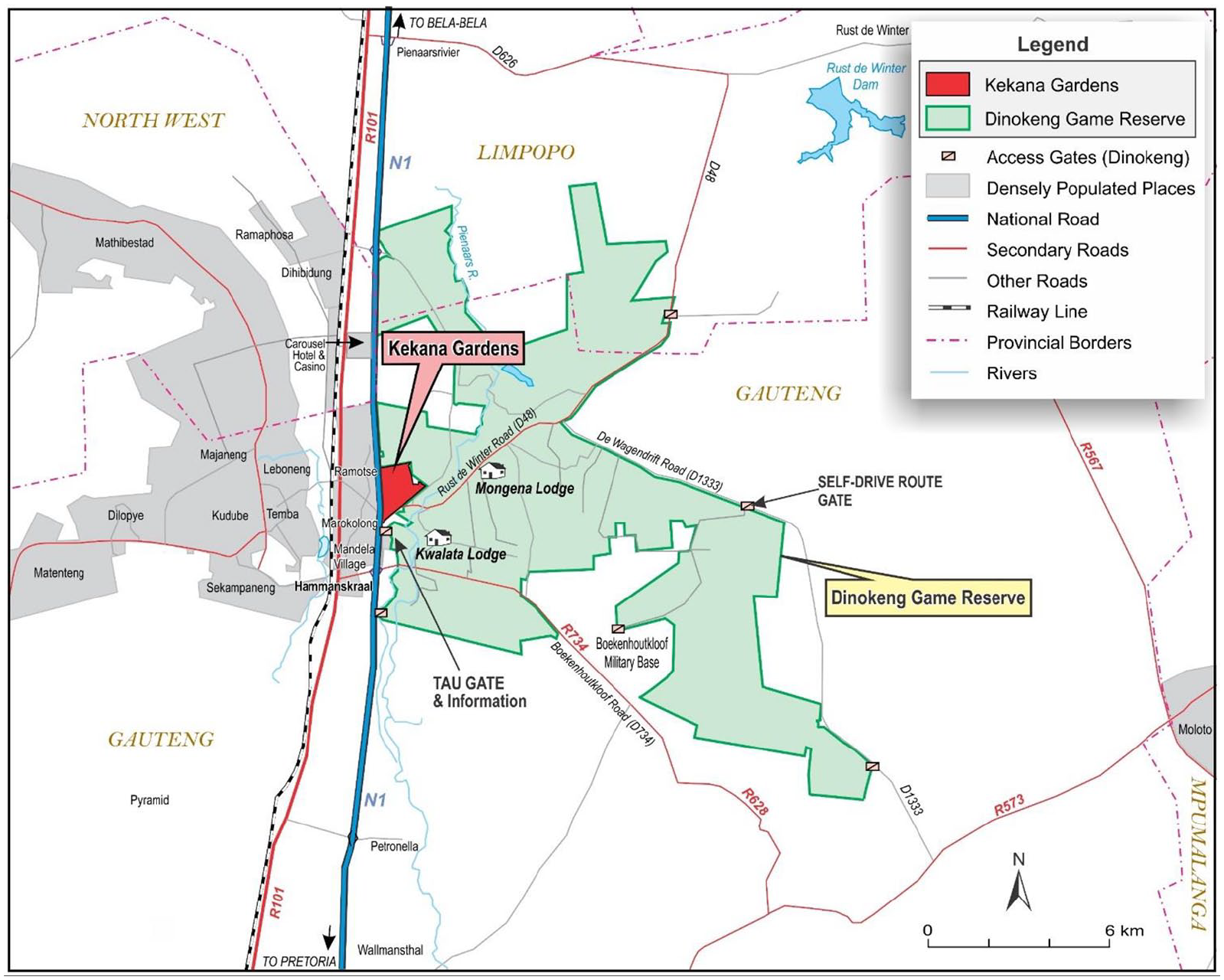
Dinokeng Game Reserve and Kekana Gardens.
DGR is a unique public–private partnership established by the Gauteng Provincial Government. The idea took root in 1995 and master planning began in 2000 (Dinokeng, 2017). It is unique in the sense that it comprises a conglomeration of multiple private landowners (currently 200) who have undertaken to develop their farms as game farms and drop the fences, yet many still live on the properties. Some have started tourism ventures such as lodges and restaurants. Furthermore, the area was not initially a game reserve. The land used for other purposes is being rehabilitated to its indigenous state, and game stocking (which began in 2007) today includes the Big Five, as well as brown hyena, cheetah, giraffe and a wide variety of ungulates (Mongena Game Lodge, n.d.; Van Rooyen, 2013). It is the only reserve in Gauteng to host the Big Five, and when lion and elephant were introduced in 2011, these became the first free roaming lions and elephants in Gauteng in 100 years (Mongena Game Lodge, n.d.). In the same year, the first visitors entered the reserve (Dinokeng, 2017; Kwalata Lodge, 2022). It is unusual in South Africa to have a Big Five reserve so close to urban centres (50 km north of the capital city, Pretoria) and with densely populated peri-urban (not rural) communities as its neighbours. DGR currently comprises 18,500 ha (Van Rooyen, 2013).
Government’s role in the partnership is to provide the necessary infrastructure for the reserve and to assist in socio-economic development of surrounding communities (Stevens, n.d.). Written into the reserve’s business plan is extensive commitment to community upliftment and environmental conservation (Van Rooyen, 2005). Employees should come from surrounding communities and be trained. The plan mentions equity ownership of game stocks by landowners and historically disadvantaged citizens. Suppliers also need to obtain a portion of their inputs from small, medium or micro enterprises (SMMEs) and Black Economic Empowerment owned suppliers, and retailers need to stock a proportion of locally produced supplies. The plan tasks landowners with facilitating links between the tourism industry, local people and businesses; assisting SMMEs and entrepreneurs; developing a social responsibility programme; and facilitating access for locals to visit DGR. Tourism operators need to commit to practicing responsible tourism; and to encourage guests to respect local culture and interact with locals (Van Rooyen, 2005).
The Kekana Gardens community is relatively new to the area. Prior to 1990, there was no community on the eastern side of the N1. It began as a squatter settlement but was later formalised. Due to this, and the fact that the reserve is also fairly new (having been farmland beforehand), in that sense, there is no history of a relationship between this community and the game reserve. Most residents are migrants, having moved into the area from elsewhere. However, there are descendants of a chieftaincy from the Hammanskraal area who now live in Kekana Gardens (Godsell, 2013). This transitory new community does not therefore have a long history of resource access or other benefits, nor of interacting with the reserve.
Research design and methodology
Design, methods and data collection
The research design was qualitative, borrowing from interpretivism and pragmatism (Creswell, 2014). This approach was chosen to explore participants’ perceptions in their own words – their feelings and opinions towards DGR (Patton, 2005; Roulston, 2014).
Working through a key leader in the community, participants were chosen who were aged 18 or over, and a mix of age and gender. This process effectively led to a non-probability purposive sample of 13 participants (six females and seven males). A local translator was used to reduce the risk of the researcher creating bias and impacting trustworthiness, and to set participants at ease (Nault and Stapleton, 2011; Snyman, 2014). Data were gathered during a morning session (approximately 5 hours) in December 2015.
This research reports on the use of two methods, namely focus group interviews (FGIs) and an adapted form of nominal grouping technique (NGT). Different individuals responded differently to each method used, which provided varied opportunities for participants voices to be heard, contributing to the richness of the findings. The different methods also accommodated different types of questions, which assisted in determining the factors that generated or undermined community support for conservation.
For the FGIs, the larger group self-divided into two groups, and the interview was held separately with each group. FGI1 consisted of five participants (one female; four males) and FGI2 had eight participants (five females; three males). The primary researcher facilitated, with assistance from the translator where necessary. The FGIs encouraged interactive discussion, yielding complementary and contrasting opinions. Holding two FGIs provided more opportunity for patterns to emerge. FGI1 contained several community leaders, who were therefore more aware of the reserve, and in certain questions, generated more quotes than FGI2
NGT was then conducted with the two focus groups together. It is a consensus method helpful in synthesising individual opinions, without the limitations of group interaction where certain individuals may dominate (Van Teijlingen et al., 2006). In original NGT, individuals generate ideas which are pooled, discussed, organised and finally voted on (Chapple and Murphy, 1996). With little evidence of NGT being used in conservation studies in peri-urban settings, this method was tested for its efficacy, using the questions on benefits and losses (See Table 1). Each participant was provided with several sticky notes and asked to generate as many answers as he or she wished. Answers were short – a single word or sentence, in mother tongue or English. Participants then stuck the notes on a large paper and together organised them into categories. After naming each category, the notes in each were tallied and participants were asked whether they agreed with the order of priority (according to the tally). If not, this was voted on. The primary researcher largely stepped back in this method to minimise influence. Simplified NGT proved to be a highly effective data gathering method, where participants could categorise, and then through ranking, indicate which benefits and losses/costs were most significant to them.
Questions in research instrument and associated data gathering method.
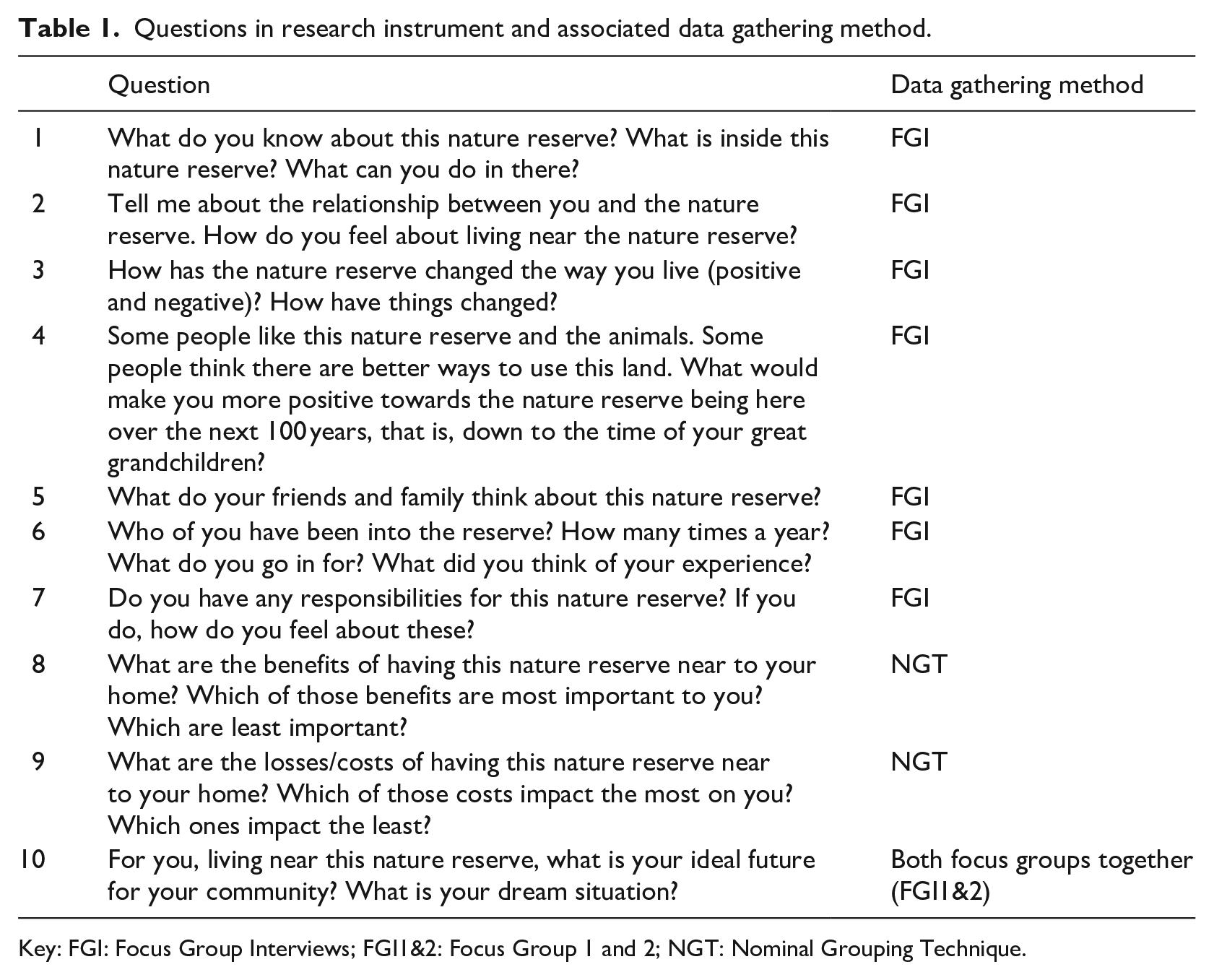
Key: FGI: Focus Group Interviews; FGI1&2: Focus Group 1 and 2; NGT: Nominal Grouping Technique.
The research instrument was developed by the primary researcher, and is provided in Table 1, along with the method used for each question. The final question, Q10, was posed to participants after NGT, within the larger group.
Ethical considerations
This research stems from a larger study done (Queiros, 2020) in which data were gathered between December 2015 and September 2017. Ethical clearance was awarded by the Research Ethics Review Committee of the College of Agriculture and Environmental Sciences at UNISA. Written permission was obtained from the community leader and reserve manager. Participants signed informed consent and anonymity was assured.
Data analysis
ATLAS.ti, (Version 7.0) was used to manage data and organise the analysis. The FGI recordings were transcribed within ATLAS.ti. For NGT data, each note formed a single document within ATLAS.ti. Open and inductive coding resulted in a code set developed for each question, which was then refined, with coding rules articulated to ensure consistency. Data analysis was followed by determining similarities, differences, relationships and patterns; a small set of themes that covered these was developed (Miles et al., 2014). These overriding themes that cut across the data and across individual questions form the basis of the discussion below. Quotations from participants form the data in qualitative studies are used to motivate the themes. For quotes emerging from the two FGIs, these are cited as FGI1 or FGI2; while quotes written on notes during NGT are cited with the number of the note (according to its document number), for example, N2 (for Note 2). Q10 on ‘Dreams for an ideal future’ was put to participants after NGT with the two focus groups together, and quotes from this are hence cited as FGI1&2. Quotation frequencies are used to add additional insight and to verify that a theme is indeed important or recurring (Cohen et al., 2011; Miles et al., 2014).
Limitations of the study
While adapted NGT had the advantage of allowing those who were less active or silent in the FGIs to be heard, a limitation is that the primary researcher could not probe further into a note, as she did not want to single out individuals. However, clarification of notes was done as a form of member checking. Furthermore, the possibility exists that, due to using a translator, their bias, if any, may have influenced participants, and some answers may not be ‘perfectly’ translated.
Findings and discussion
The six most prominent themes emerging from this research are presented in Table 2. The table also provides the codes used to code the quotations, and from which the themes were gleaned; the question number (Q), corresponding with the question numbers in Table 1; quotation frequencies (QF); and a differentiation between quotes that are positive or negative towards the reserve by italicising positive quotes where relevant.
Overriding themes and context.
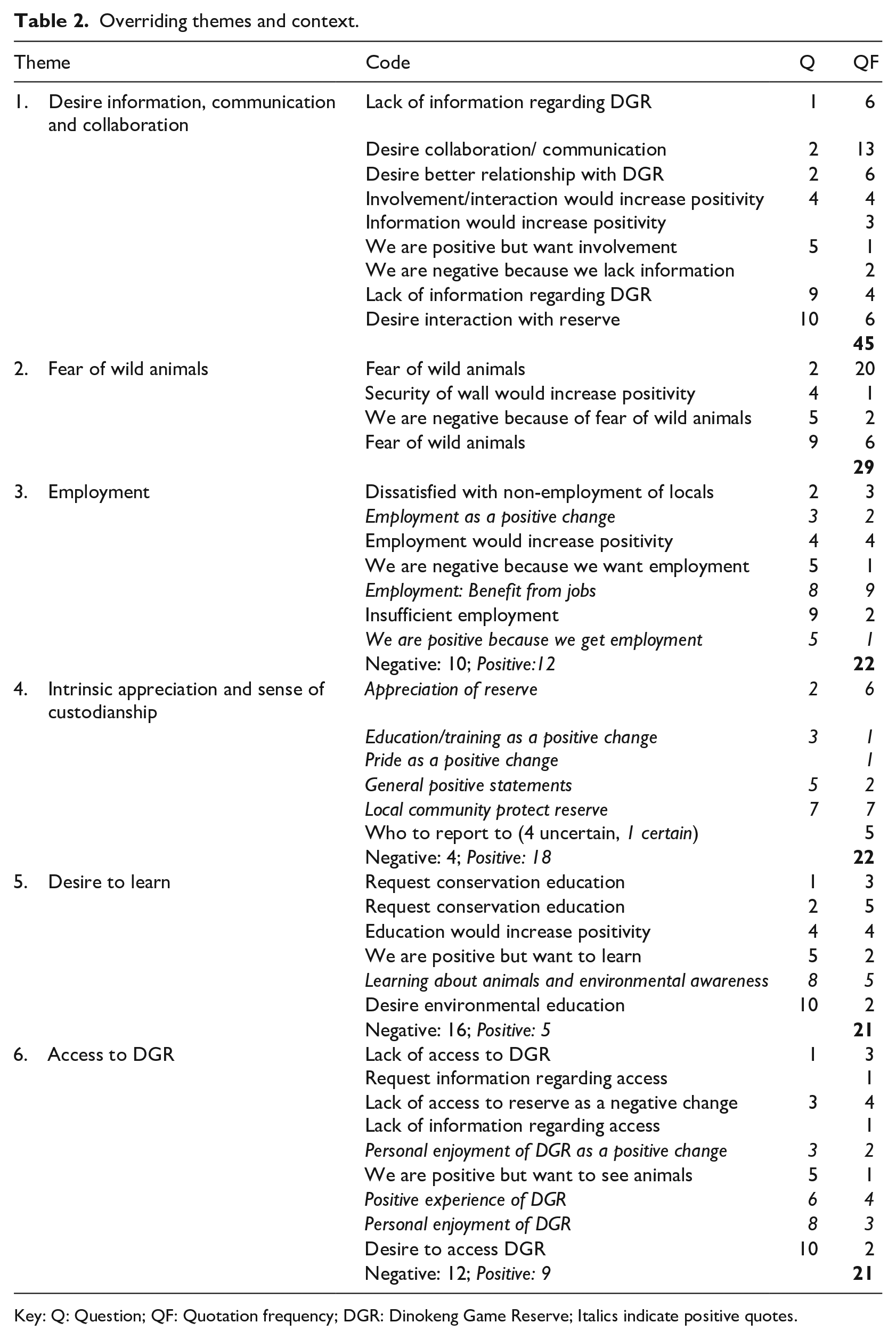
Key: Q: Question; QF: Quotation frequency; DGR: Dinokeng Game Reserve; Italics indicate positive quotes.
Desire information, communication and collaboration
The theme ‘Desire information, communication and collaboration’ was the most dominant theme emerging from the data collected and encapsulated 45 quotes.
This section first focuses on the desire for
Under Q1, on knowledge of DGR, the code with the highest occurrence was ‘Lack of information regarding DGR’. The six quotes touched on lack of information regarding the animals and lodges within, and learning opportunities. While some participants were unsure of the type of animals within DGR, others refer to the Big Five and species such as giraffe and kudu. Participants seemed aware of the presence of lodges and landowners, but with little detail. Some examples are as follows: We don’t know which kind of animals are there. Some don’t even know there are animals in there . . . (FGI1) I saw a pamphlet at Wonderboom airport whereby they were mentioning we’ve got the Big Five. Wonderboom airport . . . far away from Kekana Gardens. So that is how I discovered there’s Big Five in the game reserve. (FGI1) How can I be the neighbour to the lodge, but I know nothing about these lodges, even their names? (FGI1)
Under Q4 on what would increase positivity towards DGR, three quotes are coded under ‘Information would increase positivity’, for example, ‘If you give me information, it will help. I understand that you protect animals and me – not only animals. I know you value me’ (FGI1) and ‘Information is the bottom line. Education is essential and this will explode from village to village’ (FGI1).
Within Q5, lack of information is linked to negativity (two quotes): ‘People are not going to love something they don’t know about, but they might go for it if they have information’ (FGI1) and ‘This is why people don’t like it. There is ignorance – no proper explanation for the local people’ (FGI2).
. . . we should have access to their information . . . and they too must have our information . . . so that we can have a common movement. Common relationship. More importantly working towards the safety of the community, [the safety of] and servicing of the game reserve, because we have to form part of preserving the nature reserve as well. (FGI1)
Another expressed frustration at outsiders being hired for jobs and wanted more communication from leadership so that people in the community with the right skills could be matched to jobs.
The quotes on the wall and animals reflect the sentiments expressed under the next theme, ‘Fear of wild animals’, but add the element of collaboration/communication, for example, ‘They should interact with us so that we can know and understand those animals . . . and how to act in case one is coming . . .’ (FGI1). Another asked for a call centre that they could report to if wildlife escapes (FGI1).
Regarding inter-cultural communication, participants were positive regarding interacting with tourists, for example, ‘. . . experiencing new faces, new races, that we can meet so that we can know how’s the world outside. They’re going to explain to us where and how they’ve living. Like we’re talking to . . . different kind of people . . . that’s nice . . .’ (FGI1)
In addition, from Q2, six quotes reflected on the desire for a better relationship between the community and Dinokeng. Some participants acknowledge a good relationship with the desire for more, while others say the relationship is poor. Two participants reflected on Kwalata Lodge setting an example which other stakeholders can follow, for example, I wish that the game reserve should learn from Kwalata because his involvement in the community, it’s a success. For example [he] would invite the crèche people to come into his place, . . . hold functions and so forth. But the game reserve itself is distancing itself from the community. (FGI2)
Others refer to wanting more of a relationship, for example, in FGI2, an interviewee commented that the relationship is good, but they desire improvement; and in FGI2 it was indicated that
When you talk about the good relationship, I was hoping that we can have more. I know that we’ve got it, but we can extend [it so] that we have a more good relationship between the owners [and] leadership of Kekana Garden [and the leaders of] the [other] areas . . . near the game reserve.
In Q4, the code ‘Involvement/interaction’ was used to code four quotes, with participants emphasising the need for contact as a means to increase positivity, for example, ‘Don’t be afraid to come and talk to us . . . we want to be more active and involved. These animals belong to us’. Q5 echoes this, with one quote coded under ‘We are positive but want involvement’, where a community member expresses majority support but wants more interaction: According to my opinion we are more anxious to see this game reserve work, but unfortunately there are people who are supposed to come to us and lead us on that [but they’re not]. We want this game reserve. We want it. (FGI2)
Finally, in Q10, where participants expressed their dreams for an ideal future, ‘Interaction with reserve’ was the dream most verbalised (six quotes), for example, My dream is just simple . . . to one day see Dinokeng and Kekana being one, our community understanding better what’s within the game reserve. It’s a dream to see the partnership continuously growing and it’s a dream to see us as one – sharing a common sense; common goals; having programmes . . . becoming one committee; having a year plan together. Then we will achieve our goals . . .’ (FGI1&2)
The perceived lack of information feeds a sense of exclusion. Participants clearly request more information on the reserve (how it works, conservation and types of animals) and the data suggest that the presence of this can improve attitudes towards the reserve and improve support for conservation. Regarding communication and collaboration, the findings suggest that this is also linked to improved positivity towards DGR as well as a better relationship. There is goodwill and a clear desire for a better relationship and to understand each other. In discussion with the reserve manager and landowners, this too is their desire, and several initiatives are underway. In a follow-up discussion with one of the landowners, it was mentioned that reserve stakeholders do go out and engage at community meetings. The challenge is that only certain people attend these meetings, although some are open to all. This means that information is not always widely spread.
Fear of wild animals
The theme ‘Fear of wild animals’, commonly referred to as human–wildlife conflict, encompassed 29 quotes. In Q9, participants voted it as the third most significant loss, with six notes produced during this NGT question, for example, ‘Scared of animals’ (N99) and ‘Not safe because of Big Five’ (N111). Participants have a very real fear of wild animals – this was the most prevalent theme emerging under Q2 with 20 quotes. Eight of these expressed the emotion of fear in general, for example, ‘It’s very scary because even at night sometimes you hear those animals crying . . .’ (FGI1) or related to concerns regarding the wall surrounding DGR. Participants seem unsure of the wall’s effectiveness in keeping wild animals away from them. A crafter working just outside Dinokeng commented, ‘. . . according to myself . . . to stay near the game reserve, I’m not sure about that fence that is surrounding this game reserve, because there’s dangerous animals inside there. So sometimes I used to be scared that maybe when I wake up I’ll find a lion in front of my house . . .’ (FGI2)
This same uncertainty emerged in Q4 (1 quote) and reveals the link between the perception of an insecure boundary and attitude towards DGR: Initially they expected the game reserve to be secure. But the electric fence is not working. People are scared. What if a lion comes? Hence, they don’t like it. If the reserve electrifies the fence, it may change the local people’s minds. (FGI2)
These findings suggest that distrust of the boundary wall and fence increases negativity. In discussion with a landowner, it was mentioned that the effectiveness of the boundary fence is negatively affected by vandalism (cuts in the fence).
A further eight quotes from Q2 focused on the problem of snakes coming out of DGR. This seems to be a real issue for the community, and many snakes are killed as a result, for example, For me it’s great to be [next to] the game reserve but sometimes I have a fear because I’m staying [next to the wall]. I see many snakes coming from the game reserve . . . It’s dangerous for the children. . . . usually we’ll kill five snakes per week. And children can’t play, and they’re scared of snakes. (FGI2)
The fear of snakes is also cultural. One local commented ‘It’s a devil’ (FGI1), while another revealed that ‘. . . when we see a snake, actually we see a very dangerous thing [that] must be killed’ (FGI1). In this theme, while the perception of fear is apparent, participants did not report on actual encounters with large game or predators. What emerged clearly, however, are encounters with snakes and the fear of snakes, which feed negativity towards Dinokeng. In addition, the fact that several do not know how to handle these situations increases anxiety and negativity. A direct negative behaviour towards the environment is evident here, in the number of snakes being killed.
Four of the quotes from Q2 relate to the desire for communication and information. Interviewees want to know how safe they are and what protection is offered; and request education regarding which animals are dangerous and what to do, for example, ‘We are living with those things . . . That is the key – to have knowledge of those things, how dangerous they are, which ones are not dangerous so that we can deal with them. They must ensure safety’ (FGI1). This fear emerged again in Q5 with two quotes under the code ‘We are negative because of fear of wild animals’, for example, ‘For me we don’t like the game reserve. It’s scary’ (FGI1).
The NGT research revealed the perceived loss or cost of ‘Fear of wild animals’. Knowing this, and that it was ranked as the third most significant loss/cost, can assist Dinokeng stakeholders in managing this. Participants themselves hint at possible solutions which could decrease this sense of fear – more information and assurances (if possible) of the level of safety offered by the barrier; as well as information on which animals are dangerous and how to handle these situations (this is touched on again under the theme of ‘Intrinsic appreciation and sense of custodianship). Improved security on the part of the reserve is also important.
Employment
Twenty-two quotes relate to employment, with 12 being positive and 10 negative. Within this theme, the desire for employment emerges as well as dissatisfaction at non-locals being employed. In Q2, in the context of the relationship between locals and DGR, three quotes relate to the non-employment of locals, bemoaning the fact that non-locals or foreign nationals are employed or linking unemployment to poaching: Because they don’t hire [from] our local community, that is why those people who are not working at this moment . . . go to poach inside there . . . There’s no relationship between the game reserve and the community. We want to stop those things as well if they hire the people. Then the people will protect the animals . . .’ (FGI2)
In Q4 on increasing positivity, four quotes position employment as a means to increase positivity, while two of those add the hiring of non-locals, stating that prioritising locals would increase positivity, for example, ‘They are hiring people from outside . . . they need to prioritise locals’ (FGI1) and ‘. . . If they can employ people from the area, there will be less crime’ (FGI2). In Q5, under the code ‘We are negative because we want employment’, one quote emerges, reiterating the above: I think on my side, the people staying around our area – most of the people they wouldn’t like [the reserve] because when we go around our community they say, we’ve got our game reserve, but we are not working in there. [Landowners] just go there and hire people from far. Our grandmothers, they say ‘our kids are not working, our grandfather is not working, we’ve been left out of there’. If the game reserve could hire people, people would be more positive. (FGI2)
While in Q9, there were two notes regarding ‘insufficient employment’ as a loss, namely ‘Unemployment. Don’t offer work’ (N100) and ‘Dinokeng must give our people jobs’ (N101), under Q8, participants voted employment as the most significant benefit received, with nine notes. Strengthening this, in Q3, employment is mentioned as an aspect that has positively improved lives, with two quotes, for example, ‘And then our neighbours, some of them are working in there. Their family are now starting to get life so it’s good’ (FGI1). A quote coded under Q5 reveals positivity due to employment gained and the significant difference that employment makes to quality of life, and then to attitude: ‘From my side, the game reserve is number 1. It is a relief. People used to spend transport money to go work in Centurion. Now they work here – it’s easier. We are very happy’ (FGI2).
Employment opportunities are voted as the most significant benefit. They have improved the quality of life of some and do improve positive attitudes towards the reserve. Clearly, there is a desire for more employment, while the employment of non-locals increases negativity and frustration. It needs to be acknowledged, however, that a small reserve in its infancy cannot employ a large number of people.
Intrinsic appreciation and sense of custodianship
This theme contained 22 quotes in total. Four of the six comments made in Q2 under the code ‘
In Q3, this theme recurs in one quote, reiterating the importance of nature, but adding the element of joint And then the other important thing is that we were very much a disadvantaged community but now it’s like people are getting to know what the game reserve is all about. So, a little bit of education is now getting into the people, so it’s very important. As time goes by people will get more and more to know how to protect the nature reserve itself because that to me is their legacy as well. (FGI1)
In Q7, which asked about responsibilities towards DGR, the data substantially strengthen this custodianship theme. Represented by the code ‘Local community protect reserve’ (seven quotes), the community clearly feels a sense of custodianship towards Dinokeng. Participants feel responsible for the wall bordering the reserve, and although there is a concern for their own safety, the majority of quotes demonstrate concern for the reserve, and contain the motive to protect it, for example, I live just next to the wall. If someone messes with my wall . . . I must confront and act. I have a responsibility for that line. (FGI1) I as [a community leader] make sure people don’t jump the wall. If an animal jumps, I call the police. I’m responsible for those people jumping the wall. (FGI1) When an animal comes out of the reserve, I must protect it, because I want my child to see it. I can’t allow them to kill it. I don’t know who to call, but I will make a plan. (FGI1)
In discussions with the reserve manager and landowners, they felt that the community did not have any responsibilities, but they could be referring to formal ones, and are perhaps unaware that some locals feel this degree of responsibility. The fact that this sense of responsibility is self-imposed and not requested by the reserve is very positive.
Under Q7, within the code ‘Who to report to’ (five quotes), participants also revealed that there is some uncertainty regarding who to call and what to do if there is a problem – some know what to do, others do not. They want to know who to report to should there be a problem that either endangers the reserve or the community. For example, ‘There’s a guy by the name of . . . who heads the rangers. Last week a hyena got lost next to my house and we called [him] . . . I definitely know the person that’s involved’ (FGI2); ‘There are boards at the gate regarding who to call. I see it on the gate, but some don’t know’ (FGI1); and ‘We must know the man, because one day I will see the lion in front of my house . . . once I called . . . to give me the number of that person, but it [can] take a long time’ (FGI2).
An escaped animal can potentially be a life-threatening situation for locals, hence it is important for them to feel safe and empowered. This could be fairly easily addressed by distributing cards/fridge magnets with the number to those living near the wall. It can also be covered in educational initiatives. It goes further than just providing a number – by having this information, residents may feel more empowered (encouraging custodianship) and feel less at risk, which could result in less animals, especially snakes, being harmed.
Knowing these perceptions has important implications for DGR management. This theme has revealed that some locals have an intrinsic appreciation of nature and conservation, and an environmental awareness, and these appear to aid positivity. The perceptions emerging here also reveal goodwill towards DGR. Furthermore, a self-imposed sense of responsibility and custodianship towards DGR appears to increase a sense of involvement, and results in direct positive behaviour. For the sake of both the people and the reserve, stakeholders should encourage this sense of custodianship and empowerment through educational initiatives. This may further the sense of ownership and of having a part to play, which could foster pro-conservation attitudes and behaviour.
Desire to learn
The theme, ‘Desire to learn’ encompassed 16 quotes involving requests for learning and five that acknowledge existing learning opportunities.
In Q1, three quotes encompass the desire to be educated on conservation, for example, . . . [Dinokeng] should be part of educating the community how to preserve the game reserve because it’s of importance. It’s their legacy. That’s very important. So, people must know how to protect the game reserve because they belong to the game reserve as well. (FGI1) I hope they can help the local community. If we could get a good price, then we can go in and learn about them, interact with the nature reserve. Up to my age, I haven’t seen a lion – only on TV. (FGI2)
In Q2 on relationship, these requests continue (five quotes). Two refer to teaching regarding which animals are dangerous (FGI1) and what to do if you encounter a wild animal (FGI2); while the others were simply a desire to learn – suggestions were made to make videos for young and old (FGI1); to teach children from young regarding the ‘Big Five’ (FGI2); and to ‘teach the people [that] if you come and jump the wall and chop the trees down, then you affect the environment as a whole and you affect your own life and the animals as well’ (FGI1). In Q5, two quotes are coded under ‘We are positive but want to learn’. Respondents referred to school trips being important (FGI1) and wanting to learn: ‘Yes [they are positive], but the problem is that we need to learn about this game reserve’ (FGI2).
The theme is further strengthened in Q4, where four participants mention education as a means to increase positivity and custodianship towards DGR, for example, I think it’s very hard to protect what you don’t know. If we know those people who are owning those things, if we know the animals, then it will be easy for us to protect it. You can’t just tell someone they must protect it, but they don’t know about the game reserve. We need knowledge . . . (FGI2) . . . Once we know . . . the animals, [then] we know how the animals are important . . . (FGI2)
Finally, requests for learning are expressed as dreams for the future (Q10) in two quotes: ‘Maybe if they can give our kids . . . the tutor from the game reserve. Maybe every Saturday [they] can come and teach them how . . . the game reserve works’ (FGI1&2) and My dream . . . if maybe I can see myself building a sort of an academy whereby people can . . . learn, . . . whereby information will be given to people, so that our children can grow up securing that legacy. Because without information they will be nowhere. (FGI1&2)
The desire to enter and learn about animals and conservation appears to be strong (for both children and adults). Locals want to learn so that they can understand and protect the reserve better. The desire to protect is clear, despite most participants never having entered DGR. These results are further evidence of the goodwill from local people towards DGR. Acknowledgement of their inter-dependency with DGR also emerges. Creating opportunities for learning could improve positivity and increase the sense of the community belonging to the reserve and desiring to protect it. These findings are very positive and are important for management to act on.
Finally, existing learning and training opportunities regarding the environment are acknowledged as an aspect that locals appreciate. In Q8, ‘Learning about animals and environmental awareness’ (five notes) is voted as the second most significant benefit received (tie with the contributions that tourism brings). Examples include ‘To know more about animals’ (N86) and ‘Children learn more about animals’ (N96). In terms of training, several good initiatives exist, run by either DGR or government, for example, firefighting training, programmes offered by the Honorary Rangers and government training projects. However, it appears that knowledge of these needs to be spread to increase uptake, so that more locals can benefit from and witness the upliftment opportunities on offer because of the existence of Dinokeng.
Access to DGR
The theme ‘Access to DGR’ contained 21 quotes, with 12 of these concerning issues of access and nine concerning positive experiences following visits to DGR.
Q5 contains one quote coded under ‘We are positive but want to see animals’: ‘They are positive. It will be good if the local people can go and watch the animals’ (FGI1). Q1 contained four quotes regarding access which provide more detail and also touch on a feeling of exclusion. For example, . . . though we are closer to the lodge, we never see [the animals] . . . it’s actually a crisis, because we should know about those things, [because] we are the people who are surrounded by those things . . . (FGI1) Especially ourselves staying at Kekana, we only see people coming from far away to visit those lodges. We don’t know how, what are the procedures, what do we need to have so that we can go inside. What’s going on inside? (FGI1)
In Q3 (five quotes) on negative changes that the reserve has brought to their way of life, participants again refer to a sense of exclusion (yet accessibility for others), lack of information regarding access, as well as no longer being able to walk through DGR and the cost implications thereof. It is important to note that most people in this community would not have their own car.
Because time before I would have a chance just to travel here and back without being restricted. I was . . . doing that. So, I think it’s a negative thing because [now] I can see only people are coming from far away. (FGI1) . . . it has changed negatively because the game reserve itself doesn’t provide [the surrounding residents] with information . . . They should let us know when are the special events . . . give us special treatment: ‘Okay, guys, during this month of the year you’ll be allowed for free to do one, two, three, four’ . . . People from far away know the exact time of coming to view. They know this month we’ll be able to see the birds . . . but we’ll not get information on that, . . . and we are residing just around the game reserve. So, I don’t think it’s a good thing . . . (FGI1)
Finally, the desire to access DGR also emerges twice under dreams (Q10). One participant wishes that children could enter for free and the other dreams of a lesser charge for locals: ‘I was just thinking of ourselves living around the game reserve. We should be charged a lesser amount compared to people coming from far . . .’ (FGI1&2).
Regarding those who had accessed DGR, Q6 concerned who had entered Dinokeng and their experiences. Although only four out of 13 participants had entered, they were very positive, expressing enjoyment of the functions attended and what you could do inside. Furthermore, positive feelings were expressed alluding to being treated well, the peacefulness and sense of security. A visit into the reserve came across as being a treat, for example, ‘You are free to have good parties. It works well. You learn more when you are inside. You can go on a game drive and learn. You can do team building, cook for yourselves. Group work. You learn things’ (FGI2). Another participant commented, ‘It’s quite nice. There’s no noise there as we experience noise . . . We hear the birds and then a bit of singing’ (FGI2).
In addition, personal enjoyment of DGR emerged twice as a positive change under Q3, with participants referring to visiting Dinokeng for relaxation and attending functions; and thrice as a benefit under Q8 – one relating to relaxing, and the other two to seeing animals, for example, ‘Taking our kids to see the Big Five’ (N83); and ‘We are going to have access to go inside and have fun and see animals’ (N85).
In terms of this theme, it appears that personal experience of Dinokeng (particularly seeing animals and going to lodges for functions) creates positive attitudes. Furthermore, the data suggest a clear desire to enter and experience DGR. The feeling that the reserve is for others but not for them also surfaced, and this causes a sense of exclusion and negativity towards DGR. In conjunction with the Honorary Rangers, the reserve does have several initiatives aiming to bring local people in, such as bringing in youth from Kekana Gardens who have learning difficulties; and a Youth Day programme which takes learners into DGR for a game drive, a presentation on careers in conservation and tourism and a conservation quiz. Different landowners make their game vehicles available for transport (Dinokeng Game Reserve, 2017).
The intangible benefit of access for locals as visitors appears to be barely present in existing literature. Lee (2013) mentions this as an intangible benefit and found that increasing leisure and tourism opportunities for locals was important and increased the perception of benefits received. Strickland-Munro and Moore (2014) note that locals living outside the Kruger National Park seldom visit the park for pleasure, but rather for employment or outreach programmes. The importance of visits to the park for leisure is therefore a key finding that bears consideration. Dinokeng stakeholders could consider marketing within the Kekana Gardens location – highlighting the self-drive route and special offers such as discounts for parties and events. Where possible, to increase the number of locals that can visit, buses could be taken into the reserve.
Conclusion and recommendations
In striving towards the dual achievement of improved wellbeing for communities bordering conservation areas and biodiversity conservation in these areas, it is vital to consider the perceptions of local people as a valuable form of evidence. By knowing perceptions, the factors that generate or undermine support for conservation can be determined. These, in turn, can facilitate appropriate management interventions that are realistic and achievable in the African context and that will benefit both people and parks. Questions need to be asked that will reveal these factors. A large part of this is investigating the perceptions of benefits and losses. While tangible benefits are essential, there has been less research on intangible benefits and what communities perceive as being losses/costs due to the presence of a conservation area.
By focusing on Kekana Gardens, which borders DGR, this paper demonstrated a qualitative methodology which brought these factors to light in the form of themes. Each theme reveals important considerations, and where negative factors come to light, the solutions do too. Interestingly, four of the key themes relate to intangible benefits, highlighting their importance in engendering support for conservation. While lack of information resulted in a sense of exclusion, which would not engender support for conservation, the clear desire for information, communication and collaboration was encased in goodwill, with participants wanting to know and understand the reserve. They indicated that having this would improve both positivity towards conservation, as well as the relationship. Providing information and more regular communication need not be expensive and could address what participants perceive as a major loss. Participants appreciated existing learning and training initiatives, which clearly promoted support of DGR. However, more learning is strongly requested, and it is interesting that this learning is desired so that local people can understand and protect DGR. This again reflects the inherent goodwill present. The research suggests that providing learning opportunities would increase positivity and a sense of being part of Dinokeng. While conservation education programmes for communities bordering DGR do exist, an extension of these for adults and in schools would be beneficial. Intrinsic appreciation of DGR exists, which is positive in itself and appears to increase support for DGR. A sense of custodianship seems to increase a sense of involvement and results in direct positive behaviours. Both this appreciation of nature and sense of responsibility indicate the favour of the community towards Dinokeng, and should be encouraged and supported. Finally, the most unusual intangible benefit to emerge was that of access to Dinokeng. In this present research, lack of access causes a sense of exclusion, while access as a visitor improved positivity towards conservation. This is therefore an important intangible benefit that requires more attention. With the dearth of research in this regard, it is also a key future focus for scholars.
Fear of wild animals is perceived as a cost/loss and triggers negativity and anxiety, and results in a direct negative behaviour of killing snakes. In this research, the fear is largely focused on encounters with snakes, rather than actual confrontations with large game or predators. Considering this fear, participant quotes suggest that information provision and support in this regard could help to allay fears. The only tangible benefit, namely employment, has improved quality of life and increases support for conservation. However, more is requested, and the lack thereof is perceived as a loss. Employment of non-locals causes negativity towards DGR and should be avoided as far as possible. However, Dinokeng, like most conservation areas, is unable to provide sufficient tangible benefits to support a growing community. Support for conservation needs to depend on more than a few economic benefits. This pushes the importance of intangible benefits into the spotlight. Despite less research on these, they appear to positively influence community wellbeing in Kekana Gardens, as well as pro-conservation attitudes and behaviour.
A positive thread throughout the findings is the sense of goodwill expressed by the Kekana Gardens participants towards DGR. This provides a fertile ground for a mutually beneficial relationship. In the words of one of the Dinokeng landowners: ‘. . . It’s a win for conservation. It’s a win for the community and it’s a win for the economy and for South Africa. I think it’s a stunning example’.
The findings demonstrate the efficacy of this methodology. It can be applied in other communities where protected area management want to understand the positive and negative perceptions held by communities, which benefits and losses are most significant in their eyes, as well as what local people perceive the benefits and losses to be. By identifying the factors that engender or undermine support for conservation, stakeholders can craft interventions that will benefit local communities as well as the conservation of biodiversity in the future.
Footnotes
Acknowledgements
The authors gratefully acknowledge the Kekana Gardens participants and Mr Reward Lebogang Shadung who facilitated access to the community. The previous reserve manager at the time, Ms Jenny Stevens is thanked for her invaluable support. The input of the landowners is much appreciated, but names are withheld due to the Unisa ethics policy, which requires anonymous participation. Thank you to Prof Ciné van Zyl, the co-supervisor of the study from which this work originated, for her invaluable input into the original research.
Funding
The author(s) disclosed receipt of the following financial support for the research, authorship, and/or publication of this article: The researchers appreciate the funding provided via the UNISA Academic Qualification Improvement Programme (AQIP).
