




Abstract
This paper documents the traditional agricultural practices of Chuktia Bhunjia tribe of Odisha, India, and attempts to comprehend as to how they negotiate with their ecosystem in order to ensure sustainable agricultural production and livelihood. Data, collected using interview and observation, reveal that agricultural practices of the Chuktia Bhunjia are revolved around local ecology, beliefs, rituals and knowledge. The knowledge-based intercropping, agroforestry, crop rotation, crop diversity, rain-water harvesting and management of soil fertility are important domains involved in their agricultural practices that are found to as a function of long-term observation and experiments, and are reported to have been culturally reproduced through self-engagement and ritualistic practices associated with agriculture. Their agriculture is assumed to have significance in maintaining the soil fertility and moisture, and reducing greenhouse gases and enhancing carbon sequestration whereby to balance the landscape. The agroforestry-based agricultural practices, coupled with belief, ritual and technology, is also found to make their agriculture cost-effective and ensure conservation of ecological system. Climate change–driven agricultural decision-making among them is found to as a tool not only to arrest their crop failure but also to ensure sustainable food production and livelihood. Yet, the expected evacuation of inhabitant including Chuktia Bhunjia due to ‘tiger-project’ is assumed to be a threat to their agricultural knowledge and other cultural domains. Therefore, owing to the livelihood implication of traditional agriculture, any attempt to integrate their agricultural knowledge base with scientific knowledge would ensure sustainability of both ecology and livelihood together.
Keywords
Introduction
Since last decades, government is trying to boost agricultural production by various ventures like introduction of hybrid variety of seeds, technologies, methods, adaptation of agricultural policies and so on, to compete with global economy. The adoption of economic liberalism and globalisation as revealed from large-scale capital investment, agricultural subsidies, agricultural policies, and so on, has certainly resulted to growth in agricultural sector and gross domestic product (GDP) but the subsequent urbanisation and declining agricultural land have worried scientists about how to ensure sustainability of food production to feed the increasing masses. As Singh (2000) observes that ‘after sixty years of massive investment of capital on this sector, people are yet to agriculturally benefit as many have no adequate food supply’ (p. 47). Nevertheless, Indian farmers are encouraged to adopt conventional agricultural technologies to increase food production for global economic completion. Still, it has not trickled down the rural farmers rather than widening the gulf among them. Thus, critique of the conventional agriculture, both agricultural scientists and social scientists think of ‘alternative agriculture’ not only to challenge the concepts of ‘growth’, ‘capital formation’ and ‘liberalisation’ but also to make agriculture sustainable and free from market orientation. The term ‘alternative agriculture’ here has been used interchangeably with Indigenous agriculture, traditional farming, traditional agricultural knowledge, and so on, which is understood as the embodiment of local agricultural practice, knowledge and meanings of the farmers concerned that embrace how they express, negotiate and share the meanings and relationships embedded in their soils, ecologies, cuisines and practices (Cernea, 2005; Chamber, 1980; McCorkle, 1989; Netting, 1993; Rhoades, 1983; Singh 2000).
Haverkort (1995) defines traditional agricultural practices as ‘agricultural production where technologies being used depend completely on local resources and have, over time, developed a wide range of site-specific technologies embodied in the culture of the people in a certain area’. The rationality of Indigenous/traditional agriculture leads to the assumption that farmers’ Indigenous and traditional-based knowledge and technologies are always well-adapted to their environments‚ that farmers are always capable of adjusting to changes‚ and therefore serves as the model for sustainable agricultural development (Srivastava et al., 1996; quoted in Cleveland, 1998: 335). Netting (1993) views that ‘traditional cultivators are more sustainable than commercial and industrial agriculture’ (p. 144) and ‘may be more vital and necessary to our future than we realise’ (p. 334). The studies on traditional agriculture show that the practice operates outside of the capital intensive and high external input approaches (Cernea, 2005; Crevello, 2004; Howes and Chambers, 1980; Rajasekaran and Whiteford 1992; Soleri and Cleveland, 1993) and works along with ‘culture’, ‘value’, ‘tradition’, ‘decision-making’ and epistemology of ‘knowledge’ some of which have been crystallised into stable structure, institution and organisation (Brodt, 2001; Cernea, 2005; Richards, 1993).
In recent years, documentation of traditional agricultural knowledge of rural and tribal farmers has received significant attention due to its multitude potentiality of sustainability (Rechards, 1989; Warren et al., 1989). Literatures shows that traditional agriculture is revolved around the ecology and shaped by the knowledge, experiments, beliefs and rituals of the farmers (Behera, 2021; Kumar, 2010). Studies find that traditional agriculture, being ecologically driven system, is helpful not only in maintaining and enhancing soil quality but also push to higher crop production (Crevello, 2004; Dialla, 1994; Jeeve et al., 2006; Rhoades, 1983; Talawar and Singh, 1994; Warren and Rajasekaran, 1993). The knowledge-based agriculture is also found to be cost-effective and climatic-resistant (Basdew et al., 2017; Behera, 2021; Charles et al., 2014; Kumar, 2014; Mini, 2005; Soropa et al., 2015), adaptable, nature friendly, and productive (Fernandez, 1994) and always has the potentiality to escalate the conversion of carbon dioxide (CO2) to organic form and consequently reducing global warming (Misra et al., 2008). Besides, mixed cropping, the important form of traditional agriculture that provides 15%–20% of the world’s food supply (Altieri, 1999), is assumed to decrease the risk of crop failure, pest, and disease and diversifies the food supply as well (Sauerborn et al., 2000). Yet, it is argued that traditional agriculture although is not sufficient to feed increasing population, the ‘practices’ associated with such agriculture helps people to grow food sustainably besides becoming a tool to ecological restoration and natural resources management (Behera, 2021). Thus, the traditional knowledge includes three aspects: environmental, economic and social that can be achieved on a greater understanding of how different agricultural systems affect the environment‚ how humans perceive the environment and environmental feedback in response to their agricultural systems‚ and how these perceptions affect values‚ knowledge and behaviour.
On the above theoretical background, this present paper documents the traditional agricultural practices of Chuktia Bhunjia tribe of Odisha, India and attempts to comprehend how they negotiate with the landscape to enhance their food production sustainably and arrest the climate-driven food vulnerability through Indigenous knowledge. It collects the associated knowledge, beliefs, rituals, tools, technologies and so on, pertaining to agriculture and infers as to how their knowledge bases agricultural practices ensure agricultural and livelihood sustainability.
Materials and methods
Bhunjia is one of the tribal groups largely distributed in central India. They are divided into two broad social groups: Chinda Bhunjia and Chuktia Bhunjia (Pattnaik et al., 1984). In Odisha, Bhunjia are reported to have settled majorly in Nabarangpur, Mayurbhanj, Nuapada and Baleswar district with a total population of 12,350 with 1012 sex ratio and 44.93 literacy rate (Government of India, 2013). The Chinda Bhunjia – also known as Oriya Bhunjia – is an acculturated section of Bhunjia tribe are almost inhabit in all the district mentioned above. The Chuktia Bhunjia (the subject of the present study) inhabit only in Nuapada district of present-day Odisha. They are identified as one of the PVTGs in the state and exclusively inhabit in Sunabeda Wildlife Sanctuary (SWS) bordering the state of Chhattisgarh. According to a baseline survey by Ota et al. (2020), their total population is 3086 (1593 male and 1493 female from 938 household). They live in 35 villages/hamlets of SWS. With a sex ratio of 937, the literacy rate of Chuktia Bhunjia is estimated to be 24.54 (29.14 male literacy and 20.00 female literacy). They belong to Dravidian language speaking group (Russell and Hiralal, 1916) who speak Bhunjia dialect (mixture of Oriya and Chhattisgarhi) for intra-group communication and local Oriya for inter-group communication. Although they were reported to practice hunting-gathering form of economy, inclusion of their habitat into the protected area forced them to become settled agriculturists. Even yet, collection of minor forest produces (MFPs) constitutes an important source of their livelihood. They are animistic in nature and worship a number of natural phenomena. Majority of their festivals are associated with the agricultural practices and collection and consumption of various wild edibles.
The present study was conducted among the Chuktia Bhunjia tribe living in SWS (Map 1) during March 2020 to January 2021 to document their traditional agricultural knowledge. Data were collected using observation and interview method. Ethno-ecological approaches were largely used pertaining to the information on land and soil taxonomy and narrative method was used to comprehend the agricultural practices beginning with the land preparation to the harvesting of crops. So, beliefs, rituals and festivals associated with agriculture were collected through this approach. Each stage of agricultural practice was witnessed through observation by participant method. Both male and female farmers between 25 and 70 years of age were interviewed to gather required information.
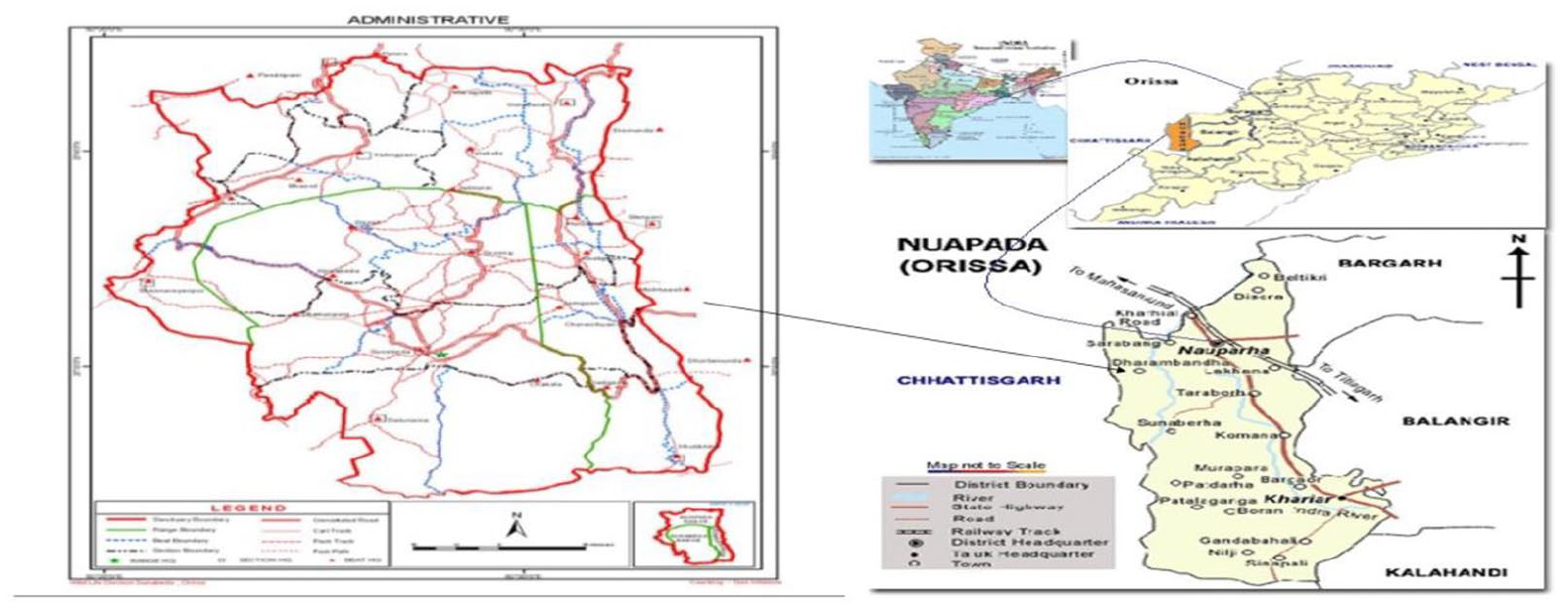
Sunabeda Wildlife Sanctuary.
Land and soil types and cropping pattern
The perception on land does vary across communities so as the Chuktia Bhunjia of SWS. The idea of ‘land’ for them is merely a specific territorial landscape surrounding their habitation that is believed to be gifts of their supreme deity-Sunadei. Gradually those landscapes were viewed as entities having specific power to produce food items for human survival. Along with gradual adaptation of settled agriculture, land as a concept was only understood in terms of territorial occupancy based on the utilisation of the resources by the people. In such context, Chuktia Bhunjia classify land as (a) forest land that are occupied and under the control of forest department, (b) common land in which everyone has the right to use (grazing land, pond, river), (c) homestead land that are owned by the individual family and (d) agriculture land, the ownership of which is determined by kinship and family structure. The first two are public land and last two are private land. After marriage, the son establishes his own family of procreation separating from his family of orientation and builds a separate household near his father or in the same village. The agricultural land remains undivided so long the father is alive. The land is cultivated by all of the brothers and gets their individual share. Once all the brothers get married, land is equally divided among the brothers. The women do not get any share of land property.
The Chuktia Bhunjia classify land on the basis of topography and water retaining capacity (Figure 1) as Aat (un-bunded low land with low water retaining), Berna/Behli (bunded mid-land with high water retaining) and Bahal (bunded high land with high water retaining). Aat is used to grow crops that require less water, usually of millets and cereals. Berna and Bahal are used for paddy cultivation because of high water retaining capacity. When Berna or Bahal is of big size, it is called doli whereas if these are of small size located in a low water zone, it is called tipri. They prefer to grow short duration paddies in tipri, whereas Bahal-doli are preferably used for long duration paddies. When land remains un-plough or uncultivated, they call it paria. Similarly, they also classify land on the basis of its location such as Khol (land in between two hill track), bandhli (land with water pouring from every side), damka (small size land within hill with up-down) and kachhar (land nearby river bank).
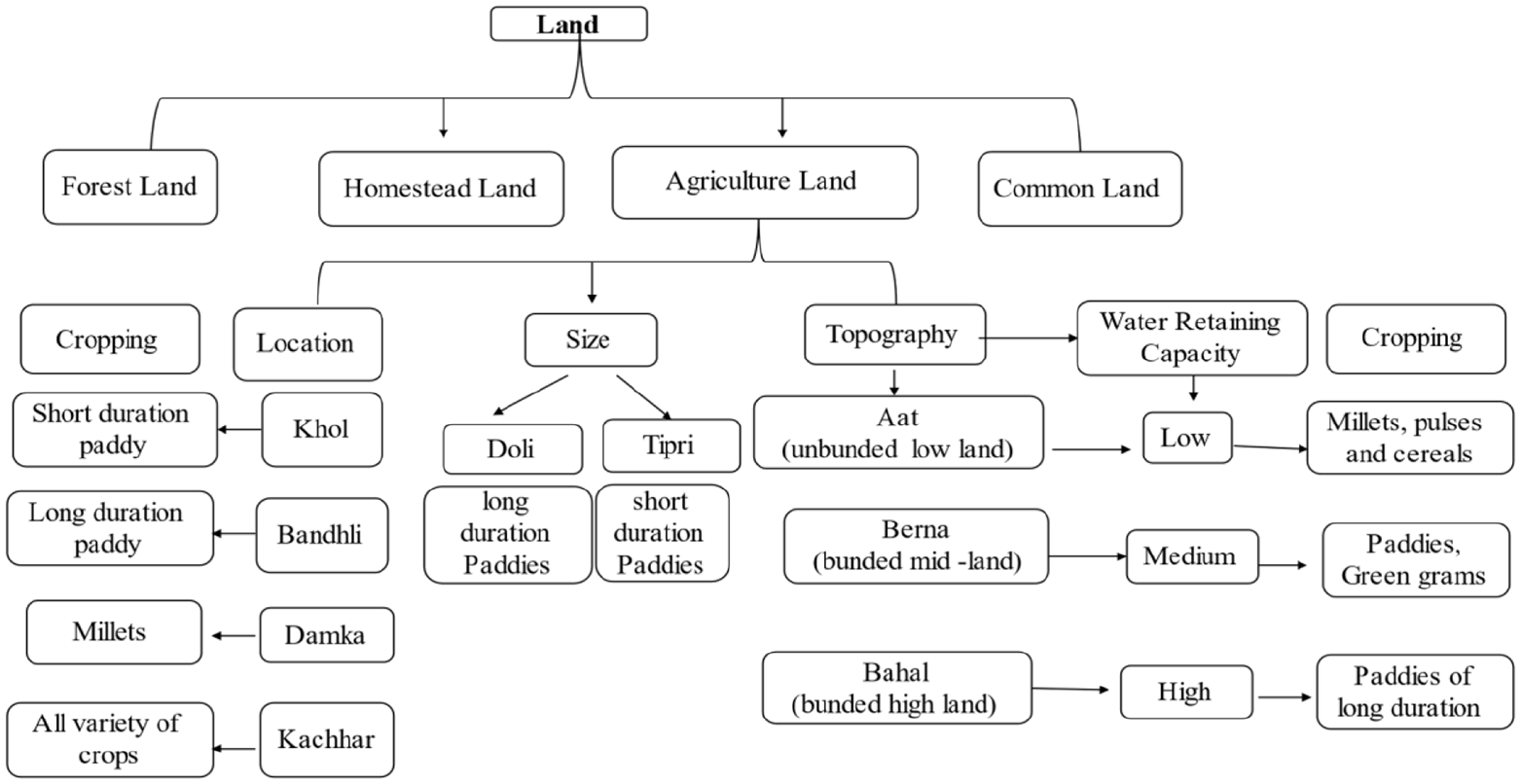
Land classification by Chuktia Bhunjia.
The Chuktia Bhunjia classify soil on the basis of texture as (1) belsu (sandy soil), (2) mal/khalia (sticky soil), (3) darli (stony soil), (4) khatu mati (loamy soil), sukha mati (wet soil) and rengtha mati (stony field) (Figure 2). Belsu and khatu are considered suitable for cultivation in which they grow millets such as Gurji (Setaria italica), Kodo (Paspalum scrobiculatum) and Rias (Sesamum indicum). Mal/khalia is unfertile and is seldom used for cultivation. They grow jute and Rias (Sesamum indicum) in Aat with mal texture. However, nowadays, local varieties of paddies are grown. Rengtha are not suitable for cultivation due to lack of water retaining capacity, so remain left for grazing. Darli, although not suitable for growing crops, is mixed with cow-dung to make it productive. They generally grow millets, namely, Jandhla (Zea mays), Khedjandhla (Sorguum vulgare); pulses like Kandul (Canjanus cajan), Semi (Canavalia ensiformis) and Jhunga (Vigna unguiculata); and jutes in this soil.
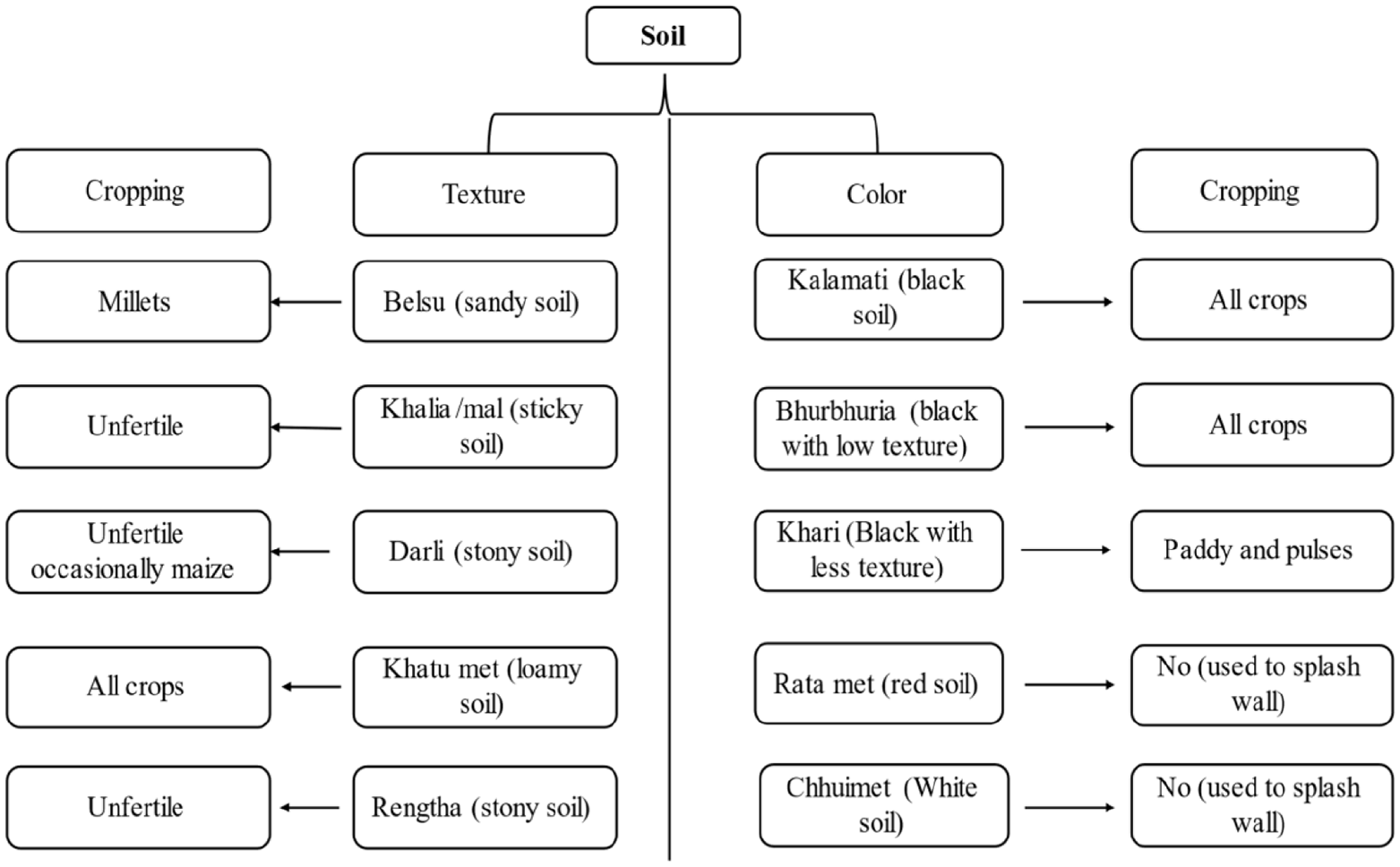
Soil classification by Chuktia Bhunjia.
On the basis of colour, they classify soil as (a) kalamet (black soil), (2) bhurbhuria (black soil with low texture), (3) Khari (black with less texture), (4) ratamet (red soil) and (5) chhuimet (white). The first two are considered fertile whereas the last two are not cultivable and used for cultural purposes and splashing houses. Land use for slash-burning cultivation (Bewar) is known as dehi where they grow millets such as Madia (Eleusine coracan), Birhi (Phaseolus mungo) and pulses like Kulath (Macrotyloma uniflorum), Kandul (Canjanus cajan), Junga (Vigna unguiculata), jutes and local varieties of paddy of short duration. So, a kind of mix cropping is practiced in dehi. Kitchen garden (Biar) is also an ecological and traditional land use system among Chuktia Bhunjia which involves multiple benefits involving management of useful plants species for family consumption. They grow vegetables like Biagan (Solanum melongena), tomato (Lycopersicum esculentum
Agriculture as a practice: land preparation and beginning of agriculture
The agricultural practices among the Chuktia Bhunjia are found to be embedded with knowledge, beliefs, rituals and local ecology. Two types of cultivation are found among them: slash-burning cultivation and wet-land cultivation. The first type is usually meant for growing small millets and cereals whereas in second type they grow paddy. Both the types of cultivations are explicated here below. Although, the preparation of land to cultivate follow different methods and time periods, the epistemology involved in the cultivation processes follow similar beliefs and rituals that have been narrated while explicating the agricultural processes and practices.
Slash-burning cultivation
The slash-burning cultivation (Bewar/Dehi) constitutes an important form of economy among the Chuktia Bhunjia of study area. Although restriction has been imposed by the forest department on this form of cultivation, to arrest the forest fire, the Chuktia Bhunjia continue to practice it due to the fact that it is their only source of cultivation in which they grow millets, cereals and short duration paddies that supplement their food requirements during food crisis, especially during the monsoon. The selection and preparation of dehi is woven into their culture, belief and ritual that begins only after celebration of aam-jatra/holi in the month of March-April which is celebrated largely to eat new mango (Mangifera indica), chahar (Buchnania lanzan) and mahul (Madhuca indica) flowers. In the fixed day, both children and young of each village pull a chariot made of Palsa (Butea monosporma) flowers in the village lane that indicates the celebration of this festival. The chariot is considered as the seat of Goddess Sunadei. The young people who participated in the event, take bath in the river stream before entering their home. In the same day evening, male members of each village assemble at Sunadei temple. They collect some dried wood to make a triangular hut exactly known as holi. They fix a branch of Semel (Combax ceiba) tree in the mid of holi. Pujhari worships the village deities inside it by offering newly grown mangoes (Mangifera indica), chahar (Buchnania lanzan) and kendu (Diospyrus melanoxylon). During this time, one of the members closes its entrance by covering branches of trees or dried wood. Pujhari’s son sets the holi fire immediately. Once Pujhari comes out by any means, head of the village cuts the fixed semel branch with an axe and a chicken is left in the fire as an offering to the deities. This festival symbolises the setting fire of dried wood and bushes for bewar or dehi cultivation. This festival is also meant to eat eating minor forest produces like mango (Madhuca indica), chahar (Buchnania lanzan), kendu (Diospyrus melanoxylon) and so on. After this festival, they select the land on the basis of soil colour, however, land with fewer trees and shrubs are obvious criteria for selection. It becomes easier for them to clear and prepare the land in a timely manner. They cut all the thorny bushes and shrubs found in the selected patches with axe that are allowed to be dried in the field. The big trees, fruit giving and religious trees are purposefully left in the selected patches. In case they cut the big trees, they bring the timbers to home that are used for house construction, furniture, fuel wood, and so on. Once the left branches in the field are completely dried, dried cow dung are poured over it to be burned along with these in order to make the land fertile and productive. It is usual practice among them that they prepare the organic waste by putting cow dung and other livestock waste in a pit either in kitchen garden or in agricultural field for several days to months. The heap of organic waste undergoes microbial degradation that converts organic waste into compost. Once it is ready to use, they just scatter the compost throughout the field before monsoon.
The actual cultivation, especially of paddies, begins on the day of askhya tritiya (an auspicious day that falls on the third day of June) by broadcasting the paddy obtained from the village priest on the day of Chaitra –another agricultural festival celebrated by Chuktia Bhunjia in the month of April–May. On the fixed date, usually on Tuesday, all the village deities are worshipped by the village priest. The male member/s from each household gather at a sacred grove located outside the village. The village priest worships all the deities there on behalf of the villagers by offering liquor, rice, coconut and sacrificing a hen and a male goat. At the end of the festival, Pujhari asks people to prepare a symbolic form of agricultural field, a plough and two bullocks with small branches and leaves of Bardi (Ficus benghalensis) tree, respectively. He tilts the land with these symbolic plough and bullocks as does in real life and others fill water in the symbolic agricultural field. Some people pour water over pujhari as if it is raining. He worships the deities for good rain and good harvesting. He also acts like broadcasting paddy, transplanting seedlings and catching fish and shell as the farmers do in real life. In the evening, they reassemble at the same place, bringing a new white cloth with them. The meat of sacrificed animals is equally distributed among the households. Pujhari then gives everyone a handful of paddies brought from his home which they broadcast in their own agricultural land in the day of akshya tritya.
In the first monsoon or asad (June–July), they tilt the field with traditional plough. The weeds and grasses grown in the field are removed and kept in land boundary. They sow different crops such as Madia (Eleusine coracan), Khedjandhla (Sorguum vulgare) and Jhunga (Vigna unguiculata), and pulses such as Birhi (Phaseolus mungo), Kandul (Canjanus cajan), Rias (Sesamum indicum) and so on, altogether in dehi. So, they follow mix or intercropping. Sometimes millets, cereals and pulses are grown in the same field but separately. Crops such as semi (Canavalia ensiformis), maka (Zea mays), Jhunga (Vigna unguiculata) and so on are cultivated without ploughing the land rather simply by digging holes to plant the seeds. The cultivation of madia is a two-stage process: seedling (palha) and transplantation (rupa). The seedling takes around one month to be ready for transplant that takes place usually during late July–August. The same patch is tilted with plough in moderate rain after which the transplantation is done.
The Chuktia Bhunjia opine that the cultivation of millets and pulses in dehi does not require much cares because the land use to cultivate these is perceived being fertile and nutrient-rich. They only visit to the field to check for germ infection, if any, and to protect the crops from wild animals and birds. It is reported that the crops cultivated in a year are usually not repeated rather grown in alternative years in the same field with a belief that crop rotation will rejuvenate the soil nutrient. Yet, they grow Khedjandhla (Sorguum vulgare), Jhunga (Vigna unguiculata) and Birhi (Phaseolus mungo) in a regular fashion. When the crops grown in the dehi is harvested, they prefer to cultivate Semi (Canavalia ensiformis), tomatoes, chilies, brinjal and so on, for their own consumption. Earlier they used to shift the patch for cultivation but at present due to restriction from the forest department, it is almost stopped and crop rotation takes place in two fixed dehi.
Rain-fed wet rice cultivation
The rain-fed wet rice cultivation, alongside slash-burning, too begins on the day of akshya tritya. The land use to grow paddies – aat and doli – are also prepared after the aamjatra. The Chuktia Bhunjia do not follow any norms regarding first tilting of paddy land, although its cultivation endows with sets of rituals and festivals. They simply remove stone and thorny plants before monsoon to make the land ploughable and cultivable. Since the study area is arid and has low rainfall zone, monsoon lash their agriculture. The Chuktia Bhunjia tilt the land in first monsoon once or twice according to requirements depending on soil texture. They throw the weeds that have grown out of the field or kept in boundary. They perceive that the weeds grown in the field absorb the entire nutrient from soil and affect growing the plants. The paddy cultivation in aat is different from that of doli. Aat is used to grow short duration paddies (locally called aatdhan) besides gurji (Panicum colonus L.), kodo (Paspalum scrobiculatum L.), suan (Panicum sumatrense Roem & Schutt) and rias (Sesamum indicum L.), whereas doli is used to grow long duration paddies. The short duration paddies include Gauji, Tikta, Lachei, Kalikhuji, Sakri and so on, and the long duration paddies include Jhuli, Banskatha, Lalbanko, Goondi, Lalat and so on. When they grow paddies in aat, they plough the land twice or thrice depending on the texture of soil. Then, after sowing seeds, they again tilt the field in order to cover the seeds with soil followed by levelling the field with a leveler or harrow (kapar) made up of either Sal (Shorea robustas) or Palsa (Butea monosperma) plant. They do not tilt the land so deeper which is believed to cause delay of seed germination.
They maintain soil moisture balance before and after broadcasting of seeds by various methods. They believe that excess moisture and lack of moisture are negative indication of seeds germination that depends on type of soil and the way the land is tilted. If the land is tilted so deep, land moisture is believed to last for longer period. Similarly, loamy soil and block soil keep moisture for longer whereas sticky soil keep the moisture for very short period due to its hard soil particle and high textured. Accordingly, they grow crops and tilt the land. They also experience that long duration paddies require high moisture and short duration crops require low moisture. They said that it is not suggested to sow seeds in highly moistured soil until moisture decreases to desired level. In such cases, they remove excess water from the field in order to balance the land moisture.
The cultivation of paddies in doli require water in balanced manner. It is usual practice among them that all the bunds are properly closed in order to store water required for moisture and germination of seeds. The sowing of paddy depends on the amount of rainfall. The Chuktia Bhunjia adopt two different methods of cultivation: (a) broadcast and (b) transplantation. If they chose to broadcast paddies, it is done on two ways: (a) Khurdabuna and (b) Uperbuna. The former method – khurdabuna – is usually followed when the rainfall is low in which seeds are sown little deeper to soil. In this method, the land is first tilted followed by broadcasting the seeds and ploughing over it. An elderly male member of the family broadcasts the seeds by holding in basketry after offering a handful of seeds to the Earth Goddess in a corner of the field. If the seeds are sown in loamy soil, they require to use harrow to level the soil. The second method – uparbuna – is adopted when the rainfall is high or soil get stack in the plough during tilting and farmers are unable to tilt the land. In this method, seeds are sown over the land. They first close the bunds of the field and tilt the field so as to soften the soil. Then they sow the seeds over it. They do not tilt the field again as it is done in the first method, otherwise the seeds may either be stacked in the soil or de-germinated. No ploughing is required to cover up the seeds as done in Khurdabuna. This kind of method is generally adopted when they cultivate seeds in sticky soil (malmet).
The Chuktia Bhunjias also grow paddies by transplantation method. The long duration paddies are usually cultivated in this method. It has two steps: growing of seedling (palha) and transplantation (ropa). They grow seedling in loamy or sandy soil to make it easier to pluck. The land is first tilted twice which is then leveled with a leveler/harrow (Kapar). The seeds are then broadcasted evenly over the soil and tilted low-deep again to cover the seeds. Once the seedling is ready to pluck, they close entire bunds (phar) of the doli to store the rain water. They remove the weeds grown in field and sometimes small thorny bushes are left there to be decomposed in the field which they perceive to become good manure. They pluck the seedlings a day before transplant. An elderly member of the household pours little cow milk in the east of seedling field as an offering to Earth Goddess and plucks two/three plants before allowing others to pluck the seedling. The plucked seedlings are made into stalk by tying up in paddy straw. The stalked seedling is called jhura. The jhuras are properly washed before transplantation. The land is then tilted twice or thrice to soften the soil. The bunds are opened to dispatch stored water after which the head of the household offers little raw cow milk in the name of village deities for good yield and transplants two or three seedlings before asking others to transplant.
Agricultural decision making: knowledge, climate change and cropping
Given the narration about the above mentioned cultivations, it is also fact that the Chuktia Bhunjia make their decision regarding agriculture on the basis of climate change and variability. By climate change, they refer late rain, abnormal rainfall, increasing temperatures, drying out of wetlands, strong winds and thunderstorm. They said that in early days, they could be able to prepare themselves for transplantation and weeding in the month of July but these days, they wait for rain to come in the same period. Earlier, agriculture season was usually felt during late June to mid-July but now the ploughing is hardly noticed because of late monsoon. As a result of these changes, agricultural seasons have shifted from August to December. The unpredictability of rainfalls, coupled with high temperature, certainly has resulted in prolonged droughts-like situation in their region and impacted their food security by decreased yield of paddies in particularly, the Chuktia Bhunjia have able to produce their staple diets, that is, millets and cereals by adopting the Indigenous strategies of reading weather and cultivation of climate-resistance crops. Thus, the agricultural decision making among them is said to be the result of climatic experience and knowledge of weathering behaviour.
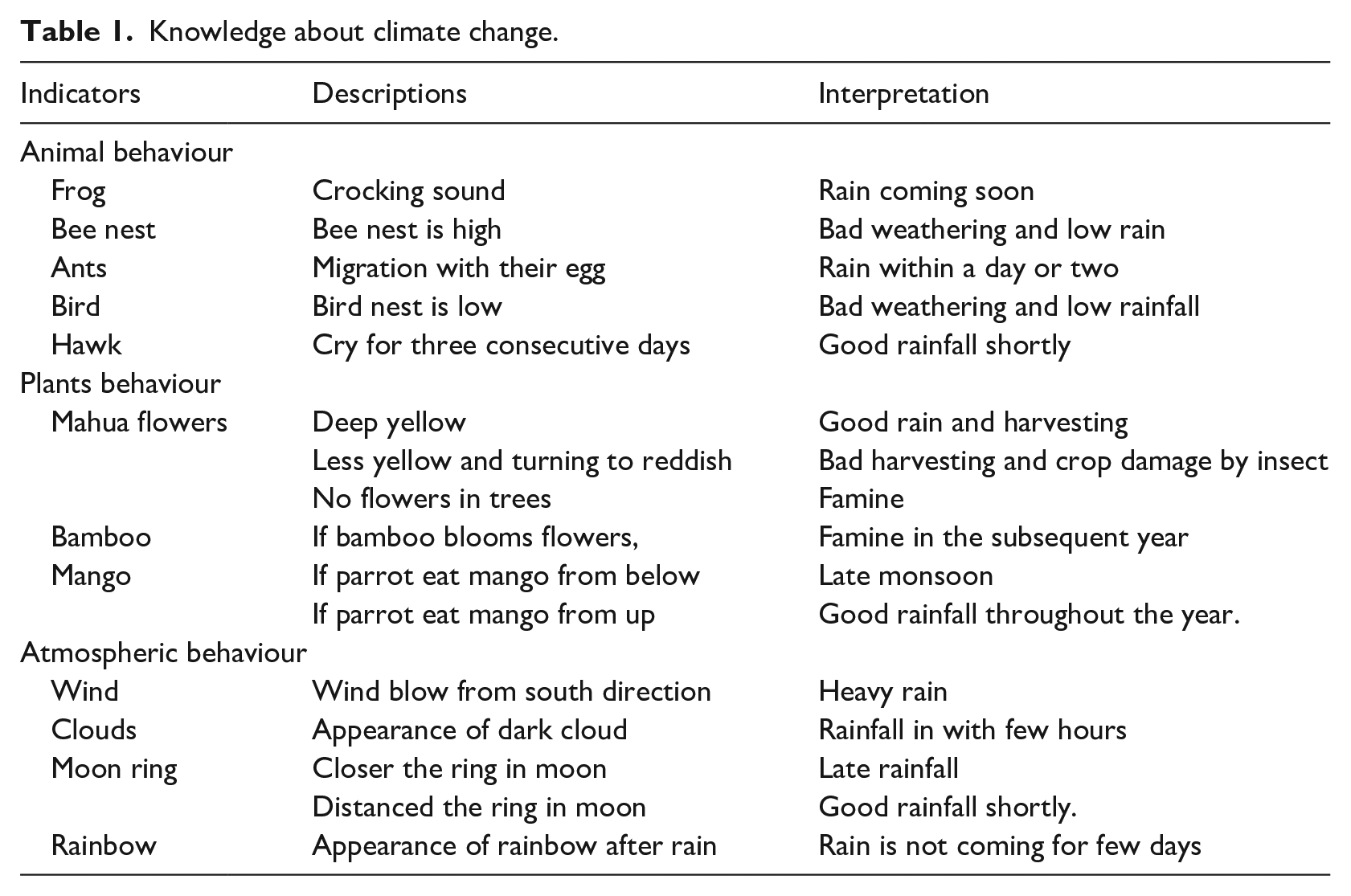
The Chuktia Bhunjia also adopt knowledge-based climate indicators in making farm level decisions concerning crop selection, seed sowing, planting and harvesting to adapt to climate change and variability based on local experiences with an aim to improve crop production. The adaptive measures involve changing planting dates, observing nature (plants, animal behaviour and atmospheric indicators) to predict season quality, mulching, mixed cropping and change of crops. To put it another way, the Chuktia Bhunjia easily read the environmental conditions and understand the natural happening of the surrounding which they said to have learnt from their parents, grandparents and self-observation. They predict the weather by looking at the behaviour of animals, plants and atmospheric conditions (Table 1). Accordingly, they grow crops to avoid being trapped by crop failure. The in-depth interviews with the experienced farmers revealed that change in local weather has forced many of them to shift crop pattern and farmers are now preferring to grow those crops that require less water. Therefore, millets and traditional variety of seeds are abundantly reported to have been cultivated by the Chuktia Bhunjia that are believed to grow in meagre rainfall. Ragi, the cultivation of which was stagnant due to inclination towards cash crop production, is therefore regained its importance because of similar cause, that is, requirement of less water. Similarly, in the context of climate variability, cultivation of crops requiring much water, especially paddies, is generally not preferred rather than switching over the traditional varieties of paddies. However, cultivation of hybrid varieties of paddies is not completely ignored.
Knowledge about climate change.
In between broadcasting and harvesting: knowledge, practice and cropping
Each type of crop grown requires cares differently. The Chuktia Bhunjia too takes care of the crops not only by protecting the crops from diseases and wild animals but also maintaining the soil moisture. They perceive that crop grown in dehi require less care because soil biomasses in dehi automatically maintain soil moisture and help growing the crops properly. They simply protect the crops from pest and wild animals by making temporary boundaries of dehi using non-timber plant species. They sometimes erect an effigy made of paddy straw. Once the plants start procuring seeds, they start staying in crop field by construct a temporary hut there, even during night, to protect their crops from wild animals. Furthermore, since majority of Chuktia Bhunjia practice dehi cultivation in the hill slope, there is always a fear of soil erosion. They view that higher the intensity of slope greater is the soil erosion. They control soil erosion by certain traditionally-adopted methods such as mulching, making bunds, growing of grasses in the boundaries, placing small stumps in the bunds, horizontal ploughing across the slope, and so on. They also construct trenches so that the run-off water would go out of the trenches without hampering the crops. They sometimes make hays at the end of the patch to dispatch the water through it. In case of high rainfall, they make bunds to avoid running of water through the crops field.
The paddy cultivation, on the contrary, requires specific knowledge on plant, soil and water. At first, they balance the moisture of the crop field by traditional methods that in fact depend on the soil texture and rainfall. When crop plants become half a foot height, they store the rainwater by closing all bunds and then they plough the land again to soften the soil. It is believed to help paddy to grow faster and plants make bunches thereafter. This is known as Bihida. During this time, they drain all the stored water to balance the soil moisture. Besides, the agricultural practices being embedded with the rituals and festivals, many deities are always attributed to the crop production. They owe God Bhima for good rain and Goddesses Chorokhutein for good production, albeit, Sunadei is believed as proprietary deity. They celebrate Asadkhena/hariyali tihar in August-September meant to pluck weeds from the crop fields where they offer local liquors and sacrifice hen and goat to Goddess Gangadi for good yield and to protect the crops from diseases. So, this festival is also known as Gangadi Jatra. Women are usually engaged in weeding activity.
The Chuktia Bhunjia also protect the crops from the insect. Although, now many of them are preferring to apply the fertilisers freely provided to them by the government, use of Indigenous method is predominantly noticed. The crops are believed to be affected by the insect (baki) after Bihida. In such situation, they commonly spray ash in the field which they believe works as insecticide. Similarly, they fix a branch of Bhelwa (Semacarpus anacardium) in agricultural field in the day of lunar escape which is believed to work as both pesticide and insecticide. Many of them allow spider (makra) to grow in their crop field as well that are believed to prey on insects. When the crops are affected by unknown diseases, they cure it using religious methods. In such case, some elder members of the village including the village headman, village priest and Kotria (who sacrifice hen/goat during festival) remain fast for a day and ask all the elder members of the village to assemble at Sunadei temple during night. They bring a leaf cup of rice and ghee with them to be offered to the deities. After mixing all the rice, each one present there offers a fist of rice and wine in the name of village deities to protect the crops from this misfortune. It is known as Jagar.
Once the paddies are half grown, they celebrate Nuakhai in the month of Bhodo (August–September), usually in a single-fixed day, mean to offer newly grown paddies to their deities before consumption. They clean their cloth, houses, utensils and other household materials before the festival. They also throw all the old mud utensils out of the home. In the fixed date, male member/s of the household go to forest to bring newly grown Kurei (Holarrhena pubescens) leaves to prepare leaf cups and plates. They also offer newly grown paddy to their deities in this leave only. A male member from each household goes to the agricultural field to bring newly grown paddy or often asks others, if not cultivated in their field, that are converted to bitten rice (Chihra) in husking tool. Sometimes, elder brother also invites other brothers, if any, to his home for the purpose who come with a plate of rice, Chihra and a leaf cup of ghee for ritual purpose. Once the head of the household finished offering the new crops in the form of Chihra to home deities, he offers the same to other members of the families to eat followed by giving it to the cow or bullock.
Harvesting to preservation: techniques, ecology and sustainability
The Chuktia Bhunjia harvest the crops usually after Dasahara festival in the month of October–November. The millets and cereals are usually harvested earlier than the long duration crops. Short duration paddies are also harvested after millets in November. Harvesting takes place in three different stages: reaping, thrashing and spinning/cleaning. Tools use differs in each stage. Their harvesting tools include sickle, paddy straw (biat), rope and bullock. Reaping is done with sickle (hasia). The head of the household first reap the crops before allowing others to do after offering a leaf-cup of raw cow milk to deities in a corner of the crop field. The reaped crops are bundled by tying in paddy straws (biat) that are later brought to the threshing pit (khala) with a stick made of bamboo or teak.
Once the stalks are dried properly, they thrash the crops with the help of bullocks. They fix a wood on the ground. Six to seven bullocks are tied in a rope (deie) to move around the crops so as to separate the seeds from straw. It is known as maden. Crops such as paddy, kodo (Paspalum scrobiculatum) and gurji (Panicum colonus
The final stage of harvesting is winnowing or spinning (demara) where chaffs are removed from pure seeds using winnowing fan (supa). The cleaned seeds are then exposed to sunlight in order to remove the water contain before storing for next use. The seeds to be consumed or marketed are stored separately from the cultivable seeds.
The Chuktia Bhunjia also celebrate Chauldhua/Pithori in the month of Dial (October–November) to wash the newly harvested grains before eating. Until this festival is celebrated, no household is allowed to wash the newly harvested paddy before eating. At the end of the harvesting, they celebrate a ritual called Choro to thank Goddess Chorokhuten for protecting the crops throughout the process. They invite village priest, few elder male members of village and other clan members. The village priest worships the Goddess on behalf of the family by offering local liquor, hen and male goat. Then a sacrificial feast is given to all people attended the ritual.
The Chuktia Bhunjia adopts various methods to preserve harvested seeds preservation. They first expose the seeds into sunlight to remove the water contain. They preserve kodo (Paspalum scrobiculatum), gurji (Panicum colonus), madia (Eleusine coracan), and so on in the bag made of paddy straw (pura). The quantity of seeds in a pura ranges from 10 to 20 mann (1 mann = approximately 5 kg). Pulses like birhi (Phaseolus mungo), kulath (horse gram) and leher (Cajanus cajan) are stored in this method by adding lim (Azadirachta indica) leaves and ash. After keeping the required amounts of seeds, the bag is airtight so as to protect the seeds from germs and insects. They also store the pulses in basketry (kunli) for which the outer and inner surface of baskets are first plastered with cow-dung and dried. After keeping grains, they firmly close the opening of the bags with Tectona grindis leaves. The Chuktia Bhunjia also preserve forest produce such as kendu (Diospyros melanoxylon), tetel (Tamarindus indica), chahar (Buchnania lanzan) and mahul (Madhuca indica) in leaf bags made of sial (Bauhinia vahlii) or palsa (Butea monosperama) after exposing these into sunlight. They firmly close the opening of the bag with the same leaves. The bags are then hung over the hearth. Maka (Zea mays) and khedjanha (Euphorbia pulcherrima) are simply hung over the hearth to keep it dry for next use.
Discussion and conclusion
The description on the agricultural practice of Chuktia Bhunjia shows that their agriculture is revolved around the knowledge and ecology; and each stage of their agricultural practices is embedded with certain beliefs and rituals. Their agricultural practices reveal that selection of land, seeds and cropping are determined by the knowledge-based experience and ethnoecological-based climatic knowledge gained from parental generation. The important domains of Chuktia Bhunjia’s agricultural practices involve intercropping, crop rotation, crop diversity, rain-water harvesting and management of soil fertility that works with both knowledge and long-term experiences. The narratives about their agricultural patterns shows that the agricultural practice of Chuktia Bhunjia has two strands: ecological and cultural. The former revolves around the knowledge, experience and observation whereas latter is associated with beliefs, rituals and ecology. Its ecological strand is noticed from their multiple negotiation with landscape through cropping and its management. It was found that small landholding and available seed diversity have historically led to practice intercropping and crop rotation particularly in dehi cultivation. Although very few Chuktia Bhunjia express that intercropping help them to manage the cultivation at minimal cost with a fact that crops grown in dehi are believed to help each other’s growth, crop diversity is also another dimension that is maintained through this practice as noticed from the cultivation of millets, cereals, pulses and so on together. So, they prefer climber species with other tree species whereby they have nothing to worry about the supporting species for climber especially semi (Canavalia ensiformis), jhunga (Vigna unguiculata). Yet, scientifically it is proved that intercropping reduces the climate-driven crop failure as variety of crops have different climatic adaptability (Shava et al., 2009; Tripathi and Singh, 2013) and efficiently utilise the natural resources such as land, light, water and nutrient and increase productivity along with maintaining stability of agroecosystem (Mushagalusa et al., 2008; Ning et al., 2017; Zhang and Li, 2003) besides, reducing CO2 emission and increasing crop productivity (Hu et al., 2017). Besides, intercropping among them has other dimension, that is, maintenance of crop diversification.
Agroforestry-based agriculture practice is predominantly reported to have been practiced by the Chuktia Bhunjia largely in dehi cultivation. Although, no farmer expressed any reason for it except as a ‘land use management system’, studies in other parts of globe show that it is widely adopted as a climate-smart practice due to its potentials for enhancing soil organic matter, agriculture productivity, carbon sequestration and water retention (Kala et al., 2008; Nair et al., 2009; Nyong et al., 2007; Paul et al., 2017; Schoeneberger et al., 2012; Zomer et al., 2016). The tree components in crop fields that are purposefully left to grow are believed to reduce the severity of extreme weather events like floods and tropical storms (Lin, 2011; Matocha et al., 2012) and serve as the windbreaks and shelter belts (Lasco et al., 2014). Furthermore, the Chuktia Bhunjia perceive that agroforestry-based agriculture has made their practice cost-effective as they are nothing to purchase as fertiliser because the leaves of trees are believed to become good manure and biogases for the crops. It is estimated that about 1.2 billion people in developing countries depend on agroforestry to sustain their livelihood and agricultural productivity (Food and Agriculture Organization of the United Nations (FAO), 2011) that are assumed to be adaptable to drought conditions as trees are believed to explore a larger soil volume for water and nutrients (Mbow et al., 2014; Verchot et al., 2007).
In addition to it, the use of organic manure prepared from cow dung and other livestock wastes by composting method is abundantly found among them which they perceive being the enhancer of soil fertility and productivity. Two traditional practices are involved in their composting method: organic waste management and enhancement soil fertility. The use of variety of organic materials in composting process such as straw, crop residues, agroindustry by-products, livestock waste, sewage sludge and kitchen waste are believed to become a nutrient-rich organic product necessary for plant growth. Studies also reveal that organic compost increases soil carbon sequestration and reduces greenhouse gases emission (Forte et al., 2017; Mehta et al., 2014) and enriches soil organic matters, soil fertility, soil microbial diversity, soil moisture and reduces soil erosion and crop pests and diseases whereby to ensure crop yield (Fließbach et al., 2007; Ge et al., 2008; Liu et al., 2013; Mader et al., 2002; Magdoff and Weil, 2004; Zhang et al., 2012). Besides, the materials used for composting being available freely at their home and forest, this practice not only make their agriculture cost-effective but also by addressing the issue of soil fertility, waste management and reducing chemical fertiliser inputs, it continues to become a tool to social, ecological and economic sustainability.
The Chuktia Bhunjia also follow the practice of crop rotation both in dehi and wet rice cultivation. The limited landholding, coupled with available seed diversity, although is found to enforce them for crop rotation, their perception of plant being nutrient for other crops is other influential factor for this practice. Therefore, particularly in aat, they grow paddies of short duration in one year and millets in the next year. In the wet-land cultivation, they usually grow mung and chana immediately after reaping paddies. It is believed that nutrient being used by paddies is a good nutrient for the mung. Although the damp and moisture nature of the land is another factor for it. While reaping mung and chana, they leave the root portion which is believed to have good nutrient value and helpful for other paddies crops. So, by rotating the crops, they not only maintain the soil fertility but also help plant to grow sustainably, by nutrient cycling, towards producing good yield (Huang et al., 2003). The studies on crops rotation also find that crop rotation is an effective approach for carbon sequestration compared to non-rotated practice (Jarecki and Lal, 2003; Raphael et al., 2016; Triberti et al., 2016), a potential practice to reduce the emissions of methane (CH4) and other greenhouse gases in irrigated-rice fields (Theisen et al., 2017). According to Cha-un et al. (2017), when rice was cultivated in rotation with corn and sweet sorghum in dry season, there was a significant reduction in greenhouse gas emission by 68%–78% as compared to double rice cultivation. Besides, the Chuktia Bhunjia are also found to maintain soil fertility through rainwater harvesting method particularly in dehi cultivation, as an evidence from bunds and mulching that are believed to reduce soil erosion and maintain soil fertility.
The cultural strand of Chuktia Bhunjia’s agriculture is revealed from the celebration of rituals and festivals in each stage of agricultural practice. The narration about the ecologically driven technology and symbolic form of agricultural tools and implements – plough and bullock made during Chaitra festival – reveal that those technologies certainly have cultural and cosmological association but are always cost-effective and economical because of easy and free availability. The use of technology and associated ritualistic practices portrays that their agricultural practices are not only ecological but also make them to sustainably harvest those forest materials used for agricultural purpose whereby to ensure its existence for future generation (Nautiyal et al., 2007). They have ritualistic attachment with those plant species that are used in preparation of agro-technology, land boundaries and mulching whereby such agricultural practices become a tool towards eco-sustainability. In other words, it can be said that the associated rituals among the Chuktia Bhunjia have continued to help them to negotiate with the ecology and agricultural practices and becoming a tool for climatic resilience; albeit, long-term observation, experience and association with landscape do have significant influence about climate and weather-led vulnerability to agricultural production. Putting it shortly, the knowledge base of the Chuktia Bhunjia is becoming a resilience strategy towards arresting the crop failure. However, the sustainability of food production through these rituals is in question, owning to the climate change and socio-economic transformation of the people in this community, their static culture and ritual based ethics of resource conservations are assumed to have greater contribution towards agricultural sustainability. Gendered nature of Chuktia Bhunjia agriculture is clearly visible from the participation of both male and female in agricultural practice, especially in plucking the seedling, transplantation and harvesting. The sharing of labour in between families makes their agriculture economical and sustainable.
The analysis of traditional agriculture of the Chuktia Bhunjia indicates that they are not short of innovation and observation. Certainly, their innovation and experience may not be called as science in conventional sense rather than a special kind of science – a ‘localised science’. At functional level, when the domains surrounding their agriculture – culture, knowledge and experience – interact with each other through a ‘system’ of belief, it negotiates with the local ecology and landscapes towards promoting sustainable agroecosystem through conserving soil, ecology and ecological resources; and maintaining crop diversity even under the conditions of water stress, limited resources and low level of technology. But the ban of shifting cultivation inside SWS, particularly after the declaration of this sanctuary as ‘tiger project’, has not only affected their agricultural knowledge but also forced many of them to adopt mechanised agriculture whereby they had to change farming practices and adopt crop diversification including adaptation of cash crop and hybrid seed varieties. So, shift in the crops among the Chuktia Bhunjia is not always internal, that is, socio-economic transformation, rather the change in climatic condition has forced few of them to adopt advanced seed varieties (Batool et al., 2019; Bradshaw et al., 2004; Moniruzzaman, 2015; Ubisi et al., 2019). The Chuktia Bhunjia Development Agency (CBDA) – a micro-project plan of government of Odisha – is also trying to attract them towards conventional agriculture since its inception through provisions of hybrid paddy distribution, cash crops cultivation, distribution of harvesting machine, chemical fertilisers and so on; non-affordability, lack of knowledge on mechanized agrotechnology and its management have enforced many of them to remain submissive to the traditional agricultural practices.
There are two kinds of arguments pertaining to traditional agriculture. The ‘positivist reductionists’ who always support the conventionalism in every sphere including agriculture reject the traditional knowledge-based agricultural practices because of their perception on traditional knowledge being unscientific and difficult to feed the increasing population. They question if their agriculture is sustainable, why are tribal people food insecure and always prone to malnutrition and starvation to death. There are ‘traditionalists’ who favour the traditional agriculture because of its ecological value, climate resistant and sustainability of food, knowledge and culture; and response to the positivist reductionist in term of ‘lack of capability to purchase food items’. The agricultural practices of the Chuktia Bhunjia fall in the second category and are found to be a tool in negotiating with the ecology and livelihood. Their knowledge-based agricultural practice is also assumed to provide them food sustainably and becoming a strategy towards climate resistance and sustainable food security. Nevertheless, the agricultural practices among them, coupled with the transformation of people due to state intervention and non-tribal influence, are losing its originality. The successive agricultural policies too fail to recognise such valuable knowledge whereby marginalised people like the Chuktia Bhunjia have always been prone to food vulnerability. Therefore, given the ecological implication and livelihood of the traditional agriculture, owing to its marginalisation at policy level, any attempt to encourage poor tribal farmers like the Chuktia Bhunjia or to integrate their knowledge with modern scientific knowledge can help them to survive sustainably because capitalistic model of agriculture cannot always solve the problem of food vulnerability of tribal communities rather than linking it with market economy.
Footnotes
Funding
The author(s) received no financial support for the research, authorship and/or publication of this article.
