




Abstract
Musahar youth have been struggling for basic needs and face indignity at multiple facets in the society due to caste. In contemporary times, historicity of caste, stigmatized identity, indignity, poor social values and low participation status make it difficult to avail any kind of social, educational and employment support. Sustainability is a form of survivability, and lack of dignity diminishes wage work, forcing them to migrate. This paper is based on PhD research data and applied qualitative research methods following in-depth interview, oral history, seasonal calendar and so on. Historical marginality of caste persists and frames aspiration, dignity and sustainability.
Introduction
For centuries, the Musahars remained a landless community engaged in agriculture-based, daily wage labour and dependent on landlord communities for sustenance. From time to time, they also participate in customary work such as cutting trees, fishing and collecting grain from harvested farms – even in contemporary times. Occupying the lowest position in the caste hierarchy, the Musahars have historically been subjected to untouchability, indignity, and spatial and social marginality (Gurung and Kollmair, 2005). Even after the enactment of Article 21A for compulsory education (Chowdhury, 2010), the Musahar youth (between the age of 15 and 25 years) have rarely been mobilized or guided to achieve education and address their social and community needs. In the absence of education, they possess limited employability skills that confine them to work based on daily wage and physical labour. Along with the socially ascribed poor social and economic conditions, the absence of education and employability skills contributes to the Musahar youth’s struggle to sustain themselves. This marginalization and oppression of the community are also reflected in the academic scholarship of the late 20th and early 21st centuries.
With this understanding of the Musahars, the author sets out to explore the concept of ‘sustainability’ as it is defined in the Brundtland report (World Commission on Environment and Development (WCED), 1987), which roots for an approach that meets the needs of the present without compromising the ability of future generations to meet their own needs. In the context of the Musahar youth, survivability is vital in the case of the present generation as well as the future generations – something that can only be attained by working around caste practices, addressing multiple concerns in the social, economic and political realms as well as the domestic and hamlet spaces, and by aspiring for sustainability.
In recent times, the Musahar youth have habitually been migrating to various urban and rural parts of the country for underpaid wage work for survival and sustenance. However, both in their natal villages and in their constituencies of work following migration, they face marginality, indignity and derogatory caste remarks. Stigma, lower caste status and subjugation follow them even during and after migration (Chand, 2020). In such a scheme of things, it is consequential to reflect on the community youth’s educational status, employability skills, aspirations and engagement with employed jobs, especially in the backdrop of the natal-village and post-migration space dynamics. The living conditions and livelihood of the Musahar community and its youth are in a marginalized status. The Musahar youth of the research field were involved in agricultural paid work, physical labour work, brick-kiln work and other available paid manual roles. They are paid less but are expected and forced to work harder. The non-Musahar, especially the so-called upper caste, do not treat them with dignity. Their status as menial workers are taken for granted, and they are treated with low dignity in the workplace. In the rural parts of Uttar Pradesh and Bihar, where the Musahars live in large numbers (Singh, 2013), they face extreme domination, unequal opportunities for social participation, caste-based social hierarchy and indignity. Under these circumstances, the Musahar youth often question their social existence, work availability and future survivability. Hence, this paper explores the livelihood of Musahar youth’s sustainability and dignity in the context of caste.
Having said this about the context of social struggle, material marginality, non-ownership of agricultural land and dependency on landlords, it becomes evident that the Musahars have been struggling for their survival. Nevertheless, many community youth have comprehended their status in society and put effort to reach beyond agricultural or physical labour. This has made them explore survival strategies for bringing improvements to their livelihood – albeit being ineffective due to lack of social capital. Consequently, this paper provides an account of their existing livelihood, struggles and work opportunities. It also conceptualizes sustainability and its relation with dignity – a significant part of Musahar youth’s livelihood – relying on the theorization based on empirical data from the field.
Objective and methodology
The paper’s primary objective is to conceptualize livelihood struggles, sustainability and dignity in the backdrop of caste and highlight the relationship of dignity as an embedded entity in sustainability. This paper is based on the author’s PhD 1 research to understand and analyse the process of sustainability for livelihood in the Musahar youth’s ongoing contemporary struggle within a social structure of caste-based hierarchical society. In a social system and circumstances instituting material marginality, dignity is crucial for people of low status (Mosse, 2018). The empirical data were collected by applying an ethnographic approach. The researcher stayed in the field for 8 months, conducting in-depth interviews, group discussions and observations in two villages – Mainpur and Mahiarva in Kushinagar District, Uttar Pradesh. Forty in-depth interviews, three oral history narratives, two seasonal calendars, three group interviews and many stakeholders’ interviews were conducted.
Livelihood, dignity and sustainability: theoretical location and interrelationship of concepts with existing Musahar discourse
First, this part locates the existing literature about livelihood, dignity, and sustainability and interrelates it with the Musahar youth’s discourses. Musahars belong to lower caste strata in the social structure, so they are considered low for dignity (Kumar, 2019). Second, caste defines work (Mosse, 2018; Subedi, 2013); this includes livelihoods, activities and ownership of assets, where relationships are all pre-set. In such a situation, livelihood is not excluded from the caste discourse. Sustainability, a concern for the whole world that emerged in the post-colonial era, has ignored caste, inequality, oppression (Castro, 2004), unequal distribution of resources and historical marginality, especially in the Asian context. As Gurung et al. (2014) highlight, the combination of barriers related to overall social and economic rights as well as discrimination against a vulnerable group of people within a minority, results in greater hardships for the ‘minorities-in-minorities’, which is often overlooked by multicultural discourses (Pfaff-Czarnecka, 2010). Therefore, the paper explores how the Musahar youth from marginalized communities located in place and space are bound to have dynamics of livelihood about sustainability and dignity. It does not end there and leads them to keep away from mainstream society and amenities such as education, accessible health facilities and employability skills, and away from social and political participation.
Livelihood
Livelihood as a concept in many disciplines revolves around themes like development, sectoral approaches, technology transfer and integrated rural development until the late 1980s (Ellis and Biggs, 2001; Patnaik and Prasad, 2014: 354; Scoones, 2009). It was not conceptualized until Chambers and Conway provided a livelihood as a framework in the form of ‘capabilities’, ‘assets’ in terms of material and social, and ‘activities’ for survival: A livelihood comprises the capabilities, assets (including both material and social resources) and activities for a means of living. A livelihood is sustainable when it can cope with and recover from stresses and shocks, and maintain or enhance its capabilities and assets, while not undermining the natural resource base.
2
(Chembars and Conway, 1991: 6; Scoones, 2009: 175)
Later, livelihood emerged in theoretical debates among many institutions and civil society organizations. In 1998, IDS 3 developed a framework that incorporated a few concepts highlighting five interacting elements: contexts; resources; institutions; strategies; and outcomes (Solesbury, 2003: 9). DFID 4 considered this framework, made some changes to the IDS framework and used it for work poverty elimination programmes, including livelihood’s social and cultural aspects (Scoones, 2009).
IFAD 5 in 2002 further, among the five assets, added the person. It has placed significant emphasis on the individual’s livelihood. It is ‘people-centred’ (Hamilton-Peach and Townsley, 2004: 1) and focuses on the individual. The ‘Hub’ Model of IFAD includes two primary institutions called ‘Poor’ and ‘Agency’ for improving people’s assets by enabling and delivering services. IFAD has considered the various social factors and the significance of the influence of these social factors to conceptualize the livelihood of the poor.
Scoones (2009) defines livelihood approaches as too complex and so not compatible with real-world challenges and decision-making processes. Idealism, complexity, naivety, lack of political nous and incompatibility with existing sectorally based organizations were part of the accusations. Furthermore, Scoones (2009) considers power and politics a central part of livelihood (p. 185). He further describes that livelihood perspectives must look simultaneously at structure and agency and the diverse micro- and macro-political processes that define opportunities and constraints (Scoones, 2009: 186).
Scoones (2009) concluded his idea about defining livelihood: A sustainable livelihood approach has encouraged a deeper and critical reflection. This arises in particular from looking at the consequence of development efforts from a local-level perspective, making the links from the micro-level, situated particularities of poor people’s livelihoods to wider-level institutional and policy framings at district, provincial, national and even international levels. Such reflections, therefore, put into sharp relief the importance of complex institutional and governance arrangements and the key relationships between livelihoods, power and politics. (p. 191)
6
Ellis (1998) has argued and debated livelihood as livelihood diversification and described it as the process by which rural families construct a diverse portfolio of activities and social support capabilities in their struggle for survival and to improve their living standards (p. 4). He includes various aspects related to people in society for survival.
Finally, Niehof and Price (2001) describes her livelihood approach as Though the different disciplinary angels may relate differently to the concept of livelihood, in the end livelihood cannot be divided into sectors or compartments. The economic, social, agronomic, ethnic, political and other dimensions of livelihood cannot be treated as if they function apart. Livelihood generation implies all those dimensions, and they interact. Saving or strengthening livelihood through external support requires a truly interdisciplinary endeavour. (p. 26)
In the Indian context, many academics have described livelihood in terms of income, including community development programmes as mentioned in Deshingkar and Farrington (2009) about migration and Sumi Krishna (2012) about gender rural communities and others. They also talk about the various issues in rural and urban areas and have gone deeper to understand the reality of historical, structural and identity-based matters. In rural settings, agriculture and farm-based sources of income have been a major concern of livelihood. Agriculture and land carry a lot of power dynamics and decide the power relation in the society. Livelihood as a development of the people is reflected in Sumi Krishna’s work (2012) and others.
The Muhasar youth has a history of struggle for survival, sustainability and dignity. It impacts their livelihood related to agricultural land and the lives of people. However, this theoretical inquiry about their livelihood in terms of development, identity, assets or capability is away from their access.
Dignity
Lewis (2007) describes how the concept of dignity started in ancient Rome and had moral, political, legal and social meanings (Lewis, 2007: 93), which later incorporated various theological values. However, human dignity is rooted in nature, not theology, and Lewis (2007) cites St. Thomas Aquinas (1225–1274). Lewis also noted Devid Humes to describe human dignity as equated with human nature (Lewis, 2007: 94). For Immanuel Kant (1724–1804), dignity is grounded in human autonomy, dignity is an ethical category (Stoecker, 2011) and humans are born with having dignity and are also equal in dignity (Stoecker, 2011: 95). Especially in the Indian context, Lewis (2007) describes that the hierarchical caste system at the centre of Hinduism makes for fatalism about social rights and social justice (pp. 95–96). Caste in Indian society, which defines dignity based on structure and stratification, makes a difference as dignity presented by Kant and Aquinas because of the caste system.
The UN Charter, 1946 and the Universal Declaration of Human Rights, 1948 introduced the concept of human dignity into international law (Lewis, 2007: 97). However, the Universal Declaration of Human Rights is one of the first documents related to rights, identifying human dignity as the basis of human rights in the UN framework. Lewis (2007) concludes that human rights, and the concomitant concept of human dignity, developed internationally within the postwar environment of sovereign states committed to providing welfare (p. 104). This is something interesting while exploring dignity as a concept in the context of Indian reality.
From a philosophical account of human dignity, Zylberman (2018) finds identity with three conditions such as scope, grip and direction. He further links dignity with rationality. To explain it better, Zylberman brings three propositions: A-type: evaluative, B-type: deontic and C-type: relational deontic. A-type represents the goodness or badness of states of affairs. B-type represents the permissible or impermissible character of specific actions. In contrast, C-type represents relational norms, claims of one agent against another or duties that an agent owes to another (Zylberman, 2018: 2). Furthermore, Zylberman (2018) describes that human dignity consists of the intrinsic and non-relational value of the human being (p. 3). However, in the relational analysis, human dignity is the necessary and universal presupposition of having any claims whatsoever (Zylberman, 2018: 9)
In the Indian context, Lal (2020) states that dignity has been a core philosophical attribute from the medieval period in movements such as Bhakti and Adi-Hindu till the present Bahujan movement. They have been continuously promoting the voices of dignity. However, Lal (2020) describes brutal violence due to caste, where the Indian constitution proves safe grounds for equality. Here, dignity is not equated with human values but based on caste. Constitutional provisions and special Acts for Scheduled Castes 7 were created to ensure dignity, honour and justice. However, people continue to suffer multiple forms of violence (Lal, 2020: 5).
In the context of the Musahar youth, even as the Universal declaration of human rights and the existing laws and policies in India are dedicated to the welfare of Scheduled Castes and address various pre-existing issues of dignity such as multiple forms of untouchability and exclusion, the subjugated existence of the Musahar youth persists.
Sustainability
Woodcraft (2015) defines social sustainability as closely linked with well-being, social capital and quality of life at a neighbourhood level. Zuo Jin and Flynn (2012) describe social sustainability in construction work and comes up with 26 criteria that fall the social sustainability into three categories: internal stakeholder, external stakeholder and macro-level. However, Social sustainability also combines the design of the physical realm, the social world infrastructure to support social and cultural life, social amenities, systems for citizen engagement and space for people and places to evolve (Woodcraft, 2015: 3). There are some other debates about social sustainability, such as social sustainability is all about human welfare, quality of life, social justice, social cohesion, cultural diversity, democratic rights, gender issues, human rights, participation, social capital development and human capability (Baffoe and Mutisya, 2015; Bostrom, 2012). Along with social as community context, Spangenberg (2002) asserts that social sustainability focuses on personal assets such as education, skills, experience, consumption, income, employment and the right to actively participate in societal activities (Baffoe and Mutisya, 2015).
However, contemporary sustainability borrows some of the main ideas of sustainability from the Brundtland report, especially the notion that the needs of both present and future generations should be considered in decision-making (Kibert et al., 2012). In this context, the significant part is the individual’s present condition, especially the one who is living in a marginalized state. Kibert et al. (2012) further argue that the Brundtland report suggests two main imperatives needed to correct this imbalance: one’s needs of human beings and indefinite nature of development. The former aspect is essential for all the individuals; however, the latter might not impact the marginalized, especially the youth who have never been considered for development.
At the individual and organization level, six dimensions of social sustainability framework were studied by Staniškienė and Stankevičiūtė (2018) in the context of sustainability in the organization; these frameworks talk about participation, cooperation, equal opportunities, potential development, health and safety, and external partnership. However, these dimensions are also significant for individual sustainability, especially for those from marginalized locations, contexts and societal diversity.
The Musahar youth lacks many aspects of sustainability, starting from employment opportunities, accessibility to basic needs and dignified life. In such conditions, pursuing the definition of sustainability as mentioned by Brundtland report has limited scope. Along these lines, this paper is looking for sustainability around survivability and livelihood sustainability.
Voices, perceptions and context of the community
Education status and employability struggle
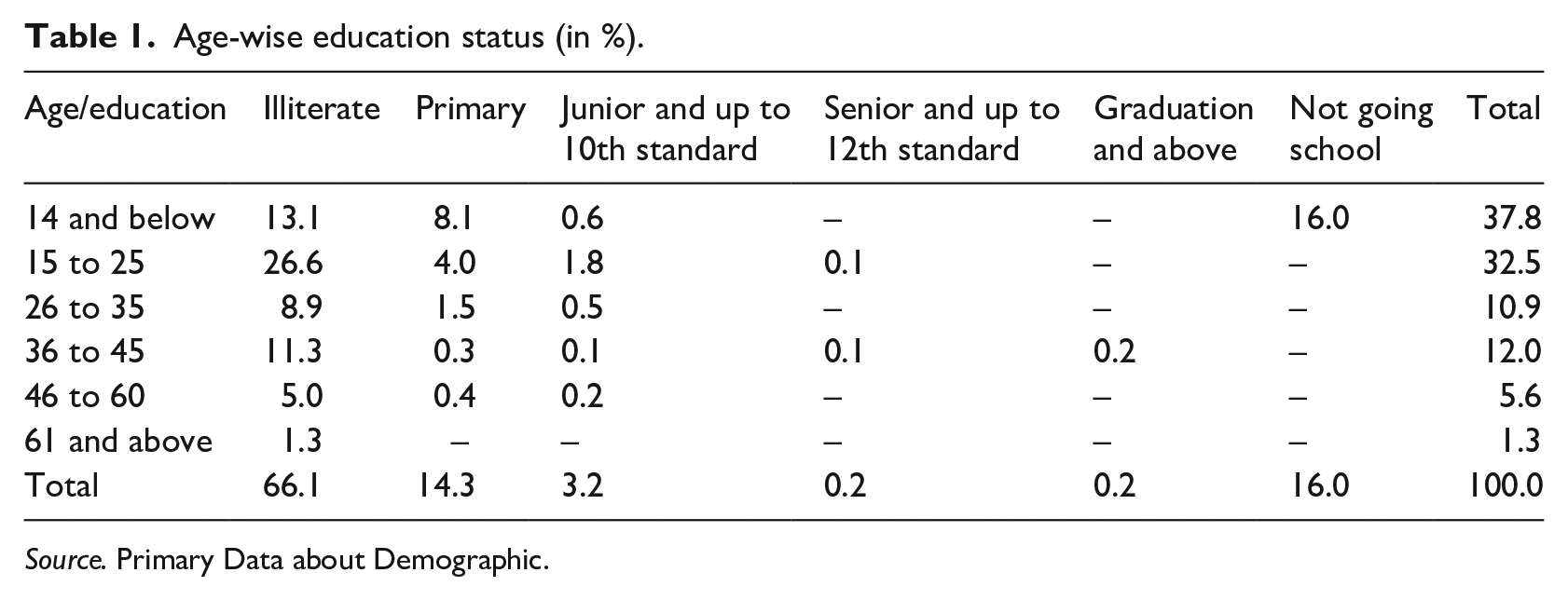
This part explains the status of education, the reasons for low education and how it is connected to historicity and contemporary livelihood. Musahar youth have been away from education due to their historical, social conditions, exploitation, unfriendly and non-supporting neighbourhoods for schooling. There is a limited mobilization from the educational stakeholder to aspire Musahar youth for the education. As per Table 1, 26.6% of youth out of 32.5% are illiterate; only 4% complete the primary, while approximately 2% reach above primary level education. At the same time, SC literacy is 66.1% and overall 73% in India as per the 2011 census (Raghavendra, 2020). So, most of them fail to complete primary education or go beyond the primary due to poor socio-economic conditions, limited employment opportunities of parents, low income and caste stigma.
Age-wise education status (in %).
Source. Primary Data about Demographic.
Due to poor education status, youth start to work between 14 and 15 years of age and some of them even start to work before that.
As per Figure 1, most of the Musahar people in these three hamlets had a monthly income of less than Rs. 10,000, which may go slightly up seasonally, and most of the income came from agricultural work. This low-income pattern was one of the major causes of Musahar youth to engage in earning activity forcefully rather than in education.
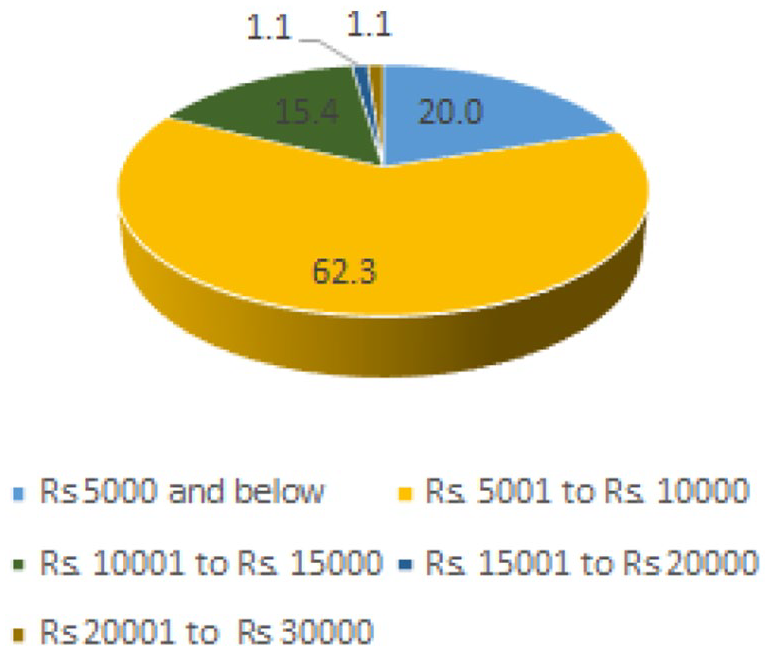
Family income.
Due to poor education status and low income, they lack the employable skills so they are forced to work in brick-line, agricultural activities or physical labour-based wage work available in neighbouring non-Musahar communities in nearby markets. Some of them migrate as well for work opportunities: My elder son was studying in 8th. Some village children of his age were going outside to work, and they also mobilized my son to go with them to earn money in Ahmedabad; he was too young to understand the consequences, and he went with them. (Durgawati (Name changed), Mainpur village)
There is a need for better livelihood strategies to obtain employment, leading them to come out of uneducated and unskilled status and vice versa. This is a cycle in which Musahar youth are trapped and cannot make themselves out of this vicious circle of poor education, limited income and limited employable skills.
(In-)dignity limits opportunities from aspiration among youth
Having discussed education, income and social status, it portrays the social conditions of Musahar and their day-to-day life. The intensity of aspirations is significant to comprehend the progress in their social location. This part talks about the Musahar youth’s aspiration as a community, parents’ aspiration for the youth and aspirational relation with the social conditions and struggles. The study has found that these aspirations have limits caused by a complex web of socio-economic conditions and also available and denied work opportunities.
Connecting to the previous part, limited education, employable skills, poor employment and undignified social and living conditions manifest the aspiration which limits them from fulfilling basic needs. Also, their historical experience of discrimination, caste-based biases and inaccessibility to agricultural land in rural parts have socially discouraged them, and they rarely go for higher education. Most parents aspire for their young children to complete schooling, but the situation restricts them to complete schooling. When they complete the age of 14 or 15, the youth regret not completing their education. Furthermore, their aspiration is only obtaining everyday wage work. In addition, they expect to benefit from the government schemes to construct homes and get ration on time from government-subsidized shops (Figure 2).
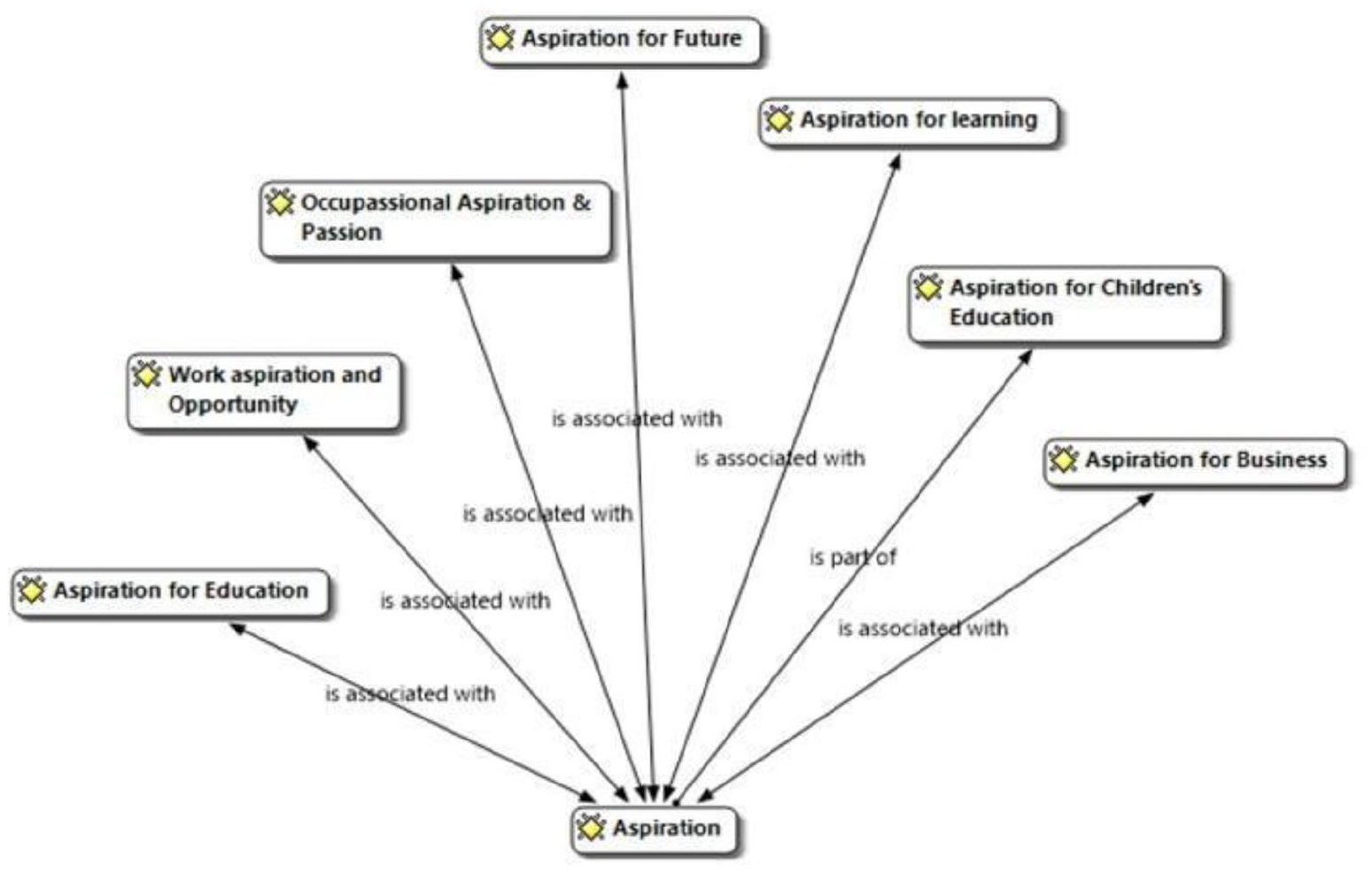
Aspiration map from study.
The study found that the aspirations of the Musahar youth are related to education, work opportunities which consist of a better future, business possibilities such as opening small kirana shops (grocery) and getting the benefit of government schemes. In terms of employment aspiration, some youth express the desire to achieve the benefits of government policies to obtain employment and facilities such as constructing homes, rationing on time and pension for the senior citizens in the village. These benefits of government policies are significant to highlight the lack of employment opportunities and their marginalized socio-economic circumstances. First, absence and inaccessibility to agricultural land have created uncertainty for employment and, second, the social conditions of Musahar historically. It also led them to face discrimination and undignified work available in the locality. It has also emphasized that other non-Musahar communities approach Musahar youth to hire and engage in activities that require more physical strength, for example, cutting earth and ploughing farms in the corners.
Musahar youth often engage in such work for which they are paid less. Apart from that, the work available in the neighbourhood is agricultural-related work, brick-kiln work, or loading and unloading work, and some get jobs in the construction work. All these works are based on physical labour; mostly in majority lower caste persons work under daily wages. So Musahar youth get treated without dignity, like being addressed with a loud and rough tone at their workplace. Although they do not mention these jobs as undignified, the narrative emerged from their description of dislike and hesitation to engage in this said work. For example, many Musahar youth dislike working in brick-kiln or agricultural-related work. They prefer to go outside their villages and migrate to work rather than engage in these traditional work opportunities.
How do historical struggle disallow them to have dignity in work? The contemporary situation and the picture of their neighbourhood is crystal clear: houses are built of straw, bamboo or very few bricks (called pakka). These houses are nothing but the walls and roofs, which cannot be equated with the mainstream houses. The desire for a good home is the most significant aspiration they have. The amount received in instalments under government schemes for housing is limited, and they also have to lose some amount due to corruption.
In the context of dignity, this study also found discouraging judgements by the non-Musahar communities in the neighbourhood who commented on Musahar youth as lazy, careless and unaware of reality. These observations impact Musahar youth’s thinking and struggle to come out of historical perceptions, stigma and dignity. Available work opportunities, such as agriculture-related wage work, wage work in construction, poldar (working in loading and unloading stuff) and MGNREGA 8 under the Government schemes, are not close to their favourite choice due to being linked to stigma – these works are considered unskilled and menial in their location. Due to that, Musahar youth are in a dilemma when choosing work for sustenance.
Hence, the aspiration limited to the basic needs, including limited education and work opportunities to address their financial needs, is nothing but a frame of thinking of youth – due to social conditions and encompassing their livelihood strategies and sustainability. It is also related to the dignity of the Musahar youth.
Livelihood strategies for survival sustainability
This part of the paper is significant for comprehending the contemporary livelihood and sustainability status of the Musahar youth. As mentioned in the earlier part, they have a limited chance for work opportunities. However, it is complex to assess these existing livelihood strategies through the aspiration or available opportunities. As Scoones (2009) highlights, there are three livelihood strategies for rural communities: agriculture-based work, migration and diversification of agriculture. In the case of Musahar youth, agriculture-based work is the first livelihood strategy that is also part of their historical livelihood processes. The second most crucial is migration, which is immensely popular among the Musahar youth, as many migrate internally at an early age. The third livelihood strategy is to avail work in the vicinity of the habitat – brick-kiln work and loading and unloading work available in the nearby markets. Although this level of possibility could rarely be considered Musahar’s availability in the market, few moved to small-scale businesses in villages in a negligible number.
In agriculture-based livelihood strategies, Musahars are engaged historically as daily wage labourers. They never owned the agricultural land; however, they used to work for the landlord community for wages based on kind, such as a few alms of grain after a hard-working day. This practice and pattern have been observed in the present negotiation by the landlord community to Musahar for hiring for wage work. In almost every village in the Kushinagar district, youth, including girls and boys, are primarily engaged in agricultural-based wage work. Seasonality and unavailability of agricultural work create uncertainty and negate youth to look for other options. The Musahar youth find it arduous to depend on agriculture-based livelihood strategies for their survival. Agrarian landowners want to hire wage labourers at a low rate, and therefore, they mostly prefer women or girls, who are only paid two-fifths of men or boys for the wage labourers. They hire male members for the hard work in agriculture for cutting earthwork. Youth, especially boys, are without work after the season ends. Apart from this, low wages, seasonality and uncertainty, poor socio-economic conditions, caste-based practice and stigma make youth move away from agriculture-based work.
Agricultural wage work is failing to ensure survival. Migration as an alternative strategy for Musahar youth is also not very exciting – they work in very harsh conditions in construction work, the dying and colouring of Saari (women’s dress) business and the iron industry. They also work as loading and unloading labourers in ships and as helpers by residing at the workplace 24×7. The migration opportunities are certainly a slow transition process that does not make much difference in their social lives, education status and living conditions. Migration also does not ensure the education of the coming generation, providing any skills or availability of resources or opportunities for orientation. It only ensures that they survive and fulfil their financial needs (Chand, 2020; Chand and Banerjee, 2019). The living conditions are very similar to others who do not migrate from their village. Even with migration, the marginality goes with them (Chand, 2020). The positive part of the migration is they are saved from a certain level of experience of stigma and caste. However, unavailability of any support, only the opportunities for menial work, meagre wages and the insecure nature of work are other forms of exclusion and practice of inequality. This retention of getting work is possible as others need them to work; otherwise, the migration might have been difficult for Musahar youth eventually. The wages are also the lowest, and constant uncertainty with the Musahar youth persists. Such circumstances create doubt on sustainability.
(In)dignity perpetuates the livelihood struggle of Musahar
In a caste-based society in India, (ex-)untouchables are considered subject to indignities and discrimination (Ambedkar and Rodrigues, 2002). Historically, the Musahars living on the outskirts of villages are stigmatized as ‘rat eaters’ or (also known) ‘rat hunters’ and belonging to the ‘untouchable’ community. That is, the Musahar have been facing dignity cries for a century. Landlessness and engagement in agricultural work as labourers for a long time in slavery-like circumstances have been attached to them like a stigma. The oral history account of a Musahar says that they were often beaten up for minimal reasons such as ‘not sheltering’ the forward caste people, bearing clean dress and not coming to the work if they were asked to do so: I have seen this in front of me, even though they did not allow us to sit on the cot in front of them. If someone had said anything, he would also have gotten beaten up. (Research participants, Mainpur Village)
However, there has been a slight change in such direct threatening, but there are many other cases where Musahar youth face humiliation and sometimes violence. There was no dignity for them in their socio-historical account of these situations. Musahar women and girls have been ill-treated; the oral historical reports identify many cases of molestation and violence. These incidences are also (co-)related to their livelihood. They were dependent on these community people for their survival needs and were poorly treated while engaged in work. Theoretically, the basis of their dignity and struggle is attached to their survival needs and livelihood strategies: There was a saying that this is the community that takes liquor and fights with each other. Nothing good can happen in such a situation. When they are not correctly doing things, how things will improve. Women also drink and dance. So, this is the condition of Musahar. (A Musahar community person shares views)
This narrative is a perception of the non-Musahar community. This study found that other communities do not criticize them for helping them improve or grow but to humiliate them. These significant concerns reflect the historical marginality, lived experience of exclusion, illiteracy and oppression, and lack of community resources. Their conditions have not improved even in contemporary times, and broadly, they are still in marginalized status. In such matters, dignity impacts their livelihood strategies in terms of hierarchical relationships, limited social networks, and social and market spaces. Dignity is part of their everyday experience. Musahar youth face a lot of criticism from other communities for their living in unhygienic conditions, bearing unclean clothes and not taking baths regularly. It was found, a certain level of dominant treatment and indirectly humiliation of Musahar youth. For example, Musahar youth were addressed with abusive words, comments in conversation and pressure in work relations.
The Musahar are supposed to be considered a priority community for implementing government policies and programmes due to their marginalized and undeveloped condition. Instead, they are the last beneficiaries in various government spaces to be heard or offered the benefit under government policies. Former requirements are never discussed or accepted because it is easier to ignore the oppression. The below narrative was shared by some married women under the age of 25 years: We went with the villagers to meet the D.M. We asked for MGNREGA
9
work; the Pradhan said no one was ready or came to ask for work under MGNREGA. So, we went to ask for work; he said he would get us some work after 15 days, but almost one month is over, but still, no one has been provided yet. (Musahar Women, Khadahi Hamlet)
Another challenge for them is corruption, bargaining and local dynamics based on caste, social capabilities and social networking, whereas Musahar youth has permanently been excluded in such places. These processes are attached to their social status and dignity as they are considered weak in society and easily demoralized or excluded. Such practice and treatment impact their livelihood regarding better opportunities and health, education, skills and employment benefits. In the particular case of the youth, they are habitually deprived of social and financial needs, opportunities for education, skills and employment for livelihood. This often put pressure on the youth and led them to engage in bad habits such as the consumption of liquor and migrate for any kind of available work. Sometimes, they also get involved in brewing liquor in the absence of work. This heaps another stigma onto them, and it also carries the fear of legal obligations and penalties.
From talking to members of the Musahar community, it appears unlikely when anyone opens up a shop in a small village market. Many felt that other community people would put all their efforts to make it fail. There were many cases in Khadahi hamlet where Musahar youth tried to open shops. Still, later they were got closed due to a lack of financial support, limited market space, and disputes created by the non-Musahar among the Musahar families for various reasons, leading to the closure of shops and impacting the youth in the family along with other members. Although many Musahar people have tried – and some are still trying – to get market space, they were discouraged different times. This study also found that Musahar households brew and sell liquor, which carries a stigma, although it attracts customers from across all communities. This was surprising, as other shops in the market space running more socially respectful businesses could not function longer while making and selling liquor which is disrespectful and stigmatized in the locality and not legally authorized flourishes. However, making and selling liquor for their livelihood do not impact their socio-economic conditions except for providing meals to survive. In general, non-Musahar communities do not enter, eat or drink at the Musahar homes. However, many non-Musahar community people come to sit in Musahar households for hours to buy liquor and even sit and drink.
The following observation was found in the small marketplace in Khadahi village, where there were almost 50 shops of various kinds, only a few belonging to the Musahar community. Phoolmati (name changed) said, I have seen that there are many shops of other caste people in the Khadahi market, but there is no shop of a Musahar in the market. (Phoolmati, Khadahi Hamlet)
However, the largest customer for them was from the Musahar community. Failure to get space in the market is due to their historical stigma of caste, untouchability and poor social status. This status also impacts their livelihood and sustainability.
Musahar youth found it uninteresting to go to the marketplace in such conditions. At the primary level, they are not skilled and do not want to engage in such activities. Musahar youth prefer to migrate. However, they do not have monetary and social network support. So, they usually migrate with some people who belong to the non-Musahar community and work with them for minimal wages. Their marginalized condition in the village goes with them even after the migration, but it allows going out, which is difficult for them considering their socio-economic conditions, low education and skill status. Migration also provides hope among youth for survival and sustainability.
Discussion: a suggestive guideline for state and civil society for a way forward for the Musahar youth
Having discussed the livelihood, sustainability and dignity concerns of Musahar youth in the present context, it has emerged that the livelihood condition of youth as a process is rooted in the long historical context of social marginality. Musahar youth have been excluded and ignored from education, skills and employment opportunities. Such persisting exclusion has perpetuated their survivability and adopted and engaged in informal employment opportunities. Unavailability of secure livelihood opportunities and stigmatized social status have almost closed the venue for Musahar youth to survive in the village. Musahar youth, especially the present generation, have been forced to migrate for survival and livelihood as a new livelihood strategy from historical agricultural wage work to industrial wages. However, this strategy also seems inefficient to address all their needs in a broad livelihood framework for survival and social needs. Due to their social status, caste stigma and unskilled labour, they cannot obtain competent employment opportunities even after migration. Migration also needs resources, networks and options, so youth are dependent on the non-Musahar communities and work in menial jobs at low wages. Limited opportunities to orient and get new knowledge are beyond their reach, which causes youth to live in exclusion and marginality as they have been living historically.
This paper highlighted the pattern of livelihood struggle of Musahar youth and the possibility of addressing these concerns in reality. The sustainability concept, in this context, is not related to the environment or diminishing resources, as mentioned in the Brundtland Report (WCED, 1987); it is about surviving in the social relation, opportunities, social status and social support system. It could be linked to the emerging definition of sustainability as a concept of sustainability to ensure appropriate alignment and equilibrium among society, the economy and the environment (DESA-UN, 2018; Mensah, 2019). The context and subsistence situation of Musahar youth vary from the standard definition of sustainability but do fall in the frame of social sustainability, which is about human welfare, including quality of life, social justice, social cohesion, cultural diversity, democratic rights, gender issues, human rights, participation, social capital development and human capability (Bostrom, 2012; Baffoe and Mutisya (2015). In the matters of Musahar youth, dignity is closely related to sustainability and livelihood that disallows them to have better opportunities and leads to facing sustainability struggles. Hence, the context of Musahar youth is related to sustainability, whereas it comprises dignity, survivability and livelihood.
Practice models are needed to address the sustainability and livelihood of the Musahar youth to enhance their social status. It is important to emphasize that sustainable development goals start from agenda 1 to end poverty and agenda 2 to end hunger (Kroll et al., 2019). It shows the Sustainable Development Goals’ (SDG) agenda priorities issues based on social issues and challenges. Furthermore, Kroll et al. (2019) explain SDG-1 is the most promising strategy by which a family no longer suffers from extreme poverty and will be able to lead healthier lives, halting the spread of infectious diseases (SDG 3), availing education and other vital services (SDG 4) and contributing to a more robust economy (SDG 8). It does not end here; established synergistic relationships concerning other goals also highlight the sustainable social context: ensure healthy lives and promote well-being and ensure inclusive and equitable quality education and promote lifelong learning opportunities (Le Blanc, 2015),
As mentioned in SDG 1 to SDG 4, SDG goals are not yet met in the case of Musahar youth. Education and skill need to be prioritized for the Musahar youth. States need to put their best effort into education, skills and dignified living status. Due to corruption, the state’s effort to provide ration and housing support has always been under-implemented. However, the state has fallen short of addressing these concerns to improve education, skills and dignified life. The local governance and location authorities are required to put effort into their education, skills and social security to ensure their dignity. Once this is guaranteed, their aspiration and their search for livelihood opportunities would be at a level where they might help them overcome their historical default of continually being marginalized. This pattern would allow them to think about their sustainability in society. If this sustainability would come, they would also try to meet the global mandates to sustainability benchmarks.
Conclusion
The Musahar youth lack education, employment, social support, dignity and certainty in their lives. For them, sustainability in the contemporary context is about having a house, getting benefits from government schemes, regular employment and wage work, and survivability because that is what their present need is and for which they have been struggling for generations. A persistent financial instability and indignity in the society due to structural and social location, and marginalized social status make them trapped in a social hierarchy and perpetuate intersectionality, which is still continuing. Such circumstances impact the youth’s aspirations and livelihood strategies, and sustainability. Theoretically, in the context of Musahar youth as well as the larger marginalized communities in the global context, the conceptualization of sustainability in the form of survivability challenges the conventional definition of sustainability in the form of environment and resource-balanced exploitation of available resources keeping in mind the future generations. Sustainability as survivability needs to be addressed based on social ecology, environment, ecology and biodiversity or resources.
Sustainability, which incorporates social sustainability, has to be broadened to absorb more concepts – the aspirational context that comes from structural realities such as caste, historical facts such as untouchability and social hierarchy, and social inequity and indignity. Social equality and dignity in society are significant and stress livelihood strategies and processes (Gupta and Vegelin, 2016; Song, 2015). In such circumstances, marginality contexts embrace indignity; indignity impacts livelihood and livelihood as part of sustainability. Such sustainability is not about the environment or biodiversity that is far important but about a process that defines the dynamic relationship and existing reality.
Migration as a livelihood strategy is an essential source for survivability and sustainability of the Musahar youth; however, the process of migration, dependency on others, low wages and marginalized living conditions confine them to their marginality. Livelihood and sustainability context would be far more critical and may provide them with a new perspective if Musahar youth have a dignified life. Communication and behavioural confidence would allow them to benefit fully from the government policies and have employment opportunities and sustainability. This would also provide them with an imagination to think beyond survivability, allowing them to think broadly about the sustainable framework.
Footnotes
Declaration of conflicting interests
The author(s) declared no potential conflicts of interest with respect to the research, authorship and/or publication of this article.
Funding
The author(s) received no financial support for the research, authorship and/or publication of this article.
