




Abstract
The Covid-19 pandemic has had unprecedented global impact, creating multiple crises that have gone beyond the epidemiological, extending to the socio-economic and political. It has exposed structural flaws in global capitalism and intensified inequalities that have traditionally been imbedded in relations of production and social reproduction. In emerging Covid-19 literature, blind spots exist on its impact on peasant households. It is this knowledge gap that this article fills. Focusing on an agrarian context in rural Zimbabwe, the article employs a classical agrarian perspective and the political economy approach as conceptual and heuristic tools to explore the impact which this novel virus has had on rural livelihoods. It shows that the pandemic has impacted agricultural production, social reproduction, labour relations and asset accumulation. While its impact has been largely negative, opportunities were created with peasant agency being critical in dealing with shocks and vulnerabilities.
Introduction
Since the emergence of the cataclysmic Covid-19 pandemic in late 2019, the world has experienced an unprecedented crisis with the pandemic being considered as one of the greatest threats to humanity in modern history (Ndlovu-Gatsheni, 2020). A year and a half since its emergence, Covid-19 is not showing any signs of abating with some countries experiencing what has been termed the ‘third wave of the Covid-19 virus peak’, with an increase in morbidity and mortality. As of 18 July 2021, the World Health Organisation (WHO, 2021) had reported 188,655,968 confirmed Covid-19 cases and 4,067,517 deaths. The number of people infected by the virus and those dying has continued being very high despite the development and administration of vaccines. As of 16 July 2021, it had been reported that globally 3,402,275,866 vaccines had been administered (WHO, 2021), but there persist the challenges of access, misinformation, scepticism, global imbalances in distribution, production bottlenecks among other factors (WHO, 2021). Due to its highly contagious nature, high morbidity and mortality rates, Covid-19 has disrupted all forms of human life while simultaneously triggering unprecedented shocks and multiple socio-political and economic ramifications (Van der Ploeg, 2020).
While initially Covid-19 was viewed as being of epidemiological or public health concern, there has been the gradual realisation that it has negative social and economic dimensions as it impacts in different ways on processes of production, social reproduction and consumption. This is particularly evident, given the way in which it is seen as having intensified inequalities and exposed the multiple structural flaws of capitalism (Stevans et al. 2021). It is also seen as having exposed the weaknesses and vulnerabilities caused by neo-liberal policy priorities particularly in processes of social reproduction and in capitalist-oriented world food systems (Pattenden et al., 2021). For Lambert et al. (2020), Covid-19 has been significant in exacerbating already existing inequalities with ethnic and geographical differences becoming clearer. It has exposed hitherto hidden fault lines in social structures resulting in mistrust, fuelled xenophobic tendencies, degraded political and legal institutions, exposed racism in care work and reproduction, increased women’s work burdens and exploitation (Stevano et al., 2021, From a labour perspective, it has negatively impacted on all classes of labour with the hardest hit being the precarious casual labourers, the different agrarian classes, migrant labourers and petty commodity producers in different parts of the world (Kaur and Kaur, 2021; Pattenden et al., 2021).
An important aspect of Covid-19 of particular concern to this article are the implications the pandemic has had on the rural poor and the already fragile global food systems. This is in a context where evolving evidence shows that Covid-19 has created a crisis in food production (particularly at household level), accessibility, affordability, quality, distribution, consumption and disposal. This has had largely negative implications on food security and nutrition (Carreras et al., 2020; Food and Agriculture Organisation (FAO), 2021a; Picchioni et al., 2021; Torero, 2020). The pandemic has disrupted the global food chain; the market; research and development; food systems; social networks; the agrarian labour market and other sectors (Ivanov, 2020; Torero, 2020). The Food and Agriculture Organisation (2020) has been particularly concerned with the impact of Covid-19 on agriculture, especially on food supply and demand as it has put global food security at serious risk. The precarious situation of rural dwellers has been exacerbated by the Covid-19 pandemic, in a context where in the pre-pandemic era, an estimated 734 million people were living in extreme poverty globally, with 80% being resident in rural areas and 76% working in the agricultural sector (FAO, 2020). The overall implications of Covid-19 have thus been a global economic crisis that has led to food insecurity, especially among low-income countries with disruptions on food supply chains having a negative impact, particularly on peasant farmers (see Carey et al., 2020). These challenges have entailed mitigation interventions on livelihoods and food systems aimed at meeting food, income and security needs for vulnerable populations. These have been aimed at building resilience and overcoming structural inequalities. Unfortunately, they have been largely inadequate (see Carreras et al., 2020; Ebata et al., 2021; FAO, 2021a, 2021b).
With Covid-19 having such an unprecedented global impact, questions are now arising on how it has affected developing countries, especially the rural poor. In Africa, emerging studies suggest that Covid-19 has impacted vulnerable populations and the economy. In 2020, Africa was fortunate enough that the impact of Covid-19 was not as catastrophic as was initially feared. Nevertheless, it was largely negative. In 2021, the situation is more challenging as the continent is witnessing a rapid increase in morbidity and mortality levels, attributable to the third wave of infections. This increase is anticipated to have serious socio-economic ramifications. As of 18 July 2021, the continent was the fifth highest region in the world with the incidence of Covid-19 at 4,531,636 confirmed positive cases and 106,074 deaths (WHO, 2021). As in other regions globally, in the past year in response to Covid-19, African governments have put in place different country-specific interventions aimed at limiting its spread. These interventions have included national lockdowns, limiting human mobility, closure of borders, shutting and scaling down the operations of businesses and informal markets, closure and partial reopening of public offices among other interventions. These interventions, despite their noble intentions, have unfortunately had negative consequences, with the immediate challenges being the loss of employment and income, resulting in precarity, poverty and destitution.
As the pandemic is currently unfolding, researchers are grappling to understand it and provide real-time, empirical and nuanced insight on its socio-economic and political implications. Admittedly, not everything is currently known. The same can be said in rural communities, for example in Zimbabwe, which this article focuses on. In Zimbabwe, the impact and dynamics of Covid-19 are still emerging. The country has had a relatively low Covid-19 prevalence with 78,872 confirmed cases and 2,491 deaths being reported on 18 July 2021 (Ministry of Health and Child Care (MoHCC), 2021), but the numbers at the time of writing were rising at unprecedented levels. It is therefore the aim of this article to address the lacuna in understanding and having insight on the impact of Covid-19 on rural households. This is in a context where studies in other countries show that Covid-19 has impacted rural populations in different ways with agrarian populations particularly being susceptible and struggling to cope (see Baada et al., 2021). Studies in different countries show that peasant farmers have suffered as their productive activities have been curtailed. Other implications have been that: the flow of peasant agricultural commodities on markets has slowed, income losses have been experienced, access to quality and nutritious food has been hampered, restrictions have negatively impacted on both products and inputs and finally, agrarian labour relations have become more exploitative (see Carreras et al. 2020; Ebata et al., 2021; FAO, 2021a; McBurney et al., 2021).
With not much being known on how the pandemic has impacted at household levels in rural Zimbabwe, the central research interest of this article which draws primary evidence from the rural Goromonzi District (Mashonaland East Province, Zimbabwe) is to provide an in-depth, empirically grounded study on the immediate impact of Covid-19 on peasant households. The central research question is: How has the Covid-19 pandemic impacted on agricultural production, labour relations, asset accumulation and agricultural value chains and what have been household risks and coping mechanisms? By answering this question, the article addresses the lacuna in the ‘thin’ empirically grounded literature on the currently under explored dynamic of rural peasant households and the Covid-19 pandemic nexus. It is premised on the argument that while there is an emerging body of literature that explores the implications of Covid-19, a significant proportion of it focuses on the health impacts or epidemiological aspects of Covid-19, much to the neglect of food and livelihood insecurity, food systems, rural resilience, the geographies of social reproduction and labour relations in a pandemic context. Not much is known on the long-term impact of the pandemic specifically on the food systems, agricultural labour, food security, nutrition, rural–urban mobility, gender and social inequities and inequalities among other dimensions. For the article and for Africa’s futures, I posit that these are of importance and need further nuanced and empirically grounded interrogation.
The article is composed of five sections. The first section outlines the conceptual framework. Fundamental in this section are the classical agrarian studies and political economy perspective and how these enhance the interrogation of peasant livelihoods in a Covid-19 context. Zimbabwe’s land reform is the preserve of the second section where the precise focus is on the fast track land reform and its transformative outcomes. The reconfiguring effect of this land reform led to the emergence of peasants in the hitherto White-owned large-scale farms. The third section highlights the study area and fieldwork. Constituting this section are the research area (Goromonzi district in Mashonaland East province), specific study sites in the district and fieldwork approach. The results and discussion, organised around themes, are the focus of the fourth section. Concluding remarks are provided in the fifth section wherein particular focus is on the lacunae addressed by the paper and implications on the conceptual frameworks.
Conceptual framework and core concepts
Conceptually, the article draws from the ideas of Byres (1991) and Bernstein (1996, 2003) on agrarian debates, particularly on the classical agrarian questions, which problematise politics, production and accumulation in an agrarian context. The concept has been used for decades from an agrarian political economy perspective to understand agricultural revolutions, the transition of labour and property relations (in agrarian contexts), social reproduction, agrarian class struggles, the transformation of social relations, agricultural transitions to capitalism and accumulation for industrialisation among others (see O’Laughlin, 2016). The problematics are considered to be connected and relational, and they are affected by contradictions in class, gender, and the organisation of production and social reproduction (Bhattacharya, 2017; O’Laughlin, 2016). In the classical agrarian framing, production centres on agricultural ‘revolutionisation’ 1 and transitions with old forms of production being replaced by new ones. Production 2 , social reproduction 3 , accumulation 4 , labour relations 5 and politics are focal in classical agrarian studies and political economy, in providing a context and the conceptual lenses used to understand the unfolding impact of Covid-19 on rural livelihoods. From a classical agrarian perspective, it is also worth highlighting that at a conceptual level, the issue of politics is central. It refers to the balance of class forces characterised by alliances and structural transformation. In societies, there can be seen discernible political configurations that give rise to a hierarchical political structure that allows for accumulation. In this article, however, the political dynamics are not explored in detail but referred to as far as they relate to agricultural production, social reproduction, asset accumulation and labour relations.
In this article, it is posited that the conceptual framing can be reoriented to focus on emerging agrarian dynamics that have occurred due to the Covid-19 pandemic. While the conceptual framework has utility, it is challenging to wholesomely apply it to the Zimbabwean context. This is in a context where rural communities that are the focus of this study have had to develop coping and resilience strategies in the face of uncertainties brought by Covid-19. The prevailing uncertainties have in different ways influenced processes of production, social reproduction as well as politics. In response to the need for a nuanced and empirically grounded research on peasant households during the Covid-19 pandemic, this article thus utilises the conceptual framing (on the classical agrarian question) to focus on the research question which is crystallised on an exploration framed around two aspects, namely production (in a pandemic context) and asset accumulation (in a pandemic context), with politics and the social reproduction dynamics being a cross-cutting theme in the discussion. These are interrogated in a related thematic context that touches on the dynamics of peasant agency, social and institutional structures, power and change, rural relations, peasant perceptions (on Covid-19), agrarian markets as well as the social dimensions.
The conceptual analysis is buttressed by a political economy approach, which also acts as both a conceptual and heuristic tool to better understand rural livelihoods in a pandemic context. A political economy approach according to Mosco (1996) is ‘. . . the study of the social relations particularly the power relations that mutually constitute the production as well as consumption of resources. It is the study of control as well as survival in social life’ (p. 24). The approach is critical in understanding the interconnectedness between politics and the economy and how this implicates with the distribution of power and resources. It brings to the fore the dynamics of tensions and outcomes in this distribution. The political economy approach allows for a systematic analysis of institutional structures, formal and informal rules governing the political positions of elites and the consequences of elite policy-making and decision-making for the poor (Poole, 2011). Given this centrality and applicability, it was considered essential for the study. In the next section, a context for the study is provided by looking at land reform outcomes in rural Zimbabwe.
Zimbabwe’s land reform context
Respondents who participated in the study were drawn mainly from Zimbabwe’s resettlement areas, which were created following the fast-track land reform programme (FTLRP) in 2000. It is therefore important to have a background understanding of how these rural households emerged in addition to having an overall understanding of Zimbabwe’s land reform context. The FTLRP came about after almost two decades of failed attempts to redress the country’s racially skewed agrarian structure. At independence in 1980, after a protracted liberation war that dislodged colonial hegemony, the post-colonial government faced the unenviable task of redressing the country’s ‘land question’ (Mkodzongi and Lawrence, 2019; Moyo, 2013). The land tenure system then had just 6000 Whites owning 15.5 million hectares of land while 4.5 million Africans were confined to 16.5 million hectares of land located mainly in poor, unproductive and marginal areas (Gundani, 2003). Almost two decades after independence, only 72,000 families had been resettled on the former large-scale commercial farming areas (LSCF) against a target of 180,000 set in 1982 (Moyo, 1995). It was only in 2000, when the former President, the late Robert Mugabe under political pressure from the opposition (who were challenging his political domination), war veterans and a popular peasant movement conceded to demands for land and implemented a state-sanctioned, controversial and unplanned land reform programme (see Moyo, 2013). The programme was so comprehensive that in just over a decade it had seen 180,000 households being resettled on 13 million hectares of land. Of these, 170,000 peasant households were resettled on the smaller A1 farms, while 10,000 households were resettled on the middle to large-scale A2 farms (Scoones, 2017).
Despite it being a subject of much polemical debate, criticism and politicisation (see Chipenda, 2021b; Tom and Chipenda, 2021), the FTLRP has been described as being the biggest agrarian transformation in modern African history (see Bhatasara and Helliker, 2018; Moyo, 2013). It reconfigured the agrarian structure that transitioned from bimodal to trimodal and socially differentiated (Moyo, 2011). The small-scale, A1 farmers who are referred to as peasants in literature (see Mudimu et al., 2021) constitute the majority of the beneficiaries (this is the main group that this article focuses on). While there has been debate on the definition of peasants, La Via Campesina cited by (Rao, 2016) defines them as: A man or woman of the land, who has a direct and special relationship with the land and nature through the production of food and or other agricultural products. Peasants work the land themselves, rely above all on family labour and other small-scale forms of organizing labour. . . The term peasant can apply to any person engaged in agriculture, cattle-raising, pastoralism, handicrafts-related to agriculture or a related occupation in a rural area (p. 99).
Moyo (2016) on the other hand defines them as ‘. . . small-scale family farmers who mainly depend on family labour and produce a significant share of their own food and may use their labour for off-farm activities and wage labour’ (p. 1). This conceptualisation is adopted in this article due to its consistency with most of the land beneficiaries (the A1 farmers) selected for the study and contextualisation to the peasantry in Zimbabwe. After Zimbabwe’s FTLRP, there is consensus in the literature that there has been the emergence of a peasant class who became a majority of the resettled class (these are the A1 farmers), and this is the reason why in this article the resettled farmers in the A1 scheme are referred to as peasants (see Mkodzongi and Lawrence, 2019; Moyo, 2013; Moyo and Yeros, 2005). While the primary focus is the A1 farmers, reference is made to the medium-scale A2 farmers and communal area farmers from the former native reserves, but they are not the central focus of the paper.
The study area and corpus of data
The setting of this study was Goromonzi District, located in the Mashonaland East Province of Zimbabwe. The district lies in close proximity to the capital Harare (approximately 40 km) and other urban centres like Marondera, Chitungwiza, Ruwa and Epworth. This close proximity coupled with its favourable agro-ecological conditions, diverse soils and high annual average rainfall has shaped agricultural production trajectories and led to an increase in land demand in the district in the colonial and post-colonial period. The FTLRP saw the district having 2822 A1 and 846 A2 farmers being allocated land, while 16 formers LSCF and agro-estates remained untouched (Chipenda, 2020). In addition to resettled farmers, the district also has areas that served as the old native purchase areas under colonialism and the communal areas or former native reserves. The diverse land tenure regime has made the district popular in the past few years for researchers wanting to undertake studies to better understand agrarian trajectories post-FTLRP.
In the study, pragmatism and the mixed-methods research approach were utilised as they were considered insightful in exploring responses by rural households to the Covid-19 pandemic. This was in a background of their well-documented advantages in research (see Creswell and Creswell, 2018; Creswell and Plano Clark 2011; Morgan, 2007; Shannon and Baker, 2016). Different multi-stage sampling techniques were employed to select respondents. The study saw 60 respondents drawn from 13 former LSCFs participating in the study. Of the 60 respondents, 50 were A1 farmers while 10 were A2 farmers, and a structured survey questionnaire was administered to them. In addition, a focus group discussion was undertaken with 12 of these respondents as an additional data gathering method to triangulate findings. Twenty respondents drawn from the communal areas of Rusike, Chinyika and the neighbouring Seke also participated in the study with 12 having a structured survey questionnaire administered to them and eight participating in a focus group discussion. The remaining 12 key informants were drawn from government departments and local authority institutions (this included traditional leadership). These respondents were purposively selected, given their knowledge and societal positions. To complement primary data, secondary data that triangulated three different sources namely official government documents, media reports and academic literature was utilised.
The fieldwork, which was undertaken between September 2020 to April 2021, was done bearing in mind the challenges posed by Covid-19 and the need to observe safety protocols so as to protect both the researchers and the respondents. The challenges of fieldwork during the pandemic are well documented (see Lems, 2020), and some of the lessons highlighted in different contexts were incorporated in the fieldwork. Given the challenges and at times impracticality of undertaking face-to-face interactions due to Covid-19, the data collection methods had to be altered and reconfigured several times. Research assistants who are residents in the local communities collected the bulk of primary data that was complemented by the use of the telephone and online messaging applications like WhatsApp and Facebook Messengers as well as the Short Message Service. These data-gathering techniques had their challenges in a context where the study was undertaken in rural areas. Some of the challenges included high expenses, lack of and at times erratic Internet and network coverage, unavailability of Internet-enabled gadgets, unfamiliarity by respondents in using online applications, busy schedules by respondents, miscommunication and inability to make immediate follow-ups when not using face-to-face techniques among other challenges. The complimentary use of different data gathering techniques in the context of Covid-19 induced challenges ensured that comprehensive data was nevertheless collected despite the challenges faced.
Results and discussion
Production dynamics during the pandemic
From a classical agrarian question perspective and from an agrarian political economy approach, production is considered as one of the ‘problematics’. In mainstream literature, the production question has centred on the revolutionisation of production and whether old forms of production have been replaced by new ones (Bhattacharya, 2017; O’Laughlin, 2016). While this framing is important, in this article, the focus is on production in the context of peasant households undertaking activities entailing the combination of various material and immaterial inputs to produce an output (Kotler et al., 2006). The production concept is utilised to gain insight on the impact of the pandemic on agricultural production activities, seeking answers crystallised around agricultural production dynamics and by extension, the impact of Covid-19 on agrarian labour relations, agricultural value chains and asset accumulation with special emphasis on risk coping mechanisms and resilience.
In Zimbabwe, it is worth noting that the agricultural sector is a key pillar in the economy. It contributes to the livelihoods of more than 70% of the population while it provides critical inputs for the country’s industry (Muvhuringi et al., 2021). Against such a background, it is critical to understand the underlying production dynamics during the Covid-19 ravaged 2020. This is in a background where globally in 2020, it was anticipated that Covid-19 would have serious implications on agricultural activities by peasant households, affecting food systems, food security, food quality, food prices and agricultural value chains (FAO, 2020). This was envisaged to affect rural livelihoods in the short to long term. In the study, the focus was thus specifically on production dynamics during 2020 with the aim of gaining insights on the impact of Covid-19 on agricultural production and rural livelihoods. This was guided by a focus on responses, coping mechanisms and resilience by farmers. In Goromonzi, what stands out is that respondents indicated that the pandemic had impacted their agricultural production activities in 2020, in different ways. This is an interesting dimension observed during the pandemic, with contradictory outcomes being witnessed. An example of this dynamic is that while there were disruptions, for some peasant farmers, agricultural output for the 2020–2021 season was even more promising compared to previous years. Although Covid-19 had been problematic, it has surprisingly created opportunities, some of which are still unravelling and yet to be fully understood.
In order to understand the production dynamics, it is important to understand the Covid-19 context. The study noted that a noticeable impact of the pandemic on agricultural production activities in 2020 had occurred following the promulgation of Statutory Instrument 2020-083 Public Health, Covid-19 Prevention, Containment and Treatment, National Lockdown Order, (Government of Zimbabwe, 2020). Through this statutory instrument and subsequent legislation, the government restricted unnecessary movement except for identified critical services. There was the closure of the informal sector and other non-essential services, the banning of public gatherings and the closure of borders among a host of other measures. At the government level, from March 2020, the country’s Covid-19 response has been guided by the declaration of Covid-19 as a national disaster (this was considered as a better alternative to the more bureaucratic state of emergency), a launch of a US$26 million National Preparedness and Response Strategy for Covid-19 and the creation of an Inter-Ministerial Ad Hoc Taskforce of Covid-19 chaired by the country’s Vice President and current Minister of Health and Child Care (MoHCC, 2020). Since mid-2020, Zimbabwe’s government national response to the pandemic has been guided by a phased deconfinement plan based on epidemiological advice. It has tiered alert levels or stages, which move up and down and guide the national prevention measures including national or localised lockdowns.
For respondents in both A1 and communal areas, the initial 3-week national lockdown imposed on 30 March 2020 was said to have been the most challenging. This was revealed in the two focus group discussions held with A1 farmers and communal area residents from the Chinyika communal lands. They reported that without any warning, they had found themselves curtailed from moving as the police and other security forces mounted roadblocks on major highways. Shops were initially closed and later allowed to operate for limited hours, land borders and national airports were closed with informal markets being initially closed but later allowed to operate for a few hours but under very strict conditions. At shopping centres and other public places, anyone breaking Covid-19 prevention protocols or the curfew was subject to immediate arrest and liable to a fine; this created challenges. This occurred in a context where initially not much information was available on Covid-19, hence the situation was very uncertain and frightening for some respondents. Subsequent national lockdowns in June 2020 and January 2021 (with intermittent restrictions that were reviewed fortnightly) were seen as not being as challenging as some farmers (with the requisite legal documentation) were now in possession of exemption letters. Retailers, wholesalers, input suppliers, agro-dealers and other critical sectors were now open (although for limited hours), but the situation was said to have been much easier. 6 Some respondents at Swiswa and Bellevue farms indicated that they had ‘adjusted’ and had become used to living in a pandemic context hence the impact of the pandemic was much less. 7
Indications were that the initial lockdown had impacted more on the small-scale A1 farmers compared to the A2 farmers, but as the year progressed, they too were negatively affected. Seventy percent of A1 farmers in the study sample reported that the national lockdown had impacted negatively to their agricultural production activities and marketing of products. The A2 and communal area farmers however reported that initially the impact was not as catastrophic as they had initially feared, but as the year progressed, with Covid-19 not ending they too had been affected. For A1 farmers, the closure of businesses and land borders, an increase in transport costs and input prices and movement restrictions had an immediate impact on their activities. An explanation for this was that some of them do not have huge stocks of inputs, some complement their production activities with other income-generating activities and many according to a respondent survive ‘from hand to mouth’. Consequently, the initial lockdown had an immediate impact on A1 farmers. The challenges that they faced at the beginning of the year was said to have also impacted their winter crop (this was also reported by A2 farmers), horticultural production and marketing activities affecting their plans for 2020. 8 In a focus group discussion with A1 farmers, sourcing inputs (seeds fertilisers, livestock vaccines) from expensive local dealers or sourcing from those with excess stock were said to have increased agricultural production costs.
In the study, three A2 farmers reported that for some farmers in their scheme, the initial lockdown had not presented serious challenges initially as it came past the peak of the summer cropping season. Uncertainty and fear of Covid-19 had seen some of them prioritising their lives and well-being of their households and not agricultural production. As time progressed however the situation had become very challenging and their agricultural production activities negatively affected. Some A2 farmers and the Agricultural Extension Officer 9 reported that there are A2 farms that acquire their inputs and machinery from South Africa, China and Brazil. As the year progressed, due to Covid-19, the closure of businesses, suspension of some transactions, closure and partial reopening of borders, restrictions to travel, and strict regimes of self-isolation and quarantining, most transactions to purchase inputs and machinery had been disturbed (with some being cancelled), negatively affecting normal farming activities.
In focus group discussions (with A1 and communal farmers), respondents highlighted that the pandemic and its associated national lockdowns and restrictions (especially in South Africa and Zimbabwe) had seen a marked increase in the prices of inputs, with some even doubling or tripling due to inflation. They felt that the price increases were not justified with unscrupulous businesspeople taking advantage of the situation. Some respondents at Warrendale, Gilnockie and Mashonganyika farms reported that they had made plans to acquire different inputs from South Africa (something which they had done over the years), the closure of the land borders had derailed these plans. Even when the borders were opened for commercial cargo, respondents complained that the operational costs had increased significantly. While this affected the whole agricultural value chain, it was felt that all additional costs were being passed on to farmers. To circumvent the additional costs, some respondents out of desperation had opted to smuggle their inputs. This had however proved to be a very risky and expensive option as it was illegal with (the uninsured) goods being susceptible to damage and theft. A farmer at Gurnsey farm who had used this option complained of having lost goods worth US$2000. Other farmers had been luckier, reporting that their farming inputs and groceries had arrived safely as they had used the malayitsha (transporters), truck drivers and buses (which were repatriating citizens). 10
The other challenge that impacted agricultural production activities was the drying up of remittances, especially in the first half of 2020. Respondents indicated that they had faced challenges when their relatives in the diaspora who usually support household consumption and agricultural production activities by assisting in food purchases and the procurement of inputs, machinery and other ‘capital’ were affected by job losses, cuts in working hours and other challenges which made it difficult for them to support their relatives in Zimbabwe. The challenge was said to be particularly high for those reliant on remittances from South Africa. The observation by respondents collaborates what was noted by Ronak et al. (2020) that in the period February to April 2020, between 2.2 and 2.8 million adults in South Africa lost their jobs due to the Covid-19-induced national lockdown and the wide-scale suspension of economic activities. Covid-19 in South Africa had numerous negative impacts on the formal and informal sectors, on the labour market and it exacerbated inequalities as not everyone had access to social protection (see Ronak et al., 2020). This affected some respondents across the border in Zimbabwe who receive remittances.
Fortunately, for most farmers in the study sample, as was indicated earlier, Covid-19 and the first strict national lockdown came at a time when most summer cropping season activities had been completed, with farmers only waiting for maize to dry up so that they could harvest it. Respondents at Swiswa and Warrendale farms and the Chinyika communal areas indicated that while some disruptions in labour and transportation were witnessed, it did not stop them from harvesting. For respondents, major disruptions in agricultural production activities were experienced in the winter cropping season, where preparations for horticultural crop production were affected. The Agricultural Extension Officer and Lands Officer indicated that crops like wheat, cabbages, carrots, cowpeas, leaf vegetables, onions and others were negatively affected due to input price distortions, late deliveries of inputs, and challenges in labour and accessing machinery, especially by those who hire it for some specific or specialised tasks. It is worth noting that the problem of input supply especially for seeds and pesticides due to Covid-19 was not unique to the district but was witnessed in other contexts nationally and it negatively impacted agricultural production activities during the winter cropping season in Zimbabwe (see Rukasha et al., 2021).
Given the turbulence experienced in 2020, some A1 farmers in the study sample indicated that they had either downscaled or suspended their winter cropping activities. This decision was informed by challenges of inputs (as highlighted earlier), uncertainty on availability and operations of markets and an increase in unfair trading practices by unscrupulous middlemen commonly called makoronyera. At Mashonganyika farm, for example some respondents reported that they had adopted what they termed a ‘wait and see attitude’ as they feared engaging in winter production would have negative outcomes. For some potential investors in the A2 sector, the year 2020 had been a year in which they had intended to venture into the production of new crops in winter. These plans had been derailed as the pandemic had seen a number of challenges ranging from bottlenecks in hiring experienced workers, the unavailability of extension workers who significantly scaled down their activities and the shelving of some initiatives with potential investors who projected that the turbulent environment would negatively impact on their investments, and they would not generate any profits. The afore analysed dynamics of agricultural production reveal several critical aspects in relation to political economy and classical agrarian questions. First, the responses to Covid-19 are political, for example government-sanctioned lockdowns. Second, the lockdowns (relaxation and intensification) influenced the economic activities of the peasants (in this context agricultural production) and broadly economic activities in other sectors of the economy. In relation to peasant production, Covid-19 is a political economy issue. Other scholars (Bernstein, 2003; Byres, 1996; Mosco, 1996) corroborate the interaction of the economy and politics. Third, production is a core component of classical agrarian studies. Fourth, constrained production due to Covid-19 reduces the capability of the peasants (in both A1 scheme and communal areas) to produce own food and to generate income from the sale of produce or labour. The implication is reduced social reproduction of the peasants. Fifthly, in the long-term, failure to generate produce for the market and income beyond household consumption leads to the inability to achieve profits, erosion of wealth from agricultural produce and the impossibility of channelling agricultural income to reinvestment and off-farm finance (for example, remittances) to agricultural production. Overall, while acknowledging the diversity of situations and fluidity across the farmers and time, the pandemic touches on the peasants’ accumulation patterns and social reproduction.
Agricultural production patterns
With the pandemic having impacted agricultural production in different ways, an important question that arises is its impact on production patterns. Figure 1 summarises the agricultural production activities of the 50 A1 farmers focusing on 13 major crops. It shows their output in the seasons 2018–2019, 2019–2020 and estimates for the 2020–2021 (at the time of the fieldwork, farmers had not yet harvested, so these were projections by farmers based on cultivated area and anticipated output). Despite the pessimism by some A1 farmers that their agricultural output in 2020–2021 would be negatively affected by Covid-19-induced disruptions, it was noted that their projected outputs in 2020–2021 would be higher than in 2019–2020 season. At the time of the fieldwork, some of the respondents were optimistic that they would recover in the summer cropping season from losses experienced during the winter season. Some respondents indicated that they are making plans to switch to other crops while others were contemplating suspending the growing of crops like roundnuts, groundnuts, cow peas and sugar beans in the 2020–2021 season. The Agricultural and Livestock Extension Officers who participated in the study were of the opinion that initially, the Covid-19 pandemic had made farmers to have a negative outlook and revise their projections for the year downwards. This was said to be an erroneous assumption, and they had encouraged the farmers to have a positive outlook as the 2020–2021 season had looked promising as time progressed. The availability and timeous supply of inputs and abundant rains had influenced the farmers’ outlook and they had begun to believe there would be an upwards trajectory of output. The agricultural output and estimates are presented in the figure below:
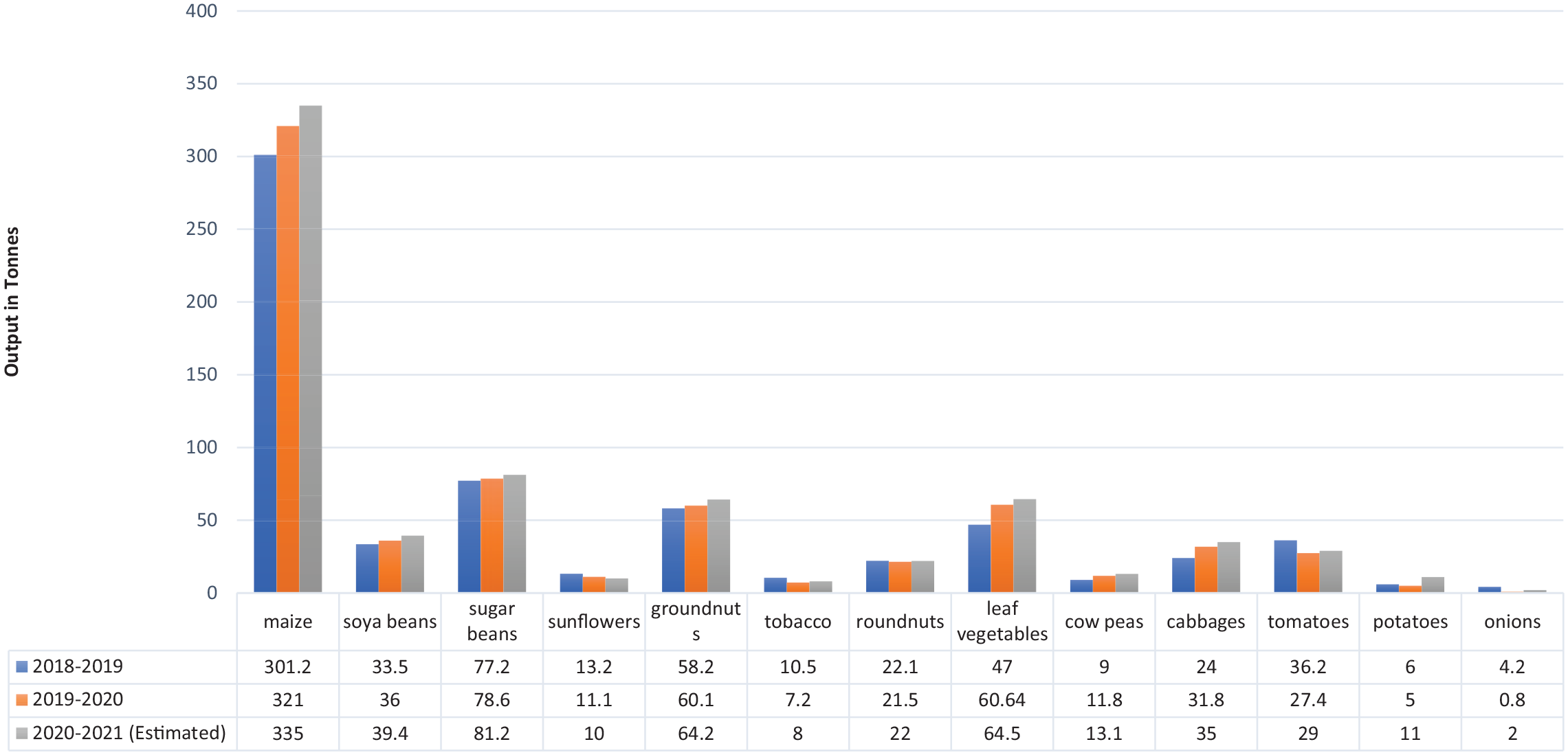
Agricultural output and estimates.
In the Zimbabwe case, it was of interest to note that despite 2020 being a Covid-19 ravaged year, agricultural production was significantly higher compared to previous years, with peasant households contributing meaningfully to national crop and livestock output. This is an interesting dynamic given that projections were that the pandemic would negatively impact agricultural output and by extension food security. It also confirms the observation by peasant farmers and agricultural extension workers in Goromonzi that despite Covid-19 challenges and production constraints, they were optimistic that the 2020–2021 season would be more productive. For the study, this was an interesting paradox, which is critical for future nuanced and empirically grounded analysis.
In 2021, estimates were that the country would produce 2,717,171 metric tonnes of maize, which was a 199% increase compared to 907,628 metric tonnes produced in the previous season (Government of Zimbawe (GoZ), 2021). The increase which is double the 5-year average has been attributed to well-distributed rainfall and widespread distribution of subsidised agricultural inputs (mainly fertilisers and seeds) through the Presidential Input Scheme which targeted 1.8 million smallholder farmers (FAO, 2021b). Increases were not only anticipated in maize production but also in traditional grains (128%), sorghum (135%) and finger millet (35%). The overall cereal production was estimated to be 3,075,528 metric tonnes against a national cereal requirement of 1,797,435 metric tonnes for human consumption and 450,000 metric tonnes for livestock consumption. The overall crop production picture of cereals (maize, sorghum, pearl and finger millet); groundnuts, roundnuts, sugar beans, African peas and sweet potatoes was anticipated to be at 3,802,838 metric tonnes against a national requirement of 2,546,367 metric tonnes, indicating a healthy surplus (GoZ, 2021: 6). Despite Covid-19-induced challenges, prospects were that in 2021, overall cereal production would rebound after two years of weather-induced challenges that had resulted in low harvests. Cereal imports were thus expected to stabilise food prices and improve food security due to increased food availability (FAO, 2021b).
In the study site, while the winter cropping season had been negatively affected by Covid-19, the same could not be said for the summer cropping season of 2020–2021. Different insight from respondents from the A1 and A2 farming models and communal areas was that they had managed to get adequate time to prepare for the summer cropping season and they had become used to ‘working under pandemic conditions’. With a favourable rainy season, state support through inputs and the highly successful state-initiated and supported pfumvudza/intwasa climate-proofing programme; and with the deployment of additional madhumeni (agricultural extension workers), they had managed to undertake their productive activities with impressive results. The situation had been aided by more relaxed Covid-19 protocols and the special exemption granted to the agricultural sector and the easing of restrictions. This had allowed farmers to move freely and procure inputs, there was a reduction in exorbitant transport costs, extension services became readily available as the government intensified its pfumvudza/intwasa programme. For some A2 farmers, the summer cropping season had become promising when some agricultural companies who had been cautious about contracts with farmers in a pandemic context, resolved to continue with contract arrangements and provide support to their summer cropping initiatives. These factors had contributed to farmers recording impressive harvests in the 2020–2021 seasons in grain production.
While the agricultural production estimates of the whole Goromonzi district during the 2020 Covid-19 ravaged year were still unavailable at the time of writing, at the provincial level (in Mashonaland East), estimates were available. Nationally, the province had the third highest cereal output after Mashonaland West and Mashonaland Central Provinces. When it came to maize, estimates were that in the 2020–2021 season, maize output would be 408,880 metric tonnes against a cultivated area of 219,610 hectares (at 1.86 t/ha). This was an increase from the 2019–2020 season where output had been 129,385 against a cultivated area of 193,053 (at yields of 0.67 t/ha) (GoZ, 2021). The Agricultural Extension and Lands Officers (follow-up interviews conducted in May 2021) pointed out that adequate and well-distributed rainfall, the timeous distribution of state inputs, aggressive implementation of the pfumvudza/intwasa programme and the adoption of good agronomic practices had seen some farmers producing maize harvests of between 6-9t/ha. These factors had contributed to high grain output in the district in a Covid-19 ravaged year. Other respondents opined that politically connected persons especially in the A2 sector had in 2020 managed to access a lot of inputs through the Special Maize Programme for Import Substitution commonly referred to as the Command Agriculture programme. 11 The same was also said to have applied to small scale and communal farmers who through their connections were alleged to have benefitted more in the pfumvudza/intwasa programme, hence their output had been very high in comparison to those not politically connected who had to purchase the bulk of inputs with little support. 12 This allegation could however not be proven during the study. Brush painting the impact of Covid-19 should be avoided due to varied impacts as shown by the field-based evidence presented in this section. Yet fundamental aspects are worth highlighting. The production patterns (of the peasants) fall within the production component of the remit of classical agrarian questions. Both agrarian questions and patterns cannot be dissociated from the political economy within which they are located, in this case, the Zimbabwean context. The production and market constraints prior to or during Covid-19 and the pandemic itself are linked to the national and global political economy. For instance, production patterns are determined by the level and quality of agrarian support. The fast track land reform frustrated the interests of global capital (see also Mkodzongi and Lawrence, 2019; Moyo, 2011) leading to the isolation of Zimbabwe by the global powers in the West and withdrawal of support for agriculture and other economic sectors. This is in a context where Zimbabwe’s macro economy is flagging and corruption is rampant hence limited capability to support the peasants and other farmers and corrupt tendencies including diversion of inputs and exclusion in Presidential Inputs Scheme and Pfumvudza. These issues denude the social reproduction and capital accumulation patterns and trajectories due to low income, profits and reinvestment.
Food consumption and the bindu
In Goromonzi, it was noted that in 2020, due to Covid-19-induced challenges, household income had been negatively affected. This had forced peasant farmers to seek alternatives to supplement household income and nutritious food. For A1 peasant households, only 30% reported changes in household food consumption patterns with 70% reporting no changes. This group of A1 farmers reported that despite Covid-19 induced challenges, they had remained food secure and had enough food for consumption and their diet was diverse. At the time of the fieldwork, this group reported eating between two and three meals a day and consuming different types of food which included maize, vegetables, fruits, fish, eggs, milk, meat and other types of (nutritious) food. The other 30% reported that the Covid-19 induced lockdowns, production bottlenecks, lack of income and challenges in receiving groceries and remittances (mainly from the diaspora) had negatively impacted their access to quality and nutritious food. Increases in food prices and lack of a reliable supply of some foodstuffs (due to travel restrictions) were said to have resulted in reduced food intake and substitution of some food with others. This was said to have had implications on consumption and dietary diversity and had made some of them skip meals, eat less food quantities than what they are used to and eat the same kinds of available food.
A popular risk-coping alternative that the study noted was that there was an upscaling of production activities by households in the family garden or bindu. The bindu was particularly important for A1 and communal area farmers with 80% A1 respondents reporting that during the Covid-19-induced national lockdown, they had intensified their productive activities in the bindu. The concept of the bindu is not new and has been observed in the resettlement areas where it plays important productive and social reproduction roles (see Chipenda, 2021a). With Covid-19 challenges, respondents indicated they had expanded production in the bindu which catered for household consumption and sale. With restrictions on fresh produce markets, fluctuations in prices and reduction in quality of agricultural produce among other dynamics, the bindu was said to have become very important. 13
Respondents also indicated that with stringent Covid-19 restrictions, there had been a noticeable increase in farmgate demands for vegetables from the bindu and livestock with high demand for indigenous chickens, pigs and eggs. Livestock production and cultivating the bindu had become critical as risk coping strategies which farmers were using as a source of additional income while catering for some of the households’ nutritional needs. Some respondents had begun growing herbs as there was increased demand for them as they were considered as effective in ‘curing’ Covid-19. 14 Other respondents had taken advantage of the situation to expand their horticultural activities and undertake door to door deliveries of vegetable parcels after noting a gap in the market as people’s movements were restricted, while there was an increased demand for food especially vegetables and meat. With exemption letters, they had managed to advertise their products on different platforms and deliver them in the nearby Harare, Chitungwiza and Marondera urban areas. 15 Although 30% of the peasants who reported food insecurity may appear statistically low, it has direct and indirect negative implications to agriculture, social reproduction, accumulation patterns and farm community and national development – all situated in a political economy context. First, food insecurity may imply ‘failed’ agriculture because the primary objective of the A1 scheme is to produce for the household. Second, food insecurity militates against social reproduction due to lack of food, particularly where alternative sources, for example food purchases and food assistance are affected by lack of income or limited capacity by the government and other stakeholders. Third, food-insecure farmers cannot function effectively in agricultural activities. Directing or redirecting proceeds of agriculture or alternative economic activities to agriculture is constrained because the primary concern will be to secure food. Fourth, farm community development and national development are often steep when the articulation of the economy and politics is negative as is the long-standing reality in Zimbabwe (see also Moyo, 2011; Mudimu et al., 2021). Food insecurity implies that the peasants failed to produce for household consumption. Accordingly, they could not produce excess for the market and national grain reserves.
Agricultural marketing dynamics during the pandemic
Another area that was affected by Covid-19, which is worth highlighting, is in the marketing of agricultural produce, which I believe is key in farmer livelihoods as it links agricultural production and asset accumulation and is central in income generation. It is also a critical feature in the discourse on social reproduction which influences livelihood trajectories. In Goromonzi, respondents indicated that their marketing activities had been affected in different ways by Covid-19 as they found themselves unable to market and sell their produce unlike in the pre-pandemic period. Their complaints were mainly targeted towards unscrupulous middlemen commonly referred to as the makoronyera, whom they felt had cheated them in 2020. While the makoronyera have always existed, 2020 was exceptional as they were said to have been more active and had profited through their unscrupulous dealings at the expense of peasant farmers. The makoronyera were said to have seen an opportunity and taken advantage of restrictions posed by Covid-19 to reach out to farmers, especially those producing grain, leaf vegetables and tobacco. From these farmers, they were said to have bought agricultural products at very low prices and later sold them for high profits. The makoronyera had realised that travel restrictions, the closure and limited operations of fresh produce markets, low prices for produce (usually in local currency) and challenges of procuring inputs were a problem for farmers; hence, they travelled to the farms, offering to buy agricultural produce while offering input incentives. 16 For tobacco farmers, in 2020, changes in the auction system, the government directive that farmers would receive 60% of their tobacco sales in foreign currency (and the balance in local currency), exorbitant transport costs, uncertainty on the tobacco sales decentralisation process, fears of contracting Covid-19 in Harare, delays in payments, prospects of immediate payments in a challenging and Covid-19 ravaged economic environment, prospects of making profit while incurring little expenses had all combined and saw some respondents opting to deal with the makoronyera. 17 Respondents from all the three sectors who dealt with the makoronyera complained of being cheated as their tobacco was underweighted and under graded and under-priced. 18 Complaints were also received from farmers who took their vegetables to Mbare Musika who complained of low producer prices as the makoronyera took advantage of the flooding of agricultural produce, fewer customers and low product quality (as it took longer to dispose of agricultural products, hence some depreciated in quality). While farmers were paid low prices, consumers bought at higher prices, depriving farmers of income, but benefitting the makoronyera.
For maize farmers, exorbitant transport costs despite the Grain Marketing Board (GMB) setting up satellite stations, low producer prices and the need for quick turnarounds in payments had seen some of them selling their maize to the makoronyera through farmgate sales, at Mbare Musika or in different residential locations. The demand for maize had increased with the bulk being needed to make stockfeed. It was only later that some of them realised that they had given away their maize at low prices as the government offered better prices with additional incentives which included accessing inputs for the summer cropping season being availed. The GMB had also surprisingly after many years paid farmers on time. Pressure to generate income by farmers with increased maize availability after the harvest had seen maize prices plummeting (from US$6-7 a bucket to as little as US$3) and the makoronyera had taken advantage of this, making some farmers experience losses. It is worth noting that the challenge of the makoronyera during the Covid-19 period was not unique to Goromonzi but was also witnessed by Shonhe (2021) in Mvurwi district. He noted that they had taken advantage of the Covid-19 situation to make a profit and just like in Goromonzi, they now have a long-standing presence in the area. The local traditional and political leadership in Goromonzi complained that the makoronyera were exploitative, creating leakages (in value chains) and undermining rural agricultural development during the uncertain pandemic period. Overall, the limited direct participation of some peasants at agricultural and inputs markets and the exploitative and cheating character of the makoronyera raises several issues that relate to social reproduction, accumulation and political economy. The relationship with makoronyera is asymmetrical to the disadvantage of the peasants. Losing produce to, being conned by makoronyera and realising low profits through doing business with them directly leads to low chances of accumulating income and reinvesting in productive and non-productive assets. The political economy of corruption and informality in Zimbabwe is state-aided or is flourishing due to lack of state control. The makoronyera is a central example. Nonetheless, in some cases, the makoronyera may offer better prices, pay instantly and in the much-sought US dollar and farmers do not incur transport costs because they purchase at the source (the farm) compared to parastatals such as the Grain Marketing Board (GMB) and Cotton Company of Zimbabwe COTTCO).
Labour dynamics
Just like production, labour relations from a political economy and classical agrarian perspective are important, given their centrality in social reproduction by peasant communities. As highlighted in the introductory section, in an agrarian context, the social reproduction concept views labour relations as critical as they implicate social differentiation, social classes as well as the structural and institutional landscape. Given this importance, the study was interested in exploring the labour dynamics during the pandemic. Labour relations in post-FTLRP Zimbabwe has been extensively explored in the literature (see Chambati, 2017; Chipenda, 2021a). Indications have been that the emergence of the trimodal agrarian structure has had implications on labour relations, which have been transformed in response to economic and productive realities. Discernible outcomes have included the broadening of social reproduction and the rise of a dynamic labour regime that is different from the one existing on the old LSCF’s. This had been necessitated by the adoption of different agricultural models and practices, farmer preferences and the need to adapt in response to the country’s recurrent socio-economic crisis that has persisted for decades. High levels of unemployment, limited opportunities in an economy characterised by a highly informal and precarious labour regime can now also be found in the agricultural sector (see Chagonda, 2016; Oosterom and Gukurume, 2019; Scoones et al., 2019). In Goromonzi, respondents indicated that in a context of a challenging economy and the absence of business-oriented farming models by most peasant farmers, workers are usually hired when the need arises and are paid when output is successfully sold. The workers thus exist in precarious conditions with their remuneration and livelihoods dependent on external factors usually beyond anyone’s control. Favourable weather, good marketing prices and an available market of products and producer–consumer interaction were highlighted as critical factors. With the pandemic, this was said to have been disturbed and it negatively affected workers. 19
Peasant households depend a lot on family labour which is supplemented by additional labour which is usually required for labour-intensive activities like planting, weeding and harvesting. As indicated earlier, in 2020, Covid-19 came at a time when respondents were preparing to harvest crops like maize, groundnuts, small grains, rounduts and other crops. For smallholder A1 households requiring additional labour to assist with harvesting, there were some challenges. It was reported that it was difficult to mobilise additional labour, the strict national lockdown had made it hard for some workers to travel while others (mostly part-time workers) for a certain period were not willing to work due to lack of information as well as fear and uncertainty over Covid-19 and would not put their health and well-being at risk. 20
Challenges with workers could be seen as having mostly affected the ‘richer A2 peasant farmers’ who in comparison to A1 and communal farmers have more workers. Respondents indicated that A2 farmers who engage in winter crop production, especially those requiring specialised skills, initially faced challenges as some skilled workers became unavailable due to pandemic-induced constraints. Those most affected were farmers who hire skilled professionals who come to provide specialised services for specific tasks ranging from crop production and the operation and servicing of machinery. Due to Covid-19, some skilled workers were reportedly said to have deliberately chosen to stay away from their duties fearing contracting the virus while the initial lack of exemption letters negatively impacted worker movement. In instances when they were available some has slightly increased their charges arguing that transport was not readily available, and they had to find alternative transport which was more expensive. 21
It is worth noting that for households in the communal areas and some A1 farms, the study noted that labour disruptions as highlighted above were minimal. This is because of their reliance on family labour. Those who undertake agricultural production activities are usually residents on the homestead hence issues of transport, curfew and other Covid-19-induced disruptions were minimal. There was also no fear of many people working in one place (and spreading the virus) hence the few agricultural production activities which are undertaken post the summer cropping season continued with minimal disruptions. As the year progressed, respondents indicated that they and local communities and workers had ‘learnt to live with the virus and life was continuing as normal’ hence labour was available and complemented by family members. 22
For respondents, the pandemic from a labour perspective was seen as having its unique dynamics, especially in a rural context. Stay at home measures were said to have been impractical as household members and hired labourers had to go and work in the fields, some were herding livestock in common grazing areas while others had to work in gardens and sell their produce to consumers coming from different areas. These activities were said to have placed many of them at risk of contracting Covid-19, but it did not stop them from undertaking their activities and it was aided by the low incidence of Covid-19 infections. 23 At the household level, respondents from the A1 farms as well as the sabhukus (traditional leadership) indicated that the division of labour which they felt was traditionally biased against women and to some extent children had continued to be negative on women and children. They pointed out that the persistent closure of schools had seen an increase in the demand for food and additional household chores, increasing women’s social reproduction burdens as many were forced to look for alternative sources of income while undertaking unpaid household duties. In a focus group discussion with A1 farmers, there was consensus that the activities which women were undertaking were putting them being at greater risk of contracting Covid-19 than men. These activities were said to include collecting water at communal water sources, going to the grinding mill, looking for firewood, going to the shopping centres, caregiving (in some instances of suspected Covid-19 patients), selling from the bindu among other high interaction activities. A few men were said to have been actively involved in household chores despite some of them not working due to the pandemic
For some respondents (especially in the A2 sector), the study noted that there was an influx of some urbanites in rural areas due to the closure of the informal sector had meant an increase in the availability of cheap labour. 24 With their sources of income depleted, it was reported that urbanites who came to rural Goromonzi during the first 2 months of the national lockdown had offered their labour at cheaper rates, as some sought bus fare to return to their homes in urban areas when the lockdown was being eased or as a stop-gap measure to meet their immediate needs. The challenge which most faced however was that it was past the summer cropping season hence jobs were few. The study noted that labour rates had decreased further as labour supply outstripped demand, but the quality of work was said to be poor (as those doing the work lacked experience). The rates of payment and types of contracts differed from farm to farm, but the study noted that the average rates during ‘normal times’ were: land clearing which ranged from ZWL$350 to ZWL$480.00/ha, planting ZWL$125 to ZWL$175.00/ha, weeding at ZWL$110 to ZWL$200.00/ha and harvesting at ZWL$100 to ZWL$150.00/ha. Respondents indicated that with the abundance of labour and few work opportunities, during the initial lockdown in early 2020, they had rarely paid such rates and would ensure that they paid as little as possible negotiate so that they would pay less. Labour rates for different activities were thus distorted unlike in the pre-Covid period where farmers had consensus on the amount which they should pay for a particular task. 25
The Covid-19 uncertainty was said to have seen farmers and workers using the labour market distortions to their advantage as in some areas labour was more abundant than available employment opportunities and this fuelled exploitation. The impact of Covid-19 restrictions and its implications on labour was not unique to Goromonzi. In Mvurwi, in the Mashonaland Central Province, for example Shonhe (2021) noted that ‘. . . shortages resulting from Covid-19 also include shortages of labour and the closure of markets due to the limits to movement under Covid-19 restrictions’ (p. 24). While generalisations on labour dynamics cannot be made, scholarship on Covid-19 implications on labour should acknowledge labour as a factor of social reproduction (see Ossome, 2021). Where farm workers cannot generate income, or peasants cannot diversify income sources through sale of labour due to Covid-19, this negatively reduces their social reproductive capacity. This is in a context where the peasants are experiencing land use and production constraints emanating from national and marginalising global political economy (see Mudimu et al., 2021), and the changing forms of wage labour that have led most peasants to be tied to exploitative labour relations, and to be paid in kind and in arrears (see Chambati, 2017).
Livelihood diversification and accumulation of assets
In the literature, the socio-economic consequences of Covid-19 particularly on work and reduction in income are well documented (Irlacher and Koch, 2020). With its negative socio-economic implication, questions arise on the implications of the pandemic on livelihoods and household risk and coping mechanisms. In Zimbabwe’s resettlement areas, it has been observed that households diversify their livelihood activities in response to risks and shocks (Tom, 2020). With Covid-19 having an unprecedented impact, questions arise on how peasant households have responded to risks and shocks which have threatened and disrupted livelihoods in different ways. From the evidence gathered in the study, it was clear that households have put in place different adaptation and response mechanisms to deal with the fallout caused by Covid-19, with their individual agency being key to their responses. There could be seen the emergence of a number of ‘bottom-up initiatives’ with the construction of different pathways and the use of institutional formations and networks to meet immediate household needs and to plan for an uncertain future. In the Goromonzi context, one can argue that there was the discernible deployment of social capital as a response to vulnerabilities caused by Covid-19. In African rural areas including Zimbabwe, social capital is critical, and it refers to shared objectives, social networks, norms and trust which facilitate agency (Putman, 1995).
In focus group discussions, respondents pointed out that while Covid-19 has been largely negative, it has also presented a few opportunities for peasant households. The lockdown restrictions, gaps in agricultural value chains, limited availability of agricultural products (especially vegetables and livestock) and relaxation of effective local policing (especially of natural resources) among other dynamics had seen some respondents taking advantage and profiting from it. In the study, it was noted that some A1, A2 and communal farmers were engaging in diversified livelihood activities to supplement household income. The common activities included artisanal mining, running tuckshops, vending, providing transport services, brick moulding, sand abstraction, petty trading, natural resource exploitation among others. Figure 2 summarises the diversified livelihood activities undertaken by 70% 26 of A1 farmers in 2020. The respondents reported generating income of between US$25 and US$350 for a month. This income was reported as being important for household consumption
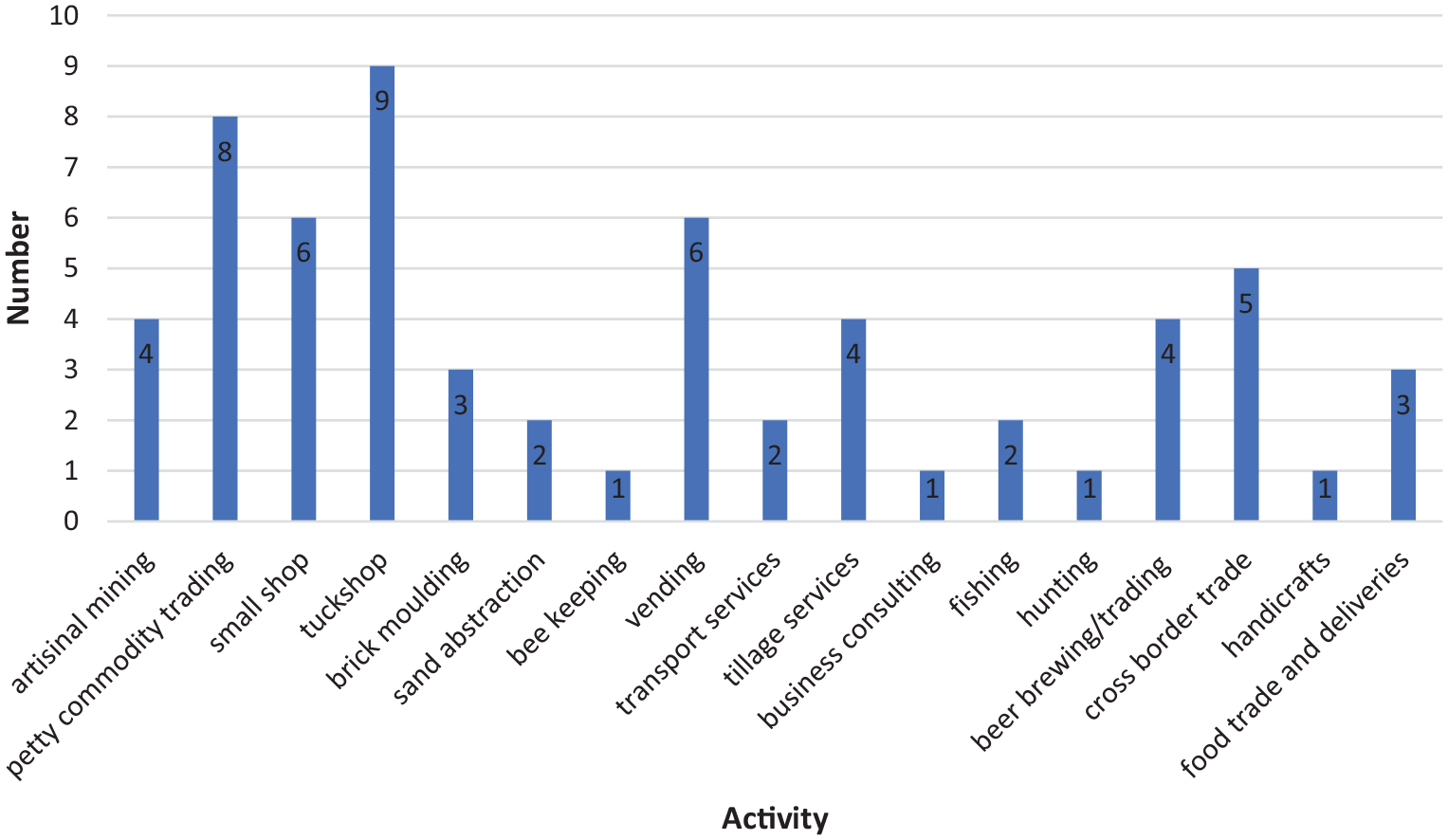
Diversified livelihood activities.
In the study sample, 30% of A1 farmers and 45% of A2 farmers indicated that despite Covid-19 challenges, they had managed to generate some profits from the different diversified livelihood activities which they undertook. This was said to have resulted in an increase in income and by extension a significant improvement in food type, quality and quantity. 27 Engaging in diversified livelihood activities was thus seen as having enabled farmers to generate additional income and be able to meet some of their financial obligations during the pandemic. 28 The issue of livelihood diversification is not a new phenomenon in rural Zimbabwe as it has been observed in the resettlement areas (see Mkodzongi, 2018). Ellis (1998) points out that livelihood diversification is a process through which rural families construct a diverse portfolio of activities and social support capabilities in their struggle for survival. Scoones et al. (2019) adds on that due to low agricultural output and lack of formal employment opportunities, off-farm activities have resulted in livelihood diversification as resettled farmers in Zimbabwe seek to make a living. In livelihood diversification processes, peasant agency becomes central as households attempt to circumvent pitfalls arising from a challenging socio-economic environment. In the rural Zimbabwe case, it provided the requisite response to shocks posed by Covid-19.
By looking at the diversified livelihood activities by households, it was clear in the study that by engaging in different activities, families were managing to enhance their well-being and it was a key survival strategy during challenging times. For some households, the diversification was necessity driven as they needed to undertake other income-generating activities in order to survive (see Ellis, 2000). For others, diversification was by choice as some households, especially in the A2 sector saw opportunities for accumulation by diversifying income streams. Interactions with respondents show that livelihood diversification for some was a coping or risk management and mitigation strategy which was a response to shocks caused by the pandemic. It was also an indication of peasant agency and resilience, which to some extent demonstrated the capabilities of respondents. It became very important in the context of limited social protection initiatives by the state.
The study noted that for some respondents, the activities were temporary and aimed at dealing with immediate challenges while also safeguarding future livelihoods as some farmers indicated had plans to plough back their profits into agriculture. This was considered critical, given the urgent need for recapitalisation after Covid-19 which had seen business and income flow disruptions. It can be argued that to some extent this was an important form of accumulation which although not new, had intensified in the farming areas in a pandemic context as income derived from diversified livelihood activities was being combined with income from agriculture to reinvest in future productive activities. Despite there being an increase in opportunities and business by some farmers, the challenge for some was high operational costs, price increases and the risky nature of most informal activities which made conducting business during the pandemic challenging, negatively impacting on livelihoods. 29
In the study, it was observed that livelihood diversification is linked to the accumulation of assets. Through livelihood diversification, some A1 peasant farmers had managed to acquire both productive and nonproductive assets. For some farmers, despite there being Covid-19, having access to diversified livelihood activities and being able to trade their agricultural produce had seen the continuation of the cycle of accumulation which has been a discernible outcome of Zimbabwe’s redistributive land reform programme. Since the inception of the FTLRP, it has been observed that peasant farmers by virtue of accessing land and the previously enclosed natural resources on LSCF, they have managed to accumulate both productive and nonproductive assets (see Moyo and African Institute for Agrarian Studies, 2009; Tom, 2020).
In a Covid-19 ravaged 2020, some of the A1 respondents and all of the A2 farmers indicated that the accumulation of assets had not stopped. Those fortunate enough to have income flows that were not disturbed by Covid-19 or those who took advantage of opportunities and had higher income flows reported having managed to accumulate assets. The most common assets reported by respondents in the study included water pumps, solar panels and accessories; generators, cell phones, radios, laptops, beds, television sets, satellite dishes among others. In a focus group discussion with communal farmers and A1 farmers, respondents indicated that while some farmers had managed to acquire assets, capitalising on opportunities, this had not been the case for all of them. Some farmers despite having plans to acquire assets in 2020, they had failed to do so due to Covid-19-induced disruptions with others deferring the purchase of assets to after 2022 when the situation would have stabilised. 30 The unavailability of funds, budget adjustments, the impracticality of purchasing, the inability to travel and choose what to purchase among other reasons had all contributed to the failure of some farmers to purchase both productive and non-productive assets in 2020. In particular, while acknowledging the importance of other agricultural factors, productive assets are pivotal in improving production, guaranteeing accumulation, and in reducing the vagaries of unfavourable political economy, particularly where government provisioning for the peasants and other categories of the farmers is limited, and support from other stakeholders is marginal or non-existent.
Conclusion
In 2020, the Covid-19 pandemic and its ensuring national lockdown and restrictions are shown as having impacted in different ways on peasants in rural Zimbabwe. Peasants’ livelihoods and the rural economy which are reliant on agriculture are shown as having been affected and projections are that Covid-19 will have long-term ramifications. This article has shown that from a classical agrarian perspective and political economy approach we can gain insight into the impact of Covid-19 on rural livelihoods. The article has shown that the pandemic has had a discernible impact on production, social reproduction and asset accumulation in rural Zimbabwe. This impact is not unique but has also been witnessed in different contexts, confirming fears in mainstream literature that in the short- to long term, Covid-19 will negatively impact rural development and livelihoods. The interplay between three major institutions, the household markets and state which according to Ossome (2021) are a major feature of contemporary capitalist economies have played important roles if influencing livelihood trajectories during the pandemic. Through the interplay of these institutions in rural Zimbabwe, the article has also shown that agricultural production activities, labour relations, agricultural marketing and asset accumulation have been affected in different ways and projections are that they will have a wider impact on poverty, inequality and marginalisation.
Covid-19 containment measures are shown as having directly and indirectly affected agricultural production activities and this had wider implications on value chains and income generation by peasant households. With the pandemic still ongoing, the article has managed to provide insight on the implications of these measures, providing critical lessons learnt on dealing with future pandemics in a rural context. An important message in this context is that a balance needs to be drawn between Covid-19 containment measures and livelihoods as some of them have been shown as having negative repercussions on people’s lives. While Covid-19 has been largely negative, the article has demonstrated that in a rural agrarian context some positive dimensions of the pandemic can be noted. The most discernible aspect has been the way in which the pandemic has opened up opportunities for peasant farmers to become entrepreneurs who engage in numerous on and off farming income-generating activities. Necessity and opportunity have been the main motivations driving peasants to engage in diversified livelihood activities in which peasant agency is a critical component. Using their agency, the article has shown that Covid-19 has allowed peasant farmers to accumulate assets and use resources available to them as well as their individual abilities and capacities to respond to Covid-19 induced challenges.
While the article is not exhaustive of all rural area dynamics in a Covid-19, it is critical as it provides real-time insight and sets a foundation for future field-based research on Covid-19 and its effects on rural economies and peasant livelihoods. This area is of significance as it requires further nuanced and empirically grounded panel studies not only on the unfolding Covid-19 dynamics but also on future lessons on requisite interventions on how societies respond to future pandemics which threaten livelihoods.
The article addresses gaps that are rife in scholarly literature and responses to Covid-19 and has implications to the conceptual frameworks, scholarship and policy. Scholarly focus on Covid-19 from a social science standpoint is still underweighted. Particularly, the agrarian perspective/dimensions of the pandemic in Zimbabwe are paltry although there is potential to increase. At the macro-level, this lacuna is exhibited by a general epidemiological stance in mainstream responses. Yet this article takes the pandemic to the remit of agrarian studies, justifies that agrarian communities are often marginalised from the mainstream, they deserve scholarly attention in relation to Covid-19 as the current global scourge, and that exploring and responding to the pandemic should delve beyond epidemiological and biomedical approaches, and advance agrarian and other dimensions. While not attempting to advance the prominence of classical agrarian studies and political economy, approaching Covid-19 using these heuristic lenses is underrepresented yet pivotal to both literature and policy. For example, while acknowledging the opportunities created by the pandemic, the threats to and disruption or decimation of agricultural production, social reproduction, livelihood diversification and accumulation patterns and trajectories demand a classical agrarian approach. However, the character of these fundamental concepts of classical agrarian questions is dynamic, complex and defies uniformity in the current context. The national and global governance and policy orientation of Covid-19 and agricultural activities by the peasants (and other farmers) is immersed in the political economy. With full recognition of the changing character of political economy and that it is just but one of the approaches to interrogating Covid-19 in agrarian contexts, premising the manuscript on this approach is commendable because it focuses on the crux of socio-political and economic functioning of societies. Furthermore, the article has the potential to inform policy responses to the pandemic by providing field-based and nuanced evidence from an agrarian context and political economy grounding.
Footnotes
Acknowledgements
I am indebted to the anonymous reviewers and my friend Dr Tom Tom whose insightful and constructive comments were useful in improving the paper. Special thanks goes to Cyriaque Hakizimana, the co-ordinator of the Network of Young African Researchers in Agriculture (YARA) and colleagues at PLAAS, University of the Western Cape who facilitated my participation in the YARA Small Grants on Covid-19, Food Systems and Rural Livelihoods in Africa 2020 Project and my output is this paper. I am also grateful to Professor Jimi Adesina, the holder of the SARChI Chair in Social Policy at UNISA for his support and agreeing to host me for the small grants project. I also appreciate the opportunity he gave me to present an earlier draft of the paper at the SARChI Chair Research Webinar Series for constructive feedback. Lastly I would like to thank colleagues at the the Institute of Intercultural and International Studies (InIIS), University of Bremen (Germany) who provided critical insight on an earlier version of this paper when I presented it at their highly engaging “Colloquium- Internationalised Politics.”
Funding
The author(s) disclosed receipt of the following financial support for the research, authorship, and/or publication of this article: This article was funded through support from the Network of Young African Researchers (YARA) Small Grants on Covid-19, Food Systems and Rural Livelihoods in Africa 2020 Project.
