




Abstract
Frontier making in Ethiopia has historical roots from the formation of the modern Ethiopian state in the late-19th century through wars of conquest. The conquest, which was inspired by political and economic motivations of the highland Christian kingdom, used the notion of a “civilizing mission”—civilizing the “backward” and “underdeveloped” people, and “underutilized” spaces—through imposition of an imperial state system and Orthodox Christianity. The foundation and horizontal expansion of Addis Ababa or Finfinne by displacing Indigenous inhabitants was part of the state building project under successive regimes. Over the last century and a half, the city has continued its unchecked expansion in a process involving multilayered actors whose interests overlapped in terms of grabbing the land they considered “underutilized.” More specifically, the last three decades evince commoditization of farmlands, grazing areas, and cultural and sacred spaces through land lease, which eventually dissolve existing customary systems, values, and practices. This paper critically analyzes the dynamics of frontier making in or from Addis Ababa or Finfinne, the political economy behind such unchecked frontier expansion and how it activated the power of resistance in 2014. The paper concludes that frontier making in or from Addis Ababa through dispossession of Oromo farmers has been part of the broader political establishment in Ethiopia and should be viewed within the same lens.
Introduction
In mid-April of 2014, following the disclosure of the new Addis Ababa 1 and Oromia Special Zone Surrounding Finfinnee 2 Integrated Development Plan (shortly called the Master Plan), a protest broke out in all corners of Oromia National Regional State—Ethiopia’s most populous regional state. The protest targeted the Master Plan that intended to annex most of the city’s surrounding towns and rural villages belonging to the Oromia National Regional State (Ararsa, 2015). Although the Master Plan triggered nation-wide Oromo Protest leading to the resignation of Prime Minister Hailemariam Dessalegn in February 2018, Oromo struggle against political oppression, socio-cultural marginalization, economic exploitation, land grabbing, and displacement under successive Ethiopian regimes dates back to the period of Oromo’s incorporation into the Ethiopian empire in the late-19th century (Gnamo, 2014). The expansion of Addis Ababa/Finfinne to the surrounding towns and rural villages, and the subsequent political implication that the exclusion, dispossession and displacement poses, and claims of entitlement over the city have become bones of contention in contemporary Ethiopian politics. Although the Ethiopian People’s Revolutionary Democratic Front (EPRDF) 3 government put the Master Plan on hold in 2016 following the nation-wide protest that shook the political order, contestation over the city’s unregulated frontier expansion is still at the core of political debates and deserves scholarly interrogation.
At the core of the contestation lies competing imaginations of territory, property rights and resource governance between the federal state and settler residents in the city on the one hand, and local farming communities at the margins of the city and the Oromo people in general, on the other hand. Such collision of macro-political and local understandings of property ownership falls within the notion of frontier expansion, which is the making and remaking of urban frontiers in the present context.
As Thomas Wilson (2012) argues, urban frontiers are areas that are not fully incorporated into a state’s zone of control but where the state strives to extend its power over the land and its people. Yet, present global challenges of urban governance in general and the fast-urbanizing African continent in particular show that urban study should advance its scope to address the ever-complicated nature of urbanization.
Within these contexts, Addis Ababa is exhibiting an interplay of macro-political economy and the private everyday life veracities and opportunities of multilayered actors in the urbanization process. The making, remaking, and unmaking of frontiers by the city are also connected to the broader visions of successive regimes in Addis Ababa who instrumentalize infrastructure developments as a means of garnering political support from the urban milieu (Cirolia et al., 2021; Terefe, 2012). Thus, showing the contours of the political economy of the city will help illustrate the reality of the making of urban frontiers which should be recognized not only as a natural process of urbanization but also as a political and economic strategy through which the state and its urban elites accumulate wealth through dispossession.
With the aim of illustrating how frontier making entails dissolving existing practices and rules by imposing orders deemed superior to the practices at the frontiers and also by dispossessing local communities of their resources, we present empirical data on how the making of the urban frontiers of Addis Ababa city has been facilitated by both legal and illegal means and how it has invoked Oromo resistance. Lund and Rachman (2017) ascertain that frontier expansion constitutes a discursive denigration of local practices, orders and ways of life.
The data for this paper were collected from 2014 to 2021 at different intervals from the Oromia Special Zone Surrounding Addis Ababa through multi-stage ethnographic approach. Displaced Oromo farmers, local government authorities in districts within the special zone and relevant authorities within Addis Ababa city administration were interviewed. Experts involved in land transfer, compensation calculations and payments were also interviewed to understand the process of land transfer and compensation. In addition, official documents such as land-related proclamations and the draft Master Plan document were reviewed.
Conceptualizing frontiers
The mainstream urban studies construes cities as bounded culture centers, which blurs our understanding of the dynamic nature of urbanization, the making and unmaking of urban frontiers and the geographical and political imaginaries invoking urban expansion. The very idea of frontier has been present in academic abstractions for a long time. Geiger (2009), for example, traces its roots in the work of the American historian, Frederick Turner (1893), who wrote about the significance of the frontier in American history as a myth used in the foundation of a settler nation. In that context, it appears to be a boundary between “civilization” and “backwardness” (Mennell, 2009). The frontier is considered to be a political and geographical imagination whereby a particular space is represented as marginal to state power (Korf et al., 2015). As Hirsch argues, several types of frontiers can emerge based on socio-economic and political contexts. He begins with agricultural frontiers, which mainly denote spaces between farmland and forest areas, which “are defined by new relations of production and interplays between conservation, shifting modes of agriculture and natural resource use and management” (Hirsch, 2009: 2). Hirsch (2009: 2), by building on the ideas of Rigg (1998), further extends the concept of frontiers to the peri-urban space describing it as “the zone of rural-urban intermeshing or interpenetration.” Peri-urban frontiers, as fluid spaces between countryside and city, are not merely physical locations but extend to a more generic interplay between urbanity and rurality in defining livelihood and occupational identity (Greenberg, 1997). Rurality, in this context, is also perceived as a space that can be “discovered, claimed, tamed, settled, transformed” (Prout and Howitt, 2009: 397) to be economically productive and culturally modernized by those who claim to be authorized to re-order and dominate the space. This conceptualization of rurality also feeds into notions of frontiers as spaces full of resources but empty of people that can be converted to productive commodities (Korf et al., 2015).
In the neo-liberal economic order, frontiers can be seen from a resource extraction point of view whereby profit maximization is the main motive of capital expansion where today’s Africa, for example, has become a resource frontier of globalization. In this regard, Yacobi (2012) argues that A resource frontier refers to an area on the periphery of a country or territory that is being opened up for resource extraction as older, more accessible resource locations become exhausted. It should be seen within the context in which the world capital expands further beyond the already occupied resource potential area to horizons where more are still to be exploited. Such an expansive nature of capital economy can be sponsored by the states and the international institutions they sponsor in the name of free-market. (p. 60)
This extraction of new resources in new areas, thus, becomes a beginning of the making of new frontiers by unmaking the prevailing physical or imaginative borders. As the main purpose of this paper is to unearth the making and unmaking of frontiers within the scope of the expansive nature of Addis Ababa city, clarifying the concept within the scope of the urban context will contribute to the comprehensive understanding of the impact of urban expansion. This will also help for framing well-thought abating mechanisms in the face of the likely challenges. Lund and Rachman (2017) contend that frontiers are always dynamic and the dynamisms “remove or discredit the recognition of particular resource claims, whereas territorialization, as actions deployed to control space, embodies claims to be recognized.” Furthermore, according to Lund and Rachman (2017): People also claim that particular spaces belong to them, just as they claim to belong to a particular place. The social conceptualization of attachment and of space is wide-ranging, and political, economic, and legal dimensions intersect and overlap. Therefore, people and communities also categorize, classify, and render certain spatial claims meaningful in opposition to and negotiation with government agencies. The combination of frontier and territorialization perspectives allows us to capture both the destructive and the constructive elements in spatial control. (p. 420)
Here, another concept interconnected to the process of frontier making is territorialization. As the notion of frontier expansion entails territorialization both in terms of discursive and practical aspects of territorial enclosure and control, it is essential to illuminate some light on territorialization processes that eventually legitimated exclusion of Oromo farmers and inclusion of settler inhabitants in the city. Discursively, territorialization constitutes state projects of governing people and spaces through which it exercises a sovereign power (Delaney, 2009). It gives the state and non-state actors the leverage to control and influence Indigenous peoples’ access to territories, and it is an “attempt to affect, influence, or control actions and interactions (of people, things, and relationships) by asserting and attempting to enforce control over a geographic area” (Sack, 1983: 55). As such, territorialization entails exercise of power to exclude “others” from a territorialized space because “the power to territorialize is often deployed with the aim of achieving power over others” (Delaney, 2009: 202).
In today’s global context where powerful actors such as state and multinational corporations exert claim over territories, territorialization produces violent enclosures in which the social and biophysical spaces are delimited to “redefine social relations, constrain resource access and use, and increase livelihood vulnerability” (Dressler and Guieb, 2015: 323). Both as a discursive consolidation of power over space or as a practical demarcation of territories as enclosed spaces designated for particular form of land use—for example as urban land—territorialization pursues destruction of certain social spaces while reconstructing a different form of social origination of space (Sevilla-Buitrago, 2015: 3). In such a process of reconstructing a different form of spatial organization, it creates exclusion, which is not a random process but structured by asymmetrical power relations (Hall et al., 2011). As it produces exclusion within an unleveled playing field, territorialized spaces become violent in stripping off territories, resources, and existence from local communities, and in limiting their representation in matters that affect them. From this vantage point, Addis Ababa’s perpetual-expansion is a political-economic strategy of power consolidation and wealth accumulation by the state and urban elites.
Addis Ababa/Finfinne: an ever frontier making city
In order to grasp the complex nature of the making of frontiers by Addis Ababa city, we employ a political-economy analytical approach because it reflects not only the politico-ideological chains the successive regimes have employed to reign over the city, but also reveals factors such as the nature of political regimes, state-society relationships and the social relations organized around power pertaining to property ownership within the frontiers of the city and beyond (Meseret and Sebawit, 2018; World Bank, 2015). Political economy also expresses “the interaction of political and economic processes within a society: the distribution of power and wealth between different groups and individuals, and the processes that create, sustain and transform these relationships over time” (Collinson, 2003: 3). It explains the intersection of political and economic processes that constantly shape the power relationships enshrined in modern states (Clammer, 1985). It can also be used to illustrate “state-market relationships and how power is organized in these relationships” (Meseret and Sebawit, 2018: 6) because it shows how individuals or groups engage in political activity to maximize their economic gains.
Therefore, the making of frontiers by or from Addis Ababa should be analyzed within the political ideology of successive regimes and their narratives of land ownership. Such positioning is important because the making of the city itself embodies the making and unmaking of frontiers within the framework of settler colonialism as the city’s historical establishment and development trends are jam-packed by forceful evictions or displacements, dispossessions, and resistances. It also exhibits the manipulation of settler-host relationships, the formation of social differentiation, the quest for land and identity as well as the struggle for the right to have a space in the city and representation in the administration.
We posit that the history of Addis Ababa or Finfinne, as common to the dominant or mainstream Ethiopian history, was written from the perspectives of those who conquered the land in the 1880s. As the writers of such history were members of their contemporary expansive regimes that designated the land on which Addis Ababa was established as a vacuum no-man’s land, they consigned the history of place and the people before the 1880s into oblivion.
Although the making of Addis Ababa generally falls within the historical development of urban centers in Ethiopia (Assefa, 1993), we believe that it has its own peculiarity. Prior to the establishment of Addis Ababa as a capital city of the ever-expanding Abyssinian state in 1886, the areas that currently fall under the city administration were inhabited by the Tulama moiety of the Oromo nation (Kenei, 2010). The Tulama Oromo clans used some areas of the land for cultural purposes or as sacred spaces for annual thanksgiving (Irreecha) celebration and Gadaa assemblies in addition to utilizing it as grazing and farmlands. The peculiarity of Addis Ababa is related to the encounter between an invading power and Indigenous societies that eventually cemented asymmetrical power relations in the form of settler-Indigenous relations.
Despite differences in political ideologies, successive Ethiopian regimes shared much in common with regard to Addis Ababa and its frontiers, particularly when it came to controlling the land and subjugating the people. Since the birth of Addis Ababa as the expanding empire’s political center in 1886, when settlement areas started to grow around the present Menelik Palace, the making of frontiers was intensified because land began to be allocated to some designated personalities, servants or soldiers who played crucial role during the military conquest of the southern and southwestern parts of Ethiopia in the name of unification (Donham, 1986).
After the forceful displacement and pushing away of the Oromo farmers from their home, a turning point of the making of frontiers was intensified when Menelik distributed land in 1891 to concentrate large amounts of land in the hands of a few. “50% of the total area of Addis Ababa was owned by 1768 proprietors each with an average of 71,000 square meters” (Molla, 2009: 150). In this way, making new frontiers further continued and strengthened by the 1907 regulation under Menelik’s rule which required Oromo farmers to register their land as a mechanism of redistributing “excess land” to Amhara settlers. “The rule contained provisions which specify the rights and obligations of land owners of urban land, the requirement of measurement and registration of urban land law as well as the issuance of title certificate” (Molla, 2009: 150).
The period from Menelik’s regime to the 1974 Revolution also passed through different phases. First, the early years of Haile Selassie’s regime (until the Italian occupation) were similar to Menelik’s period in that all of the land in the city was divided among feudal lords who controlled the political, social, and economic power of the state. The other phase that reconfigured the city’s patterns of settlement within a short period of time was the Italian occupation, which created compartments of residential patterns according to class and ethnicity. The situation facilitated the construction of new buildings, roads, bridges, schools, and other facilities which pushed citizens to some designated frontiers with an added layer of social segregation against the Ethiopians. After the defeat of the Italians, however, the past was never dead because the pushing of the farmers to the frontiers was intensified with the regime of Haile Selassie’s continued expropriation of nearby farmlands and distributing them to feudal lords, war veterans, and loyal civil servants. With this regard, Dandena Tufa (2008) argues that “the structural elements of settlement were based on clusters of residences to accommodate the officials and their followers. These clusters of settlements came to be commonly known as ‘Safar’ which literally to mean camp” (p. 32).
It was at this junction that the landholding system had created a clear hierarchy of wealth and status as a result of land possession through expropriation or what Harvey (2003) calls “accumulation by dispossession.” In such a way, administrators of the expansive rulers and the few for whom the land was partitioned created frontiers in which a certain group was considered eligible for residing in urban areas whereas others were pushed to the suburbs or beyond. The feudal regime violently and systematically created social hierarchies, exclusions, and dispossessions leading to cultural, psychological, and epistemic violence against the inhabitants. That is what Bourdieu and Wacquant (2003) call symbolic violence, a situation where he used the concept to show the formations and interrelations of social structures of inequalities, and thereby the development of perceptions where the powerless groups begin to (mis)recognize the social structures and inequalities integral to the world around them as natural (Holmes, 2013). Here, Holmes (2013) further argues that each group with power inequalities begins to “understand not only itself but also the other to belong naturally in their positions in the social hierarchy” (p. 44).
The socialist government’s nationalization of urban land also consolidated the power of the state over land expropriation and redistribution through the Urban Land Proclamation No. 47/1975 (Gebremichael, 2017). Although the military regime’s land policy did not make explicit discrimination against local inhabitants in terms of ethnicity or class, the nationalization of urban and rural land degraded customary land use systems of the Oromo in which any member of a clan had access to land without discrimination. After the Socialist government was overthrown in 1991, the country’s urban land policy had undergone a number of changes and revisions. The 1995 constitution stipulates that “Land is a common property of the Nations, Nationalities and Peoples of Ethiopia and shall not be subject to sale or to other means of exchange” (1995 Constitution, Article 40.3). Since the adoption of the constitution, the government has issued a lot of urban land holding proclamations, regulations, and directives in order to enhance the “free market economy.” Thus, the post-1991 period evinces rapid commodification of land in Ethiopia. The government’s commodification of urban and peri-urban lands intensified land expropriation both through legal and illegal approaches in all corners around Addis Ababa.
The EPRDF government consolidated its exclusive power of controlling urban lands through its successive laws and regulations. Proclamation No. 80/1993 (Proclamation for the Lease Holding of Urban Lands) was one of the proclamations that opened up urban frontiers to the land market. The proclamation also enabled the federal state, Addis Ababa city administration and urban frontiersmen (politicians and brokers) to use the legal system in satisfying their hunger for peri-urban lands. The 1993 proclamation intensified expropriation of frontier lands as it opened up peri-urban lands for market economy in the form of lease, and also laid a foundation for other subsequent proclamations. Being enacted 2 years before the constitution, the lack of constitutional support for the proclamation was a non-issue. The proclamation also bestowed the power upon the government to sell land whereas citizens cannot. In this proclamation, the sole means of transferring ownership rights was through tender or auction, with an exception for circumstances where land can be guaranteed for investment, social services, or other public benefits (Article 13) (FDRE, 1993a). By restricting citizens’ right over land, subsequent proclamations enhanced land commercialization by state officials and private dealers. These actors (i.e. politicians and land dealers) have got the power to maneuver the system by recommending who should be appointed as the heads of land administration departments in all structures of the urban administrations in Addis Ababa and its suburbs (Personal communication, Oromia Land Administration, April 2019).
As stated earlier, although Article 40 (3) of the 1995 Constitution gives the ownership of both rural and urban lands to the state and the nations and nationalities of Ethiopia, it is still the state that holds almost all rights over land tenure by leaving only the use rights for citizens—the right that landholders can use the land for subsistence but not able to transfer or sell it. In addition, Article (89:5) of the Constitution states that “Government has the duty to hold, on behalf of the People, land and other natural resources and to deploy them for their common benefit and development” (FDRE, 1995). Subsequently, the enactment of Proclamation No 272/2002, which provides that any urban land held by the permit, leasehold or other means should be under leasehold system where the main means of land transfer are to be tender, negotiation and allotment, also moved the frontier expansion one-step further (FDRE, 2002). This proclamation ensured that state land control and its frontier making processes became limitless. This proclamation entirely revoked the already diminishing land tenure rights that individual landholders had and vested absolute power in the state in terms of deciding who should or should not get urban land for any purpose. Thus, state power is frontier-free, particularly when it comes to urban land allocation. In the above proclamation, negotiation has been considered as the dominant form of land transfer. Why was negotiation chosen as a dominant means of land transfer in this proclamation? From a political point of view, as hinted earlier, it was merely to beef up the government muscle over land ownership and weaken citizens’ negotiation power. As the landholders are asymmetrically related to the state in terms of bargaining power, negotiation gives the state the leverage to maneuver the process to its advantage. From economic point of view, it is a means of enabling the wealthy to accumulate more in the land market, which actually requires large amount of initial capital to succeed in the inevitable competition. One can sense a wealth frontier being made here or what Harvey calls “accumulation by dispossession” (Harvey, 2003). As a result, the already economically incapable groups, such as the urban poor living in the slums and the land losing farmers in the suburbs, surrender their negotiation power due to such a law.
Another proclamation with far reaching implication on local communities’ land right was the 2005 Land Expropriation Proclamation (Proclamation No. 455/2005). The proclamation gives absolute power to the government to expropriate land when it is deemed needed for “public purposes”—a vague phrase in the proclamation that did not clarify what the public interest includes and whether the people on the land should be consulted before the decision for expropriation is made (FDRE, 2005). According to our interview with an expert in the Laga-Tafo town Land Administration office, the implementation of lease proclamation was enforced through political decisions rather than administrative and legal frameworks. The informant stated that there were many instances where a higher government authority from Oromia or the federal government made phone calls to the mayor of the town to give land this or that amount [any amount of land as per their interest] to individuals without undergoing any process of bid. In such context, expropriation was also automatically conducted without due processes of calculating the land values for compensation.
From a broader political spectrum, 2005 was a period when the ruling party officially adopted the so-called developmental state political economy that enhanced strong state intervention in development programs (Regassa and Korf, 2018; Zenawi, 2006).
Finally, in 2011, the government promulgated a proclamation (Urban Lands Lease Holding Proclamation No.721/2011), which further legitimized state expropriation of peri-urban land and its incorporation into urban land administration. Two fundamental points of the proclamation with implications on peri-urban Oromo farmers were the legalization of lands grabbed by land entrepreneurs or frontiersmen, and the incorporation of rural lands into urban administration (FDRE, 2011). According to our information from a former employee of the land administration department in Laga-Tafo town, the town administration converted illegally occupied peri-urban lands into lease holdings. They referred to the proclamation even though the procedure of land acquisition did not follow the lease process. While such act of legalizing the illegally acquired land further widened the frontier of wealth accumulation and thereby enhanced land grabbing, the coinage and increasing use of the term “urban land lease” for such illegally occupied peri-urban lands intensified the conversion of rural villages into smaller town administrations in order for politicians and brokers to benefit from the land tenure business.
A 2015 World Bank study indicates how the expansion of the city has been remaking its frontiers. The report shows that Addis Ababa’s annual urban expansion rate is 3.2%, which brought the city to a total size of 647 km2 by the time of the study (World Bank, 2015). This is as a result of the inclusion of previous frontiers directly under Addis Ababa’s urban administration. The expansion of the city led to the emergence of new physical and social frontiers. Data from the city administration show that 23 rural villages (Peasant Associations) were included in the city administration in 1997. According to information from a former State Minister of Communication, from the early 1990s, the ruling party (EPRDF) used land as a political instrument in winning the support of urban elites 4 particularly in Addis Ababa. According to the official, as Addis Ababa continued to be stronghold of the opposition parties, the EPRDF tolerated the city dwellers’ illegal land acquisition in the peri-urban areas by legalizing lands acquired through illicit processes. 5 According to this source, the government transferred between 4.8 and 5.4 million m2 of land for Real Estate projects alone until the 2005 election, while tens of millions m2 of land were expropriated in the name of industrial zones, condominium houses, flower farms and other leases for private housing, displacing hundreds of thousands in the process. At this juncture, it is imperative to underline that the Addis Ababa city administration eventually removed the status of “rural kebeles” from the 23 villages that were incorporated into its administration in 1997 as a strategy of partitioning the lands as per the urban land use system. In this context, it suffices to reiterate that frontier making in or from Addis Ababa embodies a two-pronged attack on the surrounding Oromos. While the first constitutes a material aspect which is attended by large-scale land grabbing, the second entailed a cultural aspect leading to an assault on Oromo identity. Here, it may be useful to use concept of ‘cultural genocide’ and Bourdieu and Wacquant (2003) notion of symbolic violence to explain the situation because the ever-expanding Addis Ababa has disrupted Indigenous social networks and cultural practices including the Irreecha thanksgiving festival celebrated by the Oromo nation.

Map of the Addis Ababa under different periods (Source: Berhanu et al., 2019: 8).
Therefore, the formation of Addis Ababa as a settler city and the continuity of frontier making from the city can be contextualized within the broader political and economic interests of successive regimes which used legal frameworks in legitimizing land appropriation. Similar to how the westward frontier expansion to the “Wild West” in the United States was mainly motivated by hunger for land rather than ideological orientation (Mennell, 2015), the establishment and unchecked expansion of Addis Ababa to nearby Oromo farmlands has also been predominantly attributed to settlers’ hunger for land. Accordingly, the dispossession of Oromo farmers from their homes and farmland in the form of over 100 years of continuous urban enabled successive regimes to consolidate state power at the center (a term including the political, administrative as well as geographical center) by further pushing Indigenous communities to the margins (see Figure 1 below). Commodification of land, re-configuring the demographic composition around Addis Ababa and narratives of development and modernization as legitimizing discourses of state intervention have systematically been used by a succession of regimes, particularly over the last three decades.
Here, the data gathered from the field substantiates this argument. Although we could not access official data for the pre-2018 period, our sources in land administration and local informants confirmed that peasants were paid “compensation” per square meter of land with the lowest rate of three Ethiopian Birr (ETB) used in the 1990s and early 2000s to 18.50 ETB in the 2010s, which the government later leased to private investors for 3000–17,500 ETB. According to the data from Addis Ababa City Administration Farmers Urban Agriculture Development Commission (2021), there is a change in the rate of cash compensation since 2019. Table 1 shows the rate of compensation for land that is used for different purposes.
Rate of compensation for land used to produce major crops (from 2019/2020 up to date). 6
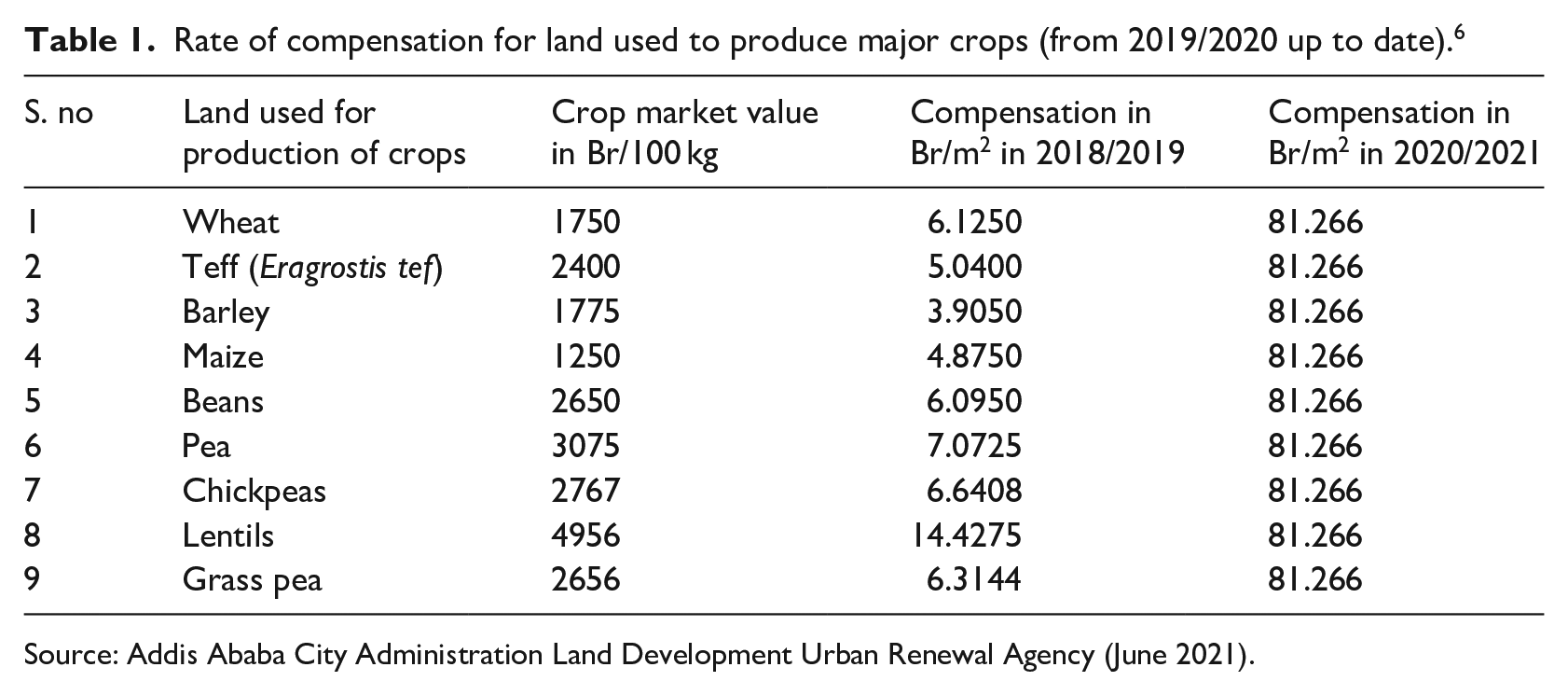
Source: Addis Ababa City Administration Land Development Urban Renewal Agency (June 2021).
Although the rate of compensation per square meter of land increased in 2020 following the revised “Expropriation of Land holdings for Public Purposes, Payments of Compensation and Resettlement of Displaced People Proclamation 1161/2019),” the revision does not take into consideration the amount of crops produced per hectare of land and its market values (FDRE, 2019). In this regard, the compensation homogenizes all categories of land to the market value of their urban utility rather than their productive values to local communities. In a focus group discussion with former farmers displaced from Lami Kura village—a village that was incorporated into the Addis Ababa city administration in 2020—it came out that there was no legal framework or administrative structure to recognize local landholders’ complaints on rates of compensation let alone their opposition to the decisions of expropriation. One informant from Laga-Tafo, an adjacent town in the eastern border of Addis Ababa, desperately stated that he lost about two hectares of land and has now become landless and impoverished as the compensation paid was insufficient for the household to restore their livelihood: When I asked local authorities about the amount of compensation and requested them to give me and my family an alternative piece of farm land, they told me, and also to other people in the village, that this is an order from the top government (the federal). We were forced to accept what they gave us and continued a miserable life since then. (anonymous informant, Laga-Tafo, April 2020)
However, as the next section illustrates, hegemonic discourses and practices of frontier making have engendered the power of resistance from the people and who have begun to hit back the expanding center.
Frontier hits back: the Addis Ababa master plan and Oromo protest, 2014–2018
Although the Ethiopian state has been pushing its frontiers of power to the peripheries since its establishment, there has never been a more calamitous state-sponsored frontier expansion than the period from 1991 to date. As we discussed in the preceding sections, the EPRDF government used land as an instrument for garnering political support and accumulating wealth through legal and illegal practices of land appropriation. Land in urban and pastoralist areas became an arena of political mobilization and wealth accumulation and enhanced the creation of patronage. The EPRDF’s diminishing support from urban elites, as demonstrated in the 2005 election particularly in Addis Ababa, prompted the party or government to embark on massive “development” projects such as condominium housings in the peri-urban areas. Apart from issuing proclamations and regulations that legitimized land expropriation under the guise of development, the EPRDF party or government also legalized land that was acquired by individuals through illicit mechanisms. Our informant from Addis Ababa city administration stated that “in the run for the 2005 election and particularly following the EPRDF’s defeat in the election in Addis Ababa, the ruling party used land as an instrument of political loyalty, particularly for the 2010 election.”
One of the grand “developmental” projects designed to target Addis Ababa’s frontiers was the Addis Ababa and Oromia Special Zone Intergraded Development Master Plan (the Master Plan) that was launched in 2013. Sometime in June 2011, the Addis Ababa Master Plan Project Office announced that it had prepared a new master plan for Addis Ababa City. There were a series of discussions in the mainstream media affiliated with the federal government, particularly ETV and the Ethiopian Radio, to promote the new plan and its objectives. A full document of the plan was later released with the title Addis Ababa City and Addis Ababa Zuria Finfinnee Special Zone Integrated Development Master Plan (2006–2030 E.C/2013–2038 G.C/) (Addis Ababa City Master Plan Office, 2014). The disclosure of the Plan provoked Oromo farmers who had been experiencing displacement from their homes and dispossession of their land under successive regimes. In early 2014, during the familiarization discussions, resistance movements erupted in Oromia Regional State to which Addis Ababa was to expand its frontier. Before discussing the nature of the resistance, as a hit back to frontier making, it is important to analyze the intent of the plan within the scope of urban frontier making process of Addis Ababa. The basic tenet of the plan was that Addis Ababa and the surrounding towns in Oromia Regional Sate should be integrated to provide services within the framework of international and national standards.
With this background, the new Integrated Development Master Plan (2013:13) establishes three objectives which are set to expand global and continental, and national urban frontiers in terms of service provision and to become competent in today’s globalizing economy. Based on this, the first objective assumes the new Master Plan will accelerate the country’s urbanization from the current 17% to 30% within the following 10 years, and to 50% within a period of 25 years. In this way, it is emphasized that increased urbanization is to play a key role in the overall economic development of the nation. Second, within the global frontier, making Ethiopia’s tourism, business, and service delivery competitive at the international level is another objective of the new Master Plan. Of course, international hotel chains and transnational manufacturing industries had already begun operating in Addis Ababa and its surrounding towns in Oromia Regional Sate before the inception of the new Master Plan. So, the purpose also seems to be to expand the frontier of such global businesses in Ethiopia. The third objective of the Master Plan was boosting Ethiopia’s position in the economic cooperation across the African continent by making Addis Ababa a hub for international and continental business organizations. This echoes broader discourses and projects of frontier making; the appropriation of resources from pastoralists, farmers, fishermen, hunters, and gatherers and artisanal miners under the grand narrative of modernist development (Regassa and Korf, 2018).
This ambitious plan envisaged incorporation of about 100 km2 into the new development plan in the coming 50 years. Like any high-modernist development planning and discourse that is future-oriented and simplistic of the present (Scott, 1998), the Master Plan produced an imaginary city that engulfs and modernizes its frontiers. At this juncture, it is imperative to raise the following questions: (1) why did this ambitious developmental plan backfire on the regime? (2) Although high-modernist development projects are often authoritarian in nature and require authoritarian regimes for their successful implementation (Scott, 1985), how did the authoritarian EPRDF regime fail to implement the plan and eventually end up suspending it?
Rather than analyzing at the new Master Plan as a main cause for the 2014–2018 Oromo resistance movement, this paper contextualizes the case within broader questions of Oromo’s economic and political representation. For several years under the successive regimes of Ethiopia, the Oromo people faced systemic marginalization, economic exploitation, political oppression, and socio-cultural stigmatization. Substantiating this argument, Mekuria Bulcha (1997) argues, “Ethiopian identity is not considered as an amalgam of the identities of the various groups that inhabit the country. It was even argued that the Abyssinians alone embody and represent traditional Ethiopia” (Bulcha, 1997: 326). On top of that, the displaced individuals claim that the politico-economic establishment of Addis Ababa itself has, for generations, been at the cost of the economic and social conditions of the Oromo who live in and around the city. They claim that the land is their ancestral land and, therefore, they deserve a fair share, if not a better one, in the ongoing urban development but now, the urban expansion has pushed them into destitution.
Rampant land grabbing and the government’s repressive system already eroded the legitimacy of the regime despite its developmental narratives. Therefore, the new Master Plan can only be seen as an immediate practical cause for the resistance movement but not the sole cause. That said, the Master Plan’s potential direct consequences were still substantial. The Master Plan was so high-powered that it could have pulled more farm and grazing lands into the boundaries of Addis Ababa. As a result, large number of people whose livelihood was entirely dependent on agriculture would be affected. On top of that, the Master Plan document was not transparent about the future of farmers whose land would be included into the new Master Plan. Such uncertainties caused by a lack of transparency and the top-down approach of the government’s policies have put further uncertainties about the fate of towns and rural villages near the capital.
The nature and consequences of the Oromo land related resistance movement
The Oromo protest from 2014 to 2018 was initially started by students in limited localities to oppose “a plan to expand the capital, Addis Ababa, by approximately 1.1 million hectares into Oromia” (Pinaud and Raleigh, 2017). The 2014 protests were comparatively small but escalated in November 2015 in Ginci—a small town located at about 65 km to the West of Addis Ababa. The protest was mainly organized by university and secondary school students and it was heightened when other community members from almost all zones of the Oromia Regional State joined it in the subsequent months. Human Rights Watch (8 December 2015) reported that, though the “protests are ostensibly responding to the Addis Ababa expansion plan, they also derive from deeper grievances” (Human Rights Watch, 2015). Ararsa (2015) argues that the Oromos resisted the new Addis Ababa Master Plan because it violates the principle of federalism that Ethiopia claims to foster by restricting Oromia’s right to self-rule, and Oromo people’s rights over their land. Although the government pretended to cancel the Master Plan to appease the protesters in early-January 2016, the protests continued until the former Prime Minister Haile Mariam Dessalegn resigned in February 2018.
In this section, taking into account the above short timeline for the Oromo protest which prompted the EPRDF government to engage in internal reshuffling, we examine the nature of the resistance and its major consequences. As discussed earlier, the Indigenous Oromo inhabitants were pushed away to the margins of the city as a result of state-backed displacement and dispossession under successive regimes. The frontier expansion was so aggressive that it continued engulfing rural lands into the city administration periodically. In the last 15 years alone, 23 peasant associations (kebeles) were “formally” incorporated into the administrative boundary of Addis Ababa (Zenawi, 2007). Given the political importance of the city and the fact that most of the recent residents in these peri-urban villages acquired the land through illicit mechanisms supported by the ruling party, the incorporation of these rural villages serves the government as a source of loyalty. By way of contrast, the violent dispossession and expropriation of peri-urban land continued to signify economic deprivation and social marginalization for those whose land was taken. The cumulative effect of this deranged state-society power relationship has gradually brought about the birth of an uncommon, society-level resistance that erupted in 2014 and culminated in 2018 with the ascent of Abiy Ahmed to power.
How is resistance explained in this particular context? Malseed’s (2008) explanation of resistance seems to capture the true nature of the Oromo people’s movement against the government where the leaders were young people who assumed that they fell under similar age group, Qeerroo.
7
Malseed (2008) argues that For such acts to be considered part of a “movement” of resistance, villagers need not be conscious of each and every action as a step toward larger goals, but there should be an atmosphere of communal acceptance and support, like-mindedness of action and consistency with commonly held ideas of social justice. (p. 503)
In relation to the land tenure system and the frontier making of Addis Ababa, resistance was invoked to challenge power inequality and to seek social change (Hollander and Einwohner, 2004: 535). It was a struggle to not surrender. It may also be perceived as an instrument to threaten or challenge hegemonic rules imposed on the society in the form of the Master Plan. Kerkvliet divides resistance into the following three forms: official, everyday, and advocacy (Kerkvliet, 2009). Official resistance deals with scrutinizing authorities in organizations that construct, implement, alter, and/or avoid policies regarding the allocation of resources. Everyday resistance, according to Scott, shows how people accept, abide by, and/or question the norms and regulations of authority over the production and distribution of resources in an indirect and unplanned manner (Scott, 1985). Finally, the advocacy form of resistance is a “direct and concerted effort to encourage, condemn or contest policies and authorities and even the system and the manner in which resources are produced and distributed” (Kerkvliet, 2009: 231–232).
In the case of the Oromo resistance, it also questioned the place of the Oromo within the Ethiopian political establishment—challenging marginalization and underrepresentation. In this regard, Oromo artists played a fundamental role through resistance songs most of which were played, sang, and cherished by the youth during the protests, thus giving inspiration, commitment, and courage in their struggle. 8 Moreover, as a youth-led movement, the resistance was well-placed to benefit from print and electronic media. Social media, particularly Facebook, was mainly used by the youth to create complex networks, to disseminate information and to expose the government’s brutality. In addition, electronic media, particularly those based abroad such as Addis Standard, Ayyaantuu Online, Gadaa.com, and OPride served as important platforms in publishing critical papers on the Master Plan and the dispossession or displacement of Oromo farmers. Furthermore, two foreign-based radio channels with wide-coverage in Ethiopia, namely the Voice of America (VOA) and Deusche Welle Radio of Germany, and a TV channel (Oromia Media Network—OMN) were instrumental in connecting the local with the global and vice versa in the Oromo protests.
The final major means of expressing communities’ dissatisfaction and resistance during the protest were non-violent approaches such as a market boycott, which was eventually followed by road blockages. Eventually, from 2015 to 2017 when the protest reached a climax, Oromo youth and activists managed to mobilize many different sections of the society including civil servants and members of the ruling party (The Guardian, 13 March 2018). The government used brutal measures by its armed forces and the security department in killing and arresting people who moved to the streets to demonstrate or lead the movement. However, the Oromo youth, commonly called the Qeerro, activists and opposition politicians heightened the resistance until the authoritarian regime was prompted to make internal reform in early 2018.
Conclusion
Frontier making in or from Addis Ababa since the late-19th century was based on asymmetrical power relations between the state and state-backed settlers on one hand, and native inhabitants on the other hand. It was a political and economic project of land expropriation and capital accumulation legitimated through legal frameworks. The frontier, viewed from the perspectives of frontiersmen, is a lucrative resource to be commoditized in the form of land sales and leases generating economic benefit as well as political loyalty and patronage. Addis Ababa’s frontier making process has been a continuous and contentious project entailing land commodification, expropriation, and dispossession through legal and illegal approaches involving both state and individual actors. The continuity and commonality of the frontier making process across different regimes is how the predatory Ethiopian state uses Oromo land at the margins of the city as part of consolidating state power at the center. Just as veterans of war, the nobility, loyal provisional governors, and their families were given land during the imperial period, the EPRDF also used land as a political commodity—both in creating patronage and punishing opposition.
As a city established by settlers through violent expropriation and displacement of native people, Addis Ababa and its frontier expansion also symbolize the conditions of subordination of the Oromo under successive regimes. As frontier dynamics dissolve existing political jurisdictions and resource regimes (Rasmussen and Lund, 2018), Addis Ababa’s unending expansion to nearby Oromia towns and villages has the effect of not only pushing away rurality and its features, but also shifting the rei in resource ownership, governance, and control. As the frontier expansion was violently implemented in the past and planned to be put in place in 2014 through the Master Plan, it constituted both material and symbolic violence against frontier subjects. This leads us to the conclusion that the discursive notions behind frontier expansion and its legitimation processes through political, administrative, and legal frameworks, as well as the contradictions between local communities’ lived experiences and the frontier imaginaries held by state and non-state actors, combine to make frontiers arenas of contestation and negotiation. In the context of Addis Ababa’s frontiers, as negotiations did not lead to consensus due to asymmetrical power relations, contestation, and conflict became the ultimate pathways for the local communities in their claim for entitlement to land rights. Nevertheless, despite the coming to power of Abiy Ahmed through the Oromo protest, the underlying questions of the Oromo including the fate of hundreds of thousands of families displaced over the course of three decades due to Addis Ababa’s expansion remain unanswered. In order to ensure that the city’s development with benefits both its inhabitants and the people outside its jurisdiction, the land rights of native inhabitants should be recognized through inclusive and people-centered land policy.
Footnotes
Acknowledgements
The authors would like to thank Benedikt Korf (University of Zürich), Feda Negesse, and Fekadu Adugna (AAU) for their critical comments on the early draft of our manuscript.
Declaration of conflicting interests
The author(s) declared no potential conflicts of interest with respect to the research, authorship, and/or publication of this article.
Funding
The author(s) disclosed receipt of the following financial support for the research, authorship, and/or publication of this article: This research has been conducted by the authors’ own funding.
