




Abstract
This paper makes use of interdependence theory to analyse the historical development of the economic relations between the GCC countries and the United States. The focus will be on oil and arms trade between the GCC countries and the United States. The results show that while the military and security dependence of the GCC countries on the United States remains relatively intact, the dependence of the United States on the natural resources of the GCC region has decreased. In light of this, the paper suggests that the historical interdependence between the GCC countries and the United States has recently evolved into a unilateral dependence and that the GCC countries’ natural resources are directed towards Asian countries.
Introduction
Oil and security are key elements of the decades-long relationship between the Gulf Cooperation Council (GCC) countries and the United States. Ensuring the security of the Gulf region, where most of the natural resources are located, means ensuring the security of the world’s oil demand in a way. The security of American oil companies relies on the security of the Gulf region. This relationship leads to an emerging interdependence relation between the GCC countries and the United States. From the state level perspective, the United States needs to protect its oil-related companies and meet its energy needs to stabilise the US economy. On the other side, GCC countries also need to obtain arms and establish a well-developed security relationship with the global power, the United States, to ensure their security. In addition, the security of the GCC countries with large investments abroad is also essential for the host countries.
In the last decade, with the increase in alternative energy sources to oil and self-sufficiency in energy needs in the United States, there has been a decrease in the country’s dependence on the Gulf region. Therefore, the GCC countries had some commercial initiatives, and their trade roads have moved towards Asia. However, despite this self-sufficiency, the United States’ dominancy over the GCC continues to sustain the security of the entire region. From this perspective, this paper argues that the complex interdependence theory, along with its economy-based understanding, cannot explain the arms and oil trade between the United States and GCC countries. Global dominancy of the United States has the following two aims: (1) absorbing more countries as a participant to the transnational market under the liberal free trade understanding and (2) sustaining the US hegemony 1 in the market (Stokes and Raphael, 2010). Although the US oil dependency on the region had decreased, oil flow into the global market would still make US policymakers more felicitous to exercise decisions as long as the relationship between GCC and Asian countries does not develop into some sort of strong political alliance. While GCC countries receive an income from oil export, their military and diplomatic dependency on the great power (i.e. the United States) continues.
The historical relationship between the GCC countries and the United States will be examined through secondary data analysis to support this argument. In this study, complexity interdependence theory is investigated, and the missing points are evaluated according to the Realist and Historical Materialist theories. Questions like ‘how has the trade between the GCC countries with the United States as well as Asian countries changed historically? How do the US arms exports to the region continue to operate?’ are discussed according to asymmetrical power motivations. ‘Asymmetry’ mentioned by Liberals (Deutsch, 1954) is evaluated to asymmetry in power motivations, which are shaped by unequal relations between countries.
This paper consists of several sections: the next section presents a literature review on the interdependence the countries from the perspectives of political economy. The third section constitutes the theoretical framework of this paper. The fourth section discusses the historical change in the oil-arms partnership between the GCC countries and the United States. This section examines the changing preferences of the GCC countries and their new trading partners. In addition, it presents how the United States supplies military equipment as the hegemonic power that establishes security in the region. The fifth section discusses the collected data based on the complex interdependence theory. After pointing the shortcomings of this theory, alternative explanations are used. The last section presents a general discussion.
Literature review
The complex interdependence theory, introduced to the International Relations (IR) studies, has been applied to various areas. One of the main reasons is that global politics has experienced neo-liberal dominance during the late- and post-Cold War era. The economic logic behind the complex interdependence has been the most influential factor in terms of its operationalisation into specific topics. It is worth investigating how this theory has been applied to particular issues and countries.
In terms of topics, the information aspect of interdependence was studied by Rogerson (2000). He holds the main assumptions and terms of the theory but goes deeper into complex interdependence. While the world had become increasingly interdependent, information flow was one of the influential factors behind such an interdependence. Thus, ‘information independence or interdependence’ should have been investigated. However, since complex interdependence is based on economic logic, studies mainly looked at economic aspects of the research realm. In this regard, Gasiorowski (1986) examines the relationship between economic interdependence and international conflict. As can be deduced from the discussed terms, two mainstream IR approaches (i.e. Liberal and Realist) are compared in his study. However, the study also provides cross-national evidence in terms of East-West relations.
Not surprisingly, economic interdependence and conflicts are discussed and applied in various cases in other works. For example, Mansfield and Pollins (2003) investigate an increasingly interdependent economic market and its relationship with political conflicts. However, even recent studies examined the diffusion of conflict and peace in this complex interdependence world (Dorussen et al., 2016). Since network analysis of the global political economy attracts more scholarly attention in IR against traditional models of understanding (Root, 2020), Dorussen et al. (2016) follow a networked international politics interpretation.
One of the main characteristics of the literature is that liberal complex interdependence is compared with the Realist point of view. Even the studies that do not include aspects on conflicts draw the framework in relative to realism. For example, the economic-based logic of complex interdependence is applied in the context of Turkish-Arab Free Trade Agreements (Magued, 2011), but again, realist theory is being used to make the complex interdependence framework clear. The most common point, however, is the evaluation of the bilateral relationship of the countries. The EU and Russia provide strong empirical evidence for the complex interdependency (Krickovic, 2015; Simionov and Pascariu, 2017). EU’s gas dependency on Russia and the risk of direct military conflict in contrast to complex interdependency are the common themes discussed in IR. Thus, there is an analytical focus on the distinct economic and political aspects. In addition, the theory is also used to analyse a historical process of the bilateral relationship. Hussain et al. (2020) examine the history of Pakistan-China relations since the 1950s. Various dynamics, such as diplomatic relations, strategic associations and economic cooperation, are included in the research.
The focus on energy as a commodity of the international market leads to the study of the complex interdependency between countries. It can be stated that oil, as the most consumed energy source, has hitherto been the main focus in the literature. The term ‘energy interdependency’ has joined the political economy realm. It is applied in various cases, such as China (Daojiong, 2006), the United States (Yergin, 2006), and the European Union (Keppler, 2007; DaDalt and Park, 2020). From this point of view, there are the following two characteristics of states: producers and consumers. The security of supply is as important as the security of demand. Thus, there is ‘a mutual interdependency’ between suppliers and demanders (Verrastro and Ladislaw, 2007: 98). It is noteworthy that the United States’ dependency on the Middle East oil was used even by the theorists (Keohane and Nye, 2012). However, what is overlooked in energy interdependency literature is that oil trade is not only shaped by dynamics related to the oil market. The issue is much more complex. Even the counterpoint held by the realists (see, for example, Klare, 2008, 2009) who prioritise scenarios cannot help us investigate the United States-GCC bilateral relationship in arms and crude oil trades.
There is a gap in the literature that investigates the United States-GCC relationship in the context of arms and crude oil trades, though this relationship has been studied in various ways, such as the perspective of the US side (Anthony, 1999) and GCC side (Al Shayji, 2014) or the priorities of both sides (Feierstein, 2017). However, applying complex interdependence on bilateral relations is not sufficient. While the complex interdependence is based on the power of the sides, how power is defined and differentiated according to different countries should be made clear. There is a need to investigate US-GCC relations in terms of big and small states 2 dynamics, particularly beyond an economy-oriented view.
Theoretical framework interdependence theory
Interdependence has been a popular term to explain changing dynamics in state relations since the 1970s (Cooper, 1972; Katzenstein, 1976). One of the most influential factors for the use of this term is increasing social, economic and political interactions. In contrast to realism that heavily concentrates on the security aspect, liberal complex interdependence emphasises the relative importance of economic aspects (Walker, 2013). Accordingly, it has been argued that military force cannot be regarded as the sole trigger of state relations. States do behave mutually regarding complex dynamics before the system (Holsti, 1978). This interpretation, however, overlooks a hierarchical interpretation. There is more to the issue than that. Indeed, there are complex interactions that include state officials, traders, investors, transnational relations, domestic pressures and consumers. Such a picture creates a mutual or cooperative understanding (Strange, 1970). Increasing levels of trade create more interactions and, consequently, more favourable outcomes (Hirschman, 1977). Therefore, the realist view of unitary state position and hierarchical world structure is repugnant to the present framework.
A pursuit of ‘mutual benefit’ is the core motivation behind the interdependence theory. However, not all actors have the same power during trade negotiations. Some powers significantly shape the context of interdependence. If, for example, A is less dependent on B than B’s dependence on A, there is an asymmetrical power among the actors. It increases the bargaining power of the stronger one. Such a situation might lead to dependency rather than interdependency (Deutsch, 1954). At this point, it is important to distinguish ‘sensitivity’ and ‘vulnerability’ regarding the power-dependency nexus. ‘Sensitivity interdependence’ attributes mutual effects, and ‘vulnerability interdependence’ means the opportunity costs of disrupting the relationship (Baldwin, 1980: 475). When one is sensitive to the other, one is dependent on them. Oil from the Gulf Coast has been one of the most used examples for simplifying the issue (Keohane and Nye, 1973). Around the 1973 crisis, both the United States and its allies (Europe and Japan) were sensitive to the region’s oil at the same level, but their vulnerability to the uncertainties or problems were different (Chan, 1984). In addition to conceptual clarification, a contextual view should also be emphasised. The context of the mutual benefits is composed of the following two main elements: actors and the matter. How much is one dependent on what and on whom?
Even though the bargaining power of the more substantial hand is used to control or direct the other, liberals believe that mutual benefit leads to ‘power with’ rather than ‘power over’ interpretation (Slaughter, 2017: 163). How the Persian Gulf countries reacted to the 1973 oil crisis is a felicitous example. Economic coercion was used to weaponise interdependence (Farrell and Newman, 2019). Oil is a strategic energy commodity and so can be used as a weapon. Oil has been used as a coercion tool, but everyone endeavours to benefit from the transnational oil market (Hughes and Long, 2015). How should oil be interpreted with regard to sensitivity and vulnerability? The vulnerability dimension of interdependence rests on the relative availability and costliness of the alternatives that various actors face . . . Sensitivity means liability to costly effects imposed from outside before policies are altered to try to change the situation. Vulnerability can be defined as an actor’s liability to suffer costs imposed by external events even after policies have been altered. (Keohane and Nye, 2012: 11)
Since oil is a fungible commodity, one that cannot be independent in the market. Thus, there is always sensitivity to oil prices as long as oil dominates the market. However, increasing oil supplies cause a country to reduce vulnerability for oil supply. Moreover, achieving energy transition can also help to reduce vulnerability during the bargaining process.
However, focusing on economic dynamics should not be interpreted as ignoring the political aspects (Claes, 2001; Keohane and Nye, 1973). Instead, it is believed that increasing economic interdependence leads to political interdependence since there is a structural linkage between them. As mentioned earlier, it is also argued that complex interdependence is against the argument that the military dominates the agenda. In contrast to liberals, Marxists argue that the economic benefits of the dominant power (i.e. the United States) are compatible with their military usage (Stokes and Raphael, 2010). The structural power of the United States (i.e. transnational economic market) and national interests of the United States (i.e. military aspect) create the dual logic. Also, realists advocate the structural and hierarchical power of the United States (Farrell and Newman, 2019), while liberal complex interdependence rejects it. Having political or economic power in terms of specific topics are enough to explain the process for complex interdependence defenders. Thus, there is no mention of the structural power of the United States.
(Asymmetrical) Interdependence refers to the horizontal relationship. The vertical side is missing. In the 1973 Gulf Crisis, the United States’ structural power did not support the liberal side. However, shale oil has made the United States a game-changer in the oil market (BP, 2021). Whether the less vulnerable US can show its structural power should be discussed in the new context. Second, the fossil fuel industry’s lobby power has been accepted by various theories (Keohane and Nye, 1973; Newell and Paterson, 1998). The changing power of transnational alliances of corporations (e.g. gun industry, arms industry) should also be cleared out. Finally, as accepted by Keohane (2009), complex interdependence missed regional dynamics. Besides bilateral interests or structural pressures, regional dynamics should also be considered.
Complex interdependency and power
In a web of complex interdependency, the vulnerability and sensibility of states define their power. Power on energy supply, technology, trade and military capacity decide the size of states. Power, in this regard, is related to states’ ability to manipulate asymmetrical relationships (Garrison and Abdurahmonov, 2011). On one hand, while small states are constrained by the lack of technology, energy reserves or any other determiner in a regional and global context, they are pushed for collaboration and cooperation. On the other hand, great powers can shape global politics. However, it does not provide a stable picture. The argument that small states always pursue alignments cannot be true (Fox, 1959). They also have their own strengths to seek new opportunities (Neack, 2002). The 1973 crisis can be an example. Big states, however, already have a game-changer role in global politics. Although energy tenses the Achilles toes of the United States until recently, it is generally considered that the United States dominates the energy market (The White House, 2019).
There is one more point that should be raised. Complex interdependency is not always related to conflicts, as argued by realists, because economic interdependency is related to how big and small states of bilateral relationships perceive one another in view of their expectations. Since these determinants are always context-dependent, ignored by a historical analysis of liberalism and realism (Cox, 1981), a critical contribution is required for the complex interdependency theory. It would be misleading to ignore the more considerable interests of big states. They benefit from energy supplies, foreign direct investments and so on, and actively assert dominance over one another. Keeping economic and political dominations alive is the main aim (Lenin, 1990). Moreover, as a hegemonic power, the United States does not always seek its national interests and transnational expectations in its bilateral and multilateral relations (Cox, 2004; Stokes and Raphael, 2010). Thus, even US allies can be included in US interests. However, small states’ main aim is survival.
Changing historical alignments within the oil and arms trades
Seeking new oil-trade partners
The state formation of the GCC countries started around the Second World War in an effort to cut the Ottoman Empire’s hegemonic power over the region. The newly established sheikhdoms of the mid-19th century were neither political nor economically independent political actors. The discovery of natural sources in the Arabian Peninsula triggered a state formation process in the sheikhdoms as well as relations with the Western powers. The United Kingdom was the long-term ally for the political, military and economic consolidation. It determined the initial strategic decisions of the Arab Gulf monarchies. Guiding these new political institutions gave the United Kingdom the opportunity to benefit from the income of the natural sources that can be defined as a mutual dependency in terms of relations. However, the United Kingdom declared its withdrawal from the Gulf in 1968, which led to the United States takeover of leadership in the region. By the early years of the 1970s, the small Gulf monarchies announced their independence and nation-state formation. The welfare from natural sources started affecting the rapid infrastructural developments and international recognition. The GCC states’ need for solid military security and the United States’ pursuit of power in the region overlapped, and a long-standing alignment was founded. The United States demonstrated its keenness as an external power to support the region in economic and political manners. Bilateral military deals with the United States encouraged the small monarchies to build their security architecture. Notably, after the invasion of Kuwait by Iraq in 1991, the United States became the main security supplier for the vulnerable oil states. Thus, interdependence among them reached a nexus of the military for oil dependence.
Furthermore, the development of technology, the acceleration of trade, the development of financial markets and increased human capital mobility improved the dependence between countries (Keohane and Nye, 2012). However, these developments have impelled different partners, such as the rising power of Asia, to participate in this network of relationships, especially in the GCC countries.
Regarding new developments to accelerate the interdependence between countries, Figure 1 presents that GCC countries’ export to the United States and Asian countries were at close levels in the early 2000s. However, while the GCC export to Asian countries in Figure 1 has increased since 2009, exports to the United States have remained relatively stable. In 2019, GCC export to China exceeded approximately five times the export to the United States, and at the same time, GCC export to other Asian countries overrode that to the United States. Looking at the export items of the GCC countries, it is possible to state that the majority of them are based on natural resources. The widening of such difference between the United States and Asian countries in terms of the export of GCC countries can be associated with shale production in the United States. Crude oil imports of the United States from the GCC have decreased to 15.9% by 2018, while it was 18.6% by 2008 (EIA, 2021b).
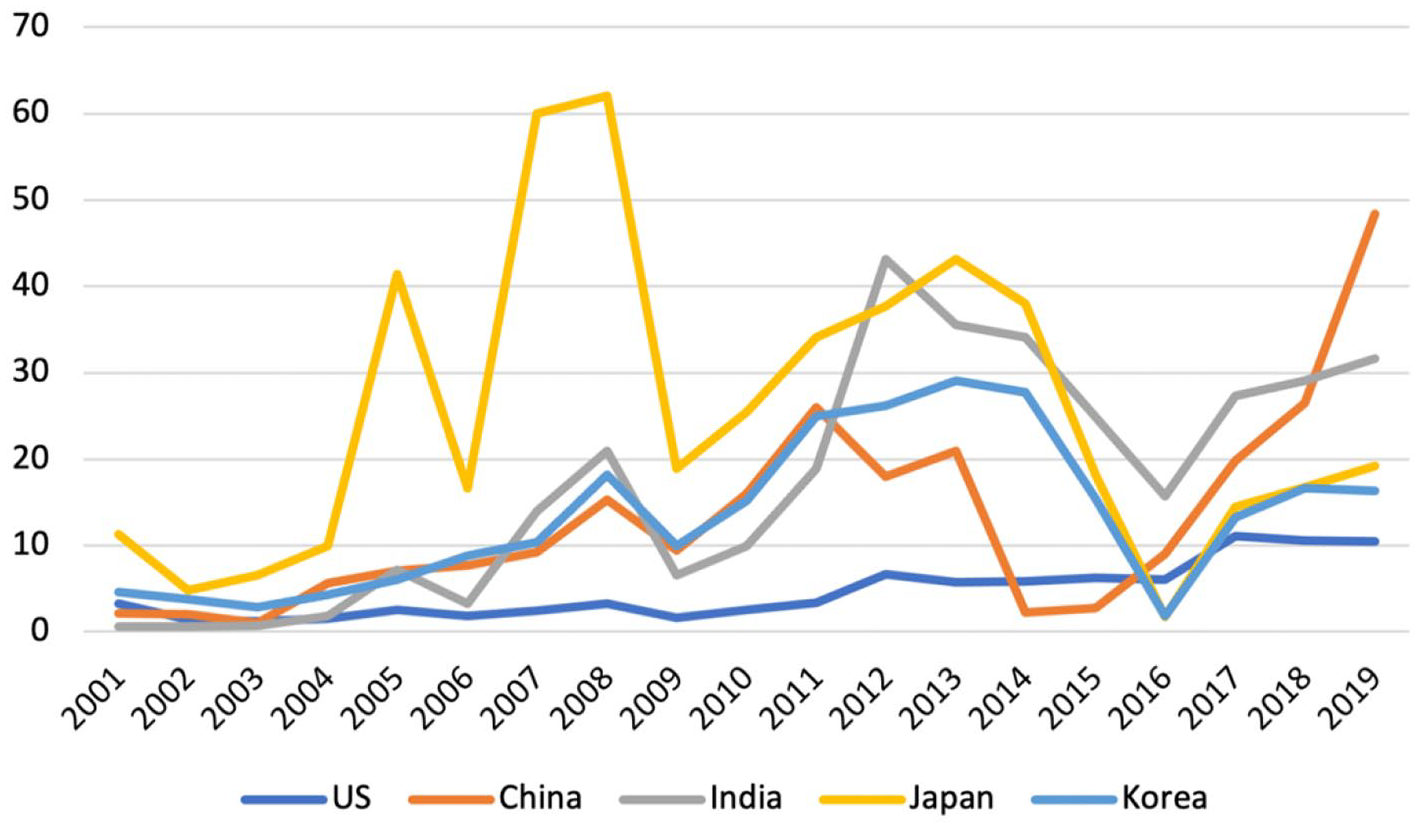
GCC countries’ exports to the United States and Asian countries (US$, billion).
As presented in Figure 2, while the oil exports of the GCC countries to North America have decreased, their exports to Asia and the Pacific have been relatively higher than to North America (increased from 2012 to 2019). Considering that GCC countries are oil exporters, it is possible to indicate an axis shift in GCC-US oil trade towards Asia.
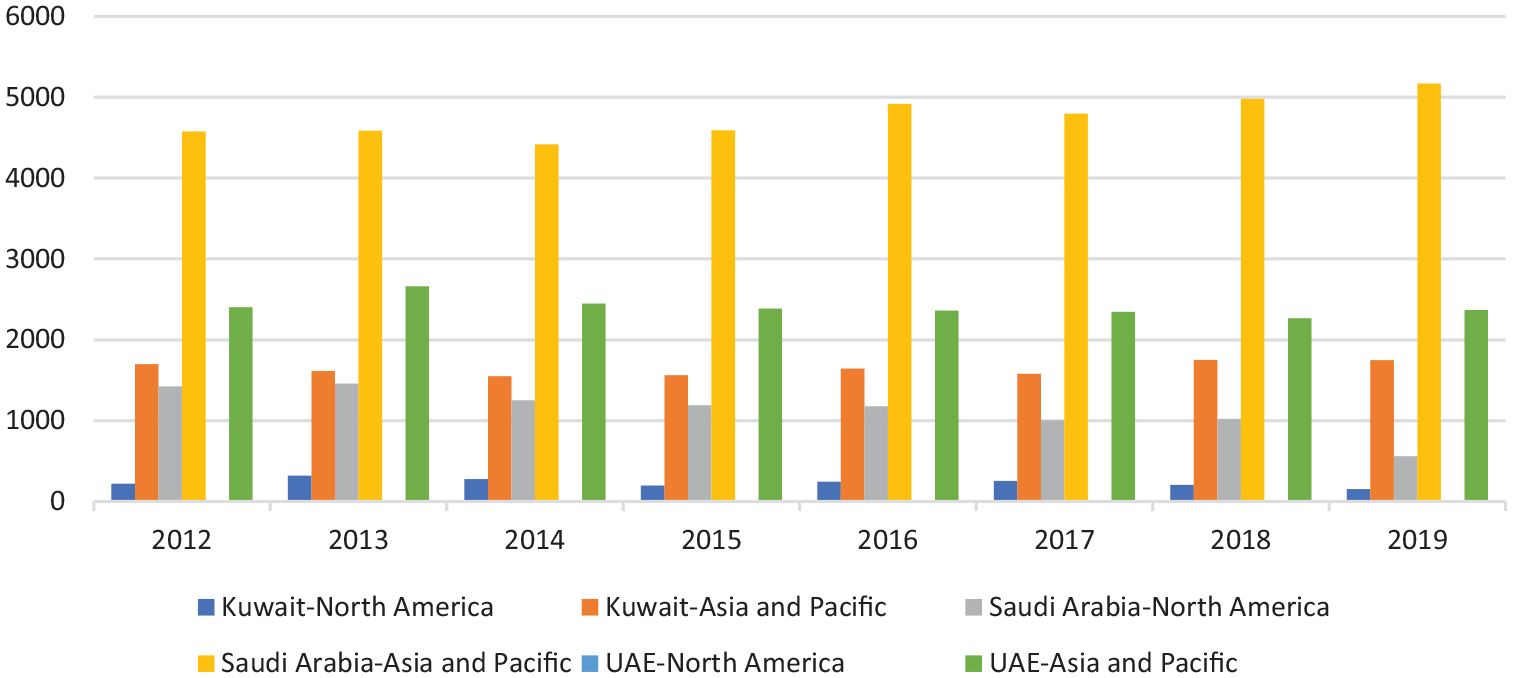
OPEC member GCC countries’ crude oil exports to North America and Asia-Pacific (1000 barrels per day).
Less oil dependence
The trade balance between GCC countries and the United States has begun to change as the United States has become self-sufficient in energy. This change in trade balance has brought the GCC-Asian countries closer in terms of trade and investment. However, most of this imbalance or axis shift occurred in the GCC export rather than mutual trade. To support this argument, it is essential to examine the US-GCC trade, which mainly depends on the US export to the GCC countries.
As for trade imbalances between the GCC and the United States, Figure 3 shows that the United States’ exports to the GCC countries have increased rapidly since the early 2000s while its imports from the GCC countries have remained relatively stable. The majority of the United States’ exports to GCC countries are vehicles, aircraft, machinery, arms, ammunition and parts related to military security. The trade balance between the GCC and the United States has further increased, especially after the United States has reached a sufficient level in energy. Thus, the increase in the trade imbalances between the GCC countries and the United States is due to the energy production of the United States and the increase in the military expenditures of the GCC countries in response to the regional instabilities over the years. Thus, this has urged GCC countries to find new trade partners to which they could export their natural resources, but their dependence on the United States in terms of military and security remained intact.
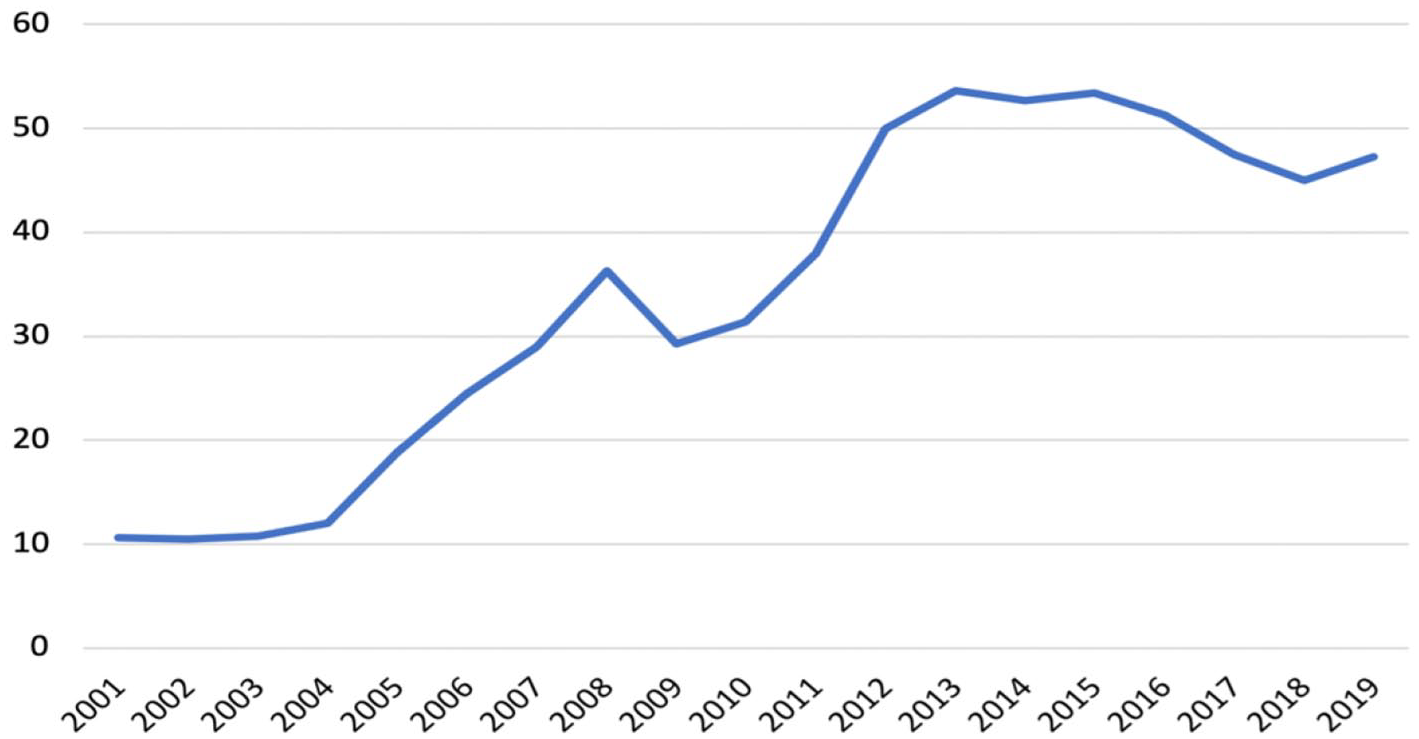
US exports to the GCC (US$, billion).
The transition of interdependence between the GCC countries and the United States towards a unilateral dependency can be related to energy production and consumption in the United States. Figure 4 presents that the energy production of the United States has started to increase after 2007 so that the United States’ external dependency on energy is reduced. Therefore, there has been a decline in trade with oil-rich GCC countries, which affected GCC countries’ oil exports. The crude oil import of the United States from the GCC in 2020 was around a similar level as that of 1973. Both sides have a credible position in the global oil market: while the United States is the most oil producer country globally, GCC countries hold almost half of the world proved crude oil reserves (EIA, 2021a). Moreover, Figure 4 shows, there is a gap between the production and consumption of GCC countries. This gap requires the search for new trade partners on the part of GCC countries. As presented in Figure 1, this process led to a new trade and investment partnership between the GCC and Asian countries. However, GCC countries continue to depend on the United States in terms of military and security, and interdependence has turned into a sort of unilateral dependency.
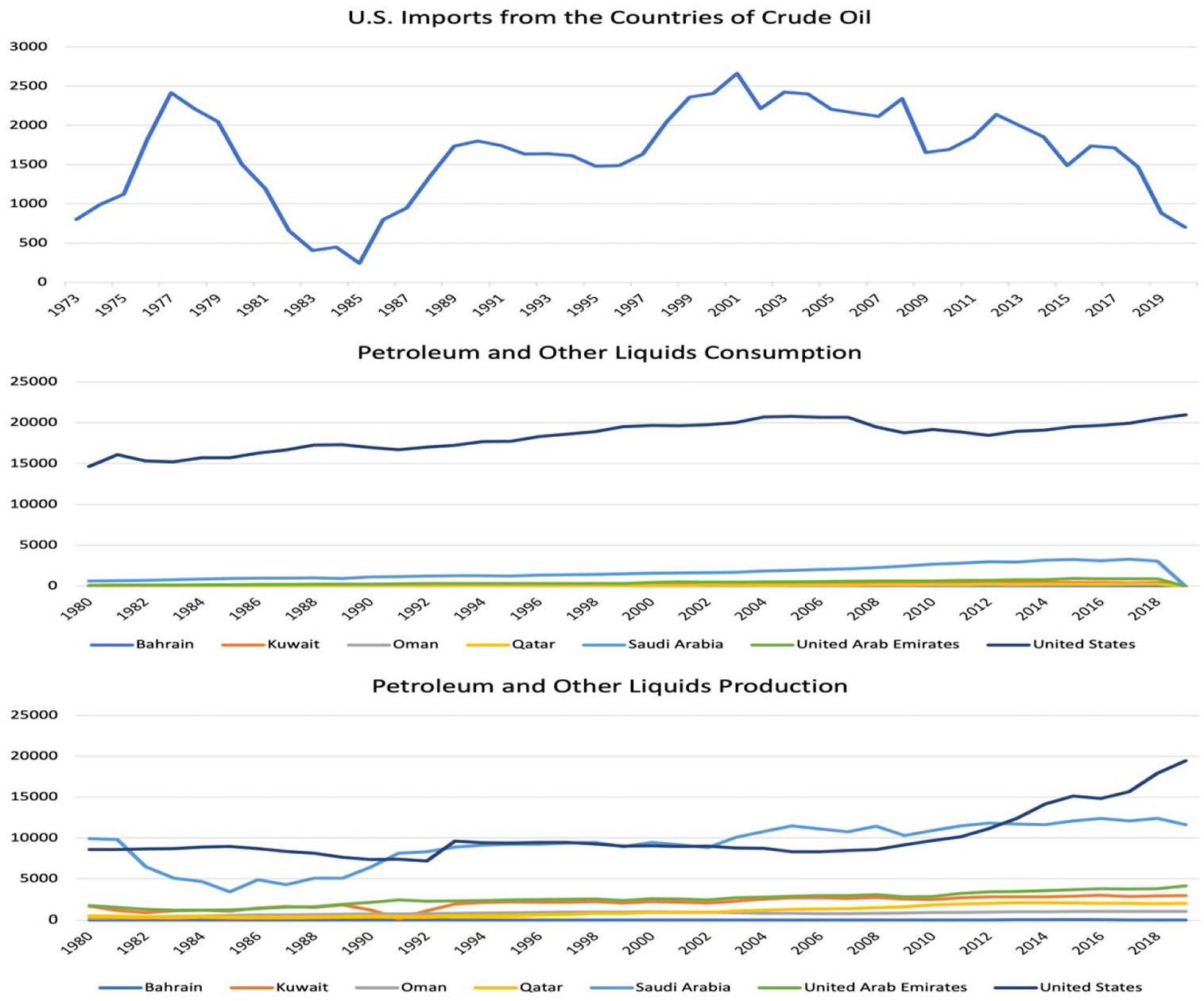
Total petroleum and other liquids productions and consumptions (1000 barrels per day).
More arms trade
The United States is the largest arms supplier for the GCC countries. In addition, the United States has several military bases across the Gulf to ensure the region’s security. Although the United States has remained a security provider in the Gulf region since the 1950s, its real impact accelerated after the 1960s following the withdrawal of the British power from the region. This role can also be seen in military exports to the region. As stated earlier, while exports of GCC countries to the United States have declined, US export to the region has increased over time, and interdependency has turned into a unilateral dependency.
According to Figure 5, in the last two decades, the United States exported 61% of Saudi Arabia’s military equipment needs, amounting to a total of US$29.25 million. This is followed by a UK supply of 18%. In the United Arab Emirates (UAE), the second-largest country in military spending in the GCC, 56% of military equipment imports come from the United States and amount to US$20,121 million. France ranks second with a share of 28%. In Qatar, whose spending on military equipment reached US$5979 million in the last 20 years, 53% were imported from the United States. France ranks second with a rate of 31%. As shown in Figure 5, there seems to be a US hegemony over the region in terms of military equipment, for supplies over half of the total army equipment needs of the GCC countries.
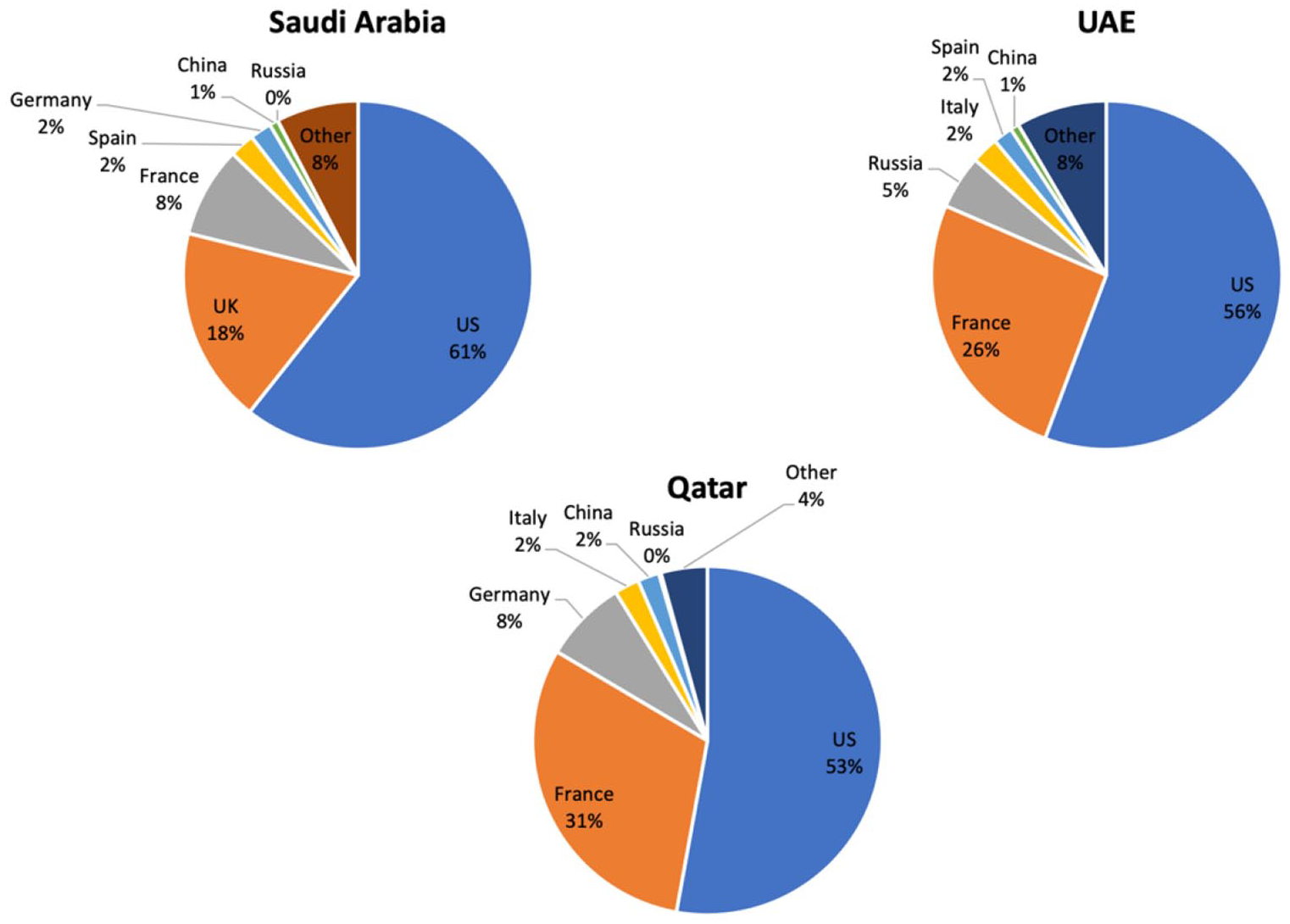
Share of total arms imports in the top three GCC counties (2000–2019).
Looking at the US hegemony in the region in detail, Table 1 presents that there has been a dramatic increase in US exports to the region since 1950. Primarily, it can be seen that Saudi Arabia is the biggest importer in every period. In the 1970s, it can be stated that other GCC countries, except Qatar and Bahrain, imported military equipment mainly from the United States. By the 1980s, this import steeped further. In the 1990s, with the reflection of the Gulf War, military equipment imports in the region started to rise rapidly. As for the 2010s, it increased to the highest level with the Arab Spring. According to the economic relationship between the United States and the GCC countries, some historical facts are found. First, American oil dependency on GCC countries decreased. Second, oil exports of the GCC countries have become highly connected with Asian counties. Finally, GCC countries still rely on the military power of the United States. Do those facts lead to a new discussion on the dependency of GCC countries over the United States? Should they be interpreted in view of the interdependency theory? Does theory still work?
US arms sales to the GCC countries (millions of dollars).
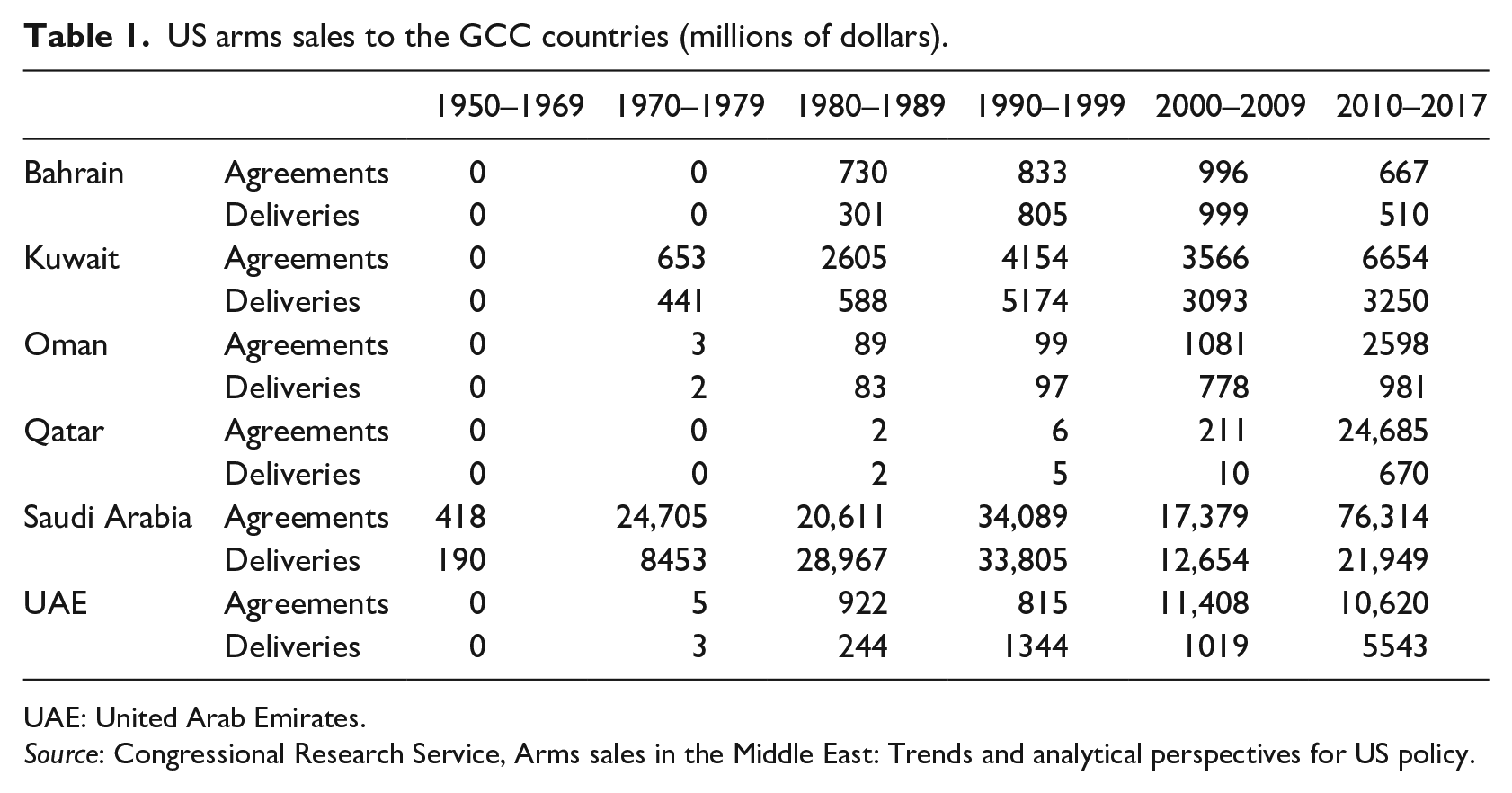
UAE: United Arab Emirates.
Source: Congressional Research Service, Arms sales in the Middle East: Trends and analytical perspectives for US policy.
Discussion
The US interests in the region rapidly evolved when the United Kingdom had declared its withdrawal from the region (Sato, 2017). During the time, high-level US oil dependency on the region was balanced in terms of the GCC’s dependence on the United States’ world hegemony. However, the oil embargoes in 1973 showed that the economic dependency of the United States on foreign sources makes the United States more vulnerable to foreign powers. On one hand, oil was the definer of the macroeconomic structure of the world (Barsky and Lutz, 2004). On the other hand, the United States is responsible for most of the global market products (Litan, 2000). This made the US dependent on the GCC countries and vulnerable against them during the bargaining process. The embargoes were a symbol of economic coercion against the United States.
Since the US policymakers realised the danger of dependency, it became the central theme of US oil policies. The Nixon administration emphasised the risk of dependence on other countries in 1974 (Nixon, 1974). President Carter took a further step with Carter Doctrine in 1980 (Carter, 1980). He noted that the United States would not hesitate to use military force to defend its national interests in the GCC countries and to ensure the free flow of Middle Eastern oil to the global market. It is now time to ask a question against complex interdependency that did the United States attempt to follow ‘power with’ or ‘power over’ policies (Slaughter, 2017: 163). As members of Organization of the Petroleum Exporting Countries (OPEC), GCC countries used oil as a weapon to follow economic coercion policies, but the United States did react with military and political coercion. Political decisions of countries differ in oil-market economics (Claes, 2001). Similarly, Bill Clinton emphasised the need to ‘deter threats to the free flow of Middle East oil’ in his administration’s National Strategy for a Global Age report (The White House, 2000). The definition of deterring threats was ambiguous. Such an emphasis did not only stay in the rhetoric but also found a material match, the Iraq War of 2003. By that time, the United States became ‘addicted to oil’ (NYT, 2006), and dependency on Middle Eastern oil should have been made ‘a thing of the past’ for the George W. Bush administration (The White House, 2006).
Liberal interdependency theory is based on sovereign powers assumptions (Beran, 1984). When all countries are sovereign, they can enter a bargaining process as equal powers despite power asymmetries. Moreover, if the US economy was highly dependent on oil imports, the United States would be vulnerable, not only dependent. However, states are not composed of only economic dynamics. The interactions of states cannot be reduced to solely economic commodities. Here, we face the reality of big and small states. The danger that small states could pose against great powers would always be limited because great powers can shape regional and global dynamics, a point that liberal theory misses (Keohane, 2009). There is not only a power asymmetry between big and small states because great powers can be game-changers. The game here includes both economic and political dynamics. On one hand, the United States has been the definer of global political dynamics since the roughly early Cold War era (Keohane, 1991). On the other hand, although the United States has been the centre of the transnational market, it depended on foreign oil sources. The United States and its allies (i.e. the European Union (EU) and Japan) were dependent on the oil supplied by the GCC countries. 71% of Japan’s oil imports came from the Middle East in 1970 (Licklider, 1988). By 1973, 80% of European and Japanese oil imports originated from the Gulf or North Africa (Toprani, 2019). The United States has been the hegemonic power over the GCC countries in terms of political, economic and military aspects. It has even led to reshaping the regions (Bromley, 2008). The national and energy security of its allies are also under the consideration of US policymakers.
This section has so far evaluated the interdependency and small and great powers arguments. But now, it is important to look at the dual logic. While the United States bargains with its (in)capabilities, it can create transnational and hegemonic pressure on other countries. The first one can be seen in embargoes against Iran, while the second can be seen in the Iraq War of 2003. Bargaining is only for survival in the case of small states. Since the 1973 crisis, the United States has looked for ways to sustain its energy independence to remove vulnerability against GCC countries, but it cannot simply be reduced for strengthening hand. The attempt also includes an aim for dominance. When the United States achieved an unplanned shale oil and gas revolution (Altiparmak, 2021), US policymakers quickly declared ‘energy dominancy’ (The White House, 2019). It historically reflects the globalisation of the US national interest (Stokes, 2018). Therefore, bargaining for hegemonic powers involves more than a survival objective.
GCC countries sell their oil to the countries in need of it mostly. China, as a rising great power, is the leading importer from the region. Oil necessity for the Chinese economy is the most important factor, but Chinese attempts can also be interpreted as increasing the interaction with the region. Oil into the transnational market is the priority of the United States, as the centre of the transnational market. Free trade principles in the economic market are supported. However, GCC countries are expected to continuously depend on US military and diplomacy. Thus, it is not a process that absorbs economic interdependency that leads to political interdependency. Instead, there is bargaining at the vertical level.
Although the complex interdependence argument suggests a difference between sensitivity and vulnerability to consider states’ powers impact on mutual trade, the global political-economic structure involves more than an asymmetrical power relationship. The United States is not only a big power but also a hegemonic one. What oil means for the United States is more than an import or an economic commodity. Thus, sacrificing the flow of oil into the global market can be the only matter for the United States. For example, the continued use of the dollar is the key for dollar hegemony (Stokes, 2005), which is still supported by the oil trade (Bromley, 2008). The positive trend in the GCC-Asian countries should be interpreted according to the role of the United States. The US hegemonic system would not complain about such a trade relationship as long as it does not undermine the US role because it contributes to a free global trade structure.
Conclusion
This study presented that economic interdependence between the GCC countries and the United States is not only composed of sensitivity and vulnerability against each other. The economic relationship between GCC countries and the United States has increased, reaching billions of dollars with oil and military equipment. However, due to the recent shale revolution and the emergence of alternative-environment friendly energy supplies in the United States, the GCC’s tendency to raise its trade with the Asian countries gave rise to a new partnership era. The study suggested that the motivations and results of the historical interdependence between the GCC countries and the United States have been based on US hegemony. Although the US oil dependency on the region decreased over time, oil flow into the global market would still make US policymakers content insofar as the relationship between GCC countries and Asian countries does not bolster political alliance. In this regard, delving into the transformation of the trade tendencies, the GCC’s rising ties with the Asian countries and the nexus of oil for arms are two central points.
This study filled some gaps in the literature. The relationship between the United States and GCC countries has been investigated in line with the complex independence theory. However, finding an extreme ‘asymmetry’ between two sides has pushed consider over small and big states. Moreover, some sectors (e.g. oil and arms), which have transnational corporation power, require investigations in relation to their hegemonic role. Thus, complex independence is more than economic relations.
First, these gaps have been filled with the idea of vertical power asymmetry rather than sovereign (i.e. horizontal) but unequal powers. Bargaining carries different aims for different powers. Second, a historical trend of arm and oil sales between GCC countries and the United States has been provided. Liberal and realist theories explain the assumptions rather than historical development or change. This work has argued that despite the historical shift in trade trend, the hegemonic power is still satisfied with the continuation of free-market understanding and its political authority. However, this study has not uncovered the historical change incorporation power of some sectors. The historical trend in trades has only been looked at through a unitary state understanding.
Footnotes
Declaration of conflicting interests
The author(s) declared no potential conflicts of interest with respect to the research, authorship and/or publication of this article.
Funding
The author(s) disclosed receipt of the following financial support for the research, authorship, and/or publication of this article: Open access funding was provided by Durham University.
