




Abstract
This paper argues that for any community transformation to be achieved, cultural values and legal frameworks, which influence issues relating to land rights and food security, must form an integral part of any policy intervention efforts. We adopted feminism as both a methodological and an analytical framework. The dominant research paradigm was qualitative. The study sample was 184 people obtained using a systematic sampling method. Data collection was through focus groups and interviews. We challenge contemporary development initiatives, in terms of their intentions and sustainability. Finally, it is important that any development initiatives facilitate the participation and involvement of all genders.
Introduction
Climate change is now more than ever a concern to development practitioners, as its effects are more physically suffered by poor people, especially those in developing countries (Conway and Schipper, 2011; Kurukulasuriya and Rosenthak, 2003; Schlenker and Lobell, 2014). Bryan et al. (2013) posit that the international community is faced with great challenges in the coming decades which include meeting the growing food demands and promoting sustainable development. It is undeniable that a myriad of literature addresses climate change and food security issues in developing countries (Ebhuoma and Simatele, 2017, 2019; Simatele and Simatele, 2015). However, there is a general lack of work tailored towards understanding the relationship among rural households’ adaptation strategies to climate change, food security and land rights. This paper questions the dynamics around land rights and how these determine food security in changing climates. We also explore power-relations and gender roles, vis-à-vis secure land rights, to contextualize how they affect development efforts aimed at securing food and livelihood sources. Imperative to note is that land in Kenya is majorly controlled and owned by men, and women’s access is through male relatives (Musangi, 2017; Smith et al., 2008).
Even though relevant legislations explicitly prohibit sex or gender-based discrimination in relation to land in Kenya, they are scarcely implemented in rural areas (Cotula et al., 2006; Mwagae, 2013; Smith et al., 2008). It is undeniable that women play a major role in providing agricultural labor, of which Prosterman (2013) estimates women’s labor at 43% in developing countries. However, it is not the endeavor of this paper to highlight one gender as currently providing food for the household more than the other, but to explore the possibility that enhancing women’s access to land as the capital of production could increase the chances of rural households’ food security. We also discuss the relevance of development initiatives, intentionally taking into consideration local context, time and space in achieving true community transformation. What we aim to do in this paper is to steer away from the tendency of modern development paradigms to generalize socio-economic issues in Africa and disregard pre-existing paradigms of social engagements. We seek to contextualize the issues under study because of the conviction that by doing otherwise, solutions to socio-economic issues will only continue to perpetuate ‘gender wars’ and food insecurity in the face of a changing climate.
Contextualizing the literature: from the global to the local
Existing evidence suggests that climate change and variability pose a real threat to food production and availability and extends the same to accessibility (Bryan et al., 2013; Chauvin et al., 2012; Food and Agriculture Organization of the United Nations (FAO), 2015a, 2015b; Phiri, 2014; Ringler et al., 2010). Rural households in Kenya and specifically Western Kenya depend on agriculture as the major source of livelihood and also derive alternative livelihoods from it (Alila and Atieno, 2016; Erick et al., 2019; Valbuena et al., 2015). In addition to challenges associated with climatic changes, women in many rural parts of Kenya have to deal with insecure land rights to a resource that ideally would serve as a basis for attaining food security.
It seemingly appears that prevailing discourses have succeeded in portraying climate change and variability as a gender-neutral issue. The persistence of this discourse is tantamount to ignoring the elephant in the room, because climate change has substantial gender dimensions to it (Denton, 2002; Jerneck, 2018; MacGregor, 2010; Sultana, 2014; Tibesigwa et al., 2015). In fact, as Sultana (2014) argues, it seems undeniable that the majority of policy discourses and debates, as well as academic writing on climate change, have been largely ungendered. Yet the impacts of climate change are acutely felt along gender lines, and adaptation to climate change is a gendered process. However, the paucity of hard evidence on gender and climate change makes it hard for practitioners to discern the many complex links, especially in the context of land rights. It is notable in the literature that if gender is mentioned at all as a climate-change issue, it is usually generally concerning the particular vulnerability of poor women in the south (Rao et al., 2019; Terry, 2009). This reality is echoed by MacGregor (2010) who observes that whereas the concepts of class, poverty and race make regular appearances in social scientific analyses of global climate change, the same cannot be said for gender.
When discussing climate change and gender, one cannot ignore the aspect of power-relations. Denton (2002) queries: ‘(W)hat have unequal power between women and men, and global inequality, got to do with an environmental crisis as monumental as the possible negative impacts of climate change?’ This question may seem trivial but it appears to challenge institutions and decision-makers, especially in sensitive sectors such as that of food security. Inequality in its effects is a distinct feature of climate change and variability; mainly because climate change tends to reflect and exacerbate the world’s worst inequalities, as argued by Wonders and Danner (2015). These inequalities include those akin to gender. Culturally, women are predominantly tasked with producing food for households and livelihoods from within and without the farmlands (Quisumbing et al., 1996; Ugwu, 2019). Therefore, any additional pressure on resources as a result of climatic changes makes fulfilling agricultural tasks difficult (Rounsevell et al., 1999). This is compounded by the fact that 70% of the world’s poor are women (FAO, 2011; Marcoux, 2006; National Institute of Statistics of Rwanda (NISR), Ministry of Agriculture and Animal Resources (MINAGRI) and World Food Programme (WFP), 2016; Prosterman, 2013). The importance of gender in tackling matters of climate change on food security is that even though women are disproportionately affected by climate change, they serve a critical role in adaptation (Van Aelst and Holvoet, 2016; Ziervogel and Ericksen, 2010). For instance, women are considered custodians of indigenous knowledge that is critical for sustainable adaptation to climate change (Aluko, 2018; Songok et al., 2011). Despite this, women, especially those in agriculture-dependent areas such as Western Kenya, face constraints in terms of access to capital for production, relevant training, and technology, among others (Aberman et al., 2015; Bryan et al., 2013; Perez et al., 2015). On the same note, it is imperative to consider that with gender-based differences come gendered power-relational issues that make worse the vulnerabilities induced by changes in climate (Reed et al., 2014; Sultana, 2014). Sultana (2014) is of the view that there is a possibility that emerging adaptation programs are also influenced by gender dynamics and complicated by gendered power-relations.
In rural Kenya, women are involved in agriculture as farmers on their own account, as unremunerated workers on family lands, and as paid or unpaid laborers on other lands (Alila and Atieno, 2016; Diiro et al., 2018; Wanjala and Were, 2009). They are also involved in petty trade of agricultural produce to earn an income for their families’ subsistence (Mehra and Rojas, 2008; Misango and Ongiti, 2013). Kenya has made progressive steps towards advancing women’s rights to property and land, specifically through putting in place appropriate legislation (Kameri-Mbote and Muriungi, 2018; Landesa, 2014; Musangi, 2017). Despite this development, women still face challenges in terms of access to land, exposing them and their dependents to disease, malnutrition and other impacts of climate change. According to Whitehead and Tsikata (2003), historically, Kenya’s land laws were developed against a customary law system that limited women’s rights to access or use, giving men absolute power over ownership and control. The extent to which these rights were limited with regard to access is an issue that is clarified by this paper through its findings. Kameri-Mbote and Muriungi (2018) estimate that only a paltry 1% of women in Kenya are sole registered owners of land and only 5% of women are registered owners of land jointly with their husbands.
Munala (1995) and Karanja (1991) make a comparison that describes gender differences in land ownership and control within three periods; pre-colonial, colonial and post-independence in Western Kenya. In the pre-colonial era, women dominated the economy at both the production and the distribution level in a system where family and kinship units owned and controlled the use of land. During this period, land tenure was vested in men, with women receiving their rights to use the land for agricultural purposes through their relationship to a man. Munala (1995) further argues that in pre-colonial times, women, through such relationships, would automatically have access to and control over land. This gave the women enviable authority to participate in economic activities on a wider scale.
The land was passed down through generations in patrilineal succession in a patrilocal sense, meaning that it was done through permanent members (men) of the family (Karanja, 1991; Munala, 1995). However, it was expected that a woman would hold land in trust for the benefit of her male children when their father dies until they became of age (Karanja, 1991; Munala, 1995). It is imperative to note that due to a lack of differentiation and diversification in the pre-colonial economy, the land was not seen as a negotiable object of trade. Munala (1995) notes that the changes brought about by the colonial period deprived women of their traditional control over land. Colonization labor facilitative laws largely targeted men for labor on cash crops farms away from their ancestral homes, leaving their homes in the hands of women. Registration and titling of land that came with this period further sealed the fate of women’s control over land as an economic tool. The titleholders were mostly men, which negatively affected women. The colonial period, therefore, not only altered property relations as they had previously existed, but also failed to provide facilitative services through the legal institutions which could give rise to incentives to women to acquire property (Munala, 1995). This situation and other obtaining situations such as increased population and climate change continue to influence how land and property are dealt with to this day.
Karanja (1991) observes that the land gives both men and women identity, that is more so social. During the pre-colonial period, men and women in Western Kenya had divided roles that ensured households were food-secure (Munala, 1995). There was also a sense of community in the way households dealt with matters of food security which is different from the post-colonial times. The spirit of collectivism of the pre-colonial era could not survive with the genesis of capitalism that came along with colonialism and post-colonialism.
In fact, nowadays, rural women work lands outside their farmlands for wages to support their families, including providing food. They rarely help each other in their farming spaces as they used to, because of individualism. This situation is made clearer by Rodney (1973) who argues that when individualism was applied to land through private ownership, it came with a new understanding that individual labor should benefit the person concerned and not some wider collective, such as the clan or ethnic group. He further notes that with this new unfolding way of life, superficially, it appeared that individualism brought progress (Rodney, 1973). On the contrary, Bondarenko (2014), asserts that Africans did not know private property in the politico-economic sense, but believed that the land belonged to their ancestors. Due to this, Africans were certain of their specific, but not proprietary, relations with the land: the people and the land were perceived as in essence non-alienable from each other, as far as the living formed an indissoluble unity with the spirits of their ancestors (Bondarenko, 2014).
In the context of the above observations, it makes sense to reference Marx’s metabolic rift theory to understand capitalism and its effects on food security and the disempowerment of women. The theory helps to analyze and synthesize how human interactions with nature, and within the broader ecosystem, can trigger environmental degradation and reduce agricultural productive, if not effectively managed (Clark and York, 2005; Foster, 1999; Moore, 2017). Foster (1999) argues that ecological sustainability has limited practical relevance to capitalist society as it is oriented towards the most immediate monetary profits. Foster (1999) draws this view from Marx (1863–1865) who articulates that the spirit of capitalism is in contradiction to (sustainable) agriculture, which must concern itself with the whole gamut of permanent conditions of life required by the chain of successive generations. As profit-oriented agriculture continues to contribute to environmental degradation – through, for instance, supplementary use of fertilizers which reduce soil fertility (Foster, 1999) – women’s secure access to fertile land for agricultural use is jeopardized (Ndiritu et al., 2014).
The status of women’s land rights and food security in Kenya
Kenya has made progressive steps towards addressing matters of gender equality, particularly on land rights. The supreme law, the Constitution of Kenya, 2010, has gone to great lengths to prescribe the rights of both men and women to land. Foremost, Article 60 (f) of the Constitution calls for the elimination of any form of discrimination based on gender in law, customs and practices related to land and property in land (Government of Kenya, 2010). The Matrimonial Property Act of 2013 (Government of Kenya, 2013) safeguards the matrimonial home from any kind of disposal without the consent of the wife (or wives) and children. Article 68 of the Matrimonial Property Act 2013 further recognizes the matrimonial property including land both during and after the dissolution of marriage. Furthermore, Section 11 of the Matrimonial Property Act 2013 makes provision on how property such as land is to be dealt with during the division of matrimonial property. This Act directs that the use of customary law should be in tandem with the principles of the Constitution of Kenya, 2010, including that which involves ancestral land.
In a bid to secure matrimonial property, Section 79 (3) of the Land Act 2012 (Government of Kenya, 2012) provides that such property cannot be disposed of by a registered owner short of the consent or knowledge of the other spouse. The Law of Succession Act, Cap. 160 safeguards the inheritance rights of women to land in the case where the death of a father or husband has occurred. The aforementioned legal frameworks paint a picture of how the country endeavors to deal with matters of land and property from a gender perspective. A cursory look at the Kenyan legal framework for land would easily lead anyone to think that with such progressive laws, rural households would be sustainably food secure, which it is not. Despite the close link between women’s land rights and food security, women in Kenya have barely enjoyed land rights given the gendered nature of access, control and ownership, where such access and use is mediated by patriarchal customary laws (Kameri-Mbote and Muriungi, 2018). The reality is that all matters of land are still addressed through dual lenses; that is, customary laws and contemporary law (Benbih and Katz, 2014; Rurii and Smith, 2010).
Methodology and philosophical approach
This paper adopted feminism as both a methodological and an analytical framework as it provides a lens to explore how changes in social inequality can happen by removing power imbalances and looking at different standpoints and experiences of women in different settings. Feminism as an approach guided the methodology used and had the ‘political aim of creating emancipatory knowledge’, as Reinharz and Davidman (1992) assert. The dominant research paradigm that was employed was qualitative and framework analysis as well as an inductive approach which was used to make sense of the data. However, quantitative techniques were also used to analyze and establish specific correlations in the variables studied. The quantitative aspect was useful in describing certain measurable aspects of women’s experiences, in areas such as the number of women who own land.
Four study sites based on social-economic indicators were purposely selected: Malaha-Isongo-Makunga and East Wanga, both in Mumias East Sub-County, and Namamali and Khalaba in Matungu Sub-County. These are all in Kakamega County in Western Kenya. A total of 384 research participants were drawn from across the study sites using a systematic random sampling method.
The sample size 384 was obtained using the adjusted sample size formula, based on the target population of 114, 693 (County Government of Kakamega Website, 2018). The following procedure was used:
Formula
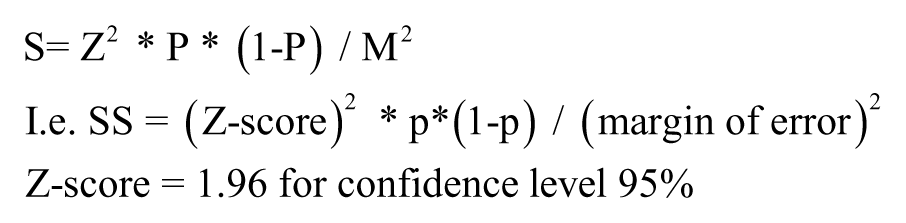
Proportion p is your expected outcome. If you do not have any idea about the proportion, you can take 0.5. This will maximize your sample (CheckMarket, 2019).
Therefore:
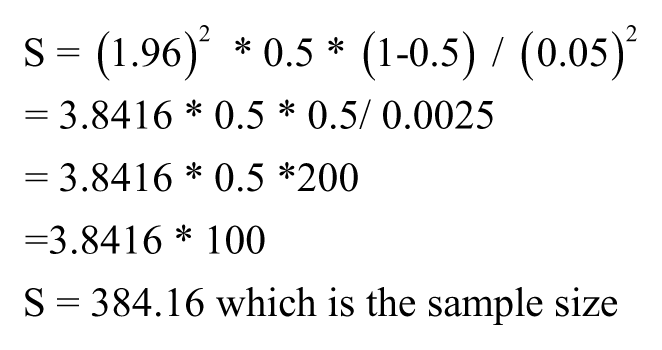
Further, the study sought to obtain an adjusted sample for the target population of 114, 693 with the following procedure:
Formula
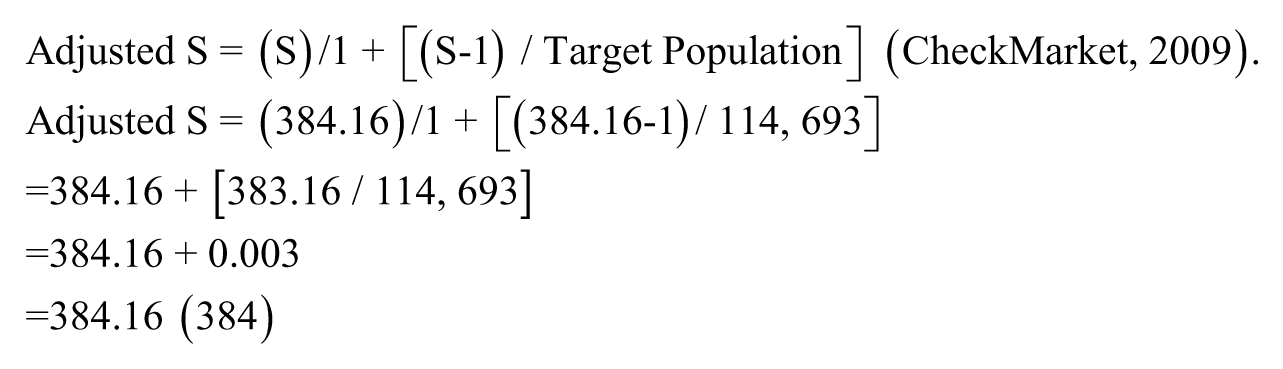
Therefore, the adjusted sample size according to the target population of the study is 384.
It was important to include both men and women in as much as the study embraced feminism, as a lens to explore how the change in social inequality can happen by removing power imbalances. This study explored how gender differences continue to perpetuate discrimination, in turn prejudicing women’s access to capital of production for food security. Understanding the perspectives of men was important as women’s vulnerabilities are fueled by a largely patriarchal society (Onwutuebe, 2019; Sikweyiya et al., 2020).
To achieve a gender-sensitive sample size, the study utilized the county’s gender-based percentages provided by the Kenya National Bureau of Statistics (KNBS); that is, 48% of the total population of the county are males and 52% are women (County Government of Kakamega, 2013). Therefore, to determine the number of men to be included in the study the following calculation was performed: 48/100 * 384 = 184.
A systematic random sampling method was then deployed to identify and select the research participants. An interval ratio of 2 was calculated by dividing the target population by the 2 study samples of 184 and 236 respectively. The first research participant was purposely selected and the interval of 2 was applied to identify and select subsequent research participants. In addition to grassroots interviews, a total of three focus group discussions were held, each comprising about eight people. To obtain the gender ratios, it was purposely decided to include three male participants in each of the groups. Furthermore, 21 interviews were conducted with key informants drawn from various government departments and traditional governance structures. These included: the Ministry of Land and Physical Planning, Ministry of Agriculture and Irrigation, Judiciary, Sub-County Land Boards, Assistant Chiefs and Village Elders. Four non-governmental organizations (NGOs) working in rural Western Kenya participated in community workshops.
Results and discussion
The Government of Kenya has enacted laws and made policies available to guide matters of land, agriculture and the environment. Nevertheless, the implementation of such a progressive legal framework leaves a lot to be desired in terms of justice in land administration, sustainable food production and utilization systems, especially for rural households. At the back of the progressive legal framework, we cannot ignore the influence that culture has on how households and communities deal with matters of land and food security, even in the face of the impacts of climate change.
Perceptions about the relationship between food security and land rights
From the empirical evidence collected in the field, it was apparent that both men and women in the study sites placed a lot of value on land as a resource. In this case, the importance was demonstrated by describing what land means to them. These include land as a pivotal source of livelihood, security and social status, a source of power, a resource for basic needs, inheritance and a transferable asset, and the main source of food. A woman aged between 30 and 40 years, for example, pointed out during a focus group discussion that ‘(i)f I do not cultivate the land and take care of animals, my family will have no resources to meet every day needs. We depend on land for everything’ (interview, Khalaba Ward, Western Kenya, 27 May 2018).
In support of the above argument, another woman, aged between 40 and 50 years, stated: Land gives life . . . the produce that comes out of my land is sold to meet the needs of my children such as school fees. There are times when times are tough and I have had to take maize that I have harvested in exchange for school fees. (Interview during focus group discussion, Namamali Ward, Western Kenya, 15 April 2018)
Secure availability of the capital of production for food security was a sensitive issue to discuss as there were dissenting views, as were orthodox views on rights that various legal frameworks provide. Prosterman (2013) explains that securing women’s access to land would allow the women to focus on production rather than to continue using the land out of fear of being deprived of longer-term access if the land is even temporarily unused. With this in mind, it was interesting that this study observed that unlike popular perceptions (Heinrich Böll Foundation – Africa, 1996; Kameri-Mbote, 2015; Ugwu, 2019) that women should own and control land as a resource, this was not the case among some women in the study sites. There were women who could demonstrate secure livelihoods and food sources within their households without owning or controlling land. This study had to juxtapose this reality against popular development approaches that espouse the empowerment of women through land ownership and control for food security. It was imperative to look further and understand how these women achieved food security in an environment that has been branded patriarchal and less sensitive to women’s needs. More than one woman described how they have managed to live with patriarchy and provide food and other needs to their families. A female respondent in her late fifties pointed out the following: My husband works away from home and whenever he comes around, he sees how well I manage our farm without his active input. The proceeds from this farm pay for our children’s needs . . . he trusts me, but this trust has been built over time. (Interview during focus group discussion, Namamali Ward, Western Kenya, 29 April 2018)
This view was shared by another female respondent, who stated: I sell wares at the local market and the proceeds have allowed my husband and I to own our 2 acres of land away from his ancestral land. He, therefore, respects me for that but even though the land title is in his name; I do not have to seek permission to use the land. (Interview during focus group discussion, East Wanga Ward, Western Kenya, 16 April 2018)
However, she was oblivious to the reality that the husband could dispose of the land without her approval, due to the nature of the title. Even with contestation, she might lose many resources in doing so as judicial processes are expensive and time-consuming.
Despite the back and forth during discussions on gendered-land rights, it was evident that both men and women agreed to the fact that women should have secure access to land for the sake of food-secure households. Ownership, as prescribed by law, might take a long time to be an agreeable issue between the genders. The demonization of African culture that misrepresents the patrilineal way of life should be challenged by an approach that seeks to understand why the land was owned by men. It is important to interrogate what culture prescribed concerning land ownership before capitalism and post-colonialism. One elderly male respondent attempted to explain this situation during a focus group discussion: The population has increased while the size of land has remained the same meaning that even the boy children have to make do with the dwindling resource. Now, if the girl child also claims their right, there is bound to be conflict. This situation is made worse with individualization of tenure where everyone is looking for a title deed. (Interview, Khalaba Ward, Western Kenya, 27 May 2018)
On that note, the discussion on seeking livelihood sources outside the farm using farm produce became relevant. There exist cooperative groups and informal self-help groups where women have sought to build their numbers and resources to uplift each other socio-economically. Development agencies such as NGOs have often used these entities as avenues to implement their projects, which the respondents did not describe as sustainable. The critical error that these organizations make is not to involve the men who are landowners right from the initiation of the projects. One male respondent during a focus group discussion quipped: These NGOs come here with grand ideas that they feed to our women without involving us . . . they cause conflict in our households because the women tell us how they have rights over our parcels of land . . . these women are visitors in our ancestral homes (Pers.Com 2018f: Interview with a male respondent during a focus group discussion in Malaha-Isongo-Makunga Ward on 19th May, 2018 in Western Kenya). Another male farmer in a focus group quipped: (T)hese NGO people come here to train and equip our women on food security issues but they forget that these local women do not own land here . . . why don’t they involve us from the beginning? Why don’t you want to invite us to these training sessions? You are talking of women empowerment but in the real sense, you are breaking our norms . . . toughening our women’s heads . . . they even stop listening to our instructions. (Pers.Com 2018g: Interview with a male farmer during a focus group discussion in Namamali Ward on 15th April, 2018 in Western Kenya). (Pers.Com, 2018f).
The FAO (2011) estimates that if rural women had the same access to agricultural resources such as the capital of production as men, farm produce could rise by 20–30%, hence reducing the total number of hungry people by 12–17%. How will this estimate from the FAO be achieved when there are conflicting mindsets?
As articulated by Clark and York (2005) the metabolic rift in the soil nutrient cycle continues to expand with the division between town and country, and new metabolic rifts continue to be created with the development of capitalism. This includes men being separated from their land as they migrate to urban areas in search of alternative sources of livelihoods (FAO, 2011; NISR, MINAGRI and WFP, 2016). This migration leaves rural women with the added agricultural-based and climate-sensitive roles to provide for households. Despite this added responsibility, these rural women face the challenge of less access to capital of production, extension services and inputs to support adaptation because of gender social norms and roles (Doss, 2011; Kakota et al., 2011; Nelson and Stathers, 2009). The situation is grave as, on the one hand, critical government agricultural extension services are targeted at landowners (men) and not women who are left behind in the farmlands. On the other hand, it was reported that, conversely, the NGOs with extension services appeared to target women through their women-centered empowerment projects. Nevertheless, it was clear that the respondents could demonstrate the relationship between food security and secure access to land. Both men and women interviewed also positively identified the pivotal role of women’s insecure food sources within their households. However, the majority of the male respondents, despite their education levels, expressed discomfort with women’s ownership of land.
Perceptions about land rights between the genders
It is common in the literature to portray patriarchal societies as those that dominate and deny women their right to secure access to land and decision-making on agricultural production (Aluko, 2015; International Organization for Migration (IOM), 2016; Kalabamu, 2006; Lastarria-Cornhiel, 2005). This kind of view of patriarchy spurred this study to explore how an ethnic community (e.g. the Luhya) could have ‘survived’ under such a ‘negative’ regime of patriarchy. Is there a possibility that households and communities can still thrive within the patrilineal system? Should we throw out the baby with the bathwater? Further research shows that women are not innocent bystanders in the propagation of negative patriarchy. The life cycle of women within patriarchal families is enabled by older women who essentially control the younger women. Kandiyoti (1988) gives an example of classic patriarchy where older women seemingly try to hold on to the only source of power through their married sons. It is perceived that these married sons are a woman’s critical resource; therefore, ensuring their life-long loyalty is important. This is the case even if it means sabotaging any perceived interest of the son’s wife to access and control any form of capital of production such as land.
It is widely propagated that African culture was and continues to be oppressive to women, with patriarchy being the basis of the oppression, especially with regard to land rights. However, empirical data from this study provides evidence that African society thrived on equity. Further, that in communities such as those in Western Kenya, men were charged with providing security and taking a lead in providing for their families, among other responsibilities. The women were nurturers, caregivers and providers. One male respondent explained during a focus group discussion: Men were in charge of clearing land for the purpose of growing food and therefore they were considered owners. Women were assigned plots of cleared land to grow their own crops while men tended to their own sections. (Interview, Namamali Ward, Western Kenya, 15 April 2018)
Undoubtedly, as Walby (1990) and Ray (2002) argue, patriarchy in the pre-colonial periods meant that power-relations were male-dominated, and a system of hierarchy dominated how people related and decisions were made (Ray, 2002). In fact, issues of power struggles between the two genders have arisen from a competition that is brewed by capitalism and individualism. With the ‘irreparable rift’ (rupture) in the metabolic interaction between humans and the earth (Foster, 1999; Moore, 2002, 2017) comes the degradation of fertile capital of production. This is attributed to competition for natural resources and accumulation of wealth which does not leave out land appropriation by men, especially in rural areas. This paper elucidates the fact that before capitalism, men and women had roles and responsibilities that were based on equity and collectiveness, with the capital of production and other resources being tools that bonded households and communities rather than those which fanned power wars between the genders.
Times have changed and so has the definition of patriarchy, which this paper would prefer to refer to as a ‘Eurocentric view of patriarchy’. This view seems not to view patriarchy in African society as being of any benefit to its people, but as something which entirely oppresses women and stalls the development of communities. Alluding to Colson (1971), Pottier (2005) argues that during pre-colonial times, each citizen had the right to resources such as land controlled by the political unit they belonged to – essentially, land was communal. This arrangement changed with colonization and after the attainment of independence by African countries where individual tenure continues to be attractive. Furthermore, as the human population increased and capitalism prevailed in Kenya, land that is finite in Western Kenya became a competitive commodity. This means, therefore, that patriarchy before colonialism was not oppressive to women in terms of land rights, as perpetuated by Eurocentric definitions of patriarchy.
Discussions around women’s rights to land elucidated numerous responses, some of which are discussed here. A female government agriculture officer at the sub-county level, giving her perspective on women’s land rights, made an interesting observation: Yes, I believe women should be allowed to access land but this should not threaten the position of men in our society because our ancestors were not wrong in laying certain traditions in place. Why would a woman want to challenge her family by trying to fight for land ownership? (Interview during a focus group discussion, Malaha-Isongo-Makunga Ward, Western Kenya, 13 April 2018)
When questioned whether she would like to be given land by her father or own land jointly with her husband, this female government officer (who sits on a Land Board that mediates land issues based on legislation) indicated that she would not want to attract curses from her ancestors. On the contrary, a secondary school female teacher explained that women’s land rights provide for an avenue that helps women such as widows to access what is rightfully theirs. She explained: Many times women are not involved in such processes. If I became a widow I would like to have the right to give land to my children and not to be bypassed and land given to the children. (Interview during a focus group discussion, East Wanga Ward, Western Kenya, 25 May 2018)
The village elders consider land ownership by women as either unacceptable or forbidden. The percentage of those who found it acceptable for women to own land is almost negligible in this study. Three male respondents interviewed in 2018 indicated that they had either bequeathed land to their daughters or were open to the possibility of doing so. Their justification for this was that gender does not dictate land inheritance; however, they were aware of certain repercussions including harassment from their sons. This means, therefore, that men within the community do not have static thinking concerning their patriarchal ways, which means that with proper engagement, perceptions might change.
Nonetheless, a majority of responses were based on references to culture. It was common for respondents to claim something akin to what a male respondent stated during a focus group discussion: ‘our culture does not allow women to own land because our ancestors saw it right to have men own the land’ (Interview during a focus group discussion, Malaha-Isongo-Makunga Ward, Western Kenya, 16 April 2018). Further, the following statement from another woman in a focus group echoed another common response: ‘Women are sojourners, creators of relations and friendships so they are expected to leave their fathers’ land and go out and be joined to another family . . . she cannot, therefore, make claim to her fathers’ land’ (2018).
At this juncture, it is imperative to provide a picture of the reality of land ownership by gender within the study sites. It was evident that the majority (97%) of the men who were interviewed claimed to own land, while a small proportion (3%) said that they do not own land. The men who claimed not to own land were men who indicated that they were living in rented houses within the local market areas. Conversely, the larger proportion (96%) of women claimed not to own land, with the majority of them living within their fathers’ homes, being married, or living within the local market areas. Those in the local market areas had rented houses. Four percent of the women interviewed disclosed having ownership of land which was through inheritance or spousal benefit, or through purchase.
Evidence collected on widows and their experiences of secure access to land, especially through ownership, painted a picture of general uncertainty and despondency among them, including forceful evictions and allocation of less fertile land. For instance, a widow shared the following during a focus group discussion: ‘My husband’s family made a decision to deny my children and I access to my deceased husband’s land that we always cultivated. They only allowed us access to unfertile land that has no tree coverage’ (interview, Mahala-Isongo Makunga Ward, Western Kenya, 13 April 2018). Also, as land parcels shrink in size due to increased population, there were numerous incidents where widows had suffered at the hands of their in-laws, brothers and fathers. One widow narrated her experience as follows: ‘After the passing on of my husband, my brother-in-law progressively infringed on the land boundaries . . . I gave up on seeking justice and my children are too young to fight for themselves’ (interview during focus group discussion, Namamali Ward, Western Kenya, 16 April 2018). This was a case example of toxic patriarchy that does not protect the rights of women but rather takes them away. Conversely, another widow explained her case as follows: When my husband died, I was the next of kin and my sons cannot sell the land without my permission. In case someone sells the land without my permission, I will press charges and they could go to prison for it is a crime. (Interview during focus group discussion, East Wanga Ward, Western Kenya, 27 May 2018)
The latter narration is the experience of very few widows with whom the study interacted. Where judicial means of seeking justice were suggested to the widows, the common theme in their response was that the process is unaffordable and tedious, marred by corruption where they lose.There is an evident clash between culture and legal provisions catering to justice on women’s land rights. This reality does not seem to be the preserve of the illiterate as it affects the thinking and decisions of all and sundry, including land administration officers and Land Board members. One male assistant county commissioner stated that he would not bequeath land to his daughters because he cannot go against his culture, in which women do not inherit the land: ‘You know women become unruly in marriage once they realize that they have land at their father’s home . . . I do not want to ruin my daughters’ marriages’ (interview during focus group discussion, in Namamali Ward, Western Kenya, 11 May 2018). It is important to note that this officer sits on the Sub-County Land Board, which is meant to mediate cases of land injustices. One would question how he deals with injustices meted at women if this is his thinking. It was made clear by the Sub-County Land Board members that culture continues to dictate how land issues are resolved within their areas of jurisdiction.
Opportunities for adaptation, food security and attainment of women’s land rights
It is undeniable that equality of the genders in various facets of life is the ideal aspect to be achieved by any development project. However, during data collection, it became evident that the achievement of gender equality on land rights in rural areas might take more than our lifetime to achieve. On the other hand, climate change adaptation and food security cannot wait for gender equality in land ownership. Women in Kenya constitute 80% of the agricultural labor force and provide 60% of farm income, yet own only 5% of the land (Musangi, 2017). This is the reality, after over 56 years of independence from British colonization. In light of these statistics, this paper pushes for development initiatives to focus on what can be gained if development initiatives could target achieving secure access to land for food security. This does not disqualify the push for women’s right to own land.
Existing literature highlights the link between secure land access and secure food security within households in rural settings (see FAO, 2011; Holden and Ghebru, 2016; Iruonagbe, 2009; Kassie et al., 2012). However, the relationship between gendered land rights and the ability of rural households to adapt to climate change and become food secure leaves a lot to be desired. Nonetheless, there are opportunities to be exploited, resulting in food security.
Culture versus statutory law
The Luhya people living in the study sites hold culture as an important facet of their existence. One elderly male respondent in a focus group discussion stated: Mwacha mila ni mtumwa (Whoever disregards culture is a slave). Men and women have always worked together to provide food with secure access to land. This new culture does not protect women and we need to go back to our ancestor’s culture and wisdom. (Interview, Malaha-Isongo-Makunga Ward, Western Kenya, 13 April 2018)
Another respondent from a local NGO engaged in a discussion on the clash between the pre-colonial interpretation of culture and the current situation. The male respondent said: Our culture has always protected women because we value their input within families. Nevertheless, the current empowerment programs portray men as enemies of women’s progress . . . Therefore, many men are now using a negative interpretation of culture to disempower women. (Key-informant interview, Namamali Ward, Western Kenya, 3 June 2018)
During certain focus groups, women expressed more interest in secure access and not necessarily ownership and control. The issue here is whether secure access can be achieved without ownership. Upon further investigation, several women suggested that ownership of a title or a request for joint titling would be tantamount to seeking a divorce. During a focus group discussion, one female respondent said: ‘I have previously suggested to my husband on the possibility of purchasing a one-acre parcel of land from my business savings. That discussion ended up with him physically abusing me’ (interview, East Wanga Ward, Western Kenya, 24 May 2018). Another male respondent in a focus group discussion stated: You cannot have two heads of a household . . . why would women want to own land? Once these women own land, they will never settle in their marriages because they become untamable. This little education that our women have received makes them feel they are equal to men. (Interview, East Wanga Ward, Western Kenya, 24 May 2018)
Yet another respondent, a male legal practitioner, pointed out the following: The law is very clear on matters (of) rights. The supreme law in Kenya does not regard one gender (as) superior (to) the other and directs subsequent laws and policies to be non-discriminatory. Having said this, any land dispute brought before my court that discriminates on women will be dealt with in accordance with the law. (Key-informant interview, Namamali Ward, Western Kenya, 10 June 2018)
How women used to handle the domineering nature of men: empowerment through collective action
In the past, women devised coping mechanisms that enabled them to live with the dominating nature of patriarchy in many African societies and even more so in Western Kenya. Oduol and Kabira (2000) postulate that women cooperated and mobilized themselves to assist one another through self-help groups whose membership was based on friendship, kinship networks and common need. Women would join efforts in working the farms to ensure that families are food secure. However, this has changed as women only go out of their farms to provide labor in exchange for money. The approach still exists in Western Kenya albeit with challenges that emanate from, among others, poverty and the growing nature of individualistic lifestyles. Expounding further on this approach, Oduol and Kabira (2000) argue that the formation of women’s self-help groups evolved as a coping mechanism in male-dominated societies whose patriarchal structure ensured that most women did not have adequate access to and control of resources. During a focus group discussion, one female respondent narrated her experience regarding Self-Help Groups (SHGs) called Chamas: Since my husband died six years (ago), my brother-in-laws have restricted my farming activities to a rocky part of my husband’s land. I do not get much from that parcel but the little savings and loans from our chama have helped me successfully keep local chicken and dairy goats. The goat milk fetches good prices in the local market . . . I am able to feed and educate my three children. (Interview, East Wanga Ward, Western Kenya, 16 April 2018)
The empowerment of women that enables them to overcome the hurdles that negative culture has placed in their lives has not been without controversy, especially in a society where women have been seen to be subordinate to men. As Kabeer (1999) argues, women’s empowerment is about the process by which those who have been denied the ability to make strategic life choices acquire such ability. Further, it is a process without a fixed end goal; it does not stop at a given point in time, as Alemu et al. (2018) posits. Empowerment is rooted in power, and, for this study, the evidence shows that women who devise ways to negotiate with the men in the lives have made socio-economic progress. One middle-aged female respondent explained during a focus group discussion how she managed to convince her husband to co-own their land: I have learned my husband’s ‘ways’, what makes him calm and receptive to my thoughts. When the time came to get a title to the land his father bequeathed him, he was the one who suggested that both our names be on the title deed. (Interview, East Wanga Ward, Western Kenya, 16 April 2018)
Another female respondent narrated during a focus group discussion: ‘My husband sensed negative scenarios play(ing) out in his family where land was taken away from widows and orphans and decided to follow up on joint-titling when succession was done amongst him and his brothers’ (Interview, Malaha-Isongo-Makunga Ward, Western Kenya, 16 April 2018).
The above narrations are an indication that the men are not static in their thoughts. With further discussions and interviews, it seemingly became clear that misinformation about the empowerment of women has led men to exercise unfair power against their women. Direct links were drawn during discussions between the denial of women’s right to access land (not on ownership) and reduced levels of household food security. This is rooted in the acceptance that women played a major role in providing food to the household and contributing to livelihood sources.
Awareness creation
If any progress has to be achieved, there has to be intentional awareness creation about opportunities within transformative culture, statutes, climate-smart agriculture and positive gender equality. During the study and particularly the interviews and focus groups, it was clear that the aforementioned were not foreign concepts. However, misconceptions did exist. In terms of transformative culture, there was a clash between the older and the current generation’s interpretation of the rights of women to land. From interviews with government and NGO officials (see Figure 1) on factors that influence the rights of women to land, low levels of awareness were identified, at 21%. This is in comparison to culture and traditions at 53% and low levels of income at 15% and lack of interest at 11% respectively.
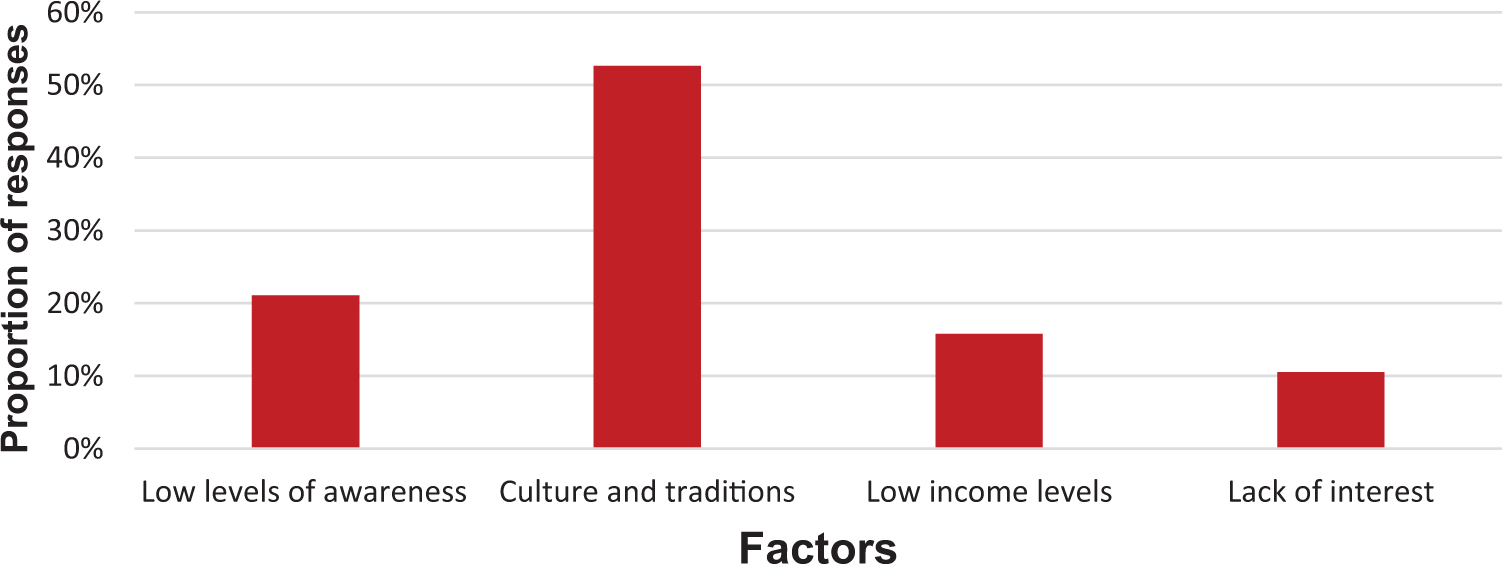
Factors that influence women’s land rights in the study sites (n = 21).
These realities confirm Wambui Karanja’s (1991) assertions that women’s security of tenure continues to be threatened by toxic practices rooted in culture. However, this ‘culture’ needs to be questioned by revisiting pre-colonial times when women and men had their parcels of land with specific crops to tend to and private tenure did not exist. It seemingly appears in the literature (Bondarenko, 2014; Munala, 1995) that women had more secure land rights in pre-colonial times. Individual titling, negative culture and environmental factors that cause the degradation of land all contribute to the denial of women’s land rights. The trend is that while male rights to and control over land are safeguarded and reinforced by individual tenure and male solidarity in institutions, women’s rights to land ownership have been thwarted, threatened, and sabotaged at every opportunity (Karanja, 1991).
As demonstrated above, land is mostly a source of power and control for men at the household level. This reality often does not take into consideration the ecological sustainability that comes with a capitalist society as espoused by Foster (1999). More land continues to be cleared as it is viewed as commodity for economic empowerment. The effects of such development on the environment, particularly on climate, takes the back seat. The economic value currently placed on land and with the increasing population cements unbalanced power-control dynamics between the genders.
This study argues that true community transformation within the study sites has to deal with a negative culture that disempowers any gender. Food-secure households will only be achieved if both men and women alike are involved in awareness creation and education projects in equal measure. Moreover, the current development culture on women’s empowerment needs to be aware of the fact that true empowerment of women cannot be done without positively engaging their male counterparts. As one male respondent in a focus group said: ‘NGOs coming here with women empowerment projects need to be aware that we men are the holders of power as regards land access . . . we are not against development, but they should not engage us as an afterthought (Interview, Malaha-Isongo-Makunga Ward, Western Kenya, 16 April 2018). To transform communities, awareness creation needs to focus on the local men, women and community leaders such as village elders and administrators. During discussions with local administrators, the common thread amongst their contribution was that they do not have access to pieces of the relevant legal framework to aid them in their work. Some casually referred to the Constitution of Kenya, 2010 on matters of land rights but could not be specific. The case was the same with the Land Boards where members interviewed were not able to refer to the relevant legal framework on land issues that they would be resolving. One male Board member said: ‘I am not confident about what the law says on women’s land rights but we have our way of resolving these issues. Where we cannot we encourage the women to seek justice through the courts’ (interview during focus group discussion, East Wanga Ward, Western Kenya, 20 May 2018). An assistant chief interviewed in 2018, responding regarding her awareness of the law concerning women’s land rights, stated: ‘The Constitution of Kenya, 2010 gives both men and women rights to land in a non-discriminatory manner’ (Interview, East Wanga Ward, Western Kenya, 20 May, 2018). However, she was unable to articulate particular articles where she bases her conviction.
It behoves development institutions to avail resources to both government workers and community members. This, together with suitable information dissemination strategies and plans, will ensure that disinformation is progressively done away with. At the beginning of this study, there was the misinformed belief that rural communities are rigid in their ways, especially on women’s land rights. However, research has informed us that these communities are misunderstood in the same way that they misunderstand progressive laws and programs targeted at them.
Despite the aforementioned challenges that pit legal provisions and practice against customs, there are positive experiences that can be used to show that women’s land rights can be achieved. Ikdahl et al. (2005) present the Bhe v. Magistrate, Khayelitsha, and others case in the South African Constitutional Court ruled on 15 October 2004. Here, the judge presided over the case brought before the court by the Women’s Legal Centre in Cape Town challenging the provision that the girls could not inherit their father’s estate. In this case, the Constitutional Court ruled that the two daughters were the heirs of their father’s estate. Judge Pius Langa stated that customary law was subject to the Constitution (Ikdahl et al., 2005). The South African context, in so far as the state of women’s land rights is concerned, is somewhat similar to the overall Kenyan context; that is, there are still major challenges with implementation of women’s legal rights where customs are involved. The South African Constitutional ruling presented above demonstrates that upholding women’s legal rights to land and property can be determined by the sole conviction of a judicial officer who decides to uphold the law.
Conclusion and recommendations
This paper posits that the most sustainable way to deal effectively with inequalities between men and women in rural areas is through strategic awareness creation and research that tells the positive story of the people in the study sites. This should be conducted collaboratively between development stakeholders and the rural communities, bringing together both indigenous and current knowledge and discarding what causes conflict between the genders. Informal learning that encourages communities on matters such as food security should be implemented. Older members of the community possess valuable indigenous knowledge inherently upheld by a culture where both men and women participated in ensuring food security within households.
More positive research needs to be written about the way the patriarchal communities existed in Western Kenya. These will counter the negative narrative that continues to place feminists at loggerheads with those who espouse patriarchy. It was not the intention of this paper to discourage efforts that empower women; however, more realistic results would be achieved if empowerment programs would involve both men and women right from the beginning. Men must be seen as part of the solution to achieve food security within rural households and are part of the justice that allows women to obtain their rights as regards land. Men and women must be equally empowered to participate in sustainable adaptation to climate change without destroying a culture – a culture which has prescribed a way of life for generations.
Development partners and the Kenyan Government need to re-evaluate development and human rights approaches if women’s land rights are to be achieved in Western Kenya. The situation has been made dire by the tunnel-vision nature of development that has not allowed itself to delve into the real patrilineal nature of land issues within communities of Western Kenya.
Footnotes
Funding
The authors received financial support from the University of Witwatersrand Faculty of Science Internship PHD Program, and the South Africa’s National Research Foundation (NRF) and Department of Science and Technology (DST) Doctoral Fellowship for the research, authorship and/or publication of this article.
