



Abstract
Organizations increasingly grapple with misalignments between formal structures and informal cultural dynamics, yet these discrepancies often remain hidden until they undermine learning, integrity, or adaptive performance. This article presents the Culture Congruence Diagnostic Model (CCDM), a behavioral-science framework for detecting and interpreting such incongruence. Grounded in research on organizational behavior, sensemaking, and behavioral risk, the CCDM focuses on four observable behavioral domains—decision-making, ownership, communication, and learning—linking them to three interacting drivers: formal mechanisms, informal norms and beliefs, and leadership behaviors. The model's four-stage diagnostic cycle integrates quantitative indicators with qualitative sensemaking to surface weak signals and reveal how behavioral patterns emerge and stabilize over time. Illustrative applications in financial services and engineering demonstrate how the CCDM clarifies root causes of cultural drift and supports psychologically safe and adaptive routines. The article concludes with implications for applied behavioral science and directions for future research.
Keywords
Introduction
Organizational culture is increasingly recognized as an enacted, behavioral phenomenon shaped by the interplay of formal structures, informal norms, and ongoing sensemaking processes. Yet organizations frequently approach culture as a matter of articulation—defining values, communicating expectations, or adjusting incentives—rather than as a continuous diagnostic practice. Research on behavioral risk and organizational learning shows that misalignments between what is formally prescribed and what is informally reinforced often remain invisible until they crystallize into performance failures, ethical breaches, or barriers to adaptation (Edmondson, 2018; Tucker & Edmondson, 2021).
Culture emerges through everyday interactions in which people interpret cues, negotiate meaning, and enact routines (Hernes & Maitlis, 2010; Uhl-Bien & Arena, 2017). Detecting cultural drift, therefore, requires systematic attention to the weak signals embedded in informal practices—signals that are easily overlooked in metric-driven or compliance-oriented approaches. The Culture Congruence Diagnostic Model (CCDM) integrates these theoretical insights into a structured lens for examining how formal mechanisms, informal dynamics, leadership behaviors, and organizational identity jointly shape observable patterns of decision-making, ownership, communication, and learning. The CCDM positions culture diagnosis as an evidence-based behavioral inquiry. In a regional financial institution, excluding risk officers from early deal discussions revealed a misalignment between espoused collaboration and underlying incentives. The CCDM shows that culture is defined less by stated values than by what organizations repeatedly measure, discuss, and reward (Schein & Schein, 2017).
Behavioral Risk and the Challenge of Formal–Informal Misalignment
Amid external pressures such as market volatility, talent scarcity, and technological disruption, organizations face a more subtle yet consequential hazard: behavioral risk. This form of risk arises when embedded norms, routines, and informal scripts diverge from espoused values or strategic intent—reflecting what Giorgi et al. (2015) describe as the disjunction between espoused and enacted cultural meanings. Behavioral risk manifests through social and psychological mechanisms that maintain misaligned behavior despite formal policy or ethical intent (Raaijmakers et al., 2022). These dynamics are often sustained by inconsistent signals and defensive leadership practices (Argyris, 1991; Edmondson, 2018), echoing what Argyris and Schön (1978) term defensive routines—self-reinforcing patterns that inhibit inquiry and learning.
Such incongruences may appear benign at first: collaboration may be formally promoted yet informally discouraged, or leaders may advocate open dialogue while tacitly penalizing dissent. These contradictions signal a breakdown of mindful organizing (Weick & Sutcliffe, 2007)—the collective capacity to notice, interpret, and respond to weak behavioral signals. Behavioral risk is not simply a compliance failure but a learning failure that erodes psychological safety, integrity, and engagement across levels of the system (Edmondson, 1999).
Behavioral risk remains hidden within what Argyris and Schön (1978) call organizational blind spots, where inquiry is constrained by single-loop reasoning. In the field of organizational development (OD), these blind spots represent unexamined assumptions that prevent adaptive learning. While recent governance and risk-management debates acknowledge the importance of “risk culture,” evidence indicates uneven adoption of behavioral diagnostics and culture metrics across industries (Financial Markets Standards Board, 2023).
The CCDM reframes behavioral risk as a core OD concern—treating it not as surveillance but as diagnostic inquiry. By integrating quantitative indicators (e.g., reporting patterns, KPI contradictions) with qualitative sensemaking (e.g., narrative interviews, day-in-the-life observations), CCDM reveals how informal dynamics can erode formal intent. When these tensions are visualized through diagnostic mapping, they become discussable, transforming invisible behavioral risks into shared learning and collective responsibility—consistent with an action-research orientation that treats diagnosis as participative inquiry (Coghlan & Brannick, 2014).
Culture as Enacted Behavior: A Behavioral-Science Foundation
Organizational culture shapes patterns of behavior, interpretation, and coordination within organizations, influencing how members make decisions and respond to challenges (Chatman & O’Reilly , 2016; Schein & Schein, 2017). Because behavior is observable, discussable, and responsive to feedback, it provides a practical entry point for examining culture in organizational settings. From an applied behavioral science perspective, observable actions are not merely outcomes of culture—they are enactments of it. As Weick (1995) argues, organizational reality is continuously created and interpreted through action, and sustained shifts in behavior gradually reshape the interpretive frameworks that constitute culture.
The CCDM begins with four key behavioral domains—decision-making, ownership, communication, and learning—because they are visible across levels and functions and provide powerful levers for cultural adaptation. Decision-making reveals how information, authority, and risk are balanced; ownership exposes underlying patterns of accountability; communication surfaces whether voice or silence prevails; and learning behaviors indicate whether errors generate insight or punishment. Each domain represents an enacted expression of deeper cultural assumptions, continuously reinforced through leadership behavior, peer norms, and formal reward systems. These patterns reflect what Simons (2002) describes as behavioral integrity—the perceived alignment between words and deeds—and they link observable conduct to the credibility and coherence of organizational culture.
By encouraging systematic observation, coding, and dialogue around these behavioral patterns, the CCDM translates culture from an abstract construct into a set of tangible practices that can be diagnosed, discussed, and influenced. Behavior serves as both a mirror and a mechanism of culture. This approach aligns with the concept of enactment, emphasizing that people construct and reinforce organizational realities through everyday action (Feldman, 2021) and position behavior as the most accessible and actionable pathway for understanding and shaping organizational culture.
Formal–Informal Congruence and Adaptive Performance
Sustainable performance depends on the alignment between formal structures and informal social systems (Schein & Schein, 2017). This principle is core to organizational models emphasizing fit (Nadler & Tushman, 2024) and is a key reason change fails when formal “E” levers clash with cultural “O” realities (Beer, 2020). This alignment is critical for psychological safety: experimentation and voice only thrive when formal goals, leadership actions, and peer norms send a coherent message that learning is valued (Edmondson, 2023).
Despite this, change initiatives often privilege visible, formal mechanisms over the informal dynamics that more powerfully shape everyday behavior (Sackmann, 2021). When new policies or designs disregard underlying social norms, change stalls (Burke, 2017).
The CCDM operationalizes this interplay. It maps formal drivers (e.g., governance, incentives) and informal drivers (e.g., beliefs, norms) together, allowing practitioners to pinpoint critical misalignments—for example, where strategic goals are contradicted by reward systems or where speak-up values are undermined by tacit sanctions. These gaps are not merely cultural curiosities; they explain stalled innovation, disengagement, and behavioral risk. Conversely, closing these gaps enhances adaptive capacity—the ability to learn, maintain trust, and execute under uncertainty (Edmondson, 2023). By translating alignment principles into a practical diagnostic, the CCDM advances the OD ambition to integrate the “hard” and “soft” dimensions of organizational life.
Why “Numbers and Stories” Matter
Although many organizations collect extensive performance data, these indicators rarely capture the underlying social dynamics that shape behavior (Tucker & Edmondson, 2021). Understanding these dynamics therefore requires combining quantitative indicators with qualitative insights into how organizational members interpret and enact formal structures (Edmondson, 2023; Feldman, 2021). The CCDM operationalizes this logic by triangulating quantitative indicators (“numbers”) with qualitative sensemaking (“stories”), enabling practitioners to detect discrepancies between formal expectations and lived organizational experience.
Quantitative data—such as surveys, performance metrics, or network indicators—reveal patterns and scale, while qualitative inquiry—through interviews, observations, and narratives—uncovers the meanings and informal signals that sustain those patterns (Edmondson, 2018; Schein & Schein, 2017). By examining where these sources align or diverge, the CCDM identifies recurring inconsistencies between formal intent, reported experience, and enacted behavior. These discrepancies often signal underlying cultural dynamics that remain invisible in single-source diagnostics. This mixed-methods approach reflects a broader insight in applied behavioral science: organizational culture cannot be understood solely through aggregate indicators but must be interpreted through patterns of interaction and sensemaking (Uhl-Bien & Arena, 2017).
Origins and Development of the CCDM
The CCDM did not originate as an abstract theoretical construct but as a response to a practical diagnostic challenge: how to systematically assess organizational culture and behavioral risk in contexts where formal governance structures appeared sound, yet underlying dynamics signaled potential vulnerability. In the aftermath of the global financial crisis, supervisory authorities increasingly recognized that reviewing financial metrics and formal control systems alone was insufficient to detect emerging risks. A series of high-profile failures suggested that behavioral and cultural dynamics within leadership teams and boards could precede and drive financial or integrity breakdowns. This recognition prompted the development of a supervisory framework that extended beyond “facts and figures” to include systematic observation of group behavior, leadership dynamics, and behavioral patterns (De Nederlandsche Bank, 2015).
An early articulation of this approach was the Iceberg Model of behavior and culture supervision, which conceptualized observable behavior as the visible manifestation of deeper group dynamics and mindset (Raaijmakers, 2015a). The supervisory lens emphasized recurring interaction patterns within leadership teams—particularly in decision-making, communication, leadership conduct, and group dynamics. This systemic orientation was grounded in organizational psychology and learning theory, and operationalized through structured assessments of board effectiveness and change capacity.
Limitations of Existing Diagnostic Models
While established organizational diagnostic models—such as congruence frameworks, systems models, and culture typologies—provided valuable conceptual foundations, several limitations became apparent during applying these models. First, many models emphasized structural alignment (e.g., fit between strategy, structure, and systems) but paid less explicit attention to group-dynamic processes within leadership teams. Empirical supervisory experience showed that subtle interaction patterns—dominance, avoidance of dissent, and diffusion of responsibility—often had disproportionate influence on the quality of decision-making, risk awareness, and learning capacity. Second, traditional culture models frequently described values and assumptions but provided limited guidance for operationalizing culture in observable behavioral terms. Supervisors require tangible entry points—specific behaviors that could be observed, discussed, and assessed across contexts. Third, often diagnostic approaches implicitly privileged formal design variables (governance, structure, incentives) while underestimating the power of informal dynamics—unwritten norms, tacit beliefs, climate, and social identity processes. Field experience consistently demonstrated that informal drivers could either reinforce or neutralize formal mechanisms. These limitations created the need for a framework that explicitly mapped the interaction between formal structures and informal dynamics, and that translated culture into observable behavioral domains.
Iterative Development Across Institutional Contexts
The CCDM evolved iteratively across distinct institutional settings. In its initial phase, the Iceberg Model was applied in supervisory assessments across financial institutions, focusing on board effectiveness, decision-making patterns, communication dynamics, leadership behavior, and capacity for change (De Nederlandsche Bank, 2015). More than 50 supervisory assessments provided a rich empirical base for refining diagnostic categories and identifying recurring behavioral risk patterns.
A subsequent phase of development occurred within a large international financial institution, where the focus shifted from external supervision to internal behavioral risk management. Here, the diagnostic logic was translated into an organizational risk framework that explicitly distinguished between formal drivers (e.g., structures, incentives, policies, reporting lines) and informal drivers (e.g., beliefs, team climate, group dynamics) shaping behaviors (Raaijmakers et al., 2022).
In later stages, the framework was further refined through application in advisory and OD contexts across multiple sectors. Applying the diagnostic logic in industries such as professional services, engineering, and the cultural and nonprofit sector provided opportunities to observe how similar behavioral patterns emerged across different organizational environments. These cross-sector applications helped test the robustness of the model beyond its original supervisory and financial-industry settings and contributed to the integration of its core elements—formal drivers, informal dynamics, leadership behavior, and observable behavioral patterns—into the model.
The distinction between formal and informal drivers proved conceptually and practically powerful. In many organizations—particularly in highly regulated sectors—efforts to influence behavior tend to focus primarily on formal mechanisms such as structures, policies, governance arrangements, and incentive systems. While senior leaders often recognize that informal dynamics also shape behavior, these processes frequently remain implicit and difficult to examine systematically. By explicitly differentiating between formal and informal drivers, the framework makes the informal side of the organization—such as group dynamics, shared beliefs, and psychological safety—analytically visible. Making these elements explicit proved valuable in practice. It enabled senior leaders to recognize impeding behavioral patterns—such as ineffective decision-making or lack of ownership.
Moreover, by providing a shared vocabulary for discussing informal processes, the model helps senior leaders and practitioners engage in collective sensemaking about behavioral patterns that remain tacit (Turner & Baker, 2023). Surfacing these dynamics supports inquiry into defensive routines and learning barriers, while drawing attention to conditions—such as psychological safety—that enable groups to question prevailing assumptions and improve decision processes (Edmondson, 2023). The framework demonstrates that risks rarely stem from a single cause; they emerge from misalignments between formal intent and informal enactment.
The Centrality of Formal–Informal Incongruence
The transition from earlier supervisory and behavioral-risk models to the CCDM involved a conceptual shift: from layered culture analysis (iceberg logic) to systematic mapping of formal–informal incongruence. Repeated field observations revealed that organizational drift rarely resulted from the absence of formal policies. Instead, breakdowns frequently occurred where: espoused values contradicted incentive structures, strategic priorities conflicted with performance metrics, speak-up policies coexisted with informal sanctioning of dissent, or leadership rhetoric was misaligned with enacted behavior. In many organizations, formal mechanisms were visible, measurable, and well-articulated. Informal dynamics, by contrast, often remained implicit and underexamined. Because most organizational interventions disproportionately target formal levers, the informal side frequently becomes a blind spot. Making this informal dimension explicit—and examining its interaction with formal systems—therefore became central to the evolving model. The CCDM places this formal–informal interplay at the heart of diagnosis. It conceptualizes culture as an emergent pattern produced by the interaction of formal architectures, informal social dynamics, leadership behavior, and enacted behavioral routines. Formal–informal incongruence became the organizing principle of the CCDM, as it consistently explained performance drift, learning failures, and integrity risks across empirical settings.
Positioning the CCDM Within the OD Diagnostic Tradition
The development of the CCDM builds explicitly on, and seeks to extend, the rich tradition of organizational diagnostic models in OD. Rather than positioning itself as a replacement for established frameworks, the CCDM integrates and further operationalizes several core insights from this tradition. Classic diagnostic models in OD—such as the Six-Box Model (Weisbord, 1976), the McKinsey 7-S framework (Waterman et al., 1980), Nadler and Tushman's Congruence Model (1980), and the Burke–Litwin model of organizational performance and change (1992)—have emphasized alignment among strategy, structure, systems, and people. These frameworks have been instrumental in foregrounding the importance of internal consistency and systemic fit. However, in applied settings, they often privilege formal design variables—strategy, structure, systems, processes, and incentives—while treating culture and behavior as important but less concretely operationalized elements.
Similarly, Schein's influential model of organizational culture provides a foundational three-level distinction between artifacts, espoused values, and underlying assumptions (Schein, 2010). Schein's work has been critical in moving the field beyond surface-level descriptions of culture and toward deeper interpretive layers. Applications of Schein's framework frequently remain focused on observable artifacts and articulated assumptions, with less systematic attention to recurring group-dynamic processes within leadership teams and work groups. Field experience suggested that these social processes—patterns of dominance and silence, coalition formation, conflict avoidance, informal sanctioning of dissent, or diffusion of responsibility—often play a decisive role in shaping how formal systems and behaviors are enacted. In particular, phenomena such as psychological safety, collective sensemaking, and identity-based conformity operate at the level of group interaction and cannot be fully captured by examining structures, values, or assumptions alone.
The early Iceberg Model of behavior and culture supervision explicitly incorporated group-dynamic processes as a distinct layer beneath observable behavior (Raaijmakers, 2015a). This addition reflected insights from social and organizational psychology, indicating that behavior in organizations is not merely the expression of individual attitudes or shared assumptions but is coproduced through ongoing interaction within social systems.
The CCDM further advances this logic in two ways. First, it makes the distinction between formal and informal drivers explicit and symmetrical. Building on the behavioral risk framework that differentiated structural conditions (e.g., governance, incentives, reporting lines) from informal dynamics (e.g., beliefs, climate, group norms) (Raaijmakers et al., 2022), the CCDM systematically maps how these drivers interact in shaping key behavioral domains. In doing so, it renders the informal side of organizations—often treated as residual or implicit in prior models—analytically visible and diagnostically actionable.
Second, the CCDM embeds these drivers within a broader perspective that explicitly links organizational identity and strategic direction to everyday behavioral patterns. Whereas many diagnostic models examine alignment among internal elements, the CCDM integrates identity (purpose, values, capabilities) and strategic choices (priorities, risk appetite, positioning) as parallel foundations that shape both formal design and informal meaning-making. This addition reflects the empirical observation that misalignments often originate not only in structures or culture but in tensions between identity claims, strategic intent, and enacted practice.
The CCDM can be understood as an integrative extension of existing OD models. It retains the systemic alignment logic central to congruence frameworks, incorporates the layered understanding of culture articulated by Schein, and adds a more explicit treatment of social-psychological group dynamics and formal–informal incongruence. From an organizational learning standpoint (Edmondson, 2023), CCDM serves as a diagnostic lens that surfaces discrepancies between espoused and enacted values—potential precursors of performance drift or behavioral risk. Through these iterative applications across supervisory, organizational, and advisory contexts, the CCDM gradually emerged as an integrative diagnostic framework grounded in both behavioral-science theory and field-based learning.
The Culture Congruence Diagnostic Model
As shown in Figure 1, the CCDM rests on two parallel foundations—organizational identity and strategic direction—and proceeds through three categories of drivers, four key behavioral patterns, and multiple performance outcomes:
Organizational identity captures purpose, values, and capabilities (PVC)—who we are and what we can do. Capabilities are embedded within identity because they represent enduring, embodied routines that anchor feasible action. Strategic direction articulates explicit priorities—where the organization will play, how it will compete, and the risk appetite guiding trade-offs. Strategy runs parallel to identity: it is periodically adjusted through learning cycles, while identity evolves more gradually. Drivers of behavior encompass formal mechanisms (governance, policies, incentives), informal dynamics (beliefs, social norms, team climate), and leadership behaviors—the three primary levers shaping conditions for action. Key behavioral patterns—decision-making, ownership, communication, and learning—anchor day-to-day work and represent the most observable levers for culture change. Outcomes include performance, employee well-being, compliance, and integrity risk. Outcomes feedback continuously into strategic direction and, when warranted, episodically into organizational identity, creating adaptive feedback loops.

The Culture Congruence Diagnostic Model.
In the sections that follow, we examine the model's key behavioral domains, the drivers that influence them, and the interplay between identity and strategic direction that sustains alignment and adaptive capacity.
Key Behavioral Domains
The CCDM highlights four behavioral domains broadly relevant across organizations. These patterns translate organizational identity and strategic direction into enacted practice, providing observable indicators of how formal and informal systems interact to produce performance, learning, and integrity outcomes.
Decision-making: This domain concerns the extent to which decisions are informed, balanced, and constructively challenged. Weak processes—such as limited dissent or insufficient consideration of options—elevate performance and integrity risks (Sutcliffe & Weick, 2022). Diagnostic cues include the quality of options explored, clarity of decision rights, and use of reflective practices like premortems. Ownership: Ownership reflects the degree to which individuals and teams experience psychological responsibility for outcomes (Owens et al., 2016). High ownership fosters initiative and collaboration; low ownership manifests as diffusion of responsibility. Diagnostic cues include end-to-end accountability, follow-through on commitments, and role clarity. Communication: Effective communication enables coordination, learning, and psychological safety (Edmondson, 2023). Open dialogue facilitates upward voice and shared meaning, whereas restricted communication suppresses dissent. Diagnostic cues include frequency of upward voice, transparency of rationales, and quality of feedback exchange. Learning: Learning behavior reflects the capacity to reflect, experiment, and adapt over time (Edmondson, 2023). Deliberate error management and after-action reviews underpin resilience. Diagnostic cues include the cadence of reflective reviews, treatment of failure, and the extent to which lessons are codified and reused.
While these four domains are widely applicable, the CCDM can be tailored to emphasize context-specific behaviors—such as safety or innovation—depending on the organization's strategic priorities. In doing so, the CCDM operationalizes culture diagnosis through observable action, linking behavioral inquiry to organizational learning and change.
Three Drivers of Behavior: Informal, Formal, and Leadership
Within the CCDM, individual and collective behavior is viewed as the emergent outcome of three interdependent driver sets: informal (beliefs, social norms, psychological safety), formal (structures, incentives, processes), and leadership (modeling, sensegiving, reinforcement). This stance is grounded in foundational frameworks that emphasize the interplay of personal, social, and structural forces (Ajzen, 2020; Scott, 2014).
Together, these drivers form a dynamic system: informal sensemaking interprets formal intent, while leadership behavior mediates their relationship through meaning-making and reinforcement (Feldman, 2021; Raelin, 2022). Diagnostically, CCDM examines not only each driver but also how their interactions enable—or erode—behavioral congruence.
Informal Drivers: the Tacit Forces Shaping Behavior
Informal drivers encompass the tacit elements of organizational life—implicit expectations, relational dynamics, and shared beliefs—that subtly guide behavior (Feldman & Pentland, 2022). Under uncertainty, these informal cues often override formal directives as individuals rely on social interpretations to guide action (Feldman, 2021). These dynamics constitute the substrate through which culture is enacted, materially affecting learning, trust, and resilience (Edmondson, 2023). Core components include:
Beliefs and mental models: Cognitive schemas shape how individuals interpret events and make judgments (Schein & Schein, 2017). When unexamined, shared assumptions can normalize routines that conflict with espoused values (Treviño et al., 2006). Social norms: Informal rules define “how things are done here,” providing behavioral scripts in uncertain contexts (Bicchieri, 2016). These norms sustain cohesion but can also powerfully discourage dissent. Psychological safety: The shared belief that one can speak up or experiment without fear of negative consequences is a critical condition for learning and ethical vigilance (Edmondson, 2023). Diagnostic cues include the presence of upward voice and prevailing stories about dissent.
Formal Drivers: Codified Systems for Coordination and Control
Formal drivers comprise the explicit, codified systems that organize work—structures, processes, policies, and incentive mechanisms (Burton et al., 2020; Puranam, 2018). These arrangements create clarity and accountability but exert their strongest influence when aligned with informal norms and leadership signals (Kotrba et al., 2021). Primary categories are:
Structure and governance: Hierarchies and decision rights delineate authority (Joseph & Gaba, 2020), while oversight mechanisms shape risk tolerance and ethical climates (Aguilera et al., 2021). Clear escalation pathways enable constructive challenge, whereas opaque structures diffuse ownership. Policies and procedures: These codify expectations and guide decisions, balancing consistency with necessary discretion for adaptation (D'Adderio & Pollock, 2020). Well-designed procedures support learning; overly rigid rules constrain adaptation and discourage voice. Incentives and rewards: Systems align effort with goals and shape behavioral priorities (Benabou & Tirole, 2016). Poorly designed incentives can distort behavior, encouraging short-term performance over reflection or integrity.
Leadership Behavior: the Integrative Force
Leadership behavior functions as the primary integrative force connecting formal systems and informal culture (Uhl-Bien & Arena, 2018). Leaders interpret and communicate strategic intent, model desired norms, and set the tone for accountability and learning (Northouse, 2021). Core mechanisms of influence are:
Modeling and discretionary choices: Everyday decisions signal what is genuinely prioritized in trade-offs between efficiency, ethics, and outcomes (Anicich et al., 2023). Sensegiving and storytelling: Leaders translate organizational identity into actionable direction, providing interpretive frames for “what good looks like” (Maitlis & Christianson, 2014). Reinforcement: Coaching, feedback, and consequences stabilize or shift routines (Feldman, 2021).
Leadership converts formal intent into lived experience. For example, a code may prohibit retaliation, yet if dissent is punished, a silence norm prevails (Detert & Edmondson, 2011). Conversely, when leaders visibly reward transparency and learning from error, informal behavior aligns with formal values (Edmondson, 2023). Effective leadership integrates emotional intelligence, self-awareness, and contextual sensemaking (Gardner et al., 2021) to cultivate psychological safety (Edmondson, 2023) and legitimize productive dissent (Detert & Burris, 2007). From a complexity-leadership perspective, leadership is a recursive process that both shapes and is shaped by the systemic context (Uhl-Bien & Arena, 2018).
These three drivers—informal, formal, and leadership—form a dynamic behavioral system. Informal dynamics interpret formal intent; leadership mediates this relationship through sensemaking and reinforcement. Congruence among these drivers determines whether an organization learns adaptively or drifts into defensive routines (Edmondson, 2023). The CCDM provides a diagnostic map for examining these interactions, viewing organizations as human systems capable of continuous learning and renewal.
Identity and Strategic Direction in the CCDM
Within the CCDM, organizational identity and strategic direction are parallel foundations that shape how behavior is interpreted, motivated, and evaluated. Identity defines who we are, strategy defines what we aim to achieve, and behavior expresses how we move between the two.
Organizational Identity (PVC)
Organizational identity captures the enduring sense of “who we are and what we can do” (Gioia et al., 2013). It integrates PVC into a coherent frame that guides behavior under uncertainty.
Purpose provides intrinsic meaning, linking individual effort to collective significance (George et al., 2021). A credible purpose enhances commitment when perceived as authentic and actionable. Values delineate what is desirable and acceptable. They influence conduct only when embedded in both formal systems and informal dynamics (Schein & Schein, 2017). Values disconnected from practice create “espoused–enacted” gaps that erode trust (Edmondson, 2023). Capabilities represent the organization's collective know-how—its routines, skills, and relational capacities (Helfat & Peteraf, 2015). They stabilize identity by anchoring purpose and values in feasible action.
Thus, identity in the CCDM is a living system of meaning, enacted through everyday behavioral patterns that align PVC.
Strategic Direction (Choices, Priorities, Risk Appetite)
Strategic direction translates organizational identity into explicit commitments—clarifying where to compete, how to win, and what trade-offs to accept (Rumelt, 2017). While identity evolves slowly, strategy operates on a shorter feedback cycle and must be testable against outcomes. It provides the behavioral “compass heading” that guides resource allocation, decision rights, and performance evaluation.
Choices: Strategic choices define the arenas of engagement—markets, products, technologies—through which purpose and capabilities are expressed. Coherent choices enable focus and collaboration; ambiguous choices produce fragmentation and conflict (Leiblein & Reuer, 2020). Within CCDM, choices are examined behaviorally: Do decision forums and metrics reflect these choices, or do legacy patterns pull attention elsewhere? Priorities: Priorities articulate what matters most right now—where focus, energy, and resources are concentrated. They become behavioral signals: what leaders ask about, measure, and celebrate (Sull & Sull, 2018). Misaligned priorities—when declared objectives diverge from resourcing—create mixed messages that erode ownership and trust. Risk appetite: Risk appetite defines the degree of uncertainty the organization is willing to tolerate. It serves as a behavioral boundary condition—shaping decision-making and innovation. An overly cautious appetite may stifle learning; an excessive one can normalize rule-bending (Power, 2016). Diagnostically, the CCDM examines how risk appetite is enacted: Are challenges and experimentation rewarded proportionately?
When strategic imperatives—such as rapid expansion—outstrip capabilities or contradict values, they generate incongruent behavioral cues, rewarding expedience over integrity. Adaptive organizations treat strategy as an iterative learning process, continually refined through reflection and feedback (Bingham & Eisenhardt, 2011). Within the CCDM, this feedback operates through dual loops: performance reviews adjust strategic direction, while deeper shifts in context prompt episodic reframing of identity.
The selection of these dimensions reflects recurring drivers of organizational behavior. The model is not complex for its own sake but because behavior emerges from interacting formal and informal systems. While simpler models focus on structural alignment, the CCDM explicitly integrates both formal mechanisms and informal social dynamics. This allows practitioners to examine how structures, incentives, beliefs, and interaction patterns jointly shape observable behavior. The value of the CCDM lies in the systematic examination of how these elements interact to produce patterns of alignment or incongruence.
Applying the CCDM
The CCDM operationalizes the diagnostic logic described earlier by systematically triangulating quantitative indicators (“numbers”) with qualitative sensemaking (“stories”). By examining how formal structures interact with informal dynamics in shaping behavior, the model helps practitioners identify patterns of alignment and tension within organizations. These patterns can reveal behavioral “fault lines”—situations where cognitive defenses, cultural inconsistencies, or structural pressures contribute to emerging risks. Visualizing such tensions allows practitioners and organizational members to translate abstract cultural or ethical concerns into observable and discussable patterns of behavior.
Applying the CCDM generates two forms of insight. First, it enables the identification of emerging behavioral risks by highlighting areas where formal governance mechanisms are undermined by informal norms, interpretations, or interaction patterns. Second, it supports the diagnosis of the organizational conditions that reinforce or mitigate these risks, helping organizations strengthen constructive routines while redesigning systems that may inadvertently encourage undesirable conduct. The CCDM treats culture as an empirical and interpretive system rather than a purely “soft” variable.
The practical application of the CCDM follows a structured diagnostic process in which quantitative indicators and qualitative insights are integrated to identify behavioral patterns, explore their underlying drivers, and translate these insights into collective learning. This process unfolds through a series of interconnected steps, described below.
The CCDM Diagnostic Cycle
While the CCDM provides a conceptual framework for diagnosing cultural incongruence, its value depends on how it is applied in organizational settings. The model functions as a structured inquiry process through which practitioners—such as consultants, managers, or internal specialists—examine patterns of behavior and their underlying drivers. The application process generally unfolds in five phases: introduction and contracting, data collection, triangulation and analysis, collective interpretation, and iterative learning.
Introduction and Contracting
The diagnostic process begins with a contracting phase in which the scope and purpose of the assessment are clarified. This phase focuses on establishing shared expectations regarding the questions to be explored, the organizational levels involved, and the boundaries of the inquiry. At this stage, practitioners work with organizational sponsors to define the focal themes—for example, decision-making effectiveness, risk escalation, or learning capacity—and to determine how the CCDM will be used to examine potential incongruence between formal structures and informal dynamics.
The CCDM can be applied in different diagnostic contexts. In some cases, the process is triggered by a specific issue or risk event—for example, when an integrity incident, governance failure, or operational breakdown has occurred, and the organization seeks to understand the underlying behavioral and cultural drivers. In other situations, the model is used proactively to gain a deeper understanding of the organization's culture and behavioral patterns, without a specific incident as a starting point. In both cases, the aim is to identify recurring patterns in how decisions are made, how ownership is exercised, how communication unfolds, and how learning processes take place.
Particular attention is paid to stakeholder alignment, as cultural diagnostics often touch upon sensitive organizational dynamics. Establishing clarity about confidentiality, participation, and the intended use of findings helps create the conditions for open inquiry. The CCDM is not designed to evaluate the functioning of individual employees or to identify individual misconduct. The framework focuses on collective behavioral patterns and the interaction between formal structures and informal dynamics that shape organizational behavior. This distinction helps ensure that the diagnostic process remains oriented toward systemic learning and organizational improvement rather than individual attribution.
Data Collection
Once the scope has been defined, the diagnostic process moves to the design of the data collection. The CCDM relies on the triangulation of multiple data sources to capture both formal and informal aspects of organizational functioning. In methodological terms, this approach reflects a mixed-methods design, in which quantitative and qualitative data are combined to generate a more comprehensive understanding of complex organizational phenomena (Creswell & Plano Clark, 2018; Guetterman & Fetters, 2021).
Quantitative indicators include performance metrics, governance data, employee survey results, risk indicators, or Human Resources metrics. These data sources provide insight into formal organizational structures and outcomes. Qualitative sources complement these indicators and help surface the informal dynamics that shape everyday behavior. These may include semistructured interviews, workshops, observational notes, or narrative accounts of decision processes. Collecting these sources in parallel allows practitioners to compare formal expectations with lived organizational experience.
In contexts such as behavioral risk management, combining these sources is particularly valuable because behavioral patterns rarely become visible through a single type of data alone. The interaction between formal indicators and qualitative accounts helps reveal the social and organizational processes that influence behavior (Raaijmakers et al., 2022).
The CCDM treats numbers and narratives as complementary perspectives on organizational reality. The triangulation of multiple data sources allows practitioners to explore tensions between formal intent and everyday practice. Using integrative frameworks (Guetterman & Fetters, 2021), practitioners can systematically juxtapose these data streams to support a richer, more nuanced diagnosis of cultural dynamics and behavioral risk. The combination of quantitative indicators (“numbers”) and qualitative narratives (“stories”) helps surface incongruence between formal organizational design and informal practice.
Triangulation and Pattern Analysis
The analytical phase combines interpretive reflection by the research team with systematic analysis of the data to identify emerging patterns. This process unfolds in two complementary steps: an initial interpretive reflection phase followed by a data-driven analysis.
The first step involves a structured reflection among the practitioners who conducted the interviews and were closely involved in the diagnostic process. During this stage, researchers share their initial impressions, observations, and perceived recurring themes that emerged during the fieldwork. These reflections may include tentative interpretations, observed tensions, or patterns that appeared salient across conversations. The purpose of this step is not to draw definitive conclusions but to make implicit impressions, assumptions, and intuitions explicit within the research team. By articulating these early perceptions, the team creates awareness of potential interpretive biases and ensures that these impressions are consciously examined in the subsequent analytical steps. This reflexive stage helps researchers temporarily “empty the system,” allowing later analysis to engage the data with greater openness. Such early familiarization and reflexive engagement with the data is widely recognized as an important step in qualitative analysis (Braun & Clarke, 2022).
The second step involves a systematic bottom-up analysis in which patterns are derived directly from the data. Researchers examine interview transcripts and other qualitative materials in detail, identifying recurring themes, key phrases, and illustrative examples. This stage follows an inductive logic in which interpretations are grounded in the data rather than imposed by prior expectations. This involves moving iteratively between individual data excerpts and emerging conceptual categories, allowing patterns to develop through comparison and clustering of observations. Such inductive pattern development is consistent with established qualitative research methodologies that emphasize systematic concept building from empirical material (Gioia, 2021).
Because both quantitative indicators and qualitative narratives may contain bias or strategic framing, the CCDM relies on triangulation across multiple data sources, analytic perspectives, and organizational levels. The analysis does not treat individual statements as evidence in isolation. Instead, interpretations are developed by identifying recurring patterns across interviews, documents, and performance indicators. Consistent patterns are interpreted only when they recur across independent sources, reducing the risk that isolated narratives or selectively reported data drive the diagnosis. Throughout the process, insights from qualitative material are compared with available quantitative indicators such as performance data, survey results, and governance metrics. This triangulation and integration of multiple data sources helps strengthen the robustness of the analysis. Through a joint interpretive approach (Bazeley, 2018), the team develops meta-inferences—insights that emerge from the integration of the datasets, identifying patterns and tensions that may not be visible through a single type of data alone (Fetters & Freshwater, 2015). This integration is particularly valuable in diagnosing formal–informal incongruence, where quantitative indicators often reveal outcomes while qualitative narratives illuminate the underlying social dynamics.
Together, these steps combine practitioner insight with systematic qualitative analysis, allowing intuitive observations from the field to be critically examined through inductive pattern development. The outcome of this analytical phase is a set of shared themes that capture recurring behavioral patterns across the organization and provide the basis for examining their underlying drivers within the CCDM framework.
Interpreting Drivers and Risks
Once recurring behavioral patterns have been identified, the next step is to examine what drives these patterns within the organization. Using the CCDM framework, practitioners analyze how formal mechanisms, informal dynamics, and leadership behavior interact to shape the observed behaviors. This step involves systematically exploring questions such as: Which formal structures, governance arrangements, or incentive systems reinforce the observed behaviors? Which informal norms, beliefs, or group dynamics appear to sustain them? Where do tensions emerge between formal expectations and everyday practice?
Practitioners conduct this analysis by systematically mapping the identified behavioral patterns onto the different drivers in the CCDM framework. This mapping helps reveal how specific behaviors are reinforced by the interaction between formal mechanisms, informal dynamics, and leadership signals. For example, a pattern of limited challenge in decision-making may be linked to both formal drivers—such as hierarchical decision structures—and informal dynamics, such as norms discouraging dissent or limited psychological safety within leadership teams.
The aim of this step is not to identify a single root cause but to understand how multiple drivers interact. Behavioral patterns emerge from the combined effect of formal mechanisms, informal dynamics, and leadership signals. This perspective aligns with established approaches to organizational diagnosis that emphasize the interaction between organizational elements in shaping outcomes (Burke & Litwin, 1992; Nadler & Tushman, 1980). At the same time, research on the microfoundations of organizations highlights how organizational outcomes emerge from the interaction between individual actions, social processes, and structural conditions (Felin et al., 2015). Observable behaviors can therefore be understood as the visible manifestation of deeper cultural assumptions and social dynamics within organizations (Schein, 2010).
The analysis focuses on understanding how interacting organizational conditions reinforce specific behavioral patterns. The outcome of this phase is a synthesized narrative that explains how specific behavioral patterns are produced and sustained within the organizational system. This narrative provides the basis for the subsequent dialogue with organizational stakeholders.
Review Sessions and Collective Dialogue
The final phase focuses on translating the analysis into collective learning. Findings are discussed in facilitated review sessions involving leadership teams or relevant stakeholder groups. These conversations aim not only to present results but also to create a shared understanding of how formal and informal dynamics interact within the organization. For this dialogue to be productive, sessions must be designed to foster psychological safety, allowing participants to openly discuss sensitive gaps between intent and reality without fear (Edmondson, 2018). This transforms the session from a presentation into a facilitated sensemaking process (Maitlis & Christianson, 2014).
During these sessions, practitioners present the identified behavioral patterns and their underlying drivers, often using visualizations of the CCDM framework to structure the discussion. This helps participants jointly reflect on potential incongruence between formal intent and enacted practice. The aim is not simply to validate the analysis but to stimulate dialogue that allows organizational members to interpret the findings in relation to their own experiences and responsibilities. These conversations often surface previously implicit assumptions and enable participants to reconsider how formal structures and informal dynamics influence everyday decision-making.
Such collective reflection processes are an important mechanism through which organizations develop shared understanding and learning. The dialogue itself generates new insights and prompts further inquiry into underlying organizational dynamics (Edmondson, 2023; Raelin, 2022).
The diagnostic cycle does not end with reporting. Organizations often revisit the framework periodically to reassess behavioral patterns and track the effects of interventions. The CCDM functions less as a static assessment tool and more as a recurring learning mechanism that supports ongoing organizational reflection and adaptation. Such iterative reflection processes can strengthen the organization's capability to recognize and respond to emerging challenges (Teece et al., 1997). The practical application of the CCDM is illustrated in Figure 2.

The CCDMdiagnostic cycle.
While the CCDM diagnostic cycle generates insights into behavioral patterns and their underlying drivers, its value depends on whether these insights become embedded in organizational routines and decision processes. For this reason, many organizations integrate the CCDM into existing governance, risk management, and leadership processes, allowing the framework to function as a recurring mechanism for reflection and learning.
Embedding the CCDM in Learning Processes and Governance
The CCDM embeds insights through four iterative stages—Identification, Diagnosis, Intervention, and Monitoring—that connect organizational identity and strategy to formal, informal, and leadership drivers, and to four key behaviors: decision-making, ownership, communication, and learning (Raaijmakers, 2015a; Raaijmakers et al., 2022). These stages form a learning cycle in which inquiry, experimentation, and feedback interact to surface behavioral patterns, realign system dynamics, and embed sustainable change.
Identification—Sensing Emerging Misalignments
The purpose of identification is to locate organizational areas where behavioral congruence may be weakening—either preventively (potential hotspots) or reactively (sites of recent performance, conduct, or safety issues). Data triangulation supports this step: HR trend lines (e.g., turnover spikes, absenteeism), compliance or audit findings, and pulse surveys on psychological safety can indicate pressure points. Equally important are informal sensing methods—such as short “weak-signal roundups,” frontline “shadow days,” or brief leadership “whisper tests” that surface latent worries (“What informal rules concern you most?”).
This phase emphasizes noticing before knowing: cultivating systemic awareness of where formal and informal forces may be drifting out of alignment (Schein, 2010; Weick, 1995).
Diagnosis—Mapping Behavior to Drivers
The diagnostic stage integrates quantitative and qualitative methods to map everyday behavioral patterns, their drivers, and their consequences (Raaijmakers, 2015b; Van Muijen & Koopman, 1999). Quantitative instruments—surveys, network analyses, or HR dashboards—identify the scale and frequency of specific behaviors, while qualitative inquiry—interviews, document review, observation, or video ethnography—reveals the meaning systems and habit loops that sustain them (Feldman & Pentland, 2003).
Triangulating across data types minimizes bias and strengthens reliability. Diagnostic synthesis occurs by placing findings on the CCDM grid, locating each theme within its driver cell (formal mechanisms, informal dynamics, or leadership signals), and flagging critical misalignments—patterns that threaten integrity, performance, or psychological safety.
This stage is inherently dialogic: data serve as prompts for collective sensemaking, not as proof points.
Intervention—Realigning Drivers and Routines
Intervention in CCDM is guided by the principle that sustainable change requires addressing both visible routines and their underlying drivers. Actions should balance technical fixes (policy redesigns, process updates, incentive realignment) with adaptive interventions that shift meaning and behavior (Heifetz et al., 2009). Examples include:
Structural adjustments: revising decision rights, harmonizing KPIs, and integrating cross-functional review forums. Behavioral nudges: leader “mistake talks,” team reflection rituals, or embedded “learning pauses” at decision milestones. Cultural conversations: facilitated sessions where teams examine informal rules (“what really gets rewarded”) and reframe their shared narratives.
Each intervention is anchored in behavioral observation, not abstraction, and supported through iterative feedback loops. Leadership presence, psychological safety, and peer reinforcement sustain the new routines (Edmondson, 2018).
Monitoring—Sustaining Congruence and Learning
The monitoring stage evaluates behavioral persistence and adaptation over time.
It relies on both leading indicators (conflicting KPI prevalence, speak-up rates, cross-unit collaboration) and lagging indicators (customer complaints, audit breaches, turnover trends). Data may be complemented by qualitative sensemaking circles—rotating focus groups or “culture dialogues” that assess whether norms are shifting or defensive routines are reemerging (Argyris, 1991; Edmondson, 2018). Advanced analytics can enhance this step, for instance, by using text-mining to detect the reappearance of euphemisms or diffusion-of-responsibility language in internal communications (Coombs & Chesterfield, 2025). Monitoring is not a control function but a learning process: by continually recalibrating what “good” looks like, organizations maintain congruence between intent and behavior (Weick & Sutcliffe, 2007).
Through this disciplined yet dialogic process, CCDM turns culture diagnosis into collective inquiry, ensuring that culture work is both evidence-based and human-centered—hallmarks of applied behavioral science. To translate CCDM's conceptual framework into practice, Table 1 summarizes how its four iterative stages—Identification, Diagnosis, Intervention, and Monitoring—operate as a continuous behavioral-learning cycle. Each stage links inquiry to action by combining quantitative indicators (“numbers”) with qualitative sensemaking (“stories”) and by embedding simple micro-routines that help leaders, teams, and researchers detect, discuss, and realign cultural dynamics in real time. The table illustrates how CCDM can function as a living diagnostic discipline—one that continually integrates data, dialogue, and reflection to sustain congruence between formal intent and everyday behavior.
Applying the CCDM: Diagnostic Questions and Micro-Routines.
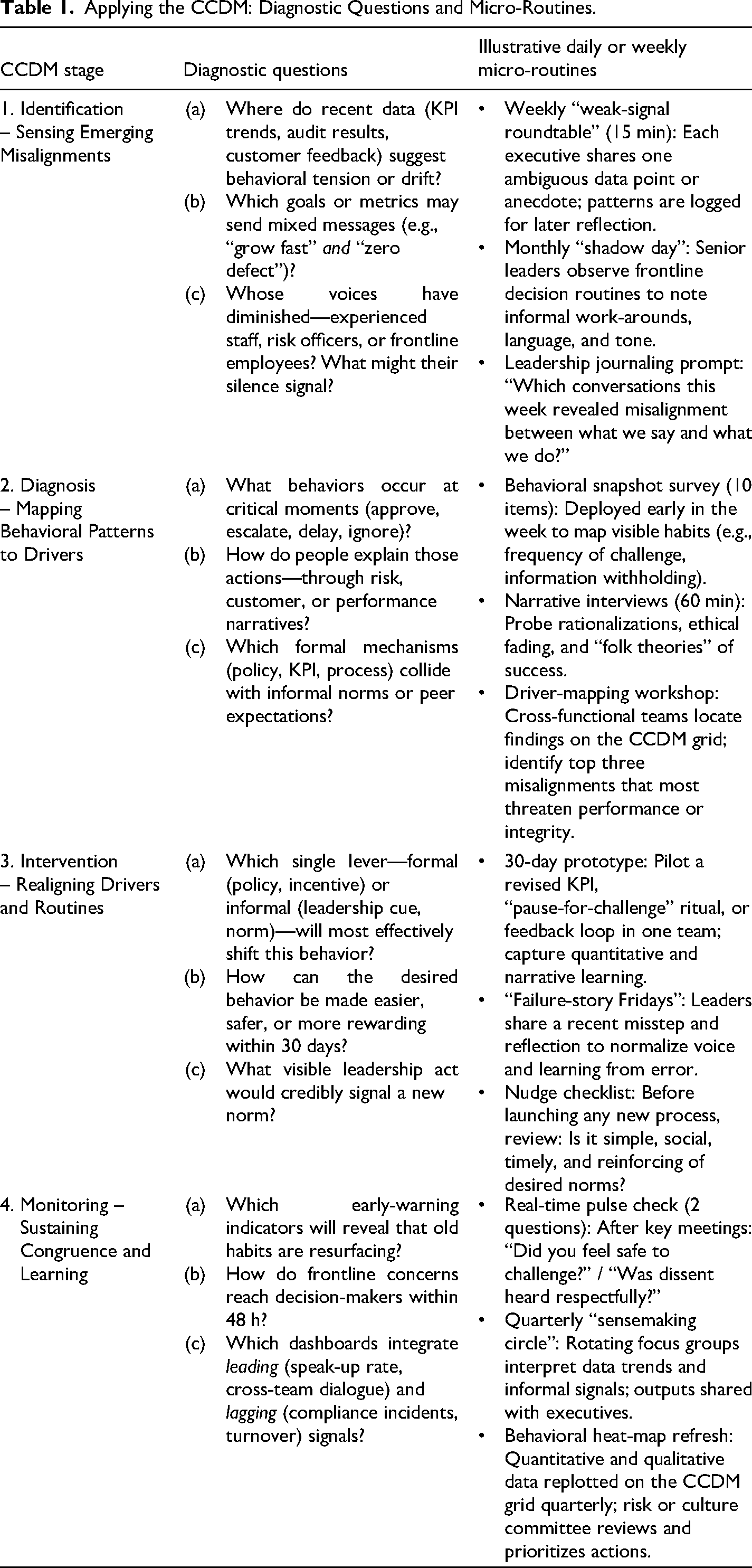
Table 1 illustrates how the CCDM can be embedded as an ongoing diagnostic discipline rather than a one-time assessment. The micro-routines and questions are intentionally adaptable: in highly regulated contexts (e.g., financial services, energy, healthcare), CCDM cycles may focus on behavioral risk, accountability, and compliance reliability; in creative or knowledge-intensive settings, the same routines can surface learning barriers, innovation bottlenecks, or psychological-safety dynamics. The key principle is the practice of disciplined reflection: noticing weak signals, translating data into dialogue, and iteratively recalibrating alignment between formal intent and lived experience. When consistently applied, the four-stage cycle enables organizations to transform culture work from episodic intervention into a continuous process of collective sensemaking and adaptive learning.
Illustrative Applications of the Cultural and Conduct Diagnostic Model
The CCDM has been applied across diverse sectors—finance, engineering, health, and professional services—to reveal behavioral incongruences that conventional audits often overlook. The following two anonymized field cases illustrate how CCDM surfaces the “invisible organization”: the informal norms, status hierarchies, and interpretive frames that shape conduct, collaboration, and risk.
Illustrative Applications Across Sectors
Example 1: Global Financial Services: The Low-Status Risk Function
Following a sequence of compliance breaches, a multinational financial-services group invited an independent behavioral diagnostic to clarify why risk management appeared structurally sound yet practically marginal. The CCDM analysis—combining interviews, document review, focus groups, and observation of compliance committees—revealed a hidden asymmetry of status and voice between commercial units and risk specialists.
Formally, collaboration between these units was mandated through a matrix structure and joint committees. Informally, however, risk officers were often excluded from early deal discussions or review decisions on risk profile status; when they did participate, their input arrived too late to influence pricing or risk assumptions. Two interacting drivers sustained the pattern.
Formal: performance metrics rewarded speed to market and deal volume rather than balanced risk–reward optimization. Informal: client-facing teams framed risk officers as “obstacles” lacking commercial judgment, while risk officers adopted a deferential “helper” role that reinforced their peripheral status.
These dynamics align with research on voice hierarchy and status-based power differentials, which show that low-status roles often struggle to exercise constructive dissent even when formally authorized (Detert & Burris, 2007; Edmondson, 2018; Fast et al., 2012).
Interventions, therefore, targeted status beliefs rather than procedures. The board publicly reframed the risk function as a cocreator of value, not a constraint; a “leadership laboratory” used simulations to demonstrate the behavioral costs of ignoring challenge; and new learning modules—listening for insight (for client leads) and assertive inquiry (for risk professionals)—were integrated into mandatory leadership development. The organization's lesson: structural solutions are insufficient unless informal status cues and identity narratives are also addressed—a principle central to CCDM's congruence logic.
Example 2: Heavy Engineering: Reframing Near-Miss Reporting as Learning
A multinational engineering company had invested heavily in a formal Safety Management System (SMS)—comprehensive work permits, safety protocols, and an electronic near-miss reporting portal. Yet, incident frequency remained stubbornly high. Using the CCDM, investigators explored whether behavioral and cultural incongruence, rather than procedural failure, explained the gap.
Interviews, focus groups, and on-site observations revealed that while the SMS was mature, the safety culture lagged behind. Supervisors were formally rewarded for high reporting volumes, yet informally, employees used the near-miss system to express frustration or retaliate against peers. Others avoided reporting to protect friendships or team cohesion. The coexistence of punitive and protective dynamics undermined psychological safety—the very condition necessary for reliable error reporting (Edmondson, 1999; Van Dyck et al., 2005).
From a CCDM perspective, the misalignment lay between formal incentives (measured compliance) and informal beliefs (fear of blame). Reform, therefore, centered on recognition that safety maturity extends beyond compliance and systems into mindset and Behaviors and rebuilding trust and psychological safety, the company launched a cultural transformation to embed Safety within its High-Performance Culture. The portal was redesigned so reports are anonymized and triaged by a mixed learning team. Managers completed “responsible-culture” workshops, and crews now conduct weekly peer reviews of anonymized near misses. The organization's insight echoed behavioral-safety literature: lasting improvement requires not only technical controls but also social reinforcement of psychological safety and learning behavior (Edmondson & Lei, 2014; Reason, 1997).
Across both cases, CCDM served not as a compliance diagnostic but as a behavioral mirror—revealing how well-intentioned systems were being shaped by informal meaning structures and leadership signals. In each instance, mixed-method inquiry turned abstract cultural concerns into actionable insights, enabling leaders to recalibrate congruence between formal mechanisms, informal norms, and behavioral outcomes. The result was not only better performance or compliance but deeper organizational learning.
Why Use the CCDM? Contributions to Applied Behavioral Science
The preceding illustrations highlight the CCDM's value as an integrative diagnostic framework that bridges formal systems and informal organizational dynamics. By examining where official narratives diverge from lived behavior, the CCDM helps leaders and researchers surface hidden dynamics—such as status hierarchies, defensive routines, and informal scripts—that conventional audits often overlook.
Rather than addressing symptoms, the CCDM directs attention to underlying behavioral drivers. Interventions, therefore, focus on aligning incentives, leadership signals, routines, and shared narratives. Sustainable change depends less on new rules than on aligning meaning systems and reinforcing feedback loops (Argyris & Schön, 1978; Schein, 2010).
The CCDM-guided diagnostics have supported organizations in recalibrating leadership messaging, redesigning incentives, and embedding cultural alignment in strategic processes. Across contexts—from financial services to engineering and healthcare—the model highlights how misalignment between formal structures and informal norms can undermine trust, engagement, and resilience.
The model's contribution extends beyond compliance or performance management. By linking espoused intent with enacted behavior, the CCDM operationalizes the behavioral-science principle that learning and adaptation emerge when feedback loops connect action with reflection. For practitioners, it provides a structured lens for diagnosing cultural incongruence and designing context-sensitive interventions. For scholars, it offers a framework for examining how behavioral risks arise from systemic misalignment and how leadership and learning processes restore congruence over time.
Limitations and Directions for Future Research
While the CCDM offers a framework for linking formal systems and informal dynamics, several limitations warrant consideration:
Scope and Context Sensitivity. The CCDM is primarily a diagnostic tool whose effectiveness depends on organizational openness and access to candid data. In highly hierarchical or politically charged environments, psychological safety may be limited, constraining voice and distorting indicators through social-desirability effects (Edmondson & Lei, 2014). Moreover, the expression of formal–informal dynamics varies across industries, geographies, and organizational cultures. Adapting and validating the model across diverse contexts, therefore, remains an important empirical challenge. Diagnostic, Not Prescriptive. By design, the CCDM identifies patterns of misalignment but does not prescribe specific interventions. Translating diagnosis into change requires complementary leadership and development approaches, such as adaptive leadership or dialogic organization development (Bushe & Marshak, 2016; Heifetz et al., 2009). Without such follow-through, organizations risk engaging in “diagnostic theatre”—performing assessments without meaningful behavioral change. Measurement and Inference Challenges. The integration of numbers and stories not only strengthens diagnosis but also raises methodological challenges. Quantitative indicators may be noisy or biased, while qualitative interpretations can vary across observers. Establishing causal relationships between behavioral drivers and organizational outcomes, therefore, remains an important frontier. Mixed-method and longitudinal research designs could improve validity and deepen causal insight. Scalability and Sustainability. Embedding CCDM practices—such as behavioral reviews or reflective learning routines—requires sustained leadership attention and institutional support. Without reinforcing systems, diagnostic efforts may become symbolic rather than transformative. Future research should examine how organizations institutionalize such learning practices and sustain them over time.
Future Research Agenda
Empirical studies across sectors could assess the model's robustness in different contexts. Longitudinal research may clarify how formal–informal congruence affects resilience, ethical performance, and innovation. Microlevel studies could further explore the psychological mechanisms linking congruence to behavior, while cross-cultural comparisons may illuminate how national and industry cultures shape these dynamics.
Conclusion
The CCDM conceptualizes culture as a dynamic system shaped by the interaction of formal mechanisms, informal norms, and leadership signals. By integrating these elements within a structured diagnostic cycle, the model advances both scholarship and practice in applied behavioral science.
For researchers, the CCDM provides a framework for examining how congruence between organizational systems supports learning, resilience, and ethical performance. For practitioners, it offers a structured approach to identifying hidden behavioral risks and aligning culture with strategy and purpose. In doing so, the CCDM connects the analytic rigor of behavioral science with the reflective practice of organization development, positioning culture diagnosis as an ongoing process of organizational learning and adaptation.
Footnotes
Acknowledgments
The author gratefully acknowledges Prof. Dr. Jacco Wielhouwer and Drs. Susan Smudde for their valuable comments on earlier versions of this manuscript.

Funding
The author received no financial support for the research, authorship, and/or publication of this article.
Declaration of Conflicting Interests
The author declared no potential conflicts of interest with respect to the research, authorship, and/or publication of this article.
Data Availability Statement
No datasets were generated or analyzed for this article.