



Abstract
Action learning has a rich heritage in management development and organizational learning. Its practices, in which groups of peers engage in questioning and reflection on actions to address problems, may be brought to a transdisciplinary research initiative, thereby creating a forum and process for members of transdisciplinary groups to work together. Transdisciplinary research through action learning is a candidate response to substantive problems for which no single disciplinary solution exist. In this paper, we make the case that the process of action learning facilitates the enactment of transdisciplinary research. Further, noting that enacting TDR is itself also a problem, we contend that engaging the co-researchers as an action learning set can lead to co-directing, co-developing and co-deploying resources to address the substantive problem.
Introduction
In action learning the starting point is action. It is based on the principle that “There can be no learning without action and no (sober and deliberate) action without learning (Revans, 2011, p. 83). From this perspective, problems provide novel opportunities for learning while the approach taken to address the problem brings challenges for those actors involved. The concept of transdisciplinary research (TDR) relates to a process of inquiry into complex problems that require interaction and collaboration among researchers from different disciplines and practitioners. From this perspective, problems require investigation from different knowledge bases taking into account the context of application. As active facilitators of action learning and active researchers collaborating across disciplinary boundaries and with practitioners, we came together to explore the challenges and benefits arising from our experience of blending action learning and TDR. To marshal our experiences, some of them shared, we extracted a set of five initiatives which captured this focus. In Table 1, we identify these five transdisciplinary initiatives that were addressed through action learning, noting the problem, the context of each intervention, the research team, and the roles. Two kinds of problem are in evidence: specific to each initiative and common across the five. The interventions in each illustrate the combinations of actors from different disciplines and practice who collaborated and engaged purposefully in action learning as they addressed the problems in their various industry and society settings.
Overview of Five Illustrative TDR Initiatives.
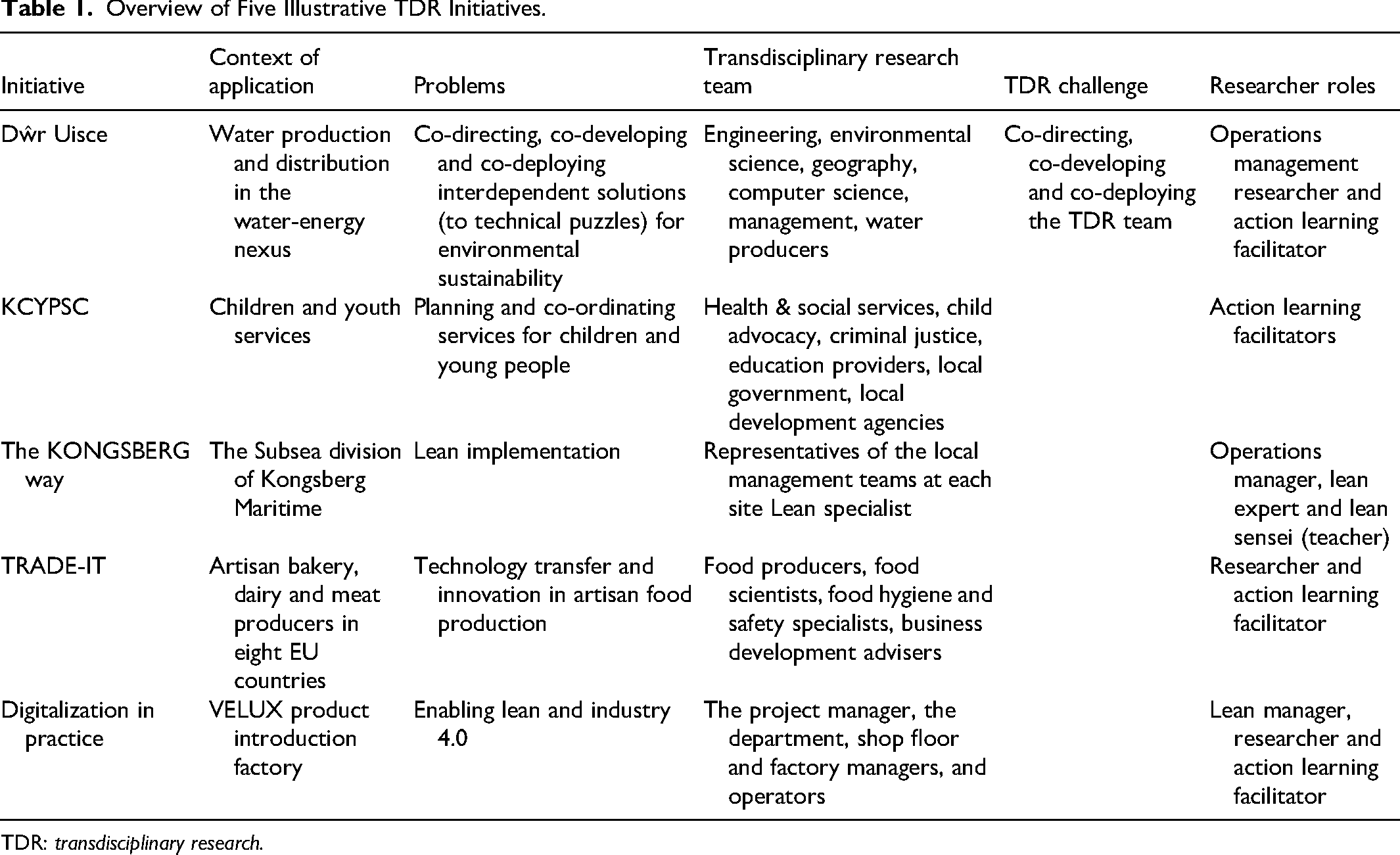
TDR: transdisciplinary research.
As a contribution to the Methodology Corner, this paper presents and reflects on our respective experiences as transdisciplinary researchers enacting an action learning approach in addressing complex problems in the various settings. Our objective in this paper is to articulate the methodology utilized in addressing the question, how can deliberate application of action learning support and enable TDR to generate new knowledge, and build innovative technological and social capacity to use this knowledge for actionable solutions. The paper is structured as follows: first we begin with brief overviews of TDR and action learning. We then integrate them, using five initiatives to provide evidence of practice. We then reflect on the evidence from these initiatives, applying both action learning and TDR perspectives. Finally, we propose our contributions to research practice.
Transdisciplinary Research
In the world of practice and research, there are different types of issue facing practitioners and researchers. Each brings the opportunity to produce different kinds of knowledge. Bolger et al. (2022) identified “a growing international momentum for transformative action at multiple levels to address key sustainability crises such as climate change, biodiversity loss and creating a circular and resource efficient society” (p.4). They went further and suggested that “the unique and urgent challenge of sustainability requires the exploration of more responsive modes of knowledge production to produce actionable and usable information” (p.4). While Bolger et al. (2022) focused on sustainability, the need and opportunity for more responsive and engaged modes of knowledge production are evident also in other areas of practice, including manufacturing and social care.
A significant implication of responsiveness and engagement in research is the need for reflexivity on the part of researchers and practitioners so that they can collaborate more effectively in their co-production of knowledge. To be attentive to and enquire into the research process as it unfolds requires an appreciation of the characteristics of this process being enacted. Research design choices include multidisciplinarity, interdisciplinarity, and transdisciplinarity. Nicolescu (2014) explores similarities and differences between these approaches:
Multidisciplinarity involves studying a research topic in not just one discipline but in several at the same time. Interdisciplinarity concerns the transfer of methods from one discipline to another. Transdisciplinarity concerns that which is at once between the disciplines, across the different disciplines, and beyond all disciplines.
It is the between, across, and beyond disciplines characteristic of research that is of interest here. The complexity of some problems which merit TDR can be such that no single discipline can address them, nor can collaborating disciplines address them without interaction with practitioners. It is here that transdisciplinarity has relevance.
TDR is a collaborative mode of knowledge production in real-life problem contexts, characterized by the inclusion of both multiple disciplines and practice-based knowledge and expertise in the knowledge production process (Polk, 2015). Bolger et al. (2022) noted: “Knowledge co-production can enhance research quality, deepen the understanding of the research question, produce more usable knowledge and increase the likelihood of its use in practice, along with building trust amongst stakeholders” (p.4). Scholz (2017) explored why TDR/knowledge co-production was needed and suggested that transdisciplinary processes develop “socially robust solutions for sustainable transitioning and impacts on the science system through mutual learning and by integrating epistemics from science and practice and focusing on the empowerment of stakeholders” (p.1).
There have been many contributions to the philosophy and practice of transdisciplinarity including: conceptual and analytical frameworks; methods and approaches for interaction and integration; specific cases showing the creative, the reflexive and transformative capacity of transdisciplinary inquiry; and concerns about the asymmetries of power and control of participants during the process of knowledge co-production (Lawrence, 2015). The OECD (2020) identified a set of characteristics of TDR which, if absent, could represent barriers to implementation: (a) breadth/diversity of interdisciplinarity; (b) depth of disciplinary integration; (c) degree/quality of interaction with non-academic participants; (d) composition of non-academic partnerships; (e) timing of participatory engagement; and (f) types of knowledge being emphasized. For Scholz (2017), epistemics and values in the processes of joint problem definition, problem representation, and problem transformation develop socially robust orientations. Accordingly, transdisciplinarity requires new roles for researchers and practitioners as it launches and facilitates mutual learning between and among researchers together with practitioners. These new researcher roles extend traditional design, data gathering, and analytic roles to include those of process facilitator, dialogue-enabler and perhaps trans- and interdisciplinary mediation.
Returning to the practical barriers to transdisciplinarity noted earlier by OECD (2020), it is clear that, in order to collaborate, partnerships need to develop a common language and mutual reflexivity in the shared context as they work towards a solution that is actionable and respectful of societal value conceptions. “Dialogue constitutes these partnerships, and such dialogs will have to be pragmatically adjusted to the cultural and socio-political context of the research, with particular attention given to the scope and scale of the issues” (Kaiser & Gluckman, 2023, pp. 23–24). Willetts and Mitchell (2006) provided useful insights into learning to be a transdisciplinary researcher using a community of practice approach. Further, Popa et al. (2015) also proposed that TDR would benefit from relating reflexivity “to collective processes of problem framing and problem solving through joint experimentation and social learning that directly involve the scientific and extra-scientific expertise” (p.45).
Recognizing both the potential difficulties of collective collaboration across (and between) disciplinary and practice boundaries, and also the relevance of reflexivity and learning helps to define boundaries for this paper. In particular, the combination of collaborative action and shared learning forms our rationale for considering the relevance and potential of action learning to exploring and exploiting transdisciplinary solutions to a problem. It is in response to this imperative that we are providing action learning as an appropriate methodology for TDR.
Action Learning
Action learning may be understood as a mode within the family of action-oriented research and collaborative learning approaches where the desired outcome is practical knowing and the inquiry process is enacted through collaborative engagement among co-researchers (Coghlan, 2011; Coghlan & Coughlan, 2015; Coughlan & Coghlan, 2011; Shani & Coghlan, 2021). Revans (1982) outlines the assumptions that underpin action learning. Learning is cradled in the task, and formal instruction is not sufficient. Problems require insightful questioning. Learning involves doing, is voluntary, spurred by urgent problems or enticing opportunities and is measured by the results of the action. Processes such as action and feedback, asking fresh questions, learning from and with each other in a learning group, the contribution of peers, and creating a multiplier effect are central to action learning. While the practice of action learning is demonstrated through many different approaches (Pedler et al., 2005), two core elements are consistently in evidence, that participants work on real organizational problems that do not appear to have clear solutions; and that participants meet on equal terms to report to one another and to discuss their problem and progress (O’Neil & Marsick, 2007). These elements complement Marquardt's (2004) six distinct interactive components of action learning: the problem, the group, the questioning and reflective process, the commitments to action and to learning, and the facilitator.
Engagement in action learning has technical dimensions combined with social dimensions in working together to address the problem (Boshyk & Dilworth, 2010; Coghlan & Rigg, 2013). Social learning, that is to say, learning with others, involves vulnerability and risk-taking by individuals as they admit to the limits of their knowledge or their lack of knowledge and explore new horizons. The antidote to this vulnerability and risk-taking is the atmosphere of trust that needs to be created in the social setting where the learning takes place in order that individuals may feel psychologically safe to unlearn and learn (Schein, 2002).
At the heart of action learning is a distinction between and among different kinds of issue. Revans (1982) distinguishes between puzzles and problems. Puzzles are those difficulties for which a correct solution exists and which are amenable to specialist and expert advice and solutions. Addressing a puzzle draws on the scientific method of identifying the issue, collecting and analyzing the data, formulating and implementing a solution. Problems, on the other hand, are difficulties where there is a lack of clarity about what the problem actually is, where there are different and valid perspectives and no obvious single solution (Revans, 2011; Edmonstone, 2014). Solving puzzles does not need action learning. In contrast, addressing problems is amenable to action learning because, in the process, different people can advocate alternative courses of action in accordance with their own value systems, disciplinary perspective, past experience, and intended outcomes.
Combining Transdisciplinary Research and Action Learning
To combine TDR and action learning, we apply Marquardt's (2004) conceptualization of action learning in the context of TDR. We describe briefly his six components, illustrating each with examples from the five initiatives summarized earlier in Table 1. Each of these initiatives demanded the collaboration of disciplinary-based actors who, not only engaged together and with practitioners in addressing the particular problem at hand but also participated in uncovering and articulating shared learning as a research contribution.
TRADEIT focused on artisan food producers who, by virtue of their small size and restricted resources, faced collaboration and learning challenges as they looked to develop their innovation and entrepreneurship capabilities through technology and knowledge transfer. A TDR team, including food scientists, management researchers and the food producers, collaborated to develop these capabilities in order to increase the competitiveness of the producers. Throughout, the team captured and ultimately codified 21 case studies in a book, describing individual perspectives, the places and produce, and reflecting on how the businesses improved their knowledge and technology transfer as a result of participating in the TRADEIT network (TRADEIT Case Book, 2016). For the VELUX factory, adopting and using I4.0 technologies was pivotal to succeed in their new formal role as a product introduction Factory. However, after 6 months, the production line did not show any improvement nor were the operators engaging in problem-solving efforts. A transdisciplinary team of management researchers, technologists and operators collaborated to explore why VELUX was not adopting and utilizing this core I4.0 technology, and how VELUX could develop the capabilities to address this problem (Saabye et al., 2023). KCYCSP faced various issues relating to provision of child and youth services by a range of agencies. Members of the participating agencies came to recognize that each agency had a distinctive culture and norms, worked differently, supported service provision to different extents, had different priorities and could sometimes be in competition with other agencies. The members framed the problem in terms of “why we work the way we do.” The action learning based opened up the transdisciplinary a new level of cooperation between the agencies.
In KCYCSP, various issues relating to provision of child and youth services were addressed by action learning sets. In discussions with the co-ordinator, the steering group and the five working groups that made up the Committee, it was agreed that each of working groups would make up an AL set. In Dŵr Uisce, the heterogeneous and diverse network of collaborators included two universities / research institutions in two countries, two water authorities (public enterprises), 60 + firms, and a conservation charity. The academic researchers engaged in the network were drawn from five discipline groups: engineering, environmental science, geography, computer science, and management (Coughlan et al., 2023).
In KONGSBERG, the focus shifted consciously from audits and compliance to problem-finding and collaborative learning. Lean assessments and Gemba walks (a Japanese term for walks in the real place such as the factory shop floor) became an opportunity for transdisciplinary dialogue and reflection rather than simply assigning a score and identifying arbitrary improvement opportunities (Powell & Coughlan, 2020).
In light of the complexity of the issues faced by the KCYPSC and the complexity of collaborating across so many agency boundaries, the Committee agreed to undertake building action learning into their monthly meetings over a year. In VELUX, the team reflected openly and repositioned the research problem, treating the phenomenon of I4.0 adoption and complementarity with lean as a problem rather than a puzzle. Evolving from this insight, the team recognized the necessity for action learning, and co-designed and co-deployed interventions to find, face, frame and form solutions to problems.
In Dŵr Uisce, one of the authors brokered conversations across the disciplines and maintained commitment to learning. The collaborators learned how to share, question, reflect on, and communicate their evolving disciplinary and transdisciplinary ideas in a supportive, trusting, and appreciative manner. They came to understand how to co-develop technical, process, and organizational knowledge and co-deploy it to produce new practical and theoretical knowledge. The KCYPSC initiative also illustrated the roles played by the researchers. One of the authors facilitated the AL activities while a second author provided support, challenge, and scrutiny in the role of critical friend. In the KONGSBERG initiative, the researcher was employed as lean program manager. As the initiative progressed, the researcher's role shifted radically from lean expert (an instructor, having all the answers and instructing people what to do), to lean sensei (a learning facilitator, having only questions and promoting deep thought and learning, both in individuals and in teams). This also made it essential to engage top management in the lean initiative, rather than just production managers and shop floor operators.
Discussion and Contribution to Research Theory and Practice
In this paper, we have explored the integration of action learning in TDR and, in particular, the ways in which the co-researchers collaborated in the process. In this section, we distill and discuss the emerging insights. We do not revisit the five initiatives—the content of each is different and the research response is contextualized within each. However, what is of interest here is the methodology whereby action learning was utilized to advance TDR and overcome the associated challenges.
At the outset, we looked to address the following question: how can deliberate application of action learning support and enable TDR to generate new knowledge, and build innovative technological and social capacity to use this knowledge for actionable solutions. En route, we drew from five initiatives in which each of us, individually or in combination, engaged.
Each of the five initiatives illustrates a particular problem which could not be addressed as a single-disciplinary or technical puzzle. All of the initiatives were located in different contexts, comprising manufacturing, delivery of social services, the water-energy nexus, and artisan food production. The problems addressed were not trivial and each was characterized by an expectation of social accountability which was demonstrated through engagement in practice by transdisciplinary teams rather than recommendations for action by others.
Our emerging insights contribute to the philosophy and practice of transdisciplinarity, guided by Lawrence (2015), noted earlier. In particular, we reflect on the use of conceptual and analytical frameworks; methods and approaches for interaction and integration; the creative, the reflexive, and transformative capacity for transdisciplinary inquiry; and concerns about the asymmetries of power and control of participants during the process of knowledge co-production. We examine each of these in turn.
Underpinning and guiding each of the initiatives were both conceptual and analytical frameworks which crossed disciplinary boundaries. Each framed the problems and identified them as meriting the application not just of different disciplinary perspectives but also the undertaking of collective action with practitioners for impact. The methods and approaches for interaction and integration differed across the initiatives—as might be expected—given their different contexts and purposes. Each initiative exhibited creativity in structuring and engaging the various co-researchers so that, as teams or sets, they were reflexive and exhibited the transformative capacity required for transdisciplinary inquiry. Some even changed the ways in which they engaged with the emergent problem in order to maintain progress towards resolution. Finally, there was no evident concern about the asymmetries of power and control of participants during the process of knowledge co-production. However, that is not to say that such a concern is irrelevant for such initiatives. Because, the co-researchers had engaged with such challenges previously, as action learning facilitators, they were able to exploit this experience to progress the initiatives on this occasion. Additionally, as facilitators, they had relational capital to work with as they engaged in the action learning.
Having reflected on the initiatives from the perspective of TDR, we turn now to our contribution to the practice of action learning. Common across the initiatives was the action learning process deliberately undertaken by the teams as they engaged in questioning and reflection, where they were committed both to addressing the problems and to learning. The process undertaken in each initiative demonstrated the combining of action learning and TDR where academic researchers from different disciplines and practitioners collaborated.
The initiatives also demonstrated how a transdisciplinary team could be brought together and keeping together, so as to co-direct, co-develop, and co-deploy actionable responses to the particular problems. Here, the teams included action learning facilitators who enabled reflexivity and the realization of learning in and from action. In the context of transdisciplinary teams, these facilitators acted as brokers and caretakers in addition to the expected roles as coordinators, catalysts, observers, climate setters, communication enablers, and learning coaches. They also acted as researchers in how they how they designed the research approach, captured the emergent learning within the groups and consolidated the emerging insights in published outputs.
Conclusion
In this paper, we have explored how deliberate application of action learning and engaging co-researchers can support and enable TDR. The result is to generate new knowledge, and build innovative technological and social capacity to use this knowledge for actionable solutions. As TDR becomes more prevalent in our complex world of grand challenges and wicked problems, further reflection on experiences is needed to build up our actionable knowledge on TDR. Reflecting on the role of action learning researchers in the transdisciplinary setting, they need focused education and training, including on themes such as team construction, philosophy and application of action learning, and building and maintaining collaborative research relationships. This study has brought together five initiatives where action learning facilitated the co-directing, co-development, and co-deployment of TDR-informed actions towards solutions. The emergent characteristics of quality TDR through action learning merit further development.
Footnotes

Funding
The authors received no financial support for the research, authorship, and/or publication of this article.
Declaration of Conflicting Interests
The authors declared no potential conflicts of interest with respect to the research, authorship, and/or publication of this article.