




Abstract
Based on a symbolic–interpretive and social–constructivist research approach, this longitudinal study explores how employees perceive workspace changes. Rich empirical processual data that were continuously collected during the change process were used to analyze workspace changes as a new type of organizational change, thereby contributing to sensemaking research. Three types of change recipients from employees’ responses to a workspace change based on differences in their underlying cognitive, behavioral, and affective patterns throughout the sensemaking process were identified: those with positive attitudes and perceptions, those with negative attitudes and perceptions, and those exhibiting a change toward positive attitudes and perceptions. As a practical contribution, change agents and leaders can gain insights and guidance for managing different employees by considering the individual patterns that trigger changes in employees’ perceptions throughout the change process. These insights about sensemaking also contribute to organizational development and change management research.
Keywords
Introduction
In an increasingly dynamic world, “organizations rely on their employees to adapt to change” (Stanley et al., 2005, p. 429), but the way employees respond to organizational change differs greatly, depending on various factors (see, e.g., Peng et al., 2021; Vakola et al., 2021). The same type of change might lead some employees to respond with “active and constructive responses, [whereas] others will engage in […] destructive responses” (Bernerth et al., 2007, p. 321). During organizational changes, employees “are not solely passive recipients of change [… but they] make sense of them, having feelings about them, and judging them” (Bartunek et al., 2006, p. 203). As people subjectively interpret and assess organizational changes, research focusing specifically on change recipients’ perceptions of different types of change is needed to understand the potential antecedents and underlying emotions and patterns of employees’ responses to change (Khaw et al., 2022; Oreg et al., 2018; Stouten et al., 2018).
Workspace changes, such as “new ways of working” (Van Meel, 2011), “new work” (Bergmann, 2020), “workplace strategies” (Savage, 2005), “work transformation” (Robertson, 2000), and “workspace concepts” (Skogland & Hansen, 2017), are the response of an increasing number of organizations to increased global competition for the “best talents” (Greene & Myerson, 2011), an increasing need for flexibility, individualism, and mobility, and the rise in digitalization and new technologies (Gonsalves, 2020; Skogland & Hansen, 2017). As defined for this study, workspace changes are understood as an organizational change initiative that results from simultaneous changes in the physical, technical workplace design (e.g., activity-based offices, open space, or open offices) and changes in the social, cultural, and organizational workspace (Jemine et al., 2021; Skogland & Hansen, 2017) that affect “where, when and how” employees work (Appel-Meulenbroek et al., 2011, p. 123). Such workspace changes therefore affect not only employees’ wellbeing, motivation, satisfaction, and productivity but also business or organizational processes, leadership, and organizational culture (Hongisto et al., 2016; van der Voordt, 2004). Thus, there is a need for new forms of work behavior, new processes (Ayoko & Ashkanasy, 2020), and new aesthetics and symbols in the workplace (Baldry, 1997; Hatch, 2018).
Employees’ sensemaking during organizational change has often been conceptualized as perceptions, interpretations, and actions (Weber & Glynn, 2006) and therefore primarily refers to cognitive and behavioral patterns. However, the role of emotions in sensemaking—for example, whether emotions, such as anger, fear, and sadness, facilitate, stimulate (see, e.g., Maitlis et al., 2013; Maitlis & Sonenshein, 2010), or inhibit sensemaking (see, e.g., Heaphy, 2017)—remains unclear in empirical studies and in theory (Dwyer et al., 2023; Kroon & Reif, 2021; Sandberg & Tsoukas, 2015). Further, sensemaking researchers suggest integrating the material or physical context, such as the work environment, in the sensemaking process (see, e.g., Bakke & Bean, 2006; Stensaker et al., 2021; Weiser, 2021). Thus, understanding how workspace changes are managed presents a new research opportunity in the field of organizational development and change management (see, e.g., Jemine et al., 2020; Sirola et al., 2021). Workspace changes can threaten employees’ identity and personal attachment to the workplace (Elsbach & Bechky, 2007; Taskin et al., 2022) and can lead to negative emotions like uncertainty, anger, mistrust, or fear (Dent & Goldberg, 1999; Rafferty & Jimmieson, 2017; Shimoni, 2017). Adjusting to workspace changes therefore entails intriguing reactions that make studying the change dynamics of employees’ sensemaking and the occurring emotions particularly interesting (Dwyer et al., 2023; Kroon & Reif, 2021).
Although organizations increasingly use workspace changes to achieve strategic organizational goals (Jemine et al., 2021; Skogland & Hansen, 2017), a theoretical foundation for managing such changes and for how to understand reactions to change is missing in workplace management research (Appel-Meulenbroek & Danivska, 2022; Renard et al., 2021). Furthermore, empirical studies on workspace changes have produced mixed and contradictory results about the effects of reactions to change on individual or organizational effectiveness and performance (Chadburn et al., 2017; Morrison & Smollan, 2020). Thus, there is an ongoing theoretical debate about “mutual gains vs. conflicting outcomes” (Renard et al., 2021, p. 1) when workspace changes are introduced. As only a few studies have focused on workspace changes against the background of sensemaking (see, e.g., Jemine et al., 2021), we ask the following research questions: How do employees make sense of workspace changes that are implemented as planned organizational change? What are the implications for effectively managing such workspace changes? To answer these questions, we adopted a symbolic–interpretive research approach (Hatch, 2018) and a social–constructivist processual perspective (Poole et al., 2000) to analyze employees’ perceptions and their sensemaking of a planned workspace change in a German insurance company.
Our study makes two key contributions to the literature. First, it provides new grounds for the study of sensemaking by exploring change recipients’ emotions and individual patterns of reaction in their sensemaking processes during organizational changes. We identify three types of change recipients and their underlying cognitive, behavioral, and affective sensemaking patterns, thereby complementing research that focuses on the role of emotions in sensemaking (see, e.g., Dwyer et al., 2023; Heaphy, 2017; Kroon & Reif, 2021; Maitlis et al., 2013). We accomplish this by conceptualizing attitude to change and sensemaking as multi-dimensional constructs (Bouckenooghe et al., 2021; Dwyer et al., 2023; Piderit, 2000) and analyzing workspace changes inside a German insurance company using a longitudinal and processual research approach. By doing so, we generate rich empirical findings inside an industry that is under strong strategic pressure to change (Kotarba, 2023; Schwarzbach et al., 2023), is characterized by an organizational risk culture that emphasizes risk awareness (Bockius & Gatzert, 2023; Roeschmann, 2014), and promotes stability over innovation (Shennaev, 2020; Yan et al., 2018).
Second, our study contributes to change process research (Oreg et al., 2011; Stouten et al., 2018) and adds specificity to how to consider individual sensemaking patterns that trigger changes in employees’ perceptions during workspace changes (see, e.g., Jemine et al., 2020; Sirola et al., 2021). We also provide guidance for managing workspace changes as a contemporary type of organizational change (Appel-Meulenbroek & Danivska, 2022; Renard et al., 2021) and furnish change agents and leaders with valuable recommendations and activities on how to manage various change recipients by considering their individual feelings and responses during the change process.
Theoretical Underpinnings
Managing Workspace Changes as Planned Organizational Change
Managing organizational change is a complex undertaking, and researchers have long been interested in why some employees hinder organizational change while others support it (Burnes, 2011). As the way employees experience and construct meaning about organizational change evolves over time (Isabella, 1990; Maitlis & Sonenshein, 2010), managing workspace changes requires considering employees’ individual attitudes (Bouckenooghe et al., 2019; Vakola & Nikolaou, 2005) and their sensemaking (Weick, 1995) along the change process. In studies that adopt such a process view, sensemaking is understood as a complex, dynamic process (Sandberg & Tsoukas, 2015) in which employees revise their change schemata or interpretations as the change unfolds (Jones & van de Ven, 2016). Sensemaking is also understood as an ongoing social process and a process of social construction (Berger & Luckmann, 1967) that continuously occurs individually (individual sensemaking) and collectively (collective sensemaking) among all employees (Maitlis & Christianson, 2014).
An increasing number of organizations use workspace changes that are based on new physical workplace designs (e.g., activity-based offices, open space, or open office) as a planned organizational change initiative to transform their business processes, employees’ work activities, and organizational culture (Jemine et al., 2021; Morrison & Smollan, 2020; Skogland & Hansen, 2017). However, a theoretical foundation for managing workspace changes by considering employees’ individual responses to change is missing (Appel-Meulenbroek & Danivska, 2022; Kämpf-Dern & Konkol, 2017; Renard et al., 2021).
Research has demonstrated that the individual needs, preferences, tasks, and work characteristics (e.g., mobility, degree of individual work vs. communication, and interaction) of affected employees should be taken into account when implementing workspace changes (Elsbach & Bechky, 2007; Rothe et al., 2011). Common strategies for successful workspace changes also refer to open communication (Airo et al., 2012), active listening, and involving recipients in the change process (Bareil, 2013; Jemine et al., 2020, 2021). In this context, adequately preparing employees before moving to a new environment (Kämpf-Dern & Konkol, 2017; Palvalin & van der Voordt, 2017) and supporting them after moving—for example, through IT training or furniture briefings (Kämpf-Dern & Konkol, 2017)—are considered crucial to support individuals’ sensemaking process.
Furthermore, recent studies have demonstrated that the way employees perceive the process of implementing and managing workspace changes is related to employees’ satisfaction with the new environment (e.g., after moving from closed offices to activity-based offices; Sirola et al., 2021). Successful workspace changes require the integration of high-quality change management, the monitoring of user experiences, and giving employees opportunities to participate in the course of the change process (Sirola et al., 2021; Vischer, 2012). Therefore, examining the introduction of workspace changes through a sensemaking lens might add knowledge to assist in gaining a better understanding of managing workspace changes from an end user's perspective (Appel-Meulenbroek et al., 2011). Moreover, it might provide new explanations for the inconclusive, mixed results obtained to date. This becomes even more important because researchers in the field of sensemaking suggest integrating the material context, such as the work environment or the physical setting, as influencing factors in the sensemaking process (see, e.g., Bakke & Bean, 2006; Stensaker et al., 2021; Weiser, 2021).
Making Sense of Planned Workspace Changes
Although change attitude is understood as a multi-dimensional construct consisting of cognitive, behavioral, and affective dimensions (Bouckenooghe et al., 2021; Piderit, 2000), the sensemaking literature has focused primarily on cognitive and discursive processes (see, e.g., Maitlis & Christianson, 2014; Sandberg & Tsoukas, 2015). In this section, we address the three dimensions of sensemaking: cognitive, behavioral, and affective patterns.
The cognitive dimension of sensemaking encompasses the mental processes that individuals use to construct the meaning of organizational change and refers to thoughts and beliefs about change, such as regarding change as unbeneficial or unnecessary (Rafferty & Jimmieson, 2017; Schulz-Knappe et al., 2019). Individuals engage in “talk, discourse and conversation” (Weick, 1995, p. 41) to develop shared meanings “that make sense of their environments when existing meanings break down” (Dwyer et al., 2023, p. 422). Commitment, expectations, and identity are understood as important types of shared meaning that can both enable and constrain collective sensemaking (Maitlis & Sonenshein, 2010).
Organizational commitment is related to sensemaking because it “describes how much employees identify with their employer and how willing they are to engage with the organization” (Schulz-Knappe et al., 2019, p. 673). Employees’ commitment to a certain set of meanings (e.g., strategy or vision) might prevent them from adapting to new organizational meanings (e.g., a new strategy or vision, such as a new workspace concept) and, consequently, lead to change resistance when organizational change occurs (Maitlis & Sonenshein, 2010). Expectations are related to creating meaning, as—mainly at the beginning of the change process—“employees assemble information to speculate on how change will unfold and anticipate its impact” (Jones & van de Ven, 2016, p. 487). In the course of the change process, employees use mental maps or schemas to “guide [their] interpretations of the past and present and expectations for the future” (Harris, 1994, p. 310).
As identity is often threatened or replaced by a new one during organizational change (e.g., new roles for employees after organizational transformation), a shared identity that “provides a vital anchor around which collectives construct meaning and understand their experiences” (Maitlis & Sonenshein, 2010, p. 563) is regarded as crucial for sensemaking (Weick, 1995). As workspace changes often require new forms of work behavior and new processes and practices (Ayoko & Ashkanasy, 2020), employees’ identity might be threatened, which influences their sensemaking process (Maitlis & Sonenshein, 2010). Furthermore, research in the fields of environmental psychology, organizational identity, and organizational symbolism reveals “a complex relationship between office design and individual employee attitudes and behaviors” (Elsbach & Bechky, 2007, p. 82). For example, the symbolic function of office design (e.g., office décor as a form of personalization or group status; Baldry, 1997) influences employees’ identities and their attachment to the workplace (Elsbach & Bechky, 2007) and, thereby, individuals’ sensemaking process during workspace changes.
The behavioral dimension of sensemaking can be understood as key processes for organizational adaptation, such as information seeking, meaning and action ascription (Thomas et al., 1993), scanning, interpretation, and responding (Daft & Weick, 1984). However, behavioral patterns can also include resistant behaviors, such as questioning, doubting, arguing, and hesitating (Schweiger et al., 2018), simulation of productivity, working to rule, machine sabotage, gossiping, using irony, or playing dumb (Wiedemann et al., 2021), which “can appear before, during, or after a change implementation” (Bareil, 2013, p. 62). In the context of workspace changes, behavioral patterns might also include space-ownership conflicts and territory defense (Vischer, 2012).
The affective dimension of sensemaking refers to patterns that might arise during changes from the familiar to the unfamiliar or negative emotions, such as dislike of the change, personal uncertainty, anger, reciprocal disgust, frustration, decreased motivation, mistrust, fear, and anxiety (Bareil et al., 2007; Dent & Goldberg, 1999; Rafferty & Jimmieson, 2017; Shimoni, 2017). Although several authors acknowledge the importance of emotions as part of the sensemaking process (see, e.g., Bartunek et al., 2006; Maitlis & Christianson, 2014), affective patterns have been under-researched in empirical studies and in theory. In this context, the role emotions play in sensemaking (e.g., facilitating, stimulating, or hindering it; see, e.g., Heaphy, 2017; Maitlis et al., 2013), particularly the role of emotions in post-incident sensemaking, is not yet fully understood (Dwyer et al., 2023; Kroon & Reif, 2021; Sandberg & Tsoukas, 2015). Consequently, there is a need for further research that focuses not only on resisting behavior but also on the emotions employees develop over time (Jones & van de Ven, 2016; Shimoni, 2017).
Research Methods
Qualitative Interpretive and Processual Research Approaches
Given that sensemaking is a process of social construction (Berger & Luckmann, 1967), in which employees “interpret and explain sets of cues from their environments” (Maitlis & Christianson, 2014, p. 64), we adopted a symbolic–interpretive research approach (Hatch, 2018) and a social–constructivist processual perspective (Poole et al., 2000) to understand how employees perceive workspace changes. A processual research approach was chosen to examine employees’ behavior and how it unfolds over time (Pettigrew, 1990). We assumed that “human understanding and action are based on the interpretation of information and events by the people experiencing them” (Gioia & Chittipeddi, 1991, p. 435).
Whereas factor models traditionally focus on antecedent conditions and their effects on outcomes (Newman & Robey, 1992), process research focuses on “the processes or sequences of events” (Van de Ven & Poole, 1995, p. 510) and on “understanding patterns in events” (Langley, 1999, p. 692). Some authors call for a strict separation of process models from factor models (see, e.g., Mohr, 1982). However, we followed Langley's (1999) and Newman and Robey's (1992) understanding of process research and included antecedents and contextual variables to gain a comprehensive understanding of employees’ perceptions of workspace changes.
The conceptual model for this study is based on Newman and Robey's (1992) and Bartunek et al.'s (2006) conceptual models, as presented in Figure 1. Building upon knowledge from the change management and workplace management literature (see, e.g., Rafferty & Simons, 2006; Skogland & Hansen, 2017), we explored project roles, work organization (such as processes, tasks, or stress), individual characteristics, needs and preferences, and leadership during planned organizational workspace changes as antecedent conditions of sensemaking. During the sequence of events in which actual change happens, recipients’ individual activities, behaviors, thoughts, and emotions, as well as their interactions with each other and with change agents (Isabella, 1990), are considered to be involved in “what people do to enact change” (Johnson et al., 2007, p. 13). As change attitudes can lead to both destructive and constructive responses (Bouckenooghe et al., 2019; Thomas et al., 2011), we incorporated the term “attitude to change” (Oreg et al., 2011) in our conceptual model. We also included the broader organizational context, consisting of elements such as strategy, structure, and culture. In line with researchers who situate workspace changes in the context of planned organizational change, we assessed change outcome as a personal benefit balance (Kämpf-Dern & Konkol, 2017), understood as perceived gains and losses (Bartunek et al., 2006) and leading to employees’ perceived productivity and satisfaction (van der Voordt, 2004).
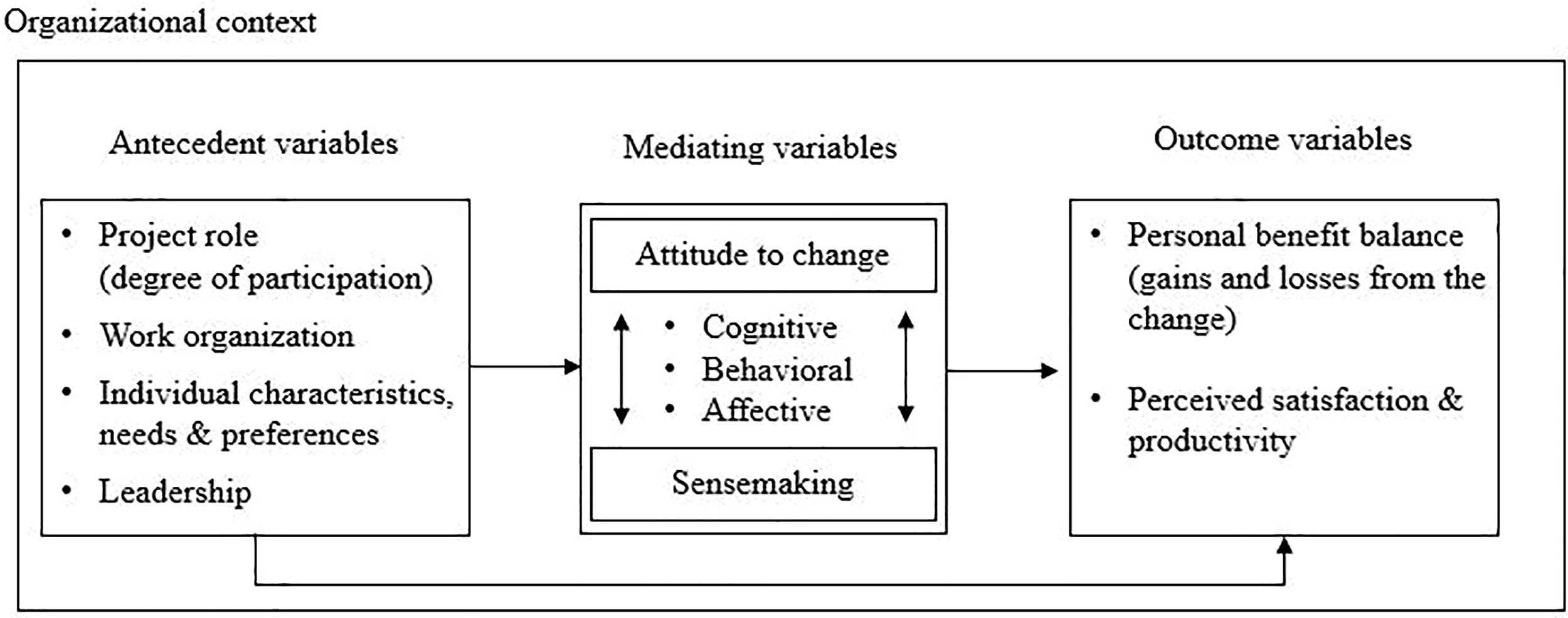
Conceptual model based on Newman and Robey (1992) and Bartunek et al. (2006).
Longitudinal Exploratory Case Study
Consistent with the processual approach, this study is part of a longitudinal field study conducted over more than two years. To fully capture the mutual relationship between the different components of change attitude and sensemaking as multidimensional constructs, longitudinal research designs that assess, for example, attitudes at various times (e.g., before, during, and after the change) are required (Schulz-Knappe et al., 2019).
We sought to explore any phenomenon in the data that could provide insight into sensemaking processes, together with prior fieldwork and small-scale data (Yin, 2017), to clarify crucial activities during planned organizational workspace changes before focusing on individual employees’ responses to such changes.
The selected case relates to the introduction of activity-based open offices and the resulting workspace changes being piloted in a German insurance company. As defined for this study, workspace changes are understood as an organizational change initiative that not only influences the physical and technical workplace design but also affects “where, when and how” employees work (Appel-Meulenbroek et al., 2011, p. 123). By rebuilding existing enclosed offices into activity-based open offices, the project served as a pilot test to understand how employees perceived the planned workspace change. Although the workspace changes were implemented as the company's response to major ongoing changes in its environment (Cummings & Worley, 2014), the company's aim was to increase employee satisfaction and productivity to support the company's newly developed cultural vision; increase digitization, automation, and flexibility; and strengthen an atmosphere of trust, teamwork, communication, and transparency. A suitable change management process was facilitated through the involvement of change agents.
To ensure broad employee involvement and shared decision making, employee representatives were selected to actively participate in workshops throughout the project. The 70 employees selected came from two departments (project-based work and line operations) and had three different direct supervisors (A, B, and C). Being particularly suitable for theory building or refinement based on the insights gained from the cases, we used an embedded case study approach (Langley, 1999) and explored 24 of these 70 employees as multiple (embedded) cases in detail. Our aim was to understand the workspace change within its broader context and to gain a holistic understanding (Scholz & Tietje, 2002) of employees’ sensemaking patterns during the workspace change.
Data Collection
We conducted 48 semi-structured interviews with 24 randomly selected volunteer employees from the two affected departments. Each employee was interviewed for 45–90 min at two different times: before moving to the new workspace and again after moving. In addition to the semi-structured interviews, qualitative data were collected retrospectively and in real time over 25 months (October 2017 to October 2019) using observation, unstructured interviews, and document analysis (Langley, 1999) during the development and implementation phase.
Although the focus of this study is on the micro perspective of the individual employee as a change recipient, empirical data from various informants with multiple perspectives and who functioned as change recipients or change agents were included to fully understand the contextual dynamics and sequences of events (Van de Ven & Poole, 1995) leading to employees’ perceptions of change. In this context, all encounters between change agents and change recipients were regarded as such sequences of events.
As a researcher accompanying the organizational change process, the first author of this study had close access to valuable data throughout the project. From the beginning of the project, her role was fully disclosed (Pollack & Pollack, 2015). The second author was also part of the core project team and was mainly involved in consulting activities concerning change management and providing methodological and conceptual support. With the study's overall goal of understanding employees’ attitudes, sensemaking, and perceptions of workspace change, data collection from observations and unstructured interviews took place around the following key questions: “How do you feel about the planned workspace change?” and “What do you think about it?” Unstructured interviews lasted between 10 and 45 min. To capture a ‘thick description’ (Langley, 1999) of employees’ workspace perceptions and to document them as completely as possible, narrative vignettes (Miles & Huberman, 1994) and memos (Corbin & Strauss, 1990) were used. For this purpose, key statements from employees were noted retrospectively, often by the evening of the day of conversations or observations. Following Schatzman and Strauss (1973), these memos described “who said or did what, under stated circumstances” and “contain[ed] as little interpretation as possible” (p. 100). In addition to measuring the perceived productivity after moving as self-assessed by individuals, leaders’ reports about collective productivity numbers across all departments were included to capture as complete a picture as possible. Thereby, the obtained self-assessed productivity by individuals was checked for plausibility.
Data Analysis
Data analysis included qualitative inductive and abductive data coding (Miles et al., 2013) and “visual mapping” (Langley, 1999; Miles & Huberman, 1994), in which data were coded into graphical representations that were iteratively developed throughout the process (Miles & Huberman, 1994). Based on the qualitative approach discussed by Miles et al. (2013) and assisted by MaxQDA software, a first cycle of inductive coding was used to derive the main variables affecting sensemaking from the empirical data. In spite of this inductive step of data analysis, the coding was theory-driven, meaning that the proposed conceptual model provided the main coding structure, yielding codes about antecedents, change attitudes, sensemaking patterns, and outcomes. As presented in Figure 2, abductive coding was used in a second cycle of analysis to obtain more detailed second-order categories that emerged directly from the empirical data and from the literature. In the third cycle, the developed coding structure was further summarized and aggregated into the main individual patterns consisting of cognitive, behavioral, and affective dimensions.
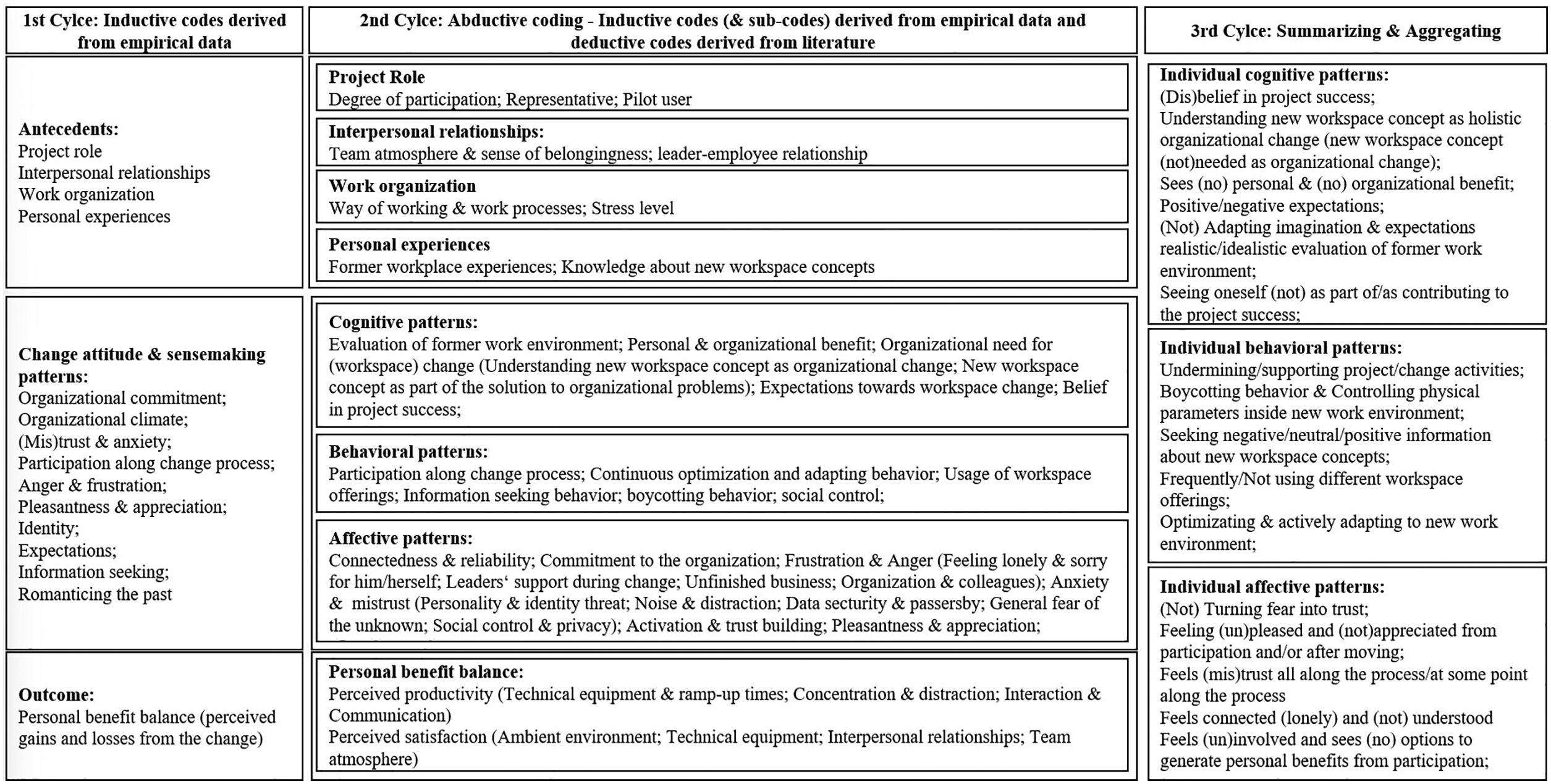
Developed coding structure during data analysis.
The first column in Figure 2 reports the codes generated from the first cycle inductive analysis, organized according to the main variables of antecedents, change attitudes and sensemaking patterns, and outcomes. As will be discussed in the results, each of these main variables includes several subthemes. The second column in Figure 2 includes the codes generated from abductive analysis in the second cycle of coding. These are organized to align with their corresponding main codes: antecedents, change attitudes and sensemaking patterns, and outcomes. The third column in Figure 2 includes the summarized and aggregated codes generated from abductive analysis in the third cycle of coding and are organized to align with their corresponding second-order categories of individual cognitive, behavioral, and affective sensemaking patterns from the second cycle of coding.
Langley (1999) suggested sensemaking strategies for data analysis to overcome strict adherence to either theory (deductive coding) or data (inductive coding) when theorizing from the process data. Consistent with this notion, we chose an iterative, abductive data reduction and analysis process using codes created from the literature (deductive coding) and codes that emerged from our empirical data (inductive coding; Miles et al., 2013). As workspace changes in the context of planned organizational change present a new phenomenon, using an exploratory research approach (Yin, 2017) with abduction as a data analysis method was deemed suitable for “generat[ing] new theory by inductively discovering a surprising empirical puzzle of theoretical significance and then deductively developing and refining the emergent explanation” (Gonsalves, 2020, p. 7) in such a nascent research field.
The units of analysis for assigning codes were individual statements or complete paragraphs, which were assigned to multiple codes if necessary and useful (Corbin & Strauss, 1990). Recognizing that process research is concerned with identifying “the antecedents or consequences of changes in organizational forms” and with understanding that “organizational change[s] emerge, develop, grow or terminate over time” (Van de Ven & Huber, 1990, p. 213), we included “phenomena such as changing relationships, thoughts, feelings, and interpretations” (Langley, 1999, p. 692). Therefore, as the project proceeded, additional data, such as post-move interviews with the pilot users, narrative vignettes, and memos gathered from project observation and informal conversations, were coded to understand how employees’ feelings, thoughts, attitudes, behaviors, and individual needs changed over the course of the change process.
In addition to the three cycles of coding, visual mapping for systematic data reduction and synthesis was performed (Miles & Huberman, 1994). By representing “large quantities of information in relatively little space” (Langley, 1999, p. 700), the resulting visual representations (“visual maps”) were supplemented with other methods (Langley & Ravasi, 2019) and therefore conducted in addition to the three cycles of inductive (first cycle) and abductive (second and third cycles) coding. While during the first cycle inductive coding was used to create codes that emerged from our empirical data, the abductive coding in the second and third cycles allowed using both, codes created from the literature (deductive coding) and codes that emerged from our empirical data (inductive coding; Miles et al., 2013). Whereas visual mapping focused on employees’ attitudes toward the change, the three cycles of coding specifically took employees’ sensemaking patterns and their perceptions of the workspace change after moving into account; the analysis therefore incorporated data collected from key questions relating to employees’ perceived gains and losses, and their perceived satisfaction and productivity.
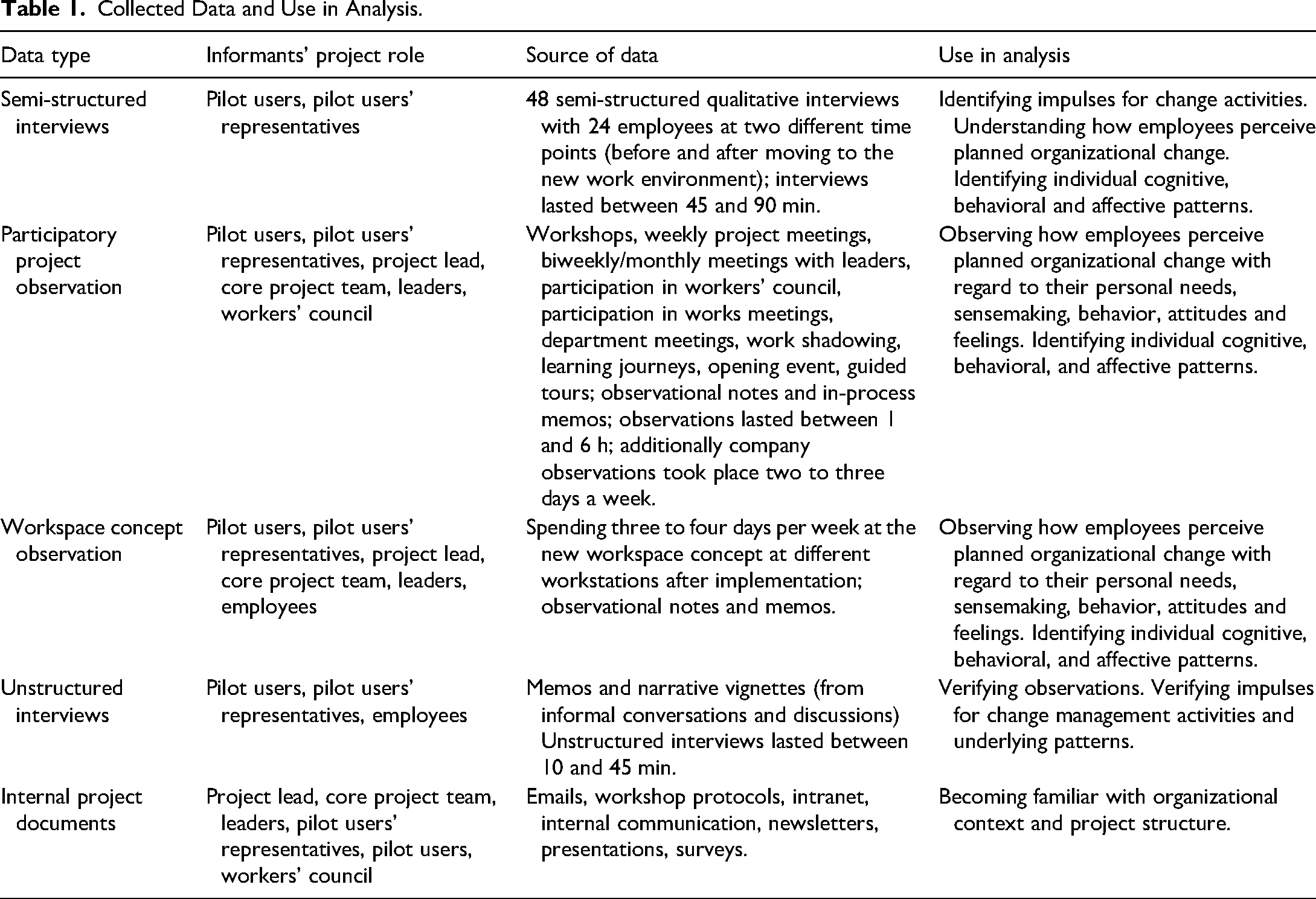
When comparing the various developed visual maps, we looked for “common patterns in the sequence of events and choices” (Langley & Truax, 1994, p. 620) and regarded them as “tools for sensemaking and part of the theorizing process itself” (Langley & Ravasi, 2019, p. 5). Being particularly suitable for multiple (embedded) cases (Langley, 1999), the visual mapping strategy in this study was performed throughout the process for each interviewed and observed employee separately. With the individual employee as the level of analysis and the overall purpose of process research to tell a detailed story (Van de Ven & Poole, 1995), visual mapping was applied for 24 different employees, understanding each employee as a single embedded case to be studied in detail. These 24 (of 70 employees in the pilot study) seemed appropriate, considering the heterogeneity of the group, consistent content across all semi-structured interviews, and data saturation (Guest et al., 2006). Further, we applied data triangulation with observations, unstructured interviews, and internal project documents (Table 1) to include insights from people other than the 24 employees (further pilot users, representatives, and employees) and to gain a comprehensive understanding of the research phenomenon (Patton, 1999).
Collected Data and Use in Analysis.
Following Newman and Robey's process model (1992) and their classification of events into “encounters” and “episodes,” we understand encounters as being “the most likely time in a process when […] change will occur” (p. 253). In this vein, employees’ attitudes were subjectively assessed and categorized as positive, negative, or equivocal, based on the data gathered from interviews, observations, and conversations concerning the following key questions: “How do you feel about the planned workspace change?” and “What do you think about it?” Responses such as “I really look forward to it,” “I appreciate the change,” and “I like the fact that this kind of change is coming” were categorized as positive attitudes. Statements such as “I really don’t like it,” “I don’t know why it has to be us,” and “I’m thinking about leaving this department” were associated with a negative attitude toward the change. An equivocal attitude encompassed statements such as “I don’t care,” “It will probably result in wins as well as problems,” or “I can understand why the company is doing it, but I am still skeptical.” The main purpose of this visual mapping was to identify whether employees’ attitudes were positive, negative, or equivocal and not to indicate the degree of these attitude categories. The fact that the researchers in this study were external to the company provided an opportunity to build a close relationship and a high level of trust between employees and researchers, particularly the first author of this study. As the relationship and trust grew stronger, the employees shared highly confidential and sensitive information, which assisted in assessing employees’ attitudes toward the change as comprehensively as possible. Nevertheless, to mitigate the risk of bias, all employees were asked retrospectively about their attitudes toward the change throughout the process, specifically before and after moving. Although there was a possibility that employees might evaluate their attitudes differently in a retrospective context, the evaluation done by the researcher matched the evaluation done retrospectively by the respondent. Furthermore, the general atmosphere within the teams and the individual employees’ attitudes toward the change were discussed anonymously with the project team and with the leaders. Additional information from the workers’ union and human resources, such as complaints or narratives, were also considered during visual mapping.
With the goal of better understanding the role of emotions in employees’ sensemaking, the relationship between the identified individual patterns was analyzed using the code-relations browser provided by MaxQDA. With the help of this tool, the relationships between codes are visualized and the main associated codes displayed. Thereby, the relations of affective patterns to cognitive and behavioral patterns for each recipient type were identified.
Empirical Findings
Building upon the generated codes during data analysis as shown in Figure 2 and the visual mapping strategy as described in the data analysis section, in the following Figure 3 the identified antecedent conditions and the individual cognitive, behavioral, and affective patterns for all employees, as well as the outcomes after moving to the new environment are presented.
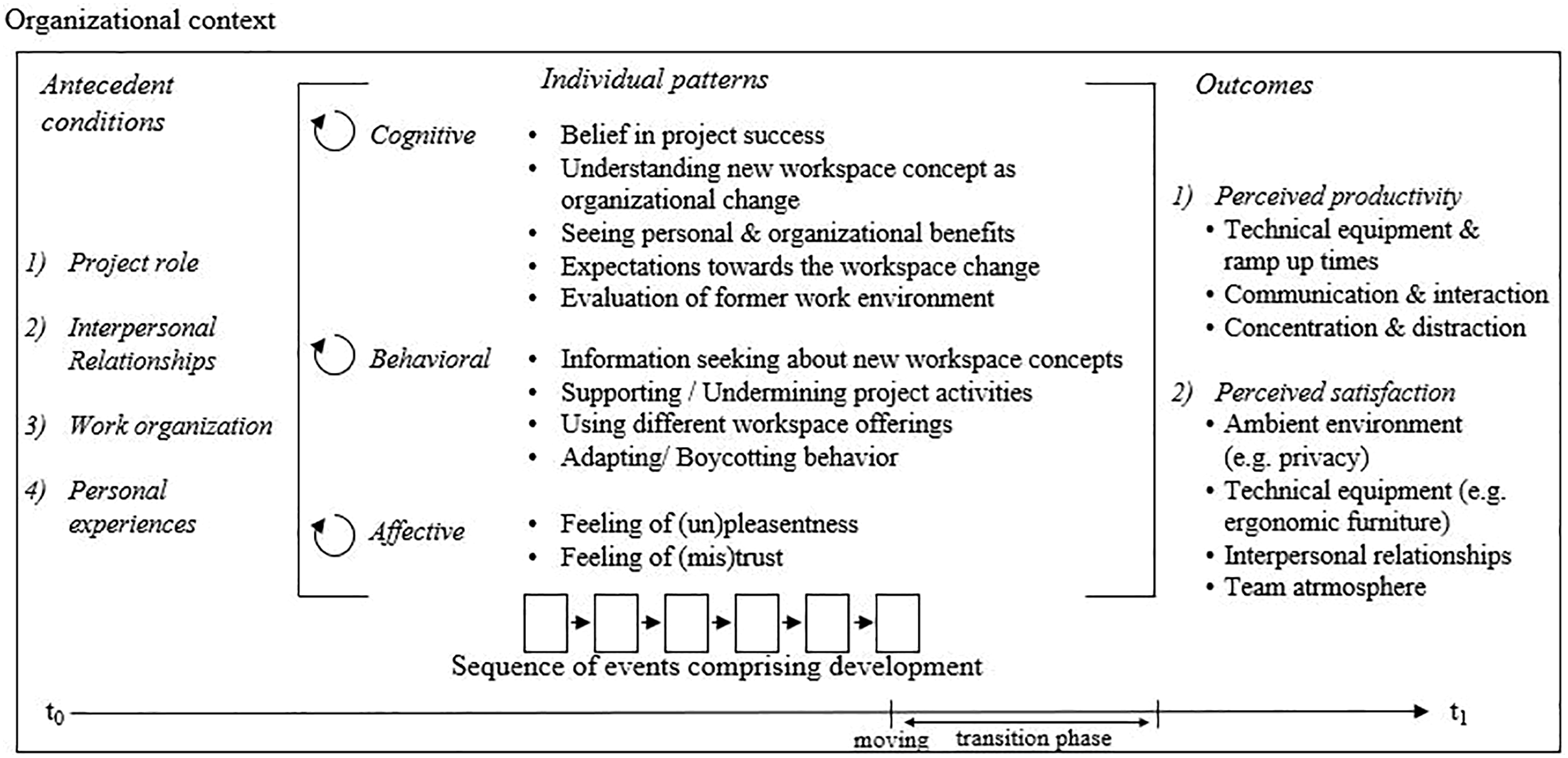
Process model of how employees perceive workspace changes—own illustration.
As the antecedent conditions and the individual sensemaking patterns—that is, the cognitive, behavioral, and affective dimensions—mutually influenced and depended on each other, they are presented together, with the individual patterns indicated in brackets directly after the antecedent conditions.
Antecedent Conditions (Individual Patterns)
The findings reveal several antecedent conditions that influence—in conjunction with individual patterns—all employees’ perceptions of the workspace change: (1) project role, (2) interpersonal relationships (employee–leader and between team members), (3) work organization, and (4) personal experiences.
Project role (individual patterns). The project role refers to the employees’ degree of participation throughout the change process and differs between pilot users and pilot users’ representatives, who were more actively involved in the change process (e.g., through participation in workshops). Interestingly, many of the representatives exhibited a positive attitude toward the change before moving to the new environment. The pilot users’ active involvement and close collaboration with the project team throughout the change process positively influenced some users’ perceptions, as they were able to build trust in the change agents (affective pattern) as people with whom to share concerns and worries and as they felt pleased with and appreciated being included in the development (affective pattern). Participating in activities that supported employees’ imagination (cognitive pattern), such as company visits, 3D models and the opening event, were identified as particularly important in shaping employees’ positive perceptions of the workspace change. Interpersonal relationships (individual patterns). The relationship between the employees and their direct leaders was identified as an antecedent affecting subsequent perceptions of the workspace change. The employees’ perceptions were influenced by whether their relationship with their leader was trustful, open, and supportive or conflicting and unsupportive (affective pattern). Furthermore, as the workspace change addressed the employees’ interactions and communication with colleagues, social relationships and the general team atmosphere were identified as antecedents affecting their perceptions of the change. A positive team atmosphere based on a sense of belongingness contributed to the employees identifying personal benefits in the change (cognitive pattern) and therefore positively influenced how they perceived it. Interpersonal relationships refer to influential connections with others from the employees’ direct surroundings, such as colleagues from other departments or the workers’ union. Although guided tours for all employees were offered prior to the pilot users’ move to reduce the number of curious passersby, there were still colleagues from other departments guiding visitors through the new environment to show off the exceptional modern design. Consequently, fear and worries about disturbances and distractions from curious passersby (affective pattern) and the resulting negative expectations of the workspace change (cognitive pattern) shaped the pilot users’ overall perceptions. Work organization (individual patterns). The employees’ work characteristics, particularly their individual level of digitization (e.g., digital skills and digital work processes), work requirements resulting from special tasks, and current stress levels, were identified as antecedents affecting the subsequent perception of the workspace change. While some employees needed paper documents only occasionally, others had large folders full of paper documents. In this context, the employees’ digital skills, their willingness to use new tools, and their adaptation to various workspace offerings (behavioral pattern) affected their perceived productivity after moving. Employees new to the departments and their mentors demonstrated special requirements resulting from training tasks. Their need for communication and interaction was higher than that of an average employee from all departments; therefore, their expected personal benefit from the workspace change (cognitive pattern) and their actual usage of different workspace offerings after moving (behavioral pattern) were high. The employees’ current stress levels affected how they perceived the workspace change throughout the process. Skepticism, fear, and worries about productivity losses and additional stress (affective pattern) shaped these employees’ perceptions of the planned change. Personal experiences (individual patterns). The employees’ former experiences in different work environments and their perceived satisfaction and productivity in their previous environments (mainly two- or four-person rooms) affected their perceptions of the change. Those employees with positive experiences in their two- or four-person rooms (e.g., due to a quiet atmosphere and privacy) had primarily negative expectations about the workspace change (cognitive pattern) and exhibited a negative perception at the beginning of the process. Further, some employees had experienced an open office in the same company, but it had been removed over 20 years ago and was located in a different company site. Employees with bad experiences from that time exhibited a negative and critical attitude toward the workspace change, as they imagined a concept (cognitive pattern) similar to the one they had previously experienced.
Outcomes
On the outcome level, the employees’ personal benefit balance, understood as their perceived gains and losses from the change, was assessed as the employees’ (1) perceived satisfaction and (2) perceived productivity after moving to the new environment. Positive drivers of the employees’ satisfaction and productivity after the workspace change were good technical equipment, ergonomic furniture, wellbeing from the ambience, better communication and interaction among team colleagues, and quicker, easier consultation with leaders and colleagues. Negative drivers of the employees’ satisfaction and productivity after the workspace change were distraction and noise from passersby and surrounding colleagues, a loss of privacy and individualization, and perceived productivity losses from clean desk principles and ramp-up times. A transition phase of approximately two to three months was identified as crucial for employees from all departments to adapt to the new environment and get used to new technical equipment after moving.
On closer examination of the visual maps from the data analysis and the employees’ attitudes and perceptions of the workspace change as defined in our conceptual model, three different types of change recipients could be distinguished: (1) employees with a positive attitude throughout the process and a positive perception of the workspace change after moving, (2) employees with a negative attitude throughout the process and a negative perception of the workspace change after moving, and (3) employees with a changing attitude in a positive direction (from negative or equivocal to equivocal or positive) and a positive perception of the workspace change after moving.
The positive perception of the workspace change from change recipient types 1 and 3 resulted from a (positive) personal benefit balance, with gains balancing (outweighing) the losses from the workspace change. Interestingly, these employees reported the same or an increased level of satisfaction and productivity after moving. The negative perception of the workspace change from change recipient type 2 resulted from a negative personal benefit balance, with more losses than gains from the workspace change. These employees reported a reduced level of satisfaction and productivity after moving and a strong wish to return to their old environment.
Although the antecedent conditions, such as high levels of stress, being new to the department, or working full or part time, play a general role in affecting the employees’ overall change perceptions, the empirical data demonstrated that the individual patterns shaped employees’ attitudes toward the workspace change and how they perceived it after moving to the new environment. The employees from Department 1 and Department 2 were characterized by different work processes and activities, with a high number of telephone calls and the need for focused work in Department 1 (in contrast to Department 2). However, the antecedent conditions identified as influencing factors for and as reference points for the employees’ attitudes toward the workspace change did not explain the employees’ overall perceptions in the course of the process. Rather, the employees’ individual affective, cognitive, and behavioral patterns shaped their responses to the workspace change and determined whether they perceived it as positive or negative.
Table 2 presents the employees’ attitudes before and after moving to the new work environment of the three identified types of change recipients and their respective individual cognitive, behavioral, and affective patterns. As shown in Table 2, recipient type (1) refers to employees with a positive attitude toward the workspace change throughout the process, recipient type (2) refers to employees with a negative attitude toward the workspace change throughout the process, and recipient type (3) refers to employees with a changing attitude in a positive direction (from negative or equivocal to equivocal or positive) toward the workspace change after moving to the new environment. The cognitive, behavioral, and affective sensemaking patterns described in Table 2 are presented in top-down order according to their appearance in the empirical data—from most to least frequently mentioned.
Three Identified Recipient Types and Their Individual Cognitive, Behavioral, and Affective Patterns.
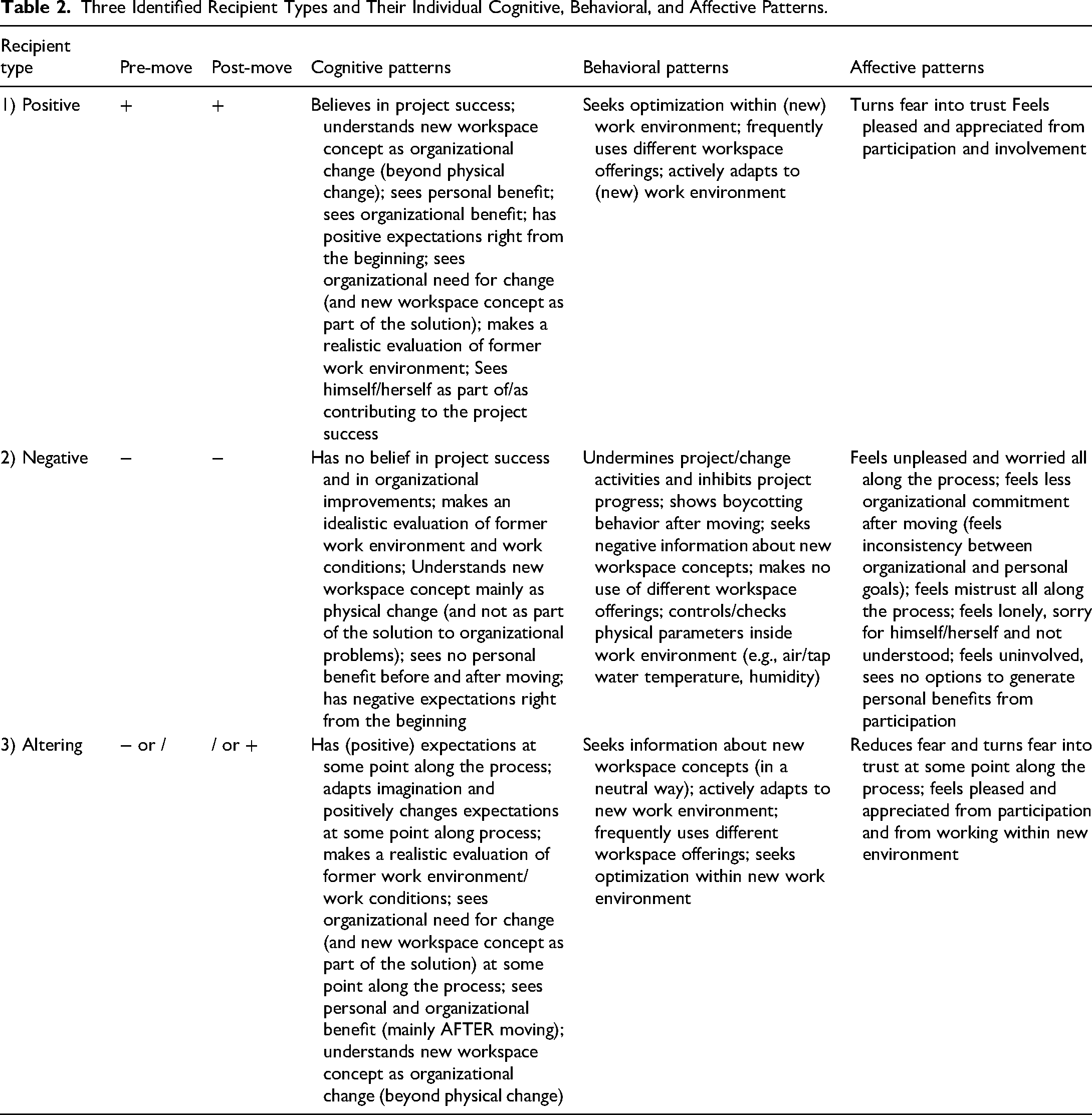
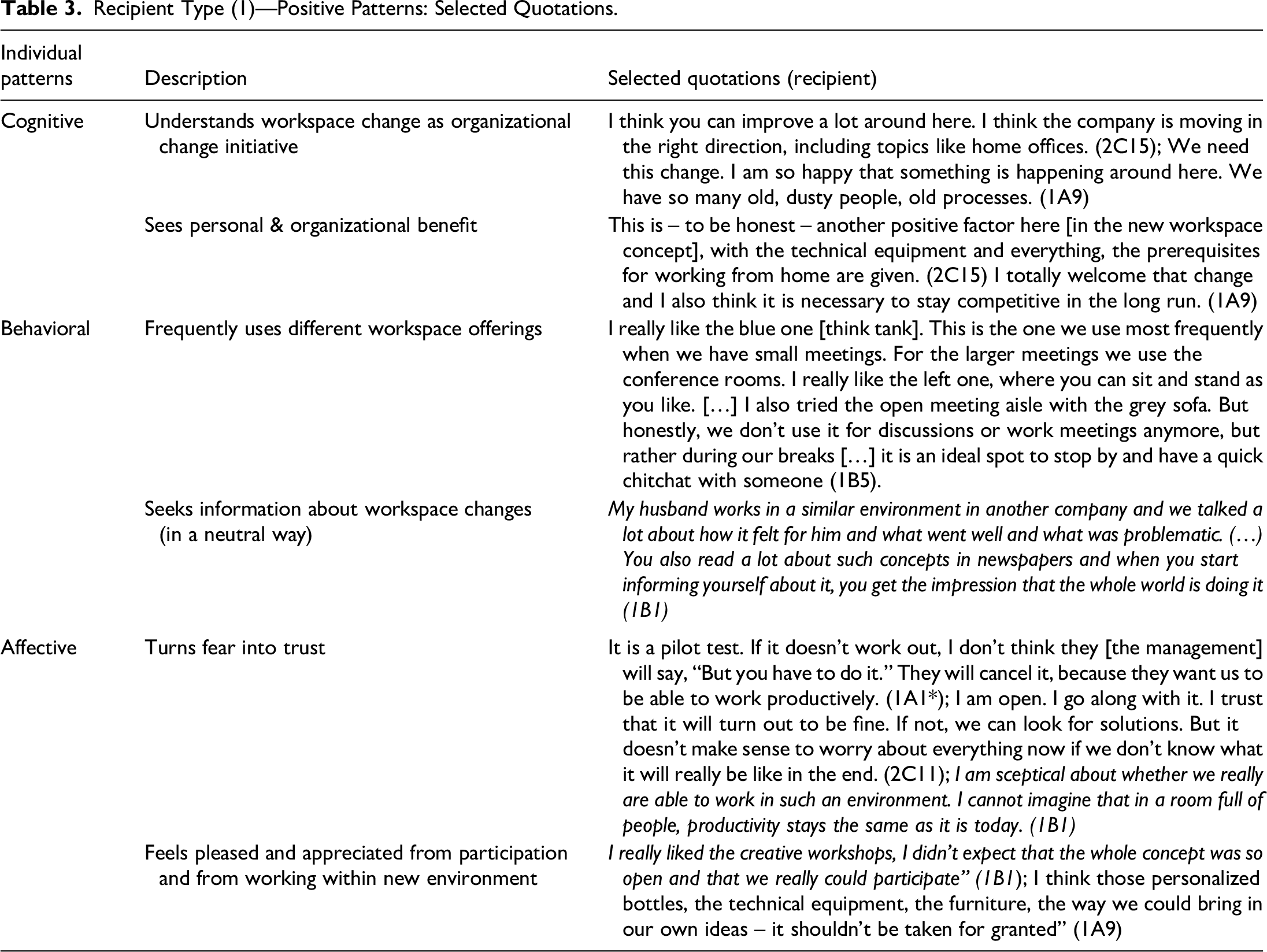
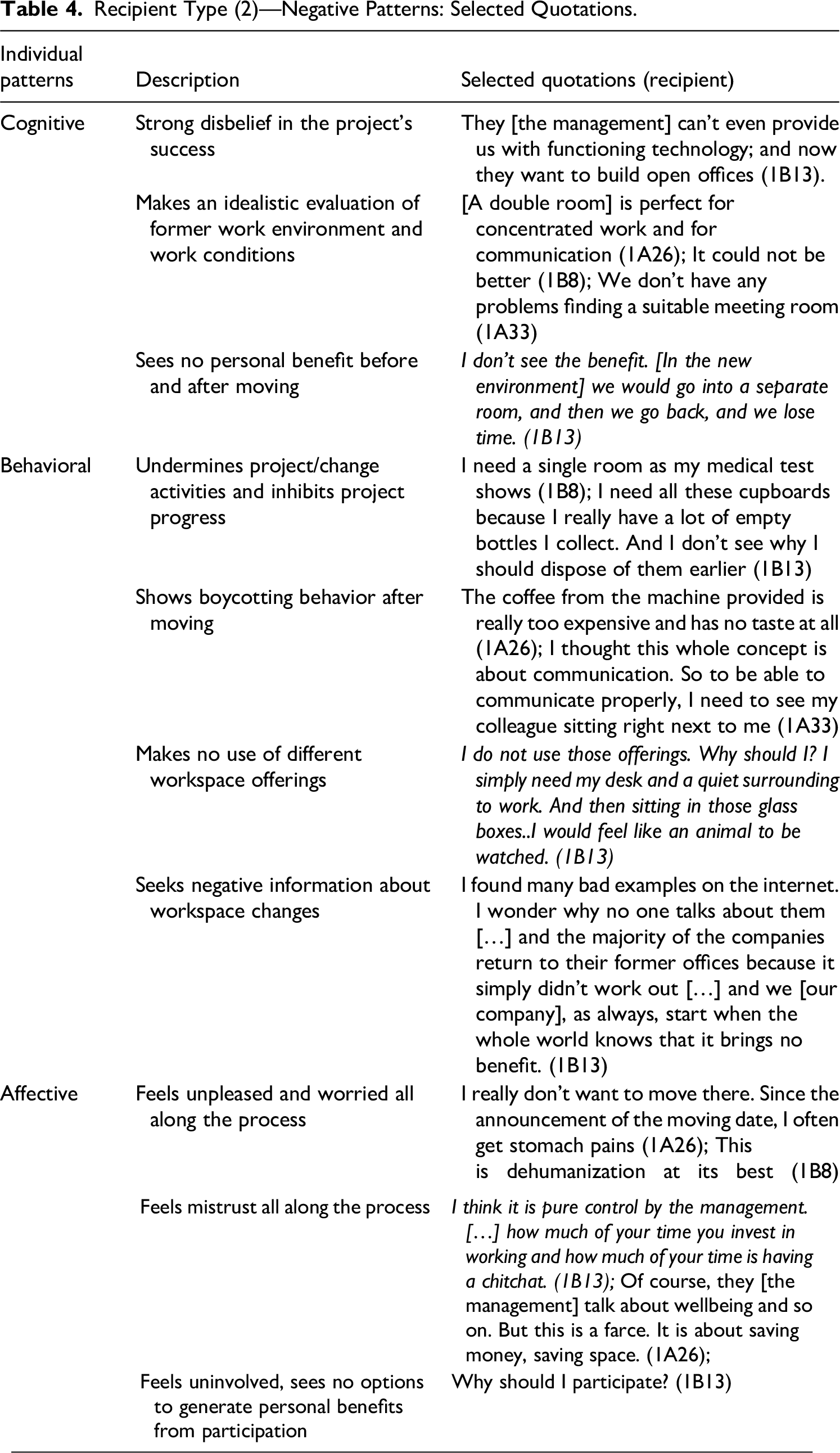
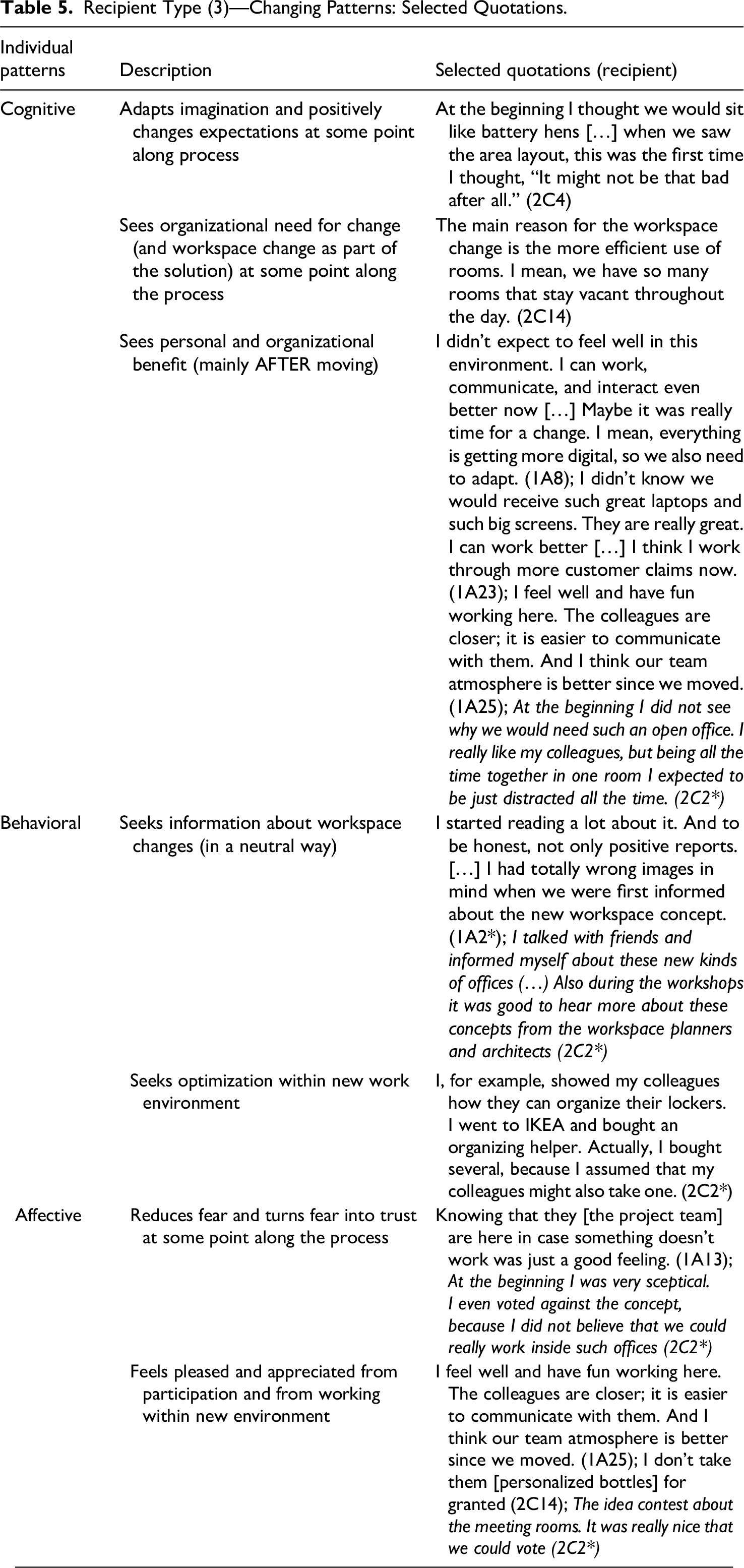
In what follows, the individual patterns of the three identified recipient types are described in more detail. To add transparency, key quotations from empirical data are presented in three separate tables for each identified recipient type (Table 3 with positive patterns and key quotations for change recipient type (1), Table 4 with negative patterns and key quotations for change recipient type (2), and Table 5 with changing patterns and key quotations for change recipient type (3)), including italicized examples from the code-relation analysis, to indicate the most significant relations between the affective, cognitive, and behavioral patterns.
(1) Change Recipients with a Positive Attitude Throughout the Process
Recipient Type (1)—Positive Patterns: Selected Quotations.
Recipient Type (2)—Negative Patterns: Selected Quotations.
Recipient Type (3)—Changing Patterns: Selected Quotations.
Cognitive patterns: Change recipients of this type were characterized by a strong belief in the project's success. Although their expectations about the workspace change were positive right from the outset, their personal experience in the new environment confirmed or exceeded their expectations after moving. As shown in Table 3, these employees understood the workspace changes as an organizational change initiative and regarded them as part of a solution to organizational problems. Interestingly, these recipients realistically evaluated their former work environment (single, double, four- or eight-person offices) retrospectively, for example, in terms of having trouble “finding meeting rooms” (2C11) or “concentrating on work in an eight-person office where it is quite noisy” (2C7).
Behavioral patterns: Change recipients of this type were informed during participative workshops or other project communication or actively sought information about workspace changes in a neutral way along the change process and sought optimization and actively adapted to the new work environment, for example, by “using personal headsets against noise” (2C7) or “reorganizing the provided storage space” (2C12). Furthermore, the employees from this group frequently used and experimented with different workspace offerings.
Affective patterns: Although change recipients of this type also exhibited certain fears about the workspace changes during the process, they managed to quickly turn those fears into trust and felt pleased with and appreciated their participation and involvement.
(2) Change Recipients with a Negative Attitude Throughout the Process
Cognitive patterns: Change recipients of this type were characterized by a strong disbelief in the project's success. The employees in this category understood the workspace changes primarily as a physical workplace change and did not see them in the context of an organizational change or organizational improvements. They idealized their former work environment, and—as they did not identify any personal benefit in the workspace changes—their expectations were negative from the outset and were confirmed after moving.
Behavioral patterns: The behavioral patterns relating to this recipient type consisted of undermining project or change activities and thereby inhibiting the project progress and boycotting behavior, such as using a personal coffee machine in the shared kitchen or removing acoustic protection from the desks after moving. Boycotting behavior could also be seen in behaviors such as the breaking of furniture, incorrect ventilation behavior, and a lack of compliance with clean desk principles. Some employees from this group constantly checked and controlled physical parameters inside the work environment, such as air temperature, humidity, or tap water temperature, to collect information for the workers’ union about “the very bad working conditions around here” (1B8). With regard to information-seeking behavior, this recipient type sought only negative information about workspace changes.
Closely related to seeing no personal benefit in the workspace changes was the employees’ behavior of not using various workspace offerings. The majority of the employees from this group stated that they would “not use one of the think tanks” (1A33) or would be “in a meeting room only for our department meeting when the leader asks us to come” (1B8).
Affective patterns: This type of change recipient was characterized by feelings of unpleasantness and worry throughout the process. Employees in this group felt uninvolved and sorry for themselves and saw no possibility of generating personal benefit from participation. In addition, we identified a feeling of mistrust toward the project sponsors, project team, and leaders throughout the process and organizational commitment after moving into this type of change recipient.
(3) Change Recipients with a Changing Attitude (in a Positive Direction)
Cognitive patterns: Being characterized by negative expectations from the beginning, this type of change recipients developed positive expectations at some point in the process by adapting their imagination about the workspace changes (before moving) or after experiencing the new environment (after moving). At some point during the process, change recipients of this type made a realistic evaluation of their former work environment and work conditions and saw an organizational need for change, recognizing the workspace changes as part of the solution to organizational problems. Understanding workspace changes as an organizational change rather than only as a physical change contributed to the employees’ positive perceptions, which resulted in acknowledging not only personal benefits, such as “working from home” (1A2*) or “being more flexible” (1B2), as well as organizational benefits, such as “staying competitive” (1B2) or “attracting new employees” (1A5).
Behavioral patterns: The behavioral patterns of change recipients of this type included seeking information about workspace changes in a neutral way (both negative and positive examples), actively adapting to the new work environment, and frequently using different workspace offerings, such as “the blue think tank” (1A28) or “the open meeting aisle” (1A5). Similar to the first type of change recipients (positive throughout the process), employees in this group sought optimization within the new environment by pointing out problem areas, concerns, and solutions to their project team and colleagues, such as “putting plants in the corridor to have more visual protection” (2C14) or “using numbers for our lockers” (1A13).
Affective patterns: The affective patterns in change recipients of this type consisted of reducing fears and turning them into trust, both toward the project team and the final workspace change. Change recipients of this type were pleased with and appreciated working within the new environment and participating in various change activities.
Discussion
Individual Sensemaking and Three Types of Change Recipients
Our study contributes to the current contradictory and inconclusive results of workspace change studies (see, e.g., Chadburn et al., 2017; Renard et al., 2021). This stream of literature has been unclear regarding whether workspace changes result in more advantages (e.g., more satisfaction due to increased wellbeing resulting from a modern environment) than disadvantages (e.g., less satisfaction due to reduced wellbeing resulting from noise and distraction) for individual employees (Morrison & Smollan, 2020; Renard et al., 2021). With the focus on employees’ individual sensemaking along the workspace change process and the applied longitudinal research approach, we shifted focus from the outcome level to the individual patterns to better explain why some employees benefit from and others suffer as a result of workspace changes. Although previous studies on individual responses to organizational change already emphasize the importance of patterns in the course of the sensemaking process (see, e.g., Bareil et al., 2007; Bartunek et al., 2006), only few studies on workspace changes take a processual view on workspace changes (Hongisto et al., 2016) and take for example individuals’ sensemaking along the workspace change process into account (see, e.g., Bakke & Bean, 2006). By situating this study in the theoretical foundation of planned organizational change and individual sensemaking, we further responded to researchers’ calls for a structured theoretical foundation (see, e.g., Appel-Meulenbroek & Danivska, 2022; Renard et al., 2021).
Based on cognitive, behavioral, and affective patterns, change recipients react to workspace changes in one of three ways: positive (type 1), negative (type 2), and switching from negative to positive (type 3). Building upon knowledge from organizational development and organizational change literature, we refer to type-1 change recipients (positive throughout the process) as “champions,” to type-2 change recipients (negative throughout the process) as “change resistors,” and to type-3 change recipients (changing attitude in the course of the process) as “acceptors” (Dwyer et al., 2023).
With the three identified types of change recipients and their various cognitive, behavioral, and affective patterns, this study's findings show that overcoming a negative change attitude implies that employees need to “unfreeze” their existing constructed meanings (see acceptors with their altering attitude) and transform them from negative into positive meanings (Sonenshein, 2010). Thereby, “resistant” employees are regarded as an important source of feedback and valuable information from employees to managers (Ford & Ford, 2010) that might result in alternative, optimized solutions for the change (Dent & Goldberg, 1999). The behavioral pattern of seeking optimization within the new environment or participation in the change process by acceptors (e.g., suggesting guided tours to reduce distraction from passersby) could be acknowledged as valuable ideas that improve the development and implementation of workspace changes. In contrast to other studies, in which acceptors are understood as enabling “a smooth implementation of the change, but […] fail to yield meaningful feedback for change agents” (Oreg et al., 2018, p. 12), the acceptors identified in our study produced constructive feedback during planning and implementation. Referring to these employees as “constructive opponents” (Scheler, 2013), as suggested by studies in the field of innovation management, might be more effective when accounting for their changing attitudes and their ability to overcome barriers.
By explicitly distinguishing between employees’ attitudes toward the change and their overall perceptions after moving to the new environment (in terms of personal benefit balance and perceived satisfaction and productivity), we contribute to the ongoing discussions about the role change resistance as a negative form of change attitude plays in sensemaking (Jones & van de Ven, 2016; Maitlis & Sonenshein, 2010; Rafferty & Jimmieson, 2017). According to Balogun and Johnson (2005), managing change is about “facilitating recipient sensemaking processes to achieve an alignment of interpretations” (Balogun & Johnson, 2005, p. 1596).
As the three types of change recipients were identified based on their attitudes toward the change, examining their personal benefit balance and their perceived satisfaction and productivity after moving is particularly interesting for better understanding the interplay between employees’ attitudes toward change and the resulting change outcomes. Interestingly, champions and acceptors who demonstrated positive attitudes toward the workspace changed from the very outset (champions) or at some point during the process (acceptors) exhibited a (positive) personal benefit balance: A positive personal benefit balance with gains obtained from the change outweighed the losses (champions), or at least a personal benefit balance with effectively equal gains and losses resulting from the change (acceptors). These employees experienced an increased or equal level of satisfaction and productivity within the new environment compared to the old one. Thus, the following theoretical propositions can be derived:
Where people perceive intrinsic value in the change for themselves, they are more likely to support the change.
This increased level of productivity was also reflected in the leaders’ reports, which showed that the collective productivity increased for each department. As the majority of the identified recipient types present champions and acceptors with an increased or the same level of productivity after moving, the self-reports obtained from the employees were confirmed as plausible. By contrast, resistors who demonstrated a negative attitude toward the workspace change throughout the process also experienced a negative personal benefit balance, with losses outweighing gains and reduced satisfaction and productivity after moving. In this context, the question of expectation confirmation in the course of individual sensemaking arises.
Where people perceive that there is personal loss in the change, they are less likely to support the change.
As demonstrated in our findings, the ability to adapt one's own expectations was identified as a crucial cognitive pattern that assisted in the course of champions’ and acceptors’ sensemaking. Interestingly, there was one change resistor (1B8)—an employee with a negative attitude toward the workspace change and a negative personal benefit after moving—who still perceived the change process and the communication as positive and “well managed.” While recent studies (see, e.g., Sirola et al., 2021) show that the way employees perceive the overall change process (e.g., participation and communication in the course of the process) is associated with the perception of the overall change outcome (e.g., satisfaction after moving to a new environment), our findings support the need to explicitly distinguish between how employees perceive the change process and how they perceive the change outcome. The negative attitude and negative perception of the workspace change by change resistor 1B8 might not be overcome by simply offering more participative activities to facilitate his or her individual sensemaking. Rather, this employee should be understood as a “real resistor” who can provide valuable feedback such as the need for “more acoustic protection” (1B8) or “more single rooms for concentrated work” (1B8) in order to improve “the very bad working conditions around here” (1B8). Such feedback might result in an alternative, optimized solution for the workspace change outcome (Dent & Goldberg, 1999; Ford & Ford, 2010), leading to the following theoretical Proposition 3:
Change resistors (type 2) will generate positive impact on proposed organizational changes if (1) they are invited to vocalize their perspectives on proposed changes, and (2) their ideas enhance the proposed organizational changes.
As shown in our findings, employees mutually influence each other, especially in an open work environment where feedback, complaints, and worries become transparent among employees. For example, in the case of acceptors, their cognitive pattern of seeing a personal benefit mainly after moving to the new environment partly resulted from interactions with resistors. In response to resistors’ negative evaluations and complaints about the new work environment, some acceptors began to reevaluate their perceptions of the workspace change and acknowledged that “it is not as bad as the others complain about” (2C4). Therefore, simply overcoming the change resistance exhibited by resistors is not always the best solution. Rather, as demonstrated in the changing perception of acceptors after being confronted with boycotting behavior of resistors, our findings show that contextual variables such as interactions between groups (Bouckenooghe et al., 2019) influence how employees experience organizational changes.
Change recipients can be triggered to become change acceptors when they are confronted with boycotting behavior by change resistors.
The Role of Emotions During the Sensemaking Process and Practical Implications
As indicated earlier in this paper, there is a lack of agreement on the general role emotions play in sensemaking (see, e.g., Dwyer et al., 2023; Heaphy, 2017; Maitlis et al., 2013; Maitlis & Sonenshein, 2010). Our findings demonstrate that both the functional and dysfunctional effects of emotions on sensemaking are possible, which leads to the following theoretical propositions about the role of emotions during sensemaking.
Positive emotions associated with trust will increase the likelihood of type 1 reactions.
Negative emotions such as fear will increase the likelihood of type 2 reactions.
Activities that build trust will increase the likelihood of a type 3 reaction for those who initially experience a type 2 reaction.
Whereas the champions and acceptors in this study turned fear into trust and were pleased with and appreciated participating or working within the new environment, resistors felt anxious, frustrated, and mistrusting throughout the process, which even resulted in a boycotting behavior. According to Rafferty and Jimmieson (2017), negative emotions arise as a result of disruptions, particularly those associated with transformational changes. As transformational changes disrupt values, strategy, and structure, employees might experience discomfort, which might, in turn, leads to negative actions or intentions (behavioral pattern) as a form of change resistance (Rafferty & Jimmieson, 2017).
Dwyer et al. (2023) emphasized that anxiety, as one particular type of emotion, changes in the course of the sensemaking process and takes on “a different form at each sensemaking stage” (Dwyer et al., 2023, p. 445). For example, the authors differ between cosmological anxiety, representational anxiety, and practical anxiety that describe anxiety immediately in the aftermath of the incident (cosmological anxiety), during the inquiry (representational anxiety), and during implementation (practical anxiety). The fact that “at each stage, a particular form of anxiety prompted practitioners to engage in further sensemaking in order to make sense of their experiences” (Dwyer et al., 2023, p. 445) is supported by our findings regarding the acceptors and resistors in our study. In the early sensemaking stage, the majority of these employees felt anxious about noise (“I cannot imagine working productively in such an office,” 2C2*), distraction, density (“We will sit like battery hens,” 2C4), or social control. However, the main concerns in the subsequent sensemaking (closer to the moving date) were related to fear of passersby, robbery in the open space, or having too little space in the common kitchen (“How will this work? We are 70 people and one kitchen!,” 1A26). Interestingly, as the workspace changes developed and the physical design was shaped, the employees’ fear and anxiety appeared more concrete. Having learned from the various project presentations in the course of the change process, the employees developed new understandings of the change by using “cognitive maps or schema of their experiences” (Harris, 1994, p. 310) and adapted their imagination and expectations toward the final workspace change (cognitive pattern), which again prompted new forms of anxiety (Dwyer et al., 2023).
Theoretical knowledge about the mutual relationship between the affective, behavioral, and cognitive components in the course of the sensemaking process is limited (Schweiger et al., 2018; Thomas et al., 1993). It remains unclear whether “affect plays an even greater role than cognition in determining employees’ responses to management-initiated change” (Stanley et al., 2005, p. 456). Therefore, our findings reveal that affective patterns across all recipient types are related to cognitive and behavioral patterns in a number of ways. For champions and acceptors, we found affective patterns, such as turning fear into trust, which were strongly connected to behavioral patterns, such as information seeking, and cognitive patterns, such as adapting one's imagination and expectation (“During the presentation of the 3D model (…) where we got all our questions answered (…) I think this was the first time when I thought this could be really nice,” 2C15). For resistors, the affective pattern of feeling mistrust all along the process was mainly related to the cognitive pattern of seeing (no) personal or organizational benefit and having negative expectations right from the beginning (“I think they [the management] just want to control us (…) I do not understand why we were selected,” 1B13).
In contrast to Weick (1988), who argued that actions precede cognition, and Kroon and Reif (2021), who identified “emotions generated by cognitive appraisal” (Kroon & Reif, 2021, p.5), our findings show that affective, behavioral, and cognitive patterns are connected. However, it remains unclear when, for example, this “turning fear into trust” takes place or whether resistors’ “mistrust all along the process” is a result of seeing no personal or organizational benefit or vice versa. In this context, among the group of champions and acceptors were employees who felt pleased with their participation and working in the new environment (affective pattern), as they actively adapted to the new work environment by frequently (champions) or hesitantly (acceptors) using different workspace offerings (behavioral pattern). These employees thereby perceived a personal or organizational benefit (cognitive pattern) (“I really like working here, everything is new, well-designed and so many nice colors […] I often use the blue think tank. It is nice for ad hoc meetings […],” 1B5). By contrast, resistors felt unpleased from working in the new environment (affective pattern) and perceived no personal or organizational benefit from the workspace change (cognitive pattern) (“I do not like it here. […] I still don’t get why we were selected. […] I do not use those offerings. Why should I?,” 1B13). Some even exhibited boycotting and controlling behavior or undermined project activities (behavioral pattern).
According to Stensaker et al. (2021), the difference between these employees lies within the change narratives they construct and the stories they tell about the change. While progressive change narratives are “linked with change acceptance, (…) regressive change narratives were tied to resistance to change” (Stensaker et al., 2021, p. 177).
With champions and acceptors constructing progressive change narratives that enable them to adapt to change, resistors construct regressive change narratives that leave them romanticizing the past (e.g., idealizing their former work environment) and struggling to accept the change (Stensaker et al., 2021).
In terms of how individual patterns as “forces that promote change” (Rafferty & Simons, 2006, p. 328) can be used to effectively manage workspace changes, existing theory emphasizes the importance of dialogue between change agents and recipients (Airo et al., 2012), as well as the need to give employees a feeling of being valued and appreciated (see, e.g., Oreg et al., 2011; Schulz-Knappe et al., 2019). However, our findings demonstrate that simply offering employees participation and valuing them are not sufficient for achieving successful change. Although all employees in this study had the opportunity to participate and be involved in the process, there were employees who felt appreciated and pleased with participating (champions and acceptors) and others who felt uninvolved (resistors). This leads to the following theoretical proposition:
Where people feel that they are valued and appreciated, and where they participate in change activities and in designing the change, they are more likely to support change.
Some authors have emphasized the need to frame change projects in terms of change readiness—for example, by starting change projects with a readiness survey (see, e.g., Armenakis et al., 1993). However, our findings indicate that such surveys are not recommended, as there are resistors throughout the project, irrespective of how many participative or communicative activities are offered. Rather, as stated above, change agents should acknowledge the potential positive forces such resistors might offer and continuously check on recipients’ thoughts and feelings (Smollan & Sayers, 2009) to situationally address employees’ information and emotional needs along the change process (Schweiger et al., 2018).
In the framework for managing workspace changes presented in Table 6, we highlight the developed theoretical propositions and the active role of change recipients in organizational change and how they can be used to manage the change process. The proposed framework contains only management activities derived from individual patterns that can be influenced from the outside and are not dispositional variables inherent to a particular employee.
Proposed Framework for Managing Workspace Changes.
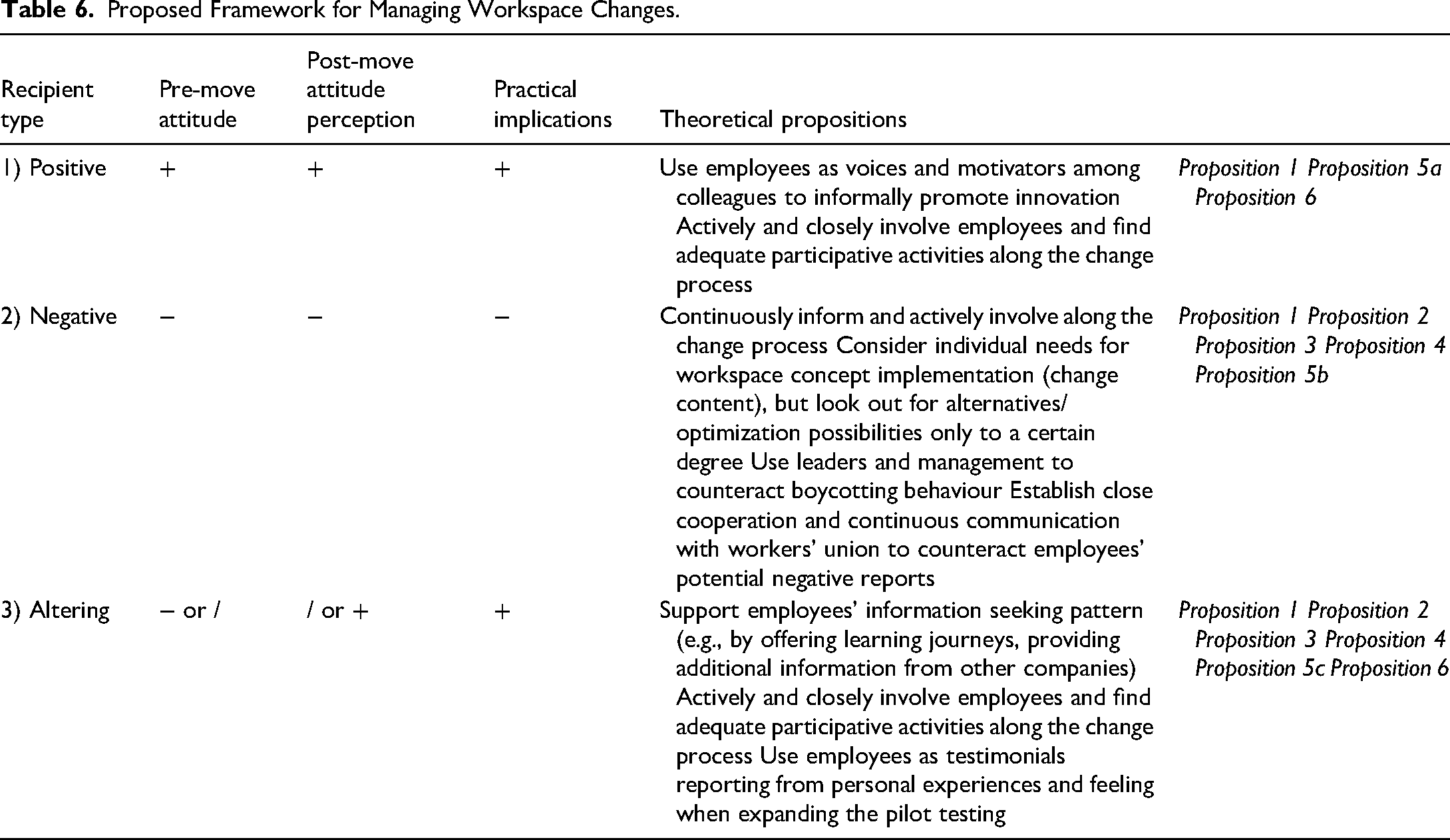
With their strong belief in the project's success and personal and organizational benefits, champions should be closely involved throughout the process. As champions actively adapt to the new work environment and frequently use different workspace offerings, they can be used as voices and motivators to informally promote new ways of working (Howell & Boies, 2004) as described in Table 6. With overall negative perceptions, feelings of unpleasantness, worry, and mistrust as affective patterns of resistors, the question arises as to when participation starts. Selecting volunteer employees for the workspace change might be one way to address employees’ resistance to change and ensure broad participation from the outset (Bartunek et al., 2006). Acceptors, with their changing attitudes as described in the bottom row of Table 6, are particularly interested in discussions about managing organizational change. As these employees overcome their negative feelings and expectations about the workspace change, turn their fear into trust, and begin to feel pleased with and appreciate participation at some point in the process, close involvement and the potential to co-create remain important for these employees as described in Table 6. Their information-seeking patterns and expectations about the workspace changes can be supported by providing them with adequate information and offering them, for example, learning trips to companies that have implemented similar concepts. Adequately managing and accompanying employees of this group is particularly interesting against the background that approximately 60% of “any large number of people […] can be influenced to either commit to change or fight it, depending on how she or he perceives its effects” (Laframboise et al., 2003, p. 308). As these employees identify personal benefits in the workspace change after moving, they can be used as a valuable asset, with trustworthy testimonials reporting on their personal experiences, worries, and feelings through the process, for example, when transferring such concepts to other departments or when planning a rollout concept for the company as a whole.
As workspace changes are often customized to a company's particular needs and strategic goals (Kämpf-Dern & Konkol, 2017; Skogland & Hansen, 2017), they differ in design, and employees’ expectations about the final workspace change might not be consistent with the company's plans. This should be emphasized when managing workspace changes as opposed to other planned changes. Moreover, the visual maps relating to acceptors reveal that certain decisive events (presentation of the 3D model, opening event, and after moving to the new environment) can cause these employees to change their attitudes at various points during the process. The physical, tangible workplace design plays an important role in all these decisive events, as employees are enabled to directly feel and experience the (upcoming) workspace change through visualization (3D model, opening event) or from working within the new environment (after moving). The essential feature of workspace changes lies in the physical, tangible component of the change content, which makes employees’ former experiences with and knowledge of similar concepts—together with the feelings produced through their abstraction, visualization, and imagination—particularly important when managing workspace changes.
Analogously, Jones and van de Ven (2016) demonstrated in their study that negative attitudes toward change and, in particular, employees’ commitment to the organization and perceptions of organizational effectiveness grow stronger over time (Jones & van de Ven, 2016). Therefore, in the later stages of a change initiative, it becomes particularly important to address employee resistance, because “left unchecked, it can fester and increasingly inflict harm” (Jones & van de Ven, 2016, p. 482). With regard to the boycotting and sabotaging behavior of resistors after moving to a new environment, our study suggests that the nature of resistance changes and that the negative effects of resistance increase over time (Isabella, 1990; Jones & van de Ven, 2016). Building upon knowledge from workplace management studies (see, e.g., Elsbach & Bechky, 2007; Rothe et al., 2011), the findings of this study confirm that it is important to actively involve resistors in order to counteract boycotting behavior as described in Table 6. As these employees primarily seek negative information about workspace changes and make no use of different workspace offerings after moving, providing them with adequate project information and continuously informing them about the potential inherent in workspace offerings is a crucial part of managing these employees. As shown in Table 6, involving these employees in the process and establishing close cooperation with the workers’ union remain important, as they can function as strong “mood makers” among colleagues and the workers’ union. Against the background of Jones and van de Ven's (2016) conclusion that it is not only about “‘how to manage change,’ but also ‘what to manage when’” (Jones & van de Ven, 2016, p. 500), project teams, workplace designers, and change agents need to decide on the extent to which they should search for alternatives and find compromises and solutions for this particular group (especially with regard to expensive, physical workplace designs).
Furthermore, the empirical findings confirm that “sensemaking does not stop when the incident ends” (Dwyer et al., 2023, p. 422), that is, once employees have been moved to the new work environment. Rather, emotions continue to play a crucial role after moving to the new work environment, as employees from all three groups feel and experience unexpected events during their daily work.
Limitations, Future Research, and Conclusion
This study has certain methodological limitations. As data collection began after the change was announced by management, the employees—most of whom displayed a negative attitude toward the change, especially at the beginning of the process—might have described their experiences, productivity, and satisfaction with their old environment better than it really was. This methodological limitation might have been mitigated to a certain degree by adopting a qualitative approach and pre-post data collection, considering individual employees’ personal benefit balance and leaders’ reports, and leveraging the possibility of specifically inquiring about employees’ experiences, satisfaction, and productivity during the process. Moreover, as the first author of this study was present at the organization for at least two days a week and in ongoing interaction with the employees for a longer period of time, this might have influenced the employees’ overall perceptions of the change.
The antecedents in this study present the main identified themes in the gathered data and do not represent a comprehensive picture of individual and contextual variables during planned organizational changes. Therefore, other variables and individual dispositions, such as openness to change, organizational commitment, perceived control of the change, and former change experiences, might also play a role in affecting employees’ perceptions of workspace change. With the qualitative research approach, the focus was not on identifying cause–effect relationships. The goal of this processual study was to gain a better understanding of how change recipients perceived the organizational change and why they perceived it in a particular way (Newman & Robey, 1992). The identified patterns are understood as core patterns observed in most employees during the change process and do not provide comprehensive and exclusive explanations but might work in parallel with other dispositional influences and contextual dynamics.
This study's findings demonstrate the necessity of considering employees’ individual cognitive, behavioral, and affective sensemaking patterns when managing workspace changes. The developed process model, the identified antecedents, and the individual patterns throughout the change process offer explanations for employees’ different perceptions of planned organizational workspace change. To a certain degree, they explain the contradictory and mixed results from other studies in the field of workspace change (see, e.g., Chadburn et al., 2017) and show the crucial role emotions play during workspace changes.
By analyzing workspace changes as a contemporary type of organizational change and by using an organizational development and sensemaking lens, our study uses an in-depth theoretical lens to better understand workspace changes in the context of planned organizational change and organizational development. With the development of several theoretical propositions, this study contributes to sensemaking research and Organizational Development and Change and bridges the organizational change and workplace management literature streams, as suggested by various researchers (see, e.g., Appel-Meulenbroek & Danivska, 2022). The developed process model helps to better understand the sensemaking process of employees’ responses to change (individual sensemaking patterns) in general and the emotional responses to workspace change (affective patterns) in particular. The developed management framework helps to better understand the process of managing workspace changes by considering employees’ individual responses to change and presents valuable practical contribution for change agents, leaders and workspace planners.
Future research should further develop the presented model and transfer it to different organizational contexts to assess the roles of employees’ work characteristics, work processes, and tasks, as well as the organization's culture, business model, and strategy, in such workspace changes.
Footnotes
Declaration of Conflicting Interests
The authors declared no potential conflicts of interest with respect to the research, authorship, and/or publication of this article.
Funding
The authors received no financial support for the research, authorship, and/or publication of this article.
