




Abstract
In this paper, we dig deeper into the reflexive learning that fuels collaborative inquiry by examining the unique ways in which changing itself takes place. We draw on two examples of collaborative inquiry, offering autoethnographic insights from our own lived experiences of changing change. These insights are underpinned by reflexive learning which we capture in textual form to show how learning in collaborative inquiry involves “impacting with” rather than “impacting on.” Our analysis reveals that reflexivity is not a homogenous or static experience but consists of several dynamically changing entangled “dimensions” of practice. Through dimensions relating to the process, content, and impact of reflexive learning, collaborators can arrive at a “stance”—a fluid, loosely shared basis for action that enables organizational practices to be reconfigured or preserve key principles.
Introduction
The commitment to cocreating knowledge for impact continues to catalyze several different modes of collaborative inquiry in research or pedagogical programs (Sharma et al., 2022; Spencer et al., 2022). The quality of the collaboration itself is a central feature of cocreation and of the underlying dialogical exchanges that support it (Shani & Coghlan, 2021). Recent analyses of collaborative practices that foster cocreation, particularly in scholar–practitioner collaborations, have drawn attention to the importance of inclusiveness and principles that orientate impact, not only as a mark of change in the difference made but also in the process of changing that underpins such cocreation (Antonacopoulou, 2022). In this paper, we dig deeper into the reflexive learning that fuels improving actions that are marked by the unique ways in which changing itself takes place. This allows us to provide a fresh understanding of why the diverse definitions and associated concepts of reflection that are offered in the extant literature on management and leadership learning, call for a fresh positioning of reflexive practice and its configuration in relation to changing change.
Moreover, appreciating the richness of reflexive practice calls for new research approaches that do not treat reflexivity as a single “variable,” which can be tested for its mediating/moderating impacts on performance, creativity, and other outcomes. Instead, as we exemplify in our analysis, the process of learning that underpins reflexivity's transformative power reveals the affordances or “possibilities” for generating new understandings, fuelling renewed confidence and clarity on courses of action. We recognize that central to this way of changing is not only the reconfiguration of practices. It is also a mark of the “stance” that is formed as renewed confidence fuels curiosity to search and research for improvements in actions. It is here we also recognize the power of choice in the stance taken, thus affirming that reflexive learning fosters not only identity development but also a related positioning. Such positioning marks a stance toward wider environmental changes and fosters responses to wicked problems with responsibility and accountability not only for the outcome but also for the process of impacting each other and the collective drive to serve a higher purpose—the common good.
“Reflection,” “reflexivity,” and “reflective/reflexive learning” (Cunliffe, 2002) are recognized in scholarship and practice as important tools for developing managers and leaders (Hibbert, 2012). Scholars have identified the process of reflecting on one's own actions as a means by which individuals can connect abstract knowledge to practice (Antonacopoulou, 2010; Hibbert & Cunliffe, 2015), develop a situated understanding of ethics in leadership and management (Cotter & Cullen, 2012; Hibbert & Cunliffe, 2015), develop a more “critical” eye toward the norms embedded in everyday leadership assumptions (Antonacopoulou, 2019; Cunliffe, 2002; Reynolds & Vince, 2004) and come to identify themselves as a leader (Eriksen, 2009; Raelin, 2011). This growing interest is informed by a number of different perspectives, such that the literature on learning through reflection and its implications is characterized by “definitional confusion and conceptual diversity” (Cotter & Cullen, 2012, p. 228).
In this paper, we offer further clarity by examining how reflexive management learning (RML; a meta-term adopted by Cotter & Cullen, 2012, p. 227) plays out in the context of collaborative inquiry where practitioners and academics cocreate knowledge for impact, substantiated by the reconfigurations of their practice and improvements in their action choices. Therefore, we capture these modes of impact as a mark of changing change, because we want to also account for the distinctive value that cocreation itself makes in fostering systemic responses, which we recognize as shifts not only in paradigms but also in action choices. Specifically, we expose hitherto unaddressed dimensions in RML and their implications for the transformative learning that such shifts entail. One such dimension is the position held toward issues marked by the stance taken. This dimension of RML mobilizes new ways of changing when practices are reconfigured and key principles preserved.
Our analysis is enriched by autoethnographic accounts of the collaborative inquiry of the authors and extends Cotter and Cullen's initial framing of RML by adding further clarity that delineates the richness of RML, explicating further the process or mechanisms and techniques that enable reflexive practice, the content of the reflections, and finally, the associated outcomes which we position as the impact—what we refer to as changing change because the act of change is itself subject to transformation. In so doing, we address an important criticism of the literature identified by other authors (Iszatt-White et al., 2017), namely that RML focuses almost exclusively on the means of reflexivity, at the expense of the content or outcomes (impact) of learning.
We propose an RML framework, informed by all three dimensions (process, content, and impact) presented in Figure 1 and offer suggestions as to how this framework can usefully guide future collaborative inquiries orientated toward cocreating actionable knowledge. We define this cocreated knowledge in the context of collaborative inquiry as “taking a stance”—emplacement—a positioning through which new practices can emerge and existing practices reconfigured. As a result, we position RML as an entangled process derived from
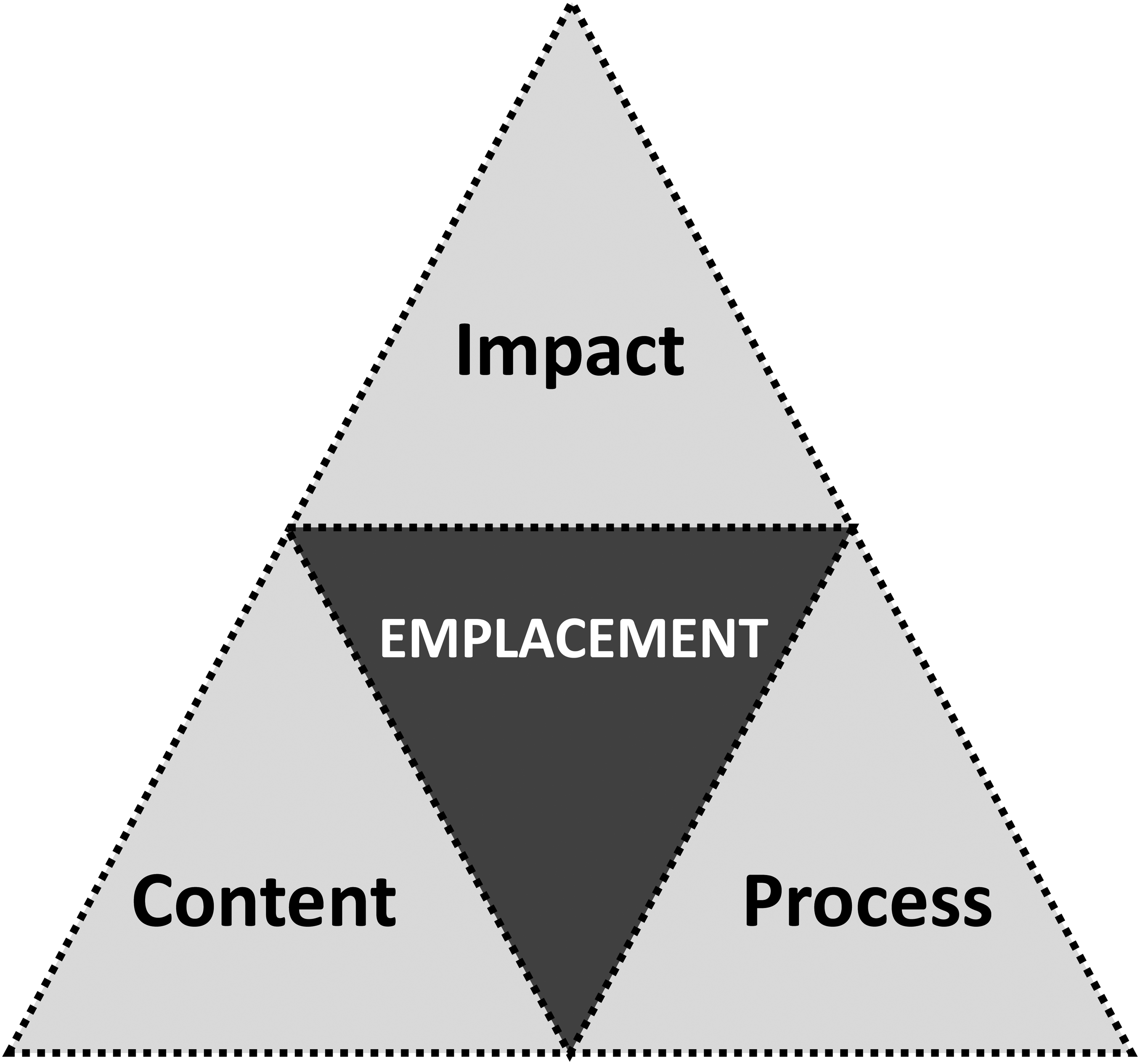
The reflexive management learning (RML) framework.
We organize the paper into three sections. Following the introduction, we provide conceptual clarity by distilling the dimensions that so far have defined reflexivity both conceptually and in practice. We consider how these dimensions of reflexive practice have informed the reconfiguration of organizational practices and, more widely, system shifts. We then present our reflexive learning from the collaborative inquiries of the authors to illustrate how the dimensions of our new RML framework play out. In the discussion, we elaborate on the RML framework presented in Figure 1 and consider the wider implications for designing collaborative inquiries. We emphasize the importance of approaching reflexivity as a rich and multivaried phenomenon and not as a single “variable,” which can be tested for its mediating/moderating impacts on performance, creativity, and other outcomes. As we exemplify from our collaborative research practice, the process of learning that underpins reflexivity's transformative power through its affordances or “possibilities” also calls for an equally entangled approach to collaborative research.
Reflecting on the Reflexivity Literature: A Hall of Mirrors?
Reflecting on experience has had a profound influence on management/leadership development (Raelin, 2001; Schön, 1983) across many professional contexts (Quinn & Bunderson, 2016). This affirms its central role in learning through “arresting moments” (Greig et al., 2013) that can be used as a basis for action, generating situated understanding, questioning the status quo, and seeking a “gear change” (Gorli et al., 2015), “learning to see more and differently” (Antonacopoulou, 2019) new possibilities (through idea generation, promotion, and realization; Schippers et al., 2015), to name but a few. Reflection has rightly then featured as an integral component in learning interventions, be these orientated toward understanding experiences, pragmatically deriving lessons, or mobilizing transformations (Kolb, 1984). It is through such meaning-making that reflection is prompted by a sense of being “struck” by something during an experience (Cunliffe, 2002; McInnes & Corlett, 2012; Wittgenstein, 1980). This response generates a desire to attribute new meanings which better “fit” the experience, and hence catalyze a critique of meanings and assumptions, not only actions. Reflexivity, therefore, is positioned as an extension of reviewing or reflecting on experience to draw attention to the conscientization that it uniquely promotes (Antonacopoulou, 2019).
The link between reflecting, reflexivity, and management learning has attracted scholars of a great many fields within organization studies, including organizational routines (Bucher & Langley, 2016; Dittrich et al., 2016; Edmondson et al., 2001), emotions and embodiment in organizations (Gilmore & Kenny, 2015; Vince & Reynolds, 2009), leadership development and practice (Denis et al., 2010; Eriksen, 2009; Raelin, 2001), strategy (Denis et al., 2007; Nicolini, 2012; Nicolini & Monteiro, 2017), organizational change (Antonacopoulou, 2004; Orlikowski, 1996; Tsoukas & Chia, 2002; Tucker & Edmondson, 2003), management ethics (Hibbert & Cunliffe, 2015), and sensemaking (Cunliffe & Scaratti, 2017; Lüscher & Lewis, 2008). However, all this attention has generated further conceptual confusion, not only about where reflection starts and reflexivity ends, but also about how these become integral to the quality of learning, especially if such learning is intended to support improvements in professional practice (Antonacopoulou, 2019). For example, the idea of reflexivity promoting a “shift,” as Soh et al. (2023) recount in their examination of the reflexive mindset compared to the previous compliance mindset that underlined internal audit practice, is not the same as Gorli et al.'s (2015) account of practitioners taking stock of their everyday practices and authoring themselves and their identities as they make sense of and develop ways of coping.
In this paper, our focus is on reflexive practice, and we draw on and extend Cotter and Cullen's (2012) reference to “Reflexive Management Learning.” By doing so, we provide further clarity on reflexive practice as part of the learning process, especially during the cocreation of knowledge that collaborative inquiry is designed to address. We choose the latter focus because we feel that the post-Covid world calls urgently for a greater alignment between science and society to foster the systemic changes that can sufficiently respond to the grand challenges of our time. Understanding how learning can be supported through collaborative inquiry programs that support reflexive learning is essential, especially when navigating the volatile, uncertain, complex, and ambiguous (VUCA) conditions that underpin grand challenges (Antonacopoulou, 2022).
In framing more clearly our focus on RML, we explicate our treatment of reflexivity as a practice and in relation to learning and changing (Antonacopoulou, 2004). We agree with Cotter and Cullen (2012) who problematize the treatment of reflexivity. They highlight the varied conceptual origins, diverse definitions, and assumptions about the outcomes and implications of reflexive practice in the literature, prompting them to expose the multiplicity of conceptualizations of “what reflexive learning is and of how it might be done in practice” (p. 228). One point of debate concerns whether reflexivity takes place “in the moment” or retrospectively. Cotter and Cullen (2012) identify a “decelerative/latitudinal” current in the reflexivity literature, in which individuals step away from or slow down their work in order to reflect. “Stepping back” is thought in experiential learning to support individual and collective transformation (Kolb, 1984; Raelin, 2001, p. 11).
However, Schön (1983) distinguished “reflection on action” (reflecting on past experiences) from “reflection in action” (reflecting on phenomena as they are experienced), to surface, test, and evolve previously tacit knowledge, in ways that help individuals act in their current context (Polanyi, 1966). The reflective practitioner (Schön, 1983) articulated reflexivity more overtly as a professional skill that connects learning to practice, rather than separating it (Raelin, 2011). Schön's approach aligns more closely with Cunliffe's (2002, p. 38) definition of “learning from within” emphasizing the “reflex” below the level of consciousness. Such primal response often equates to a form of dissonance whereby the learner realizes that their prior understanding does not adequately fit their current experience (Chia, 2009; Vince, 2002). This is what prompts recognizing reflexive practice as an embodied, emotional response akin to an awakening which broadens ways “of seeing simultaneously inside (within) and outside (above and beyond) the actions constitutive of one's conduct in relation to that of others” (Antonacopoulou, 2019, p. 25). The “back-and-forth” nature of the reflexive process can be compared to the experience of being in a “hall of mirrors” at a fair or amusement park (Riessman, 2015). Davies et al. (2004, p. 386) explain it by saying: Standing in front of one mirror, our reflection is caught in another, and that other reflects yet another image in a ceaseless infinite regression. (…). Yet the infinite regression captured in such a hall of mirrors draws attention to the backward looking of reflexivity, as if the process is always a return, a turning back. Yet the act of reflexivity creates new thoughts and ideas at the same time as going back over old thoughts and ideas. And is not going back in fact a new process in itself? If reflexivity is a process, a back and forth process, then the act of catching the moment, the doing of the reflexive gaze and of listening with the reflexive ear, must change the thinking that is being thought. That reflexive process is elusive and exhausting and often threatens to disrupt the very thing it sets out to observe. Yet it is necessary for finding both how that constitutive work is done and how it might (on occasion and perhaps temporarily) be done otherwise.
We see collaborative inquiry as a “hall of mirrors” which generates situated knowledge that allows collaborators to form a “stance” from which they can steer change. In the context of collaborative inquiry, a stance is not a fixed position, but a socially constructed, fluid, and temporary jumping-off point, from which collaborators can change change. Such a stance orientated toward the common good, withstands and embeds critique because it marks its relational character due to the collaboration. In other words, reflexive learning as a stance emerges not only as a mark of resilience to tolerate VUCA conditions but also as a mode of inquiry fuelling cocreation of future possibilities that the collaboration itself nurtures. This marks an emplacement as a stance-taking process that invites, beyond embodiment or enactment, the activation of responsibility. Antonacopoulou (2022) explicates this in her account of partnering for impact, also defining emplacement as “standing up for what we stand for,” which in collaborative inquiries propels a focus on impact where such impact is orientated toward the common good.
This focus on the production of knowledge(s) through entangled relationships, inseparable from process, content, or impact, requires us to understand change as “impacting
It merits clarifying further that the type of learning that distinguishes “reflective learning” and “reflexive learning,” as Cunliffe (2002) points out, is that the former surfaces a new understanding of the assumptions underpinning their experience, so that learners understand how the world works. This is called “technical” reflection by Reynolds (2011) because the learner is thought to be able to view their experience through an “objective lens” (Cotter & Cullen, 2012, p. 229), distancing themselves from experience to give it meaning (Freire, 1973). This has shaped scholarship on how a learner moves toward abstract principles and ideas from concrete experiences and uses this abstracted knowledge to shape future actions (Kolb, 1984). In contrast, in “reflexive learning,” the learner learns to challenge their assumptions and identify how they themselves are implicated in constructing social reality, mastering the level of critique necessary to form a practical judgment for their subsequent action choices (Antonacopoulou, 2010). In accomplishing this process otherwise referred to as “critical reflection” (Reynolds, 2011), learners may consider how social reality might be changed (Cunliffe, 2002). People accomplish this through ongoing and evolving conversations that narrate experiences by authoring through language and, through everyday interactions, in dialogue with themselves and others (Cunliffe, 2002; McInnes & Corlett, 2012). Such “authoring” and “authorship,” as Gorli et al. (2015) explain, explicates further why reflexive learning is intimately connected to the identity work of the self both in terms of personhood and being a professional.
Put simply, reflexive learning catalyzes new possibilities by seeing issues differently and then together making public the social and political forces at play, so that the emerging stance guiding the response marks an emplacement. This is why reflexivity is intimately intertwined with modes of education that cultivate character and conscience and not only competence (Antonacopoulou, 2019), aligning it to “conscientisation” as a form of education and learning attributed to Freire (1973). This is also why emplacement as a stance-taking process activates responsibility because it necessary goes beyond the ability to respond (Haraway, 2016)
Reflexive learning goes beyond the cognitive sphere and into the social one (Cunliffe, 2002). Thus, it connects more clearly to wider sociological debates about the dynamics of structure and agency, as Archer (2012) and others show, to reveal the scope for reflexivity to catalyze critique (Antonacopoulou, 2010). Here lies another fundamental aspect of reflexivity as a relational practice of identity works in what is differentiated as “critical reflexivity”. Here, focusing on the external environment and one's place and constitutive role within it is fundamental to the role of reflexivity. In what is well captured in interventionist action research, the reflexivity provoked by the cycles of action and reflection transforms professionals’ construction and enactment of their professional practice “generating content, process, and premise learning” (Coghlan, 2011, p. 62). This is also more recently echoed by Huber and Knights (2022), who draw on Mead's pedagogy to argue that through meaningful social interaction, we come to “re-form” our identities and learn to think and feel differently. Reflexive learners, therefore, engage in relational dialogue to generate understandings about their own self-assumptions and actions, and the implications these have for their authoring of social reality and their own person (self)-hood. Hence, Cunliffe rightly argues (2002, p. 37), they are “becoming more aware of how we constitute and maintain our realities and identities in continued dialogue with the self and others.” In doing so, Huber and Knights (2022) also echo, they not only think but also feel differently. To which we would also add that those practicing reflexivity do so by engaging not only their thoughts and feelings but also their “sentience” (Antonacopoulou, 2019; Rigg, 2018).
Drawing on Antonacopoulou's (2019) framing of reflexivity in relation to sensuous learning we can recognize the power of sentience in forming practical judgment (phronesis). Reflexivity is not only about ways of seeing and feeling but it is also about cultivating the resilience and strength of character to pursue both the (re)formulation and alternative expressions that provide consistency in conduct as part of the ongoing “ways of becoming” (Antonacopoulou, 2019, p. 27). As such, consistent with Bourdieu's (2000) conceptualization of reflexivity, in terms of constant reformulation and expression of meaning and their use in action, the notion of stance-taking is not fixed nor an ideological one. Instead, what we emphasize in terms of learning is the realm of social arbitrariness reproduced in social institutions, structures, and relations, as well as in minds and bodies, expectations, and behavior. The latter for us provides the basis of our further elaboration of the richness of reflexive practice by accounting for the entanglement of multiple dimensions as a mark of its emplacement. This enables individuals and groups to recognize that organizations are not neutral or “benign” (Brookfield, 2010 in Cotter & Cullen, 2012, p. 243) but capable of reproducing inequalities through oppressive practices (Duarte, 2009). For this reason, reflexive learning can be associated with a normative or “reformist” (Cotter & Cullen, 2012, p. 239) orientation that aims to liberate by rekindling their “sociological imaginations” (Duarte, 2009) or better still “desirable futures” (Gümüsay & Reinecke, 2022). As Hibbert (2012) points out, reflexive learning can help learners identify and engage with power, but reflexivity is itself not immune to power asymmetries. Making efforts to create “safe spaces” for collective or individual reflection, therefore, is challenging for educators yet not insurmountable, as Huber and Knights (2022) suggest. This is why our analysis is focusing on such systemic shifts drawing on emplacement as a stance-taking process that affords to navigate VUCA conditions by changing change.
Finally, reflexive learning opens a richer array of outcomes or what we consider impact(s). Identity work (both personal and professional) remains at the forefront of outcomes noted in extant research, especially because it places social interactions as the platform that serves to establish, reinforce, and/or undermine their sense of identity and engagement with the world (Gorli et al., 2015; Huber & Knights, 2022; Iszatt-White et al., 2017). Such identity work is continually enacted through the “language games” in dialogic social interaction (Wittgenstein, 1980), through which words are given their precise meaning in situ. These language games become part of the way that individuals “narrate” their own story in dialogue with the self or with others (Holquist, 1981). Reflexivity emerges as a form of identity work, in which people produce—and undo (Iszatt-White et al., 2017)—their self-understandings in an ongoing, dialogical process in which learning and “becoming” are entwined in the process of constructing social reality (Clegg et al., 2005). Recognizing the socially constructed, dialogical nature of self and learning enables us to explore and build a theory about reflexivity's rich and diverse nature, in line with calls to develop scholarship which does not simplify but embraces the complexity and multiplicity of praxis (Tsoukas, 2017).
Hence, our aim is to extend references to reflexivity as impactful to individual cognitive and emotional states or team performance and innovation (Huber & Knights, 2022; Schippers et al., 2015) and explore the oft-hidden dynamics between the process (form), content and impact of practicing reflexivity fuelled by emplacement. For the purposes of this paper, this aim is situated in collaborative inquiry—a practice we recognize as transcending and connecting units (individual/team/organization) of analysis. We approach arresting this richness as an understanding of how reflexivity is characterized by multiple dimensions entangled in the dialogic exchanges (Beech et al., 2012) of learners as they engage in a reflexive practice, itself a practice embedded in collaborative inquiry, thus also drawing attention to the recursive nature of reflexivity.
Following Hibbert (2012, p. 805), we position reflexivity as recursive: “if the patterns of our foundational assumption change as a result of the process of reflexivity then the actual process of thinking is also changed.” Such recursiveness we particularly account as “impact” because we extend beyond thinking and emotions and attend to actions. This is why we focus on impact as “improving action” (Antonacopoulou, 2022). This means that we attend to the relational and collaborative nature of RML, in which reflections are not purely cognitive, but produced out of the political, social, sensory, and psycho-dynamics of experience (Rigg, 2018; Vince, 2002). Whilst we focus on the way people use language to make sense of experience (Fletcher & Watson, 2007), we also attend to the nature of reflexivity which helps in the way learners “learn how to learn” (Hibbert et al., 2010).
Precisely because we are settled in our position of learning as more than behavior change and knowledge acquisition, we feel no need to fall into perennial confusions between learning, unlearning, and relearning (see Antonacopoulou, 2019). We focus instead on the organic growth of the individual and the collective when learning propels forming, performing, and transforming management and organizational practices (Antonacopoulou, 2018). This way, we can reveal how reflexivity can take place formally and informally, during or after an experience, in groups or in dialogue with oneself, and may reveal what “learning for impact” means when relating to understandings of the self, the task at hand, or wider conceptions of social reality and the stance that guides our participation in cocreating the “system” (in the ecology and economy). This multilayered appreciation of reflexive learning orientates the improvements in action, as both intentions as well as, action choices that are informed by the process of cocreation, which is the process by which collaborative inquiry is underpinned.
This perspective enables us to address a number of current weaknesses in the literature. These include a lack of attention to how identity work plays out in RML (Iszatt-White et al., 2017), a typically exclusive focus on the means by which reflection is accomplished, as opposed to the content or outcomes (Gutzan & Tuckermann, 2019), and the presentation of reflection as a cognitive, individualized endeavor, as opposed to one entangled in the relational production of social life through interactions with others (Cunliffe, 2002). In addition, Gutzan and Tuckermann (2019, p. 333) highlight the need for more rich empirical evidence of how RML is played out in organizational contexts.
We illustrate reflexive learning in the next section by providing accounts of our lived experiences in two different collaborative inquiries. We also build on this process of coauthoring our reflexive learning as an additional illustration of how collaborative inquiry fosters reflexive learning. We bring the insights together in advancing our RML framework to support future collaborative inquiry.
Coauthoring Lived Experiences of Reflexive Learning
The review of the literature in the previous section highlights the gap that the study reported in this paper sought to address by framing the research question: Why is RML critical to the way collaborative inquiry takes shape and the impacts it realizes? Consistent with calls for more complex, contextually embedded empirical analyses of how RML occurs in situ and from the perspective of the learners themselves (Cotter & Cullen, 2012; Gutzan & Tuckermann, 2019; Hibbert, 2012), this study presents a longitudinal tracing of such learning in the organic growth of academics and practitioners engaged in collaborative inquiry and cocreation of knowledge for impact. We draw on our autoethnographic accounts of collaborative inquiry and, as coauthors, we present our learning and reflexively account for the impacts that our collaboration is cogenerating.
The first example draws insights from our collaborative inquiry on a Doctorate in Business Administration (DBA) program. This example gave us the opportunity to reflexively learn how to embed “research as a management practice” where the reconfiguration of the internal audit approach catalyzed important changes and improvements in the way conduct risk was addressed in a financial institution. It also instigated a reflexive mindset as a key dimension in the way internal auditing (IA) is now being conducted in that institution, forming a stance toward the importance of balancing immersion into auditees’ activities to fully appreciate the contextual nuances, and yet also maintaining sufficient distance in order to uphold the independence that internal auditors must preserve in order to discharge their fiduciary duties.
The second example captures the reflexive learning of participants (educators) at the Royal Norwegian Airforce Academy (RNoAFA), where a collaborative inquiry instigated a reflexive critique of the approach to educating leaders and leadership in officers and specialists. The collaborative inquiry, in this case, catalyzed a reflexive critique of the pedagogical approach adopted and a forming of a stance toward the values and pedagogical principles upheld by the RNoAFA toward “growing” leaders and leadership in the military profession. This example signals that collaborative inquiry, especially when conducted in the wider context of a modernization program of the Norwegian Defence, became a vehicle for defending the pedagogical principles adopted by the RNoAFA. In doing so, it also affirmed that, in the face of modernization, standing for these principles demanded educating policy makers about the importance of sustaining these principles and providing the necessary continuity, even if this called for doing more with less resources. In this example, we recognize a mode of changing that retains the essence of learning leadership and, in doing so, the significance of defending and upholding these pedagogical principles as a mark of sustained excellence, pivotal to the emplacement that underpinned this systemic shift in Norwegian Defence.
The two autoethnographic narratives are different, as expected, not only because they convey the lived experiences of the protagonists, but because also they mark collectively an important and often missed aspect of reflexive accounts. We focus on the content, process, and impact of reflexive learning. Much as Johnson (2020) accounts for “lived compositions” in the past, present, and future, we reveal the vulnerability and becoming entailed by “thinking with” autoethnography, as Phillips et al. (2022) propose. In this sense, the autoethnographic accounts may be predominantly the voice of the “practitioner” but that is (as this paper itself represents) the emerging story that the ongoing coauthoring of “y-our story” reveals when the “thinking with” becomes also the “writing with.” This for us marks a critical aspect of cocreation, recognizing that collaborative inquiry is as much about the “co” in “co-creating knowledge,” hence our focus on impacting “with,” not impacting “on.” We recognize Phillips et al.'s (2022, pp. 761–762) argument that power is “always in play in the research process itself, notwithstanding the democratic, collaborative, dialogic ideals and transformative aims of social justice and social change.”
Our experience and commitment to dialogical exchange cocreated the reality we arrest in the accounts of reflexive learning and mark our commitment to “rewrite the story” (to use Antonacopoulou's, 2018 framing), thus marking our shared obligation to “impacting with” through the collaborative research. Impacting “with” (like thinking and writing “with”) shifts the focus to the cocreation of impact (serving a greater purpose—the common good), thus reflexively learning with each other and, in doing so, forming our stance toward emerging issues, not as a fixed position but as a reflection of our ongoing “relational becoming” (Phillips et al., 2022, p. 763).
It would, of course, be important to also make explicit the role of reflexivity in our collaborative inquiry and our coauthoring of our individual and collective learning experiences. We choose not to make “validity,” as other scholars do (e.g., Dennis, 2018), the focal point of the reliability or legitimacy of our accounts. We are entirely aligned with the methodological rigor that necessarily underpins all inquiry (scientific or otherwise). In this sense, the reliability or authenticity of our account is marked by the “truth” our communicative negotiations and responsibilities uphold in our shared commitment to not only capture our corresponding truth. Instead, our focus, inspired by James (1907), is that “Truth in our ideas means their power to work.” Put differently, although deeply personal to us as coauthors, our accounts of our individual and collective reflexive learning are also a mark of our commitment to practicing reflexivity, challenging and broadening each other's appreciation and understanding of how we cocreate the systems and practices that we also seek to change and improve.
In this respect, our analysis goes beyond validity in our claims and focuses on our collaborative inquiry and the impacts it cogenerated. This is consistent with Dennis’s (2018, p. 112) reference to praxis as “the ethical labour of understanding the Self by recognising the Self as Other and the Self in Other.” This affirms that collaborations amplify the “inter-ness”—connection—that defines the quality of the relationship between partners, as well as the acts of partnering, which Antonacopoulou (2022) elaborates as the essence of “inter-being” as a mark of sympoiesis, which is the essence of cocreation: “Cocreation itself then is founded on inclusiveness that redefines the way interrelationships, interdependencies and interactions between multistakeholder partnerships unfold.” By implication, such a focus can potentially also extend the very ways in which impact is measured and accounted for” (Antonacopoulou, 2022, p. 10).
RML in IA
This collaborative research emanated within the DBA program at an international business school and started with enrolment to the program. The design of the DBA drew from the literature on how merging theory and practice leads managers to engage in scholarly practice (Raelin, 2007), phronesis (Flyvberg, 2001), and collaborative inquiry (Coghlan et al., 2012). It is grounded on an epistemology of practice (Raelin, 2007) and underpinned by ideas of praxis and phronesis. Praxis, the art of doing, acting, and enacting, is described as a form of critical thinking that combines reflection and action with a commitment to human flourishing, a quest for truth and respect for others (Kemmis, 2010; Küpers & Pauleen, 2013). The Aristotelian idea of phronesis denotes practical wisdom based on ethics and values and informed by reflection (Antonacopoulou, 2010; Flyvberg, 2001; Ramsey, 2014). In Heidegger's terms, phronesis is concerned with a way of being in the world (Shotter & Tsoukas, 2014). It is pragmatic, context-dependent, and oriented toward action (Kinsella & Pitman, 2012).
Informed by these ideas, the DBA design has three stages of development: firstly, a period of structured classes, run through action learning (Revans, 1982); secondly, a 10,000-word Doctoral Development Plan as a transition from taught modules to thesis; and finally, an Action Research thesis which takes an action-orientated research approach, typically as an insider-action researcher approach (Coghlan, 2019) is adopted to problematize, investigate, and take steps to resolve a significant issue in the student's own organization or management practice.
The program design develops three interacting practices that facilitate the becoming of a scholarly practitioner: a disposition that treats management practice as a subject of inquiry, employing research to inform and evaluate practice; a propensity for critical reflection or reflexivity; and engagement in collaborative dialogue (Rigg et al., 2021). We concur with Spencer et al. (2022) that dialogue and dialogical sensemaking are fundamental to the learning process and at multiple levels. Engagement with literature we see as a dialogue with the ideas of others; the change process involves dialogue or public reflexivity with coworkers; the doctoral journey involves dialogue with peers (other students), as well as the quality of dialogue between academic supervisor and practitioner. In addition, there is a further conversation with examiners within the doctoral viva.
In the IA example, we refer to here, our partnership for impact goes beyond the confines of the DBA journey. Dialogue has continued between the practitioner, supervisor, and the two examiners in the three years since DBA completion, as we have explored further sensemaking to write for publication. This constitutes a different and ongoing kind of “partnering for impact” (Antonacopoulou, 2022), through which all of us are learning from the collaborative dialogue about the ways we inquire. In fact, the quality of our relationship over time was founded on the trust that underpinned our initial critique of ways of searching and researching everyday practices, and not only malpractices that amplify into crises. We discovered that focusing our formal meetings during the DBA supervision, but also subsequent to DBA completion, inviting each other to account for our respective ways of coping with everyday challenges, has elevated our collaboration beyond seeing each other professionally and instead, as trusted friends who share all that life presents us with.
This has transformed our inquiry from one that looks at how we study a phenomenon, to how we understand one another and our perspective of trusting and upholding one another, especially when we meet ourselves in moments that we simply do not know what to do. An example was the way the research collaboration started by recognizing the persistence of risk that was undermining an IA approach and its capacity to arrest and address conduct risk. Conduct risk constitutes any behavior a firm engages in that would cause problems to consumer protection, market integrity, or competition (Llewellyn et al., 2014). It took courage, patience, and perseverance in the initial meetings for the supervisor and the DBA candidate to present this IA challenge with the typical approach followed by identifying and resolving “wicked problems.” It was clear that the mode of inquiry was not only problem-driven but the search for a solution superseded the identification of the causes. Moreover, we recognized that the inquiry would tend to be restricted to ready-made solutions by seeking “best practices” instead of investigating in situ what conditions created and permitted conduct risk to persist.
Reflecting on our collaborative inquiry we recognize that an important part of our “learning together” and not only “learning from each other” (Beech et al., 2022) was the commitment to embed “research as a management practice” (Antonacopoulou, 2022). This means that we were actively deliberating and asking ourselves and one another how and why searching to understand the phenomenon of conduct risk would call for more than simply a search for understanding its causes and consequences. Instead, we were realizing the importance of searching and researching as an act—a practice around which we could reorganize how the IA function would improve its approach of arresting conduct risk. We were embarking on an inquiry into the very approach of search and research (Antonacopoulou, 2018). This provided a very different approach to the way we turned the “problem” into a “research question” that an action research intervention was designed to address.
In this respect, our collaborative inquiry was framed as a strategic learning agenda that engaged us all in dialogue and with the shared commitment and purpose of understanding the issue at hand by including as many and varied perspectives as possible. This shifted the approach of conducting the research from one that would simply meet the guidelines of the DBA program to one which would also meet the learning needs of all those that agreed to participate. Addressing conduct risk was the driver toward designing the action research intervention as a collaborative inquiry platform. Our reflexive learning through collaborative inquiry became our stance and our “impacting with” emerged as our emplacement. This means that we have remained fully present and alert to the challenges we encountered in our action research. However, our collaborative inquiry adopted a stance that motivated our collaboration beyond personal interests or agendas and instead toward a commitment to serve the common good. By doing so, the actionable knowledge that emerged from our collaborative inquiry not only fulfilled successfully the award of the DBA degree but more importantly it fuelled the sentience that has sustained our shared drive to continue to explore and learn from each other, producing a series of joint publications, sharing our insights and inviting others to join in this conversation and approach to researching and reconfiguring management practices.
In our collaborative inquiry, the key Internal Auditor led the process with the team of colleagues in the organization that was created to undertake the reconfiguration of the IA practice. Alongside their own systematic reflections in diaries and ongoing conversations with colleagues, there were continuous reflection sessions with the academic supervisor. They maintained the degree of distance necessary so that at every round of searching and researching (in collecting data across different levels and perspectives to include auditees as well, redesigning the IA approach, and testing the new approach to arresting conduct risk in mainstream IA assignments) there was debate and joint unpacking of the nuances in the exegesis provided to how to conduct risk manifested, persisted and could be averted.
In Table 1, we provide a summary of reflections by the Internal Auditor who was leading the collaborative inquiry within the organization and with the academic partners (supervisor initially and subsequently examiners). By providing this longitudinal account of learning, this summary reveals that, as illustrated in our RML framework in Figure 1, the content of the reflections was changing as did the process of reflexivity, enabling the emerging insights that mark the impact of reflexive practice.
Reconfiguring the IA Approach Through Reflexive Learning.
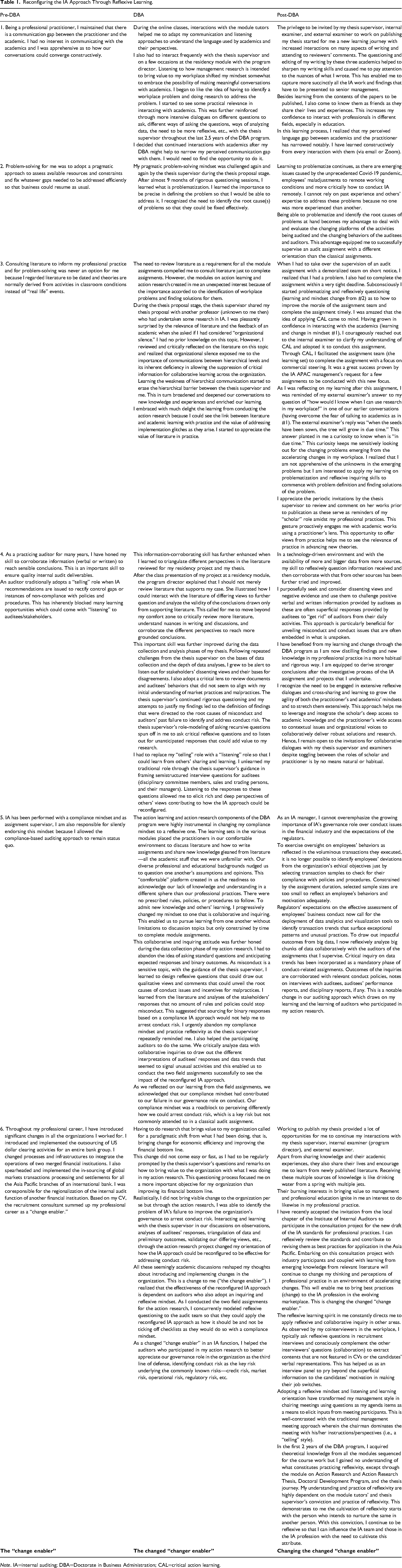
Note. IA=internal auditing; DBA=Doctorate in Business Administration; CAL=critical action learning.
We could devote the remainder of this analysis to unpacking the learning and lessons we continuously derive; suffice it to say that we collectively agree that our collaborative inquiry is characterized by a deep trust in one another as friends and not only as collaborators. We bring to our planned and ad hoc interactions our respective life challenges, which are both the subject of collective deliberations as well as an integral part of the quality of the relationship that underpins our collaboration. Giving voice to the scholar–practitioner collaborator who distills the process of reflexive learning through the DBA in a before, during, and after account (based on diary notes throughout our collaboration) as summarized in Table 1, offers an additional important insight into a collaborative inquiry that is underpinned by reflexive learning. Namely, that when we form powerful connections with one another, it genuinely does not matter who is doing the talking (authoring), because we place the focus on the space-in-between “y-our story.”
Any one member of our collaborative team authoring his/her account captures both his/her lived experience and our collective journey. Such “authoring” of a “story,” as an accurate account of events past, transcends their version of events (what we would frame as “his-story”). Instead, they have the capacity to speak for the team experiencing and participating in shaping the story and it is unfolding. The latter bears particular attention as it reveals that reflexive learning's impact (beyond process and content) is in nurturing the common sense that must necessarily underpin the common good, as Antonacopoulou (2022) also explains with reference to partnering for impact. Our learning from our collaborative inquiry is reflexive because it implicates us and our identity as scholars, scholar-practitioners, and practitioners (all of us assuming these identities simultaneously even if serving in different positions/roles) in appreciating the significance of this phenomenon and the commitment to address it.
In other words, what we demonstrate here is that the content, process, and impact of reflexive learning in collaborative inquiry place the grand challenges we are facing as a common priority (not only a common concern) that begs joining forces in addressing, because it serves the common good. We have also been able to capture this empirically (Soh et al., 2023, 2024) in demonstrating that averting conduct risk and reconfiguring the IA approach (impact) in this case was possible because the collaborative inquiry between us amplified to also a collaborative inquiry within the organization (process). We are also now collaborating with colleagues in the Finance and Accounting profession to realize the impact of this analysis in supporting the IA profession to rethink the education and professionalization of Internal Auditors. By identifying through our research that the IA profession fosters learning practices that instigate a compliance mindset that may augment conduct risk, we now have recommendations that can help avert it, drawing on our collaborative research. Namely, we are proposing that the future education of IA professionals should foster a reflexive mindset. For us, the importance of this recommendation is not only the support it finds in our research findings, but also for the difference it makes in identifying and addressing conduct risk in practice.
We recognize that we draw on our own experiences of practicing a reflexive mindset in the way our reflexive learning has catalyzed this capacity in our ongoing collaboration. In this respect, we are not only practicing what we preach. We embody reflexivity as a way of living and working, anchored by our learning. Reflexive learning, therefore, is emerging as our stance for how we choose to conduct ourselves not only in our collaboration, but also in our professional and personal life as individuals. Such emplacement reframes our reflexivity and our learning in service of a higher purpose—the common good—by bringing conduct risk to focus and joining forces in cocreating actionable knowledge that can address it.
RML in the Norwegian Defence
We echo the same stance in the second example, where our focus is on RML in the Norwegian Defence. This is a typical research collaboration that initially started by codesigning a research study with the intent to capture the way the RNoAFA grows leaders and leadership in the officers and specialists in this branch of Norwegian Defence. Having pioneered the use of reflection alongside theory and practice as a central principle of their signature pedagogy, it has also supported, through this approach, the development of military leaders across the Norwegian Defence. It was important, therefore, to understand not only what the approach to growing leaders entails and how learners engage in RML to develop as leaders, but why reflexivity was so critical to leadership practice as well. Placed in the context of the venerable commitment to learning from failure and the changing nature of the military profession in peace (and not only in crisis and war) these conditions perforce entail the need to examine the process, content, and impact of growing leadership.
A qualitative case study approach underpinned the research design, supported by a combination of data collection methods including ongoing participant and nonparticipant observations, formal semistructured interviews, and ongoing informal conversations. These data methods were part of a six-year collaborative partnership between the RNoAFA and the GNOSIS Research Institute, founded on the commitment to cocreate knowledge for impact, a principle that guided the design of the study. The study was jointly shaped by two of the coauthors whose shared commitment to action research (Coghlan, 2011; Greenwood & Levin, 2007; Marshall, 2016) also catalyzed abductive reasoning at all stages of the research process (Golden-Biddle, 2020; Sætre & Van de Ven, 2021).
An abductive orientation and action research-informed approach meant that academic and practitioner perspectives were interweaved, allowing us to observe and confirm patterns and anomalies without seeking closure. We sought in these patterns and anomalies episodes of creative social activity and allowed ourselves to live through the surprise, doubt, and possible exegesis these generated. This means that we maintained both inner and outer arcs of attention, engaging in self-critical observation of the ways concepts and practices are framed, interpreted, and felt in any given situation as well as focusing externally, to observe what is going on and to question taken-for-granted assumptions and practices with others (Marshall, 2016). Such an “immersed reflexive” (Coghlan, 2011, p. 64) approach to research is not only interventionist by design but is also designed to support the noticing of how taken-for-granted ways of doing and perceiving can influence the choices made and the transparency of such choices. This means that we introduced an emplacement approach to our collaborative inquiry by taking a stance toward the process, content, and impact of knowledge cocreation (Figure 1). The cycles of action and reflection, and the reflexivity provoked by abduction, were intended to capture the approach adopted by the RNoAFA in growing leaders as well as to strengthen it, thus “generating content, process, and premise learning” (Coghlan, 2011, p. 62).
Such a process, otherwise acknowledged as a way to build theory by developing “new ways of seeing” (Bansal et al., 2018), uniquely embeds a reflexive gaze in the very process of studying why reflexivity matters and how RML is conducted. This characterizes “emplacement” (Pink, 2009)—a mode of research that always implicates the intertwined nature of sensual bodily presence and perceptual engagement of social, material, and environmental conditions shaping social practices and imperative in rewriting the story (Antonacopoulou, 2018).
In advancing practice-based studies, applications of emplacement (e.g., in entrepreneurship as practice; Antonacopoulou & Fuller, 2020) already pave the way for an ontology where subjects, objects, ideas, images, discourse, and practices give voice to the place of multiplicity in everyday life and from which disclosure is possible. Emplacement is not just about researchers embedding and collaborating with practitioners to understand and interpret accurately the issues in a given context. It is also about interbeing—when a reflexive gaze enables retaining the level of critique that notes the entanglements in the place leadership holds in a given moment. This is so that, beyond the occasion that marks leading, we also notice and account for its impacts, not all of which may be improvements in action, but revelations of human fallibility.
By living the experience with those we study, entangling ourselves in the epistemic and civic renewal (Sklaveniti & Steyaert, 2020), our methodological approach embedded reflexivity at all stages of the research process, enabling us to expose contradictions and tensions, as well as mark the extensions in the (positive) impacts we were seeking to generate. For example, this study was being conducted coincidentally at the time when the Norwegian Ministry of Defence launched a major modernization program across all branches of the Norwegian Military. This study became both entangled in this process of modernization and contributed to the transition by inducing reflexivity. From this entanglement, we were better placed to appreciate how our methodological approach (as a stance toward research practice as a collaborative inquiry) served to support systemic change, through shifts that were not necessarily paradigmatic but action and choice-based.
Reflexively accounting for our methodological approach is itself a mark of our reflexive learning and the recognition that the collaborative inquiry enriched our capacity to “see” the response to the modernization challenge. The fact that someone standing on “the outside” is asking questions that led those of “us” in the RNoAFA to go deeper into WHAT we do, and HOW we do it, WHY we do what we do, is of great importance. In this way, we get to challenge and explore our own leadership development practice. The fact that this is done with skilled and knowledgeable researchers is very relevant because the exploration becomes wider and deeper. Through the interpretation and analysis of the researchers’ observations “we see ourselves in a different way,” and “we understand ourselves in a new and perhaps different way than we did before.” New ways of seeing ourselves become new ways of being, and our collaborations foster our interbeing in that our collaboration gives us new concepts, new vocabulary, and renewed motivation to carry on improving our actions through choices that also preserve our principles.
Table 2 presents the account of two RNoAFA educators (and coauthors of this paper) describing their stance toward leadership development and how this is also illustrated in the reflexivity exhibited by the cadets—learners they educate. What we explicate in this table is the way reflexive learning acts as a connecting tissue to not only align different participants within the RNoAFA but also enable the embeddedness of external learners (in this instance the scholar who initially embarked on the research collaboration) and then progressively the team of researchers—as conduits for bringing attention to issues. For us as a collaborative inquiry team of researchers, this attentiveness is not a matter of “issue selling,” as Lauche and Erez (2022) usefully explain relational dynamics in change processes. Instead, for us it is a means of activating the response that the modernization program was instigating. It was a mark of the collective responsibility to uphold pedagogical principles that the modernization program was threatening to undermine. By fostering ways of seeing the organizations’ practices, the underlying principles, and their consistency placed under closer scrutiny, this instigates a process of changing that is not as much a transition or a transformation, but a case of emplacement—taking a stance—as a critical aspect of RML.
RML in the RNoAFA.
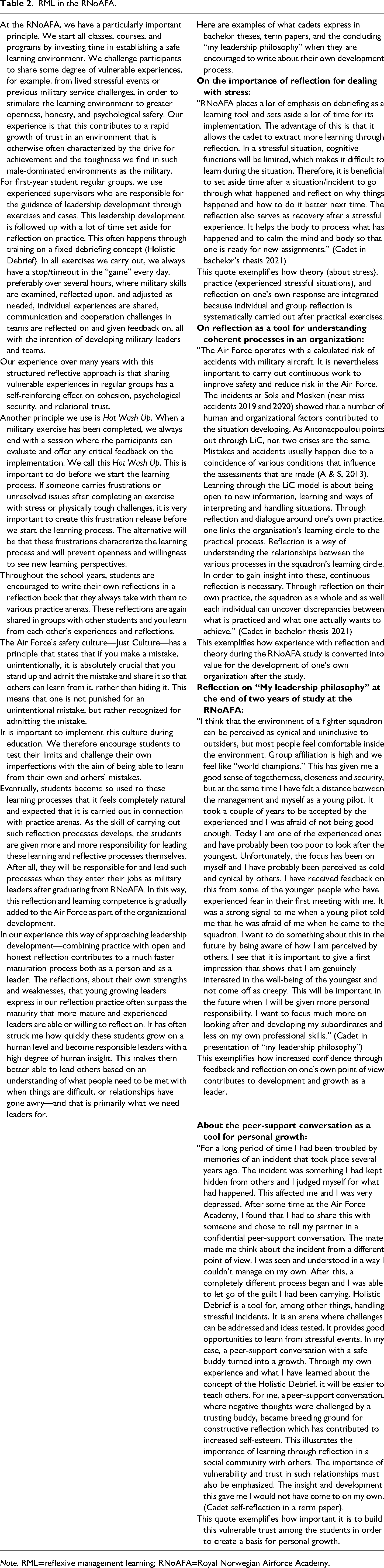
Note. RML=reflexive management learning; RNoAFA=Royal Norwegian Airforce Academy.
This prompts us to suggest that in the collaborative inquiry, we account here, the key insight we derive is that despite the modernization of Norwegian Defence, which resulted in changes in the resource allocation and the education of future military leaders, the RNoAFA affirmed its stance toward its pedagogical practices and avowed the retention of core principles that define its unique approach of developing leaders and leadership. In other words, the reflexive learning at the heart of the collaborative research inquiry enhanced clarity and confidence in the existing practices and prompted adjusting to the modernization program by retaining and sustaining the educational principles and practices that continue to serve the development of leaders and leadership suitable for the military profession. By strengthening the resolve and stance taken toward the approach of growing leaders and leadership the collaborative inquiry strengthened the trust in the process already in place. It also prompted a further education exercise by engaging in dialogue with senior figures in the Norwegian Defence and the Ministry of Defence who were enforcing the changes. This did not only entail extending the study to include their perspective in the process of data collection. It also entailed invitations to “external players” to witness directly the educational practices and better appreciate why the current pedagogical principles were essential to retain. By taking this stance, the RNoAFA navigated the modernization of Norwegian Defence by retaining those aspects of its pedagogical practice that mattered most to its capacity to continue to meaningfully serve its purpose. To arrive at this firm and “unnegotiable” stance necessitated support from the external researchers who delivered presentations at internal conferences, and organized workshops to bring the research team and other members of the Norwegian Defence together to debate the emerging findings from the study and their relevance in constructing the response to the modernization agenda.
In this respect, the reflexive learning embedded in (and by) the collaborative inquiry strengthened the ability to respond to the wider system change the modernization called for, by preserving that which would be essential to its effective implementation, taking a stance toward what matters most, to retain and honor the impact it has in growing leaders and leadership. In this sense, the impact of the RML in this example of collaborative inquiry was the realization of what matters and the conviction to fight that it be retained. This is not to suggest that there was no improvement in action and that keeping things as they are is what emerged. On the contrary, the emplacement that this impact marks is the defending of core principles. In other words, it is what Antonacopoulou (2022, p. 6) frames as an axiology in collaborative practice where “how we value ourselves, each other and the value we attribute to being worthy” marks the way values are emplaced, not only embodied. By honoring ourselves and each other we elevate the quality of trust that the collaborative relationship calls for, so that the inquiry can sustain the level of critique necessary to reveal issues that need to be attended to, engaged with, and addressed.
Discussion—RML as Changing Change
Our analysis in this paper reveals both the importance of reflexive learning in collaborative inquiry as well as the character of such learning and reflexivity in terms of content, process, and impact (Figure 1). It is these three dimensions of RML that we discuss further in this section to inspire the design of future collaborative inquiries that foster not only change but the way changing is supported.
Our lived experiences of collaborative inquiry and their reflexive analysis highlight the importance of embedding reflexive practice in any inquiry but especially collaborative inquiry and in doing so approaching reflexivity through multiple dimensions, through which a stance can be generated that facilitates “impacting with” in changing change. Figure 1 illustrates diagrammatically these dimensions in our proposed RML framework. The dynamics of reflexivity in our RML framework call for an appreciation of an entangled approach to the process of learning through affordances and possibilities of reflexivity. It is in the character of the reflexivity itself and the connections between content, process, and impact that emplacement is also activated as the stance formed not only in the inquiry itself but also in the collaboration. Emplacement is a foundational element of a reflexive approach to collaborative inquiry because it invites collaborators to approach their collaboration and the quality of the relationship that underpins it with a stance toward the value of learning from each other, as Beech et al. (2022) also promote. This is achieved through creating safety in vulnerability when learning that goes beyond recognizing, addressing, resolving, and forgiving occasional mistakes. Such a safety in vulnerability indicates that the quality of relationships among learners enables them to bring their whole selves into the learning process, open to being vulnerable with each other to see the other, and through the other to see themselves.
Beyond Beech et al.'s (2022) suggestion that partners collaborate “as if” (emphasis in the original) they have a “shared understanding,” we make the case for emplacement as a dimension of collaborative inquiry where the reflexive learning goes beyond “paradox boxes.” Instead, we invite working with tensions that could be afforded a place, in “figuring out” the stance that emerges as a guiding principle for the changes that can be afforded. As our own lived experiences exemplify, context remains an important dimension for reflexive learning. However, as our analysis marks the importance of emplacement, we feel that this also calls attention to the place and space in developing a reflexive approach in collaborative inquiry. This is why emplacement marks a positioning toward issues and affords practicing reflexive learning in ways that activate responsibility toward such issues. Taking a stance is more than a response to issues. It is a mark of the choices made based on the governing axiology which instills in reflexivity the conscientization toward changing and the learning necessary to make change possible. Choice, therefore, as a mark of stance-taking, affirms the entanglement in the system and explains systemic changes as a process, content, and impact of collective action, especially when supported by collaborative inquiry.
Implications for Practice
Extending the insights from our analysis to support future collaborative inquiries, we suggest here that other practitioners and researchers can employ our framework, illustrated in Figure 1, to develop a multidimensional approach to RML in their collaborative inquiry that allows them to recognize the stance they take toward changing change. We offer some questions that explicitly harness the process, content, and impact embedded in reflexivity learning that could support collaborators to explore their hall of mirrors.
Does reflexive learning emerge through writing, observation, participation, and discussion? How formalized is the inquiry process? Is the inquiry embedded in a structured program of collaboration, or does it occur through informal “corridor” discussions? Where is collaboration happening? What places and spaces are collaborators interacting within? How are participants feeling about their engagement? To what extent are they fully present? To what extent do they experience discomfort or dissonance? To what extent do they feel safe being vulnerable when learning with and from each other? What entanglements (relationships, priorities, inequalities, and other social phenomena) are the focus of the collaboration, and how might these surface? How and why have specific issues emerged as the focus of the collaborative inquiry? What interactions have led to moments of “struckness”? What is the emplacement—stance formed—seeking to defend? What does emplacement seek to preserve? What is emplacement seeking to change? What principles form the underlying axiology of emerging emplacement? Are we ready to embrace the shifts that changing entails? What understandings have we (or should we) “let go”? How might we enhance resilience through the stance taken? What guides impact? How is the learning changing me/us and our ways of interrelating? What facilitates or obstructs our ability to impact with each other? What is our stance, and what does it mean for our capacity to shape change? How will we account for the impact of the improvements of action? What are we choosing and why? How do we experience and “label” shifts?
We distill as a key emerging insight from our lived experiences of collaborative inquiry the idea that RML is fostering shifts—modes of changing as part of a wider movement that entails progress, which can be marked by improvements and reconfigurations (as we illustrated in the Internal Audit example), or marked by affirming and retaining principles that serve well the governing axiology and purpose (as we illustrated in the Norwegian Defence example). Such shifts invite us to rethink RML not only marked by changes that are visible and reportable. Instead, it prompts attending to the unfolding changing invited by processes of reflexivity, alongside the content of such reflexivity, to consider the possibilities for the emerging impacts of practicing reflexivity. In this respect, RML is as much about the ways collaborative inquiry supports interventions that are transformative both for the reconfigurations that it supports, as well as the affordances for changing that it nurtures.
Our analysis makes a compelling case for collaborative inquiry not only as a means for development and change initiatives as this special issue invites us to appreciate. We feel that our lived experiences of collaborative inquiry add substance to calls for creating practical knowledge about organizational change (Beer, 2021) and, in doing so, explain the “learning mechanisms that provide both a platform for integration of multiple perspectives, enabling discoveries, development of new mindsets and creation of new meaning” (Shani et al., 2022). More specifically, our RML framework invites future collaborative inquiries to more systematically account for the process, content, and impacts that the cocreation of actionable knowledge supports, by attesting to the stance that it also fosters.
We show in our analysis that a stance is not only a testament to the governing axiology of the collaborators and their collaboration. It is also an emplacement as a methodological approach that promotes the entanglement of collaborators in the inquiry as they individually and collectively “figure out” how to respond to wicked problems or grand challenges by assuming their responsibility and realizing their impact. It is about how the collaborators, and their inquiry invite, through their joined critique, the possibilities afforded in different situations, be it by reconfiguring current practice, or by affirming and preserving that which is unique, valued, and a key to sustained excellence, especially when serving their purpose. By introducing emplacement as a methodological orientation, we extend current approaches to cocreating actionable knowledge and provide fresh insights into the way collaborative inquiry advances science-practice transformations.
Conclusion
In this paper, we presented autoethnographic accounts of our lived experiences of collaborative inquiry and illustrated both our reflexive learning and the value of practicing reflexivity in arresting change and changing in ourselves, our collaboration, our respective practices, and the wider systems we are part of. Perhaps more importantly, we have drawn attention to the change that is afforded when collaborative inquiry focuses on the process, content, and impacts of RML. By embedding RML as integral to the collaborative inquiry we exemplify the way collaborators “figure out” the emerging reality as they search and research together to address any given “research question” or identified wicked problem. By repositioning wicked problems as inquiry-driven research question(s), this invites collaborators to “meet” each other with trust in their vulnerability to experiment with learnings, so as to recognize, forgive, address, and resolve occasional mistakes of previous action choices.
By bringing the choices closer to focus, this radically shifts the emphasis of the collaborative inquiry on the stance that collaborators are invited to form toward issues. Such a stance is not only a mark of clarity of meaning and purpose, or a new mindset and understanding. It is a vantage point that allows disclosure, which promotes the emplacement of collaborators and their inquiry into the system that sustains the issue at hand. It is only when the collaborative inquiry exposes that the issues are unsustainable that it also invites collaborators to inquire differently, so that, supported by their reflexive learning, they are afforded changes and modes of changing that propel them toward cocreating forward both their desired future, and also their stance toward changing.
As we have discovered in our own collaborative inquiry, such changing is as much about transforming as it is about growing, maturing, and standing up for what we stand for. Such an emplacement centers reflexivity beyond context, culture, and space, driven by the identity of location of collaborators. Instead, emplacement amplifies the interbeing of collaborators such that their inquiry is governed by an entangled approach to the process of learning and changing through affordances and possibilities of reflexivity, which we see as bringing about significant shifts. We invite future collaborative inquiries to explore and extend the proposed RML framework capturing dimensions of reflexive learning that an emplacement orientation to collaboration and inquiry will no doubt promote, provoke, and support.
Footnotes
Acknowledgments
We express gratitude to all the research participants in our collaborative research that remain entirely implicated in our lived experiences and the learning we derived from our collaboration, but which will remain anonymous in line with our confidentiality agreement. We are also very grateful to colleagues at the Universities of Oxford, UK, Stockholm School of Economics, Sweden, VU University, The Netherlands, and Cyprus for the opportunity to deliver research seminars and to share this learning and derive valuable feedback that improved considerably the way we framed our contribution. We also benefited from valuable feedback from conferences such as that of the US Army College and the International Society for Military Studies where we also presented our collaborative work and obtained valuable feedback.
Declaration of Conflicting Interests
The author(s) declared no potential conflicts of interest with respect to the research, authorship, and/or publication of this article.
Funding
The author(s) received no financial support for the research, authorship, and/or publication of this article.
