




Abstract
There is broad consensus in academia and practice that organizational resilience is a critical factor for organizations to cope with crises. However, despite considerable theoretical progress, empirical knowledge on the dynamics of organizational resilience remains limited. To explore facilitators and consequences of organizational resilience with a holistic approach, we report results of a mixed-methods multi-study throughout an ongoing crisis within the Pakistani textile industry. Qualitative findings indicate a broad set of organizational resilience facilitators, differentiated in respect to their content and temporal properties. Quantitative findings from longitudinal survey data suggest the pivotal importance of “soft” facilitators related to employee focus and learning orientation. In terms of consequences, results show that organizational resilience can reduce emotional exhaustion and contribute to business success. Overall, the findings are consistent with an integral understanding of organizational resilience as a meta-capability, building on a set of facilitators occurring at different time points throughout a crisis.
Keywords
Global challenges such as financial crises, pandemics, and climate change, increasingly expose organizations to conditions threatening survival. Therefore, it is vital to understand how organizations can positively adjust or function during adversity and emerge resourcefully. Accordingly, the concept of organizational resilience which reflects the organization's “ability to survive, and potentially even thrive, in times of crisis” (Seville et al., 2008, p. 259) has gained considerable momentum over the past years, with scholars and practitioners aiming to understand the dynamics of organizational resilience and its potential to add value during times of crises (Annarelli & Nonino, 2016; Linnenluecke, 2017; Munoz et al., 2022).
Conceptually, one difficulty with research on organizational resilience lies in the complex and multifaceted nature of the construct (Duchek et al., 2020). Although the theory on organizational resilience has proliferated, there is still much ambiguity surrounding the concept and the literature is highly fragmented (Conz & Magnani, 2020; Linnenluecke, 2017). Thus, scholars have begun to develop more integrative frameworks of organizational resilience by synthesizing different perspectives and approaches (e.g., Raetze et al., 2022; Williams et al., 2017). Moreover, recent reviews highlight the scarcity of empirical studies on organizational resilience and its contributing factors (Barasa et al., 2018; Hillmann, 2021; Raetze et al., 2021). Overall, there is a lack of knowledge on the dynamics of organizational resilience, so it remains unclear how organizational resilience actually works and can be practically achieved (Boin & Van Eeten, 2013; Duchek, 2020).
Empirically, research on organizational resilience poses a challenge, given that organizational resilience thrives in crises, which by their nature tend to occur unexpectedly, impeding elaborate data collection and timely access to organizations (Darkow, 2019). The need of empirically investigating organizational resilience is reflected in the recent call to approach the highly complex and idiosyncratically embedded construct with more suitable research designs (Duchek, 2020; Raetze et al., 2021). In particular, two methodological limitations appear in the current empirical literature. Thus far, (1) the empirical organizational resilience literature has been dominated by retrospective analyses of cases and archival data (Linnenluecke, 2017; Raetze et al., 2021). Archival data offers advantages such as resource savings and frequent availability of large sample sizes (Lyon et al., 2000; Shultz et al., 2005). However, the underlying construct and insights on the workings of the phenomena might not always be captured since archival measures often represent results of decisions and internal practices and frequently lack accuracy due to aggregation (Boyd et al., 1993; Lyon et al., 2000).
As an alternative to archival data, perception-based approaches have also been employed in organizational resilience research (e.g., Fietz et al., 2021; Parker & Ameen, 2018; Rodríguez-Sánchez et al., 2021). However, (2) perception-based studies on organizational resilience are often cross-sectional in nature and not conducted throughout a crisis or change (for exceptions, see Gover & Duxbury, 2018; Lampel et al., 2014). In particular, cross-sectional studies have limited capacity to investigate temporal dynamics and establish cause-and-effect relationships (Mann, 2003; Taris & Kompier, 2003; Zapf et al., 1996), limiting knowledge on the development of organizational resilience. In addition, retrospective perceptual data (i.e., data that is collected after the event of interest) entails the potential disadvantage of inaccuracy due to memory biases and recall errors (Berney & Blane, 1997; Huber & Power, 1985; Manzoni et al., 2010).
In light of these methodological limitations, scholars have proposed to approaching organizational resilience with a broader range of data sources, including in-depth qualitative field investigations and quantitative data with longitudinal designs during a crisis, deriving a more nuanced understanding of organizational resilience and its trajectories (Duchek, 2020; Raetze et al., 2022). Similarly, the general management literature suggests addressing complex constructs of interest in real-time over multiple measurement waves, in situ, and as close to participant perceptions and experiences as possible (Aguinis & Edwards, 2014; Fisher & To, 2012; McCormick et al., 2020). Hence, this paper aims to advance the current knowledge on organizational resilience by exploring its internal workings and trajectories from an experience-based and in situ perspective. Specifically, we conduct two perception-based studies on organizational resilience throughout a crisis. The first study adopts an in-depth qualitative approach to capture managers’ embedded and idiosyncratic knowledge on what determines the resilience of organizations, while the second study quantitatively explores organizational resilience facilitators and consequences in a longitudinal setup to establish cause-and-effect relationships. With a multi-study mixed-methods approach, we aim to overcome the drawbacks of archival, retrospective, and cross-sectional perceptual studies, addressing scholars’ calls to conduct more mixed-methods research on resilience (Kamalahmadi & Parast, 2016; Raetze et al., 2022). Thus, this paper aims to derive a more fine-grained understanding of the dynamics of organizational resilience, its facilitators, and its consequences. In particular, it is our goal to unpack how organizational resilience develops over the course of a crisis. We intend to investigate what helps to build organizational resilience in terms of facilitators as well as what effects organizational resilience yields for the organization and its employees throughout an ongoing crisis.
The specific character of the textile industry provides a particularly valuable context to investigate organizational resilience. The textile industry is localized in geographically complex, interdependent, and buyer-driven supply chains (McMaster et al., 2020) and authors have highlighted its dynamic nature (Bruce & Daly, 2011; Wiengarten et al., 2012). For instance, Christopher et al. (2004) denote short life-cycles of products, high volatility due to unstable demands, low predictability, and high impulse purchasing as typical characteristics of dynamic fashion markets. This results in a volatile and turbulent economic environment, which has been argued to commit an organization to regularly practice risk management and thereby increases the opportunities of developing organizational resilience capabilities (Parker & Ameen, 2018). Thus, the study contributes to a better understanding of organizational resilience development as embedding resilience research in a volatile environment holds the potential to bring forth a wide range of resilience facilitators and the formation of yet undiscovered effects. In addition, exploring resilience during a crisis adds a temporal component to our research by allowing an investigation of how companies in dynamic economic environments respond to adversity over time. We thereby answer calls to gain insights on organizational resilience as a dynamic construct (Conz & Magnani, 2020; Raetze et al., 2021) and join the relatively limited body of research on the development of organizational resilience over the course of a crisis in a volatile environment.
The remainder of the paper is structured as follows. We begin by providing a brief overview of existing conceptualizations of organizational resilience. We proceed with outlining the objective and methodological approach, before sequentially presenting the qualitative and quantitative studies. First, we present the qualitative methodology and embed the reporting of the emerging results in a review of the relevant literature on organizational resilience facilitators. Next, the quantitative section gives an overview of the literature on consequences tied to organizational resilience along with the development of the hypotheses. The quantitative methodology is outlined and followed by a presentation of the results. Finally, we conclude with a discussion on the findings and their relevance for academic and business scholars, identify the study's limitations, and propose future research.
An Integral Perspective on Organizational Resilience
Historically, resilience has been a critical concept in the fields of individual psychology (Bonanno, 2004; Masten et al., 1990), ecology (Holling, 1973; Walker et al., 2002), and engineering (Hollnagel et al., 2006). Over time, resilience has been applied across a wide variety of disciplines, including supply chain management (Ponomarov & Holcomb, 2009), strategic management (Hamel & Välikangas, 2003), organizational sciences (Sutcliffe & Vogus, 2003), and organizational psychology (Powley, 2009). In organizational psychology, scholars often focus on individual employee resilience, which can be defined as “the capacity of employees to utilize resources to continually adapt and flourish at work, even when faced with challenging circumstances” (Kuntz et al., 2016, p. 460). In contrast, in disaster management or organizational sciences the dominant understanding of resilience is less concerned with the resilience of the individual parts of the system (i.e., employee resilience), but with the whole system's capability for resilience (Van der Vegt et al., 2015). Here, organizational resilience can be understood as more than the sum of the employees’ resilience capacities (Horne & Orr, 1997), and rather be defined as the entire “organization's ability to anticipate potential threats, to cope effectively with adverse events, and to adapt to changing conditions” (Duchek, 2020, p. 220). The dominant understanding of organizational resilience in organizational sciences reveals significant influences from engineering and ecological literature (Van der Vegt et al., 2015). While the engineering school emphasizes restoring the organization to a pre-crisis state, the ecological perspective assumes that organizational resilience might result in a new equilibrium, for example, in an expanded and strengthened organizational status (Conz & Magnani, 2020). Across literature streams, a multitude of conceptual perspectives on organizational resilience has emerged, approaching the construct, for example, as a strategy, a characteristic, an ability, a capacity, or an organizational behavior (Hillmann & Guenther, 2021; Linnenluecke, 2017). In an attempt to structure the most common conceptualizations, Duchek (2020) differentiated between the literature that (1) investigates organizational resilience as an outcome, (2) focuses on organizational resilience capabilities, and (3) treats organizational resilience as a process.
Ad (1) Studies with an outcome focus evaluate whether organizations have succeeded in bouncing back from a crisis (e.g., Coutu, 2002; DesJardine et al., 2019). They primarily aim to identify the factors determining whether organizations are more or less resilient (Duchek, 2020). Studies with this focus provide insights into specific resources (Gittell et al., 2006), practices (DesJardine et al., 2019), business models and strategies (Hamel & Välikangas, 2003), principles (Mallak, 1998), and organizational behaviors (Horne & Orr, 1997) that help enhance organizational resilience.
Ad (2) Studies with a capability focus aim to provide deeper insights into the specific organizational routines and capabilities that strengthen organizational resilience (e.g., Duchek, 2014; Lengnick-Hall et al., 2011). Organizational resilience capabilities have been linked to an extension of the resource-based view (RBV) of the firm (Parker & Ameen, 2018), with specific capabilities that help firms to apply their resources to achieve a competitive advantage across different critical situations (Vanpoucke et al., 2014). Organizational resilience capabilities are often approached with a dynamic connotation. Thus, they are not treated as fixed or static but as path-dependent, contextually idiosyncratic, and deeply embedded in the processes as they develop while coping with a challenge (Duchek, 2014; Ortiz-de-Mandojana & Bansal, 2016).
Ad (3) Studies focusing on organizational resilience as a process further emphasize the dynamic and temporal dimensions (e.g., Linnenluecke et al., 2012; Sutcliffe & Vogus, 2003). While most scholars agree that organizational resilience develops and evolves over time, most process-based studies do not treat the concept as an outcome of this process but as the process itself (Williams et al., 2017). Process-based studies often seek to describe the stages, paths, and phases of organizational resilience development (e.g., Burnard & Bhamra, 2011; Duchek et al., 2020) or investigate the mechanisms that activate organizational resilience during unexpected events (Powley, 2009). Overall, a process-based perspective can accommodate long-term developments regarding the organizational response and adaptation, and the unfolding of the crisis. Therein lies the assumption that crisis itself is not a singular event but can, like organizational resilience, be treated as an ongoing development (Williams et al., 2017).
Recently, conceptual organizational resilience literature has begun to combine different research streams to derive a more integral and holistic perspective on organizational resilience (Conz & Magnani, 2020; Darkow, 2019; Duchek, 2020; Hillmann & Guenther, 2021). For instance, Conz and Magnani (2020) developed a framework of organizational resilience that conceptualizes it as evolving while categorizing its capabilities in different stages—proactive capabilities that are present before the unexpected event, absorptive and adaptive capabilities deployed at the time of the event, and reactive capabilities needed after the event has occurred. Likewise, Duchek (2020) conceptualized organizational resilience as a meta-capability consisting of different capabilities tied to different stages of the resilience process. Hence, this literature highlights that an integral view of organizational resilience fosters a theoretical understanding of the concept, generating a profound basis for empirical investigations (Darkow, 2019; Duchek, 2020).
This research builds on the integral conceptualizations of resilience, understanding organizational resilience as a meta-capability that evolves and builds on facilitators tied to an organization's behaviors, resources, and capabilities (Darkow, 2019; Duchek, 2020; Hillmann & Guenther, 2021). Adopting an integral perspective allows us to examine the development of organizational resilience through facilitators occurring at different time points throughout a crisis (Conz & Magnani, 2020; Duchek, 2020). In addition, our integral perspective incorporates long-term developments in the organizational response and the development of crisis effects, building a foundation for exploring trajectories (i.e., consequences of organizational resilience over time).
Objective and Methodological Approach
Overall, the present research aims to contribute to a better understanding of the dynamics of organizational resilience. Against this backdrop, the investigation is set out to answer the key question of how organizational resilience develops over the course of a crisis in the volatile environment of the Pakistani textile industry. The overarching goal of our investigation translates into two research questions:
We chose a multi-study mixed-methods approach relying on both qualitative and quantitative data. Study 1 starts with a close-up of managers’ perceptions via interviews during a crisis. Given the void of in situ and experience-based insights on the dynamics of organizational resilience during a crisis, qualitative inquiry is a fruitful first step to explore with an open lens what determines organizational resilience (Darkow, 2019; Raetze et al., 2022). Moreover, a qualitative approach accounts for the complexity and substantial theoretical ambiguity surrounding the concept as it enables a more fine-grained understanding through the in-depth exploration and explanation of thoughts and behaviors that govern responses (Patton, 2015). While Study 1 focuses on research question 1 and explores facilitators of organizational resilience, it also looks at notions on the consequences of organizational resilience in research question 2.
Next, hypotheses are developed based on the results of the exploratory Study 1. The facilitator's categorization transfers into the subdivision of Hypothesis 1 and the notions on consequences are further developed to Hypothesis 2 and 3. Accordingly, the generated qualitative data builds a foundation for a quantitative empirical investigation via a survey series across a broader set of respondents in Study 2. More specifically, Study 2 aims to capture the development of organizational resilience over time, generalizing and enhancing the findings of Study 1 by exploring key facilitators and consequences of organizational resilience. Overall, the mixed-methods design allows us to explore the complexity of the dynamics of organizational resilience more fully and in-depth, utilizing the combined strengths of both qualitative and quantitative research (Creswell, 2009).
Study 1: Qualitative Investigation
Methods Study 1
We used an exploratory approach to develop a grounded understanding of what determines organizational resilience from the inside organizational perspective. Qualitative inquiry via interviews was chosen to closely capture the managers’ voices and their creation of meaning from their personal experiences (Creswell, 2009; Zilber & Meyer, 2022). Semi-structured interviews are particularly suited for managers due to efficient time-management and balance between control/standardization and the openness for spontaneity and new leads (Bernard, 2000). Furthermore, following Schoenberger (1991), employing corporate interviews during “periods of great economic and social change” (p. 183) allows for valuable insights as these periods challenge existing analytical categories and theoretical principles.
Sample
We targeted a reasoned sample of textile factories in the Pakistani province Punjab, selected with the support of the Lahore office of the federal enterprise GIZ GmbH as part of research cooperation. The COVID-19 crisis affected the business operations of our sample, as global and localized measures to reduce infection rates resulted in various business-related challenges, such as changing of operational procedures, dealing with demand shocks, and halting temporary production. We employed a purposive sampling approach and interviewed one key informant of each factory, and the interviewees consisted of CEOs, directors, and senior managers associated with crisis management. Participant selection was based on their involvement in crisis management and their extensive knowledge about the overall organizational situation and processes. A total of 17 cases allowed us to reach saturation. Hence, we stopped when no new data was unearthed, leading to substantive new ideas or themes (Eisenhardt, 1989; Strauss & Corbin, 1998). Participants’ ages ranged from 28 to 64 years, with an average age of 47.47 years (SD = 11.16). Of the 17 participants, 16 were male and one was female. This gender distribution is typical of the textile sector in Pakistan. The average tenure of the participants was 18.41 years (SD = 11.05) and ranged from 5 to 42 years.
Data Collection
The interviews were conducted via online calls between May 19th and June 11th, 2020. This time interval marked the first peak of the COVID-19 crisis in Pakistan, with a national lockdown period occurring shortly before (April 1st to May 9th). Thus, the timing offered a unique opportunity to gain insights during the critical period of the crisis. The interviews lasted approximately 40 min to 2.5 h, and participation was voluntary. All interviews were in English and recorded after obtaining consent. They were fully transcribed by a third-party researcher, using a standardized transcription protocol, and the principal investigator reviewed transcripts for accuracy (McLellan et al., 2003). A semi-structured protocol was established to guide the interviews and included questions on the organization's management of the crisis, on the overall perceived level of the organization's resilience, on positive influencing factors, and barriers or inhibitors. Interviewees were regularly asked to add examples to their responses and elaborate on the meaning of their understanding of the organization's resilience.
Data Analysis
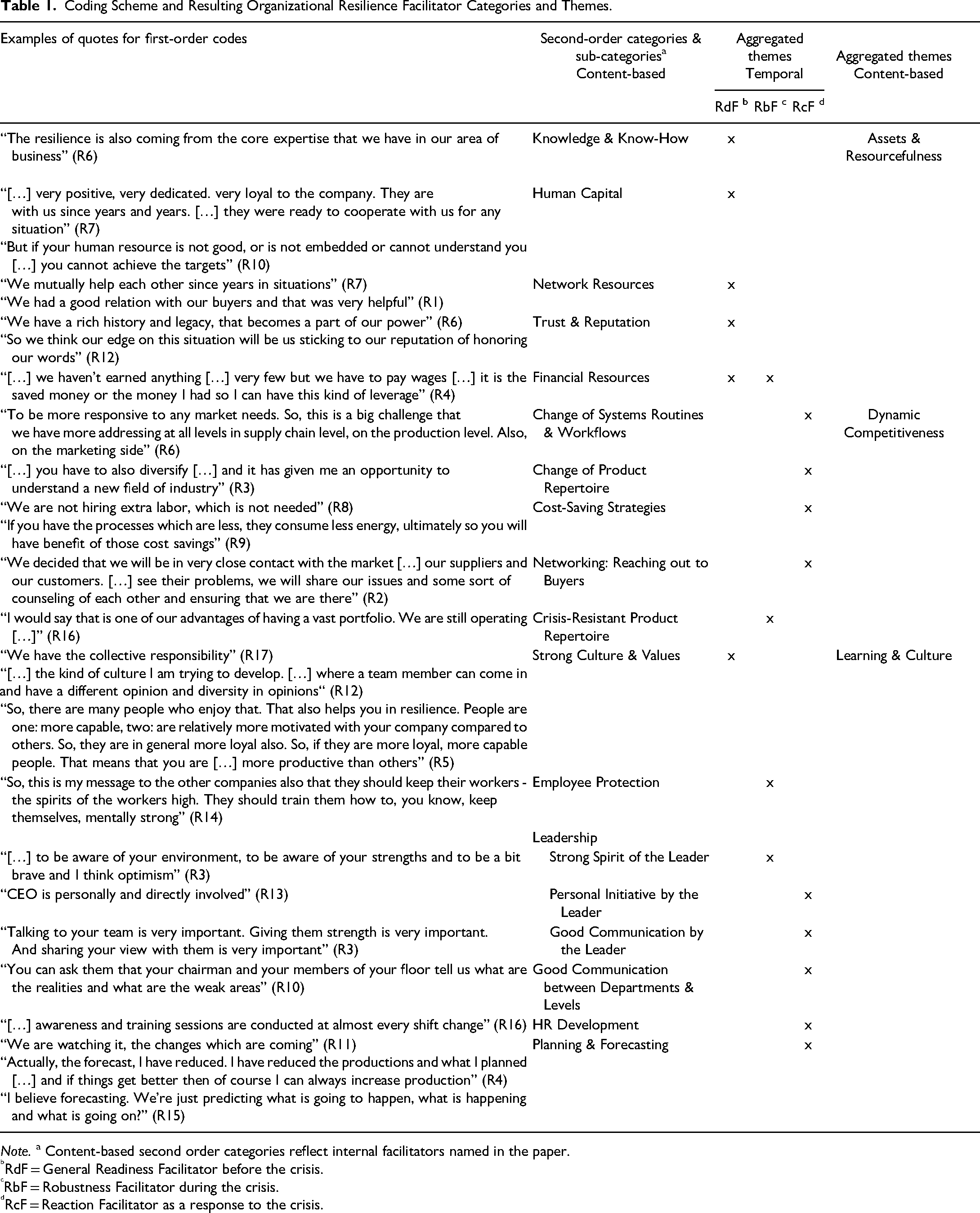
We adopted a principally inductive strategy in our data analysis (Glaser & Strauss, 1967). Following steps of a grounded approach, we avoided forcing data into pre-existing categories, yet the researchers’ knowledge of the relevant extant literature helped develop an informed theoretical sensitivity (Thornberg, 2012). Data analysis involved the basic steps in qualitative work of coding the data, combining the codes to broader categories, identifying predominant themes, and interpreting the results (Creswell, 2009; Strauss & Corbin, 1998). The analysis developed gradually, marked by an iterative process of independent reading and open coding of the transcripts. With the overall aim of increasing the findings’ validity and reliability, the process was accompanied by repeated discussions of the researchers to obtain rich descriptions and deeper understanding, and to develop refined guidelines for the coding process (Creswell, 2009). The analysis team, consisting of two researchers, discussed the emergence of each new code until they agreed on a specific definition. Codes were assessed for external heterogeneity (i.e., the extent to which differences between categories are apparent) and internal homogeneity (i.e., the extent to which the data of a particular category coheres meaningfully; Patton, 2015). Identified first-order codes were clustered into higher-level concepts. Table 1 visualizes the coding-scheme including exemplary quotes for first-order codes, second-order categories, and aggregated third-order themes.
Coding Scheme and Resulting Organizational Resilience Facilitator Categories and Themes.
Note. a Content-based second order categories reflect internal facilitators named in the paper.
RdF = General Readiness Facilitator before the crisis.
RbF = Robustness Facilitator during the crisis.
RcF = Reaction Facilitator as a response to the crisis.
Overall, our open exploration of what determines organizational resilience resulted in higher-level concepts of resilience facilitators that emerged from the interview answers. Most of these facilitators related to internal factors in a sense that they referred to resources, behaviors, and capabilities within the organization's control. The framework of facilitators, emerging from the interview data, was iterated with extant literature to sharpen and improve the construct definition, increase internal validity, and raise the theoretical level (Eisenhardt, 1989; Huberman & Miles, 2002). Reviewing and comparing the emerging framework with existing frameworks helped categorize the internal facilitators into broader themes. The comparison with established and recent works of scholars on organizational resilience yielded a suitable framework from the textile context (Pal et al., 2014) for content-based classification (see Table 1, aggregated content-based themes).
Regarding the facilitators’ temporal properties, three different classifications emerged in the interviews which were linked to temporal considerations in the organizational resilience literature (see Table 1, aggregated temporal themes). Independent of our content-based and temporal classification of internal facilitators, several external facilitators resulted from the coding process, which we elaborated separately. Finally, we reviewed notions on the consequences of organizational resilience to enhance the overall understanding of internal and external organizational resilience trajectories and impacts.
Results Study 1
The first results section discusses three overarching themes that subsume internal facilitators of organizational resilience, as emerged from the factory managers’ interviews (see Table 1, aggregated content-based themes and second-order categories). Pal et al.'s (2014) broad categories of organizational resilience enablers serve as a frame for these subsets of emerged internal facilitators: 1) Assets & Resourcefulness, 2) Dynamic Competitiveness, and 3) Learning & Culture. Other pertinent literature for the subfactors within the themes is highlighted and the temporal classification is integrated into the corresponding sections to avoid redundancies. Table 1 shows exemplary quotes encapsulating the managers’ interview stories of the internal facilitators, the emerged internal facilitators, the temporal classification, and the aggregated themes. Then, the second section proceeds with a brief outline of the external facilitators and derives potential internal and external consequences of organizational resilience from the interview answers.
Temporal Classification
In addition to the differentiation in terms of content-based themes, we inductively derived three different classifications acknowledging the facilitators’ temporal properties: 1) General Readiness Facilitators before the crisis, 2) Robustness Facilitators during the crisis, and 3) Reaction Facilitators as a response to the crisis (see Table 1, aggregated temporal themes). Based on the findings and the according literature, we define these facilitators as follows:
Ad 1) General Readiness Facilitators are established before the crisis and are generally available to the organization. Their relevance has been frequently proposed (e.g., Conz & Magnani, 2020; Duchek, 2020). Whereas Conz and Magnani (2020) referred to capabilities in the stage before crisis as “proactive” (p. 404), interview data pointed toward the term readiness, because the facilitators emphasized by managers were not only related to planning for the unexpected event, but at the same time were present in general before the crisis and thus contributed significantly to the organization's capability to manage the crisis.
Ad 2) Robustness Facilitators during the crisis support the organization in resisting shocks, preventing and reducing a firm's negative effects and vulnerabilities (Conz & Magnani, 2020; Ismail et al., 2011). Specifically, Robustness Facilitators reflect Tierney's (2003) definition of robustness as “the ability of elements, systems, and other units of analysis to withstand stresses and demands without suffering damage, degradation, or loss of functions” (p. 2).
Ad 3) Reaction Facilitators develop in response to the crisis, shaped explicitly throughout the crisis process. Hence, the highlighted Reaction Facilitators aid the organization's adaptive capacity, which, in turn, has been related to the evolution of novelty or learning mechanisms throughout disturbances (Carpenter et al., 2001). In relation to the capacity for “spontaneous changeability” (Stacey, 1995, p. 478), we therefore posit that Reaction Facilitators encompass the mobilization of a flexible, adaptive reaction to the environment.
Internal Organizational Resilience Facilitators
Assets & Resourcefulness
The first theme related to the facilitators of organizational resilience can be subsumed under Assets & Resourcefulness. The availability and accessibility of a broad set of intangible and tangible resources were identified by participants as a crucial facilitator and is generally well established in the literature on organizational resilience (Hamel & Välikangas, 2003; Kantur & İşeri-Say, 2012; Vogus & Sutcliffe, 2007). The theme comprises the following facilitators identified in the interviews: Knowledge & Know-How, Human Capital, Network Resources, Trust & Reputation, and Financial Resources. These facilitators were categorized as General Readiness Facilitators. However, Financial Resources were also tagged as a Robustness Facilitator to the degree that they are specifically available during the crisis to alleviate its adverse effects.
Knowledge & Know-How were highlighted as critical resources contributing to organizational resilience. For instance, managers referred to the value of general organizational knowledge when emphasizing the prompt transfer of technologies and expertise needed for suitable solutions to mitigate the crisis. Similarly, Duchek (2020) suggested the importance of a prior knowledge base, drawing on a wealth of experience when exploring possible responses to unexpected events.
Human Capital (i.e., the abilities, skills, and workforce strength) emerged as central to organizational resilience in the interviews. Besides staff qualifications, employee involvement, dedication, trust, and loyalty were underlined as crucial to cooperate and succeed despite the crisis. This finding is aligned with the vital roles that human capital (Barasa et al., 2018; Biggs et al., 2015) and social resources (Pal et al., 2014) play in the resilience of organizations to crises and disasters.
Moreover, Network Resources (good relationships with customers and suppliers) act as a General Readiness Facilitator of organizational resilience. They supported organizations in building common ground and discovering mutual solutions for the COVID-19 challenges. Good relationships were pictured as loyal, mutual, and long-term. Notably, the importance of supportive and collaborative networks is frequently reviewed in the literature on organizational resilience (Barasa et al., 2018; Duchek, 2020; Lengnick-Hall & Beck, 2005).
Another extracted facilitator associated with strong relational bounds is Trust & Reputation. The managers’ responses proposed to the importance of building reputation, staying true to it, and supporting collaboration to finally achieve organizational resilience in challenging times. These aspects align with facilitating factors mentioned in the literature such as “deep social capital” (Lengnick-Hall & Beck, 2005, p. 752) and the “deep social fabric of goodwill” (Pal et al., 2014, p. 412).
Finally, Financial Resources were described as “cylinders of oxygen” (R9) to withstand the strain and sustain the workforce. Financial assets are frequently mentioned in the literature as essential to withstand cuts and stopped payments while remaining functioning (Biggs et al., 2015; Gittell et al., 2006). Based on our findings, we first derived Financial Resources as a General Readiness Facilitator, since financial assets were present before the crisis, marking the overall financial position of the organization. Moreover, we observed Financial Resources also as a Robustness Facilitator referring to the financial situation during the crisis, such as income or expenses.
Dynamic Competitiveness
The second theme identified in the interviews is Dynamic Competitiveness, referring to the importance of organizational resources and capabilities with dynamic attributes (Norris et al., 2008). Here, robust and flexible deployment or the reconfiguration of resources is instrumental in achieving a competitive advantage in turbulent times (Pal et al., 2014).
The managers identified four Reaction Facilitators with dynamic attributes deployed and developed in response to the crisis: the Change of Systems, Routines & Workflows, the Change of Product Repertoire, Cost-Saving Strategies, and Networking: Reaching out to Buyers. One Robustness Facilitator buffered during the crisis, a Crisis-Resistant Product Repertoire.
Regarding the Reaction Facilitator, Change of Systems, Routines & Workflows, the managers noted that the specific phase of low production during the crisis brought an opportunity to reflect on “all the ways and means” (R14). For the imminent crisis, adapting to a change in customer needs and orders was required. Therefore, for instance, research and development efforts were adapted and amplified. Moreover, COVID-19 specific changes in the systems, routines, and workflows were implemented, including sanitation, medical, and social distancing measures.
Furthermore, the Change of the Product Repertoire was noted as an important Reaction Facilitator. Managers frequently mentioned that their companies used the opportunity to find new business fields by adapting to the upcoming demands and diversifying the product repertoire, while using their expertise and available resources. Hence, a close connection to the concept of bricolage was evident, describing recombination of the resources at hand for new purposes (Baker & Nelson, 2005), which has likewise been suggested to influence organizational resilience positively (Mallak, 1998).
Another Reaction Facilitator was also related to a change in the use of resources: Cost-Saving Strategies. To reduce the needed resources, companies applied different strategies, such as the enforcement of lean management principles, energy savings, (management) salary cuts, and readjustment and recalibration of labor costs, with labor reductions or hiring freezes as examples.
Furthermore, we found that Networking as in Reaching out to Buyers in response to the crisis was a perceived driver of organizational resilience. Thus, mobilizing critical ties with buyers and investing in relationships throughout the crisis translated into more shared understanding, adaptability to mutual needs, and greater levels of trust and support.
Finally, we found that a Crisis-Resistant Product Repertoire acted as a Robustness Facilitator during the crisis. This facilitator consisted of having a vast product portfolio, offering product types that were not negatively affected by the crisis, or operating with flexible processes, including backward integration. We assigned the facilitator to the Robustness Facilitator category, as robustness can be associated with a lower probability of resource deterioration (Norris et al., 2008), such as crisis-resistant products requiring fewer product change investments.
Learning & Culture
The third theme related to Learning & Culture and subsumes softer, more tacit, and ingrained facilitators (Pal et al., 2014). In this theme, the facilitators revolve around an employee focus and learning orientation pivotal to organizational resilience. Whereas one general factor, Strong Culture & Values, constituted a General Readiness Facilitator, two other factors were categorized as Robustness Facilitators: Employee Protection and a Strong Spirit of the Leader. The latter builds together with the Reaction Facilitators, a Personal Initiative and Good Communication by the Leader in the Leadership subtheme. Other Reaction Facilitators in the Learning & Culture theme include Good Communication between Departments & Levels, HR Development, and Planning & Forecasting.
Strong Culture & Values was raised as a General Readiness Facilitator by the managers, who referred to the benefits of a generally supportive, inclusive, and open environment with accessible communication and learning. A general “human touch” (R12) and tolerance toward mistakes and diverse opinions would enable better organizational learning and ownership, enjoyment, motivation, and loyalty, enhancing competitiveness. Similarly, scholars have suggested an enabling culture and creative climate, including openness toward learning from failure, as essential in fostering organizational resilience (Mafabi et al., 2013; Weeks, 2008). Finally, as part of a strong culture, a clear vision, positive attitude, and shared goals were outlined as intangible facilitators, which are likewise mirrored in the theoretical literature (e.g., Mallak, 1998; Therrien et al., 2017) and case studies (McManus et al., 2007).
Furthermore, Employee Protection emerged as a vital Robustness Facilitator in the interviews. Managers underlined valuing physical and mental health, securing employee job safety, and protecting overall well-being for mastering the crisis. Closely related, Kuntz et al. (2016) noted that crafting an environment that develops employee resilience through feedback and support increases the capacity for resilience on an organizational level as part of a reciprocal process. Accordingly, the robustness effect of the Employee Protection facilitator might stem from reducing vulnerabilities on the employee level and the associated reduced vulnerabilities on the organizational level.
Furthermore, Leadership emerged as an important organizational resilience enabler concept in the interviews. In particular, a Strong Spirit, Personal Initiative, and Good Communication by the Leader of the Company were identified as major facilitators. Under the Robustness Facilitator Strong Spirit of the Leader, managers stressed that a strong leadership spirit during the crisis was characterized by the leader's own strengths and optimism, with environmental awareness of the crisis. In correlation, Fang et al.'s (2020) case study indicated that leaders’ psychological capital (i.e., self-efficacy, hope, optimism, and psychological resilience) positively affects organizational resilience, buffering the effects of a natural disaster. Moreover, two additional Reaction Facilitators could be subsumed under the overall importance of Leadership. Personal Initiative by the Leader (personal involvement and availability) and Good Communication by the Leader (clear, honest, and motivating communication and fostering the mutual exchange of perspectives) emerged as helpful leadership reactions throughout the crisis. Similarly, in a case study of a Singaporean hospital after the SARS Crisis, Teo et al. (2017) found that reaching out personally, noting employee needs, and mindfully communicating are important leader behaviors to build organizational resilience.
Good Communication between Departments & Levels was also highlighted as a critical Reaction Facilitator. Managers underlined the importance of open, transparent, and effective communication pathways—including bottom-up channels from the work floor—as crucial to organizational resilience development throughout the crisis. The importance of good internal communication practices for an organization's resilience also reflects prior case study research (e.g., McManus et al., 2007).
HR Development was another Reaction Facilitator outlined by the managers connecting to the Learning & Culture theme. Employee training occurred to support and educate them on topics that gained importance throughout the crisis, such as health and safety precautions. Some managers saw the crisis as a learning and restructuring opportunity to teach the workers multiple skill operations and to transfer to a salary-based system instead of a piece-rate based system. Accepting these restructuring initiatives was expected to be higher during the crisis than normally, as jobs were more insecure and fewer orders came in, rendering a piece-rate system less attractive for the workers.
As a final Reaction Facilitator in the Learning & Culture theme, Planning & Forecasting was highlighted by managers, who underlined that close monitoring allowed them to have the vision for preemptive steps, adjusting (production) goals with agile reactions to changing customer demands. Similarly, Burnard and Bharma (2011) have linked environmental scanning with the detection of disruptive events in their conceptual organizational resilience framework for organizational responses. They noted that organizations could develop and apply new knowledge linked to enhanced organizational learning by actively dealing with the dynamic environment.
External Organizational Resilience Facilitators
While most of the facilitators mentioned by the managers aligned under the three internal facilitator themes (Assets & Resourcefulness, Dynamic Competitiveness, and Learning & Culture), some facilitators were external to the organization. For instance, religion was underlined as an essential, culturally embedded element for gaining strength in the face of disasters. Furthermore, a reliable supply chain, governmental and non-governmental institutions, and the regulatory environment were highlighted as critical for maintaining positive functioning.
Internal and External Consequences of Organizational Resilience
Overall, interviewees showed a complex understanding of how organizational resilience benefits inner and outside stakeholders. As one manager stated, “So, I understand that we need to find ways of making things possible for the sake of the country and its people who live paycheck to paycheck” (R12).
Moreover, regarding the organization, resilience was linked with resistance toward the economic impact of the crisis (R9: “the winds are very high […], and you can stand”) and (re)building business success (R16: “it keeps us sustain […] it brings us back from this crisis”). Organizational resilience was often associated with the company's “survival” (e.g., R3) and “com[ing] back on track” (R17), “keep[ing] up the shape” (R6), and finally being “in better shape than most of the companies in Pakistan” (R4).
Concerning the internal stakeholders, responsibility for employee well-being and protection was a high priority (R6: “the biggest responsibility is protection and safety of our people”; R13: “First of all, the general well-being of our people”). Protecting employees from the negative consequences of the crisis was of particular importance to managers, considering that “the condition in Pakistan is very tough” (R9). To secure the protection of employees, organizational resilience is critical as the managers “see business as a tool to bring a positive change for all the stakeholders” (R6).
Furthermore, managers stressed the positive impacts of organizational resilience on the external environment, such as the workers’ families, the wider community, and the society. For instance, one manager illustrated the impact of his company: “There are 2,500 people. That's 2,500 families. And if you look at the ripple effect, it's massive” (R3). Concerning the societal environment, managers outlined: It's a long chain. If there's a huge unemployment in the company, in the country, you do the effects. How like, the crime rate is going to go up. A lot of the economical down effects, it starts to happen. And if a company can afford, they should sustain. (R15)
Study 2: Quantitative Investigation
The aim of Study 2 was to verify the structure and predictive validity of the identified facilitators of organizational resilience. In addition, we built on explorative findings of Study 1 by investigating critical consequences of organizational resilience on the organization and its employees. For this purpose, we conducted a survey series in a longitudinal setup with a wide range of Pakistani textile factories managers.
Facilitators of Organizational Resilience
The interviews conducted for Study 1 highlighted the importance of three broader themes of facilitators for building organizational resilience: Assets & Resourcefulness, Dynamic Competitiveness, and Learning & Culture. The corresponding facilitators were classified as “internal” because they revolved around organizational behaviors, resources, and capabilities that the organization itself did or did not possess or practice. The importance of internal factors also becomes reflected in the link between organizational resilience and the RBV, according to which a firm's sustained competitive advantage depends on internal rather than external factors (Ambrosini, 2003; Barney, 1991). Thus, Barney (1995) gave an early impetus to “look inside” (p. 60) to understand an organization's internal strengths and weaknesses. Empirically, scholars have observed multiple internal aspects of organizations that play a key role in building up organizational resilience, such as financial resources (Gittell et al., 2006), knowledge management (Mafabi et al., 2013), adequate planning (McManus et al., 2007), and leadership practices (Teo et al., 2017). Accordingly, we argue that the three themes of internal facilitators derived from the interviews provide sources of organizational resilience, leading us to the following hypothesis:
Consequences of Organizational Resilience
For organizations, crises frequently disrupt company operations, elicit financial pressures, and threaten overall survival (Burnard & Bhamra, 2011; Christensen & Kohls, 2003; Kash & Darling, 1998). Drawing on the RBV (Barney, 1991), organizational resilience can become a key facilitator for maintaining company performance during a crisis. Crises are linked to increased uncertainty (Ahir et al., 2018; Bloom, 2014), and the resulting dynamic environment requires the ability to effectively structure resources and bundle them into capabilities for maintaining organizational value creation (Sirmon et al., 2007). Thus, the RBV can be complemented with a capability perspective, by identifying specific capabilities that help firms to apply their resources across different critical situations (Vanpoucke et al., 2014). Hence, treating organizational resilience as a meta-capability (Duchek, 2020) provides a rationale to explain how resilient firms integrate and reconfigure organizational behaviors, resources, and capabilities throughout a crisis to deal with challenges more successfully. Several authors have linked organizational resilience with higher organizational performance (Suryaningtyas et al., 2019), perceived financial performance (Stephenson, 2010), and perceived profitability and competitiveness (McCann et al., 2009). Overall, organizational resilience seems to be a powerful factor for strengthening business success, which leads to the following hypothesis:
For individuals, the literature shows that crises can negatively impact employee mental health and well-being (Giorgi et al., 2015; Montani et al., 2020; Ogbonnaya et al., 2019). In this context, emotional exhaustion, which refers to a chronic state of physical and emotional depletion (Wright & Cropanzano, 1998), is a particularly relevant indicator of crisis-related employee psychological well-being. This is because emotional exhaustion is linked to various crisis-related work stressors, such as restructuring and downsizing (Harney et al., 2018), deterioration of working conditions (Skefales et al., 2014), role ambiguity and role conflict (Bedford et al., 2022), and job insecurity (Kerse et al., 2018). Conceptually, work-related stressors such as role ambiguity and job insecurity can be understood as negative job demands that interfere with employees’ well-being by causing energy-depletion and feelings of lack of control (Van den Broeck et al., 2010).
The job demands-resources model (Bakker & Demerouti, 2007) offers an explanation as to why organizational resilience can ameliorate feelings of emotional exhaustion. Job demands refer to aspects of the work context that cost energy (Bakker, 2015). If job demands exceed employees’ adaptive capacities, they become stressors (Bakker et al., 2003), resulting in work-related stress and mental and emotional exhaustion (Koon & Pun, 2018; Schaufeli et al., 2009; Van Ruysseveldt et al., 2011). Conversely, job resources help to offset the negative influence of job demands on work-related outcomes (Bakker et al., 2005).
Overall, we expect organizational resilience to increase job resources while reducing job demands. As previously highlighted in the interviews, resilient organizations possess an employee focused culture and a learning focus, where human capital, empowerment, and intra-organizational communication are essential facilitators for building organizational resilience. Thus, resilient organizations benefit from actively promoting employee appreciation and participation. In particular, appreciation by superiors (Bakker et al., 2005), social support in the workplace (Llorens et al., 2006), and employee voice (Conway et al., 2016) are protective job resources regarding stress experience and emotional exhaustion. In terms of job demands, resilient organizations can prevent crisis-related demand spikes from being passed on to employees through greater flexibility gained from organizational slack (Taylor et al., 2019). For instance, financial slack has been found to predict whether firms engage in labor hoarding (i.e., maintaining their workforce during an economic downturn; Bäurle et al., 2021; Giroud & Mueller, 2017). Therefore, resilient organizations should be able to decrease job insecurity, which has been associated with emotional exhaustion and decreased emotional well-being (Kerse et al., 2018; Piccoli & De Witte, 2015; Shoss et al., 2018). Hence, by increasing job resources and reducing job demands, we expect resilient organizations to maintain working environments conducive to employee emotional well-being, leading us to the following hypothesis:
Methods Study 2
Sample and Data Collection
An online survey series for testing the hypotheses was conducted with a sample of middle- to upper-level managers from Pakistani textile factories. The sample was recruited within a research cooperation with the Lahore office of the federal enterprise GIZ GmbH and their contacts in the Pakistani textile industry. The sample included several of the interviewed companies from Study 1 plus other companies.
Data collection followed a survey series of seven waves. We chose a longitudinal design for tracking organizational resilience development throughout the crisis. Recruitment of the sample was carried out by contacting focal persons in the target companies. Survey waves were conducted every two weeks between mid-June and mid-September 2020. Reminders were used to increase participation. Each invitation to the survey was sent to the same group of employees (155 employees from 43 companies). The response rate ranged from 62 (40%) to 111 (72%) employees across waves. 1 Altogether, 73 (47%) respondents completed at least four survey waves, 28 (18%) participated in all seven survey waves, while 127 (82%) of individuals missed at least one survey wave. For completed survey waves, the mean proportion of missing answers was 0.1%. At the beginning of each survey wave, participants were assured that their answers were treated anonymously. An encrypted code system was employed, matching participant survey answers across survey waves, and data was kept accessible only to members of the research team to secure privacy.
Altogether, our sample consisted of 146 different employees from a total of 40 companies. For maximization of data utilization, complete and partially complete data sets were retained in the analysis and multilevel modeling was used, estimating the amount of variation that could be attributed to the observations’ grouping structure at the employee and firm level. The average participant age was 38.03 years (SD = 10.65, range = 23–73). 95.3% of the sample was male. 53.1% of participants classified themselves as upper-level managers and 46.9% as middle-level managers.
Measures of the Dependent Variables
We measured organizational resilience, business success, and emotional exhaustion in every survey wave. The first survey asked participants about the lockdown period during which most factories were closed. Participant answers regarding this time-period served as a baseline, against which later survey waves were evaluated. Each subsequent survey wave referred to the respective previous two weeks. Besides referencing either the lockdown period (survey wave 1) or the previous two weeks (survey wave 2–7), item wordings were kept identical across survey waves. All items were formulated in English. Likert-scale answer categories ranged from strongly disagree (1) to strongly agree (7) on all scales. Due to the repeated measurement design and nesting of employees within firms, we estimated Cronbach's alpha for the repeated measurement (level 1), person (level 2), and firm level (level 3) via multilevel confirmatory factor analysis and report the range of the overall value for Cronbach's alpha across survey waves.
Organizational Resilience
Organizational resilience was measured with four items from Ambulkar et al. (2015). The corona crisis was named to facilitate the context of measurement. A sample item reads: “During the last two weeks, have you thought or felt the following: We are able to cope with changes brought by the corona crisis disruption”. Across survey waves, Cronbach's alpha ranged between .81 and .93. Cronbach's alpha was .78 at the repeated measurement level, .95 at the person level, and .82 at the firm level.
Business Success
The perceived impact of the corona crisis on the organization was measured with a single item adapted from Olson et al. (2003). The item reads: “Overall, business has been successful during the last two weeks compared to normal times before the crisis”.
Emotional Exhaustion
For measuring emotional exhaustion, a three-item scale from Watkins et al. (2015) was used, which is based on the Maslach Burnout Inventory (Maslach & Jackson, 1986). A sample item reads: “During the last two weeks, compared to normal times before the crisis: I have felt emotionally drained from work.” The scale yielded a Cronbach's alpha range of .89 and .97 across survey waves. Cronbach's alpha was .90 at the repeated measurement level, .99 at the person level, and 1.00 at the firm level.
Measurement of Organizational Resilience Facilitators
The final survey additionally asked participants to what extent they perceived each of the 19 internal facilitators mentioned in the interviews to be present in their organization. Table A1 in the Appendix shows the exact wording of facilitator items, including their crisis-related temporal classification. Questions regarding facilitators either referred to the general availability of the facilitator before the crisis, its availability during the crisis or its occurrence as a response to the crisis, corresponding to the facilitator's qualitatively derived temporal classification as Readiness, Robustness, or Reaction Facilitator. Concerning the content classification, the three theme names (Assets & Resourcefulness, Dynamic Competitiveness, and Learning & Culture) reflect the organizational resilience facilitator categorization proposed by Pal et al. (2014). However, the specific facilitators derived from Study 1 correspond to the inductively derived names and concrete sets, overlapping but not congruent with the specific facilitators identified by Pal et al. (2014). Therefore, we used principal component analysis (PCA) to verify whether the categorization of facilitators into broader themes reflected actual relationships between the facilitator items.
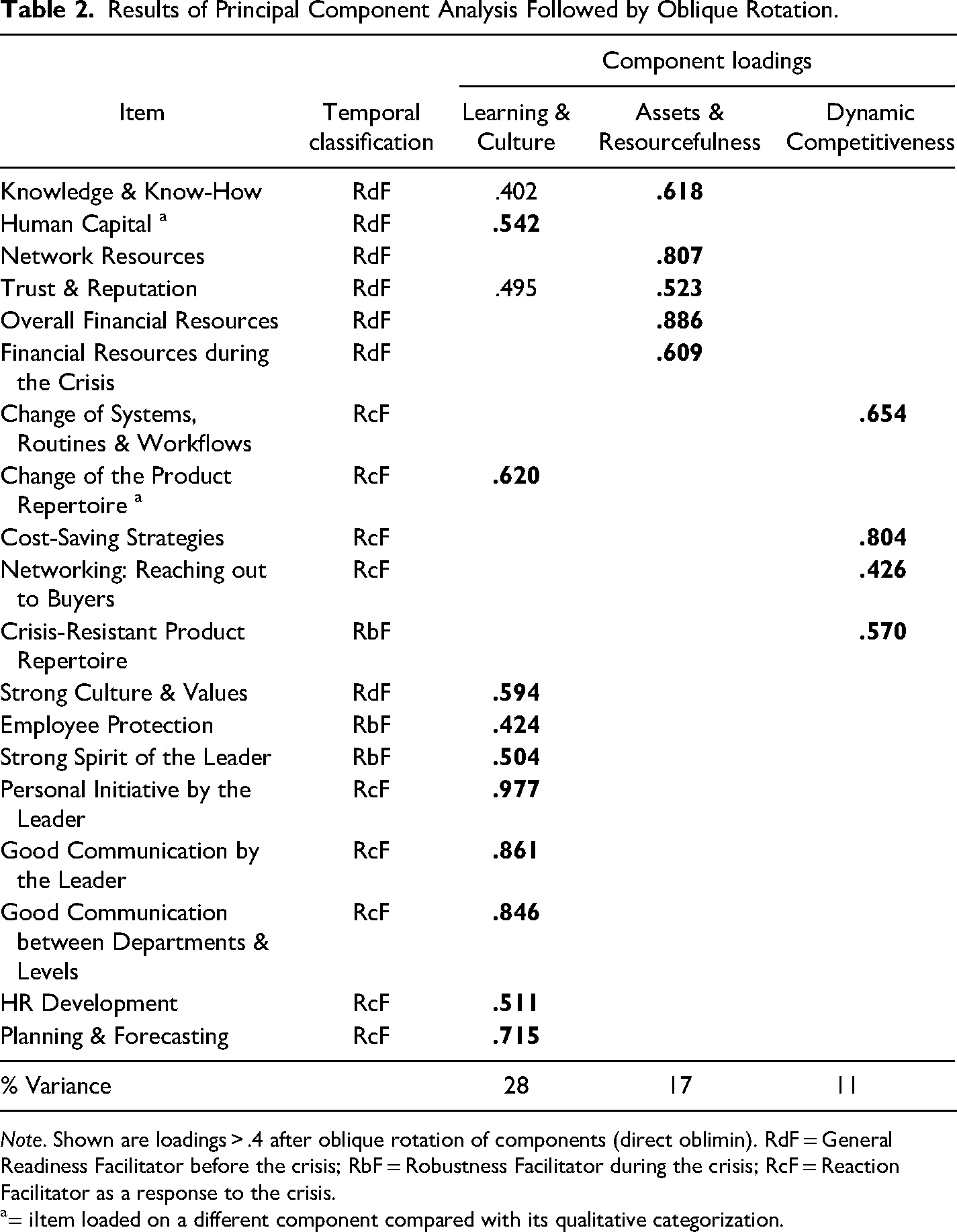
Before conducting the PCA, we tested whether the data was suitable for PCA with the Kaiser-Meyer-Olkin measure of sampling adequacy. The test resulted in a value of .8, which is above the recommended threshold of .6 (Kaiser, 1974). In accordance with the qualitatively derived categorization of facilitators into three themes, we extracted three components and examined item loadings after oblique rotation (direct oblimin). Similarly, parallel analysis of eigenvalues of the data covariance matrix (Horn, 1965) suggested retaining three components. Table 2 shows the three-component solution which explained 55.2% of total variance. All items presented loadings of > .4 on at least one component. The first component included 10 facilitators related to the theme Learning & Culture. The second component included five facilitators related to Assets & Resourcefulness, and the remaining four facilitators were attributed to the component Dynamic Competitiveness. Notably, two facilitators (Human Capital and Change of Product Repertoire) loaded on the Learning & Culture component even though interview results assigned them to different themes (Assets & Resourcefulness and Dynamic Competitiveness respectively). A follow-up thematic inspection identified both facilitators as conceptually ambiguous since they showed overlap with an employee focused culture and organizational learning respectively, both characteristics of the Learning & Culture theme. Thus, they were assigned to the Learning & Culture theme for further analysis to maximize internal consistency of measurement. In addition, two facilitators (Knowledge & Know-How and Trust & Reputation) presented cross-loadings of > .4 on the Learning & Culture component. However, both facilitators loaded stronger on the Assets & Resourcefulness component, reflecting their qualitative categorization and were therefore retained within their original category. Altogether, the PCA supported the three-theme categorization of facilitators, leading us to create three composite measures for hypothesis testing.
Results of Principal Component Analysis Followed by Oblique Rotation.
Note. Shown are loadings > .4 after oblique rotation of components (direct oblimin). RdF = General Readiness Facilitator before the crisis; RbF = Robustness Facilitator during the crisis; RcF = Reaction Facilitator as a response to the crisis.
= iItem loaded on a different component compared with its qualitative categorization.
Assets & Resourcefulness
Dynamic Competitiveness
Learning & Culture. A composite score for Learning & Culture was created by averaging participant ratings on the following 10 facilitators: Human Capital, Change of the Product Repertoire, Strong Culture & Values, Employee Protection, Strong Spirit of the Leader, Personal Initiative by the Leader, Good Communication by the Leader, Good Communication between Departments & Levels, HR Development, and Planning & Forecasting. Reliability analysis yielded a Cronbach's alpha of .90 at the person level and .88 at the firm level.
Data Analysis
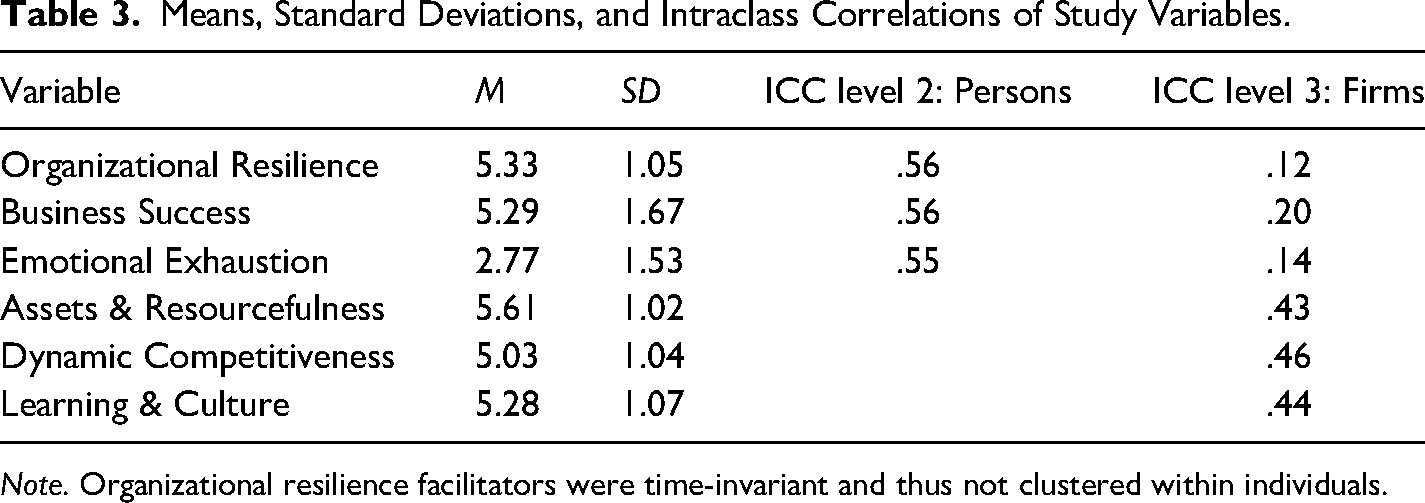
Data analysis was done using R version 4.1.2 (R Core Team, 2021) and Mplus version 8.6 (Muthén & Muthén, 2021). The data were hierarchically structured, with repeated measurements (level 1) being clustered within persons (level 2) who were clustered within firms (level 3). Table 3 shows the means, standard deviations, and intraclass coefficients (ICC) of the study variables. Level 2 ICCs of the dependent variables were .56 for resilience, .56 for business success, and .55 for emotional exhaustion, indicating that differences between employees accounted for 55–56% of variance in the outcome variables over time. Concerning level 3, ICCs were .12 for resilience, .20 for business success, and .14 for emotional exhaustion, indicating that differences between firms explained 12%—20% of variance in the outcome variables. Given the substantial amount of variance explained by the different levels, a multilevel approach with random intercepts was considered appropriate for further analysis. We estimated three-level multilevel models for testing the hypothesized effects, accounting for the nesting of responses by including random intercepts for individuals and organizations. Not considering the similarity in the outcome variable between observations nested in the same grouping structures can inflate Type-I errors since the variance of hypnotized effects gets underestimated (Rodríguez & Goldman, 2001). Following recommendations from the multilevel literature (Brincks et al., 2017; Enders & Tofighi, 2007), we used a combination of within-group and grand-mean centering to partition variance in the predictor variables into within-person, between-person, and between-firm components. At level 1, we within-group centered values of the time-varying variables around the person mean. At level 2, we within-group centered person means around the firm average, and at level 3 we used the grand-mean centered firm average of the predictor. The resulting centered predictors are uncorrelated with each other (Brincks et al., 2017). Thus, the differential effects of within-person dynamics, of time-invariant between-person variations within firms, and of time-invariant between-firm differences on the dependent variable can be examined. We used standard visual checks to verify assumptions of normality of residuals at all levels and homogeneity of variance of residuals at all levels. Estimates of significance for fixed effects were obtained using the lmerTest-package in R (Kuznetsova et al., 2017), which implements t-tests with Satterwhaite-Correction for degrees of freedom. Table 4 shows correlations for all study variables and Figure 1 shows the trajectories of the three dependent variables over time.
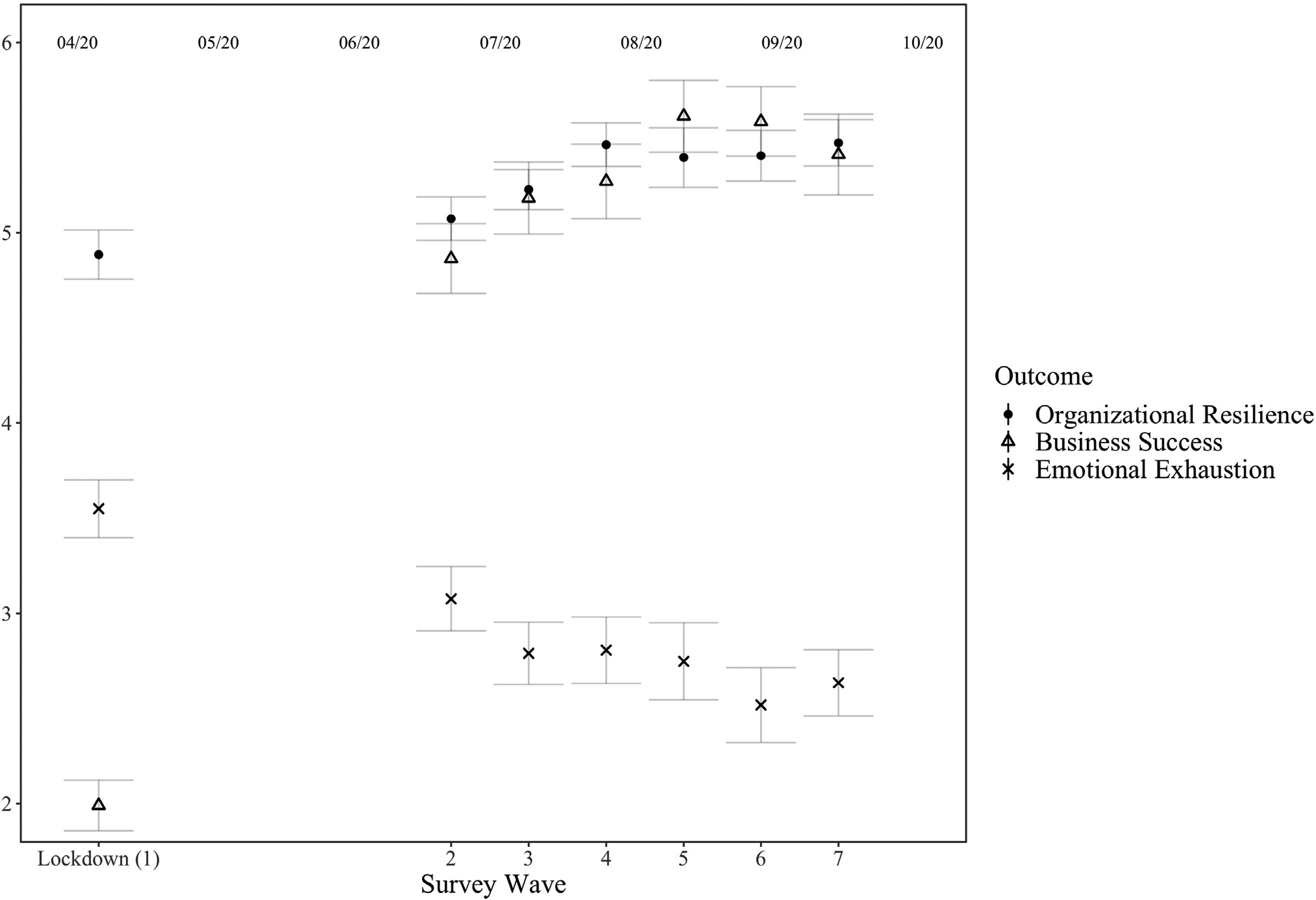
Trajectories of study variables over time.
Means, Standard Deviations, and Intraclass Correlations of Study Variables.
Note. Organizational resilience facilitators were time-invariant and thus not clustered within individuals.
Intercorrelations of Study Variables.
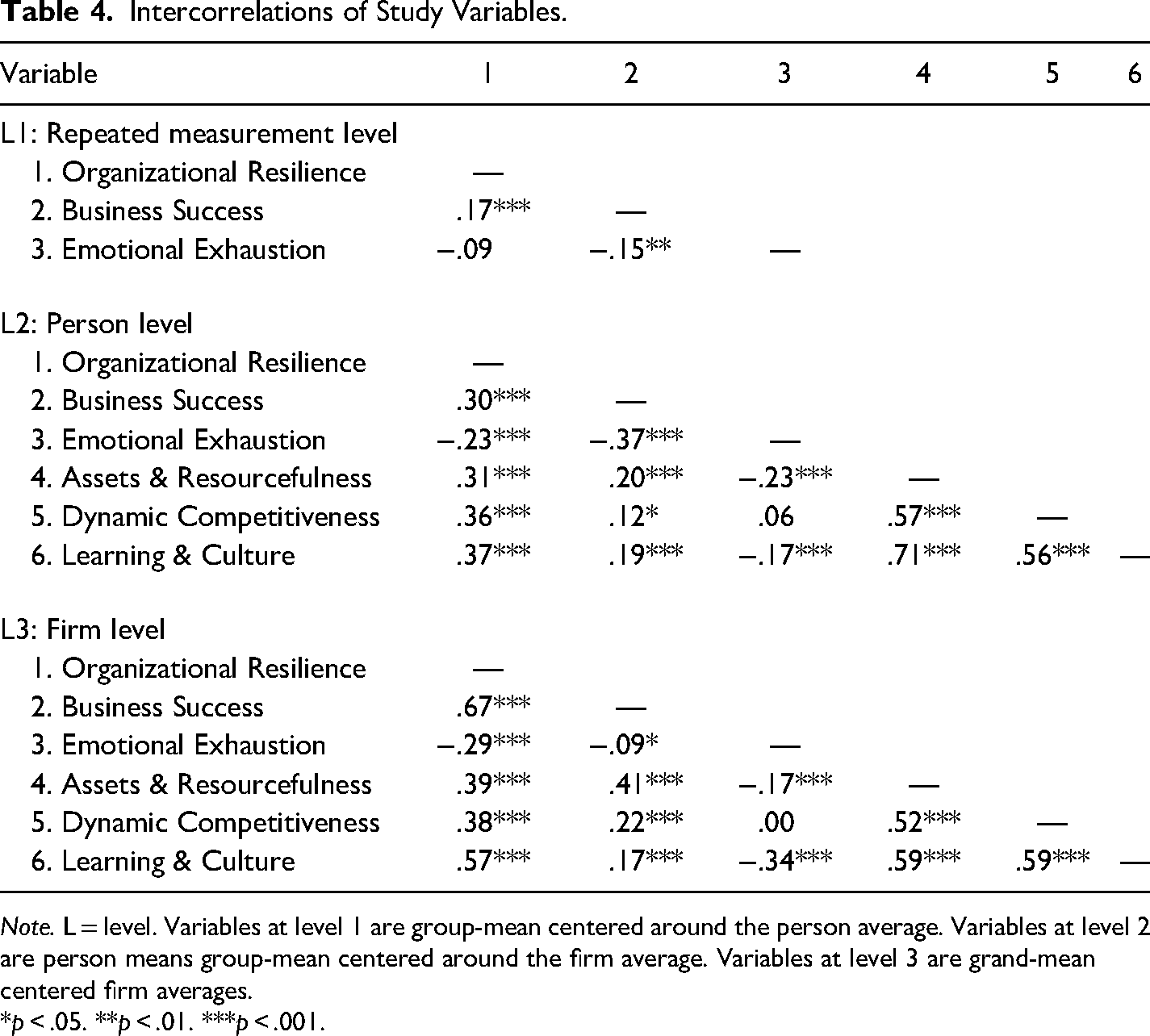
Note. L = level. Variables at level 1 are group-mean centered around the person average. Variables at level 2 are person means group-mean centered around the firm average. Variables at level 3 are grand-mean centered firm averages.
*p < .05. **p < .01. ***p < .001.
Since multiple participants missed one or several survey waves, we accounted for possible missing data bias by employing inverse probability weighting (IPW). Weights were calculated from logistic regression models by multiplying the baseline sampling probability with the probability of observing a participant at the respective survey wave. Logistic regression models included all time-invariant covariates (age, gender, and firm size) and, for subsequent survey waves, lagged measures on the three outcome variables (organizational resilience, business success, and emotional exhaustion). The multiplicative combination of two weighting procedures is a common strategy for handling attrition and dropout in longitudinal studies (Schmidt & Woll, 2017; Vandecasteele & Debels, 2007).
Results Study 2
Table 5 shows the results of multilevel model analysis for predicting organizational resilience (Model 1), business success (Model 2), and emotional exhaustion (Model 3). For every outcome, baseline measures of the dependent variable (organizational resilience, business success, and emotional exhaustion) as well as age, gender, and firm size were entered as controls. For predicting emotional exhaustion, we also included business success as a control variable to account for potential confounding with the organizational resilience effect. In addition, we included a time trend (i.e., survey wave) in all models as a predictor, and added a random slope for time at the person level to account for differing trajectories between persons over time.
Estimations for the Multilevel Models.
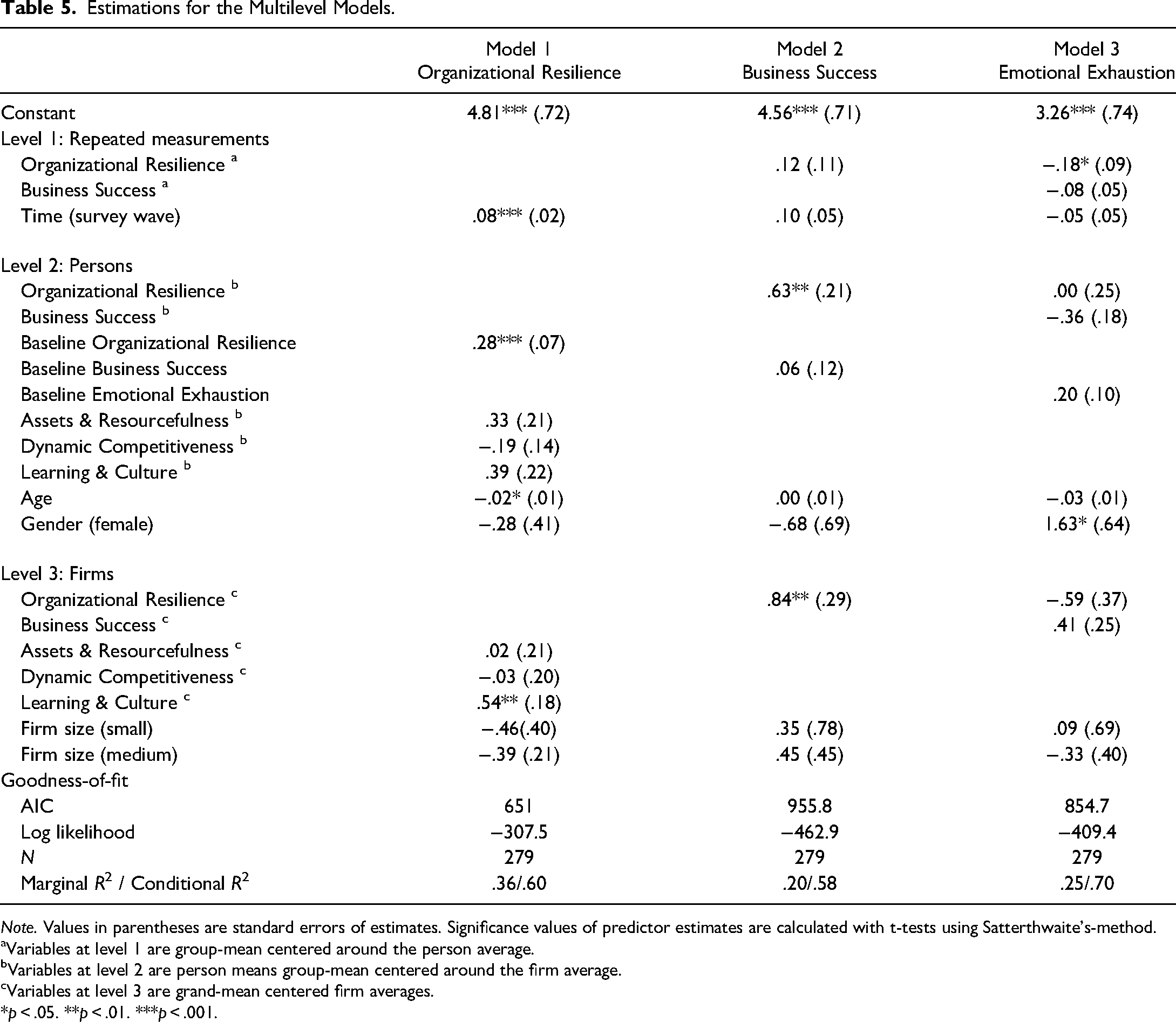
Note. Values in parentheses are standard errors of estimates. Significance values of predictor estimates are calculated with t-tests using Satterthwaite’s-method.
Variables at level 1 are group-mean centered around the person average.
Variables at level 2 are person means group-mean centered around the firm average.
Variables at level 3 are grand-mean centered firm averages.
*p < .05. **p < .01. ***p < .001.
For hypothesis testing, we examined fixed effect parameters of the corresponding multilevel models. Regarding the prediction of organizational resilience (Model 1), we observed a significant positive effect of the grand-mean centered firm value of Learning & Culture (β = .54, t = 3.01, p = .004), whereas the effects of the firm average of Assets & Resourcefulness (β = .02, t = .08, p = .935) and Dynamic Competitiveness (β = −.03, t = −.15, p = .880) on organizational resilience failed to reach significance. Overall, this led to support for Hypothesis 1c, indicating that the availability of facilitators connected to Learning & Culture contribute to organizational resilience, while no support for Hypothesis 1a and 1b could be established. At the person level, none of the facilitator effects became significant, indicating that variations in facilitator judgments between employees within firms did not predict organizational resilience. We observed significant effects of several covariates on organizational resilience: Organizational resilience at baseline significantly predicted organizational resilience during the survey period (β = .28, t = 3.93, p < .001). In addition, time had a positive influence on organizational resilience (β = .08, t = 3.51, p < .001), indicating that organizational resilience post-baseline increased over time. Lastly, age was a significant predictor of resilience (β = −.02, t = −2.06, p = .045), suggesting that older employees rated the organizational resilience of their company more negatively.
In support of Hypothesis 2, Model 2 showed a significant effect of the grand-mean centered value of organizational resilience on business success throughout a crisis (β = .84, t = 2.87, p = .007), indicating that higher organizational resilience leads to greater business success. In addition, the within-firm centered person mean of organizational resilience significantly predicted business success (β = .63, t = 2.94, p = .007), indicating that within-firm deviations in employee ratings of organizational resilience predicted ratings of business success. No significant effect of the within-person centered value of organizational resilience was observed (β = .12, t = 1.07, p = .287), thus there was no indication that varying perceptions of organizational resilience over time predicted business success. In addition, we fitted a lagged regression model, further exploring the temporal dimension of the relationship between organizational resilience and business success. In this model, business success was regressed on within-person centered organizational resilience values of the previous survey wave and the within-person centered business success. Results showed that neither the lagged organizational resilience predictor (β = .11, t = .89, p = .375) nor the lagged business success predictor (β = .01, t = .10, p = .922) contributed significantly to business success during the follow-up survey wave, indicating that varying organizational resilience perceptions over time did not precede business success perceptions.
Regarding Hypothesis 3, we found a significant effect of the within-person centered organizational resilience value on emotional exhaustion in Model 3 (β = −.18, t = −2.02, p = .045), giving support to the notion that organizational resilience over time contributes to reducing employee emotional well-being throughout a crisis. The contribution of varying organizational resilience perceptions on emotional exhaustion over time confers support for Hypothesis 3. Neither the within-firm centered person mean (β = .00, t = .01, p = .995) nor the grand-mean centered firm mean of organizational resilience (β = −.59, t = −1.62, p = .122) significantly predicted emotional exhaustion indicating no time-invariant influences of organizational resilience on emotional exhaustion. In terms of covariate effects, female gender positively predicted emotional exhaustion (β = 1.63, t = 2.54, p = .014), indicating that female employees showed higher levels of emotional exhaustion.
Discussion
This paper aimed to generate an in situ understanding of the facilitators and consequences of organizational resilience throughout a crisis by capturing employees’ experiences within crisis-affected companies. We gained a rich and informed picture of the explored phenomena by combining qualitative and quantitative approaches. The qualitative interviews contributed to the depth of the results since they are based on the personal experiences and individual stories of the affected parties during the peak of the crisis (Patton, 2015). The quantitative analysis then added breadth in terms of generalizability of the key relationships with facilitators and consequences.
This work contributes to the literature by advancing the debate on holistic perspectives on organizational resilience. By empirically applying the emerging conceptual integration of different perspectives on organizational resilience (e.g., Conz & Magnani, 2020; Darkow, 2019; Duchek, 2020; Hillmann & Guenther, 2021), we confirmed the relevance of this integration for understanding the determinants of organizational resilience in a crisis setting. Specifically, we identified a broad set of organizational behaviors, resources, and capabilities that facilitate organizational resilience as a meta-capability. We also considered the dynamic evolving character of the organizational resilience process, addressing temporal properties of the facilitators. A two-fold classification emerged to differentiate a broad set of facilitators in respect to their content (i.e., Assets & Resourcefulness, Dynamic Competitiveness, and Learning & Culture; Pal et al., 2014), and temporal properties (i.e., General Readiness Facilitators before, Robustness Facilitators during, and Reaction Facilitators as a response to the crisis). Examining the relationship between both classifications, facilitators tied to Assets & Resourcefulness mainly included General Readiness Facilitators, while Dynamic Competitiveness comprised mostly Reaction Facilitators, and Learning & Culture built on facilitators of all three temporal dimensions.
Relatedly, this paper also contributes to the literature by identifying, refining, and testing an extensive range of organizational resilience facilitators, aligned with recent approaches of systemizing drivers of organizational resilience (e.g., Barasa et al., 2018; Gover & Duxbury, 2018; Pal et al., 2014). Our findings contribute to the relatively limited body of empirical studies by carving out how organizational resilience can be developed and bolstered in the “real world” (Barasa et al., 2018, p. 491). Our mixed-methods approach supported the positive influence of facilitators in terms of Learning & Culture on organizational resilience (H1c). However, more research is needed for Dynamic Competitiveness (H1b) and Assets & Resourcefulness (H1a), as only our qualitative study yielded support for their facilitating effect. A possible explanation for the insignificant effect of Assets & Resourcefulness in the regression framework could be its interdependence with Learning & Culture. For example, Barasa et al. (2018) have argued that while organizations need “hardware” in terms of material resources for building organizational resilience, “software” such as leadership and a learning oriented culture is more important, ensuring that the hardware becomes mobilized to achieve organizational resilience. Thus, the effect of Assets & Resourcefulness facilitators would at least partially be manifested through Learning & Culture practices conducive to mobilizing their organizational resilience-enhancing potential. Regarding Dynamic Competitiveness, its nominally weak and negative effect on organizational resilience in the regression framework may have arisen partially due to adjustment costs resulting from dynamic adaptations, such as changing routines, systems, and workflows that inhibit short-term organizational functioning. Overall, these findings highlight Learning & Culture as particularly promising to strengthen organizational resilience. Regarding the effects of the covariates, our results indicated that age had a negative influence on organizational resilience perceptions. Previous research has also indicated the influence of demographic attributes and people characteristics on organizational resilience (e.g., Gover & Duxbury, 2018; Kim, 2020; Saad et al., 2021). Further, we found that organizational resilience increased over time throughout the crisis and was positively related to the lockdown baseline measure. Thereby, this finding substantiates theoretical assumptions that organizational resilience is a dynamic phenomenon and evolves over time (Raetze et al., 2021).
Furthermore, this paper contributes to the literature by advancing knowledge about the consequences of organizational resilience. We found support for two previously sparsely explored consequences of organizational resilience. First, our results indicated that organizational resilience positively influences managerial perceptions of business success throughout a crisis (H2). Existing studies have linked resilience with business performance mainly in the supply chain context (e.g., Abeysekara et al., 2019; Li et al., 2017) and through mediating variables, such as organizational learning capability (Rodríguez-Sánchez et al., 2021) and product innovativeness (Akgün & Keskin, 2014). While some authors have observed direct relationships between organizational resilience and organizational performance (e.g., Beuren et al., 2021; McCann et al., 2009; Prayag et al., 2018), most have used cross-sectional data. Thus, the temporal sequence cannot be investigated. In contrast we were able to track organizational resilience and business success over time and differentiate time-variant from time-invariant effects of organizational resilience on business success. We did not find support for the proposition that variations in organizational resilience over time affect business success, however, our results indicate that more resilient firms overall enjoy more business success. Second, we found a negative influence of organizational resilience over time on the experienced emotional exhaustion (H3), indicating the hitherto neglected role of organizational resilience in averting adverse impacts on an organization's workforce throughout a crisis. While the effects of individual resilience on individual emotional well-being have been studied extensively (e.g., Kitamura et al., 2013; Mealer et al., 2012; Youssef & Luthans, 2007), empirical literature remains largely silent on the potential of organizational resilience to (positively) influence employee well-being and stress related perceptions (for an exception, see Taylor et al., 2019). Drawing on the job demands-resources model (Bakker & Demerouti, 2007), our results suggest that organizational resilience affects emotional exhaustion due to experiencing a more favorable balance of job resources and job demands. This argument is likely to extend to a variety of job resources and demands across different types of crises. However, the effect of organizational resilience on emotional exhaustion might be more pronounced in a health crisis such as COVID-19, as employee well-being takes high priority in the crisis management process. Therefore, our results suggest that it could be fruitful to explore a wider range of crises contexts and organizational resilience impacts on work-related well-being in future studies. Regarding the effects of the covariates, we found that female employees were more emotionally exhausted than male employees. This finding is consistent with prior research on females experiencing more stress during the COVID-19 crisis (e.g., Hwang et al., 2021; Park et al., 2020).
Practical Implications
This paper identifies a variety of levers to build organizational resilience with insights concerning at what stage (before, during, in response to a crisis) specific levers become relevant in the resilience process. Collectively, the identified facilitators can serve as a benchmark for identifying organizational resilience deficiencies, taking preventive steps toward improving organizational preparedness for a crisis. This knowledge can allow managers to pursue organizational resilience as a proactive strategy instead of viewing it as a defensive response to an already occurred event (Annarelli & Nonino, 2016).
Furthermore, the present work underscores that “soft” factors, including an open and inclusive culture, can be beneficial for gaining organizational resilience during times of crisis. Whereas our results indicate that a focus on employees can build organizational resilience, in practice, crises often result in high rates of job loss (Chetty et al., 2020; Hoynes et al., 2012), lead to fewer employee trainings (Shen & D’Netto, 2012), and cause fewer general investments in “soft” HR-practices (Ererdi et al., 2021). Conversely, our research corroborates findings (e.g., Gittell et al., 2006) that organizations might benefit from investing in employee relationships not only before but also during periods of a crisis.
Finally, the results underpin the relevance of investing in organizational resilience. Our findings suggest that organizational resilience provides value, ensuring business success throughout a crisis, while also contributing to enhanced employee well-being by protecting them from crisis-related stress. In addition, our qualitative findings point to the potential of organizational resilience to improve the well-being of local communities and society at large. In sum, these positive effects render organizational resilience a powerful tool for decision-makers to create positive change for the organization and its stakeholders.
Limitations and Future Research
The present work has limitations. First, we did not examine external facilitators and consequences in our quantitative study, a choice that limited the scope of our findings and discussion. Further studies could emphasize the contextual embeddedness of organizational resilience by prioritizing relationships between organizational resilience with external actors, conditions, and systemic variables. For instance, it would be worthwhile to investigate in detail the role of cultural practices or governmental regulations in building organizational resilience. Likewise, further studies could explore how organizational resilience might positively affect a community or society at large. Together, both internal and external facilitators could be placed within a common framework to understand their respective influences and co-dependencies better.
Second, our theoretical findings were solely based on perceptual data, limiting their generalizability due to possible divergences between perceptual data and firm-level data tied to organizational functioning. We considered perception-based data to be essential for capturing the embedded knowledge related to organizational resilience. However, compared to firm-level data, perception-based data is more subject to bias, and especially qualitative data is often challenging to interpret (Lyon et al., 2000). Thus, future studies should complement perception-based approaches with firm-level data to strengthen generalizability and validity, obtaining the advantages of utilizing multiple data sources.
Third, the data was based on a male dominated sample which is typical for Pakistani textile sector. Given that men might respond differently than women and a different industry context might yield other implications on crisis management, the generalization of the results may be somewhat limited in this respect. While the volatile environment of the Pakistani textile sector creates a valuable context for better understanding the development of organizational resilience, future studies could build on the findings and investigate the effects on differently composed samples.
Fourth, while incorporating a process-based perspective allowed us to identify the temporal properties of the explored facilitators, our methodological approach did not result in facilitators linked to typical stages or phases of organizational resilience (e.g., before, during, or after the event, see Conz & Magnani, 2020; Duchek, 2020). Specifically, our design did not allow for the emergence of an “after the event” category of facilitators as the explored crisis was still ongoing during the study. Moreover, our inductively derived category of Readiness Facilitators only partly corresponded to facilitators that have been associated with the stage “before the event”. While we inductively identified General Facilitators, such as knowledge, finances, and human resources, which have been linked with this phase, we do not derive typical proactive capabilities such as Anticipation (Duchek, 2020). However, possible avenues exist to link our temporal classification of facilitators with existing frameworks of organizational resilience stages. In line with our conceptualization of crisis as a process, Reaction Facilitators incorporated adaptive capacity and learning mechanisms throughout a crisis. Adaptation and learning mechanisms also appear in other stage frameworks but are linked with the “after event” category (e.g., Duchek, 2020). In addition, managers outlined the value of anticipation in terms of repeated Planning & Forecasting “in response” to the ongoing crisis process. Therefore, it would be worth exploring to what degree planning and forecasting mechanisms in response to the crisis can be linked to anticipatory planning before a crisis. In general, more research is needed to explore organizational resilience facilitators before and after a crisis empirically.
Conclusion
This paper approaches organizational resilience as a meta-capability for sustaining and enhancing organizational functioning in times of crisis. It demonstrates that in situ research throughout a crisis can help to illuminate the dynamics of a complex and embedded construct. Using a qualitative approach in Study 1, we derived a two-fold categorization of a broad set of organizational resilience facilitators, providing orientation in terms of contents (What facilitates organizational resilience?) and temporal properties (When does the facilitator occur?). The follow-up quantitative analysis in Study 2 suggested the pivotal role of “soft” factors for strengthening organizational resilience, tied to learning orientation and employee focused practices. In terms of consequences, the findings also indicated the value of organizational resilience for business success and employee emotional well-being. However, more research is needed to clarify the interdependence of the facilitator themes since building blocks of organizational resilience likely do not exist in a vacuum but are partially co-developed. Finally, we hope these findings stimulate further investigations into how the pursuit of organizational resilience realizes benefits for internal and external stakeholders.
Footnotes
Acknowledgements
We gratefully acknowledge Celine Bökemeyer’s valuable research assistance and thank the Lahore office of GIZ GmbH for their support in contacting the Pakistani companies. Finally, we give special thanks to all participants who took part in our research.
Declaration of Conflicting Interests
The author(s) declared no potential conflicts of interest with respect to the research, authorship, and/or publication of this article.
Funding
Data collection was carried out within a research cooperation funded by the federal enterprise Deutsche Gesellschaft für Internationale Zusammenarbeit (GIZ) GmbH.

Notes
Appendix A
See Table A1.