




Abstract
The purpose of this paper is to explain and update Kurt Lewin's concept of topological psychology and show how it can improve how we think about and undertake organizational change. To illustrate the use of this concept, we have created an imaginary dialogue in which Lewin helps an organization to move from fixed- to hot-desking. In this dialogue, we draw on Lewin's writings to show how he might have responded to criticisms of his work (e.g., that his diagnostic approach is too mechanistic to work in a socially constructed world). Based on our discussion of topological psychology, we offer three recommendations to better connect theory building with managerial thinking: (1) use plain language to explain your concepts; (2) use drawings to illustrate and explain the change situation; and (3) focus on the exceptions and not the rules in order to generate a better understanding of the nature of organizational life.
Keywords
Introduction
In the course of history, it seems that the persona of a great thinker tends to overshadow his/her ideas. We know the names of the ancient Greeks who laid the foundation of modern philosophy, but how much do we actually know about the theories of Socrates, Plato or Aristotle? Maybe we can recall some fragments of Plato's State, yet the chances that someone can explain Aristotle’ Nicomachean Ethics are slim. Similarly, we might attribute ‘sapere aude’ to Immanuel Kant, but not know what the ‘Critique of Pure Reason’ is all about. Though these are examples from philosophy, when it comes to Kurt Lewin, one of the most influential psychologists in the field of organizational behaviour, things are not that different (Burnes, 2020; Endrejat & Burnes, in press; Wolf, 1973). Although Lewin's ideas are frequently cited (e.g., the three-step model of change or action research), that does not necessarily mean that the authors have read or understand Lewin's work (Bartunek & Woodman, 2015; Burnes, 2015, 2020; Cummings et al., 2016). In this paper, to show what is lost when Lewin's ideas are neglected, we describe his theory of topological psychology and show how it can be used to improve change practice and theory development.
Perhaps one of the reasons why only a few scholars (e.g., Herbst, 1952) use Lewin's topological approach for their work is Lewin's complicated descriptions, partly written in a self-created mathematical language (Burnes & Cooke, 2013). This complicated language, which draws its terminology from physics and mathematics, sounds alien to our way of describing social phenomena (Endrejat & Burnes, in press). Even his friend and biographer, Alfred Marrow (1969, p. 116), was moved to comment that Lewin's writings on topology were ‘difficult reading’ and that ‘few psychologists were willing to devote the time to the careful study of his complex system of concepts.’
Yet his approach to resolving social issues – such as improving the situation in the German textile industry in the early 1920s or addressing racism and religious intolerance in America in the 1940s – shows continuity and development over more than 25 years (Burnes, 2020; John et al., 1989). To bring Lewin's ideas to a wider audience, we provide a concise summary of the basic premises of topological psychology. To make the application of Lewin's ideas more tangible, we have created a fictional dialogue 1 in which Lewin helps an overburdened change agent to implement hot-desking, i.e., a situation where employees have no permanent desk, but take whichever desk is available when they come into the office. Lewin would class this as a planned change within an organization
Owing to the Covid-19 pandemic, home working became quite a common practice. This experience led many companies to move to this on a more permanent basis in order to save office space and, therefore, money. As such, hot-desking has replaced fixed-desking in many workplaces (Kane, 2020). However, this change does not come without its problems, which have to be overcome in order to make hot-desking effective. In our fictional dialogue, we show how Lewin's topological psychology can be used to create visualizations that help those involved to understand and overcomes the obstacles they face. Our approach is based on the premise that a good picture is worth a thousand words and facilitates the ‘Eureka Moment’ when those involved realize what needs to occur to make a change successful.
The paper begins by summarizing and clarifying Lewin's topological psychology. It then goes on to present our ‘dialogue’, which is set in a fictional company attempting to introduce hot-desking. We then discuss the issues raised by our fictional account in relation to the use of topological psychology. In so doing, we show that the paper contributes toward an understanding of why Lewin's ideas were once so useful and appealing and why they should be again. In particular, we make three suggestions as to how Lewin's work can be better understood and used: (1) use plain language to explain your concepts; (2) use drawings to illustrate and explain the change situation; and (3) focus on the exceptions and not the rules in order to generate a better understanding of the nature of organizational life. Thereby, we address the call to harvest the insights from historical scholarship to enhance today's management learning and education (Worley & Good, 2021). Furthermore, we follow Lewin's attempt to bridge the chasm between theory and action by showing how his ideas can be applied to real-world problems. The paper concludes with a discussion of how Lewin's topological psychology in particular and his ideas in general can provide an effective alternative to what many see as the proliferation of redundant theories that are only targeted at an academic audience and which make little sense to real-world practitioners (Gioia, 2021; Tourish, 2020).
The Foundation of Lewin's Thinking: Topological Psychology
Even if you have never heard of Lewin, you probably know his aphorism ‘there is nothing as practical as a good theory’, which he actually borrowed from an unknown businessman (Lewin, 1943b, p. 118). 2 Readers who are more familiar with Lewin's work might assume that this statement refers to ‘his’ field theory. However, field theory was originally a concept developed in physics that was taken up by many other scientific disciplines.
In the mid-nineteenth century, physics was confronted with the fact that Newtonian laws (i.e., that objects hold energy and inflict force) did not suffice to explain observed phenomena. Faraday and Maxwell suggested that not only should objects should be considered as repositories and transmitters of forces, but also that the spaces around them should be as well (Forbes & Mahon, 2014). Hence, they created the concept of an electromagnetic field, which also became the theoretical basis for Einstein's relativity theory.
Yet the concept of a field as a geometric space is still an abstract way of representing physical relations. A field is not a physical concept by itself, but rather a mental creation that can be used to think relationally. It was the philosopher Cassirer (1910) who used this notion and transferred the concept of field from physics to philosophy, to explain the emergence of social reality. Cassirer suggested that instead of perceiving elements independently from each other (focus on their substance), the mind best grasps reality by ordering elements in relation to each other (focus on their function). If scientists understand the nature of these relations, they can formulate rules about how phenomena emerge.
Lewin was strongly influenced by Cassirer and adapted the field theory concept from physics to show how the psychological forces surrounding an individual or group could influence their behaviour (Lewin, 1936; Lewin, 1949). Like Bourdieu (1985), who also borrowed the field concept from Cassirer, Lewin understood reality as an ensemble of relations (Friedman et al., 2016). In doing so, Lewin was ‘redefining psychology as the study of behaviour in the psychological field’ (Bronfenbrenner, 1977, p. 203).
Lewin elaborated on his epistemological approach by creating topological psychology (Lewin, 1936) and vector psychology (Lewin, 1938): ‘In general one may say that the topological tools allow us to determine which events are possible in a given life space and which are not possible. Vector concepts are necessary to determine further which of the possible events will actually occur in a given case’ (Lewin, 1936, p. 85). We will follow the chronical order of these two monographs (the only ones Lewin wrote) and first explain the concept of topology and then vector psychology. However, it should be noted that Lewin had written about vectors before 1938 (e.g., Lewin, 1934) showing that his ideas emerged in parallel rather than in sequential order.
Lewin relied on drawings to illustrate his ideas and argued for the use of mathematics not only quantitatively, but also qualitatively. Accordingly, he decided to use topology, a sub-discipline of mathematics that studies relations among regions in space, as the foundation for ‘his’ field theory, which hence was called topological psychology. Topological psychology explains social behaviour by representing the structure of the total situation (Lewin, 1939). This situation includes the individual as well as desired or undesired options that could be visualized as regions. He used Jordan curves, i.e., a closed curve, to represent all factors of the external environment, as perceived by the individual, and called this graphic the individual's ‘life space’. The life space thus illustrates everything that affects an individual at a given moment: an employee in the travel expenses department who is afraid that digitalization will make his/her job obsolete is affected by this anticipation today, not when a digital tool goes live. Given its dynamic nature, one should not imagine the life space as a fixed picture, but rather as a snapshot: if the external factors change, so does the life space for the individual.
The proximity between two regions could also be used to identify the path necessary to allow moment from the current position to a desired goal. The path might involve making ‘unknown’ areas in the life space ‘known’ in order to pass through them. For instance, in an example given by Lewin (1936), solving a complicated long division (without any electronic help) requires the problem to be broken down into smaller pieces. Each sub-solution is a new stone in the bridge that allows one to cross the unknown realm. This movement from a current to a desired state is called ‘locomotion’. To get a better understanding of these paths, Lewin (1936) added vector psychology to topological psychology.
Lewin assumed that organisms strive to maintain an equilibrium. Events, either internal (e.g., hunger, ambition) or external (e.g., failure in operational processes), initiate behaviour because they disrupt the equilibrium by creating a tension (Lewin, 1938). To quantify the forces that act upon the individual (the appeal of a bakery depends on whether we are slightly hungry or very hungry), Lewin used vectors (positive or negative attraction) to indicate the magnitude of the forces.
Usually, individuals find themselves in a field of various forces which also contradict each other. Take for instance an employee who hears about a job opening in his/her organization. Prestige and a higher salary would be driving forces towards applying for this vacancy (i.e., the job opening has a positive valence – i.e., attraction). Fear that the new job might cause work-family conflict owing to longer working hours would be a hindering force preventing the employee from applying (i.e., the job opening has also a negative valence). This causes a tension or conflict that could be ‘characterized psychologically as a situation in which oppositely directed, simultaneously acting forces of approximately equal strength work upon the individual’ (Lewin, 1935, p. 122). Lewin distinguished between three kinds of conflicts:
Appetence (desire) conflict: One has to choose between two options that are both desirable. For instance, a HR manager has to choose between two qualified candidates. Aversion conflict: One has to choose between two options neither of which is desirable. That would be the case if the HR manager either has to send a warning notice to an employee who is also a friend, or risk receiving such a notice him/herself if they do not. Appetence-Aversion conflict: One object has a positive and negative valence for the individual. For instance, the HR manager wants to join the organizational soccer team but is afraid to embarrass him/herself due to a lack of skills. Such a conflict can also emerge when the action and the result have a different valence. For instance, the HR manager would love to have a clean desk, but hates tidying up.
All these intra-individual conflicts could cause a tension which we nowadays call ambivalence (Piderit, 2000).
3
Due to the relatively stable force-constellation (i.e., force field), ambivalence often causes apathy, inaction, and procrastination (Miller & Rollnick, 2013). Thus, a behaviour change requires that an individual perceives the impact of the forces in a new way that allows the ambivalence to be resolved.
The idea of vector psychology is also central to force field analyses, and is popular among practitioners who use it to measure the factors fostering or hindering a desired change. It should be noted, however, that a force field analysis does not represent the full complexity of Lewin's topological and vector psychology (Burnes & Cooke, 2013). Rather, Lewin wanted to use the concept of vectors to illustrate the path necessary to reach a desired object or avoid undesired objects. For this purpose, Lewin (1938) generated a new geometry which he called hodology (hodos = path). Although Lewin used numerous formulas and theorems (see Lewin, 1938), to establish this geometry, it turned out that he had a ‘less rigorous thinking and use of mathematics than he seemed to claim’ (White, 1992, p. 45). This might be one reason why hodology never gained popularity, and frankly, we see little merit in reviving this concept. However, we have a different opinion about the idea of topological psychology. Consequently, we decided to avoid the complicated formulas in vector psychology, and showcase how the basic premises of topology can still be helpful in facilitating organizational change.
How a Simplified Topological Approach Could Foster a Planned Change
We introduce a new take on Lewin's topological approach by applying it to a current form of planned change which organizations are confronted with: the introduction of hot-desking. Drawing on Lewin's writings, we have scripted an imaginary dialogue which shows that Lewin's ideas have much to offer for current change agents. Before we present the dialogue, we lay out how we adapted Lewin's concept to make it a useable tool for change agents.
Lewin did not see his ideas and methods as set in concrete, and neither do we. Rather he saw them as a living organism that continually evolves and adapts. For example, Lewin’s (1947a) Human Relations articles – that was published shortly before his death – saw him introduce new labelling for key elements of his change model, i.e., unfreezing, moving and freezing. Nor was Lewin afraid to challenge fundamental elements of his theoretical approach to incorporate ‘the constraints, opportunities, resources, and pressures that originate in the social, political, and technological environment’ (Cartwright, 1978, p. 179). Therefore, we see no need to apologize for taking the liberty to re-think elements of Lewin's topological approach by making three amendments.
First, we use topological psychology in the context of a planned change. Although Lewin used his force field drawings in the famous Harwood experiments (Burnes, 2007), where he raised workers’ morale and productivity, his approach was not designed just to address organizational issues (Bartunek & Woodman, 2015; Cummings et al., 2016). Instead, in developing planned change, he had a broader application in mind, which was to resolve conflicts in society such as racism and religious intolerance (Burnes, 2004, 2020). Thus, Lewin's topological approach can facilitate both social and organizational planned change initiatives. For example, someone with low change readiness feels constrained by the forces within their life space, which they perceive as limiting their potential for movement (i.e., change). As Lewin (1936, p. 14) explained, ‘the most important characteristics of a situation are what is possible and what is not possible for the person in this situation. Each change of the psychological situation of a person [i.e., the forces within their life space] means just this – certain events are now “possible” (or “impossible”) which were previously “impossible” (or “possible”)’. For instance, when new software is too complicated for one employee to understand, the region in their life space devoted to ‘helping staff to set up their courses’ might be blocked for him/her. Consequently, introduction of the new software might be resisted. However, for a colleague with more expertise in applying digital tools, the change of software might be welcomed because it makes such activities easier for them.
Second, we use the space within the Jordan curve to put different, desired regions into different places. Lewin usually located the person at one end of the Jordan curve and the goal at the other end. He then drew the regions and barriers the individual has to cross or overcome to reach the goal. We deviate from this concept, as we think that each employee has multiple goals at the same time (Fernandez & Kruglanski, 2019). Furthermore, Lewin (1936, p. 110) states that ‘[g]oals are not points but regions into which a person would like to enter or in relation to which he wishes to have a certain position.’ Therefore, we think that representing the multiple goals as independent regions is better suited to mirroring ambivalence, as the following example given by Lewin (1936, p. 14) indicates: “… when an employee of a company is dismissed, the important change for him is that he can no longer give orders to the office boys, that he can no longer make purchases for the firm, and that all other possibilities of action which he enjoyed as a member of the firm are taken away from him.”
In this example, Lewin lists various reasons why the employee might not embrace the change. We think that these reasons differ so much that they should be depicted as different regions in the person's life space. Lewin (1936, p. 14) then goes on to note that: “On the other hand, he can now do many things which were not possible before. He can snub his former employer, he can read books because he has plenty of time, he can sleep late in the morning, etc.”
This shows that a change can also make new, desirable regions accessible. Putting the person in the centre of the life space with different regions located on opposite ends could also help to make tangible intra-individual conflicts that need to be resolved before one can expect change readiness.
Third, Lewin suggested that the thickness of a barrier indicates the required force to overcome it. We suggest that a binary indication as to whether or not it is possible to enter a region suffices. To overcome such barriers, change agents should identify with change recipients ways of passing through or circumventing them. Lewin (1936) suggests that one way of doing this is by inserting channels through a barrier. He illustrates how this can be done with the example of a toy located in a circular barrier – the toy lies on a table a child cannot reach. The child runs to the mother for help. The mother becomes a region that has the function of a ‘door’, as she helps the child to get the toy.
To sum up, our topological approach should help change agents to raise employees’ change-supportive psychological states, defined as the ‘positive attitudes and evaluations, willingness, or intentions to support organizational change’ (Kim et al., 2011, p. 1668). Collaboratively creating a topological map helps agents to understand which valued regions are perceived as threatened and how the perceived barrier of the change can be overcome. We illustrate this in the next section by considering the change situation in our fictional company.
Lewin in Action: How Might We Apply Topological Psychology Today?
The Situation/Planned Change Objective
Digitalization has created new communication technologies that allow teams to collaborate virtually. The Covid virus has accelerated the trend towards virtual working whereby colleagues do not need to be in the office, or any office, to collaborate effectively. For many organizations, this has resulted in their attempting to redesign their offices and implement hot-desking (Kane, 2020). Hot-desking refers to an office situation in which employees have no fixed workspaces, but use whichever desk is available on the days they are in the office. As not all employees are in the office every day, this allows employers to reduce their office spaces and cut accommodation costs (Gonsalves, 2020).
SleepWell, a fictional service company that coordinates the logistics for various pjama producers, decided to implement hot-desking. They hired ThinkFlex, an architecture office specialist to help them implement hot-desking. This change, however, did not go as planned. It led to various downsides, such as increased stress and distractions, as well as decreased supervisor support and lower productivity (James et al., 2021).
Although the employees were invited to share their ideas while the architects planned the re-structuring, the employees were not satisfied with the results. Occasionally, when the architects enter the company, they encountered verbal abuse, as employees are angry and complain that they cannot work effectively. They want their old office back. It is a situation in which the OD department of SleepWell decides to ask for help from Kurt Lewin.
Protagonists
Betty – Head of the OD division at SleepWell
Tom – an I/O psychology student, doing an internship at the OD division of SleepWell
Johanna – an architect at ThinkFlex, responsible for the client SleepWell
Esther – Employee 1
Alex – Employee 2
Kurt Lewin – whose comments/suggestions are drawn from his writings.
The Dialog
Dear Kurt, thank goodness that you came along. I really don't know what to do. There is a lot of tension, some employees are even thinking about leaving the company. ‘A strong total tension, is peculiarly unfavourable to the solution of intellectual tasks. In its general psychological structure the solution of an intellectual problem consists essentially in a transformation of the Gestalt relations within the sphere of the problem, in a mental “clicking,” so to speak.’ (Lewin, 1935, p. 152). Yes, I hope that this clicking takes place. But how could I convince my colleagues to accept this change? ‘A necessary condition for the occurrence of such “clicking” is that the individual achieve a view of the field as a whole. The decisive transformation of the structure of the field also requires that the person be able to stand above the situation. He must have the possibility of gaining some distance from the task. Only thus is it possible to see the total system of relations instead of simply several isolated facts in the field’ (Lewin, 1935, p. 152). Is that why we hire external consultants? Sure, but let's dive in. We already incentivized the workers by paying them a one-time bonus for their trouble. The goal was to circumvent workers’ suspicion that the money SleepWell saves with a reduced office space only goes into the pockets of the top management. But this did not reduce employees’ resistance. Yes, but this is really a surprise? Your employees already earn more than the average workers in this town. Thus, the power of the force of ‘extra-money’ is a rather weak one (Lewin, 1947a). So how would you approach this issue? ‘Break open the shell of complacency and self-righteousness’. And how do we do this? We need to unfreeze the people who are expected to change in order to achieve some fluidity within the situation, so it is flowing towards the change. So we encourage people by highlighting the benefits of hot-desking. These benefits are obvious. By saving space in the offices, the opportunity arises to create attractive communal areas, e.g., cozy lounge areas, a break corner with table soccer, or a new library. These areas support informal and spontaneous exchange. You can chat there just as much as at the water cooler, and the spatial quality is even more appealing thanks to the beautiful design – so the employees get something out of it that is more than just money. Yes, highlighting these driving forces could be one way. However, just pushing without reducing the hindering forces increases the tension within the system. And how do we find out about the hindering forces? And more importantly: how do we reduce them? Through participation. So let us talk to the people that matter.
They invite Esther and Alex to join the discussion. Finally, some of you folks feel compelled to talk to us. But we offered you the opportunity to provide your opinion! I haven't seen the opportunity. There was a box, next to the blackboard, in which you could have put your suggestions. I don't really consider this talking, rather tokenism. I put some letters in your box. But still, this whole thing is not as I expected! Yeah, I really need to let off some steam. Interesting. I take it that your goal is to punish the people responsible for this mess. A bit, yes, for how they treated us [Betty wants to say something but Lewin signs her to remain silent]. But of course, our goal is that these changes are reversed and everything is as is was before. Yes, of course, I understand this. However, do you think that is likely that SleepWell will pay the price of re-structuring the whole office again? Probably not. But still, your wish is comprehensible. And don't get me it wrong, if I say that it is ‘irreal’ (1936, p. 188). It is just that such fantasies are not as differentiated from reality in your own mind as they might be. Hence the ‘irreal’ desire and wish is more in the foreground, and the case against them are not taken into consideration. Is that why Appreciative Inquiry (Cooperrider & Whitney, 2005) includes a ‘Dream Phase’? So that there is a generative image that pulls us toward a change and energizes us to design the needed changes? I would rather call it ‘cloudy wish’ (1947b) but let's not get stuck in terminology, there are other matters I need to attend to. In an hour, I have to be at a school, consulting teachers and students how to best integrate digital tools into the regular lessons. So, I suggest we start the drawing What?!? I want to understand your perspective on the change and how you feel about it. Like a picture is worth a thousand words? Exactly. Models have the power to represent a fact intuitively that would otherwise be missed. For instance, the ‘Swiss Cheese Model’ (Reason, 2011) is a powerful illustration how safety barriers fail in combination, and so it's valuable for error management. But I’m not aiming to produce models. I want to draw what is really going on. Back in the days, we used chalk and paper on the floor, but you can also use the flipcharts I invented in Bethel (Freedman, 1999) or your tablets if you feel more comfortable. Like the way we architects use models and floor plans to gather feedback from our clients on whether we got them right. Esther and Alex, let us get your perspective on this issue. I start by putting you as the ‘person’ in the centre. Which goals and regions were accessible before hot-desking? It was easier to get lunch together. You just stood up, when everyone else did. Furthermore, spontaneous social exchange is missing. Before hot-desking, I got the chance to chat about the kids and football games with my colleagues. And I miss the undisturbed working mode. I have the feeling that I was more able to concentrate on my desk and there was less movement around me. That stresses me out! Furthermore, I also feel less self-determined because now I don't have the choice and control over working where I want. So the ‘before-situation’ looked something like Figure 1? I put the desired regions ‘undisturbed working mode’ and ‘spontaneous social exchange’ on opposite ends, as I think these goals don't always align perfectly. Yeah, that more or less does it. That was a pretty quick diagnosis. Speaking of diagnosis. In my OD class, I learned that change should take place in a dialogical manner, based on social constructivism, not on a diagnostic approach resting on positivism (Bushe & Marshak, 2009). Calling my approach positivistic makes me think that my successors got me wrong (cf. Colucci & Colombo, 2018). To clarify: I am not interested in quantifiable units of physical actions and reactions, but want to understand the Gestalt – the entire life space, as seen by Alex and Esther. And with regard to the terms ‘diagnostic vs. dialogic’: For me, talking to Esther and Alex feels like a dialogue. Nonetheless, I used the term diagnosis because ‘to act correctly, it does not suffice, however, if the engineer or the surgeon knows the general laws of physics or physiology. He has to know too the specific character of the situation at hand. This character is determined by a scientific fact-finding called diagnosis.’ (Lewin, 1948: 204). Like a good doctor, I get a good diagnosis by talking. I assume dialogical OD also starts with something similar to form the basis for collaboration? Yes, when I look at three examples of Dialogic OD (Bushe & Marshak, 2015, p. 15), they all have one of these phases. Appreciative Inquiry calls it ‘discovery’ (Cooperrider & Whitney, 2005), Theory U ‘downloading of past patterns’ (Scharmer, 2016) and the Future Search (Weisbord & Janoff, 2014) starts with ‘exploring the past (where we’ve been) and the present (where we are)’. Tom, if you are upset about the diagnosis term, call the first step in an action research approach analysis, like Sanford (1970, p. 4). OK, but doesn't your way of conducting an analysis focus on what is broken, instead of directing attention where we want to go? And neglects the perception of those involved and the importance of social constructivism? ‘It is not necessary at this point to dive into the epistemological question of the “objectivity” and “reality” of social structures as sociology defines them, nor into the topic whether it is justifiable to compare this reality with the reality of physics’ (1936, p. 25). Besides, Alex, Esther, does it feel as if I don't care about your opinion? No, it doesn't. And like the dialogic OD practitioners you describe, I had the ‘growing realization that mere diagnosis – and surveys are a type of diagnosis – does not suffice. In inter-group relations as in other fields of social management the diagnosis has to be complemented by experimental comparative studies of the effectiveness of various techniques of change’ (1948, p. 204–205). Thus, a diagnosis should immediately be tested. If you put it like this, your approach sounds like adductive thinking that gains more attention in OD (e.g., Endrejat & Burnes, in press; Sætre & van de Ven, 2021). But opening this discussion might be a conversation to have another time. Finally! Let us get back to hot-desking. I agree. In 30 min, I have to be elsewhere. Therefore, I will now add the introduction of hot-desking into the picture. For you, it feels like the change limits your space of free movement by blocking some regions that were accessible before. Like in Figure 2. But this is not what's happening in reality! Hot-desking does not limit the space of free movement, but actually enlarges it! ‘What is real is what has effects’ (Lewin, 1936, p. 19). I asked these folks about their perception and it does us no good to tell them what to think and feel. And I understand ‘the space of free movement as the totality of regions to which the person in question has access from his present position.’ (1936, p. 100). So by not giving them orders you want to circumvent reactance? I don't know this term, but this sounds very interesting. Reactance is a behavioural reaction in response to a perceived jeopardy of one's freedom (Brehm, 1980). Yes, we don't want that. If we use threat and punishment, we as change agents become the enemies of the change recipients (Lewin, 1935, p. 142) Then, as a follow-up question, based on reactance theory (Brehm, 1980): If the regions are now unattainable, shouldn't they appear larger in Figure 1b in comparison to Figure 1a? Like, the grass is greener on the other side? That is an excellent idea. Unfortunately, in topology, the size of an object does not matter, a circle can be a rain drop or the Pacific Ocean. However, if you want to apply this adjustment and if it works for your practice, why not? Can we get back on track? What do we do now? The office is structured as it is. First, let me ask you, Betty: Does hot-desking apply to all employees? Yes, except for the CEO and HR. HR needs an office that can be locked, owing to data protection issues. Why do you ask? ‘The establishment of this feeling that everybody is in the same boat, has gone through the same difficulties, and speaks the same language is stressed as one of the main conditions facilitating the reeducation’ (1948, p. 67). I wasn't aware that team leaders also have to search for their desks in the morning. Second, let us check the permeability of the hot-desk barrier with regard to each desired region. I start with the region ‘self-determination’. Alex, why do you perceive your self-determination threatened? It feels like the change robbed me of the choice of where to sit. Are there any alternatives which could reinstate this self-determination? Now that I come to think about it, I could always arrive early and take my favoured seat. However, if I am late this might not be the case. Luckily, technology already has a good answer to that – more and more companies are using a desk-booking app. You can easily book a desk for the day using your smartphone while still having your coffee at home. Some apps also monitor the required Covid-safety distances. That sounds like a good idea. OK, Tom, please ensure we get more information about this app. That means that the region is not really blocked, and self-determination is still attainable? Not the way it was before, but in another way. OK, so I suggest we take a closer look at the second blocked region: You are afraid, or realized, that you cannot work in an undisturbed manner. Yes. What does undisturbed mean? When I have some complicated matters to solve, I need a familiar environment. This is not possible if I am at a new desk all the time. But you can work from home, for three hours a day. That was indicated in the CEO Mail that explained the hot-desking concept. I didn't know this. I mustn't have read the full mail. Also, colleagues might think I am just taking some time off. Then we might have a group discussion about this and maybe change the norm about working from home. Esther, you are concerned about shared lunches. Yes, I really like our common lunch sessions, sometimes in the cafeteria, sometimes when we go out to the park when the weather is nice. This has become more complicated since we don't sit in the same room. May I make a suggestion? Sure. Why don't you just establish a WhatsApp group to coordinate? That's a good idea. This also might help with the second aspect: That I am afraid of losing the relationships between us. These little chats at the watercooler, you know? But maybe, I will get to know new colleagues, if I sit next to them. So, we draw an extra region for the WhatsApp group. The path from one region to the desired region is often not the shortest one, but the path associated with least effort (Lewin, 1934). ‘If one wants to overcome a barrier, one usually does it not by continuing the original kind of locomotion […]. The problem which the barrier sets is essentially one of finding the most suitable kind of locomotion or communication.’ (Lewin, 1936, p. 130). And what about spontaneous social exchange? Has anyone got any suggestions?
Silence
Then I guess we won't find a solution for this region. But we shouldn't push too hard, but instead accept that a planned change sometimes also comes with downsides for the employees and listen to their concerns. I have just had this idea: In my last seminar about learning to work with SAP, the instructor used this ‘Get-to-know Bingo’. The game encouraged us to talk to strangers to find out some similarities between us. Maybe, we can adapt this game to get to know new colleagues? We can give the Bingo winner a prize. Is that not some sort of relational job crafting (Wrzesniewski & Dutton, 2001)? You can craft jobs now? Interesting. For me, what is happening proves the rule that ‘group discussion brings out a richer, better balanced, and more detailed picture of the situation. The atmosphere of openness which is possible in group discussion as opposed to the secrecy so characteristic of individual information-giving is very important for the readiness to co-operate.’ (Lewin, 1948, p. 132). We will set up this game. Now Esther, Alex, let me ask you: Might there be some additional regions that become accessible due to the change from fixed to hot-desking? I have a tendency to mess up my desk and not be able to find documents. Hot-desking forces me to tidy up at the end of each day. I guess that makes me more effective, overall. OK. I’ll add this region. So, what we have just discussed results in Figure 3. I am still not fully convinced, but let's give it a try. Wonderful, so let's all raise our hands, if we support this procedure as a means for public decision-making. Without this freezing of a solution, this change is only a ‘shot in the arm’ (Lewin, 1947a, p. 34). We can repeat these drawing sessions and I will take the results to my colleagues so we can prototype the solutions and you can give us some more feedback. OK, we are done for the moment but should schedule the next workshop focussing on the social system. Leon Festinger and I discovered that a new vending machine is more accepted, if it also offers new beverages (Marrow, 1969). Behaviour modification is more successful, if the surrounding regions in the life space are changed, too. I have the feeling that you did not adapt your work time policies, leadership guidelines, etc. Indeed, we thought about one step at a time. And we did not underline sufficiently that we see hot-desking as part of a culture change initiative to become more agile. Yes, but that ignores the interdependency between the regions of the life spaces of your employees. But let's talk about this another time. Now I have to prepare a talk about how virtual reality influences the perceived life space of production workers. I thought you were heading to a school? Yes, and on my way, I will prepare the talk …. And I just realized that I am late already.
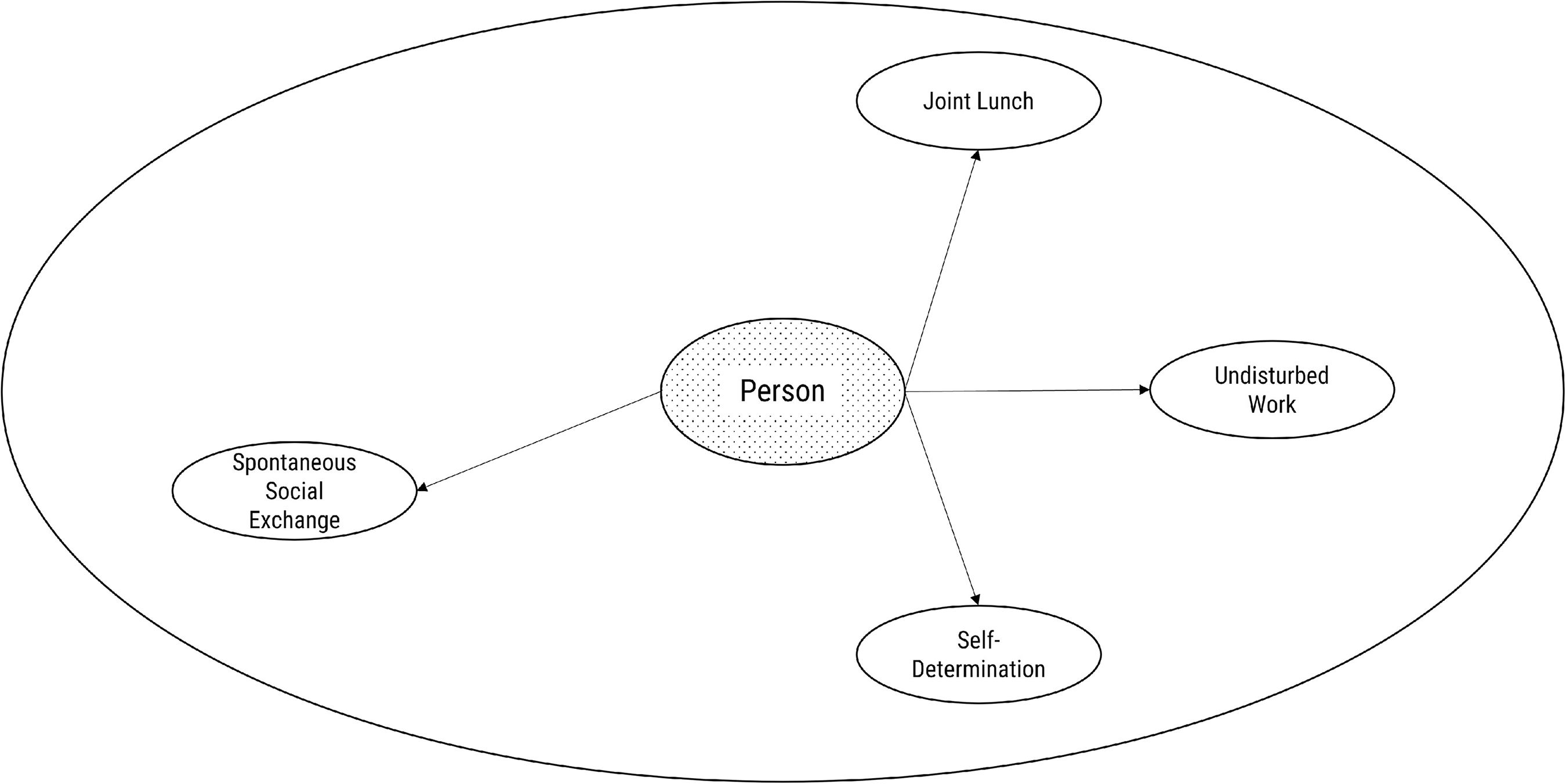
Situation – as perceived by employees – before the planned change ‘implementing hot-desking’.
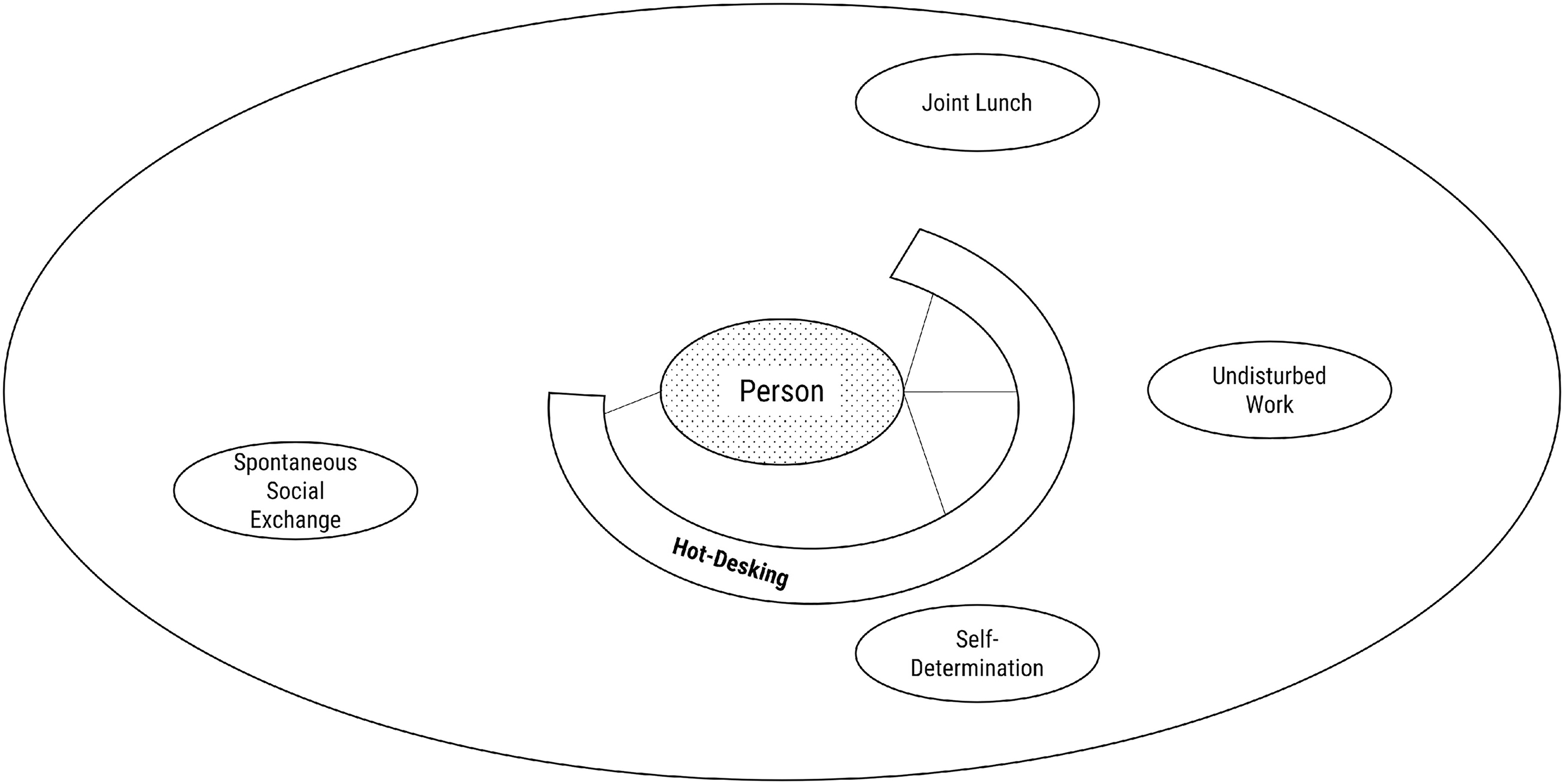
Consequences of the change ‘implementing hot-desking’ – as perceived by the employees.
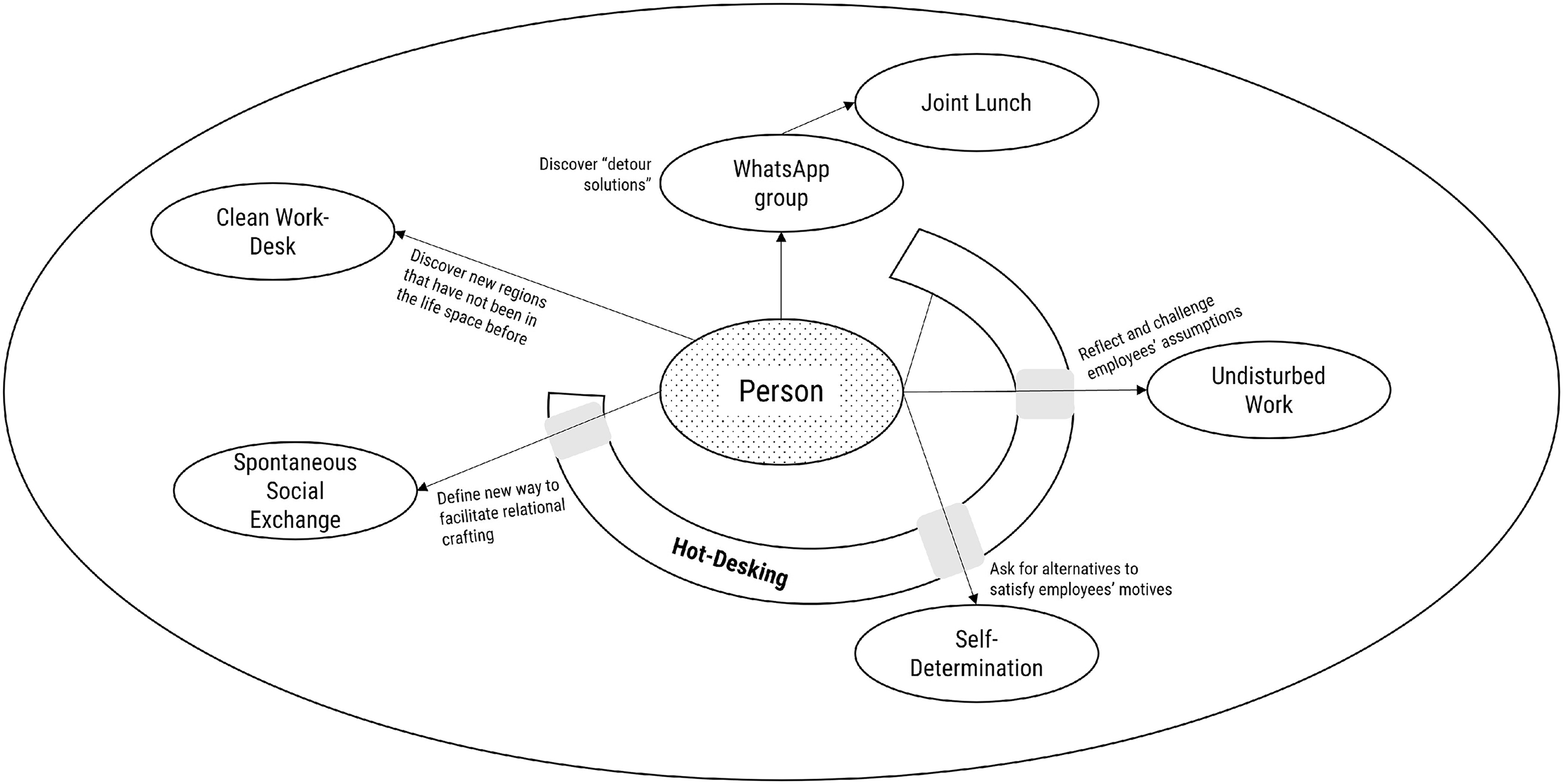
How employees would support the planned change ‘implementing hot-desking’.
Discussion
Much of Lewin's influence on leading scholars such as Deutsch, Festinger, and Heider is based on his inspiring personality (Adelman, 1993). We tried to capture some of this by drawing on his writings to show how Lewin the consultant might use his ideas to facilitate change readiness among employees.
As the previous section provided an overview of how Lewin's ideas and concepts could be applied in a practical manner, we now shift the focus to the second strength of the Practical Theorist (Marrow, 1969) by discussing how Lewin's topology can inspire management scholars to create more practical theoretical thinking.
Criticism of the Current State of Management Theory
Nowadays, it seems that a plethora of management theories exist, many borrowed from other disciplines such as clinical psychology, each aiming to explain a little bit of ‘reality’ (Oswick et al., 2011). This fragmentation leads to the fact that the majority of dominant theories in management lack explanatory depth (Wood et al., 2018). This criticism is not new (e.g., Cartwright, 1978). Indeed, considering the trending topic “sustainability”, Sanford (1970, p. 18) gave a surprisingly contemporary comparison fifty years ago, when he stated that: ‘Like other industries, social science has been polluting its environment. […] It has been creating an enormous amount of waste in the form of useless information.’ Five decades later, it seems that theories are still often written to promote the writer and not for their practical benefit, which Martin (2003) refers to as ‘theoretical inflation’ that creates an ‘illusion of “theory development”’ (Tourish, 2020). However, many academics see such an approach as necessary for a writer to get published in top-tier journals (Arend, 2021). This is why academics are often portrayed as theory-obsessed individuals who live in ivory towers and have little contact with the real world of managers and do not produce work that addresses the needs of organizations.
Reactions to the Criticism of Management Theory
The criticism has sparked many attempts to improve management theory. One popular approach is to systematize the various theory strands into a coherent picture. For instance, Cornelissen et al. (2021) developed a model that includes seven styles for theorizing (e.g., propositional theorizing, process theorizing, or meta-theorizing). In a similar vein, Sandberg and Alvesson (2021) suggested a framework that distinguishes whether theories help to explain, comprehend, order, enact or provoke our thinking. Cronin et al. (2021) differentiate between unit theory (which frames empirical work on specific aspects of a phenomenon) and programmatic theory (which summarizes what the unit theories collectively support as established knowledge). They argue that research programmes that organize theoretical knowledge (i.e., programmatic theory) rather than the synthesis of empirical findings (i.e., unit theory) is what should drive practitioners’ actions. Thus, theory is not targeted to change managers’ current behaviour, but addresses actions that might take place years from now (Cronin et al., 2021).
These recent attempts to deal with the criticism of management theory use models to help scholars get a better theoretical understanding of what a theory is. Yet they do not serve the purpose of making theoretical knowledge applicable for managerial challenges (Arend, 2021). To rephrase an aphorism attributed to Einstein: Using theoretical models to order theoretical contents seems like solving problems in the same way they were created.
To have a real-world impact, management studies should adhere to academic rigour but also drive social change, requiring scholars to take a more active role (Cunliffe & Pavlovich, 2021). To achieve this impact, we need methods to understand the specific situation and form causal relations, rather than general conclusions. As mentioned above, Lewin (1943a) considered his topological psychology as such an instrument. Furthermore, his holistic approach allows those involved to gain an understanding of the factors influencing current behaviour, which stands in contrast to today's dominance of ‘net-effects thinking’, favouring linear and correlational relationships (Delbridge & Fiss, 2013, p. 328). Thus, it is worth considering what current management theory can learn from Lewin's ideas. 4
How Lewin's Topology Can Inspire Theoretical Thinking
To stop the exponential growth of overcomplicated theories that are alien to managers’ life space and to elaborate how Lewin's notions could improve a theory-building that connects to managerial thinking, we derive three recommendations. First, use plain language to explain your concepts. Second, use drawings to illustrate and explain the change situation. Third, focus on the exceptions and not the rules, in order to generate a better understanding about the nature of organizational life.
With regard to the first recommendation, what we could learn from Lewin is to use a terminology which is in line with everyday language, as ‘the descriptions that have been most valuable to science have not been those made by scientific methods’ (Lewin, 1936, p. 12). For this purpose, management education might put more effort into training its students to observe and explain a phenomenon. Lewin's neologisms (e.g., space of free movement, gatekeepers) helped assign meaning to events, thereby gaining new insights. Trying to explain observations in simple terms might be closer to reality than an overemphasis on structural equation models (Kramer, 2016).
The term ‘social climate’ is a concept that helps readers intuitively grasp that Lewin and his colleagues study group phenomena that are influenced by and in return influence dynamics within the group. Like meteorological climate, a social climate consists of multiple dynamic processes that create an atmosphere that affects the current situation (i.e., the weather, meteorologically speaking). Thus, Lewin created not only a catchy term but also an intellectual basis to approach, study, and understand a phenomenon of interest. For instance, he explains the negative impact of an authoritative leader by describing how the authoritative leader limits the space of free movement. As Lewin et al. (1939) showed, owing to the restrictions imposed by the leader, followers build up tension that is released as soon as the leader leaves the room by behaving aggressively towards their co-workers.
Lewin thus explained the effect of different leadership styles using topological psychology. In fact, for Lewin, topological psychology helps to establish a shared vocabulary to communicate between theories that thus far have used their ‘own language’, contributing to the necessary ‘joining up of concepts normally used in a compartmentalized manner’ (Tsoukas, 2017, p. 132). To illustrate how such a common terminology or dictionary of concepts could be applied, we use an example in which Lewin (1936, p. 46) describes that: “The rich man generally has much greater freedom of movement because of his means. He can take a special train or an airplane in order to reach his destination quickly. The poor man may have legally exactly the same rights as the wealthy one, but what is much more important for him is the fact that his social dependence and the task of supplying himself with the immediate necessities of life, such as his daily food, narrow down his freedom of movement to a much greater extent.”
While reading this passage, the basic corollaries of conservation of resource theory (COR; Hobfoll et al., 2018) come to mind. Like Lewin, the COR states that ‘those with greater resources are less vulnerable to resource loss and more capable of resource gain’ (Hobfoll et al., 2018, p. 106).
As another example of how Lewin's terminology helps to explain theories, consider the broaden-and-build theory (Fredrickson, 2001). One basic tenet of this theory is that a negative state associated with negative emotions makes one less capable of coping with external demands. Lewin put forth a similar notion and called the effect of negative emotions like anger on our functioning ‘regression’: The stronger the negative emotion, the less structured the life space and the less nuanced our repertoire of actions. In other words, the less tension we feel, the more we can rely on our capabilities. For example, referring to the dialogue in our fictional change case, a statement like ‘implementing hot-desking leads to the regression of Alex’s and Esther’s thinking’, has the potential to be grasped intuitively and inspire actions to address the situation. By using his topological terminology and concepts, Lewin was – unlike his contemporary Sigmund Freud – able to conduct experiments to test his hypotheses (e.g., Barker et al., 1941).
Lewin would have illustrated this regression using several drawings that show how Alex's and Esther's life space becomes less structured and dominated by barrieres, indicating that the behaviour repertoire is less nuanced (cf. the broaden-and-build theory). Lewin's use of drawings to show and explain processes leads to our second recommendation which boils down to ‘a picture is worth a thousand words’. Nearly all of Lewin's writings contain topological drawings. One might even speculate that Lewin's ‘Eureka Moments’ happened while he was drawing. For instance, in one of his studies (Lewin, 1947b), he came to the conclusion that changing food habits required him to work with housewives, as they are the ‘gatekeepers’ deciding what arrives on the kitchen table. It is likely that his insight to shift attention from husbands as ‘head of the family’ to the wives, came while he drew the ‘channel’ of how food reaches the table.
Drawings might also help to visualize the psychological reality still described in different terms by different theories. Returning to the COR example mentioned above, the corollary that individuals with greater resources are more capable of resource gain (Hobfoll et al., 2018) could be visualized topologically by an employee who has access to a goal or region that allows him/her to reach other important regions that offer resource gains.
Using visualizations could make theories more tangible to lay people as they help to explain the occurrence of events. In fact, such drawings are already being applied to product and service development in order to better understand the customer journey and experience (e.g., Moon et al., 2016). Thus, we suggest that theories should go beyond depicting statistical models that are tested in the paper but use more vivid visualizations. With his drawings of the life space, Lewin developed an approach to generating causal relationships, arranging facts into a coherent picture, and giving research a new direction with only a few adaptations. Aligning today's research towards this end might increase scholars’ endeavour to understand why phenomena emerge, initiate change, and thereby become more relevant for practitioners (Endrejat & Burnes, in press).
Our third recommendation is to shift the focus from explaining regular cases to finding explanations for irregular observations. Lewin never spent much effort on focussing on an average situation, as this is never a real situation in any given organization. Just collecting data from numerous sources does not help to answer the most important question: how should we to act in a specific case to achieve the desired effect? (Marrow, 1969). We, as scholars, cannot give guidance on how to deal with a given situation if we have only studied one or two variables that might have a significant (if the sample was large enough) but meaningless effect. Instead, Lewin (1936) urged us to take the characteristics of a person, the momentary state, and psychological environment into consideration. Lewin's starting point for such an expedition was his inquiry into why a person behaves one way and not another. He did so by detecting dissimilar behaviours in similar situations and by finding explanations that cause these special events (Marrow, 1969). These experiments were thus not only conducted to test a hypothesis, but also to understand the organization and content of an individual's life space (Bronfenbrenner, 1977). Knowing how to measure and change these aspects might be the contribution managers expect to learn.
Conclusion
Kurt Lewin – a practitioner who mitigated stereotypes against minorities, altered food consumption to fit the demands of World War II, and still found the time to appreciate theory – is often depicted as a historic figure in management learning curricula. In this paper, we showed why it is worth taking a closer look at his ideas and how these concepts might be useful for current thinking and action. In line with Kurt Lewin's widely cited aphorism ‘there is nothing so practical as a good theory’ this article has shown how Lewin's concepts help to solve contemporary challenges.
Today, many scholars seem to think that Lewin's ‘there is nothing so practical …’ aphorism refers only to ‘his’ field theory. However, Lewin neither invented field theory nor was it his method of choice to understand phenomena. We showed that Lewin's major theoretical contribution is topological psychology, that still offers inspiration for current thinking. We first described why the term ‘field theory’ is misleading and subsequently elucidated Lewin's theoretical cornerstone – topological psychology.
Unfortunately, Lewin died too early to follow up on his intention to modify his topological approach. With this paper, we took the liberty of speculating how Lewin might have further developed topological psychology to be of practical use to change agents. To make our ideas tangible and facilitate the ‘click’ in the reader's mind, we crystalized down Lewin's complicated illustrations and language. The result is a method that can be easily applied by change agents who are interested in conducting transformations in a participative manner by collaboratively getting an understanding of change recipients’ life space.
Lewin's approach to change is often understood as diagnostic, positivistic and hence outdated, and, so it is argued, better substituted by modern constructivist, dialogic methods (e.g., Bartunek & Woodman, 2015). However, from his time in Berlin through to his work in America, Lewin's approach was that researchers should take an active role in helping participants to identify and understand their perceptions and actions (Colucci & Colombo, 2018). Lewin, as a Gestalt psychologist, also assumed that cognitive processes shape the mental representation of the situation in which behaviour takes place. Furthermore, we have shown that Lewin's democratic and iterative approach depends on the collaboration of change recipients, and that a solution emerges during the consulting process. Thus, one might consider whether declaring Lewin and his ideas as the opposite of modern, dialogical OD approaches is merely a way of putting the ‘new’ into new OD approaches. It would be interesting to shine more light on this.
Lewin urged us to take a ‘healthy’ approach towards ‘theory’ by putting its influence into perspective. For instance, Lewin's statement that there is nothing as practical as a good theory is among the most cited aphorisms in the scientific community. Accordingly, many scholars suggest that Lewin put a strong emphasis on theory building. However, as with many of his ideas, this assumption does not show the full picture, because shortly after praising the value of theory, Lewin asks us to be vigilant that a theory ‘never breaks loose from its position to be a servant, as tool for human beings’ (Lewin, 1943b, p. 118). Having this in mind might help to avoid developing theory that neglects practical needs. In this paper, to pave the way towards this goal, we suggest three simple rules: (1) use plain language to explain your concepts, which is what Lewin (1947a) was trying to do shortly before he died; (2) use drawings to illustrate and explain the change situation, but avoid the complicated mathematics that Lewin used (Burnes & Cooke, 2013); and (3) focus on the exceptions and not the rules in order to generate a better understanding of the nature of organizational life. We hope that these suggestions will, as Lewin (1936, p. 7) suggested help ‘narrow the gap between a still half-speculative theory and concrete reality’.
Footnotes
Declaration of Conflicting Interests
The author(s) declared no potential conflicts of interest with respect to the research, authorship, and/or publication of this article.
Funding
The author(s) received no financial support for the research, authorship, and/or publication of this article.
