




Abstract
To address complex social challenges, it is widely recognized that leaders from public, for-profit, and civic organizations should join forces. Yet, well-intended collaborators often struggle to achieve alignment and fail to gain traction in their joint efforts. This article proposes the concept of “entry points” as a key milestone in a collaboration's early stages. Using a unique set of rich, longitudinal data, we examine how ten cross-boundary teams with representation from ten city governments in North America and Europe searched for these entry points (i.e., opportunities for focused action to advance learning and progress towards their collective goals). Based on systematic coding, we propose factors that impeded or enabled the teams' abilities to find entry points in their collaborative work. The paper contributes to literatures on cross-boundary collaboration, problem-oriented governance, and paradoxes in organizational behavior, and it offers an analytic framework to help cross-boundary collaboration practitioners identify their entry points.
“A problem well put is a problem half-solved” is a famous mantra attributed to American philosopher John Dewey. But what can be done when a group of people cannot agree on a problem statement to begin with? This article explores the challenges of collaborative problem-solving in the earliest stages and develops the concept of “entry points for CBC teams” as a guiding principle. We define entry points for CBC teams as opportunities for collective problem-focused action with the potential to advance learning and progress towards the team's objective.
To tackle complex social issues, such as affordable housing, equitable economic development, and providing quality education, cities rely on collaboration across organizational and sectoral boundaries—what we term cross-boundary collaboration (CBC) (Forrer et al., 2014; Mayne et al., 2020; Termeer et al., 2019; Edmondson & Harvey, 2017). Involving multiple actors who represent different departments, different levels of government, and different sectors, such as private sector organizations, non-profits and/or community organizations, can be challenging (Bardach, 1998; Bryson et al., 2015). Specifically, CBC not only calls for designing and launching multi-agency, multidisciplinary teams, it also requires collaborators to align on the problem definition, goals, team composition, and work process. Building trust, dividing the work, and managing the team to deliver collective results are just a few of the challenges CBC teams face (Waardenburg et al., 2020a). A lack of alignment and focus on the early stages of these types of collaborations can therefore be disorienting to the individuals and organizations involved: they have convened and committed to working on an issue together but are still unsure of how to approach the issue and where to begin (De Jong et al., 2021). In fact, one might borrow from Dewey to argue that a problem poorly stated is a group half stalled.
This study aims to better understand the dynamics of early-stage CBC. We study the early stage because the known barriers to effective collaboration across boundaries may prevent projects like these from gaining sufficient traction to continue (De Jong et al., 2021). By using data collected during nine months of engagement with CBC teams in a “field lab” –a design-oriented learning environment where CBC teams convened to start working on a social issue–, we will answer two main research questions: What does a CBC team's successful start look like, and why are some teams more successful than others in getting started?
The contribution of the paper is threefold. First, it deepens the understanding of CBC teams in their early stage, a key and challenging moment for CBC teams. Second, it proposes a set of desired qualities to identify suitable entry points to start addressing a team's focal issue and gain momentum. And third, it advances knowledge on factors that inhibit or enable the work of CBC teams as they first engage in it. These contributions have implications for theory and practice. The propositions of entry point qualities and relevant factors help inform future empirical research on the subject of CBC teams with public sector representation, and practitioners may use the insights we offer to help design, launch, and guide CBC efforts in practice.
Collaborating Across Boundaries in Cities
To closely examine the early stages of CBC problem-solving, we build on three bodies of research: CBC and teaming in the management literature, problem-oriented governance in public management, and social paradoxes in organizational behavior. All three literatures offer insights and concepts that contribute to an understanding of the challenges CBC teams face. Our goal is to integrate these via an analytic approach that allows us to zoom in specifically on the early stages of collaboration.
CBC and Teaming
Research on teaming shows that effective problem-solving around complex challenges requires engaging individuals and institutions with diverse and complementary expertise, perspectives, and resources (Sunstein, & Hastie, 2015; McChrystal et al., 2015; Hackman, 2011; Edmondson & Harvey, 2017). This diversity is typically separated across silos and breaking them down provides the advantage of potentially achieving outcomes that individuals working on their own could not have achieved (Huxham & Vangen, 2004). The management literature provides insights regarding factors associated with successfully bringing diverse expertise together (see Edmondson & Harvey, 2017, 2018; and Mathieu et al., 2017, for reviews). These factors include pursuing a shared vision, finding alignment on values and incentives, inviting input and feedback, allowing risk-taking and expression of doubts, and enabling effective team-member interactions and knowledge sharing (Edmondson, 2016; Nembhard & Edmondson, 2006; Lovelace et al., 2001; Okhuysen & Bechky, 2009). CBC teams in cities working on issues like homelessness, public safety, and equitable economic development certainly face challenges associated with interdisciplinarity and might benefit from the insights the management literature offers. At the same time, the involvement of governmental actors operating within restrictive legal and political frameworks, the complicated stakeholder configurations, and the very public setting in which the work is done adds layers of complexity. Therefore, the question is if insights from the teaming literature hold true for CBC teams focused on social issues in a highly political context; especially as conventional bureaucratic silos of governments are often ill-equipped to productively organize knowledge, expertise, resources, and routines around a complex social issue.
Problem-Oriented Governance
One strand of the public management literature that takes this political context explicitly into consideration is problem-oriented governance. It centers on the notion that most complex social issues cannot be addressed by mono-disciplinary policies and siloed government agencies and examines the value and challenges of inter-agency collaboration and CBC (Bardach, 1998; Head & Alford, 2015; Head, 2022). At a minimum, problem-oriented governance requires coordination among agencies. However, to sustain joint efforts, governments and their partner organizations must build capabilities to effectively engage in collaborative problem-solving. These capabilities include the “ability to forge new cross-silo and state-society relationships” and the “ability to strengthen and leverage existing relationships” (Mayne et al., 2020).
While the benefits of this type of problem-centered, multi-stakeholder collective action might be intuitively clear, it is enormously difficult in practice (Klievink, 2011; Agranoff, 2012; De Jong, 2016; McChrystal et al., 2015 Edmondson & Harvey, 2017; Scott & Boyd, 2022). Many of the challenges that the management literature identifies—misalignment of vision, values, or incentives; a lack of mutual understanding and trust—apply to the domain of problem-oriented governance. At the same time, the literature on inter-agency and cross-boundary problem-solving surfaces structural barriers to collaboration that stem from the way public organizations are governed, funded, managed, and held accountable; challenges including sharing data, taking risks, sharing power, learning from errors, and measuring collective performance encumber or inhibit collaboration. The literature on problem-oriented governance is less prescriptive than the literature on teaming and largely stops short of offering solutions or recipes for success. Some scholars have suggested factors that increase the likelihood of collaborative success, including agile governance, the role of leadership, environmental conditions, power relations, and evenness in resources (Agranoff & McGuire, 1998; Ansell & Gash, 2007; Bryson et al., 2006; Emerson et al., 2012; Hudson et al., 1999; Sørensen & Torfing, 2011). Most of the research, however, is more detailed in its description and explanation of the problem than in its prescription of possible solutions.
Where the management literature typically takes teams as the unit of analysis and is aimed at identifying enablers of success, studies in governance take organizations or interorganizational coalitions as the unit of analysis and are more focused on identifying structural constraints. For the purpose of our study, these two bodies of literature are highly complementary. Ultimately, the work of problem-oriented governance is done by human beings, representing their respective organizations while working together on a social issue that cannot be solved by any organization on its own. The fundamental challenge of CBC seems to lie in grappling with the structural constraints associated with problem-oriented governance on one hand and overcoming the barriers to inter-personal collaboration in diverse teams on the other.
Both tasks present CBC teams with a variety of seemingly contradictory demands, or paradoxes (Fairhurst et al., 2002). For example, in their study of CBC teams fighting organized crime, Waardenburg et al. (2020a) found that teams saw themselves in situations needed of collaboration to build trust (i.e., sharing crime data across agencies), but they also needed to build trust to collaborate (i.e., to start sharing, they had to trust each other). CBC teams commonly encounter paradoxical challenges such as this.
Social Paradoxes
Research on the role of social paradoxes has identified sources of tension that lead actors to experience “stress, anxiety, discomfort, or tightness in making choices, responding to, and moving forward in organizational situations” (Putnam et al., 2016, p.69). For example, as reviewed and summarized by Smith and Lewis (2011), belonging tensions emerge because individuals within groups may want to distinguish themselves in their work or role but also achieve cohesion by exploring similarities across group members (Brewer, 1991; Huy, 2002; Pratt & Foreman, 2000); performing tensions arise because different stakeholders working together may pursue varied and potentially contradictory goals (Donaldson & Preston, 1995; Denis et al., 2007); organizing tensions respond to simultaneously needing agency and guidance or control and flexibility (Denison et al., 1995; Gittell, 2000); and learning tensions surface because adopting new ideas requires re-learning or unlearning past knowledge (March, 1991; Senge, 2006; Weick & Quinn, 1999). Most of this work studied private sector organizations; an exception investigated CBC teams with public sector representation (Waardenburg et al., 2020a). These authors proposed three types of paradoxes in this type of collaboration, which overlap with some of the tensions above and are aligned with challenges previously identified in the collaborative governance literature: substantive problem-solving, collaborative process, and multi-relational accountability (Ansell & Gash, 2007; Provan & Kenis, 2008; Moynihan et al., 2011; Bryson et al., 2015).
First, substantive problem-solving paradoxes manifest as a tension between the desire to deeply analyze a problem and to act swiftly, which commonly emerges as a struggle between focusing on an immediate situation or concrete case and addressing the larger abstract phenomenon and related systemic issues. Second, collaborative-process paradoxes include the need to trust enough to collaborate and to learn to trust through collaboration, and the need to draw on traditional bureaucratic roles or disciplinary expertise while at the same time innovating new roles to conduct interdisciplinary problem solving. Third, multi-relational accountability paradoxes arise when collaborators feel that their commitment to the collaboration is at odds with their responsibilities to their parent organization (Waardenburg et al., 2020a). For instance, a CBC team may feel a need to redefine the problem or change an approach to solve it in a way that challenges assumptions put forward by authorizers of the CBC. Managing and renegotiating the scope of work and the focus of joint action in light of emerging insights is likely to create friction with mandates provided by distant authorizers operating under hierarchical and siloed accountability requirements.
To effectively manage disorientation, uncertainty, and complexity, CBC teams need a sufficient level of psychological safety to be comfortable with the fact that an easy solution is not readily available and that no one has sufficient expertise or authority to solve the problem. This is because psychologically safe teams create environments in which it is safe to disagree, take risks, make mistakes, and speak up (Edmondson 1999; Edmondson, 2012). More recent research has found that CBC teams that see these challenges as a shared responsibility requiring coproduction to be solved are more effective. They report team environments in which members ask questions of each other to better understand how to proceed, where they are invited to contribute, and in which each party's contribution is valued (Kerrissey et al., 2021). How these inter-personal dynamics play a role in early CBCs is particularly relevant given the inherent paradoxical nature of CBC work, arguably exacerbated by disorientation as teams start to engage in collaboration and the fact that this work is aimed at tackling complex social problems in volatile, uncertain, complex, and ambiguous environments.
In sum, research from studies in three different (sub)fields (CBC and teaming in the management literature, problem-oriented governance in the public management literature, and social paradoxes in organizational behavior) contribute to our understanding of the value and challenges of CBC in tackling social issues in cities. We bring these insights together to sharpen our analytical lens and zoom in on the understudied early stages of problem-solving collaborations as a key phase for such teams. Our motivation builds on the premises that different times in the life of teams might require different conditions for effective performance (Hackman & Wageman, 2005), and that beginnings may be particularly challenging moments due to the uncertainty, disorientation, and tensions associated with the early stages of a collaborative problem-solving process. Given the critical importance of successful collaboration in tackling complex social issues, a better understanding of what happens in early, make-or-break moments will fill an important gap between existing strands of research and offer guidance to practitioners engaged in navigating CBC in cities.
Gaining Momentum: Entry Points for CBC Teams
In this paper, we focus on gaining momentum, as it is often where new collaborations fail. We suggest that how teams engage in new work is a particularly important question for informing theory and practice. Specifically, we ask what a successful start to a CBC looks like, and why some teams are more successful than others at gaining momentum. As we observed specific actions taken by early-stage teams and how they differed on their level of focus on the issue they were trying to address, the concept of “entry point for CBC teams” started to emerge.
We then combined this emerging notion with insights offered by prior research to develop the concept of an entry point further and propose it as a key milestone at the beginning of CBC processes. Specifically, we reviewed research and frameworks that see problem-oriented work and policy formulation as incremental, “continually building out from the current situation, step-by-step and by small degrees” (Lindblom, 1959, p. 81), and as non-linear processes that can be advanced by aiming for “small wins” (Weick, 1984). For example, Problem Driven Iterative Adaptation (PDIA) (Andrews et al., 2013; Samji et al., 2018) provides an iterative, experiential learning approach that aims to escape the widespread practice of importing predetermined best-practices. It proposes a locally grounded approach to problem-oriented governance by dissecting the problem and analyzing the viability of the change space in terms of authority, acceptance, and ability. Specifically, PDIA recommends rapid experimental loops to break down problems into root causes, identify entry points, search for possible solutions, act, reflect upon what has been learned, adapt, and then act again. This work shares similarities with work on teaming in pursuit of innovation (Edmondson, 2012) that identifies the importance of execution-as-learning and highlights the deliberatively iterative nature of the collective learning process through cycles of diagnosing, designing, acting, and reflecting (Edmondson, 2013). Each of these frameworks highlight the ongoing iterative nature of CBC work and the need for a learning-by-doing orientation to make progress, and they stress the importance of using gradual, stepwise interventions as learning opportunities. We propose our emerging concept of entry point for CBC teams as a first step to initiate this learning-oriented, iterative process and gain momentum in the collaboration.
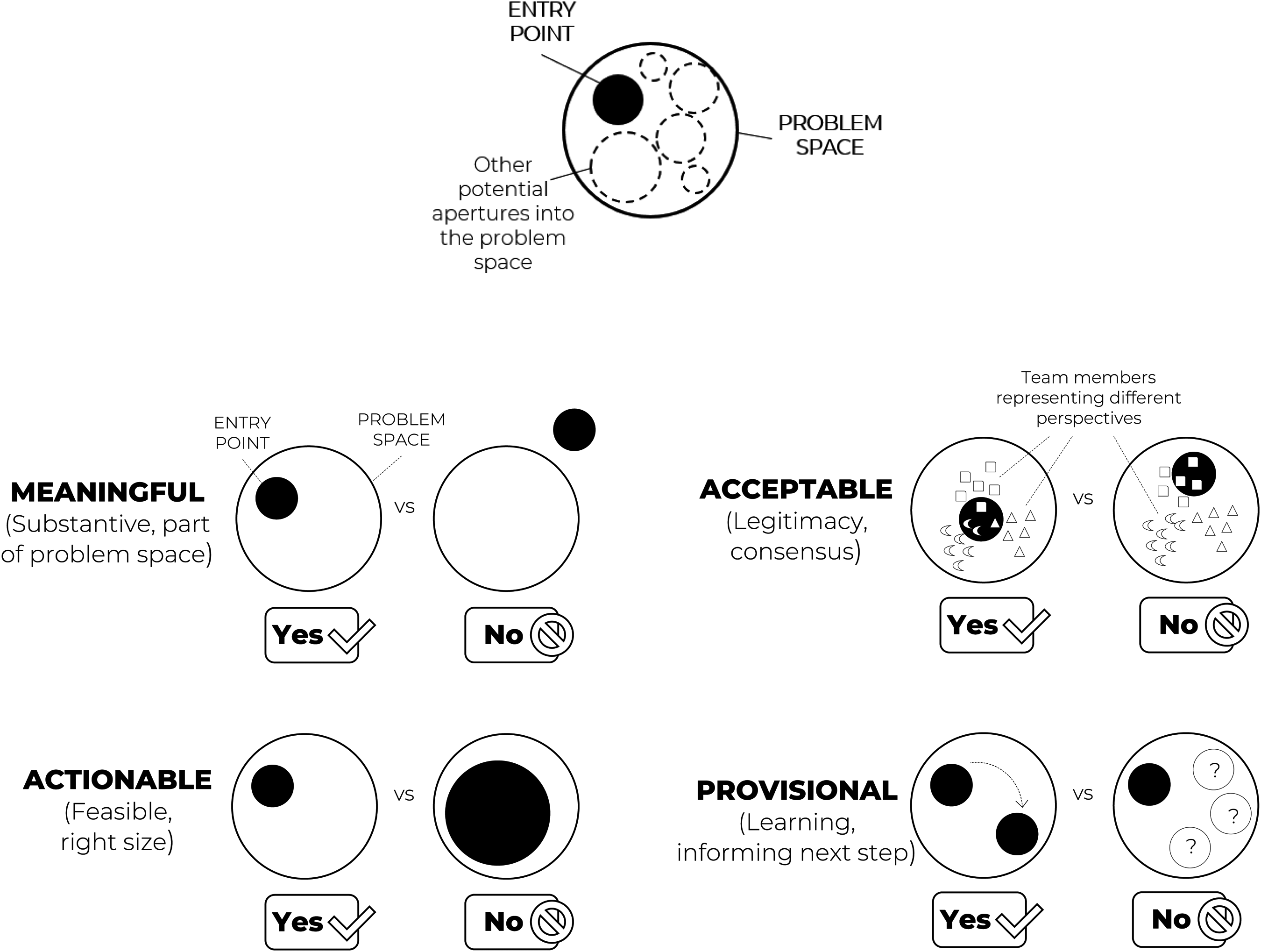
Entry point for cross-boundary collaborations and qualities of suitable entry points.
Combining our inductive exploration of the data and insights from previous literature, we conceptualize entry point for cross-boundary collaborations as an opportunity for focused action to advance learning and progress towards a team's collective goals. It is a minimal viable action carved out of a universe of possibilities, a pathway into part of the problem. It identifies a specific piece within the larger issue on which to focus, allowing a team to move from conversation to action, while placing them in a position to learn more about the problem as they proceed. In addition, further empirical work led us to propose four desired qualities for these minimal viable actions: suitable entry points need to be meaningful given the larger issue to tackle, actionable in light of the team's capacity, acceptable to the team and its authorizing environment, and provisional in terms of the ability to generate learning about the focal issue and inform next steps. Our analyses also allowed us to propose three explanatory factors (representation, trust, and agency) that relate to CBC teams' success in finding and selecting a suitable entry point. We describe and discuss these concepts further in our findings and discussion sections.
Methodology
Empirical Context
The Field Lab Setting
We studied ten early-stage CBC teams that participated in a nine-month program (the “field lab”) to build collaborative capabilities and tackle a selected social issue in their cities. The field lab setting provided an opportunity to study the development of the ten teams closely and holistically and followed the criteria for a design-based learning environment laid out by the Design-Based Research Collective (2003). Specifically, field labs present a learning environment designed to allow the development of theory and practice that support engaging in CBC. The particular field lab in our study was based on similar programs that had been run with previous cohorts in the same collaborative capability program, as well as on field labs in other settings, all of which worked with boundary-spanning teams to build collaborative capability. By design, each iteration of the program with a specific set of teams informed the next, ascribing to the design-based tenet of engaging in cycles of design, enactment, analysis, and redesign (Cobb, 2001; Collins, 1992). Of these iterations, we study one.
The program design of the field lab in our study was also informed by research on learning environments conducive to CBC. As in prior research on learning spaces for collaborative work in multi-agency teams (Waardenburg et al., 2020b), the field lab provided space and time to experiment, offered structured problem-solving techniques, frameworks and scaffolding, collaborative process facilitation, and progress review. The program combined a one-week, in-person training—with plenary sessions and facilitated group work—followed by ongoing support and monitoring of the teams' work through city visits, periodic check-ins, and coaching calls over nine months. The program introduced all teams to the same existing material on CBC and provided them with the same support and guidance. For example, teams were trained on formulating strategic goals, conducting stakeholder analyses, and engaging in negotiations, but they did not receive any guidance on entry points specifically nor on factors that inhibit or enable finding them.
Finally, the field lab design created multiple and varied interactions with teams. This generated a rich set of documents (e.g., team memos, observer notes from working sessions, survey data, etc.), which we used as our dataset to follow the teams' development and engagement with their work throughout the field lab program and to shed light on the subject of early-stage CBC teams.
The Ten CBC Teams
Given our study's field lab setting, how teams became participants in the program is important to consider. The CBC field lab was a component of a larger initiative to work with cities and develop their governance capabilities. Mayors from cities all over the world were welcome to apply. The ten CBC teams we studied represented cities across North America and Europe with populations ranging from 125,000 to 1.3 million.
The CBC teams were formed after 1) their mayors demonstrated interest in developing their cities' collaborative capabilities and 2) their cities were selected as credible candidates to participate in the field lab. Each city mayor identified a social issue to address and convened a multi-organization, eight-person team to represent different perspectives related to their selected problem. Teams engaged in different focal issues. For the teams observed, the issues were equitable economic development (3 teams), affordable housing (3 teams), quality education (1 team), mental health (1 team), youth unemployment (1 team), and transportation (1 team).
Given how the teams in our study were formed and invited into the program, they constitute a convenience sample of CBC teams for our research. This presents limitations in terms of the generalizability of our findings, which should not be overlooked. Nonetheless, we argue that the ten teams we studied present a valuable opportunity to advance knowledge on CBC. They all represented instances of the phenomenon of interest (i.e., early CBC teams tackling social issues in cities), each of them provided a singular opportunity to explore our research questions, and the size of the sample is appropriate for a multiple case study (Stake, 2013). Additionally, as discussed above, the field lab setting offered the opportunity to access comparable longitudinal data throughout the cases and a platform prone to the exploratory, iterative, action-oriented, and learning-oriented research to fit the exploratory nature of our research questions.
Data
To address our research questions, we leveraged archival and longitudinal data collected throughout the duration of the field lab program, allowing us to describe the first nine months of these ten cross-boundary efforts. Figure 2 depicts the program timeline and the data collected at each stage.
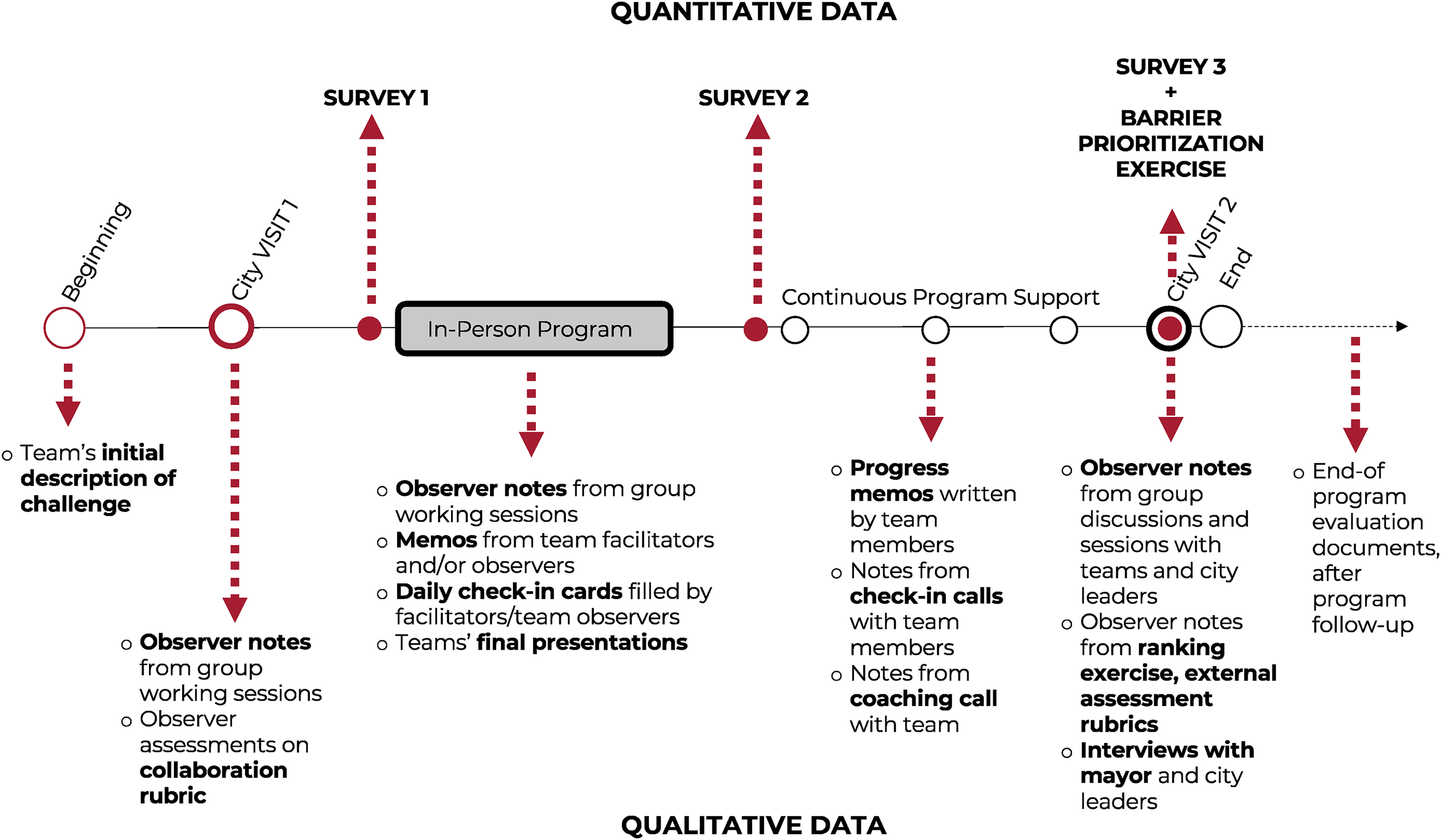
Field lab program timeline and data collection.
Through interaction with participating teams, the program support staff collected a rich set of qualitative documents, including observer notes from team working sessions and field visits, progress memos, and responses and reflections on team exercises. During visits to cities, program support staff observed the teams and recorded their impressions using a rubric designed for this purpose that, based on Moore's (1995, 2013) Strategic Triangle and De Jong et al.'s (2021) Augmented Strategic Triangle, covered different dimensions of collaborative work in public settings (public value definition, operational capacity, legitimacy and support, and team coalition). The qualitative comments related to the items in each of these dimensions are also part of our dataset. A complete set of documents for a team would include all qualitative data listed under each of the six stages of data collection in Figure 2 (initial description of challenge, kick-off city visit 1, in-person program, continuous program support, final city visit, and end of program status). While some documents do not exist for some cities, every team had data for each of the six stages. In total, we had access to almost 400 single-spaced pages of text, with an average of 38 pages per team. 1
In addition to these observations and archival data, we conducted a survey covering key areas of collaboration at three points during the program: 1) immediately before the in-person training; 2) one month following the in-person training; and 3) at the end of the program during the final visits to cities. We drew from the first and third waves of this survey, as they comprised the bulk of the teams' work during the program and their overall response rates were high (100% and 96%, respectively). We focused on items that captured how team members perceived the clarity of their goals and action plans, their progress as they collaborated, and their team's sense of “psychological safety” (Edmondson, 1999) as a group-level measure of how individuals in a group perceived the possibility of taking interpersonal risks in their work to advance and keep learning. During the final visits to cities, facilitators also conducted a team exercise using a barrier prioritization tool similar to the one described in De Jong, et al. (2021). Each team member was presented with a list of 15 common collaboration barriers to rank individually. The facilitator then aggregated all responses to identify the three most and least challenging barriers each team had encountered throughout the program and used the results to engage each team in reflection and discussion. This exercise provided another source of data that captured team members” perceptions of their collaborative engagement. 2
Analytical Approach
Following the Edmondson and McManus (2007) classification of field research, we argue that the phenomenon of CBC in cities falls between nascent and intermediate states of theory development. That is, no fully developed theory exists with well-defined and well-bounded constructs developed through extensive convergent knowledge and evidence. Instead, the study of CBC in a city context is still in early stages with some prior work coming from separate bodies of literature that provide useful frameworks, lenses, and constructs, but have not yet produced a preliminary explanation of how city-based CBC unfolds, particularly when focusing on the beginnings of this type of collaboration.
For this reason, we chose to conduct exploratory research, with the goal of further developing theory and key constructs. Our mixed methods action research approach draws heavily from analyses of rich qualitative data collected during the field lab experience, complemented with quantitative analyses of standardized data across teams, such as longitudinal survey items and the barrier prioritization tool described above. The use of varied sources of data is well suited for exploring complex phenomena and an established practice in action research (Aguinis, 1993; Argyris et al., 1985; Alderfer, 1977).
Qualitative Analyses
A qualitative approach is appropriate to analyze rich data collected “in close proximity” to the phenomenon (Miles et al., 2014, p.11). We conceptualized each team in our data as an individual case study in a multi-case setting and we took an exploratory comparative approach (Yin, 2018) iteratively implementing within-case and across-case analyses (Creswell & Poth, 2018; Charmaz, 2006). We engaged in four distinct phases of qualitative coding and analysis. We used the archival documents for each team following a grounded theory approach in which codes were developed by iterating between data and literature (Strauss & Corbin, 1994; Charmaz, 2006). Figure 3 depicts these different stages, indicating the sources of data and the analytical tools and approaches used in each. For each stage, we indicate the key analytical outputs and how they feed into the next phase of analysis, including how our codes, themes, and definition of the emerging construct of “entry point for CBC teams” developed in the process. We describe each phase in more detail in the following paragraphs.
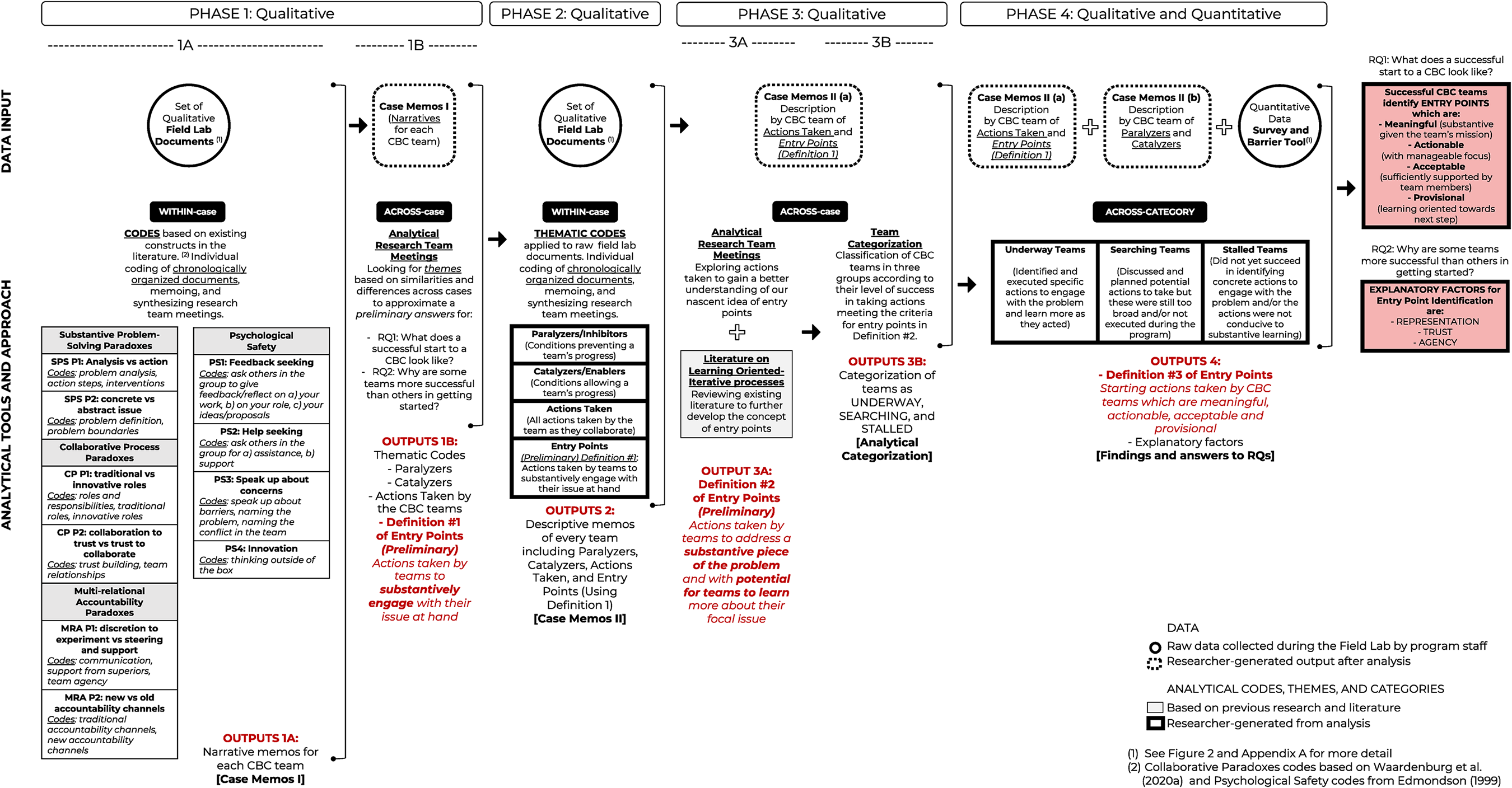
Methodological approaches and analytical phases.
In Phase 1, we used the qualitative documents to build within-case narratives describing team development and the challenges of getting started. We then used these team narratives to compare across cases in search of patterns. Given the exploratory nature of our research, we combined etic and emic approaches to coding. We started with a preliminary codebook built by the research team based on existing frameworks on the complexity of CBC and teaming; specifically, Waardenburg et al.'s (2020a) framework on paradoxes of collaboration and Edmondson's (1999) construct of psychological safety. As we engaged with the data, we allowed for new codes to emerge, which we recorded and incorporated into our codebook. These new codes then guided our next phases of qualitative analyses. (E.g., one emerging code was “feeling stuck,” which then helped us name one of our analytical categories of teams, described later in this section).
For each team, we engaged in an iterative process of individual rounds of reading, coding and memo-ing, as well as group discussions to coalesce around a description for each case. We systematically followed three steps for each of the team cases:
Step 1.1: Two different researchers performed individual line-by-line coding and three coding memos (pre-, during-, and post-coding) by engaging with the sets of documents available for each team organized in chronological order. Step 1.2: The research team held group discussions based on the two sets of pre-, during-, and post-coding memos produced in Step 1.1. Step 1.3: We produced a summary memo for each city based on team discussions in Step 1.2. These summary memos captured narratives for each team by listing and defining themes of their collaborative experience and recording direct quotes and evidence from the documents.
Once we had completed all within-case summary narratives, we engaged in individual and group analysis sessions to identify patterns across cases and generate overarching themes to explore in the next phase using more focused coding (Saldaña, 2014; Charmaz, 2006). This oriented our second coding round towards summarizing themes of inhibitors, enablers, actions taken, and entry points. We also produced our first (preliminary) definition of entry points as actions taken by teams to substantively engage with their issue at hand.
The goal of Phase 2 of our qualitative analyses was to identify sources of paralysis (inhibitors) and sources of catalysis (enablers) in each team, as well as the early actions they decided to take to start addressing their focal issue (i.e., entry points). We used these themes to recode each of the original, chronologically organized documents and, similar to above, we made use of iterative individual and group engagement with the data as a process to check our analyses.
We followed an iterative within-case analytical process similar to the one described for Phase 1, comprised of three steps that we systematically replicated for each team:
Step 2.1: We went back to the raw documents and produced individual memos listing sources of paralysis and catalysis in each team, as well as a description of entry points if teams took specific steps to move into action. At this stage, we understood entry points based on our first preliminary definition (as actions taken by teams to substantively engage with their issue at hand). Step 2.2: We used the memos from Step 2.1 to hold research team group discussions to coalesce around a description of inhibitors and enablers for each team as well as characteristics of entry points for teams that took specific actions to make progress in their collaborative work. Step 2.3: We generated a summary memo for each team listing and describing sources of paralysis and catalysis as well as a chronological account of actions taken by the team as they started to address their issue.
In Phase 3, incorporating our review of the literature on iterative, collaborative learning to address complex issues, we drafted a second definition of entry points for CBC teams as actions taken by teams to address a substantive piece of the problem and with potential for teams to learn more about their focal issue. We then used this second definition of entry points to organize teams in a spectrum from low to high, according to two criteria: 1) whether teams identified a focused course of action that addressed a substantive piece of the problem, and 2) whether the selected action had potential for teams to learn about their focal issue. We identify three different categories. Teams on the high end of the distribution—or “underway” teams—took specific actions to engage with the substantive nature of the problem. In contrast, teams on the lower end of the distribution—“stalled” teams—proposed no actions within the realm of the problem and/or devoted most of their work to collaborative processes and project management tasks. In between these two groups of teams, “searching” teams discussed and planned potential steps, but they were still too broad and/or not executed.
The research team first classified teams individually and then arrived at a consensus in the cases where there was initial disagreement. Three members of the research team engaged in this exercise, arriving at 100% agreement across raters for 6 out of 10 teams (teams B, C, D, G, H, and J). For the remaining four cases (teams A, E, F, and I) disagreement was always between adjacent categories (specifically, between searching and underway). The research team decided the final classification of these four teams in a group discussion until consensus was reached for each case.
Finally, in Phase 4, we used this operationalization of entry points as our outcome of interest to identify systematic variation in paralyzers and catalyzers within each category, which led us to formulate our proposed relevant factors to early-stage CBC. Further exploration of the actions taken by teams within each analytical category also led us to incorporate into our definition of entry points for CBC teams four qualities that make an early action suitable to gain momentum. We describe the team categories, the explanatory factors, and the characteristics of suitable entry points in more detail in the results section.
Quantitative Analyses
In Phase 4, we complemented the qualitative approach described above with analyses of survey data to explore changes in teams' perceptions of their work throughout the program, as well as assessing how responses aligned across each team's members. Survey responses provided information on how team members perceived their goals as a team, their action plan, their levels of trust and psychological safety, and their sense of progress (this latter measure was only available at the end of the program). We specifically focused on the first and third waves of the survey and explored changes in these measures of perception between the beginning and the end of the program, aggregated at the team level. All measures are constructed from multiple Likert-scale items and have adequate internal consistency values for our purposes (Cronbach's alpha is at or above 0.7 for all used measures). 3
We also investigated variation in perception among the teams' members as a supplemental measure of internal alignment. We looked at the spread across team members for each of our measures of interest and organized these analyses by team progress category (underway, searching, or stalled) to describe similarities and differences. 4 We acknowledge that the variation we observe confounds true differences in perceptions with measurement error, but given our use of these measures as one additional source of information to triangulate and complement our qualitative analyses and their values of internal consistency for this sample, we argue their use is appropriate.
Furthermore, we analyzed data from the barrier prioritization exercise, which allowed us to identify trends in teams' rankings of challenges throughout the program by progress category. We explored aggregated results by team, calculating the mean ranking score across team members for fifteen challenges. We also calculated the standard deviation for each challenge within each team as a proxy for alignment in how team members perceived each challenge. 5
Validity and Reliability
Following Creswell and Creswell (2018), we used different strategies to ensure our study's validity. We leveraged the documents in our dataset while being conscious of their variation in terms of each author's relation to the phenomenon under study (i.e., documents directly produced by team members—such as progress memos and presentations—, meeting minutes taken by program observers with secondary but close to verbatim quotes by team members, and qualifying assessments of teamwork by program support observers external to the teams). By using these different sources of qualitative data capturing the teams' development from different perspectives, as well as the survey and barrier prioritization tool quantitative data, we were able to complement and contrast information and triangulate our propositions. In our findings, we also discuss potential discrepant information and offer possible explanations. Being aware of our embedded role in the research setting, we also made sure to follow Gibbs (2007) recommendations to achieve qualitative reliability in our analyses. We held regular and iterative research meetings to share analyses and build consensus across the different stages of analyses. Specifically, we built in cross-check processes by iterating between individual engagement with the data, sharing individual analyses with other team members, contrasting across these sets of individual analyses, and summarizing our discussion and findings.
Findings
We organize our findings in three different sections. First, we describe the three categories of teams (underway, searching, and stalled) that emerged from our analysis according to their degree of success in selecting entry points. For this categorization we used our definition of entry points for CBC teams which emerged from combining our inductive analysis of the data and the existing literature on iterative, learning-oriented action (i.e., actions taken by teams to address a substantive piece of the problem and with potential for teams to learn more about their focal issue). We describe each of the categories of teams in relation to actions they took and whether these actions focused on the problem and were learning-oriented. The second section in our findings describes the emerging construct of entry points for CBCs by examining the actions taken by underway teams, and we propose a set of criteria for an effective entry point. We find that entry points exist when the team identifies meaningful, actionable, acceptable, and provisional actions. We define each criterion and describe how it appeared in the teams studied. Third, we propose three factors (representation, trust, and agency) to explain the variation across teams in making progress (defined as identifying entry points and operationalized in our three analytical categories). We describe each of the factors and provide evidence on how they are or are not present for each category of teams. The first two sections offer an answer to our first research question (what does a CBC team's successful start look like?) while the third one addresses our second research question (why are some teams more successful than others in getting started?).
Initial Progress in Early-Stage Cross-Boundary Teams: Finding Focus and Selecting Entry Points
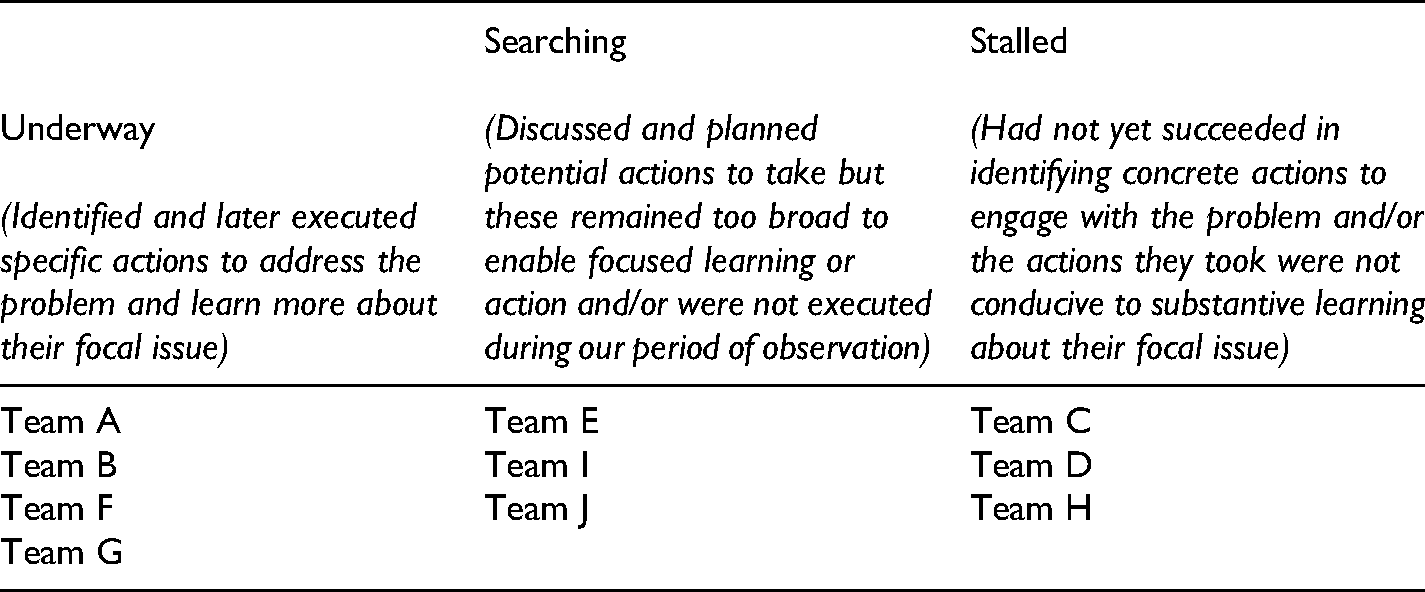
To explore the beginnings of CBCs and propose factors that helped or hindered them to select an entry point, we situated all teams on a spectrum from low to high, based on the extent to which they met the following criteria: 1) they identified a focused course of action that addressed a substantive piece of the problem, and 2) the selected action had potential for teams to further learn about their focal issue. We organized teams into the following three clusters:
- - -
Table 1 shows the ten teams categorized as stalled (3), searching (3), and underway (4).
Categorization of CBC Teams.
A within-category description of the early actions taken by teams allows us to answer our first research question and describe what a successful start looks like for a CBC. The four underway teams identified one or more entry points that helped them get started, take some concrete actions related to their focal issue, and learn more about the problem. None of the actions taken by the four underway teams solved the problems they were working on immediately or entirely, and at the end of nine months, there was still much work left to do, but their selection of a suitable entry point arguably set them upon a learning trajectory to make progress. Table 2 below describes the entry points that the underway teams found and acted on. Interestingly, all underway teams ranked “Defining interventions, programs, and policies” as one of the most challenging barriers in the barrier prioritization exercise (Appendix C), while the rest of the teams did not. This data point might indicate that the underway teams engaged more deeply with the challenge of determining entry points and moving to action— and eventually succeeded in taking suitable, concrete steps.
Entry Points for Underway Teams.
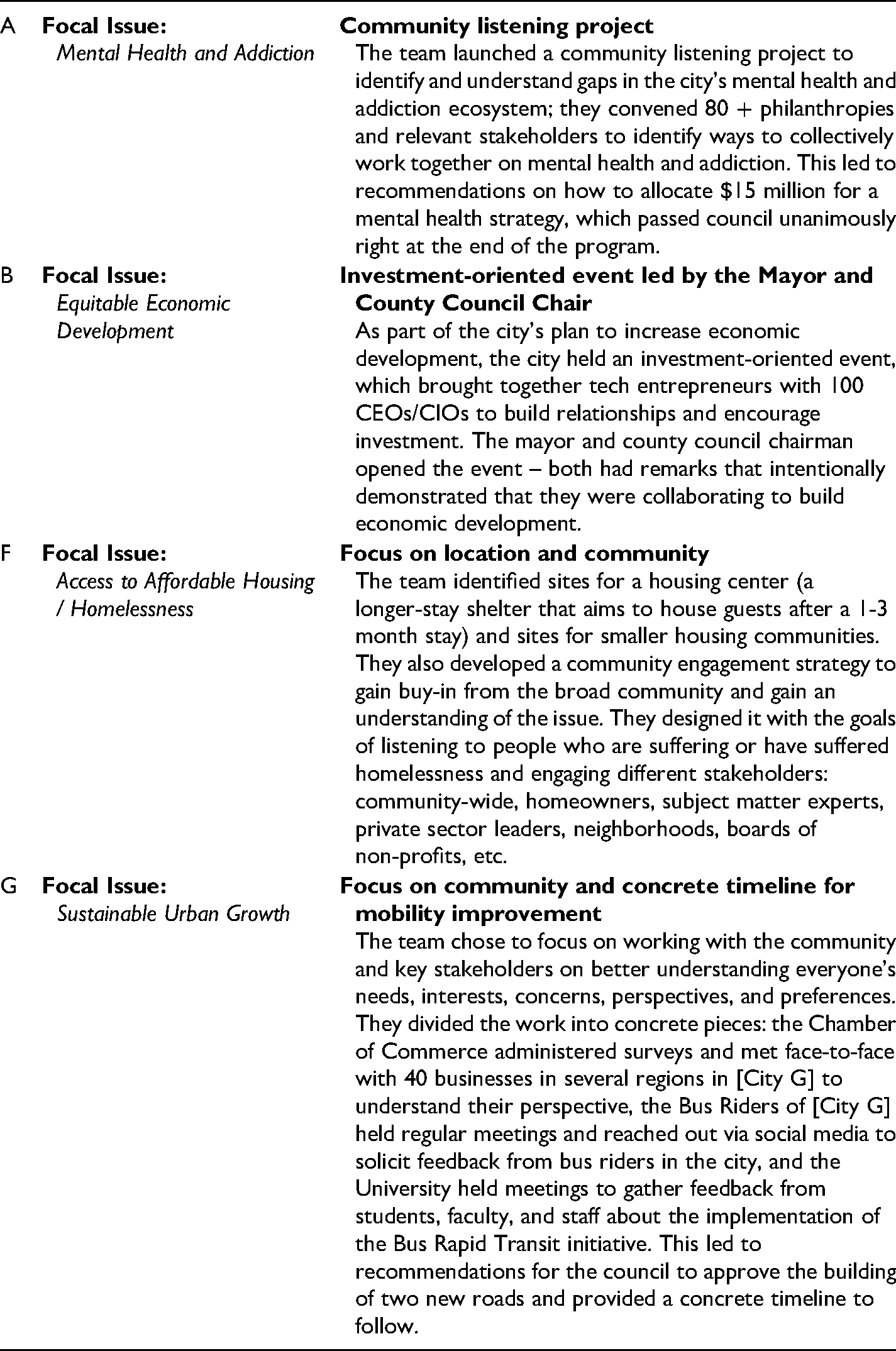
The other six teams were not able to find or select an entry point that was focused enough and had potential for the team to learn about their focal issue. The three searching teams discussed various ideas that could turn into suitable entry points, but they did not move to action during the program arguably because their ideas were still too broad—they needed more refinement to be sufficiently focused on the issue at hand and allow for learning. For example, at the very end of the program, Team J, working on youth unemployment, discussed the idea of collecting data by interviewing young people in their city. This idea had the potential of becoming a suitable entry point, but conditional on the scope of their questions and their plan to learn from and use the information collected. Team I, which worked on economic development, discussed designing a communication strategy to connect with the community, but its scope and design was not fully defined at the end of the program. A plan to communicate with residents might be helpful in generating issue-relevant learning but it was still not clear if Team I was considering a two-way communication strategy or if it mostly planned to explain its economic development plans to the community. Team E, working on quality education, was successful in engaging funders, but, at least by the end of the program, they had not yet identified a specific enough action or plan for which to use the funds they could obtain.
These searching teams faced more difficulties narrowing down their problem definitions than underway teams. As a result, they struggled to gain clearer focus and to identify concrete actions to take. For example, Team I managed to articulate an overarching strategy but struggled to envision a concrete path for action. A field lab observer recorded the following for Team I on the final visit: One of the top challenges discussed was the team's ability to define a concrete plan of action. They have an overall encompassing strategy, but they still struggle with operationalizing it. There is more disagreement when they go into the specifics of it, and they acknowledged it.
In fact, moving to the implementation stage presented a salient issue for searching teams. Team E members identified “Developing a plan of action” and “Implementing a plan of action” as their two biggest challenges in the barrier prioritization tool (Appendix C). Similarly, Team J, expressed how their focus oscillated between “short and long term” perspectives and a “project-oriented vs. system-led” approach to interventions. In sum, we observed searching teams working hard to turn broad goals into implementable actions, but, at least for the duration of the program, they did not find fully concrete and learning-oriented entry points.
Finally, stalled teams struggled to act on their problem for most of the studied period. They found it testing to concretely and narrowly define their problem statement and found themselves preoccupied by challenges unrelated to the substance of their problems. For example, Team C struggled with formulating its public value proposition and felt trapped in a state of analysis-paralysis. During the final visit to the city, a team member reflected on their apparent stalemate saying: It felt like we were stuck in circular conversation at the beginning. […] To a degree, we’ve done a lot and to a degree we haven’t … it feels like we’re still back at where we were from the start—back to ground zero […] One of the main threats I see here is that there is a tendency to continue to have dialogue but not much investment [in action]. (Team C, team member's reflection)
In fact, during the barrier prioritization exercise, Team C identified “defining public value” and “defining success” as two of the most challenging barriers throughout the program (Appendix C). At the end of the program, much of their work as a team seemed to have focused on preparing a presentation for the city's leaders about their work on and ideas about their focal issue. As one team member reflected: “We got it wrong that it's been focused on the presentation instead of solving the problem.” They engaged in action to prepare this presentation, but did not take actions directly targeted at the substance of the issue.
Teams D and H experienced difficulties narrowing down what specific areas to tackle or on which groups of affected constituencies to focus. For Team D, what proved challenging was agreeing on where to start and deciding on what the core of their effort should be (homelessness vs. sustainable housing) or their main constituency (people experiencing homelessness, or low-income people with housing challenges). This lack of clarity made it hard to discuss and define concrete strategies: The team lacks consensus on who they are trying to solve this problem for because they speak about building housing for three different groups. They recognized that differences about priorities exist within the group and that others may not agree on the public value at all times. The definition of the problem is still very generic. They have identified different groups of citizens that they want to impact (homeless, low-income) and also groups of stakeholders they need to interact with (general public), but the categories show strong overlap and they struggle a lot to differentiate them. (Team D, observers' reflections during final visit)
Team D ended up coalescing around the task of hiring a project manager. During the final visit to the city, several team members described drafting the job description and getting funds approved to hire someone as their accomplishments during the program. One member said, “We made the job description together as a group,” and another said, “We have a draft job description for project manager.” Another one added, “the commitment from city council and permission to hire a task manager are big steps. The task manager will be hired for two years.” While this was a concrete action achieved by the group's shared work, it did not specifically address the substantive nature of the problem nor did it allow them to identify concrete learning opportunities to guide next steps. In addition, it may have arguably postponed progress by leaving the work to someone else—the project manager to be hired. As captured by one of the observers during the final visit to the city: “There is no definition of possible deliverables, given that the team is stuck on the idea that they need a project manager. They have a short-term plan for selecting a project manager.”
Team H, working on homelessness, also named many different parts of the problem (prevention vs. remedial efforts, different groups of people becoming homeless, perception of other residents). At the end of the program, the team had some ideas for interventions (focusing on veteran homelessness, programs sharing stories around homelessness, educating citizenship, etc.) but “there doesn’t seem to be a clear plan prioritizing strategies or strategically combining programs and interventions” (Team H, observers” reflections during final visit). In fact, even at the beginning of the program there seemed to be certain lack of clarity on how to strategize for action. During the initial city visit to launch the program, one team member in Team H highlighted their perceived need for a strategic plan: “We need a strategic plan so we can apply for implementation money, not just planning money.” At that same time, another complained that there had been too many strategic plans in the past without action. As an observer noted during the final visit to the city, a team member pointed at plans contained in a binder they had brought to the meeting and said: “We have three strategic plans but there's no progress. We need to get beyond the plan.” By the end of the program, the team was engaged in developing another strategic plan to obtain funding.
Qualities of Suitable Entry Points Oriented Towards Progress
A closer exploration of the entry points identified by underway teams (see Table 2) helped us articulate more clearly what the key characteristics of a suitable entry point are in this type of work. We propose that CBC teams working on complex social problems all face common barriers, but those that make concrete progress manage to find entry points that encompass the characteristics of being meaningful, actionable, acceptable, and provisional. As described in more detail below, the most successful teams devised concrete actions that made logical sense given the mission of the team (i.e., they were meaningful), gave them something manageable on which to focus (i.e., they were actionable), were sufficiently supported by members of the team and their authorizers (i.e., they were acceptable), and allowed the teams to move to action while simultaneously understanding that more learning still needed to be done (i.e., they were provisional) (See Figure 1). Below, we describe each of these qualities in more detail, and we provide examples of actions taken by underway teams and contrast them with those of searching and stalled teams. We also argue how an entry point that meets each of these criteria helps address the paradoxical nature of CBC work.
Meaningful Entry Points
We propose that an entry point that allows teams to make progress needs to be meaningful and address some part of the focal issue. This will increase the likelihood of generating some impact that is substantively relevant to the problem the teams are tackling. For example, the actions taken by Teams B and C are notably different in this respect. Team B (underway) organized an investment-oriented event to engage companies in the economic ecosystem of their city, an action that clearly falls within their problem space of addressing economic development. In contrast, Team C (stalled) took action to put together a presentation for the mayor and some city leaders at the end of the program displaying disposition to analysis but no concrete action steps. We argue that to increase the likelihood of teams making progress, they need to consider concrete actions with an impact on the issue. Looking for meaningful entry points helps teams with the substantive problem-solving paradoxes (Waardenburg et al., 2020a) by allowing them to take a small action while remaining engaged with the full context and complexity of the problem. Instead of debating between analysis and action, a meaningful entry point affords an opportunity to take an action that, by virtue of being focused on part of the problem space, not only increases the likelihood of substantive impact but provides further information to enrich the analysis of the problem, leading to more meaningful action.
Actionable Entry Points
A suitable entry point needs to be implementable by the team. If an action selected by CBC teams encompasses too large a piece of the problem or is expected to take too long to execute, it might derail the teams” first steps into action. For example, Team F (underway), working on homelessness, was able to pick specific sites to locate a longer-term shelter and other small housing facilities. Team I (searching), developing a holistic economic development plan, came out of the in-person program with the idea of creating a communication strategy to engage with a broader audience in the city, and they discussed this strategy throughout the duration of the program: … [T]hinking about our communication strategy, we need to figure out how to communicate the strategy in a way that it's relatable to everyone affected by our program, so it doesn’t feel … just like a corporate strategy. I think we have so far made … good work communicating to the usual audience, organization leaders and so on, but we still need to figure out how to engage the rest of our residents. (Team I, team member's reflection)
Team I's scope definition and communication design remained elusive, at least throughout the program, with team members still discussing how to implement the communication strategy at the end of the program. This suggests that the scope of the problem they were trying to address might have been too large making the choice of targeted action more challenging.
Similar to meaningful entry points, actionable entry points allow teams to deal with the substantive problem-solving paradoxes (Waardenburg et al., 202a) by taking concrete, manageable actions that remain connected to the larger issue they are trying to tackle.
Acceptable Entry Points
An acceptable entry point is an action everyone on the team can support. Not everyone needs to be enthusiastic about it, but nobody should object. That is, it needs to be perceived as a legitimate effort by team members and the stakeholders they represent. For example, Team G (underway) implemented a holistic community engagement strategy that drew on the broad representation of perspectives in the team. Different team members worked with their respective organizations and constituencies (the chamber of commerce, a university, a bus riders affinity group, etc.) to understand their needs in relation to a sustainable transportation model for the city and build support for the initiative. In this case, the support within the team radiated outside team boundaries to reach external meaningful actors, and this arguably supported passing two new Bus Transit Routes in the city. In contrast, Team H (stalled), focusing on homelessness, worked on designing a regional strategic plan and hiring a consultant. In this case, there seemed to be alignment across members within the team but they experienced difficulties bringing onboard external actors from the city and county level of government. They expressed mixed feelings about how a meeting with county and city officials had gone. One team member shared, “It was a hard meeting, I felt challenged a lot,” and another added, “It was unfortunate to see some [people] use this setting, created to build real collaboration, for political gain.” Another one described it in these terms: “We had a joint meeting and there were some dissenting voices from the city and county.”
We propose that finding acceptable entry points helps teams tackle the collaborative process and the multi-relational accountability paradoxes (Waardenburg et al., 2020a). Entry points that are perceived as a legitimate course of action by team members will get teams engaging in reinforcing positive cycles of collaboration. Acceptable entry points are also promising in bridging gaps between internal team members, their home organizations, and other relevant stakeholders.
Provisional Entry Points
A suitable entry point needs to enable learning and allow teams to decide on the next step to take. As such, it is not a final solution, but an action that sets a team up for execution as learning (Edmondson, 2012). In other words, the action generates learning that informs the team about what next action to take. For example, Team A (underway) launched a community listening project bringing together a large number of external stakeholders that could help them identify gaps in the city's current strategy to deal with mental health and addiction. This engagement eventually led to the specific recommendations to allocate funding for a city-wide mental health strategy that was passed by the city council right at the end of the program. This case showed how the implementation of a first action (the community listening project) resulted in learning that then informed a second action (a specific recommendation to be funded and passed by the council). In the case of Team J (searching), the idea they considered at the end of the program of interviewing young unemployed people signals a potential entry point that, depending on design, could indeed allow the team to learn about the focal issue and inform subsequent action. In contrast, Team D (stalled) focused a lot of their effort on drafting the job description for a project manager. They clearly perceived the need for this guiding figure and engaged in this action jointly as a team, but, on its own, hiring a project manager would not provide an opportunity to substantively learn about homelessness in their city.
We argue that provisional is core to the entry point being a place from which to build more focus and momentum. As such, it helps teams deal with the paralysis ensuing from all paradoxes by providing avenues for both analysis and action, keeping both concrete actions and the larger phenomenon in mind, allowing both collaboration to build trust and trust to engage in collaboration, and managing both external and internal accountability and legitimacy building.
Explaining Variation in Progress: Representation, Trust, Agency
After offering an answer to what a successful start looks like for a CBC team, we moved to answer why some teams were more successful than others in finding entry points. We used our categorization of teams (stalled, searching and underway), and explored patterns across teams within each of these categories to identify relevant factors in hindering or enabling focused, learning-oriented actions. Through inductive analyses, we identified three explanatory factors for teams in the early stages of collaborations that were able to find entry points: representation, trust, and agency. In the following sections, we describe what we mean by representation, trust, and agency in the context of early-stage CBC teams, and we present evidence from our data to illustrate differences across categories in each of these explanatory factors.
Representation
Teams varied in terms of composition according to which organizations their members represented. We considered representation across different sectors (public, private, non-profits), but also across different operational area levels (national, regional, local). While underway teams displayed broad stakeholder representations and an intentional disposition to involve external stakeholders, stalled teams included a narrower and less balanced set of perspectives. In between, searching teams strived to expand representation but still missed sufficient input from relevant stakeholders, noticeably from the population most affected by their focal issue.
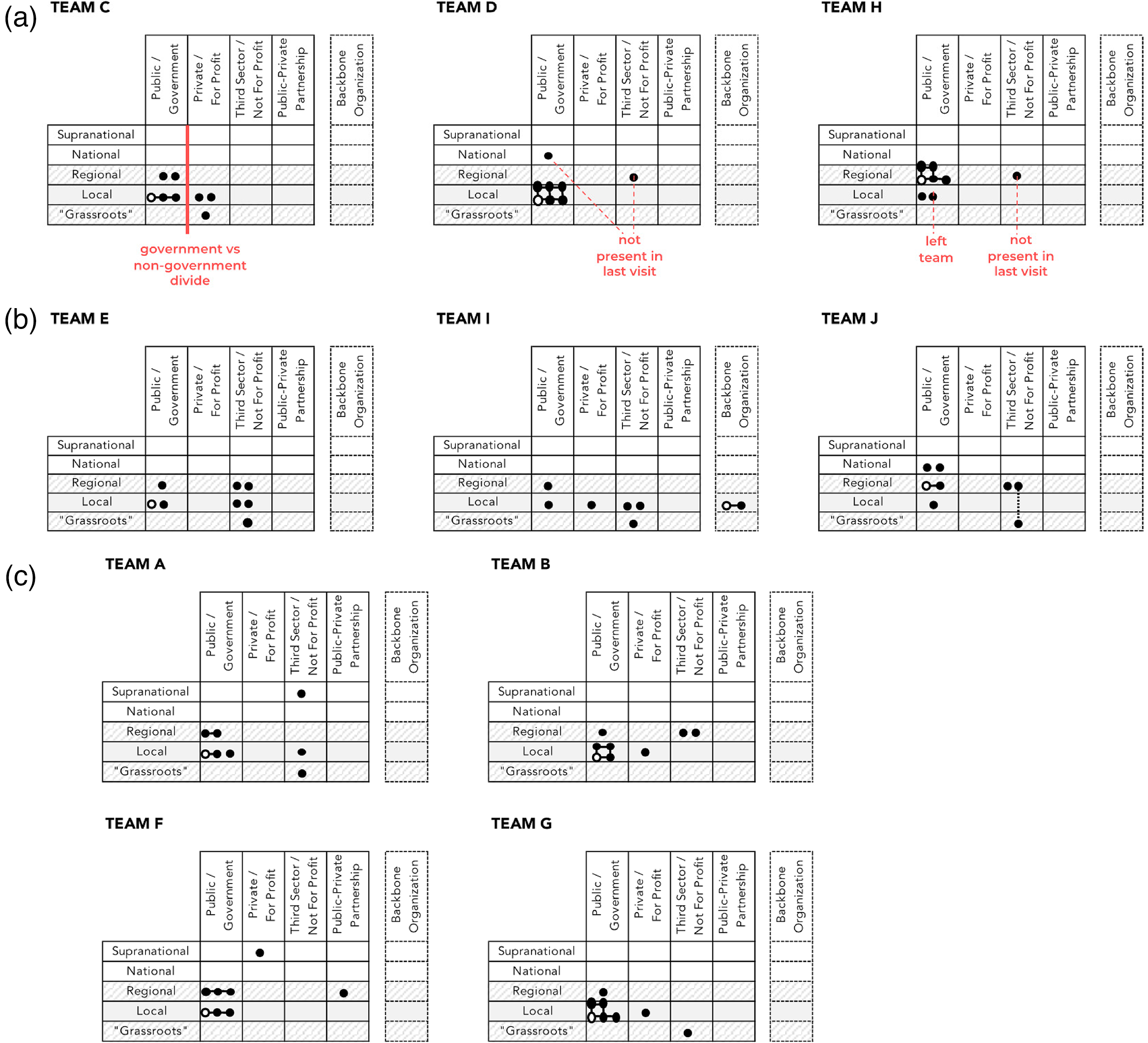
Composition matrices (based on Keohane and Nye, 2000).
In the case of Team H, working on homelessness, most members were part of the county government, while only two represented the city. This lack of balance became even starker when one of the city members had to leave the team (for reasons unrelated to the collaborative work), a loss that was perceived as a major setback by the rest of the team. After this, a team member reflected, “I consider the loss of [city team member] to be a major setback to the process of improving collaboration on homelessness solutions between [City H] and outside stakeholders.” During the final city visit, an observer noted, “The team mentioned several times the setback that had been losing [city team member], a city member with relevant experience working around homelessness.” This left Team H with five county members and one city member, the six team members present at the end-of-program city visit.
Team D, working on homelessness as well, also exhibited an unbalanced composition. In this case, six members represented the city government, who, similarly to Team H, were the ones present during the end-of-program visit.
Team E, which was working on quality education, included representatives of service providers on one side, and city government on the other. Even at the beginning of the program, they were aware of some level of “fractured-ness” in the team, mostly because a wide group of service providers in the city had already been working on the issue for some time but without representation of the city public schools. Including service providers and a representative for the schools in the CBC team achieved a more balanced composition, and the disconnection between the two sectors was addressed in the team's conversations at the beginning of the in-person program: The team came into the program a bit fractured because the service providers and fundraisers had already begun working on [the] issue together for about 18 months, but the efforts had not included anyone from [City E] Public Schools until now. [Team member from City E Public Schools] was new to the team and everyone in the group acknowledged how great and important this is (especially related to capacity – physical space for programs, information sharing, etc.). However, getting through some of the conversations the first day [was] tricky because service providers kept referencing an “us” that the school representative was not part of, and there were information gaps that needed to be filled in. On the second day, the group started surfacing some tensions regarding the “fractured-ness” of the team and the reasons for poor communication in the past. (Team E, observers' summary memo of in-person program)
Similarly, most team members in Team I, another searching team, were already part of the work on a citywide economic development strategy that pre-existed the CBC program. However, when the team was created to be part of the program, the addition of two team members representing the city council and a grassroots activist perspective helped achieve a more balanced composition. This extension of the team and the novel perspective the two team members brought was further reinforced when all the members in the team were included as part of the proposed new governance body for the citywide development project. In fact, in both cases (Team E and Team I), much of the teams' work and discussions revolved around reimagining their governance structure to include all the different perspectives that they deemed necessary. [They] used to meet as an executive committee and now we actually changed our bylaws […]. So, this group [the team that participated in the program] has become our executive committee and this is the monthly meeting that we have talking about issues, talking about where we’re going. So, this group is engaged on a regular basis now. So, that's been very exciting. (Team I, interview with city leaders in final visit) The youth are somewhat represented, but the businesses who have the jobs that should be available to the youth are under-represented at this time. There was also talk that they may not have enough youth representation because the youth do not feel ownership to help solve the problem. As was mentioned before, business is not well represented (except through [name of non-profit]). (Team J, observers' reflections in final visit)
Underway teams were also very intentional in soliciting input from the larger community of stakeholders. Instead of remaining within the microcosm of the team itself, they devised strategies and took actions to gain community and stakeholder input. They devoted large amounts of their work to planning community engagement efforts. Team A launched a community listening project and was very intentional about including the perspective of multiple stakeholders: Our issue is broad and the complexity of the problem requires us to include a large number of diverse stakeholders and existing groups. We support the need for taking an intersectional approach and involving representatives from related social issues and we also want to honor and engage existing work while managing the large number that will be involved in informing and bringing the strategy to action. The role of the [name of initiative connecting broad group of stakeholders] will accommodate this need, and their work will be to develop and consent to strategies as individuals and representatives of their organizations and communities. The governance model will evolve and change as the strategy moves into implementation. (City A, team member's reflection)
Team F developed a Community Engagement Plan to educate citizens about homelessness from an equity lens, to deal with community opposition, and to garner support to push elected officials to commit to long term initiatives: Part of the final visit to the city is devoted to workshop a civic engagement strategy. They discuss listening to people who are suffering or have suffered homelessness. Then, they focus on how to engage different stakeholders: community-wide, homeowners, subject matter experts, private sector leaders, neighborhoods, boards of non-profits, etc. They are aware that they have to get to different audiences and maybe use different framings accordingly. They also include in their next step that it is “absolutely necessary to engage elected officials in teaching community.” (Team F, observers' reflections during final visit) After City Council approved the [Bus Rapid Transit] routes in April, the team was able to provide specific updates and ask questions related to the decision and next steps. For example, the Chamber of Commerce administered surveys and met face-to-face with 40 businesses in several regions in [City G] to understand their perspective. [Bus riders from local affinity group] have held regular meetings and have reached out via social media to solicit feedback from bus riders in the city. And the University has held meetings to gather feedback from students, faculty, and staff about the implementation of the [Bus Rapid Transit] initiative. (Team G, team member's reflection)
Trust
Trust turned out to be a key factor to finding entry points as well. We define trust in CBC teams as an expression of confidence between collaborating parties and an interpersonal expectation that others' actions will not be harmful or exploit any perceived vulnerabilities (Edmondson, 2004; Mayer, Davis, & Schoorman, 1995; Jones & George, 1998). Trust among team members results in “a set of behavioral expectations […] allowing them to manage the uncertainty or risk associated with their interactions” (Jones & George, 1998; p. 532). We also investigated the related concept of psychological safety as a group-level construct that captures “individuals' perceptions about the consequences of interpersonal risks in their work environment” (Edmondson, 2004, p. 241). We observed that trust (either within the team or with outside stakeholders) was a relevant challenge for stalled teams. In searching and underway teams, we found intentional care to cultivate trust within the team.
This divide between government and non-government team members was particularly apparent, since Team C worked in a policy context with historical mistrust of government. In fact, Team C is the only group in the study that found “Learning to trust each other” as one of the most challenging barriers in their prioritization exercise (Appendix C), and the only one for which psychological safety was lower at the end than at the beginning of the program (Appendix F).
Team H, which worked on homelessness and was also categorized as stalled, had to navigate pre-existing tensions between city and county, as both levels of government had a role to play in addressing this issue. One county team member shared at City H's kick-off meeting, “We need greater trust between the city and county. [City H] is the epicenter of the problem and also where the services are. Historically, we’ve gotten in each other's way. We need more openness and willingness to work together.”
Interestingly, in teams H and D (Team D was another team in the stalled category), team members felt comfortable within the team and trusted the other team members. Both teams ranked “learning to trust each other” among the least challenging barriers of collaboration and were on the higher end of the distribution for psychological safety both at the beginning and at the end of the program. In contrast, they expressed lack of trust to other stakeholders outside the team and identified politicians outside the room, competing projects, and other government representatives as reasons against progress: There are difficult times in [City D] in a political context. […] Each of the political parties has their agenda and some major project they want to prioritize, from citizen participation to new ways of providing services and everything between. (Team D, team member's reflection)
I still feel we do not have the chief executive officers totally on board. At this level [signaling the people in the room] I feel very comfortable with the collaboration we are building and we see the urgency and the need. It is the next level (county and city management) that is proving harder in creating that level of collaboration. (Team H, team member's reflections).
Some members share previous feelings they had regarding the work of the group so far. They are respectful but honestly bring up issues of trust. The honest sharing is very emotional, but it feels like a breakthrough for the group and for them to bond. (Team I, observers' notes during in-person program)
Very early in the week, some tensions surfaced and the team had a hard conversation touching on how truly equitable [name of project for holistic development in City I] is managing to be […]. As a consequence of speaking up and candidly […], the team seems to have become substantially more connected. Also during this week, the group developed norms and expectations for working with each other, focusing on ensuring open communication among the group, stating that “moving forward, this group is family.” (Team I, observers' memo at the end of in-person program)
When discussing their norms, one of the members in Team I stressed the importance of open communication by proposing that “when we have something to say, I challenge us to say it in the room with everyone, not save it for a conversation only with one on the hallway.” Team E, another searching team, also developed norms for their interactions, vowing during the in-person program not to be “too polite” with each other moving forward as a way to comfortably challenge and question each other. During the in-person program, the observer notes captured these dynamics in Team E: In the first part of the conversation, when discussing the agreed-upon public value, there were several important moments: [Team member 1] stopped the group as noted above to make sure [Team member 2]'s voice was heard, and then [Team member 3] stopped the group again because he felt like the members were talking across each other and weren’t really aligned. Then [Team member 1] stopped again to check in with [Team member 4] to see if he felt aligned with the “buckets” they were talking about as far as “quality programming”. (Team E, observers' notes during in-person program) [Team member] challenged them about their commitment to this work once they all went back home. Were they going to forget about it? This made the team … think about how committed they were and how they would hold each other accountable. (Team J, observers' notes during in-person program)
For searching teams, in general, issues of trust related to stakeholders outside the team were found to be much less salient.
Team G had arrived at the program with the solution (a bus rapid transit system) before a clear definition of the issue (equitable and sustainable urban mobility), and they collectively worked to understand the issue more holistically as part of sustainable city growth instead of just implementing a technical solution for a public transportation system. As part of this process, they adopted a human-centered approach, trying to understand the push-back they had experienced in the past as resistance to change. They tried to act from a place of empathy to understand their constituents: We spent a fair bit of time discussing how the organizational culture in the city could best respond to what we were proposing without feeling threatened, how to break down existing silos within the departments, and how to try to get at the emotional concerns of stakeholders with real answers, rather than technical responses, which has been the past tendency, and which is what has gotten us into trouble. (Team G, team member,'s reflection)
[We] immediately set up meetings with people to share information and to build trust. We can truly only evolve at the speed of trust. I reached out to other agencies to have conversations about what worked. Rather than rushing through process to get to the next step, more effort and time is spent to understand where people are coming from. [We] had an engagement session last week where we met with riders to learn where they want to be engaged in the future and what steps we might take to get there. (Team G, team member's reflection, final visit to city)
Team B used negotiation tools, such as the idea of writing each other's victory speeches, to address pre-existing tensions between the city and county: The mayor and county council chairman opened the event—both had remarks that intentionally demonstrated that they were collaborating … to build economic development. [The mayor's speech] intentionally added opportunities for them to acknowledge the good things that the other was doing, literally “writing each other's victory speech,” from the negotiation session at the collaboration program. (Team B, team member's reflection)
Agency
Agency, or the capacity of teams to “own” the work, make independent decisions, and self-guide their efforts, seemed to be an important factor in determining if a team found a successful entry point. On the two opposing sides of the spectrum, stalled teams seemed to display a significant lack of agency, while underway teams benefited from organically emerging leaders to drive their work.
As described earlier, Team D focused its efforts on hiring a project manager who would have to start doing the work in earnest, which may have been a form of unintentional work avoidance. The team members appeared to see themselves as a committee writing a job description for someone else rather than as a team responsible for thinking through the problem and ideating solutions.
Similarly, Team C, particularly at the end of the program, seemed to see their involvement as finished and were ready to pass along the work. They saw themselves as an advisory committee to the city leaders, rather than a team responsible for making sure the proposals were implemented. Repeatedly during the meeting, the team expressed the need for the creation of a new implementation team in charge of materializing the goals they have agreed on. They kept referring to the convening of this implementation team as the next step and saying that they [the new implementation team] would be the ones in charge of “defining and setting the milestones.” (Team C, observers' notes during final city visit)
Finally, Team H focused their attention on planning without moving to action. As mentioned, at the beginning of the program they complained of there being too many strategic plans, and at the end, they were still discussing how to determine a new plan. Furthermore, after the in-person training sessions in the program, no whole team meetings took place, which suggests a lack of momentum.
Despite these signs of empowerment, searching teams related concerns with their authorizing environment that seemed to introduced doubts about their ability to effect change. For example, some of the members in Team E expected the mayor to take charge and champion the initiative, perhaps instead of seeing agency as fully within the team. In addition, some of the teams shared concerns related to external actors who were doing similar work. They seemed to see these external stakeholders as limiting their ability to act and/or holding some of their responsibility for effecting change. For example, a member of Team J shared during the final visit to the city that “challenges become greater when we need commitment from outside the room.”
In Team B, two team members (one from the city and one from the county) took responsibility for shared team leadership. They were perceived by others in the team as having the most subject matter expertise, which partly explained their ability to lead. But this shared leadership also helped to quell the pre-existing tensions between the city and county in addressing economic development. As mentioned, this team suffered from an unbalanced composition with over-representation of city members and only one county member in a context with pre-existing city-county tensions. However, the team was able to address this issue by discussing it early in the program and by embracing co-leadership. The co-leaders saw the pre-existing tensions between their organizations as a shared responsibility to be managed and tried to provide solutions. As shared by a team member: “Let's quit thinking in the first person and let's put your interests ahead of mine for the time being.” It's productive when you feel like someone is trying to take a little more interest in what your interests are. […] From a legal, public policy standpoint, we have to have both the city and the county involved.
In sum, searching teams displayed higher levels of agency. They saw themselves as playing a relevant role to make a difference in their focal issue with their confidence resting on the expertise of organically emerged leaders and team members. They put themselves in positions to push their work, for example by presenting their work to relevant city stakeholders such as elected officials, city councils, etc., and included some or all of their members in governance structures making decisions on their issue.
Discussion
Contributions
This study deepens and expands our understanding of the dynamics of CBC teams as they start their journey. It develops the concept of entry points for CBC teams as a key milestone in the early stages of a problem-solving process. We found that representation, trust, and agency are key factors that helped teams to take focused, learning-oriented actions. Successful teams leverage entry points, conceived as apertures into a complex and partly unknown problem space and move from conversation to action in a way that allows them to learn more about the problem they aim to tackle. Close analyses of these entry points resulted in the conclusion that suitable entry points were meaningful, actionable, acceptable, and provisional. Table 3 summarizes the key findings of our study.
Factor Summary Table by Category.
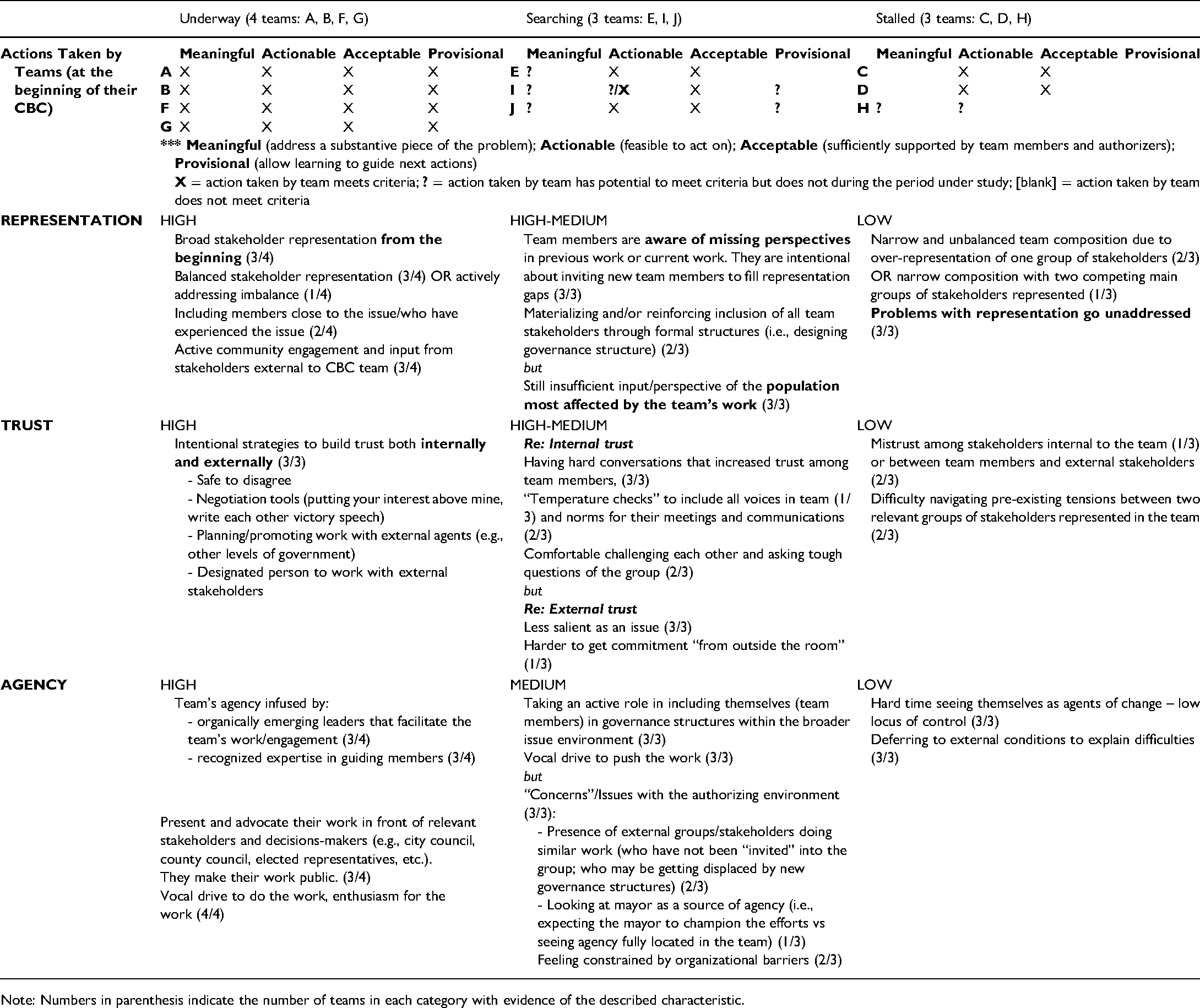
Note: Numbers in parenthesis indicate the number of teams in each category with evidence of the described characteristic.
While the early stages of the collaborative problem-solving process can have a make-or-break character, the dynamics in and around CBC teams have not been studied in much detail. The fact that uncertainty, ambiguity and disorientation are inherent to tackling complex, multifaceted social issues has been pointed out extensively in the literatures on public management and organizational behavior, in particular by studies on paradoxes. However, a detailed empirical analysis on early-stage dynamics, an identification of factors conducive to success and an operationalization of the concept of entry points are new contributions that are relevant for researchers and practitioners alike.
Meaningful, Actionable, Acceptable, and Provisional Entry Points to Navigate Paradoxes
Previous research on paradoxes in collaborative governance had identified three kinds relevant to CBCs: substantive-problem solving paradoxes, collaborative-process paradoxes, and multi-relational accountability paradoxes (Waardenburg et al., 2020a). Consistent with acceptance strategies that invite actors to embrace paradox (Clegg et al., 2002; Lewis, 2000) and resolution strategies that suggest looking for ways to meet paradoxical demands simultaneously (Smith & Lewis, 2011; Poole and Van de Ven, 1989), Waardenburg et al. (2020a) found in a field study that successful CBC teams were able to adopt a “both/and” mindset to deal with paradoxes: accepting the paradoxical nature of their work and addressing both sides of apparent contradictions at the same time. Our study identifies factors that increase the likelihood of a team adopting this mindset and being comfortable with the inherent paradox associated with an entry point: focusing on a small part of the problem and keeping sight of the larger issue at the same time.
Meaningful, actionable, acceptable, and provisional entry points allow teams to deal with contradictory elements simultaneously. They enable CBC teams to set themselves on a path of discovery and learning by doing and move beyond analysis-paralysis, competing commitments, and performance anxiety.
Representation, Trust, and Agency as Critical Factors
Not all teams find their entry point(s) immediately and some never do. Uncertainty and ambiguity can cause teams to feel anxious about making decisions, acting, and moving forward (Putnam et al., 2016). We found that teams that do start to gain momentum (searching teams to some extent and underway teams to a large extent) have more balanced representation, higher levels of trust, and a stronger sense of agency.
Underway teams effectively engage multiple perspectives needed for their work from the beginning and make their different views compatible by establishing a psychologically safe environment and fostering trust internally and externally. Borrowing from Besharov and Smith's (2014) model of multiplicity of logics, underway teams manage to 1) include the multiple core logics needed to function (in this case, to address their focal issue effectively), and 2) align these logics represented by different stakeholders in a way that they provide compatible prescriptions for action. This arguably helps teams identify suitable entry points. In searching teams, representation and trust are intentionally worked on by acting to resolve gaps in representation and having hard conversations to challenge each other, which develops trust. However, all these teams still lack sufficient input from the population most affected by their work (something that underway teams intentionally address by promoting active community engagement plans) which may explain why the actions they planned and/or undertook did not fully and clearly meet the criteria for suitable entry points.
At the other extreme, stalled teams do not effectively address their representation issues. One team had representatives from two opposing sets of stakeholders, which interacted with pre-existing tensions between these two groups. There was no attempt to resolve this tension by including additional perspectives in the team or create space to work through the tension (strategies that searching and underway teams employed). In the case of the other two stalled teams, internal trust in the group was not an issue, possibly because they were relatively homogeneous in terms of representation. In these two cases, the teams spoke of lack of trust with external stakeholders, which resulted in them deferring to issues with external actors and environment conditions to explain their difficulties in making progress and their perceived lack of agency. In contrast, underway teams showed higher levels of agency –they believed in the expertise within the team, saw the urgency in acting, and owned their role in effecting change. In an in-between position, searching teams showed enthusiasm for the work and took ownership by actively inserting themselves in external governance structures that would guide the work. They, however, still doubted their ability to effect change as they saw organizational constraints and limitations in their authorizing environment.
Limitations
Our approach has several limitations. First, we could not observe the long-term impact of the teams' efforts and we do not have good data on the substantive outcomes of the work of the teams after the end of the program. In other words, we only know if the teams underwent a promising start and not if they ended up being successful in making progress on the issue in the long term. However, getting started is a major challenge in its own right, and our work offers relevant contributions to this phase of CBC. While a good start is not a predictor of a good ending, we do know that not starting at all guarantees failure. Therefore, zooming in on the early stages of CBCs can shed light on a critical phase of problem-solving that has not been sufficiently studied empirically. Second, while our data sources are rich and varied, we cannot assume they are entirely unbiased, systematic, and consistent. Due to turnover of scribes and observers, different people with different perspectives and positionality captured the teams' experiences. In order to minimize the risk of bias, we triangulated across different sources of data and conducted multiple rounds of researcher checks to calibrate our understanding and interpretation of the documents in an iterative process. Finally, the teams participated in a program with certain parameters, including a cap on team participation (8 people), a particular approach to facilitation (offering basic diagnostic tools and scaffolding for process management), and a limited amount of time (9 months). While this particular setting was the same for all teams and variation among the teams was observed, the program design may have benefited some teams more than others for reasons exogenous to this study. For that reason, one needs to exert caution not to overgeneralize the findings beyond the specific setup of such a learning-oriented environment.
Directions for Future Research
Future research might expand the timeframe of the CBCs studies and examine if and how the focus and scope of the work evolves over time and if success in identifying a meaningful, actionable, acceptable, and provisional entry point predicts long-term effectiveness. Another related avenue for research would be the connection between subsequent entry points and how learning from one resulted in the other. More research would be needed to further develop the constructs of entry point qualities, as well as to explore the mechanisms that connect representation, trust, and agency with the identification of each of the qualities of entry points, and the relevance of these and other factors to entry point identification in later stages of CBC. Finally, applying our proposed definition and qualification of entry point to boundary-spanning teams outside of a designed learning environment like the field lab would provide relevant evidence to generalize our findings.
Implications for Practice
While it is thought that CBC teams aiming to tackle social issues can be a driving force for positive change in cities, CBCs can be plagued by false starts and inertia. To help a CBC gain traction, collaborators can pay special attention to the representation of the group, the trust among its members and external partners, and the presence or lack of agency in the team. CBC teams that exhibit a high degree of these three characteristics might be more inclined to find an entry point into the problem space and achieve early-stage traction. For example, teams can ask themselves if all needed perspectives are represented at the beginning of their work and keep checking for a balanced composition by expanding perspectives as they learn about their issue through their work. Teams can also establish communication norms to secure collaborating spaces where team members would feel comfortable challenging each other, making mistakes, or asking for help. And to imbue team members with a sense of agency, conveners and team members themselves can work towards knowing each other's motivations, knowledge, and skills to elevate expertise, confidence and commitment. Following the characteristics associated with representation, trust, and agency summarized in Table 3, young CBC teams can use diagnostic questions to assess their level on each of these factors.
Furthermore, based on our findings, a practical tool could be developed to help members in CBCs identify actions that are meaningful, actionable, acceptable, and provisional, guiding them toward suitable entry points into their problem spaces. Team members may discuss potential actions to take and evaluate them against these four principles. Once executed, collaborators may engage in intentional reflection to parse the learning stemming from their chosen entry point, as they engage again in another iteration of entry point selection.
Conclusion
We studied ten teams working on complex social issues in cities in the earliest stages of collaboration to better understand the challenges they faced and how the most successful teams overcame them. Teams engaging in collaboration across boundaries to tackle complex problems in cities encounter a host of common barriers regarding alignment and consensus-building that can be particularly challenging in the early stages of their work. In order to make progress, teams need to find a place to start, and our research suggests that selecting entry points that are meaningful given the larger issue, actionable in light of the team's capacity, acceptable to the team's authorizing environment, and provisional in terms of the ability to generate learning are helpful in gaining momentum. We also find that a balanced representation of perspectives in the team, trust within the team and in external relationships, and a sense of agency among the team members explain variation in teams' success at finding suitable entry points.
This paper contributes to the literature on problem-oriented governance, social paradoxes, and CBC and teaming. It also offers guidance to practitioners designing and managing CBC teams during the early stages of their work.
Supplemental Material
Footnotes
Appendices
Acknowledgements
We would like to thank our colleagues George Veth, Bulbul Kaul, David Margalit, Courtney Hall, Sunghea Khil, Santiago Pulido Gomez, Angelo Kalaw, Jessica Creighton, and Warren Dent for their input, feedback and assistance. This work was supported by the Bloomberg Harvard City Leadership Initiative, which is funded by Bloomberg Philanthropies.
Declaration of Conflicting Interests
The author(s) declared no potential conflicts of interest with respect to the research, authorship, and/or publication of this article.
Funding
The author(s) disclosed receipt of the following financial support for the research, authorship, and/or publication of this article: This work was supported by the Bloomberg Harvard City Leadership Initiative

Notes
References
Supplementary Material
Please find the following supplemental material available below.
For Open Access articles published under a Creative Commons License, all supplemental material carries the same license as the article it is associated with.
For non-Open Access articles published, all supplemental material carries a non-exclusive license, and permission requests for re-use of supplemental material or any part of supplemental material shall be sent directly to the copyright owner as specified in the copyright notice associated with the article.
