




Abstract
The COVID-19 pandemic provided an opportunity to explore the relationships among character, identification-based trust, and perceptions of leadership effectiveness in the context of crisis leadership. Focusing on the leadership of Canadian Prime Minister Justin Trudeau, we first explore whether Canadians of voting age believe character is important in political leadership during the pandemic. Second, we examine voter perceptions of the importance of the dimensions of character identified by Crossan et al. (2017) and to what extent voters perceive Trudeau demonstrates the behaviors associated with these dimensions. Third, we explore the role of identification-based trust in the relationship between character and perceptions of leadership effectiveness. Fourth, we study the relationships between character, trust, and effectiveness during dynamic conditions where the stakes for citizens with respect to health and social well-being are high. The results of our study connect character to trust and perceived effectiveness of a political leader during a crisis.
Keywords
The COVID-19 pandemic has illuminated the need for effective leadership in the public, private, and not-for-profit sectors, revealing the best and worst in leaders. And if a crisis is a defining test for leaders and their character, then, as many observers have noted, not everyone has passed this one. A crisis in leadership presents a major challenge for organizations and their many stakeholders. For example, Wright and Havas (2020) wrote, “We’re all unsettled by uncertainty. But being a leader is a privilege right now—it's the ultimate test of your character, skills, and business acumen. It's time for you to show to your team and your stakeholders why you have the role.”
Predictably, much has been written, both in academic circles and the media, about political leaders and their handling of the once-in-a-lifetime pandemic. Leadership scholars have long studied what it takes to lead, and which qualities citizens perceive to be essential for effective leadership in the political arena, particularly during crises such as the COVID-19 pandemic. For example, Haslam et al. (2021) focused on how political leaders mobilize populations to act in the most effective ways to bring the pandemic under control. They used the identity leadership approach to explain how leaders can represent and advance the shared interests of group members and create and embed a sense of shared social identity among them. Haslam et al. argued that a sense of “us-ness” is the key resource that leaders need to marshal to harness the support and energy of citizens during crises. Relatedly, Sergent and Stajkovic (2020) found that as of May 5, 2020, states with female governors that issued early stay-at-home orders had fewer COVID-19 deaths than states with male governors who issued the same orders. Subsequent qualitative analyses revealed that female governors cultivated more empathy and confidence through their COVID-19 briefings than did male governors. For example, the female governors were able to forge deeper connections with their constituents by exhibiting empathy and showing compassion in expressions of concern and care for citizens’ welfare.
Within this context of crisis leadership, the purpose of our study is fourfold. We first investigate whether Canadians of voting age believe character is important in political leadership during major health, economic, and societal crises. There has been a tradition of emphasizing and scrutinizing the role of character in political leadership (e.g., Barber, 1972; de Clercy et al., 2020; Greenstein, 1968; Laustsen & Bor, 2017; Seijts et al., 2021), yet the construct is not well understood. Second, we examine voter perceptions of the importance of the dimensions of character identified by Crossan et al. (2017) to effectively fulfill the role of prime minister and to what extent voters perceive Canadian Prime Minister Justin Trudeau demonstrated these dimensions during the COVID-19 pandemic. Third, we explore the role of identification-based trust in the relationship between perceptions of character and perceptions of leadership effectiveness. We focus on trust because trust toward politicians is an essential, and scarce, commodity during times of crisis. During a pandemic, trust contributes to adherence to health guidelines such as social distancing and wearing face masks, reduces the spread of misinformation, fosters support for and adherence to the lockdown, encourages vaccination, and facilitates a greater sense of community (e.g., Cairney & Wellstead, 2021; Lalot et al., 2022; Sibley et al., 2020). Fourth, we examine the relationships between perceptions of character, identification-based trust, and perceptions of leadership effectiveness over time—that is, during dynamic conditions and where the stakes for citizens with respect to their health, wealth, and social well-being are high. Our study contributes to a growing body of research on character in general and the application of the leader character framework developed by Crossan et al. (2017) to understand how individuals assess the character of their current leaders in particular.
Our paper proceeds as follows: First, we provide a brief overview of existing research on how personal attributes relate to perceptions of presidential success. In particular, we describe the difference between personality and our main variable of interest—character. Second, we focus on the character framework developed and validated by Crossan et al. (2017). We also explain why we employed this framework for our study. Third, we provide the theoretical foundation for our assertion that identification-based trust helps to explain the relationship between character and perceptions of leadership effectiveness. We articulate the importance of identification-based trust during crisis situations. Fourth, we describe the methodology used to explore the research questions we highlighted in our introduction. Finally, we discuss the results, report qualitative data that supplemented our survey measures, highlight the theoretical and practical significance of our findings, and offer opportunities for future research.
Individual Difference Variables
There has been a long-standing interest in how personal attributes or individual difference variables (e.g., cognitive ability, personality traits, or physical characteristics) contribute to job performance and success at work (e.g., Motowidlo, 2003; Ones & Viswesvaran, 2011). Predictably, scholars have also explored how personal attributes relate to performance in public office, especially executive offices such as the US presidency (e.g., George & George, 2019; Rubenzer & Faschingbauer, 2004; Valenty & Feldman, 2002). Research has shown that several personality traits are associated with perceptions of presidential success. For example, Rubenzer et al. (2000, 2002) asked presidential experts and biographers to score presidents on the revised Neuroticism-Extraversion-Openness (NEO) personality inventory. This inventory measures the Big Five personality traits—extraversion, agreeableness, conscientiousness, neuroticism, and openness to experience—and facets of each of these personality traits. The authors then related these scores to perceived presidential success in office as assessed through the Murray-Blessing survey, completed by almost 1,000 academic historians who provided their views of presidential greatness.
The survey results showed that, on average, presidents were perceived as more extraverted, less open to experience, and less agreeable than typical Americans. On the facet scales, on average, presidents were distinguished by high scores on achievement striving, assertiveness, and openness to feelings, and low scores on straightforwardness and modesty. As Rubenzer and his colleagues concluded, “Thus, presidents tend to be hardworking and achievement-minded, willing and able to speak up for their interests, and value the emotional side of life. They tend to trust in the traditional sources of moral authority yet are willing to bend the truth and to bully or manipulate people to get their way. They tend to see themselves as just as good as, and maybe better than, other people” (p. 407).
Further, Watts et al. (2013) examined the double-edged sword of narcissism on perceptions of presidential success. Their results reveal that an expert-derived estimate of narcissism was related to indicators of success, including overall performance (as assessed by historians), persuasiveness, and crisis management, as well as indicators of negative performance, including ethical indiscretions. Their data showed that narcissism is more elevated in presidents than in the electorate and has increased in presidents over time.
In these explorations, the word character is often mentioned. Yet while scholars see character as an indispensable component of leadership (e.g., Hannah & Jennings, 2013; Laustsen & Bor, 2017), the term is poorly understood. Sometimes, the terms personality and character are even used interchangeably. However, there are important differences between character and personality traits. For example, character is anchored in virtuous behaviors and can be learned through deliberate practice over a person's life span, as opposed to personality traits, which are relatively stable and, importantly, mostly agnostic to virtue (e.g., Crossan et al., 2021; Wright & Huang, 2008; Wright & Lauer, 2013). Further, unlike personality traits, the effective deployment of any of the virtues that comprise character is context-sensitive, thereby creating cross-situational variance in behaviors (e.g., Hannah & Avolio, 2011; Schwartz & Sharpe, 2006). A main purpose of our paper is to address this confusion by highlighting a comprehensive framework of leader character that has been developed and validated in the organizational sciences and applied to political leadership.
Leader Character
Our research builds on prior studies of the role of character in political leadership (e.g., de Clercy et al., 2020; Seijts et al., 2021) and on the scholarship on virtuous character (e.g., Crossan et al., 2017; Hannah & Avolio, 2011; Peterson & Seligman, 2004). We focus on virtuous character (henceforth character) because it is concerned with the quality of judgment in decision-making and as such is not limited to the domain of ethical or moral decision making. Sturm et al. (2017) explained that “having sound judgment is an important aspect of effective leadership” (p. 350). Leader success in crisis situations depends to a great extent on exercising good judgment (e.g., Boin et al., 2013; Tichy & Bennis, 2007).
Crossan and her colleagues (e.g., Crossan et al., 2016; 2017) explained that character is an amalgam of virtues, personality traits, and values that help to facilitate sustained excellence in individuals, teams, and organizations. Virtues are situationally appropriate behaviors, such as humanity, which are widely considered as emblematic of good leadership in that they contribute to the well-being of individuals and, ultimately, societies. For example, Maak et al. (2021) contrasted the polarizing approach to the public taken by US president Donald Trump and Brazil president Jair Bolsonaro with the compassionate approach taken by New Zealand prime minister Jacinda Ardern and German chancellor Angela Merkel, which reflected empathy and caring.
Some virtuous behaviors reflect the activation of personality traits, such as resiliency, which are relatively stable dispositional variables. For example, Huffman et al. (2021) found that higher resilience among healthcare providers was associated with lower stress, anxiety, fatigue, and sleep disturbances. But character is not simply a list or inventory of desirable personality traits; character encompasses only those traits that are virtuous in nature, using the specific set of criteria established by Peterson and Seligman (2004) in their seminal book Character Strengths and Virtues: A Handbook and Classification. This means that personality traits such as Machiavellian pragmatism, charismatic authority, and agreeableness are not character-related. Also, some of the virtues are expressed as values, such as justice. For example, Pillai et al. (1999) found that transformational leadership influenced organizational citizenship behaviors through perceptions of procedural justice and trust among both full-time employees and students.
Character is, in short, a habit of being—a set of observable behaviors—anchored in virtues, personality traits, and values that facilitate human excellence and produce personal and social betterment through quality of judgment (e.g., Bright et al., 2014; Crossan & Crossan, in press; Crossan et al., 2017; Peterson & Seligman, 2004; Sturm et al., 2017). However, the role of leader character in relation to competencies and performance has long been neglected, and hence a plethora of studies on character—in business, politics, education, military, and so forth—have recently emerged in the scholarly literature to link character to excellence at the individual, team, and organizational levels (e.g., Bright et al., 2006; Hendriks et al., 2020; Lavy, 2020; Seijts et al., 2020).
Crossan et al. (2017) developed and validated the leader character framework we use here through a series of quantitative and qualitative studies. Their framework, shown in Figure 1, consists of eleven dimensions that leaders in the public, private, and not-for-profit sectors deem important to achieve sustained excellence. The framework also provides more than sixty character elements, or behavioral descriptors, that are illustrative of the character dimensions. For example, the dimension of temperance is comprised of five character elements—patient, calm, composed, self-controlled, and prudent—and is described by Crossan et al. (2017) as: conducts oneself in a calm, composed manner; maintains the ability to think clearly and responds reasonably in tense situations; completes work and solves problems in a thoughtful, careful manner; and resists excesses and stays grounded.
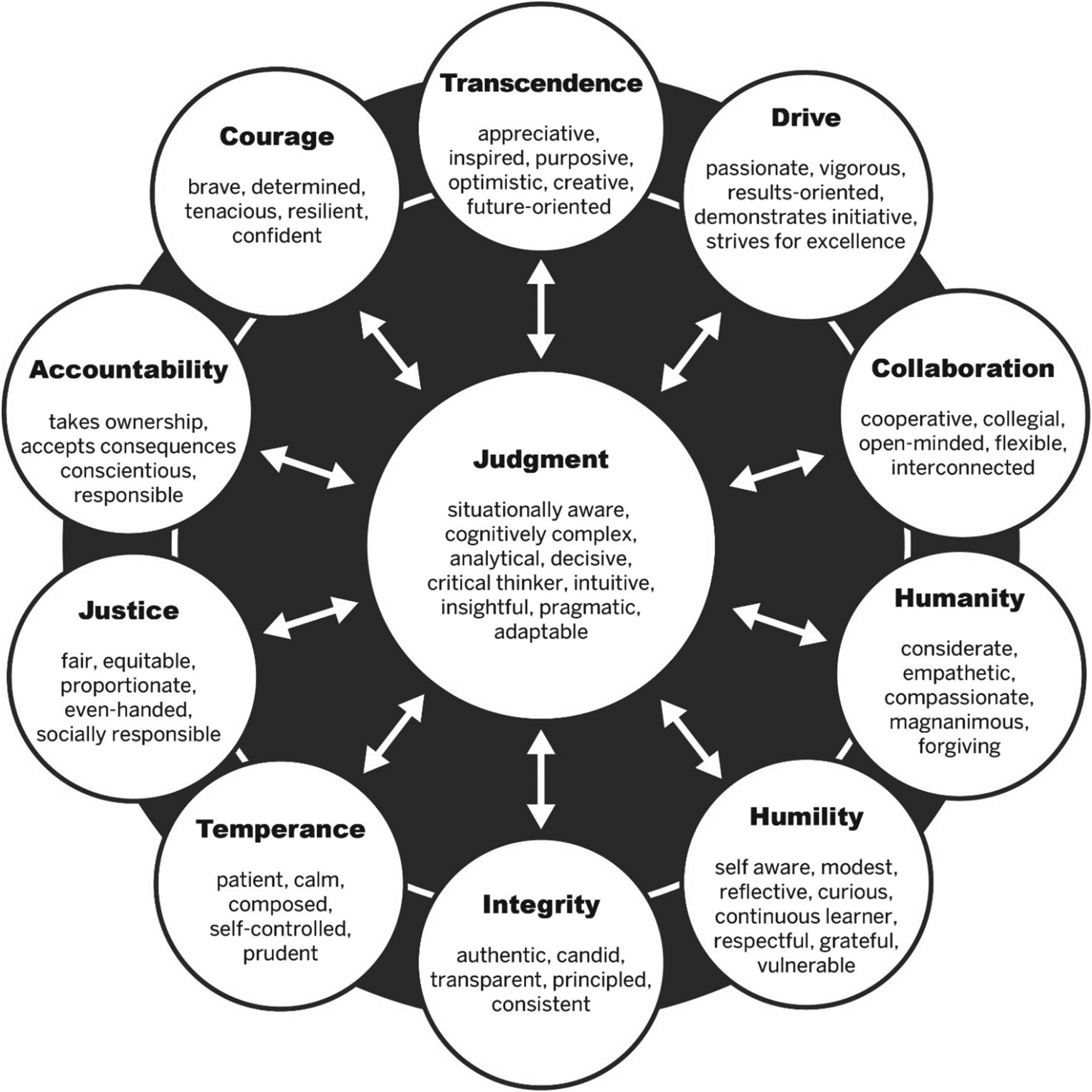
Framework of leader character. Note. Leader character dimensions and associated character elements. Adapted from Crossan et al. (2017).
The leader character framework illustrates two essential features: the character dimensions are interconnected, and judgment exists at the centre of the interconnected dimensions. The interconnectedness among the dimensions means that the dimensions (and their concomitant elements that support the activation of each dimension) independently and interactively influence judgment and subsequent action (e.g., Schwartz & Sharpe, 2006). For example, courage is a virtuous behavior. However, it may operate as a vice when not connected to other dimensions. For example, an excess of drive and confidence may be interpreted by citizens as hubris or insensitivity in the absence of compassion.
Further, leadership is always context-dependent (e.g., Porter & McLaughlin, 2006; Yammarino, 2013). Judgment, therefore, is placed at the centre of the leader character framework because good judgment (or the Aristotelian concept of phrónêsis or practical wisdom) is the outcome of applying the dimensions of character in situationally appropriate ways (e.g., Crossan et al., 2017; Eikeland, 2006; Schwartz & Sharpe, 2010). For example, wise leaders conduct a skillful analysis of a complex and complicated situation to grasp the essence of the challenges they are facing, and they use logical reasoning to determine the requisite action. To illustrate, Austrian chancellor Sebastian Kurz demonstrated the balance of character dimensions in judgment in March 2020 when he discussed European efforts to avert a paralysis of public health systems as a result of the COVID-19 pandemic. He specifically noted the economic damage associated with aggressive steps to combat the spread of the coronavirus, warning, “You have to consider carefully when to adopt these measures, because a national economy cannot handle this over too long a period.” The challenge that many people observed at that time was that the coronavirus was dominantly a medical attack on the elderly and an economic assault on the younger generations. Therefore, leaders were faced with a so-called “wicked problem” that required both insight into the heart of challenging issues and critical thinking about them (see Figure 1; judgment) as well as character dimensions such as accountability, courage, humanity, humility, and temperance.
Crossan et al. (2017) generated a theory-driven, multidimensional, and integrated framework of leader character. Subsequent research has related their conceptualization of character to areas including, but not limited to, perceived managerial performance, subjective well-being of employees and business students, and ethical decision-making.
This is not to say that other frameworks of character are unhelpful. For example, in 1972, Barber offered an insightful typology of presidential character. He identified two dimensions, namely, activity (active or passive) and affect (positive or negative) and classified past presidents into one of four categories: active-positive (e.g., readiness to act and high optimism); passive-positive (e.g., ingratiation, superficially optimistic, and a desire to please); active-negative (e.g., aggressive, highly rigid, and using power as a means to self-realization); or passive-negative (e.g., strong sense of duty, desire to avoid power, and service toward others). Further, scholars such as Bittner (2011) and Johnston (2002) have examined the role of political leadership during national elections; however, in doing so they use only partial representations of the concept of leader character drawn from election surveys, such as the Canadian election survey, in their analyses.
We find at least three problems with these (and other) frameworks. First, they are not always based on rigorous, empirical research. Second, they employ a limited assortment of indicators of character (e.g., honesty and compassion) that are not necessarily comparable across time or cases as both the survey content and the formulation of survey items are somewhat variable across elections. Third, they do not capture the complex ontology of character, by which we mean to signal that the dimensions of character are interdependent (rather than isolated) and that more of a virtue is not always better (e.g., Miller, 2019; Schwartz & Sharpe, 2006).
Identification-Based Trust
Numerous studies point to the importance of trust to effective leadership (e.g., Burke et al., 2007; Caldwell et al., 2010; Dirks & Skarlicki, 2004; König et al., 2020; Legood et al., 2020; Mayer et al., 1995; Zhu et al., 2013). Trust can be seen as a personal resource to draw on as leaders navigate crises. For example, van der Werff et al. (2019) considered trust an essential ingredient for effective interpersonal relationships, providing a social lubricant to foster cooperation and mutually beneficial exchanges. Thus, it is hardly surprising that in organizational settings where individuals must work collaboratively to achieve goals, trust has been shown to be vital to success. For example, a meta-analysis by Colquitt et al. (2007) revealed that individuals who are willing to trust others tend to engage in better task performance, perform more citizenship behaviors, and commit fewer counterproductive behaviors.
In a political context, Weinberg (2020) stated that trust acts as a “key psychological lubricant for governing effectively in such times of uncertainty” (p. 2). Trust, therefore, is a necessary feature of a well-functioning democracy, albeit not the only necessary feature. When trust in a leader is broken, bad outcomes may result. The role of trust is highly salient during a pandemic (e.g., Bol et al., 2021; Esaiasson et al., 2021). Keane noted “the ‘Great Pestilence’ of our times exposed fragilities in healthcare systems, economic systems, and the fabric of social and institutional trust” (as cited in Boin et al., 2021, p. 2). For example, the lack of trust in leaders and institutions could affect a host of variables, including the perceived credibility of communications, cooperation with directives, and the sharing of information. Envisioning the importance of trust is easy when considering what was required for governments to successfully close all non-essential businesses, reassure stressed populations, and issue stay-at-home orders.
There is limited research on the mechanisms through which character contributes to perceptions of leadership effectiveness. In our study, we explore the role of trust in the relationship between perceptions of character and leadership effectiveness. Scholars have noted that trust is essential in political leadership (e.g., Boin & ‘t Hart, 2003; Mohamad & Othman, 2020; Williams et al., 2009). This is because political leaders are unlikely to build commitment toward ideas and plans that they formulate to address health, economic, and social challenges when trust among citizens and key stakeholders is lacking. We assert that trust is based on the character of the leader. That is, individuals observe leaders in action and make attributions about their character—such as humanity, courage, justice, and judgment—and then use these to formulate their perceptions of trust regarding their leaders (e.g., Dirks & Ferrin, 2002; Sendjaya & Pekerti, 2010).
We are particularly interested in the role of identification-based trust during the COVID-19 pandemic. This form of trust is based on empathy with other people's desires and intentions and is thought to strengthen the leader-follower relationship. Lewicki et al. (1997) explained identification-based trust exists because individuals understand, agree with, empathize with, and take on the person's values as a consequence of the emotional connection between the individuals and the political leader. In short, identification-based trust emphasizes an emotional connection between the leader and followers, which, in turn, leads to positive outcomes (e.g., Colquitt et al., 2012; Lewicki & Bunker, 1996; Scandura & Pellegrini, 2008; Walumbwa et al., 2020; Zhu et al., 2013). For example, Wibowo and Paramita (2021) found that empathetic leadership by the supervisor increased resilience in nurses dealing with COVID-19 patients and also decreased nurse turnover intentions.
Sison (2006) articulated that virtues and character strengths constitute the underpinning on which trust and effective leadership are founded. For example, in examining supervisor-subordinate dyads from a large garment manufacturing firm, Zhu et al. (2013) concluded that leaders create trusting relationships by behaving with integrity, being fair, demonstrating humanity, and inviting collaboration—all of which are dimensions of leader character. Norman et al. (2010) found that positive psychological capacity exhibited by the leader working through a downsizing event—including aspects of leader character such as resiliency, optimism, and hope—affected managers and employees’ levels of trust in the leader and the leader's perceived effectiveness. In a political context, Wilson (2020) identified several practices employed by New Zealand prime minister Jacinda Ardern and her government that served to build trust among their citizens during the early days of the pandemic: fostering a clear, transparent, and shared purpose (transcendence, integrity); being bold and deliberate and acting quickly and decisively (courage, accountability); inviting input to plans (collaboration, humility); following the science and using facts and evidence (judgment); and conveying empathy and enabling kindness (humanity).
Thus, consistent with Seijts et al. (2021), we explore whether citizens of voting age report higher identification-based trust in leaders who they consider to be of high character, demonstrated through virtuous behaviors throughout the crisis (e.g., demonstrating humanity, integrity, temperance, collaboration, and judgment), than with those who are seen as having low character. Identification-based trust instills citizens with confidence that their interests will be protected and, as such, facilitates confidence in the leader.
Trust, in turn, is associated with positive perceptions of leadership effectiveness (e.g., Dirks & Skarlicki, 2004; Hogan et al., 1994). For example, using a weekly diary study design, Breevaart and Zacher (2019) found that employees’ trust in their supervisor (or leader) positively predicted employees’ perceptions of leader effectiveness. They explained this finding using implicit leadership theory (e.g., Lord et al., 2020; Schyns & Schilling, 2011). Implicit leadership theory is based on the assumption that employees create cognitive representations of the world, including the characteristics that people generally associate with effective leaders. Breevaart and Zacher found that transformational leadership including key leadership behaviors such as caring behavior toward employees, setting and communicating an optimistic vision for the future, and collaboration, were associated with trust and perceptions of effectiveness.
Time-Based Effects
Governments and agencies across the globe are under enormous pressure to steer their citizens through the increasingly complex challenges presented by the COVID-19 pandemic. For example, as Angeli and Montefusco (2020) wrote, “Pandemics should be considered in the broad class of non-linear phenomena, in that one small system perturbance may trigger disproportionate, exponential systemic reactions” (p. 105). This suggests that there may be pressures on sensemaking and learning processes during the pandemic. It also means that there will be successes and failures as leaders work through the myriad challenges presented by the pandemic.
We therefore explored whether the relationships among perceptions of character, identification-based trust, and perceived leadership effectiveness are dynamic—influenced by both personal and contextual factors. For example, it is entirely possible that the actions that leaders take at or shortly after T = 1 as a response to emerging challenges influence people's assessment of leader character, trust, and effectiveness at T = 2. Thus, consistent with Burke et al. (2007), trust can be conceptualized as a state that can develop over time or quickly, based on contextual factors and followers’ expressed needs.
Citizens continuously attribute outcomes to their leaders and the institutions or organizations they lead. In fact, the public may become dissatisfied and lose trust with—or confidence in—government agencies as successive waves of COVID-19 hit Canada and subsequent measures are taken such as public health restrictions, vaccination requirements, or lockdowns. Such a decline in trust may be problematic as leaders try to reduce the impact of the COVID-19 pandemic. Thus, given the potential implication for leaders, institutions, and, indeed, the fabric of a nation, we felt it was important to monitor perceptions of trust and leader effectiveness over the course of the pandemic's first year, thereby allowing us to assess whether the associations among perceptions of character, identification-based trust, and perceived leadership effectiveness change over time.
Research Questions
To summarize, we focus on four sets of research questions. First, does the character of political leaders actually matter to Canadian voters during major crises such as the COVID-19 pandemic? Does character become more or less important in the eyes of Canadian voters as a crisis unfolds? And, specifically, is character seen by the public as more or less important than competencies and commitment to effectively fulfill the role of prime minister? We explore perceptions of leader character over the first full year of the COVID-19 pandemic, from April 2020 to March 2021, with three independent assessments, using the same survey. Second, we probe whether all the dimensions that comprise the leader character framework are considered essential for political leadership in a time of crisis by Canadian voters and whether the perceived importance of the dimensions are time dependent. Third, we consider whether the attributions of the character displayed by Prime Minister Trudeau are associated with perceptions of leadership effectiveness. Fourth, we examine the role identification-based trust plays in explaining the association between character and perceptions of leadership effectiveness in times of crisis.
Method
Sample and Procedures
We relied on the AskingCanadians organization to administer three identical online surveys and to collect the data. The first survey (N = 653) was administered during the week of April 20, 2020; the second (N = 651) during the week of October 19, 2020; and the third (N = 651) during the week of March 23, 2021. Our survey occurred during several critical periods. As examples, during the second survey, Canada was in the midst of a second wave of the COVID-19 pandemic, which commenced mid-September of 2020. Prior to the third survey, on December 14, 2020, Canada began its COVID-19 vaccination program, slowly ramping up through the late winter and spring of 2021. The largest province of Canada, Ontario, was among the hardest hit by the pandemic and entered a third wave of the pandemic during the week of March 23, 2021, just as we undertook the third survey. This was also when critics said the federal government had not delivered vaccines fast enough.
The respondents—Canadians of voting age—were sourced from a well-established online market research panel community (e.g., de Clercy et al., 2020; Seijts et al., 2018). We sampled only respondents to an English-language survey across Canada. The three independent samples were measured against interlocking age, gender, and regional quota structures that resembled the demographic distribution of Canada. Our data revealed that the characteristics of the three samples are highly similar to each other.
Measures
Character
We used the character framework developed and validated by Crossan et al. (2017) as the basis for (a) assessing the perceived importance of the dimensions of character for political leadership, and (b) appraising the leadership of Prime Minister Trudeau during the pandemic. Specifically, we asked the respondents to rate each of the eleven dimensions according to how strongly the respondents agreed or disagreed that each dimension was an essential aspect for effectively fulfilling the role of prime minister. We believe this is an appropriate approach given the extensive literature that indicates that individuals develop implicit assumptions and expectations about the personal characteristics, qualities, or behaviors that are inherent in good, effective leaders (e.g., Lord et al., 2020; Schyns et al., 2011), including political leaders (e.g., Ammeter et al., 2002; Wyatt & Silvester, 2018). We provided the character elements in parentheses (e.g., courage [brave, determined, tenacious, resilient, and confident]) (see Figure 1) to enhance the transparency of the dimension and thus facilitate a common frame of reference among the respondents. The scale scores ranged from not at all (1) to to a great extent (5); the midpoint of the scale was somewhat (3). The dimensions were presented in random order to the respondents to minimize the threat of order effects and survey fatigue. Further, respondents were asked to state to what extent they believed Trudeau demonstrated each of the dimensions of character during the pandemic. We believe that, given the magnitude of the COVID-19 crisis and the prime minister's frequent communication efforts, the respondents had ample opportunity to observe and learn about the behaviors Trudeau displayed to assess his character. For example, in the first 110 days of the pandemic, Prime Minister Trudeau gave eighty-one national addresses (Aiello, 2020). Again, both the character dimensions and their concomitant elements were provided to create a common frame of reference for the respondents. The response options ranged from not at all (1) to to a great extent (5); the midpoint of the scale was somewhat (3). The dimensions were presented in random order to the respondents.
Identification-based trust
We adapted four items taken from the scale developed by Lewicki et al. (1997) to assess identification-based trust. A sample item is “Justin Trudeau and I have the same basic values.” The scale scores ranged from strongly disagree (1) to strongly agree (5); the midpoint of the scale was neither disagree nor agree (3).
Perceived effectiveness as a leader
We asked respondents about their perceived effectiveness of Trudeau as prime minister during the pandemic using a single item: “How effective do you consider Justin Trudeau to be in fulfilling the roles and responsibilities associated with the role of prime minister?” The scale scores ranged from very ineffective (1) to very effective (5); the midpoint of the scale was neutral (3). The approach of using a single item to assess perceived leadership effectiveness is consistent with other studies of political leadership (e.g., Bligh et al., 2004; Davis & Gardner, 2012) whose authors suggested that approval ratings, such as those used by the Gallup Organization and the Angus Reid Institute, reflect the electorate's opinions and appraisal of the president's (or prime minister's) leadership. Sackett and Larson (1990) outlined three criteria for the appropriate use of single-item measures in research: the construct of interest is (a) unidimensional rather than multidimensional, (b) straightforward to the respondents, and (c) sufficiently narrow. We believe our measure for perceived leadership effectiveness meets these criteria.
Demographics
Respondents completed questions about their gender, age, employment status, income, education level, residence, and political preference.
Results
This section proceeds in four parts. First, we provide descriptive statistics. Second, we conduct a factor analysis to justify the aggregation of the dimensions of character into a single score for subsequent analyses. Third, we provide answers to our four sets of research questions. Fourth, we report qualitative data that supplement our survey measures.
Crossan et al. (2017) stated that leadership is a function of competencies, character, and commitment to the role of leadership. We wanted to know if respondents actually cared about character in political leaders. Thus, we first asked the respondents to rank, in order, the importance of competencies, character, and commitment, as they relate to fulfilling the role of prime minister. We gave the respondents a brief description of competencies (skills, knowledge), character (virtues, personality traits, values), and commitment (aspiration, engagement, sacrifice). A chi-square test revealed that the number of respondents who ranked character as the most important aspect to fulfilling the role of prime minister during the COVID-19 pandemic increased significantly from April (30%) to October (39%); λ2(2, 1304) = 11.74, p < 0.01. No significant change was observed from October 2020 to March 2021; the percentage held steady at 38. Thus, it appears that character is seen as important for political leadership by individuals of voting age. This conclusion was reinforced by conducting a count of the words leadership and character in a political (politics, political) context using Factiva. We searched all major English Canadian and US business sources (which included, for example, Globe and Mail, National Post, ABC News, New York Times, and LA Times) from 2005 to 2020. The results reveal that the mention of character has steadily increased in the political leadership discourse from 2005 (N = 24,063 mentions) to 2020 (N = 68,449 mentions).
Table 1 shows the data for the perceived importance of the dimensions of character for political leadership across the three instances of measurement. A multivariate analysis of variance (MANOVA) was conducted to determine if differences across the three instances of measurement could be found. If the MANOVA showed any significant results then follow-up tests would be conducted, using ANOVAs and post-hoc LSD tests. No significant results for the MANOVA were obtained; Pillai's Trace = 0.014, F (22, 3886) = 1.26, p >.05, ŋ2 = .01. The means in Table 1 suggest that the respondents agreed (4.0 or higher) that each of the dimensions of character is an essential aspect for fulfilling the role of prime minister. The exception was transcendence, with scores between 3.88–3.99. Further, as the results in Table 1 reveal, the assessments were relatively stable across time with only marginal, non-significant changes from April 2020 to March 2021. Accountability, integrity, and judgment were consistently seen as the most essential dimensions of character for fulfilling the role of prime minister; courage, humility, and transcendence consistently received the lowest ratings.
Means and Standard Deviations for the Perceived Importance of Dimensions of Character for Political Leadership and the Extent to Which Prime Minister Justin Trudeau Demonstrates the Dimensions of Character.
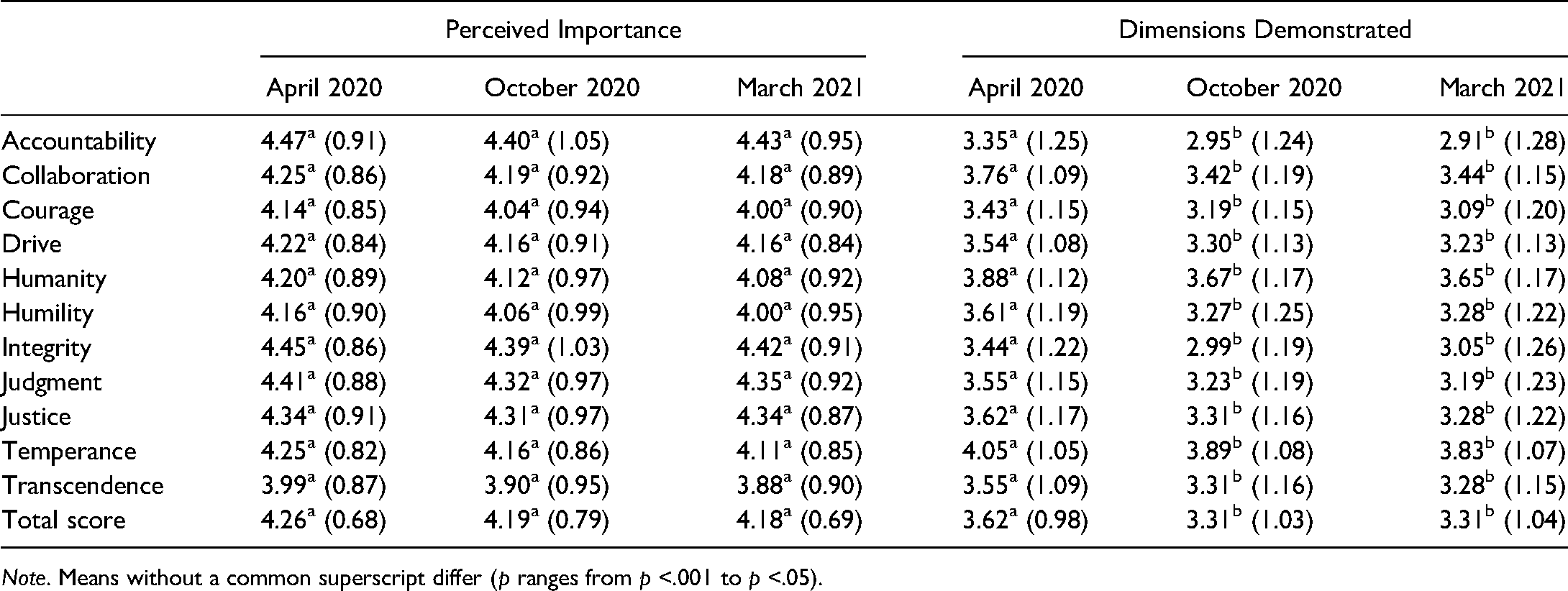
Note. Means without a common superscript differ (p ranges from p <.001 to p <.05).
The character assessments of Trudeau during the 2020–2021 period are displayed in Table 1. A MANOVA indicated significant differences across the three instances of measurement for the assessments of character; Pillai's Trace = .044, F (22, 3624) = 3.70, p <.001, ŋ2 = .02. Subsequent follow-up tests were conducted using ANOVAs and post-hoc LSD. The data shown in Table 1 allow for three main observations. First, the three lowest (accountability, courage, and integrity) and highest (collaboration, humanity, and temperance) behavioral displays by Trudeau of the character dimensions are identical for the three assessments. Second, the assessments of all dimensions of character are significantly lower in October 2020 compared to April 2020 (all p ≤.01). This finding may reflect the unease with the onset of the second wave of the pandemic and the response of the government. None of the dimensions further decreased (or increased) from October 2020 to March 2021. Third, as the results in Table 1 show, there is a sizable gap between the perceived importance of the eleven character dimensions and the belief that Trudeau lives up to the expectations. The gap appears to have widened from April to October but remained relatively stable from October to March.
We conducted a factor analysis to support the aggregation of the eleven dimensions that comprised the assessment of Trudeau's overall character as adjudicated by the respondents into a single score for subsequent analyses. We performed a principal component analysis on the dimensions using a Promax rotation because the dimensions tend to be highly correlated (e.g., Crossan et al., 2017; Seijts et al., 2021). The results for the first assessment of character in April that revealed a single extracted factor (λ = 8.32) explained 75.60% of the variance. The Cronbach α for the attribution of character was.96. Data for the second and third assessments were comparable: a single extracted factor (λ = 8.43; and λ = 8.30) explained between 75% and 77% of the variance. The Cronbach α for the attribution of character was.97 for both assessments.
The results of an independent samples t-test indicated that identification-based trust in Trudeau declined from April (M = 2.99, SD = 1.09) to October (M = 2.76, SD = 1.06). This decrease was significant; t(1302) = 3.81, p <.001. There was no further decrease from October to March (M = 2.67, SD = 1.10); t(1300) = 1.48, p >.05. Ratings of perceived leadership effectiveness also decreased significantly from April (M = 3.31, SD = 1.26) to October (M = 3.09, SD = 1.23); t(1302) = 3.20, p <.001. But again, there was no further decrease from October to March (M = 3.07, SD = 1.30); t(1300) = 0.96, p >.05.
Lastly, we explored whether identification-based trust helps to explain (or mediate) the relationship between character and perceptions of leadership effectiveness. We used the Hayes PROCESS macro, model 4, in SPSS to examine this potential relationship. We included demographic (gender, age), socio-economic (income, education, rural location), and political preference as control variables. The results reveal that the bootstrapped 95% confidence interval, with 5,000 samples, did not include zero for the indirect effect of character on leadership effectiveness for T = 1 (April 2020) (indirect effect = .31 (SE = .05); bootstrapped 95% CI = [.21,.41]); T = 2 (October 2020) (indirect effect = .37 (SE = .06); bootstrapped 95% CI = [.25,.49]); and T = 3 (March 2021) (indirect effect = .32 (SE = .06); bootstrapped 95% CI = [.21,.44]). Our results reveal partial mediation because the direct effect of character on leadership effectiveness remained significant: T = 1 (direct effect = .58 (SE = .07); bootstrapped 95% CI = [.45,.71]; p <.001); T = 2 (direct effect = .51 (SE = .06); bootstrapped 95% CI = [.39,.63]; p <.001); and T = 3 (direct effect = .63 (SE = .07); bootstrapped 95% CI = [.49,.77]; p <.001). The results also revealed that, predictably, Liberals reported higher perceptions of leadership effectiveness for Trudeau in the total effects model than non-Liberals. Table 2 shows the correlations among the variables measured and included in the analyses.
Descriptive Statistics and Correlations Among Variables Measured.
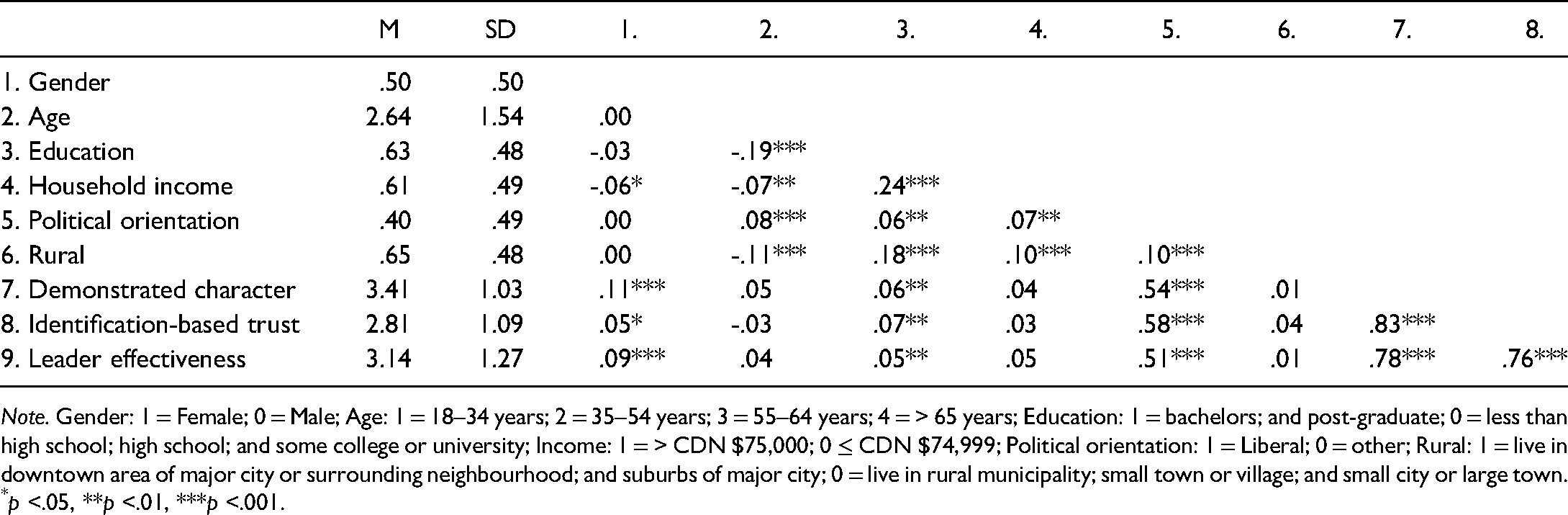
Note. Gender: 1 = Female; 0 = Male; Age: 1 = 18–34 years; 2 = 35–54 years; 3 = 55–64 years; 4 = > 65 years; Education: 1 = bachelors; and post-graduate; 0 = less than high school; high school; and some college or university; Income: 1 = > CDN $75,000; 0 ≤ CDN $74,999; Political orientation: 1 = Liberal; 0 = other; Rural: 1 = live in downtown area of major city or surrounding neighbourhood; and suburbs of major city; 0 = live in rural municipality; small town or village; and small city or large town. *p <.05, **p <.01, ***p <.001.
We also ran the analyses for region—that is, eastern versus western Canada—and for each of the three assessments. We did so to see if our results were robust. Research has shown that regional rather than provincial affiliation accounts for differences in political culture across Canada (e.g., Henderson, 2004; McGrane & Behrdahl, 2013). Further, de Wiel (2005) reported that there are systematic differences by region in political values and attitudes. In our study, we considered western Canada as the provinces of British Columbia, Alberta, Saskatchewan, and Manitoba. Eastern Canada was comprised of Ontario, Québec, Prince Edward Island, Nova Scotia, New Brunswick, and Newfoundland and Labrador. The results showed the same patterns for direct and indirect effects as reported above.
We acknowledge that our results should be viewed with extreme caution. This is because Table 2 shows there is significant multicollinearity in the data; hence, we cannot draw any firm conclusions. Consequently, our results involving leader character, identification-based trust, and perceptions of leadership effectiveness should be considered hypothesis-generating as opposed to definitive.
Discussion
The results of our one-year investigation during the COVID-19 pandemic reveal that Canadians of voting age believe character is important to political leaders, and the perceived importance of character for effectively fulfilling the role of prime minister increased since the initial stage of the pandemic. This result is perhaps no surprise since the mention of character has steadily increased in the political leadership discourse. Further, the respondents generally agreed that each of the eleven dimensions of character we included in our survey is an essential aspect of effectively fulfilling the role of prime minister.
We believe that people are able to intuitively understand how the dimensions of character and their supporting behaviors contribute to successful leadership during the pandemic, and thus, they are able to perceive the importance of those dimensions. For example, the behaviors associated with transcendence carry and promote a forward-looking perspective and a sense of optimism despite the myriad challenges being faced; and the activation of behaviors that support humility contribute to being open to learning, especially in challenging, unfamiliar, or new situations. However, leaders may not always demonstrate those character-related behaviors consistently. Our investigation suggests that there was a varying gap between the perceived importance of the dimensions that comprise leader character and the belief that Prime Minister Trudeau lived up to those expectations. This gap widened from April 2020 to October 2020 but then remained stable after October. The data for identification-based trust and perceptions of leadership effectiveness mirrored the pattern for character: an initial and significant decline followed by stability around the midpoint of the scale. Although Trudeau was unable to retain the relatively favorable assessments from the early months of the pandemic, the subsequent results can be interpreted as a positive because the Liberal party, led by Trudeau, retained the lead in the popular vote—a proxy for popularity and job performance—by a wide margin throughout the year (see, for example, https://newsinteractives.cbc.ca/elections/poll-tracker/canada/). Nevertheless, a decline in perceptions of character, identification-based trust, and perceptions of leadership effectiveness should always be reason for concern for any leader because it makes them vulnerable.
Finally, our results suggest that identification-based trust helps to explain the relationship between perceptions of character and leadership effectiveness. Character, therefore, may be both an antecedent of trust and leadership effectiveness, and an important attribute for a political leader to develop. We believe this is an important finding for at least two reasons. First, as stated before, in the absence of perceptions of character and trust, leaders are unlikely to gain traction on their plans to address health, economic, and social challenges; consequently, their performance suffers. Second, as Whiteley et al. (2016) reported, evaluations of political leaders are powerful heuristics for allowing voters to judge the honesty and trustworthiness of a government. Such evaluations or perceptions of leadership qualities are associated with voting intentions and behavior (e.g., Davis & Gardner, 2012; Pillai et al., 2003; Williams et al., 2012).
Our results are interesting and useful because, first, as discussed by Seijts et al. (2021), even though there is widespread agreement that character is an essential ingredient of leadership, what the construct of character really entails is ambiguous. In our research, we used a framework of leader character that has been developed and validated by Crossan et al. (2017). The wording of the eleven dimensions and their associated elements is heavily influenced by the language used by the private, public, and not-for-profit sector leaders who were involved in Crossan et al.'s qualitative and quantitative studies. They explained that in formulating the framework, the goal was to ensure that the dimensions that were incorporated were relevant to the successful leadership of organizations and that the dimensions (and associated elements) were described in clear, accessible, and actionable terms.
Second, our study contributes to a growing body of research on character in general and the leader character framework developed by Crossan et al. (2017) in particular. The framework includes a combination of character dimensions and supporting elements that independently and interactively are thought to contribute to excellence at the individual, team, and organizational levels. For example, research has revealed that this holistic perspective toward character relates to subjective well-being, perceptions of promotability, and ethical decision-making (e.g., Monzani et al., 2021; Nguyen & Crossan, 2022; Seijts et al., 2020). Programmatic research (with replications and extensions) is a natural and necessary part of the scientific process and should build confidence in the constructs we develop and theories we create. Thus, a main contribution of our study is that we empirically connect perceptions of character to identification-based trust and perceived effectiveness of a political leader during a crisis situation. We believe these findings further contribute to the perceived usefulness of the character model.
A third unique feature of our study is that we assessed perceptions of character over time. Crises such as the ongoing COVID-19 pandemic are typically unpredictable and may involve many defining moments when character is needed to successfully navigate challenges and complex decisions. As a result, political leaders continuously find themselves on a public stage with a focus on their character. Measuring perceptions of character, identification-based trust, and perceptions of leadership effectiveness over time is essential to develop a deeper, richer understanding of the interplay among these constructs (e.g., Edmondson et al., 2003; Marks et al., 2001). The decline in trust and perceived leadership effectiveness, as we observed, is troublesome. As stated before, trust is a necessary feature of a well-functioning democracy. Fukuyama (2020) noted that the main factors responsible for successful pandemic responses have been state capacity, social trust, and leadership. He articulated that those countries which handled the initial stages of the crisis successfully were marked by strong state capacity and trusted leadership. In contrast, countries with dysfunctional governments, polarized societies, or poor leadership have done badly, leaving their citizens and economies exposed and vulnerable. As efforts to beat the pandemic progress with an expectation of some kind of normalcy during the second half of 2021 and beyond, trust is essential to sustain citizens’ vigilance, address caution fatigue, and encourage vaccination.
Fourth, character is an important personal attribute or resource that can be leveraged in daily situations from the mundane to the most challenging. Character is not something that is bestowed upon an individual but is formed and re-formed in the context of the environments within which people operate, such as family, school, church, work, sports, and politics (e.g., Byrne et al., 2018; Crossan et al., 2016). The experiences gained in those (and other) settings may prompt an ongoing process modification as individuals experience and reflect on the consequences of behaviors deployed in particular environments, make assessments about the appropriateness of those behaviors for achieving their goals, and then decide to continue to operate in the same way in similar situations or, alternatively, change their course of action to be more effective. Indeed, as humans, we have the potential to constantly learn, modify, adapt, and experiment as we make our way in life. Character is developed incrementally through deliberate practice and reflection exercises via a range of different approaches including but not limited to reading, workshops, simulations including role plays, mentoring, and life and work experiences (e.g., Crossan et al., 2016; Hartman, 2006). Thus, the ongoing pandemic, or any other crisis, provides an important opportunity for people to rapidly accelerate their development as leaders given the many teachable moments that are embedded in the event. Institutions therefore need to legitimize discussions around leader character as an important topic of conversation and include stakeholders who recognize that character matters and want to incorporate character awareness and development into their leadership development processes (e.g., Nkwor & Adiele, 2020; Seijts et al., 2015).
This learning seems to be particularly relevant to political leaders because learning the job is a significant undertaking for any individual, in particular for prime ministers and presidents. For example, Neustadt (1960) wrote, “Regardless of his prior training, nothing he has done will have prepared him for all the facets of that job.” Neustadt argued that all presidents enter the highest office somewhat ignorant, innocent, and arrogant and that overcoming these liabilities through reflection on action and in action may take years to overcome.
We emphasize that the results that we obtained should be of interest to business organizations and leaders in other settings because issues of character, trust, and leadership effectiveness are highly salient across sectors. And while the generalizability of our results should be further explored with research in a variety of settings and populations, it is relatively straightforward to envision how character is relevant for business leaders in response to a crisis or a volatile and ambiguous business situation. For example, business leaders must activate the character dimension of transcendence or the ability to bring and promote a forward-looking perspective, as well as a sense of purpose and optimism, to help tackle the challenges being faced. They must show courage, that is, be determined, resilient, and confident in spite of the obstacles and setbacks the organization and its employees are encountering. Temperance is essential for leaders. They need to be able bring a sense of calmness and composure to the leadership role because good leaders understand that their words, emotions, and behaviours—good or bad—are contagious and can spread like wildfire in an organization. Further, by bringing a sense of collegiality and open-mindedness, leaders facilitate effective teamwork and learn to appreciate the strengths of diversity and inclusion. However, to make this happen also requires humility. Business leaders must be open to learning, especially in challenging, unfamiliar, or new situations—of which there are many. But being humble requires the leader to be reflective, because it is foolish, arrogant, or even dangerous to believe that they alone have all the answers. For any leader to be trusted and effective in the most challenging situation will also require that they bring both humanity (compassion, empathy) and justice to the role. For example, any suggestion that the COVID-19 pandemic put all of us in the same boat is, quite frankly, misdirected. Granted, we are indeed all in the same storm. But some people are on a luxury yacht; others are in a speedboat; some might only have a canoe … and some people are just swimming for their life. Effective business leaders thus demonstrate genuine concern and care for others. The future also needs business leaders with integrity to help find principled solutions that will help their stakeholders navigate, solve and/or prevent the myriad social, economic, and environmental crises they are facing. In particular, the world needs leaders with the courage to bring candour and transparency to the conversation so that together we can make good, honest decisions. And, lastly, all of the leader character dimensions are fundamental to developing good judgment in a business setting: to facilitate sound decisions in a timely manner based on relevant information, the consideration of all stakeholders, and the critical analysis of facts.
Strengths, Limitations, and Areas for Future Research
Our study has several strengths. First, our design was longitudinal in nature, which allowed us to track changes in perceptions throughout the COVID-19 pandemic. Second, the three samples were representative of the electorate. Third, the surveys were anonymous; hence, we expected candor in the appraisal of leader character, identification-based trust, and perceptions of leadership effectiveness. And even though there was relatively little variance in our measure of perceived importance of the dimensions of character, the respondents differentiated on the items measuring the extent to which the prime minister actually demonstrated the behaviors associated with each dimension. Fourth, consistent with the ontology of character, we included all eleven dimensions of the character framework developed by Crossan et al. (2017) in our design rather than focusing on a single dimension or element, which is a usual practice in survey research.
Our study also has several limitations, which offer opportunities for future research to further explore the relationship between character and trust. First, owing to resource constraints, our sample size in each of the three surveys was around 650 people. Future studies should include larger sample sizes to obtain more robust estimates of measures and allow for the exploration of moderator variables. Second, the data is all self-reported. Of course, internal states or deeply held beliefs—which include perceptions of character, identification-based trust, and perceptions of leadership effectiveness—are difficult to assess outside of self-reports. Future studies should consider alternative sources of data to supplement analyses and hence bolster confidence in our conclusions. For example, a measure of leadership effectiveness could be the number of illnesses and deaths, the number of vaccines administered, or adherence to social distancing measures including stay-at-home orders. Third, the cross-sectional nature of the data collection limits the statistical tests that can be conducted and the interpretations of findings. For example, it is hard to draw conclusions about change between survey administrations as we cannot isolate the inferred changes in perceptions from any effect due to unmeasured differences between samples. This also means we cannot draw causal conclusions regarding the inter-relationships among our variables of interest and, more specifically, examine within-differences across time (e.g., through cross-lagged panel analysis). For example, it is very likely that prior performance matters in formulating perceptions of leader character and identification-based trust. This is consistent with Huseby (2000), who wrote that “poor performance in salient political issues leads to negative evaluations of government performance, which in turn influences citizens’ support for the political system” (p.10). Citizens are more likely to abide by measures advocated by institutions and their leaders when they trust these leaders and believe they have good character. And even though we used validated scales, common method bias and multicollinearity may be threats to interpreting the relationships among character, trust, and perceived leadership effectiveness we obtained. Thus, collectively, multiple sources of data, different quantitative and qualitative analytical methods that allow for the exploration of explanatory mechanisms by which the variables affect each other, and within-person designs have the potential tell a more compelling (and causal) narrative.
Fourth, perceptions of character, trust, and effectiveness are context-dependent and may be susceptible to contrast effects. Our design did not control for extraneous variables that could have served as potential confounds to the results we obtained. For example, since we studied a single leader, Prime Minister Trudeau, respondents may have assessed him in relationship to premiers of Canadian provinces, mayors of municipalities, or even provincial health officers. In Canada, the provinces and territories have most of the responsibility for delivering healthcare and other social services. Some of the premiers were universally disliked and hence Trudeau may not look bad in comparison. Thus, addressing these (and other) limitations in our design in future studies might counter romanticized, heroic views of leadership during uncertain and crisis situations—thus allowing researchers to tease apart how perceptions are shaped by beliefs about what leaders actually do and what they are actually able to accomplish, as opposed to relying on media accounts and the social construction of leadership that facilitate leadership images and attributions about leadership (e.g., Bligh et al., 2011; Meindl, 1995; Meindl et al., 1985). Meindl and his colleagues introduced the attributional approach to leadership, or the romance of leadership. This approach states that people commonly believe leaders are directly responsible for organizational outcomes. Consequently, the concept of leadership has been inflated to an often-unwarranted significance; it implies, for example, that individuals give organizational or political leaders credit for positive outcomes, but that they also attribute blame to leaders for negative results.
Despite the limitations of our investigation, we conclude this study helps with understanding the interplay of character and trust with respect to assessing the performance of political leaders during times of crises and helps explain why some political leaders have successfully navigated the politics of the pandemic.
Footnotes
Declaration of Conflicting Interests
The author(s) declared no potential conflicts of interest with respect to the research, authorship, and/or publication of this article.
Funding
The author(s) received no financial support for the research, authorship, and/or publication of this article.
