




Abstract
Despite the growing debate on the difficult relationship between management theory and practice, we still know little about what happens when academics and practitioners meet in liminal contexts, and how they deal with perceived differences. We study a corporate executive program where management academics and R&D managers draw on the ‘knower-doer’ stereotype to exchange knowledge about technology innovation management. We introduce the concept of dynamic stereotyping -i.e. using readily available occupational images to engage immediately in temporary and fluid exchanges with members of other occupations. Dynamic stereotyping (anticipation, reaction and reversal) can help reduce the relational insecurity experienced by academics and practitioners when they meet and promote the transition from abstracted to more embodied and realistic views of each other. We contribute to the theory-practice debate and to the literatures on stereotypes and occupations by providing a process-based view on stereotyping and the conditions favoring dynamic versus rigid stereotyping.
Keywords
Introduction
Understanding how organization theory and managerial practice inform each other has been a topic of debate in management and organization studies for decades and has focused mainly on the gap between management science and managerial practice. This gap is often seen as due to the different worlds inhabited by management academics and management practitioners, their different mind frames, incompatible interests, and different specialized systems of expertise (Baldridge et al., 2004; Beyer & Trice, 1982; Hambrick, 1994; Hay & Heracleous, 2009; Kieser et al., 2015; Starkey & Madan, 2001; Van de Ven, 2007; Weisbord, 1974). In a work suggestively entitled “Are managers from Mars and academicians from Venus?”, Baldridge et al. (2004) synthetize many of the taken-for-granted differences between management academics and practitioners, and the widely shared fear that despite the search for complementarity the theory-practice relationship in management is drifting increasingly towards mutual impoverishment. A problem often invoked is the constant opposition between knowers and doers: While academics live in ‘ivory towers of science’ obeying the rules of scientific rigor, practitioners are the captives of corporate boardrooms and are forced continuously to improvise to face an everchanging world. While the former group floats in an abstract world of ideas, too preoccupied with thinking to intervene in the real world, the latter group muddles through everyday life and thrives on myths, legends, and commonsense in the pursuit of instant success (Gulati, 2007; Hambrick, 1994; Mintzberg, 2004; Sandberg & Tsoukas, 2011; Weisbord, 1974). However, only few studies examine the making (or unmaking) of academic-practitioner differences in day-to-day settings; most contributions to the theory-practice debate merely take them for granted (Bartunek & Rynes, 2014). Whereas most arguments implicitly consider scholarly and managerial publications to be the main academic-practitioner exchange media, the evidence shows that a very small percentage of managers read management journals (Barends et al., 2017; Pfeffer & Fong, 2002; Rousseau, 2006). There have therefore been several calls for comparative studies on how academics and practitioners make sense of each other's theories and practices beyond publications, in situated contexts such as business education or joint collaboration projects which require them to face the realities of the ‘other’ within and beyond taken-for-granted prejudices (Astley & Zammuto, 1992; Bartunek, 2020; Bartunek & Rynes, 2014; Tushman et al., 2007; Ungureanu & Bertolotti, 2020; Weick, 2003). As a response to such calls, we explore the relational mechanisms which allow academics and practitioners to engage in real-world exchanges and construct and negotiate perceived differences.
We study the interactions between academics specialized in innovation management and R&D professionals working in high-tech companies during a one-year corporate executive program aimed at advancing R&D managers’ expertise in technological innovation management. We conducted ethnographic research and interviews to study the interactions among academics and R&D managers, and especially how their sense-making of each other evolved in terms of perceived differences and similarities. Our study foregrounds the underestimated role of cross-occupational stereotyping in enabling immediate interaction despite differences. We refer to cross-occupational stereotyping as practices that allow individuals who perceive themselves and the others as belonging to a distinct group to draw on socially available images to make sense of each other and start quick interaction. We propose the novel idea that cross-occupational stereotyping can be the starting point (i.e. the plug) allowing creative interactions between members of different work communities who are relatively unfamiliar with one another but are required to act recurrently but temporarily and usually with a low-to-medium level of relational involvement to achieve a given objective. Importantly, we show that from a process standpoint, cross-occupational stereotyping is paired (includes stereotypical definitions of both self and the ‘other’) and follows a trial and error logic (anticipation, reaction, provisional reversal) which enables the individual to move from biases that are self-defensive to more aware, embodied, and nuanced understandings of the ‘other’. An enhanced understanding of relational mechanisms between academics and practitioners contributes to recent scholarly dialog which acknowledges how relating with the ‘unknown other’ is becoming daily practice for many occupations in the knowledge society which are characterized by fast-paced, fluid, and intermittent exchanges across boundaries (Anteby et al., 2016; Barley et al., 2017; Gorman & Sandefur, 2011). We propose the novel idea that dynamic stereotyping allows individuals with different backgrounds to relate on the fly within temporary and fluid exchange situations by making dynamic assumptions about who the other is and on that basis acting tentatively within the exchange.
Putting Academic-Practitioner Interactions Back into Context
The much-debated gap between theory and practice in the management field has been attributed mostly to the separateness of the academic and managerial communities and their limited ability to engage in meaningful exchanges due to different, even incompatible, types of knowledge stemming from divergent professional logics, practices, and interests. For instance, academics nurture distinctiveness by cultivating the language and practices of professional specialization (peer review, specialized publications, conferences, etc.) which add to their competitive advantage but create barriers with respect to the outside world. This has led to academics being held accountable for the limited translation of academic knowledge into managerial practice (Baldridge et al., 2004; Bennis & O’Toole, 2005; Splitter & Seidl, 2011; Starkey & Madan, 2001; Weisbord, 1974). At the same time, practitioners are connected to actors in and around their organizations by a myriad of practical and political interests, but they seldom consider academics to be significant sources of influence. Consequently, practitioners rarely stay in touch with what is happening in academia, and make few attempts to incorporate academic theories into their practices (Beyer, 2011; Beyer & Trice, 1982; Markides, 2010; Mintzberg, 2004; Van de Ven, 2007).
Despite these boundaries, there is also evidence that academics and practitioners interrelate in multiple ways during their day-to-day lives and end up influencing each other in several circumstances. For instance, as public support for research and education continues to decline, academics increasingly turn to practitioners for funding and social legitimation, either through executive education offers, consulting activities or cross-sector projects supported by institutions. Similarly, to secure new sources of competitive advantage, managers invest in the market of ideas by setting up new alliances with academics, consultants, governments and research agencies (Friga et al., 2003; Gioia & Corley, 2002; Ireland, 2012; Starkey et al., 2009; Ungureanu & Bertolotti, 2020).
Liminal settings such as executive education, business consulting, and joint collaboration projects are evocative of this trend and call on academics and practitioners to see, voice, and experience each other's needs and interests, negotiate them in context, and come to terms with the diversity of characters and situations. A main characteristic of such settings is that participants stand at the threshold between previous ways of structuring their worlds, and the new ways occasioned by the encounter with ‘the other’ (Beech et al., 2010; Carton & Ungureanu, 2018; Czarniawska & Mazza, 2003; Petriglieri & Petriglieri, 2010).
Despite wide agreement that what happens in liminal settings can inform our understanding of the relationship between management academics and practitioners, evidence on academic-practitioner interactions in such settings is limited and mostly anecdotal. Executive business education represents a prototypical example (Friga et al., 2003; Tushman et al., 2007). While there is much concern about the role of executive education for the theory-practice gap, scholars differ widely in their analysis of the problem and what should be done about it (Trank & Rynes, 2003). On the one hand, some studies have argued that executive education is problematic because it implies power asymmetry to the advantage of academics who leverage the educator-student roles in defense of high status and knowledge authority in the classroom. By exasperating differences between the two groups, executive education may deepen practitioners’ beliefs about the ‘ivory tower’ of academia, and turn the theory-practice gap into a self-fulfilling prophecy (Aguinis et al., 2020; Bennis & O’Toole, 2005; Leavitt, 1989; Mintzberg, 2004; Pfeffer & Fong, 2002). On the other hand, many concerns have regarded an opposite trend whereby the increasing customer-orientation in executive education shifts the power imbalance in the favor of practitioners. The problem here is that academics may be tempted to do whatever they can to please their customers even if it implies telling them what they want to hear or what they already know, with the concrete risk that the theory-practice gap proves once more self-fulfilling (Friga et al., 2003; Gioia & Corley, 2002; Pfeffer & Fong, 2004; Trank & Rynes, 2003).
The contradictory arguments above suggest that to understand what happens in the relationship between academics and practitioners, we need to study the underlying cognitive and emotional processes stemming from their interactions. From such standpoint, the executive education setting is liminal (i.e., in between the two worlds) because it forces academics and practitioners to make sense of each other through interaction, by leveraging (i.e., highlighting, negotiating, resisting or abolishing) perceived differences and incompatibilities, and negotiating power relations. The importance of cognitive and emotional transformation has been shown in other liminal settings of academic-practitioner interaction as well. For instance, although not focused on academic-practitioner interactions, Petriglieri and Petriglieri (2010) show that practitioners use business schools as safe spaces allowing them to step back from the turmoil of corporate life and reflect on their identities. Czarniawska and Mazza (2003) suggest that academic-manager interactions in a consulting project can emerge as a journey involving initiation rites, gradual acceptance, and mutual adjustment. Beech et al. (2010) highlight that during joint projects, academic-practitioner dialogs alternate between instances of closure and disagreement and moments of mutual interest and openness (Bartunek & Rynes, 2014; Splitter & Seidl, 2011). Yet how and why perceived differences are leveraged during academic-practitioner interactions is mostly left unexplained (Ungureanu & Bartolotti, 2016). To further understand this issue, we now draw on the literature on stereotypes in work and occupational settings which devoted more attention to the role of perceived differences in interaction.
Stereotypes and Perceived Occupational Differences
In a world overwhelmingly full of stimuli, a growing tendency is to group individuals based on social categories including but not limited to race, gender, and age. Work and professional relationships make no exception. If we think about an occupation, a prototypical image of an occupational group may easily come to mind: lawyers as assertive and manipulative, doctors as self-secure and immensely expert, accountants as precise and meticulous, computer scientists as geeky and asocial, care-givers as patient, devoted and unassertive (Barley & Kunda, 2001; Cicourel, 1981; He et al., 2019; Trice, 1993). These attributes are often imbued with taken-for granted beliefs and expectations, known also as stereotypes, which allow individuals to process and interpret incoming social information and to form impressions and judgments of others (Allport et al., 1954; He et al., 2019; Macrae & Bodenhausen, 2000). While there is still limited understanding about how publicly acknowledged traits of a typical occupation form, it is widely acknowledged that they include the kind of knowledge, and the type of behavior that a typical member is likely to display in certain situations (Fine, 1996; Trice, 1993). Consequently, when members of an occupation try to ‘make sense’ of the behavior of members of another occupation they are typically attempting to apply some readily available classification principles which derive either from their direct experience with these individuals over time, from the typical images of their occupations that they are exposed to, or from a combination of the two (Barley, 1996; Trice, 1993).
According to He et al. (2019) there are multiple dimensions from gender, to status, personality traits and work attitudes which can become stereotyped, but few investigations of stereotypes based on occupational images per se. An exception is constituted by Barley and Kunda (2001)'s discussion of the historical dualism between knowers and doers. According to the authors, occupational groups such as doctors, scientists, teachers, lawyers, and engineers traditionally enjoy high status as ‘knowers’: professionals whose expertise is primarily intellectual and analytical and is aimed at solving real world problems using logical consistency and rationality. In contrast, nurses, technicians, clerks, operators, and craftsmen are seen as those who do the ‘work’, solve the problems, and turn the ideas and indications from the ‘knowers’ into reality (Barley, 1996; Barley et al., 2017; Bechky, 2003; Sandberg & Tsoukas, 2011). While for many years social psychology has discussed intergroup stereotypes (e.g. gender, race), studies of occupation-based stereotypes such as the knower-doer dualism are infrequent. On the one hand, some widely acknowledged findings of gender and race stereotype research such as the ego-justification function of stereotypes may also apply to occupational stereotypes. Accordingly, stereotypes are shortcuts allowing individuals to live better with selves, and easier with others; Not only do they serve as self-confirming justifications for accepting some individuals and rejecting others -i.e., through ingroup-outgroup distinctions- but also as heuristics -i.e., ways to keep judgments about others simple and immediate (Allport et al., 1954; Fiske, 1998; Jost & Hamilton, 2005; Macrae & Bodenhausen, 2000). In line with these arguments, research on occupations shows that status battles between engineers and technicians or doctors and nurses at the workplace occur by instrumentalizing perceived differences in such ways that higher status occupations stress perceived differences and lower-status occupations invoke similarity, in the attempt to maximize recognition of their work group and their self-esteem as group members (Barley, 1996; Bechky, 2003; Trice, 1993).
On the other hand, stereotypes are often seen in the literature as rigid schemes which trigger self-fulfilling prophecies where those who stereotype strengthen their status and affirm their superiority, and those being stereotyped end up conforming to the assigned stereotypes (Haslam et al., 1998; Jost & Hamilton, 2005). However, occupational distinctions (e.g., knowers vs. doers) may be less fixed or rigid than other dimensions such as gender or race for which this effect has been documented. For instance, ethnographic studies on the occupational lives of accountants that were conducted in the 1980s (Boland, 1982; Chambers, 1980) confirmed that publicly available occupational images -whether positive in the form of clichés, or negative in the form of stereotypes- can facilitate interactions between accountants and their clients by increasing exchange predictability. At the same time, the studies also showed that if typical images are misused or abused, they might also introduce misalignments or conflicts in a professional relationship. To better understand cross-occupational stereotypes, then, we need a more dynamic and symmetrical approach to those who stereotype and those being stereotyped. Recently, Skovgaard-Smith et al. (2019) showed that nurses, surgeons, medical secretaries, and external management consultants involved in a change project in a public hospital built their identities by means of ‘reciprocal’, rather than unilateral ‘othering’ which significantly conditioned how the interaction in the project unfolded. These limited findings highlight the need to understand how perceived differences and similarities are leveraged in an interaction context, and with what consequences for the relationship between members of two occupations.
Methods
The Ethnographic Study of a Cross-Occupational Exchange
We draw on an ethnographic study of the encounters during a one-year Corporate Program in Management of Technological Innovation (hereafter CPIM) between a group of management academics and a group of R&D managers. Eleven companies sponsored participation of 31 R&D management professionals whose work experience in technical areas in large companies with strong technological innovation orientation (automotive, appliance manufacturing, information and communication technology, energy) averaged 10 years. Thirty of the R&D managers had a technical background (MSc level) in mechanical, energy, or automation engineering, and one had a background in business management. While the motives for enrolling in the program varied slightly across companies, the main reason was training and specialization for career development. In 75% of the cases, the firm sponsored application to the CPIM for employes with a technical background who had been identified by the firm's human resources function as high-potential individuals expected to take on a leadership role in the company. In the remaining 25% of cases, the company sponsorship was a response to the employes’ specific requests. In all cases, the expected benefit for the R&D managers was acquisition of expert skills related to managing technological innovation which would allow them to assume greater responsibility in strategic innovation projects or company functions (R&D and operations). The 14 academics who participated in the program had an average of 13.5 years’ experience in academia, and were expert researchers and instructors in areas such as innovation finance, marketing of new products, technology transfer, people management in the creative and tech industries, and entrepreneurship. Their participation in the program was rewarded with financial compensation from an international business school which was the promoter and organizer of the CPIM and had links to the research departments in which the academics worked full-time. The program lasted 12 months and included 224 h of face-to-face interaction (bi-weekly lectures, workshops, discussion tables, project encounters), 350 h of e-learning on a platform made available by the business school, and 6 days of cross-company immersion organized by the top management of the sponsoring companies. The topics and contents addressed during the program were established in part by the program's commissioners together with the business school top management, and in part by the academics and managers participating in the activities.
We chose to study the context of an executive corporate program because it represents a typical case of day-to-day encounters between management academics and practitioners in a liminal setting (Czarniawska & Mazza, 2003; Tushman et al., 2007) -see also our discussion in the previous section. The actors did not know one another and had not worked together previously within a predefined organizational structure. Also, 30% of the academics had only small experience (0–1 years) of training programs for professional managers and executives, 40% had some experience (1–3 years), and 30% reported more than 3 years previous experience. Among the R&D managers, while 90% had been exposed to training programs organized by their companies, none had been enrolled in an executive education program like CPIM. In addition to their participation in the CPIM project, both groups worked full time on various other projects.
Data Collection
We employed unstructured and semi-structured interviews, observations, and document analysis. Interviews: We conducted 45 semi-structured interviews (14 academics and 31 R&D managers) and 24 ethnographic interviews (7 academics and 17 R&D managers). We gathered informants’ viewpoints at regular intervals in time: before the program started we asked our informants to present themselves, to explain their reasons for engaging in the program, to discuss their expectations and perceptions of the program, and their plans for the following months. We asked the academics questions about the R&D managers who were participating, and vice versa. For instance, we asked whether they knew one another, whether they had worked together previously, and what they thought/expected of each other. In the first weeks of the program, we posed the same questions to understand their impressions on first meeting. We repeated these interviews throughout the program. We also asked both academics and R&D managers how they defined innovation management in their day-to-day lives, which topics they were most concerned about, how they dealt with them, and to what extent their approach was similar to or different from what they were experiencing in their participation in the program. It is also noteworthy that we did not start with the intention to analyze cross-occupational stereotypes; rather we had the broader goal to study how management academics and practitioners interrelated in a liminal context in light of their perceived differences and similarities. When the theme of stereotyping emerged from our observations, we made the decision not to include specific related questions in the interview protocol in order to avoid conditioning our participants’ mindsets. Instead, we used ethnographic interviews entailing broad follow-up questions to clarify the witnessed interaction schemes (i.e. ‘Can you tell me why you asked this question during the lecture and what you think of how the instructor/participant replied?’ ‘What are your feelings so far about your ability to relate to the instructors/participants?’). All interviews were recorded and transcribed verbatim.
Participant observation: We conducted 225 h of observation of CPIM activities including lectures, workshops, company visits, and online discussions on the program's platform, as well as interactions during lunches and events such as seminars and socializing dinners. The first author was a full-time observer in all the CPIM activities; the second author was an occasional observer. The CPIM academics and participants were informed that the participant researcher was gathering material for a dissertation on the relationship between management theory and practice and that she would have assisted (without participating) to all the program's activities. This condition gave the participant researcher the privileges of an insider and allowed us to study interactions in real time, as the actors met, and relations changed and transformed (Strauss & Corbin, 1998) rather than retrospectively. In addition to observing CPIM activities, the participant researcher conducted one-day observations in the working environments of 20 of our 31 informants. Field notes were taken and expanded into files.
Documents: We had full access to 165 documents produced during the CPIM program; they included brochures, leaflets, lecture handouts, articles, PowerPoint presentations, textbooks, written assignments, and learning logs provided by a sample of CPIM participants. The learning logs were particularly useful for making sense of how participants referred to each other's expertize during mundane exchanges.
Data Analysis
We used a grounded theory approach to go back and forth among the data, the emerging grounded categories, and the literature (Strauss & Corbin, 1998). We used NVivo to support the coding process. During open coding, we looked for talk about perceived occupational or professional differences and similarities (Fine, 1996), and then progressively grouped our first-order informant concepts into higher order theoretical dimensions. For example, the recurrent field notes which included the occupational labels that the academics and R&D managers used to present themselves and their exchange partners (e.g. ‘scientific experts’, ‘lay problem solvers’, ‘creative disruptors’, ‘chaotic creators’, ‘half-baked consultants’, ‘isolated scientists’, see the first column of Figure 1) were first grouped in a generic category called ‘stereotypes’ which we subsequently refined by going back and forth between our empirical data and literature on stereotypes and perceived occupational differences. We continuously interrogated our data dynamically using a process lens (Langley, 1999). Since we realized that when actors used a stereotype to refer to self they mostly also used a corresponding stereotype to refer to alter (i.e. their exchange partner), we grouped stereotypes in pairs. We noticed also that at certain points the stereotypes the actors used for alter began to be used to describe self, and vice versa. This prompted us to inquire whether we were witnessing a change process such as rhetorical contamination or social influence (Strauss, 1997). Since each instructor was responsible for a different course (i.e. technology innovation and operations, technology innovation management, people management in creative industries, etc.), we chunked the data into sets of interactions between instructors and participants, and for each set identified a beginning stage (usually coinciding with the beginning of each course), a middle stage (unfolding of the course including group work, workshops, company visits, etc.) and an end stage (wrap up, conclusions, final assessments). In each interaction set, we focused on critical incidents -i.e. episodes where an argument launched by one party became the object of debate/contestation by the other party, and which generated at least three iterations between the two parties). We checked also for whether the characteristics of the critical incidents (frequency, duration, number of iterations) varied across the duration of the program but found no significant differences (perhaps because R&D managers were often exposed to new sets of interactions with new instructors). As we analyzed the episodes, we noticed that most exchanges began with stereotypes (e.g., ‘scientific experts’, ‘lay problem-solvers’, ‘continuous change adopters’, ‘half-baked consultants’) which aimed at anticipating and managing the exchange partners’ impression, so we grouped them in the more abstract second order theme of ‘anticipatory stereotypes’ (see second column of Figure 1). We then followed how these stereotypes were leveraged as the interaction followed, and came up with other two second order themes, reactive and reversed stereotyping. The second-order categories were then assembled at an even more abstract level into aggregate theoretical dimensions (see Figure 1). For instance, since anticipatory, reactive and reversed stereotyping were obviously related and followed a sequential order, we grouped them in an overarching category called ‘dynamic stereotyping’ (see the data structure depicted in Figure 1). As we tried to further make sense of dynamic stereotyping, we identified a frequent triggering condition whereby individuals manifested concerns about their upcoming interaction, which we labeled as “manifesting pre-exchange anxiety”. Last, we also circled between our data and relevant literature to identify what Strauss and Corbin (1998) refer to as ‘intervening conditions’ in the grounded model (i.e., the boundary conditions in which dynamic stereotyping is likely to verify). Throughout the process, we had the opportunity in several meetings to discuss inconsistencies and refine a common interpretation of all our initially independently developed dimensions.
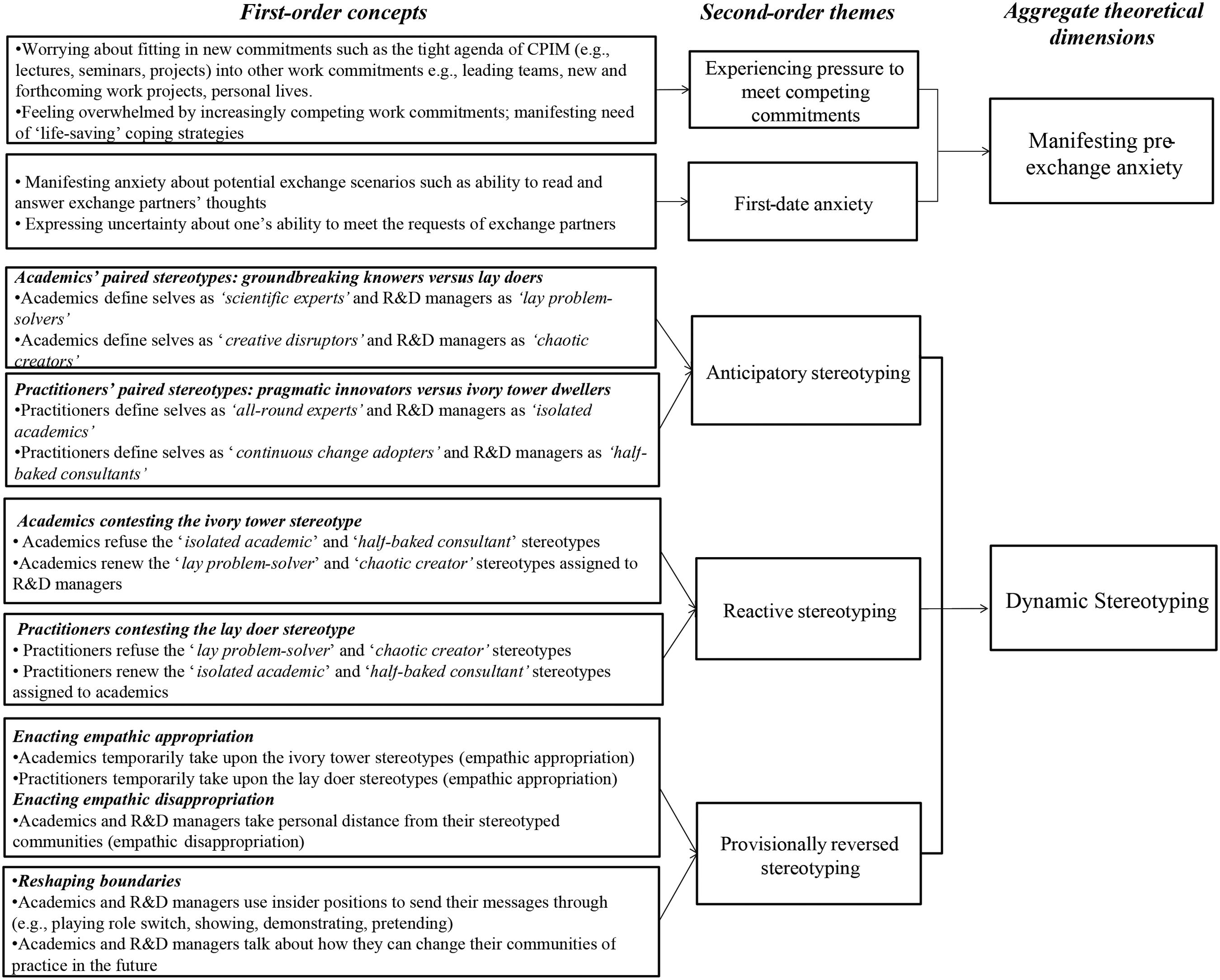
Data structure.
Findings
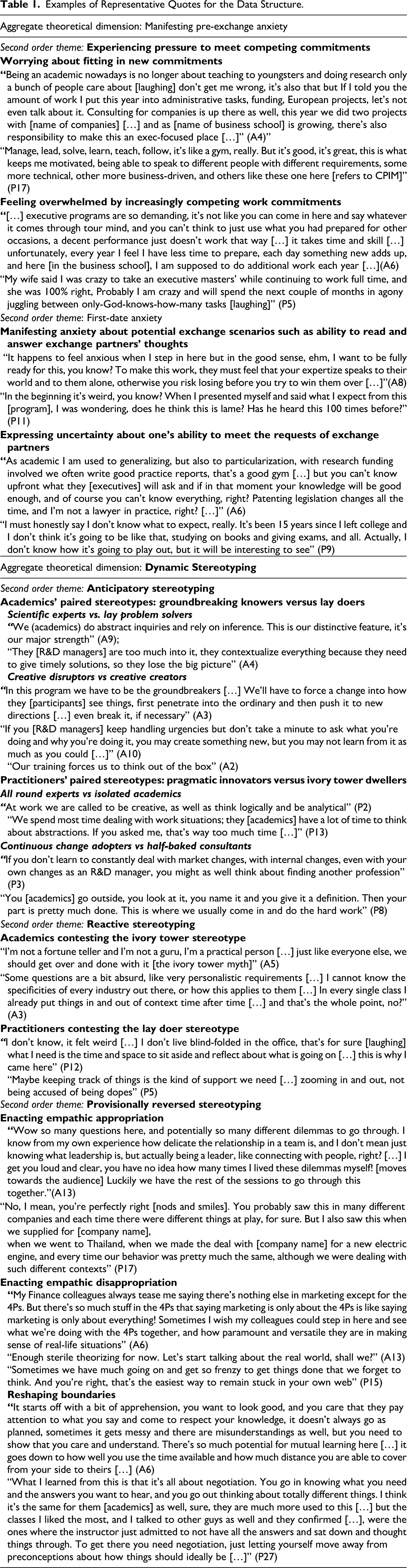
Below, we present our findings according to how the stereotyping mechanism we observed unfolded during the interaction episodes between academics and R&D managers: from pre-exchange anxiety to dynamic stereotyping which consisted in anticipatory, reactive and provisional stereotyping practices. To better illustrate the empirical evidence, we anticipate here Table 1 which exemplifies the main categories in our data structure.
Examples of Representative Quotes for the Data Structure.
Manifesting pre-Exchange Anxiety
Before the program began and during the initial meetings, academics and R&D managers expressed anxieties about the program, their exchanges, and the challenge of managing multiple work commitments in different spheres, as follows.
Experiencing Pressure to Meet Competing Commitments
R&D managers were concerned about their ability to perform well in both the program and their ongoing responsibilities such as managing and leading the members of their teams, respecting existing project deadlines, assuming new responsibilities, and maintaining a reasonable work-life balance. The academics complained that their hectic work lives encroached upon their personal lives, and referred to the constant increases in teaching loads, and research opportunities and consulting projects that had accumulated over the academic year.
First-Date Anxiety
The start of the program involved instructors and participants in a dense web of regular scheduled activities (e.g. face-to-face lessons, workshops, company visits) which provided opportunities for participants to meet, discuss their mutual expectations, and define the program structure and organization. Our initial set of interviews highlighted that each party had made efforts to make a good impression on the other party but had few indicators about the most effective approach or the other party's reactions. Consequently, all our informants manifested numerous doubts and contradictions about how their collaboration was unfolding, described by academic (Ac1) as “first date anxiety”. As the following two excerpts suggest, the academics were fearful of being unable to deal with the managers’ questions and reactions in real time, and of appearing unprepared or irrelevant. Similarly, the managers feared that the academics’ world was too far removed from their own, and worried about their ability to “live up to expectations” and make the experience “somehow meaningful”: (Ac1): “I can't say I’m not worried, I don't even know who I’ll have in front of me for the next year or so […]. It's like going on a first date, you know [laughing]. Will I be able to get their attention, or will they think I’m just another guy that, you know, comes in and talks? […] We need to make sure we turn this into a valuable experience for all of us”
(P13): “I’m sure this experience will be meaningful, usually when you don't know what to expect you end up having more rewarding experiences […]. I don't think we speak the same language, I don't know if I can make myself understood […] not sure I know [what] the standards and expectations are [in this project] and how exactly [to] meet them”
We also identified differences among our informants in the degree of pre-exchange anxiety manifested. Specifically, instructors with less experience of executive training engaged in more expressions of pre-exchange anxiety (average of 24.5 instances among academics with 0–1 years of experience vs. 12.5 in the case of colleagues with >3 years of experience). Similarly, R&D managers with less experience in project management and cross-functional coordination generated more instances of discourse about pre-exchange anxiety than their more expert peers (17.5 instances on average for R&D managers with careers devoted mostly to technical positions and small experience (less than 2) in cross-functional/inter-organizational projects versus 6.5 instances for managers who had occupied at least 2 organizational functions and had experience of more than 2 cross-functional/inter-organizational projects).
Managing pre-Exchange Anxiety Through Dynamic Stereotyping
In dealing with exchange anxieties, academics and R&D managers used stereotypes to anticipate each other's behaviors during forthcoming interactions, in an attempt to make these behaviors more predictable and thus less threatening. We discovered that stereotypes were paired -i.e. used for both self and interaction partners and were dynamic -i.e. followed the course of the interaction between the two parties. We distinguished three stages of dynamic stereotyping: anticipatory, reactive, and provisionally reversed.
Anticipatory Stereotyping
To launch the interaction and reduce pre-exchange anxiety, academics and practitioners used already available stereotypes about their occupations which drew on the knower-doer dichotomy. Specifically, academics defined themselves as groundbreaking knowers and applied the paired stereotype of lay doers to R&D managers. Symmetrically, R&D managers defined themselves as pragmatic innovators and applied the paired stereotype of ivory tower dwellers to academics. The main purpose of paired (i.e. self-alter) stereotypes was to anticipate an image of complementarity despite differences which helped to reduce pre-exchange anxiety (see Table 1 for additional quotes).
Academics’ paired stereotypes: groundbreaking knowers versus lay doers. During their first encounters with R&D managers, the academics struggled to present themselves in favorable (i.e. useful) ways to R&D managers as ‘groundbreaking knowers’. Two recurrent stereotypical pairs were employed: when academics defined self as scientific expert they referred to R&D managers as lay problem-solvers; when they defined self as creative disruptor, they referred to R&D managers as chaotic creators.
In relation to the first pair (scientific experts vs. lay problem-solvers), CPIM instructors defined themselves as active members of the management scientific community. Both during the interviews and in their exchanges with managers, they explained that their main mission was to use academic training and skills to understand connections among complex world phenomena, as informant Academic 10 described below: (A10): Research allows you to isolate things in the environment, dismantle, study, abstract, and then put them back in the environment, and give insights to those who are in need […] If I’m not able to study things, reflect on them and then translate them into the lives of other people, then I might be a brilliant consultant or a well-read practitioner, but I’m not an academic […].
We found that academics mostly opposed their “scientific pedigree” to the “lay attitude” of R&D managers. The R&D manager was portrayed as a ‘lay doer’ who focused primarily on solving specific problems in circumscribed contexts quickly, rather than thinking and analyzing, and with a deep technical understanding of innovation projects but no holistic picture of innovation processes, their outcomes and conditions. In the excerpt below, the self-definition of academic 4 is presented as opposite and possibly complementary to the definition of alter: (A4): […] I guess that in our daily lives we [academics] deal with different matters than R&D managers. They act more than they think because they deal with the contingent; they don't reason in terms of ideal types nor spend their days thinking about different shades of gray on each facet of each little thing out there […] I don't mean they don't think; they just have less knowledge to play with […].
In relation to the second pair of stereotypes (creative disruptors vs. chaotic creators), the academics also mentioned the importance in their work of creativity. In this view, the distinctiveness of the academic profession lies in a dynamic vision of the world which stems from an innate intellectual curiosity that encourages the academic to “question the status quo” and promote “groundbreaking insights in the lives of others”. This self-definition which we labeled ‘creative disruptors’ was opposed to R&D managers defined as ‘chaotic creators’. Their immersion in their work practice means R&D managers often need to improvise and make sense of events as they emerge (i.e. disordered creativity). The academics’ systematic attitude to creativity could bring order into the R&D manager's disordered creativity. Their mission was thus to challenge managers’ pre-existing mental frames and instill new ways of looking at innovation projects. The following excerpt shows how academics used this pair of self-alter stereotypes during a workshop: (P3) So, what exactly does that tell me [about the project P17 had just described]?
(A3) You might find me a little intellectually snobbish but I like to help people think in a more complicated way instead of a simplified one. Since people in this class might have more knowledge and skills than I do, why insult their intelligence with commonsensical inquiries? They don't need to hear from me what they always hear at work, they need a fresh perspective, and this is exactly what I feel I can offer […] It may sound arrogant but at times synthesis can be more visionary than invention.
Practitioners’ paired stereotypes: pragmatic innovators versus ivory tower dwellers. We found dynamics similar to the ones described above also on the R&D managers’ side. Data collected before the start of CPIM suggest that managers defined themselves by their occupational and organizational roles. Although in some cases they felt they identified equally with the titles of ‘R&D technician’, ‘engineer’, or ‘innovation manager’, they all agreed that the term that best described their occupation was ‘innovator’. We found that when R&D managers defined themselves as pragmatic innovators they mostly concomitantly defined academics as ivory-tower dwellers. Below, we describe the two pairs of self-alter stereotypes used for this purpose: all-round experts versus isolated academics, and continuous change adopters versus half-baked consultants.
Like the academics, R&D managers took immense pride in their occupation which they saw as boundary spanning with respect to science and practice. They prized their scientific training and ability to apply science to concrete phenomena such as the development of a new electronic board for a temperature-sensing oven, or collecting data on the efficiency of renewable energy in vast urban areas. They also commonly described their expertize as a mix of engineering training, communication skills, and broad understanding of innovation processes, and explained that the ability to apply scientific training to unpredictable work situations was their most valuable professional skill. We labeled these self-description ‘all-round experts’. In contrast, they described academics as ‘isolated academics’ – i.e. “professionals used to talking to peers about advanced topics through very specialized publications and niche practices” (informants’ words). The following excerpt shows how R&D managers described their scientific background as applicable to real world innovation, and distinguished it from academics’ more technical, detached, and self-referential approach:
(P15): “At work we are called on to be creative, think logically, and be analytical […] my background in electronic engineering gives me a scientific mindset all the time (…) I mean, ivory tower prescriptions definitely won't do for me. I already know that in 99% of cases reality is neither black nor white but gray. I’ve learned it day after day, I see with my own eyes as I muddle through […] it would be impossible for me to stay on the outside and just perorate”.
In addition, R&D managers spent much time describing how they coped with the fast-paced and constantly changing nature of their work. For instance, it often happened that they expressed their frustration about unpredictable top management decisions which changed the direction of an R&D project every couple of months, or praised their ability to make continuous product revisions based on the impromptu requests of marketing colleagues. We labeled these self-descriptions ‘continuous change adopters’. By contrast, academics were described as ‘half-baked consultants’ -i.e. enthusiastic to create new knowledge for industry but unable to connect such knowledge to real world needs and decisions. For this reason, R&D managers often manifested the desire that academics would tailor their academic knowledge to the R&D managers’ needs (i.e. “down from the ivory tower and back to earth”), thereby becoming their change consultants: (P9): Analyze, learn quick, decide fast and check twice, no, actually, check three times!” Nothing less than that would do in my job, no half-baked solutions or anything […]. What I expect from this program is some parameters that can help me distinguish right from wrong, something that can tell me: Look, when you’re in this type of situation, you must normally do this kind of analysis, you must act this way or this other way and if you are lucky you’ll be all right.
Reactive Stereotyping
Although by using self-alter stereotypes academics and practitioners tried to steer their forthcoming exchanges in predictable directions, they often achieved the opposite effect. As shown above, complementarity was unequal: While self was often defined as competent, active, and necessary, alter was a passive actor in a closed or over-specialized world that needed to change. This led academics and managers to refuse and challenge the stereotypes assigned to them in the anticipatory phase.
Academics contesting the ivory tower stereotype. It often happened that academics did not identify with being ‘ivory tower dwellers and complained that they found labels such as ‘isolated scientist’, and ‘half-baked consultant’ biased, offensive, and distorting of their work. Consequently, they contested these stereotypes and invited R&D managers to adopt more nuanced perspectives of academic work which importance was further stressed: (A3): Don't ask me what will happen next, I know you might want to but please take into consideration that we are scientists, not fortune tellers. Our publications should be seen as keys to a better understanding of reality, not like keys to future prophecies!”
(P12): This is not what I’m asking […] perhaps I didn't make myself clear…
(A3): If you ask me such a thing, you obviously don't know me at all! You see, I don't believe in pre-determined solutions. It is not in my nature nor in my profession to do so […]
(P20): So you’re saying there's no solution? I personally believe in solutions that can actually work but I’m not saying they have to be easy or perfect.
(A3): There is no single key that will open a prophecy [but] there are many keys that can help you solve an incomplete situation in an incomplete way […]
As the last excerpt above and the one below show, the academics not only rejected stereotype related to ivory-tower dwellers but they also refused to become “problem-solving automats”, as Academic 8 termed it in interview. Instead, they tried to convince the R&D managers about the unsoundness of such imputations. The following comment further explains how academics reacted to R&D managers’ ‘half-baked consultant’ stereotyping: (A3): Some R&D managers like to believe in management recipes-for-all-seasons. I’ve been there before […]. First, they say they want to learn from you, to get to know your perspective and then they just try to get you to solve their problems. They ask you: So, is it A or is it B? […] But I believe we are decision makers in complex situations and we must all take responsibility to act, think, and make decisions. This is twice as true if we consider we are dealing with complex management issues […]
Practitioners contesting the lay doer stereotype. Analogously, we found that managers rejected all stereotypes that portrayed them as lay doers. Specifically, they rejected academics’ imputations that they tend to rely on commonsense, ignore the big picture, or focus exclusively on narrow problem-solving. In addition, they also refused the suggestion that their creativity lacked systematization (i.e. chaotic creators). The following excerpt from a discussion on disruptive versus incremental innovation exemplifies how, consequent to Academic 3's suggestion that lay practitioners tend to praise radical innovation and ignore the benefits of incremental innovation, not only did R&D manager 21 intervene to refuse this stereotype but he also defensively renewed the ivory tower stereotype for the instructor: (P21): I’m learning a lot of things here but sometimes I feel we are chasing pure theory, there are a lot of notions and analytic distinctions but without dealing with the complexity of it at all… like the innovator's dilemma, continuous and discontinuous change, and absorptive capacity versus technical capacity or transformational capacity. It doesn't mean that if we don't use these exact terms we don't think about this stuff. It's part of our work […].
We found that reactive scripts during CPIM were in 67% of cases explicit -i.e. academics and managers confronted assigned stereotypes face-to-face (during lectures, workshops, company activities, etc.), while in 33% of the cases reactions remained implicit and were only communicated to us during one-to-one interviews. Interestingly, we found that the academics whose reactions were implicit often had either more experience of executive training > 3 years (62%) or almost no executive training experience (0–1 years, 30%). Similarly, R&D managers who decided not to react overtly to stereotypes had high levels of cross-functional and project management experience (74%), followed by those with the least experience (22%), and only 4% of managers with mid-range levels of experience. By contrast, those who explicitly reacted to assigned stereotypes more often were academics and R&D managers with mid-range levels of executive training and cross-functional experience, respectively.
Provisionally Reversed Stereotyping
As actors dealt with each other's reactions, the level of mutual involvement gradually rose. To face reactive stereotyping and avoid the risk of relational breakdowns, academics and R&D managers enacted provisionally reversed stereotyping in which they circled around self and alter stereotypes in loops of abrupt involvement and disinvolvement. First, they strove to give the impression that they understood the other as if they were part of the same group (i.e. enacting empathic (dis)appropriation) and then they tried to use an ingroup perspective to bring the exchange partners to their side (i.e. reshaping boundaries). It is noteworthy that reversed stereotyping was a consequence of reactive stereotypes, and thus was performed only in cases where reactions to stereotypes were voiced explicitly.
Enacting empathic (dis)appropriation. When their stereotypes encountered reactions, academics and R&D managers veered between empathic stereotype appropriation and disappropriation in an attempt to provide reparation for the emerging conflicts.
Empathic appropriation allowed the academics and R&D managers to accept the previously assigned stereotypes as generally representative of their occupational communities but dissociated self and exchange partners from such stereotypes (empathic dis-appropriation). For example, in attempts to get closer to the CPIM participants, instructors dissociated from ‘other academics’ and distinguished participants from ‘other typical managers’. In the following excerpt, Academic 11 dissociates from colleagues who contribute to perpetuating the myth of the ivory tower researcher and criticizes some scholarly theories for being too pedantic and distant from the world of practice: (A11): Many of my operations colleagues spent their lives studying the alternative ways in which production men can save 0.1 of a second to make the production more efficient. I mean, sometimes I feel like telling them, come on! You analyze egg yolks all day but can't tell the difference between an ostrich and a chicken egg? What I’m saying is that academics often go chasing details and forget what the real world is about. They should take more examples from you guys […] and try to answer your type of questions.
At the invitation of the academics, R&D managers also dissociated from ‘other typical R&D managers’ (i.e. colleagues, former bosses, people they knew) and acknowledged that “academics in here are different from other academics out there” (informants’ words). For instance, the following excerpt is drawn from a lunch conversation where an instructor shows reparatory empathy after refusing the label of ‘half-baked consultant’ assigned to him by the participants. These latter accept his invitation by voicing perplexity about the ‘other colleagues’ in their organizations who are “limited enough to think academics are useless thinkers” (informant's words). Such perplexities are reminiscent of academics’ anticipatory stereotypes: (A10): […] So many dynamics are the same because people are people, and organizations are organizations, many practices are alike, and also many mistakes are alike. But If I wasn't able to make this clear enough with this case study… [pause]
(P3) No, I see what you mean, I don't know if organizations are all alike but for sure in my previous job in [energy company name] we used to get the same kind of mistakes […]
(P19): When you step inside the company, you forget what you do in your normal daily life, but when you get out for a moment and have time to reflect, you ask yourself, damned, if I must implement a research system inside our company and I use Google in my private life all the time, how come I don't think about implementing a Google-like tool?
(P11): I see what you mean, theoretically we are all innovators but practically we’re just workers, we do the same things every day and in the end we’re no longer able to see new things. […] I don't want to become a routine slave like other guys who worked here all their lives. Or maybe they’re right. Maybe I’m already like that.
(A10) It's just a question of staying on-guard, like frogs, remember my metaphor? Many R&D managers forget this simple lesson, but I don't think it's your case.
[…]
(P3) Maybe in a few years, a new [competition brand name] product will come out and I will say to myself, it was so obvious, I could have done that myself long ago if only I had allowed myself to think!
As can be seen in the example above, the process of stereotype (dis)appropriation required empathic rephrasing – summarizing what the exchange partners said in a caring way – and perspective-taking – trying to see their point of view, for instance by continuing the discourse from where they had left it. This was accomplished by using each other's language, voice tones, and even speech cadencies.
Reshaping boundaries. We found that empathic (dis)appropriation was often used for the persuasive purpose of redrawing boundaries about what was acceptable in the classroom. Specifically, to become accepted for who they were, academics first had to show they had learned how to think, speak, and act like managers and then tried to secure conversion from within. The following comment was made during a lecture on consumer insights in which R&D managers expressed their doubts about the usefulness of an approach called experiential auditing. Academic 7 first uses a defamatory joke about science to assume a distance from academia, and then problematizes ‘R&D day-to-day dilemmas’ as if he were a manager, mentioning that before becoming a ‘useless academic’ he was a ‘useless marketing consultant’. As he creates a sense of closeness through empathy (i.e., “I know what it feels”, “we’re in the same boat”), he further argues in favor of his occupation: (A7): You know how the saying goes, to make a mistake is human, to repeatedly make mistakes is science [laughing]. Erm, that is to say that marketing theories do not always take into consideration the trickiest things out there, the ones that you and I know they make the difference. Before becoming a useless academic, I was a useless marketing consultant, and I know how this goes because I’ve lived the dilemmas of consumer insights in my own skin, and I know what it feels like to get everything and to get nothing back from experiential audits. Yeah, I’m with you on that, we’re in the same boat. But although I am risking you firing me, I have to say that it depends on how you use the tool and set up the criteria for it. […] So, is experiential auditing perfect? No. Are consumer experiments perfect? No. But what are the alternatives? […] Used cautiously and responsibly, the tools in marketing research can bring clarity in your market vision…
With the help of provisional reversals, academics and R&D managers dismantled mutual resistances, inspired trust, and promoted interest in their own objectives. Ironically, however, they also ended up denying what they had initially tried to defend -the superior worth of their occupational groups. For instance, as the program interactions unfolded, both parties began criticizing and even stereotyping ingroup members such as colleagues, students, bosses, consultants, clients, and suppliers, as the following excerpt shows: (P10): “I happen to do meetings with marketing people quite often and I can clearly sense our incompatibilities, we just don't speak the same language [ …]. I remember I asked myself a hundred of times, why do they ask me this or why won't they do that? After the marketing course, I can't say I like them more than I used to [laughing] but I think for the first time I’m starting to see what their worlds are like and imagine how they spend their working days or what they talk about […] This is new for me […].
Thus, as the interaction unfolded, it seemed as if academics and R&D managers almost switched perspectives in search of a compromise that would reduce their exchange anxiety. In the following excerpt an academic uses her own words to describe the transformative journey occasioned by provisionally reversed stereotyping: (A5): I think I’ve learned how it goes. If managers don't get the certainty they are looking for, they interrupt the relationship on the spot […]. Because they want exactly what they asked for. Full stop. So, if you want to do your job you got to be crafty and spend time showing them why you won't give them what they want. If you get them to trust you, it is not so much because they appreciate your knowledge but because they feel you understand their world. That doesn't mean you must become an expert in what they do, it means you have to talk to them as if you appreciate and value what they do […]
Discussion
Figure 2 depicts the main arguments of our grounded theory about the dynamic use of stereotyping in exchanges between management academics and R&D managers, highlighting the process aspects – i.e., the connections between themes – and the intervening conditions – i.e., conditions in which the interconnected themes are likely to occur. We have suggested that stereotypes can serve multiple functions in an exchange (see explanation of the arrows in Figure 2). In the initial phase, actors might use stereotypes based on occupational membership to reduce anxiety through inferences about the goals, expectations, and behaviors of their (fairly unknown) exchange partners (anticipatory stereotyping). Since stereotyping strategies are often self-serving, they tend to deliver incomplete or offensive images which exchange partners may manifestly or tacitly reject (reactive stereotyping). When reactions to stereotypes are voiced explicitly, relational involvement increases, encouraging the actors to explore self and alter stereotypes within a circular process called reversed stereotyping. Reversed stereotyping feeds back actors’ perceptions of pre-exchange anxiety, potentially shaping their reactions to future episodes of interaction, such that the reversed stereotyping at the end of one episode may become an input for the anticipatory stereotyping in a following episode. In appendix A, we also provide a vignette which further exemplifies the sequences in the process of dynamic stereotyping. In the reconceptualization of mutual stereotyping as a dynamic process, we also discuss the conditions in which it is more likely than rigid stereotyping. In line with Strauss and Corbin’s (1998) indications, intervening conditions were derived from the constant comparison of our empirical data with the literature on occupations and will be discussed in greater detail in the discussion below which details our contributions to the theory-practice debate, and to the literature on occupational stereotyping.
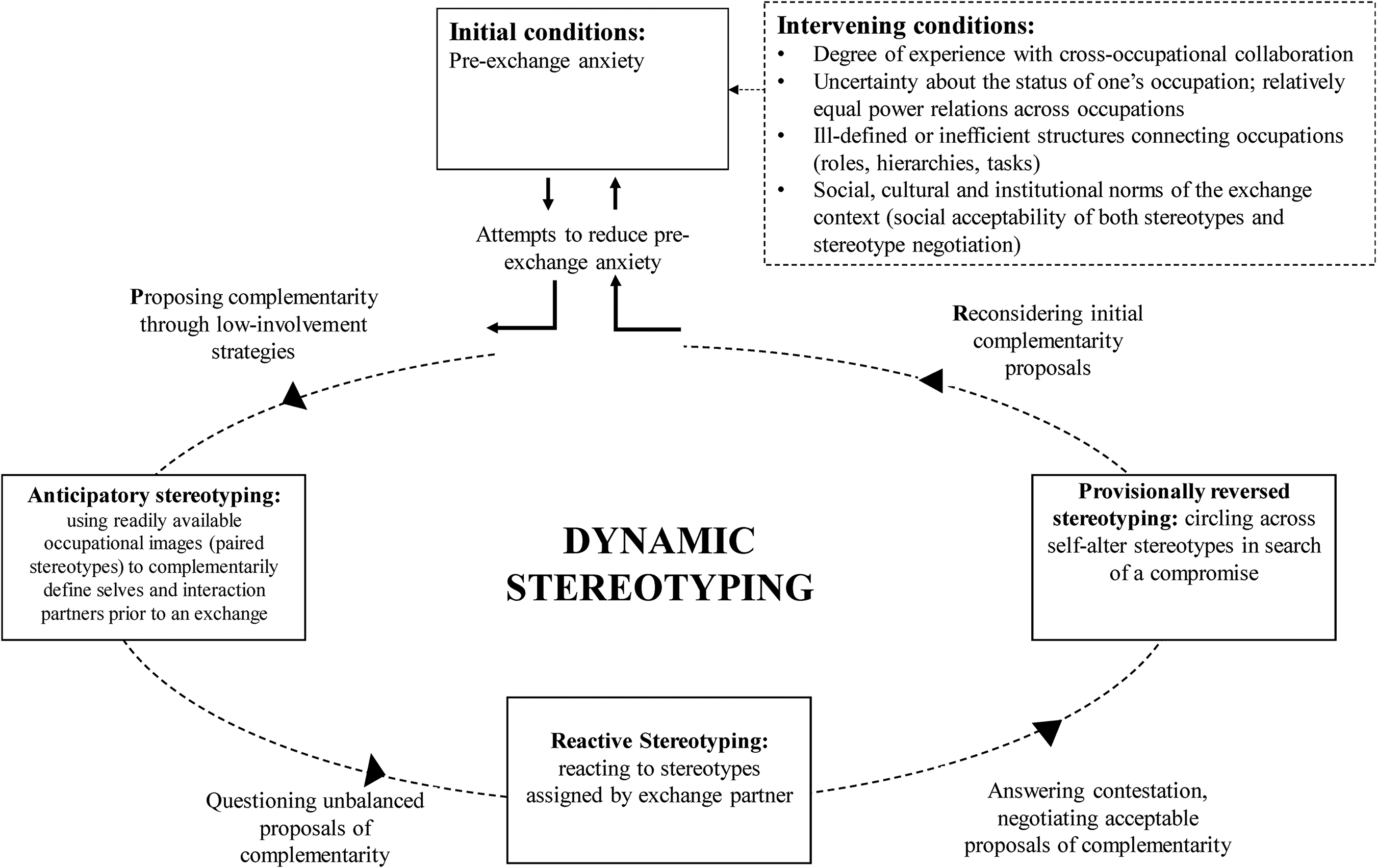
Triggers, processes and conditions of dynamic stereotyping in a cross-occupational exchange between management academics and practitioners.
A Process View of Dynamic Stereotyping Across Occupations
Instead of focusing on the differences and similarities between the worlds of management academia and managerial practice, studies of the theory-practice relation often take them for granted and abound in prescriptive solutions for future academic-practitioner relations. This study takes a step back from the principled debate on rigor-relevance and investigates how theory and practice are embodied and currently co-exist in real world interactions between academics and managers. Our study confirms that cross-boundary stereotyping thrives on the individual sense of belonging to an occupational community (intragroup similarity) and the need to manifest closure towards other occupational communities (intergroup distinctiveness). In this study, we have documented the centrality of the knower-doer stereotype in interactions between groups of management academics and practitioners and identified a pattern common to both academics and practitioners, that of ideally seeing themselves as pragmatic knowers situated in the middle of the knowing-doing distinction, and placing interaction partners at the limits.
It is significant that the use of the knower-doer stereotype is related closely to the theory-practice debate in the field of management which often describes academics and practitioners as opposites, and laments the difficulties involved in linking academics’ abstract, detached, and self-centered theorizing to business managers’ narrow, action-based, and context-driven practice (Hambrick, 1994; Hay & Heracleous, 2009; Pfeffer & Fong, 2002; Rynes et al., 2001; Starkey & Madan, 2001). Our findings are in line with the argument that the inter-subjectively perceived differences between academics and practitioners are crucial for explaining the worrying gap between management theory and practice (Baldridge et al., 2004). However, in contrast to the current literature, we provide a less pessimistic view. Specifically, we see stereotypes based on perceived differences not as dead-end destinations but as points of departure for making sense of liminal exchanges occurring in fast-paced, sporadic, and unstructured conditions such as consulting projects or executive business programs. The studies by Czarniawska and Mazza (2003) and Beech et al. (2010) are among the few works suggesting that academics and managers may negotiate inter-subjectively perceived differences in context, as they transform the relationships in which these stereotypes are initially manifested. We build on their work by arguing that stereotypes may act as heuristics during academic-practitioner interactions – i.e. they help to reduce the diversity and complexity of exchange situations to a few modal images, allowing management academics and practitioners to act immediately based on a set of socially available typical images (i.e. the knower-doer stereotype). Most importantly, we suggest that stereotypes may constitute fertile ground for the assumption, negotiation, and reconsideration of perceived differences.
While there is agreement in the literature that occupational stereotypes exist, there is a lack of agreement about the content of these occupational stereotypes (He et al., 2019). We highlight the importance of the knower-doer dualism and we contribute to literature which discusses occupational stereotypes criteria such as gender, occupational status, personality traits and competence (He et al., 2019) by investigating the link between the knower-doer dualism and the ideal of occupational competence – i.e., the goal of being perceived as competent, confident, independent, competitive, and intelligent based on how ‘respected’ one's occupation is (Fiske, 1998; He et al., 2019). We submit that while all professionals who perform stereotyping may strive to define selves as more competent than members of an outgroup, what competence means to each group may vary in the interaction context and over time (Anteby et al., 2016). The consequence is that while gender and personality traits may appear as fixed during stereotyping (e.g., being masculine, intelligent or confident is often socially desirable and no one is willing to give up on the advantage), when the stereotyped dimensions are occupational images which are more fluid and shifting per se, also stereotypes become more malleable and serve as leverages in the negotiation of mutually perceived differences. Since the meanings of a competent academic or manager may change over time and with perception, an academic may find it socially desirable to temporarily exit the role of knower and embrace that of doer, and for managers the reverse as well.
Additionally, as a main contribution, we show that stereotyping is not just dynamic but is also mutually constructed through social interaction. While social psychology studies do not ignore the fact that stereotypes can be transformed (Blair, 2002), they usually investigate suppression as a unilateral voluntary process in which individuals try to exert self-control over the stereotypes they apply to others (Kawakami et al., 2000). To the best of our knowledge, dyadic (self-alter) stereotyping has not so far been theorized. Similarly, research on occupational images pays limited attention to how self-alter images are paired in interactions, for instance how professionals renegotiate the knower-doer stereotype (Barley et al., 2017). Our work shows that the need to establish complementarity with respect to other occupations plays a key role in cross-occupational stereotyping. Gary Alan Fine (1996) uses the term ‘professional analogizing’ to explain how chefs legitimate their profession in comparison to other high-status professions such as law, medicine, or art which resonates with the anticipatory stereotypes documented in this study. However, Fine's work does not explore how a profession's attempts to establish complementarity with other professions are received during interactions among these professions, for instance, how the chef confronts the lawyer, the doctor, or the artist and negotiates with them what they mean to each other. Skovgaard-Smith et al.’s (2019) uses the concept of ‘reciprocal othering’ to suggest that the individual's need to boost self-identity may shape the typical images he or she attaches to others (see also Barley, 1996; Fine, 1996; Koveshnikov et al., 2016). As these examples suggest, most research attention has been on the anticipatory function of stereotypes and fits well with the theory-practice debate. In acting as a defense against stress and uncertainty, stereotypes increase the predictability of exchange patterns on the one hand but preclude the possibility that the actors will see one another in a different light. In contrast to the studies mentioned above, we highlight the important role of reactions to stereotypes or counter-stereotyping. Due precisely to the inaccuracy and uncertain outcomes of occupational stereotypes, according to cultural anthropologist Allen Batteau (2000, p. 735) they need first to be contested and then refined through tentative strategies which “transform mine into yours and yours into mine and independent predators into mutually dependent partners […] up to the closing of the deal.” We thus propose that stereotyping should be seen as an articulate process of social negotiation based on anticipation, reaction, and potentially, reversal.
Importantly, our work differs from previous studies in proposing a stereotyping coping mechanism which we call provisionally reversed stereotyping. Individuals engaged in stereotyping who are interested in preserving their relationship may enact cycles of empathic stereotype appropriation and disappropriation, accept stereotypes about their profession in general, and draw a line under the occasion of the exchange. The game of (dis)appropriation constitutes a skillful tool to enable ingroup-outgroup boundaries to be crossed, to get closer to ‘the other side,’ and to make one's voice heard.
Dynamic versus Rigid Stereotyping in the Changing Context of Cross-Occupational Relations
While social psychology studies on inter-group stereotyping and studies of occupational relations so far mostly emphasize the rigid nature of stereotypes and their negative impact on inter-group relations (i.e. defense, demarcation), we argue that stereotypes could become ‘dynamic’ if they serve a broader and more indefinite spectrum of cross-occupational relations. However, in line with decades of social psychology research on stereotypes (Allport et al., 1954; Fiske, 1998; Jost & Hamilton, 2005), we acknowledge that both processes may occur, and highlight the need to identify the conditions under which rigid or dynamic stereotyping is more likely to emerge.
We suggest that a first intervening condition for dynamic stereotyping is previous experience of collaboration with other professions or occupations. We have shown that more experienced professionals manifested less exchange anxiety and triggered fewer instances of stereotyping. Importantly, our study shows that exchange anxiety is both good and bad. In particular, professionals who have less experience with spanning boundaries between occupations may be more subject to exchange anxiety, and more likely to initiate stereotyping and refuse assigned stereotypes. By contrast, more expert boundary-spanners may be less keen to employ stereotyping but also may be less willing to voice their reactions to stereotyping when it occurs. Since studies suggest that latent conflict may be more detrimental to relationships than manifest conflict (De Dreu & Gelfand, 2008; Ungureanu et al., 2019), we draw specific attention to this finding. However, given our small sample and our specific research context, we would invite future research to investigate further how experience of cross-occupational interactions relates to the tendency to initiate and react to stereotypes.
We suggest also that a degree of uncertainty about the status of one's occupation combined with relatively equal power relations across occupations constitute important triggers of dynamic stereotyping (Bucher et al., 2016). On the one hand, sociologists report the so-called ‘deprofessionalization’ of work which consequently undermines the status and authority of experts (i.e. ‘knowers’) such as researchers, teachers, doctors, and law professionals at the expense of new professions such as managers, technicians, and administrative staff (described also as ‘semi-professions’). This makes the roles and relationships of these two groups increasingly unstructured, their reciprocal attitudes more uncertain, and their behaviors during interaction increasingly unpredictable (Anteby et al., 2016; Barley et al., 2017; Fournier, 2002; Gorman & Sandefur, 2011; Kellogg, 2019). Such view is in line with those contributions to the theory-practice gap highlighting that the roles of academics and practitioners in the executive classroom are changing to become more equal and uncertain due to the constantly changing institutional context in which academics and practitioners operate (Friga et al., 2003; Gioia & Corley, 2002; Trieschmann et al., 2000). Status uncertainty per se seems to play a positive role in crossing ingroup-outgroup boundaries, and we would argue it is an important trigger of trial and error relationship building. Specifically, relatively equal power relations across occupations may encourage individuals not only to question the stereotypes they use but also to convince others to do so. However, if members of an occupation have significantly more power, prestige, and structural control, they may be less motivated to revise their stereotypes about other occupations, and more likely to sabotage exchanges with members of these occupations if perceived as threatening or deskilling (Barley, 1996; Bucher et al., 2016; Trice, 1993).
While stereotyping has often been reported in highly structured and power asymmetric exchanges (hospitals, multinational organizations), we document its importance in exchanges where roles, and hierarchies are less well defined such as those related to management academics and practitioners (Bartunek & Rynes, 2014; Ungureanu & Bertolotti, 2020). Many studies of the theory-practice gap in management have argued that the lack of structure between academia and managerial practice is problematic because it promotes superficial and self-serving exchanges between these two communities, and deters deep commitment to common goals (Mohrman et al., 2001; Van de Ven, 2007). As a consequence, many studies propose a structuring of academics-practitioner relations through engaged scholarship, where academics’ roles are reimagined to include practitioners’ needs as core goals, or through evidence-based scholarship, where academics must create consensus around the strongest evidence for practice and disseminate this evidence outside academia (Hodgkinson & Rousseau, 2009; Rousseau et al., 2008). However, we take a less pessimistic view of ill-structured interactions between academics and practitioners and highlight that exchange insecurity may be beneficial for negotiating perceived inter-occupational differences. From such perspective, it is important to highlight that when engaged in spontaneous and emergent social interaction, academics and practitioners go beyond their membership in different occupational groups and become social agents in pursuit of social acceptance, governed by a common need to reduce social anxiety. Such serendipitous situations may have advantages over more structured yet more power-imbalanced solutions such as evidence-based management where one group is competent and the other is merely searching for that competence (Morrell et al., 2015).
However, it is also important to note that the ‘business school business’ as Pfeffer and Fong (2004) term it, is far from being unstructured due to its increasing army of staff (business school staff, facilitators, counselors, etc.) and plethora of tools (business cases and games, facilitated experiential processes, etc.) supporting classroom interaction. While this support is aimed clearly at reducing the burden of diversity on instructors and students, our case shows that academics and R&D managers having access to structured roles (i.e. student-instructor in executive classrooms) may decide instead to use the knower-doer stereotype which allows for more flexibility and efficacy during exchanges. Future research could investigate if and how stereotyping occurs in the presence of alternative forms of support for collaboration such as roles, tools and brokers.
Lastly, the social, cultural, and institutional rules of the exchange context may play an important role in dynamic stereotyping. Drawing on the work of Goffman (1959), Skovgaard-Smith et al. (2019) suggest that ‘situational requirements’ such as the implicit norms of decorum may inhibit actors involved in an institutionalized context from performing status-based discrimination, and encourage them to look for more socially acceptable strategies such as the reversed scripts documented in this study. We can thus speculate that anticipatory and reactive stereotypes will depend on the social, cultural, institutional, and organizational rules in which the exchange is situated and invite future research on this topic.
Conclusions, Limitations, and Implications for Practice
We conclude that the increasing insecurity and diversity of exchanges that occur in fast-paced conditions push members of loosely coupled occupations such as academics and managers, to search for readily useable tools for their exchanges. These tools may take the form of dynamic stereotyping especially if the parties involved are trying to reduce relational insecurity, have previous experience with similar ill-structured and hierarchically balanced relations, and envision some sort of temporary utility in the exchange. Stereotypes must not only be savvy in terms of the required time or effort but also easily adaptable to the unfolding interaction in context.
Of course, our study has some limitations. First, our longitudinal data may limit generalizability since the processes described are anchored in the specific context and interrelations we observed. We recognize that not all academic-practitioner exchanges unfold in the ways observed in this study, just as not all fast-paced, fluid, and temporary exchanges characterizing many contemporary occupations follow the dynamics highlighted here. In the section above, we discussed the conditions in which our findings are likely to hold. We also state that our study is not meant to encourage cross-occupational stereotyping but only to acknowledge its frequent use in mundane social exchanges. Instead of merely encouraging individuals to voluntarily suppress stereotypes, we advocate the beneficial role of deep social interaction for de-stereotyping. Finally, our proposed model has significant implications for practice by providing a perspective on how the gap between management academics and practitioners can be bridged if these parties have an opportunity to interact. Specifically, in the discussion above we have argued that connecting management scholarship with management practitioners’ day-to-day activities is not an unreachable desideratum but an inherent potential on the context of day to day social exchanges (Weick, 2003). Moreover, differences, stereotyped views, conflicts, and misunderstandings are as necessary as engaged collaborations and coordination to advance the theory-practice relation in management (Bartunek, 2020; Bartunek & Rynes, 2014; Ireland, 2012; Ungureanu & Bertolotti, 2020). Without this delicate balance between sameness and difference, exchanges between the two worlds will be unlikely to thrive.
Footnotes
Appendix A
Declaration of Conflicting Interests
The author(s) declared no potential conflicts of interest with respect to the research, authorship, and/or publication of this article.
Funding
The author(s) received no financial support for the research, authorship, and/or publication of this article.
