




Abstract
This study details the unexplored connection between employees’ exposure to family incivility and voice behavior to pinpoint organization problems, considering the mediating role of their work engagement and the moderating role of their emotion sharing with colleagues in this connection. Survey data obtained from employees who work in the banking sector reveal that a critical reason rude treatment by family members keeps employees from expressing their opinions about organizational shortcomings at work is that they exhibit limited positive work energy. This explanatory role of work engagement is less salient though when employees can draw on the relational resource of emotion sharing. For organizational change professionals, this study accordingly showcases a core explanation, thwarted work engagement, by which family-related hardships prevent employees from undertaking productive problem-focused voice activities, and it explicates how this mechanism can be subdued if the work environment encourages employees to express personal feelings openly to their peers.
Keywords
Introduction
Organizational change scholars and practitioners underscore the instrumental role of employees’ propensities to identify organizational shortcomings, known generally as employee voice, which can enable the employer to change the status quo, resolve the underlying issues, and thus thrive (Bergeron & Thompson, 2020; Harlos, 2001). A popular distinction cites prohibitive versus promotive voice, such that the former pertains to expressions of opinions about problem situations, whereas the latter involves expressions of opinions about solutions to problems (Svendsen et al., 2018; Wang et al., 2020). We focus on the former type, which we label problem-focused voice, consistent with prior research (De Clercq & Belausteguigoitia, 2017; Starzyk et al., 2018). It often precedes its promotive counterpart (Liang et al., 2012), and it also tends to be a more challenging behavior to adopt (Liang & Yeh, 2019; Morrison, 2011). In particular, dedicated efforts to identify and talk about organizational failures ultimately may enhance the organization's status, but these efforts also prompt significant hurdles. When employees bring negative situations into the open, other members may consider these efforts threatening and disagree with the raised issues, particularly if they suggest mistakes for which those colleagues could be held responsible (Barry & Wilkinson, 2016; Chamberlin et al., 2017).
In light of these difficulties, employees who already are exposed to adverse, resource-draining circumstances might be hesitant to dedicate substantial energy to change-invoking voice behaviors that pinpoint problems (Allen et al., 2015; Hobfoll et al., 2018). Thus for example, employees are less likely to voice their opinions about organizational problems to the extent that they have to deal with narcissistic leaders (Huang, Krasikova, et al., 2020), leader–member exchange differentiation (Dong et al., 2020), or politicized organizational climates (Bergeron & Thompson, 2020). When the surrounding environment seems unfavorable, it becomes less likely that employees are willing to raise concerns that otherwise could benefit their employer (Ng & Feldman, 2012). With this study, we propose another possible inhibitor of problem-focused voice behavior, with roots outside the work realm: the experience of family incivility (Bai et al., 2016). This resource-depleting, personal situation refers to the extent to which employees receive rude or demeaning treatments from their family members and thus perceive that they are not treated with respect by loved ones (Cheng et al., 2019; Lim & Tai, 2014).
Employees tend to experience harmful spillovers from their private to professional lives, such that their preoccupations with the quality of their family lives can make it difficult for them to focus on work issues and stay committed to the organization's success (Gopalan et al., 2021). Prior research accordingly reveals a negative link between employees’ suffering from family incivility and their job performance (Lim & Tai, 2014) or organizational citizenship behavior (De Clercq et al., 2018). We know of no studies that address how this family-related source of hardship might escalate into diminished problem-focused voice behaviors though. This oversight is striking; it prevents organizational development professionals from gaining a complete understanding of why or when the personal difficulties that employees experience at home might compromise their productive efforts at work, especially difficult efforts such as pinpointing shortcomings (Morrison, 2011). The primary objectives of this study therefore are to detail key factors that underpin or affect the escalation of family incivility into tarnished problem-focused voice.
First, we posit that an important channel through which this escalation may take shape is that employees become less engaged with their work. Work engagement is characterized by three pertinent, interrelated components: vigor, dedication, and absorption (Schaufeli et al., 2006; Schmitt et al., 2016). Vigor refers to employees’ perseverance and motivation to direct substantial time to work-related topics; dedication captures their devotion to work and corresponding sense of excitement when they work diligently; absorption reflects their focus on and submersion in day-to-day job activities (Byrne, 2014; Schaufeli & Bakker, 2010). Extant research underscores the unidimensionality of the work engagement construct, as well as its distinction from related concepts such as job involvement or job satisfaction (Gazica & Spector, 2015; Liat et al., 2020). We propose specifically that exposure to family incivility may direct employees away from potentially controversial efforts to pinpoint problem situations, because their positive work energy bases become drained, as manifest in their limited work engagement (Karatepe & Karadas, 2016; Quinn et al., 2012).
Second, we postulate that this explanatory mechanism of lower work engagement is mitigated by emotion sharing or the extent to which employees can openly express their feelings to organizational colleagues (De Clercq & Belausteguigoitia, 2019; Stephens et al., 2013). 1 In particular, emotion sharing may serve as a buffer against the drainage of work-related energy resources in response to experienced family incivility (Lim & Tai, 2014), as well as against the probability that this energy drainage translates into diminished problem-focused voice behavior (Alessandri et al., 2018). The mental support that they receive from organizational peers, as informed by this emotion sharing, may enable employees to cope with the adversity that they experience at home, such that they maintain a certain level of work engagement and are better able to devote some of their remaining energy to discretionary work activities that pinpoint problem areas (De Clercq & Belausteguigoitia, 2019; Peters & Kashima, 2007). Formally, when employees can share their emotions with coworkers, the negative indirect relationship between their experience of family incivility and their problem-focused voice behavior, through the effect of tarnished work engagement, should be subdued.
Contributions and Practical Relevance
These theoretical considerations underlie several research contributions, with great relevance for organizational practice. First, we posit and empirically demonstrate how family incivility—a significant, resource-draining threat to personal and professional well-being (Sharma & Mishra, 2021)—diminishes the chances that employees proactively voice organizational concerns, because of the limited engagement that they exhibit toward work (Schaufeli et al., 2006). By focusing on work engagement as a key explanatory factor, we explicitly recognize that a lack of positive work energy among employees, in response to family incivility, poses an important challenge to the quality of an organization's internal functioning, because it generates work-related complacency and curtails problem-focused voice efforts (Huang et al., 2019; Schmitt et al., 2016). With this approach, we show organizational practitioners how employees who suffer at home may shoot themselves in the proverbial foot, by avoiding work activities that otherwise could make a positive difference through the identification of organizational failures.
Second, we address calls to apply contingency approaches to investigations of the harmful outcomes of family incivility (Gopalan et al., 2021; Sharma & Mishra, 2021). In particular, we detail how the diminished probability of problem-focused voice behavior, in response to disrespectful treatment at home and subsequent tarnished work engagement, may be subdued by access to valuable resources that are embedded in peer relationships (Hobfoll & Shirom, 2000; Reynolds-Kueny & Shoss, 2021). Prior studies reveal that the detrimental outcomes of family incivility do not rise to the surface automatically; instead, personal resources can help employees deal with the associated hardships, such as their emotion regulation skills (Bai et al., 2016), mindfulness (Sharma & Mishra, 2021), or core self-evaluations (Lim & Tai, 2014). We complement this research stream by considering how a critical and hitherto underexplored relational resource, emotion sharing (De Clercq & Belausteguigoitia, 2019; Yang, 2014), might mitigate the role of work engagement in connecting family incivility with diminished problem-focused voice behavior. With this specific focus on emotion sharing, we reveal a critical and relevant path that organizational development professionals can pave to immunize employees against work-related difficulties caused by challenging family situations, that is, by stimulating them to talk freely about their personal concerns with other members.
Theoretical Background and Hypotheses
Previous studies on family incivility, a notable manifestation of family-related adversity, are relatively rare, but the salience of this phenomenon makes it an important topic for various organizations, considering its potential to curtail productive work activities (De Clercq et al., 2018; Lim & Tai, 2014). In contrast with parallel work-related concepts, such as coworker or leader incivility (Abubakar, 2018; Potipiroon & Ford, 2019), family-induced incivility tends to be more difficult for organizational leaders to discern and also particularly upsetting for employees, because of the private nature of their troubles (Cheng et al., 2019; Sharma & Mishra, 2021). Extant research has investigated how family incivility may decrease work performance (Lim & Tai, 2014) or trigger deviant work behaviors (Bai et al., 2016; Cheng et al., 2019) but not how this source of personal hardship might direct employees away from problem-focused voice behaviors—let alone relevant factors that might explain or impact this translation. To fill this gap, we theorize about the mediating and moderating roles of work engagement and emotion sharing, respectively, in the link between family incivility and problem-focused voice behavior.
Our arguments are grounded in conservation of resources (COR) theory (Hobfoll et al., 2018). According to this theory, employees’ experience of negative situations, whether they originate from professional or private lives, may generate complacency at work, because the situations deplete their energy resource bases, which fuels their motivation to preserve any residual resources for their own individual well-being (De Clercq et al., 2019; Ng & Feldman, 2012), rather than allocating them to work behaviors that already are challenging (MacMillan et al., 2020). We accordingly propose that employees’ exposure to disrespect from their family members may translate into their lower work engagement and problem-focused voice behavior, because these employees, suffering from family incivility, strongly prefer to save their valuable energy instead of devoting it to discretionary efforts that are geared toward speaking up about problem areas (Chamberlin et al., 2017; Quinn et al., 2012).
The premises of COR theory also suggest that the extent to which employees respond more or less powerfully to resource-draining situations, such as family incivility, is contingent on factors that affect the gravity of the experienced resource drainage. Their responses should be less pronounced if they have access to relational resources that protect them against the difficulties (Choi, 2019; Hobfoll & Shirom, 2000). In line with this rationale, we advance the argument that employees’ emotion sharing—or the extent to which they feel at ease expressing their personal feelings to colleagues (Stephens et al., 2013)—should help them experience their family incivility as less upsetting and energy depleting. Therefore, they may be more likely to remain engaged with their work and continue voicing their opinions about problem situations in the organization. Alternatively though, to the extent that they cannot rely on this valuable relational resource, the resource drainage that they experience in response to family incivility (De Clercq et al., 2018) should be more salient, with detrimental outcomes for their work engagement and problem-focused voice behavior (Ng & Feldman, 2012).
The proposed conceptual model, with its anchoring in COR theory, is depicted in Figure 1. Employees’ work engagement, or lack thereof, is a core factor that explains how exposure to family incivility can translate into reduced problem-focused voice behavior. Emotion sharing then functions as a buffer, such that the conversion of family incivility into diminished problem-focused voice behavior, through work engagement, becomes less probable among employees who can rely on the emotional support of their organizational peers.
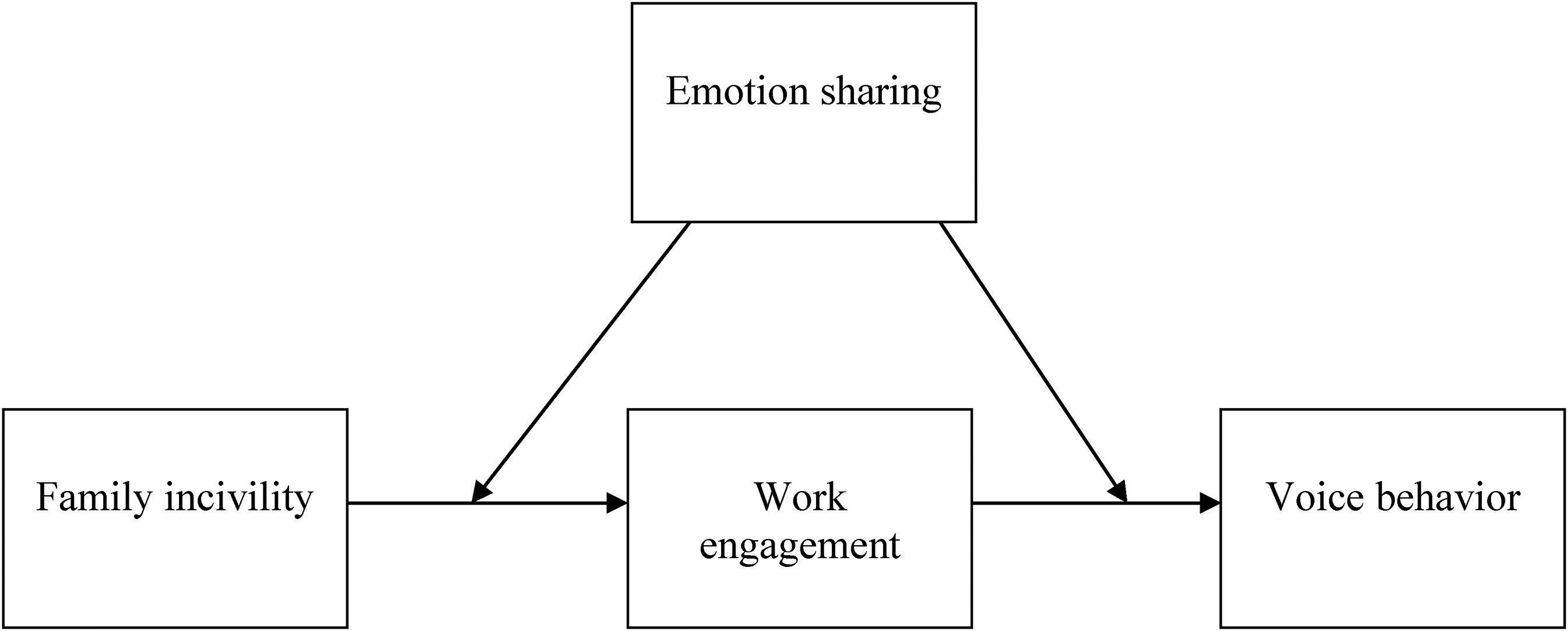
Conceptual model.
Mediating Role of Work Engagement
The hardships that employees experience in one area, such as the family domain, can exert negative influences on their attitudes and behaviors in other areas, such as work (Cheng et al., 2019; Witt & Carlson, 2006). Studies that focus on family-to-work conflict reveal how employees whose family responsibilities undermine their work functioning suffer from depleted energy resource reservoirs in the course of doing their job (De Clercq et al., 2019; Hoobler et al., 2010). Consistent with this COR logic, the negative treatment that employees receive at home may be experienced as highly demanding and intrusive into their positive energy resource reservoirs, which they otherwise could allocate to work-related issues (Hobfoll et al., 2018; Lim & Tai, 2014). Employees exposed to family incivility then may become less engaged with their work, as a way to shield their existing resource bases (Gopalan et al., 2021; Hobfoll, 2001). They focus on their precarious personal situation first, instead of being concerned about how their employer might suffer if they fail to exhibit work-related enthusiasm. In summary, when they are the victims of demeaning treatment by family members, employees likely are deprived of positive work energy and exhibit lower engagement toward work.
When employees exhibit low work engagement, they similarly may reject proactive efforts to bring organizational failures into the open. Their lack of positive work energy—manifest in lower levels of vigor, dedication, and absorption—likely elicits frustration among employees about the limited quality of their work functioning (Alessandri et al., 2018; Azeem et al., 2020). Consistent with COR theory, this resource drainage then may lead to diminished problem-focused voice behaviors, because employees seek to avoid additional resource losses and conserve their valuable time, instead of “wasting” it on reporting organizational problems. As mentioned in the Introduction, problem-focused voice efforts may be received with great skepticism, to the extent that other organizational members feel attacked by these efforts and consider them threats to their personal turf (Bergeron & Thompson, 2020; Chamberlin et al., 2017). Employees who lack engagement with work accordingly may prefer to save their personal energy and exhibit passivity with respect to organizational failures, instead of expressing their opinions about such failures and dealing with the risk that these reports will be rejected anyway (Huang et al., 2019). The tenets of COR theory similarly predict that employees tend to be motivated to leverage positive work energy, achieved through high levels of work engagement, in productive work behaviors that might generate further resource gains (Hobfoll et al., 2018). In the context of this study, highly engaged employees might receive organizational recognition for their devoted efforts to bring problems into the open, such that it becomes more likely that they undertake problem-focused voice behaviors (Weiss & Morrison, 2019). In turn, we hypothesize:
These arguments suggest a critical mediating role of work engagement in the translation of family incivility into lower problem-focused voice behavior. Employees who suffer rude treatment by family members are more likely to halt their efforts to pinpoint organizational problem areas, because they do not feel excited about their work (Gopalan et al., 2021; Schaufeli et al., 2006). Therefore, we predict that a key explanatory mechanism that underpins the escalation of family incivility into diminished problem-focused voice behavior is the limited vigor, dedication, and absorption that employees exhibit in the course of doing their work (Aslam et al., 2018). Prior research shows that diminished work engagement can channel adverse work conditions—such as abusive leadership (Huang et al., 2019) or a lack of learning opportunities (Guglielmi et al., 2013)—into negative work outcomes. We complement this research stream by explicating a similar mediating role in relation to employees’ suffering from family-related hardships.
We further apply COR theory to postulate a potentially pertinent moderator of these relationships. The challenges linked to family incivility and the subsequent lack of work engagement may be mitigated if employees have access to supportive relational resources (Hobfoll et al., 2018). Specifically, employees’ emotion sharing with colleagues should moderate the relationships between their exposure to family incivility and work engagement (Hypothesis 1) and between work engagement and problem-focused voice behavior (Hypothesis 2), because such sharing protects them against the resource-depleting effect of disrespectful family treatment, as well as the experience of limited positive work energy.
In line with COR theory, resource-depleting conditions, whether they arise from the workplace or family domain, feel less threatening if employees can counter them with relevant resources (Hobfoll, 2001; Treuren & Fein, 2021). The translation of family incivility into lower work engagement similarly should be less likely in the presence of emotion sharing, because of the benefits that come with the ability to express negative experiences in and of itself, combined with the empathy or support that employees may receive from colleagues who face similar difficulties at home (De Clercq et al., 2019; Stephens et al., 2013). That is, if they can openly express their feelings to colleagues, employees can more easily avoid feeling isolated in terms of their suffering from resource-draining family incivility, if they sense that their family-related challenges are mutually shared with understanding colleagues (Nahapiet & Ghoshal, 1998; Reynolds-Kueny & Shoss, 2021), who in turn may provide them with emotional support (Stephens et al., 2013; Yang, 2014). Similarly, employees with opportunities to share their personal challenges with colleagues might be in a better position to put their family hardships in perspective. That is, if some peers experience similar challenges, or at least can relate to them, employees may develop a sense of being in the same boat and realize they are not the only ones going through difficult times at home (Bai et al., 2016; De Clercq & Belausteguigoitia, 2019). This perception should further diminish their suffering from depleted positive work energy. We therefore postulate:
The translation of tarnished work engagement into lower problem-focused voice behavior also may be subdued if employees can freely exchange their emotions with peers. Previous studies reveal that employees who can express their emotions, both positive and negative, and count on the emotional support of others are better able to shield themselves against and cope with difficult work conditions, such as work overload (De Clercq & Belausteguigoitia, 2019) or role ambiguity (De Clercq & Belausteguigoitia, 2019). They perceive that they are not alone in their precarious situation and become less burdened by it. We similarly propose that emotion sharing may allow employees to deal with the frustrations that stem from their lack of positive work energy, because they can express their frustrations with the experienced work hardships and draw from the emotional support of peers who may confront the same frustrations (Stephens et al., 2013). Similar to their buffering effects on the harmful role of family incivility, such exchanges of emotions may infuse employees with a sense of shared fate, in terms of how they experience day-to-day work activities, so it becomes less likely that their limited work engagement drives them to conserve their resource bases by avoiding problem-focused voice activities (Hobfoll et al., 2018; Huang et al., 2019). Finally, if employees can express their emotional concerns about their own low work engagement to colleagues, they may gain useful insights and reassurances from supportive colleagues (Reynolds-Kueny & Shoss, 2021; Yang, 2014). In turn, the focal employees’ potential resentment toward their employer should be diminished, leaving them still motivated to add to their organization's well-being with some problem-focused voice efforts (Chamberlin et al., 2017).
The integration of the aforementioned arguments predicts a moderated mediation process (Hayes & Rockwood, 2020). To the extent that employees can draw from the relational resource of emotion sharing, the effect of their reduced engagement at work, as a conduit through which resource-draining family incivility curtails problem-focused voice behavior, should be mitigated (Peters & Kashima, 2007). Formally, employees’ propensity to share their emotional concerns with colleagues, and the mental support and sense of solidarity they receive in turn (De Clercq & Belausteguigoitia, 2019; Yang, 2014), should decrease the chances that family incivility escalates into diminished problem-focused voice behavior through lower work engagement. In contrast, if employees cannot count on the emotional support of peers, the likelihood that they exhibit less engagement with their work in response to the incivility they experience at home is more pronounced, and this drainage in positive work energy, in turn, is more likely to escalate into work-related complacency (Hobfoll et al., 2018; Liang et al., 2017). When employees keep their emotions to themselves, lower work engagement becomes a more prominent determinant of how their exposure to family incivility compromises their problem-focused voice efforts.
Research Method
Sample and Data Collection
We tested the research hypotheses with survey data collected among employees who work in a large banking organization based in Mozambique. The company, with its headquarters in the capital city of Maputo, has more than 600 employees and offers a broad portfolio of services, including retail banking, private equity, and international trade warranties. The focus on one specific organization helps avoid the potential effects of unobserved organization- or industry-related factors that can influence the extent to which employees raise their voice about organizational problem situations (Morrison, 2011). Moreover, the banking sector in Mozambique is highly competitive, marked by significant volatility and a multitude of local and international players that compete for limited market space. Thus, organizations need to rely on discretionary efforts by their employees to identify and address internal failures (Barros et al., 2018; Gil-Alana et al., 2017). From this perspective, our investigation of how family-related hardships may steer employees away from dedicated problem-focused voice efforts, and how supportive collegial relationships can mitigate this translation, is highly relevant.
The country setting of Mozambique is interesting, due to the presence of two, potentially opposing, culture-based forces. On the one hand, the high levels of uncertainty avoidance and collectivism that mark Mozambique (Hofstede et al., 2010) imply that employees likely experience disrespectful treatments by people who are close to them (family) as particularly upsetting, which may reinforce their negative responses (e.g., diminished work engagement, problem-focused voice efforts). On the other hand, collectivism also tends to raise colleagues’ considerations of one another's well-being (Hofstede et al., 2010), so the beneficial role of emotion sharing as a protective shield against family incivility and diminished work engagement may be especially potent. These contrasting perspectives make Mozambique a compelling setting to investigate the link between family incivility and problem-focused voice behavior. To be clear though, the arguments that underpin the research hypotheses are not country-specific, so we expect that the proposed relationships should apply to a broad set of countries, yet the strength of the relationships may vary across countries, depending on their pertinent cultural factors.
We leveraged the well-established translation–back-translation approach for the survey development (van Dick et al., 2018). In particular, a first version of the English survey was translated into Portuguese by a bilingual translator, then back-translated into English by another bilingual colleague. After minor discrepancies were addressed, the survey was finalized and administered in Portuguese. The organization's senior management provided a comprehensive list of its employees, which served as the sampling frame. From this list, we selected 300 employees with a random digit generator to avoid selection bias. The contacted employees were promised full confidentiality; we explained that their individual responses would never be shared in any research output, nor would their organization have access to information about who took part in the study. We also emphasized that our research focus was on the detection of general patterns in aggregate data and that the participants could leave the study at any point in time. This well-established set of measures diminishes the chances of acquiescence and social desirability biases (Jordan & Troth, 2020; Spector, 2006). To address the risk of common method bias, due to our reliance on a single survey to collect the data—and associated concerns about demand characteristics, such that participants might alter their responses to match their interpretation of the study objectives (Malhotra, 2010)—the invitation letter that accompanied the survey noted that the goal was to gain insights into employees’ day-to-day work experiences, but it did not detail any specific research questions or hypotheses. Furthermore, we presented the survey questions in a single batch, without any spatial separations between items that captured different constructs or any mention of construct names (Malhotra, 2010). From the 300 initially contacted employees, we received 202 completed surveys, for a response rate of 67%. Among these participating employees, 52% were men and 48% were women, and they had been employed by their organization for an average of 12 years.
Measures
The focal constructs were measured with previously validated scales, applying seven-point Likert anchors that range from “strongly disagree” to “strongly agree.
Family incivility. We assessed the extent to which employees are the victims of rude and disrespectful actions by family members with a six-item scale of family incivility (Lim & Tai, 2014). For example, employees assessed their agreement with items such as “My family members make demeaning or degrading comments about me” and “My family members put me down or are condescending to me” (Cronbach's alpha = .98).
Work engagement. We measured employees’ possession of positive work-related energy with the abbreviated, well-established nine-item version of the Utrecht Work Engagement Scale (Schaufeli et al., 2006). The three dimensions that underpin work engagement (vigor, dedication, and absorption) tend to be highly correlated, as was the case in our study, with correlations that varied between .839 and .911 (all significant at p < .001). Thus, the nine-item measure provides adequate assessments of employees’ engagement levels. The participants rated statements such as “At my job, I feel strong and vigorous,” “When I get up in the morning, I feel like going to work,” and “I am immersed in my work” (Cronbach's alpha = .97).
Problem-focused voice behavior. We assessed the extent to which employees proactively speak up about organizational problem areas with a five-item scale of prohibitive voice (Liang et al., 2012). Two sample items were “I dare to voice out opinions on things that might affect efficiency in my organization, even if that would embarrass others” and “I speak up honestly about problems that might cause serious loss to my organization, even when dissenting opinions exist” (Cronbach's alpha = .91). Our reliance on self-ratings is consistent with approaches taken in prior voice research (e.g., Lin et al., 2019; Tan et al., 2021), and it reflects the argument that employees are best placed to provide comprehensive assessments of their own activities, in comparison with other assessors (e.g., supervisor, colleague) who often have only partial insights into the full range of employees’ voice behaviors (Barry & Wilkinson, 2016; Morrison, 2011).
Emotion sharing. To assess the extent to which employees can openly share their personal feelings and concerns with organizational colleagues, we applied a three-item scale of emotion carrying capacity developed by Stephens et al. (2013, p. 13), who define it as the extent to which “relationship partners express more of their emotions, express both positive and negative emotions, and do so constructively, as a source of resilience in individuals and in teams.” Two example items were “I can fully express my emotions to my colleagues” and “When my colleagues and I interact with each other, we express both positive and negative feelings to each other” (Cronbach's alpha = .92).
Control variables. The empirical analyses accounted for the effects of two demographic characteristics: gender (0 = male; 1 = female) and organizational experience (in years). Men tend to be more forthcoming in expressing their opinions about possibly controversial work issues (Huang et al., 2021), and employees with longer organizational track records likely have more confidence that they will be successful in their voice efforts (Tangirala & Ramanujam, 2008).
Construct validity. In support of the presence of convergent validity, the fit of a four-factor measurement model was adequate: χ2(224) = 670.91, confirmatory fit index = .93, incremental fit index = .93, and Tucker-Lewis index = .91 (Hair et al., 2006). Each measurement item loaded strongly on its corresponding construct (p < .001), and the average variance extracted (AVE) values were each higher than the cut-off value of .50, ranging between .67 and .89 (Bagozzi & Yi, 1988). We also found evidence of discriminant validity, in that the AVE values of all constructs were higher than the squared correlations between corresponding constructs, and the fit of the constrained models in which the correlation between construct pairs was set equal to 1 was significantly worse (Δχ2(1) > 3.84, p < .05) than the fit of unconstrained equivalent models in which these correlations were free to vary (Hair et al., 2006).
Common method bias. In addition to the previously outlined methods to minimize it, we tested for the presence of common method bias with two statistical tests. First, with Harman's one-factor test, using an exploratory factor analysis (Huang Lin, & Lu, 2020; Podsakoff & Organ, 1986), we checked whether any single factor accounted for the majority of the total variance in the data. The first extracted factor represented only 43.8% of the total data variance. Second, we undertook a confirmatory factor analysis to assess the comparative fit of a one-factor model, in which the measurement items for the four predicted constructs loaded on a single construct, with the fit of the four-factor model. The one-factor model exhibited significantly worse fit (χ2(6) = 2,826.84, p < .001), offering additional evidence that common method bias was not a concern (Lattin et al., 2003). Finally, from a conceptual perspective, the likelihood of this bias decreases substantially for conceptual models that include one or more moderating effects, because it is difficult for participants to predict the research hypotheses and adjust their responses to match those predictions (Simons & Peterson, 2000).
Analytical Procedure
The research hypotheses were tested with the Process macro developed by Hayes et al. (2017). A notable benefit of this macro is that, in addition to calculating individual paths, it provides an encompassing evaluation of mediation and moderation effects, which is a key reason for its widespread application in empirical tests of conceptual frameworks that include moderated mediation dynamics (e.g., Barthauer et al., 2020; Wang et al., 2018). Furthermore, the Process macro does not make assumptions about the normality of indirect and conditionally indirect effects; rather, it formally tests for the possibility of asymmetric sampling distributions, through its reliance on bootstrapping (Hayes et al., 2017).
To test for the presence of mediation, we applied Process Model 4 and estimated the confidence interval (CI) for the indirect relationship between family incivility and problem-focused voice behavior, through work engagement. In this first stage, we also assessed the signs and significance of the associated direct paths between family incivility and work engagement, then between work engagement and problem-focused voice behavior. Next, to check for the presence of moderated mediation, we applied Process Model 58 and estimated the CIs for the conditional indirect effects. As explicated in Hayess (2018) Process macro, the CIs refer to three distinct levels of the moderating variable: one standard deviation (SD) below its mean, at its mean, and one SD above its mean. Consistent with the proposed theoretical framework, the calculated model included a moderating role of emotion sharing in the relationships between family incivility and work engagement and between work engagement and problem-focused voice behavior. In this second stage, we also evaluated the moderating role of emotion sharing in the direct paths between family incivility and work engagement and then between work engagement and problem-focused voice behavior.
Results
Table 1 lists the bivariate correlations and descriptive statistics, and Table 2 lists the mediation findings generated from the Process macro. Family incivility is negatively related to work engagement (β = -.184, p < .001, Hypothesis 1); work engagement is positively related to problem-focused voice behavior (β = .616, p < .001, Hypothesis 2). The test for mediation indicates an effect size of -.113 for the indirect relationship between family incivility and problem-focused voice behavior, through work engagement. Its CI does not include 0 [-.217, -.032], so we find support for the presence of a mediating effect by work engagement (Hypothesis 3).
Correlation Table and Descriptive Statistics.
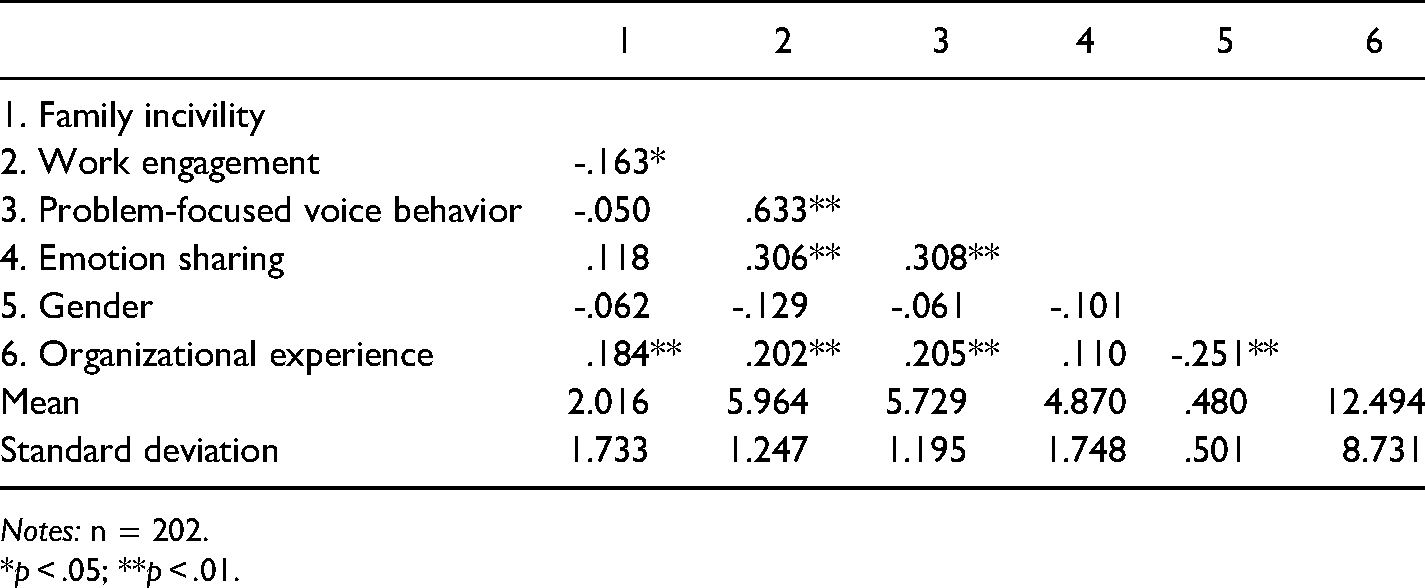
Notes: n = 202.
*p < .05; **p < .01.
Mediation Results (Process Macro).
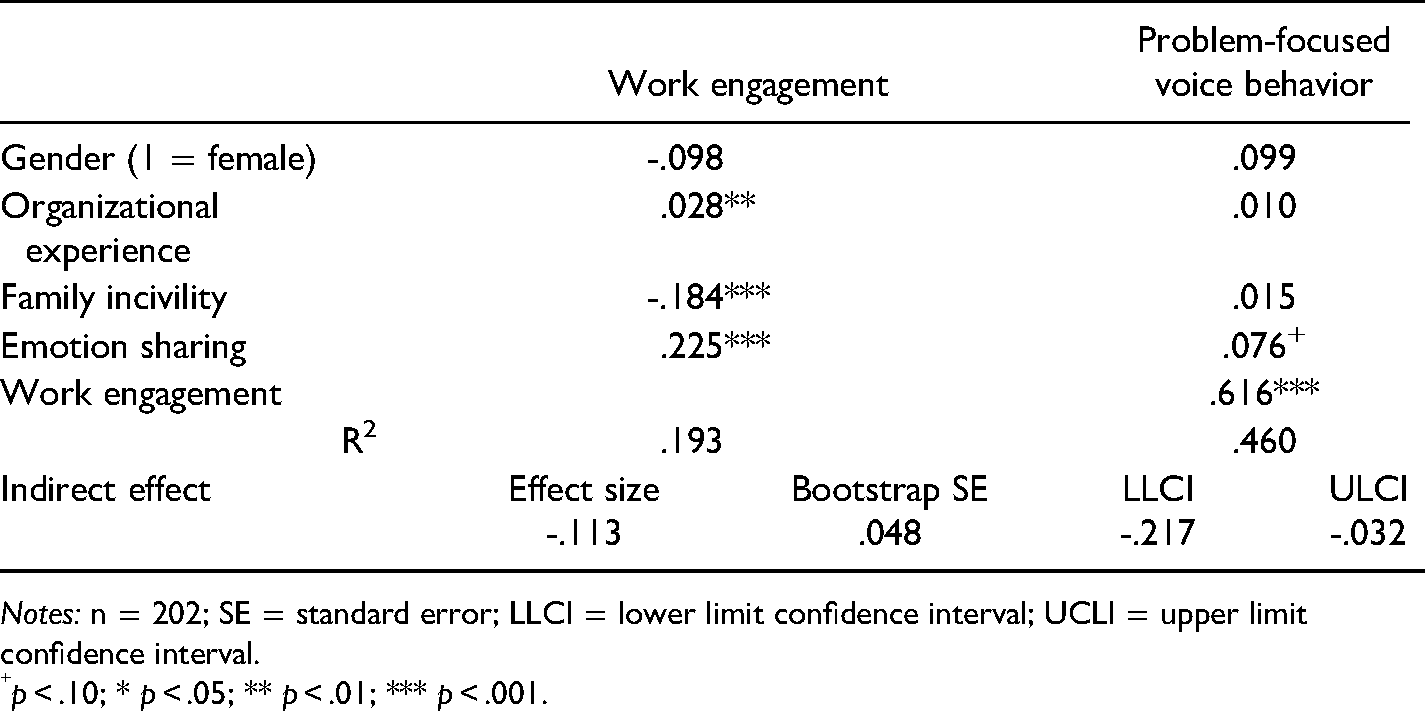
Notes: n = 202; SE = standard error; LLCI = lower limit confidence interval; UCLI = upper limit confidence interval.
p < .10; * p < .05; ** p < .01; *** p < .001.
The findings in Table 3 reveal a positive, significant effect of the family incivility × emotion sharing product term (β = .075, p < .01, Hypothesis 4) for predicting work engagement, as well as a negative significant effect of the work engagement × emotion sharing product term (β = -.065, p < .05, Hypothesis 5) for predicting problem-focused voice behavior. These results offer evidence of buffering effects in both relationships. In particular, the Process macro results show that the negative relationship between family incivility and work engagement becomes weaker at higher levels of emotion sharing (-.360 at one SD below, -.185 at the mean, -.085 at one SD above). Focusing on the right side of the conceptual framework, we note that the direct positive relationship between work engagement and job performance, as also reported in Table 3 (β = .528, p < .001), indicates that lower work engagement leads to lower job performance. The negative sign of the product term accordingly indicates diminishing effect sizes of this direct relationship at increasing levels of emotion sharing (.654 at one SD below, .502 at its mean, and .415 at one SD above).
Moderated Mediation Results (Process Macro).
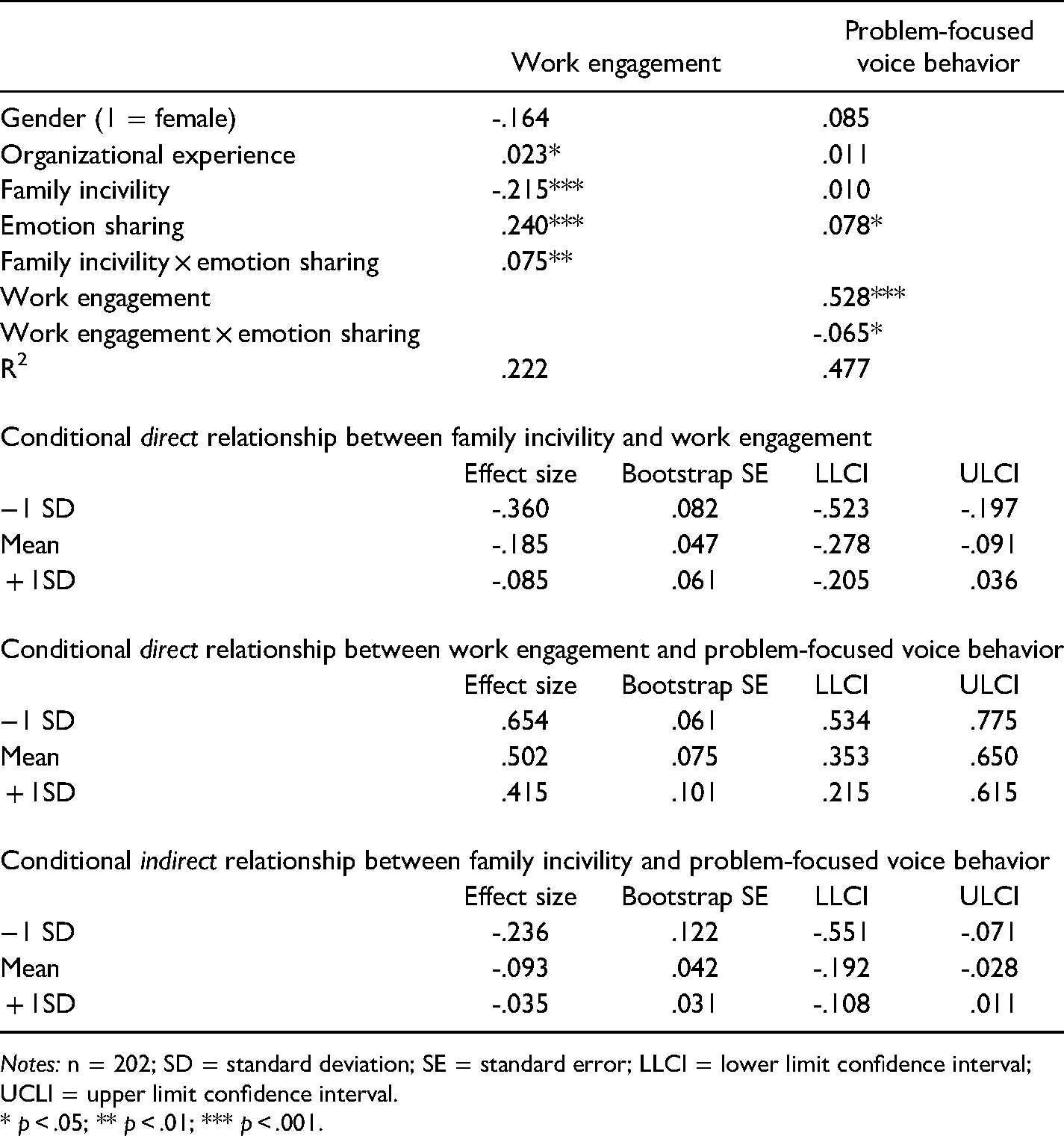
Notes: n = 202; SD = standard deviation; SE = standard error; LLCI = lower limit confidence interval; UCLI = upper limit confidence interval.
* p < .05; ** p < .01; *** p < .001.
To assess the presence of moderated mediation formally, we compare the strength of the conditional indirect relationship between family incivility and problem-focused voice behavior, through work engagement, at different levels of emotion sharing. The results in Table 3 reveal diminishing effect sizes at higher levels of this relational resource: from -.236 at one SD below the mean, to -.093 at the mean, to -.035 at one SD above the mean. These CIs do not span 0 at the two lower levels of the moderator ([-.551; -.071] and [-.192; -.028], respectively), yet the CI entails 0 at its most elevated level ([-.108; .011]). These findings confirm that emotion sharing attenuates the negative indirect relationship between family incivility and problem-focused voice behavior through work engagement, corroborating both Hypothesis 6 and our study's general theoretical model.
Discussion
This study adds to prior research on the negative spillover effects of private hardships onto work lives, by detailing the detrimental role of family incivility in curtailing problem-focused voice behavior, with a specific focus on work features that explain or influence this translation. Previous studies suggest that demeaning family treatments can turn employees away from discretionary work activities (De Clercq et al., 2018; Lim & Tai, 2014); with this study, we go further to clarify the consequences of such incivil treatments in relation to energy-consuming, disruptive work behaviors that are already challenging, as well as why and when family incivility may thwart such activities. By leveraging COR theory (Hobfoll & Shirom, 2000), we propose specifically that the likelihood that employees curtail efforts to voice their opinions about organizational failures in response to family incivility arises because they feel less engaged with their work, whereas emotion sharing opportunities function as protective shields in this process. The statistical results provide support for these conceptual predictions.
This study accordingly expands voice research by providing a key theoretical insight: Employees who confront adverse, demeaning treatment at home may avoid expressing change-invoking opinions about organizational failures, because their positive work energy resource reservoirs have been depleted, as evidenced by their lower work engagement (Alessandri et al., 2018; Schaufeli & Bakker, 2010). By detailing the process by which resource-depleting family incivility compromises proactive attempts to bring negative work situations into the open, we identify a core mechanism by which exposure to family incivility halts employees’ problem-focused voice behaviors: their desire to conserve work-related energy and associated tendency to exhibit low levels of work engagement (Huang et al., 2019). Their drained positive work energy compromises the motivation of employees, suffering from family incivility, to extend themselves in efforts that bring negative organizational situations into the open. We thus pinpoint the risk of a downward spiral, such that employees feel upset about their family situation, exhibit indifference toward work, choose not to contribute to organizational effectiveness with reports of organizational failures, and ultimately might suffer even more hardships, to the extent that their complacent responses diminish their social status at work (Weiss & Morrison, 2019).
A second theoretical implication that arises from this study is that this intermediary role of tarnished work engagement becomes less salient to the extent that employees can rely on the relational resource of emotion sharing (Stephens et al., 2013). That is, the depletion of their positive work energy is a less potent explanation for why the hardships of family-induced mistreatment escalate into lower problem-focused voice behavior in this scenario. In COR theory, the likelihood that employees react to resource-depleting family situations by conserving personal energy devoted to work diminishes when valuable resources help them subdue the corresponding hardships (Choi, 2019; Hobfoll et al., 2018). Employees who feel comfortable openly sharing their emotions with coworkers may feel less isolated and more supported (Yang, 2014), such that they (1) experience rude behaviors in their homes as less intrusive to their professional functioning and remain engaged with their work, despite their adverse family situation, and (2) are more likely to stay focused on efforts to identify problem areas in their organization, despite their potentially limited work engagement. As the results of the moderated mediation analysis emphasize, free expressions of personal feelings are essential for avoiding the aforementioned downward spiral. These expressions prevent employees’ exposure to family incivility from escalating into lower work engagement and then from allowing their lower work engagement to descend into diminished problem-focused voice efforts, which ultimately could compromise their organizational standing (Morrison, 2011).
Overall, this research offers organizational development scholars and professionals more in-depth views of the harmful consequences of family-related hardships for employees’ work functioning. We contribute to burgeoning research into family incivility by pinpointing (1) how a lack of engagement with work links this notable form of family adversity to diminished problem-focused voice behavior and (2) how employees’ emotion sharing contains the conversion of family incivility into lower problem-focused voice behavior through work engagement. Significantly, our study extends prior research that attends to the direct effects of free emotion exchanges among employees, as a relational resource that enhances organizational commitment (Reynolds-Kueny & Shoss, 2021) and group cohesion (Yang, 2014). Instead, we detail an indirect but no less instrumental function of emotion sharing: It offers protection against the danger that rude treatment by family members culminates in employees’ hesitance to add to their employer's success with reports of problem areas, due to the challenges they experience with remaining engaged with work.
Limitations and Future Research
Some shortcomings of this study can pave paths for continued investigations. First, we identify work engagement as an important conduit between family incivility and lower problem-focused voice efforts; additional research could examine other factors, such as employees’ job involvement (Wu et al., 2015) or organizational commitment (Pooja et al., 2016). Such studies also might examine whether the intermediate role of work engagement is robust even after accounting for the effects of related but distinct work attitudes. In a similar vein, our predictions underscore the influence of employees’ desire to conserve their personal resource bases in explaining why family incivility translates into diminished problem-focused voice behavior, through work engagement; further examinations could explicitly assess this mechanism.
Second, we focus on emotion sharing as an instrumental, relational resource that buffers or immunizes employees against the translation of family incivility into lower work engagement and problem-focused voice behavior, consistent with findings that show how demeaning family treatment tends to generate significant emotional hardships (Lim & Tai, 2014; Sharma & Mishra, 2021). We theorize different (unmeasured) mechanisms that underpin this buffering role, such as the mere ability to vent and share negative feelings, the experience of empathy from colleagues who encounter similar negative experiences at home, or the reciprocation of such emotion sharing by these colleagues; future research could explicitly assess these different mechanisms. Yet another limitation is that the proposed buffering role of emotion sharing is predicated on the untested premise that employees are able to vent their emotions about family issues (Hypothesis 4) or diminished work engagement (Hypothesis 5) specifically, even if the operationalization of this construct captures the sharing of emotions in general. Continued research could explore a more indirect, beneficial role of emotion sharing too, such that an increased sensitivity to and understanding of emotion-laden situations, due to experiences with family incivility, may enable employees to cope with stressful situations at work in general. The ultimate outcome then might be that they remain committed to some level of problem-focused voice, despite diminished work engagement caused by family-induced hardships.
Third, further studies could consider other contingency factors that operate at the relational level, different from emotion sharing, such as the level of value congruence among employees (Wang et al., 2012) or leader–member exchange (Choi, 2019). One interesting organizational contingency could be the extent to which speaking up about problem areas is an acceptable practice, according to the organization's work climate (Morrison, 2011). In climates in which these efforts are discouraged, employees may respond particularly vigorously to experienced family incivility with a reluctance to express their views about organizational failures, as informed by their expectations that these views will be ignored or rejected (Chamberlin et al., 2017). In turn, pertinent individual characteristics may play a role too, such as employees’ resilience (De Clercq & Belausteguigoitia, 2019) or emotion regulation skills (Grant, 2013). It would be interesting to compare the relative potency of various relational and personal buffers, as well as to establish whether the role of emotion sharing holds beyond these effects.
Fourth, the theoretical logic behind our hypothesized relationships is not country-specific, which enhances the external validity of the findings. As mentioned in the Research method section, we do not expect that the signs of the hypothesized relationships should vary across countries, but their strength might. In this regard, we note the potentially opposing outcomes of a cultural value such as collectivism, which might increase the offense employees take when confronted by family incivility but also their appreciation for emotional support from coworkers (Hofstede et al., 2010). With our single-country focus, we cannot test the influence of macro-level cultural values on the strength of the proposed relationships, so multicultural studies should address this issue. A related extension might investigate corresponding individual values, such as employees’ own intolerance for risk (Loi & Ngo, 2010) or collectivistic orientation (Hui et al., 2014).
Practical Implications
This study has critical implications for organizational practice. Demeaning behaviors by others at home can spill into the workplace and compromise the nature and quality of employees’ work-related activities. A notable challenge is that many employees may be hesitant to admit to problems at home, out of a sense of professionalism or so as not to appear vulnerable (Lim & Tai, 2014). But emotional hardships due to disrespectful family treatments can be excruciating and generate indifference toward work-related issues, as this study reveals. Organizational development professionals thus should prioritize employees’ family-related suffering if it comes up in discussions about their work functioning, as well as encourage them to express how their family troubles may be interfering with their work. Employee assistance programs (EAPs) could have a key role to play in this sense, in terms of identifying employees who are experiencing family-related problems and helping them find ways to resolve the problems, such as with counseling services that show them how to keep negative family experiences from spilling over into their work domain (Hsu et al., 2020). During performance reviews, dedicated managers also might invite employees to think about how their motivation to identify and resolve organizational failures can be tarnished by stressful situations at home (Haar, 2017). By setting specific performance targets related to reporting organizational concerns, with some set frequency, as well as suggestions for how to meet those targets (Morrison, 2011), supervisors might reduce the chances that employees’ problem-focused voice efforts get undermined by their limited sense of work engagement due to family-related hardships.
Beyond this advice to identify employees who are suffering from family incivility, we recognize that organizations might be unable to address the underlying issues fully, considering their private, sensitive nature (Sharma & Mishra, 2021). But as this study shows, employees who are victimized by disrespectful behaviors at home can greatly benefit from the emotional support of colleagues who are open to hearing about their concerns and struggles (Reynolds-Kueny & Shoss, 2021). A sense that someone is willing to listen offers peace of mind to most people, so it might help employees to limit negative family spillovers to their work functioning. With the positive work energy that they can maintain in this case, they may remain invested in contributing to their employer's success, such as by allocating valuable time and effort to problem-focused voice behaviors (Cheng et al., 2014). To encourage emotion sharing, organizational development professionals could organize corporate events, inside or outside the workplace, that help employees connect on a personal level and encourage them to share their challenges or ideas to immunize themselves from the negative influences of private-life difficulties on dedicated work efforts.
Conclusion
With this research, we complement prior investigations by examining the link between employees’ exposure to family incivility and their problem-focused voice behavior, with special attention to the roles of their work engagement and emotion sharing. Disrespectful treatments at home undermine a willingness to bring organizational failures into the open, by depleting employees’ work-related energy, as is apparent in their limited work engagement. This dysfunctional role of diminished work engagement depends on the nature of employees’ exchanges with colleagues too. When employees choose not to keep their emotional concerns to themselves and instead share them openly with others, the probability that family incivility compromises their propensities to add to organizational effectiveness with devoted problem-focused voice efforts, due to reduced work engagement levels, is subdued. We hope these insights can provide a springboard for continued investigations of how organizations can avoid work-related complacency among their workforce, even in the face of family-induced adversity.
Footnotes
Declaration of Conflicting Interests
The author(s) declared no potential conflicts of interest with respect to the research, authorship, and/or publication of this article.
Funding
The author(s) received no financial support for the research, authorship and/or publication of this article.
