




Abstract
This paper investigates the role of microlearning on cost-efficiency on knowledge transfer in a project-based organization. As part of an action research study in a Norwegian public sector organization working with construction projects, a microlearning series was initiated to increase knowledge transfer on cost-efficiency. Seven microlearning lessons were distributed to 334 employees, including short questionnaires after the first and last lesson. The study reflects on the design process of the lessons, on the participation rate, and on how it contributes to an increase of knowledge. Microlearning was perceived as relevant by the participants. It makes knowledge transfer less arbitrary by providing a common body of knowledge to all project teams. For the organizational practice, this implies that microlearning also has potential for knowledge sharing on other topics in the project-based organization. Updating the microlearning series with further examples and new lessons is expected to contribute to continuous learning on cost-efficiency.
Keywords
Introduction
The high price tag and cost overruns of public construction projects are commonly known, and cost increases both in the planning stages and during construction are widely discussed in the media. An example for this is a construction project carried out by the Norwegian Parliament in which costs more than doubled from 1.1 to 2.3 billion Norwegian Crowns (NOK) during the construction phase (Schinstad, 2018). The list of cost increases in public projects is long: the new Berlin-Brandenburg airport, the Elbphilharmonie in Germany, or older projects like the Channel Tunnel or the Sydney Opera House. In the end, the taxpayers must pay the bill. This confronts public construction projects with the challenge to avoid unnecessary high costs. However, international studies found that cost increases in large construction projects have been constantly high during the last 70 years (Flyvbjerg, 2014). This indicates a need for and high potential to optimize knowledge transfer from previous projects to future projects in order to achieve higher cost-efficiency.
Cost-efficiency in construction projects means doing things right, producing an output (e.g. a building) in a competent way and with optimized use of resources (Zidane & Olsson, 2017). The term ‘cost-efficiency’ will in this paper be used to cover all aspects of reducing costs, thus also including cost-effectiveness (achieving the desired outcome with minimal costs, the degree of success or usefulness) (see Zidane and Olsson, 2017, for an extensive discussion of this topic).
This leaves us with the question how to achieve increased knowledge transfer between projects to avoid a reproduction of the same errors leading to cost overruns. It is important to consider the characteristics of a project-based organization in this context. According to PMBOK®, project-based organizations refer to organizational forms using temporary systems (here called projects) for carrying out their work. In a project-based organization, a lack of communication between projects can limit learning to the individual or to each project team. Although each project is unique, there are often project experiences, which are also valuable for other projects. Even if lessons learned from a project are relevant for other projects, a lack of routines and time constraints in the dynamic and hectic project workday hinder good knowledge transfer between projects. Consequently, it is hard to achieve synergies between projects, to transfer best practice examples to future projects and to assure learning from other projects’ failures.
Knowledge transfer between projects can happen in a formal and structured way initiated centrally in the organization, or in an informal way. Training courses, the rotation of resources between project teams or databases to register project experiences are examples of formal tools enabling the transformation of individual knowledge to organizational knowledge. However, the success of a database is dependent on both timely and complete registration, and on project teams taking an active role in retrieving and using the provided information. Conversations with members from other project teams are an example of informal knowledge transfer between project teams.
Formal tools and training require the allocation of time to learning and thus leave the organization with the challenge to dedicate resources towards it. Therefore, it can be beneficial to explore new ways of knowledge transfer, using modern technology to reduce the time investment. The tool of microlearning, short digital action-oriented learning units, has emerged in recent years, both in the corporate and educational sector. Scientific articles on the use and effect of microlearning in an organizational context are still scarce. Microlearning is a tool for quick and effective learning, but the shortness of microlearning lessons and the short duration limit its use for deep learning. Experience from businesses show that microlearning works well to get an introduction into a topic, and that design and content of the microlearning must be relevant for the project resources. Relevant content can include topics from similar projects, communicated in a way that other project teams can identify with. The idea is to provide a common knowledge foundation on cost-efficiency for the project teams. It is expected that the teams integrate elements from the microlearning into their own projects, either consciously or unconsciously.
The study is executed at a Norwegian public sector company, the government's key advisor in construction and property affairs, building commissioner, property manager, and property developer. The focus is on the company's activities as a building commissioner working with public construction projects. Although the organization is committed to cost-efficiency, knowledge transfer from one project to the other does not happen automatically, especially due to a lack of time during a busy workday and partly due to a lack of tools for sharing information. In the research context of a 2-year-long strategic project to increase cost-efficiency in the organization's construction projects, the researcher developed a series of microlearning on cost-efficient construction projects. In seven lessons, different aspects of the topic were presented to the employees, with a practical approach based on examples from the organization's own projects.
This paper is exploring how a project-based organization can tackle the problem of knowledge transfer on the topic of cost-efficiency. The author specifically investigates to what degree a microlearning series on cost-efficiency in construction projects can contribute to foster learning and eventually increase cost-efficiency in future projects. The following research questions (RQs) are addressed in this article:
RQ 1: What was the reception and perceived relevance of this microlearning series on cost-efficient construction projects? RQ 2: How can a microlearning series serve as an enabler for continuous learning between projects? RQ 3: To what degree can a microlearning series fulfill the needs of a project-based organization?
After an overview of the theoretical background of knowledge transfer and microlearning, as well as an account of the methodology used in this study, the results will be presented and discussed. Limitations and suggestions for further research and answers to the RQs conclude the paper.
Theoretical Background
Learning and Knowledge Transfer in a Project-Based Organization
The importance of organizational learning has been emphasized for several decades, especially after Senge (1990) coined the term of the “learning organization.” “A learning organization is a place where employees excel at creating, acquiring, and transferring knowledge.” (Garvin et al., 2008: 110). This is achieved by the building blocks of a supportive learning environment, concrete learning processes, and leadership reinforcing learning (Garvin et al., 2008). Knowledge management comprises all the activities within an organization of how knowledge is handled. Ayas and Zeniuk (2001) point out the importance of an organizational culture conducive to learning especially in a project-based workplace. To work successfully in their projects, project managers need a supportive learning environment, allowing reflective practice and the possibility to question organizational processes (Ayas & Zeniuk, 2001; Garvin et al., 2008). At the same time, teams need common practices to experience a sense of belonging to the organization, especially if project teams are separated, both physically and through their work tasks.
Project teams need the “ability to create a network that will allow other teams to take action as well” to be able to engage in knowledge transfer transmitting both tacit and explicit knowledge to others (Fitzgerald, 2003). For projects, tacit knowledge can be described as the individual's competence arising from previous experience. Explicit knowledge is documented and formalized in documents, instructions, or reports, and thus made available for potential users (Liebowitz, 2001). In a project organization, networks are created within the project teams as well as on an organizational level. The individual team's local cultures of learning can differ to a high degree (Garvin et al., 2008). Rejecting the former idea of learning as sheer knowledge consumption, a learning organization rather should apply a more dynamic concept of “situated curriculum” as a characteristic of a specific community of practice (Gherardi et al., 1998). This means shifting focus from an overemphasis on teaching to the learner's perspective of effective learning (Dowson, 2016). To turn learning into action and to deliver real-world benefits, learning which is adapted to and relevant for the organization is crucial (Dowson, 2016). When learning also entails a habitual change, people and the organization develop simultaneously (Dowson, 2016).
Another challenge is the “stickiness” of knowledge, especially of socially embedded tacit knowledge. Stickiness is used as a metaphor for difficulties encountered in transferring knowledge and describes how much effort is needed to transfer knowledge (Von Hippel, 1994). There is a tendency that problems are only solved where the needed knowledge is available (Von Hippel, 1994). Translated to a project-based organization, relevant knowledge to solve a problem can be “sticky” to one project team and is not necessarily available for another project team to solve a similar problem. This is in line with the findings by Wiewiora et al. (2009) that there tends to be little direct communication of documented lessons learned between separate project teams in a construction company. However, in the public sector, people tend to remain in their positions and thus enable frequent interaction and knowledge exchange between team members from different projects (Wiewiora et al., 2009). Nevertheless, people might hold back information about their faults if there is a company culture where “bad news” is not welcome (Wiewiora et al., 2009). Findings of an analysis of internal stickiness of knowledge transfer “suggest that knowledge-related barriers—recipient's lack of absorptive capacity, causal ambiguity, and the arduousness of the relationship between source and recipient—are most important impediments to knowledge transfer within the firm” (Szulanski, 1996: 37).
Although a project-based organization is conducive to individual learning as a lot of knowledge is created in projects, organizational “[l]earning is not a natural outcome of projects” (Ayas & Zeniuk, 2001: 64). Organizational learning is hindered by the projects’ temporality and the exchange of key personnel (Jafari et al., 2011), as well as a lack of incentives and the absence of effective user-friendly systems for knowledge sharing (Ajmal et al., 2010). To achieve a state of reflective practice, knowledge created in one project must be diffused to others and lessons learned must be shared across projects (Ayas & Zeniuk, 2001). In that way, “projects may serve as practice fields for developing learning capabilities and cultivating effective habits of reflective practice that cross the boundaries of the specific project or project team” (Ayas & Zeniuk, 2001: 62).
In this context, it is necessary to mention that learning and knowledge transfer goes beyond the exchange of information. Whereas information can be described as patterned data, knowledge is the capability to act and “includes the set of facts and rules of thumb that experts have acquired over many years of experience” (Liebowitz, 2001: 1). The transfer of knowledge is more relevant and more challenging than transferring mere information.
Knowledge management is about creating added value from the organization's intangible assets (Liebowitz, 2001). In order to achieve this, knowledge management models aim at creating value-adding organizational processes leading to improved organizational operation (Jafari et al., 2011). The Fraunhofer IPK knowledge management model as described by Jafari et al. (2011) consists of the four elements of (1) creation, (2) storage, (3) distribution, and (4) usage. Likewise, Ordanini et al. (2008) describe the first three of the steps with (1) creation of new knowledge, (2) retention of embedded knowledge, and (3) transfer of shared knowledge, but they do not describe the fourth step of usage.
In a project-based organization, new knowledge is created through experiences in one project, and stored either as individual experience in the minds of the project resources, or in a formal database. Knowledge is then transferred to other projects and used by them. However, time constraints and unwillingness to share lessons learned inhibits effective sharing of knowledge in a project-based organization (Wiewiora et al., 2009). This is partly due to people hoarding information about their faults, or because they are reluctant to pass on their expertise wanting to keep control of the knowledge they possess (Wiewiora et al., 2009). To overcome time constraints and increase knowledge sharing, alternative and less time-consuming ways than traditional methods to share knowledge effectively among projects can be considered. Microlearning can be one of those options.
Microlearning
Microlearning is an emerging form of learning, especially in the corporate environment, which is more than just digital learning of short duration, but an action-oriented learning with immediate relevance (Kapp & Defelice, 2018; Tipton, 2017). Maddox (2018) defines microlearning as “[a]n approach to learning that conveys information about a single, specific idea in a compact and focused manner” and as “[a] learning technique that operates within the learner's working memory capacity and attention span, providing just enough information to achieve a specific, actionable goal.”
Through its multimedia approach and availability on multiple devices, microlearning is designed to appeal to all types of learners, giving them the possibility to decide what, when, where, and how much they want to learn (Gautham AS, 2018). Microlearning can either be an independent learning opportunity or integrated in a larger formal training program (Kapp & Defelice, 2018). It is also well suited to reach decentralized workforces (Paul, 2016). Dolasinski and Reynolds (2020) stress the advantages of microlearning over more traditional forms of learning: It is quick and effective, less time consuming for the learner, flexible, self-directed, and adapted to the short attention span of today's impatient learners. Possibilities for multimedia content and interaction make it playful, interesting, and engaging for employees (Fox, 2016). It is designed to deliver information in a way adapted to how our brain works as the quick experience of learning avoids mental fatigue (Selko, 2019; Shail, 2019). Complex or comprehensive material can be broken down into manageable units with one or two objectives each, sorted either by subtopics or in ascending order of complexity or detail (Kapp & Defelice, 2018; Shail, 2019). An instructional design with one idea at the time avoids excessive cognitive load (Paul, 2016). The presentation of small learning units in spaced intervals assures adaptation to an individual's learning curve, also making it possible to learn in otherwise unproductive waiting moments (Cai et al., 2017). Microlearning is usually comparably inexpensive and easy to customize for the respective business (Scaglione, 2019). Changes and updates are easily implemented to assure that microlearning lessons are up to date at any time (Paul, 2016).
A disadvantage of microlearning is, however, that microlearning is not suitable for deep learning due to the limited amount of knowledge, which can be conveyed (Kapp & Defelice, 2018). Therefore, it works best in contextual settings already familiar to the learner or as a supplement to what employees already know (Paul, 2016). Microlearning can be delivered in several e-learning modules, each on a specific aspect of the same topic delivered in memorable portions (Gautham AS, 2018). Several microlearning modules can constitute an organization's microlearning library (Dolasinski & Reynolds, 2020). Kapp and Defelice (2018) point out a caveat for microlearning sessions: A simple downsizing of existing traditional courses can give problems with design, leading to lower learning effectiveness.
The term nanolearning is often used synonymously to microlearning. Some define nanolearning as even shorter than microlearning with typically 3–5 min instead of 5–15 min (Gautham AS, 2018). The goal to deliver on one learning goal or topic is often more specific for nanolearning due to its shorter duration (Gautham AS, 2018). In the present paper, the more general term microlearning is used, even if the organization used the term nanolearning when sending out the module.
To assess the effect of microlearning, Paul (2016) suggests monitoring the access rate to the microlearning and include quick follow-up questions after the microlearning course. For microlearning with a very practical approach, it can also be assessed if the knowledge acquired in the microlearning is practiced afterwards.
The author could not find any literature on the use of microlearning specifically in a project-based organization. However, the hypothesis seems likely that microlearning can contribute to an increased knowledge transfer between projects as it is a less-time consuming way to convey knowledge and easy to use in an organization, where project teams are dispersed in different locations.
The Research Context of This Study
The present research on microlearning is conducted as one element of a larger action research project on improving cost-efficiency in public construction projects.
Arising from the need to achieve higher cost-efficiency, a Norwegian public sector organization working with public construction projects initiated a strategic project during the years 2018–2020. The organization works on ∼150 construction projects at any point of time, with a total annual investment volume of ∼7.5 billion NOK (≈716 million EUR) in 2019. The defined objective was reducing investment cost by 20% (until 2025) without increasing life cycle costs of the buildings or decreasing customer satisfaction. The aim of the initiative was also increased innovation, forming a more professional and value-creating and knowledge-sharing organization. Stand-alone actions in single projects, such as using new technologies, the use of different contractual approaches or a more effective use of area, had been used in the organization before. Even though these actions can contribute to delivering a valuable project at low cost, this might not be enough to reduce cost significantly and permanently. The challenge is to transfer relevant experience between projects to improve the cost performance of a project portfolio in the long term.
As part of a small team working on this project, the author engaged into the strategic project as an internal practitioner-researcher. The researcher was well immersed in the organization before she became an active participant in the strategic initiative and was thus aware of the organizational preconditions and constraints. Engaging into an internal project trying to solve a practical problem and aim at improvements combined with research on the project makes the overall research project an action research project.
Different activities have been performed during the strategic initiative. On the organizational level, targets for cost-efficiency were included into the key performance indicators, ensuring managerial focus. On the project level, engaging practitioners in the cocreation of measures for cost-efficiency was essential. In total, meetings with 75 project teams (mainly project managers and project controllers) were conducted. In the meetings, so-called “value cards” were established for each project with the purpose of maximizing the value generated by the project while minimizing project costs. On the cards, cost-reducing actions for the respective project were categorized along the topics of “analysis of needs/concept,” “standardization,” “new contractual models,” “technology/digitalization,” “engineering costs,” “cost estimation and control,” and “project organization.” The cards were used in practice for reference, follow up, and information sharing among the projects. However, a need for broader distribution of both information on cost-efficiency and on concrete measures taken in the projects arose from these “value meetings”.
As one attempt to increase knowledge sharing on cost-efficiency, a microlearning unit with seven sequential lessons was created, executed, and evaluated. This microlearning unit is investigated in this study.
Methodology
Action research is an approach of applied research “designed to find the most effective way to bring about a desired social change or to solve a practical problem, usually in collaboration with those being researched.” (SAGE, 2020). A parallel process of organizational change and research serves as “a means of both changing the system and generating critical knowledge about it” (Susman & Evered, 1978: 586). Action research is contextual in nature and as such deeply rooted in the reality of the organization. In this type of “situated inquiry,” research is considered more as a process than as a product, might not be replicable under other circumstances, and thus does not aim at generalizability (Law, 2004). For the validity of the research, this implies “to make the best possible use of these tools [research methods] within the constraints of the workplace” (Somekh, 1995: 341). Action research of high validity helps practitioners to make better-informed decisions based on a deepened understanding of complex situations (Somekh, 1995). Reflectiveness of the process and awareness of choices can assure the quality of action research and its validity (Reason, 2006).
With this methodological background, the researcher developed a series of microlearning lessons on cost-efficiency as part of the larger action research project in a public sector company. The research presented in this paper focuses on the verification of how a microlearning series can contribute to knowledge sharing and is as such not explicitly an action research study, even if the microlearning series has the practical aim of improving the knowledge on cost-efficiency.
In each of the seven lessons, one aspect of the topic of cost-efficient construction projects (see Table 1) was presented to the employees, with examples from the organization's own projects. The lessons were distributed weekly to all employees in four departments of the organization, 334 employees in total. The participants work with construction projects in all project phases, with the administration of buildings, or as technical specialists supporting both construction projects and operations and maintenance of the buildings. The targeted group comprised people in all age groups, career stages, and seniority, with slightly more female than male employees. The vast majority has higher education in the form of a master's degree or similar. Their professions included mostly project managers, engineers, architects, project controllers, technicians, and administrative personnel. All employees were familiar with microlearning as they had been exposed to small microlearning units about other topics for about a year, but with a smaller scope (with one to three lessons). Each lesson took ∼5 min to complete. Participation was voluntary but was encouraged by management. The central topics as well as the content of the lessons including examples from recent construction projects were based on information obtained in meetings with project managers during the past year.
Participation Rates for the Microlearning Lessons (Junglemap Nanolearning, as of June 23, 2020).
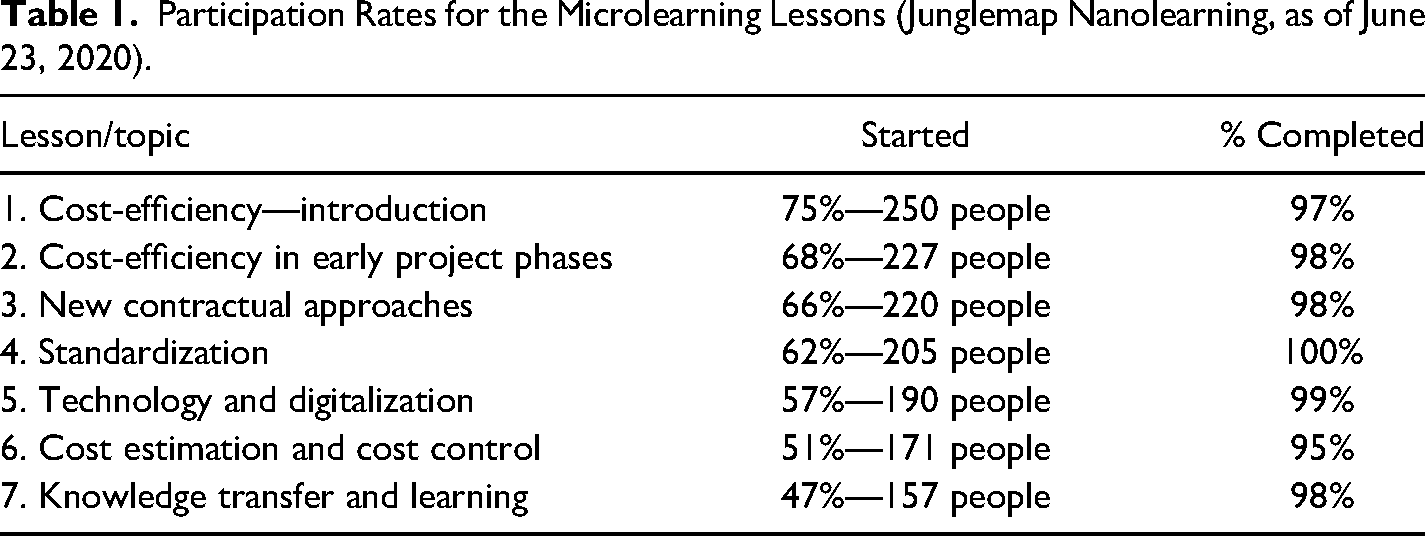
The participation rates vary from 75% (250 people) for lesson 1 to 47% (157 people) for lesson 7, with decreasing rates for each new lesson. After each end lesson, the last page of the lesson gave the participant an overview of which lessons of the course they had already completed. The idea was that the participants take the lessons in sequence, one lesson each week. However, it was not mandatory to complete all lessons in sequence, and the overview gave the participants an idea of their progress and made it possible to complete previous lessons at a later stage. Of those completing lesson 7, only three respondents had omitted previous lessons. Of those having started a lesson, almost all also completed it (with rates ranging from 95% to 100%). Table 1 gives an overview over the participation rates for each lesson.
At the end of the first and seventh lesson, the learners were asked to answer a short quest-back form. A total of 250 respondents answered three questions after the first lesson focusing on the prior knowledge of and attitude to cost-efficiency. A total of 157 respondents answered four questions after the seventh lesson focusing on the learners’ perception of the microlearning series. In most of the questions, answers were required on a 5-point Likert scale, where the participants express the degree to which they agree to the statement. The question concerning the relevance of the microlearning series was a closed question with yes or no as alternative answers. After ended microlearning, the researcher analyzed participation rates for each lesson and the answers to the quest-back form questions and evaluated them with basic statistical methods. The significance of the differences was tested with a paired samples t-test to test if the knowledge on cost-efficiency and on the perception of organizational tools and systems changed significantly. The test was performed on all complete datasets, that is, in those cases, where participants had answered both the questions after first and seventh lesson (n = 153). Data from the quest-back form were used to answer RQ 1.
To assure a combination of practical relevance and reflectiveness, the answers to RQs 2 and 3 are based on the researcher's reflection in the design phase of the microlearning, as well as on feedback from participants and other involved colleagues. For each lesson, the researcher collected both relevant information from literature and examples for cost-efficiency from meetings with project managers. These were then put together in short lessons and reflected on with colleagues with expert knowledge on the respective topic. An employee from the internal training department assisted with reflections on the design of the lessons, focusing on the presentation of content and language.
The researcher had the role of initiating the microlearning and creating the content of the lessons. Reflectiveness and quality control were increased by involving several people into the creation of the lessons. The researcher also engaged in a dialogue with the heads of department to encourage participation in the microlearning. As the researcher was an insider employed in the organization and an active team member in the larger organizational strategic project, this entailed previous knowledge of the organization and thus a certain degree of bias. However, in an action research context, this is rather considered an advantage as it allows to focus on the problem at hand and build on the researcher's closeness to the organizational setting while simultaneously take a researcher's distance to see things critically and make change possible (Coghlan, 2007). This also allowed for easier customization of the design and content of the microlearning to the needs of the organization. A high level of reflectiveness on both actions and analysis of the results aimed at reducing bias in the research process.
Results
The Design of the Microlearning and its Desired Effect
Design and Practical Aspects
In the process of developing the microlearning, practical aspects were of high importance to engage as many of the recipients as possible. The researcher worked closely together with resources responsible for internal training, considering the aspects of timing and length, design elements and accessibility, and commitment.
Timing and Length
The series of seven microlearning units was scheduled in the weeks between winter break and Easter, with one weekly lesson. No other microlearning campaign for the same target group was conducted at the same time. The links to new lessons were sent out each Tuesday at 7:30 am, as it was expected that it would be easiest to catch the attention of the recipients at the start of their workday. Lessons were kept short, with an estimated maximum execution time of 5 minutes. This also allows to use otherwise unproductive time spans, such as travelling to work by public transport, or short waiting periods, such as time until a meeting starts, to complete a lesson. Progress is logged to facilitate completion of a started lesson at a later point of time. In addition, after the first lessons, the Covid-19 lockdown put the majority of the participants into home office. Whereas all courses with presence in the classroom were cancelled, the digital online lessons could continue as planned.
Design Elements and Accessibility
Lessons were created with a maximum of seven pages, with each page focusing on one aspect of the topic. Poignant and clear language as well as good illustrations or pictures were important. Some lessons also contained a short video-clip (30–60 seconds). Video and sound enhance the user experience, but it was made sure that they had subtitles to allow to completion of the lesson independent of sound or the availability of headphones. Easy accessibility was assured by providing the microlearning on a flexible platform without extra log-in, allowing access from both PC and mobile devices. Short lessons and intuitive layout also contributed to smartphone-friendliness. Distribution happened through automated mailing from the platform, including automated reminders if participants had not completed the lessons within a set number of days. The threshold to start a lesson was kept as low as possible as lessons can be accessed directly through the link from the invitation e-mail. When the participants had completed a lesson, a page displayed if there were any available lessons which they had not completed yet. This should make it easier for them to turn to and complete any outstanding lessons.
Commitment
Participation of the relevant departments was clarified with the departmental manager beforehand. Managers were asked to encourage their employees to participate in the microlearning. The start of the microlearning was also announced on the organization's intranet just before the launch of the first lesson.
Content
The microlearning series was part of a larger program to increase cost-efficiency of the construction projects. The guiding principle when developing the lessons was relevance of the presented cost-efficiency measures for most of the projects. This entails that the lessons had to cover topics of general interest. The choice of overall themes is based on the previous experience from construction projects as well as 1 year of meetings with ongoing construction projects, identifying measures for cost reduction.
To assure high quality of the content of each lesson, the researcher involved specialists in the elaboration of each topic. The aim was to write the lessons with a balance of a general introduction into the topic at hand, but with many concrete examples from the construction projects. To avoid lengthy lessons, the content was written as compact as possible and links to documents or websites were provided for those who wish to immerse themselves more into the topic.
Desired Effect
The desired effect of the microlearning campaign was two-fold: One aspect was the direct transfer of information and knowledge from previous projects to ongoing projects. Participants could enlarge their knowledge of areas where cost reduction is possible and get to know concrete examples, which worked in other projects. The other aspect, which goes beyond pure knowledge transfer, was to arise attention towards cost-efficiency in construction projects. Microlearning can help to enhance corporate messaging, making it obvious for the employees that this is an important topic for the top management. Scaglione (2019) summarizes the desired effect of microlearning: “Employees not only receive a quick burst of content that is relevant to their jobs, they’re also reminded that you [i.e. the management of the organization] value” the addressed topic.
After the microlearning campaign, the lessons were also made accessible in the internal central learning platform. In that way, also employees who want repetition or who are new to the organization can use the lessons in the future. This also gives the possibility to update the lessons with new information or to add new lessons to emerging topics.
The Topics Covered in the Microlearning Lessons
The topics covered in the microlearning lessons (see Table 1) were chosen based initial internal studies on cost drivers in construction projects and on topics emerging in meetings, which were held with each ongoing construction project in the course of the previous year. In these meetings, participants discussed which measures for cost-efficiency the project had taken, which measures could be initiated, and which effect the chosen measures are expected to have on the costs of the project. The measures were then assembled and grouped according to topics to make it easier for other projects to learn from them. The following topics were found to be most popular, reflect the whole life span of the construction projects, and have the highest impact on cost: (1) cost-efficiency in the early project phases, (2) new contractual approaches, (3) standardization, (4) digitalization and technology, and (5) cost estimation and cost control. For each topic, the researcher picked best practice examples from the meetings with the projects and included them into the microlearning. These five topics formed the core of the microlearning as the central lessons. The first lessons served as an introductory lesson on cost-efficient construction projects in order to set the scene, and the last lesson on knowledge transfer and learning served to round up the topic and give a perspective into how the organization works now with transferring knowledge between projects and how this can be improved in the future.
The Reception and Relevance of Microlearning
Approximately half of the target group completed the seventh lesson, and a higher number completed the earlier lessons, with the highest participation rate (75%) for the first lesson (see Table 1). As the microlearning series was designed to give participants full anonymity, no conclusions on the demographics of those having participated versus the whole target group are possible. In order to assess the relevance and the learning effect of the microlearning campaign for the participants, small quest-back forms constituted the last page of the first and last lesson. Lessons were only registered as completed when all questions were answered. At the end of the first introductory lesson, three questions served to assess the level of knowledge and the attitude of the participants towards the topic of cost-efficient construction projects. After completion of the course (lesson 7), four questions were asked to evaluate how the course affected the participants and if it changed their attitude towards cost-efficient construction projects. Table 2 gives an overview of questions and distribution of answers both after the first and seventh lesson.
Questions and Answers After the First and Seventh Microlearning Lesson.
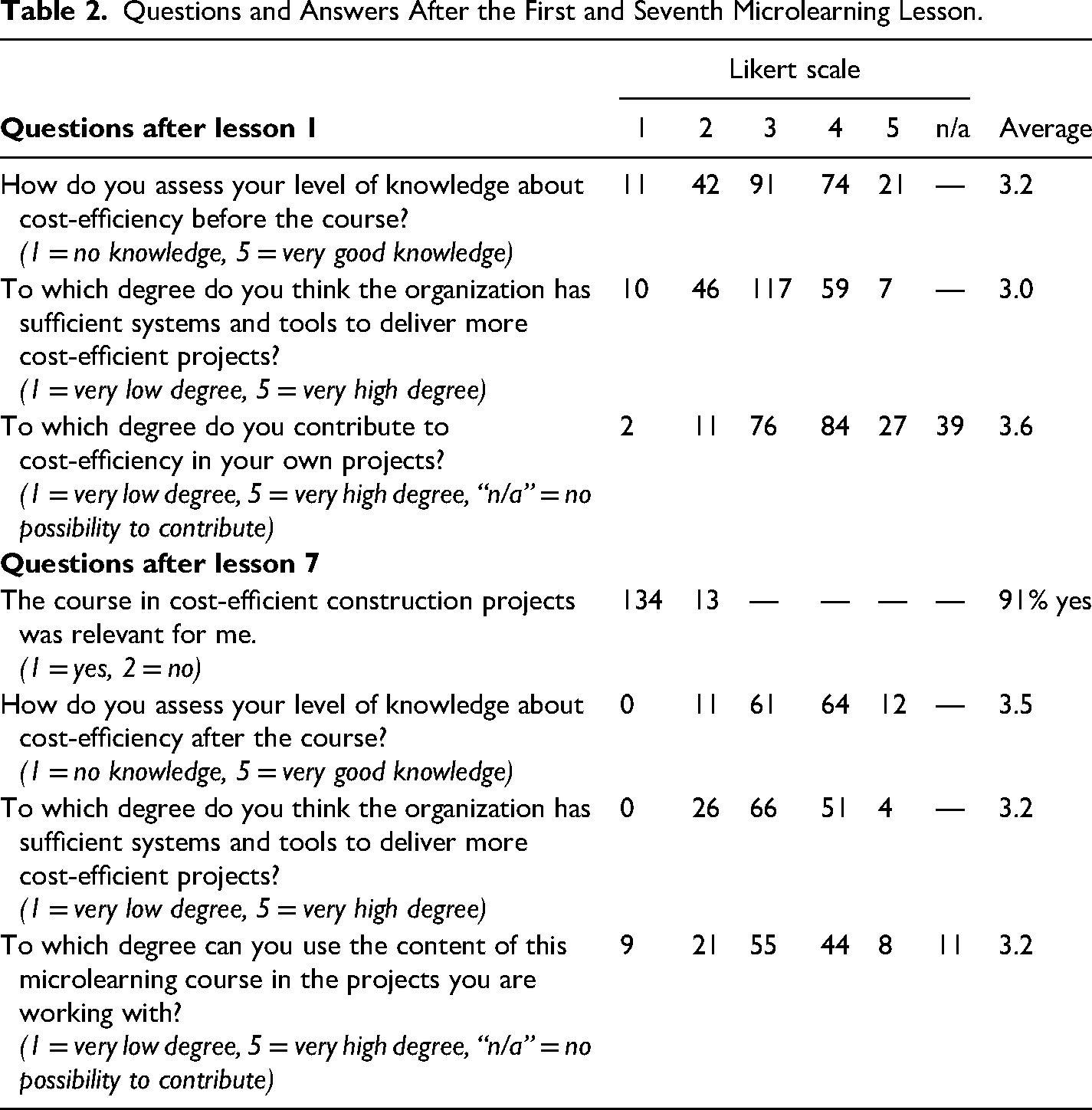
The scores on the 5-point Likert scale give an indication of how the respondents assess their own knowledge of and attitude towards cost-efficiency in construction projects. The scores of all questions illustrate that the respondents on average assume to have “medium” knowledge of cost-efficiency before the course, and that they are passably content with the organization's tools and systems to deliver more cost-efficient projects. The average score of 3.6 for people's own contribution to cost-efficiency indicates that most of the participants contribute to deliver cost-efficient projects to a medium to high degree. For the first two questions, the mode of the answers is 3, which corresponds to the mean (or average) score of 3.2 and 3.0, respectively. The third question has a higher mode of 4. When asked about the degree of their contribution to cost-efficiency in their projects, a larger number of participants evaluate their contribution as quite high as those evaluating their contribution as quite low. Nevertheless, 39 people answer that this is not applicable for them, i.e. that they have no possibility to contribute to cost-efficiency.
At the end of the course, 91% of the learners evaluated the microlearning-course as relevant for them. This is a high share given that the learning module was sent out to everybody in the chosen departments. It indicates that the lessons have covered relevant topics and communicated them in a way, which was perceived as relevant for the respondents. Although the assumption seems likely that a higher share of that those answering that they have no possibility to influence cost-efficiency in their construction projects have not completed the whole course, this is not the case: A 66.7% share of this group completed all lessons, which is not significantly different from the 66.5% completion rate for the group assigning themselves a certain degree of influence on cost-efficiency. However, a higher share of respondents from the “no possibility to influence” group evaluated the microlearning course as not useful for them (19.2% compared to 8.5%).
For the next two questions, the average result is slightly higher than at the start of the microlearning: The average level of knowledge about cost-efficiency was assessed to be at 3.5 of 5, which is on average 0.3 points higher than before the microlearning, and the mode has moved from 3 to 4 for this question. Considering only the participants having answered this question both after the first and last lesson (n = 153), the mean changed from 3.25 to 3.56. The paired samples means difference tests show that the change in perception of the knowledge level is significant at a 0.05 significance level, meaning that there is a significant increase in knowledge for those having completed the microlearning series. Concerning the degree to which they think that the organization has sufficient tools for cost-efficiency, the average value has slightly increased with 0.2 points from 3.0 to 3.2. For those having answered this question in both the first and last lesson (n = 152), the change was from 2.97 to 3.23. The paired samples means difference tests show that this difference is significant at a 0.05 significance level, meaning that the participants have a more positive perception of the organizational tools for cost-efficiency after having completed the microlearning. The last question concerned the degree to which the participants can use the content of the microlearning in the projects they are working with. This gave an average result of 3.2 of 5 points, or a medium degree to which people think that they can implement the newly acquired knowledge in their projects.
Discussion
Based on the theoretical background, knowledge transfer between projects within the organization is crucial. This can happen as a consequence of direct contact between the source and the recipient of information. However, individual knowledge transfer is an arbitrary process. Direct transfer will not always be possible, especially in large organizations with many separate project teams. The knowledge base of individual knowledge of a project-based organization is almost unlimited, but people's own initiative to share and demand knowledge will determine the amount of knowledge shared. An intermediary can help to systematize knowledge transfer and assure that knowledge transfer is not limited to those projects with strong relations and a good network.
A centrally initiated microlearning on relevant topics seems to be able to serve as an intermediary. The disadvantage is the limitation of information, which is conveyed. However, if effort is put into selecting the most relevant topics and examples, microlearning can contribute to a less arbitrary process of knowledge sharing, as everybody has the chance to receive the same information in a structured way. The reception of the microlearning shows that the majority of the recipients have accepted the offer to participate in at least some of the microlearning lessons. Of those who completed the last lesson, the overweighing majority evaluates the microlearning as relevant for them. The initiative targeted complete departments and was thus not aimed at a very specific target group. Therefore, a variance in relevance of the microlearning series can be expected. This is also reflected by the spread of the answers: While cost-efficiency might presumably be highly relevant for both project managers and project controllers, it might be less relevant for specialist project staff contributing to projects with their specific (technical) expertise. However, as mentioned before, the anonymity of the microlearning does not allow for such conclusions.
Connecting this study on microlearning to the literature on knowledge sharing in a project-based organization, this particular study can be seen as one tool in a learning organization (Senge, 1990), comprising all the building blocks of a supportive learning environment, concrete learning processes, and leadership reinforcing learning (Garvin et al., 2008). Especially in a project-based organization, building networks that allow other teams to repeat actions from one team is very important (Fitzgerald, 2003). The microlearning lessons can contribute to building bridges between the project teams. Learning from examples from previous projects through the microlearning lessons can make it more natural for other project teams to share knowledge, also tacit, openly with others also in other fora. This can reduce the stickiness of knowledge (Von Hippel, 1994; Szulanski, 1996). In that way, individual knowledge from the projects can be transformed to organizational learning as a natural outcome of projects, despite (or maybe because) the temporality of projects (Ayas & Zeniuk, 2001). For the topic of cost-efficiency, a higher degree of learning from other projects even has the practical implication of potential economic savings for the public. As the examples are taken from the context of the organization, it makes it possible to turn learning into action directly (Dowson, 2016) by applying acquired knowledge to the new projects. However, microlearning should rather complement than replace direct communication of lessons learned between project teams (Wiewiora et al., 2009).
Looking back at the literature of knowledge management, Ordanini et al. (2008) identifies three central elements of knowledge management: knowledge creation (new knowledge), retention (embedded knowledge), and transfer (shared knowledge). Jafari et al. (2011) summarize the knowledge management steps as creation, storage, distribution, and usage of knowledge. Figure 1 integrates those elements into a framework together with some of the key outcomes from the presented study and shows the difference between managing tacit versus explicit knowledge. In addition to the elements named by Jafari et al. (2011) and Ordanini et al. (2008), the researcher also integrated the extra step of “acquired knowledge” between “sharing” and “using” knowledge, to stress the fact, that sharing knowledge does not automatically entail an acquisition of knowledge by the recipient and that knowledge can be acquired by the recipient without being used at once. In that way, the framework visualizes how microlearning can contribute to formalize the retention, distribution, and acquisition of knowledge. This framework can also help to understand how much knowledge is transferred or lost in the different stages, in order to avoid stickiness in the knowledge transfer process (Szulanski, 1996).
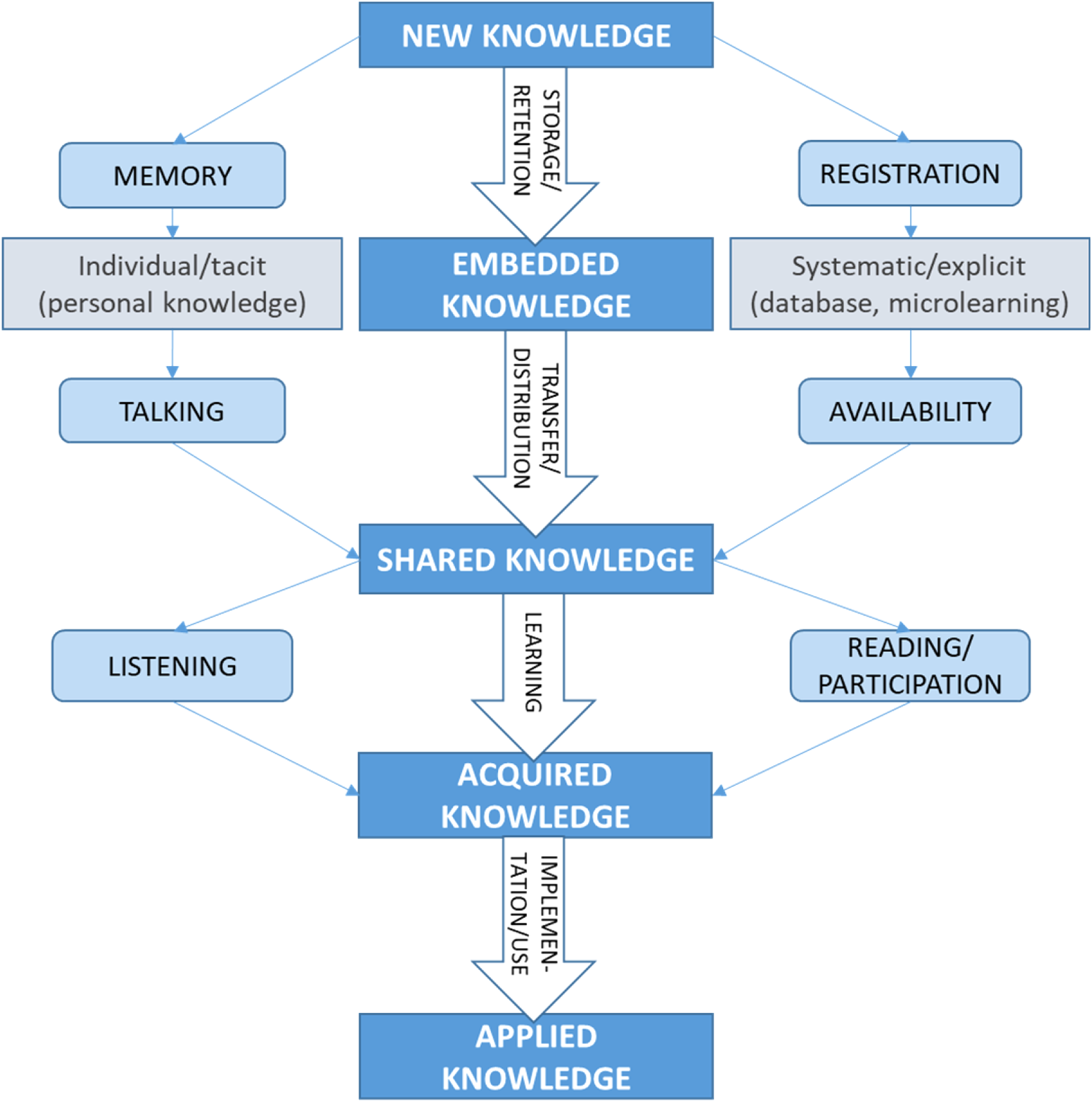
Adapted knowledge management model (based on Ordanini et al.’s (2008) knowledge management key outcomes and Jafari et al.’s (2011) knowledge management steps).
If we assume that a certain amount of knowledge is created and remembered by those who have experienced it, this will be available stored in the individual minds. When registering this new knowledge formally, you will have to concentrate on the most important topics and some knowledge will be lost. The same is true for microlearning, as you can only include the most important information into the lessons. The important difference happens in the distribution step: While individually stored information is only conveyed in an arbitrary way to other individuals and thus will have limited effect for the application in future projects, the condensed information conveyed through microlearning will reach a much higher number of people. In the form of databases or microlearning, the knowledge will also be available for others on a more permanent basis than tacit knowledge. In the present study, almost 50% of the recipients have completed lesson 7. This means that the limited amount of new knowledge is made accessible to a much larger share of the organization and that there is a higher chance that the new knowledge will be applied in other projects in the future. This assumption is supported by the fact that most of the participants assume that they can use the learning outcome in their projects (medium score of 3.2 of 5).
Literature on microlearning suggests creating short and compact lessons each covering one topic at a time (Kapp & Defelice, 2018; Shail, 2019). The content should be relevant and practical, enforcing a topic which the recipients were already familiar with to a certain degree (Paul, 2016). The results from the microlearning support a certain degree of familiarity with the topic of cost-efficient construction projects, confirmed by an average score of 3.2 out of 5 how participants assess their own level of knowledge on the topic, and an average score of 3.6 out of 5 for the self-assessment by the participants on their personal contribution to cost-efficient construction projects. The integration of links to further reading integrated into the microlearning lessons attempts to counter the disadvantage that the tool itself is not adapt for providing deeper learning (Kapp & Defelice, 2018). In addition, the participants are encouraged to contact the relevant project teams to engage into a dialogue about actions in the projects presented shortly in the microlearning. This should provide an opportunity to increase the take-away from the microlearning lessons for those interested to gain more specific knowledge on some aspects touched upon by the microlearning lessons. For future microlearning, one option would also be to provide optional lessons on more specific topics to increase deeper learning. According to Tipton (2017), microlearning is a just-in-time learning with immediate relevance for the learner, which is confirmed by the study result that more than 90% of those having completed the whole course agree on the its relevance. In addition, the average score of 3.2 for the question if the participants can use the content of the course in their own projects is a good score predicating the relevance of the course, given the quite broad target group of the course.
According to Paul (2016), the effect of microlearning can be assessed by the fact how often the material is accessed and by including quick follow-up questions. In the present study, approximately half of all the recipients have accessed the complete microlearning, and 75% have participated in at least one lesson.
The participation rate is acceptable, but as the aim is to educate all the participants on the topic, a participation rate closer to 100% would be desirable. For further microlearning series, several actions for increasing the participation rate could be taken. Small time slots in mandatory departmental or team meetings could be provided, giving the employees time to complete the lessons. Although this might lead to high participation rates, it however contradicts the idea of microlearning to fill otherwise unproductive time spans, and that everybody can proceed in the lessons at their own speed. Furthermore, the microlearning series could be distributed as a mandatory course for the target group through the internal learning platform. In that way, the employees are reminded of the course, and managers will be informed if the course is not completed by the allocated deadline. Another possibility is to remind employees of the microlearning lessons in other ways than by e-mail, e.g. in person, in team meetings or by pop-up notices. And lastly, the content of the lessons could be a topic in team meetings to give those employees an advantage who have completed the course—and thus provide an incentive to complete the lessons to be able to participate in the discussion.
These possible actions have been shared with the organization and will be taken into consideration when the microlearning is updated and launched again. Integration into the internal learning platform has already taken place, making the lessons accessible for everybody at any time.
The short follow-up questions integrated into the first and last lesson showed a slight self-perceived learning effect on the topic of cost-efficient construction projects through the microlearning, as the score increased from 3.2 to 3.6 (of 5), which is a statistically significant increase suggesting a learning effect through the microlearning series, although other potential reasons for the increase cannot be eliminated at this point. Other explanations might be different personal scales on assessing the level of knowledge (as the assessments were some weeks apart) or the effect of other campaigns on the same topic in the organization. A certain degree of the mood at the specific day cannot be eliminated, but there were no other central initiatives on the topic aimed at the same target group, apart from initiatives aimed at specific projects, so this factor is unlikely to influence. The slight increase of 0.2 points in the score of the participants’ self-assessment of the systems and tools the organization has for cost-efficient construction projects indicates that the microlearning has educated some, but not many, participants on systems and tools they were not aware of before. In addition, the researcher has heard of participants using examples from the microlearning series in other fora, for example in workshops and presentations, which also points towards the relevance of the course.
When taking a closer look at the data, especially the connection between completion of lessons and answers to the questions, it is interesting that the assumption of not being able to influence cost-efficiency does not have a correlation with the total completion rate of the lessons. Assumably, the majority of participants either are interested in the topic nevertheless or feel an obligation to participate. The larger share of those with no perceived possibility to influence evaluating the course as not useful (19.2% compared to 8.5% of the total) points towards a correlation between those two aspects. However, in the reverse conclusion, this also means that over 80% evaluate the course as useful for them, even if they perceived they have no possibility to influence cost-efficiency in their projects. This signals that the course has influenced their perception of cost-efficiency.
There are some interesting aspects in the details of the questionnaire data: 19 respondents assess their level of knowledge as lower after the course than before. Five of them assessed the course as not relevant, but it is however unlikely that the course itself should have led to a knowledge loss. A possible explanation would be that those people were in a different disposition/mood in the two instances and thus applied the scale in a different way. This might however also be true for all participants and includes an error source in all subjective questionnaire questions. Another reason would be that they realized during the course that their first answer was overoptimistic and that the topic is wider than they originally were aware of. The same explanations could be true for the 26 participants giving the tools and systems a lower score after the course than before. They might either be influenced by a different disposition or get the impression during the course that the organization handles cost-efficiency in construction projects not as efficiently than they thought.
Having a closer look at the change in knowledge level, it can be observed that those with a comparably low score (below 3) after the first lesson experience a higher knowledge increase than the average for the total of the participants ( + 1.32 points compared to + 0.3 points). When comparing to the group with a high score of 4 or 5 after the first lesson, those report a lower average level of knowledge after the last lesson (−0.3 points). This indicates that the microlearning course is best fit for those with a comparably low knowledge level on a topic. Thus, it cannot be the only form of learning in an organization but needs the combination with other methods of knowledge transfer. Microlearning can only give a condensed version of each topic and is thus a good method to trigger ideas for one's own project. Based on that, microlearning can be followed by a more informal learning approach talking to people from the respective project team to get a deeper insight into the matter at hand. In a more formal approach, the organization can provide internal training courses on specific topics, which can be used to get more background knowledge on the relevant topics.
Another interesting aspect is in how far microlearning can constitute a tool for continuous knowledge transfer between projects. The present study analyzes the microlearning series as a “one-off” event, giving only an instant view on the status at a specific point of time. However, when using microlearning in a strategic way, it can continuously contribute to challenging and updating best practice and to encouraging innovation. In the following, some suggestions are given how microlearning could contribute to continuous knowledge transfer.
By creating a feedback-loop as illustrated in Figure 2, it is possible to keep the microlearning up-to-date and relevant for the projects. In the present action research project, there are other actions to achieve higher cost-efficiency in construction projects. Some of the participants, especially the project leaders among them, had been part of the so-called “value meetings” for their respective project. These meetings serve as an arena to discuss and document measures for cost-efficiency for the concrete project. Some of the examples for the microlearning were taken from these meetings and it is expected that future meetings can generate new examples. In that way, the existing microlearning series can serve as the basis for further development of sharing knowledge on cost-efficiency. In regular intervals, for example once a year, new good examples of cost-efficiency measures are continuously included into the existing lessons, and new lessons can be created as new topics emerge. This might also contribute to a positive effect on the projects, as they might be eager to have their examples included into the microlearning lessons distributed widely in the organization. However, this feedback-loop requires resources for conducting further meetings, choosing suitable new examples, updating the microlearning lessons and creating new modules, for keeping the microlearning available for the recipients and encouraging them to participate.
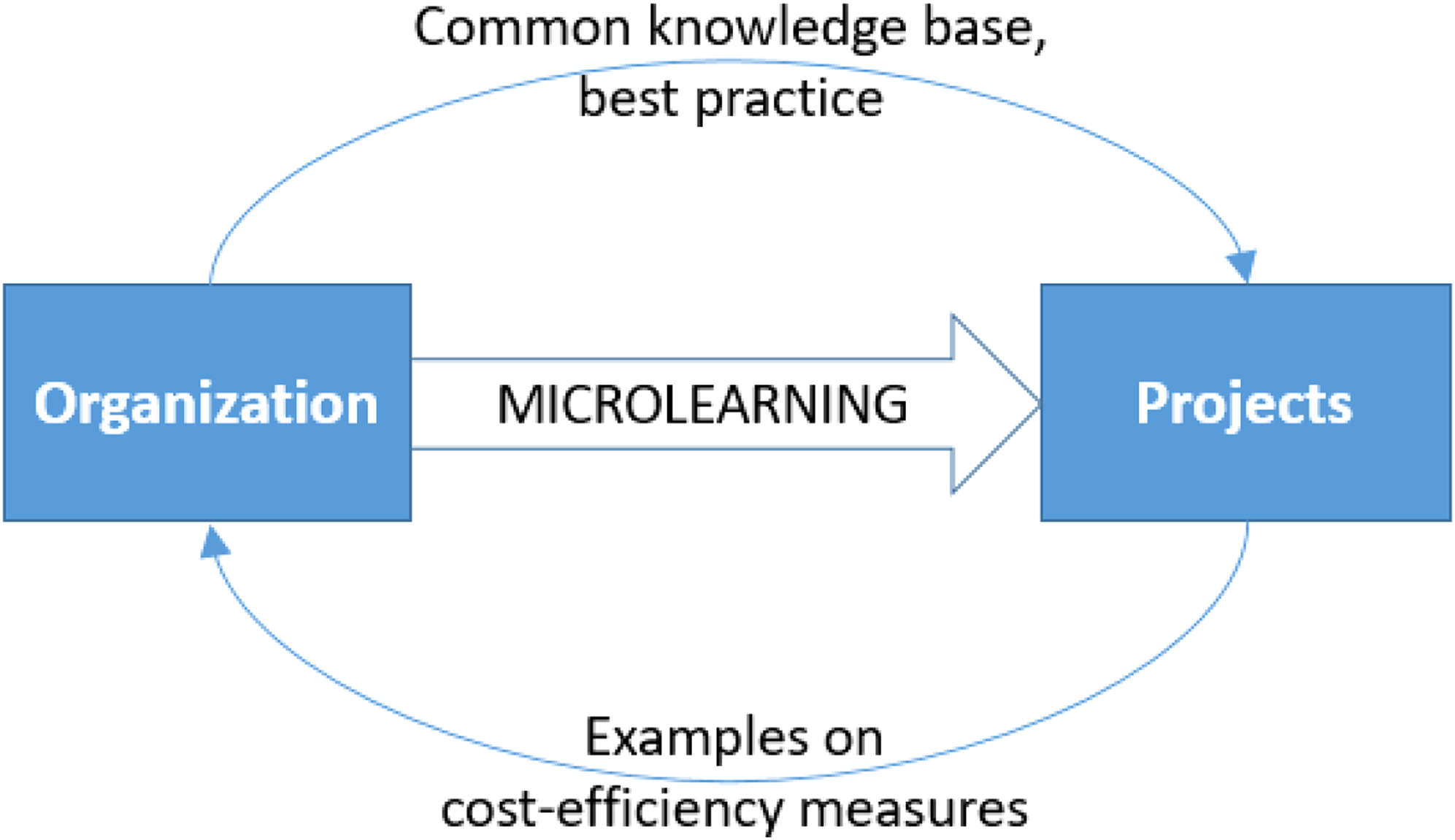
The microlearning feedback-loop.
This study investigates a microlearning series in a project-based organization, as part of an action research project. Until now, microlearning has mostly been explored in managerial literature, but not so much from an academic perspective. The researcher has not found any previous studies analyzing the effect of microlearning through small questionnaires integrated into the microlearning lessons or investigating the relevance of microlearning. Therefore, this study constitutes an important contribution to the academic research of microlearning tools and can be a good start to investigate the learning tool of microlearning further. In addition, this study gives reflections on using microlearning as a continuous learning tool for a topic, not only a one-off event.
As this study is part of an action research project within one organization, there is not claim for generalizability of this research. Nevertheless, the microlearning concept could supposedly also be used in other project-based organizations in the same way. However, the research has also shown the importance of context for assuring high relevance of the microlearning series. This entails that the microlearning has to connect to issues familiar to the participants and take details and examples in the lessons from the organization itself.
The novelty aspect of the presented study also lies in the fact that it is conducted as one element of an action research project. In action research, solving a practical problem is in the foreground. This means that a microlearning series should foremost be designed and perceived as a real learning experience, not a mere data collection in a research project. The microlearning itself constitutes one element of the organizational intervention within the action research project. Previous work in the action research project provides the input to the microlearning by identifying relevant topics and good examples from the projects, which the participants can relate to. The subsequent work can profit from the microlearning in the way that all participants have a common basic understanding of cost-efficient construction projects, that they have heard of examples from other projects, and that they are more familiar with the topic, and thus might have a higher awareness. A future activity in the action research project could be to identify new topics and examples to be integrated in a follow-up of the microlearning.
Conclusion
RQ 1: What was the reception and perceived relevance of this microlearning series on cost-efficient construction projects?
The reception of the microlearning series was good, with almost 50% of the recipients completing the whole series and 75% of the recipients at least completing the first lesson. A lack of time or that fact that those participants, who evaluate the course as not relevant for them, stop after first lesson, might explain the decreasing participation over seven modules. Of those who started a lesson, almost all also finished it. This indicates that the short lessons were of interest for the participants. This is also confirmed by the fact that 91% of the participants respond that the microlearning series was relevant for them. The answers to the integrated follow-up questions show a slight but significant learning effect from the first to the last lesson ( + 0.3 points), which is especially high for those with a low initial level of knowledge. Also the perception of the systems and tools for cost-efficiency of the organization is slightly more positive after the course ( + 0.2 points). The score of 3.2 of 5 for the question if the participants can use the content of the course in their projects indicate an acceptable degree of practical relevance. However, this could be improved in future microlearning series by including the participants wishes, what they would expect from a microlearning course with high practical value for them. In that way, the microlearning series can be updated from time to time to keep the content up to date.
RQ 2: How can a microlearning series serve as an enabler for continuous learning between projects?
The presented microlearning is not only planned as a one-off learning event but is intended to be used continuously to remind the participants of the topic and to communicate new knowledge. However, the presented study cannot fully answer the question, to what extent continuous learning between projects is achieved, as the study was performed after providing the microlearning series once. Several actions were taken or suggested to guide the direction towards enabling continuous learning between projects through microlearning: Accessibility is assured as the microlearning is made available on a central learning platform within the organization after the campaign. A feedback-loop is suggested, in which new examples and new topics are continuously added to the microlearning (see Figure 2) and which can provide up-to-date learning, challenge current best practice, and encourage innovation in the projects. Practical and up-to-date examples with high relevance for other projects can enrich the lessons. The continuous use of microlearning is also expected to contribute to an organizational culture, where the central topic of cost-efficient construction projects is an integral element to consider during the project. However, microlearning has to be seen as one factor contributing to continuous knowledge transfer between projects. Other complementary methods include project databases, formal trainings or seminars, and the establishment of arenas encouraging informal knowledge transfer between projects.
RQ 3: To what degree can a microlearning series fulfill the needs of a project-based organization?
In a project-based organization, learning can be challenging due to decentralized project teams and time constraints in a hectic project workday. Microlearning contributes to overcoming this by enabling flexible digital learning for teams in dispersed locations. It is possible with a very limited investment of time by the participants. In contrast to informal learning where tacit knowledge is shared or formal training courses, microlearning gives the possibility to share experiences from various projects broadly in the organization, increasing the number of people in different project team, which can benefit from the knowledge. Transferring relevant knowledge becomes less arbitrary, making a common body of knowledge available to all project teams. Acceptable participation rates and good scores on perceived relevance suggests that there the microlearning series could contribute to fulfilling a need for increased sharing of knowledge.
Implications for Practice
This article is written from a practitioner-researcher's perspective as part of an action research project within the organization. This implies that a practical approach has been guiding the research process. Implications of the study for practice are summarized in this section to give practitioners both working with organizational development or training in project-based organizations recommendations for their own practice.
The article addresses the problem of knowledge transfer on the topic of cost-efficiency in an organization where project teams work separately from each other and knowledge is not automatically dispersed to other project teams. Findings of the study include a positive reception of the microlearning. From a business perspective, it is recommendable to continue the focus on cost-efficiency established by the microlearning series. This can both include consecutive microlearning with new lessons and more examples from best practice, but also other methods such as seminars where project managers present successful cost-efficiency measures from their projects or interdisciplinary workshops, where the participants actively collaborate on finding actions for cost-efficiency for a project. Although the effect might take some time to show, this is expected to result in an organizational culture where cost-efficiency is a “built-in” attribute in all construction projects.
As to the microlearning series itself, it would be beneficial to make it more attractive to increase the participation rate in future microlearning campaigns. The participation rate is acceptable but can still be improved. One option would be increased gamification of microlearning to encourage learning with high motivation, commitment and fun, aiming at a higher completion rate and better retention of content.
Limitations and Suggestions for Further Research
This study is limited to one organization and thus does not claim generalization of results, although there is no indication that a similar approach cannot work in other organizations as long as the microlearning lessons are adapted to the respective organization. However, this is a microlearning on construction projects, so further research is recommended to investigate if the same approach also is applicable in organizations working with other types of projects.
Practical limitations include the fact that microlearning only constitutes one element of engaging people into learning. A variety of measures will be necessary to enrich a culture for learning between projects.
Another limitation in the theoretical part of this paper is the fact that most literature sources for microlearning are from managerial magazines, due to the limited amount of academic studies on microlearning and the lack of academic papers on this issue in peer-reviewed journals.
Concerning the collected data, it would be beneficial to have more data measurement points in the lessons to be able to assess the learning progression after each lesson. However, in this action research approach with the main objective of increasing the awareness and knowledge of cost-efficiency, the amount of questions for data collection was attempted to be kept to a minimum in order to prioritize practicability and learning over data collection and not to deter respondents from participating in the microlearning.
From an academic point of view, it will be interesting to assess the further implementation of cost-efficiency measures into the construction projects based on the microlearning series, and the reception of future microlearning lessons, adapted with new topics and new examples. A new study after a second or third microlearning campaign would be able to provide more thorough answer to RQ 2 if microlearning enables continuous learning between projects.
The present study shows that microlearning can contribute to a more effective knowledge transfer in a project-based organization. This paper also provides suggestions for future microlearning series, for example to increase the participation rate. It is excepted that microlearning will have an even stronger effect when used in a continuous process and in combination with other methods of knowledge transfer.
Footnotes
Acknowledgments
The presented research study is part of an action research project at the presented organization. The action research project is jointly financed by the organization and the Norwegian Research Council. The author would like to thank Ole Jonny Klakegg and Jørgen Kjetil Knudsen for contributing with their ideas and their constructive feedback on drafts of this article.
Declaration of Conflicting Interests
The author declared the following potential conflicts of interest with respect to the research, authorship, and/or publication of this article: The author is an employee of the presented organization.
Funding
The author disclosed receipt of the following financial support for the research, authorship, and/or publication of this article: This work was supported by the Norwegian Research Council as part of a public sector PhD-project.
