




Abstract
We use speech act theory to study the U.K. state’s response to large-scale public disorder across English cities in August 2011. This historical case has practical implications for understanding how nation states address other crises—because we explain in detail how the discourse of powerful state actors restores order. Drawing on parliamentary debate, Select Committee testimony, and interviews with police officers, our contribution is to describe and analyze how this happened contemporaneously at different levels. At street level, this involved the reassertion of sovereignty through territorial struggles by the police. At what we call “state level,” speech act theory helps us show how Members of Parliament framed the disorder and participants in ways that supported the reestablishment of norms and of order; principally through homogenization, in a process we describe as “tidying.”
Introduction
During August 2011, protests following the police’s fatal shooting of Mark Duggan, a Black resident of Tottenham, became a flashpoint for 4 days of large scale disorder (6th to 9th) across several English cities (principally, London, Birmingham, Manchester, Salford, Liverpool, and Nottingham). Disorder spread via mainstream media and messaging services, both of which propagated a perception of the police as temporarily powerless. The scale of this set of events was remarkable. A year later, by August 10th of 2012, a total of 3,103 people had appeared in court for offences related to the disorder (Ministry of Justice, 2012).
Despite the widescale and shocking nature of this crisis, what became known as “the riots” did not lead to social change of the kind that people originally protesting about Mark Duggan’s killing wanted. This case has great resonance now because, on a transnational scale, events relating to the Black Lives Matter movement are still unfolding. Rather than comment on these directly here—which it is always difficult to do in academic research that is carried out mid-crisis—in this article, we analyze this historical case in depth. In doing so, we explain why large-scale disorder failed to lead to social change. We explain this in terms of the U.K. state’s ability to mobilize a countervailing force to crisis: the “production of order.” In doing so, we detail mechanisms and practices the state used to resist change. This contributes to a long-standing conversation in The Journal of Applied Behavioral Sciences (JABS) on social change (Alvord et al., 2004; Easley, 2010; Sharma & Good, 2013), and more specifically on the role of discourse in such change (Barrett et al., 1995; Morrell & Bradford, 2019; Morrell & Currie, 2015; Oswick et al., 2010). Writing on such controversial topics, we also aim to share with readers a “provocative manuscript” (Schwarz, 2020, p. 7) that we feel is in keeping with strong traditions of JABS. Accordingly, we are not simply diagnosing and explaining change, but also responding to the recent call for papers that are themselves “initiating change” (Schwarz, 2020).
Context
There remains considerable debate surrounding the nature and causes of the 2011 “riots” (e.g., see Dodd & Davies, 2011; Hope, 2012; House of Commons, 2012a, 2012b, 2012c; Lewis et al., 2011). The aim of this article is to consider a much more particular aspect to this crisis—the contemporaneous response of the state, which we understand in terms of production of order. This took place at two levels: at street level—in terms of the actions of the police, and at what we call “state level”—in a day of exceptional Parliamentary debate. In common with other scholars who have studied rioting, we understand street-level practices in terms of asserting sovereignty through territorial struggle (Wahlström, 2010). We make an original contribution here by additionally drawing on speech act theory (Austin, 1955; Gregson & Rose, 2000; Miller, 2000; Rajagopalan, 2000; Searle, 1969, 1973, 1976) to identify and analyze discursive processes that helped Members of Parliament (MPs) reassert or “produce” order.
During the “riots,” across many English cities, thousands of citizens participated in public disorder on a massive scale. Many used the latest technology to support remote coordination, to out-maneuver police; and to prosecute tactics and purposes antithetical to order—such as arson and looting, and violence against the police and emergency services. This action, though large-scale and ostensibly iconoclastic was fragmentary—with no obvious common purpose or prospect of pressing claims, and it took different forms at different times in different locations (House of Commons, 2012a). It was also fleeting—in the sense that it unfolded over a very short timescale and in the sense that actions were often coordinated through instant messaging technology. It rapidly gave way to the restoration of order and thus large scale change was resisted. As we explain, this happened on two levels: First, because to reappropriate space on behalf of the state, the police engaged in territorial struggles and the reassertion of state sovereignty. Second, shortly after these territorial struggles, there was a state-level narration of order. This took place through the medium of “Speech Acts”—where MPs’ discourse framed the “riots” in ways that supported the restoration of order. Of particular interest in the U.K. case is a specific institutional mechanism amplifying the power of MPs’ discourse: Parliamentary debate. This took place on the August 11, 2011, when MPs and the House of Commons was recalled from recess to debate the disorder.
The day’s events (the Prime Minister’s statement and the subsequent day’s debate) were analyzed contemporaneously by the lead author as part of a broader project on public order policing (Morrell & Bradford, 2019; Morrell & Currie, 2015). Later, over a longer period, transcripts of the day were analyzed by the authors—approximately 70,000 words of text (accessible via www.parliament.uk). The focus was to see how MPs’ contributions helped “produce order.” The authors also retrospectively analyzed contemporaneous media accounts of the disorder, subsequent Select Committee reports, and the response by the government (House of Commons, 2012a, 2012b, 2012c), as well as the report by the Metropolitan Police (2012), 4 Days in August. For additional contextualization, we draw lightly on 38 interviews with police officers, on the topic of public order, that were recorded and transcribed and that varied in length from a few minutes during a break in a training exercise, to just over 2 hours. Beginning with a review of what we mean by the production of order, we describe the context to the U.K. disorder of August 2011 before analyzing the state’s response. To account for the constitutive force of discourse in MPs’ production of order, we use speech act theory.
Speech act theory is a suitable framework because it anchors effects (here—the production of order by MPs) to utterances (what was actually said in MPs’ contributions). We stay faithful to key aspects of the original version of speech act theory, concentrating on the work of Austin (1955) and Searle (1973, 1976). So, we focus on the performative nature of language, and a concern with locutionary, illocutionary, and perlocutionary dimensions. The linkage between discursive utterances and effects is the central concern of a broader literature on performativity inspired by Butler (1993; Cabantous et al., 2016; Learmonth et al., 2016).
In applying speech act theory to understand crisis and social change, we connect with a stream of literature that otherwise challenges the “monologism” (Linell & Markova, 1993) of speech act theory. Some critics have suggested that speech act theory has its roots in individualist, Cartesian philosophy and is therefore decontextualized (Pratt, 1986). By firmly connecting to a social context, we respond to such critics and we also join a rich seam of literature in JABS on discourse and change (Barrett et al., 1995; Oswick et al., 2010). In keeping with this work in JABS, we develop a pragmatic, context-sensitive illustration of Austin’s core message: that words themselves “do” things that can have significant ideological and material effects. We begin by explaining how the state produces order.
The Production of Order
Human geographers teach us that civic spaces—of the kind that riots disturb and throw into turmoil—are physical and material, but at the same time their physicality and materiality need to be understood as a product of history, as a consequence of social norms, practices, and routines (Massey, 1994). Across society as a whole, civic order is underpinned by a shared sense of what civic space means (Lefebvre, 1991, 2002a, 2002b, 2002c). This is a key idea within the “spatial turn” (Green et al., 2010) across many disciplines (Banerjee, 2003; Wahlström, 2010).
The production of order involves processes of commensuration and homogenization. These bring about a loss of the sense of space as created by nature, and a shift in its meaning into something that is an object owned by the state or its citizens (Banerjee, 2003). The way space (as it is created by nature) becomes something that can be “owned,” is a gradual colonization, “the forces of history smashed naturalness forever” (Lefebvre, 1991, p. 49). At times, Lefebvre (the preeminent theorist of space and order) frames this in terms of the everyday (Lefebvre, 2002 a, 2002b, 2002c), at times it can be understood in broader currents in his thought on urbanization (Lefebvre, 2003), European philosophy or political economy. We extend Lefebvre’s account by showing how, during crisis, the state uses these same forces of commensuration and homogenization to “produce order” almost in real time.
Lefebvre’s (1991) thinking is sometimes summarized in terms of the conceptual triad of space. Acknowledging that this is a simplification of his work, the triad describes: (a) spatial practice or “perceived space”—the characteristic practices of different social formations; (b) representations of space or “conceived space”—plans, maps, signs, codes; and (c) representational spaces or “lived space”—symbolic and local, or cultural, interpretations of space. An analogy for the relationship between these elements is they are a dialectic, but with three poles. This is without the synthesis between antinomies that features in Hegel (Lefebvre, 1991); but closer to a Nietzschean dialectic, “a convoluted dance of eternal opposition . . . punctuated by rapprochement and subversion . . . distanced though simultaneously intertwined and perpetually in flux” (Morrell, 2012, p. 469). Each element needs to be understood in relation to the other, and as descriptors of process that are inevitably only partially accurate. Space is continually becoming, or emergent, rather than, say, at one time definitively “representation,” then at another time a different, fixed category that is “representational.” Nor is it dependent at any particular time on one form of practice.
Representations of space establish privilege, normalize difference, support processes of homogenization, and perpetuate and flatten inequalities (Lefebvre, 1976). In short, they produce order. For example, order is produced by large-scale activity—urban design for instance (Gottdiener, 2000), and by representations of activity—such as traffic signs or workflow diagrams and aspects of the built environment (Clegg & Kornberger, 2006). Laws and different kinds of logic or discourse also create boundaries and order and these boundaries can be both physical and concrete as well as metaphoric and abstract (Harvey, 1993). These can also play a part in sustaining order through local assertions of identity (Tyler & Cohen, 2010). Whether at a large or small scale, “(social) space is a (social) product” (Lefebvre, 1991, p. 26). Order influences action, but it is also the consequence of previous actions.
The state can create order by making gulfs in power appear natural and unquestioned, creating boundaries that entrench power relations (Wahlström, 2010). These can take effect through the influence of institutions, laws, and social conventions, which are in turn constituted by norms (Lefebvre, 1976). The purpose of these is to give social space the impression of homogeneity, and support “state effects” that underpin order such as control and intervention (Painter, 2006). Such effects can be seen in the everyday geography, contours, and demarcations of the high street—ordered in ways designed to support consumption. The boundaries of an office complex, pit or factory, can be understood analogously (physical, but reinforced by abstract boundaries in law and routines or convention and norms). These boundaries normalize differences between public and private space. They make ownership of such spaces seem normal and in this way they support the status quo—again, “producing” order.
When we apply this to think about civic disorder—such as riots—this perspective shows how riots often involve a change in what space means. Ordinarily, representations of space are given by the state and serve to homogenize and normalize, thereby sustaining order (Lefebvre, 1976, 1991). But, during riots there can be a shocking resistance to these state representations of space as various “counterprojects” break with homogeneity. Certain spaces can become “out of bounds” or “no go areas” for example. Barricades can separate what spaces the state still owns from spaces that have become occupied by rioters. Arson can change the meaning of space dramatically as fires replace artificial light. Wide-scale looting is a flagrant breach of social conventions and laws.
All these and more happened during the large-scale disorder of August 2011, and this meant the state had to produce order quickly: to restore a sense of normality while also reasserting sovereignty and territorial jurisdiction (Agnew, 1994). Necessarily and evidently this involved street-level practices by state representatives such as the police and emergency services (Wahlström, 2010), but there was an additional fascinating feature of the U.K. state’s response. This was to recall Parliament (which was in recess) for an exceptional day’s debate on the 11th of August. We analyze this using speech act theory to detail discursive practices that MPs used while working on behalf of the state. These helped restore a sense of what civic space meant and also a sense of order. This emphasis on practices accords with the interests of Deleuze and Guattari (1983) and Soja (1996) who recognize these as key to order.
Understanding the “Performative” State: The Role of Speech Act Theory
Speech act theory originates in the work of the philosopher Austin (1955), further discussed by Searle (1969, 1973, 1976). Austin’s work mainly comes to us posthumously, through notes of his lectures. Consequently there is debate (outside of our scope) as to whether Searle offers genuinely new insights into speech act theory, or is essentially a torchbearer (Rajagopalan, 2000). The central argument in Austin’s framework is that utterances are “performative” (Gregson & Rose, 2000; Miller, 2000). Words do not just relay content, describe, or state things, they actually “do” things. Furthermore, the way they do things is not through semantic content, it is by being uttered in particular settings with a certain intent: hence speech “act.”
Paradigmatic examples Austin gave include, “I do” (in the context of a marriage ceremony), “I bet you” (waging a sum of money), “I bequeath” (leaving something in a will). Such linguistic acts often have force because they are associated with ritual, ceremony or convention (Miller, 2000), and depend in some way on a shared set of understandings about what happens in institutional settings, whether (in these examples) the church, betting shop or lawyer’s office. But—importantly in speech act theory—all utterances signify and enact simultaneously (Gregson & Rose, 2000). Speech act theory offers a way to operationalize the fundamental insight of interpretive discourse analysis. This is that language, comprising both individual utterances as well as broader bodies of discourse, has constitutive effects on its context (Heracleous & Marshak, 2004). This is consistent with a number of antecedents in social theory (Heracleous, 2006). Actors make use of linguistic resources in an intentional, performative manner, and simultaneously exist and operate within established understandings typified by language (Heracleous & Barrett, 2001).
Austin differentiates between three aspects of talk as performance: the locutionary dimension, the illocutionary act, and the perlocutionary effects. The locutionary dimension is as follows: “words thought of as sounds, as elements of a vocabulary and as syntactically ordered sequences . . . sense and reference”; the illocutionary act is what is, “conventionally done in producing a sentence; the act of asserting or commanding or questioning”; the perlocutionary effects are, “produced by performing an illocutionary act” (Miller, 2000, p. 156). Austin himself had problems distinguishing between the illocutionary and the perlocutionary (Horn, 2005) and later variants of speech act theory (Searle, 1969, 1973) expanded on or challenged these categories. Here we employ these categories to differentiate between (a) the content of what was said; (b) what it achieved in situ, in the House of Commons; and (c) its effects in terms of the production of order.
Speech act theory is useful because parliamentary talk is filled with performative protocols: “I give way to the Honourable Lady”; “I thank the Honourable Gentleman”; “I join the Prime Minister in paying tribute”; “I will take up the member’s invitation”; “I commend the Prime Minister for his decision”; “I want to put on record”; “I condemn”; and so on. All these both signify and enact. Beyond semantic content and the utterance (the locutionary dimension), they express positions such as support, solidarity, difference, or simply being there (the illocutionary act). Perlocutionary effects extend beyond the chamber to how other parties hear, see or interpret these words.
Despite the initial focus of speech act theory on single, decontextualized instances of performative speech, the approach has been extended and employed within broader discourse analytic frameworks as a way to analyze the effects of particular discursive choices on their context. For example, Heracleous and Marshak (2004) employed speech act theory as the action-oriented aspect of an integrative discourse analysis approach. They analyzed the trajectory of speech acts within a senior team meeting regarding choices in organization design, particularly the illocutionary and perlocutionary dimensions, to shed light on a strategic decision and the role of speech acts in reaching that decision. Furthermore, Guild (2002) employed speech act theory within a discursive analytical approach in the context of an employee layoff process at a ski resort. The study revealed the relative importance of different stakeholders to management as apparent via management’s illocutionary and perlocutionary speech acts, which were shown to be in contrast to stated organizational values. Ford and Ford (1995), going against the dominant idea that communication processes occur within processes of change, argued that change is instead constituted by intentional, performative communicative acts. Particular types of utterances, given their performative nature, accomplish certain effects, which then collectively constitute organizational change. Subsequent studies found extensive use of speech acts in the context of change processes (e.g., Palmer et al., 2004). Finally, critical studies have examined how particular speech acts can legitimate and perpetuate employment discourses that marginalize women in particular industries (e.g., Stobbe, 2005); and ethical studies how a performative conception of oaths could promote more responsible behavior in business by committing and motivating agents to continuously upholding their promise (Blok, 2013). Speech act theory has therefore been employed beyond a focus on the single utterance and often in conjunction with a discursive approach, to shed light on larger scale events (Pratt, 1970).
Foreshadowing our findings, by analyzing parliamentary debate in terms of speech act theory, we give examples of locutionary content describing the riots. We show that these had illocutionary effects: to display consensus, assert control, and to frame events as requiring urgent response and corrective action. Finally, the intended perlocutionary effects were to produce order. This was done through: homogenizing and normalizing; unifying state-level actors (MPs) with the response at street level; and galvanizing operations in the aftermath of the “riots”—including the mobilization of legal processes and institutions.
In what follows, we analyze MPs’ contributions in the debate, drawing on interview data for triangulation. We identify and analyze four themes from the debate: “disorder,” “riot,” “gangs,” and “copycats.” From a critical discourse analysis perspective (Fairclough, 1992, 2005), these are central discursive constructions of the kind that manifest in language, written and oral texts, and shape social practices. They in turn operate within, as well as constitute, broader grand discourses of statehood and proper citizenship, deviation from which justifies and necessitates robust state response. As our analysis shows, speech act theory allows us to trace the illocutionary and perlocutionary dimensions of these themes, informed by their connotations in context, and to note the implications of this analysis for the production of order.
Urban Disorder and the “Performative” Production of Order
Disorder
The term “order” has a number of connotations in the House of Commons, usually concerning the terms under which debate can be conducted, or whether practices are in keeping with established protocols and tradition. In the debate, there was a high degree of cross-party consensus, with none of the oppositional jeering and cheering associated with emblematic events such as Prime Ministers Questions, and only mild points of friction relating to contemporary policy on cuts in policing. MPs from very different parts of the political spectrum signaled this in summing up the events of the day; “I am proud today of the way in which Parliament has conducted this debate” (Ms. Blears, who was considered to be on the left of the Labour party), “The contributions made by honorable friends and other honorable members have made me proud to be a Member of Parliament” (Mr. Gove, considered to be on the right of the Conservative party).
Overall, the day’s debate on disorder was conducted in an extremely orderly fashion. One exception came after a slightly surreal exchange between a Labour MP, Robert Flello, and the Prime Minister. Mr. Flello asked a question without wearing a jacket, which it is customary for male members to wear in the House of Commons. The Prime Minister began his reply: I do not know whether we need an inquiry into safety in the House, Mr. Speaker, but someone seems to have stolen the honorable Gentleman’s jacket.
The Speaker replied as follows: I assure the House that nothing disorderly has happened. The honorable Member for Stoke-on-Trent South (Robert Flello) was perfectly in order. He was focusing not on sartorial matters but on violence, and he was perfectly in order. We will leave it at that. I ask the House to try to rise to the level of events.
This sense of what order was “in the House” and references to violence and stealing jarred with recent events. Officers we interviewed recalled chaos in street-level struggles over territory: [I was] keeping this crowd back so that London Ambulance Service and London Fire Brigade can do their job. Save life, that’s got to be more important than anything else that’s going on at the moment [a colleague] managed to keep the whole high street free of any looters just by using the show of force [a police tactic involving raising batons and charging in a line]
The most visibly shocking aspects to the disorder had come about because civic space had been transformed - fires replaced artificial light, roads were barricaded, shops looted and public spaces became out of bounds. These radical inversions suggest disorder can be understood in terms of Bakhtin’s carnival—rapid reconfiguring of power relations, displacement of authority, and a space for new voices to be heard (Belova et al., 2008). Consistent with other commentators (Spalek et al., 2012), one select committee witness identified this: Clapham Junction [was] like a carnival atmosphere. It was a party atmosphere—a very, very hyped up, intense celebration that, “We can do this and we can get away with it. Look, the police are 50 yards away and they’re just watching.” (Reverend Perkin, in Britain, 2012b, p. 60).
Carnival is not necessarily emancipatory (Žižek, 2007), and disorder, even if it challenges one mode of domination, need not mean improvement. A move away from the state’s representation of space could offer no more than a glimpse of the abyss, as Dodd and Davies’ (2011) account of a barricade at Hackney’s Pembury Estate showed: masked youths—both men and women—helped carry debris, bins, sticks and motorbikes, laying them across the roads to form a flaming boundary to the estate.
This image, of a flaming boundary at one of the focal points of the disorder, highlights interplay between representations of space (the civic boundary of the estate, the roads), representational spaces (the local, cultural significance of that boundary) and spatial practice (burning debris, lines of people in masks, the barricade). These totems of “disorderly” spatial practices in August 2011 involved appropriation of state space and territorial claims. At the same time as being representational (lived) space some were attempts to impose new representations of space and to subvert or parodise state representations of space (Traugott, 1995).
Riot
Speech acts are historically highly significant in response to street-level disorder. The reading of the Riot Act gave unprecedented powers to those empowered by the state to put down disturbances, in the form of indemnity from prosecution (which in one instance led to the Peterloo Massacre). “Riot” continues to have a specific legal definition, and implications. One officer, we interviewed, set these out for us in relation to the 2011 “riots”: There was no common purpose for me, which is technically why you could say it’s not a riot, because for a riot to happen under the Public Order Act, everyone has to have a common purpose. But for a disorder, it can be violence or threats of violence but they don’t have to have a common purpose. . . . If a riot happens the police are liable for any damages . . . the cynic could say that’s why it was called a disorder and not a riot but if you look at the facts then it actually wasn’t a riot.
In debate, sensitive to the context for his speech, Malcolm Wicks, MP for Croydon North, emphasized, “As soon as I heard that there were riots—and they were riots” (Croydon was the scene of iconic footage of arson as a local landmark—a furniture store—burned down). The Prime Minister’s opening statement asserted, “I confirm that any individual, home owner or business that has suffered damage to or loss of their buildings or property as a result of rioting can seek compensation under the Riot (Damages) Act 1886, even if uninsured.” Interestingly, even though the Metropolitan Police Service (MPS) processed thousands of claims for compensation, their report 4 Days in August (MPS, 2012) only uses “riot” or “rioter” in reported speech, whereas in cites (over 500 times) “disorder,” or “disorders.”
The offence of “riot” is also significant because it is potentially associated with increased severity of sentencing. MPs showed consensus with reference to the role of the judiciary, for instance, Opposition Leader Ed Miliband’s asked the Prime Minister to “agree” that magistrates and judges need to have those circumstances at the front of their mind so that those found guilty of such disgraceful behavior receive the tough sentences that they deserve and the public expect?
Even though there was this consensus on calling the circumstances “riots,” there was a lack of clarity about whether the “riots” had common purpose and whether they were “disorder” (one incident), or “disorders” (multiple incidents). Many MPs cast the participants in disorder as mindless: “thugs,” “hooligans” (Mr. Cameron, PM) “thugs and hooligans” (Mr. Metcalfe), “thugs” (Ms. May), “mindless violence and thuggery” (Mr. Cameron, PM), perpetrators of “mindless violence” (Mr. Pawsey). But others suggested the rioters were coordinated: “opportunistic looting” (Ms. Cooper), “deliberate, organized, violent criminality” (Ms. Blears), “copycat criminals” (Mr. Binley), “organized criminality” (Mr. Lloyd & Mr. Barwell). Occasionally MPs invoked categories that were still, on each occasion of use, unitary and exhaustive (i.e. they grouped all participants together), but that also seemed to describe different phenomena: a new class of criminal consumer: BlackBerry-enabled, self-organized groups, whose new-found collectivism had diminished their fear of the police and increased their contempt for the law. (Mr. Watson) mindless idiots and career criminals who take pleasure in causing trouble and who thought that this was a golden opportunity to rob and steal and not get caught. (Mr. Leech)
These tensions between themes of mindlessness, organization, individualism, and coordination indicate (as later research found), that the power, interests, affiliations and “careers” of those participating varied. To restore order quickly during crisis, and to reassert the sense of returning to normality, it is preferable to be able to point to one cause, one event, one category of threat. This homogenization means disruption can be compartmentalized or bracketed and it can also be identifiably described as finished. But the scale, diversity and duration of the disorder(s), as well as the aftermath presented a challenge because it was not straightforward to ascribe such neat categories to the events. Even if the semantic content of what MPs said was incoherent, they consistently echoed each other’s sentiments and displayed a cross-party consensus about the framing of events. Speech act theory helps call attention to how, over and above description, MPs’ utterances were “doing” something. In the wake of street-level crises of territoriality and sovereignty, the debate showed state actors producing order.
The clearest way in which MPs and police were linked through speech acts was in MPs paying tribute to the service by police officers at the frontline. “Let me take this opportunity to pay tribute to the Welsh police forces” (Mr. Lwyd); “In relation to Birmingham and the West Midlands, may I add my tribute to the work of the police (Mr. Burden)”; “May I voice my support for the police, including the brave officers who faced unprecedented violence and criminality in Manchester” (Mr. Goggins); “May I pay my tribute to the West Midlands police” (Ms. Steward); “Will the Prime Minister pay tribute to police forces from outside London, such as Bedfordshire (Mr. Selous)”; “I congratulate Thames Valley police” (Dr. Lee). At the locutionary level (semantic content) these assertions seem to be local—because MPs mention their constituencies. However, at the illocutionary level (as performance), recurring references to the work of the police had two functions which showed MPs working at the level of the state. First, this signaled the apparatus of the state standing as a whole against “the” riots, and second it was a way for parliament to associate itself with corrective action at street level. Combined with cross-party consensus about the framing of events, for instance in terms of gangs (as discussed in the next section), the perlocutionary effect of the debate was to show Parliament acting as the guardian of order. The aim was to restore a common sense of civic space, and in doing so to bracket disruptive spatial practices. This meant collectively casting those responsible for such practices as Other. This was clearest in citations to “gangs.”
Gangs
In his opening statement, the Prime Minister asserted Mark Duggan’s death was “used as an excuse by opportunist thugs in gangs, first in Tottenham itself, then across London and in other cities.” The Prime Minister also offered a very specific definition of “gang”: Territorial, hierarchical and incredibly violent, they are mostly composed of young boys, mainly from dysfunctional homes. They earn money through crime, particularly drugs, and are bound together by an imposed loyalty to an authoritarian gang leader. They have blighted life on their estates, with gang-on-gang murders and unprovoked attacks on innocent bystanders.
There were 99 citations of “gang(s)” in the day’s debate, these also included references to “gang culture.” “Gang” and “gang culture” were used interchangeably—for instance the Prime Minister said (prefacing the above definition), “at the heart of all the violence sits the issue of the street gangs” then shortly after, “I have asked the Home Secretary to work with the Secretary of State for Work and Pensions and other Cabinet colleagues on a cross-government program of action to deal with this gang culture.” The Home Secretary, Teresa May, undertook, “I will bring a report on gang culture and the number of gangs in our society . . . to the House in October.” In response to the Prime Minister, Opposition Leader Ed Miliband stated, We need a sustained effort to tackle the gangs in our cities—something we knew about before these riots. In the consideration that the Prime Minister gives to how we tackle gang culture, will he look urgently at the Youth Justice Board report published last June, which had a series of recommendations about what the Government should be doing to tackle gang culture?
Equivocation of “gang” and “gang culture,” and the way “gangs” was used as an exhaustive category, smoothed over important sources of heterogeneity. Cavanagh and Dennis (2012) argue that political and media discourses relating to the 2011 riots, were framed as “pure criminality” and “mob rule,” in contrast to discussion of earlier riots in British history—where there was more of a political focus on “social problems,” “leaders,” or “infiltrators.” The “gangs” tag shifted emphasis away from deeper seated, sociological phenomena often associated with large scale disorder, such as poverty and policy, or a host of issues relating to race (Bennett, 2013). Such homogenizing, discursive consolidation has been evident in other instances where the state regulates gangs and their urban spaces (Alonso, 2004). As speech acts, citations to “gangs” were not simply locutionary description of groups. Instead they showed state actors producing space, in ways that served to homogenize and normalize—placing those participating in disorder into a preexisting, unitary category. This category was unproblematic, in the sense it included those already beyond the bounds of society. The illocutionary act was a kind of “tidying”—sweeping together a heterogeneous plurality of actors and interests. This placed them collectively outside the polity, and that cued appropriate response: action by state representatives at the level of territory to restore order, and a trailing of future changes to representations of space, “a report on gang culture and the number of gangs,” and, “a cross-government program of action.”
Homogenization had its parallel in one feature of gang activity, which was the renegotiation of representational spaces: Gangs behaved in an entirely atypical manner for the duration of the riots, temporarily suspending hostilities with their postcode rivals. The effective four-day truce applied to towns and cities across England. (Lewis et al., 2011, p. 4)
In disorder, the state’s representation of space, can often be appropriated and take on new meanings as representational spaces. For some gangs, postcodes allot territory and identity, and (unlike their use by the state to homogenize space) they cement differences. During the disorder, these boundaries were dissolved because the scope for criminality became more ambitious: it became a grander-scale project relating to what was possible while the police were stretched. This involved revising established ideas of what civic space meant.
Evidence of suspension of hostilities supports the Prime Minister’s statement about opportunism, but we know from subsequent large-scale qualitative research that the extent of gang involvement was “significantly overstated” (Lewis et al., 2011, p. 4). Though we would stop short of generalizing from our interviews, and though we asked about this, officers did not tend to mention gangs, but conceivably could have been describing gang culture: [In London] once it got round to 5am a lot of the crowd had gone, but they’d gone to, you know, the retail park, some of them, and had worked out “Actually these places are virtually police free or there’s very few of them around,” and that’s when it, to me, just switched to acquisitive crime. . . . Took on a different dynamic altogether after that, and everything else that followed, Enfield Sunday night and elsewhere, later Croydon, that was purely about anarchy as a prelude to looting. [In the West Midlands] young kids, disengaged with school . . . 14- to 18-year-old youths who’re in training shoes and tracksuits . . . damaging the shops . . . stealing the property [In Leicester] kids mainly running around on their bikes, balaclavas on, smashing window, shops, and then it progressed into them into looting shops and throwing bricks, bottles at police . . . it was predominantly teenagers, kids on bikes who had decided to copy what they’d seen [An officer who policed Salford] it was hatred of the system [rather than gangs].
Copycats
A signal and distinctive feature of the disorder was the use of instant messaging technology. MP Malcolm Wicks referred to how, “the thugs were more mobile, certainly more numerous and made more effective use of technology than the police.” One officer who had joined the police force in 2010 and was involved in frontline policing during 2011 told us, “I know people were surprised at how quickly it spread around London and copycatted into Birmingham and up North.” Keith, an experienced public order trainer described the disorder, “in terms of how it manifested itself that was unique . . . in terms of how it was driven with the social media.”
Paul Lewis, journalist for The Guardian (2012) and also a researcher on a large scale study, Reading the Riots, described this as, “contagion” (House of Commons, 2012b, p. 95). This was consistent with Select Committee testimony: We were not expecting that level and spread, that replication, that copycatting of sheer criminality. (Tim Godwin Acting Commissioner, Metropolitan Police, in House of Commons, 2012b, p. 21) Everyone was copycatting Tottenham. (Nathan Chin, former gang member, in House of Commons, 2012b, p. 108) These disorders have been described as the social networking disorders . . . the so-called BlackBerry riots or the Twitter riots or the Facebook riots. (Keith Vaz MP, Committee Chair, in House of Commons, 2012b, p. 81)
The “copycatting” of looting and instances of arson such as the Pembury Estate barricade illustrate how disorder can be characterized by “repertoires of contention” (Tilly, 2003, p. 45). Repertoires of contention are shared social scripts for action, templates that offer choices in a collective performance or resistance to authority, “learned cultural creations [that] emerge from struggle” (Tilly, 1995, p. 26). However, while instant messaging is an extremely contemporary repertoire that shrinks space, repertoires such as looting and arson are rooted in physical space (Brey, 1998). They create dramatic representational spaces but limit scope to enact change because they offer little prospect of developing into alternative ways of pressing claims.
Contemporaneous commentary suggested much of the copycat activity was consumerist. The Prime Minister’s statement asserted this emphatically: The whole country has been shocked by the most appalling scenes of people looting, violence, vandalizing and thieving. It is criminality, pure and simple—and there is absolutely no excuse for it. . . . Young people stealing flat-screen televisions and burning shops—that was not about politics or protest, it was about theft.
This was echoed by many other MPs: “criminality, pure and simple” (Tom Brake); “Whereas in years gone by rioters shouted ‘Church and King,’ they now shout for ‘Adidas and Nike’” (David Burrowes); “no real reason lies behind the current riots, apart from criminality” (Tony Lloyd). The copycat attribution homogenizes participants in disorder, as a result it supports consolidation or tidying. However, it potentially underplays one aspect of the disorder, which was the temporary shift for some to a new kind of public space, where authority was displaced and where seemingly “anything goes.” For “career criminals” or those looting “pure and simple,” perhaps deeper aspects to order in their everyday lives (consumption or the value of brands) were not displaced. For others, Select Committee testimony (above) suggested a carnivalesque atmosphere and so this was not “criminality, pure and simple.” This echoed sentiments expressed in our interviews with police officers. One front-line police officer asked about another phase of this research project—observation of training exercises, “did they let you have a go at being one of the rioters? That’s fun.” Another described some people’s motivations for attacking police officers, “I think for a lot of people it’s just fun, if I’m being honest.” Commentators, Select Committee testimony and interviewees showed how mass disorder represented a shift in representational, lived space. This may have been accompanied by homogeneity in terms of spatial practices—as the label “copycat” signals, but this need not entail homogeneity of interests and motives nor common representational space. For example “looting” could be: opportunistic, organized, improvised, copycatting, calculating, reckless, carnival, delirium.
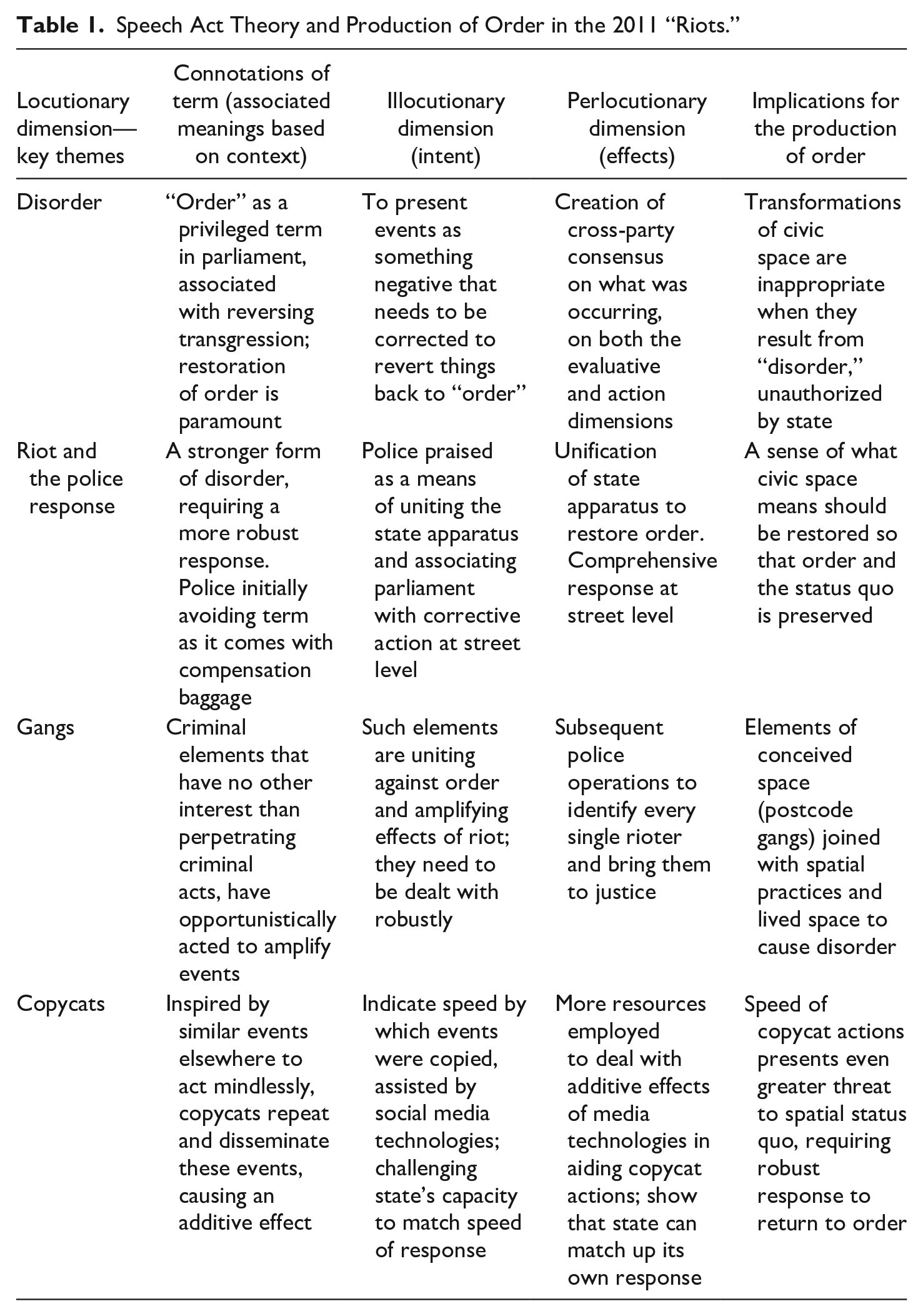
Table 1 outlines the analysis in terms of locutionary, illocutionary and perlocutionary dimensions, connotations of key themes, and implications in terms of production of order.
Speech Act Theory and Production of Order in the 2011 “Riots.”
Implications for Practice
Speech act theory (Austin, 1955; Searle, 1969, 1973, 1976) has important implications for practice because it gives us a new way to explain how state actors influence society through the medium of discourse. Here we have shown the effects of speech acts in MPs seeking to restore order in great detail, but there are wider implications than this. The way in which powerful state actors “bracket,” “tidy,” or “homogenize” complex events has implications for how society as a whole responds to complex challenges. To produce order in this setting, MPs expressed consensus over unitary categories. These flattened differences and allowed transgressive spatial practices to be bracketed, thereby working to restore order. This consolidation was supported by established practices, well-rehearsed, institutionalized routines that helped the state: display consensus; sweep together heterogeneous elements into an exhaustive category; and coordinate different levels of response, by enabling MPs to align themselves with street-level practices.
These kinds of processes may oversimplify (as we suggest here), but then another implication is that they can also hold out the promise of clarity and focus—or strategic direction. In relation to the COVID-19 crisis for example, a lack of clarity of messaging has proven deeply problematic in many different jurisdictions. Greater “rule clarity” has been shown to be associated with higher levels of compliance with measures put in place to combat the spread of COVID-19 (Kooistra et al., 2020), yet there has been a failure to align the response at different levels of analysis in many jurisdictions, including within the United Kingdom (Kyprianides, 2020; Reicher, 2020). What we show here, however, is that during an earlier crisis the U.K. state benefited from a skilled and practiced coordination between street level and state level. Such coordination is plainly possible, which makes its relative absence during the COVID-19 crisis all the more striking.
Another implication of our account of speech acts, and of our analysis of this case, is that institutions can improve messaging if they have a better understanding of how certain mechanisms serve to amplify the performative effects of discourse. We have explained how, in the wake of a crisis, the U.K. parliament offered state representatives a platform, through the mechanism of an exceptional day’s debate, amplifying the performative aspects to their contributions. Analogous mechanisms may be helpful when considering the state’s response to other kinds of crisis—whether these are natural disasters or slower burning grand challenges such as climate change.
Rather than offering an otherwise empty “talking shop,” such events may have important signaling and coordinating roles, serving to make clear to the public both, what the crisis is and what is the appropriate response to it. McAdams (2017) argues that the codification of laws has an effect on people’s behavior that goes beyond deterrence and the power of legitimate authority because law(s) provide focal points around which action can be coordinated. Making something illegal (or a legal requirement) both sends an important signal that the behavior is considered morally wrong (or right) and provides a point of reference and regularity around which desired forms of behavior can cohere. To return to the example of COVID-19, U.K.-based research has demonstrated a very strong correlation between the “expressive power” of the laws put in place and public compliance with them (Jackson et al., 2020). Debates such as the one described here could have a similar effect, serving to cohere discourse around a set of ideas that also provide focal points for action.
Our analysis identifies the need for two levels of spatial production that confront states dealing with large-scale social crises. The first is the atypical and complex demands it places on those who are responding at street level. The second is that such crises necessitate a state-level response that is concerned with restoring a sense of normality, and thereby producing order in real time. Another implication here is that what constitutes the most effective overall response by the state, in terms of restoring order, is likely to depend on the timing and coordination of responses at these two different levels. Concomitantly, the strongest challenges to order will not just be expressed in practices at the level of territorial struggle, nor attack representations of space, they will also propose new kinds of representational space. To do so they will need to frustrate attempts at state tidying—discursive consolidation through speech acts that promote normalization and homogenization. Theorists of civic order have typically seen these forces as the product of history or gradual colonization. This case of the 2011 riots shows that these forces also play a role in the production of order, as the state works in real time to smooth over crisis. Considering crisis is instructive to understanding the relationship between the state and order because it shows the state working on the production of order rapidly, rather than over successive generations and through the forces of history (Lefebvre, 1991).
Discussion and Conclusion
A necessary, intended perlocutionary effect of the state response was to restore order by what we call tidying: collectively gathering deviance under one banner that is Other. This Othering was simplistic though, and the idea these were not “riots, pure and simple” (see Hope, 2012), is worth reflecting on. One consideration here is the underlying sense and reference of disorderly spatial practices. Some individual and collective acts during August were flagrantly “disorder,” in part because they displaced representations of space and violated established boundaries. Individual-level examples were arson, smashing windows, burglary. Group-level examples included barricades and organized looting. The frequent catalyst for these was a widespread, if transient, perception that police were powerless, and this reflected deep changes in how authority and the everyday were perceived by the public—not simply those involved in disorder. The state’s grip on order seemed more tenuous than previously believed. However, and running contrary to the state’s logic of consolidation and tidying of rioters, there were various aspects of heterogeneity to the riots that may have made them less threatening than smaller scale, organized resistance. One aspect to this was the complex role of race.
Murji and Neal (2011) argue the riots were both racialized and not racialized. On the one hand, at inception, events were racialized as they involved African–Caribbean communities, but on the other hand, events over the 4 days were not. Deracialization was visible in terms of the diverse ethnic composition of the rioters and residents, in the geographically widespread nature of subsequent looting and disorder, and the seemingly incongruous character of rioting in nearby “unracialized” areas, like Enfield (Murji & Neal, 2011). This differed from previous riots, where boundaries, practices, ethnicity and discourse aligned more sharply. For instance, Burgess (1985) showed the media’s discursive representation of race in the riots of the 1980s. This designated particular urban spaces as sites of deviance that lay outside broader societal values and norms. Such constructions are continually negotiated and transformed; mobilized both by “outside” actors (e.g., the Police) and communities in these areas (see Keith, 1993).
There is a risk of neglecting race in analysis of the 2011 riots, as this could disguise continuing stigmatization (R. Brown, 2011). This may mean that we substitute, rather than abolish categories that can have performative effects, that is, where citations to a category are constitutive, producing and regulating certain kinds of subject (Butler, 1993). Speech act theory shows how nonracial discourse can become racially performative because of separation between the locutionary act and its effects. For instance, even though it is contrary to evidence, the term “gangs” is historically associated with black, minority ethnic and immigrant young men. And, groups of Black males are associated with gang activity and with violence and drug dealing and abuse by White populations (Alexander, 2008). These processes have been spatialized because many urban areas of deprivation have higher concentrations of minority ethnic groups (Amin, 2012). Spatial concentration makes these groups more visible to the state, and the use of public spaces by young people as territorialized communal sites, can be discursively framed as sites of “gang culture.” deviance and criminality (Back, 1996). Alexander (2008) argues that conflating race, immigrant groups, and gangs frames them as against national unity and interests, accelerating processes of regulation and surveillance. More broadly still, there is discursive framing of minority ethnic groups and public disorder and crime (e.g., muggings) within urban areas by the media, politicians, and the state (Keith, 2005). Since spatiality, and racial and gang discourses are intricately interwoven, prejudices can translate into state control and discipline (Anderson, 1990). Racial political discourses have been deployed to reterritorialize, by supporting the case for greater regulatory powers and conferring legitimacy to the state’s attempts to recapture such spaces (Beckett & Herbert, 2010).
Lefebvre (1991, p. 54) suggests, “revolution that does not produce a new space . . . has failed in that it has not changed life itself.” We are not comparing the events of August to revolution by any means, but Lefebvre’s description is relevant in considering why this large-scale disorder did not materialize into greater change. One explanation for why these events were transient may be that there was no single “Other,” and instead there was heterogeneity among those participating. Moreover, many, but not all, of these seemed to share an inscribed social script equating success or happiness with possessions, which is the formula that underpins contemporary consumption. In this sense, the “riots” may have left representational space, and an underlying order, untouched. There may indeed have been the homogeneity MPs sought for to normalize and restore order, but rather than this being because “rioters” were collectively and en masse outside the polity, it may be because the majority embraced deeply conventional, consumerist values.
Another way to express this is in terms of the difference between representations of space and representational spaces. Representations of space by the state make space a place for exchange, where representational spaces turn space into something that can be used (Fernandes, 2007). Representational space is lived, or in use as a consequence of social action and discourse; it is, “alive: it speaks” (Lefebvre, 1991, p. 42). It is space that is taken and used, expropriated from the state and market, and inhabited differently, thereby disrupting homogeneity (Harvey, 2012). The “riots” may not have expropriated from the market, but simply represented an alternative, ephemeral marketplace for some, with consumption facilitated by violence rather than capital. This may have been combined with a resigned understanding that carnival is fleeting and that return to state order was inevitable.
The commitment to consumption was clearly not the motive for all, in particular the origins of the “riots” and the march from the Broadwater Farm estate to Tottenham police station were very different phenomena with very different motives and interests. Disorder can often take the form of assertions of rights by the disenfranchised or a political organization in public space. This is where, “on street corners or in parks, in the streets during riots and demonstrations—political organizations can represent themselves to a larger population and through this representation give their cries and demands some force” (Mitchell, 2001, p. 129). Such spatial practices subvert representations of space and bring into being a very different kind of representational space. During disorder, any of a number of spatial practices can transform how space is routinely experienced. Indeed that is sometimes their purpose, for instance in the “reclaiming the streets” and “occupy” movements (G. Brown, 2004). However, looting and the barricade offer limited scope to press claims. In contrast, the suspension of markers of territory, identity and affiliation; and the possibility of remote coordination through closed information networks were very different repertoires of contention, and these could prefigure or channel social change (Tilly, 1995).
Connecting Lefebvre’s ideas of the production of space to speech act theory offers a novel perspective on order and one that links the “triad” to specific actors. It allows us to join a conversation on the role of discourse in social change (Barrett et al., 1995; Oswick et al., 2010), our contribution to this conversation being to account more particularly for the role of speech acts. The contextualization of our analysis, in terms of constative talk from officers who were at street level, suggests they were preoccupied with the reassertion of sovereignty through territorial struggles. This was partly based on a logic of difference: that this experience was entirely exceptional and unprecedented. Our analysis of performative talk, from MPs working at state-level, suggests they were primarily preoccupied with normalization and homogeneity: framing participants in disorder, en masse, as outside society—an act of consolidation or “tidying.”
Footnotes
Declaration of Conflicting Interests
The author(s) declared no potential conflicts of interest with respect to the research, authorship, and/or publication of this article.
Funding
The author(s) disclosed receipt of the following financial support for the research, authorship, and/or publication of this article: Kevin Morrell gratefully acknowledges the support of the British Academy whose award of a Mid-Career Fellowship made this research possible MD140052.
