TurnerA. J., “Sun-dials: History and classification”, History of science, xxvii (1989), 303–18, p. 311.
2.
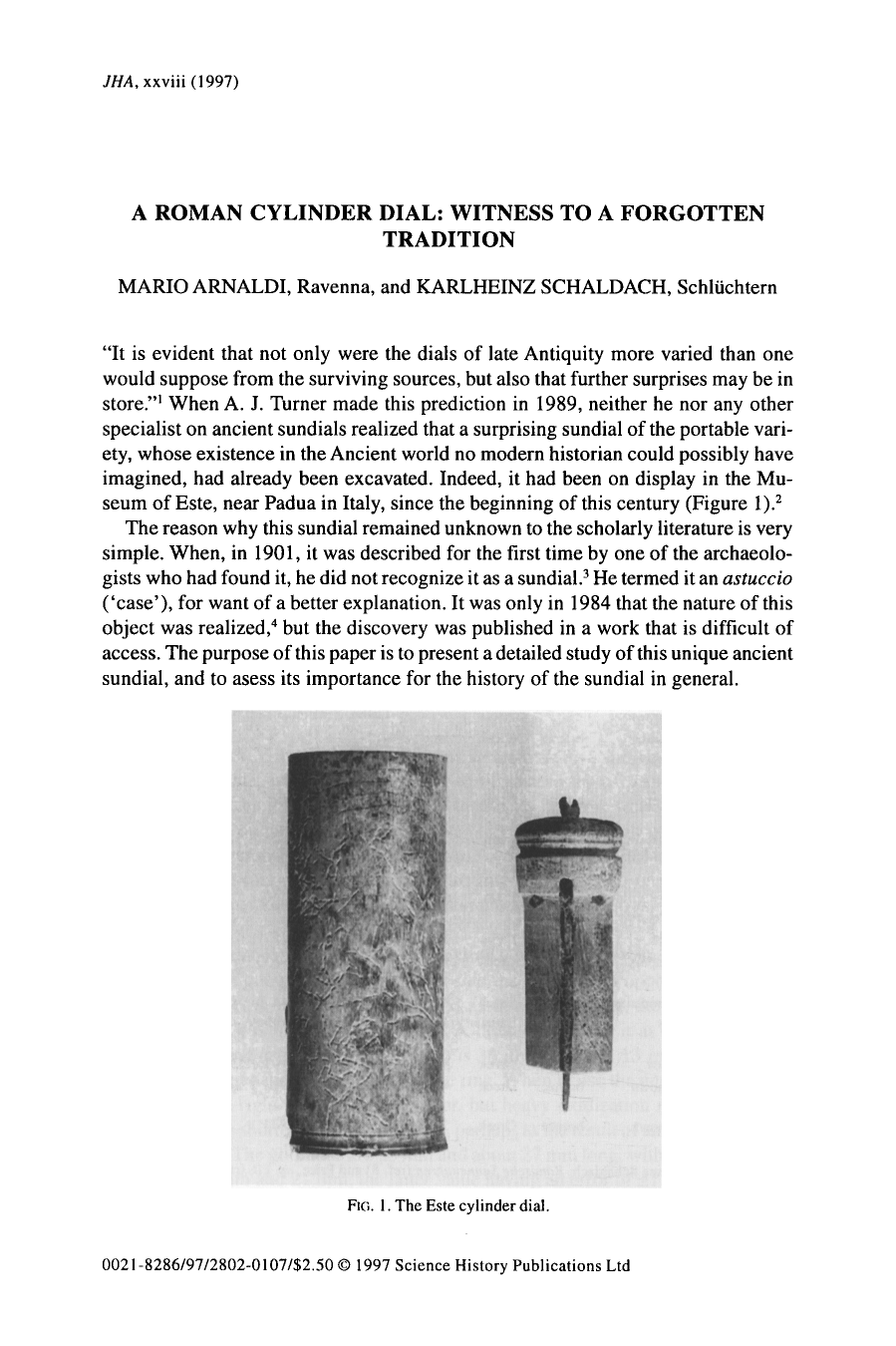
The authors would like to thank the Museo Nazionale Atestino in Este for providing this photograph, which is published by the permission of the Italian Ministero dei Beni Culturali and of the Museum.
3.
ProsdocimiA., Guida sommaria del R. Museo Atestino in Este (Este, 1901), 81.
4.
BonomiS., “Tomba Romana del medico a Este”, Aquileia nostra, lv (1984), cols 77–107.
5.
“Viatoria pensilia” we have only from Vitruvius, De architectura libri x, Book IX. Two other terms, “and” “are considered also to refer to portable sundials. But it is not possible to establish definite relations between these terms and the types of sundials that have been discovered. See also ref. 8.
6.
The last listing of eleven items then known was given by de Solla PriceD. J., “Portable sundials in Antiquity”, Centaurus, xiv (1969), 242–66.
7.
The oldest known instrument, found in Herculaneum and published for the first time in Antichità di Ercolano, iii (Naples, 1762), preface.
8.
A detailed discussion of the Mainz dial as well as the other variants and Roman dialling in general is included in SchaldachK., Römische Sonnenuhren (Frankfurt a. M., 1997).
9.
This is one of sixteen names of sundials that Vitruvius mentions in Book IX, though without giving further information. Each of the seven climates was a band of latitudes, on which see HonigmanE., Die sieben Klimata (Heidelberg, 1929).
10.
Cf.BuchnerE., “Römische Medaillons als Sonnenuhren”, Chiron, vi (1976), 329–46.
11.
Cf.GounarisG., “Anneau astronomique solaire portative antique découvert à Philippes”, Annali dell'Istituto e Museo di Storia della Scienza di Firenze, v/2 (1980), 3–18.
12.
Cf.FieldJ. V., “Portable sundials and the London sundial-calendar”, History of technology, xii (1990), 103–35.
13.
Those characters were essentially used in notes or on waxed writing tables, but not on artistic objects.
14.
One of the coins found in “the tomb of the physician” shows the image of Vespasian, and other objects are also dated to the second half of the first century a.d. Vespasian's coin gives us a terminus post quem, which does not exclude the possibility that the coin might be much older than the tomb itself.
15.
Cf.GibbsS., Greek and Roman sundials (New Haven and London, 1976), 71.
16.
Cf.MillsA. A., “Altitude sundials for seasonal and equal hours”, Annals of science, liii (1996), 75–84.
17.
On dials of Type VI the degrees of the solstices can be roughly measured to ±24°, the same value as given by Vitruvius in Book IX in the context of his analemma.
18.
Field, op. cit. (ref. 12), 119.
19.
Buchner, op. cit. (ref. 10), 331.
20.
Seneca, Apocolocyntosis 2.2. The accuracy of the present dial compares well with that of other sundials surviving from Antiquity (especially dial II.1 and those of Type IV). We have of course to be cautious in imposing on the dial-makers of Antiquity modern standards of mathematical precision.
21.
Cf.Turner, op. cit. (ref. 1), 305.
22.
Cf.KrenC., “The traveler's dial in the late Middle Ages: The chilinder”, Technology and culture, xviii (1977), 419–35.
23.
Cf.GoukP., The ivory sundials of Nuremberg (Cambridge, 1988).
24.
ThorndikeL., “Of the cylinder called the horologe of travelers”, Isis, xiii (1929/30), 51–52.
25.
A modern treatment on the basis of the variant manuscripts till 1500 is not yet written. Eight manuscripts were listed by Thorndike, more than 50 in ZinnerE., Verzeichnis der astronomischen Handschriften des deutschen Kulturgebietes (Munich, 1925), 286f.
26.
On the albion (a complex instrument for calculating planetary positions) in 1431 and on the astrolabe in 1434, cf.UibleinP.“Johannes von Gmunden — seine Tätigkeit an der Wiener Universität”, Österreichische Akademie der Wissenschaften, phil.-hist. Klasse, Sitzungsberichte, cccxcvii (Vienna, 1988), 11–64.
27.
Kren, op. cit. (ref. 22), 424f.
28.
ZinnerE., Deutsche und niederländische astronomische Instrumente des 11.–18. Jahrhunderts, 2nd edn (Munich, 1967), 322.
29.
ViennaMS, NB 5418, fols 202–204v, dated 1433.
30.
The ivory piece belongs to the National Museum of Bavaria in Munich, inv. no. Phys. 64; it bears the International Checklist Number #7524 (such numbers are being assigned to all medieval instruments in the Frankfurt-based project to catalogue all medieval scientific instruments, see KingD. A., “Medieval astronomical instruments: A catalogue in preparation”, Bulletin of the Scientific Instrument Society, xxxi (1991), 3–7).
31.
The last edition is MigneJ. P., Patrologia Latina, cxliii (Paris, 1853), cols 405–8.
32.
Zinner, op. cit. (ref. 28), 374.
33.
Cf.Kren, op. cit. (ref. 22), 420; Kren and Thorndike mention PaduaMS, Bibl. Antoniana I, 27, f. 96r, which is one of more than sixty medieval shadow schemes known to the authors. A shadow scheme is a simple arithmetical pattern that provided reasonably close approximations of shadow lengths during the day throughout the year; the best studies on shadow schemes are NeugebauerO., A history of ancient mathematical astronomy, ii (Berlin and New York, 1975), 736–46, and KingD. A., “A survey of medieval Islamic schemes for simple time-reckoning”, Oriens, xxxii (1990), 191–249.
34.
WiedemannE. and WürschmidtJ., “Über eine arabische kegelförmige Sonnenuhr”, Archiv für die Geschichte der Naturwissenschaften und der Technik, vii (1916), 359–76; see also LivingstonJ., “The Mukhula, an Islamic conical sundial”, Centaurus, xvi (1972), 299–313.
35.
Not quite correctly cited by Kren, op. cit. (ref. 22), 420, who writes that Wiedemann and Würschmidt analysed “a cone-shaped dial … dating from the 10th century”.
36.
ZinnerE., Die Geschichte der Sternkunde (Berlin, 1931), 277.
37.
KingD. A., “Mizwala” [= sundial], The encyclopaedia of Islam, vii (Leiden, 1991), fac. 117–18 (pp. 210–11).
38.
So BrydenD. J., Sundials and related instruments, Catalogue 6 (The Whipple Museum of the History of Science, Cambridge, 1988), Part 4, Section 1: Cylinder dials.