Of the inadequate older surveys the most detailed are SmallRobert, An account of the astronomical discoveries of Kepler (London, 1804 [reprinted Madison, Wisconsin, 1963]), 163–297; DelambreJ.-B., Histoire de l'astronomie moderne, i (Paris, 1821 [reprinted New York, 1969]), 390–467; and DreyerJ. L. E., History of the planetary systems from Thales to Kepler (Cambridge, 1906 [reprinted New York, 1953]), 380–403. More recent analyses are presented by KoyréA., La révolution astronomique (Paris, 1961 [English version, London, 1973]), 172–281; WilsonC. A., “Kepler's Derivation of the Elliptical Path”, Isis, lix (1968), 5–25 and “How Did Kepler Discover His First Two Laws?”, Scientific American, ccxxvi (1972), 93–106; AitonE. J., “Kepler's Second Law of Planetary Motion”, Isis, lx (1969), 75–90 and “Infinitesimals and the Area Law”, Internationales Kepler-Symposium, Weil der Stadt 1971 (Hildesheim, 1973), 283–305; and GingerichO., “Johannes Kepler and the New Astronomy”, Quarterly journal of the Royal Astronomical Society, xiii (1972), 346–73 (see also pp. 293–7 of his article “Kepler, Johannes” in Dictionary of scientific biography, vii (New York, 1973), 289–312). More general summaries, written with a scholar's accuracy and novelistic impressionism respectively, are to be had in Caspar'sMaxJohannes Kepler: Biographie (Stuttgart, 11948)—more usable in Doris Hellman's extensively annotated English version, Kepler (New York, 1959), especially pp. 121–42—and Koestler'sArthurThe sleepwalkers. A history of man's changing vision of the universe (London, 11959), particularly pp. 313–43.
2.
Astronomia nova, seu physica cœlestis tradita commentariis de motibus stellœ Martis, Ex observationibus … Tychonis Brahe (Prague, 1609 [facsimile reprint Brussels, 1968]). In sequel we quote from the text of Caspar's edition in Johannes Kepler Gesammelte Werke [hereafter cited as GW], iii (Munich, 1937); his preceding German version, Kepler. Neue Astronomie (Munich, 1929), has, however, more detailed technical notes.
3.
These—to his old Tübingen tutor Michael Maestlin, his erstwhile fellow Tychonian assistant Christian Longomontanus, the Bavarian chancellor Hans Georg Herwart von Hohenburg, and the Frisian clergyman David Fabricius notably—are conveniently accessible in GW, xiv and xv. See Caspar's chronological list in GW, iii, 447–54.
4.
Leningrad (‘Pulkovo’) Kepler MS XIV, ff. 68–360v. Though Caspar in his Anmerkungen to the text of the Astronomia in GW, iii occasionally cites points of detail from this working notebook of Kepler's, and Volker Bialas has more recently made some use of it in surveying “Die quantitative Beschreibung der Planetenbewegung von Johannes Kepler in seinem hand-schriftlichen Nachlass”, Kepler Festschrift zur Erinnerung an seinen Geburstag vor 400 Jahren (Regensburg, 1971), 99–140, especially 110–12, the only detailed examination of its content is that which features in Owen Gingerich's enlightening analysis of “Kepler's Treatment of Redundant Observations …”, Internationales Kepler-Symposium, Weil der Stadt 1971 (Hildesheim, 1973), 307–14.
5.
We closely follow the perceptive summary of Ptolemy's planetary models given by O. Neugebauer on pp. 198–201 of his The exact sciences in Antiquity (Providence, Rhode Island, 21957).
6.
See KennedyE. S. and RobertsVictor, “The Planetary Theory of Ibn al-Shātir”, Isis, 1 (1959), 227–35; and KennedyE. S., “Late Medieval Planetary Theory”, Isis, lvii (1966), 365–78. In his unpublished Ad harmonicon cœleste libri quinque priores (1600?; see SchofieldChristine, “The Geoheliocentric Mathematical Hypothesis in Sixteenth-Century Planetary Theory”, British journal for the history of science, ii (1965), 291–6, especially 295), François Viète added the elegant corollary that, since its instantaneous distances from D' perpendicular to and parallel to OD' are (D'G + GI) sin t and (D'G — GI) cos t, the epicycle centre I—that is, the planet itself in Copernicus's analogous heliocentric theory—traces in the plane of the moving vector OD' an ellipse of semi-axes D'G + GI = 2e and D'G — GI = e.
7.
Of polar equation + = 1 and so af = R + e (cos t + cos 2 t) — ½ (e2/R) (sin t + sin 2 t) (sin t + 3 sin 2 t) …, differing from the equivalent Ptolemaic vector by some (e2/R) sin 2 t (sin t + sin 2 t) … or, since in Ptolemy's model R = 20e, by at most 0·D07R (when 8 cos3t + 3 cos2t — 4 cos t — 1 ≈ 0 and so t ≈ 47°, 102° and 144°). The minimum approach of f to O in the Ptolemaic theory is readily obtained, on setting af = r, as the equal minimum of Of2 = r2 + 2 er cos t + e2 by the condition d(Of2)/dt = 0 and hence dr/dt = er sin t/(r + e cos t) where R2 = r2 — 2 er (cos t + cos 2 t) + 2e2 (1 + cos t) and so dr/dt = (– er (sin t + 2 sin 2 t) + e2 sin t)/(r — e (cos t + cos 2 t)); whence by reduction (sin t ≠ 0) there is 2r2 (1 + 2 cos t) + 2 er cos2t — e2 cos t = 0 and consequently cos t = — (4r2 — e2 + √(4r2 — e2)2 — 16 er3)/4 er = — ½ – 1/8 (e/r) — 3/18 (e2/r2) …. Accordingly t ≈ cos−1 — ½ = 120° and so r ≈ R — e = 19e, and thus more accurately t ≈ cos−1 — 0·5066 … = 120° 26 ½'. These results are derived numerically at considerable length by Willy Hartner on pp. 109–15 of his “The Mercury Horoscope of Marcantonio Michiel of Venice”, Vistas in astronomy, i (1955), 84–138 (reprinted with corrections in his Oriens-Occidens (Hildesheim, 1968), 440–95, especially 465–71; but note that in the “Addition to p. 471” on p. 494 he should have stated: “A refined computation shows that the minimum of [Of =] s occurs close to [t =] 120°30', where s = 18·520157”). For the historical reasons why Ptolemy chose such a model with a duplicate minimum approach of f to O see GingerichO., “The Mercury Theory from Antiquity to Kepler”, Actes du XIIe Congrès International d'Histoire des Sciences, Paris 1968 (Paris, 1971), iiiA, 57–64, particularly 57–60.
8.
Determined parametrically by the coordinates Cg = e (2 cos t + cos 2 t), gf = e sin t. In his manuscript sketch of this quartic locus Viète inaccurately represented it as having cusps at “apogee” (t = 0°, Cf = 3e) and “perigee” (t = 180°, Cf = — e); I am grateful to Noel Swerdlow for bringing out this point in a seminar of his at Brown University on 19 May 1972. On al-Shīrāzī's construction of the general deferent locus f in the plane of the rotating vector OC see Kennedy, “Late Medieval Planetary Theory” (ref. 6), 373–5. To underline how slightly it diverges from the Ptolemaic one, let me remark that al-Shīrāzī's point f approaches nearest to O when t ≈ 120° 55 ½'.
9.
See Roberts and Kennedy, “The Planetary Theory of al-Shātir” (ref. 6 above). Much as before, Viète later showed in his Ad harmonicon cœleste … that, since CG = 2 e cos t and GF = e sin t, the epicycle centre F traces out round C in the plane of the moving vector OC an ‘epi-ellipse' of semi-axes 2e and e respectively.
10.
De revolutionibus orbium cœlestium, Libri VI (Nuremberg, 1543), f. 142v: “sidus hoc motu composito, non describit circulum perfectum juxta priscorum sententiam Mathematicorum, differentia tamen insensibili”. In his annotated copy of the De revolutionibus, now in Leipzig University Library and readily available in photofacsimile (New York, 1965), Kepler has underlined the last phrase and placed a reminding symbol in the margin alongside; compare the remark in ref. 11 below. On eliminating EfI = t between OI = r = √(R + e cos t)2 + 4e2 sin2t and, where EOI = ϕ, I's apsidal distance r sin ϕ = (R — e cos t) sin t, there ensues r = R + e cos ϕ + 2 (e3/R2) sin2 ϕ cos ϕ … as the polar equation of the Copernican orbit EIL. While the radial ‘exorbitation' of this from the Ptolemaic eccentric circle r = e cos ϕ + √R2 — e2 sin2 ϕ is ½ (e2/R) sin2 ϕ … or, in the case of Mars (e ≈ 1/11 R), about 0·004R when ϕ ≈ 90°, it is approximated by the ellipse r = R + e cos ϕ + (e3/R2) sin2 ϕ cos ϕ … of eccentricity DO = e and minor axis EL to within the minute error (e3/R2) sin2 ϕ cos ϕ …, which is at most (when ϕ ≈ tan−12, that is, about 55° and 125°) some 0·0003R for Mars. If only Kepler had suspected that to gain the true orbit he needed only to rotate Copernicus's through 90° he would have saved himself five years of exhausting (if richly rewarding) toil! Otto Neugebauer has heavily underscored the justice of Viète's contemporary disparagement of Copernicus as “Ptolemæi paraphrastes” (Apollonius Gallus (Paris, 1600), f.11 = Opera mathematica (Leyden, 1646), 343) in his perceptive essay “On the Planetary Theory of Copernicus”, Vistas in astronomy, x, (1968), 89–103; see also his Exact sciences in Antiquity (ref. 5 above), 202–6. On likewise divorcing past truth from ideological propaganda I can but wholeheartedly agree with his concluding observation (p. 103): “Modern historians, making ample use of the advantage of hindsight, stress the revolutionary significance of the heliocentric system and the simplifications it had introduced. In fact, the actual computation of planetary positions follows exactly the ancient pattern and the results are the same…. Had it not been for Tycho Brahe and Kepler, the Copernican system would have contributed to the perpetuation of the Ptolemaic system in a slightly more complicated form but more pleasing to philosophical minds”.
11.
As he later wrote in Caput IV of his Astronomia, “Hanc exorbitationem itineris Planetarii a perfectione circuli Ptolemæus Copernico jure objecerit: Ego non objicio. Nam infra demonstrabitur … necessario effici, ut Planeta a circulo parumper deflectat, non excurrendo quidem, ut in hac hypothesi Copernicana, sed contrariam in plagam ad centrum sc. ingrediendo” (GW, iii, 75). In 1600, of course, matters were less clear and the Copernican ‘exorbitation' from the perfect circle might well have then seemed something of a blemish to him; compare the previous ref.
12.
Astronomia, Caput IV = GW, iii, 77: “Distantiæ vero formæ Copernicanæ Ptolemaicis non possunt æquari, nisi æquatio 43 minutis varietur”. In large part this massive discrepancy arose from the values chosen by Ptolemy and Copernicus, each of them seriously deficient, for Mars's eccentricity; as we have seen, their divergence when they share the same parameters is slight. Their comparable difference in timed true motion is still less; for, since on eliminating r between the equations earlier derived (in ref. 10) for the Copernican orbit—and now putting R = 1—we may deduce that ASM = t — 2 e sin t + e2 sin 2 t — e3 (2 – 14/3 sin2t) sin t …, its departure from the Ptolemaic eccentric is only e3 sin3t … or at most (in quadratures) some 2 ½' of arc in Mars's case (where e ≈ 1/11). Like the latter circle path, however, it errs crucially from the elliptic truth by ¼ e2 sin 2 t …, producing a maximum discrepancy therefrom (in octants) of about 8'.
13.
He afterwards observed in Caput XIX of his Astronomia that “ex [Tychonis] observatis error hujus calculi Ptolemaici viii minutorum in Marte arguitur; … si contemnenda censuissem 8 minuta longitudinis, jam satis correxissem (bisecta scilicet eccentricitate) hypothesin” (GW, iii, 178).
14.
Caput XVI (= GW, iii, 156): “Si te hujus laboriosæ methodi pertæsum fuerit, jure mei te misereat, qui eam ad minimum septuagies ivi, cum plurima temporis jactura, et mirari desines hunc [1605] quintum jam annum abire, ex quo Martem aggressus sum”.
15.
In his discussion of “Kepler's Treatment of Redundant Observations” (see ref. 4) Gingerich has lately unravelled the tangled complexities underlying the schematic account given of the construction of the ‘vicarious' hypothesis in Caput XVI of the published Astronomia (GW, iii, 156–68). Of his four favoured Tychonic sightings of Mars in—or, more accurately, close to—solar opposition, that in 1587 and above all that in 1595 needed considerable post factum adjustment. Kepler's working notebook (Leningrad MS XIV) records three separate attempts in 1601 accurately to correct Tycho's values, and the last of these differs significantly from those—conjectured by Gingerich to have been contrived as late as 1604—taken as observational basis in the published Astronomia. In 1601 Kepler's best computation yielded a ratio SC/SF = 11058/18562, whence SC/1/2 SF = λ = 1·19 … only.
16.
Tycho's best observations would in principle have allowed him to work within an error of 2' of arc, but his assumption that the sum-distance and area rules yield the same numerical accuracy when applied to the Martian orbit and its circumscribing circle (see ref. 23 below) effectively restricts Kepler's theshold to be some 3 ½-4' of arc.
17.
Astronomia, Capita XVII-XIX = GW, iii, 169–77.
18.
Astronomia, Capita XXII-XLIII = GW, iii, 191–285.
19.
Astronomia, Caput XLIV = GW, iii, 286: “Itaque plane hoc est: Orbita Planetæ non est circulus, sed ingrediens ad latera utraque paulatim, iterumque ad circuli amplitudinem in perigæo exiens, cujusmodi figuram itineris ovalem appellitant”. Earlier, in a letter to Fabricius on 4 July 1603, Kepler had written: “non poteram acronychia loca in octavis circuli intra 7 vel 8 minuta conciliare, si vel centies repeterem…. Tempora enim accumulantur versus apogæum et perigæum contra omnem circuli legem…. ne dubium existeret in Ellipoide, … nihil nobis præter Geometriam adest” (GW, xiv, 426, 429).
20.
Astronomia, Caput XXXI = GW, iii, 233: “… modum æquationis non per fictam hypothesin sed ex ipsa rerum natura computandæ me præparabo”.
21.
Astronomia, Capita XXXII-XXXIX = GW, iii, 233–62.
22.
Astronomia, Caput XL = GW, iii, 263. The problem of summing these infinitesimal ‘delays’ caused Kepler a great deal of trouble, as he there says: “Cum ergo sint moræ Planetæ in æqualibus eccentri partibus ad invicem in ea proportione, in qua sunt ipsæ partium illarum distantiæ, at puncta singula in toto semicirculo eccentri distantiam mutent; non levem operam mihi sumpsi, ut inquirerem, quomodo singularum distantiarum summæ haberi”. AitonCompare, “Infinitesimals and the Area Law” (ref. 1), 294–6.
23.
In fact, Kepler further (see the previous ref.) approximated the sum-distance rule by computing the ‘equivalent’ indivisibles integral ∫ r.dθ where θ is the corresponding central angle ACm. We may readily see that this assumption of numerical equivalence between these measures sets a theoretical bound on the angular errors he is prepared to tolerate in computation. From a modern viewpoint, if we suppose the general equation of Kepler's ovals to be (in polars) r = 1 + e cos ϕ + Ae2 sin2 ϕ + Be3 sin2 ϕ cos ϕ …, A and B taking on appropriate values in particular instances, we may with some little difficulty conclude that (a) where c1t = ∫ r.ds, then c1 = 1 + (A + 3/4) e2 … and therefore ϕ1 = t — 2 e sin t + (15/8 + 1/2A) e2 sin 2 t — e3 (11/2 + 2A — (21/2 + 6A — 2/3B)sin2t)sin t …; (b) where c2t = ∫ r2.d ϕ, then c2 = 1 + (A + 1/2) e2 … and so ϕ2, = t — 2 e sin t + (7/4 + 1/2A) e2 sin 2 t — e3 (5 + 2A — (9 + 16/3 A — 2/3 B) sin2t) sin t …; and (c) where c3t = ∫ r.dθ, then c3 = 1 + ½ (A + 1) e2 …, yielding ϕ3 = t — 2 e sin t + (7/4 + ¼ A) e2 sin 2 t — e3 (5 + A — (28 + 11A — B) sin2t) sin t … Evidently, for small e the discrepancy ϕ1 — ϕ2 is of the order of e2 sin 2 t …, effectively independent of A and B, and so in the case of Mars (e ≈ 1/11) at most about 4’ of arc (at quadratures). Since when A = 1 the difference ϕ3 — ϕ1 is likewise of the same order, to the extent that Kepler in his computations of the Martian orbit empirically accepts the equivalence of these three variant measures, this 4’ of arc would seem to mark the threshold of error within which he works.
24.
Presupposing the area law c2t = ∫ r2.dϕ, c2 = 1 — e2. The sum-distance rule c1t = ∫ r.ds (see the previous ref.) yields c1 = 1 – 3/4 e2 … and thence and so Since Kepler himself could not compute any of these series expansions, we will not here insist on their differences.
25.
This was first derived—in an equivalent form—only a dozen years ago by Kuno Fladt; see his “Das Keplersche Ei”, Elemente der Mathematik, xvii, (1962), 73–78.
26.
Or as he equivalently described it in Caput XLVI of his published Astronomia (GW, iii, 296): “apparet resegmentum nostri circuli eccentrici infra multo esse latius, quam supra, in æquali ab apsidibus recessu. Quod cuilibet vel numeris exploratu facile est, vel Mechanica delineatione, assumpta evidenti aliqua eccentricitate”. Kepler's reference to the breadth of the lunule intersected between the ovum and its circumscribing circle, rather than to the width of the oval itself, has recently misled a number of people—notably N. R. Hanson in his Patterns of discovery (Cambridge, 1958), 77 and correspondingly in his posthumous Constellations and conjectures (Dordrecht, 1973), 263—to depict the Keplerian ‘egg’ as itself fatter “below” (towards perihelion).
27.
Astronomia, Capita XLVI/XLVII = GW, iii, 295, 297, 299: “sequitur jam, viam hanc … vere esse ovalem, non ellipticam, cui Mechanici [Durerus] nomen ab ovo ex abusu collocant…. Sit autem hæc figura perfecta ellipsis, parum enim differt…. insensibiliter diffe[rt], eo quod compensatio sit inter supernos excessus ooidis supra ellipsin, et infernos defectus”.
28.
Astronomia, Caput XLIX = GW, iii, 312–13.
29.
“Doce me Geometricè constituere, quadrare, secundùm datam rationem secare Ellipoides, statim docebo te ex genuina hypothesi calculare” (GW, xiv, 429–30).
30.
Astronomia, Caput LIII = GW, iii, 337–44.
31.
“in mediis longitudinibus … In dimensione orbis annui 100000, circuli perfectio prolongat circiter 800 vel 900 nimis. Ovalitas mea curtat 400 circiter nimis. Veritas est in medio, propior tamen ovalitati meæ …: Omninò quasi via Martis esset perfecta Ellipsis” (GW, xv, 79–80). In Caput LV of the published Astronomia he similarly concluded that “patet, viam Planetæ neque circulum esse, neque tantum a circulo ingredi ad latera, quantum ovalis … ingreditur, sed media incedere via…. Nam ibi loci [ad quadraturas] peccat Ovalis … 660 particulis in defectu, ut circulus perfectus totidem peccat in excessu” (GW, iii, 344–5).
32.
Astronomia, Caput LVI = GW, iii, 345. He had earlier said much the same to Fabricius on 11 October 1605: “Cum viderem distantias ex perfecto circulo eccentrico extructas penè tantum peccare in excessu, tam quoad seipsas, et earum effectum in prosthaphæresibus orbis annui, quam quoad æquationes Eccentri: Quantum Ellipsis mea (quæ perperam ab ovali differt) quam tibi in numeris præscripsi peccabat in defectu: Rectissimè argumentatus in hunc modum. Circulus et Ellipsis sunt ex eodem figurarum genere, et peccant æqualiter in diversa, ergò veritas consistit in medio, et figuras Ellipticas mediat non nisi Ellipsis. Itaque ominò Martis via est Ellipsis, resectâ lunula dimidiæ latitudinis pristinæ Ellipseos. Erat autem lata lunula 858 de 100000. Ergò debuit esse lata 429, quæ est justa curtatio distantiarum in longitudinibus mediis, ex perfecto circulo extructarum. Hic inquam veritas ipsa est” (GW, xv, 247–8).
33.
We paraphrase the description of this variant equant model which Kepler communicated to Fabricius in October 1605 (GW, xv, 248–9; the figure there reproduced by the editor Max Caspar is, we may note, badly out in its proportions, nor does Caspar in his adjoined Anmerkungen hint at the subtleties or clarify its obscurities). For one reason or another Kepler chose not to mention its existence in his published Astronomia.
34.
In Kepler's own words, “si [CRQ'] linea determinaret etiam Apogæum verum Epicycli, tunc ex itinere planetæ fieret perfectus circulus. Nam ducta [Rm] parallela ipsi [S]C, … [Q'Rm] æquat [RCA] anomaliam mediam, quia sunt æqualis restitutionis Epicyclus et concentricus, … tunc juncta [mC] lineam faciunt tam longam, quam si ex C Eccentricus perfectus describatur radio [AC]: … Atque hæc hypothesis falsa est, quod anno 1602 rescivi: Sin autem manente C puncto æqualitatis ipsius [R] linea [SRQ”] fieret linea Apsidum verarum Epicycli et [Q”] vera Apsis Epicycli, sic ut ipsi [RCA] anomaliæ mediæ constitueretur æqualis [Q'Rm], et [Rm] inclinaretur ad [CA], quod est perinde ac si dicam Epicyclum æqualibus temporibus moveri æqualiter circa suum centrum: Tunc hæc esset quàm proximè hypothesis, qua sum usus per 1603. in 1604 annum…. Et haberet mediocrem causam naturalem” (GW, xv, 248).
35.
“Atque ex hac hypothesi jam quam proximè vera distantia extruitur [m] ab [S], sic et [mSA] quam proximè vera coæquata. Dico quam proximè nunquam enim ita verè, ut cum ea Physicæ æquationis computatio instituatur. Porrò, hæc hypothesis mihi … non satisfecit, quod punctum [G] causa naturali carebat. Nam punctum C habet causam naturalem, quod scilicet [S]C et [Rm] æquantur, et quod tantundem est est, ac si dicam, ut distantiæ sunt sic esse moras in æqualibus arcubus Eccentri” (GW, xv, 249).
36.
Astronomia, Caput LV = GW, iii, 345: “Itaque causæ Physicæ cap. XLV. in fumos abeunt”.
37.
Astronomia, Capita LVI/LVII = GW, iii, 345–64. Earlier, with the events still fresh in his mind, Kepler had told Fabricius in October 1605 that “Statim arripui hanc pro naturali hypothesin, planetam non versari in Epicycli circumferentia … sed in diametro [Sm] librari. Jamque distantias et totam æquationum tabulam extruxi inde” (GW, xv, 249). The physical basis of this hypothesis of diametral libration was afterwards amplified in the fifth book of Kepler's Epitome astronomiæ Copernicanæ (see GW, vii, 363–70).
38.
Astronomia, Caput LVIII = GW, iii, 364–6. There is an historical puzzle here. In his October 1605 letter to Fabricius (GW, xv, 249) Kepler had earlier sketched the via buccosa as a true ‘puffy-cheek’, symmetrical top and bottom and re-entrant at quadratures. In the published Astronomia it is correctly computed to be a “top-heavy” oval: “Exilior est igitur resecta lunula superius …, latior inferius …. At in ellipsi lunula hæc æqualis est latitudinis in punctis æqualiter a[b] apsidibus remotis. Patet igitur, viam buccosam esse; non igitur ellipsin” (GW, iii, 366). We are left with the strong impression that a once accurately descriptive appellation has degenerated to be a lucus a non lucendo.
39.
This follows at once by substituting A = — 1 and B = — ½ in the pertinent series in ref. 23 above.
40.
Astronomia, Caput LIX = GW, iii, 367–76. From this the polar equation of the focal ellipse is immediate: For, since r cos ϕ = e + cos θ, there is r = 1 + e (r cos ϕ — e) and so r = (1 — e2)/(1 — e cos ϕ). It is an index of the slow development of mathematical and astronomical theory that this minimal step was not to be taken for another 59 years till Nicolaus Mercator stated the ellipse's equation (without proof) in his Hypothesis astronomica nova, et consensus ejus cum observationibus (London, 1664), 4 [= Institutionum astronomicarum libri duo (London, 1676), 166]. For another fifty years it failed to take its place in the textbooks, and in the interim such men as Newton, Edmond Halley, Leibniz and Johann Bernoulli were forced to derive it anew for themselves.
41.
We may, in fact, show that the angular difference is ¼ e2 sin 2 ϕ — ½ e3 sin3 ϕ …, that is, about 7’ of arc at most (in octants) in the case of Mars (e ≈ 1/11). From a large-scale geometrical construction Kepler himself measured (GW, iii, 365) errors of 5 ½’ and 4’ in upper and lower octants respectively.
42.
British journal for the history of science, ii (1964), 129, n. 42. The precise words with which Kepler rejected the via buccosa are: “cum ellipsis præbeat justas æquationes, hanc igitur buccosam, jure injustas præbere” (GW, iii, 366). In his recent paper on “Infinitesimals and the Area Law” (see ref. 1 above), AitonE. J. has (p. 300, n. 63) sought to find fault with Kepler's reasoning on a different basis, pointing to the discrepancy of some 4’ of arc at most which (compare ref. 23) arises when the sum-distance rule is used to evaluate the buccosa's focal area (ASm) and the corresponding sector of the ellipse which it approximates is measured “exactly” by the related sector of the circumscribing ‘eccentric’ circle. Equally, however, the ellipse itself when the sum-distance rule is applied to it would show a similar discrepancy; for, in the terms of ref. 23, the divergence 1/8 e2 sin 2 t … is effectively independent of the coefficients A and B which alone significantly determine the ovality and ‘eggishness’ of the buccosa and the ellipse. Since Kepler's postulated numerical equivalence of the sum-distance rule to that ensuing from the area of the corresponding sector of the eccentric circle is itself prone to a like maximum error of 4’ of arc, such a discrepancy must lie at the threshold of his tolerances and may therefore—if only in hindsight, three centuries on—be neglected. On any grounds Kepler could never empirically have refuted the claim of the via buccosa accurately to mirror the Martian orbit.
43.
“O me ridiculum! perinde quasi libratio in diametro, non possit esse via ad ellipsin…. demonstrabitur, nullam Planetæ relinqui figuram Orbitæ, præterquam perfecte ellipticam; conspir-antibus rationibus, a principiis Physicis, derivatis, cum experientia observationum et hypotheseos vicariæ …” (GW, iii, 366).
44.
Astronomia, Caput L X = GW, iii, 381: “Mihi sufficit credere, solvi a priori non posse, propter arcus et sinus . Erranti mihi, quicunque viam monstraverit, is erit mihi magnus Apollonius”. He himself subsequently derived an effective method for the solution of his equation, whereby “datâ anomaliâ mediâ [t] … computo anomaliam fictitiam [θ'], postea [e sin θ'] eaque ablata habeo verè coæquatam [θ ≈ t — e sin θ']”, as he initially described it in a stray draft letter to an unknown correspondent in about 1610, adding that “mihi enim unâ multiplicatione citra sinuum tabulas prodit valor areæ [θ]” (GW, xvi, 265). The elaboration in which this procedure is iterated, using the scheme θi+1 = t — e sin θ1, i = 0, 1, 2, …, n — 1 to derive θ ≈ θn from a tentative starting value θ0 he afterwards set out in Liber V, Pars II of his Epitome astronomiæ Copernicanæ (Frankfurt, 1621), 696 [= GW, vii, 393]; compare Kepler's contemporary letter to Maestlin in June 1620 (GW, xviii, 7–31, especially 15–16) where he gives his old Tübingen tutor a preview of the method. The attractiveness of this iterative approach is, of course, that small errors made en route do not affect the accuracy of the final approximation θn; indeed, in the worked example in his Epitome Kepler faltered slightly at one point, computing sin−10.74 to be 47° 44'6”, without effect on his final result. For the purposes of systematic tabulation it is enough, as he went on to tell Maestlin, to proceed “per Falsi regulam” (GW, xviii, 15). In his Tabulæ Rudolphinæ (Ulm, 1627) [= GW, x], Kepler in fact for each θ = i° of the array θ = 0° (1°) 180° calculated corresponding values ti = i + e sin i and ϕi = cos−1 [(cos i + e)/(1 + e cos i)], setting these pairs of mean and true motions (for each planetary eccentricity e) in parallel columns, and then between each row ti, ϕi; ti+i, ϕi+1 interposing an intercolumnium ki = (ϕi+1 — ϕi)/(ti+1 — ti), thereafter supposing per Regulam Falsi that for all t ε [ti, ti+1] there is, to sufficient accuracy, ϕ = ϕi + Ki (t — ti). Indeed, since on eliminating ϕ we directly connect true and mean anomaly by ϕ ≡ ϕt = t — 2 e sin t + 5/4 e2 sin 2 t — e3 (3 – 13/3 sin2t) sin t …, it follows on putting Ti = ½ (ti + ti+1) that ϕ = ϕTi + (t — Ti) ϕ'Ti + ½ (t — Ti)2 ϕ” Ti …, and hence, because (t — Ti)2 ≤ (ti — Ti)2 = ¼ (ti+1 — ti)2, there is to this latter order (ϕ — ϕi)/(t — ti) = ϕ'Ti = 1 – 2 e cos Ti + 5/2 e2 cos 2 Ti — e3 (3 – 13 sin2Ti) cos Ti…. Because ti+1 — ti ≈ 1° ≈ 2/115 radians, the error in assuming that ki = ϕ'Ti, constant, is at most, even in the case of Mercury (e ≈ 1/5), something less than 1’ of arc, and thus in Kepler's terms wholly negligible.
45.
See Gingerich's“The Mercury Theory from Antiquity to Kepler” (ref. 7 above), 60–63; also his “A Study of Kepler's ‘Rudolphine Tables'”, Actes du XIe Congrès International d'Histoire des Sciences (Warsaw/Cracow, 1968), iii, 31–36, and BialasVolker, “Neuere Untersuchungen über Keplers Planetentafeln”, Johannes Kepler. Werk und Leistung/Wissenchaftliche Beiträge (Linz, 1971), 99–108.




 ,
, 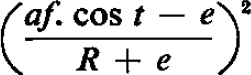 +
+ 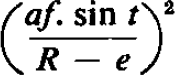 = 1 and so


 and so
  Since Kepler himself could not compute any of these series expansions, we will not here insist on their differences.


 . Erranti mihi, quicunque viam monstraverit, is erit mihi magnus Apollonius”. He himself subsequently derived an effective method for the solution of his equation, whereby “datâ anomaliâ mediâ [