An annotated text of the Gibson Lecture given at the University of Glasgow on 21 October 1969. An earlier version was delivered as the Woodward Lecture at Yale University on 10 March 1969.
2.
In a letter to ConduittJohn, husband of Newton's niece Catherine Barton, dated “Upminster 18 Jul: 1733” (King's College, Cambridge: Keynes MS 133, 10r). English reactions to the Principia in the years immediately following its first publication in 1687 are most recently analysed—with a special emphassis on Newton's younger contemporary LockeJohn—in Axtell'sJ. L. essay on “Locke, Newton and the two cultures” (in [ed. YoltonJ. E.], John Locke: Problems and perspectives (Cambridge, 1969), 169–82); see also his “Locke's review of the Principia”, Notes and records of the Royal Society of London, xx (1965), 152–61.
3.
An anecdote, referring to a period some time “After Sr I. printed his principia”, credited by Conduitt to “Mr Folkes” [Martin Foulkes] (King's College, Cambridge: Keynes MS 130.6, repeated in slightly revised form in MS 130.5).
4.
From the time, that is, when he completed the revised version of his preliminary tract “De motu corporum” (ULC. Add. 3965.7, 40r−54r) till late March 1687 when (see Halley to Newton, 5 April 1687, reproduced in The correspondence of Isaac Newton, ii (London, 1960), 473) he sent off to London the final copy for the third book of the Principia. In old age, Newton wrote less accurately to Pierre Varignon in 1719 that “The Book of Principles was writ in about 17 or 18 months, whereof about two months were taken up with journeys, & the MS was sent to ye R.S. in spring 1686 “(from the original English draft in private possession [M.101.H.3, 79], first published in an inferior transcription by RigaudS. P. in his Correspondence of scientific men of the seventeenth century, ii (Oxford, 1841), 436; equivalent Latin drafts exist in ULC. Add. 3968.42, 596v/615v and in King's College: Keynes MS 142).
5.
The most comprehensive account of this intended revision was that which Newton gave to David Gregory in mid-1694; see Gregory's Immutanda in nova elem: Suorum editione ad mentem autoris [sc. Newton] Maio 1694 (University Library, Edinburgh: Gregory MS C42, unpublished in its original Latin), an English translation of which is printed by TurnbullH. W. in his edition of The correspondence of Isaac Newton, iii (London, 1961), 384–6. The major changes Newton had by then determined to make in the structure of Book 1 of his Principia can be studied in detail in his still extant manuscript drafts, now for the most part gathered in ULC. Add. 3965.6. As he told Gregory, it was his plan to excise the geometrical sections 4 and 5 of that book completely, incorporating three of their lemmas into the introductory first section, but deferring the rest to a separate appended Liber geometriæ. The latter, together with the reconstructed second and third sections, will be reproduced in the seventh volume of my edition of The mathematical papers of Isaac Newton.
6.
Now in Trinity College, Cambridge: R.4.47, first published by EdlestonJoseph in his Correspon dence of Sir Isaac Newton and Professor Cotes (London, 1850), Appendix, 274–5. Despite Turnbull'sH. W. affirmation (The correspondence of Isaac Newton, iii, 155) that this is a “copy in Bentley's hand”, the manuscript is autograph except for Bently's endorsement that it contains “Directions from Mr Newton by his own hand”.
7.
In his History of the inductive sciences, from the earliest to the present time, Book II, Ch. VII (London, 1837, 167 = 21857, 128), Whewell proclaimed that “No one for sixty years after the publication of the Principia, and, with Newton's methods, no one up to the present day, had added anything of any value to his deductions. We know that he calculated all the principal lunar inequalities…. But who has presented, in his beautiful geometry, or deduced from his simple principles, any of the inequalities which he left untouched? The ponderous instrument of synthesis, so effective in his hands, has never since been grasped by one who could use it for such purposes; and we gaze at it with admiring curiosity, as on some gigantic implement of war, which stands idle among the memorials of ancient days, and makes us wonder what manner of man he was who could wield as a weapon what we can hardly lift as a burden”. A similar remark three years afterwards in his Philosophy of the inductive sciences, founded upon their history, Part 1, Book II (London, 11840, 152 = 21847, 158) affirms that “Newton's synthetical modes of investigation … were an instrument, powerful enough in his mighty hand, but too ponderous for other persons to employ with effect”. Akin to this is Whewell's assertion (Philosophy of the inductive sciences, 11840, 150 = 21847, 156–7) that “If the properties of the conic sections had not been demonstrated by the Greeks, and thus rendered familiar to the mathematicians of succeeding ages, Kepler would probably not have been able to discover the laws respecting the orbits and motions of the planets which were the occasion of the greatest revolution that ever happened in the history of science”. This high-flown generalization Isaac Todhunter gently deflated in his critique of the Philosophy (William Whewell: An account of his writings (London, 1876), i, 128–49), justly observing (p. 132) that “It is not true that any large amount of familiarity with the conic sections is required for the discoveries of Kepler; a very small fraction of the treasures accumulated by the Greek geometers would suffice for this purpose: Probably a dozen pages would supply the necessities of a student who wished to master even the Principia of Newton”.
8.
“Newtonian studies II. Newton and Greek geometry”, Harvard Library bulletin, xiii (1959), 354–61. Before composing his essay, unfortunately, Huxley had no direct acquaintance with Newton's unpublished papers, and accordingly had to rely on the inconsistencies and subtle distortions of the traditional account of Newton's method in the Principia. There is more than a faint echo of Whewell's famous earlier phrase (see n. 7) in his affirmation (p. 356) that “The Principia is like a mighty battlefield in which the victors achieve signal successes undaunted by their deliberate choice of archaic weapons”.
9.
“Cum Veteres Mechanicam (uti Author est Pappus) in rerum Naturalium investigatione maximi fecerint, …: Visum est in hoc Tractatu Mathesin excolere quatenus ea ad Philosophiam spectat. Mechanicam vero duplicem Veteres constituerunt: Rationalem quæ per Demonstrationes accurate procedit, & Practicam” (Philosophiæ naturalis principia mathematica (London, 11687), Præfatio ad Lectorem, signature A3r).
10.
ULC. Add. Dd.9.68 [Arithmetica universalis (Cambridge, 11707)], 127–8 [211–12], Problema 55 (Problem 69 in later editions). Newton's solution first appears in his unpublished “Veterum loca solida restituta”, where it is directly referred to Pappus's “modus ducendi Ellipsin per quinque data puncta” (ULC. Add. 4004, 89v).
11.
Paris, 1685. In a scholium to Proposition 21 of his first book Newton added (Pricipia(11687), 69) that “Methodo haud multum dissimili hujus problematis solutionem tradidit Clarissimus Geometra De la Hire Conicorum suorum Lib. VIII, Prop. XXV [191–2, Sectionis Conicæ datis tribus punctis… & focorum altero …; determinare axem positione, & magnitudine]”.
12.
Apollonius Gallus. Seu, exsuscitata Apollonii Pergæi ΠEPI 'EΠAφΩN geometria (Paris, 1600). Newton first had acess to this about late 1664 in Frans van Schooten's Latin edition (Francisci Vietæ opera mathematica (Leyden, 1646), 325–38).
13.
Newton's undergraduate notes (late 1664?, now in the Fitzwilliam Museum, Cambridge) on conic properties, largely drawn from the various tracts inserted by Schooten in the two volumes of his second Latin edition (1659–61) of the Geometrie, are reproduced in The mathematical papers of Isaac Newton, i (1967), 29–45.
14.
Memoirs of the life and writings of Mr. William Whiston…. Written by himself (London, 1749), 39: “Sir Isaac, in Mathematicks, could sometimes see almost by Intuition, even without Demonstration; as was the Case in that famous Proposition in his Principia, that All parallelograms circumscribed about the Conjugate Diameters of an Ellipsis are equal; which he told Mr [Roger] Cotes he used before it had ever been demonstrated by any one, as it was afterward. And when he did but propose Conjectures in Natural Philosophy, he almost always knew them to be true at the same Time”.
15.
Principia (11687), 47. Newton there makes no claim to originality in his statement of the theorem pithily noting in lieu of a proof of it that “Constat [Lemma] ex Conicis”.
16.
Euclidis elementorum libri XV. breviter demonstrata, operâ Is. Barrow (Cambridge, 11655). Newton's library copy of this edition, heavily annotated in his juvenile hand, is now in Trinity College, Cambridge (NQ.16.201); see Mathematical papers, i (London, 1967), 12 n.28.
17.
Among many such unpublished assertions still extant in his autograph, let me quote from Newton's abortive preface to the second edition of his Principia (Cambridge, 21713) composed at a time (mid-1712) when he still intended to append to it a revise of his De quadratura curvarum, now titled “Analysis per quantitates fluentes et earum momenta”: “Analysin [“fluentium” is cancelled] quâ Propositiones in Libris Principiorum investigavi visum est jam subjungere ut Lectores eadem instructi Propositiones in his Libris traditas faciliùs examinare possint et earum numerum inventis novis augere” (from the original in private possession). Newton, in fact, did not begin to pen the first draft of his De quadratura till December 1691, nearly five years after he had sent off to Halley (see n. 4) the final press manuscript of his Principia.
18.
For instance when, in retrospect half a century afterwards, he reviewed the content of the early calculus researches he set down in 1665 in his Waste Book (now ULC. Add. 4004) he wrote that “In another leaf [f.51] … the same [direct] method is set down in other words, and fluxions applied to their fluents are represented by pricked letters and the paper is dated May 20, 1665”. Here, however, the “pricked” letters mentioned by Newton are not his later standard (singly dotted) fluxions—first introduced by him in known manuscript in late 1691—but a distinct homogenized (double dotted) partial derivative notation; see Mathematical papers, i (1967), 151n. 20.
19.
BallRouse W. W., “A Newtonian fragment [now ULC. Add. 3965.2, 5r−6v] relating to centripetal forces”, Proceedings of the London Mathematical Society, xxiii (1892), 226–31. A none-too-adequately-commented reproduction is made of the manuscript in HallA. R. M. B., Unpublished scientific papers of Isaac Newton (Cambridge, 1962), 65–8; see also my review in History of science, ii (1963), 129n. 4.
20.
Not necessarily that of real, physical time. As I go on to stress, in Book 2, Proposition 10 of his Principia Newton in counter-instance makes the time of passage of a projectile through a resisting medium dependent on a geometrical, uniformly fluent line-length (the base line in his figure).
21.
ULC. Add. 3965.10, 107v/134v, to be published in the sixth volume of Mathematical papers.
22.
To give it its Latin title, “Geometria curvilinea” (ULC. Add. 3963.7, 46r–61v/3960.5, 49–60). The complete text of its two states will be reproduced in the fourth volume of my edition of Newton's Mathematical papers (to appear in 1970).
23.
ULC. Add. 3965.7, 55r–62bisr. The basic text of the De motu corporum was first printed, from the copy registered in December 1684 in the Royal Society archives, by RigaudS. P. in his Historical essay on the first publication of Sir Isaac Newton's Principia (Oxford, 1838), Appendix, 1–19, “I. Isaaci Newtoni propositiones de motu”.
24.
An aside (p. 99, n. 4) added to the reprint of his “A program toward rediscovering the rational mechanics of the Age of Reason” (Archive for the history of exact sciences, i (1960), 3–36) in Truesdell'sEssays in the history of mechanics (Berlin, 1968), 85–137.
25.
de L'HospitalGuillaume, Analyse des infiniment petits, pour l'intelligence des lignes courbes (Paris, 11696), Preface, signatures éiiv/éiiir: “C'est encore une justice dûë au sçavant M. Newton, & que M. Leibniz luy a renduë luy-même [Journal des sçavans du 30. Aoust 1694]: Qu'il avoit aussi trouvé quelque chose de semblable au Calcul différentiel, comme il paroît par l'excellent Livre intitulé Philosophiæ naturalis principia Mathematica, qu'il nous donna en 1687. Lequel est presque tout de ce calcul”. Newton found many occasions to fling this quotation back at Leibniz at the time of the fluxion priority squabble.
26.
LagrangeJ.-L., Théorie des fonctions analytiques, contenant les principes du calcul différentiel (Paris, An V[= 1797]), 19: “une solution … fondée sur la méthode même du Calcul différentiel”.
27.
The unexplained calculations (on the back of Gideon Shaw's letter to him on 29 January 1671/2 whose interpretation forms the sole documentary support of Gregory's claim to priority of discovery are reproduced by TurnbullH. W. in his edited compendium, The James Gregory tercentenary memorial volume (London, 1939), 360–1/364–5.
28.
I have examined some of these subtleties in my essay review of Herivel'sJ. W.Background to Newton's Principia (“Newtonian dynamics”, History of science, v (1966), 104–17, espec. 108–10).
29.
Christiaan Huygens publicly announced his researches into centrifugal force—giving no proofs—in the thirteen “De vi cefitrifuga ex motu circulari theoremata” enunciated on the final pp. 159–61 of his Horologium oscillatorium sive de motu pendulorum ad Horologium aptato demonstrations geometricæ (Paris, 1673). Newton himself later observed that he “in honour of the author retained the name & called the contrary force vis centripeta”.
30.
Newton in fact made wide use of polar coordinates in his mathematical researches from 1664 onwards. In an early paper (ULC. Add. 4004, 1191r) in which he expounded a way of determining the eccentricity of the Earth's solar orbit from the observed apparent diameters of the Sun he had, in particular, computed from first principles the polar defining equation of an ellipse referred to a focus as origin, while in his 1671 fluxional tract (see Mathematical papers, iii (1969), 168–72) he correctly constructed the radius of curvature at a general point on a curve defined in polar coordinates.
31.
To O(dφ3) it follows that and accordingly and with , whence .
32.
“Extrait de la Réponse de M. Bernoulli à M. Herman, datée de Basle. le 7. octobre 1710” (Histoire de l'Académie royale des Sciences. Année M.DCC.X. Mémoires de mathématique & de physique pour la meme année (Paris, 1713), 521–33), 523–5 and especially 526: “Vous voyez, Monsieur, que j'arrive tout d'un coup à une équation différentielle …, dans laquelle il n'y a aucun mélange des indéterminées entr'elles; & qu'aussi la construction geométrique s'en peut aisément déduire, les quadratures des espaces curvilignes étant données, & même plus commodément que NewtonM. ne l'a trouvée dans la pag. 127 &c. de ses Princ. Math. [11687]”. Newton had no fear that this slight would go unnoticed, for in KeillJohn he had a mettlesome champion only too ready to do battle with Bernoulli on his behalf. On 9 November 1713 Keill wrote from Oxford that “Since I left London I have considered Mr Bernoulli's solution of the Inverse Probleme about Centripetal Forces, and I am amazed at his impudence…. [H]e gives a formula for the element of the angle at the center wch seemed to be more intricate than yours, but I find it to be only yours disguised, so that his general solution is only taken from yours, and he has done nothing but what you had done better before. In his application of it to the particular case [of an inverse-square force] he has with a great deal of Labour showed that the curve described must be a Conick Section when the thing may be demonstrated in a few lines …” (ULC. Add. 3985.2). Keill's published “Observationes … de inverso problemate virium centripetarum …” (Philosophical transactions, xxix, no. 340 [for July-September 1714], 91–111) gave a technical critique of Bernoulli's paper, contributing also “ejusdem Problematis solutio nova”. The dispute was effectively shelved in 1716 by the defection of Bernoulli's ally Jakob Hermann, who in his Phoronomia, sive De viribus et motibus solidorum et fluidorum libri duo (Amsterdam, 1716), 73–4 [Liber I, Sectio II, Caput II “De motibus curvilineis in vacuo in quacunque gravitatis variabilis hypothesi”, Propositio XXIII, Scholium], having repeated Newton's solution, added that “Hoc problema primùm solutionem accepit à Cel. Newtono Prop. 41. Lib. [I] Princ. Phil. Nat. Math. & postea à Perspicacissimo Geometra Joh. Bernoulli gemino modo …”.
33.
Newton took great pains in later life to affirm that the trio of Propositions 11, 12 and 13 of his first book did, in fact, constitute a full solution of the inverse-square case. In particular, in an addition to Corollary I to the last in the second edition of his Principia (21713, 53), repeating word for word the “Note” he had earlier, on 11 October 1709, communicated to Roger Cotes (EdlestonJ., Correspondence of Sir Isaac Newton and Professor Cotes, 5), he observed that “datis umbilico et puncto contactus & positione tangentis, describi potest sectio Conica quæ curvaturam datam ad punctum illud habebit. Datur autem curvatura ex data vi centripeta: & Orbes duo se mutuo tangentes, eadem vi describi non possunt”. Indeed if the body sets off with initial velocity V from the given point [R,O] at angle α to the radius vector and under a “pull” of strength g to the origin, and if s is the orbital arc-length up to the general point (r,φ), then (ds/r dφ) = sin α and the radius of curvature at (R,0) is V2/g sin α: Conditions uniquely met by the curve r−1 = A+B cos(φ+∈), a conic traversible (by Propositions 11–13) in an inverse-square force field centred on the origin (a focus), which has its major axis of length and eccentricity of magnitude .
34.
Correctly so called after Roger Cotes's full discussion of the component species of this hyperbolic secant spiral in his “Logometria” (Philosophical transactions, xxix, No. 338 [for January–March 1714], 5–45 [= Harmonia mensurarum, sive Analysis & synthesis per rationum & Angulorum mensuras (Cambridge, 1722), 1–41]), 34–9 [= 30–5]. Cotes's original manuscript notes (Trinity College, Cambridge: R.16.38, 26–9) reveal that he carried out this enumeration about late October 1709. In his “De motu corporum gravium, pendulorum, & projectilium in medijs non resistentibus & resistentibus, supposita gravitate uniformi & non uniformi atque ad quodvis datum punctum tendente, et de varijs alijs huc spectantibus, demonstrationes geometricæ” (Acta Eruditorum, February/March 1713, 77-95/115-32), 124/128-30, Johann Bernoulli cited as possible inverse-cube orbits only what he named the “Spiralis logarithmica” (r = aekφ: V2 = gR), the “Spiralis Archimedea inversa” (r = a/φ: V2 = gR cosec2α) and the general “Spiralis Hyperbolica” (r = asec kφ: V2 > gR cosec2α): In a private letter to Leibniz on 12 August 1710 he had earlier referred obliquely to the secant spiral and its interesting particular case k = &frac1/2;, presenting the latter's Cartesian equation in the form (related to the force-centre as origin) y = (2a2–x2)/√4a2–x2 (first published in Got. Gul. Leibnitij et Johan. Bernoullij commercium philosophicum et mathematicum (Lausanne/Geneva, 1745), ii, 230–1).
35.
Newton's slightly faulty analytical rechecking of this inverse-cube case, made (as its draft work-sheet on ULC. Add. 3960. 13, 223r confirms) sometime after “Lady day [25 March 1694] last past” and subsequently passed on in improved—still not quite accurate—form to David Gregory on 8 May of that year, is published from the latter autograph (Gregory MS C53, now in Royal Society Gregory Volume, 163) in The correspondence of Isaac Newton, iii, 348–9. Newton's preliminary manuscript drafts of Proposition 41 and its Corollary 3 (Principia, 11687, 127-9/130-1) from which his amanuensis Humphrey Newton compiled the press transcripts (in ULC. Dd.9.46 and Royal Society MS LXIX) in 1686 are no longer extant.
36.
Aiton'sE. J.“The inverse problem of central forces” (Annals of science, xx (1964), 81–99) is a well documented account of the major publications on the inverse problem during the period 1687–1714, but—without foundation, I believe—uses Newton's geometrical formulation of Book 1, Proposition 41 of his Principia to support the conventional dogma that with “little doubt Newton's propositions were indeed discovered analytically and then recast in synthetic form” accordingly, he over-rates the originality of Varignon's and Johann Bernoulli's analytical “improvements”. In a similar way HankinsT. L. in an otherwise profound article on “The reception of Newton's Second Law of Motion in the eighteenth century” (Archives internationales d'histoire des sciences, xx (1967), 43–65) makes the unfortunate observation (p. 61) that “by 1700 [Varignon] was rewriting Newton's theorems on planetary motion in the calculus”.
37.
This forbidding polar equation is my analytical summary of Newton's elegant geometrical definition of the hypotrochoid in his Proposition 49, Book 1 (Principia (11687), 146–50). The rectification of its general arc which he there gives is a necessary preliminary step towards identifying it as the direct-distance tautochrone.
38.
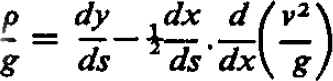
Since , the result follows at once by substituting (ds/dx)2/(d2y/dx2) for v2/g and computing its derivative with respect to x.
39.
“Joh. Bernoulli responsio ad non-neminis provocationem, Ejusque solutio quæstionis ibi ab eodem propositæ de invenienda Linea curva, quam describit projectile in medio resistente” (Acta Eruditorum, May 1719, 216–26), 222–5; see also Bernoulli's“Operatio analytica per quam deducta est … solutio”, ibid., May 1721, 228–30. John Keill's “challenge” to Bernoulli to solve the problem was initially sent in summer 1717 in a private letter to Brook Taylor, who passed it on (in confidence) to Montmort soon after, whence it came to Bernoulli. A. R. Hall in his Ballistics in the seventeenth century (Cambridge, 1952), 155 reasserts the traditional view that “Keill … was guided … by a desire to humiliate Bernoulli by means of a problem which he supposed insoluble”, but Edleston, in his Correspondence of Sir Isaac Newton and Professor Cotes, 187, accurately noted that there is no evidence that the challenge was ever intended for Bernoulli's eyes and that the next year Keill extracted an apology from Montmort for so passing it on (see Montmort's unpublished letter to him on 5 November [1718], now ULC. Res. 1893, Packet No. 2).
40.
It is well known, of course, that the Principia's second book was radically altered by Newton at various times (mainly in the early 1690s) between 1687 and 1713; cf. HallA. R., “Correcting the Principia” (Osiris, xiii (1958), 291–326), 294–7, 313–22.
41.
First communicated by Bernoulli to Leibniz on 12 August 1710 (Commercium philosophicum (n. 34), ii, 231–2) and later published in his “De motu corporum gravium …” (n. 34), 91–3, Theorema 6. In the case of the semicircle , at once v2 = gy and dx: dy: ds = y:–x: r, so that . As Bernoulli was quick to point out in 1710 and (in print) in his “De motu corporum …”, 93, Newton's erroneous first result ρ/g = –x/r implies that the resistance (p) everywhere exactly balances the component (gx/r) of gravitational acceleration acting instantaneously in the direction of orbit, whence the velocity (actually and so variable with the distance y fallen to the base) should, for consistency, be everywhere uniform.
42.
In the scholium following Theorema 6 in his “De motu corporum gravium …”, 93–4, where he asserts: “Error iste qui tanto Viro excidit, non quidem in ipsa ejus solutione latet, quam justam esse & ab omni paralogismi vitio immunem deprehendi quamquam non parum detortum & intellectu difficilem; sed quærendus ille est in ipso applicandi modo, qui in eo laborat, quod … in serie quæ exprimit [DI] terminum quemlibet sumat pro aliqua interminatæ [DI] differentiali seu ut ipse vocat fluxione tanti gradus quantæ dimensionis existit …, quod in primo & secundo [Q] verum esse potest, in reliquis [R,S, …] vero minime”. This untenable conjecture that the error in the original version of Newton's Proposition 10 lay in his confusion of the coefficients Q, R, S, … with the corresponding first, second, third, … derivatives of y was first proposed by Johann's nephew Niklaus I Bernoulli about spring 1713 in an “Addition” (Histoire de l'Académie Royale des Sciences. Année M.DCCXI (Paris, [21714 =] 21730), Mémoires, 54–6) to his uncle's “Lettre … écrite de Basle le 10. Janvier 1711. touchant la maniére de trouver les forces centrales dans des milieux resistans en raisons composées de leurs densités & des puissances quelconques des vitesses du mobile”. Parry and counter-parry over the accuracy of this spurious “error” occupied a prominent place in the ensuing calculus priority squabble.
43.
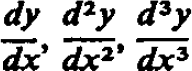
Théorie des fonctions analytiques (n. 26), 368: “Il est remarquable que, si l'on substitue simplement … pour Q, — R, [+]S, on a un résultat exact: C'est ce qui a fait croire aux Bernoulli [Johann and Niklaus], qui ont découvert les premiers l'erreur de Newton, et à tous ceux qui en ont parlé depuis, que cette erreur venait de ce que Newton avait pris les termes de la série Qo–Ro2[+]So3–… pour les différences premières, secondes et troisièmes de l'ordonnée, tandis que ces termes ne sont égaux qu'à ces différences divisées par 1 2, 6, …”.
44.
“Observations sur une discussion relative a la Théorie de la résistance des milieux”, Mémoires de l'Académie Royale des Sciences et Belles-Lettres [de Berlin]. MDCCXCVIII (Berlin, 1801), 60–75.
45.
Johann's published papers “De motu corporum gravium …” and “Lettre de 10. Janvier 1710 …” (see n. 34 and n. 42) appeared only in spring 1713 and early 1714 respectively.
46.
ULC. Add. 3965.12, 219r: “Sr I send you inclosed the solution of ye Probleme about the density of resisting mediums set right, I desire you to shew it to your Unkle & return my thanks to him for sending me notice of ye mistake”. In subsequent years Newton was not unwilling (if a little chary) to admit his mistake in the first edition, but when he did so he invariably insisted that he himself was the first who accurately located it (as distinct from proving its result numerically wrong in a particular case). Thus he wrote in 1719 in a draft of an intended letter to Varignon that “the mistake lay in drawing the tangent of the Arch … from the wrong end. For the tangents of both arches … should have been drawn the same way with the motion of the body because they represent the moment of the motion” (from the original [M 101.H.3, 79] in private possession; in the Latin letter sent the remark was obliterated—see ULC. Add. 3968.42, 596r and the equivalent draft in King's College, Cambridge: Keynes MS 142 (P)).
47.
Principia (21713), 231–40 (signatures Gg4/Hh1–4). A selection from the unpublished autograph drafts (mostly in ULC. Add. 3965.10/12/13) of these variant preliminary proofs will be included in the eighth volume of my edition of Newton's mathematical papers.
48.
The careful reader, it is true, will notice that leaf Gg4 of the 1713 edition is a cancel and that the text on sheet Hh runs one line less than on those (Gg and Ii) surrounding it, and would then, on referring to the equivalent theorem in the editio princeps, be led to make a shrewd guess at what had happened. For lack of enough space on the final p. 240 (signature Hh4v) of the insert Cotes was, in fact, forced at the last moment to omit the opening paragraph of the scholium of the revised proposition which Newton ultimately sent him on 6 January 1712/13 (Edleston, Correspondence of Sir Isaac Newton and Professor Cotes, 145–6). This reads: “Fingere liceret quod projectile pergeret in arcuum GH, HI, IK chordis, et in solis punctis G, H, I, K per vim gravitatis & vim resistentiæ agitarentur, perinde ut in Propositione primo Libri primi corpus per vim centripetam intermittentem agitabatur; deinde chordas in infinitum diminui, ut vires reddantur continuæ. Et solutio Problematis hac ratione facillima evaderet” (ULC. Add. 3965.12, 193r/193v = Trinity College, Cambridge: R.16.38, 265r; compare MacKenzieD. F., The Cambridge Press, 1696–1712 (Cambridge, 1966), i, 332). The original of the proof here outlined is preserved on ULC. Add. 3965.12, 198r.
49.
See n. 33.
50.
Principia (11687), 236–45. Newton there deduces the logarithmic projectile path by first principles from the equations of motion .
51.
In the words of David Gregory's memorandum C42 “Maio 1694” (see n. 5): “Propositioni X Lib: II subnexurus est aliud problema quo semita projecti investigatur in vero rerum systemate. hoc est posita gravitate reciproce ut quadratum distantiæ a centro et resistentia directe ut quadratum velocitatis, quod nunc in potestate esse credit” (English translation by TurnbullH. W. in The correspondence of Isaac Newton, iii, 384).
52.
“Responsio ad nonneminis provocationem …” (n. 39).
53.
CostabelPierre, “Newton's and Leibniz's dynamics” (The Texas quarterly, x, pt. 3 (Autumn 1967), 119–26), 125. In context the remark is directed to the implemented Corollary 1 to Propositions 11–13 of the Principia's first book (see n. 33), the validity of which is judged to be “more a question of intuition than of demonstration”. I am also hesitant to fall uncritically in with Clifford Truesdell's more cautious remark (“A program toward rediscovering the rational mechanics of the Age of Reason” (n. 24), 9 [= Essays (ibid.), 92]) that “Except for certain simple if important special problems, Newton gives no evidence of being able to set up differential equations of motion for mechanical systems”. Principia, Book 1, Propositions 39–41 and Book 2, Propositions 2–4 and 10 seem to me pressing counter-instances to this observation.
54.
Principia (11687), 481–3. This is analyzed in the forthcoming fourth volume of my edition of Newton's mathematical papers.
55.
See Propositions I and II of his “N. Mercatoris quadratura hyperboles geometrice demonstrata” (Exercitationes geometricæ (London, 1668), 9–13), 9. In Newton's dynamical extension the differential equation dvt/dt = — kvt is shown to yield the solution vt/vo = e−kt by putting vo/(vo–vdt) = vds/(vdt — v2dt) = … = 1/k.dt and deducing that vn dt/vo = (1–k.dt)n, whence in the limit as n.dt → t there results log (vt/vo) = –k.t.
56.
Principia (11687), 192–5. We may show that Newton's somewhat ponderous geometrical argument is equivalent to expressing the total attraction (0 ≤ SF ≤ SI) of an infinitesimally thin spherical shell of centre S and radius SI on an external point P as . See also LittlewoodJ. E., “Newton and the attraction of a sphere”, Mathematical gazette, xxxii (1948), 179–81 [= A mathematician's miscellany (London, 1953), 94–9].
57.
See n. 22.
58.
ULC. Add. 3966.12, 105r−107t/102r–104r/110r–111r; ff. 105r−107r are reproduced by John Couch Adams in A catalogue of the Portsmouth Collection of books and papers written by or belonging to Sir Isaac Newton (Cambridge, 1888), Appendix III to Preface, “On the motion of the apogee in an elliptical orbit of very small eccentricity”. At a crucial stage on f.103r, a “6” is conveniently changed to a “24”, thus producing (in context) an impossibly accurate 38°51′51” as the computed annual advance of lunar perigee. So much for Whewell's eulogy in his History of the inductive sciences (see n. 7) of Newton's “beautiful geometry” in his computation of “the principal lunar inequalities”.
59.
A description of the “Inauguration of the statue of Sir Isaac Newton” at Grantham in September 1858 was appended by David Brewster to the revised edition of his Life of Sir Isaac Newton (London, 21858), 367–84. A photograph of Theed's statue is set facing p. 75 in Isaac Newton, 1642–1727 (London, 1927), ed. GreenstreetW. J..
60.
Issue for 12 April. I have not been able to track down a copy, but the item is reprinted, with additions, in The Grub-street journal, No. 68 [Thursday, 22 April 1731], 2, where it is recorded that “two boys stand before [Newton's] figure with a scroll, on which is drawn a remarkable Diagram relating to the solar System [that of the “Propositio Kepleriana”?]; and over that, a converging Series, an invention which shows the utmost stretch of human understanding”. The equivalent account in The gentleman's magazine: Or trader's monthly intelligencer, i, no. IV [April 1731], 159–60 is slightly paraphrased. See also Brewster'sDavidMemoirs of the life, writings and discoveries of Sir Isaac Newton (Edinburgh, 1855), ii, 393; and compare HaskellF., “The apotheosis of Newton in art” (The Texas quarterly, x, pt. 3 (Autumn 1967), 218–37), 219–21.
61.
Described in John Conduitt's scheme for the “relieve” at the base of the tomb as “A boy weighing in a stillyard … the sun against all the other planets” (King's College, Cambridge: Keynes MS 131; quoted by Haskell in his “Apotheosis …” (n. 60), 221).
62.
Detailed by David Piper in his Catalogue of seventeenth century portraits in the National Portrait Gallery, 1625–1714 (Cambridge, 1963), 249 as “558. Oils on canvas, 50×58&frac1/4; in.… |Three-quarter length, seated in a high-backed red armchair, turned towards the right; his right hand resting on the arm of his chair, his left hand turning the pages of a mathematical treatise open on the red-covered table on the right; … he wears his own hair fairly long, thin and white; dark grey eyes looking at the spectator; clean-shaven; plain white neckcloth loosely tied; wrapped in an ample flowered black dressing-gown; … lit from the left”. After rejecting the spurious tradition which fathers the painting on to Vanderbank, Piper adds that “A variant (bust only; engraved by McArdell) in the Master's Lodge, Trinity College, has an attribution that goes back to 1760, as SeemanE., but the handling … does not seem characteristic of Seeman (who also did much copying work) …” However, the clarity of the portrait's detail and the accuracy of its minutiæ make it, I think, something more than Piper's conjectural “posthumous memorial portrait”. An inferior contemporary (full) copy exists in the Babson Institute, Wellesley, Massachusetts, now dominating the parlour transported there en bloc from Newton's old house in St. Martin's Street, London when it was demolished in 1913; see BraschF. E., “Newton's portraits and statues” (Scripta mathematica, viii (1941), 199–227), 221/226-7, and the two plates inserted between pp. 32/33 of WebberR. S., A descriptive catalogue of the Grace K. Babson Collection of the Works of Sir Isaac Newton (New York, 1950).
63.
In straightforward analytical equivalent Propositions 79–81 (and the intervening Lemma 29) reduce the triple integral measuring the pull of a uniform sphere of radius a on an external point distant b from its centre to the evaluation of the simple integral , assuming the attraction of a particle to vary as the nth power of the distance. Evidently since he had no desire to repeat the cases n = — 2 and n = 1 already discussed (from first principles) in his preceding Propositions 71 and 77, Newton restricted his exemplification of Proposition 81 to the relatively uninteresting instances n = −1, −3 and −4. It is an easy corollary to the general theorem that the sphere attracts as though its mass is concentrated at its centre only when n = 1 or −2. (MacLaurinColin Compare, Treatise of fluxions (Edinburgh, 1742), §902, where the case b = a yields the condition for Ia,a = &frac4/3;πan+3 at once to be 3.2n+2 = (n+3)(n+5): The solution n ≈ — 5&frac1/6; is not generally admissible).





 and accordingly
  and
and  with
with  , whence
  .
. at (
at ( and eccentricity of magnitude
  .
. of its general arc which he there gives is a necessary preliminary step towards identifying it as the direct-distance tautochrone.
 , the result follows at once by substituting (
 , at once
  . As Bernoulli was quick to point out in 1710 and (in print) in his “De motu corporum …”, 93, Newton's erroneous first result ρ/
 and so variable with the distance
  pour
pour  .
. . See also
  , assuming the attraction of a particle to vary as the