




Abstract
The Graha-lāghava (“Easy [computation] of the planets”; epoch date 1520), is an astronomical handbook, authored by Gaṇeśa Daivajña (b. 1507 CE) of Nandigrāma. This work became one of the most popular astronomical texts of the second millennium in India and gave rise to a new astronomical school of parameters, eponymously known as the “Gaṇeśa-pakṣa.” We analyze the first of the 16 chapters that make up this work, which covers planetary mean positions and velocities, providing a translation and technical commentary of the text. In our exposition, we also invoke two substantial commentaries on this work that were composed in the 17th-century by brothers Mallāri and Viśvanātha, which help clarify and contextualize Gaṇeśa’s contributions. An Appendix to the online edition of the Journal gives the Sanskrit text of the quoted passages.
Introduction
Gaṇeśa, his work and legacy
Gaṇeśa Daivajña of Nandigrāma (Maharashtra 1 ; b. 1507) is a celebrated figure in the astral sciences (Sanskrit jyotiṣa) of early modern South Asia. 2 Among the numerous works—at least 15—attributed to him, 3 the most renowned is the Graha-lāghava (“Easy [computation] of the planets,” epoch date 1520). This astronomical handbook quickly became a canonical text especially in northern and western India. It inspired in the ensuing centuries a profusion of astronomical tables based on its parameters and procedures, as well as a number of substantial commentaries. In testament to its enduring popularity, many hundreds of manuscript copies of the work are still extant and Gaṇeśa’s system is still considered relevant by many practitioners of astrology in India today.
Himself directly related to several noted astronomers including his father Keśava, Gaṇeśa also helped establish another major professional lineage of jyotiṣa scholars in central and northern India. This “kin-school” was descended from his fellow Maharashtrian Divākara, an astronomer who traveled to Nandigrāma to study under Gaṇeśa. 4 After completing his training, Divākara relocated to Kāśī (Varanasi/Benares) and passed on his craft to his five sons, who in turn transmitted the profession to succeeding generations. From the early 1500s to 1700 or after, an exceptional corpus of works blossomed from Gaṇeśa’s teachings, including handbooks, almanacs, astrological treatises, commentaries, and astronomical tables. The professional circumstances of this lineage and the scientific achievements of its members are thus of considerable importance in the history of Indian astronomy in the second millennium.
The Graha-lāghava follows the traditional format of a Sanskrit astronomical handbook or karaṇa. Over the course of 16 chapters it covers planetary positions and velocities, timekeeping and calendar construction, and several more specialized topics including eclipses, heliacal rising and settings, the orientation of the lunar crescent, planetary conjunctions, and the so-called mahāpātas or ominous configurations of the sun and the moon. All these subjects are treated, as usual in Sanskrit technical texts of whatever genre, in metrical verses composed of four lines or pādas. Numerical parameters, which can be difficult to fit into verse meter, are conventionally expressed in standard Sanskrit bhūta-saṃkhyā or “word-numeral” format. 5 That is, the digits of a decimal place-value integer are represented by nouns traditionally associated with the number in question, such as “hand” for “two” or “moon” for “one.”
Notwithstanding the overall conventionality of its content and format, Gaṇeśa’s handbook is original and innovative in many respects, including its revision of fundamental parameters for planetary motions. Its most distinctive feature is its complete avoidance of tables of arc and sine values, a rather remarkable culmination of various strategies in previous karaṇas to simplify and/or algebraically approximate the mechanisms of trigonometry. Given that spherical-astronomy geometric models are founded upon the application of orbital inequalities requiring angular measurement and chord-arc conversion, trigonometry of course cannot be totally eliminated from the Graha-lāghava’s procedures. But Gaṇeśa has succeeded in concealing it, as far as the user is concerned, within versified tables of specialized astronomical function values and ingenious algebraic approximations. The user is thus freed from frequent consultation and manipulation of table entries and interpolation techniques for basic trigonometric functions. As the following discussion of the text makes clear, this achievement was evidently a source of great pride to Gaṇeśa and his followers.
Gaṇeśa’s modifications of existing procedures and parameters gained his works the distinction of being recognized as a new standard model or pakṣa (“school/theory”) within Sanskrit jyotiṣa. The four classic pakṣas, all established by the mid- to late first millennium of the Common Era but each using slightly different values for its cosmogonic and chronological parameters, are the following 6 :
Ārya-pakṣa, introduced in the Āryabhaṭīya of Āryabhaṭa (b. 476). Days begin at sunrise, and the canonical period is the mahā-yuga of 4,320,000 years.
Ārdharātrika-pakṣa (“midnight model”), likewise due to Āryabhaṭa and likewise based on the mahā-yuga, but days begin at midnight.
Brāhma-pakṣa, apparently originating in some (now lost) “astronomy of Brahmā” prior to Āryabhaṭa, but invoking as its authoritative text the 628 Brāhma-sphuṭa-siddhānta of Brahmagupta. Days begin at sunrise, and the canonical period is the kalpa or lifetime of the universe, extending for 4,320,000,000 years or a thousand mahā-yugas.
Saura-pakṣa (“Sūrya’s or Sun’s model”), also sometimes ascribed to an early-CE canon but relying on a later textual authority, a version of the Sūrya-siddhānta dating from about 800. Like the Ārdharātrika-pakṣa that seems to have inspired it, the Saura-pakṣa holds that days begin at midnight, and the canonical period is the mahā-yuga.
Gaṇeśa and the jyotiṣa practitioners he trained were clearly well versed in the standard texts of these earlier pakṣas. In particular, as we will see in what follows, the works of the renowned 12th-century astronomer Bhāskara (II), or Bhāskarācārya—namely, his comprehensive treatise Siddhānta-śiromaṇi, and his karaṇa or handbook Karaṇa-kutūhala—seem to have exerted an important influence on the Gaṇeśa school’s approaches to technical problems and their exposition.
Planetary mean motions in the Graha-lāghava
As in all pre-heliocentric spherical astronomy traditions, the geometric models of Indian astronomy start from the simplifying assumption of “mean” (madhyama)—that is, uniform circular—eastward motion of celestial bodies revolving about a stationary spherical earth. (Meanwhile, the universe as a whole turns westward about the earth every day, impelled by the cosmic pravaha wind.) The standard set of nine bodies or “planets” comprises the Sun, the Moon, Mars, Jupiter, Saturn, the apogee of the lunar orbit, the (westward-revolving) ascending node of the lunar orbit, and the so-called śīghra-apogees of Mercury and Venus (see the following paragraph). Each of these bodies is assigned a period-relation parameter which varies from pakṣa to pakṣa, expressing the number of 360° revolutions it completes in a canonical time period equal to a given number of years, typically a mahā-yuga or kalpa. These standard parameters 7 are listed in Table 1.
Canonical periods and associated planetary parameters employed in the three main pakṣas of Indian jyotiṣa, as enumerated respectively in the Siddhānta-śiromaṇi, the Āryabhaṭīya, and the Sūrya-siddhānta.
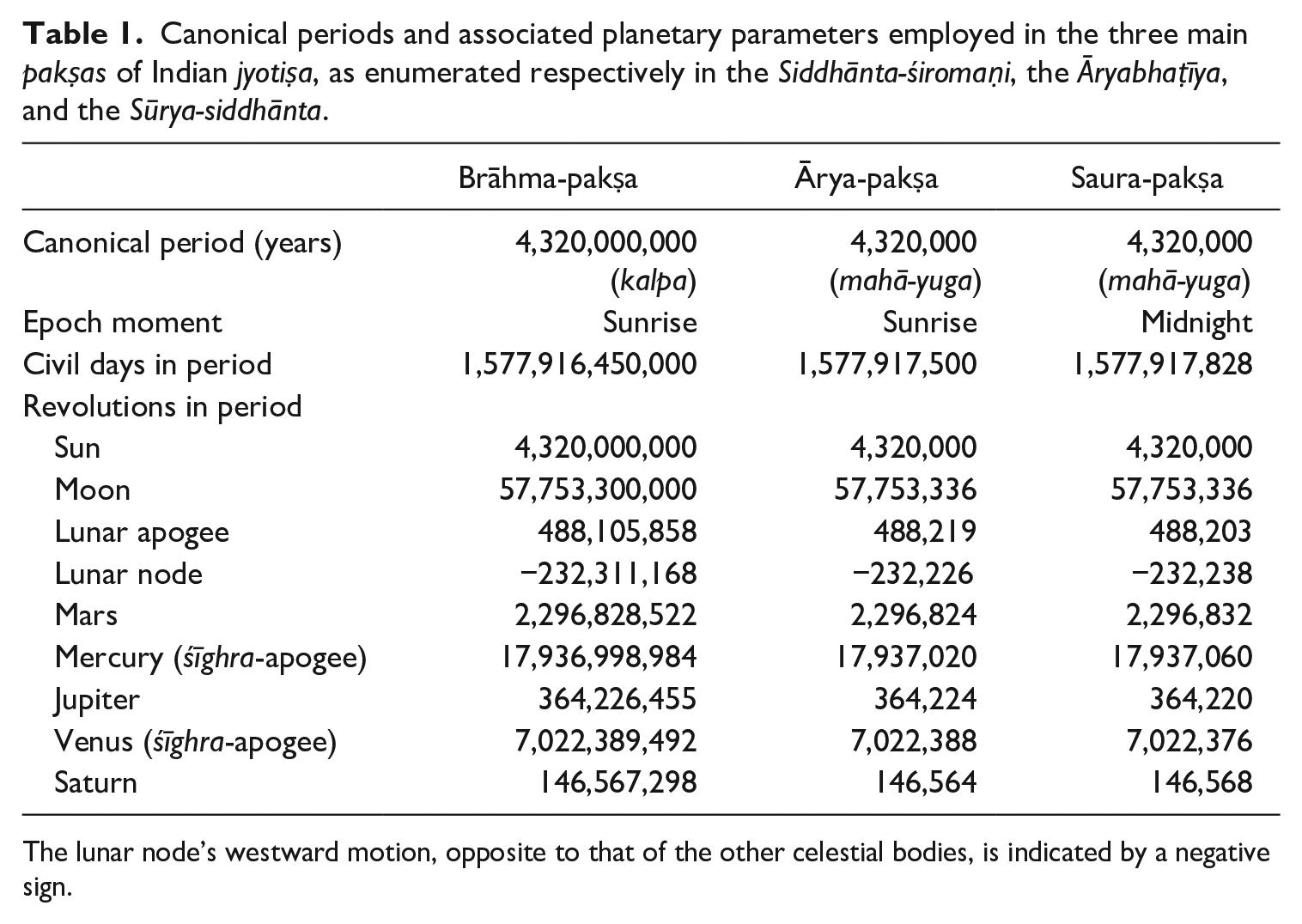
The lunar node’s westward motion, opposite to that of the other celestial bodies, is indicated by a negative sign.
Given its known starting position on a standard reference circle at a known past time, a celestial body’s mean position on that circle at any later time can be computed using the given revolution-number. This standard reference circle is the ecliptic or zodiac circle, and the mean body’s distance from its zero-point is called mean longitude (here denoted
Both mean and true celestial longitudes are typically expressed in units of 30-degree zodiacal signs (rāśi), degrees (aṃśa), arcminutes (kalā), and arcseconds (vikalā). The Indian ecliptic is also demarcated by the 27 traditional lunar constellations or nakṣatras. The nakṣatras, like the zodiacal constellations, were long ago adapted to represent uniform intervals of the ecliptic as well as their original asterism figures: one nakṣatra is 360°/27 = 13°20′ of arc.
Mean positions and times are stated by default with reference to a terrestrial point having zero longitude and latitude. This is conventionally taken as the intersection of the equator and the traditional Indian prime meridian passing through the localities of Laṅkā (at zero latitude) and Ujjayinī, roughly corresponding to modern Sri Lanka and Ujjain respectively. Gaṇeśa measures elapsed time since epoch in cycles (cakra) of 11 years or almost exactly 4016 days, a period relation that is apparently his own innovation. Otherwise, his chronology relies on standard concepts of Indian calendars. 8
Calendar eras
The most commonly used solar-year calendar eras in Indian astronomy are the Saṃvat, beginning in 57 BCE, and the Śaka, beginning in 78 CE. Thus a year number in one of these eras is roughly converted to its Common Era equivalent by subtracting 57 or adding 78, respectively. Since Indian calendars typically put the beginning of the year at a point near an equinox, a stated Śaka or Saṃvat year number will span parts of two consecutive Common Era years. Gaṇeśa reckons years in the Śaka era, using the beginning of Śaka 1442 (which falls in 1520 CE) as his epoch date.
Year reckoning: Meṣa-saṅkrānti and Caitra-śukla-pratipad
The year in most Indian calendars begins either with Meṣa-saṅkrānti, the Sun’s entry into the first sidereal zodiacal sign Meṣa (Aries), or with Caitra-śukla-pratipad, the start of the lunar or synodic month Caitra. (Both of these events occur not far from the vernal equinox when the Sun reaches the beginning of the tropical zodiac.) Gaṇeśa counts solar years from one Meṣa-saṅkrānti to the next, but considers his epoch date at the start of Śaka 1442 to be the commencement of the year’s first calendar month at Caitra-śukla-pratipad.
Month reckoning
A calendar month is one complete cycle of lunar phases, called a synodic or lunar month. Occasional intercalation of a 13th synodic month in a year maintains the calendar’s seasonal pattern. For Gaṇeśa, the start of a calendar month occurs at the moment of conjunction of Sun and Moon (new moon). A solar (saura) month is one-twelfth of a sidereal year, or the average time that the Sun spends in each zodiacal sign.
Days and their subdivisions, and tithis
A mean civil day is considered to be the average time between two consecutive sunrises or two consecutive midnights (Gaṇeśa’s system uses sunrise). A mean tithi is one-thirtieth of a mean synodic month.
For more precise timekeeping, 1 day is divided into 60 equal ghaṭikās or ghaṭīs, each of which comprises 60 vighaṭīs or palas, which in turn are divided into 60 vipalas. Fractional parts of a tithi can also be represented in base-60. All such sexagesimal subdivisions are denoted in Sanskrit text by a “floating-point” notation using vertical lines to separate the successive places. Translated text conventionally renders them in a “fixed-point” version with a semicolon separating integer and fractional parts of a number, within which the sexagesimal places are separated by commas.
The content of the Graha-lāghava’s first chapter comprises the following:
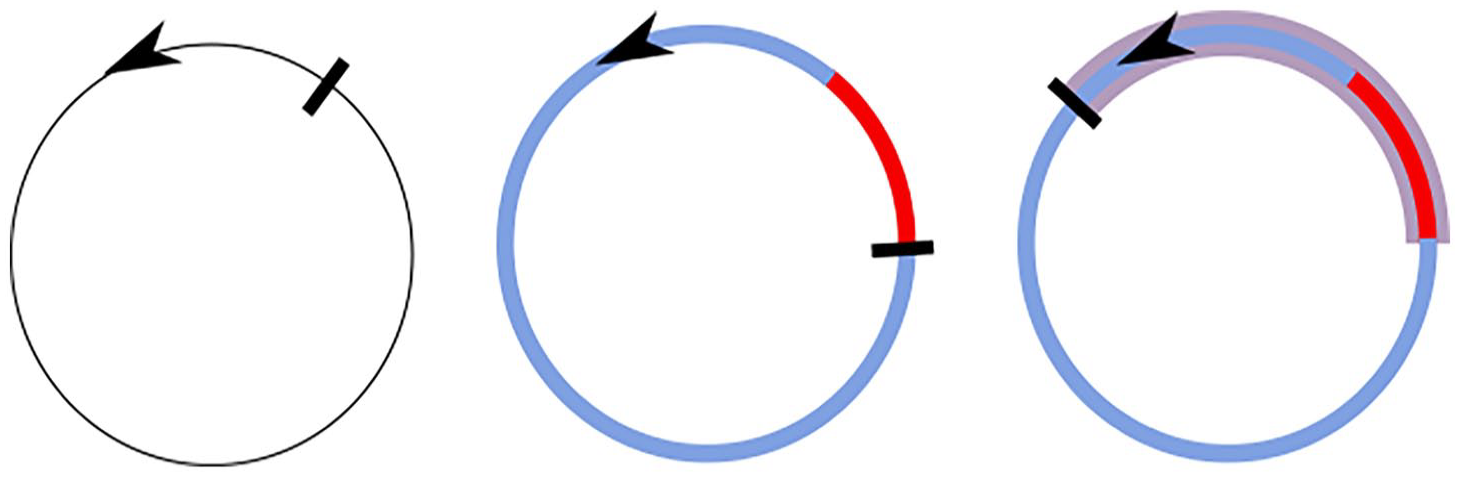
Illustration of the components of planetary mean longitude in the Graha-lāghava. The circle represents the mean planet’s geocentric orbit and the tickmark on the circumference represents its position in longitude, increasing counterclockwise. The desired date is here assumed to be less than two cakras since epoch. Left: The planet’s starting mean longitude at the epoch date. Center: Mean longitude after the lapse of one cakra since epoch. Adding to the epoch mean longitude the planet’s mean longitudinal increment in a cakra (the larger arc of the circle) is equivalent to subtracting from it the planet’s specified dhruva (the smaller bold arc). Right: Adding to the previous mean longitude the planet’s mean longitudinal increment during the ahargaṇa (thick shaded arc) produces the mean longitude for the desired date.
For each of these topics, we present the Sanskrit text of the relevant verses of Gaṇeśa’s chapter with accompanying roman transliteration, translation, and identification of the verse meter(s) used. 9 (Partial verses are indicated by the appropriate pāda labels a, b, c, and d.) Our translation of each passage is followed by our explanation of its technical import and, where possible, its relationship to earlier works.
Our analyses lean heavily on explanatory passages in the works of two 17th-century commentators on the Graha-lāghava, Mallāri and Viśvanātha, both sons of Gaṇeśa’s student Divākara. We have summarized, and sometimes partially quoted and translated, their comments in the relevant topical expositions. The commentators’ remarks provide not only clarifications and elaborations of Gaṇeśa’s meaning, but also valuable information about knowledge transmission, intertextuality, and mathematical methodology within scholarly lineages in Sanskrit jyotiṣa. In particular, the stylistic differences between Mallāri’s exegesis with theoretical explanations (ṭīkā with vāsanā) and Viśvanātha’s focus on worked examples (udāharaṇa) illustrate the diversity of perspectives that commentators brought to their chosen base-texts.
We know relatively little about the personal chronology of these two brothers, except that Viśvanātha is said to be the youngest of Divākara’s five sons. 10 We have tentatively inferred that Viśvanātha’s commentary was probably composed after Mallāri’s, which may partly account for their many textual similarities, sometimes to the point of echoing passages and quotations verbatim. The practice that we have followed here of bracketing together Mallāri’s and Viśvanātha’s commentaries seems to have been introduced by modern editors, beginning with Bhālacandra in 1865. 11
Verses 1.1–1.3: Benediction (Maṅgalā-caraṇa)
Gaṇeśa’s work begins 12 with three introductory or maṇgalā-caraṇa verses. 13 The first two employ a type of complex double narrative in which entire verses or verse sequences can be read with two distinctly different meanings. In the first verse, one of Gaṇeśa’s meanings praises the deity Viṣṇu under his epithet Keśava, together with his speech (vāc), embodied as the sacred Vedic text (śrūti). The other meaning praises Gaṇeśa’s father Keśava and his composed “speech” in the form of astronomical texts. The second verse can be read either as praising the incarnation of Viṣṇu in the divine hero Rāma (who in the Rāmāyaṇa epic breaks the bow of the deity Śiva in an archery contest), or as introducing the reader to a karaṇa text. The third verse of the maṅgalā-caraṇa features Gaṇeśa’s statement of purpose for the Graha-lāghava.
Verse 1, Reading 1: The generator (jananī) of the awakening (prabodha) of enlightenment (jyotiḥ), purifying the mind by the performance (caraṇa) of the well-proclaimed (sūkta) Vedic rituals (karma), full of explanation of the inexplicable (gahanārtha) yet few in syllables (svalpākṣarā), made clear by aids (upāya) composed by his devotees: long live the Vedas (śruti), the word of Keśava [Viṣṇu]!
Verse 1, Reading 2: The generator (jananī) of understanding (prabodha) in astronomy (jyotiḥ), clarifying [doubtful] thinking by the practice of its well-articulated rules (tatsūktakarma), full of deep meaning (gahanārtha) yet few in syllables (svalpākṣarā), made clear by supplements (upāya) composed by his adherents: long live the words and speech of [the astronomer] Keśava!
Verse 2, Reading 1: And bear in mind, [student,] that skillful (karaṇa) Rāma, the form of Viṣṇu, [by whom] the bow of Śiva (īśacāpa) with [its] bowstring (maurvikā) [was] broken, gleaming with a garland (hāra) of [many] bound strands (dṛḍha-guṇa) [and/or: with a garland of the quality (guṇa) of steadfastness (dṛḍha)], with well-shaped arms (suvṛtta-bāhu), bestowing good outcomes (su-phala-prada), [having] taken (ātta) the form of man (nṛ-prabhā).
Verse 2, Reading 2: And bear in mind, [student,] that lovely (rāma) astronomical handbook (karaṇa), as beautiful as Viṣṇu, devoid of arcs with their sines (maurvikā-īśacāpa), adorned with reduced (dṛḍha) multipliers (guṇa) and divisors (hāra), [with] excellent circles and arcs (suvṛtta-bāhu), bestowing excellent results (su-phala-prada), [with] the gnomon-shadow (nṛ-prabhā) obtained (ātta).
Verse 3: Although great scholars made astronomical handbooks (karaṇas), in them accuracy is not obtained in the omission of sines and arcs. Therefore, I am undertaking to make a correct treatise on the planets, of an excellent and easy kind, excluding operations with sines and arcs.
Gaṇeśa concludes these opening invocatory verses with his aspirations for this work, most importantly the complete excision of trigonometry from the rules and procedures he presents. He acknowledges that many of his “great scholar” predecessors had similar ambitions, but he is critical of their attempts, dismissing them as inaccurate.
In glossing verse 3, Mallāri helpfully explains the definition of a karaṇa as reckoning from a given historical epoch, as opposed to a siddhānta which starts at the beginning of the kalpa, or a tantra reckoning from the start of the current mahā-yuga. Both brothers emphasize Gaṇeśa’s achievement in producing a practical handbook without tabulated sines.
Verses 1.4–1.5: Calculating the ahargaṇa, “accumulated days” between the epoch and the desired time
In the following two verses, 16 Gaṇeśa outlines the process to determine the ahargaṇa or accumulated civil days between a known point in the past—namely, the end of the most recent completed 11-year cycle or cakra—and the user’s desired date. This involves computing the number of elapsed lunar (synodic) months in that interval, converting to tithis or 30ths of a mean synodic month, then converting this quantity of tithis into civil days. An accompanying rule determines the current week-day from the computed ahargaṇa.
When the present Śaka year is decreased by 1442 (dvi-abdhi-indra) [and] divided by 11 (īśa), the quotient is called the cakra [number]. The remainder is multiplied by 12 (ravi) [and] increased by [the number of elapsed months of the present year] starting from Caitra. [The sum] is increased by the [number of] intercalary months (adhikamāsa) separately [derived] from that, [and] increased by the cakra multiplied by 2 (dṛk), increased by 10 (dik), [and] divided by 33 (amara). [That result] multiplied by 30 (kha-tri) is increased by [the number of] elapsed tithis [of the present month] and a sixth (aṅga) part, without remainder, of the cakra. [The sum] decreased by the omitted days, [i.e., a] sixty-fourth (abdhi-ṣaṭka) part separately [derived] from that, is certainly the day-accumulation (ahargaṇa). The day of the week is the ahargaṇa increased by the cakra times 5 (hara), [counted modulo 7] from [the day of] the moon [i.e., Monday].
Division of the elapsed years since epoch modulo 11 yields an integer number c of elapsed cakras and an integer number

The
In reality, however, a lunar month is shorter than one-twelfth of a solar year. A given number of solar months, such as

(The reasoning supporting this formula is discussed below in relation to Mallāri’s commentary on it.)
The

The number a of civil days or ahargaṇa corresponding to

Finally, Gaṇeśa prescribes determining the current weekday from the assumptions that the epoch weekday was a Monday and that the number of days in an 11-year cakra is 4016. Then the increment to the weekday per cakra is 4016 mod 7 = 5. So the current weekday number, counting from Monday, will be (a + 5c) mod 7.
Mallāri deduces
18
that Gaṇeśa’s choice of 33 for the adhimāsa term divisor in the formula for If 1593300000 intercalary months in a kalpa are obtained with 51840000000 solar months in a kalpa, then what [is obtained] with the desired [number of] solar months? Here, when the kalpa solar months are divided by the kalpa intercalary months, the quotient is 32|16|4: one intercalary month in these months.
In fact, the Brāhma-pakṣa kalpa parameters produce a quotient slightly different from Mallāri’s result:

assuming approximately 30 days per solar month and exactly 60 ghaṭīs per day. The Saura-pakṣa parameters for a mahā-yuga of 4,320,000 years or 12 × 4,320,000 = 51,840,000 solar months are a slightly better fit to the intercalation period stated by Mallāri 20 :

This quantity rounded up to 33 provides the divisor in the adhimāsa term.
More precisely, in an 11-year cakra of 11 × 12 = 132 solar months, there will be four complete intercalation periods plus an excess of a little less than 2 months:

This remainder is rounded up to two excess solar months accrued in each of the c cakras since epoch. Furthermore, Gaṇeśa has reckoned that 10 of these excess solar months had already been accumulated at his epoch date. Therefore the total number of required intercalary months at the desired date will be 1/33 of the sum
The conversion from tithis to days is likewise derivable from pakṣa period relations. The number of civil days per tithi based on a Brāhma-pakṣa kalpa, as Mallāri notes 21 is
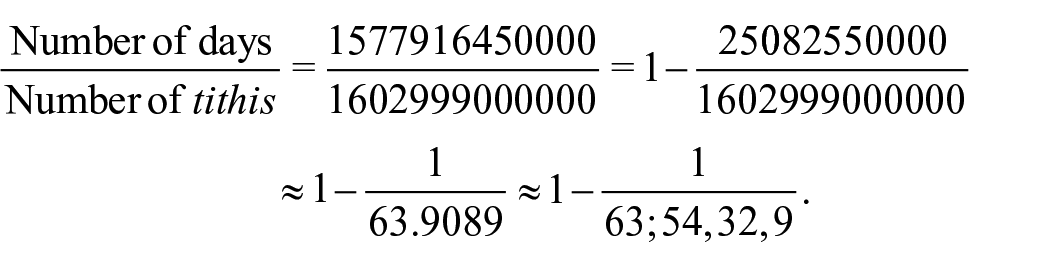
Checking this against its Saura-pakṣa counterpart,

we confirm that the conversion factor from tithis to days is indeed approximately
But as Mallāri points out
22
the tithi-number In 6 cakras [there are] 66 years; [when] their 24486 [lunar] days are divided in one place by 63;54,32, and in [another] place by 64, the two quotient results are 383 [and] 382, leaving out the fractions. The difference of the results is 1. The proportion using that: If with six cakras the difference [of the two results] is equivalent to 1 [lunar] day, then what [is the difference] with the desired [number of] cakras?
That is, Mallāri claims that there are about 371 × 66 = 24,486 tithis in 66 years or 6 cakras, which we can verify using either the Brāhma-pakṣa kalpa:

or the Saura-pakṣa mahā-yuga:

Dividing 24,486 by 64 to get the day-conversion term yields a quotient of approximately 382, whereas dividing it by the more precise 63;54,32 (note that this number too indicates Mallāri’s reliance on Brāhma-pakṣa parameters) yields approximately 383. Consequently, for every six cakras in the time since epoch, one extra tithi has to be thrown into the
A few additional approximations have been made in the calculations so far. For instance, as mentioned previously, we added the m elapsed synodic months in the current year to the For the purpose of [finding civil days corresponding to] the desired day, the number of civil days may be one day less or greater; and the [number of] tithis likewise.
Viśvanātha
24
makes the same point about increasing or decreasing the computed weekday as necessary, especially if the cakra-remainder y* equals zero (presumably because a zero
The reasons underlying the choice of the 11-year cakra cycle and its equivalence to 4016 civil days remain somewhat obscure. Mallāri merely explains the cakra concept itself as a technique for reducing the size of computations
26
: With this [established] by the teacher: In many years there are a lot of civil days. So for the purpose of brevity and for fear of student mistakes, first, however [many] years [have elapsed since epoch] are divided by 11. Whatever is the quotient, its name is the cakra; whatever is the remainder, it is multiplied by 12; the months produced are the solar months.
A realistic value of solar year-length—in fact, any value between 365.2 and 365.3 days—yields instead around 4017 to 4018 days in 11 years, while Gaṇeśa’s cakra-length 4016 implies a year-length of less than 365.1 days. To derive Gaṇeśa’s value, we might consider 27 that the four complete intercalation cycles in an 11-year cakra produce a total of 12 × 11 + 4 = 136 synodic months or 30 × 136 = 4080 tithis, which converts to

Viśvanātha’s only allusion to the cakra length in discussing these verses reveals
28
that Gaṇeśa took the trouble to set up a conversion between the ahargaṇa of his own system and that of Bhāskara’s handbook Karaṇa-kutūhala, nicknamed Brahma-tulya: Now the way of bringing [forth] the ahargaṇa of the Brahma-tulya from the ahargaṇa of the Graha-lāghava is stated by the great Gaṇeśa Daivajña. It is as [follows]: The ahargaṇa produced from the Graha-lāghava, increased by 123113 (viśva-indu-agni-aruṇa), [and] augmented by 4016 (nṛpa-kha-abdhi) multiplied by the [number of elapsed] cakras, should be the ahargaṇa of the Brahma-tulya.
It is true that 123,113 civil days are approximately equal to the 337 solar years separating the Śaka 1105 (1183 CE) epoch date of the Karaṇa-kutūhala from the Śaka 1442 epoch of the Graha-lāghava. Gaṇeśa appears to have determined this number by following the Karaṇa-kutūhala’s ahargaṇa algorithm, rather than employing his own cakra system. 29
Verses 1.6–1.9: Mean longitude computations for the planets: dhruva and kṣepaka parameters; deśāntara correction
In the preceding verses 4–5, Gaṇeśa broke down the elapsed time between the Graha-lāghava’s epoch and the user’s desired date into two parts: the integer number c of completed 11-year cakras, and the ahargaṇa or integer number 0 ⩽ a ⩽ 4016 of civil days elapsed within the current cakra. Now in verses 6–8 30 he states components of planetary mean longitudes that correspond to these time intervals. As usual in Indian astronomy, here and throughout the work Gaṇeśa treats the seven planets sequentially in standard weekday order (Sun, Moon, Mars, Mercury, Jupiter, Venus, Saturn).
In the course of one cakra beginning at the moment of epoch, a mean planet completes an integer number of revolutions plus an excess fractional revolution, or residual mean longitude. Gaṇeśa’s dhruva is the 360°-complement of this residual mean longitude. The product of the dhruva with the number c of completed cakras is subtracted from the mean longitudinal increment accumulated in the elapsed days within the current cakra: namely, the ahargaṇa a multiplied by the daily mean longitudinal increment
Verses 1.6–1.8: Numerical values of dhruvas and kṣepakas
The dhruva of the sun is 0,1,49,11 (kha-vidhu-tāna-bhava) [and] the dhruva (bhamukho) of the moon is 0,3,46,11 (kha-analā-rasa-vārdhi-īśvara). Now 9,2,45 (khaga-yama-śara-kṛtā) is called [the dhruva] for the apogee of the moon. [The dhruva] of the lunar ascending node is 7,2,50 (śaila-dvau-kha-śara); of Mars, 1,25,32 (bhū-tattva-danta); of the anomaly of Mercury, 4,3,27 (abdhi-guṇa-uḍava); of Jupiter, 0,26,18 (kha-ṣaḍ-yama-vasu-ila); of the śīghra-anomaly of Venus, 1,14,2 (ku-śakra-yamala) beginning with zodiacal signs; then of Saturn, 7,15,42 (śaila-pañca-bhuva-yama-abdhi). Now, the kṣepaka is described. In [the case of] the sun [the kṣepaka] is 11,19,41 (rudra-gobja-kuveda); here in [the case of] the moon, 11,19,6 (śūlin-gobhuva-ṣaṭ); in the lunar apogee, 5,17,33 (akṣa-atyaṣṭi-deva); in the lunar ascending node, 0,27,38 (kha-uḍu-aṣṭa-agni); next, in Mars, 10,7,8 (dik-śaila-aṣṭa); in the [śīghra-]anomaly of Mercury, 8,29,33 (vibha-kala-nava-bha); in Jupiter, 7,2,16 (adri-aśvi-bhūpa); in the [śīghra-]anomaly of Venus, 7,20,9 (adri-nakha-nava) [in] zodiacal signs and so on; in [the case of] Saturn, equal to 9,15,21 (go-tithi-svarga).
The planetary dhruva values, as stated by Gaṇeśa in verses 6–7 and as tentatively reconstructed (to arc-thirds) by us from pakṣa period relations.
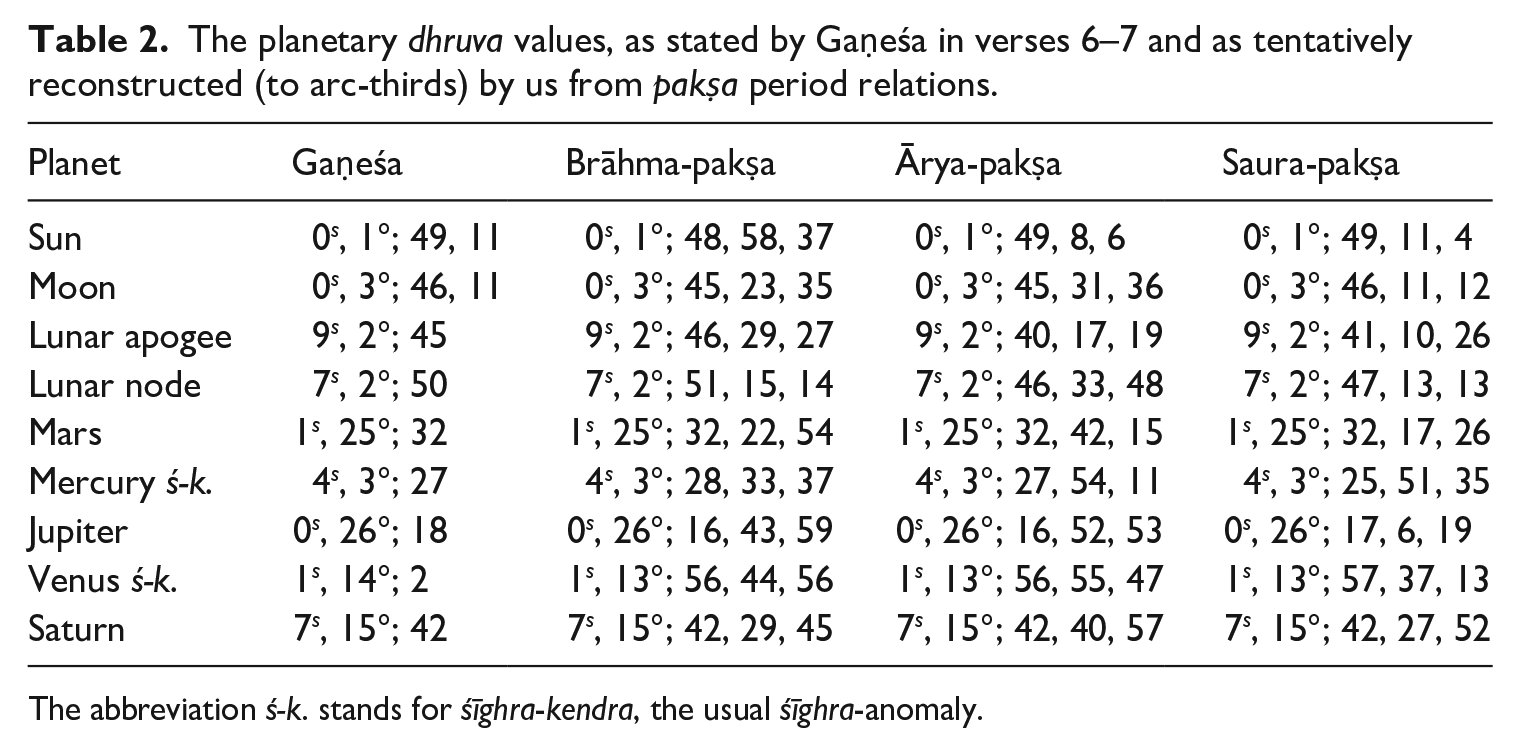
The abbreviation ś-k. stands for śīghra-kendra, the usual śīghra-anomaly.
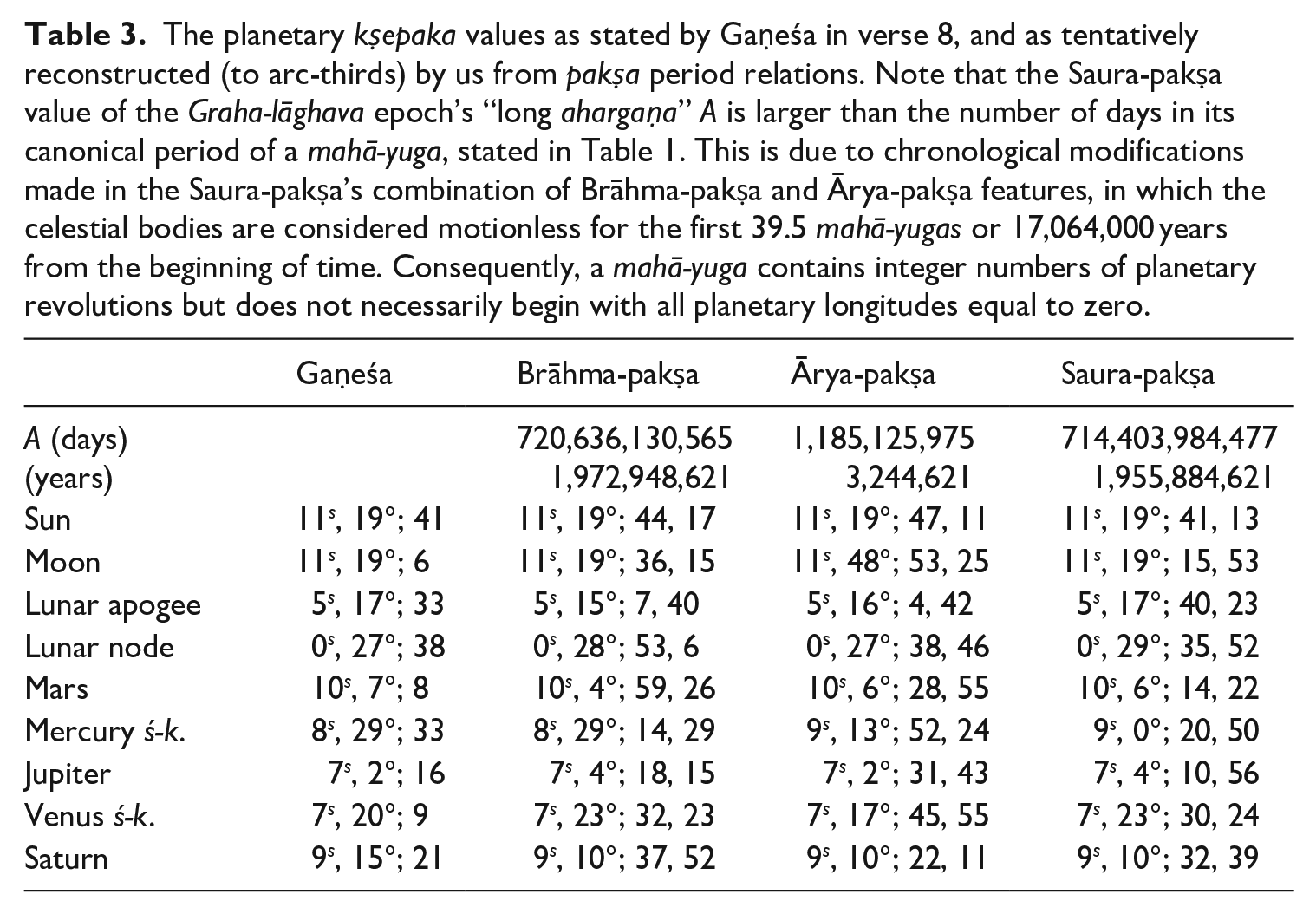
The planetary kṣepaka values as stated by Gaṇeśa in verse 8, and as tentatively reconstructed (to arc-thirds) by us from pakṣa period relations. Note that the Saura-pakṣa value of the Graha-lāghava epoch’s “long ahargaṇa” A is larger than the number of days in its canonical period of a mahā-yuga, stated in Table 1. This is due to chronological modifications made in the Saura-pakṣa’s combination of Brāhma-pakṣa and Ārya-pakṣa features, in which the celestial bodies are considered motionless for the first 39.5 mahā-yugas or 17,064,000 years from the beginning of time. Consequently, a mahā-yuga contains integer numbers of planetary revolutions but does not necessarily begin with all planetary longitudes equal to zero.
The total number of revolutions each planet completes during a cakra is computed by multiplying the 4016 days of the cakra by the ratio of the number of planetary revolutions during the pakṣa’s canonical period to the corresponding number of civil days. The fractional remainder of that result after discarding integer revolutions, converted to degrees and subtracted from 360°, is the dhruva:

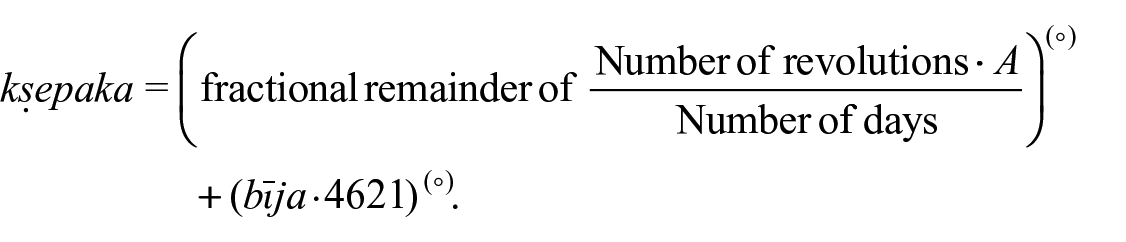
In theory, a planet’s kṣepaka or epoch mean longitude could be computed in the same way. Namely, the pakṣa’s canonical revolutions/civil days ratio can be multiplied by the “long ahargaṇa” A, or number of civil days spanning the entire time interval from a distant past moment when all planetary longitudes were zero to the Graha-lāghava’s epoch date at the start of Śaka 1442. The resulting product will be a (large) integer number of revolutions plus a fractional remainder, which in units of degrees represents the kṣepaka:

In practice, however, some additional adjustments are necessary to produce any plausible approximation to Gaṇeśa’s numbers.
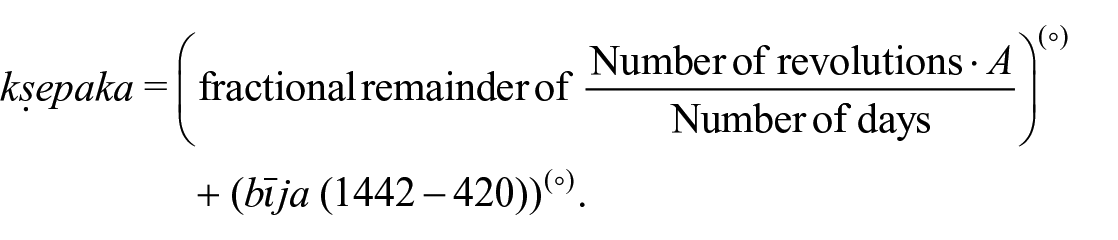
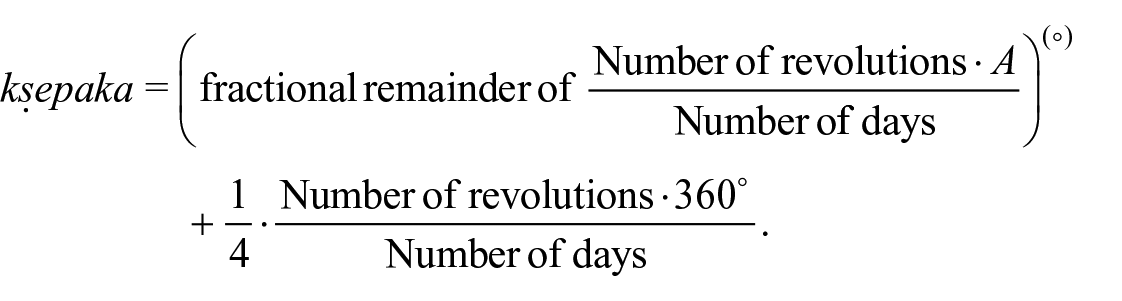
We summarize below the kṣepaka recomputation procedures that we used for each pakṣa-specific set of values. For the corresponding values of the Graha-lāghava epoch’s “long ahargaṇa” A, we have adopted the calculations explained within the reconstruction computations in Dvivedī’s edition. 33 The secular corrections or bījas that we employ with the Brāhma-pakṣa and Ārya-pakṣa parameters are discussed in more detail in Appendix A.
As the entries in Tables 2 and 3 indicate, our reconstructions of dhruvas and kṣepakas have not been consistently successful in reproducing Gaṇeśa’s stated values to the nearest arcminute (and not always even to the nearest degree). We explore some of the challenges underlying such reconstructions in the following discussion of Mallāri’s remarks on these verses. Chief among these intriguing complications is Gaṇeśa’s remarkable “mix and match” approach to choosing planetary parameters from different pakṣas, which he makes explicit in verse 16 at the end of the chapter.
Here is the explanation. Here, having grouped the [elapsed] years in elevens, the teacher makes the determination of the ahargaṇa. The ahargaṇa thus [determined] falls within an eleven-year [period]. [The mean longitudinal displacements of] the planets produced with that [ahargaṇa] fall within [an] eleven-year [period]. So, having found [the mean longitudinal displacements of] the planets [in] however many cakras have elapsed, and added [them] to those, [the mean longitude increments of] the planets starting from the text’s Śaka [epoch] are [produced]. [The mean longitudinal increments of] the planets for one cakra consisting of 11 years are found in that way by the teacher. They are as [follows]: [if] in [the number of] solar years of a kalpa there are [a number of] revolutions of planets in a kalpa, then in eleven years, how many [revolutions are there]? Here, due to not using the resulting [completed integer] revolutions, only [the partial revolutions] in zodiacal signs and so on are taken; the name dhruva [“fixed”] is given to them because of the immutability [of the mean longitudinal displacement over 11 years]. Or else, having found the ahargaṇa [corresponding to] eleven years using the method previously stated in [this] karaṇa, [the mean longitudinal displacements per cakra of] the planets are found; they, [times the number of elapsed cakras], are to be added to [the longitudinal increments of] the planets [in the current ahargaṇa]. But here the teacher, performing a subtraction from twelve signs, makes [that] the definition of the dhruva. Hence the dhruvas are to be subtracted from [the mean longitudinal increments of] the planets produced from the ahargaṇa: thus it is said below, because of the subtraction from a circle.
Mallāri begins his analysis by explaining how to additively combine the planet’s longitudinal increment produced by the ahargaṇa or fractional part of the current cakra with that produced by the elapsed integer cakras since epoch. The latter quantity depends on the pakṣa-parameter ratio of planetary revolutions to time-units that we discussed earlier in this section. Namely, the number of revolutions a planet completes in an 11-year cakra is proportional to the number of its revolutions in an entire kalpa:

As we noted at the beginning of this section, when the integer part of the resulting total revolutions completed by the planet in a cakra is discarded, the remaining fractional part is a constant representing the planet’s residual mean longitude, or net mean longitudinal displacement per cakra. This constant, multiplied by the number c of elapsed cakras, can be added to the ahargaṇa-increment to produce the planet’s total mean longitudinal increment between the epoch date and the desired date.
But as Mallāri describes, Gaṇeśa has chosen instead to subtract the constant (positive) displacement per cakra from 360° to obtain a complementary or negative dhruva. This quantity in its turn, likewise multiplied by the number c of elapsed cakras but subtracted from rather than added to the ahargaṇa-increment, yields the same total mean longitudinal increment between the epoch date and the desired date.
Mallāri does not analyze Gaṇeśa’s preference for a subtractive dhruva-constant over what might seem to be the more intuitive alternative of an additive one. We may speculate that he was at least partly motivated by the advantage of having smaller numbers to multiply by c in the case of the Sun and Moon, whose additive residual longitudes would both be cumbersome quantities in excess of 330°. The unusualness of this “reversed” approach may also have added to its appeal as a distinctive feature highlighting the originality of Gaṇeśa’s work. 35
Mallāri’s commentary continues with an attempted numerical reconstruction of the Sun’s dhruva-value 36 ; he does not similarly explain the dhruva derivation for any other planet.
Here, so that a child [may] understand [the dhruva-computation], the ahargaṇa of eleven years is this 4016, [found] using a dust-computation [i.e., the sort of procedural layout for numerical computation that would be carried out on a dust-board or on the ground]. So, with “the ahargaṇa multiplied by 13 [and] divided by 903. . .” and so on, the mean [longitude of the] Sun is 11s, 28°; 10, 49. .This is subtracted from 12 signs to yield the dhruva of the Sun: 0s,1°;49, 11. In this way the dhruvas of all the planets are produced.
Again, the equality of the 11-year cakra and the period of 4016 civil days is taken as a given, without explanation. The phrase “the ahargaṇa multiplied by 13 [and] divided by 903. . .” is quoted from the mean longitudinal increment formula for the Sun in verse 1.7 of Bhāskara II’s Karaṇa-kutūhala, the standard Brāhma-pakṣa karaṇa. 37 That formula breaks the solar mean longitude into three components:
Bhāskara’s stated epoch mean longitude, here denoted
a mean longitudinal increment approximately equal to the Sun’s mean daily motion multiplied by Bhāskara’s ahargaṇa or accumulated days from the epoch to the desired date; and
a subtractive correction term equal to
It appears that Mallāri is prescribing the reconstruction of Gaṇeśa’s dhruva according to the following calculation with an ahargaṇa of 11 solar years = 4016 civil days:
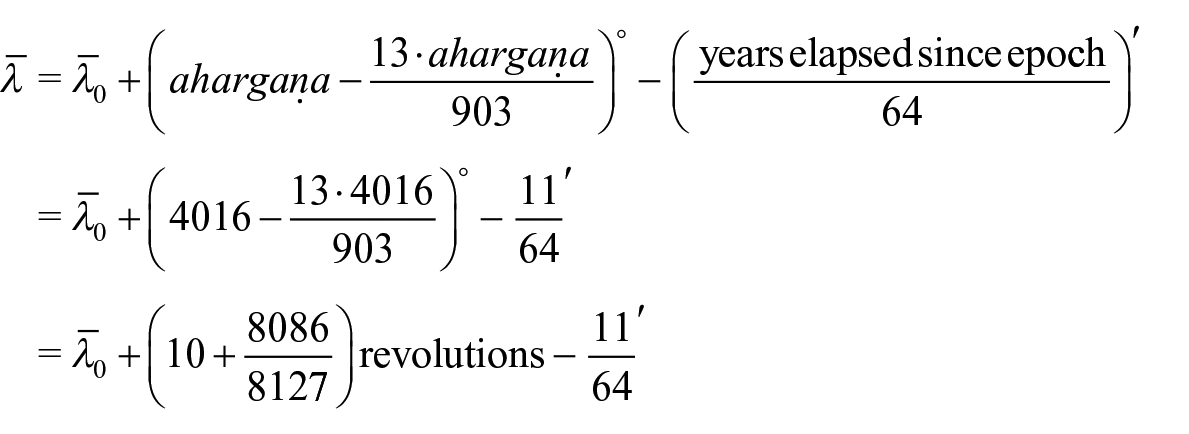
or, discarding the 10 integer revolutions in 11 years:
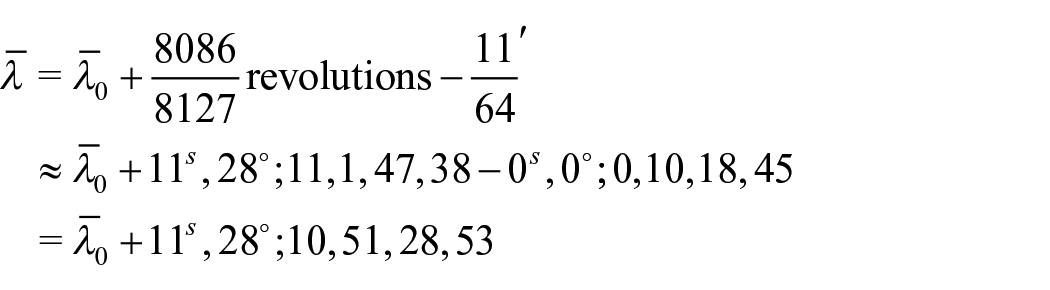
When rounded to arcseconds, neither of these resulting values for the Sun’s mean longitudinal increment (namely, 11s, 28°; 11, 1, 47, 38 ≈ 11s, 28°; 11, 2 or its corrected form 11s, 28°; 10, 51, 28, 53 ≈ 11s, 28°; 10, 51) exactly equals the 11s, 28°; 11, 49 that produces Gaṇeśa’s stated dhruva value. On the other hand, as shown in Table 2, multiplying a 4016-day ahargaṇa by the Saura-pakṣa ratio of 4,320,000/1,577,917,828 solar revolutions per civil day produces a fractional-revolution increment of approximately 11s, 28°; 10, 48, 56, whose 360°-complement does indeed round to Gaṇeśa’s value.
As in the case of the adhimāsa term divisor discussed above, it is not clear why Mallāri appealed to a Brāhma-pakṣa-based formula in his explanation when the corresponding parameters from the Saura-pakṣa provide a more accurate reconstruction. To make the reconstruction easier to understand by invoking a well-known ahargaṇa rule? to illustrate the freedom to choose among diverse pakṣas and parameters? perhaps to slightly disguise the exact form of Gaṇeśa’s computation to make it harder for imitators to copy?
Turning to the kṣepaka enumerations in verse 8, Mallāri similarly glosses their numerical values and continues 38 :
Here is the explanation.
[The mean longitudes of] the planets [that are found] here are produced beginning from the beginning [epoch date] of the text; hence, these text-beginning [longitudes of the] planets ought to be applied here with respect to the beginning of the kalpa. The determination of that is as [follows]. Considering the Śaka [year] equal to 1442 (dvi-abhi-indra), the sunrise mean planets at Caitra-śukla-pratipad are determined according to whatever pakṣas they each individually pertain to; the technical term for them, “addend” [kṣepa], is appropriate because this addend is added. Its addend-ness [derives] from [its] being added to [the mean longitudes of] the planets.
Evidently Mallāri considered the procedure for computing these epoch mean longitudes, each according to the preferred pakṣa for that planet, to be sufficiently transparent to the reader that no further explanation was required.
Viśvanātha’s concise account 39 focuses on the creation of revised values of dhruvas and kṣepakas based on his own observation of an eclipse. Since it pertains mostly to the issue of planet-specific pakṣa preferences, we defer its discussion to the investigation of that issue in a later section.
Verse 1.9: Determining the mean longitudes of the planets at a desired time; locality-difference (deśāntara) correction for the Moon
Verse 9
40
finally provides an explicit statement of Gaṇeśa’s formula for planetary sunrise mean longitude, incorporating its three components: namely, the epoch mean longitude or kṣepaka, the subtractive dhruva multiplied by the c completed cakras since epoch, and the longitudinal increment
The [mean longitudinal displacement of] a planet corresponding to the ahargaṇa, diminished by the dhruvas multiplied by the cakras increased by [the planet’s] own kṣepaka, is the mean longitude [of the body] at sunrise. The minutes of arc commensurate with a sixth (rasa) part of the number of yojanas situated between one’s own place and the standard meridian [are applied] to [the mean longitude of] the Moon negatively or positively [when the location is] westwards [or] eastwards [of the meridian].

This value is reckoned for mean sunrise on the prime meridian of terrestrial longitude. At a nonzero longitude, mean sunrise will be earlier or later depending on whether the observer is situated east or west of the prime meridian.
Gaṇeśa accounts for the effect of this time-difference on the lunar longitude by applying to it a correction in arcminutes which is equal to one-sixth of the linear distance D between the observer’s locality and the meridian, measured in units called yojanas. This deśāntara correction
Mallāri’s derivation of the (D/6)(′) expression for the deśāntara correction begins
43
: Here is a method for knowing when local sunrise will be from sunrise at the [prime meridian] line. The circumference of the Earth is said [to be] greatest at Laṅkā: four thousand nine hundred and sixty-seven, 4967. At Meru [at the North Pole], the circumference is nonexistent; in between, [according to] a proportion. That is as [follows]: At Laṅkā, due to the nonexistence of the sine of latitude, the cosine of latitude is maximal [and] equal to the Radius. So, if that stated circumference of the Earth [occurs] with the cosine of latitude equal to the Radius, then what [occurs] with the cosine of the desired latitude? Due to the cosine of [nonzero] latitude [being] less than the Radius everywhere, the circumference of the Earth itself will be less than the stated [circumference] everywhere. So for simplicity, [the circumference at an arbitrary latitude is] taken commensurate with four thousand eight hundred, 4800.
The stated canonical value of 4967 yojanas for the equatorial circumference passing through Laṅkā (point L in Figure 2) is given in the Siddhānta-śiromaṇi.
44
Theoretically, as illustrated in Figure 2, the radius JN of a parallel of latitude φ° distant from the equator is related to the equatorial radius

which implies that the circumference of such a parallel equals (4967 cos φ) yojanas. For convenience, Mallāri instead takes 4800 yojanas as the approximate circumference of any such parallel. 45
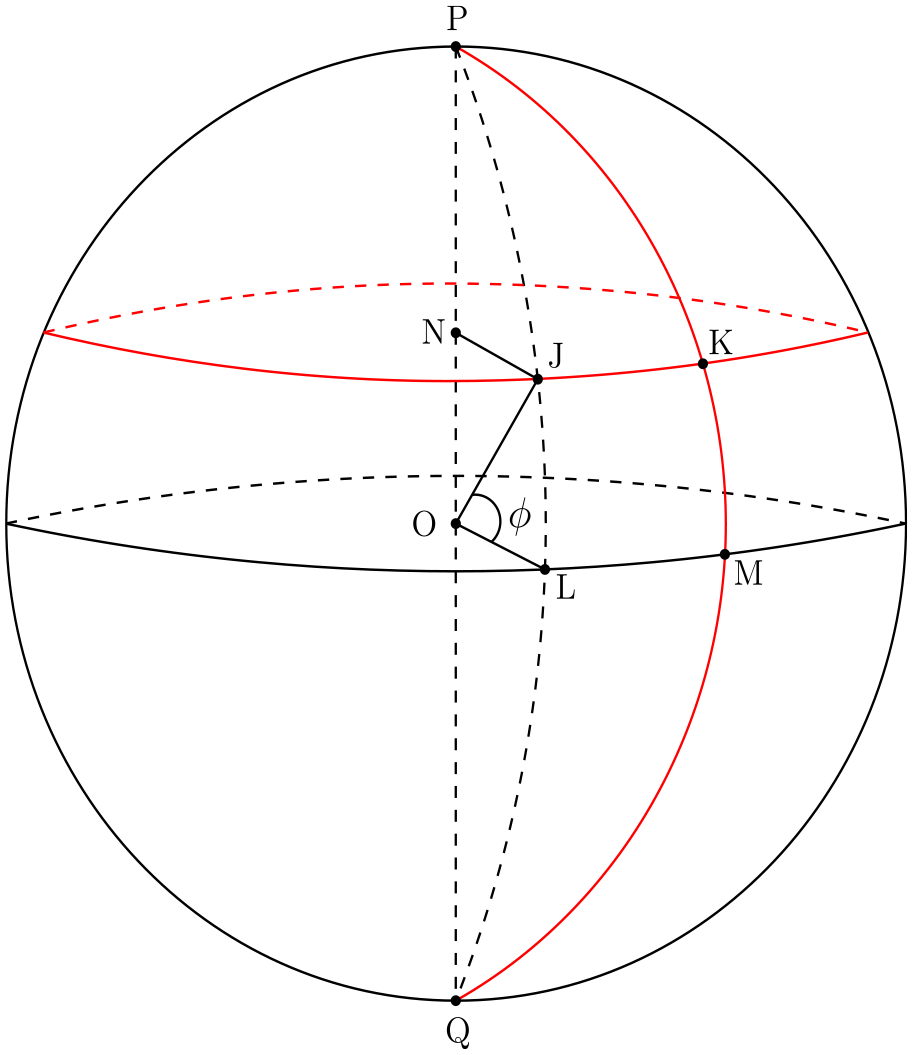
The deśāntara-correction is applied based on the linear distance in yojanas KJ between an observer’s locality K at latitude ϕ on some meridian PKM and the corresponding point J on the prime meridian PJL.
In one civil day or one rotation of an entire (4800-yojana) parallel of latitude, a planet traverses its own mean daily longitudinal increment. So during the time corresponding to some distance D east or west of the prime meridian, smaller than 4800 yojanas, the planet will cover a proportional part of its daily increment. As Mallāri explains
46
: Then, a proportion: If the planet traverses the arcminutes of [its mean daily] motion in these 4800 yojanas of circumference, then what is [its motion] in the yojanas of difference between one’s own place and the [prime meridian] line? Here, only the Moon’s [deśāntara-]correction is made. [It is] not made [in other cases] because of the smallness of the [mean daily] motion of the other [planets]. [It is] omitted due to the smallness of the difference [in the result and] the cumbersomeness of the procedure; thus [the omission] is not [to be regarded] as an error.
And it is stated in the Siddhānta-śiromaṇi: Any [procedure] of the book that is omitted for fear of [unduly] burdening its learners due to [involving] a lot of effort and small difference [in the result], minimal usefulness, [or] obvious meaning: that purpose is not [to be regarded] as a fault. Hence the [mean daily] motion 790 is the multiplier, [and] the circumference 4800 the divisor, of the yojanas of locality-difference [from the prime meridian] line. The multiplier and divisor are [both] reduced by the multiplier; the resulting divisor is six.
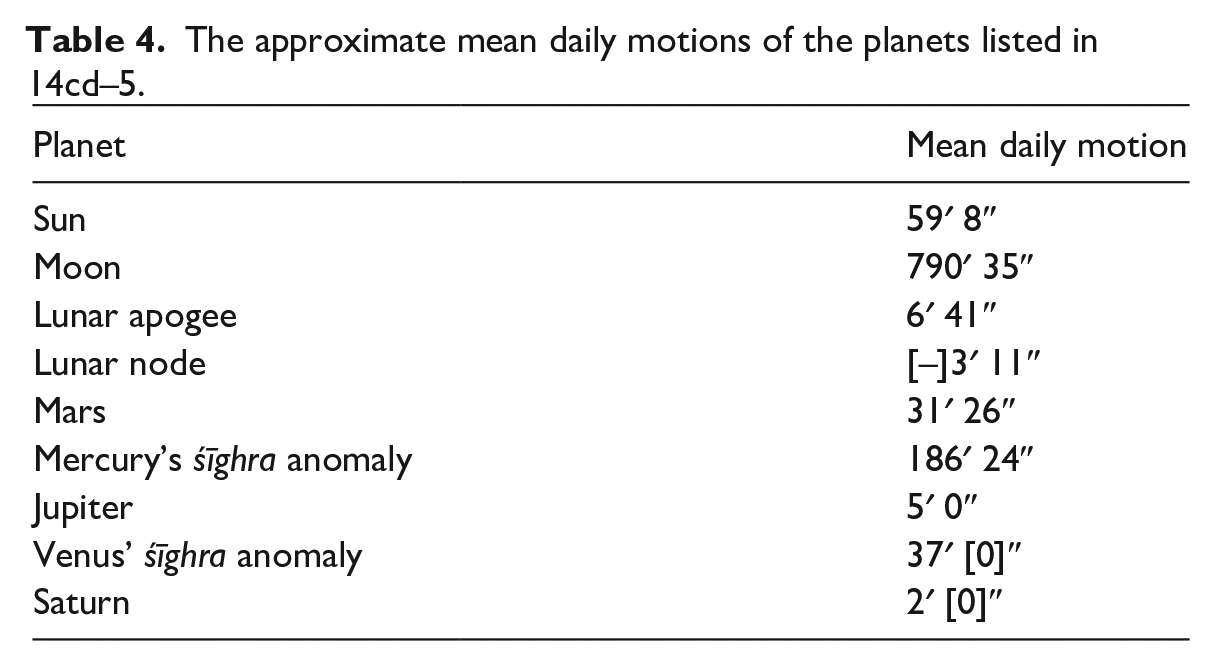
That is, in the case of the Moon with daily mean longitudinal increment approximately equal to 790′ (more precisely 790′35″; see Table 4), the proportional locality-correction to longitude works out to

as Gaṇeśa prescribes. Analogous corrections for the other planets are not computed, on Bhāskara’s principle 47 that procedures producing negligible effects may be neglected. Indeed, the Sun’s mean daily motion of about 1° or 60′ would produce a correction of 1/80 of an arcminute, or less than one arcsecond, per yojana of distance D.Viśvanātha’s very brief comments, 48 after glossing some key technical terms, touch upon the same points as Mallāri’s, including citations of the same Siddhānta-śiromaṇi passages.
The approximate mean daily motions of the planets listed in 14cd–5.
Verses 1.10–1.14ab: Mean longitudinal displacements of planets
In this section, we examine Gaṇeśa’s compactly versified algorithms for the planets’ mean longitudinal increments over the a civil days of the ahargaṇa.
49
We have reconstructed their possible derivations from planetary parameters provided by the three main astronomical pakṣas as enumerated in Table 1, whose fundamental period relations can be reduced by continued-fraction approximations to convenient values of mean longitudinal increment for one day,
Each of Gaṇeśa’s formulas for the quantity
Verse 1.10: Mean longitudinal increments of the Sun (and Mercury and Venus) and the Moon
The ahargaṇa is diminished by a 70th (kha-naga) part of itself; [further] decreased by the ahargaṇa divided by 150 (kha-tithi) in arcminutes, [it becomes the mean longitudinal increment of] the Sun, Mercury, and Venus in degrees and so on. The product of the ahargaṇa and 14 (manu), diminished by its own 17th (adri-bhū) part, decreased by the ahargaṇa divided by 140 (kha-manu) in arcminutes, [is the mean longitudinal increment of] the Moon, beginning with degrees.

The corresponding formula for the Moon is

The assignment of units to the different terms in these formulas is somewhat ambiguous in Gaṇeśa’s verse. But we can conclusively determine which terms are in degrees and which in arcminutes, either from the commentators’ glosses or via the reconstruction computations.
Here is the explanation. Here the determination of [the longitude of] a planet is to be done by means of the “primal motion” (pūrva-gati). In that case the way to know the primal motion is as [follows]. In the beginning, on Sunday at the beginning of Caitra, the ecliptic along with the equator and other circles was launched by Brahmā in the westward-moving pravaha wind; then the planets, having reached the ecliptic by means of the pravaha wind, deviated bit by bit from [their] own place, [each] with its different [individual] primal motion. So in observing day by day, the primal motion of the planets appears different [for each]. In this, no method is seen for computing [the longitude of] a planet day by day, owing to the indeterminacy [of the] motion. So the difference [of the longitudes] of a planet on one day and the next [lit. today and tomorrow] is [its daily] motion. So [when one has] determined the [daily] motions of a planet throughout the planet’s course in a revolution, whatever is at their mean—[namely,] whichever [daily] motion is greatest of all and [whichever is] least of all, half the sum of those two—is acknowledged [as] just [its] “mean motion”. That is hard to determine, owing to the imperceptibility of accurate degrees etc. demarcated by arcseconds. It turns out approximate, [and is] acknowledged as such. So at any current time, in observation [by?] Vasiṣṭha etc., discrepancy in the [daily] motion [was] seen; and likewise by others. By Āryabhaṭa, Brahmagupta, Bhāskara etc., [using] that same procedure, the [mean daily] motions [were] seen [as] different. From those [motions] planetary revolutions too [were] calculated; they are as [follows]. If [in] one day [there is] so much [mean] motion, then what [is the mean motion in] the civil days of a kalpa? So in [each] siddhānta, the planetary revolutions [as] read and recited are all different; they came about only for that time. At the present time, great divergences are seen. And it is stated in Varāha[mihira]’s [Bṛhat]saṃhitā: “The alteration in reality [from what has been authoritatively] stated is manifest from investigating by observation.” And in the Vasiṣṭhasiddhānta: “Thus, O Māṇḍavya, [this] science taught by me is stated concisely. A deviation of the sun, the moon, and so on (i.e., the other planets), will occur from yuga to yuga.” “From yuga to yuga”, [i.e.,] in a long time, [there will be] deviation, variance: as much as [to say], unsteadiness. And it is stated in the Sūrya-siddhānta: “Just this original treatise is what the Sun proclaimed in the beginning. Only here [there is] discrepancy in time on [account of] the unrolling of the yugas.” And in Brahma[gupta]’s siddhānta: “A good astronomer, knowing the bīja from the Dhyānagrahopadeśādhyāya [handbook], [makes the appropriate] determination and prediction from [the longitudes of] the planets corrected by that.”
53
The discrepancies of [the longitudes of] the planets [were] examined by that teacher [Gaṇeśa], having observed the planets by setting up a [sighting-]tube. That is as [follows]: the sun and the lunar apogee are Saura-pakṣa. The moon comes out in accordance with the Saura-pakṣa, less nine arcminutes. Mars, Jupiter, and the lunar node are Ārya-pakṣa. Mercury’s śīghra-anomaly is Brāhmapakṣa. Saturn comes out in accordance with the Ārya-pakṣa, plus five degrees. And Venus’s śīghra-anomaly comes out equal to half the sum of the Brāhma-pakṣa and Ārya-pakṣa [results]. At this time, those are the observed planets. And later on too, procedures for the planets [will be] made by future great astronomers, having observed the planets by setting up a sighting-tube [and having] examined [their] discrepancies, as subsequently at the end of the book [it] is stated by the teacher too. Hence [the positions of] the planets come about [specifically for] this very place and time. So with this applicability to the present, the mean solar motion in degrees etc. is known: 0,59,8,34,17,9. Then the proportion: if in one day the [mean] motion is so much, then what [is it] in the ahargaṇa? The [mean daily] motion is the multiplier of the ahargaṇa. Here for the purpose of part-multiplication,
54
the part of the motion [equal to] unity is taken [as] greater than the motion. S[un] [mean daily] mo[tion]: 0,59,8,34,17,9; in this case, taken [rounded up to] one. The difference 0,0,51,25,42,51 is to be multiplied by that ahargaṇa and subtracted from the ahargaṇa multiplied by one. In this [there is] laborious work. For the sake of brevity, this 0,0,51,25,42,51 in [the form of] a single digit should be multiplied by something. So when it is multiplied by seventy, the highest [digit] is one, without remainder. So, the ahargaṇa multiplied by one is divided by seventy; the ahargaṇa times one is to be diminished by the result, since [it was] taken [as] greater. The subtraction is because of the invariability of the multiplier equal to one in both places, thus “diminished by a 70th part of itself”. Now the part that [was] taken [as] greater with respect to the [mean] motion, 0,0,0,24,0,0: the ahargaṇa is multiplied by that, [and] the result is to be subtracted from the [mean] Sun because of the excess. Here also for the sake of brevity, this constant is put into the same category with “kha-tithi” [meaning] “150” in the arcminutes place.
55
That is, Mallāri argues for an empirical derivation not only of Gaṇeśa’s specific
Mallāri infers that Gaṇeśa observationally determined the current solar mean daily motion value
Our reconstruction process for Gaṇeśa’s
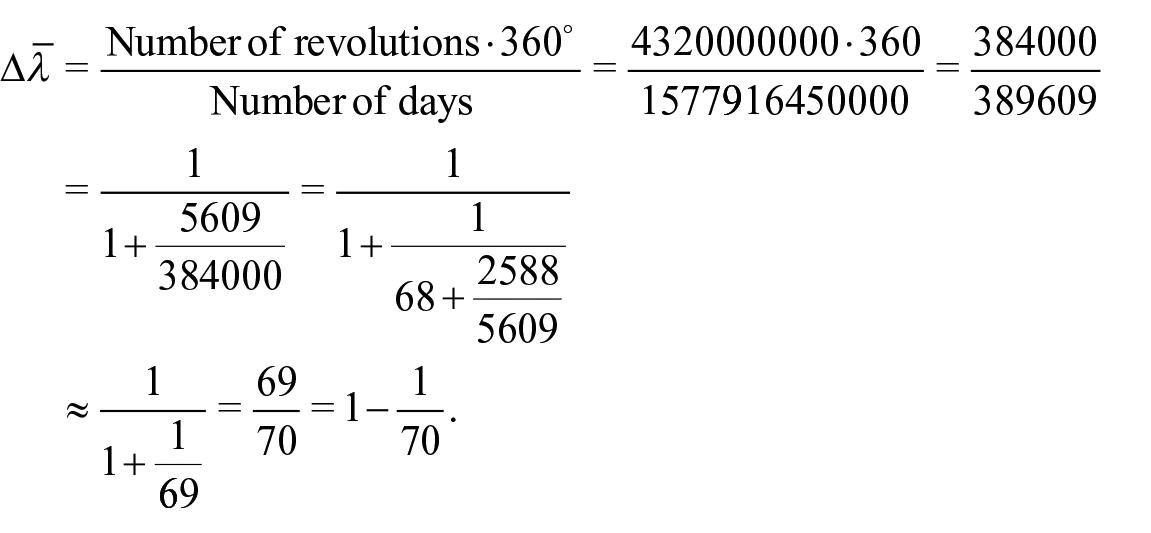
The difference between this approximate value and the exact fraction we rounded it up from can itself be approximated by means of the same method. That (very small) difference is:

Converting this remainder from degrees to arcminutes for increased precision, we determine a simplified continued-fraction approximation for it:

The combination of these two terms is identical to Gaṇeśa’s formula for the Sun’s
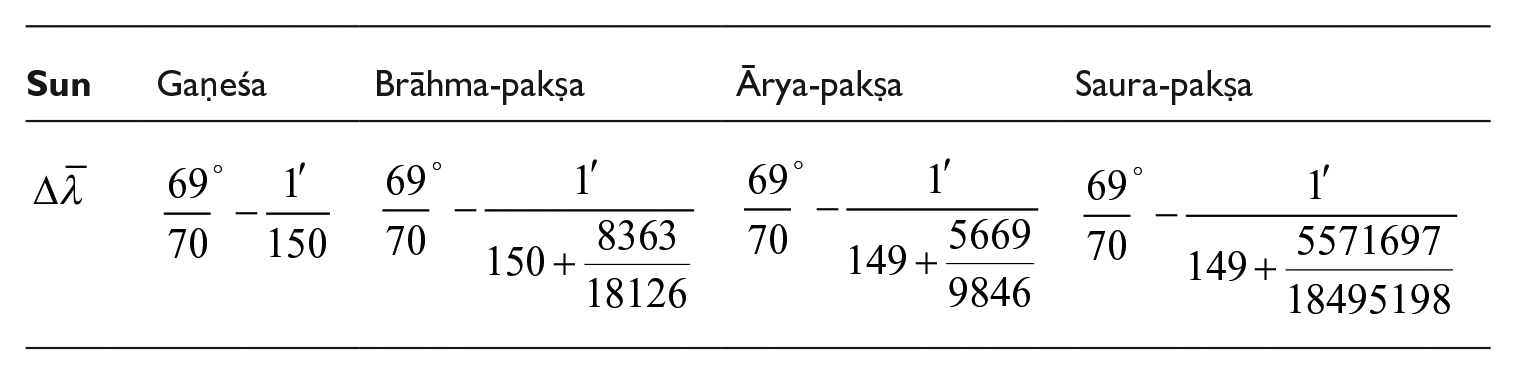
Gaṇeśa’s
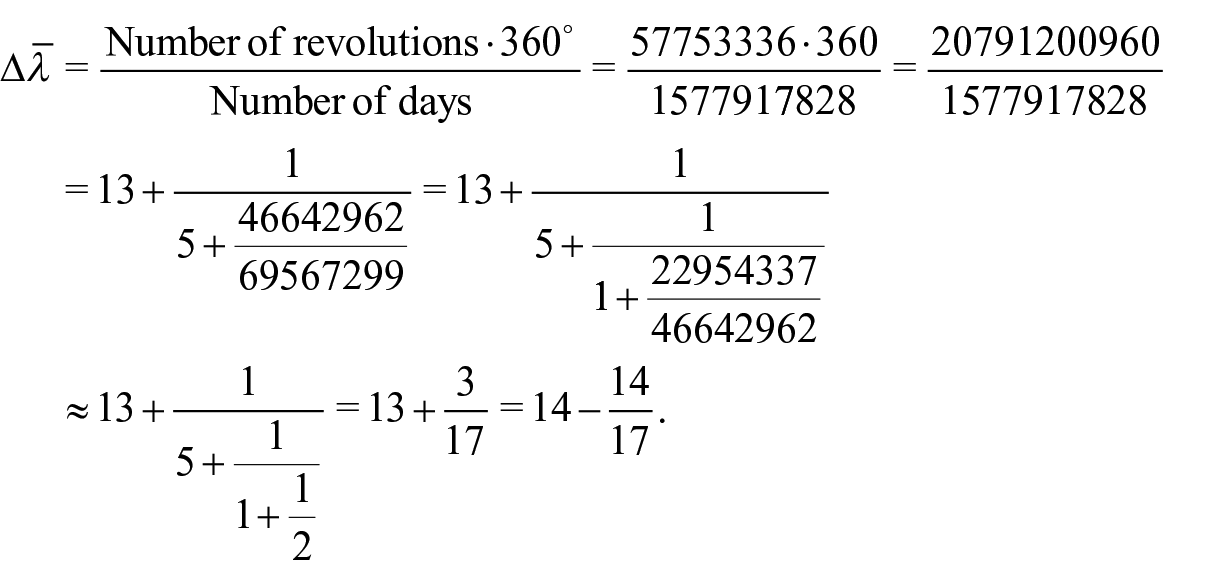
Again, this approximate value is a slight overestimate of the exact fraction. So we calculate their difference in arcminutes, and approximate that difference in its turn by a simpler fraction, to give us the second of the two terms in Gaṇeśa’s formula:
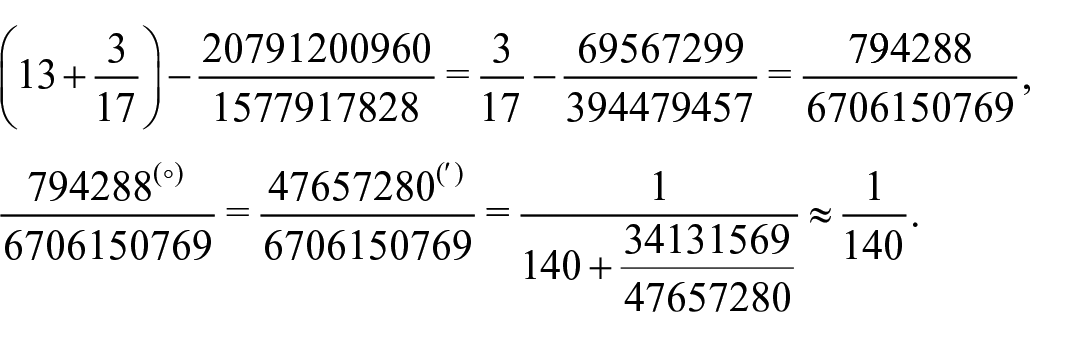
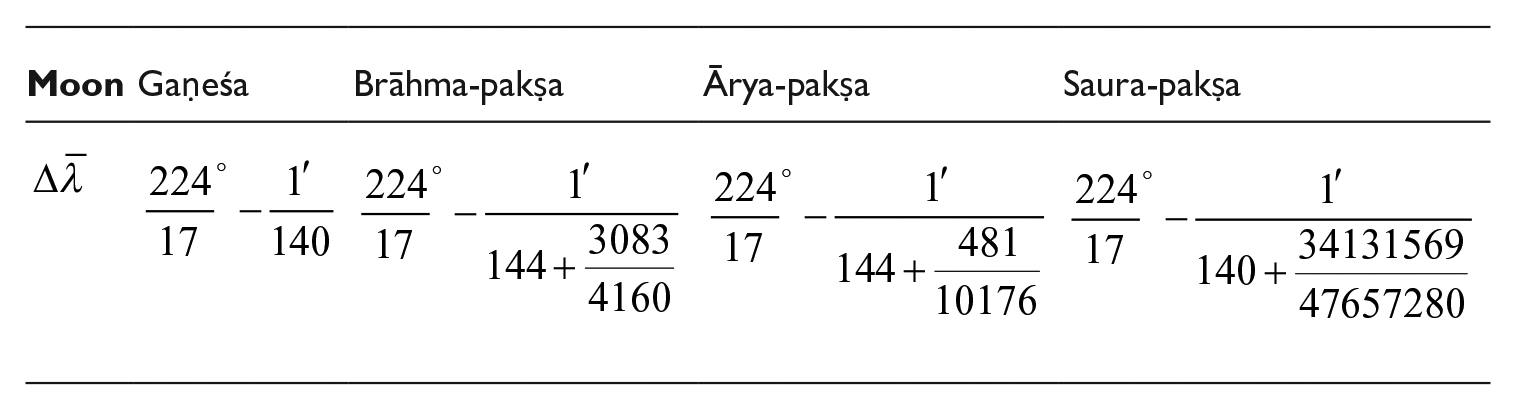
Given the difficulty of understanding Mallāri’s explanation as a clear and consistent description of actual astronomical practice in establishing numerical parameters of mathematical models, we think it more likely that Gaṇeśa, like Bhāskara before him, followed a process more closely resembling our reconstruction. That is, he seems to have obtained these elegantly efficient
Viśvanātha, in sharp contrast to his brother, restricts himself in this passage
57
to a worked example with an ahargaṇa value of 1521 days to compute one of the components of the rule to compute the solar longitudinal displacement (namely
Verse 1.11: Mean longitudinal increments of the Moon’s apogee and the Moon’s ascending node
The ahargaṇa divided by 9 (nava) is [the mean longitudinal increment of] the moon’s apogee in degrees and so on, along with arcminutes [equal to] the ahargaṇa divided by 70. The sum of the results in degrees and arcminutes [respectively produced] from the ahargaṇa divided in two ways, by 19 (nava-ku) [and] by 45 (iṣu-vedā), is the 360-complement [of the mean longitudinal increment] of the moon’s ascending node.

and for the lunar node, which revolves “backwards” from east to west, that is, with a negative mean motion,

Dvivedī shows 58 in his continued-fraction analysis that the Brāhma-pakṣa period relations yield the best approximation to Gaṇeśa’s lunar-apogee formula, although still not an entirely accurate one:
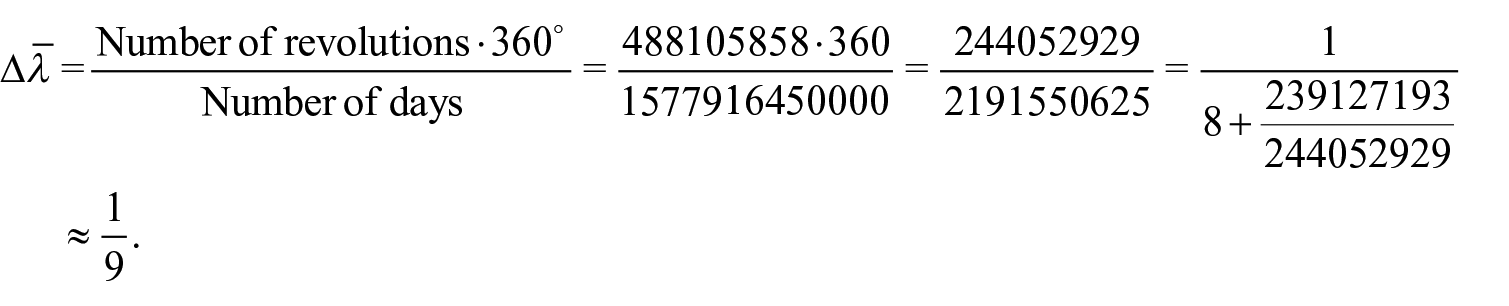
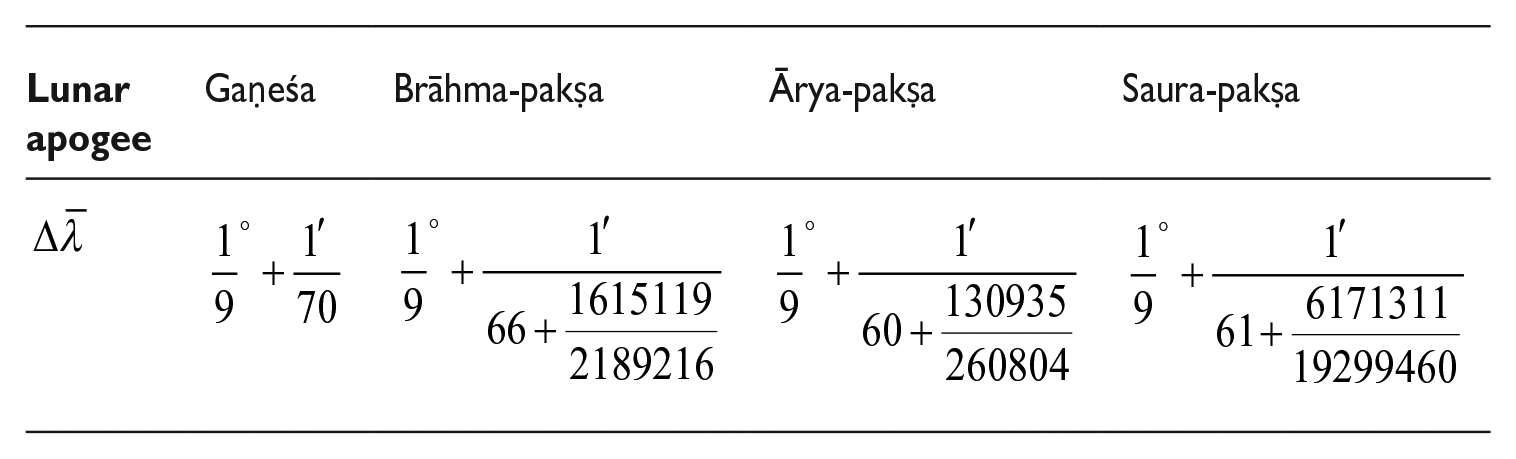
Since this approximate value is a little smaller than the exact fraction, their discrepancy is given by:

or in arcminutes:

This fraction would round most nearly to
We can employ a similar derivation from Brāhma-pakṣa kalpa parameters for the lunar node’s mean daily increment
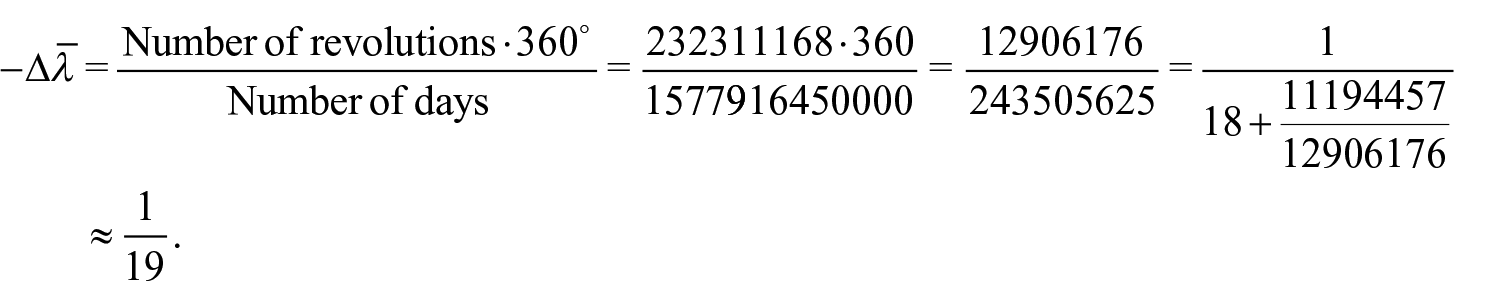
Since this approximate value, again, is less than the exact fraction, we find an additive term corresponding to their discrepancy:

or in arcminutes:

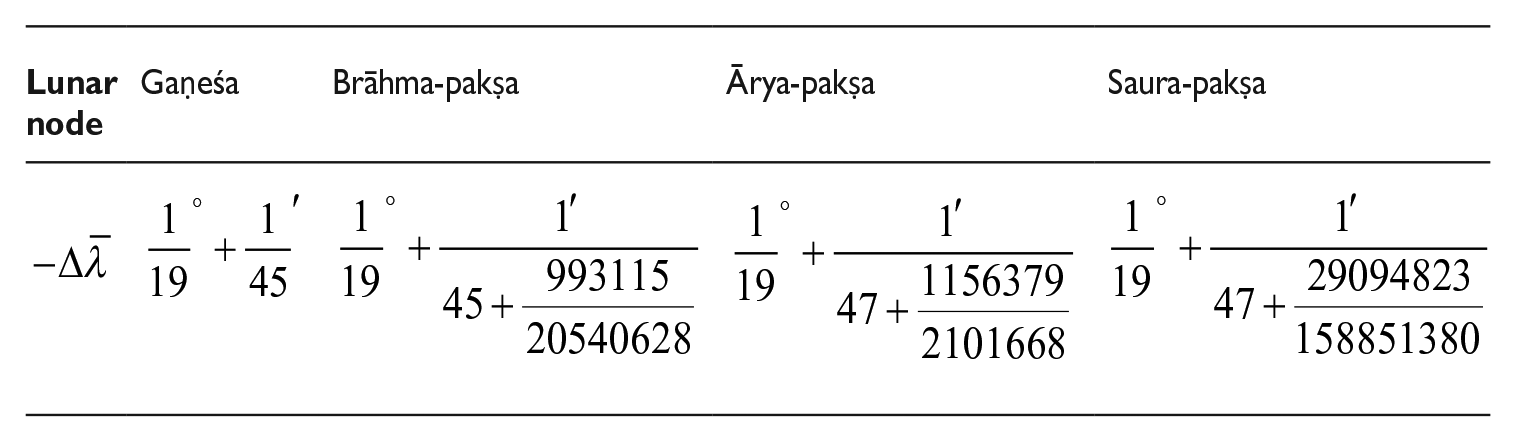
Viśvanātha likewise reprises his commentarial structure from the previous verse 10: namely, carrying out a worked example for each of the planets concerned, with the same ahargaṇa value of 1521 days, to arrive at its sunrise mean longitude at the end of that interval. Since both Mallāri’s and Viśvanātha’s comments on the rest of the planetary longitudinal-increment rules in verses 12–14 continue in the same expository paths, we have not included any further summaries or analyses of them in discussing those verses.
Verse 1.12: Mean longitudinal increments of Mars and the śīghra anomaly of Mercury
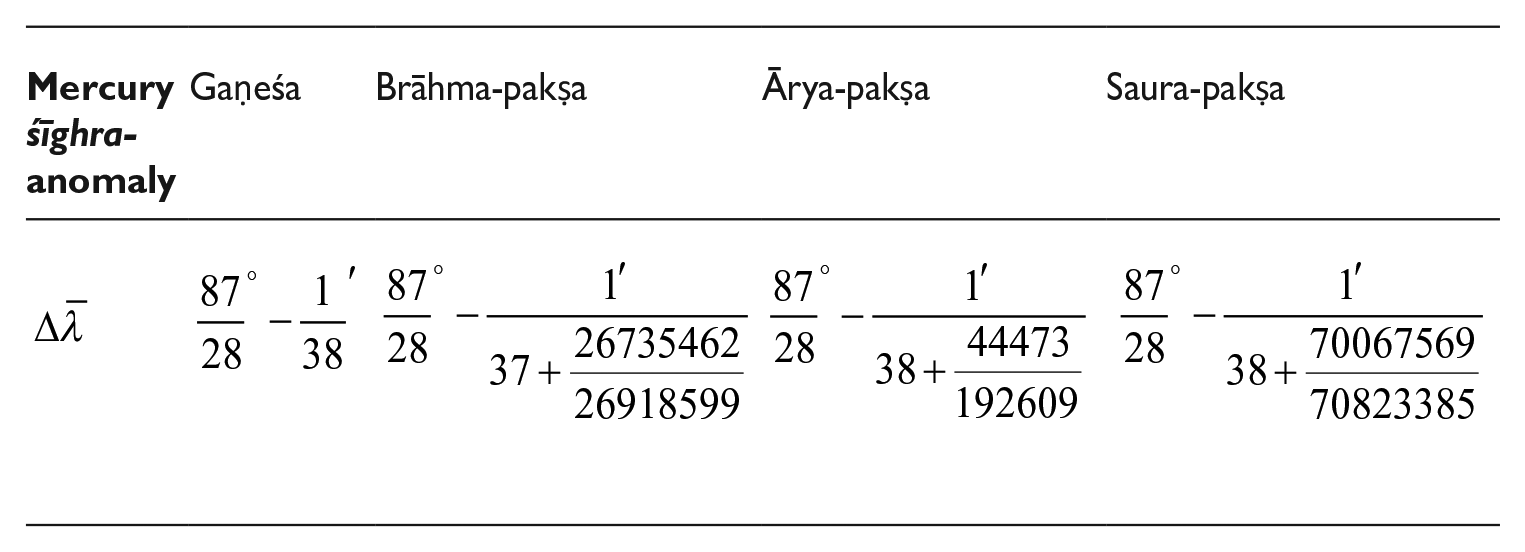
The ahargaṇa multiplied by 10 is [separately] divided in two ways, by 19 (aṅka-ku) [and] by 73 (tri-śaila). The difference of the results in degrees and arcminutes [respectively] is [the mean longitudinal increment of] Mars. The ahargaṇa multiplied by 3 (tri) added to its own 28th (vasu-dṛk) part is [the mean longitudinal increment of] the śīghra-anomaly of Mercury, [with] subtracted arcminutes [equal to] the ahargaṇa divided by 38 (ahi-guṇa).


Following the pattern in the previous verses for reconstructing the daily-increment
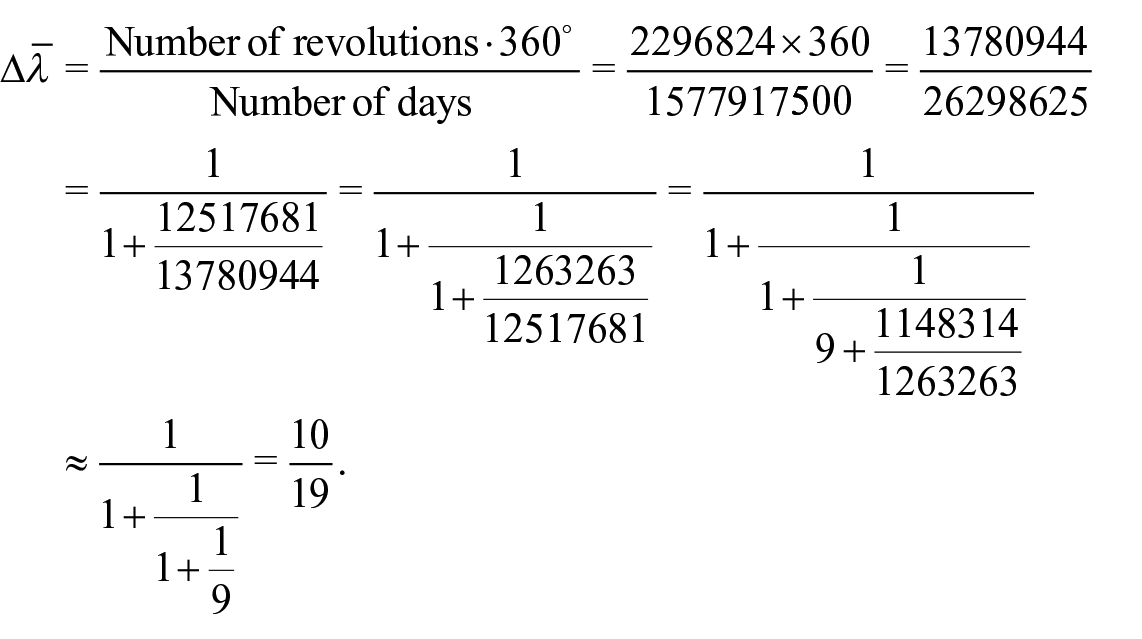
The discrepancy between the too-large approximation and the exact fraction is

which is rounded to
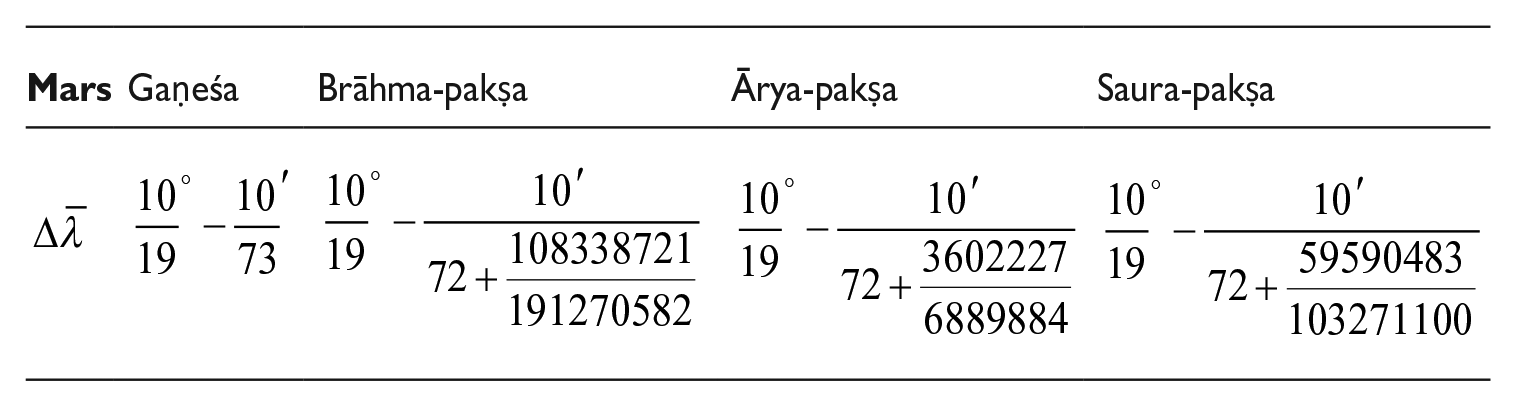
Recall that the śīghra-anomaly of an inferior planet is the difference between the longitude of its śīghra-apogee and the longitude of the mean planet itself, which is considered to coincide with the longitude of the mean Sun. So the number of śīghra-anomaly revolutions in a kalpa, according to Brāhma-pakṣa parameters, is equal to the 17,936,998,984 revolutions of Mercury’s śīghra-apogee minus the 4,320,000,000 revolutions of the Sun:
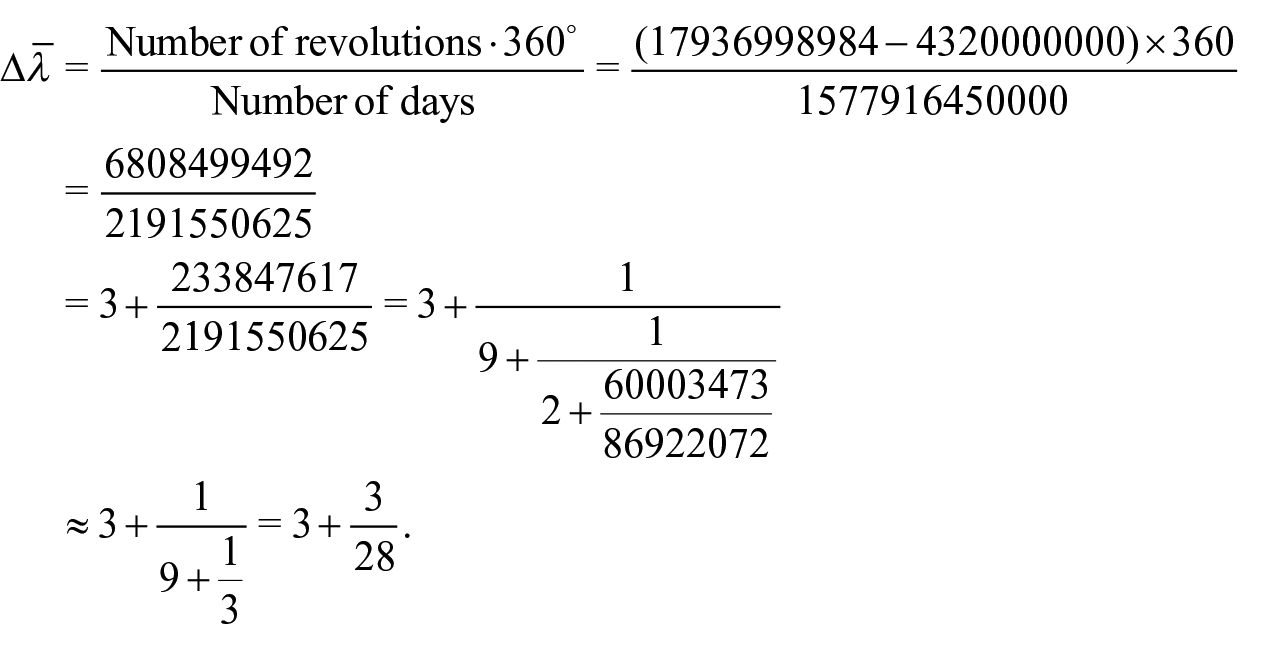
The discrepancy between the too-large approximation and the exact fraction is

which is rounded to
Verse 1.13: Mean longitudinal increments of Jupiter and the śīghra-anomaly of Venus
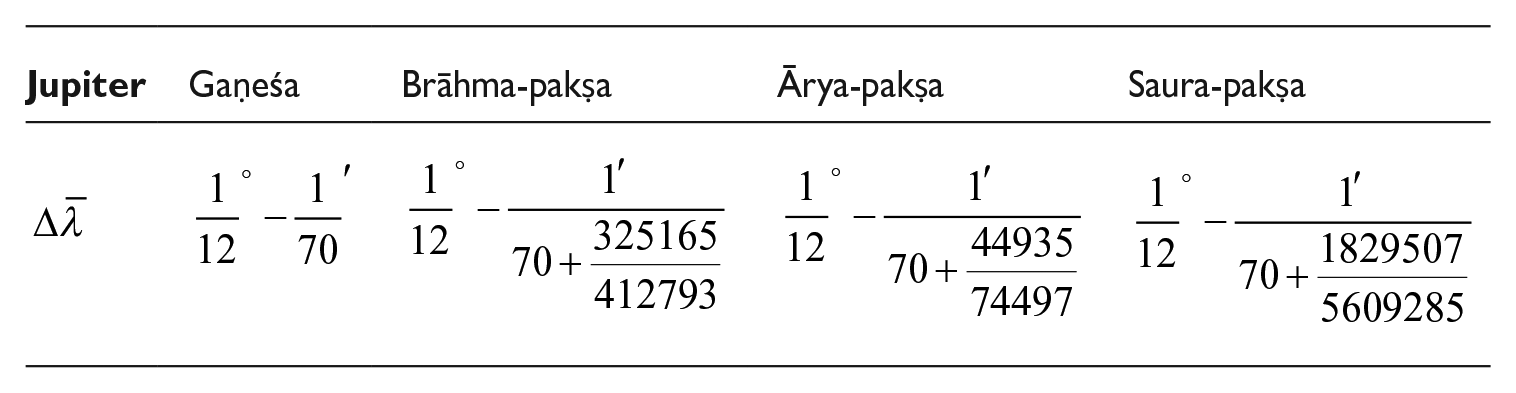
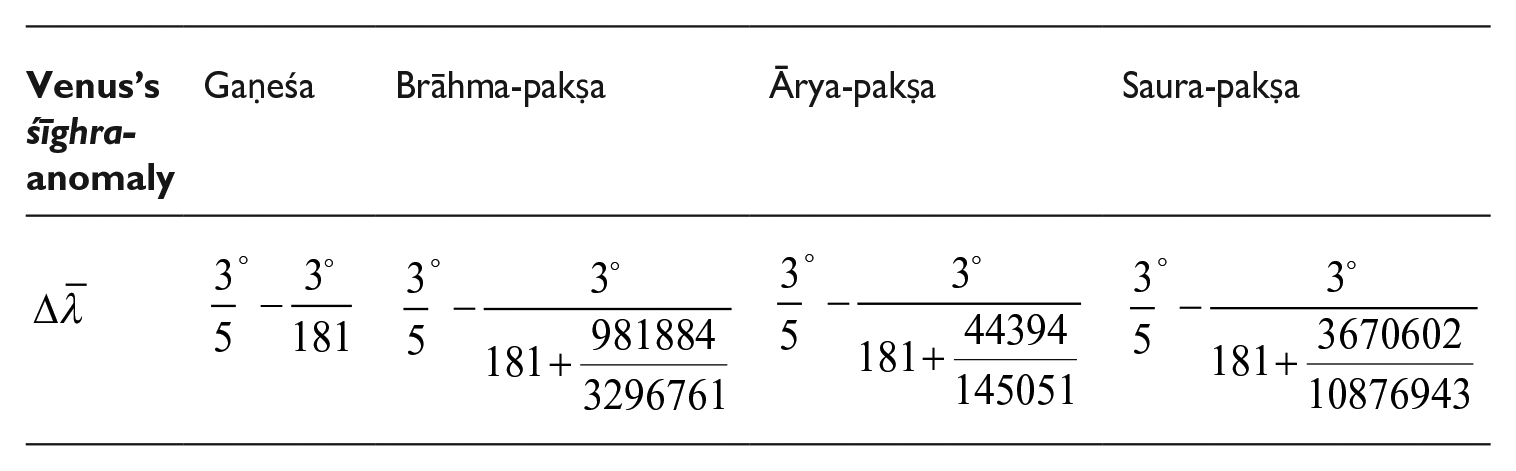
The ahargaṇa divided by 12 (arka) is [the mean longitudinal increment of] Jupiter [in] degrees and so on, [when] decreased by the quotient from [dividing] the ahargaṇa by 70 (kha-śailā), in arcminutes. The sum in degrees of the [two] quotients from [separately dividing] the ahargaṇa multiplied by 3 (tri) in two ways, by 5 (akṣa) and by 181 (ku-ibha-abja), is [the mean longitudinal increment of] the śīghra-anomaly of Venus.
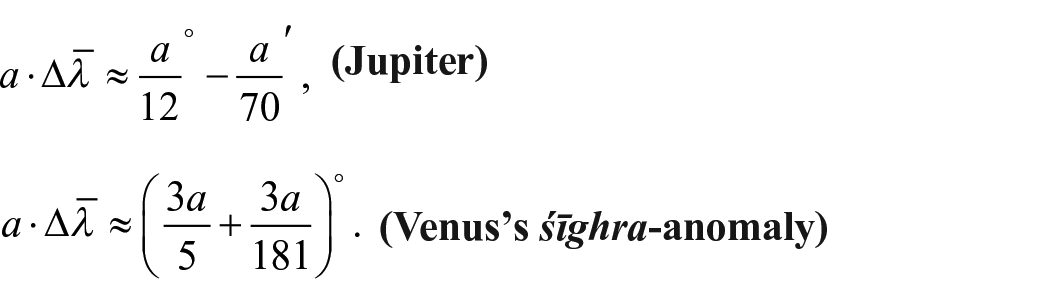
We derive the Jupiter algorithm from Ārya-pakṣa mahā-yuga parameters as follows:
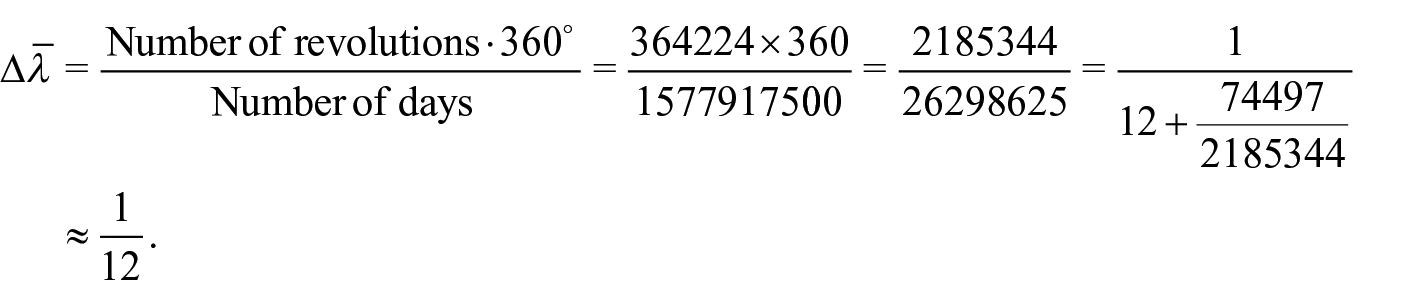
The discrepancy between the too-large approximation and the exact fraction is

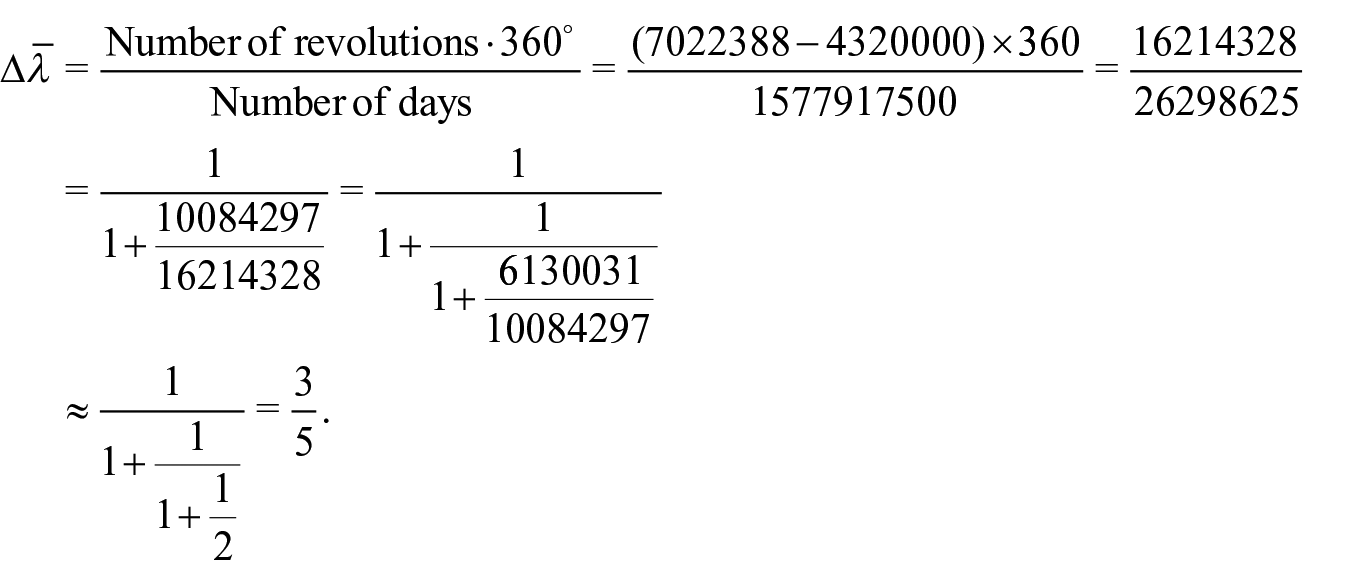
For the śīghra-anomaly of Venus, we again use Ārya-pakṣa mahā-yuga parameters, according to which 7,022,388 revolutions of Venus’s śīghra-apogee minus 4,320,000 revolutions of the Sun gives the śīghra-anomaly cycles:
The discrepancy between the too-small approximation and the exact fraction, in degrees, is

Verse 1.14ab: Mean longitudinal increment of Saturn
The ahargaṇa divided by 30 (kha-agni) is [the mean longitudinal increment of] Saturn in degrees and so on, [when] increased by the arcminutes of the result from the ahargaṇa divided by 156 (ṣaṭ-pañca-bhū).

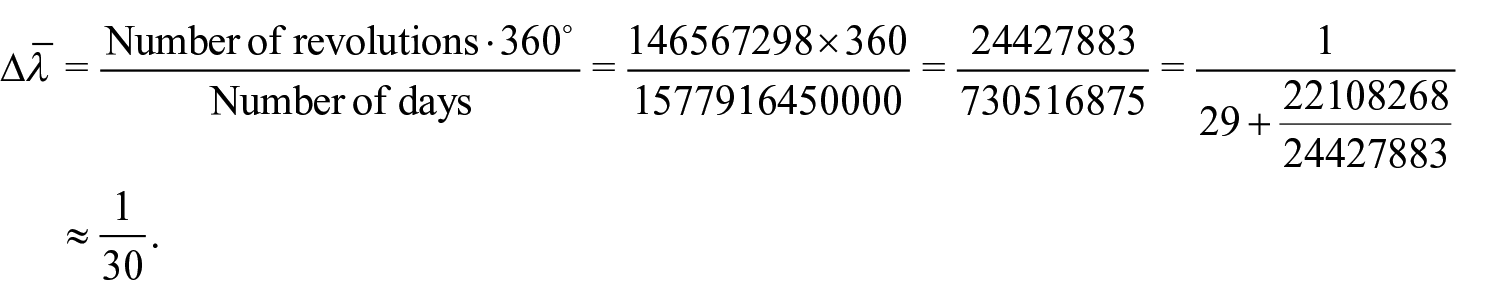
We derive the Saturn algorithm from Brāhma-pakṣa kalpa parameters as follows:
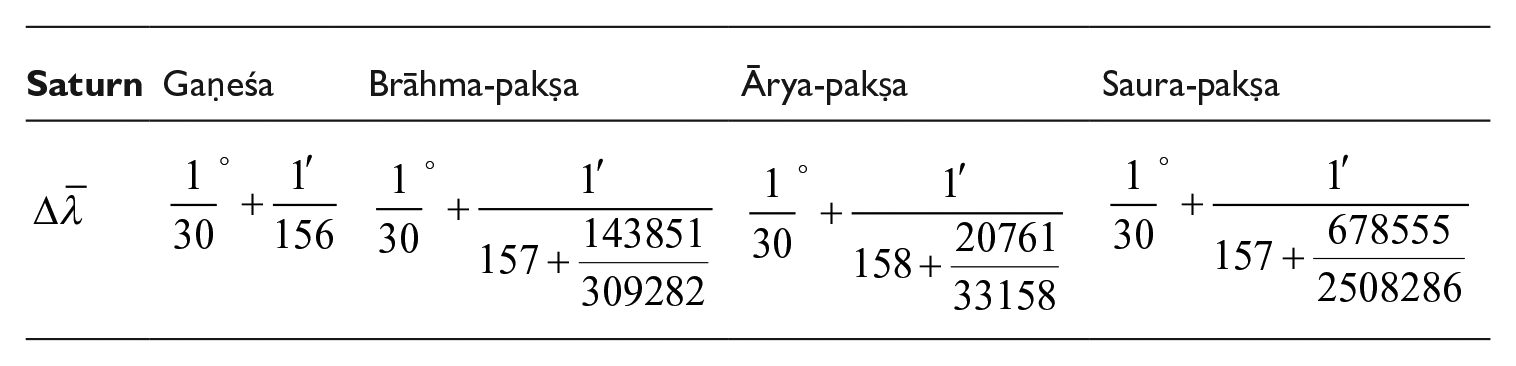
The discrepancy between the too-small approximation and the exact fraction is

None of the pakṣa parameters produce a version of this term that rounds accurately to Gaṇeśa’s
Verse 1.14cd–15: Mean daily motions
Having explained how the planets’ mean longitudes are to be calculated for mean sunrise on a certain date, Gaṇeśa now lists abbreviated values of their mean daily motions
The [mean] daily motion of the Sun: 59,8 (go-akṣa gaja); of the Moon: 790,35 (abhra-go-aśva pañca-agni); now the [mean] daily motion of the [lunar] apogee: 6,41 (ṣaḍ-ila-abdhi). [The mean daily motion] of the lunar node: 3,11 (traya ku-śaśin); of Mars: 31,26 (indu-rāma tarka-aśvin); the [mean] daily motion of the śīghra-anomaly of Mercury is 186 (ari-ahi-kṣmā) minutes and 24 (jina) seconds; of Jupiter: 5,0 (śara kha); the [mean] daily motion of the śīghra-anomaly of Venus is 37 (adri-guṇa), of Saturn 2 (dve).
The planets respectively traverse these many arcminutes of the zodiac circle [i.e., ecliptic] eastward every day, each upon its own orbit: this is the idea. How [is it] that the zodiac circle set in the pravaha wind is always turned by its torrent towards the west, [while] the planets wander with changing velocity variously swift and slow? If [it is] so, then how [can] alteration, i.e., swiftness [and] slowness, occur [in] the mean velocity of those planets situated on the same path? Hence [they] each revolve on a separate path: this is the idea. Why [is there] inequality of the velocity? it is stated: Any [planet] that is close to the earth completes a revolution in a short time, [i.e.,] there is swiftness of its motion; any that is far away [revolves] in a long time, hence the slowness of its motion. [And] each one is slow-moving with respect to the next. And so it is said in the Siddhānta-śiromaṇi: “While all the orbits of the planets are graduated by the [21600] arcminutes of a circle, in a small circle the arcminutes are small [in arclength], and in a large one, large. Therefore Mercury, Venus, Mars, Jupiter [and] Saturn appear as if successively slower than the Moon, going [outward] in order.” So the orbits of the planets are seven. Above the planetary orbits is an eighth, the circle of the nakṣatras, [which] is just the zodiac circle; on it are the twelve equal zodiacal signs. Its degrees are the geometric degrees [? kṣetra-aṃśa]; [it] does not have motion always towards the east, [but] set in the pravaha wind, it turns always towards the west. Then on account of traversing component parts (avayava) [of the ecliptic in] zodiacal signs, degrees, arcminutes, and so forth, swiftness and slowness of [the motion of] the planets is asserted; nevertheless, the daily progress in yojanas is indeed constant for all planets. Hence indeed Bhāskara said: “But the motion in yojanas of the sky-dwellers is always constant, and [only] on account of the assumption of [measuring it in] arcminutes etc. is it declared [to be] slow or fast.” Here the constellation-circle cannot stay immobile in the same place, so it oscillates somewhat to east and west: so it is considered. Why? Because the rising-places of the points [marking] the equinoxes and solstices are not staying in the same place. The points of the equinoxes and solstices are observed going beyond the position of their own places, so the [ecliptic] circle is shifting westward. [When they] are found [falling] short, then [it] is shifting eastward: so it is known. Hence it is said in the Sūrya-siddhānta: “The [ecliptic] circle is shifted eastward when [the sun’s position] found from [calculation] operations is less than [the longitude of] the sun [from its] shadow, by [the amount of] degrees of [their] difference; then [after] turning around, [it is shifted] westward by [the degrees] of difference when [the calculated position] is greater.” Observed shifted east or west from what position? So: With regard to wherever the north and south [celestial] poles are on the horizon, that is a locality without [terrestrial] latitude. In that [place] the symmetrical east-west circle [through the zenith] is [also] called its circle of the equator. And then the name of the circle on whose path the sun with eastward motion traverses twelve signs is [given as] the “obliquity (krānti) [declination? ecliptic?] circle” [i.e., the ecliptic]. So on both the obliquity-circle and the equator at intervals of six zodiacal signs a pair of intersections occur; those intersections are known on the zodiac circle [by] the names “beginning of Aries” and “beginning of Libra”. At three zodiacal signs eastward and westward of those equinoctial intersections standing on the horizon, at a distance twenty-four degrees south and north of that equator circle, is the [maximum] declination/obliquity; the pair of intersections [with] circles south and north of that are called “beginning of Capricorn and Cancer”. The name “solstice (ayana) point” is applied to those two. So wherever on the horizon the four points of equinoxes and solstices [thus] positioned on the zodiac circle rise owing to the westward rotation, their same names are assigned to those [locations] there on the horizon too. From there the constellation-circle is shifted; thus it is to be understood. Since the zodiac circle is highest of all, considering the twelve equal zodiacal signs with [their] component parts upon it, [and] marked strings extending to those component parts from the center of the earth: On whatever string where the planet placed in its own orbit stands, it is understood as placed at the component part—its degree etc.—in that zodiacal sign. Thus by Lord Brahmā, binding with the south and north [celestial] poles the zodiac circle with the nakṣatras, together with the planetary orbits supported by it, then placing all the planets upon a string from the point of the beginning of Aries, creating in this way the constellation-circle set in the westward-facing rotation of the pravaha wind—the planets however [were] bound in eastward-facing rotation. Therefore all the planets, though revolving westward each [on] its own path, [were] launched to go eleven thousand eight hundred plus sixty minus one minus a quarter [i.e., 11858.75] yojanas each day, facing eastward. And it is said: “Having created the constellation-circle”, etc. Therefore the derivation of the [daily] motions is in accordance with the arcminute [depending] upon the smallness or greatness of the arcminutes constituting each [individual] orbit, and in accordance with the [orbital] apogee [possessing] swiftness or slowness. Thence the east-west oscillation of the constellation-circle is just those degrees of precession (ayana); thence, by however many degrees [is measured] the fixed [sidereal?] zodiacal signs’ divergence in distance south or north of the equator, the name of those degrees is “declination” (krānti). Thence on account of the declination, it is appropriate to do [any] action to be performed [according to] the planet [corrected] by that precession; their defined position [involves] the degrees of precession. [For those] in whose opinion the zodiac circle is placed elsewhere than the constellation-circle, their justification is just established practice [?]. And in this way the explanation of the arcminutes of each [daily] motion is concisely stated, and [also] from the topic explained previously.
In this long quotation-studded passage 62 Mallāri resumes the exposition of cosmological models upon which he embarked in his commentary on verse 10, which is presumably what he means by “the topic explained previously.” His insistence on it is in keeping with a long tradition of jyotiṣa authors exhorting students of practical algorithms for computation (gaṇita) to pay equal attention to spherical astronomy theory (gola), in order to become truly knowledgeable and avoid revealing ignorance in “assemblies of the learned. 63 ”
The model Mallāri describes is essentially the standard picture of the universe in geocentric spherical astronomy, with concentrically nested planetary orbits producing different apparent speeds for planets at different distances. The precession of the equinoxes is here explained as a trepidation, or periodic oscillation of the ecliptic with respect to the equator. This motion can in theory be detected by observing changes in the positions on the local horizon where equinoxes and solstices occur, since the equinoxes are the intersection points of the ecliptic and equator. Specific features characteristic of Indian jyotiṣa include the conventional value of 24° for the obliquity of the ecliptic, the value of 11,858.75 yojanas for the planets’ hypothesized equal daily motion in arclength, and the specification of sidereal versus tropical (precession-corrected) planetary longitudes. 64 Mallāri’s allusion to “those” who distinguish the physical location of the zodiac circle or ecliptic from that of the circle of constellations seems to suggest a spherical model with the two circles in the same plane but at different distances from the earth.
On this topic Viśvanātha, on the other hand, 65 confines himself to declaring that spaṣṭo’rthaḥ “the meaning is clear.”
Verse 1.16: Gaṇeśa’s assignment of individual planets to different pakṣa models
In this last verse of the Graha-lāghava’s first chapter, Gaṇeśa associates each of his mean-planet models with one or more of the classical pakṣas, in some cases accompanied by modifications of his own devising.
The Sun and lunar apogee are Saura-pakṣa, as well as the Moon [but] less nine minutes. But Jupiter is derived from the Ārya-pakṣa, and [so are] Mars and the lunar node.
66
The [śīghra-]anomaly of Mercury is Brāhma-pakṣa. Now, an additional five degrees [applied] to the Ārya-pakṣa [value] is Saturn. The [śīghra-]anomaly of Venus is half [of the sum of its values] in the Brāhma-pakṣa and Ārya-pakṣa. Thus these [mean longitudes] come out in accordance with observation. With those [longitudes] established here, [the timing of] syzygies, rituals, official duties, ceremonies, and so on may be determined.
Column 2 shows the pakṣa attributions and parameter modifications stated by Gaṇeśa in verse 16. The third column repeats Gaṇeśa’s kṣepakas or epoch mean longitudes from verse 8. The fourth contains reconstructed kṣepaka values (to arcseconds) selected from Table 3 and arithmetically manipulated in accordance with Gaṇeśa’s description of his pakṣa selections.
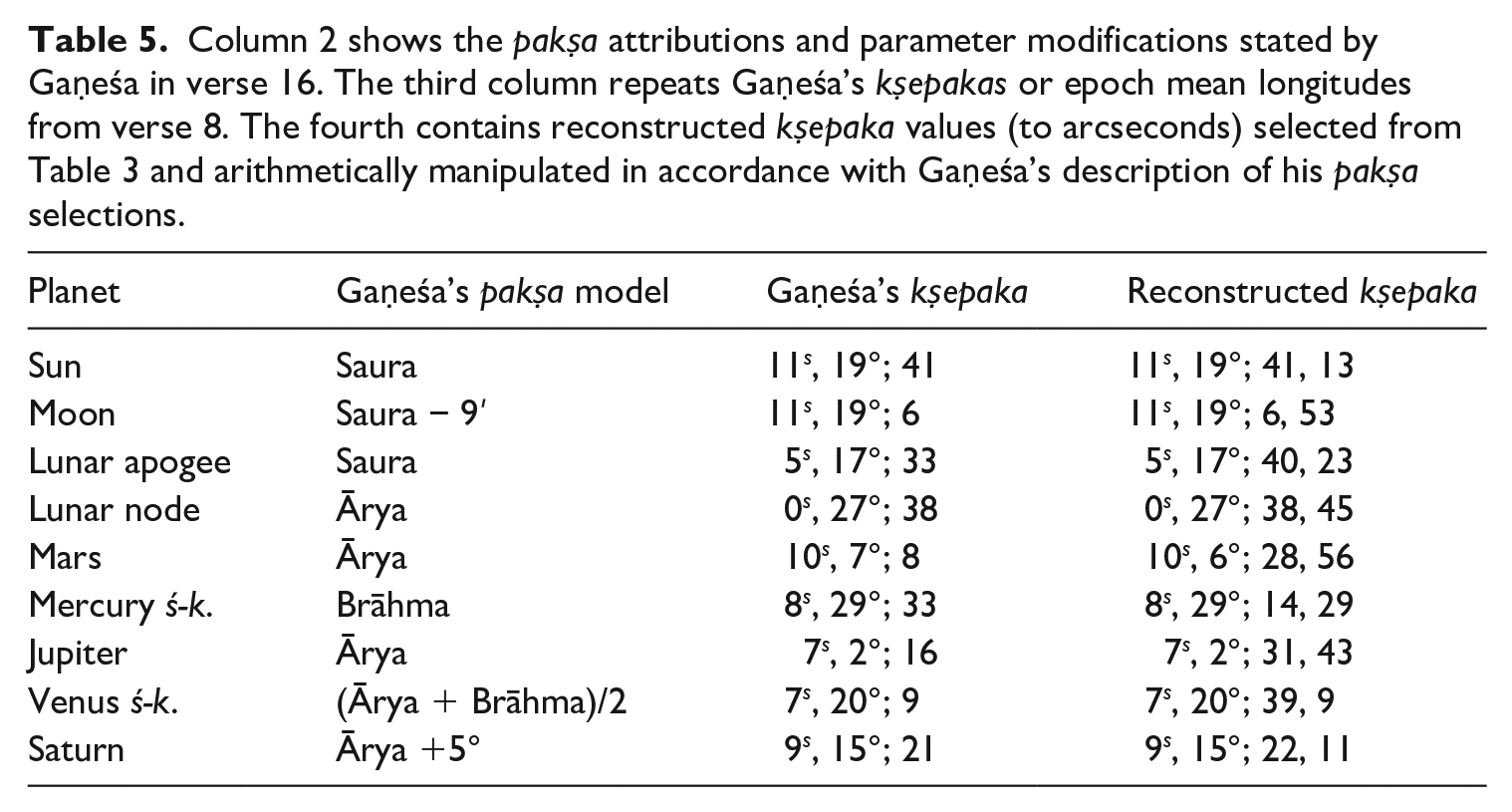
This information is of no apparent use to any Graha-lāghava reader who simply wants to carry out astronomical calculations according to Gaṇeśa’s system, and who therefore has no need to reconstruct that system from the classical pakṣas. It was presumably intended as guidance for other astronomers interested in revising earlier astronomical models to improve their predictive success. From the minimal information Gaṇeśa provides, we infer that the prescribed choices and procedures in this verse are meant to be applied to computing the epoch mean longitudes or kṣepakas. (For example, it is hard to think of another context in which an astronomer would find it helpful to add a constant as large as 5° to any longitude component for Saturn, which moves only about 12° in an entire year.)
We have tested this inference by selecting and correcting some of the kṣepaka values we reconstructed in a previous section in accordance with Gaṇeśa’s prescriptions; the results are shown in Table 5. Indeed, the Table 5 values, though far from consistently reliable in exactly reproducing Gaṇeśa’s kṣepakas, are at least as close to them as—and in most cases substantially closer than—any of the unmodified pakṣa-specific reconstructed kṣepakas listed in Table 3. Given our ignorance of the details of Gaṇeśa’s computational procedures, we’ve refrained from any ad hoc fine-tuning of our reconstruction calculations to engineer better agreement with Gaṇeśa’s values.
Thus these [mean longitudes of the] planets determined according to these pakṣas “come out”, [i.e.,] “attaining” “accordance” with respect to “observation”, [i.e.,] unity between observation and calculation. So, recognizing [that] the determination of [the longitudes of] the planets in [the case of] eclipses, risings and settings, nativities etc. according to many books is senseless labor, the teacher made this book for the sake of conciseness. “With those” [longitudes of the] planets “established here”, [i.e.,], in this book, “[the timing of] syzygies, rituals, official duties, ceremonies, and so on may be determined.” Parvan: eclipse; dharma: prescribed oblations, eleventh-tithi [fasting] observance, etc.; naya: [official] duties [such as] royal administration, judicial conduct, etc.; satkārya: auspicious action [such as] [sacred-]thread investiture, marriage, etc. [The timing of any of them] “may be determined” from those books for the beginning of its assigned tithi; that is the gist. The ascertainment of the beginning of the eleventh [tithi] is to be carried out for that very tithi. In nativities etc., in every case just the locality-specific [longitudes of the] planets are to be obtained. For, whatsoever accomplishment of agreement [between] observation and calculation [is appropriate] at whatever [given] time is just to be obtained from exertion. Here is the reasoning, and the way [to] examine the difference of planets [has] been explained formerly.
Viśvanātha echoes these sentiments, sometimes verbatim or nearly so
68
: These planets so determined by this method attain “observation-equality”, [i.e.,] agreement of observation and calculation. So, recognizing [that] the determination of [the longitudes of] the planets performed according to many books is senseless labor, the teacher made this book for the sake of conciseness. “With those” [longitudes of the] planets “established here”, [i.e.,], in this book, “[the timing of] syzygies, rituals, official duties, ceremonies, and so on may be determined.” [By] parvan: eclipse; dharma: religious observance; naya: [official] duties; satkārya, etc.: marriage, [sacred-]thread investiture, etc.; is specified. For, whatever accomplishment of agreement [between] observation and calculation [is appropriate] at any [given] time is just to be obtained from exertion.
Viśvanātha has provided a somewhat more informative discussion of the process of planet-specific pakṣa selection in his earlier comment on verses 6–8,
69
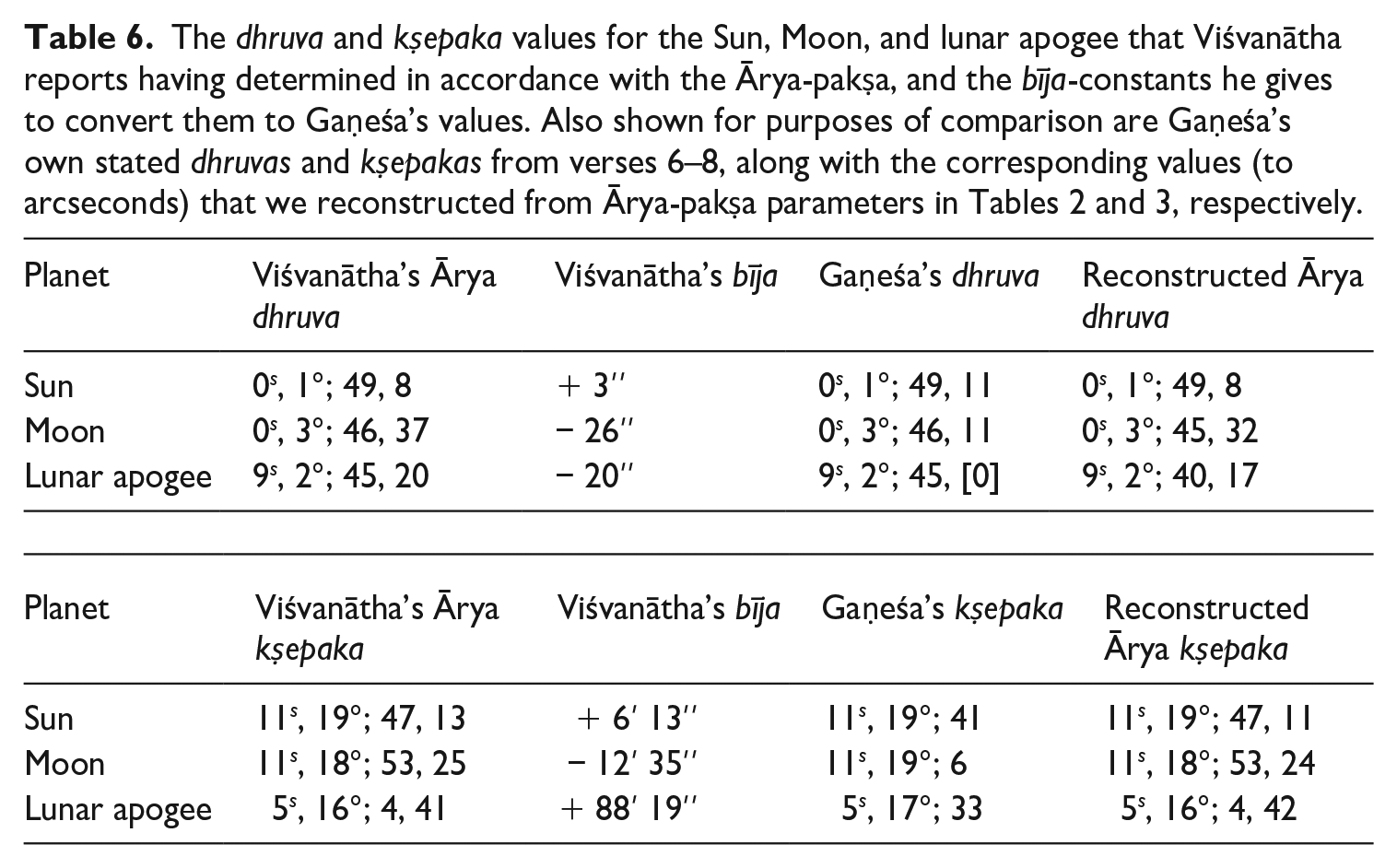
which we deferred addressing earlier: Now here in the eclipse [involving] the Sun and the Moon it is seen [that the moments of] first and last contact occur [in accordance] with the Ārya-pakṣa; because of this, he [i.e., Viśvanātha himself] states the dhruvas and kṣepakas of the Sun, Moon, and lunar apogee for the purpose of determining the tithi [according to] the Ārya-pakṣa: [Verse 1:] Perceiving, when the elapsed years [since the epoch] of the Graha-lāghava [were] equal to 111 (dharaṇī-kṣoṇī-kṣapeśa), the eclipse of the Moon and Sun [to be] consistent with the Ārya-pakṣa; I, the esteemed Viśvanātha, knowing mathematics, state the kṣepakas along with the dhruvas produced by the Sun, Moon, and lunar apogee in zodiacal signs and so on, made on the basis of observation. [Verse 2:] The dhruva of the Sun: 0,1,49,8. [The dhruva] of the Moon equal to 0,3,46,37; now, those [numbers] of the lunar apogee: 9,2,45,20. [Verse 3:] The kṣepaka: 11,19,47,13 in [the case of] the Sun; in [the case of] the Moon: 11,18,53,25; its apogee: 5,16,4,41. Alternatively, I state the bīja-correction of the Sun, Moon, and lunar apogee [thus] established. The bīja-[correction to apply] to [the kṣepaka of] the Sun [as] produced from the revered Graha-lāghava, in arcminutes and so on, is positive 6,13; and [the bīja to apply] to the Moon is negative 12,35; to the lunar apogee, positive 88,19; [and] 3, 26, and 20 multiplied by [the number of] cakras, in arcseconds, [are applied] to [the (negative) dhruvas of] the Sun, Moon, and lunar apogee, positively, negatively, and negatively [respectively].
The event that Viśvanātha refers to seems most likely to have been the total lunar eclipse of May 15, 1631 (Śaka 1553), 111 years after the Graha-lāghava’s epoch. (The other total lunar eclipse within the same year occurred on November 8 and was less fully visible from Viśvanātha’s location; see Figure 3. No solar eclipses visible from South Asia occurred during Śaka 1553.) Unfortunately, it is not clear from Viśvanātha’s brief account exactly how his observations may have informed his pakṣa selections for these mean-motion parameters. Presumably he performed the full procedure for calculating the eclipse (which requires complicated orbital corrections and other adjustments in addition to the initial luni-solar mean-motion computations) multiple times, in accordance with instructions provided in a treatise or handbook from each pakṣa. Comparing their different computed predictions of the times of the beginning and end of the Moon’s obscuration by the earth’s shadow, he found the Ārya-pakṣa version to be most accurate. Again, given the many unknowns involved in the data and observational procedures Viśvanātha used, it is probably impossible to determine conclusively why his Ārya-pakṣa results happened to be superior.
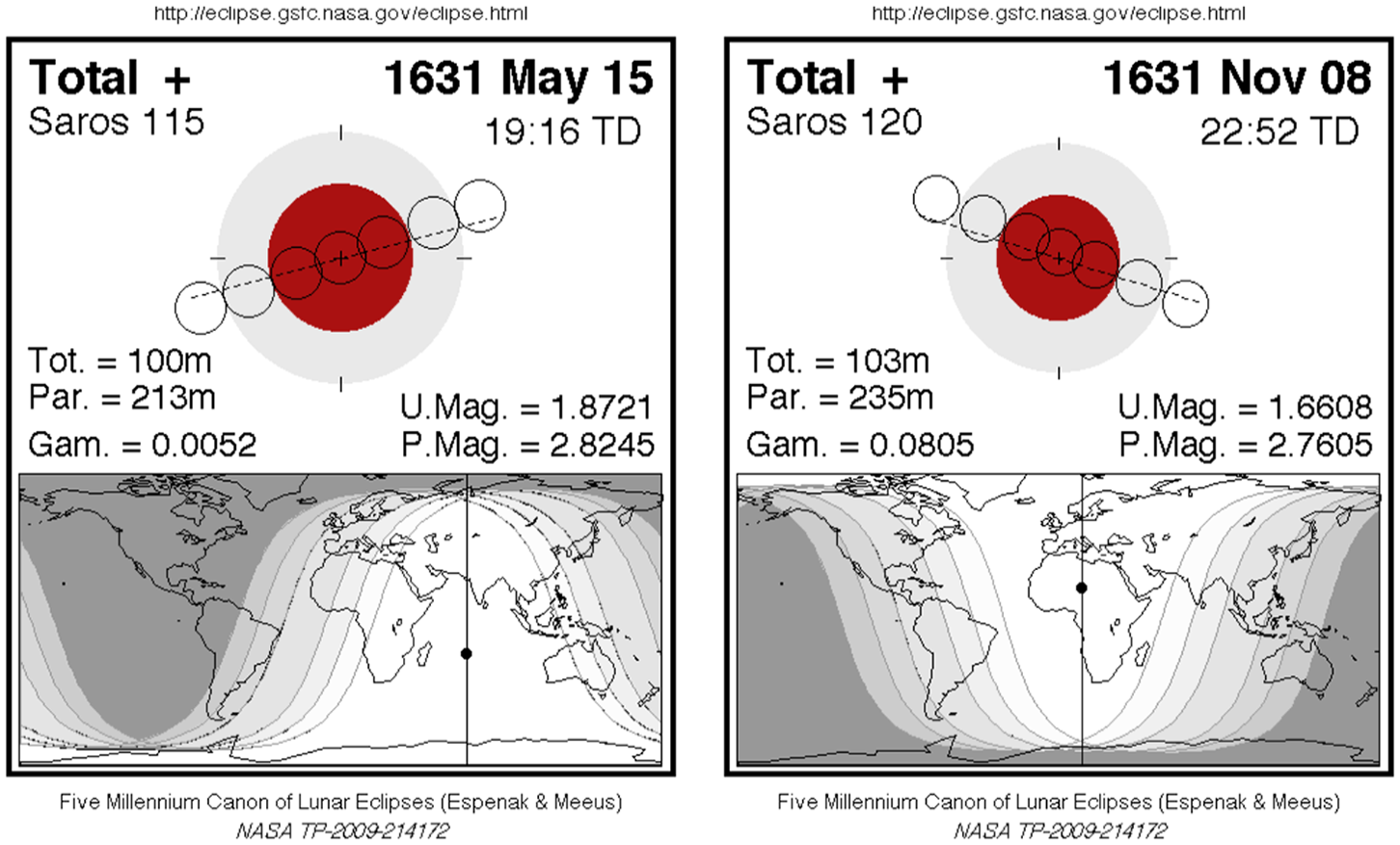
Schematic of the total lunar eclipses on May 15 and November 8 in 1631.
Viśvanātha evidently had enough faith in his computations to supply bīja-correction constants (see Appendix A) so that readers could convert Gaṇeśa’s dhruva and kṣepaka values to his own Ārya-pakṣa-derived versions of them. Viśvanātha’s and Gaṇeśa’s values, along with our own versions reconstructed from Ārya-pakṣa parameters in Tables 2 and 3, are listed in Table 6. Comparing our results to Viśvanātha’s reveals fairly good agreement in the kṣepaka values but not in the Moon’s and apogee’s dhruvas. As previously, we feel that the reconstruction process is too historically uncertain to allow meaningful attempts to improve the agreement by tweaking the computations.
The dhruva and kṣepaka values for the Sun, Moon, and lunar apogee that Viśvanātha reports having determined in accordance with the Ārya-pakṣa, and the bīja-constants he gives to convert them to Gaṇeśa’s values. Also shown for purposes of comparison are Gaṇeśa’s own stated dhruvas and kṣepakas from verses 6–8, along with the corresponding values (to arcseconds) that we reconstructed from Ārya-pakṣa parameters in Tables 2 and 3, respectively.
Conclusion
The remarks of Mallāri and Viśvanātha on this chapter conclude with the following colophons,
70
emphasizing their and Gaṇeśa’s shared identification with the epithet/surname daivajña “destiny-knower, astrologer”: Mallāri: Thus the mean procedure for the planets is produced in the commentary (vṛtti) on the Graha-lāghava made by [the author] named Mallāri, the son of Divākara, best of daivajñas. Thus, the first chapter on determining the mean planets in the commentary (ṭīkā) expounded by Mallāri Daivajña on the Graha-lāghava composed by the revered Gaṇeśa Daivajña. Viśvanātha: Thus the example-set (udāhṛti) on the mean [motion] chapter of the Graha-lāghava expounded by Viśvanātha Daivajña, the son of the revered Divākara Daivajña, is complete.
Even in this initial chapter (of 16), Gaṇeśa’s aims in the Graha-lāghava reveal remarkable boldness and maturity—especially if we accept as historical the longstanding legend that he composed the work at or near its epoch year 1520, at the young age of 13. 71 From the point of view of the modern historian, the Graha-lāghava’s originality seems primarily manifested not so much in its boasted eschewing of trigonometric methods as in its ambitious and explicit revision of model parameters to combine and modify data from different pakṣas.
There are tantalizing glimpses here of a body of empirical scientific practice that has long remained rather mysterious. It’s well known that many jyotiṣa authorities were deeply learned in more than one pakṣa, and even wrote treatises and commentaries in different pakṣas, with established procedures for converting results from one pakṣa to another by means of bīja-corrections. Clearly, Indian astronomers’ professional practice had little to do with the ideologically rigid exclusive loyalty nowadays often associated with the concept of adherence to a particular “school.” The catholicity with which Mallāri and Viśvanātha reference and quote various authorities from all the major pakṣas bears out this impression.
But we still know very little about the details of how jyotiṣa practitioners used their observational data to evaluate, select, and correct quantitative features of the different models. The expositions of Gaṇeśa and his commentators do not shed much light on this question. The information about pakṣa attributions that Gaṇeśa provides in verse 16 omits any description of the observations he made or how they were used to adjust parameters. Nor do Mallāri’s high-level descriptions of parameter derivation and modification significantly advance our understanding. This is partly due to the embedded nature of much of the knowledge Mallāri alludes to: for instance, he takes it for granted that readers will understand the procedure of “setting up a sighting-tube” or nalikā (in his commentary on verse 10), and how astronomers use it to make observations. 72 Probably Viśvanātha was likewise confident that his readers would be familiar with the tasks of carrying out the sort of eclipse observation that he briefly mentions having performed himself.
We are left in the end with the same open-ended speculations about how much Mallāri or Viśvanātha really knew about the details of Gaṇeśa’s observational practice, and how the process of reconciling theoretical models with new empirical information actually worked in jyotiṣa. It is somewhat daunting to contemplate how little testimony on the practical aspects of model revision is available to us from Gaṇeśa’s school, a mere two pedagogical generations after Gaṇeśa’s own research engendered it. It may be that our projected scrutiny of the remaining chapters of the Graha-lāghava and its commentaries will fill in some of the gaps.
What is amply attested in these commentaries, on the other hand, is their commitment to enlightening the student, if not the fellow-researcher. Viśvanātha with his painstakingly worked examples (udāharaṇa), and Mallāri with his probing dialogues, paraphrases and explanations (upapatti), are both clearly determined to ensure that their reader will understand how to use the Graha-lāghava’s methods, and (to a limited extent, at least) how and why they work.
Supplemental Material
sj-pdf-1-jha-10.1177_00218286241241812 – Supplemental material for Astronomical handbooks in 16th-century South Asia: Analysis of mean planetary motions in the 1520 Graha-lāghava of Gaṇeśa Daivajña
Supplemental material, sj-pdf-1-jha-10.1177_00218286241241812 for Astronomical handbooks in 16th-century South Asia: Analysis of mean planetary motions in the 1520 Graha-lāghava of Gaṇeśa Daivajña by Sahana Cidambi, Clemency Montelle and Kim Plofker in Journal for the History of Astronomy
Footnotes
Appendix A: Bīja -corrections to kṣepakas or epoch mean longitudes
The so-called bīja-corrections in Indian astronomy are convenient devices for modifying the results of mean-motion computations, either to account for secular variation accumulated over the centuries since the establishment of pakṣa parameters, or to convert results from one pakṣa model to another. 73 A bīja-correction is constructed usually in the form of a small constant to be multiplied by elapsed years between some historical start date and the user’s own date; their product is then added to or subtracted from the quantity to be modified. Following Dvivedī, 74 our attempts to reconstruct in Table 2 the planetary dhruva and kṣepaka values for Gaṇeśa’s epoch date from Brāhma-pakṣa and Ārya-pakṣa parameters have utilized the bīja-systems presented in Table A1. 75
The Brāhma-pakṣa bīja terms are considered cyclical with a period of 12,000 years, attaining their maximum at the midpoint of the 12,000-year cycle. The canonical number of years elapsed from the start of the Brāhma-pakṣa kalpa to the Graha-lāghava’s epoch date is 1,972,948,621, equal to an integer multiple of 12,000 plus a remainder of 4621 years.
Furthermore, for the śīghra-anomalies of Mercury and Venus, the Brāhma-pakṣa kṣepaka computations require combining the bījas for the śīghra-apogee and the Sun. That is, we denote by k the simple proportional kṣepaka dependent only on pakṣa parameters and the “long ahargaṇa” A from the start of the kalpa up to the Graha-lāghava’s epoch:
Then the bīja-corrected kṣepaka for Mercury’s śīghra-anomaly will be
The corresponding quantity for Venus is given by
The Ārya-pakṣa bījas, on the other hand, omit any correction term for the Sun. So the śīghra-anomaly kṣepakas of Mercury and Venus can be corrected by their śīghra-apogee bījas alone.
As discussed in our remarks on verse 16, the terms that Viśvanātha calls bījas in his commentary on verses 6–8 are merely the differences between Gaṇeśa’s stated dhruva and kṣepaka values and the versions that Viśvanātha has computed from Ārya-pakṣa parameters: a very simple example of bījas designed to convert between different pakṣa models.
Notes on contributors
Supplemental material
Supplemental material for this article is available online.