




Abstract
The Royal Frankish Annals (RFA) report under A.D. 807 three lunar and one solar eclipse (complete and dated correctly), a lunar occultation of Jupiter, and “a small spot” on the Sun interpreted as Mercury transit. This transmission is embedded between texts on the landing of diplomatic delegates from Baghdad and Jerusalem in Venice and on their meeting with Charlemagne. Technology transfer is explicitly mentioned (a mechanical water clock). The interpretation of a spot on the Sun as planetary transit is attested in Arabic reports since A.D. 840. The Jupiter occultation by the Moon is dated “Luna 17,” correctly counted in Muslim calendar practice since the first crescent detection. Eclipse predictions and records by astronomers from the cAbbasid caliphate using Ptolemy’s Almagest are extant from the early ninth century. There are time-spans of 6 months each between the three reported lunar eclipses (806 Sep 1/2, 807 Feb 25/26, Aug 21/22), a period of possible repetition given in the Almagest, but not known to the Carolingians. The 6-month rule for lunar eclipses might be preserved in the Carolingian Seven Book Computus. We present multiple evidence that visitors from Baghdad brought new insight and fostered the Carolingian progress in astronomy.
Keywords
Celestial phenomena in the Royal Frankish Annals
The Royal Frankish Annals (RFA 1 ) narrate life, politics, wars etc. of Charlemagne (A.D. 740s to 814, King of Frankia from 768, Emperor from 800 Dec 25) and of his successor until A.D. 829, with natural disasters, celestial phenomena, etc. Since the early 790s, the RFA were written year by year by anonymous authors; the oldest extant manuscripts (MSS) are copies from the ninth century; shortly after A.D. 801, the RFA were revised. 2
We study the celestial sightings in the RFA entry for A.D. 807: a sunspot, a Jupiter occultation by the Moon, and four eclipses, all reported for A.D. 806 and 807.
For the historical context, we note that the Carolingians had just taken Venice (Italy) and Dalmatia (now Croatia) from the Eastern Roman Empire by early A.D. 806. 3 As a counter-measure, a fleet was dispatched from Byzantium to the Adriatic Sea (RFA A.D. 806) to block the Dalmatian and Venice ports. An Arabic delegation could nevertheless land in Treviso (northern Italy), the Carolingian border town to Venice. The conflict was resolved when Charlemagne returned Venice and Dalmatia to the “Greeks,” while a Byzantine delegation acknowledged him as Emperor of the West (RFA A.D. 812).
The relevant text starts with the last part for A.D. 806 on the arrival of the delegation from Baghdad and continues with the entry for A.D. 807, here in our English translation (806 by Scholz and Rogers,
4
MS variants in brackets, line breaks and brackets by us)
5
: (806 . . .) “Emperor Nicephorus (of the Roman Empire known as Byzantium, died A.D. 811) dispatched a fleet under the command of the patrician Nicetas (Nicetas Monimachos, A.D. 761/2-836, eunuch, general, and later monk) to reconquer Dalmatia (occupied by the Franks, now part of Croatia). And the envoys, who about four years earlier had been sent to the king of the Persians (Hārūn ibn Muḥammad ibn cAbdallāh, known as Hārūn al-Rashīd, born A.D. 763-766, caliph A.D. 786-809), sailed through the very anchoring places of the Greek (East Roman/Byzantine) ships and returned to Treviso (near Venice, Italy), into the shelter of the port, without being noticed by one of the enemies [with seviente in E3, E5: without the enemies becoming angry]. The Emperor (Charlemagne) celebrated Christmas (our 806 Dec 25) at Aachen (Germany). And the date changed to 807. In the previous year, on 4th [day before the] Nones [counted inclusively] of September (806 Sep 2), there was an eclipse of the Moon; then, the Sun stood in the 16th part of Virgo, and the Moon stood in the 16th part of Pisces; but this year, the day before the calends of February (Jan 31) was the 17th Moon, when the star Jupiter was seen like it quasi passed through it (the Moon), and on the third Ides of February (Feb 11) there was an eclipse of the Sun the middle of the day, during which both stars (Sun and Moon) stood in the 25th part of Aquarius. Again on the 4th calends of March (Feb 26) there was an eclipse of the Moon, and there appeared during that same night battle lines (lat. acies) of wonderful size, and the Sun stood in the 11th part of Pisces and the Moon in the 11th part of Virgo. On the 16th calends of April (Mar 17), the star Mercury was seen in the Sun like a small spot [lat. in sole quasi parva macula, nigra tamen
6
], but dark, a little above the middle centre of that star (the sun), it was observed by us for eight days. But when it first entered or left, we could not notice at all because of clouds. Again in the month of August, on the 11th calends of September (Aug 22), an eclipse of the Moon happened at hour of night third, the Sun stood in the 5th part of Virgo and the Moon in the 5th part of Pisces. Thus, from September of last year to September of the present year, the Moon was obscured three times and the Sun once.” (continued below).
For the given time span (“Sep of last year to Sep of the present year”), the record on solar and lunar eclipses as well as planetary occultations is complete, while many other eclipses are missing in Carolingian chronicles. There is no previous evidence for systematic day- and night-time observing nor time-critical observations due to eclipse predictions by Carolingians. The RFA record for the observations in A.D. 806 and 807 follows a certain structure, namely reporting when (calendar date), what (which celestial objects), and where (celestial sign). All eclipses were dated correctly by Carolingian convention with the preceding night as part of the next day, see Table 1. They were copied often by other chronicles, that is, important. 7 In pre-modern times, celestial phenomena were often interpreted as portents, also in Carolingian chronicles, but not in our RFA paragraph. Therefore, this record may originate from a foreign source.
Celestial observations in RFA A.D. 806/807.
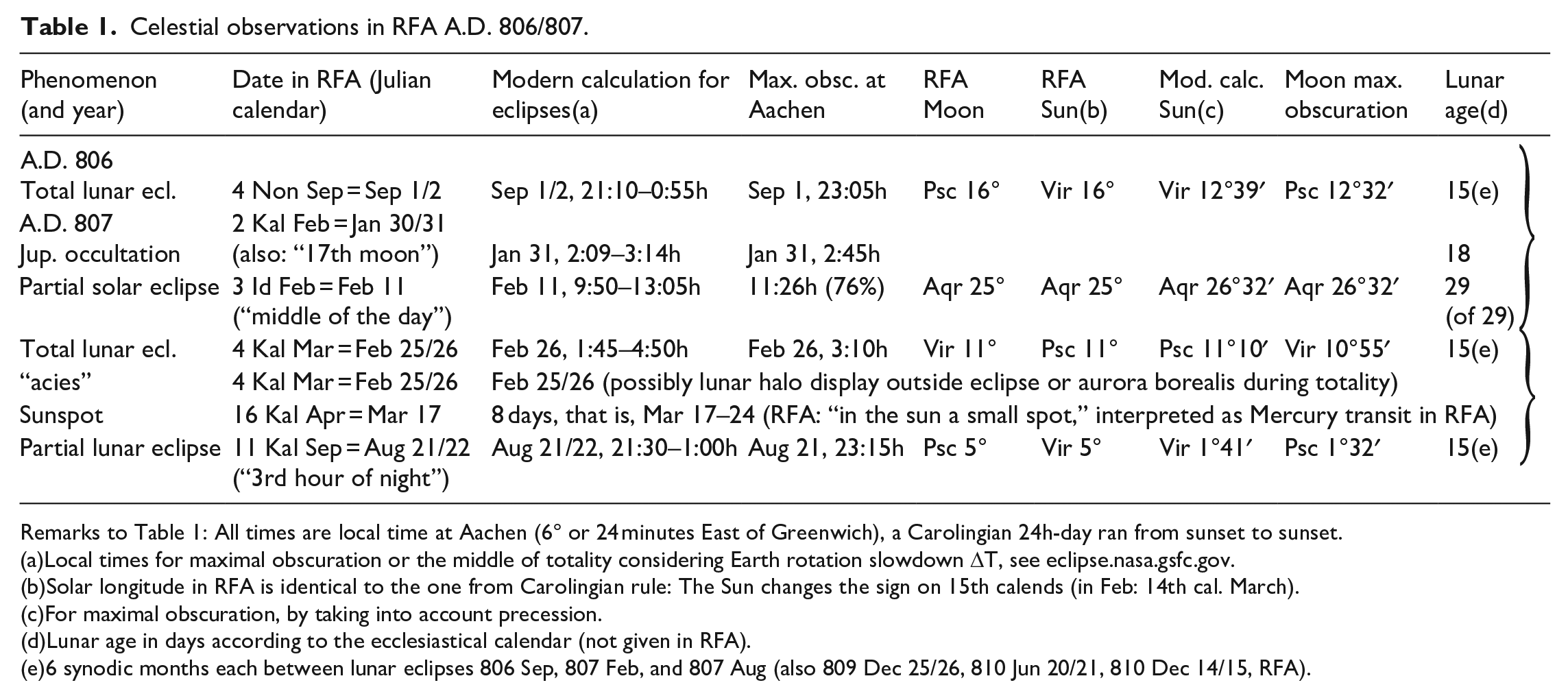
Remarks to Table 1: All times are local time at Aachen (6° or 24 minutes East of Greenwich), a Carolingian 24h-day ran from sunset to sunset.
Local times for maximal obscuration or the middle of totality considering Earth rotation slowdown ΔT, see eclipse.nasa.gsfc.gov.
Solar longitude in RFA is identical to the one from Carolingian rule: The Sun changes the sign on 15th calends (in Feb: 14th cal. March).
For maximal obscuration, by taking into account precession.
Lunar age in days according to the ecclesiastical calendar (not given in RFA).
6 synodic months each between lunar eclipses 806 Sep, 807 Feb, and 807 Aug (also 809 Dec 25/26, 810 Jun 20/21, 810 Dec 14/15, RFA).
The text does not show any obvious corruptness (few MSS variants). The phenomena were apparently observed: “battle lines” (acies) in a lunar eclipse night were not predictable; wordings like “quasi passed through” for Jupiter and “middle of the day” for the solar eclipse; the presumable transit (“visa est”) is reported with clouds.
The A.D. 807 entry on observations of transients is embedded between the landing of an oriental delegation in A.D. 806 in Italy and their arrival at court 807—a motivation to search for evidence for oriental knowledge transfer. After considering this and other diplomatic visits and the historical context, we will discuss the celestial observations.
On the visit of the Arabic delegation in Aachen
After the astronomical observations of A.D. 806/807, the RFA continues
8
: Radbert, the emperor’s emissary [sent from Frankia in A.D. 802, RFA], died on his way back from the East. The envoy of the king of Persia by the name of Abdallah [Hārūn al-Rashīd, caliph A.D. 786-809] came to the emperor with monks from Jerusalem, who formed an embassy from the patriarch Thomas. Their names were George and Felix. This George is abbot of Mount Olives, a native German and called, by his real name, Egilbald. They came to the emperor and delivered presents which the king of Persia sent to him, that is, a tent and curtains for the canopy of different colors and of unbelievable size and beauty. They were all made of the best linen, the curtains as well as the strings, and dyed in different colors. The presents of the Persian king consisted besides of many precious silken robes, of perfumes, ointments, and balsam; also of a brass clock, a marvellous mechanical contraption, in which the course of the twelve hours moved according to a water clock, with as many brazen little balls, which fall down on the hour and through their fall made a cymbal ring underneath. On this clock there were also twelve horsemen who at the end of each hour stepped out of twelve windows, closing the previously open windows by their movements. There were many other things on this clock which are too numerous to describe now. Besides these presents there were two brass candlesticks of wonderful size and height. All this was taken to the emperor in the palace at Aachen. The emperor kept the ambassador and the monks with him for a while and then sent them to Italy and told them to wait there till it was time to set sail.
The complicated mechanical water clock 9 indicates technology transfer on time-keeping for day- and night-time. A member of the Arabic delegation certainly explained its use. Since astronomy and time-keeping were always closely connected, it is plausible that knowledge transfer also in astronomy happened: our thesis is that the astronomical observations in A.D. 806 and 807 were performed by or with the Arabic travelers.
The two named Christian delegates from Jerusalem, then under cAbbasid rule, who joined the mission from Baghdad on their way to Frankia, were independently mentioned and named in a contemporaneous Salzburg abbey (then Carolingian Bavaria, now Austria) prayer-brotherhood guest-book: “Ista sunt nomina ultra mare / de Hierusalem. / Thomas patriarcha. / Georgius m[onachus]. / Felix m[onachus] cum omni / c[ongregatione] eorum,” 10 written in A.D. 807; while this book mainly listed monks and abbeys for whom the Salzburg monks also pray (and vice versa), the very fact that the delegates were enlisted may indicate that they have stopped on their route in Salzburg. 11
The group coming from the Orient consisted of the Arabic delegation from Baghdad, the Christian monks from Jerusalem (Frankish by origin), and Charlemagne’s envoys returning from Baghdad, of whom only the head, “Radbert, the Emperor’s emissary,” was mentioned by name; they were accompanied by many more. 12 During most parts of the journey, at least from Jerusalem to Aachen, the Arabic delegates traveled together with the Franks. Even if the observations did not take place at Aachen, the report is written in Latin, probably by the Frankish monks from Jerusalem.
Three other sources also report this delegation. First Einhard’s Vita on Charlemagne (written A.D. 830s): “He had such friendly relations with Harun-al-Raschid, the king of the Persians . . . sent his own representatives back . . . and he sent magnificent gifts for him, among which were robes, spices, and other riches of the east” (chap. 16). 13
In his “Gesta Karoli” from A.D. 884, Notker Balbus 14 of St. Gallen (ca. A.D. 840–912) convolved the diplomatic visits of A.D. 801 (arrival near Rome and meeting with Charlemagne further north in Italy between Easter and Pentecost, elephant transported over the Mediterranean and to Aachen later) and 807 into one narrative: “envoys of the Persians were sent to him [Charlemagne]. They did not know where Frankia was located and considered it a real accomplishment when they were able to reach the coast of Italy . . . after a year had past 15 they, weary and worn out from their journey, met Charles, famous for all his virtues, at Aachen. They arrived there in the last week of Lent. They were announced to the emperor . . . They spent that night and the following Sunday together in the church . . . The Persians also brought the emperor an elephant, monkeys, balsam, nard, and various ointments, spices, perfumes, and different medicines . . .” 16
Here, only the arrival at Aachen and the mention of “balsam, nard, and various ointments” fit better to A.D. 807 than to 801. If the given arrival week (“last week of Lent”) pertains to A.D. 807 (then Mar 21–27), it overlaps with the observation of a spot on the Sun Mar 17–24, so that the scholars from Baghdad may have observed the phenomenon with their peers at Aachen. However, Notker’s work, written 70 years after Charlemagne, describes him in an unrealistic way, with some events and quotations quite certainly made up by Notker, 17 so that it is possible that the timing given here (main week of lent as arrival) could be fabricated for narrative reasons. Their arrival in Italy in A.D. 806 (RFA), was probably too late for traveling to Aachen before the winter, so that they may have wintered in northern Italy or maybe Salzburg. The travel time from northern Italy to Aachen was ca. 5–7 weeks, 18 so they may have started their journey in February for an arrival by Easter, not impossible in case of good weather. Our conclusions on knowledge transfer are not affected by the arrival date.
Another short mention of the visit is the poem “Annals of the Deeds of Emperor Charlemagne in Five Books” (Poeta Saxo) composed by a monk of St. Gallen or Corvey in A.D. 888–891: “Persarum princeps illi devinctus amore / precipuo fuerat nomen habens Aaron; / gratia cui Caroli prae cunctis regibus atque / illo principibus tempore cara fuit”, that is, Hārūn al-Rashīd offering friendship to Charlemagne. 19
There were several other diplomatic delegations exchanged between the Carolingians and the cAbbasids since both these dynasties were established in A.D. 751. 20 Other knowledge transfer from the cAbbasid caliphate to the Carolingians is established for pharmaceutical knowledge, 21 nautical 22 and hunting 23 techniques, and mathematics. 24
Sustainable knowledge transfer in natural sciences, in particular astronomy, from Muslim lands to central Europe otherwise did not happened before the late 10th century, for example, with the astrolabe studied and used by Gerbert of Aurillac (born ca. A.D. 945, Pope Sylvester A.D. 999–1003) 25 and the Lotharingian monk Walcher. 26 The quest to understand the astrolabe and to determine prayer times at night motivated European scholars to move from pure reception of antique knowledge via Arabic scholars to quantitative observations. The conquest of Arabic Sicily (Italy) by Roger I. in A.D. 1091, the Reconquista of Toledo and Saragossa (Muslim Spain) by Christian troops in A.D. 1085 and 1118, respectively, the Crusades to Jerusalem since A.D. 1096, and translations of Arabic works to Latin 27 facilitated sustainable knowledge transfer.
Sunspot observations in the Royal Frankish Annals and Einhard’s Vita
RFA for A.D. 807 in literal translation: “On the 16th calends of April [March 17], the star Mercury was seen in the Sun like a small spot, but dark, a little above the middle center of that star [the sun], it was observed by us for eight days. But when it first entered or left, we could not notice at all because of clouds.”
We will consider (a) whether Mercury was visible Mar 17–24, (b) the state of solar activity at A.D. 807, (c) a similar record on a black spot by Einhard, (d) whether a conjunction was predictable by Carolingians, and (e) a nearly contemporaneous Arabic sunspot observation also interpreted in connection with a planetary conjunction (A.D. 840). Except Einhard (see below), there is no other known report from the Latin West on spots or transits across the Sun for centuries before and after A.D. 807.
(a) Visibility: In principle, the inner planets Mercury and Venus can transit before the Sun—“the star Mercury was seen in the Sun,” but only Venus transits can be seen by the naked eye. Modern calculations show that there were no Mercury or Venus transits in A.D. 807: during 807 Mar 17–24, Mercury was 19°–15° east of the Sun, Venus was 46° west. 28 Hence, observations of these planets could have shown that conjunctions were not possible at those dates: Mercury was even detectable 807 Mar 17–24 (up to about 10° above horizon at Aachen) at first to second magnitude. That Mercury is mentioned in the RFA, may be caused by the fact that only Venus was actually detected on the sky.
Since long, the observation was considered a sunspot sighting. 29 Close reading of the text allows a clear conclusion: Sunspots and transits appear “dark” and both can look “like a small spot” (sunspots are not necessarily round), both cross the solar disk from East to West; “a little above the middle center” is possible for both (sunspots only within ~30° solar latitude, they can form or disappear while crossing); however, a duration “for 8 days” is impossible for transits (naked-eye spots can be seen up to ~10–14 days crossing the disk due to solar rotation), while planetary transits last up to a few hours.
(b) Solar activity: During maxima of the 8–13 year Schwabe cycles, sunspots can sometimes be seen by the unaided eye and, indeed, the spot sighting in A.D. 807 is in such a maximum (A.D. 804–810) indicated by radiocarbon. 30 A spot is detectable by the unaided eye, if it has a sufficient size and if certain observing conditions are fulfilled.
What is reported for the lunar eclipse night (807 Feb 26) as “acies eadem nocte mirae magnitudinis” (“battle lines,” “flames”) was interpreted as aurora borealis 31 during the total lunar eclipse when it was sufficiently dark—this would also indicate higher than normal solar activity. 32 It could alternatively indicate some halo effect of the full Moon before or after the eclipse, which were sometimes interpreted as “battle lines.” 33
(c) Einhard wrote toward the end of his Vita of Charlemagne (chap. 32) 34 :
“Per tres continuos vitaeque termino proximos annos et solis et lunae creberrima defectio et in sole macula quaedam atri coloris septem dierum spatio visa.”
Our literal translation: “For three consecutive years, which were closest to the end of his life [died 814 Jan], eclipses of both Sun and the Moon were seen very frequently and in the Sun a certain spot of black/dark colour for the space of seven days.”
Einhard used “atri coloris” for “black/dark colour” (RFA 807: nigra), gave “7 days” as duration (RFA: 8), and did not interpret it as transit. His report may be independent also because of the dating. Einhard gave “three consecutive years” at the end of Charlemagne’s life. The eclipses and the RFA sunspot were in A.D. 806 and 807 within 1 year, far from the King’s death on 814 Jan 28. Solar eclipses were listed for 810 June, 810 Nov 30, and 812 May 14, and lunar eclipses for 809 Dec 25/26 (Carolingian year 810), 810 Jun 21 and Dec 15, 35 all in the RFA, plus a predicted solar eclipse for 811 Apr 27 only in the Seven Book Computus. 36 Hence, Einhard might have meant the years A.D. 810–812. 37 (The 810 June eclipse was construed by Dungal in a letter to Charlemagne. 38 ) Anyway, there were neither Venus nor Mercury transits A.D. 810–814.
(d) Predictability: the RFA record does not mention that a conjunction or even a Mercury transit was expected—a spot was seen and interpreted.
From the Plinian order of the planets (Moon, Mercury, Venus, Sun, Mars . . .), Carolingians could in principle conclude qualitatively that transits of Mercury and Venus across the solar disk may be possible (if the ecliptic latitude of the planet would be within ±0.25°). Frankish-Latin scholars also knew the Plinian diagram of planetary latitudes showing Venus within ±14° of the ecliptic, Mercury within ±8°, etc. 39
A mathematical scheme trying to predict the ecliptic longitude of the five planets was known: from their location at a certain time in the past (e.g. the presumable creation), the time passed since then, and the presumable zodiacal periods of the planets, one could calculate longitudes for any time. In combination with the rule on the sign and degree of the Sun for each date, conjunction dates could in principle be calculated. A text starting with “In quo signo versetur Mars” (Seven Book Computus 40 ) gave the details. However, given so many unknowns (e.g. regarding the time since creation), the chance that a fitting combination would be random is much too large and based on incorrect assumptions. Hence, Carolingians could not correctly predict planetary longitudes.
(e) Arabic astronomers might have known Ptolemy’s discussion on transits 41 : “Venus and Mercury . . . placed below the Sun by the more ancient astronomers, but by some . . . above, for the reason that the sun has never been obscured by them . . . however, such a criterion seems to have an element of uncertainty, since it is possible that some planets might indeed be below the Sun, but nevertheless not always in one of the planes through the Sun and our viewpoint, but in another [plane], and hence might not be seen passing in front of it” (Almagest). 42 In his Planetary Hypotheses (known in Arabic astronomy in the ninth cent.), Ptolemy considered the observability: “up to now we have not seen an occultation of the Sun (by any of the planets) . . . if a body of such a small size were to occult a body of such large size and with so much light, it would necessarily be imperceptible. Moreover, such events could only take place at long intervals . . . When the center of the epicycles is at one of the nodes, and the planet is also at that node, and the planet is also at the apogee or perigee, then the planet may hide part (of the Sun).” 43
Arabic scholars interpreted spots as transits since A.D. 840, Ibn al-Qifṭī: “Ghars al-Nacma Muḥammad b. al-Ra’īs Hilāl b. al-Muḥassin al-Ṣābi’ said in his book: I found in the handwritings of Jacfar b. al-Muktafī . . . that in the year 225 [A.H.] during the caliphate of al-Muctaṣim [A.D. 833–842] there appeared a black spot close to the middle of the sun. This took place on Tuesday, 19 Rajab 225 [A.D. 840 May 25], and when two days had gone from this date, i.e. after 21 Rajab, events occurred. Al-Kindī [died shortly after A.D. 870] mentioned that this spot lingered on the sun for 91 days [until Aug 23] and soon thereafter Muctaṣim died . . . Al-Kindī mentioned that this spot was due to the occulting of the Sun by Venus, and their clinging together for this period.” 44
Al-Kindī explicitly interpreted a spot on the Sun to be “due to the occultating of the Sun by Venus”; this is the first such extant Arabic record. Venus was indeed in conjunction with the Sun during this period; al-Kindī did not claim that Venus would have been in conjunction for the whole 91 days. As very good observer, 45 he should have seen Venus during this period. With the Almagest, al-Kindī could have calculated that Venus was in conjunction with the Sun around A.D. 840 July 24, but a few degrees south of the ecliptic (Mercury was in conjunction with the Sun 840 Jun 1 and Aug 7, but not transiting). If al-Kindī wanted to claim that the “spot” lasted 91 days, he may have considered a shadow and/or some evaporation caused by Venus passing by the Sun. 46
Since neither a Venus nor a Mercury transit happened in A.D. 840, we deal again with sunspots 47 during a strong solar activity maximum three Schwabe cycles after A.D. 807: spots in A.D. 837, 840, and 841 seen in China, low-latitude aurorae in A.D. 839 and 840, and low radiocarbon. 48 A single spot or group cannot be seen for 91 days, but several groups passing across the Sun sequentially during those 91 days are possible.
The observers of A.D. 807 and 840 considered a transit due to Mercury or Venus possible—seen as (dark) spot on the Sun. The RFA (approved by Charlemagne) and al-Kindī prefer this interpretation in contrast to a defect of the Sun—the latter could have been seen as negative portent (like Einhard). With the Almagest, Arabic scholars could also have calculated a conjunction of Mercury for 807 Apr 10, but with a geocentric latitude of Mercury 40 arc min south—and 2.5 weeks after the observed spot (Mar 17–24). Even if Arabic scholars could predict transits with the Almagest, 49 the spot sighting in A.D. 807 is explicitly reported for 8 days—such a duration would be in contradiction to the Almagest. Thus, it is more likely that the spot sighting is somewhat serendipitous (but see below), and the interpretation followed the detection. In sum, the interpretation of the observed spot on the Sun in the RFA in A.D. 807 due to a planetary conjunction points to an Arabic origin and possibly to a Ptolemaic background.
Jupiter occultation by the moon on A.D. 807 January 30/31
RFA for A.D. 807 literal: “but this year [807], the day before Feb 1 [Jan 31] was the 17th Moon, when the star Jupiter was seen like it quasi passed through it [the Moon].” This observation was a Jupiter occultation by the Moon, reported as observed.
Here, we will consider (a) the dating of this observation, in particular whether the lunar dating was on the Muslim calendar style since the first detection of the new crescent (first light), and (b) other medieval observations of planets and occultations.
(a) The date of the Jupiter occultation by the Moon was given as “pridie” or “2nd cal Feb,” both Jan 31 with the night 30/31, which was said to be the “17th Moon.” The latter could be meant as the 17th day since the last expected new moon (on the ecclesiastical calendar day 1), which was pre-calculated for Jan 14 (with night 13/14), 50 so that the given 17th would be Jan 30 (with night Jan 29/30)—1 day off. 51 Also, since the last true new moon (conjunction) on Jan 12 at 15:42h UT, 52 the 17th would be Jan 28 (with night Jan 27/28) if counting inclusively from Jan 11/12; or Jan 29 (with the night Jan 28/29), if counting inclusively from Jan 12/13, which was closer to true conjunction.
The Jupiter occultation truly happened in the night Jan 30/31 at 2:10 to 3:15h local time at Aachen, which is consistent with the Roman dating in the RFA.
The Carolingians considered the 24h-day to run from sunset to sunset, so that they dated a night with the date of the following bright day, confirmed with other, datable night-time observations: among their 28 lunar eclipse records 53 (A.D. 770–878), 22 give a date, one is 14 days off. Of the remaining 21, all but two give the date of the later day following Carolingian convention, that is, the date we would assign to the bright day after the relevant night. In one of those two, the lunar eclipse “in the 2nd hour of the night” (RFA) of 817 Feb 5/6, it might have been dated Feb 5 in the RFA and the Anonymous Vita, because it seemed to start around or even before sunset. In the other case, the Annales of Flavigny gave for A.D. 787, but meaning 788: “luna eglypsin pertulit 2nd feria [Monday], 6th Kal. Martii”; this lunar eclipse happened in the night we date 788 Feb 25/26 (Mon/Tue) in the early morning. Of those 19 giving the correct later date, seven lunar eclipses happened before midnight, but the Carolingians gave the later date.
It was suggested by Dekker 54 that the RFA actually meant the 18th day of the Moon that is, the ecclesiastical calendar date of Jan 31 with the night 30/31, but by mistake gave the 17th day—or that the mistake was introduced by a copying scribe: writing luna XVIIma instead of luna XVIIIma is indeed a possible error. Among the 12 other cases listed in Table 2, all but one gave the correct ecclesiastical lunar date and one was off by only 1 day. Most importantly, the RFA report from A.D. 807 neither gave the ecclesiastical date for any other observation, nor does it show any sign of corruptness.
Lunar ages given in context of conjunctions in Carolingian and other chronicles within a few centuries of A.D. 807.
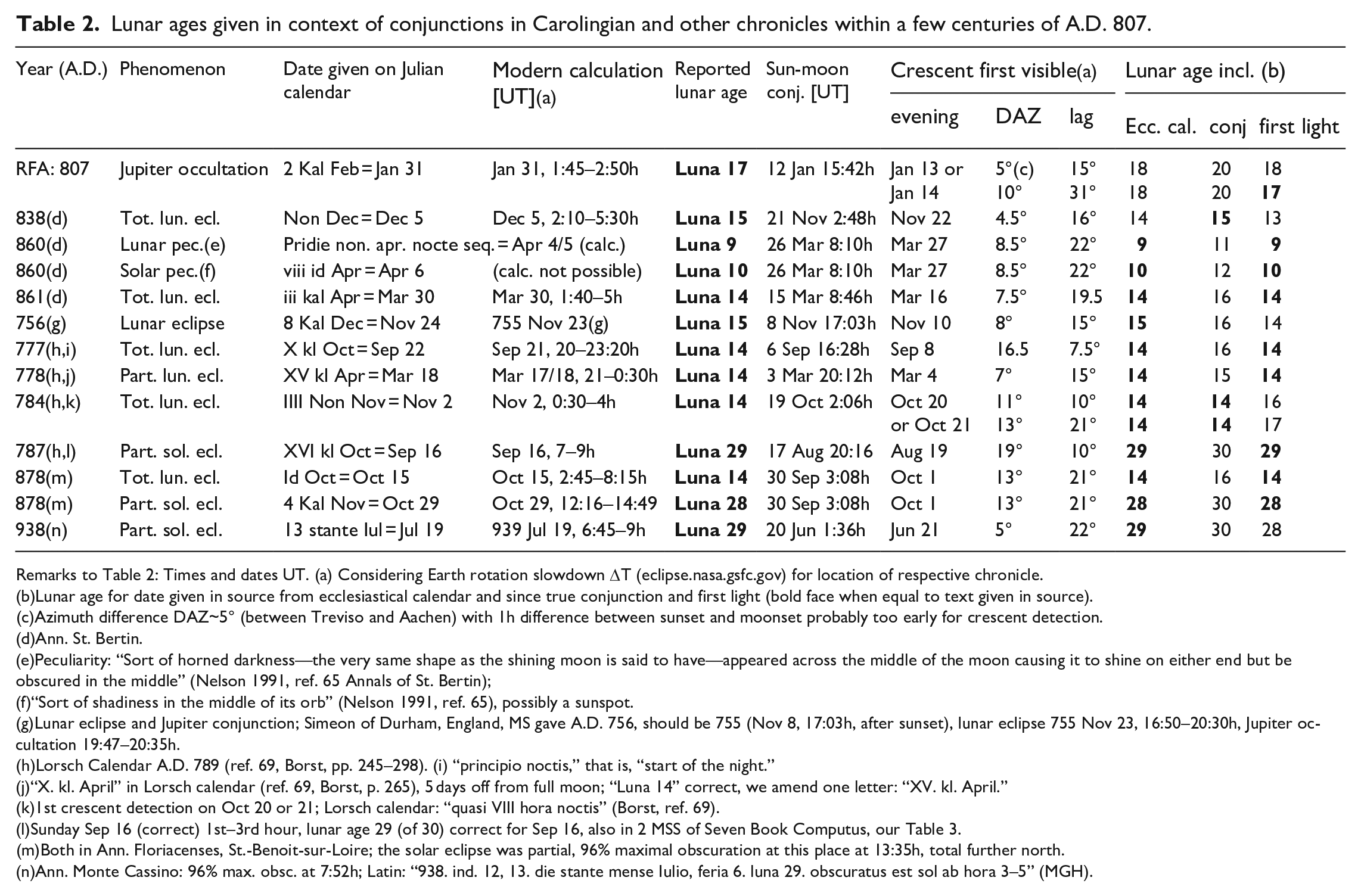
Remarks to Table 2: Times and dates UT. (a) Considering Earth rotation slowdown ΔT (eclipse.nasa.gsfc.gov) for location of respective chronicle.
Lunar age for date given in source from ecclesiastical calendar and since true conjunction and first light (bold face when equal to text given in source).
Azimuth difference DAZ~5° (between Treviso and Aachen) with 1h difference between sunset and moonset probably too early for crescent detection.
Ann. St. Bertin.
Peculiarity: “Sort of horned darkness—the very same shape as the shining moon is said to have—appeared across the middle of the moon causing it to shine on either end but be obscured in the middle” (Nelson 1991, ref. 65 Annals of St. Bertin);
“Sort of shadiness in the middle of its orb” (Nelson 1991, ref. 65), possibly a sunspot.
Lunar eclipse and Jupiter conjunction; Simeon of Durham, England, MS gave A.D. 756, should be 755 (Nov 8, 17:03h, after sunset), lunar eclipse 755 Nov 23, 16:50–20:30h, Jupiter occultation 19:47–20:35h.
Lorsch Calendar A.D. 789 (ref. 69, Borst, pp. 245–298). (i) “principio noctis,” that is, “start of the night.”
“X. kl. April” in Lorsch calendar (ref. 69, Borst, p. 265), 5 days off from full moon; “Luna 14” correct, we amend one letter: “XV. kl. April.”
1st crescent detection on Oct 20 or 21; Lorsch calendar: “quasi VIII hora noctis” (Borst, ref. 69).
Sunday Sep 16 (correct) 1st–3rd hour, lunar age 29 (of 30) correct for Sep 16, also in 2 MSS of Seven Book Computus, our Table 3.
Both in Ann. Floriacenses, St.-Benoit-sur-Loire; the solar eclipse was partial, 96% maximal obscuration at this place at 13:35h, total further north.
Ann. Monte Cassino: 96% max. obsc. at 7:52h; Latin: “938. ind. 12, 13. die stante mense Iulio, feria 6. luna 29. obscuratus est sol ab hora 3–5” (MGH).
The “17th Moon” could have been counted since the first observational detection of the new crescent (new light), the Muslim style 55 : after the true new moon (conjunction) on Jan 12 (~16h UT), the young crescent was first visible possibly on the evening we date as Jan 13 (but at an azimuth difference between Sun and Moon of only 5°–6° for northern Italy and Germany), but most probably first on Jan 14. 56 At sunset on Jan 14, the Moon was 15°18′ to 16°46′ above horizon at the location of the Arabic delegation between northern Italy and Aachen. Inclusive counting from Jan 14/15 yields Jan 30/31 for the 17th—hence, given since first light 57 (from conjunction to occultation 17.3 days). In Table 2, we show that the Carolingians did not use the Muslim convention otherwise. The dating since first light (Muslim calendar convention) points to oriental observers. 58
Finally, we consider how the Carolingians otherwise meant a statement on lunar age. In Table 2, we compare data from 13 Carolingian and related records, 59 where a lunar date was given, with the expected day from the ecclesiastical calendar and modern calculations of conjunction and first light (note that Carolingians counted inclusively): in all but two cases (A.D. 807, 838), the lunar age was given on the ecclesiastical calendar, which was probably meant; in A.D. 838, it was one day off (correct for the time since true conjunction); in A.D. 784, the lunar ages in the ecclesiastical calendar and since true conjunction were equal. In about half the cases, the lunar age would also correspond to the number of days since the first light date. However, this does not mean that these authors gave the lunar date in Muslim convention: the ecclesiastical calendar was late by, on average, one day in the Carolingian era (~17h by A.D. 751, ~30h by A.D. 900), see note 51, so that the ecclesiastical date often matched the lunar age since first light, often one or two evenings after true conjunction. Counting the lunar age since first light, full moon and lunar eclipses would be on day 12, 13, or possibly 14 (instead of 14.6-14.9 days after true conjunction), while the Carolingians considered full moon and lunar eclipses to be possible of day 14 or 15 only (no solar eclipse record gave Luna 27).
(b) Other medieval planetary observations in the Latin West: While the RFA for A.D. 807 mentioned “Jupiter,” lunar-planetary conjunction records for ±4 centuries around A.D. 807 did not name any planets. 60 A presumable Saturn occultation record in A.D. 806 by Ado 61 was actually our Jupiter occultation 807 Jan 30/31. The next known conjunction report with the planet name is found in A.D. 1283 (Parma, Italy). 62
Only a few Carolingian reports naming planets from before A.D. 800 are known, for example, presumably from Alcuin (ca. A.D. 735–804, Charlemagne’s science advisor) giving planetary positions within constellations. 63 From his student Rabanus Maurus (A.D. ca. 780–856, abbot in Fulda) one later record on planets is extant. 64 A letter exchange between Alcuin and Charlemagne in A.D. 797 and 798 named Mars in the context of observations, also in the RFA for A.D. 798 (see below). In A.D. 855, Prudentius reported a close conjunction of Venus and Mercury in the Annals of St. Bertin without naming the planets. 65 Except A.D. 807, no Carolingian interest in lunar occultations is found.
On the other hand, Arabic scholars read in the Almagest about occultations and close conjunctions between stars, planets, and the Moon. Several early reports about planetary conjunctions are extant, for example, A.D. 858–1003 by Ibn Yūnus. 66 A close Mars-Saturn conjunction in A.D. 760 May was reported and depicted (labeled Ares and Kronos) in the Syriac Chronicle of Zuqnīn finished A.D. 775/6 by a Christian stylite (living in the cAbbasid caliphate). 67 Oriental observers were familiar with names of planets and show more interest in subtle planetary phenomena like conjunctions.
In sum, the RFA report on the Jupiter occultation by the moon in A.D. 807 is unusual for Carolingians—dated “Luna 17,” that is, counted since first light (Muslim calendar).
Three lunar eclipses and one solar eclipse
In our RFA record, three lunar and one solar eclipse from 806 Sep to 807 Aug are reported with the correct Roman date and the zodiacal sign (and parts) of Sun and Moon, for example, “4th Nones of September (806 Sep 2), there was an eclipse of the Moon; then, the Sun stood in the 16th part of Virgo, and the Moon stood in the 16th part of Pisces.”
We will consider (a) the specifications of zodiacal positions of Sun and Moon in the RFA (for eclipses) and in other Carolingian texts (unrelated to eclipses), (b) the Carolingian “Seven Book Computus” (A.D. 809–812) with eight solar eclipses (A.D. 760–812), where the zodiacal positions were added, (c) the unprecedented completeness (and correctness) of Carolingian eclipse records A.D. 806–807, (d) eclipse prediction schemes known to Carolingians, and (e) whether science transfer on eclipse prediction was possible given that Arabic scholars already knew Ptolemy’s Almagest by A.D. 807.
(a) Position of Sun and Moon in the zodiac: we compiled the solar ecliptic longitudes from the RFA (A.D. 807) in Table 1, compared to parts or degrees obtained from the Carolingian rule, for example, as formulated later by Rabanus: the Sun enters a new sign each month on the 15th cal. (but in Feb on 14th cal. Mar). 68 The Lorsch prototype calendar for A.D. 789 and its copies, in particular the calendar of Prüm (Germany) for A.D. 793 (MS Madrid 3307) had two deviations: the Sun enters Aquarius on 16th cal. Feb. (17 Jan) and Pisces on 14th cal. Mar. (16 Feb). 69 For the observations of 807 Jan and Feb, the deviations of the Lorsch and Prüm calendars are not applied in the RFA. The positions of the Moon are given in the RFA such that they are either the same as the Sun (for the solar eclipse) or opposite on the sky (for lunar eclipses).
Those who specified entries of the Sun into certain signs stood in the tradition of Bede (A.D. 672/3–735), who explicitly cited Pliny (A.D. 23–79) that the Sun was at Aries 8° on 8th cal. Apr, that is, Mar 25 (De Temporibus, chap. 30), so that the Sun entered Aries on the 15th calends April (Mar 18) and, hence, each sign on the 15th calends of the month. This localization of the Sun was quite correct at Bede’s time, Sun at Ari 0.5°–1° on 735 Mar 18, but it was off at Pliny’s time. According to Byzantine practice (John of Damascus, A.D. 675/6–749), the Sun would enter Aries on Mar 21 (and the other signs on the 23rd, 24th, or 25th of the month), 70 and according to al-Battānī (died A.D. 929) the Sun would enter Aries on Mar 16 (shifted due to epoch difference). 71
There are earlier examples, for example, RFA for A.D. 798: “In this year the star called Mars could not be seen anywhere in the entire sky from July of the preceding year to July of this year.” 72 Charlemagne and Alcuin discussed the reappearance of Mars; in the extant reply, Alcuin (letter 155) cited Charlemagne: “Recently, when the Sun was leaving Leo, it [Mars] appeared in Cancer”; Alcuin replied: “Recently, it [Mars] appeared, when the Sun was in Leo.” 73 Hence, both dated the reappearance correctly to the period when the Sun was in Leo, 798 July 18-Aug 17, Charlemagne may have meant the last ~10 days (“leaving”); indeed, Mars was in Cancer. The RFA report on Mars (A.D. 798) was also correct. 74 Charlemagne’s advisor and biographer Einhard attested: “He . . . with deep purpose and great curiosity investigated the movement of the stars.” 75 The last known Carolingian to specify a zodiacal sign correctly is Nithard in his “History” 76 : “A.D. 841 . . . eclipse of the sun occurred in Scorpio in the first hour (hora prima) of October 18.” 77 Even though the knowledge of the date of the Sun’s entry into a sign was known to the Carolingians, this was rarely used to calculate the zodiacal degree for later days. 78
In the (Carolingian) Leiden planetary configuration, the positions of Sun, Moon, and planets were drawn relative to signs: Venus and Mercury at the border of signs and the other objects in the middle of signs. It was suggested that the positions of the seven planets within the zodiacal signs would indicate a certain date. 79 However, the angles subtended by the circles standing for planets, as seen from the surface of Earth, are ~20° large, that is, so unprecise that they give positions only by zodiacal sign, not by degrees. 80
After Nithard (A.D. 841), among hundreds of medieval accounts on solar eclipses, 81 only 15 reports specified the constellation or sign of the Sun (A.D. 1093–1478), and eight of them gave an exact degree (A.D. 1133–1310), 82 that is, all much later.
There are two mentions of eclipses with zodiacal positons before A.D. 806 connected to solar eclipses, both strongly incorrect. 83 None of the previous applications (Lorsch A.D. 784, Charlemagne, Alcuin, Ermoldus, all before A.D. 806, and Rabanus, A.D. 820) were connected to solar eclipses.
(b) The knowledge on how to calculate zodiacal degrees (RFA A.D. 807) was also applied in the Carolingian Seven Book Computus (Liber de Computo); it was based on a congress of scholars in Aachen in A.D. 809 and written until a last redaction in 812; the best MS is Madrid 3307 from A.D. 820 from Murbach (France), five complete and some 200 partial MSS exist. 84 The work compiled the present knowledge in astronomy, calendar computus, etc. (mostly copied also in the even longer Three Book Computus, Liber Calculi, in A.D. 818 under bishop Arn of Salzburg 85 ). The Seven Computus (V, 10) listed information for eight solar eclipses A.D. 760–812 86 : their dates and hours are correct and were mainly from the RFA and the Lorsch Annals, two were predicted, and for seven, the zodiacal degrees were added with Rabanus’ rule 87 (see Table 3).
Partial solar eclipses in the Carolingian Seven Book Computus (finished A.D. 812).
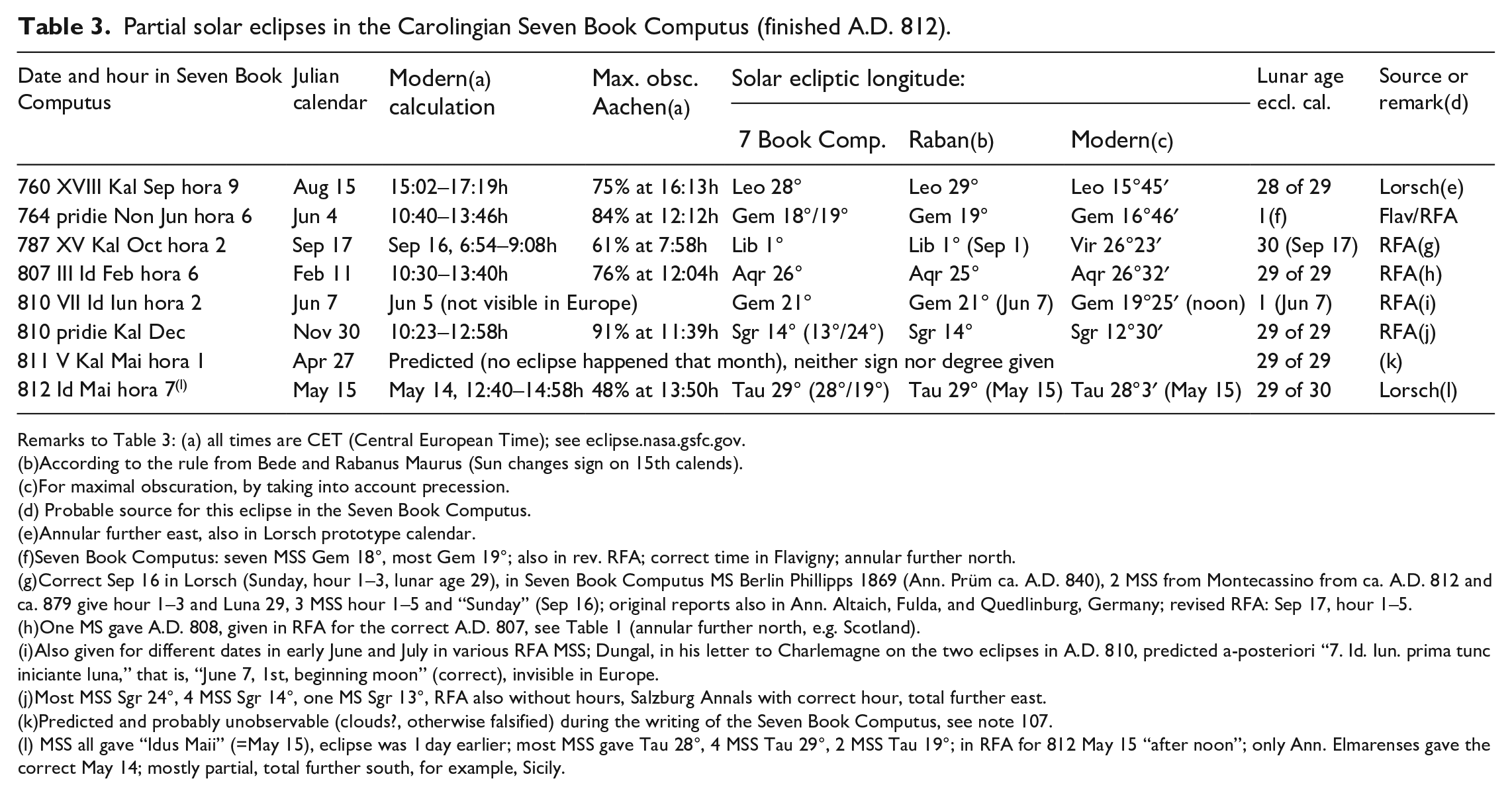
Remarks to Table 3: (a) all times are CET (Central European Time); see eclipse.nasa.gsfc.gov.
According to the rule from Bede and Rabanus Maurus (Sun changes sign on 15th calends).
For maximal obscuration, by taking into account precession.
Probable source for this eclipse in the Seven Book Computus.
Annular further east, also in Lorsch prototype calendar.
Seven Book Computus: seven MSS Gem 18°, most Gem 19°; also in rev. RFA; correct time in Flavigny; annular further north.
Correct Sep 16 in Lorsch (Sunday, hour 1–3, lunar age 29), in Seven Book Computus MS Berlin Phillipps 1869 (Ann. Prüm ca. A.D. 840), 2 MSS from Montecassino from ca. A.D. 812 and ca. 879 give hour 1–3 and Luna 29, 3 MSS hour 1–5 and “Sunday” (Sep 16); original reports also in Ann. Altaich, Fulda, and Quedlinburg, Germany; revised RFA: Sep 17, hour 1–5.
One MS gave A.D. 808, given in RFA for the correct A.D. 807, see Table 1 (annular further north, e.g. Scotland).
Also given for different dates in early June and July in various RFA MSS; Dungal, in his letter to Charlemagne on the two eclipses in A.D. 810, predicted a-posteriori “7. Id. Iun. prima tunc iniciante luna,” that is, “June 7, 1st, beginning moon” (correct), invisible in Europe.
Most MSS Sgr 24°, 4 MSS Sgr 14°, one MS Sgr 13°, RFA also without hours, Salzburg Annals with correct hour, total further east.
Predicted and probably unobservable (clouds?, otherwise falsified) during the writing of the Seven Book Computus, see note 107.
MSS all gave “Idus Maii” (=May 15), eclipse was 1 day earlier; most MSS gave Tau 28°, 4 MSS Tau 29°, 2 MSS Tau 19°; in RFA for 812 May 15 “after noon”; only Ann. Elmarenses gave the correct May 14; mostly partial, total further south, for example, Sicily.
(c) Completeness and correctness: All four eclipses in the RFA A.D. 806/807 are correctly dated with both the Roman calendar and the zodiacal degrees. The RFA report mentioned “from Sep of last year [A.D. 806] to Sep of the present year [807], the Moon was obscured three times and the Sun once,” this statement is correct and complete for Frankia (one lunar eclipse also with the hour 88 ). In this summary, only the eclipses are mentioned. The first two lunar eclipses were total, the last one almost total. It is possible that the completeness could be achieved, because the eclipses were also predicted. While Carolingians knew that lunar eclipses occur only at full moon and solar eclipses only at new moon, both phases tabulated roughly (±2 days) in their ecclesiastical calendar, they did not regularly monitor Moon or Sun during these critical phases.
From A.D. 807 until the death of Charlemagne (A.D. 814), all solar eclipses were reported: 807 Feb 11, 810 Nov 30, and 812 May 14 (all RFA), plus one on 809 July 16 in some minor annals (from the Anglo-Saxon Chronicle, note 37), and two expected ones which were not visible (810 June, 811 April). However, for the time A.D. 760 (first Frankian eclipse record) until A.D. 806, only 3 of 16 solar eclipses, which were visible somewhere on their empire, were reported, and then, A.D. 814–861, only 3 of 15 solar eclipses (including the total eclipse in A.D. 840) 89 ; we end the statistics in A.D. 861 with the death of Prudentius, the author of the western continuation of the RFA (Annals of St. Bertin), who was much interested in astronomy. 90 It is particularly surprising that no records are extant on the relatively large solar eclipses of A.D. 833 Sep (50% maximal obscuration at Aachen, but 80% in the Carolingian Spanish March), 852 Mar (50% maximal at Aachen, total further north), and 856 Jan (61% maximal at Aachen). After A.D. 814, the Carolingians reported only ~20% of the lunar eclipses. As in A.D. 806/807 (RFA), a complete record of eclipses is found also in the Carolingian year A.D. 810 with three lunar eclipses in 6-month-sequences and one solar 15 days before a lunar (RFA): 809 Dec 25/26, 810 Jun 20/21, and 810 Dec 14/15 (lunar) plus 810 Nov 30 (solar).
(d) Eclipse predictions known to the Carolingians by A.D. 806: From Pliny and Bede, Frankians knew the 1- and 6-month period between solar eclipses and a presumable 4-month period between lunar eclipses. 91 Pliny’s knowledge of the Saros and that sun and moon can be eclipsed within 15 days, was not repeated by Bede.
The Irish monk Dungal of St. Denis (since A.D. 825 school master at Pavia, Italy, d. after A.D. 827/8) 92 was asked by Charlemagne whether two solar eclipses were possible in A.D. 810. Only Dungal’s reply from A.D. 811 is extant 93 : He explained the motion of Moon, Sun, and planets around Earth and claimed that antique scholars could predict eclipses with the Great Year (15,000 year, following Macrobius). From Pliny, Dungal should know the 223 months Saros cycle, but he did not mention it explicitly (he gave “20 years,” maybe rounded from the 223 months Saros or the 19 year Meton cycle); based on Bede and Pliny, Dungal wrote “an eclipse of the Moon sometimes occurs in the 5th month following the last one, and a solar eclipse in the 7th month following.” Dungal then argued that, since there was a solar eclipse on 810 Nov 30, there could also have been an eclipse six (synodic) months earlier on Luna 1, that is, June 7 (visible only in the south Pacific)—he acknowledged that not all eclipses are visible everywhere.
(e) Ptolemy’s Almagest was known in Arabia in Persian and Syriac translations even before A.D. 800. 94 It mentions the Saros period of 223 synodic months (=242 draconic months = 18 year + 11 day + 8 hour), and it also knows that solar eclipses can repeat after 1, 5, 6, or 7 synodic months, but not always—and that lunar eclipses can repeat after 5, 6, and 7 months, 95 known to Ptolemy most certainly from Babylon or Hipparchus.
Of these periods between eclipses, just the 1- and 6-month periods between solar eclipses was known to the Carolingians by A.D. 806, through Pliny and Bede, Ptolemy’s Almagest was not yet transmitted to the Latin West. In Arabia, though, the works “zij al-mumtaḥan” (“tables verified by observations,” ca. A.D. 810) by Yaḥyā ibn Abī Manṣūr (d. ca. A.D. 830), “zij al-mumtaḥan” by Ḥabash al-Ḥāsib (A.D. 864–874), and “zij al-Sindhind” (“tables of Siddhanta”) by al-Khwārizmī’s (A.D. 813–833) incorporated Indian and Almagest eclipse prediction schemes 96 “verified by observations.”
It is well possible that the completeness of the eclipse record in the RFA for A.D. 806 and 807 (and the following years) was due to predictions by the Arabic visitors. From the existence of the above “tables verified by observations” by Yaḥyā ibn Abī Manṣūr by around A.D. 810 we can conclude that eclipse predictions and observations were made (and recorded) very likely already before this time: “There were three main reasons for making the various observations: checking the accuracy of planetary tables [with Sun and Moon], listing the data for future use, and longitude determination.” 97
Regarding eclipses, we quote here from the earliest extant records from Arabia: A.D. 829 June 20, Ḥabash: “There was a lunar eclipse . . . calculations of (al-Zij) al-Mumtaḥan and of Ptolemy were near to each other but that of Ptolemy was more accurate (indicating) that the distance (in longitude) between Bāghdad and al-Iskandariyyah (Alexandria) is 50 minutes of an equal hour . . . solar eclipse, which (occurred) in this year at the end . . . of Ramaḍān [829 Nov 30], all calculations”.
98
A.D. 866, al-Māhānī: “The Sun is to be eclipsed on Sunday the 28th of Jumādā al-Ūlā . . . to begin at 6 hours and ½ of 1/10 . . . The positons of the Sun and Moon in view at the middle of the eclipse are 23;29° [can read 28;29°] in Gemini . . . this eclipse began (a little) more than a third of an hour after Zawāl” [ca. noon], all very accurate.
99
These records show the superior astronomical knowledge in Arabia at that epoch, there are several more such reports in the ninth century. 100 Eclipse parameters like exact timing, duration, altitude, and ecliptic longitude were calculated in advance (mostly based on the Almagest) and then compared with actual observations. The two eclipse timings of Ḥabash had an average accuracy of 0.38h, the mean accuracy of observed times from seven eclipses reported by Al-Māhānī was 5 min, which is very good. 101
Before the RFA entry for A.D. 807, the Carolingians never correctly specified the zodiacal degree of Sun or Moon in connection to eclipses. When the solar eclipses of A.D. 764 and 787 were added to the revised RFA between A.D. 801 and 806, 102 their zodiacal positions were not included. The motivation to specify them in the RFA and the Seven Book Computus could come from the Arabic visitors in A.D. 807: Arabic scholars studied the draconic month with its lunar nodes and recorded their zodiacal positions. 103
Expectability of the dates of the transients by Almagest eclipse periods
While there is no direct evidence that the Arabic visitors calculated in advance all the exact parameters of the A.D. 806 and 807 eclipses (like Ḥabash and Al-Māhānī later), they might have known the typical eclipse periods from Ptolemy. The dates of the RFA observations in A.D. 806 and 807 follow some of Ptolemy’s eclipse periods—lunar eclipses after 5, 6, or 7 months, solar eclipses after 1, 5, 6, or 7 months:
(1) After the partial lunar eclipse of 805 Sep 12 (well visible in Arabia) and the total lunar eclipse of 806 Mar 8 (visible in the East of the Arabic peninsula and Persia), six or 2 × 6 months later, respectively, one could expect the lunar eclipse of 806 Sep 1/2.
(2) Then, after the lunar eclipse of 806 Sep 1/2, another lunar eclipse was considered possible 5 months later at the full moon of 807 Jan 27—and while the Arabic visitors did not detect a lunar eclipse in this night, they might have noticed that an occultation of Jupiter by the moon was coming up (Jan 30/31, second half of night).
(3) Another lunar eclipse was considered possible 6 months after the one on 806 Sep 1/2, and it was confirmed on 807 Feb 25/26 (second half of night).
(4) With the concept of syzygies and eclipse seasons or with Almagest calculations, the Arabic astronomers could expect a solar eclipse on Feb 11, that is, half a synodic month before the possible lunar eclipse of 807 Feb 25/26, both eclipses were observed. 104
(5) After the solar eclipse of 807 Feb 11, another one was possible at conjunction 1 month later, that is, Mar 13, but according to the Almagest at a different place on Earth—also given by Pliny and Bede (note 91); if the Arabic visitors had already left their winter place to travel north, they could hope to see an eclipse further north, for example, at Aachen; Ptolemy was not very precise regarding the dependence of eclipse prediction on geographic latitude (climata), so that it was important to observe at different latitudes. While it was overcast on Mar 13, continued close watch of the Sun revealed a spot.
(6) Then, 6 months after the lunar eclipse of 807 Feb 25/26, another one was expected on Aug 21/22 and indeed observed around midnight.
In particular, the two 6-months-periods between the three lunar eclipses cannot be explained with the Carolingian knowledge from Pliny and Bede, who gave only 4-month periods between lunar eclipses (note 91), a strong argument for foreign influence: Furthermore, the same applies to the motivation to observe the moon 5 months after a lunar eclipse, when the Jupiter occultation was detected. The improved scholarly level can also be seen in the fact that the next three large lunar eclipses were recorded in Frankia: on 809 Dec 25/26, that is, 29 months after 807 Aug 21/22 (this is 6 + 6 + 5 + 6 + 6 months via undetected penumbral and partial lunar eclipses)—and then 6 months each to the next ones on 810 June 20/21 and Dec 14/15, that is, again only periods given in the Almagest, while 29 months is not dividable by Pliny’s 4 months.
Did the Carolingians formulate some of their new knowledge related to eclipses in the Seven Book Computus? It gives prediction rules for solar and lunar eclipses in an appendix to book V, 105 found in several MSS including MS Melk from ca. A.D. 840 (from Auxerre) and MS Vatican Reg. Lat. 309 from A.D. 859/860 (from St. Denis). Rule A is on solar eclipses and rule B on lunar eclipses (chap. 15), 106 our translation for B: “[B] Also for lunar eclipses, it is thought that they can be known in advance, if one counts 177 days since a known solar eclipse. Namely, if after (sub) this sum a 14th moon occurred, a lunar eclipse will happen in the same manner; if furthermore, 177 days are computed in another way as long as (until) the age of the 14th moon be identical with those (eclipse dates). As often as this will happen, an eclipse will not be missed.”
Observed eclipses conform with rule B: in A.D. 807, the example year given in rule A (note 106), 177 days after the solar eclipse of 807 Feb 11 and then counting 14 more days to the next full moon (in total 6.5 synodic months), the lunar eclipse of 807 Aug 21/22 happened (RFA). While the first part of rule B says that 6.5 synodic months after a solar eclipse, a lunar eclipse can happen, the second part stresses that lunar eclipses can happen in intervals of six synodic months (177 days); this can be derived from or confirmed by the lunar eclipse sequences of 806 Sep 1/2, 807 Feb 25/26, Aug 21/22 (RFA), and also 809 Dec 25/26, 810 Jun 20/21, Dec 14/15, all known in Frankia.
The 177-day-period for lunar eclipses could not come from Pliny or Bede (4 months) nor was its origin mentioned. Another argument for Arabic knowledge transfer is the solar eclipse predicted for 811 Apr 27 in the Seven Book Computus, five synodic months after the observed solar eclipse 810 Nov 30, a period not mentioned by Pliny or Bede, but in Ptolemy’s Almagest. (Note, that the Seven Book Computus gave hours for the two unobservable solar eclipses (810 Jun, 811 Apr 27), 107 but not for the observed one 810 Nov 30. With the eclipse theories of Ptolemy, in principle, Arabic scholars could calculate such hours.) These are concrete examples for the consideration by Borst (2006), the editor of the Seven Book Computus: “The appendices to book V [chap. 13ff], which report partly from astrological motivation about the zodiacal signs and their relation to the course of the Sun and the Moon, . . . do not deny Islamic influence.” 108
N.B.: Seven Book Computus rule A for solar eclipses (“will be found in the 24th year,” note 106) can be applied to the eclipses listed therein (Table 3): the number of years from A.D. 760 to 807—the latter is the only explicit example given in text A—counted inclusively was 48, that is, dividable by 24 (per viginti quattuor dividatur), A.D. 807 was given as reference year. Also the number of years A.D. 764–787 and A.D. 787–810 counted inclusively is 24 (the number of years A.D. 764–810 would not fulfill the division rule). To count inclusively was given in the text: “eclipse will be found in the 24th year” (vicesimo quarto anno eclipsis invenietur, note 106). There is no such connection to the A.D. 812 eclipse. Hence, the rule taken literally as transmitted happened to work several times. Another possible application of the 24th-year-rule may be the eclipse observation by Nithard in A.D. 841, that is, the 24th year since A.D. 818. 109
Excursus Nemroth: Somewhat similar eclipse rules are found in the Liber Nemroth 110 on both lunar eclipses (again 177 days) 111 and solar eclipses, namely “first 10 years after creation, then once in 24 years,” 112 that is, counting exclusively to 24 years instead of inclusively in the Seven Book Computus. It is disputed whether Liber Nemroth or Seven Book Computus is earlier. 113 We present two new arguments in favor of the priority of the Seven Book Computus: Livesey and Rouse (ref. 110) suggested that it was compiled in the 9/10th century, probably in Montecassino, Verona, or St. Gall; indeed also, the Seven Book Computus MS Rome Casanatense 641 from ca. 812 and MS Montecassino Arch. Badia 3 from ca. 879 (Borst, ref. 36), both with the list of solar eclipses, are from Montecassino—the Seven Book Computus with solar eclipse knowledge would have been available in Montecassino, when the Liber Nemroth might have been compiled. The smallest solar eclipse from the Seven Book Computus (812 May 14, 48%) was three times 6 months after the last observed one (810 Nov 30); the predicted one (811 Apr 27) was 5 months after 810 Nov 30—both periods are from the Almagest (only the 4-month period was known to Pliny and Bede). Thus, eclipse periods inherent in the Seven Book Computus go beyond the rules in Liber Nemroth.
Excursus Byzantium: Knowledge transfer from the (East) Roman Empire?
- Theophanes (d. A.D. 817/818): “on May 4 [A.D. 813], an eclipse of the Sun occurred in Tau 12°” 114 —an eclipse with 96% maximal obscuration at Constantinople. On May 4, the Sun would be at Tau 18° according to Bede, but by Byzantine practice, the Sun would enter Taurus on Apr 23, 115 so that it would be at Tau 12° on May 4.
- No further eclipse reports from Byzantine sources for A.D. 306–1261 were found, where zodiacal degrees were mentioned explicitly—except Marinus of Nablus (b. ca. A.D. 440, Palestine): “an eclipse of the sun which was so great that it made night out of day . . . stars could be seen . . . happened in the sign of Capricorn toward the rising point” 116 ; the only solar eclipse during his probable life time was on 484 Jan 14 (96% maximum at Samaria), indeed in Capricorn and shortly after sunrise.
- The Byzantine calendar year starts Sep 1, so that the period given in the RFA summary for A.D. 807 (i.e. 806 Sep1/2 to 807 Aug 21/22) was one calendar year, 117 but the RFA has: “Sep of last year to Sep of the present year.”
- Ptolemy’s Handy Tables, partly a simplification of the Almagest, with more emphasis on additional climata for eclipse prediction, a somewhat revised theory for planetary latitudes, even easier usability, and tables up to A.D. 1151; they were copied during the reign of Leo V (A.D. 813–820, (East) Roman Emperor), but with “drastic errors.” 118
- The Irish monk Dungal (St. Denis, Frankia) wrote to Charlemagne in A.D. 811 119 : “. . . solar eclipse, of which you have said to have heard of in several reports that it happened twice in the year 810; and which, as you have mentioned to have read/grabbed (legisse), not only antique philosophers of the gentiles, but also a certain bishop from Constantinople would have said before that they would happen, because they were known to them as a somewhat natural effect of the combination of elements and known by investigating in the usual and credible manner” (our translation). Given the context with “antique philosophers of the gentiles,” Dungal probably meant bishop, church father, and philosopher Eusebius of Caesarea (A.D. 260–339), who was often in Constantinople and who has written about eclipse prediction (by Thales); Dungal recurred on both gentile and Christian authorities. It was also suggested that a Byzantine bishop meeting with Charlemagne in the fall of A.D. 810 (RFA), maybe staying until the Nov 30 eclipse, could have mentioned the eclipse expectation for June. 120
- Relations between the Byzantine Roman Empire and Charlemagne’s Roman Empire were poor since his coronation as Emperor on 800 Dec 25: they did not recognize each other as emperors, delegations in A.D. 802 and 803 returned without success, marriage negotiations failed, the naval war in Dalmatia and around Venice with sieges and battles in A.D. 806–807, 809, and 810, etc.; peace was restored only in A.D. 810 (RFA).
In light of these arguments and the previous evidence for Arabic knowledge, science transfer from Byzantium is less likely for our transmission than from the cAbbasids.
Summary and concluding remarks
We have discussed in depth the one paragraph in the RFA with a complete record of lunar and solar eclipses etc. (A.D. 806 and 807). Travel, arrival, and departure of a mixed delegation from Baghdad and Jerusalem are mentioned just before and after the RFA text on the astronomical observations. The Arabic visitors brought a mechanical water clock, that is, superior time-keeping technology—this requires profound scientific knowledge. The interpretation of the sunspot record (A.D. 807) as planetary transit is otherwise found only in nearly contemporaneous Arabic sources (e.g. A.D. 840 by al-Kindī). The dating “luna 17” of the Jupiter occultation in A.D. 807 Jan is given according to Muslim calendar practice counted since first crescent sighting; only in this case, the two datings are consistent with each other and astronomically correct. Except in A.D. 807, Carolingian chronicles never reported a planetary occultation.
The only celestial observation in the original RFA before A.D. 806 is that Mars was not detected July 797 to July 798. Eclipses were reported only since A.D. 806 (two exceptions for A.D. 764 and 787 added in the RFA revision); in A.D. 806 and 807, all solar and lunar eclipses were recorded. Eclipse periods from the Almagest, in particular the 6-month-periods between the three lunar eclipses, not transmitted by Pliny and Bede, can explain the timing of all observations including the serendipitous observations of the Jupiter occultation (few nights after an expected lunar eclipse 5 months after an observed one) and the spot on the Sun (about a month after the solar eclipse). That “eclipses of both sun and moon within 15 days of each other” have occurred in the time of Pliny (Nat. Hist. II, 10) and of Gregoire de Tours was not transmitted by Bede (but would conform with the Almagest). The 6-month period for lunar eclipses found in the Seven Book Computus is the first working eclipse prediction scheme in the Latin West, which can often be applied successfully; this knowledge was transferred by the A.D. 807 delegation and may originate from the Almagest.
After the A.D. 807 visit, no further planetary-lunar conjunctions were recorded, but many more eclipses. The spot reported by Einhard for Charlemagne’s “last three years” (died A.D. 814) could be a small reflex of the observational praxis launched by the Arabic visitors. Both the Seven and Three Book Computus as well as the colorful illuminated depictions of constellations in Aratus Germanicus (ninth century MS Leiden Voss Q. 79) are also examples for progress. Zodiacal positions of the Sun were recorded last by Nithard in A.D. 841. Few Carolingians could specify the location of comets quite well, for example, Lupus (comet Halley A.D. 837). Most of the new knowledge was lost after a few decades at most, when Einhard, Nithard, Rabanus, and Lupus passed away.
From the next decades, numerous planetary diagrams were transmitted, maybe motivated partly by observations of those occultations in A.D. 806/7. The interpretation of a sunspot as Mercury transit in the official RFA, approved by Charlemagne, shows that such a possibility was accepted—consistent with the order of planets given by Pliny, Bede, and Ptolemy (Moon, Mercury, Venus, Sun, Mars . . .). However, Pliny thought that they never cross the sun (Nat. Hist. II, 19), maybe due to inclinations, but this is not cited in the Seven Book Computus, which otherwise has a lot from Pliny. In the decades after Dungal’s letter of A.D. 811 on solar eclipses, where he excerpted the transmission on the order of the planets from Macrobius, Carolingian scholars have considered differences in the orbits of Mercury and Venus, see for example, their planetary diagrams. 121 This discussion should be viewed in the context of their Mercury transit interpretation.
Given that Ptolemy was somewhat uncertain whether transits of Mercury and Venus can happen, in particular, whether they would be observable, oriental scholars were motivated to observe (and to predict) transits to check whether Mercury and Venus were at least sometimes below the Sun; for example, in the encyclopaedia of Yahuda b. Solomon Kohen (13th cent.) on the order of planets: “Avicenna [Ibn Sīnā] saw Venus appearing like a spot in the midst of the sun and thus Venus lies below the sun.” 122
Charlemagne was in favor of learning and knowledge transfer; thus, he invited foreign scholars: Alcuin of York, Dungal and Dicuil from Ireland, Peter of Pisa and Paulus Diaconus from Italy, Theodulf from Spain, etc. The superior astronomical knowledge of the Arabic delegation of A.D. 807 may have been a stimulus for the astronomical congress of A.D. 809 and the Seven Book Computus. While the attempted knowledge and technology transfer from cAbbasid Arabia to the Carolingians in A.D. 807 in astronomy was connected to theory building (eclipses and planets), it mainly gave a motivation for more observations and records. Still, it was not sustained, but lost soon after Charlemagne’s successors. The knowledge transfer about 200 years later from Muslim Spain to Christian Europe became long-lasting, because its impetus to real observations was truly followed (e.g. astrolabe). Even though Charlemagne was receptive of foreign knowledge and cultural transfer from antiquity, his (the receiving) culture did hardly understand the superior knowledge offered.
Footnotes
Acknowledgements
DLN and RN have designed and performed this study together with equal share. We thank Daniela Luge (U Jena) for help with the Latin texts as well as Rob van Gent (U Utrecht), Achim Hack (U Jena), Johannes Thomann (U Zürich), and the late Paul Kunitzsch (LMU Munich) for important comments on historical-astronomical, Carolingian, and Arabic issues in an earlier version of this work.
Notes on Contributors
 ).
).