




Abstract
The previously unpublished cuneiform fragment BM 47886+47914 belongs to an astral compendium written no later than 140/139 BCE. It contains a rare combination of procedures connected to mathematical astronomy, including a previously unknown one for Mercury’s daily motion, and what appear to be astrological procedures. It is argued that the fragment is an indirect join to BM 55555+55562 (ACT No. 210 = BMAPT No. 95), a similar, undated compendium of planetary and lunar procedures, including one mentioning a “year of the Sun,” for which a Greek origin has been proposed. BM 47886+47914 preserves a date of writing, with possible implications for the origin of the “year of the Sun.”
Keywords
Introduction
The introduction of the uniform zodiac in Babylonia near the end of the fifth century BCE spurned major developments in Babylonian astral science, some of which are covered by the tablet to be discussed here. This concerns, first of all, mathematical astronomy, which enables the computation of dates and zodiacal longitudes of lunar, solar, and planetary phenomena. All computations in mathematical astronomy are expressed in the floating sexagesimal place value notation. A second set of developments concerns new forms of astrology that use the zodiac, such as horoscopy, along with earlier forms of celestial divination and schematic astronomy that were incorporated in a zodiacal framework. Mathematical astronomy developed within the relatively short period of a century, since the most complex lunar tables are attested from ca. 310 BCE. Fully fledged horoscopes emerge near the end of the fifth century BCE, but the subsequent developments in zodiacal astrology are more difficult to date. In the course of time, Babylonian scholars saw a need to formalize the operational knowledge underlying the new techniques by composing instructional texts known as procedure texts. They are written in the Late Babylonian cuneiform script and dialect of the Akkadian language. In the case of mathematical astronomy, the procedure texts contain computational rules, usually formulated as instructions, and other statements about lunar, solar, and planetary periods, and characteristic parameters underlying the algorithms. In the case of astrology they include various predictive rules, formulated either as instructions or as omen-like statements, and various other statements about astrological doctrines. Usually a separation is maintained between astronomical and astrological procedures. That is, most tablets contain only astronomical procedures, or only astrological ones. BM 47886+47914 constitutes an exception, because it combines procedures connected to mathematical astronomy with procedures connected to astrology and, perhaps, schematic astronomy. As will be argued below, it could be an indirect join to BM 55555+55562 (ACT No. 210 = BMAPT No. 95), which contains a mixture of planetary and lunar procedures. One procedure on the latter fragment mentions a “year of the Sun,” which has been attributed to Hipparchus. But BM 47886+47914 preserves a date of writing that rules out this explanation of the “year of the Sun” if both fragments belong to the same tablet. The rest of the paper is structured as follows. The edition of the tablet (photograph, transliteration, translation, philological remarks) is followed by a commentary, a discussion of the possible join with BM 55555+55562 and its implications.
Edition of the tablet
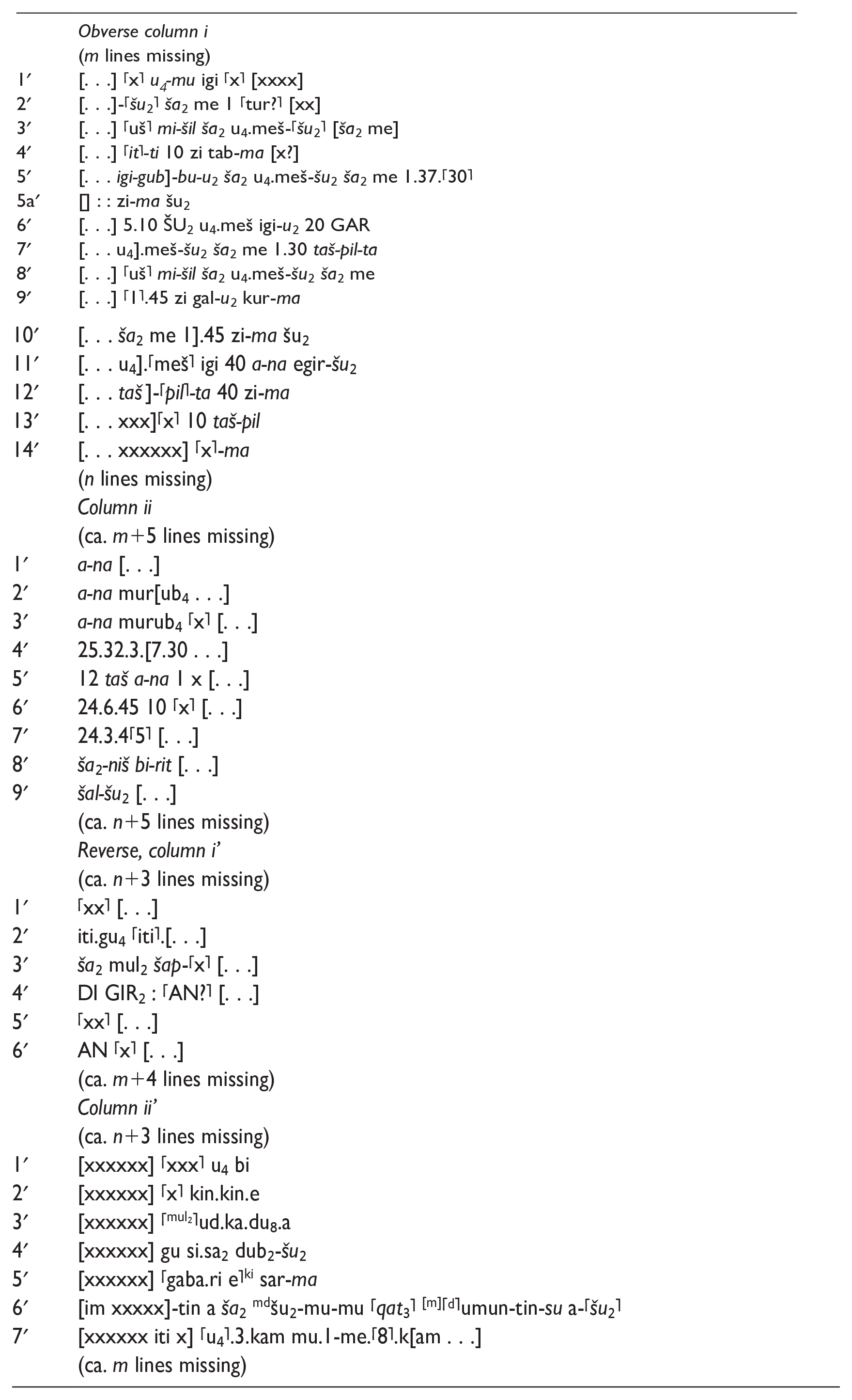
Transliteration
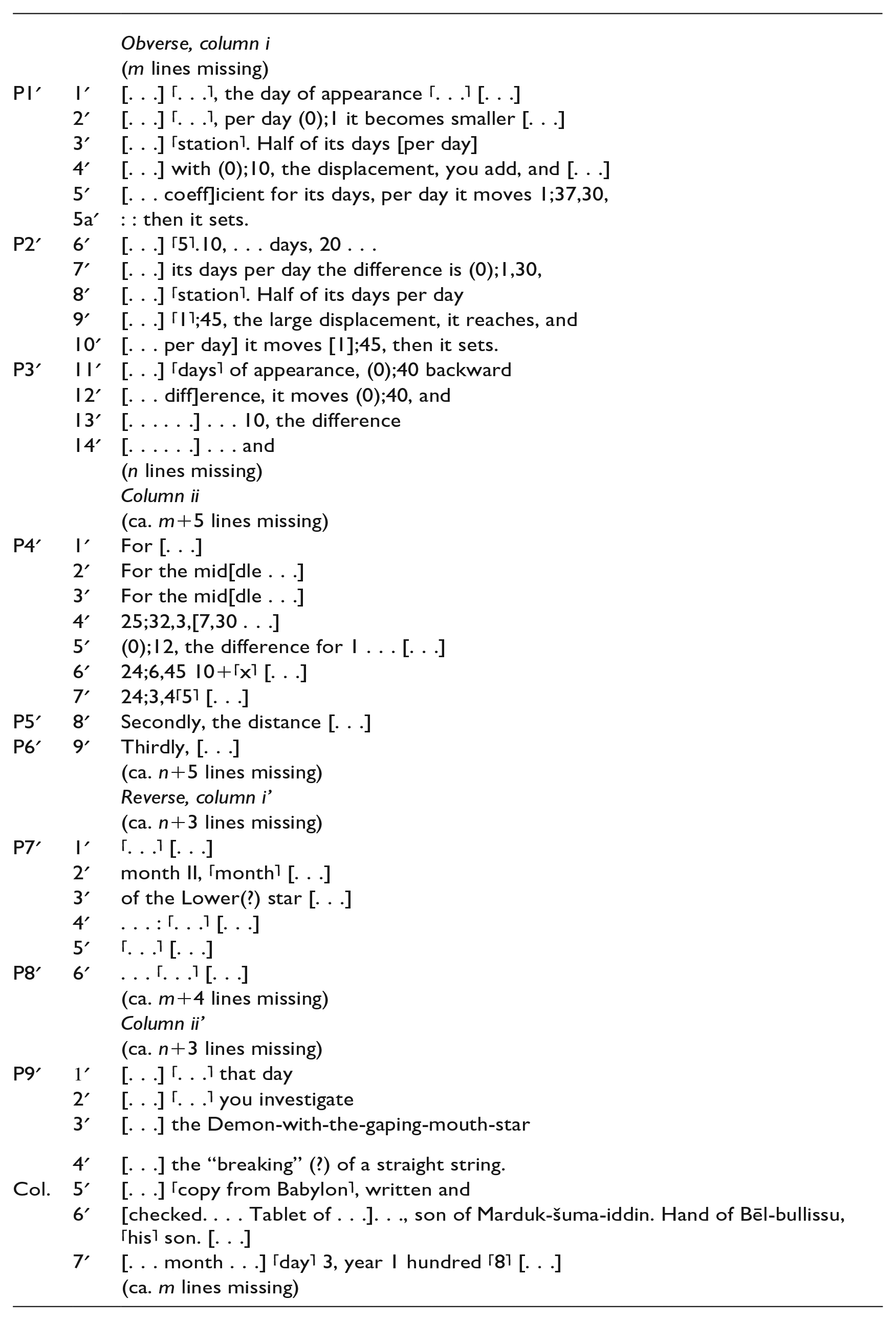
Translation
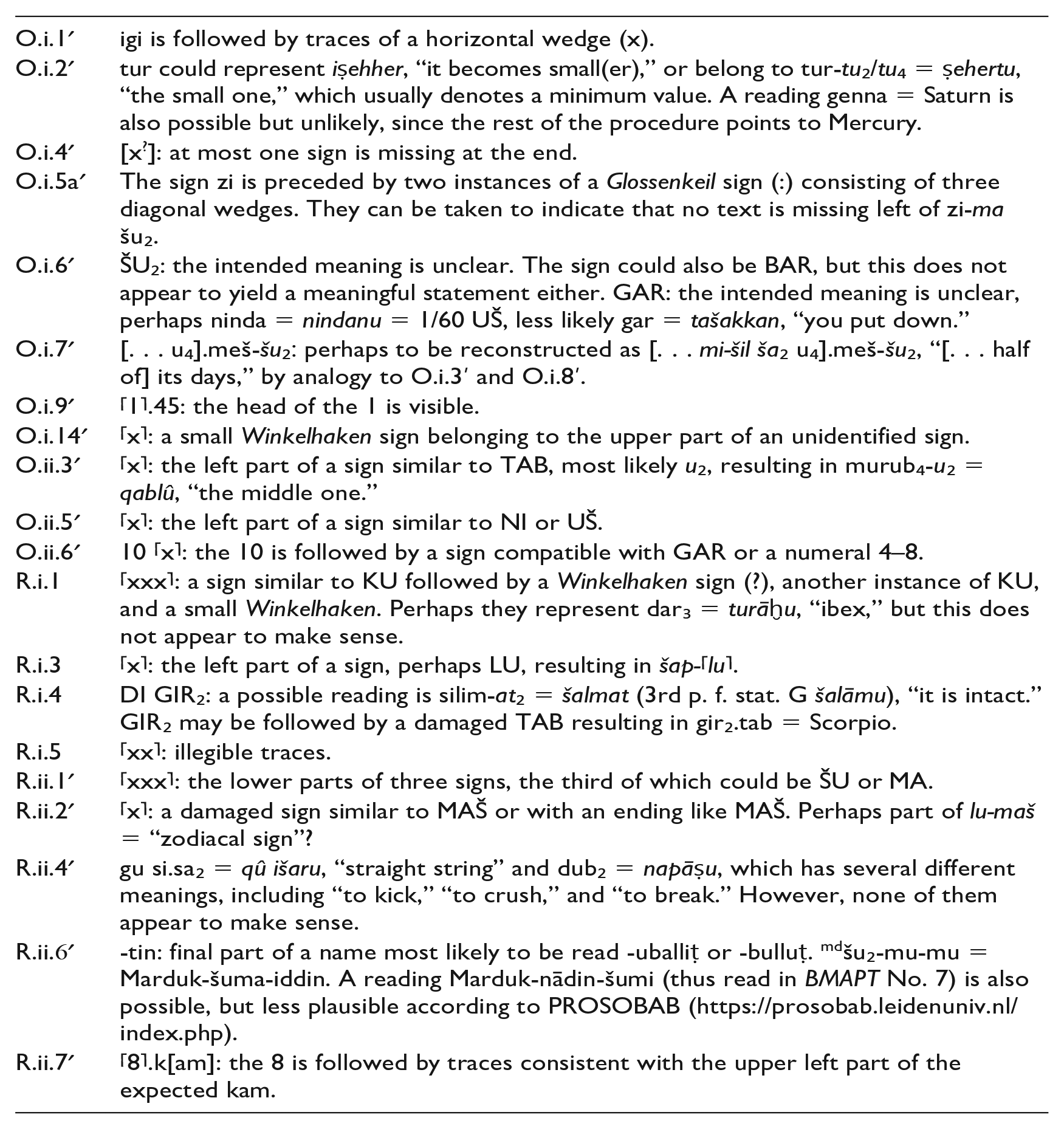
Philological remarks
Discussion of the tablet
The fragment (Figure 1) consists of two directly joined parts from the Babylon collection of the British Museum, BM 47886 (81–11–3, 593) and BM 47914 (81–11–3, 621). According to the museum registers they originate from Hormuzd Rassam’s excavations in Babylonia. No findspot is specified in the registers, but other tablets from the 81–11–3 collection are known to originate from Babylon, Birs Nimrud (Sippar), Dailem (Dilbat), and Borsippa. 1 As will be argued, the colophon implies Babylon. The fragment measures 8.0 × 8.0 × 3.9–4.3 cm and does not preserve any edges of the original tablet. It has a flat obverse and a curved reverse, in agreement with the usual arrangement. On each side two columns are visible. They are ordered from left to right on the obverse and from right to left on the reverse. Thickness and curvature of the fragment suggest that there were originally three, perhaps four columns on each side.
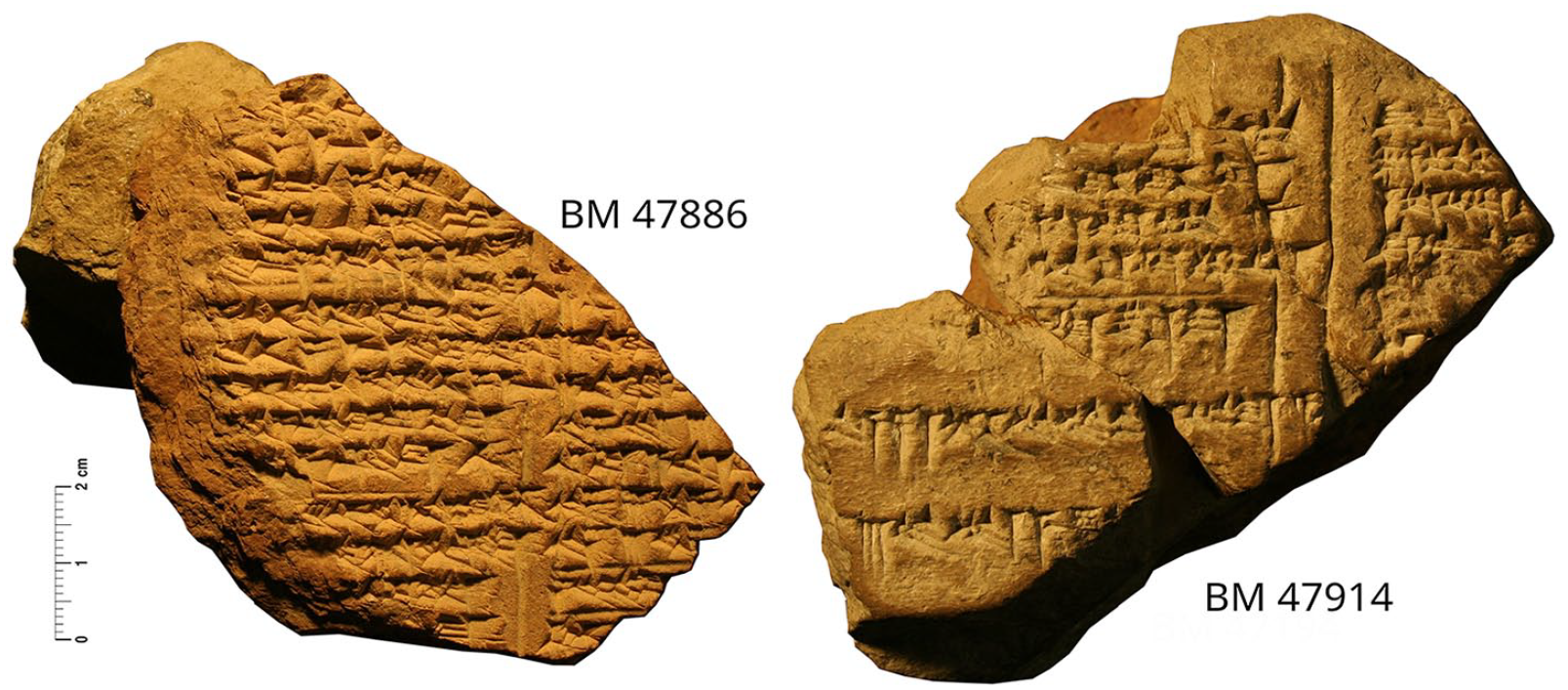
BM 47886+47914, obverse and reverse.
Nine procedures (P1′–P9′) and a colophon are partly preserved. P1′ and P2′, perhaps also P3′, contain rules for the daily motion of Mercury, a topic not covered in previously published procedure texts. After a gap of unknown length the tablet continues in column O.ii with procedures for Saturn (P4′–P6′). The sections on the reverse (P7′–P9′) are badly preserved and difficult to interpret. They do not appear to be connected to mathematical astronomy but, perhaps, have an astrological purpose. P9′ is followed by a colophon, which suggests that column R.ii′ is the leftmost, final column. In P1′–P6′ time intervals are expressed in “days” (ūmu), which actually denote mean tithis, a unit corresponding to 1/30 of the mean synodic month (≈ 29;31,50,8,20/30 days). Longitudinal displacements are expressed in UŠ, corresponding to the modern degree of arc, but this unit was usually omitted by the scribes. A subdivision of the UŠ, 1 nindanu (GAR) = 1/60 UŠ, might be mentioned in P2′. In the commentaries the symbol v is used for daily longitudinal displacements, and dv for the daily difference of v. The abbreviations O and R stand for obverse and reverse, respectively.
P1′: Mercury, daily motion from morning first to morning last
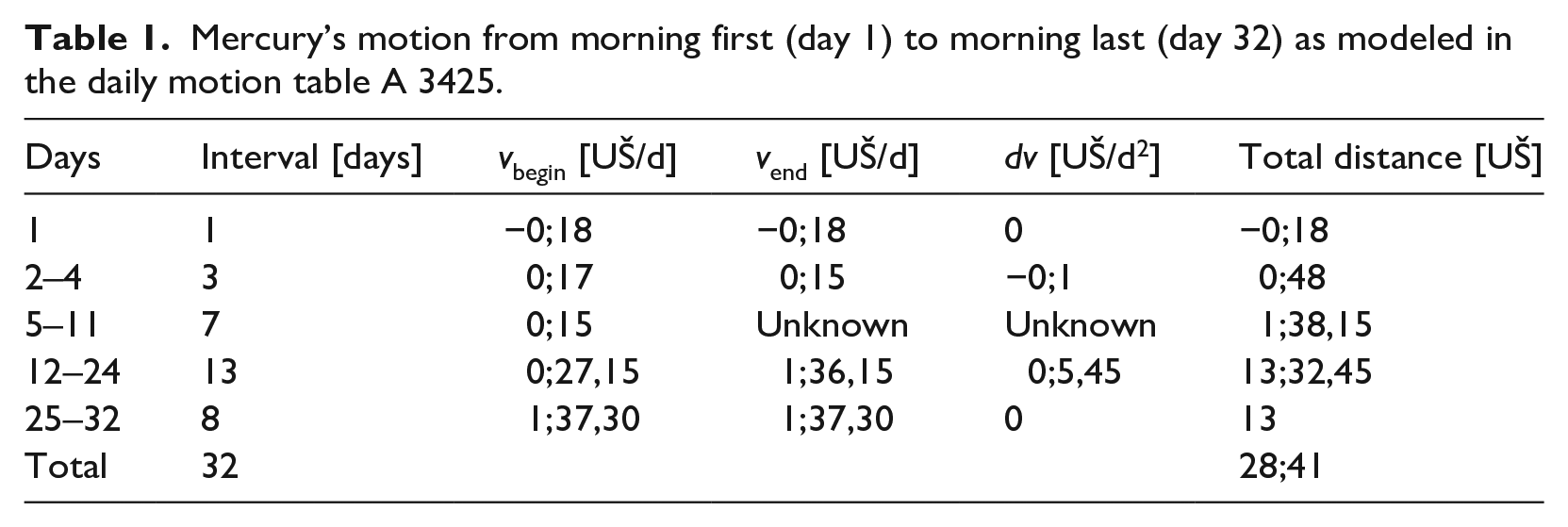
The left part of P1′ is broken off. At most a few lines of text are missing between the original upper edge and O.i.1′. As will be argued, the formulation and the numbers point to a scheme for Mercury’s daily motion similar to that underlying A 3425, a table with daily zodiacal positions for the year SE (Seleucid Era) 122 (190/189 BCE). 2 Some elements of P1′ can be plausibly interpreted and reconstructed through a comparison with this table. The relevant parameters, derived from the data in A 3425 O.iii′.25–R.i.27, are compiled in Table 1. In particular 1.37.30 (O.i.5′) can be securely identified with v = 1;37,30 UŠ/day, the value used in A 3425 for the final part of the interval from morning first (MF) to morning last (ML). This is consistent with O.i.5a′, where it is said that this value applies until the setting, that is, morning last, presumably for a number of days. It follows that the “day of appearance” mentioned in O.i.1′ must denote Mercury’s morning first. The expression in O.i.2′ could refer to a daily decrease of v by 0;1 UŠ/day, a value also attested in A 3425, where it applies on days 2–4 of the interval from MF to ML. The beginning of O.i.4′ must have mentioned a number that is added to 10, most likely a daily increment. This is suggestive of a model with linearly increasing values of v, analogous to days 12–24 in A 3425, during which v increases from 0;27,15 UŠ/day to 1;36,15 UŠ/day by 0;5,45 UŠ/day per day. The 10 can be plausibly interpreted as 0;10 UŠ/day. If the daily increment of v is similar to the value in A 3425, say about 0;6, it would take about 14 days for v to increase from 0;10 to 1;37,30 UŠ/day, which is a plausible duration.
Mercury’s motion from morning first (day 1) to morning last (day 32) as modeled in the daily motion table A 3425.
P2′: Mercury, daily motion from morning first to morning last or evening first to evening last?
This procedure appears to be analogous to P1′, but the state of preservation prevents a conclusive interpretation. The number 5.10 in O.i.6′ could represent v = 0;5,10 UŠ/day. The expression 20 GAR can be read as 20 nindanu = 20/60 UŠ, which could represent v = 0;20 UŠ/day, a value that appears to be assigned to the “day of appearance,” that is, morning first or evening first. O.i.7′ mentions a difference 1.30, which could represent the daily increase of v in a subsequent part of the interval. On that assumption the only plausible interpretation is 0;1,30 UŠ/day. The statements in O.i.8′–10′ suggest that in the second half of the interval v is constant and equal to 1;45 UŠ/day, which is said to be a maximum value. However, the underlying model for v is unlikely to be a sequence that increases linearly from 0;20 UŠ/day to 1;45 UŠ/day, because that would require 57 days, incompatible with the attested Babylonian values of the time from MF to ML or from EF to EL, which are between 14 and 45 mean tithis.
P3′: Daily motion of a planet (Mercury or Venus?)
P3′ is most likely also concerned with planetary motion, this time involving a first appearance followed by retrograde motion (O.i.11′), consistent with the morning first of Mercury or Venus. In the former case the procedure cannot apply in Aries, where Babylonian scholars knew Mercury to be prograde at morning first. If the 40 represents daily motion it must be interpreted as 0;40 UŠ/day. This value could apply to either planet (see, for instance, BMAPT, 80: Table 3.22).
P4′: Saturn system B: Parameters of zigzag algorithms
The beginning of the procedure is lost. The statements in O.ii.1′–3′ are too damaged for a conclusive interpretation, but the content of O.ii.4′–7′ points to Saturn. A similar statement, x ana murub₄-u₂ gar-an, “you put down x as the middle value,” where x is a number, is attested in BMAPT No. 13 P11′, a procedure concerning the mean synodic arc of Mars in system B. O.ii.1′–3′ could have contained statements similar to a-na murub₄-u₂ . . . x gar-an = “As the middle value of . . . you put down x.”
The parameters mentioned in O.ii.4′–7′ are identifiable as the maximum of the zigzag sequence for the synodic time of Saturn in accordance with system B, M = 25;32,3,7,30 mean tithis (O.ii.4), its monthly difference d = 0;12 mean tithis (O.ii.5), and its mean value μ = 24;6,45 mean tithis (O.ii.6). The number 24.3.45 (O.ii.7) could not be identified, but is similar to μ = 24;2,45 mean tithis, the mean synodic arc in system B″. Perhaps it belongs to a hitherto unknown variant of system B; alternatively it could be a copying error for 24.2.45. The expression that follows “(0);12, the difference” in O.ii.5′ can be reconstructed as a-na 1 UŠ [. . .], “for 1 UŠ [. . .].” In several procedure texts this expression introduces the difference of a zigzag sequence per unit of longitude (UŠ) along the ecliptic, that is, for each UŠ the quantity increases or decreases by (M-m)/3,0, where m and M are the extrema of the zigzag sequence and 3,0 (= 180) UŠ is their distance along the ecliptic. No trace of these differences is preserved. In the case of Saturn system B one expects (25;32,3,7,30–22;41,23,7,30)/3,0 = 0;0,56,53,20 mean tithis per UŠ; in the case of system B″ (25;24,5–22;41,25)/3,0 = 0;0,54,13,20 mean tithis per UŠ.
P5′–P8′: Unclear
The expressions “secondly” and “thirdly” suggest that P5′ and P6′ contained variants of P4′. P7′ and P8′ are too badly damaged for a conclusive interpretation. In R.i′.3′ one might reconstruct “Lower Star of the Head of the Scorpion” (mul₂ šap-lu ša₂ sag gir₂.tab), a Normal Star identified as π Scorpii. 3 This is one of two Normal Stars whose name includes the element “lower” (sig = šaplu), the second one being the “Lower Star of the Horn of the Goat-Fish” (mul₂ sig ša₂ si maš₂). 4 Neither star is in the core group of Normal Stars. The constellation or sign Scorpio might be mentioned in R.i′.3′.
P9′: Astrological procedure or schematic astronomy?
The last four lines of P9′ are partly preserved, not enough for a conclusive interpretation. The expression kin.kin.e = tešteneʼʼi, “you investigate” (second person present tense Gtn še'û), is attested in Late Babylonian astronomical and astrological procedure texts, for instance in AO 6455, 5 a compendium from Uruk: (R.37) “In order for you to see an ominous decision about the king, you investigate (the position) of the planets within the (zodiacal) constellations/signs” (ina lu-maš kin.kin-ma). The investigation is usually aimed at the planets, the Moon, and their motion through the zodiac. This could also apply here, since the word lu-maš, “zodiacal constellation/sign,” may be partly preserved in R.ii′.2′. The expression gu si.sa₂ dub₂-šu₂ (R.ii′.4′) is familiar from other astronomical and astrological texts. It is provisionally translated literally as “the breaking(?) of the straight string,” but the intended meaning remains unclear. In AO 6455 the expression is used in connection with zodiacal signs that are mutually opposite (O.18–19): “the Scales (Libra), the opposite of the Hired Man (Aries), the breaking(?) of a straight string.” In the so-called Dalbanna text 6 several alignments of stars or constellations are qualified as “broken(?) straight strings” (gu si.sa₂ dub₂.ba), where dub₂.ba most likely represents the verbal adjective napṣu, “broken(?).” It has been proposed that the intended meaning of napāṣu in the Dalbanna text is “to tighten, to tauten,” but this is contradicted by the literal meaning and by some of the alignments. 7 Two alignments in the Dalbanna text (G and J in Walker 1995) involve the star or constellation named “Demon-with-the-Gaping-Mouth” (ud.ka.du₈.a), which is also mentioned in R.ii′.3′. 8 It therefore appears that P9′ is also concerned with such an alignment.
Colophon
The remains of the colophon reveal that the tablet was copied in Babylon on day 3 of an unknown month in the year 108 (R.ii′.7′), which can only pertain to the Seleucid Era (SE 1 = 311/310 BCE) or the Arsacid Era (AE 1 = 247/246 BCE). The latter was used in Babylonia after ca. 145 BCE. If we assume a Parthian date (ca. 145–50 BCE) then year 108 pertains to the Arsacid Era and corresponds to 140/139 BCE. The original text in R.ii′.7′ can be tentatively restored based on the following date formula found on many Parthian-era tablets: iti.M u₄.D.kam mu.Y1.kam ša₂ ši-i mu.Y2.kam = “month M, day D, year Y1 (of the Arsacid Era), which is year Y2 (of the Seleucid Era),” where Y2 = Y1 + 64 = 172. Therefore mu.1-me. ⌈8⌉.k[am], “year 1 hundred 8,” was probably followed by ša₂ ši-i mu.1-me.1.12.kam, “which is year 1 hundred 1,12” (= SE 172). If we alternatively assume a Seleucid date, then the tablet was written in SE 108, corresponding to 204/203 BCE.
The colophon mentions both the owner and the scribe of the tablet. Such colophons are rare in Babylon, but common in Uruk on tablets written by scholars connected to the Rēš temple in the period 250–150 BCE. The owner of the tablet is [. . .]-uballiṭ or [. . .]-bulluṭ, son of Marduk-šuma-iddin, and the scribe is his son Bēl-bullissu. Their names contain the elements Marduk and Bēl, titulary deity of Esagila, Babylon’s main temple, which reveals the provenance of the tablet. No clan designation is preserved, which makes it difficult to identify these individuals. A possible candidate for the owner’s father is Marduk-šuma-iddin, son of Bēl-iddina, descendant of Egibatila (Egibi). He is attested around SE 180, 8 years after the probable date of writing of the present tablet, as the owner of BM 35495+, 9 a synodic table for Venus with data for SE 180–242 and corresponding procedures (BMAPT No. 7). The scribe Bēl-bullissu could be the same individual as the scribe of BM 55546, a tablet from SE 186 (126/125 BCE) inscribed with synodic tables for Venus and Mars 10 and a corresponding procedure for Mars (BMAPT No. 15). Both identifications support a Parthian date of the tablet.
A possible indirect join with BM 55555+55562 and its implications for the “year of the Sun”
BM 47886+47914 belongs to a small group of compendia covering multiple planets. Of the ca. 102 published astronomical procedure texts only seven tablets belong to this category (BMAPT Nos. 42–47, 95). A comparison with BM 55555+55562 (BMAPT No. 95), a fragment (size: 5.3 × 8.4 × 3.3–4.2 cm) of a compendium of procedures for Jupiter system A′, Saturn system A, and lunar system B, reveals that they probably belong to the same tablet. Their indistinguishable ductus (Figure 2), similar layout, and compatible thickness, 11 curvature, and content support this, and nothing contradicts it. Ultimate confirmation can be obtained only if the gap between them is bridged by further fragments. If they belong to the same tablet, then the fragments are to be positioned roughly as shown in Figure 3. The obverse of BM 47886+47914 (P1′–P6′) could belong to columns O.i–ii, the obverse of BM 55555+55562 (P1′–P3′) to columns O.ii–iii, alternatively O.iii–iv. The reverse of BM 55555+55562 (P4′–P8′) could belong to columns R.i–ii, the reverse of BM 47886+47914 (P7′–P9′, colophon) to columns R.ii–iii, alternatively R.iii–iv. BM 55555+55562 column O.ii′ (O.iii in Figure 3) has a width of about 7 cm. If there were three columns this suggests an original width of ca. 21 cm, similar to that of several other Babylonian astronomical compendia, such as BM 32167+ (BMAPT No. 53). However, the unusual thickness of the tablet could indicate that there were four columns per side, in which case the original width was probably about 28 cm.
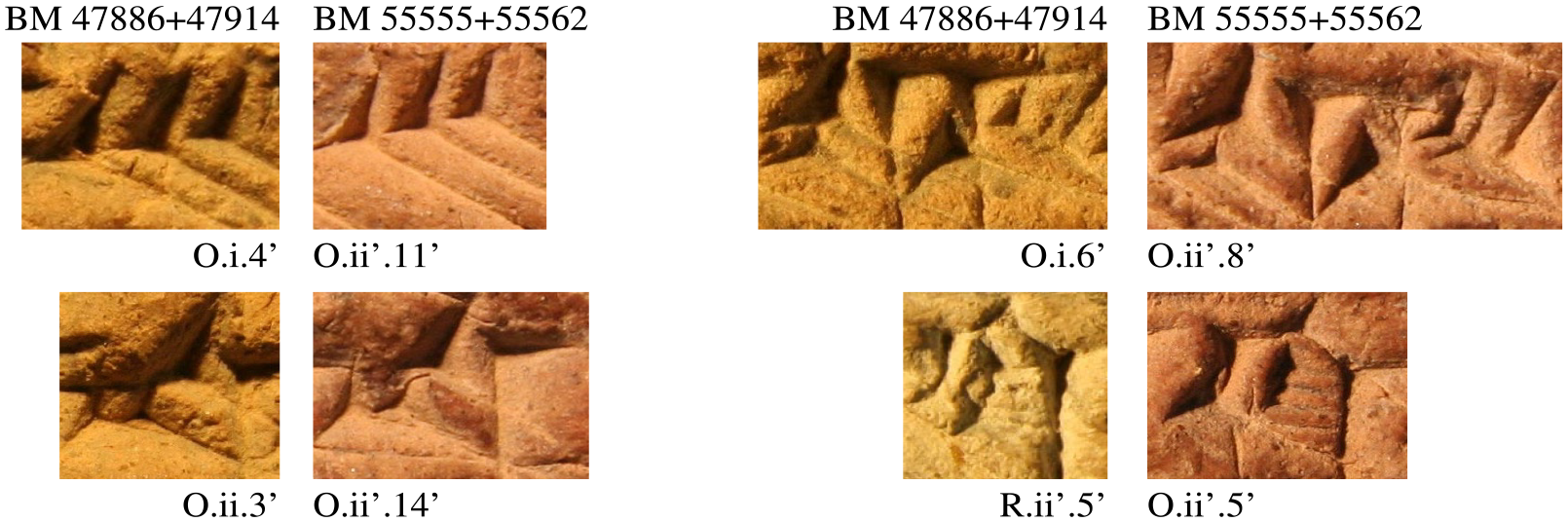
Comparison of selected cuneiform signs (30, u4.meš, na, ki) from both fragments.
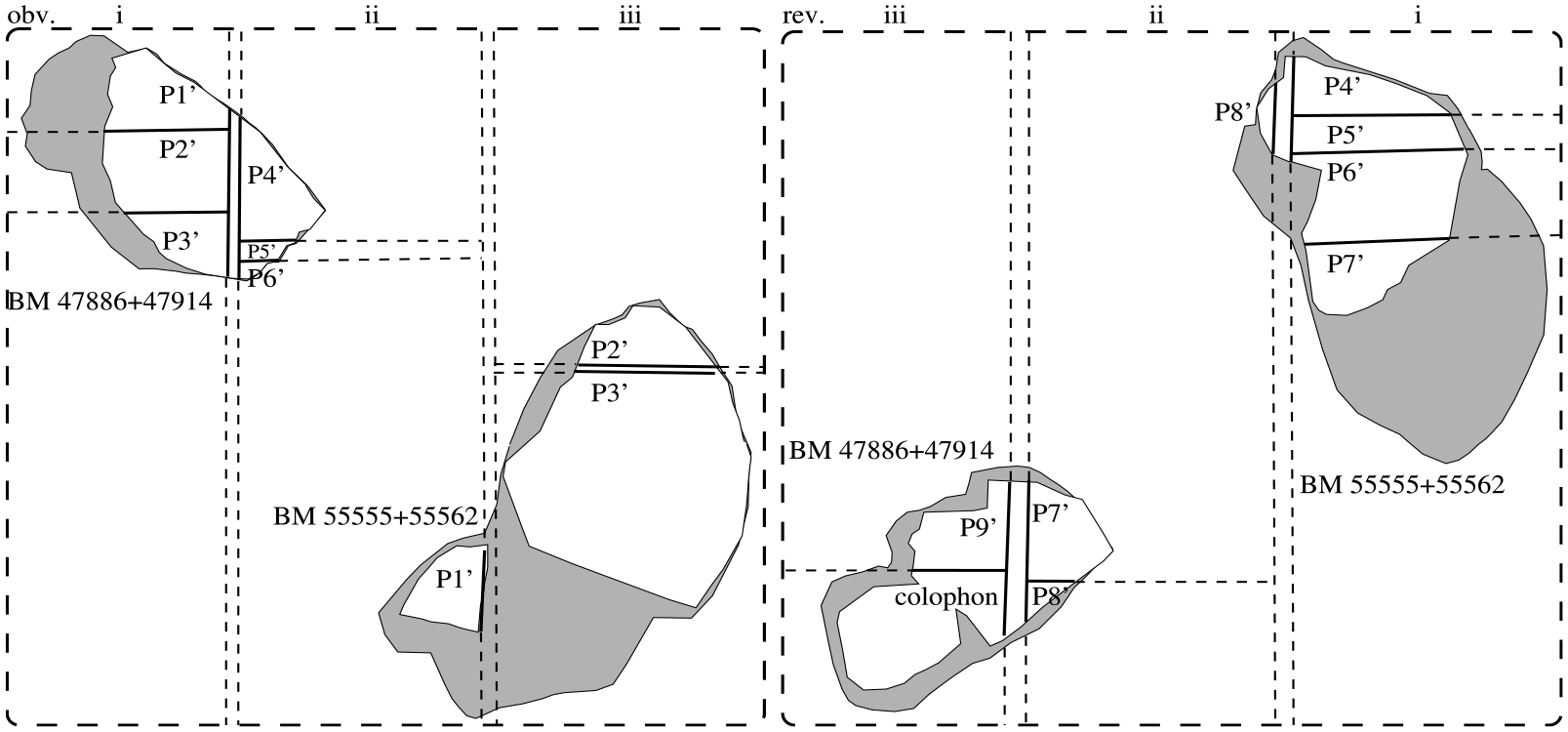
Tentative reconstruction of the arrangement of BM 47886+47914 and BM 55555+55562 (BMAPT No. 95) assuming three columns per side. If there were four columns per side the horizontal distance between both fragments increases by ca. 7 cm. The vertical distance between both fragments is unknown.
BM 55555+55562 (BMAPT No. 95) has attracted attention because of the following passage in O.ii′.11′-12′ (P3′): (11') [1].⌈4⌉ 9.34.⌈2⌉5.27.18 u₄.meš ša₂ 18 mu ša₂ dutu (12') [ana ki?]-⌈šu₂?⌉ gur (11') [1],⌈4⌉ 9,34;⌈2⌉5,27,18 days for 18 years in which the Sun (12') returns [to] its? [position?].
The 1,49,34;25,27,18 days contained in “18 years of the Sun” correspond to a “year of the Sun” of 1,49,34;25,27,18/18 = 6,5;14,44,51 days, a value close to the sidereal year and even closer to the tropical year. 12 More importantly, it is not attested in other cuneiform sources and also incompatible with Babylonian lunar systems A and B, which raises the question of its origin. 13 A possible answer was provided by Dennis Rawlins, 14 who discovered that 297 of these years correspond to 6,5;14,44,51 × 4,57 = 30,7,58;0,0,27 ≈ 30,7,58 = 108,478 whole days, and that this is the number of days in between two summer solstices reported in the Almagest (3.1). 15 The first one was observed by the “school of Meton and Euctemon (. . .) in the year when Apseudes was archon at Athens, on Phamenoth 21 in the Egyptian calendar, at dawn,” which corresponds to June 27, 432 BCE (Julian Day 1563813). The second one was observed by Hipparchus “at the end of the 43rd year of the Third Callippic Cycle,” which corresponds to 135 BCE. 16 The Almagest does not specify the exact date of that solstice. According to modern computations it occurred on June 26 135 BCE (Julian Day 1672291), 108,478 days after the former one. 17 Rawlins concluded from this that Hipparchus observed that solstice and divided the 108,478 days that passed since the earlier one by 297, and that the resulting year length, presumably already expressed as a sexagesimal number of days, found its way to Babylonia, where it ended up on BM 55555+55562. The question of how Hipparchus determined the number of days between both solstices was not addressed by Rawlins, but this was easy if Hipparchus knew their dates in the wandering Egyptian calendar used by Ptolemy and other Greek astronomers before him. 18 This can be verified explicitly by converting June 26 135 BCE to the wandering Egyptian calendar, which yields Ptolemy VIII Euergetes II, year 35, Payni (month X), day 4. 19 If Hipparchus assumed that the earlier solstice occurred on Phamenoth 21, the date mentioned in the Almagest, then it immediately follows that there were 297 × 365 + 2 × 30 + 13 = 108,478 days in between them, as found by Rawlins.
However, if BM 47886+47914 belongs to the same tablet as BM 55555+55562, then the origin of the “year of the Sun” may have to be reconsidered. Since the colophon on BM 47886+47914 implies a date of writing no later than 140/139 BCE, the “year of the Sun” cannot be based on a solstice observed in 135 BCE. This would refute the current argument for a Greek origin of the “year of the Sun” and remove one of the few relatively secure attestations of Greek astronomical knowledge in a Babylonian cuneiform text.
Possible alternative derivations of the “year of the Sun”
Regardless of whether or not both fragments belong to the same tablet, are there plausible derivations of the “year of the Sun” that do not rely on the solstice observed by Hipparchus in 135 BCE? No solution is presented here, but two features that appear to have been ignored might point to an alternative derivation. First, it is peculiar that BM 55555+55562 reports the length of 18 “years of the Sun” instead one such year. This could be a consequence of a derivation from astronomical data separated by 18 years. The saros cycle of 223 months corresponding to 18 years can be excluded, because its duration is about 11 days longer than 18 “years of the Sun.” 20 Some other 18-year interval not connected to eclipses might have been used, but no such period has yet been identified.
Secondly, further, perhaps more promising alternative derivations come into view if the assumption that the “year of the Sun” was obtained from a whole number of days is abandoned. In particular, there are several multiples of 11 smaller than 297 (= 27 × 11) that can be multiplied by the “year of the Sun” to yield a “nice” fractional number of days plus a negligible remnant. For instance, 198 (= 18 × 11) “years of the Sun” equal 3,18 × 6,5;14,44,51 = 20,5,18;40,0,18 days ≈ 20,5,18;40 = 72,318 2/3 days, 99 (= 9 × 11) “years of the Sun” equal 10,2,39;20,0,9 ≈ 10,2,39;20 = 36,159 1/3 days, and 33 such years equal 3,20,53;6,40,3 ≈ 3,20,53;6,40 = 12,053 1/9 days. The “year of the Sun” could therefore in principle have been derived from the fractional number of days between phenomena such as solstices separated by 198, 99, or 33 years, if the time of these phenomena was specified down to 1/3 day or 1/9 day. A practice of timing astronomical phenomena such as solstices and eclipses to fractions of a day is attested in Babylonia 21 and in the Greco-Roman world, one example of the latter being the solstices reported in Almagest III.1. Future research may uncover a plausible pair of phenomena and reveal where they were observed, and where the “year of the Sun” was computed from the number of days between them.
Footnotes
Abbreviations
ACT = Neugebauer, O., 1955, Astronomical Cuneiform Texts, London and New York. DOI: 10.1007/978-1-4612-5507-9
BMAPT = Ossendrijver, M., 2012. Babylonian Mathematical Astronomy. Procedure Texts, New York.
Notes on contributor
Funding
The author disclosed receipt of the following financial support for the research, authorship, and/or publication of this article: This research was conducted in the context of the project “ZODIAC - Ancient Astral Science in Transformation” which is funded by the European Research Council (ERC Advanced Grant No. 885478) under the Horizon 2020 framework.
