




Abstract
Manuscripts in Oxford and Erfurt preserve evidence of the earliest known efforts made in Latin Europe to remeasure the eccentricity and maximum equation of the Ptolemaic solar model. The present article analyses and contextualizes this evidence, while also revisiting Ernst Zinner’s hypothesis according to which the relevant observations were made by Alard of Diest (fl.1308).
Introduction
In chapter four of book III of his Almagest, Ptolemy follows the lead of his predecessor, Hipparchus, in demonstrating how one can derive the size of the eccentricity of an eccentric solar model from prior knowledge of the tropical year as well as the lengths of two adjacent seasons. 1 Astronomers who worked in the Islamic Middle East during the ninth to 16th centuries famously improved on this technique as well as Ptolemy’s specific results. Recent research by S. Mohammad Mozaffari has shown that these medieval solar theories were sometimes capable of tracking the true longitude of the Sun with remarkable accuracy, owing not least to independent determinations of the eccentricity whose errors remained well below those attested for Copernicus and Tycho Brahe. 2 The parallel history of such measurements in Latin Europe has yet to become the object of systematic study, leaving open even fundamental questions about when and how Latin astronomers first began to re-examine the parameters of the Ptolemaic solar model. 3 With this article, my aim is to highlight that the first clearly documented measurements of the solar eccentricity in a Latin context were made in Paris in 1312 and in a different location—probably Diest in Brabant—in 1314. Additionally, there is good evidence that an earlier such effort was made in Diest in 1308. As will be discussed below, there is a strong likelihood that the astronomer responsible for all of these observations was Alard of Diest, as already suggested by Ernst Zinner in 1951.
Observations in Paris, 1312
The source that documents the solar observations of 1312 and 1314 was first brought to light in 1948 by Lynn Thorndike, 4 who transcribed an acephalous text in MS Oxford, Corpus Christi Corpus, 144, fols. 97r–98v (= O), containing an unusually extensive record of observations made by an anonymous astronomer in Paris in the early 14th century. The preserved portion of the text sets in at the end of 1311 and fully covers the years 1312 to 1315, which are all counted from 1 March. Most of the observations in question concern the ecliptic longitudes of Saturn, Jupiter, Mars, and Venus, which were measured with the aid of an armillary instrument and the known positions of four reference stars (αAql, αCMa, αLeo, αTau). 5 In addition to these planetary longitudes, the text as we have it contains two passages summarizing the results of solar observations in 1312 and 1314 together with the implied values for the eccentricity (e) and maximum equation of center (q max ).
Subsequent to Thorndike’s publication of the whole text, the anonymous observations in O attracted the attention of Ernst Zinner, who in 1951 proposed some emendations to the transmitted numbers and nominated the Flemish astronomer Alard of Diest as their originator.
6
I shall return to Zinner’s hypothesis later in this article. For now, let us take a closer look at the first of two relevant passages in O (fol. 97r). It reads as follows: Anno incarnacionis domini 1312, 12 die Marcii, per 50 minuta unius hore post meridiem Parisius fuit equinoctium vernale. Et 14 die Septembris per 13 horas 35 minuta post meridiem invenimus ibidem equinoctium autumpnale. Et per hoc tempus ab equinoctio vernali ad equinoctium autumpnale fuerunt dies 186, 13 hore, 44 minuta. Medius autem motus solis in tempore fuit 183 gradus et 53 minuta et 39 secunda. Superfluum igitur super medietatem circuli orbis sols fuit 3 gradus, 53 minuta et 39 secunda. In corda eius recta: 4 partes, 4 minuta et 36 secunda. Medietas autem arcus corde eiusdem superflui: 2 partes, 2 minuta et 18 secunda. Et hec est prope quantitas distancie centri deferentis a centro terre, quia aux deferentis erat in medio fere inter duo puncta equinoctii, scilicet in puncto solsticii in fine Geminorum. Et maior equacio diversitatis medii motus solis ad verum est 1 gradus, 56 minuta et 49 secunda et 30 tertia. In the year of the incarnation of the Lord 1312, on the 12th day of March, at 0;50h past noon in Paris, the vernal equinox occurred. And we found the autumn equinox on the 14th day of September, at 13;35h past noon. And during this time from the vernal equinox to the autumn equinox there were 186d 13;44h. The mean motion of the sun during this time was 183;53,39°. It follows that the excess beyond half the circle of the solar orbit was 3;53,39°. In its straight chord: 4 parts, 4 minutes, and 36 seconds. One-half of the arc of the chord of the same excess: 2 parts, 2 minutes, and 18 seconds. And this is nearly the distance between the centre of the deferent and the centre of the Earth, because the apogee of the deferent was about midway between the two equinoctial points, that is, at the point of the solstice at the end of Gemini. And the greater equation of the difference of the mean motion of the sun from the true motion is 1;56,49,30°.
The author here documents an independent determination of e and qmax whose fundamental inputs were (a) the times of the vernal and autumn equinox, as found for the longitude of Paris in the year 1312, as well as (b) the daily mean solar motion, which was used to find the arc of mean motion between the two equinoxes. While the expression invenimus, which is here used in relation to the autumn equinox, harbors a degree of ambiguity as to whether the equinox times were found by observational or computational means, this ambiguity is removed by a subsequent passage concerning the equinoxes in 1314, which will be discussed below. The latter contains an explicit reference to an empirical method that involved the solar noon altitude (O, fol. 97v: per altitudinem solis in meridie) as its fundamental measurement. Since the first passage, for 1312, looks structurally, thematically, and verbally very similar, it seems reasonable to assume that its equinox times were based on the same method.
Another important consideration in favor of an observational approach is the fact that the data cited in the present passage do not resemble results that could have readily been derived from the computational tools available to astronomers at the time. As an example, one may consider the vernal equinox of 1312, which the astronomer in O places 50 minutes past noon on 12 March. Neither the Toledan Tables, which were still popular at the beginning of the 14th century, nor the Alfonsine Tables, which began to emerge as the new computational standard in the 1320s, would have produced matching results. In the case of the former, the predicted equinox time for Toledo would have been 13 March, c.10:58 a.m., while the latter located the same equinox on 12 March, c.02:51 a.m. 7 As will become clearer from the discussion below, O’s stated values for the maximum solar equation and eccentricity are likewise highly atypical, as they fail to conform to any known set of tables, which again supports the hypothesis that they were derived from observed, rather than computed, equinox times.
In Table 1, O’s recorded times of the equinoxes of 1312 are compared with modern calculations for the geographic longitude of Paris Observatory (2;20,11° E). 8 The latter are shown as time intervals (rounded to the nearest minute) from (true) solar noon on the date in question. This use of reference point assumes that the author inferred his equinoctial times by observing a solar noon altitude (as was clearly done in the analogous case of the 1314 solar observations, which are discussed below), but without adjusting for the equation of time.
Comparison of equinoctial dates and times for 1312 in O (fol. 97r) with modern data.

It can be seen that the difference (δ) relative to the modern result is about one hour greater for the recorded time of the autumn equinox than for the vernal equinox. The interval between these two times is 186d 12;45h, which clashes with the 186d 13;44h mentioned in the text. Remarkably, however, the latter interval is in excellent agreement with modern calculation (15;46h – 2;2h = 13;44h), which adds weight to the conclusion that one of the two equinox times requires emendation. The alternative hypothesis according to which 13;44h was an error for 12;45h is strongly vetoed by the information that the Sun travelled 183;53,39° in mean longitude during the interval in question, which receives confirmation from the additional statement according to which the excess beyond 180° was 3;53,39°. For this arc of mean longitude to result from an interval 186d 12;45h, the author would have had to work with a rate of solar mean motion of 183;53,39° ÷ 186d 12;45h = 0;59,9,6,18,9. . .°/d, presupposing an unrealistically short year length of 365;9,44,55,43. . .d = 365d 3;53,58,17,31. . .h.
By contrast, the non-emended value gives us 183;53,39° ÷ 186d 13;44h = 0;59,8,19,32,18. . .°/d for the daily mean motion and a year length of 365;14,33,40,54. . .d = 365d 5;49,28,21,53. . .h ≈ 365 ¼ – 1/137d. This is a rather good value for the actual length of the tropical year, whose closest recorded counterpart in Latin astronomical literature is 365d + 82;21°/360°/d = 365;14,33,30d = 365d 5;49,24h, as attributed to several Islamic astronomers—among them Ibn al-Zarqālluh—in the Liber de rationibus tabularum (1154) of Abraham Ibn Ezra. 9 There is also a certain affinity with the Alfonsine Tables and their mean solar motion of 0;59,8,19,37,19. . .°/d (implying a tropical year of 365;14,33,9,57. . .d), 10 though the evidence that these tables were in use in Paris as early as 1312 is rather tenuous. 11 Overall, the evident corruption of the data in O calls for a degree of caution in drawing conclusions about the year length actually presupposed by our author.
To understand how our author used the information in the first half of the passage to find e and qmax, let us turn to Figure 1, where circle PQRS represents the Sun’s eccentric path around a center C. Also marked on this circle is the apogee, A, which lies on a line connecting C and the position of the observer at O. As seen from O, the Sun’s true longitudes appear against the backdrop of the circle of the zodiac, EFGH. Let E be the Sun’s true position at the vernal equinox, such that F is the summer solstice, G the autumn equinox, and H the winter solstice. The first three of these points have their counterparts on the eccentric circle in KLM. According to the information provided in our text, the Sun’s course from K to M (through Q) takes 183;53,39°, such that KP + RM = 3;53,39°. This is the arc of mean motion for the combined duration of spring and summer. The arc for spring is KL, which will be greater than 90° by KP + QL. Under normal circumstances, arcs KP and QL are both required to find the eccentricity, CO. Assuming a deferent radius with the arbitrary value R = 60, the intermediary steps for this calculation are:


Thus, to find the eccentricity:

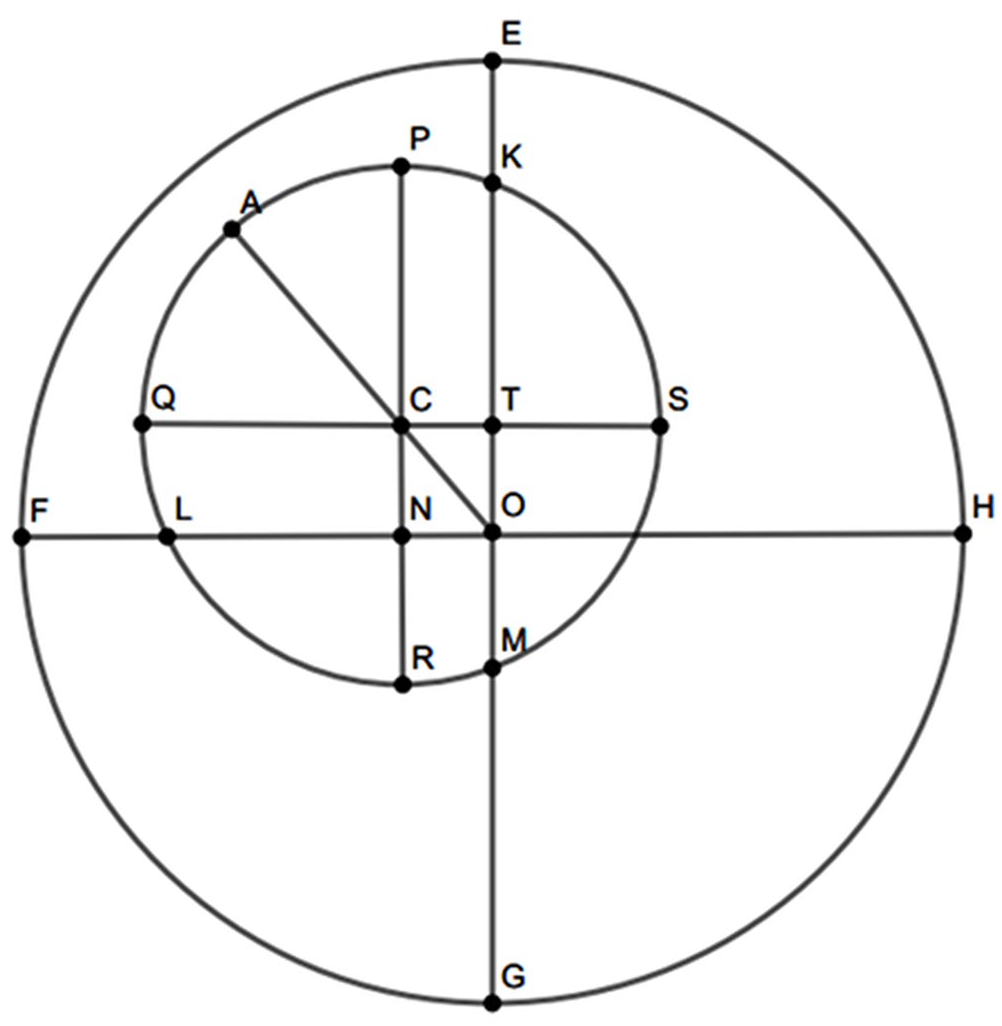
Schematic drawing of an eccentric model.
If it is the case, however, that the apogee lies in the direction of the summer solstice, such that ACO all come to lie on FH, the length of e = CO is simply equal to NO. It accordingly becomes superfluous to know QL via the time of the summer solstice. The times of the two equinoxes will suffice to find e as the equivalent of NO. According to the data provided in our text, PK = 3;53,39° ÷ 2 = 1;56,49,30°. Hence, e = 60 × sin 1;56,49,30° = 2;2,18,55. . . This is the “one-half of the arc of the chord” (medietas arcus corde) mentioned in the text as 2;2,18. In deriving this value from PK = 3;53,39°, our astronomer did not operate directly via the sine, but began by the equivalent method of finding the chord for 3;53,39° and subsequently halving the result (since Crd α = 2 × sin α/2). The chord for this angle is 4;4,37,50. . . against 4,4,36 in the text (4;4,36 ÷ 2 = 2;2,18). To convert e into qmax, one would ordinarily use the relation qmax = sin−1 (
The author of the above passage thus cleverly exploited the assumed position of the solar apogee, which he placed “about midway between the two equinoctial points” (in medio fere inter duo puncta equinoctii), to achieve a considerable simplification of the standard Ptolemaic method of deriving e from two seasonal lengths. What the text does not disclose, however, is his empirical or computational basis for locating the solar apogee at or near this position of 90° ecliptic longitude. The widely available Toledan Tables would have put the apogee on 12 March 1312 at 87;22,47°, based on a fixed sidereal longitude of 77;50° and an accumulated precession value of 9;32,47°. According to the Alfonsine Tables, the solar apogeal longitude was 89;18,50° on the same date. An approximate modern value for the apogee in March 1312 would be 91;8°, meaning that the author was reasonably close to the target with his assumption.
The result he obtained in this manner is, in fact, rather good. It was not only a step up compared to Ptolemy’s exaggerated eccentricity of e = 2;30, but it also improved upon the value implicit in the table for the solar equation in the Toledan Tables (qmax = 1;59,10°, implying e = 2;4,45), which went back to al-Battānī. 12 In 1312, the approximate value of the eccentricity of the Keplerian elliptic model of the Sun was e* = 0.01700. On the simplifying assumption that e* = 1/2 e, 13 the author’s result of 2;2,18 corresponds to 0.01699, with a deviation (de*) of only –0.00001 (= –0;0,2,9,36). In this regard, the 1312 observations led to a more accurate value for e than even those obtained by prominent 13th- and 14th-century astronomers in the Middle East such as Muḥyī al-Dīn al-Maghribī (de* = +0.00049), Jamāl al-Dīn al-Zaydī (de* = +0.00055), and Ibn al-Shāṭir (de* = +0.00077). 14
Observations in 1314
The passage on the Parisian solar observations of 1312 omits any mention of the method that was used to find the times of the vernal and autumn equinoxes, which are given to minutes (in multiples of 5). More information in this regard can be gleaned from the second set of solar data recorded in O (fol. 97v), which appears among the planetary observations made in 1314: Item eodem anno 1314 inperfecto, 12 die [gem.] Marcii per 6 horas post meridiem fuit equinoctium vernale prout verius deprehendere potuimus per altitudinems solis in meridie et declinationem eius ab equinoctiali et per calculationem motus solis diversi. Et eodem anno in eodem loco 15 die Septembris sequentis per 2 horas et 30 minuta unius hore post eandem meridiem fuit equinoctium autumpnale. Et sic tempus ab equinoctio vernali ad autumpnale fuit 186 dies, 10 hore et 30 minuta. Medius autem motus solis in tempore predicto 183 gradus, 45 minuta, 43 secunda et 20 tertia. Et sic residuum medietatis circuli 3 gradus, 45 minuta, 43 secunda et 20 tertia. Corda recta eiusdem arcus 3 gradus, 59 minuta, 19 secunda. Medietas autem eius 1 gradus, 58 minuta, 9 secunda. Item altitudo capitis Cancri ad eandem meridiem 63 gradus, 33 minuta et 10 secunda. Altitudo vero capitis Capricorni 15 gradus, 30 minuta. Altitudo vero capitis Arietis et Libre 39 gradus, 2 minuta et 30 secunda. Et sic duplum declinationis 47 gradus et 31 minuta. Declinatio vero simplex 23 gradus, 31 minuta et 30 secunda. In the same year 1314, on the 12th day of March, at 6h past noon, the vernal equinox occurred according to what we could most accurately determine through the altitude of the Sun at noon and its declination from the equator, and through calculating the Sun’s variable motion [per calculationem motus solis diversi]. In the same year, in the same location, on the 15th day of the following September, at 2;30h past the same noon, the autumn equinox occurred. And thus, the time between the vernal equinox and the autumn equinox was 186d 10;30h. The mean motion of the Sun during this time [was] 183;45,43,20°. Thus, the remainder beyond half the circle [was] 3;45,43,20°. The straight chord of the same arc [was] 3;59,19°. Its half: 1;58,9°. Furthermore, the altitude of the head of Cancer at the same noon [was] 63;33,10°. The altitude of the head of Capricorn: 15;30°. The altitudes of the heads of Aries and Libra: 39;2,30°. And so, twice the declination [was] 47;31°, while the simple declination [was] 23;31,30°.
As before, the passage as we have it confronts us with some corrupt numbers. For one thing, the 186d 10;30h that are given as the interval between the two equinoxes do not match the reported equinox times, which differ by 186d 20;30h. An emendation from 10;30h to 20;30h is ruled out by the stated arc of mean motion of 183;45,43,20°. To derive this arc from an interval of 186d 20;30h, the author would have had to work with a mean motion rate of 0;59,0,25,33. . .°/d. This implies a year length of 366;3,27,33,3. . .d and is, therefore, not a plausible value. Another reason for rejecting 20;30h as the intended interval is provided by Table 2, which shows that the preserved text places the vernal equinox 7;35h too early with respect to noon, whereas the error for the autumn equinox is only 0;59h. This makes it very doubtful that the reported time of the vernal equinox at 6h past noon is an accurate representation of the result originally achieved by the author.
Comparison of equinoctial dates and times for 1314 in O (fol. 97v) with modern data.

Zinner suggested correcting the time of the vernal equinox from 6h to 12h, which would reduce the interval to 186d 14;30h. 15 Yet, this cannot stand, either, since 183;45,43,20° ÷ 186d 14;30h = 0;59,5,10,8. . .°/d, with an implied year length of 365;34,4,24,4. . .d (i.e., greater than 365½ days). A solution must rather be sought in replacing 6h with 16h (in which case δ = +2;25h), which brings the interval in agreement with the stated 186d 10;30h. In combination with the arc of mean motion, this leads to a daily mean motion of 183;45,43,20° ÷ 186d 10;30h = 0;59,8,20,18. . .°/d, with an implied year length of 365;14,28,58,4. . .d = 365d 5;47,35,13,56. . .h. As we shall see below, this result is not only plausible, but may have some bearing on identifying the astronomer behind this passage.
Having obtained from the interval between the two equinoxes an excess in mean motion of 183;45,43,20° – 180° = 3;45,43,20°, the author proceeded, as before, by computing the corresponding chord, which is 3;56,19,56. . . The 3;59,19 in O are clearly the result of a scribal error and must be emended to 3;56,19. By halving this value, one obtains e = 1;58,9,30, as confirmed by the text’s truncated value of 1;58,9. The text does not explicitly identify it as the eccentricity of the Sun’s orbit, though this was doubtlessly intended. Another detail missing from this passage is the maximum equation of center. Assuming that the placement of the solar apogee at 90° still holds, it follows that qmax = 3;45,43,20° ÷ 2 = 1;52,51,40°.
The passage for 1314 is more informative when it comes to the methods that were used to measure the stated equinox times. Our astronomer remarks that he relied on “the altitude of the Sun at noon and its declination from the equator” (per altitudinems solis in meridie et declinationem eius ab equinoctiali) as well as on a calculation of the “variable motion of the Sun” (per calculationem motus solis diversi). These phrases suggest a somewhat different approach than the one famously used by the Parisian astronomers Peter of Limoges and William of Saint-Cloud to determine the time of the vernal equinox in 1290. The latter method involved measuring the solar noon altitude on a date near the equinox and using the rate of change in the solar declination (approx. 0;24°/d) to estimate the time until/since the equinox. 16 Rather than using this specific recipe, the astronomer responsible for the equinox observations of 1314 presumably converted the declination at the observed solar noon altitude into an ecliptic longitude. Subsequently, he divided the longitude difference relative to the equinox (at 0° or 180°) by a solar velocity adequate to the relevant time segment. 17
To obtain an instantaneous value for the Sun’s velocity, an astronomer from this period could turn to computational tables that displayed the hourly solar (and lunar) velocities as functions of the mean anomaly. 18 The headings to tables of this general type often refer to the solar velocity as motus solis diversus (i.e., “the variable motion of the Sun”), 19 which would seem to account for the author’s statement that he proceeded per calculationem motus solis diversi. One potential problem with this use of velocities is that the relevant tables were computed for a specific value of e, which introduces an element of circularity if the goal is to establish e from scratch. In our specific case, however, this problem is neutralized to a large degree by the assumed position of the solar apogee at 90°, from which it follows that the Sun’s instantaneous velocity at the two equinoxes (i.e., at the quadrants from the apogee/perigee) is practically the same as its mean velocity. Whether the astronomer was aware of this advantage cannot be proven, though it seems likely.
Two other parameters the astronomer needed to know beforehand in order to convert the solar noon altitude into an ecliptic longitude were the local latitude (φ) and the obliquity of the ecliptic (ε). The latitude is subtracted from 90° to obtain the co-latitude, which is the meridian altitude of the equinoctial points. By subtracting it from the observed noon altitude (α) one arrives at the corresponding declination (δ), while the Sun’s ecliptic longitude (λ) can be calculated as a function of the declination and obliquity via the relation sin λ = sin δ ÷ sin ε. Both φ and ε can be found empirically as part of a single process involving measurements of the extremal solar noon altitudes at the summer and winter solstice (αmax and αmin). The difference between these values equals 2ε, while adding ε to αmin or subtracting it from αmax leads to the co-latitude (90° – φ). That this is how the author operated seems fairly evident from the values listed at the end of the above passage, viz.: αmax: 63;33,10° αmin: 15;30° 90° – φ: 39;2,30° 2ε: 47;31° ε: 23;31,30°.
An obliquity of ε = 23;31,30° is not attested in earlier Latin or Islamic literature, which adds weight to the hypothesis that we are here dealing with the result of empirical observation. If this is the case, the result achieved was an excellent one, coming very close to the modern calculation of ε for 1314, which was approximately 23;31,46° on 12 March. The above data are inconsistent, however, and require emendation. As was already noted by Zinner, retaining the obliquity value of 23;31,30° would require changing the solstitial altitudes to 62;33° (instead of 63;33,10°) and the co-latitude to 39;1,30° (instead of 39;2,30°). It is also clear that 2ε would have to be changed from 47;31° to 2 × 23;31,30° = 47;3°. 20 Retaining O’s value for 2ε would come at the cost of substituting for ε an exaggerated value of 47;31° ÷ 2 = 23;45,30°, which is considerably more difficult to reconcile with the remaining data than 23;31,30°.
The emended co-latitude implies a latitude of φ = 50;58,30°, which, as Zinner recognized, 21 is too far north to be a value intended for Paris. Indeed, it is striking that the solar observations for 1312 refer to Paris, whereas those for 1314 do not expressly mention a location, leaving open the possibility that these equinoxes were observed elsewhere. Together with the noticeable differences in structure and content between the two passages, this consideration lends supports to Zinner’s hypothesis according to which the solar data for 1314 were not originally part of the Parisian text in O, but entered it as a marginal gloss that was transferred to the main text.
Observations in Diest, 1308
Zinner went further, in fact, and established a plausible connection between O and the extant evidence concerning the astronomical activities of Alard of Diest, an obscure astronomer from Brabant who is also attested as a physician. 22 His extant works include an astronomically enhanced calendar with lunisolar conjunctions for 1301–1376, computed to the nearest half-hour and with some added instructions for rough computations of ecliptic longitudes of the Sun and Moon. 23 In his brief introduction to this calendar, Alard gives the latitude of Diest as 50;58°, which comes rather close to the value implicit in O’s reported data for 1314. 24
Even more important for present purposes is the information offered by a parchment slip originally wedged between two pages of the 14th-century MS Erfurt, Universitätsbibliothek, Dep. Erf. CA 4o 371 (= E). 25 Its written contents include a table of ecliptic coordinates for ten stars, which according to the table heading were “verified in AD 1307 at Diest in Brabant by Master Alard” (Stelle fixe verificate anno domini 1307 apud Dieste in Brabancia per magistrum Alardum). It includes all four stars that served as reference points for the planetary observations in O (αAql, αCMa, αLeo, αTau). That the two sources may be related is suggested by the fact that most of the longitudes in the table are precessed by 17;40° relative to Ptolemy’s star catalogue, which is also broadly true of the stellar longitudes in O (which, however, exhibit many inconsistencies). Zinner concluded from this that it was Alard who performed the observations for 1312–1315 recorded in O, using for this the table he had drawn up in 1307. 26
Zinner’s hypothesis gains in plausibility from considering the other data recorded on the same parchment slip in E. Immediately below the star table, the same hand noted the value of ε (arcus totius declinationis solis) as 23;30,20°, followed by a qmax (maxima solis equatio) of 1;53,50°, which would imply e = 1;59,11. Both 23;30,20° and 1;53,50° are atypical values for their respective parameters, which makes it credible that they were the result of new observations. This is also suggested by their proximity to O’s data for 1314, which include an explicit ε = 23;31,30° and an implicit qmax = 1;52,51,40°. Such proximity also exists between the co-latitude of 39;2,30° mentioned in O (but probably an error for 39;1,30°) and the value for the altitudo capitis Arietis noted down on the slip in E, which is 39;2,44°. 27
The differences between the values recorded in these two sources may simply be due to them stemming from observations made at the same location (Diest), but in two different years. E’s observations are presumably earlier, considering the 1307 date assigned to its star table. Indeed, a further entry immediately below the altitudo capitis Arietis concerns the time of the vernal equinox of 1308, which is here given as 3;40h past noon on 12 March (anno domini 1308 imperfecto, 12a die Marcii gradus ascensus hora introitus solis in Ariete 6us Virginis post meridiem 12e diei per 3 horas equales et 40 minuta hore). Modern calculation for the longitude of Diest places the vernal equinox 2;46h after true noon, meaning that the astronomer erred by less than one hour.
The final item on E’s parchment slip is a value for the length of the tropical year (quantitas anni solis): 365d 5;47h. This is another rather unusual estimate, which has its closest counterpart in earlier Latin astronomy in Henry Bate’s Tables of Mechelen (c.1280) and their implicit year length of c.365d 5;47,9h. 28 While it may be tempting to assume that the value in E is simply a truncated version of Bate’s year length, there is reason to be cautious. The possibility that Alard derived his value independently from Bate is raised by a note in the bottom margin of MS Berlin, Staatsbibliothek, lat. fol. 610, fol. 130r, which credits magister Alardus with a year length of 365d 5;47,15h rather than 365d 5;47,9h. 29 At any rate, it seems to be more than a pure coincidence that the year lengths attributed to Alard in these two manuscripts differ by mere seconds from the year length implicit in O’s data for 1314. As already discussed, this source gives the Sun’s mean motion in 186d 10;30h as 183;45,43,20°, implying a tropical year of 365;14,28,58,4. . .d = 365d 5;47,35,13,56. . .h.
This proximity was not noted by Zinner, but it may be taken as further evidence in support of his view that Alard of Diest was the astronomer behind the observational record in O. His involvement seems especially likely in the case of the solar observations documented for 1314, which presumably were also made in Diest and may have entered the Parisian record of O as a gloss that got transferred into the main text. It is less certain that Alard was also identical with the astronomer who made observations in Paris in 1312. Nevertheless, the clear parallels between the passages discussed above, especially with regards to their method of extracting the value of e from equinox times, seem to speak in favor of this hypothesis.
Conclusion
The evidence analyzed in this article allows us to nominate Alard of Diest as the first Latin astronomer to have remeasured the eccentricity of solar orbit. He did so by using a cleverly adapted version of Ptolemy’s method, which allowed him to derive values for the eccentricity (e) and maximum equation (qmax) from the times of two consecutive equinoxes, but without having to observe solstices. His approach to finding these equinox times appears to have been quite sophisticated, as it involved converting observed noon altitudes into declinations and further into ecliptic longitudes. If Alard was indeed the author of all the material discussed above, it would follow that he performed this sort of measurement at least three times, in 1308 (Diest), 1312 (Paris), and 1314 (probably again in Diest). The values for e that were derived in these years are 1;59,11, 2;2,18, and 1;58,9,30 (with each applying to a deferent radius of R = 60). With the benefit of hindsight, it is clear that the result for 1312 (2;2,18) was the most successful of the three, differing by a mere –0.00001 (= –0;0,2,9,36) from the eccentricity of the Keplerian orbit. We also have the results of Alard’s efforts to determine the obliquity of the ecliptic (23;30,20° and 23;31,30°), of which the second was impressively accurate, although both were a clear improvement upon the then-common value of 23;33,30°. 30
It seems unfortunate that very little can be said about Alard’s aims in pursuing these observations. The most obvious practical application of a new value for e would have been the construction of new tables for the solar equation, yet there is at present no evidence that this was attempted by Latin astronomers at the time. Neither do we know of any contemporary astronomical tables that made use of Alard’s recorded values for the obliquity of the ecliptic (e.g., ascension tables or tables for the solar declination). There is also the unanswered question of how Alard would have dealt with the variance in the results produced by his own observations, or whether this variance discouraged him from taking his research any further. Nevertheless, the sources discussed above provide us with an important window into the observational side of Latin astronomy in the early 14th century, which was evidently of a higher quality than has long been suspected. 31
