




Abstract
German astronomer Max Wolf (1863–1932) pioneered photographic observation of asteroids and is credited as the discoverer of Trojan asteroids in 1906. His partnership with the Austro-Hungarian Empire astronomer Johann Palisa for visual confirmation led to the suggestion to call these bodies, with apparently common properties, “Trojans.” Wolf’s systematic approach led the Heidelberg-Königstuhl Observatory to be a world power in asteroid discovery around the turn of the twentieth century and led to the recognition of a new orbital class. E. E. Barnard had made an isolated observation of a Trojan in 1904, but the credit for Trojan discovery nevertheless rests with Wolf and Palisa, who immediately identified the unusual motion of 588 Achilles. Despite Wolf’s extensive education in orbital mechanics, the association of Trojan asteroids with the elegant three-body solution of Lagrange seemed unknown to him. It was quickly pointed out by his Swedish colleague C. V. L. Charlier, who had just completed a textbook on celestial mechanics.
Introduction
The NASA “Lucy” spacecraft, launched in 2021, has stimulated interest in Trojan asteroids, as it will explore several of them in the timeframe of the late 2020s-early 2030s. 1 Its name is an analogy to a famous fossil since the Trojans may hold “buried” information 2 about the early Solar System which will be revealed by closer study. Prior to this 21st century revival, most of the interest of Trojan asteroids lay in their intriguing dynamics, which features in many elementary textbooks. They are mostly named for Greek and Trojan warriors mentioned in classical sources in connection with the Trojan War, 3 the origin of this connection being discussed below.
The two-body problem, with bound solution the Keplerian elliptical orbit, is the only gravitational dynamics problem which is completely and generally soluble, 4 as expounded initially by Newton in 1686 in Book I of the Principia. 5 Perhaps the most elegant single result from the post-Newtonian golden age of celestial mechanics was Lagrange’s discovery that under certain circumstances the three-body problem also has exact solutions. In addition to those in which the three bodies are aligned, small bodies, now generically known as Trojans, can stably orbit near the path of an associated planet, if they remain near “triangular” points 60° ahead of or behind it. Thousands, including those first discovered, which are the subject of this article, are now known to be associated with Jupiter. Some are also associated with Mars, Neptune, Uranus, and Earth. Similar relationships have been proposed to exist in the asteroid belt, but Saturn is not known to have any Trojans. The German astronomer Max Wolf’s remarkably productive early application of techniques of astrophotography to asteroid discovery is directly witnessed today mostly by his discovery in 1906 of the prototype of the Trojan asteroids, 588 Achilles. The slow motion of this body was immediately apparent, implying a large distance from the Sun. Yet, despite an extensive training in celestial mechanics techniques, Wolf was slow to realize, or accept, that Achilles was the first example of a real body corresponding to Lagrange’s 1772 solution of the three-body problem. That this was the case was quickly shown by the Swedish astronomer Carl Vilhelm Ludvig (C.V.L.) Charlier, yet seemingly not accepted by Wolf and colleagues despite their close working relationship with him. The subsequent rapid discovery of similar asteroids at both Jovian Lagrange triangular points drove home that a new class of objects had been found. The term “Trojan” for this class grouped them as unique, with the Trojan War names Achilles, Patroclus, and Hector (later changed to Hektor) given together when it was realized that the objects were related. Nestor was discovered by Wolf in 1907, in turn Priamus and Agamemnon roughly a decade later, after which there was a gap until 1930 before further discoveries. Seeing a pre-existing elegant theory paradoxically ignored leads to an examination of the interplay of observation and theory in early photographic astronomy. It becomes clear that the success of discovery techniques led to intense time pressures on observational astronomers specializing in asteroids, with celestial mechanics mainly used to assure reliable future observations. In this sense, Wolf and his Heidelberg colleagues ensured a successful future for observational astronomy of asteroids, while denying themselves the luxury of interpreting their results.
The aim of this paper is to present the development of three-body theory from its inception to the time when it was widely accepted that Lagrange’s geometrical solution found expression in the form of Jupiter’s Trojan asteroids. The observational techniques for asteroids led to wide-scale targeted surveys with much in common with modern search programs, with Max Wolf at Königstuhl a leader in their development. Through interpretation of trends of discoveries and contemporary assessments of the outlook for progress, I will argue that the diligence of the early German astronomers led to the flourishing present field of research on small bodies of the Solar System.
Lagrange and the three-body problem
Celestial dynamics problems with more bodies than two are not exactly soluble in the general case. A three-body problem in which the bodies are in a straight line at constant separation, revolving at the same angular speed, may be set up in the inertial frame by equating centripetal acceleration to specific force using Newton’s second law. The solution of the resulting high-order equation is more difficult than the setup and was first treated by Leonhard Euler 6 in 1737. Joseph Louis Lagrange (1736–1813) provided an elegant solution to the three-body problem 7 which additionally included two other points, in an equilateral triangle, at which bodies could orbit retaining their geometry with respect to the two others. Lagrange was responding to a prize call by the Royal Academy of Sciences of Paris in 1772 for “perfecting the methods on which the lunar theory is founded.” The competing influences of the Earth and Sun on the Moon make its motion complex and the prototype of the gravitational three-body problem, sufficiently complex that only in the mid nineteenth century was it generally regarded as solved. 8 While Lagrange’s work fell short of the aim of providing a complete lunar theory, the possibility of five exact solutions to the three-body problem was of interest to practitioners of celestial mechanics. Although a practical reason for understanding the detailed motion of the Moon was not given in the prize call, the “lunar distance” method was important in navigation, for the determination of longitude, even after the invention of reliable chronometers by the Englishman John Harrison. In 1765 the British Board of Longitude awarded not only to Harrison, but in part to the widow of the German Johann Tobias Mayer, a prize for the determination of longitude at sea. 9 Both of their methods depended on having local knowledge of the time at the zero mark of longitude (Greenwich for the British then, and now for the entire world; Paris for the French at the time). With the perfected Harrison chronometer, that time could be kept on board ship. The alternate lunar distance method was based on measuring angles between the Moon and known fiducials in the sky to determine the celestial longitude of the Moon. After correction for parallax, the time at the longitude zero mark when the Moon was in that position could be determined by consulting tables. 10 The two methods used the local time as determined most usually from Sun sightings during the day and made available at night for the lunar method by a standard clock, which had sufficient accuracy for this purpose involving short periods of time. The difference between local time and that at the longitude zero mark, in hours, was the longitude in degrees when multiplied by 15. During the period from the development of the chronometer until the mid-19th century, the complex mechanical devices were very expensive, while lunar tables could be cheaply printed. The Astronomer Royal Nevil Maskelyne, appointed in 1765, encouraged use of tables in part for this practical reason, while officially supporting this by establishing the Nautical Almanac, the first edition of which appeared in 1767. 11 The lunar distance method, and by extension accurate lunar ephemerides, thus remained of great interest at the time Lagrange competed for the Paris prize. Not mentioning this considerable commercial and military value, the Royal Academy of Paris also noted secular changes in the Moon’s orbit as a subject of interest, despite Johann Tobias Mayer’s work of about twenty years earlier apparently resolving issues pointed out by Euler. With the rise of the mécaniciens such as Laplace and Lagrange, improving on Newton’s work in gravity, the French were also interested in possible imperfections in that theory as possibly revealed by the motion of the Moon and the yet unexplained Great Inequality in the motions of Jupiter and Saturn. 12 The prize was thus offered three times with increasing value, until Lagrange won it in 1772 with the Essai sur le problème des trois corps. 13 Lagrange’s solution did not require the third body to be of negligible mass and gave two classes of solution.
Figure 1 illustrates the geometry of the three-body problem, overlain with positions of recently known Trojan asteroids. No comparable geometrical figure was made by Lagrange, who famously stated that “One will not find any figures in this work. The methods that I lay out need neither constructions nor mechanical or geometric reasoning, but only algebraic operations, in regular and uniform fashion.” 14 In the class of motion found by Euler, the three bodies are along the same line (collinear). What came to be called the L1 and L2 points are located near the planet, and these points are of modern technological use for satellites. The third collinear point, L3, is found on the opposite side of the Sun from the planet and is not shown in the figure. The collinear points are not stable: spacecraft need to actively control their position to stay near them. Earth Trojan asteroid 2010 TK7 is the first body known to be able to temporarily reside 15 at L3.
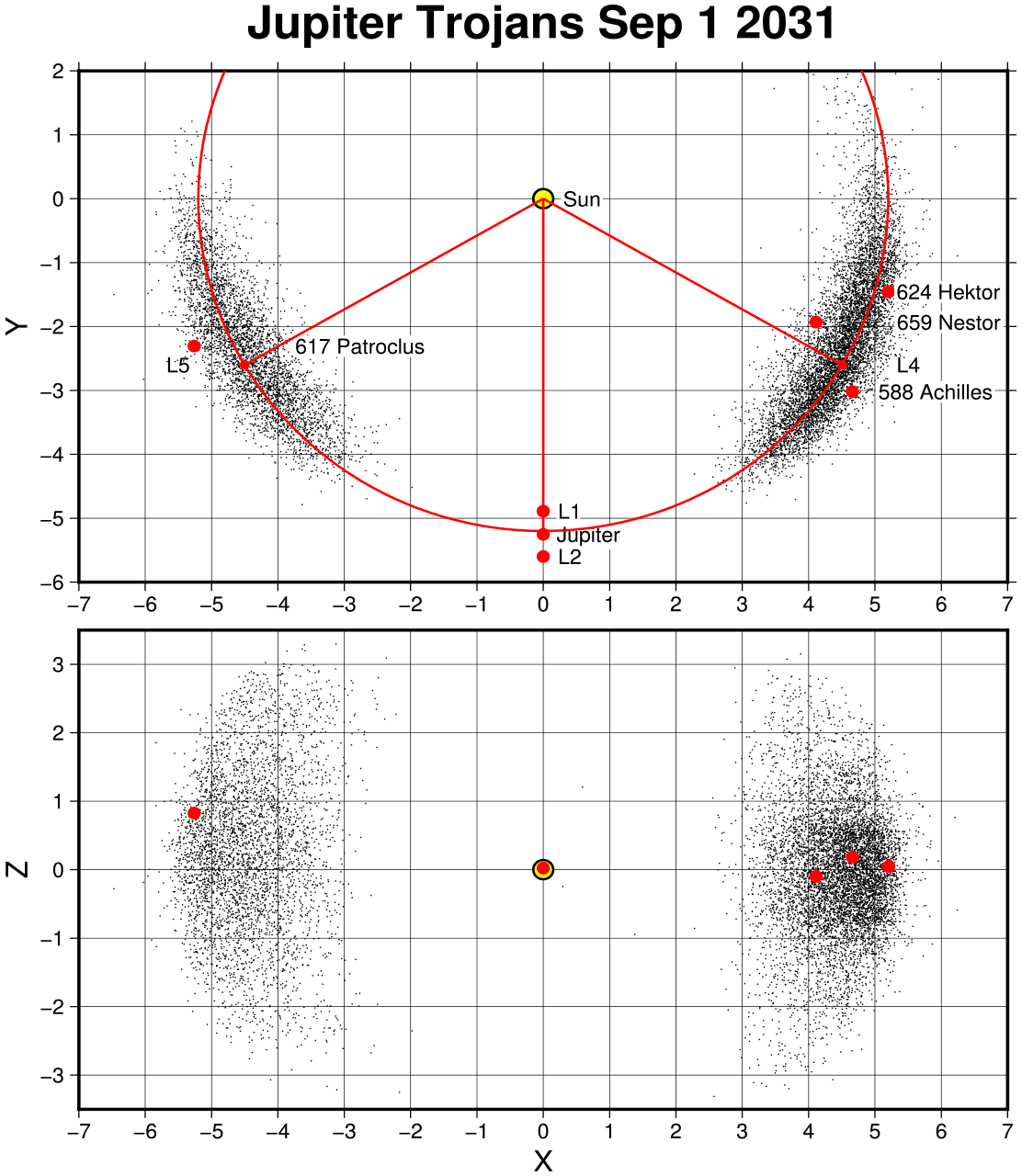
Position of 11552 Trojan asteroids on September 1, 2031. View from above ecliptic north pole is at top, view from first point of Aries at bottom, scale in both is AU. The L1–L2 collinear Euler-Lagrange points near Jupiter are shown in the top view, however the L3 point is out of view at X = 0 and near Jupiter’s nominal orbit (circle of 5.2 AU diameter centered on the Sun’s exaggerated disk at X = 0, Y = 0) near Y = + 5.2 AU. For clarity the points are labelled with their number not subscripted. The triangular leading (L4) and trailing (L5) Lagrange points, and the first four Trojan asteroids found, are labelled at their Y value for minimal obscuration of other bodies. There is no labelling in the bottom XZ view, but bodies share X positions with those in the top plot. The true positions of Jupiter and the L1, L2 points are shown, which are slightly displaced from the nominal circular orbit positions. The relative positions shown are similar to those at the time of initial discovery of Trojan asteroids in 1906. 16 Trojans of very large libration amplitude are not shown in the XY view, while one Trojan of large inclination is not shown in the XZ view.
Lagrange’s triangular solution, in the idealized or “restricted” three-body problem, with circular orbits, has the smaller bodies at positions forming an equilateral triangle with the planet and Sun; in other words, as viewed from the Sun, these positions are 60° ahead of (leading or L4 point) or behind (trailing or L5 point) the planet in its orbit. Conventions about numbering of Lagrange points now seem well established, but some earlier work notably reverses the numbering of triangular points. The planet and Trojans orbit the center of mass (very close to the Sun) counterclockwise when viewed from the north as in the top panel. A new orbital class was recently found which surprisingly allows stable gravitational interaction with Jupiter for a small body orbiting clockwise 16 near its orbit.
Although Figure 1 shows a snapshot of positions in a fixed (inertial) coordinate system on a given date, it is also common to represent Trojan positions, and do the associated solutions involving pseudo-forces, in a noninertial corotating system. 17 The triangular points allow stable motion of a small body under the influence of the Sun and planet if their mass ratio is less than approximately 0.04. Lagrange considered only the ideal case of motion exactly at the designated points, although he did suggest that small deviations from the ideal case could be solved for by approximate methods. 18 Lagrange thus did not investigate stability, perhaps due to considering the triangular solutions as being only idealizations. The stability of the Lagrange points means that Trojan asteroids may move near them in librational motion 19 in looping paths as seen in the corotating system. The period of such libration varies with its amplitude but is roughly 125 years. Figure 1 thus very roughly shows positions about one libration period after the time of initial Trojan discoveries and reproduces the orbital geometry then. The year 2031 is also close to that at which the Lucy mission has an Earth encounter after having encountered four L4 asteroids, to switch to exploring the L5 point with an encounter with 617 Patroclus (and its now-known moon) in 2033. 20 It is also clear from Figure 1 that the leading L4 point has more members (7508 known as of January 2022) than the L5 point (4044) in a ratio of nearly 2:1. With so many Trojans now known this imbalance appears to be a dynamical rather than observational phenomenon. 21
Comets and their dynamics were very well known in 1772, that of 1680 having been investigated in detail by Newton in Book III of the Principia. 22 Their elongated orbits would not have led one to expect them to be found at Lagrange points. Asteroids were discovered only in 1801, 29 years after Lagrange’s publication, although well before his death in 1813. The author has found no evidence that he at that time drew any connection to his earlier result. Thus, in 1772 there seemed to be no candidate objects to be located at Lagrange points. Lagrange himself stated that his special solutions were purely of theoretical interest (“Cette recherche n’est à la vérité que de pure curiosité”) and would not exist in the real universe (“ces cas n’aient pas lieu dans le Système du monde”). 23 In the Essai, Lagrange generalized from the ideal solutions to the case then known to take place, that of the Sun, Earth, Moon system, with one of the bodies very far away. This allowed addressing the general topic of the prize, the lunar theory. His assumption about what really existed in the “Système du monde” was not to be disproved until 1906, when the first Trojan asteroid was discovered and recognized, associated with the planet Jupiter.
Systematic astronomy
The observational path toward the discovery of Trojan asteroids may be considered to originate with the discovery of the planet Uranus on March 13, 1781. Although William Herschel was initially employed as a musician, he made systematic efforts in astronomical instrument design and observing 24 that made this discovery hardly accidental. The 16 cm aperture, 2.1 m long reflecting telescope he used was of such good quality that when he came across the planet while doing a star survey, he could immediately see its disk. It had been observed several times before, 25 as early as 1690, and recorded as a star. Herschel was not expecting to find the first planet since antiquity, and initially thought he had found a comet. Others had, however, worked on the systematization of the positions of planets in the Solar System, and about 1772 the Titius-Bode “law” had been published. 26 Uranus (eventually so named at Johann Bode’s suggestion) fit relatively well in the scheme, which also predicted that a planet must exist between Mars and Jupiter. Again, systematic searching was applied, this time to the zodiac where it was expected a planet must be. A novel international search initiative was organized by Baron Franz Xaver von Zach of the small German state of Gotha, effectively in the year 1800, creating an atmosphere in which another new planet was an anticipated result. 27
While doing a survey for other reasons, and initially unaware of the international search, Giuseppe Piazzi, assisted by Niccolo Cacciatore, discovered the first minor planet on January 1, 1801, in Palermo, Italy 28 using a 7.5 cm aperture refracting telescope mounted on a precision meridian circle. 29 It was subsequently numbered and named 1 Ceres, and later designated as an asteroid. It is now considered to be a dwarf planet but retains “1” as its minor planet number. It has the planet-like characteristic of having become spherical due to self-gravity, but by being in the asteroid belt and insufficiently massive it is not deemed to have cleared out its orbital zone. 30 Ceres was the final destination of the Dawn spacecraft, which also initially orbited Vesta, and is the largest (946 km diameter) although not brightest of asteroid belt bodies. 31 The nature of Ceres was subject to debate after its discovery, and it was initially referred to as a “planet.” The term “Planet” was still sometimes in use for asteroids in Germany over a century later, which is the timeframe of this article. William Herschel, upon discovery of the second asteroid Pallas in 1802, first published the term “asteroid” for these objects, which were of star-like appearance even in his new 120 cm aperture, 12 m focal length telescope, large for the era. 32 As the nineteenth century advanced, it was found that large numbers of such asteroids existed, mainly in a zone between the orbits of Mars and Jupiter.
The above endeavors in systematic astronomy were done with instruments quite different from those available a century or more later. Much of the technological development relevant to nineteenth century astronomy took place in Germany. 33 Early in that century, Joseph von Fraunhofer’s quality lenses allowed smaller reflectors like Herschel’s, with their speculum mirrors, to be replaced with refractors. About mid-century, the collaboration of Robert Bunsen and Gustav Kirchhoff, in Heidelberg, allowed fundamental advances in spectroscopy that are still commemorated at their workplace on its main street. Late in the century, silvered glass mirrors allowed yet larger telescopes to be built, with advantages that glass held its optical figure better than speculum metal, and silver’s much better reflectivity allowed detection of fainter objects. Advances in photography allowed observers to use dry plates of high resolution and sensitivity. Less emphasis has been given to the concurrent advance of mechanical and electrical technology in which Germany also led, but Figure 3 (below) shows a mechanically excellent driven equatorial mount which is a pinnacle of 19th-century engineering. The long refractor allowed the observer to make minor adjustments to the drive rate, for exposures that often lasted several hours. Although the German Empire or Second Reich 34 had external conflicts, and was internally politically dynamic, between the Franco-Prussian War from which it arose in 1871, and the start of World War I in 1914, it was a stable, prosperous, and even liberal state favoring the development of science. Such conditions encouraged research in astronomy, including new techniques in sky surveying, in which Max Wolf was a pioneer. Much as the discovery first of Uranus, and later of Ceres, that of Trojan asteroids arose from systematic astronomy.
Max Wolf as the premier astronomer of the German Empire
A casual survey of introductory astronomy textbooks shows that most mention Trojan asteroids, and several mention them in connection with Lagrange. One mentions the existence of only 15 Trojans despite being published in 1998 35 when over 200 were known. Only one book in this incomplete sample mentions Wolf in this context, 36 and further mentions his major contribution to asteroid surveys, although claiming that one “could simply aim a camera-equipped telescope at the stars and take long exposures,” which sounds far easier than it was in practice. We can conclude that Wolf is not a “famous” astronomer in English language material presented to university students. Predictably, this will change as the Lucy mission draws more attention to the Trojan asteroids in the next decade, with for example an outreach web page prominently mentioning Wolf. 37 In general, English-language material published about Wolf is sparse after some obituaries published upon his death in 1932. We detail here aspects of his life relevant to the Trojan asteroid work, first noting sources that may provide other details.
Raymond Dugan’s short 1933 combined biography and obituary 38 of Wolf begins by quoting (in German, author’s translation follows) the praise Wolf gave in his obituary 39 of E. E. Barnard: “He was a virtuoso in seeing and measuring, he had a talent for recognizing the new that others carelessly overlooked, and he had, as his best characteristics, iron diligence paired with indestructible enthusiasm for research.” Dugan, who had worked with Wolf many years previously, and corresponded with him throughout his life, found that these words applied to Wolf equally. A shorter obituary in English is that of Hector McPherson, 40 who noted his “charming personality” in addition to his scientific achievements. In addition to these brief sources, the presentation address of the Royal Astronomical Society Gold Medal from 1914 gives a slightly lengthier description of Wolf’s notable work up to that date. 41 Perhaps the longest biographical sketch in English accompanied the award of the Bruce Medal in 1930, near the end of Wolf’s life. 42 It emphasizes the breadth of his work, and a systematic approach in fields including nebulae and proper motions, also evident in asteroid search programs. This summary includes mention of his spectroscopic work, including that on Wolf-Rayet stars, although not mentioning that these are named for the French astronomer Charles Wolf. (The other well-known Wolf term is the sunspot number named after Swiss astronomer J. R. Wolf). Max Wolf’s studies of stars with high proper motion, discovered with comparator techniques co-developed by Wolf and similar to those used for asteroids, resulted in a catalog of 1053 stars which now bear his name. Further details about Wolf’s Bruce medal award are given in a short summary which also includes material allowing insight into his admirably modest character. 43 A German-language article with many photographs marked the 150th anniversary (2013) of Wolf’s birth. 44 A book-length 1962 treatment in German 45 is part of the series “Grosse Naturforscher” 46 aimed at a semi-popular audience. The author, Hans Christian Freiesleben, 47 was a student of Wolf’s at Heidelberg’s Ruprecht-Karls Universität, and apparently did extensive archival work there, with not all sources directly indicated in the book. Where this book is a source of information here, his name will be referred to rather than supplying a further endnote. The present author had a brief visit to the university archives, and some of their material is available online. An English-language review of Freiesleben’s book provides some highlights 48 but has a few small errors.
Heidelberg is a historic mid-sized city in the valley of the Neckar River in southwestern Germany, about 20 km from its confluence with the Rhine at Mannheim. Since World War II, the Land (state) in which Heidelberg is found has been called Baden-Württemberg, but historically it was Baden, a duchy within Germany in its various political forms. Wolf was born in 1863 into an upper middle-class Heidelberg family, which allowed him to indulge an early interest in astronomy to the extent of having a home observatory (Figure 2) equipped with a 15 cm telescope and astrographs (Figure 3). Working with this pair of fast astrographs guided using the ocular of the 15 cm telescope visible at lower left in the figure, Wolf made the first photographic discovery 49 of an asteroid, later given number 323, on December 22, 1891. A portion of the discovery plate is shown in Figure 4, with the magnitude estimated as 11.8 in visual follow-up by J. Palisa in Vienna on December 31. The announcement noted that two objects had been found on photographic plates taken on sequential nights, but that the second was thought to be 275 Sapienta, while the first was new. This discovery helped Wolf in later important activities leading to the establishment of what is now the Landessternwarte (State Observatory) Heidelberg-Königstuhl on the Königstuhl (King’s Chair) mountain near the city, 50 with its altitude (556 m) allowing a fuller sky view and better conditions than in the valley. In obtaining the new observing facility, Wolf’s engaging personality and clear ideas about his goals played a major role. Already in 1891, working in his home observatory with his portrait cameras mounted on the 15 cm “6-Zöller” guide telescope, he could see the advantages of attracting the patronage of wealthy, elderly American heiress Catherine Wolfe Bruce, 51 who supported libraries and astronomy. The aforementioned asteroid 323 provided such an opportunity. No attention was drawn to the fact that this was the first asteroid discovered using photography when it was announced the following July 52 to have had its name chosen by Wolf as “Brucia”. It was thus in 1892 that Wolf began corresponding with Miss Bruce, although on a trip to America in 1893 he was unable to visit her. Nevertheless, in 1894 she contributed $10,000 for the construction of the telescope which bears her name. This was installed in 1900. The donation played a role in Grand Duke (Großherzog) Friedrich I of Baden sponsoring the observatory, originally opened as the Großherzogliche Bergsternwarte (Grand Ducal Mountain Observatory) in 1896. The Astrometric Division opened at this time was headed by the older astronomer Wilhem Valentiner 53 (1835–1931), best known for editing and contributing to the “Handwörterbuch der Astronomie” (Dictionary of Astronomy). 54 He had a long history of making astrometric measurements and had been associated with Baden astronomy for many years, having been the final director of the Mannheim Observatory and moving in 1880 to Karslruhe about 80 km to its south. Although he did meridian circle observations there, a satisfactory observatory was never built, leading to his relocation to Heidelberg, where most of his work was done with meridian circles no longer at the site. In 1897, the Astrophysical Division opened with Wolf as its director.
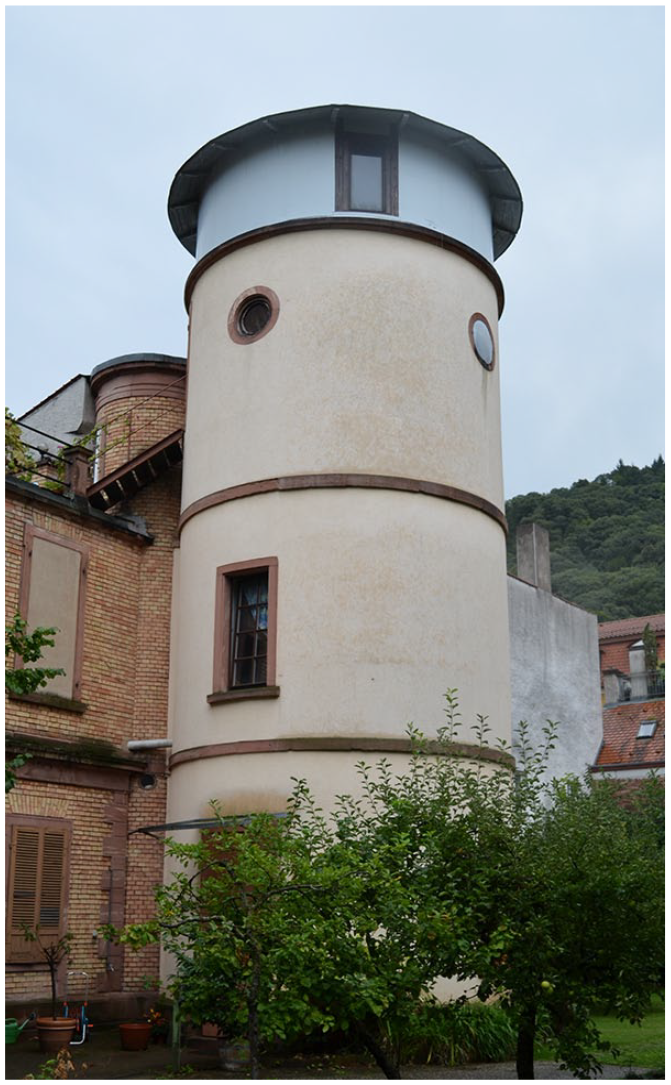
The original observatory in the Märzgasse in Heidelberg, now part of a private dwelling. Photo by author.
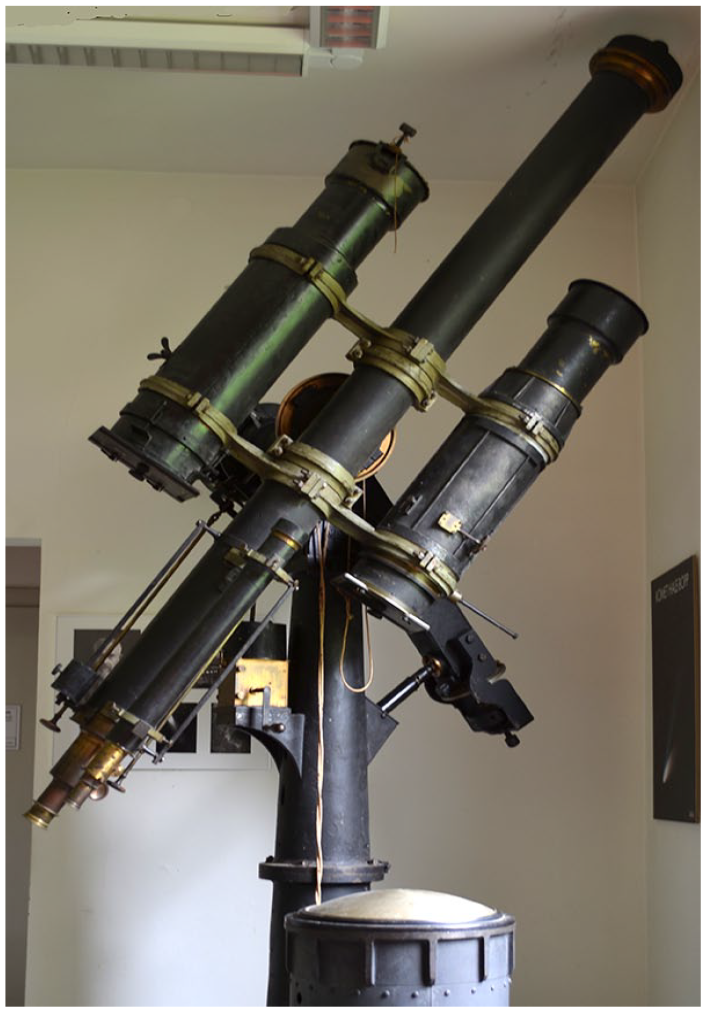
Max Wolf’s astrographs and central 15 cm guide telescope with one of two original lenses from the Bruce telescope at bottom. Photo by author.
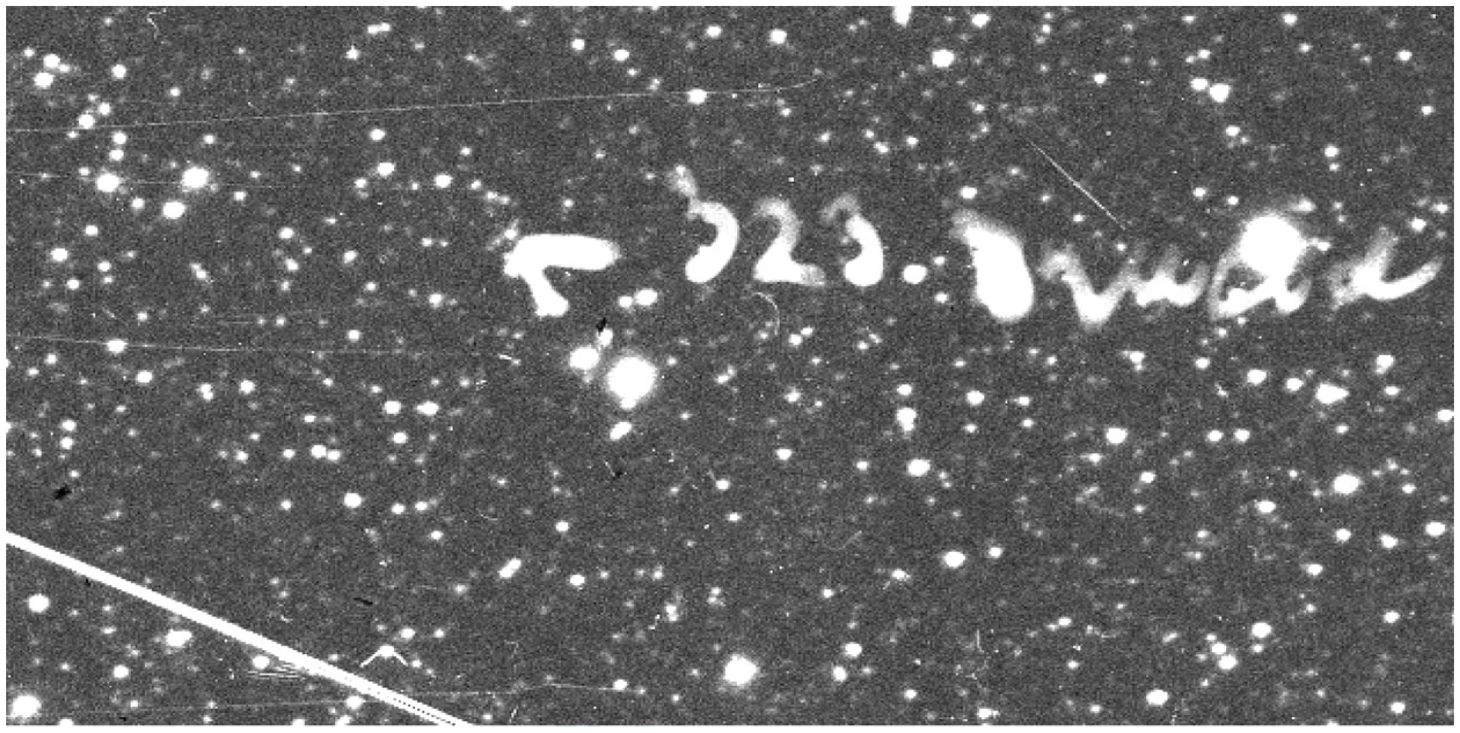
Small portion (about 2° × 1.5°, N at bottom) of the digitized discovery plate of asteroid 323 Brucia, one of a pair taken on December 22, 1891 from Wolf’s home observatory. The annotation would have been made later, and the asteroid appears as a short streak near the tip of the white “V” in the ca. 1 hour exposure. The star 36 Gem, near the right and written on, is of magnitude 5.27. Streak at lower left is a fracture in the glass plate. (Credit: HDAP).
In contrast to Valentiner’s positional astronomy, where long focal length was an advantage and narrow field of view not a serious obstacle, Wolf saw the value of fast lenses and use of photography as enabled by them for studying nebulae 55 and searching for asteroids. 56 His methodology 57 was aimed at finding asteroids and determining their orbits, with the pragmatic explanation that “In the hunt for new planets, photography has exceeded all expectations. . . On the other hand, it has been shown that in the verification and tracking planets already photographed, . . .The participation of an observer is therefore more desirable than ever.” In practice that visual observer was often Johann Palisa 58 (1848–1925), a very successful observer of asteroids who still retains the distinction of having discovered the most visually. Born in what is now the Czech Republic, he became at age 24 the director of the Naval Observatory in Pula, on the Adriatic Sea in what is now Croatia. Both locations then being in the Austro-Hungarian Empire, he moved to Vienna after the founding of its observatory in 1880 with the then largest (68 cm aperture refractor) telescope in the world. After 1890, 59 he switched his observing to being primarily follow-up for photographic discoveries, becoming a frequent collaborator of the younger Wolf by exchange of postal correspondence. In matters of orbit reduction there was also frequent contact with the Astronomisches Rechen-Institut (Astronomical Calculation Institute) 60 which at that time was in Berlin (since 1945 in Heidelberg). 61 A large amount of orbit and ephemeris calculation was done in a timely manner by Adolph Berberich 62 (1861–1920) there. This was published in the widely distributed Astronomische Nachrichten and also sent out by telegraph for follow-up by worldwide asteroid observers. In the three centers Heidelberg, Vienna, and Berlin, joined by efficient postal and telegraph services, a powerful method of photographic search, visual follow-up and astrometry, and orbit/ephemeris determination was in operation in the epoch of the Trojan asteroid discovery.
An important outcome of the Wolf-Palisa cooperation was the first photographic star atlas. The most popular basic atlas in the late nineteenth century was the “Bonner Durchmusterung” or “BD” published by Argelander in 1859 63 with completeness to the ninth magnitude. As much fainter minor planets were being discovered by numerous observers, the application of Wolf’s photographic prowess to making a star atlas which detailed much fainter stars was a timely idea. The charts were made between 1900 and 1916 and most of the original plates have been digitized. 64 The charts were printed on thick paper fit for use at the telescope and covered about 50 square degrees, similar to those of the BD. 65 The charts were sent by subscription, organized by Palisa. 66 Although the charts had varying exposure lengths and were not calibrated by magnitude, they went down to approximately magnitude 14, about 100 times fainter than the BD. Such charts could allow quickly identifying new objects, although in practice Wolf’s photographic approach consisted of looking for streaked images due to moving objects, as seen in Figure 4.
Wolf’s far-seeing plans also included having a larger instrument, a Zeiss reflector of 72 cm aperture and focal length 2.82 m (f/3.9). It, like the Bruce telescope, was underwritten by a wealthy widow, Katherine Bohm-Waltz of Karlsruhe, who was a relative of the Wolf family. Despite its fast optics, the field of view was small, and this instrument was meant for follow-up but also equipped for spectroscopy. It was among the world’s largest when it came into operation in 1906. Having played a large role in the founding of the Bergsternwarte, Wolf became its overall director in 1909 upon the retirement of Valentiner. The Astrometric Division had obtained new instruments, and Valentiner had also published observations of asteroids. However, the divisions operated relatively separately, and external collaborations contributed more to Wolf’s work.
After the Waltz telescope’s installation, Wolf’s observatory was rapidly overtaken by others, especially in the United States, in terms of instrumentation, but as he intended it nevertheless became one of the foremost in the world in asteroid discovery. With advanced photographic and search techniques enabled by its instruments, and reduction techniques that included an early stereoscopic comparator, 67 the observatory had discovered 316 asteroids by 1914. In 1913 it found 32 of the 88 new asteroids discovered. Wolf’s work spanned many areas of interest in the early 20th century, but a common theme was the rapid application of modern imaging techniques, at that time photography and plate scanning. 68 Some early methods of Wolf’s are described in English in considerable detail by Holden 69 : by the early 20th century these techniques had been yet further advanced. Freiesleben points out that the close cooperation with Johann Palisa indeed allowed rapid visual follow-up of asteroids discovered photographically and with mechanical aid by Wolf’s group at Heidelberg, ensuring being able to properly determine orbits.
Before moving on to Wolf’s discovery of Trojan asteroids, I present biographical material in English allowing some insight into his character. He was at one time a close friend of the prominent “Deutsche Physik” Aryan science proponent and Nazi supporter Philipp Lenard, 70 who having won the Nobel Prize in 1905 was a prominent member of the university. It is thus germane to ask about Wolf’s political leanings, especially since German astronomy, and Wolf personally, suffered greatly from World War I. A timid onsite inquiry into this brought the answer from a Heidelberg librarian that “1932 was a good time to die” implying that someone with fascistic tendencies would have revealed them with the end of the Weimar Republic and emergence of the Third Reich in 1933. Freiesleben states that some letters from Wolf’s youth had antisemitic statements but that such sentiments were common in the bourgeois classes of Germany in the late nineteenth century. An incident likely involving Lenard made Wolf’s broader adult views clear. In a series of lectures promoting “Pure Science” in the Berlin area in 1920, in the context of attacking relativity and Einstein in an antisemitic environment, Wolf was listed as a future speaker. 71 Wolf wrote an apologetic letter 72 to Einstein mentioning a visit from the organizer, Paul Weyland, 73 in which Wolf’s admitted reservations about the general theory of relativity seemed to have been transmuted into his name appearing on the speaker list. The letter began “Zu meinem Schrecken” (“To my horror”) and clarified that despite his scientific reservations, his new tests on plate measurement seemed to indicate that the eclipse measurements likely were correct, a point followed up in a publication. 74 He also pointed out that he had communicated to Weyland that his name should be removed from the list of speakers, in an overall very apologetic and respectful letter.
Wolf was internationally known and respected by the turn of the twentieth century. He had played a major role in development of the Heidelberg Observatory with its very purposely chosen and effective instruments, and in developing observational techniques which for general use included astrophotography with large fast instruments, and perfected methods in asteroid searching in a highly fruitful manner. He had been successful in attracting sponsorship yet avoided the dangerous political controversies developing in Germany. The German Empire, also known as the Second Reich, was proclaimed at Versailles, then under German occupation, on January 18, 1871. 75 Wolf’s early astronomical activities took place in the Dukedom of Baden which was part of this confederation of German states, and his accomplishments peaked in pre-World War I days. It can be fairly claimed that he was the premier astronomer of the German Empire at that time, at least among those doing observational and instrument development work. Later years proved trying, however.
Already before the war, Wolf seemed to suffer from self-doubt. A letter to Charlier written in January 1913 in an initial attempt to refuse an invitation to speak in Stockholm gives much insight into this aspect of his character. 76 It claims that such a visit would be an embarrassment and that in any case Wolf could no longer speak Swedish, so could not lecture in the language. Listing his failings, especially in mathematical areas, he concludes: “You have no idea at all, how stupid I have become.” His summary of his life to that point was that “it is nothing for one who has a talent for measuring, photographing, and building instruments to become an astronomer. Without mathematical gifts (however) the scientific life will be a constant self-torture and make him unhappy. I did not know that earlier, and my passion for the stars was too great. However, it was a mistake, for which I must atone.” 77 Freiesleben (p. 139) states that the war was unexpected for Max Wolf, as for many intellectuals. Shortly before its beginning, Wolf had a director’s house built at his own expense, and usually lived on the mountain. Shortages of coal in wartime meant that wood from local forests was used for heating. Food itself was inadequate, and as a smoker, Wolf often lacked tobacco. Wolf continued to work, often without assistants, while worrying about those who had been sent to the front. Despite these hardships, Wolf discovered Alinda, the second known (after Eros, discovered in 1898) near-Earth asteroid, in 1918. 78 Freiesleben (p. 94) detects extreme mood changes in his notes at this time, ranging from “the greatest embarrassment of my life. . .I am judged” in seemingly mistakenly finding a moon orbiting Alinda, to “a consolation in misfortune. Thank heaven” the next day upon discovery of a nova.
The difficult war years ended with the collapse of the Empire through abdication of Kaiser Wilhelm II and the founding of what was often then called the German Republic on November 9, 1918. This is usually now referred to as the “Weimar Republic,” with the signing of the World War I armistice on November 11, 1918 only one of many events leading to its political stabilization in following months. However, numerous factors led to extreme economic decline. This led to further hardships for research and for astronomy, with, for example, photographic plates becoming hard to obtain and of lower quality than before the war. Despite Wolf’s international reputation and many friends abroad, Germany was excluded from many international activities, and specifically not allowed to be a member of the International Astronomical Union 79 at its founding in 1919. Wolf worked intensively for inclusion, although some internal resistance came from Germany’s Astronomische Gesellschaft, of which he was president in 1930–1932. Wolf’s colleague in Trojan discovery August Kopff (1882–1960) presented to the IAU in 1932, during Wolf’s terminal illness, asking for German membership. However, it appears that financial issues did not allow this, and (West) Germany was admitted only in 1951 (East Germany in 1962: since reunification in 1990 there is only one Germany in the IAU).
Passing away on October 3, 1932, Wolf lived the declining years of his life in a troubled republic, at least missing the formation of the Third Reich the following year. His accomplishments peaked in the pre-war years with the establishment of a world-class observatory and numerous astronomical discoveries. Already unsettled in personal feelings at that time, he looked back in 1931 (Freiesleben, p. 154) to a time when he “stood in the first place in astrophotography. . .meanwhile we no longer have a big part in putting up new instruments, while the Americans have built up their equipment to undreamed of levels. Because of that I can no longer compete.” In another letter he wrote that “the investment for the Mount Wilson Observatory was already 100 times bigger than for ours, even in the pre-war years. So that’s it.” A lasting achievement from his brief occupation of a top position among the world’s astronomers, and one arising in a natural way from his systematic developments in astronomical equipment and techniques, was the discovery of the asteroid class we now know as “Trojans.”
Discovery of Trojan asteroids
In the course of routine survey observations on February 22, 1906, Wolf and Kopff discovered four asteroids 80 using the double Bruce astrograph (Figure 5). Wolf himself discovered what was denoted in the system of the time 1906 TG, drawing attention to its small movement in right ascension (Figure 6). This small motion arises from Kepler’s third law for an object near the distance of Jupiter as compared to the closer main belt asteroids commonly discovered. At the time of discovery, 1906 TG was nearly in opposition: the anti-sunward region of the sky is optimal for asteroid searches since objects there show near-full phase and are about as near as possible to Earth, making them brighter. Wolf’s method relied on looking for streaks on photographic plates, and at this point the apparent motion of asteroids is rapid although retrograde, making a longer streak than at other positions along the orbit. This object was near, but not exactly at, the Jupiter L4 Lagrange point, preceding Jupiter by about 70° in their nearly common orbit. This was not apparently realized at the time of discovery, when most asteroids being found were main belt objects. In May of 1906, Berberich used the original observation plus optical observations from Vienna on March 5 and April 13 to determine an orbit, 81 making the great distance of the object “sure,” and noting that since it never had nor would come near Jupiter, it had been in that orbit for a long time.
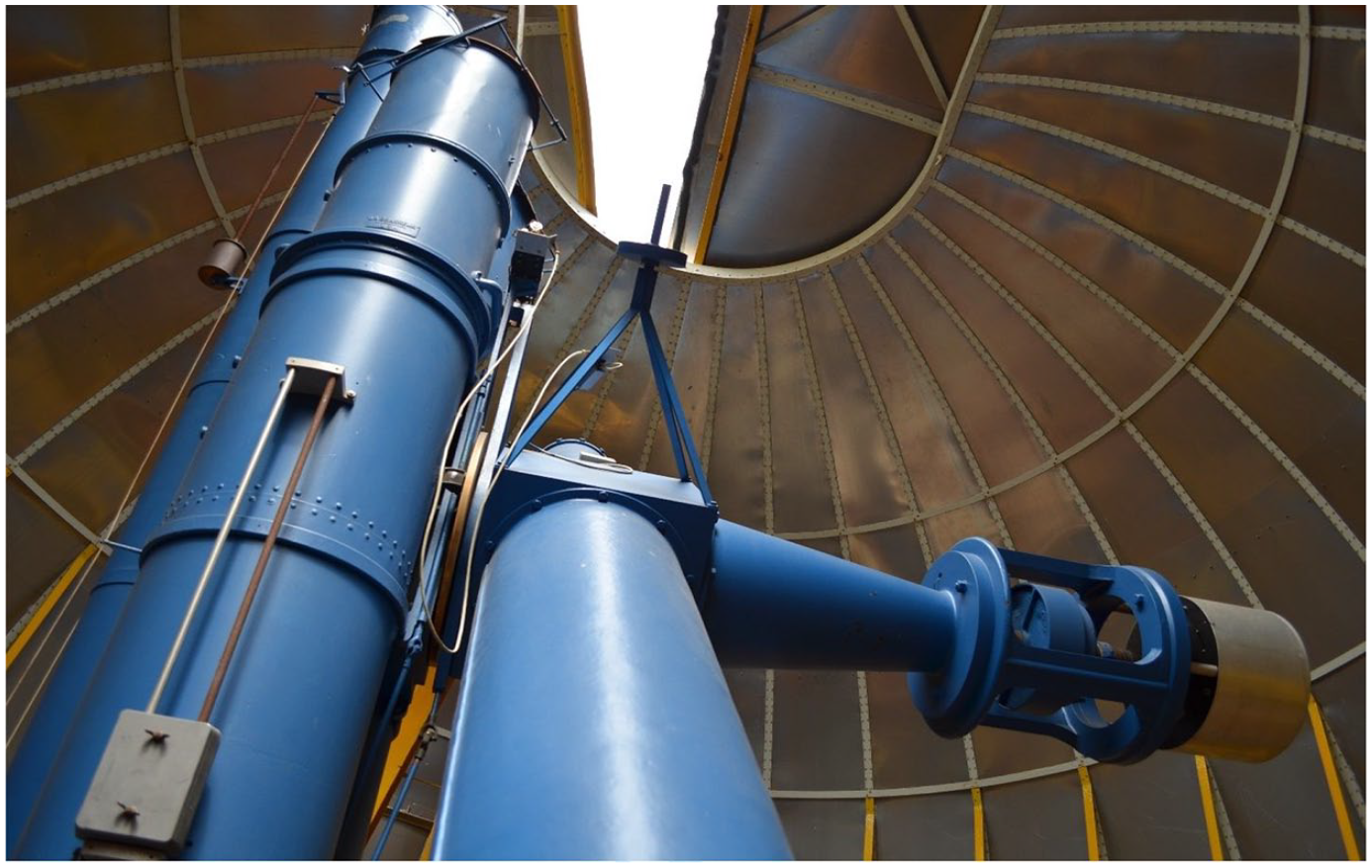
View of the Bruce double astrograph looking north along the polar axis, the northern pillar and the further telescope of which are not clearly visible. The front tube and its unseen twin have 40 cm aperture f/5 lenses (see Figure 2), while the guiding telescope to its left is of 25 cm aperture and 4.15 m focal length. Photo by author.
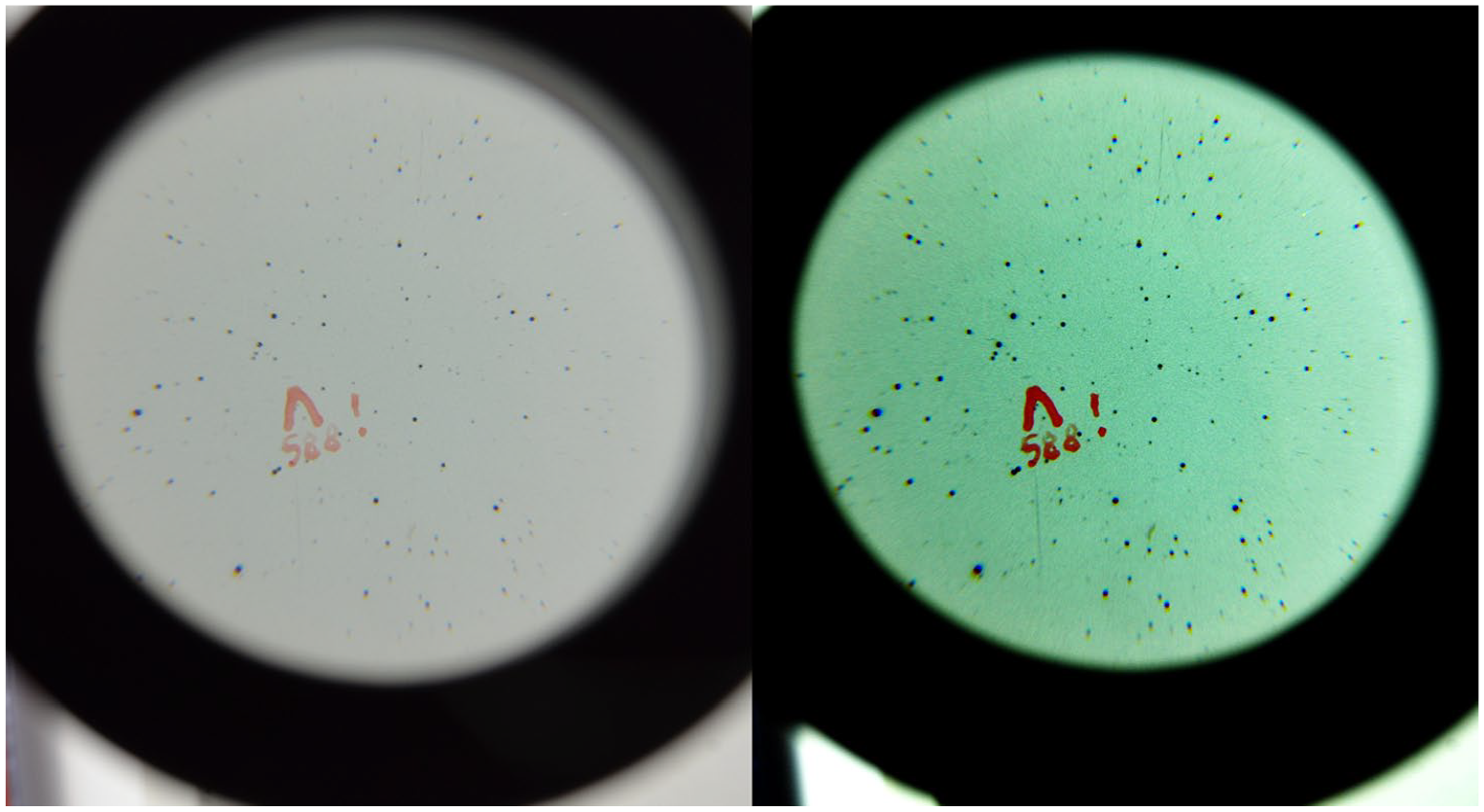
Small part of the discovery plate of 1906 TG (588 Achilles) as viewed through a magnifier. The right panel is a digitally contrast-enhanced version of the left panel on which a small streak near the tip of the “V” is more visible. The annotation would have been added later. Photo and processing by author.
It is unclear to what degree the Heidelberg observers were initially aware of the three-body solution of Lagrange. Certainly, they were aware of important methods in perturbation theory of asteroids which are an important part of Lagrange’s overall works on celestial mechanics. However, one person was very well placed to interpret the new discoveries: the Scandinavian astronomer Carl Ludwig Charlier 82 (1862–1934). Having worked on observations early in his career, Charlier became director of the Lund Observatory in 1897. He later did extensive mathematical work in two main areas, celestial mechanics and statistics, the latter not only as applied in astronomy but more generally. He worked on stellar statistics at a time when this field developed in Sweden, contributing to studies of the structure and dynamics of our Galaxy. Charlier had recently published on the topic of stability of the Lagrange points in the three-body problem, finding that the triangular points should allow stable motion 83 and had just written a book, 84 Die Mechanik des Himmels, on celestial mechanics, the second volume 85 of which awaited publication in 1906, but introduced the currently used designations of the triangular Lagrange points. Already in a remarkable short article in May 1906, Charlier (1906) noted the great interest of 1906 TG, 86 in that its slow motion had been noted by the discoverers, and that its mean motion was very close to that of Jupiter. He pointed out that it was close to, but not exactly at, the triangular point, but that eccentricity and inclination of orbits would lead one to expect slight displacements from those points. He further gave a description of the epicyclic and librational motions that could be expected (the latter having period 148 years). Finally, he pointed out that since 1906 TG could belong to a new class of bodies, it would be a good idea to extend the search to the other Lagrange point. Despite the journal of publication, Astronomische Nachrichten, being under the editorship of Max Wolf, and published in Heidelberg, it is unclear what degree of credence was given there to Charlier’s rapid and correct interpretation of the situation.
Charlier sent a postcard from Lund, Sweden to Max Wolf on July 25, 1906, received the next day (Figure 7), in which he pointed out first a previous observation 87 of an object in a position where 1906 TG could have plausibly been in 1895. Calculations for large L4 asteroids suggest that the near-equatorial position of this object was well south of the Lagrange point, and it definitely was not 588 Achilles, as 1906 TG is now known. Having no doubt in his own mind that 1906 TG was the first known Lagrange point asteroid, Charlier further suggested that it be given the name “Triangula,” which would have emphasized the triangular aspect of the L4 and implicitly the L5 point. He notes that a larger number of observations would facilitate further calculations. Finally, he mentions hoping to see Wolf in Jena, although it is uncertain that they did meet. The name suggestion was not followed, nor has any subsequent asteroid been given this name.
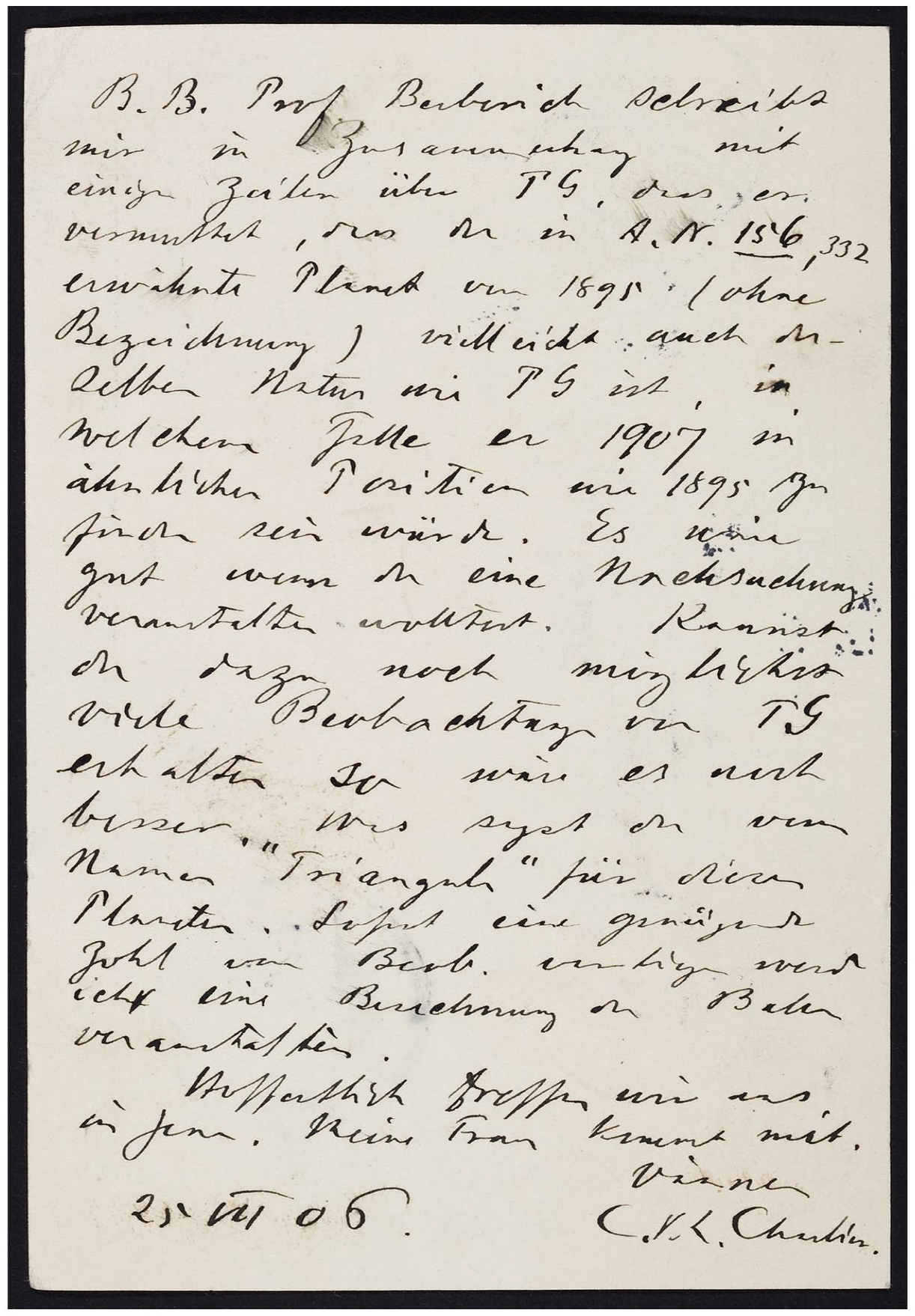
Postcard from C. V. L. Charlier to Max Wolf sent on July 25, 1906, suggesting the name “Triangula” (eighth line from bottom) for the first Trojan asteroid. (Universitätsbibliothek Heidelberg).
In turn, Charlier’s second volume of Die Mechanik des Himmels, although having its Preface signed on September 18, 1907, does not mention the three Trojan asteroids known by that date. The only real objects treated are in the outer main belt, in regard to use of the three-body problem in determining stability under the influence of Jupiter. He states (p. 89) that the Lagrange solutions mentioned above “found by Lagrange in one of his finest treatises, seem at first glance to be of only superficial interest,” supporting that with the same direct quote from Lagrange given above. This shows his great familiarity with Lagrange’s work, although in his own book it leads into a comparison of that approach with his own formal solutions of the three-body problem. Thus, if Wolf was preoccupied with observational work and little aware of theory, Charlier laid emphasis on theory while keeping abreast of observations. Wolf’s 1913 letter to Charlier compares their respective talents, with a self-critical view. It is possible that Charlier did not wish to include the Trojan class in a book due to inadequate observations in the short time since their discovery. It can nevertheless be fairly stated that he was the discoverer of the properties of Trojan asteoroids, and based on his 1906 articles and postcard, knew that 1906 TG was one.
Further discoveries and naming of a class
As the other Lagrange point eventually came into view, searches were conducted there in the autumn of 1906, whether as a matter of course or due to Charlier’s suggestion. The second Trojan was found by Kopff among seven new discoveries 88 on October 17, and designated initially 1906 VY, without any comments upon publication. It was near opposition and about 40° from Jupiter near the L5 trailing Lagrange point. On February 10, 1907, Kopff discovered 1907 XM, once again near opposition, giving a small daily motion but with no comments. 89 This attracted the attention of celestial mechanics specialist Elis Strömgren 90 (1870–1947), then working for the Astronomosiche Nachrichten in Kiel. He pointed out 91 on May 17, 1907, that this latest discovery, like 1906 TG, was near a triangular libration point, although 19° from it and of large inclination. The L5 discovery of 1906 VY was not mentioned, so that only two potential “Jupitergruppe” asteroids were posited by him as either possibly being held by Jupiter near its orbit, or as members of an outward extension of the asteroid belt. On June 11, 1907, Palisa sent a postcard (Figure 8) suggesting assigning names from Homer’s Iliad to the three similar asteroids. By using the term “Konsorten,” Palisa implied a relationship between the asteroids, although it is hard to tell if that was only in them being far from the Sun or related through orbital behavior in the Lagrange sense. The Heidelberg discoverers Wolf and Kopff promptly (June 21) indicated in the Astronomische Nachrichten that they were following this suggestion by Palisa in giving the names Achilles, Patroclus, and Hector: they did not mention the likely connection to Jupiter, but denoted them as “sonnenfernen Planetoiden” that is, far from the Sun. 92
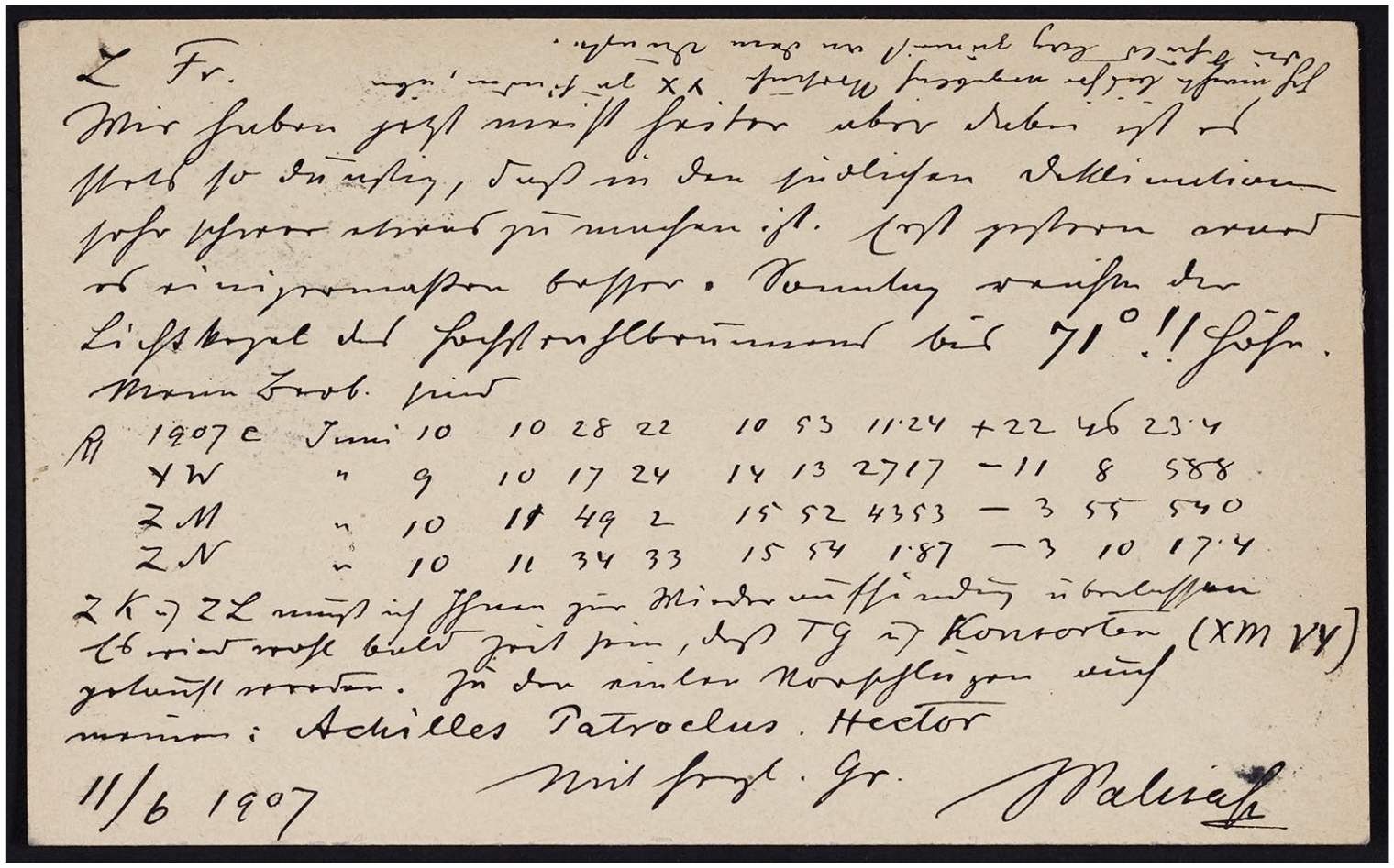
Postcard from Palisa to Wolf sent from Vienna on June 11, 1907 and received the next day in Heidelberg, suggesting names for the first three Trojan asteroids. The handwriting is in “Sütterlin” script, and the top two lines are upside down except for “L Fr.” meaning “Lieber Freund,” that is, “good friend” at top left. The bottom three text lines pertain to naming the Trojan asteroids. In printed German they read “Es wird wohl bald Zeit sein, daß TG und Konsorten (XM VY) getauft werden. Zu den vielen Vorschlägen auch meiner: Achilles Patroclus. Hector.” This freely translates as “It is soon going to be time to baptize TG and ‘consorts’ (XM VY). Among many suggestions (here is) also mine: Achilles, Patroclus. Hector.” (Universitätsbibliothek Heidelberg).
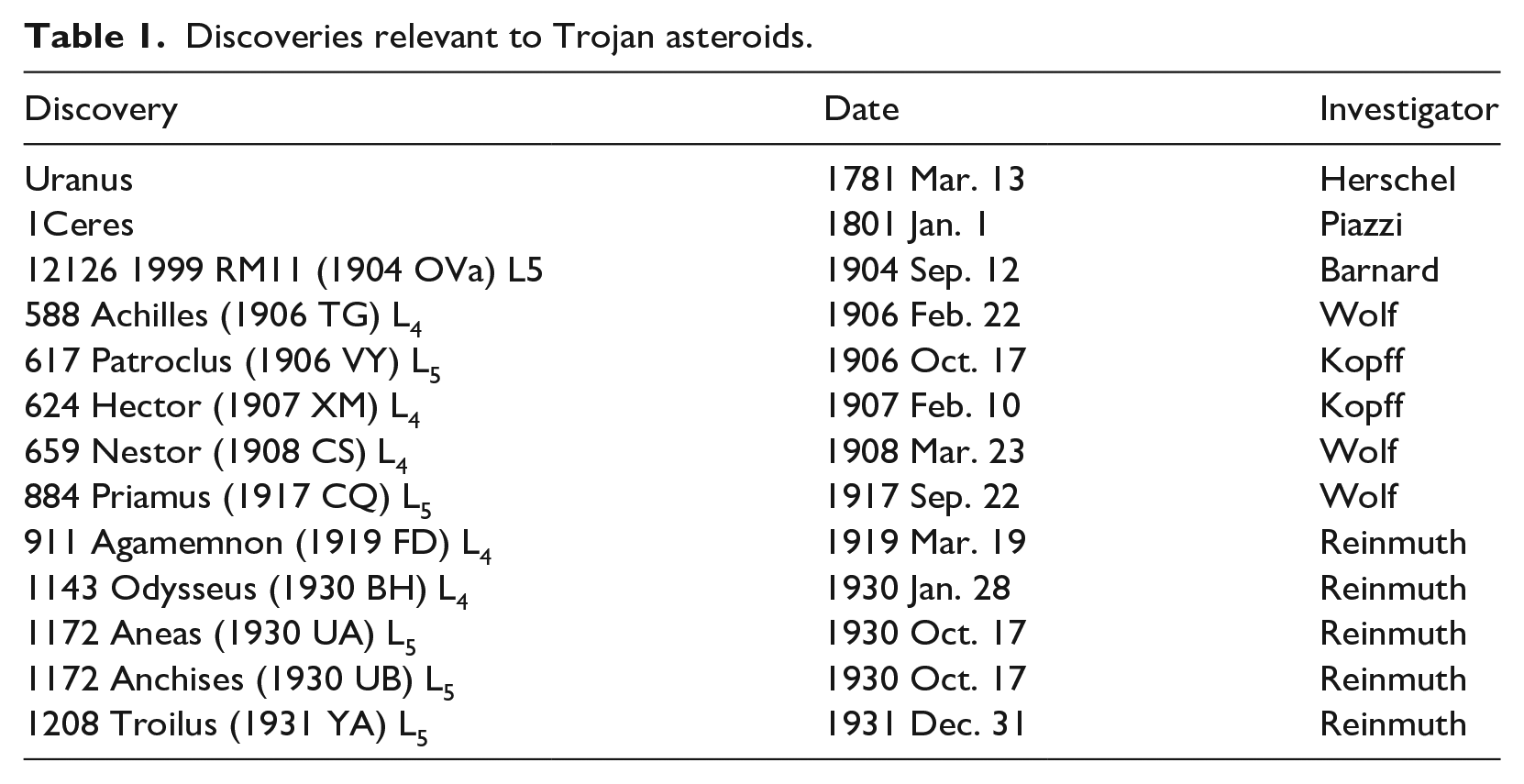
By the time of the naming, the orbit of 1906 TG had been well enough determined to assign its current minor planet number, with the name 588 Achilles. 1906 VY was named after Achilles’ dear friend or cousin Patroclus and later assigned the number 617, and 1907 XM was named for their mutual enemy, the Trojan Hector. Later, this latter asteroid was numbered as 624, and its name is now spelled Hektor. Subsequently, asteroids near the Jupiter L4 point have been named after Greek heroes, and those near L5 after Trojans. The early naming did not follow this later rule, so Trojan Hektor is near L4, while Greek Patroclus is near L5. Generically, the Jupiter Lagrange triangular point asteroids are now called Trojans: further it is understood that unless that term is modified by the name of another planet, “Trojan” means an asteroid associated with Jupiter. 659 Nestor, discovered by Wolf in 1908 as 1908 CS, without commentary, 93 was named according to this pattern as Nestor of Pylos was a “Greek,” but not until 1910. 94 Despite being considered “interesting” as a possible member of the “Achilles-Gruppe” and having an ephemeris calculated almost upon discovery, 95 Nestor was lost and only located again in 1917. 96 Although this issue will not be dealt with in detail here, the usual perturbation methods break down for resonant asteroids. This issue was brought forward in an article about the resonant Hilda asteroids, 97 already known in the period, which establishes also that as early as 1903 not only were the Kirkwood gaps well recognized, but also the existence of groups with similar orbital constraints through resonance. Further, the practice was to name these features after the prototype asteroid, in this case 153 Hilda. This is also the case for the asteroid families 98 discovered in 1918 by K. Hirayama, which being of collisional origin have no necessary connection to dynamically grouped bodies. Palisa’s suggestion broke with tradition as it used male names, where female or feminized names, often from mythology, predominated among asteroid names. The notable famous exception was near-Earth asteroid 433 Eros, although it had been preceded by 342 Endymion. The related names suggested by Palisa implied membership in a group despite the resonant nature of the grouping apparently not being realized. The “Trojan/Greek” pattern continued with the discovery of 884 Priamus (King of Troy thus in L5), Wolf’s last Trojan discovery, published without comment but clearly of interest due to numerous follow-up observations. 99 A new generation of asteroid observers came to Trojan studies with the discovery of 911 Agamemnon, 100 eventually named and properly placed in L4 as King of the Acheans (Greeks), by Karl Reinmuth (1892–1979) in 1919. By this time, Wolf’s discovery machine, despite the difficulties brought on by the First World War, was very productive, so the lack of comment about this object may simply be through difficulty in keeping up. It was nearly eleven years before Reinmuth again found a Trojan asteroid, by which time the nomenclature had become established, with the announcement 101 being under the name “Ein neuer Trojaner entdeckt” (A new Trojan discovered). The remaining Trojan discoveries before Wolf’s death are listed in Table 1.
Discoveries relevant to Trojan asteroids.
The interest of Wolf in the new class of bodies was such that the first asteroid imaged 102 with the new 72 cm Waltz reflector was the by then numbered but not named (588) [1906 TG], on January 22, 1907. The same observation was reported again 103 with emphasis on the capabilities of the new telescope, which could extend the detection limit by three magnitudes as compared to the Bruce telescopes. No comment was made on the nature of the asteroid. The Waltz reflector was not principally intended for asteroid search, but its light-gathering power made it useful for follow-up.
There are now over 6000 Trojan asteroids known with relatively well-established orbits, and over 12,000 in total. The current formal naming conventions 104 specify only “names from the Trojan War” for bright Trojans, while fainter ones are now named for Olympian or Paralympian athletes. 105 As no further bright Trojans may be expected to be discovered, presumably female characters from the Trojan War will not be able to be recognized with Trojan asteroid names, although several are among the “normal” asteroids, including some discovered before 1906. 106
The Lagrange theory is now widely known, and certain aspects of it are used in space navigation. Resonant motion is recognized as an important factor in solar system dynamics and cosmogony. Wolf’s systematic efforts in pioneering ways to find asteroids led to unforeseen riches in celestial dynamics, although at what point he may have become aware of the special nature of Trojan libration remains unclear. Ironically, it has recently been found that Wolf was not in fact the first observer of a Trojan asteroid.
E. E. Barnard and the pre-discovery observation of a Trojan asteroid
In a web page at the Minor Planet Center published in 1999, 107 Brian Marsden (1937–2010) pointed out that modern survey work had led to the identification of the Trojan asteroid 12126 1999 RM11 with an object observed by E. E. Barnard in 1904. It is fitting here to clarify the relevant literature and comment on the significance of Barnard’s observations. Indeed, this asteroid, with Barnard’s observation included, now has the longest data-arc span of any Trojan asteroid. 108
Barnard’s 1904 observations 109 were part of an ongoing attempt to improve the orbit of the irregular Saturnian satellite Phoebe, whose discovery on photographic plates (coincidentally taken on a 24″ telescope funded by Catherine Bruce) was announced by Harvard College Observatory 110 in 1899. Phoebe is an irregular retrograde satellite, and the announced magnitude of “fifteen and a half” made observations challenging. The preliminary orbit suggested that it could be found as much as 30′ from Saturn. Barnard specifically mentions that the best ephemeris appeared to be “in error because of the unusual motion of the satellite,” so that visual use of the 40″ refractor, then the largest telescope in the world, was suggested. Only in 1905 did Frank E. Ross 111 explain the confusing observational situation by convincingly demonstrating that the orbit was retrograde. To improve the Phoebe problem, Barnard’s task was to find it as a faint moving object near Saturn. Indeed, he did find such an object on September 12, 1904, but having nothing to do with Phoebe. Based on attempts to reconcile its position with the later ones of Phoebe, Barnard realized that he had observed an asteroid. In 1907, after the discovery of three Trojan asteroids and their designation as the “Jupitergruppe,” he published this inference, 112 but without making any potential connection. He posited that “the object was a faint asteroid . . . doubtless lost for good,” and that “Some time the position of this faint asteroid may be important and I wish to put the observations on record.” This diligence did enable later “recovery”, which took place 95 years after his observation.
This confirms Marsden’s conclusion that Barnard was indeed the first person to observe a Trojan asteroid. The context of the observation was not realized, although the best effort was made to preserve information for posterity. Ironically, among the Trojan asteroids observed by the time the group was named in 1907, the object Barnard eventually designated as asteroid 1904 OVa was almost exactly in the direction of the L5 Lagrange point (although closer to the Sun due to its elliptic orbit). One can speculate that finding a distant asteroid directly aligned with a Lagrange triangular point could have led to the discovery of the new dynamic class by Barnard. However, the search for an object (Phoebe) associated with Saturn did not allow attention to be drawn to the observed object’s link to Jupiter until the much later work by Marsden.
Discussion
To give context to the modern study of Trojan asteroids, I have made an attempt to lay out the relevant history of celestial mechanics from a time when it was purely descriptive, up to the present age. An intervening period with a geometric and mechanistic view has given way to an era of dynamical complexity which may be studied with capable instruments, advanced computing, and developing theories of chaos. The first Trojan asteroid was discovered possibly in ignorance of the elegant theory of Lagrange that predicted its motion, while in turn being regarded as a purely mathematical exercise by that géomètre. The modern seeker of new types of behavior in celestial mechanics has a powerful and generalizable set of tools available to guide the quest. Even so, there are new surprises around every corner.
The field of study opened by Lagrange and Wolf is now a very active and interesting one. The discovery of Earth’s rather exotic Trojan companion holds promise that yet more surprises await even in our small corner of the Solar System. While little emphasis here has been given to techniques of orbit computation, resonant asteroids posed challenges to the classical techniques. The work of Wolf was mainly in the observational field, with an exemplary fusion of instrumental innovation, early grantsmanship, systematic surveying, and organized follow-up through complementary observations and calculations. It may rightly be claimed that his techniques, including the fastidiousness with which he ensured, where possible, that observations would specify an orbit well enough for later recovery and further study, were the direct forerunners of the modern astronomical survey techniques now applied with much more capable instruments both on the ground and in space.
Footnotes
Acknowledgements
Funding
The author disclosed receipt of the following financial support for the research, authorship, and/or publication of this article: This work was supported by a Research Incentive Grant from Athabasca University in association with a Canada Research Chair. The web and “Horizons” services of NASA/JPL aided in studying asteroid orbits, and asteroid data was obtained from the Minor Planet Center. The Bibliothèque Nationale de France and La Bibliothèque Numérique de Lyon furnished digital scanned copies of original works. This work made use of the HDAP which was produced at Landessternwarte Heidelberg-Königstuhl under grant No. 00.071.2005 of the Klaus-Tschira-Foundation. Some digitized books were also obtained from the  website. Gifts of historic books by Schubart and Christopher Essex were received with thanks. Translations were facilitated by Google Translate as well as standard dictionaries, with Schubart reading difficult parts of the old Sütterlin script on some documents. I appreciated helpful comments from two anonymous referees.