




Abstract
In the cloister of the Patio de Escuelas Menores of Salamanca, there is a mural known as El Cielo de Salamanca (The Sky of Salamanca) depicting some Ptolemaic constellations, the Sun and Mercury. It is part of a painting (c. 1483–86) that was hidden for a century and a half. Rediscovered in 1901, it was moved to its current location in 1953. Those who visited it shortly after its completion describe it as a magnificent astrological vault. However, in 1960, Zinner stated that the mural was a representation of the celestial vault of an August day in 1475. This interpretation has been taken as a fact ever since. Here it is shown that it is a speculative proposal with many inconsistencies. The authors consider that the painting is an iconographic representation with astrological motifs depicting the planets in their houses or domiciles according to the Tetrabiblos. Based on this new interpretation, consistent with what was taught in Salamanca at that time, the article proposes what the original painting may have looked like.
Introduction
In the World Heritage city of Salamanca there is a relatively small cloister, the Patio de Escuelas Menores, where a vault popularly known as “El Cielo de Salamanca” (The Sky of Salamanca) stands (Figure 1). Some astrological motifs are painted there and in its central part, some, but not all the zodiac signs, can be observed. Because of that, when you visit the vault and notice your sign is not there, you may wonder why. 1
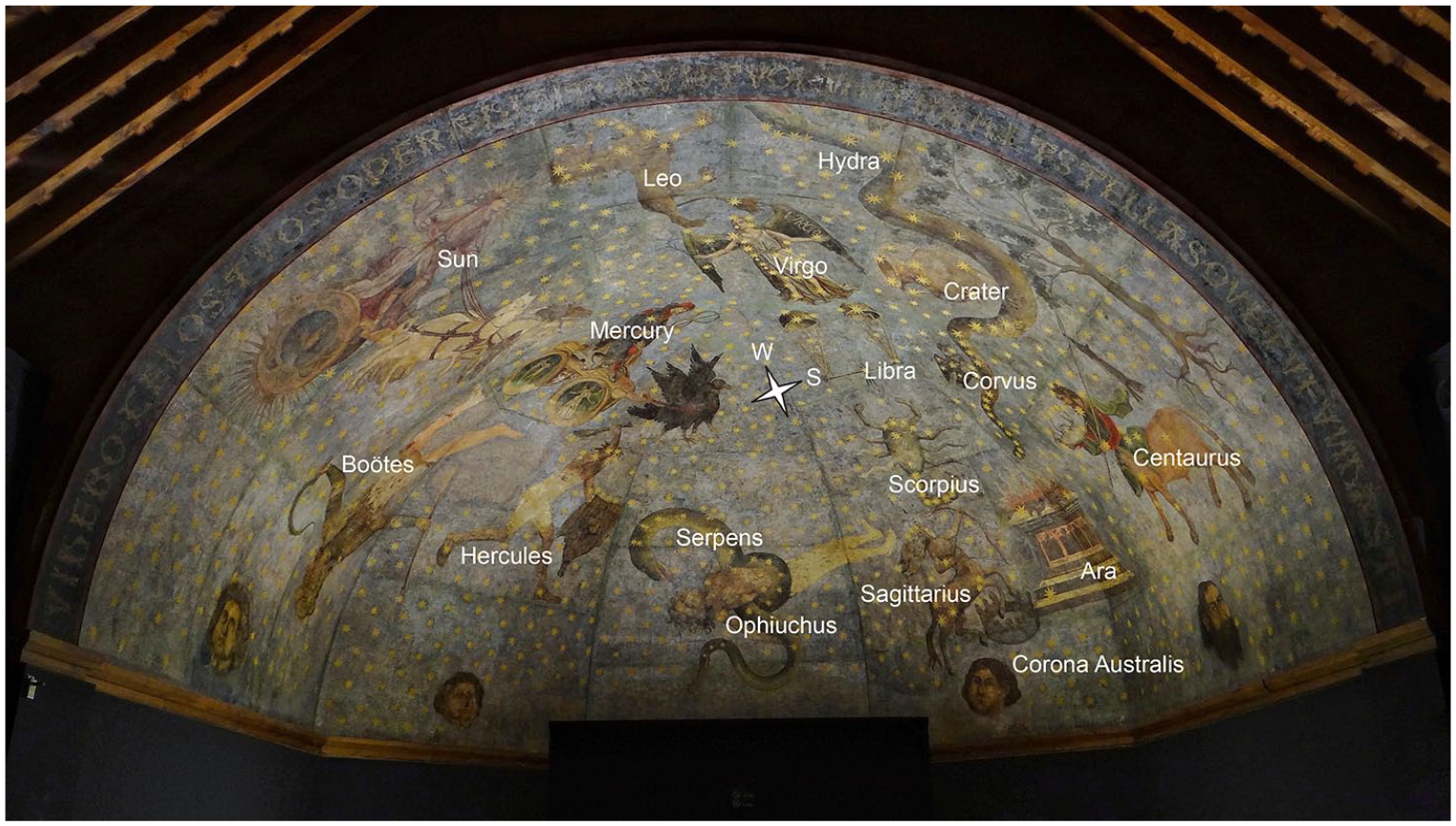
General contents of the vault.
To explain this, we must go back more than five centuries, when this painting was (c. 1483–86) in another place and its size was three times the size we see today. Its history is fascinating, and the interpretation of its meaning has been taken for granted on many occasions.
In 1901, in the Escuelas Mayores building in Salamanca, a hidden chamber in a false ceiling above the Chapel of San Jerónimo was discovered. A deteriorated mural covered the vault with what appeared to be hidden astrological motifs. Visual inspection showed that it was only a third of the original painting. 2
Its construction dates to the last quarter of the 15th century, a golden period for Astronomy/Astrology in the University of Salamanca. 3
The University library was built over the faculty chapel, crowned by a barrel vault divided into three sections. Fernando Gallego was commissioned to paint it by using a mixed technique of oil and tempera. The dates of execution were probably c. 1483–1486.
From 1503 to 1506, the library was moved and the level that separated it from the chapel was demolished (Figure 2). As a result, the vault crowned the chapel, but these modifications and the humidity affected the painting, and an unfortunate process of restoration was then carried out, even some stars were painted again.
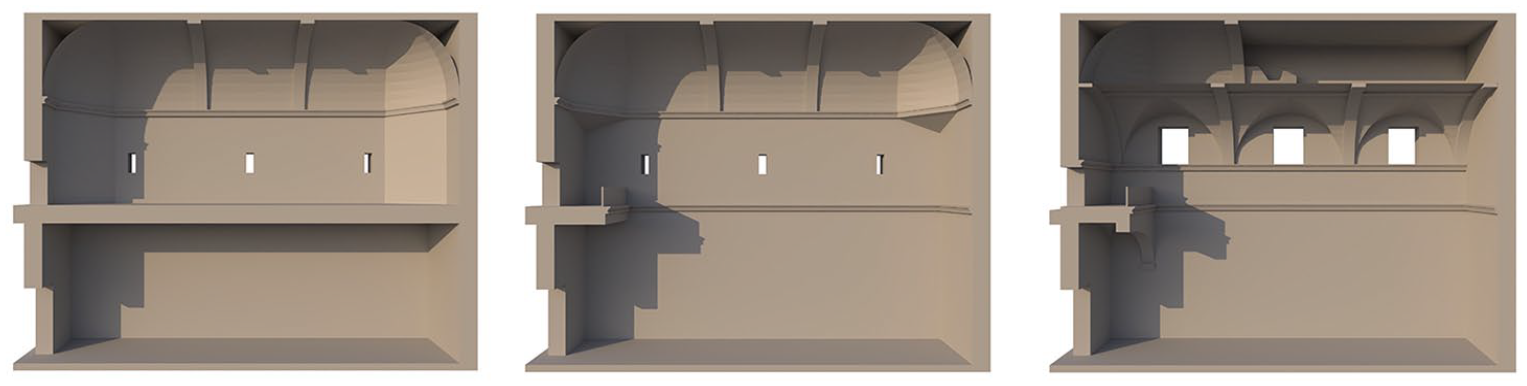
Recreation of the evolution of the library and the chapel. From left to right: 15th, 16th, and 17th centuries.
In 1761, the chapel of the faculty was renovated and although the initial plan was to destroy the original vault completely, approximately one third of it was hidden in a false ceiling and totally forgotten for a century and a half.
Rediscovered in 1901, it remained in a very poor condition until 1953, when the Gudiol brothers were commissioned to relocate it to its present location—in a wooden structure in the Patio de Escuelas Menores—using the strappo technique. Unfortunately, in the process some of the sinopias that were sent to the Gudiol’s workshop in Barcelona never made it back to Salamanca.
Since 1951, the painting has been known as “El Cielo de Salamanca” (The Salamanca Sky) which has given rise to the popular belief that it represents the sky, as seen from Salamanca.
There are no documents from the time it was created that describe in detail what it represents. Those who visited it shortly after its completion describe it as a magnificent astrological vault where the zodiac signs, Ptolemy’s constellations, and the planets (the Sun, the Moon, and the five visible planets) were represented.
In 1960, Zinner stated that the vault represented the celestial vault of an August day in 1475. This interpretation has been taken as a fact ever since and that’s the one written on the panel located in the room where the mural is currently located. However, the analysis conducted in this article shows that it is a speculative proposal with many inconsistencies. The authors therefore propose an alternative interpretation based on the Tetrabiblos, which is what Diego de Torres, a professor of astrology at the university, taught when the painting was made.
Description
We do not have precise information about the contents of the original vault, but from the brief descriptions of the period 4 we know that it featured the following:
(i) The seven planets, including the Sun and the Moon.
(ii) The 12 zodiac signs.
(iii) The 36 Ptolemaic constellations (21 boreal and 15 austral).
(iv) The 12 winds.
From all of them, the ones preserved in the present 5 vault are (Figure 1):
- An iconographic representation of the Sun, next to Leo, and Mercury, next to Virgo, riding a chariot.
- Five signs of the zodiac: Leo, Virgo, Libra, Scorpius, and Sagittarius. They form an arc that divides the distribution of constellations according to their hemispheres: four of which are boreal (Bootes, Hercules, Ophiuchus, and Serpent Caput) and six are austral (Hydra, Crater, Corvus, Centaurus, Ara, and Corona Australis).
- Four winds, located at the bottom.
The painting is said to have been done by Fernando Gallego. He captured this celestial information using a series of iconographic references. Several of his designs, previously seen on altarpieces, were adapted from some 1482 Venetian engravings, shown in the Poeticon astronomicon. 6 The similarities of the figures of the vault and the illustrations of the facsimile are evident (Figure 3).
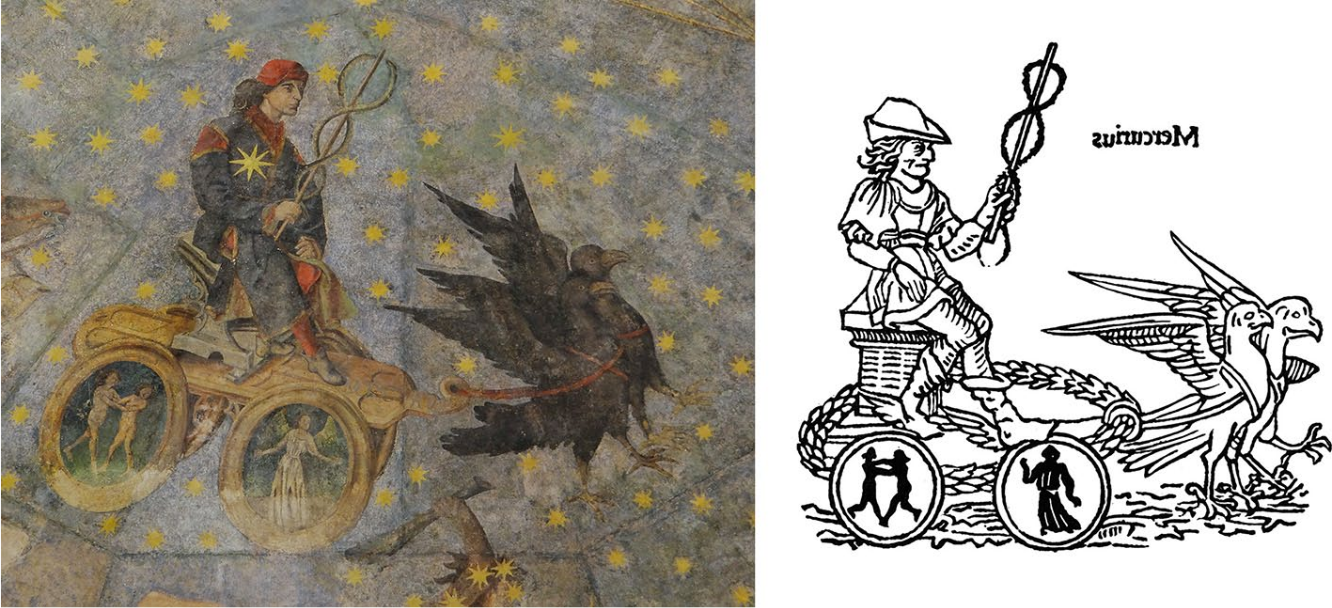
Comparison of Mercury based on the similarities between Gallego’s painting and the engraving of the Poeticon astronomicon (Venice: Gerhard Ratdolt, 1482).
The astrology chair and “El Cielo de Salamanca”
It is important to know the historical background of the painting. 7
Around 1460, a chair of Astrology was created in Salamanca University and occupied by Nicolas Polonio, who prepared the Tabulae Resolutae 8 for his students taking the meridian that passes through Salamanca as a reference. The Tabulae were an adaptation of Andreas Grzymal’s version of the Alphonsine Tables used at the University of Krakow. Polonius’s successors, such as Juan de Salaya (1464–69), continued to use them. He was followed by Diego Ortiz de Calzadilla (1469–1475) and by Fernando de Fontiveros (1476–1480). The next one was Diego de Torres, who had been linked to the University of Salamanca since 1469 as assistant to the chair of Grammar and Medicine and took charge of the chair of Astrology from 1481 to 1495.
Abraham Zacut, born in Salamanca in 1452, carried out research in astronomy becoming the best astronomer in the Iberian Peninsula although he never became a professor at the Salamanca University because of his Jewish background. He wrote in Hebrew ha-Ḥibbur ha-gadol (The Great Composition or Ḥibbur) edited in 1478 9 which was translated into Spanish in 1481 10 by Juan de Salaya. In the early 1480s Zacut moved to Extremadura and, after the expulsion of the Jews from Spain, to Portugal where the Almanach Perpetuum (1496) 11 was published. Ḥibbur and Almanach Perpetuum shared many tables in common and took the Salamanca meridian as a reference as well. Additionally, they agreed in many of the calculations 12 with the Tabulae Resolutae.
Diego de Torres was the professor of astrology in Salamanca University at the time the painting was being made. Although there is no direct evidence to confirm it, it is quite reasonable to assume that the painter was familiar with the professor’s work. His most important book is the Opus Astrologicum, 13 a text based on the Tetrabiblos or Quadripartitum 14 and Centiloquium, which are quoted several times in its pages. Furthermore, although he does not expressly state it, the tables he includes are based on the Ḥibbur. 15 As it is well known, Ptolemy’s Tetrabiblos was the reference book for the teaching of astrology in European universities in the 15th century.
Opus Astrologicum is an astrological text that mainly gives advice on judicial astrology and its applications to Medicine. Torres explains how to make a natal chart to judge the influence of the stars in a person’s life. He performs calculations regarding the planets’ positions in the zodiac signs, a normal thing to do in Astrology in the 15th century. But his text doesn’t include any examples where the calculations are related to the positions of the constellations. This is important as we will see later. He also collects some rules for predicting eclipses, calculating conjunctions, etc.
Therefore, considering the contents of the book and the astrological nature of the painting, it’s likely that the painter was advised by Diego de Torres.
A new library for the university was being built during this period and it was completed in 1479. The university then decided to paint its vault with astrological motifs, which was done between 1483 and 1486, probably by the painter Fernando Gallego. Since he’s not known for any other astrological paintings, he probably had to receive advice by a subject expert, most likely Diego de Torres.
The original painting represented the constellations included in the Almagest. 16 The celestial sphere is projected into the shape of the vault where the zodiac signs are placed at the center from west to east with 18 boreal and 15 austral constellations on each side.
Unfortunately, the Cloister Book of the University between 1481 and 1503, when the vault was painted and the years immediately after, has not been preserved. Nevertheless, those who visited the library shortly after the painting was finished indicated that it was an astrological representation of heaven. 17
Zinner’s interpretation
In contrast, “El Cielo de Salamanca” is nowadays considered to represent the celestial vault sometime in August 1475. As a matter of fact, in the enclosure where “El Cielo de Salamanca” is located, there is an explanatory panel 18 stating that the mural painting represents the configuration of the sky observable from August 15 to August 28, 1475.
The idea of associating “El Cielo de Salamanca” with an actual sky is due to Ernst Zinner (1886–1970), who in 1960 visited Salamanca University. In a short article that contains no references, 19 he concluded that what was represented in the painting corresponded to the sky around 6 August 1475. He argued that the painting could imitate 15th century mural paintings found in some Italian churches. Zinner said that he based his hypothesis on the position of two planets and that, to arrive at that date, he limited himself to the period 1473–93 as he believed it was then when the vault had been built and painted. Zinner needed to find a reason to justify his choice of date (6 August 1475) and looked for royal events such as birthdays, concluding finally that August 6 was the date when the University Library was inaugurated. However, that is incorrect: The opening date of the library was after 1479 and not in August 1475 and the position of the planets (Sun and Mercury) in the painting doesn’t correspond with the sky on August 6, 1475. 20
The same article also mentions that the astrology professor at the University is probably the one who would have calculated the position of what is represented, although he does not mention the name. The alleged calculator would have been Diego de Torres, but he, in his Opus Astrologicum, which he wrote while the painting was being made, makes no mention of such matter and neither do any of the professors after him. There is no document prior to 1960 stating that “El Cielo de Salamanca” represents the position of the planets in the celestial vault in commemoration of an event.
The historian Gisela Noehles-Doerk in 1992
21
assumed Zinner’s interpretation. She asked the astronomer H. W. Duerbeck to determine for the period 1474–1494 (which she says is the date range for the planning and construction of the library) a configuration where the Sun was in Leo, Mercury in Virgo and the planets Venus, Mars, Jupiter, and Saturn were not in the zodiacs Leo, Virgo, Libra, and Sagittarius respectively. He answered
22
: “If one starts from a memorable event from the time of the planning or construction of the library in Salamanca, then according to the position of the planets in the
He also showed the positions of the planets on August 20, 1475 (Table 1).
The planets on 20 August 1475.
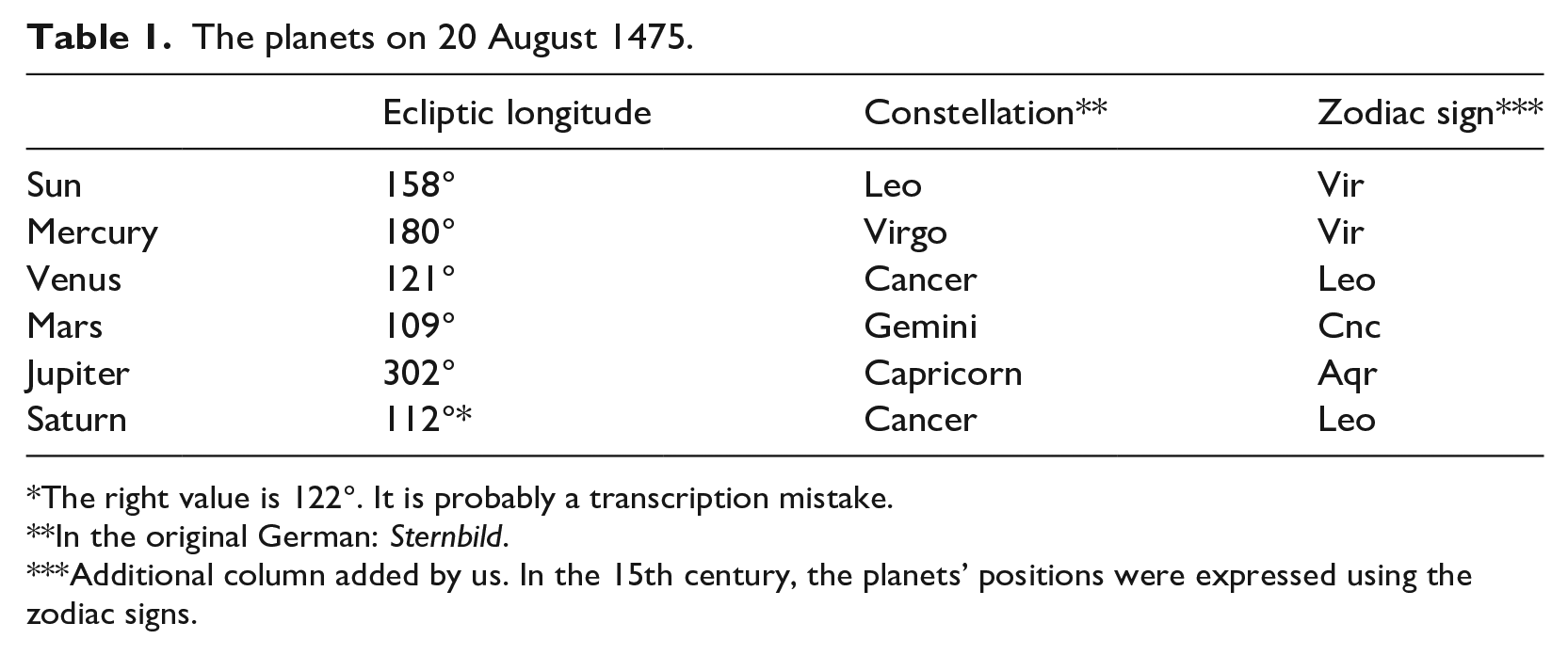
The right value is 122°. It is probably a transcription mistake.
In the original German: Sternbild.
Additional column added by us. In the 15th century, the planets’ positions were expressed using the zodiac signs.
As we have seen he says: “. . . according to the position of the planets in the
For Torres and Zacut, as shown in Figure 4, the Sun would have been in Leo between July 14 and August 14, 1475 (until 2 PM), and not between the August 14 and 29, then it would have moved to Virgo until September 13.
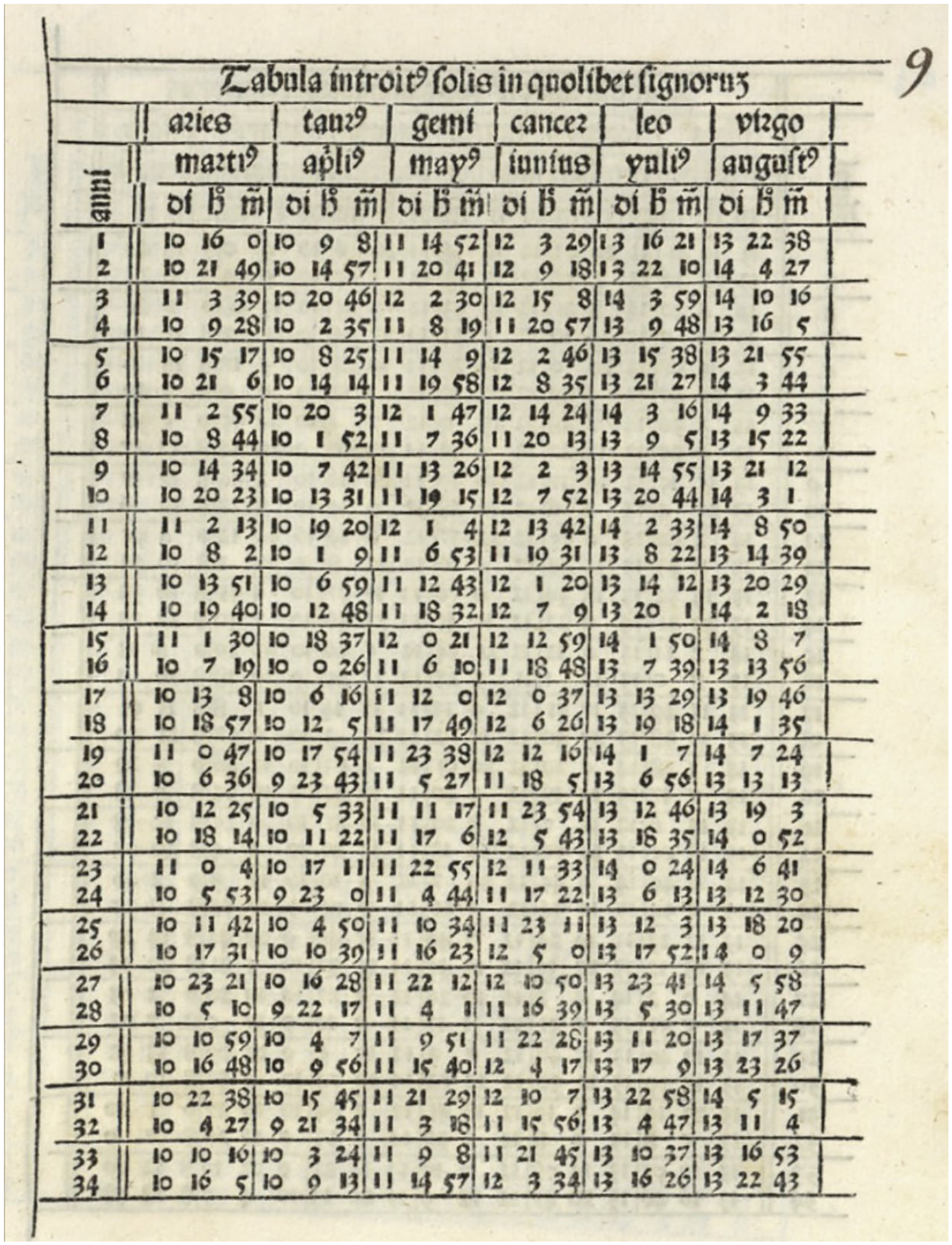
Sun-related table entries under the different zodiac signs. Year 1 corresponds to 1473. Zacut’s Almanach Perpetuum (Leiriae: Abraham ben Samuel d'Ortas, 1496).
For further detail, Table 2 is included. The data shows that during that period there was no configuration matching the representation.
Planets’ positions in the zodiac signs in August 1475 from Salamanca using the ecliptic longitudes of that year 1475*.
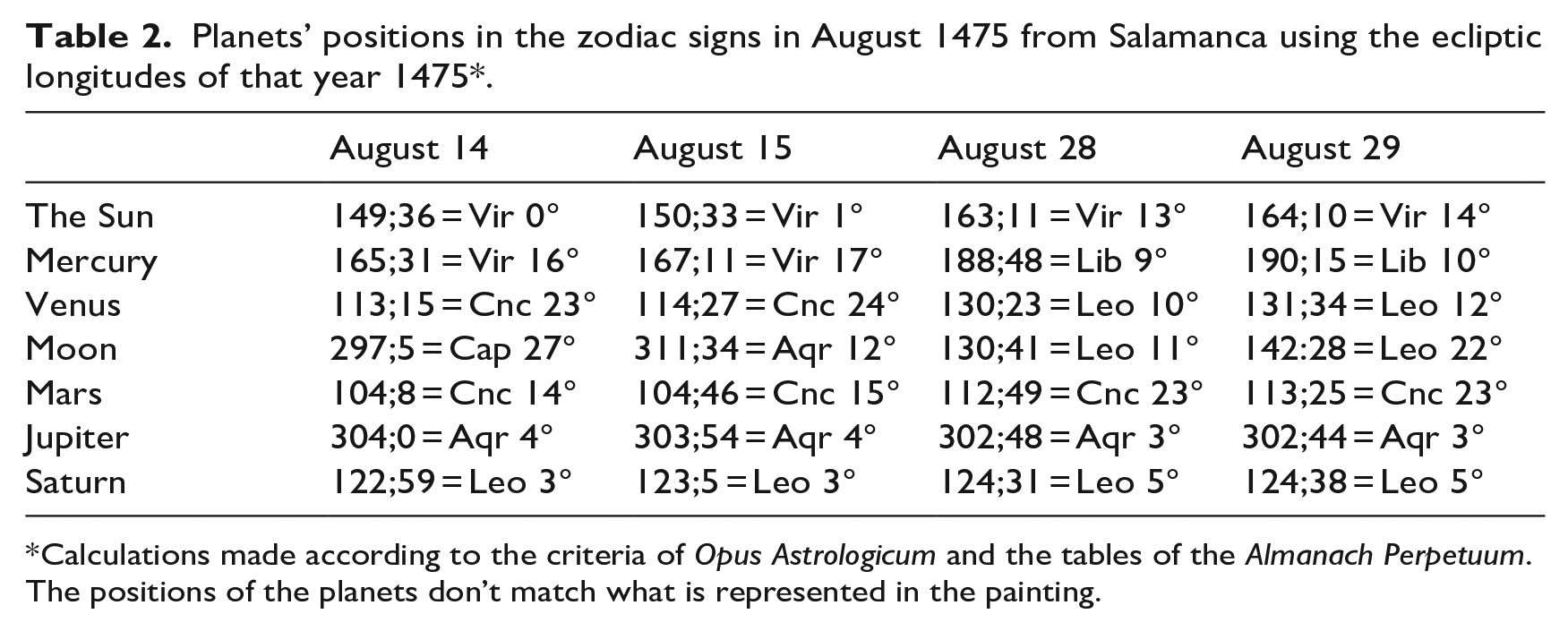
Calculations made according to the criteria of Opus Astrologicum and the tables of the Almanach Perpetuum. The positions of the planets don’t match what is represented in the painting.
However, Zinner’s interpretation has been assumed as a fact. The only change is in the date of the night sky that is said to be depicted (from August 6 to 14–29 August 1475) and different reasons have been given (planetary conjunctions, a very rare configuration, etc.) to justify why that date was chosen. 23
What is surprising is that a hypothesis formulated five centuries after the painting was made and with highly speculative, if not erroneous, assumptions had immediate success. The authors believe that Zinner’s proposal was accepted quickly and uncritically due to his great prestige at a time when Spain was culturally isolated.
It’s very likely that planetary configurations matching the zodiac symbols exist, even choosing a random configuration. In the non-preserved part of the painting, the other five planets (Venus, Mars, Jupiter, Saturn, and the Moon) were distributed among the seven missing zodiac signs, generating a total of 7 5 = 16,807 different possible configurations. 24 This means that different skies with the same configuration as in “El Cielo de Salamanca” could be found. However, even if there’s a date around that period in which the Sun is in Leo and Mercury is in Virgo, that in itself is not proof that the author intended to represent the night sky on that date.
An astronomical or an astrological sky?
It has even been suggested 25 that what is represented is close to a planisphere but not an actual one; when the painting (Figures 1 and 5) is compared with the night sky using a modern planisphere (Figure 6), several discrepancies can be observed:
(i) The figures of the zodiac have approximately the same size, meaning they actually represent the zodiac signs. Moreover, Libra is rotated with respect to Virgo, which is not consistent with the shape of the constellation in the real sky.
(ii) The Sun and Mercury are represented in the form of icons with disproportionately large dimensions compared to Leo and Virgo.
(iii) The Sun should be located under the feet of Leo instead of over its head and the head of Hydra and Mercury should be between Virgo and Crater and not between Virgo and Boötes.
(vi) Most of the stars seem to be painted just for purely aesthetic reasons. Perhaps some of them were intended to represent stars included in the Almagest catalog but are incorrectly located. 26
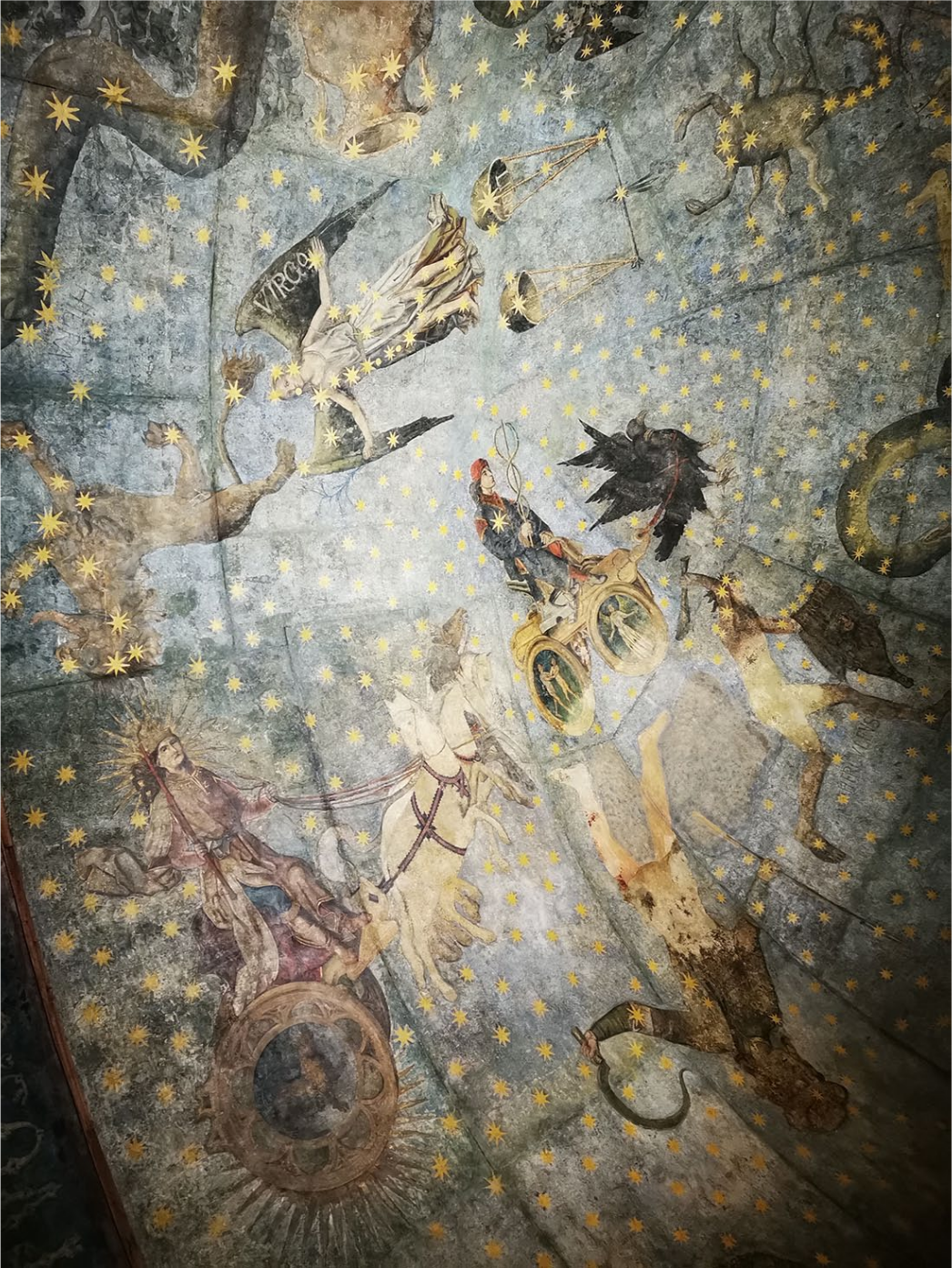
In a real sky, the Sun, represented riding a cart, should be under Leo’s feet. The tail of the lion should be above its hind legs (see Figure 6).
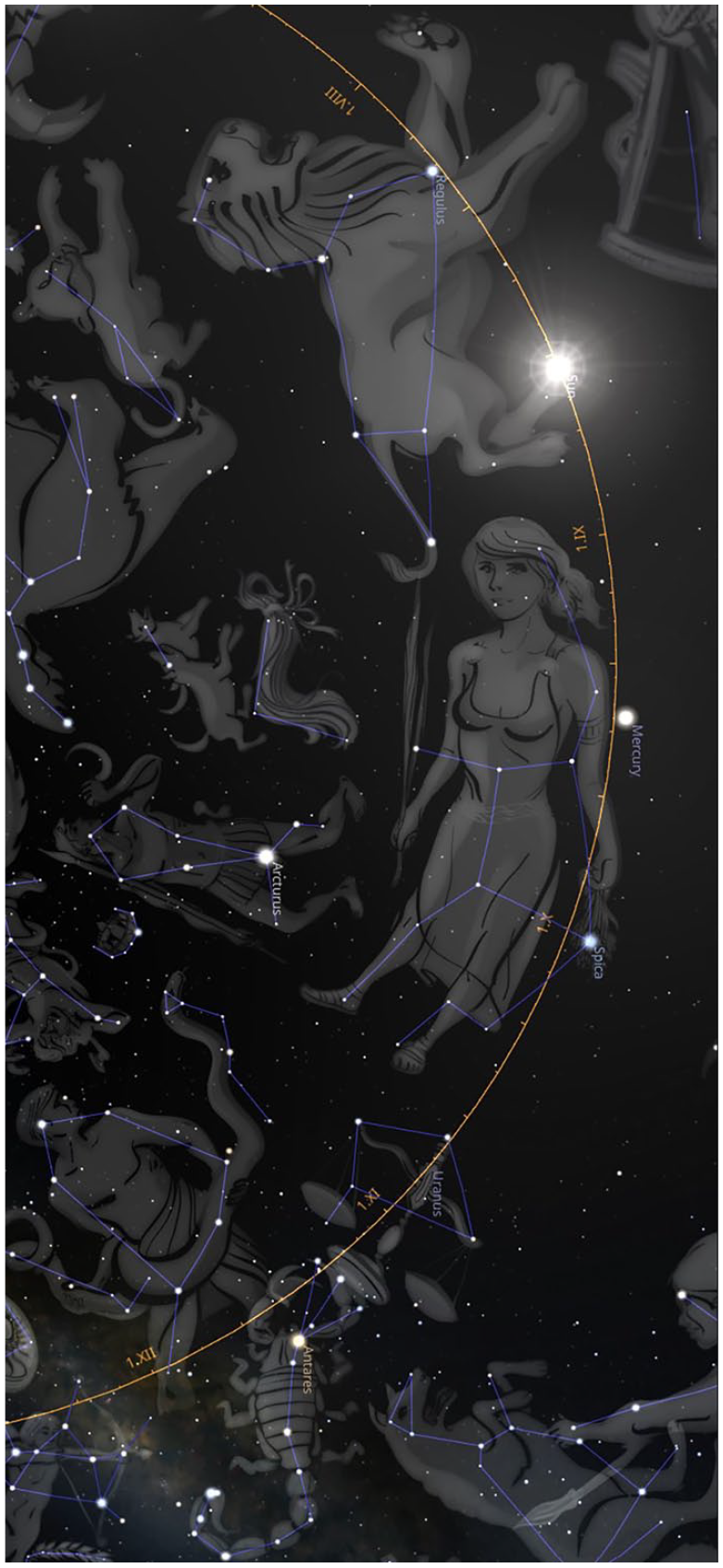
Simulation with Stellarium 23.3 of the sky taking Salamanca as reference, on August 20, 1475 (Julian calendar) at 20:00 PM UMT.
An astrological interpretation
The presence of the Sun in Leo (its only domicile) and Mercury in Virgo (one of its domiciles, its diurnal one) suggests that the painter placed the planets in their respective domiciles or houses. 27 Master pieces showing each planet in an astrologically related zodiac sign are pretty common 28 in the Italian Renaissance even in the Ancient Egypt (e.g. the round zodiac of Dendera, in the Louvre).
Additionally, Leo appears in the wheel of the cart that the Sun is riding, its only domicile, and in the cart carrying Mercury, its two domiciles, Virgo and Geminis, are painted.
We can apply the same criterion to the non-preserved part of the mural painting. The planets would be in one of their domiciles according to the Tetrabiblos as shown in Figure 7.
(A) Diurnal domiciles: the Sun in Leo and Mercury in Virgo where they are already located in the preserved part.
(B) Nocturnal domiciles (in the non-preserved part) Moon in Cancer, Venus in Taurus, Mars in Aries, Jupiter in Pisces.
(C) Saturn could be in Capricorn (diurnal) or Aquarius (nocturnal). We think that the best place would be the sign Capricorn (diurnal), so the number of planets in diurnal and nocturnal domiciles is balanced.
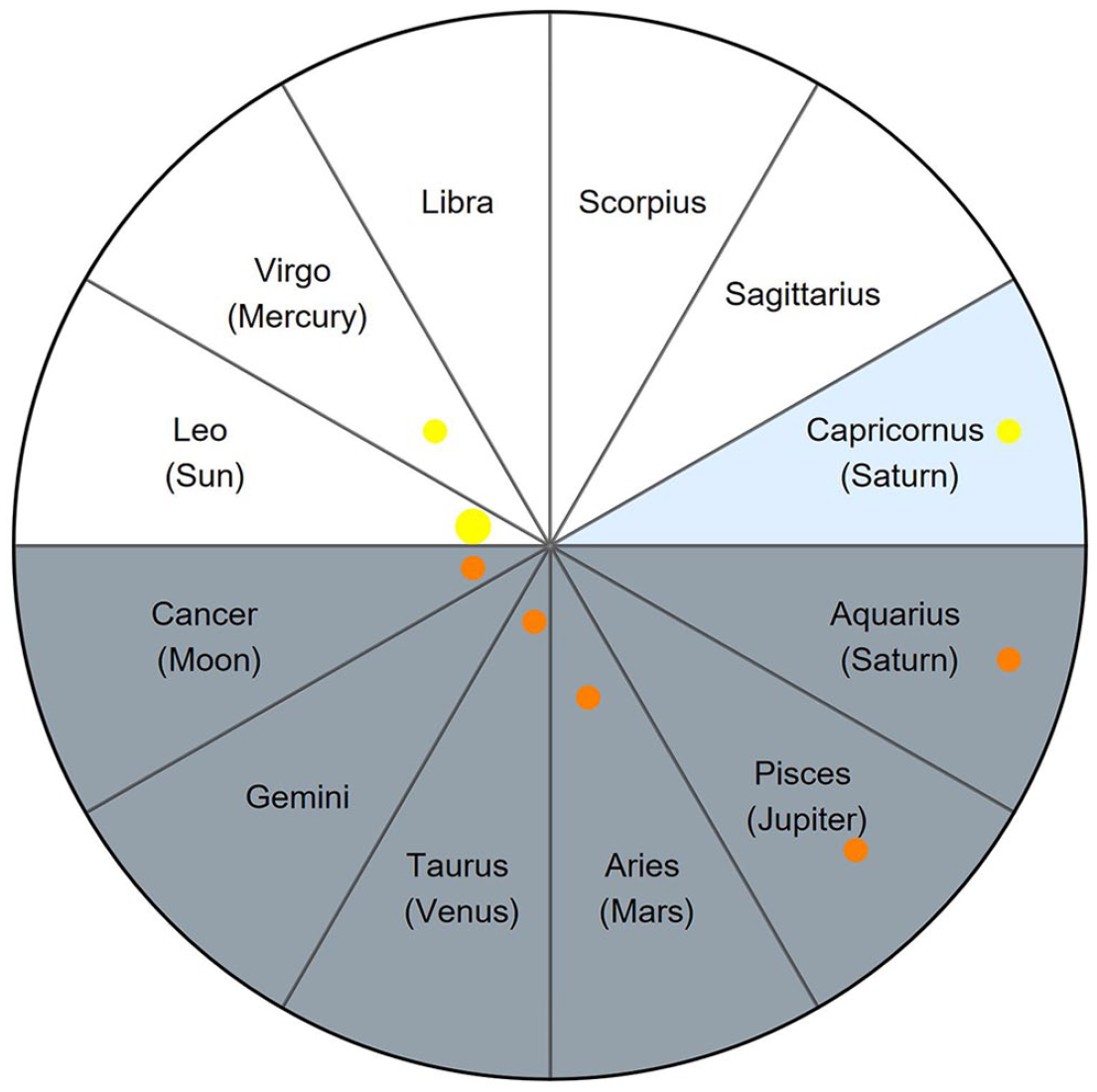
A possible solution to the position of the planets in the original vault El Cielo de Salamanca.
By chance, around 200 km from Salamanca, in the Prado Museum there is a collection of Pietro Facchetti paintings with some planets in their domiciles. 29
This new interpretation is also supported by the following fact: in 1759, shortly before the vault with the original “El Cielo de Salamanca” was hidden, Juan González de Dios (professor at the University of Salamanca) collected some inscriptions 30 from the chapel. In one of those inscriptions, the Tetrabiblos and Centiloquium are expressly cited: “Terrestres vultus [for vultibus] coelestibus subjiuciuntur [for subiuciuntur] ... ” [Claudio Ptolomeo, Tetrabiblos, ii, 7] and “Vultus huius saeculi sunt subiecti vultibus coelestibus … ” [Centiloquium 9]. That inscription further supports the idea that the contents of the vault are related to those two books.
Based on the description of the contents of the original painting and on the study of other astrological maps of the time, one of the authors (P. Recio) has created a representation matching that description (Figure 8). The engravings of the Poeticon Astronomicon were taken as a starting point and, on them, the new proposals were adapted following the design canons of Fernando Gallego. The basic criteria are as follows:
- The 12 zodiac signs would be present, aligned with each other, and forming an arc that crossed the vault with the idea of dividing the hemispheres. They would be accompanied, in turn, by their respective planetary regencies (seven) and would extend along the Boreal plane.
The winds, assuming there were 12, would be distributed in the lower area of the vault, adding five to each octagonal end and two to the central section.
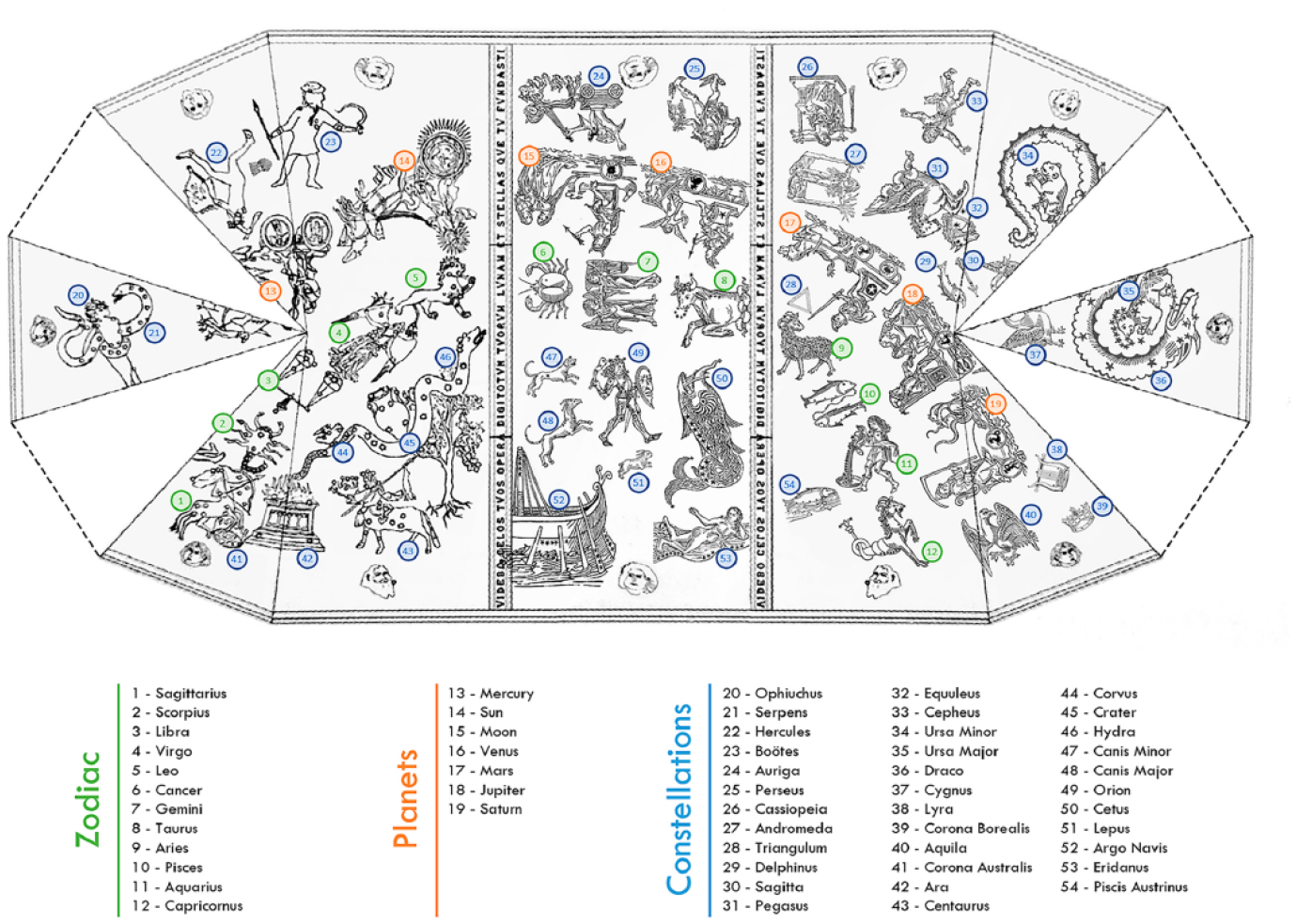
Recreation of the possible distribution of the vault elements based on the references consulted and the architectural limits of the surface. 31
Conclusions
During the second half of the 15th century, a splendid astrological mural with a bizarre history, was painted on the vault of the Universidad de Salamanca’s library. After remaining hidden for almost two centuries, part of it (1/3) was recovered and transferred to a different location (1953).
Those who visited the library shortly after the painting was finished indicated that it was an astrological representation of heaven. However, in 1960, the German astronomer Ernst Zinner speculates that the painting represents the sky vault at a certain date, which turns out to be incorrect. In 1992, the historian Gisela Noehles-Doerk follows in his wake and states that what was represented was the sky from August 14 to 29, 1475. Even nowadays 32 it is taken as a fact that it represents a real sky. It has been shown the statement is not correct either for that period or for any other period that includes any of those dates.
This article has shown that this idea (that it represents a real sky) not only presents many inconsistencies but also makes assumptions that are not really supported by documentary sources. Probably, the most important one is not to consider that in the 15th century, astrological calculations were made with respect to the zodiac signs and not with the constellations.
In addition, this paper has shown that “El Cielo de Salamanca” conforms to the astrological criteria of Ptolemy’s Tetrabiblos. It has also indicated that the planets are represented in their astrological houses or domiciles which is coherent with the thought and function of a 15th century chair of astrology, who assisted the chair of Medicine in the elaboration of astral charts.
In the process of recovery (1953) of the “El Cielo de Salamanca” some of the sinopias were lost. All the speculation regarding its meaning would be drastically reduced if the position of just one planet from the part of the painting that was not preserved were known.
In short, “El Cielo de Salamanca” does not represent the location of the planets on a specific date but, most likely, depicts the planets in their astrological houses according to the Tetrabiblos and based on this, the authors have created a representation of what the complete original vault may have looked like. It is a magnificent iconographic representation, surely based on the Poeticon Astronomicon, which fulfilled a double function: decorative and didactic. Now it is in the Patio de Escuelas Menores, one of the most beautiful places in the monumental Salamanca.
Footnotes
Acknowledgements
Ángel Prieto and Rubén García for their help in reviewing the article. Eduardo Hernández and Marta Vázquez librarians for their help in consulting the books of the historical library of Universidad de Salamanca.
