



Abstract
In the mid-19th century, the need for an accurate time becomes ever more important for many economic and industrial sectors, as well as for maritime and railway transport. States took a keen interest in these developments, which resulted in the founding of an increasing number of state observatories. While this well-known phenomenon has attracted the attention of numerous historical researches, the actual setting up of an observatory has more rarely been studied. Based on the well-documented case of the Observatoire cantonal de Neuchâtel, we will look at the setting up of the establishment through its scientific instruments and work procedure. Founded in 1858, the Observatory was primarily intended to fulfill the needs of the watchmaking industry while contributing to the progressive standardization of Swiss time. Adolphe Hirsch, the Observatory’s first director, spent 3 years setting up, installing, and calibrating an operating chain dedicated to the time service. The astronomer’s correspondence shows his expectations and the manufacturers’ technical capabilities. We can thus reconstruct the steps in the design of the scientific instruments—which operated as a network. The outcome being a high-performance operating chain for the time determination. During the commissioning process, Adolphe Hirsch chose an emerging technology—the printing chronograph. In fact, the Observatory was entirely configured around this new method, placing this institution among the first in the field. This new observation technique modifies the episteme of time determination and the role of the human factor within the process.
Keywords
Introduction
The 19th century was marked by the founding of astronomical observatories. 1 Winning recognition as one of these scientific institutions was a sensitive and crucial undertaking. The commitment of an astronomer, the selection of scientific apparatuses, and their installation were key steps in the founding of a new observatory. The richly documented case of the Neuchâtel Observatory (Observatoire cantonal de Neuchâtel), founded in 1858, enables us to examine the political decisions, choice of instruments, and scientific practices adopted at the institution’s inception for the purpose of establishing a culture of precision that would be recognized by the scientific community. By “culture of precision,” we shall refer to the set of heterogeneous factors—including administrative, technical, industrial, and scientific ones—that influence the production of data regarded as reliable. The history of observatories and observation processes have been studied extensively, as has the role of scientific instruments. 2 By contrast, there has been less research on the formation and functioning of a complex of scientific apparatuses for time determination. Thanks to the correspondence of the Neuchâtel Observatory with scientific-instrument makers, political authorities, and the architect in charge of the building’s construction, we can track the creation of the Observatory almost day by day and examine the challenges faced by the project’s promoters and the choices they made.
The Neuchâtel Observatory’s core mission was to contribute to the development of the watchmaking industry 3 and to be recognized by the international community of scientific institutions. To this end, it set out to provide a time service through the determination, conservation, and transmission of time. In this article, we shall focus solely on time determination by examining the establishment of the “operating chain” considered complete in 1861. The term denotes the complex of scientific instruments, technical equipment, mathematical calculations, and environmental and human factors involved in the production of these data, that is, the time signal. 4 We use the concept of operating chain to describe the activity of the Observatory working in a network and to emphasize that a scientific instrument in this context must be viewed in relation to a set of other instruments and apparatuses.
To reconstruct the operating chain, we have studied (1) the Neuchâtel Observatory instruments, held at the Musée International d’Horlogerie (MIH) in La Chaux-de-Fonds, (2) the Observatory’s archives, in particular the correspondence of its first director Adolphe Hirsch (1830–1901), held at the Bibliothèque Publique et Universitaire de Neuchâtel (BPUN), and (3) the administrative documents, plans, and drafts preserved in the Archives de l’État de Neuchâtel (AEN). The exchanges between the Observatory director and instrument makers shed light most notably on the issues and technologies concerning time determination in the mid-19th century 5 ; the administrative archives offer rare insights into the difficulties and problems surrounding the installation of the Observatory and the formation of a culture of astronomical precision.
We begin by discussing the origin of the Neuchâtel Observatory project and the stages leading to its approval by political institutions. Next, through correspondence and official decisions, we describe the technical development of the project, the collection and installation of the scientific instruments, the discussions over the choice of instruments, and the establishment of the observation system. We conclude by examining the impact of the printing chronograph—introduced from the United States starting in the mid-19th century 6 —on the operating chain, which we describe in its 1861 state.
Origin of the project
The watchmaking industry is of crucial importance in the Neuchâtel canton. 7 Until the 19th century, local watch production consisted of mid-range and entry-level models. Luxury items and high-accuracy watches were a Genevan and British specialty, while the quality of French products was declining. 8 Gradually, however, the Neuchâtel industry expanded, winning market share for accurate models by leveraging lower costs and the imported experience of local manufacturers who—on returning from their London or Paris training—started up firms in the canton. 9 In the 19th century, the Neuchâtel watch industry faced a skilled-labor shortage and a lack of scientific resources to improve the accuracy of its products. 10 Since the 18th century, various private initiatives had been trying to determine time as precisely as possible, for example by installing meridian telescopes on public buildings. 11 These solutions, however, proved inadequate. The need for accurate scientific data guaranteed by the State became ever more urgent, driving watchmakers to demand the establishment of a public, local, and independent institution.
The 1855 Universal Exhibition in Paris provided the opportunity to observe the competition’s methods. Neuchâtel sent delegates—most of them watchmakers, industrialists and tradesmen—in particular to “seek out improvements to be made in our watch industry.” 12 In their report to the Council of State, they recommended the promotion of precision watchmaking and marine chronometry in the Neuchâtel canton by establishing a State observatory in Neuchâtel, a “sine qua non condition” for ensuring neutrality in controlling watch parts and for securing their international reputation: “The calibration tables 13 compiled by us have virtually no value in the eyes of the buyer, who, while he may not suspect our good faith, may at least question the accuracy of our observation methods; whereas a chronometer accompanied by a calibration table made and signed by the director of a Government Observatory is authoritative and enhances the value of the device by inspiring confidence for the non-specialist.” 14 It was therefore to meet industry needs that the delegates called for “the construction of a government Observatory in Neuchâtel, an Observatory dedicated to the exact verification of our watch-manufacturing products, which would avoid the considerable expenses entailed by the establishment of a complete scientific Observatory.” 15 In the report’s conclusion, the delegates drew up a short list of instruments needed to set up such an institution: a meridian telescope, a wall telescope—by which they doubtless meant a mural circle—and an astronomical clock. 16
The young republican government of Neuchâtel, in office since 1848, adopted most of the delegates’ recommendations and opened a budget line to found an observatory based on a report made by the Neuchâtel physicist Henri Ladame (1801–1870). 17 In this aftermath of the 1848 Revolution, a republican state was being constituted in the Neuchâtel Canton and was asserting its role; the executive saw the establishment of an observatory as a means to support and influence the region’s economic development. 18 The Council of State deemed the formation of a precision industry “of great interest,” for it “provides a new source of revenue, a new element of superiority for manufactured products, a new guarantee against the weakening or deterioration of the labor force, and against the dispersion of our national industry.” 19 The Ladame report recommended a small facility for an estimated cost of 24,000 francs [rounded to 25,000 francs in the budget line] comprising “a meridian telescope, a parallactic [equatorial] telescope, a barometer, a clock, some thermometers, a device for chronometric observations, and astronomical books containing position tables for celestial bodies published annually by the leading observatories.” 20 This proposal was somewhat more specific than the one submitted by the delegates in 1855. However, at the Grand Council meeting of June 27, 1856, the accounting commission suspended the 25,000-franc appropriation until the project’s definition and the planned expenditure had been clarified. 21 The Council of State did not object to the suspension, as it believed it could submit the appropriation to the legislature in the November session, but the attempted counter-revolution of September 1856 (by royalists who wanted the Canton to revert to Prussian rule) blocked the project for over a year. 22 In December 1857, Aimé Humbert (1819–1900), the State Counselor in charge of education, requested an additional study from a committee of local experts comprising Professors Édouard Desor (1811–1882), Auguste Vouga (1795–1884), and Louis Favre (1822–1904). 23 The committee’s report, delivered on February 20, 1858, estimated the cost of setting up an observatory with a meridian telescope, an equatorial telescope with a motor drive, a sidereal clock, a regular clock, and meteorological instruments at 50,000 francs. 24 Contrary to the Ladame report, the new report called for lodgings for the keeper and the director, not only to watch over the scientific instruments and chronometers deposited by manufacturers, but also to take advantage of every favorable opportunity for observing the sky.
Faced with these two projects, Aimé Humbert felt the need for an additional opinion—from an astronomer. 25 To find one, he reportedly sought the advice of acquaintances including his physician, Louis Guillaume (1833–1924). Guillaume told him that during his medical studies in Zurich he had befriended a young astronomer: Adolphe Hirsch. 26
Adolphe Hirsch’s initial project
In March 1858, Adolphe Hirsch, then a private tutor in Venice, came to the Paris Observatory, where he had been hired by its director, Urbain Le Verrier (1811–1877). On the way, he stopped off at Neuchâtel to study the plan to establish a cantonal observatory. Hirsch, born in Halberstadt (Germany), favored a scientific observatory since “the means that watchmakers ordinarily use to set their watches are not accurate or rational, for they nearly always consist merely of looking at regulators [a precision clock used by watchmakers for verifying the rate of watches] that are assumed to be infallible [. . .].”
27
He recommended that the future observatory be equipped with a meridian instrument, an equatorial telescope, two “top quality” clocks “of which at least one should be produced by a renowned craftsman”
28
(one clock set to sidereal time, the other to mean time), meteorological instruments, and an apparatus “to subject the chronometers to different temperatures and observe their operation in these conditions, in order to assess and, if need be, improve their compensation.”
29
Lastly, Hirsch advised the installation of a telegraph machine “to enable the Observatory to communicate with the centers of the watchmaking industry.”
30
Regarding instruments, his report thus barely differed from the two earlier plans, despite the addition of telegraphy. Above all, Hirsch stressed the need to provide the Observatory with sufficient resources. The Observatory should be able to conduct scientific work and meet two conditions that would enable manufacturers to obtain accurate calibration tables: “First, the Observatory must be effectively endowed with the resources needed for time determination to the same degree of accuracy as obtained in the best observatories, or at least with all the precision available in the current state of science; second, your observatory, without claiming to become one of the leading astronomical centers, must nevertheless be able to produce scientific observations, so as to take its place among the observatories known in the scientific world. If it could not, the calibration tables that it would provide for your watchmakers’ chronometers would not possess sufficient authority in the eyes of the buyers, however much they would deserve to—and you would thus have failed to achieve your stated goal.”
31
As Jimena Canales has noted, Adolphe Hirsch believed that one needed to attain a certain degree of accuracy and to be on the cutting edge of scientific progress in a niche sector—time determination—in order to offer watchmakers a guaranteed certification of their products that would be recognized in the international market. 32
Hirsch convinced the State Council. Not only was he put in charge of contacting scientific-instrument makers but—if the Grand Council accepted his report—he would become the institution’s director. 33 Despite the series of scientific reports and a young astronomer’s commitment to the project, the founding of the Observatory was still threatened by the political power play that marked the early years of the young Neuchâtel canton. The republicans then in power feared that everything would be called into question by an alliance between the monarchists, whose attempted 1856 counter-revolution had just failed, and the independents, who had split from the republicans. The exchanges between Hirsch and Humbert attest to these concerns and the determination to obtain a rapid vote by the Legislature. 34 Despite this uncertainty, Hirsch reached out to several scientific-instrument makers, mostly in the German-speaking world. He took advantage of his networks in Berlin, Vienna, and Paris to propose instruments by renowned manufacturers such as Georg Repsold (1804–1885) in Hamburg, 35 Georg Ertel (1813–1863), 36 and Georg Merz (1793–1867) in Munich, 37 Joseph-Thaddeus Winnerl (1799–1886), 38 an Austrian working near the Paris Observatory, and Matthäus Hipp (1813–1893), 39 born in Württemberg, working at the Atelier Fédéral de Construction des Télégraphes in Bern. Thanks to these contacts, Hirsch was soon able to present proposals to the State Council allowing the cantonal executive to complete the report and submit it to the Grand Council. On May 18, 1858, the Grand Council agreed to found a “cantonal astronomical Observatory, suited to the scientific determination of time” 40 and a loan of 60,000 francs in the cantonal budget. In 1860, the total cost finally exceeded 127,000 francs—more than double the planned amount. It is is mainly due to the addition of the telegraph network, the upgrade of certain instruments and the higher price of the building. 41 The manufacturers’ demand for a watch-certification institution was therefore accepted, but Hirsch broadened the new entity’s remit. The Observatory would be dedicated not only to the direct needs of the watchmaking sector, but also to scientific research, so that the certificates it issued would possess “sufficient authority.” 42
The founding of the observatory
Once the project was adopted, the procurement of scientific equipment began. Among the instruments for time determination, the Ertel meridian circle—in use between 1859 and 1912—played a crucial role. Its purpose was to determine the time that served to compare chronometers and transmit the time signal. As Jérôme Lamy and Frédéric Soulu stress: “Astrometry, practiced with a meridian telescope, was the key activity of 19th-century astronomers.” 43 Astrometry could add an observatory to the map of trustworthy institutions or remove it. 44 The meridian circle therefore played a central role in the operating chain for time determination, functioning in a network with other essential instruments and apparatus such as the Winnerl sidereal pendulum clock and the Hipp printing chronograph.
The choice of Ertel und Sohn
The essential instrument in the observation system was the meridian circle.
45
The Observatory archives offer a detailed history of the meridian circle during the design phase.
46
For its procurement, Hirsch contacted two renowned German firms: Repsold und Söhne in Hamburg and Ertel und Sohn in Munich. Both had supplied instruments to leading observatories such as Pulkowa.
47
The exchanges with Repsold were inconclusive, particularly because of the production delay announced by the company, which turned down the offer in a letter that does not conceal a certain indignation triggered by the astronomer’s request for a guarantee: “Allow us to note in passing that until now no one has ever asked us to do so, and that we are flattered at having won sufficient recognition for the work performed for the most renowned scientists in the course of nearly 30 years of business as to be exempt from a special warranty for the instruments bearing our name.”
48
Hirsch then turned to Ertel und Sohn, the Bavarian workshop from which Father Secchi (1818–1878), a well-known astronomer and director of the Collegio Romano Observatory, had recently ordered instruments: “To prove to you that we have contacted the best sources, I would mention [. . .] that the Observatory newly established in Rome by Father Secchi—one of the best observers of our time—has procured exactly the same instruments from the same craftsmen.”
49
Ertel was the successor to the famed manufacturer Reichenbach. Hirsch ordered a product that he adapted in accordance with his experience, his readings, and the financial resources at his disposal. Between March 27, 1858, and the instrument’s delivery in late August 1859, the steady exchange of letters allows us to track the development of the project. 50
On March 27, 1858, Hirsch placed an order with Ertel for a meridian circle based on models 4 and 5 of the company’s 1853 catalog, 51 spelling out the desired requirements: “The main conditions—besides the perfect execution of the instrument’s optics—would be that the errors in the division of the lunette’s collimation line, placed perpendicularly on the axis, [errors] of rotation, [errors] in the ends of the axis, etc., should be as small as possible, that they should also be as constant as possible, and lastly that all arrangements should be made to enable the observer to determine them.” 52 The errors must not only be as small as possible, but also constant; most importantly, the observer must be able to verify them himself. Very promptly, on March 31, 1858, Ertel submitted a generic technical drawing of two meridian circles with a range of possible technical solutions (Figure 1). 53 The firm proposed two variants for the instrument’s reverse apparatus, which would notably alternate pressures on the two sides of the rotation axis in order to limit wear and thus the onset of errors. The systems for controlling the instrument’s constants were drawn with two options for the collimators and a suspended bubble level for checking inclination. The drawing also shows counterweight and lighting systems. Between April and early June 1858, when the final order was placed, several exchanges took place between Hirsch and Ertel about the meridian circle’s technical characteristics, to the point where Hirsch asked for a new technical drawing: “Another [drawing] was needed, as I had substantially altered the original arrangement.” 54 On June 2, 1858, the Bavarian manufacturer sent a new drawing (Figure 2) together with an estimate. 55
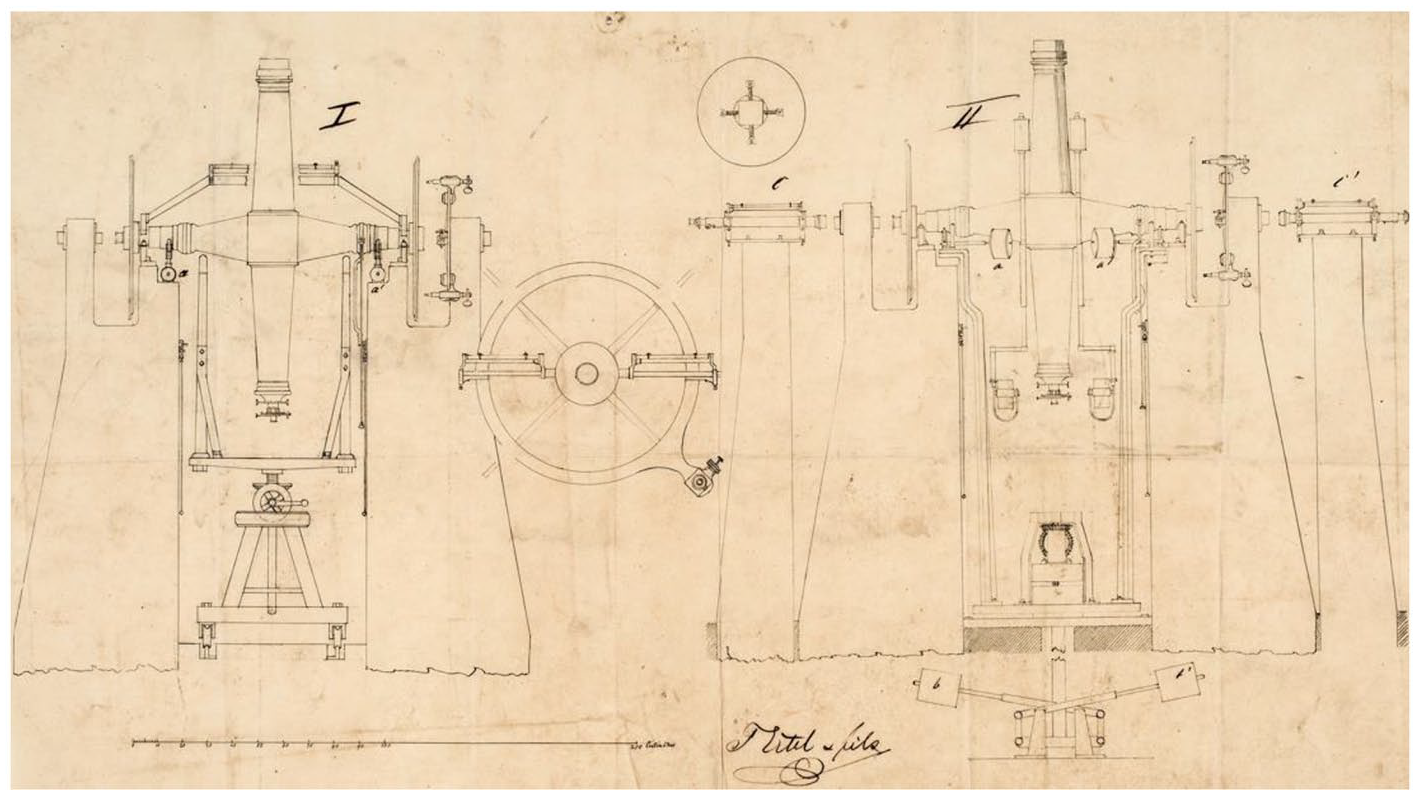
Technical drawing of generic meridian circles sent by Ertel & Sohn to Hirsch, March 31, 1858, AEN, 2IND-89.
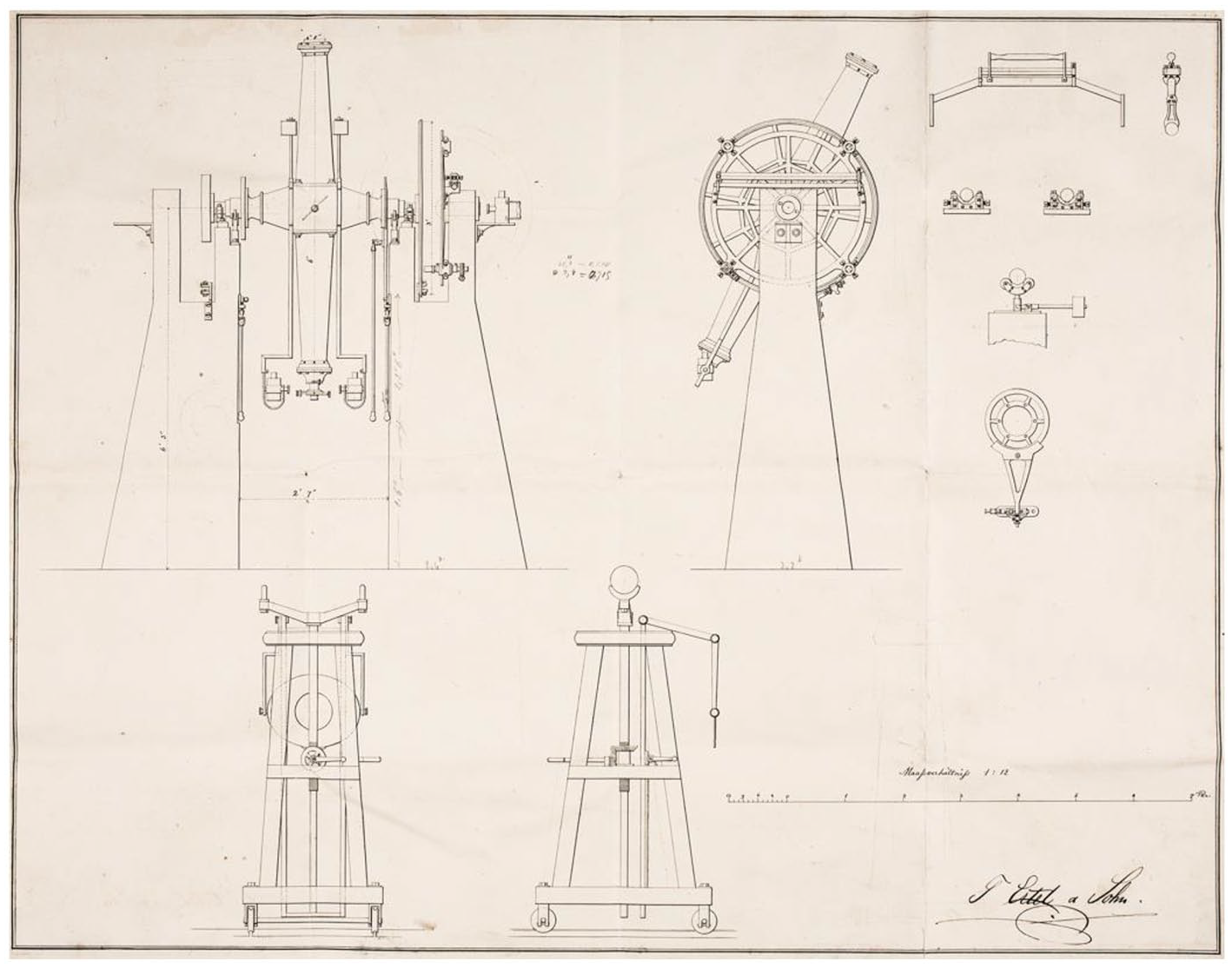
Intermediate technical drawing of meridian circle by Ertel & Sohn, June 2, 1858, AEN, 2IND-89.
This new version finalizes the main dimensions of the instrument, which is fitted with a graduated circle 3′ in diameter, divided into 10,800 graduations, with a focal length of 72″ and an aperture of 56 lines (1 line is 1/12th of an inch). These dimensions reflect Hirsch’s desire for a wider aperture in order to observe stars of magnitudes of 11 and 12 56 and Ertel’s suggestions about the ideal proportions between aperture and focal length. 57 The dimensions make the meridian circle of the Neuchâtel Observatory a somewhat larger instrument than those installed elsewhere, but not large enough to rival the budgets of the leading observatories such as Greenwich, Paris, and Pulkowa.
Changes made during procurement
Once a consensus had been reached on the instrument’s technical specifications, discussions continued on various issues. As the Ertel meridian circle has not survived, it cannot be physically examined to determine its condition in use. The correspondence between Hirsch and Ertel is thus the main source that enables us to summarize the changes made between the drawing of June 2, 1858, and its likely operating condition on September 8, 1859. 58
The letters show occasionally heated exchanges on certain options. One example concerns the lighting of the threads inside the eyepiece. Hirsch began by requesting the Starke system used in Vienna, 59 but Ertel recommended his own system. Hirsch then asked for the lighting of pale threads against a dark background, the method used by George Airy (1801–1892) in Greenwich. Ertel is aware of the Greenwich system, which involves placing a prism inside the eyepiece. He found that this could not work, because the tube was too narrow to place the prism behind the diaphragm. 60 Hirsch stood by his preference for Airy’s method but, absent a technical solution, he insisted on using the Starke system as a fallback option. 61 Presumably, after tests in Munich, in the presence of Hirsch, the initial system of Ertel is retained. This one consists in the lighting of the wires from a light source outside the eyepiece. The light reaching the wires by apertures near the diaphragm. 62
Other issues negotiated were less crucial to the instrument’s operation, such as Hirsch’s idea of fitting the instrument with a second graduated circle for reasons of balance and symmetry. Ertel turned it down because of the greater cost involved and his skepticism about its usefulness. After ordering it, Hirsch canceled the option, preferring to allocate the sum to a counterweight system. 63 However, as the second circle was already in production, the order could no longer be modified. 64
The resulting object (Figure 3) was designed on the basis of these negotiations, which yielded a personalized scientific instrument tailored to the latest technical innovations in astronomy. Once this crucial step had been completed, there remained the task of analyzing the defects of the meridian circle to determine its performance. For example, the 10,800 graduations of the meridian circle limbus were checked to determine the divergence between their engraving and a perfect geometric division. The instrumental constants (collimation, inclination, and azimuth) were checked regularly during the instrument’s period of use in order to apply the appropriate mathematical corrections to the error-reduction calculations and to observe whether the errors were due to environmental causes (such as different thermal dilations of the parts) or mechanical ones (such as a bending of the optical tube or an uneven wear of the trunnions).
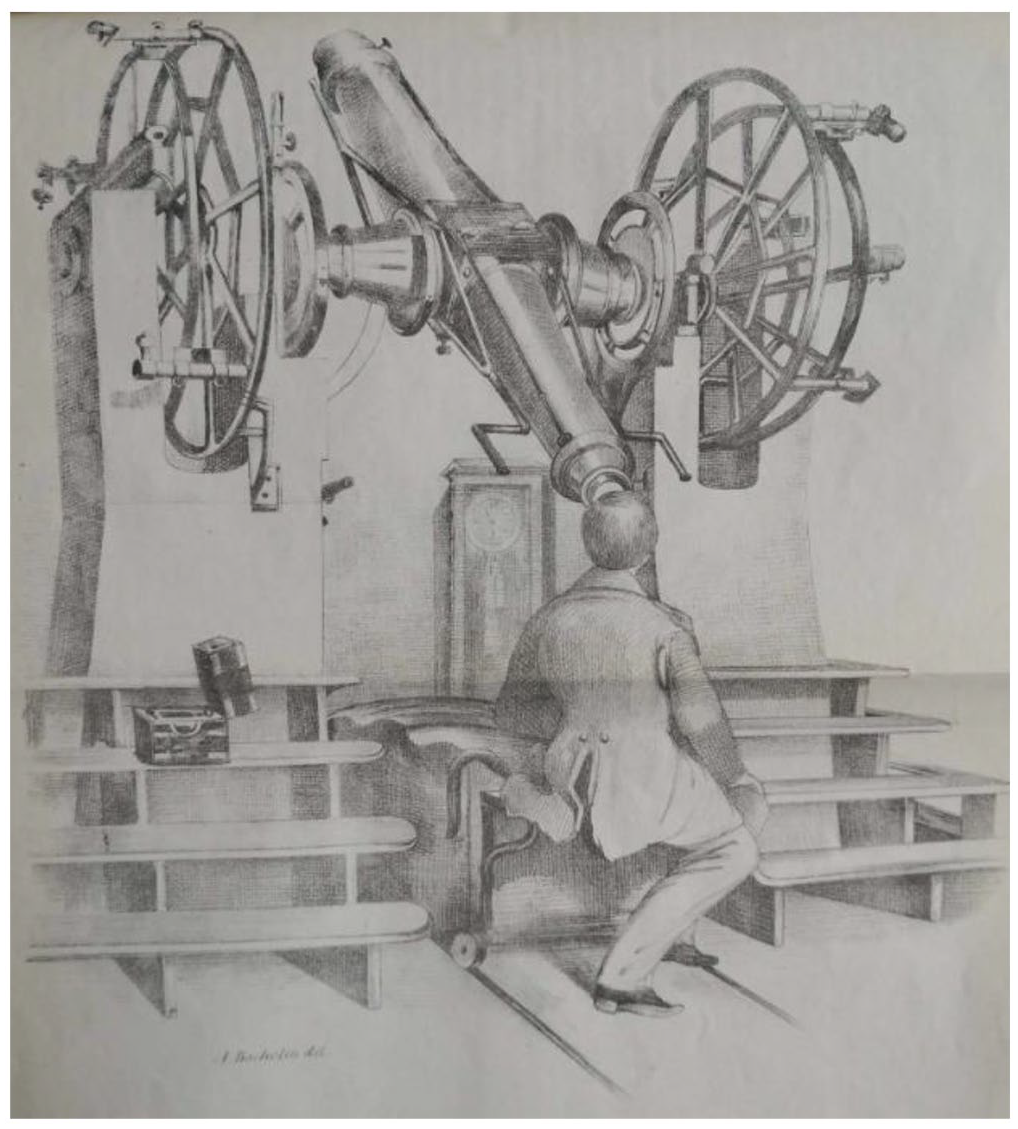
Illustration by Auguste Bachelin: Adolphe Hirsch, “L’Observatoire cantonal de Neuchâtel,” L’Almanach de la République et Canton de Neuchâtel (Neuchâtel, 1861), 36–41, 38.
Procuring a high-quality meridian circle, however, was not enough to ensure good operating performance. It was also necessary to design the space that would house it.
The building’s architecture
In addition to corresponding with Ertel, Hirsch was involved in the design of the Observatory building. Hans Rychner (1813–1869), the architect in charge of the project, was in constant contact with the future director of the institution, which would incorporate the latest architectural solutions for astronomy.
65
Hirsch accordingly proposed the construction of a functional building whose center of gravity would be close to the ground in order to ensure the stability of the scientific instruments: “The principles applied today in this type of construction are totally different from those applied yesterday; we are no longer trying to come as close as possible to the sky we want to observe; on the contrary, we are staying as close as possible to the ground, so as to obtain maximum solidity and avoid the vibrations and shaking to which tall buildings are more exposed than others.”
66
Hirsch explained to Hans Rychner exactly how to place and orient the building, ensuring that it would lie on the east-west axis and so allow meridian observations in the best possible conditions by establishing a north-south opening in the building. Indeed, as Françoise Le Guet-Tully and Jean Davoigneau point out, the astronomical instrument took precedence over the building and influenced its configuration. The building therefore had to be positioned and designed correctly to house the Ertel meridian circle. 67 To this end, Hirsch recommended moving a marine chronometer from the Geneva Observatory to the chosen location in order to determine its longitude, and then calculating precisely the north-south axis with the aid of a gnomon. 68 Hirsch used one of Ertel’s theodolites to position sights to the north and south to verify the meridian circle’s collimation. 69 He argued that this addition made the Observatory one of the best places for conducting meridian observations: “we have further confirmation that the fact of possessing three sights, including two distant ones [. . .], gives our facility a major advantage and is an essential precondition for the accuracy of its observations.” 70 The meridian circle was placed on pillars anchored to the rock of the Colline du Mail (the adjacent hill) and independent of the building: “All the instruments are therefore placed on the ground floor and on solid foundations made of large cut stones supporting rock pillars. These foundations and pillars are completely separated from the other parts, and even the floor of the room is not in contact with them.” 71 The walls of the meridian room were insulated to reduce temperature variations, and a groove was cut out in the wall running north-south so that the meridian circle could be oriented along the meridian plane.
In addition to the building’s architecture, it was also important to structure the environment of the meridian circle and the other instruments. Using the sights required a clear line of vision. For the northernmost sight, a peasant was hired to cut the vegetation and install a light every night in a recess specially designed for the purpose. Ground movements and sight movements were monitored to verify their exact positions. Attention was also given to the Observatory’s immediate surroundings. For example, lawns were seeded to reduce reflection of the sun’s rays. Land parcels were bought as the City of Neuchâtel expanded, in order to preserve the lines of sight and avoid chimney smoke. The director also had to become involved in more specific matters that might interfere with the Observatory’s activities and scientific instruments. Atmospheric disruptions were a major concern, for example when plans were made to set up a sweeping incineration plant south of the Observatory. One also had to guard against noise and vibrations that could compromise the instruments’ stability, for instance when roadworks or public events took place nearby. 72
At the same time as supervising the building’s construction and taking measures to control the local environment, Hirsch pursued his research to finalize his instrumentation. In the process, he discovered a new technical option that he added to the operating chain.
The addition of the printing chronograph
While orders for scientific instruments were proceeding briskly, Hirsch added a new device to the technical system for time determination: a printing chronograph, whose purpose was to accurately record time intervals. This instrument—which we could qualify as a “generic instrument” according to Terry Shinn’s proposed classification 73 —was first used in astronomy in the United States. It was introduced in Europe at the Greenwich Observatory at the behest of its director, George Airy. 74 As we shall see, this addition to the operating chain entailed technical alterations to the meridian circle’s filar micrometer—a key instrument for measuring celestial angles—composed of a micrometer screw and a variable number of threads, the Winnerl sidereal pendulum clock, and even the observation method.
The main reason that prompted Hirsch to use the chronograph cannot be clearly identified. His knowledge of the astronomical world, his readings and a trip at the Greenwich Observatory in summer 1858 must have led him toward this solution. The director of the future observatory took advantage of his connection to Matthäus Hipp, one of the pioneers of electrical engineering, with whom he was discussing the federal telegraph network. 75 Hipp produced the chronograph and chose to move to Neuchâtel to set up a firm specialized in electrical engineering. 76 The final order for the chronograph was confirmed in a letter of October 3, 1858. 77 The model chosen—a printing chronograph—allowed the simultaneous recording of star-passage times and the seconds of the sidereal clock. Every time the star was bisected by a thread of the meridian circle’s filar micrometer, the observer would flip a switch, sending an electrical impulse to the chronograph. The machine would print the impulse on a paper tape whose movement was driven by a clock mechanism regulated by an ingenious system made by Hipp. The system relied on the synchronization of the oscillation frequency of a vibrating blade and the rotational frequency of the teeth of a ratchet wheel. Hirsch notes that “this arrangement is so perfect that the cylinder completes its consecutive revolutions, of 2 m [minutes] each, with discrepancies that ordinarily do not exceed 0.1 seconds, therefore to within 1/1200th. One can see that this accuracy is more than sufficient for a machine intended to measure hundredths of seconds. We therefore consider M. Hipp’s vibrating spring as one of the most perfect regulators for continuous movements.” 78 Nevertheless, to use the Hipp chronograph (Figure 4), one had to take into account recording and transcription errors. Recording errors could be due to the electromagnets, which do not always take the same time to attract the magnets, or irregular movements of the chronograph roll. The pen that registered the data (Figure 5) could also draw lines of variable thickness or lines that were not sufficiently sharp. The transcription operation could also generate errors as the intervals recorded on the paper were converted into time values. In addition to these technical errors, the chronograph now made perceptible the interval between the moment when the observer sees the bisection of the star and the moment he presses the button. This response time led Hirsch to conduct research on the personal equation, a field in which he became a precursor in the 1860s. 79
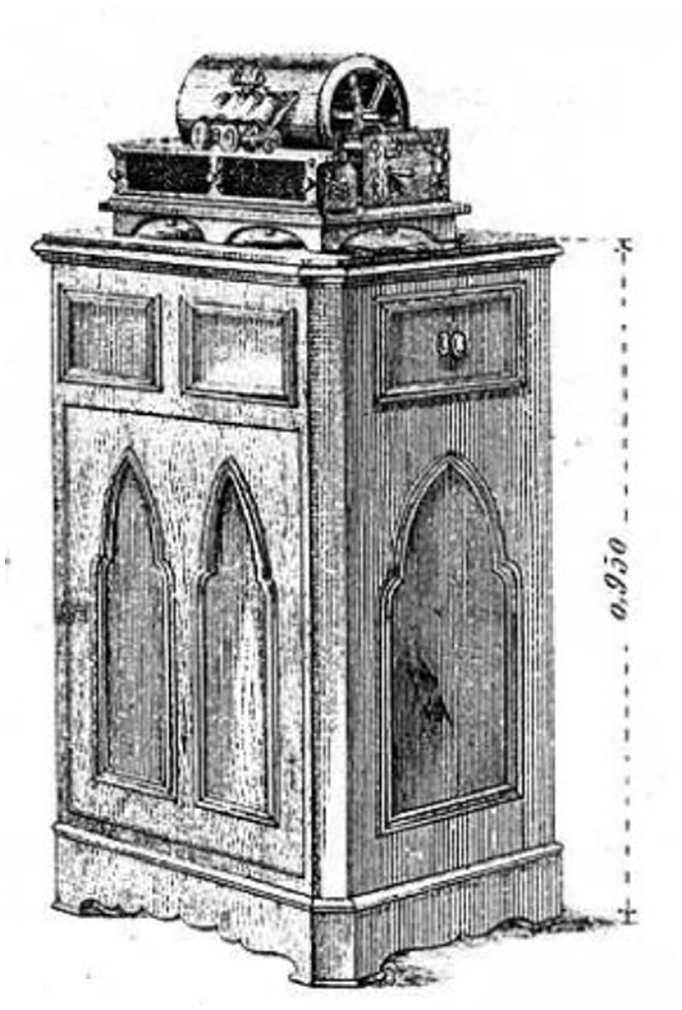
Lithograph of the Hipp printing chronograph. Matthäus Hipp, Prix-courant de la fabrique de télégraphes et d’appareils électriques à Neuchâtel, Hipp—Section B—appareils scientifiques (Neuchâtel, 1869).
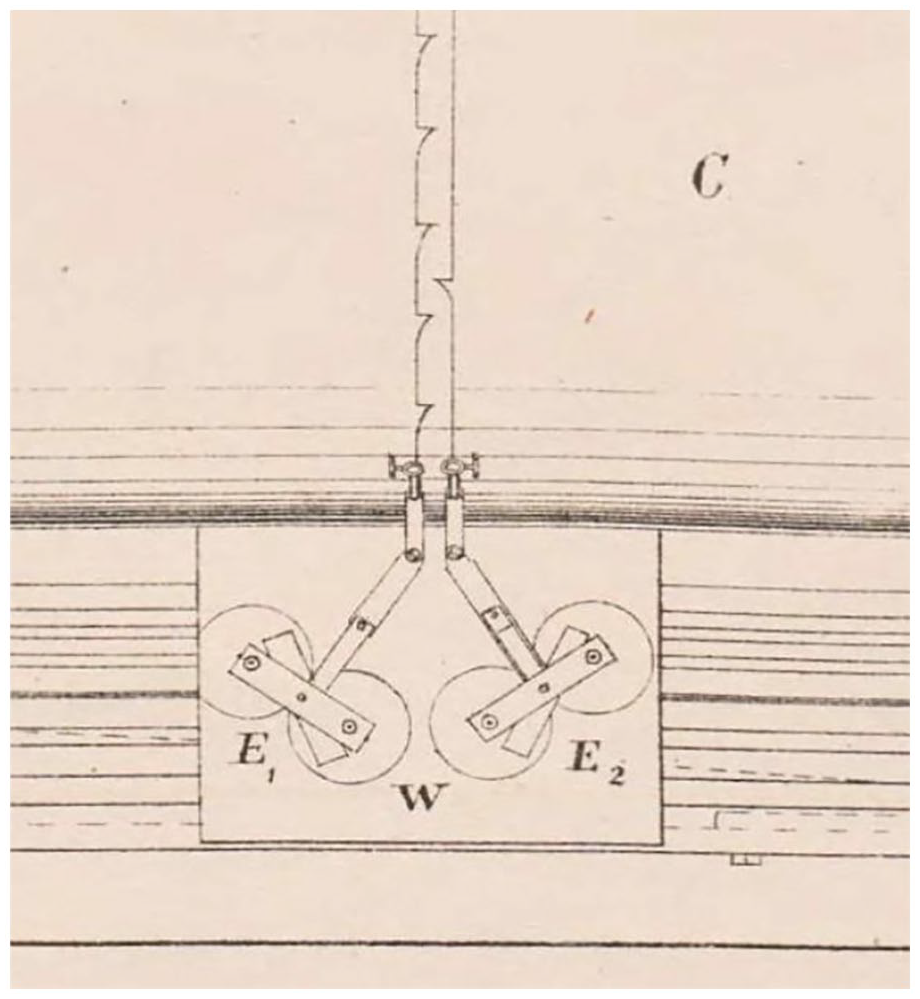
Detail of Hipp’s printing chronograph in operation. Emil Plantamour and Adolphe Hirsch, op. cit. (Note 78), Plate II (detail).
Unlike Airy, Hirsch did not yet have at his disposal the scientific instruments installed at the Observatory when the chronograph was introduced. He was thus able to ask the manufacturers to adapt the meridian circle and the sidereal clock in order to create an observatory structured around the new technology. 80 As Lamy and Soulu argue, Hirsch used the chronograph by incorporating it into “an economy of particularly optimal practices.” 81 This addition modified the observation method and made it possible to increase the volume of data produced.
A new method for meridian observation
The main consequence of adding the new instrument was the shift from the “eye and ear” or Bradley method to the chronographic or American method for meridian observations. 82 Until the mid-19th century, the method most commonly applied for the astronomical determination of time was the “eye and ear” method. The observer would count the seconds using the beats of the sidereal clock’s escapement. He would then observe the star’s transit in the telescope’s field of view in order to determine the instant in which the star was bisected behind each thread of the filar micrometer. Depending on the thread’s position relative to the star in two consecutive seconds, he could estimate the fraction of a second in which the bisection occurred. He would record this value, estimated to within a 10th of a second, before repeating the exercise for the following thread. 83 The micrometer of the meridian instrument could thus contain no more than five or seven threads, a limit that even the best observers could not exceed. 84 The reason is that this method involved two tedious and complicated processes: the memorization of seconds and the determination of the instant of passage for each thread. The chronograph simplified data capture, since instead of counting, dividing, and memorizing in real time, the observer could concentrate on the manual closing of an electrical contact at the instant of each bisection.
Hirsch estimated the precision of the “eye and ear” method at approximately one-tenth of a second for one thread for the best observers, whereas the chronographic method would produce a result closer to 0.09 seconds. 85 In other words, the improvement in accuracy would be minimal by comparison with what one might have initially expected. 86 The new method’s key advantage was that it would increase the data set and so allow a more effective statistical processing. This led Hirsch to state that “the accuracy of a star passage [is] nearly twice as great with the American method.” 87 This change formed part of the gradual shift from a qualitative error to a quantitative and statistical error, which Carl Friedrich Gauss (1777–1855) addressed in a more concrete manner. 88 The chronograph therefore made it possible to increase the number of measurements performed while relieving the observer of a rather laborious task.
As a result of this addition, the number of threads in Ertel meridian circle’s filar micrometer, initially designed with five, increased to 21 vertical threads distributed in four groups of five threads placed on either side of the central thread. 89 To obtain this number, Hirsch performed calculations to design a micrometer matching what he regarded as the best configuration. 90 The quantity of data produced by observing passages with this filar micrometer thus increased fourfold at a time when observatories were being infused—in Allan Chapman’s words—with a “factory mentality.” 91 To compare the raw data gathered with the aid of the meridian circle and chronograph, the sidereal pendulum clock also had to be adapted.
The Winnerl sidereal pendulum clock
The sidereal pendulum clock (Figure 6) is an essential component of the operating chain for time determination, as it provides and stores sidereal time. Despite their high regularity, the functioning of such clocks is inevitably imperfect, hence the need to check this clock’s condition as often as possible by the astronomical observation of star passages at the meridian. Once checked, it was used to verify the functioning of the Observatory’s two timekeepers set to mean time: the Association Ouvrière (Workers’ Society) pendulum clock, known as the Dubois clock, and the Houriet pendulum clock. The two clocks served to compute the time transmitted on the telegraph network and to verify the chronometers.
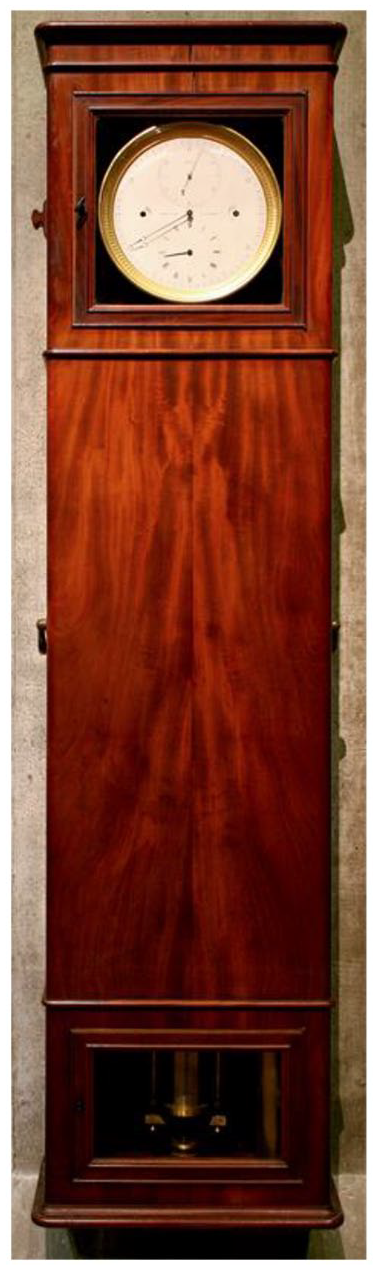
Winnerl sidereal pendulum clock in its case, preserved at the MIH.
The sidereal pendulum clock was ordered from Joseph Thaddeus Winnerl, supplier to the Paris Observatory, who agreed to produce the device despite the fact that “some ten years ago [he] stopped producing such items, which, as they rather seldom found takers, generated losses rather than profits for [him].” 92 We can assume that Hirsch contacted him directly after a call for bids published in a specialized magazine failed to yield results, demonstrating how hard it was to obtain such instruments. 93
The sidereal pendulum clock also had to be adapted to the new method, since it now served not only to produce the escapement beat so that the observer could hear it but also—even more importantly—to send electrical impulses for the seconds to the Hipp chronograph. The impulses were printed on the chronograph paper, in parallel with the observations of star passages (Figure 5). The clock was fitted with an electrical contact that closed every second thanks to the action of a 60-tooth wheel fitted on the escapement axle. The challenge for the clockmaker was to design a seconds switch that did not disturb the clock’s operation. The problem was that the energy needed to shut the contact had to be offset in order to keep the pendulum constant. This electrical system was activated only during the observation spells so as to minimize its impact on the clock’s proper operation. 94 Although preserved today at the MIH, the Winnerl sidereal clock has undergone several alterations and is no longer fitted with its original seconds switch. However, a documentary trace of this device described by Hirsch survives, together with a rough diagram. 95 Winnerl was reluctant to add a seconds switch during order fulfillment. He initially even refused to take the order, then agreed after meeting Hipp. 96 Incorporating these innovations delayed clock delivery by almost a year, forcing Hirsch, in the interim, to use a regulator made by Girard, a local watchmaker. 97 Once installed, the Winnerl clock had to be checked regularly and its constants monitored. The clock’s regularity depended mainly on variations in barometric pressure, temperature, and oil viscosity. Hirsch repeatedly mentioned the clock’s excellent regularity and its delicate maintenance by renowned watchmakers. After a decade of service, he wrote: “The Winnerl sidereal pendulum clock has been running with extreme regularity; its mean day-to-day variation in 1869 was ±0.051. Late last year, however, its electrical movement ceased to function regularly because the oils thickened. I therefore had it cleaned thoroughly a few weeks ago.” 98
Operating chain for time determination
The three instruments we have discussed form an operating chain for time determination. To understand how the Observatory’s time service functioned, we need to consider the scientific instruments, the devices, and the operations performed to obtain the time as a whole operating as a network. It is this network that enabled Hirsch to launch the Observatory’s activity. In his study of the acquisition of instruments for research in fundamental physics, Dominique Pestre emphasizes that the formation of a technical system consists in a set of “micro-decisions” rather than the implementation of a clear, overall vision from the outset. 99 Changes occur, and these can influence the other instruments or daily practice, as demonstrated by the example of the printing chronograph. It takes several years for the operating chain to function in a satisfactory manner and in a state that may be regarded as stabilized. Despite all the constant alterations and adjustments, we can regard the operating chain for time determination as having been completed by 1861 with the arrival of the final instruments such as the Winnerl clock. Simply obtaining the instruments was not enough. Optimizing their use required mastering their characteristics and defects. To achieve this, the instruments had to be studied and calibrated. It was necessary to know their manufacturing defects, their behavior in a measurable environment (temperature, humidity, atmospheric pressure, and other variables) and their alterations (such as distortion and wear). This information made it possible to correct the measured data through error-reduction mathematical operations. The instrument set has therefore received constant care and attention, ensuring that the Neuchâtel Observatory can rightly claim to have provided accurate data throughout its existence.
To summarize the operating chain for time determination, we have produced a visualisation (Figure 7) presenting all the instruments, their networking, and the operations performed to produce the data. Hirsch’s hard work to obtain the most efficient operating chain possible is what enabled the Observatory to establish a culture of astronomical precision in the Neuchâtel Canton.
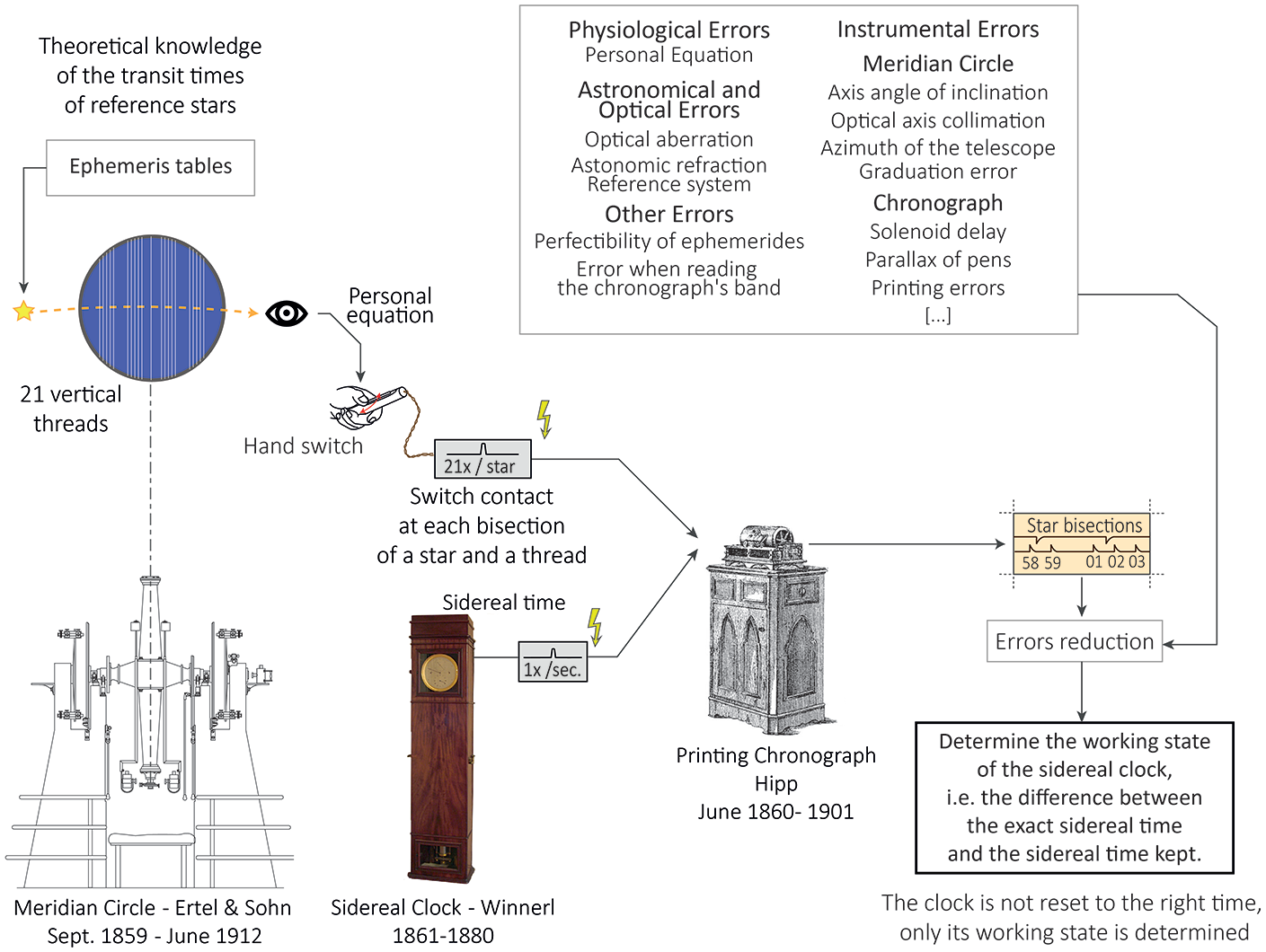
Visualization of the operating chain for time determination at the Neuchâtel Observatory in 1861.
Conclusion
The study of the establishment of a culture of astronomical precision at the Neuchâtel Observatory shows the many steps that were needed for the institution to find its place in the international scientific community. It took 3 years for the institution, founded at the request of the watchmaking industry, to become fully operational. Assembling the scientific apparatuses required special care. The choice of manufacturers, the instruments’ characteristics, and their capacity to be incorporated into a time determination network were key steps shaped by financial, technical, political, and environmental constraints. Once installed, the technical system had to be mastered so that it could function properly and meet the criteria of astronomical precision. The continuous dialogue between Adolphe Hirsch and scientific-instrument makers made it possible to set up an operating chain for time determination using the latest innovations in electrical engineering such as the printing chronograph and telegraphy. It then took Hirsch’s unfailing rigor to measure and eliminate as many instrumental and observational errors as possible, most notably through research on the personal equation. These investigations actually made the Neuchâtel Observatory one of the pioneers on physiological reaction time research.
The scientific instruments and technical equipment have steadily evolved with technological change, repairs, and replacements. There is no such thing as a “final status” for the Observatory’s instruments. They have always undergone adjustments, although there have been periods in which astronomers have expressed greater satisfaction than in other periods with the devices at their disposal. The operating principles outlined in Hirsch’s initial plan remained broadly unchanged until the major changes implemented by his successor Louis Arndt (1860–1941), who renovated almost all of the Observatory’s instruments. The Neuchâtel Canton Observatory was continuously seeking to improve its instrumentation and scientific practices so as to maintain its benchmark position in the field of time determination. With this goal in mind, it is strongly promoting the production of data with minimal dependence on the human factor and the least possible sensitivity to error.
Translated by Jonathan Mandelbaum
Footnotes
Acknowledgements
We would like to thank Gianenrico Bernasconi, Paolo Brenni, Catherine Herr-Laporte, Anton Näf and Marco Storni for their valuable suggestions and remarks. Any possible mistakes are to our credit. We also thank the SNSF for their support to the project “The Observatory of Neuchâtel (1858-1948): cultures of precision, quality economy and “commodification” of time” supervised by Professor Gianenrico Bernasconi and carried out at the University of Neuchâtel. Finally, we would like to thank all the institutions that helped us in our research and for making their archives available.