




Abstract
In 1551, Georg Rheticus published a compact set of tables that effectively completed the set of all six trigonometric functions. However, his work was not widespread, and may not have been known to Francesco Maurolico when he published a secant table in 1558. Before the end of the century, several authors argued whether Maurolico had borrowed the notion of the secant, and his table, from Rheticus. We present Maurolico’s text on his table (named the tabula benefica in a nod to Regiomontanus’s tangent table, the tabula foecunda), as well as a translation and analysis. Finally, we demonstrate that Maurolico’s table is too accurate to have derived from Rheticus’s work, absolving him of the historical accusation.
Trigonometry began in ancient Greece as a means of converting geometric models of the motions of celestial bodies into quantitative predictions of their positions. Hipparchus of Rhodes, and later Claudius Ptolemy, tabulated the lengths of chords in a circle as a function of the arcs they subtend, and used these tables to convert arcs into lengths. Greek mathematical astronomy likely transmitted to India, and when it did, Indian scientists invented the sine and the versed sine, 1 both more efficient in practice than the chord. In early Islam, until the 10th century, the sine and versed sine (as well as the cosine, the sine of the complement of the given arc) remained the primary tools; but in eastern Islam the tangent and the other trigonometric functions were introduced.
However, the trigonometry that found its way to medieval Muslim Spain included only the sine, cosine, and versed sine 2 ; and as Europe learned of mathematical astronomy through the Spanish connection, these three continued as the primitive functions. This remained true through the 15th century; Johannes Regiomontanus’s standard trigonometric work De triangulis omnimodis 3 relies on just this foundation. However, Regiomontanus’s 1490 astronomical handbook Tabulae directionum contains a new single-page table called the tabula fecunda, or “fruitful table.” The table caught on and was used by most of Regiomontanus’s 16th-century successors under that name, until Thomas Fincke’s 1583 Geometriae rotundi coined the term “tangent.”
The first appearance in print of the other three modern trigonometric functions (secant, cosecant, and cotangent) is in the 1551 Canon doctrinae triangulorum, a small set of tables by Georg Rheticus, more widely known as the person who brought Copernicus to public attention. Rheticus abandoned the standard trigonometric terminology in favor of an elegant scheme that brings the six functions together in a symmetric relationship. In Figure 1, the base circle has radius R. 4 Right triangles are divided into three species, depending on which side—the hypotenuse, base, or perpendicular—is set equal to R. With the given angle in the triangle as indicated in the figure, all six trigonometric functions appear as the hypotenuse, base, or perpendicular of one of the three species.
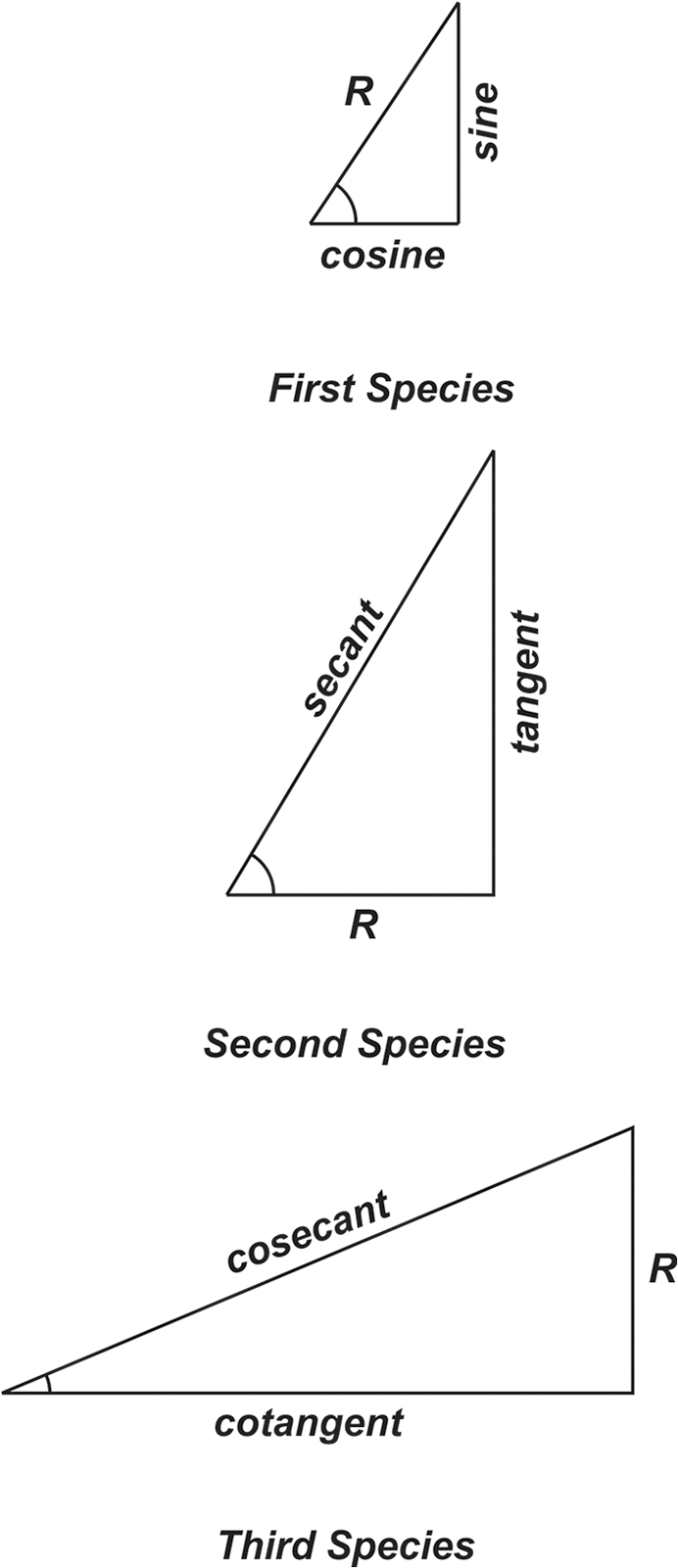
Rheticus’s definitions of the six trigonometric functions.
Rheticus’s novel structure was known to his successors, and the monumental tables of his posthumous Opus palatinum (1596) continued to apply it. However, only one other influential mathematician (François Viète; see especially his 1579 Canon mathematicus seu ad triangula) adopted it in a significant way. Seven years after Rheticus published his first tables, Sicilian scientist and mathematician Francesco Maurolico printed a table of his own new trigonometric function, the tabella benefica (“beneficial table”), in explicit imitation of Regiomontanus. This function, which Fincke eventually coined the “secant,” had already appeared as one of Rheticus’s six functions, but in Maurolico’s work there was no sign of Rheticus’s structure or reference to his name. 5
Originally from a Greek family, Maurolico (1494–1575) 6 spent his career fulfilling various civil roles in his home town of Messina, and was abbot of Santa Maia del Parto from 1550. Much of his extensive scientific output involved restoring ancient mathematical texts to their original glory by producing editions of or commenting on them. His interests were broad: within mathematics he contributed to a variety of topics in geometry; he also worked in astronomy, optics, and even music and meteorology. He may be most known for his scathing criticism of the Copernican system in De sphaera, contending that Copernicus deserved a “whip or a scourge” rather than a refutation. 7
Maurolico’s tabula benefica appears within his 1558 Theodosii sphaericorum elementorum, 8 which contains editions of Theodosius’s, Menelaus’s, and his own work on spherics, summaries of Autolycus’s De sphaera mota, Theodosius’s De habitationibus, Euclid’s Phenomena, and a short compendium of mathematical topics. A two-page Demonstratio tabulae beneficae (folios 60-61), describing the uses of the new secant table, appears immediately after his own work on spherics. 9
In this paper we provide an edition, translation, and commentary on the Demonstratio tabulae beneficae; and we examine Maurolico’s tables in order to examine a controversy that arose over their originality.
Edition
[folio 60r]
Demonstratio Tabulae Beneficae. 10
[1]AD imitationem tabulę fœcundę Ioannis de Monte regio, fecimus aliam tabulam, quam Beneficam appellauimus, quod eius beneficio calculis quibusdam facilitas procuretur. Vt autem utriusque tabulę subiectum et speculatio patefiat, Esto triangulum rectilineum .ABC. cuius angulus ABC. rectus. Recta autem .BD. perpendicularis ad basim .AC. Ponaturque linea ab sinus totus et gnomo [5] proiiciens vmbram .BC. qui sinus et gnomon supponitur partium .100000. Eritque angulus .A. cum quo intramus tam in tabulam fœcundam, quam in tabulam Beneficam. Et etiam in tabulam sinus recti. Per quem ingressum ex tabula fœcunda habetur linea .BC. quem est vmbra versa. ex tabula Benefica habetur linea .CA. radius scilicet coniungens apicem gnomonis scilicet punctum .A. cum .C. puncto extremo vmbre. ex tabula sinus habetur linea .BD. sinus [10] scilicet anguli .A. cuius sinus secundus est linea .DA. sinus scilicet anguli .ABD. quod est complementum anguli .A. quandoquidem coniuncti facium angulum rectum.
Quoniam igitur triangula .ABD. .BCD. Partialia sunt per .8. sexti Euclidis similia inter se et totali triangulo .ACB. propterea erunt lineę .DA. .AB. .CA. cuntinue proportionales. Quare, si quadratum ipsius ab diuidatur per lineam .AD. numerus quotiens erit linea .CA. Item erit sicut .AB. linea ad ipsam .BD. sic .AC. [15] ad ipsam .CB. Quare, si ducatur .AC. in .BD. et productum secetur in .AB. quod fiet, abiectis de producto quinque ad dextram figuris, quot scilicet sunt zifrae in numero .100000. numerus quotiens erit .BC. vmbra versa. Contra erit sicut .BD. ad ipsam .AB. sic et BC. ad ipsam .CA. Quare, si ducatur .AB. in .BC. quod fiet. Applicando ad dextram numeri .BC. quinque zifras: et productum secetur in .BD. numerus quotiens erit linea .CA. Item si ponatur angulus [20] .A. graduum .30. Tunc .BD. sinus erit dimidium ipsius .AB. sinus totius. Sed sicut .AB. ad ipsam .BD. sic .AC. ad ipsam .CB. Ergo tunc .BC. vmbra erit dimidium numeri .CA. tabulę Beneficę. Et quadratum ipsius .AC. quadruplum ad quadratum ipsius .BC. et ideo quadratum ipsius .AC. .sesquitertium ad quadratum ipsius .AB. Vnde tunc, si ponatur .AB. semidiameter
[folio 60v]
[1] spherę, linea iam .AC. erit latus. Cubi circumscripti à sphera. Sed hoc nihil ad rem. Adhuc, si ponatur angulus .A. graduum .45. hoc est dimidium recti: tunc lineę .AD. .DB. .DC. erunt inter se ęquales, Vnde .BC. vmbra erit ęqualis gnomoni suo .AB. et .AC. numerous tabulę Beneficę duplus ipsius .AD. siue .DB. qui sunt sinus primus et secundus anguli .A. [5] Et tunc, si ponatur .AB. semidiamter circuli, erit .AC. latus quadrati in circulo descripti. Sed nihil ad rem. Demum, si ponatur angulus .A. graduum .60. tunc angulus .C. fiet graduum .30. et tantundem angulus .ABD. Quare .AD. erit dimidium ipsius .AB. Sed sicut .BA. ad ipsam .AD. Sic est .CA. ad ipsam .AB. Ergo, .AB. tunc dimidium ipsius .AC. Vnde cum .AB. ponatur partium .100000. erit in eo casu .AC. numerus tabulę Benificę partium .200000. [10] Postremo si ponatur angulus .A. graduum .90. hoc est rectus, tunc in tabula sinuum ipse sinus .BD. est iam ipse sinus totus .AB. Nam in eo casu linea .BD. counitur ipsi .AB. Tunc vero tam in tabula Fœcunda, quam in tabula Benefica, ibi vmbra versa et hic radius in infinitum abeunt: quoniam scilicet .BC. vmbra et .AC. radius sunt æquidistantes et necubi quamvis in infinitum producte concurrunt. Ex quibus satis constat diffinitio, et fabrica ipsarum tabularum [15] Foecundę et Beneficę: Nam ex tabula sinuum per regulas proprias composita eliciuntur ambę.
Porrò quò ad Vsum tabulę Beneficę (nam foecundę calculus fuit dudum demonstratus.) hec accipe. Sint in superficie sphęrę duo quadrantes circulorum maiorum .ABE. .ACD. inter se inclinatorum. Et à puncto .F. polo scilicet ipsius .AC. descendant duo quadrantes .FED. .FBC. Eruntque anguli apud .CDE. puncta recti. Sintque ex triangulo spherali .ABC. cogniti arcus [20].AB. .BC. quero ex his arcum .AC. Sic. Cum arcu .BC. intro in tabulam Beneficam et excipio numerum multiplicandum, qui sit .G. Et quoniam sinus secundus arcus .BC. est ipse sinus arcus .FB. Erunt iam, sicut dudum ostensum est, sinus .FB. arcus, sinus totus, atque .G. continue proportionales. Sed per demonstrata Menelai, sicut sinus ipsius .FB. ad sinum totum arcus .FC. sic sinus ipsius .BE. ad sinum ipsius .ED. Igitur sicut sinus ipsius .BE. ad sinum [25] ipsius .CD. sic erit sinus totus ad ipsum .G. Quam ob rem multiplico ipsum .G. in sinum ipsius BE. Et productum diuido in sinum totum (quod fit abiiciendo quinque figuras de producto ad dextram, quot sunt zifrę in sinut toto) et habebo in quotiente sinum arcus .CD. quo ablato à quadrante, superest mihi arcus .AC. quę situs. Atque hoc quidem pacto, ex .AB. arcu eclipticę à sectione ęquinoctii incepto et ex .BC. declinatione cognoscam .AC. rectam [30] ascensione.
Item, mutatis terminis, ex .AB. arcu circuli latitudinis inter stellam .B. et equatorem .ACD. clauso, et ex .BC. declinatione stelle datis, discam arcum .AC. equatoris, qui dicitur differentia transitus stellę per coeli medium: et qui ad sciendam eius ascensionem rectam vsu venit.
Adhuc, variando iuxta necessitatem propositi terminos, ex latitudine ortus .AB. et ex declinatione .BC. stellę propositę in puncto .B. positę datis eliciam [35] arcum .AC. differentię ascensionalis eiusdem stellę. Et sic deinceps in cęteris quęstionibus, que ad hanc arcuum descriptionem redigi possunt.
Si autem in eodem triangulo sphęrali ABC. datus sit angulus, A, hoc est arcus .DE. et arcus .BC. tunc ex his scietur arcus .AB. sic. Cum arcu .FE. intro tabulam Beneficam, et numerus multiplicandus ibi inuentus sit .G. Et quoniam sinus secundus arcus .FE. est sinus arcus .ED. Erunt, sicut prius, sinus .ED. arcus, [40] sinus totus, et .G. continue proportionales. Sed, sicut ostendit Menelaus, sicut est sinus ipsius .BC. ad sinum ipsius .AB. sic sinus totus ad ipsum .G. Quam ob rem, multiplicio .G. in sinum ipsius .BC. et productum partior in sinum totum (quot sit abiectis quinque dexeterioribus figuris) et exibit ex diuisione sinus ipsius .AB. arcus quesiti. Tali calculo, ex arcu .BC. declinationis et ex maxima declinatione .ED. datis comperitur arcus .AB. eclipticę, [45] qui arcui ascensionis .AC. respondet. Et similiter faciam in aliqua simili quęstione, vt si ex angulo .A. complemento latitudinis regionis, et ex arcu .BC. declinationis stellæ in puncto .B. positę velim nancisci arcum .AB. horizontis inter ęquatorem et stellam ex orientem qui latitudo ortus vocatur. Sicut dictum est.
Quod si dati sint duo arcus .AC. .CB. tunc per eos inueniam arcum .AB. Dabuntur enim arcus .CD. .FB. quę sunt datorum complementa: et [50] ex his per regulam declinationis dabitur arcus .BE. et eius complementum .AB. quesitum.
Denique si ex arcubus .AB. .BC. datis quęratur arcus .ED. Tunc intrabo tabulam Beneficam cum arcu .BE. et numberus inuentus sit .G. et quia sinus secundus ipsius .BE. est sinus ipsius .AB. Idcirco erunt, vt prius, sinus ipsius .AB. sinus totus et ipsum .G. continue proportionales. Verum vt ostendit Menelaus sicut sinus ip[s]ius .AB. ad sinum totum sic iam [55] sinus ipsius .BC. ad sinum ipsius .ED. Igitur erit sicut sinus ipsius .BC. ad sinum ipsius.
[folio 61r]
[1] ED. sic sinus totus ad ipsum .G. Quare multiplico .G. in sinum ipsius .BC. et productum partior in sinum totum (quod sit abiectus quinque figuris, vel quot zifrae sunt in numer sinus totius) et habeo in quotiente sinum arcus .ED. quesiti. Hoc ergo pacto ex .AB. arcu eclipticæ, et ex eius declinatione .BC. nanciscemur maximam [5] declinationem .DE. Ex quibus quidem manifestum est, quod omnia, quæ Ioannes de Monte regio per tabellam fœcundam vitato diuisionis fastidio per multiplicationem elaborabat, hic per Beneficam nostram haud difficilis supputari possunt. Sed practica huiusmodi Regularum exempla inferius vna cum tabellis ipsis exponemus. Hęc in arce Apollinari, dum cum .D. Ioanne Vigintimillio Hieraciensium Marchione degeremus, [10] olim mense Augusto .1550. speculabamur. Nunc adnectemus his quędam veterum opuscula ad eandem Sphæricorum theoriam spectantia.
Translation
[folio 60r]
Demonstration of the tabula benefica
[1] In imitation of Regiomontanus’s tabula foecunda, we have fashioned another table, which we have called Benefica, because of the ease that is managed in certain calculations with its help [beneficium]. However, so that the subject and theory of either table be explained, let there be a right triangle ABC whose angle ABC is right. However, [let] the right [line] BD be perpendicular to base AC. Let line AB be assumed to be the sinus totus and gnomon [5] projecting the umbra BC. The sinus and gnomon are supposed to have 100,000 parts. And there will be angle A, for which we find entries both in the tabula foecunda and in the tabula benefica, and also in the table of right sines. Through this entry in the tabula foecunda, line BC, which is the umbra versa, may be found. From the tabula benefica may be found line AC, the radius, namely [the line] connecting the apex of the gnomon, namely point A, with C, the endpoint of the umbra. From the table of sines may be found BD, [10] namely the sinus of angle A, whose sinus secundus is line DA, namely the sinus of angle ABD, which is the complement of angle A, seeing as that together they make a right angle.
Therefore, since the partial triangles ABD and BCD are, by the eighth [proposition] of the sixth book of Euclid, similar to one another and the total triangle ACB, on that account lines DA, AB, and CA are in continued proportion. Hence, if the square of AB is divided by line AD, the quotient will be line CA. Likewise, just as line AB is to BD, so AC [15] is to CB. Hence, if AC is multiplied by BD and the product is divided by AB (which will be done), casting off five [digits] at the right of the figure from the product—as many, namely, as there are zeroes in the number 100,000—the quotient will be BC, the umbra versa. On the other hand, just as BD is to AB, so BC is to CA. Hence, if AB is multiplied by BC (which will be done), applying five zeroes to the right of number BC, and the product is divided by BD, the quotient will be line CA. Likewise, if angle [20] A is assumed to be 30°, then BD will be the sinus dimidium, while AB will be sinus totus. But just as AB is to BD, so is AC to CB. Therefore, the umbra BC will be half of the number CA in the tabula benefica. And the square of AC will be four times the square of BC and therefore the square of AC will be 4/3 the square of AB. So, therefore, if AB is assumed to be the radius
[folio 60v]
[1] of a sphere, then line AC will be the side of a cube circumscribed by the sphere. But this is beside the point. In addition, if angle A is assumed to be 45° (that is, half of a right [angle]) then lines AD, DB, and DE will all be equal. So, umbra BC will be equal to its gnomon AB, and AC, the number in the tabula benefica, double AD or DB, which are the sinus primus and secundus of angle A. [5] And thus, if AB is assumed to be the radius of a circle, AC will be the side of a square described in the circle. But this is beside the point. Finally, if angle A is assumed to be 60°, then angle C will be 30° and the same size as angle ABD. Hence, AD will be half of AB. But just as BA is to AD, so is CA to AB. Therefore, AB is half of AC. So, when AB is assumed to have 100,000 parts, in that case AC will be a number in the tabula benefica with 200,000 parts. [10] Next, if angle A is assumed to be 90° (i.e., right), then in the table of sines, the sinus BD is now the same as the sinus totus AB. For in that case line BD is united with AB. But then, both in the tabula foecunda and in the tabula benefica, the umbra versa, and thus the radius, go to infinity. This is the case because the umbra BC and the radius AC are parallel and will not intersect, even if drawn to infinity. From these things, the definition is evident enough, as is the making of the tabulae [15] foecunda and benefica: For both may be derived from the table of sines by their own particular rules.
Now for the use of the tabula benefica (for calculations with the foecunda were shown previously), learn these things: Let there be in the surface of a sphere two quadrants of great circles, ABE, and ACD, inclined toward one another. And from point F, namely the pole of AC, let there descend two quadrants, FED and FBC. The angle at CDE will be right. Then, in the spherical triangle ABC, let arcs [20] AB and BC be known. From these, I will seek arc AC thus: I look up arc BC in the tabula benefica, and find the number to be multiplied (let it be G). And since the sinus secundus of arc BC is the sinus of arc FB, then, just as was shown previously, the sinus of arc FB, the sinus totus, and G will be in continued proportion. But by Menelaus’ Theorem, as the sinus of FB is to the sinus totus, arc FC, so is the sinus of BE to the sinus of ED. Therefore, as the sinus of BE is to the sinus [25] of CD, so will be the sinus totus to G. On that account, I multiply G by the sinus of BE. Then, I divide the product by the sinus totus (and let five figures be cast off from the product to the right, as many as there are zeroes in the sinus totus), and I will have in the quotient the sinus of arc CD, which, when subtracted from the quadrant ACD, leaves me with arc AC, which remains. And in this way, if AB is an arc of the ecliptic beginning from a section of the equator, then from BC I can know the declination, and from AC the right [30] ascension.
Likewise, changing points, from AB, an arc of the circle of latitude bounded by star B and the equator ACD, and from BC, the declination of the given star, I may discover arc AC of the equator, which is called the difference of transit [differentia transitus] of the star through midheaven; and by using it, one can know the right ascension.
Thus, likewise necessarily changing the proposed points, from the rising latitude [latitudo ortus] AB and given the declination BC of the star supposed to be placed in point B, I can find [35] arc AC, the ascensional difference of the same star. And continuing with other inquiries [I can find] those things that can render the description of that arc.
If, however, in the same spherical triangle ABC, the angle A is given, that is, arc DE and arc BC, then from these arc AB can be known thus. With arc FE, I go to the tabula benefica, and the number to be multiplied, G, will be found there. And since the sinus secundus of arc FE is the sinus of arc ED, just as before, the sinus of arc ED, [40] the sinus totus, and G will be in continued proportion. But, as Menelaus shows, the sinus of BC is to the sinus of AB as the sinus totus is to G. For this reason, I multiply G by the sinus of BC and divide the product by the sinus totus (which should be cast off by five figures from the right) and the result will be the sinus of arc AB, which was sought. By such calculation, given arcs BC (the declination) and ED (the maximum declination), arc AB of the ecliptic is found, [45] which corresponds with AC, the arc of ascension. And I can do similar things for other similar questions. For example, if, given angle A, the complement of the latitude of the region, and arc BC, the declination of a star located in point B, I want to obtain AB, the arc of the horizon between the equator and the star from the east, which is called the rising latitude, then I can do just as was said.
And if the two arcs AC and BC are given, then from those I can find arc AB. Indeed, arcs CD and FB, which are the complements of the givens, are known, and [50] from these, by the rule of declination, arc BE is given, and its complement AB, which was sought.
Finally, if having been given arcs AB and BC, arc ED is sought, then I will go into the tabula benefica with arc BE, and let the number found be G. And because the sinus secundus of BE is the sinus of AB, on that account, as earlier, the sinus of AB, the sinus totus, and G will be in continued proportion. But as Menelaus shows, sinus AB is to the sinus totus as [55] sinus BC is to sinus ED. Therefore as sinus BC is to sinus
[folio 61r]
[1] ED, the sinus totus is to G. Therefore, I multiply G by the sinus of BC and divide the produce by the sinus totus (which should be cast off by five figures, or as many zeroes as there are in the number of the sinus totus) and I have as the quotient the sinus of arc ED, which was sought. Thus, in this way, from AB, an arc of the ecliptic, and its declination, BC, I can obtain the maximum [5] declination DE.
Indeed, from this it is obvious that everything that Regiomontanus, with a squeamish [fastidium] evasion of division, worked out by multiplication in the tabula foecunda can be computed with our benefica without difficulty. But below we will set out a practical example of these sorts of rules with the tables themselves. We considered these things while we were with Lord Giovanni Ventimiglia, Marquis of Geraci, working on the Apollonian arc [10] during the month of August, 1550. 11 Now we will join to this certain older works considering the same theory of the spheres.
Commentary
We reproduce the diagrams as they appear in the text, capitalizing the letters for ease of use. Capitalized trigonometric functions (“Sin” rather than “sin”) indicate the use of a base circle of 100,000.
[f. 60r lines 1–11] The standard functions are defined according to the line segments in Figure 2. A is the given angle; the unit length AB is chosen to be 100,000. Then BC is the tangent (tabula foecunda) and AC is the secant (tabula benefica), both 100,000 times the modern functions. Maurolico notes that BC is also equal to
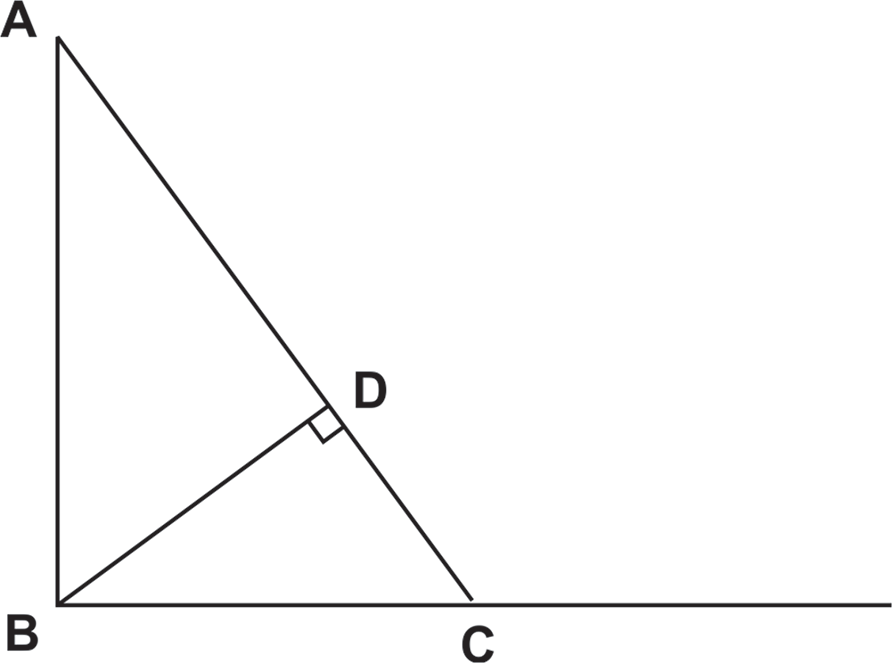
Maurolico’s secant for a given angle at A.
[lines 11–19] Since all the triangles in the figure are similar, we have
[line 19 – f. 60v line 14] Maurolico gives four examples of the triangle, where
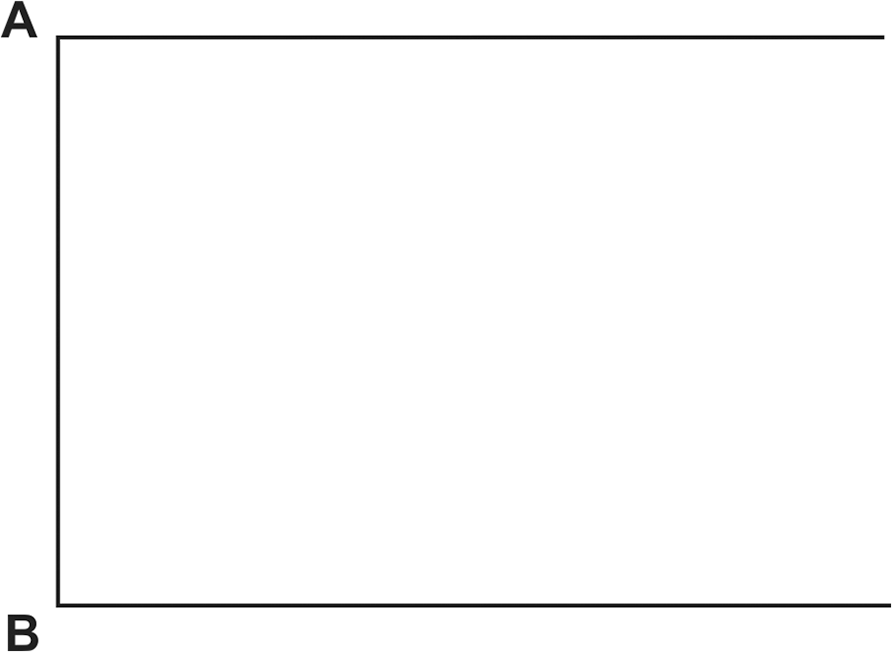
Maurolico’s secant when the angle at A is 90°.
Along the way Maurolico proves two geometric facts:
For
For
[lines 14ff] After a brief remark that both the tangent and secant tables may be computed from a sine table, Maurolico transitions to spherical trigonometry. Figure 4 (drawn twice in the text) serves for the rest of the passage. All four arcs are 90° long.
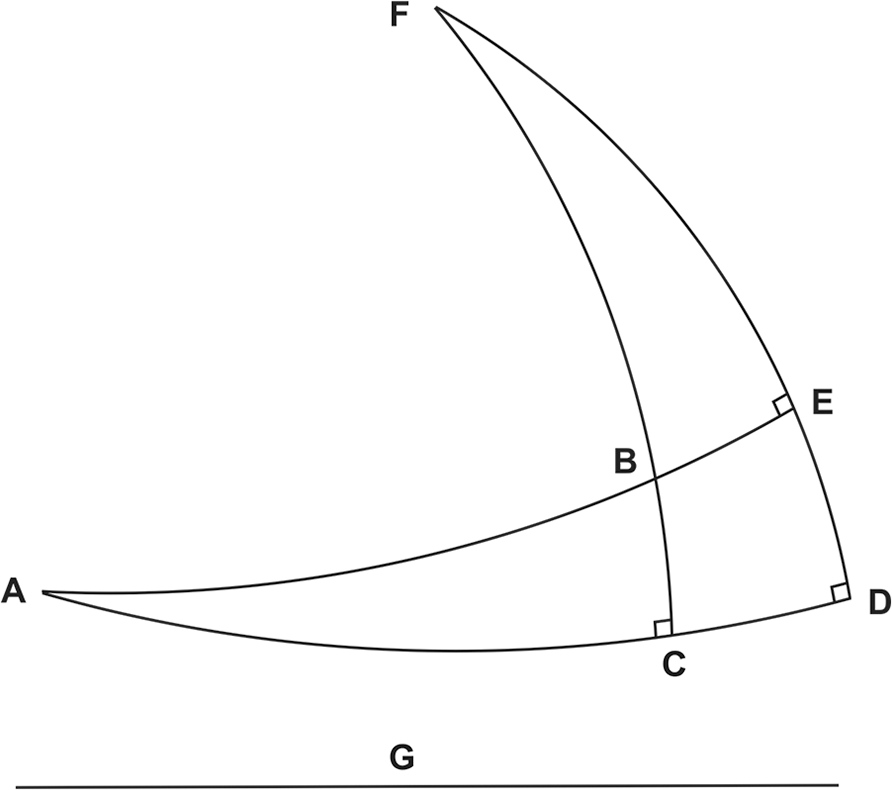
The diagram for Maurolico’s astronomical applications.
The spherical trigonometry is divided into four sections, each finding some element of right triangle ABC given two other elements (as well as the right angle at C), followed by applications in spherical astronomy.
[lines 16–28]
[lines 28–35] Three astronomical applications of (a) are given:
If ABE is the ecliptic and ACD the celestial equator, then AB is the longitude λ of B, and BC is its declination δ. The method in (a) may be used to find AC, the right ascension α of B.
If AB is an arc on the circle of latitude 13 to star B, and ACD is the celestial equator (so that BC is the star’s declination), then (a) may be used to find AC, the “difference of transit.” 14
If AB is the arc from the east point on the horizon to star B and ACD is the celestial equator, then (a) may be used to find AC, the ascensional difference (the difference between the star’s right ascension and oblique ascension).
[lines 36–43]
[lines 43–48] Two astronomical applications of (b) are given:
If ABE is the ecliptic and ACD the celestial equator, then
If ABE is the horizon with A the east point, AED the equator, and B some star on the horizon, then
[lines 48–50]
[lines 51 – f. 61r line 3]
[lines 3–5] One application of (d) is given:
If ABE is the ecliptic and ACD the celestial equator, and the longitude AB and declination BC of a point B on the ecliptic are given, then we may use (d) to find the obliquity of the ecliptic
[lines 5–10] Maurolico concludes that his tabula benefica is as useful as Regiomontanus’s tabula fecunda, provided that one is not “squeamish” about the divisions required by the various formulas. Divisions were a real issue for astronomers: they took more effort to perform than multiplications, and are more prone to error. As his examples in this text attest, Maurolico himself does not seem concerned about them. His comment that he will set out a “practical example” of the tables likely refers to the canons following the tables (folios 67 and 68), in which he solves several astronomical problems using both the tabula fecunda and the tabula benefica.
Finally, it is worth noting that Maurolico says he worked on this in August 1550, the year before Rheticus’s Canon doctrinae triangulorum was published. One wonders whether he did so to head off (in the end, unsuccessfully) a priority dispute with Rheticus. In fact, a manuscript exists containing early notes of Maurolico’s work on the tabula benefica, though not the table itself. 15 A set of notes titled “Demonstratio Tabulae Beneficae,” dated June 7, 1549, gives what appears to be an early version of lines 1–19 and 28–35 above, including versions of Figures 2 and 4 (though with slightly different lettering). 16
The controversy over the origin of Maurolico’s secant table
Maurolico opens the Demonstratio tabulae beneficae with an explicit acknowledgment of his debt to Regiomontanus and his tabula fecunda, but does not mention Rheticus. Twenty-five years later, Thomas Fincke published one of the most popular and influential trigonometry texts prior to the invention of logarithms, the 1583 Geometria rotundi.
17
This book was responsible for several innovations, including the introduction of the words “tangent” and “secant” and the first appearance of the abbreviations “sin,” “tan,” and “sec.” In it he comments on Maurolico’s work: “Maurolico published the canon of Rheticus, with a few changes, in the Messinese edition of Menelaus, also changing the name: he called it the [tabula] benefica, as line OI, or the number it defines, may be called beneficial [benefica]. And line OI is no more beneficial than the line AI is fruitful [foecunda].”
18
Fincke’s judgment in favor of Rheticus may have been influenced by Erasmus Reinhold, whose tangent tables Fincke followed in constructing his own. 19 Reinhold had not included secant tables in his Primus liber tabularum directionum (1554), but explains how to calculate them in his description of his table of tangents. 20 He also notes that he does not need to go into more detail because this is readily available in Rheticus’s canon. 21 Fincke was certainly aware of this statement; he takes a demonstration, with attribution, from the section of the Primus liber in which Reinhold mentions Rheticus’s tables. 22
This provides some context for Fincke’s claim about Maurolico’s copying. Reinhold, writing in 1553, would not have been aware of Maurolico’s work, and so only had Rheticus (and Regiomontanus) as a source. Fincke may simply have assumed that Maurolico had used Rheticus in the same way that Fincke himself had used Reinhold’s work.
The accusation that Maurolico’s table was copied with minor alterations from Rheticus’s Canon doctrinae triangulorum was addressed just under a decade later by Antonio Magini in his De planis triangulis (1592): “It is true that all mathematicians report having learned this [the structure outlined in Figure 1 and used by Viète] from the said Palatine author [i.e., Rheticus] in his works, where he first introduced the use of the secant or hypotenuse, and widened the use of the tangent (which was invented by Regiomontanus), although Francesco Maurolico, not least of the mathematicians of the previous century, may also seem to have discovered the secant, when in a certain one of his additions to the Elements of Theodosius, published at Messina in the year 1558, he constructed a table of secants, which he called benefica. Nor is it that we should suspect that the latter took anything from the former, because the methods of each are quite different, and the great canon was commended to Leipzig by [Rheticus] in about 12 pages in 1551. On account of the scarcity of the work, it would not have been able to turn up in Messina in Maurolico’s hands; on the contrary, it was only offered to us by chance a few years ago.”
23
The rarity of Rheticus’s 1551 tables was due to the fact that they had been placed on the Catholic church’s Index expurgatorius, surely one of the most unusual books on that list. 24 Magini notes that Maurolico’s style differs from the approach advocated by Rheticus; indeed, Maurolico is much closer to Regiomontanus.
A couple of decades later John Wedderburn echoed Magini’s view in his Quatuor problematum confutatio: “Francesco Maurolico, a Sicilian, thought himself the first to invent secant tables, although a little earlier, the Palatine had constructed the same [tables] in Germany; neither took anything from the other, as you can see from the extremely clear evidence of Giovanni Antonio Magini in the most perfect work on the primum mobile.”
25
Wedderburn’s use of Maurolico as an example was not an accident. The Quatuor problematum confutatio was written as a response to an attack on Galileo’s Sidereus nuncius by Martin Horky, Magini’s secretary. 26 Horky had gone beyond the norms of polite discourse, and Magini had apologized to Galileo privately while disassociating himself from his young secretary. Nothing was done publicly, however, which apparently prompted Wedderburn, a Scottish student at the University of Padua, to reply. 27 In the Quatuor problematum confutatio, Wedderburn brings up Maurolico in the context of accusations that Galileo had taken his design for the telescope from others. Wedderburn first gives the printing press (which, he suggests, was developed independently in Europe and India), and then Rheticus and Maurolico, as examples of independent discovery. 28 The implication of taking an example from Magini himself seems clear: Horky’s own patron had argued for such an instance.
Of the early modern references to Maurolico’s relationship to Rheticus, Magini seems to have been the most attentive to the actual details of their publication. Fincke may have been following Reinhold (who did not know about Maurolico’s table), while Wedderburn was surely more interested in using Magini’s claims as ammunition against Horky. In contrast, Magini considered the circumstances of Maurolico’s publication, the difference between the two sets of tables, and the availability of Rheticus’s canon in his own day. That said, Magini’s “evidence” seems far from “extremely clear.” However, the entries in Rheticus’s and Maurolico’s tables are a potential additional clue to help to resolve the question.
Recomputation of tables
Maurolico’s treatise contains four single-page tables on folios 65 and 66: tabella sinus recti (sines), tabella foecunda (tangents), tabella benefica (secants), and tabella declinationum et ascensionum (declinations and ascensions). We ignore the latter, except to note that Maurolico uses
The sine table
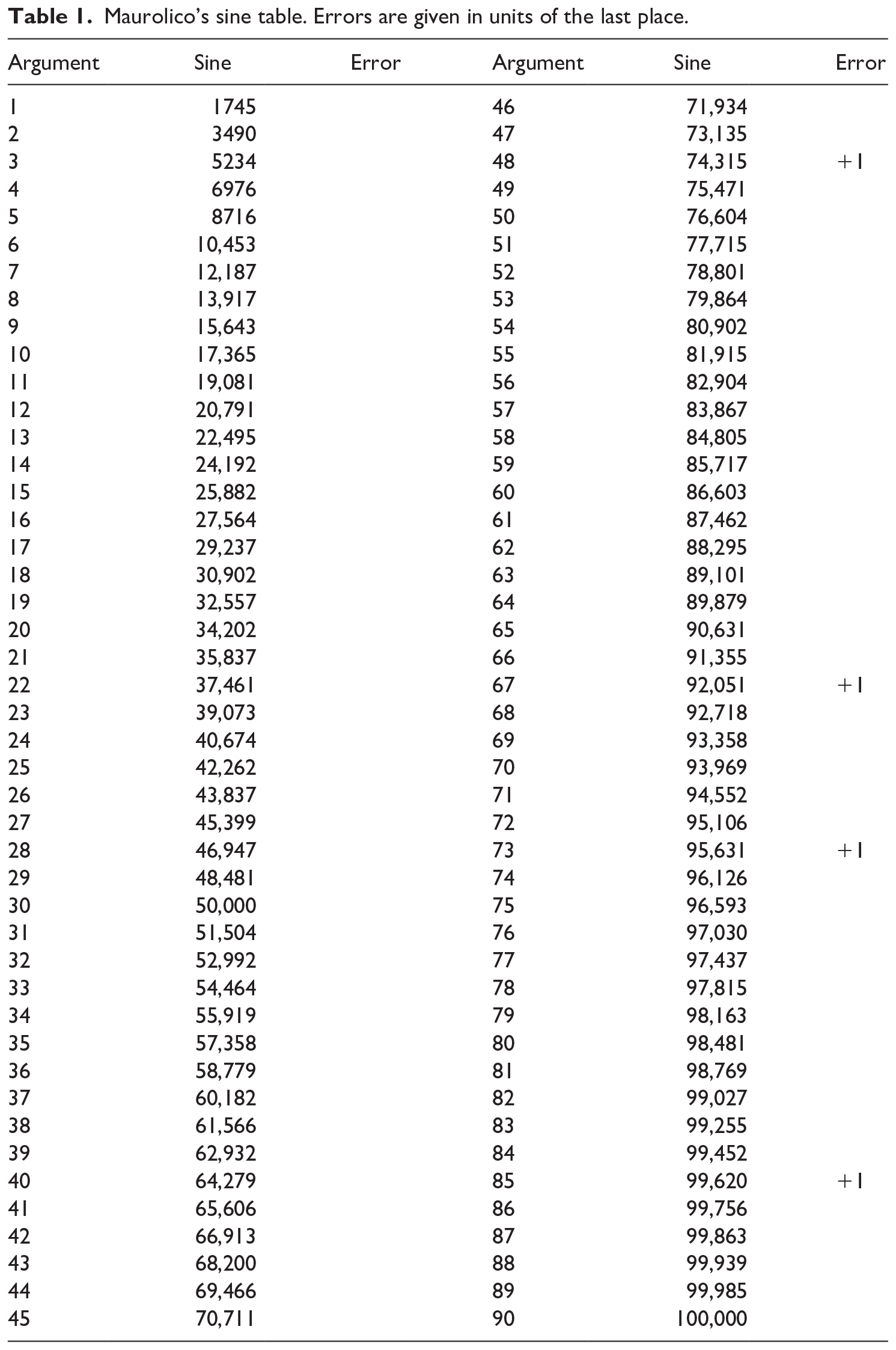
The sine table is recomputed in Table 1. As Glowatzki and Göttsche report, 30 the values are accurate to all decimal places except four (48°, 67°, 73°, 85°), which are all in error by one unit in the last place. Glowatzki and Göttsche say that Maurolico presumably took his sine table from that of Regiomontanus in his Compositio tabularum sinuum rectorum (indeed, they assert that Maurolico’s tangent and secant tables were computed from it as well 31 ), which uses a base circle radius R = 10,000,000. 32 The entries for integer arguments in the latter table, given to two more places than Maurolico’s table, are remarkably accurate, correct to all seven places except for six entries.
Maurolico’s sine table. Errors are given in units of the last place.
The tangent table
Maurolico’s tangents (Table 2) are generally accurate except for small errors in the last place, until near the end of the table. Here Maurolico, along with all sixteenth-century table makers, runs into difficulty. When θ is close to 90° the denominator of
Maurolico’s tangent table, not including the entries after 89°.
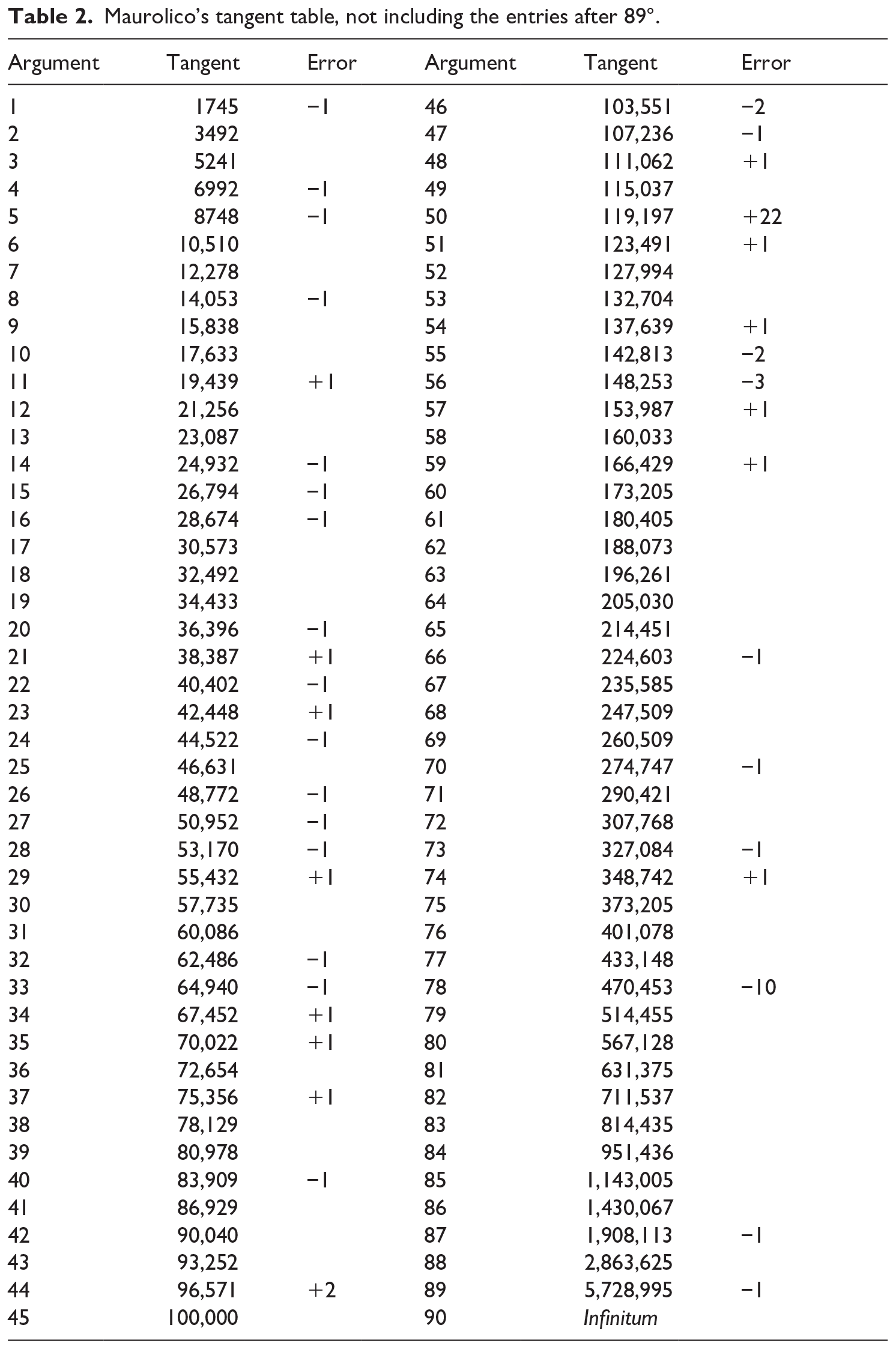
It has been suggested that Maurolico took his tangent values for arguments up to 45° from Regiomontanus’s table in his Tabulae directionum,
34
and indeed this seems to be the case, although up to around 60°. Only 25 of the first 59 entries in Maurolico’s table are correct to all places (most of the rest are in error by one unit in the last place); all but five of these 59 entries match Regiomontanus’s values, including an entry with a large error (probably scribal) at 50°. Beyond 60° Maurolico’s values are significantly better than Regiomontanus’s; indeed, they are generally slightly more accurate than the rest of the table, even though the numerical instability is greater. As Table 3 indicates, Maurolico’s values at the end of the table are substantially more accurate than may be obtained even using precise calculation from Regiomontanus’s sine table for
The latter part of Maurolico’s tangent table (including the entries above 89°), the corresponding section of Regiomontanus’s tangent table (which has no entries above 89°), and a tangent table recomputed from Regiomontanus’s sine table with
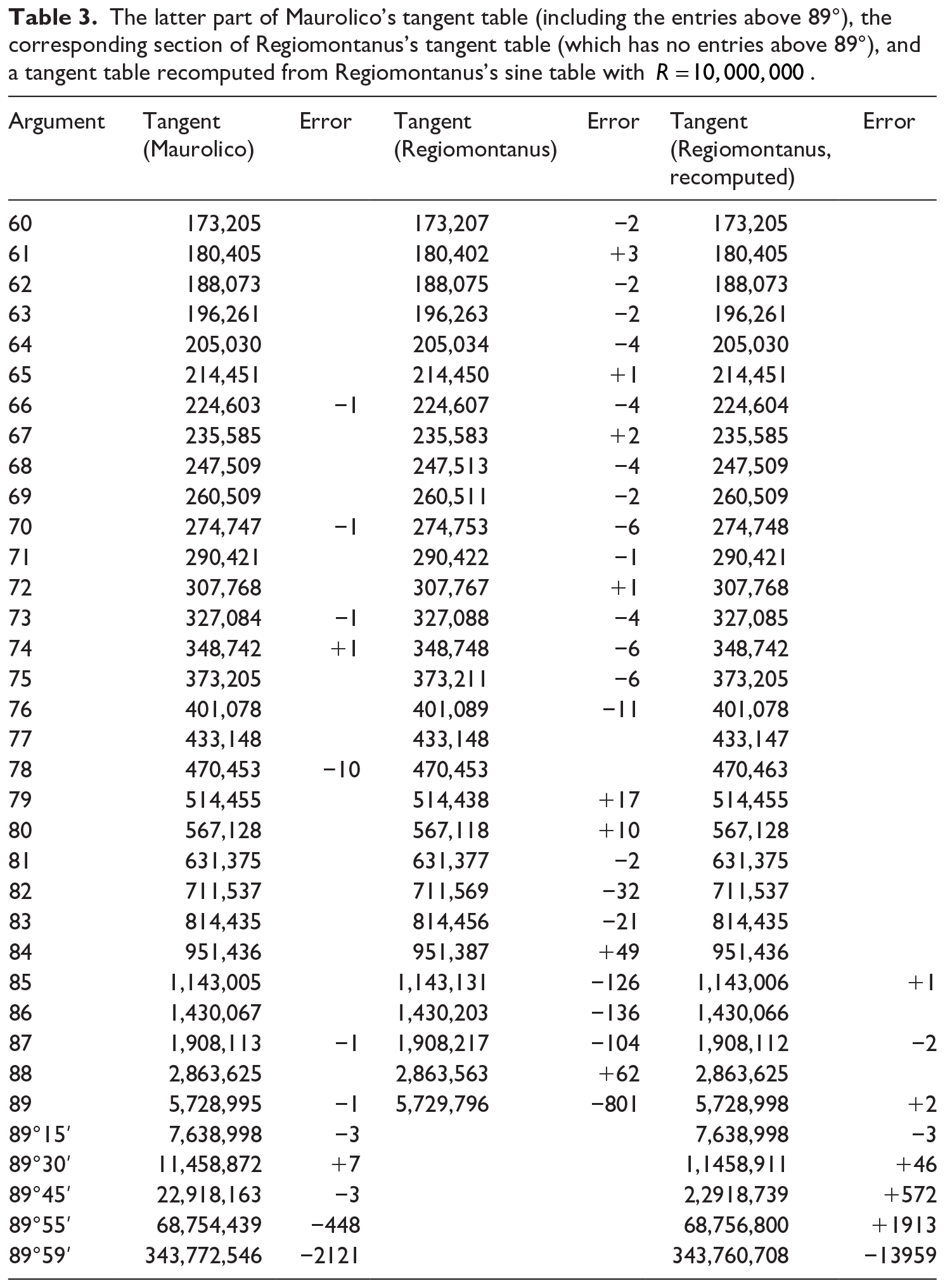
These findings suggest that as early as 1550, Maurolico was aware of the issues involved in computing tangents for arguments near 90° and did computational work behind the scenes to evade the problem. Somehow he was able to obtain tangent values more accurate than could be found from any sine table available to him.
The secant table
The entries in Maurolico’s table of secants (Table 4), computed for
Maurolico’s secant table, not including the entries after 89°.
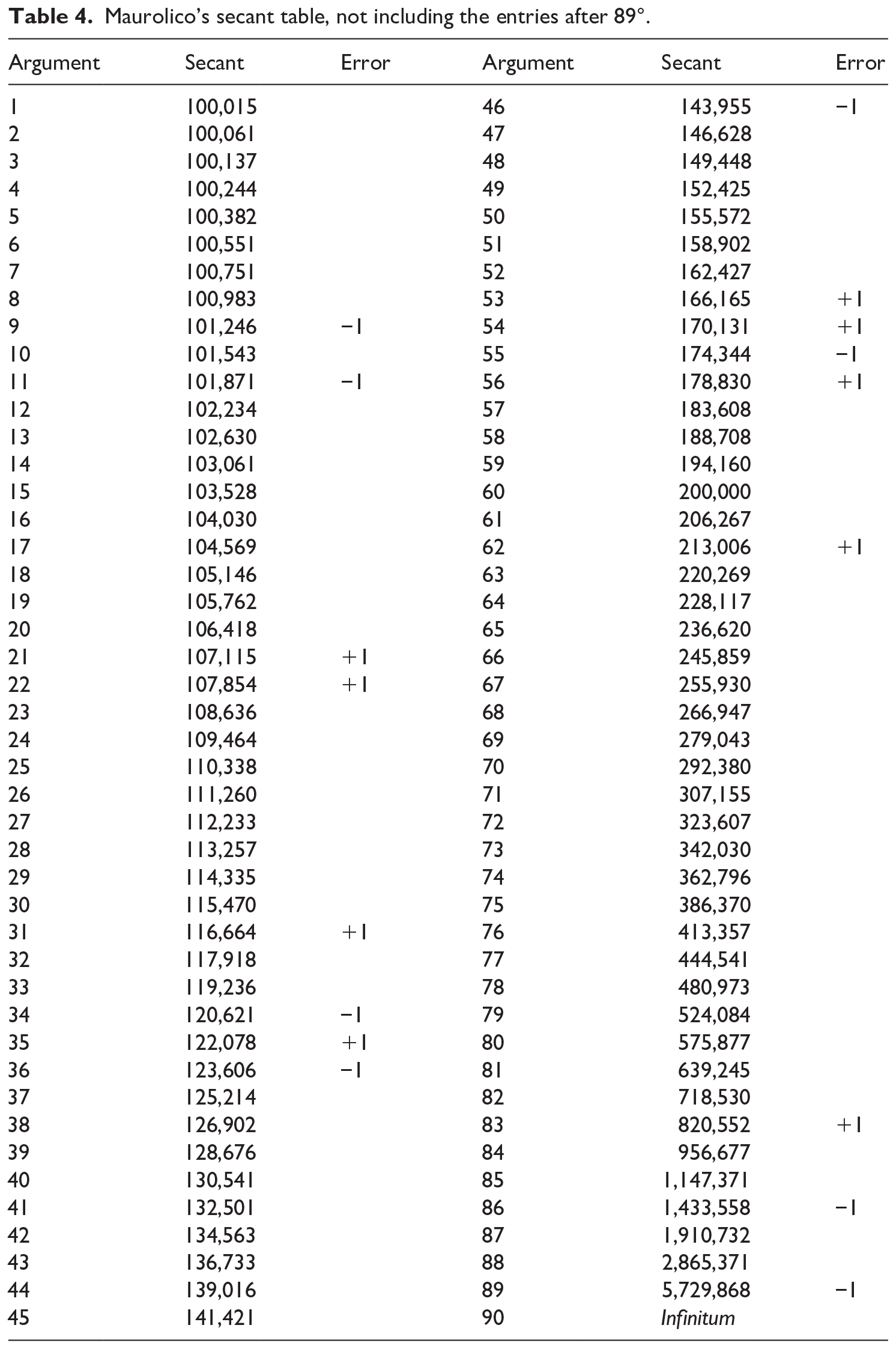
The latter part of Maurolico’s secant table (including the entries above 89°), the corresponding entries of Rheticus’s secant table (which has entries only for every 10′), and a secant table recomputed from Maurolico’s tangent table using the Pythagorean Theorem.
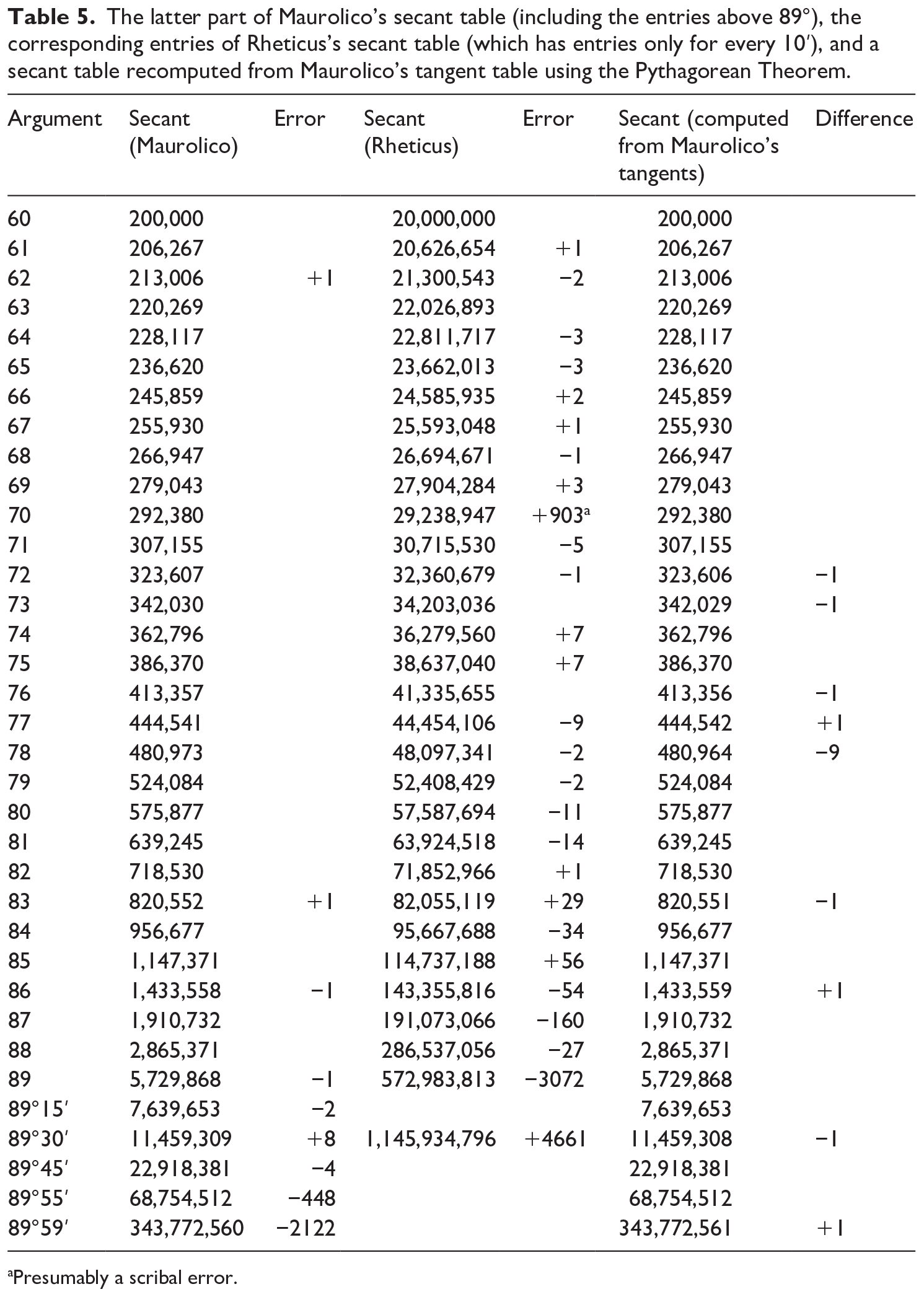
Presumably a scribal error.
The explanation for Maurolico’s success is partly that he does not compute his secants from a sine table (according to
Conclusion
Maurolico’s tables, although much smaller than Rheticus’s and those of other contemporaries, were among the best of their time. The accuracy of his tangent and secant tables establish Maurolico’s independence from Rheticus, but also reveal that his computations were deliberate and sophisticated. Many table makers afterward adopted Maurolico’s addition to Regiomontanus’s nomenclature for the new functions (“tabula benefica,” from “tabula fecunda”) alongside Fincke’s “secant” and “tangent,” while few (apart from Viète) followed Rheticus. The sine, tangent, and secant became the standard three trigonometric functions thereafter. Maurolico’s conservative attitude of admiration for the ancient ways, it seems, did not stop him here from helping to forge a new path for trigonometry.