




Abstract
In 1717, Halley compared contemporaneous measurements of the latitudes of four stars with earlier measurements by ancient Greek astronomers and by Brahe, and from the differences concluded that these four stars showed proper motion. An analysis with modern methods shows that the data used by Halley do not contain significant evidence for proper motion. What Halley found are the measurement errors of Ptolemaios and Brahe. Halley further argued that the occultation of Aldebaran by the Moon on 11 March 509 in Athens confirmed the change in latitude of Aldebaran. In fact, however, the relevant observation was almost certainly made in Alexandria where Aldebaran was not occulted. By carefully considering measurement errors, Jacques Cassini showed that Halley’s results from comparison with earlier astronomers were spurious, a conclusion partially confirmed by various later authors. Cassini’s careful study of the measurements of the latitude of Arcturus provides the first significant evidence for proper motion.
Introduction
The possibility of motion of the stars relative to one another was raised by Hipparchos, around 130
There is possibly an echo to this in the statement by Macrobius
2
who lived around 400
Brahe 3 concluded that the ancient measurements are rather inaccurate. For example, he compares the latitudes of Aldoboram (Aldebaran) that result from the measurements by Timocharis, Hipparchos, and Ptolemaios and “cannot but wonder” about the large differences between them. He warned, correctly, that the latitude from Ptolemaios is erroneous: “widest of the mark.”
In 1717, Halley 4 published Considerations on the change of the latitudes of some of the principal fixt stars, in which he ignores the warning by Brahe and compares contemporaneous measurements with those of Hipparchos and Ptolemaios for the latitude of four stars, namely Palilicium or the Bull’s Eye (i.e. Aldebaran), Sirius, Arcturus, and the bright shoulder of Orion (Betelgeuse). He also compares contemporaneous measurements of Sirius with those of Brahe. On the basis of this he suggested that all four stars had shown proper motion.
In the same paper, Halley refers to an occultation of Aldebaran observed on 11 March 509, in or near Athens according to the seventeenth-century French astronomer and polymath Ismaël Boulliau: 5 “when in the beginning of the night the Moon was seen to follow that star very near, and seemed to have eclipsed it.” Boulliau computes that such an occultation could not have happened, from which Halley concluded that an actual occurrence of an occultation was possible only if “the latitude of Pallicium were much less than we at this time find it.” As we will see below, Halley refers to the absolute value of the latitude, and implies a proper motion in the southern direction.
By the time of Halley the concept that stars are attached to a sphere, or to spheres if they do not all participate in the same precessional motion, had been replaced with the idea of stars moving in three-dimensional (3D) space. Because in the Copernican system the daily, yearly, and long-term precessional motions of the stars are apparent, merely reflecting rotation, revolution, and precession of the axis of the Earth, there was no need to assume that the stars all share the same motions because they are attached to a sphere. With his discovery that planets move in ellipses, Kepler was forced to conclude that the planets move freely in space, thereby also undermining the concept of a sphere of the stars. It is important to note, however, that eighteenth-century astronomers could no more determine distances or radial motions of the stars than Hipparchos or Ptolemaios, so that technically the challenge of observationally determining proper motion is the same in the eighteenth century as in ancient Greece.
How conclusive is the evidence produced by Halley for proper motions? This was questioned already by Jacques Cassini, 6 the son of Gian Domenico Cassini, who argued that the measurements by Hipparchos/Ptolemaios were too inaccurate to be of use for the determination of proper motion, and who corrected the latitudes given by Brahe. In modern times, van de Kamp 7 notes that the proper motions of Aldebaran and Betelgeuse are very small, and that Halley’s results for these stars must be considered spurious. Even so, the determination of proper motions of Sirius and Arcturus by Halley is often still considered valid. 8 With regard to the occultation, Neugebauer, 9 referring to computations by Stephenson, agrees with Boulliau that no occultation took place! Notwithstanding these problems, Halley is still generally credited with the discovery of proper motion. In this paper, we take a close look at the argumentation by Halley, and at the study by Cassini (Table 1).
Ecliptic latitudes of the four stars discussed by Halley in various catalogues: Ptolemaios/Hipparchos in a modern edition (Toomer
1
) and in an edition by Hudson
10
and Brahe in the edition by Kepler
11
and Flamsteed.
12
For each catalogue the one-sigma error
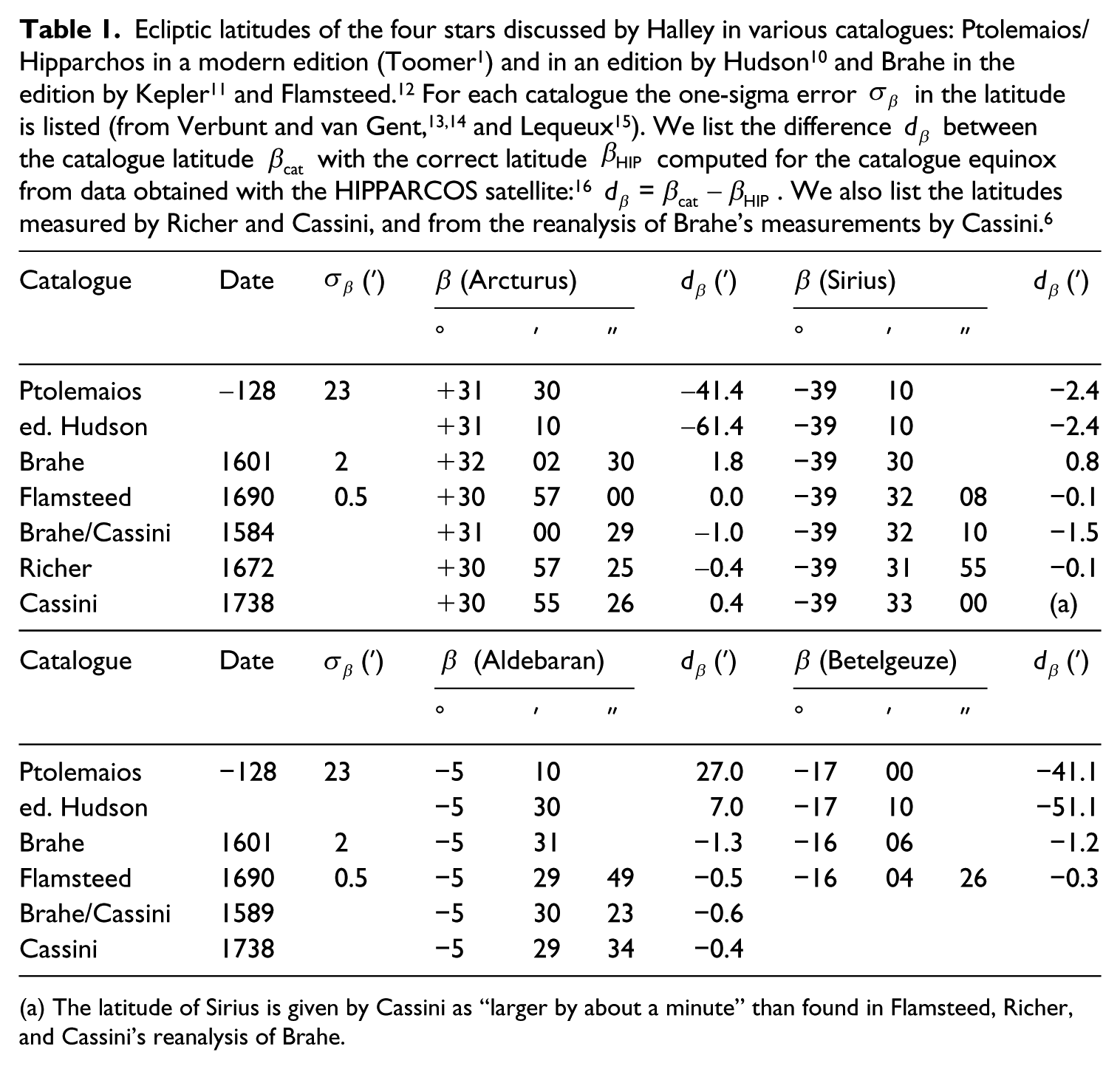
(a) The latitude of Sirius is given by Cassini as “larger by about a minute” than found in Flamsteed, Richer, and Cassini’s reanalysis of Brahe.
Latitude differences: Halley
Precession at constant obliquity leads to an increase in the ecliptic longitude, but does not affect the latitude. The slow change in obliquity leads to slow changes in latitude. In Table 1, we collect ecliptic latitudes of Aldebaran, Sirius, Arcturus, and Betelgeuse from the star catalogues of Ptolemaios, Brahe, and Flamsteed. The latitudes given by Ptolemaios (taken from Toomer’s
1
edition) differ by much more from those given by seventeenth-century astronomers than can be explained with the change in obliquity. In our analysis, we assume that Ptolemaios corrected longitudes determined by Hipparchos, undid his corrections, and used the epoch of Hipparchos,
In his 1712 edition of the star catalogue of Ptolemaios, Hudson 10 acknowledges emendations made by Halley. In the same year, Halley edited a star catalogue based on data from Flamsteed, which he had surreptitiously obtained in collusion with Newton. 18 This work may have alerted Halley to large latitude differences. (The positions of the four stars in Table 1 in the 1712 pirate edition are identical to those in the 1725 edition by Flamsteed 12 himself.)
The proper motions in the latitude direction cannot be derived simply by dividing the difference between the latitudes for different catalogues by the time interval, but require correction for the change in obliquity between the catalogue equinoxes. Halley remarks that the value for the obliquity used by Brahe is
Columns 2–5: difference in latitude found by subtracting from the values given by Ptolemaios (left) or Brahe (right) the values found by converting the positions from Halley’s time to the equinox of the old catalogue.
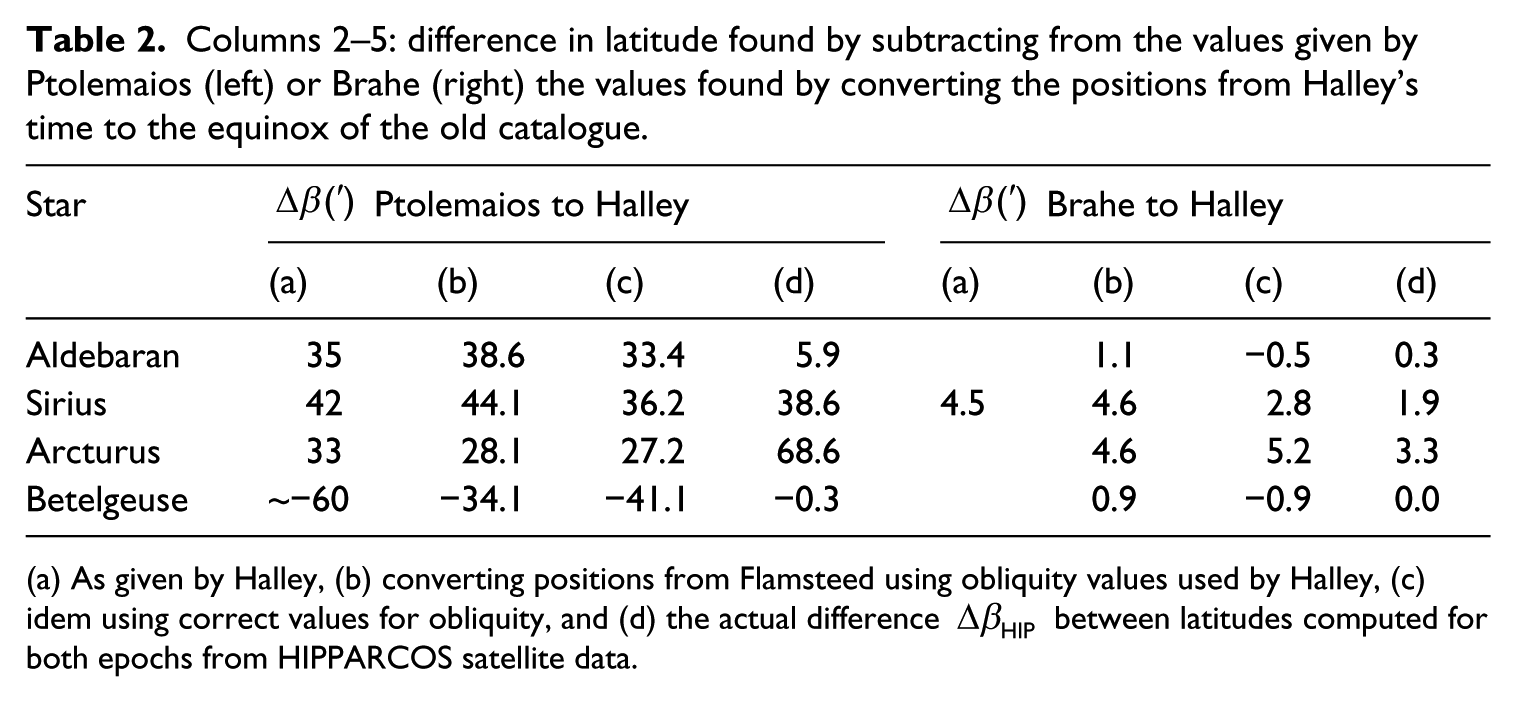
(a) As given by Halley, (b) converting positions from Flamsteed using obliquity values used by Halley, (c) idem using correct values for obliquity, and (d) the actual difference
The one-sigma errors
The exercise of comparing contemporaneous latitudes with those in an old catalogue was repeated by Halley for the catalogue of Brahe, for Sirius only. Halley
4
gives two values for
The uncertainty in the obliquity also adds to the errors in the comparison with Ptolemaios. At the end of his article, Halley
4
expresses some doubt that the value for the obliquity at the time of Hipparchos to Ptolemaios was indeed 22′ larger than in his own time. This doubt is justified, as the correct difference in obliquity is 15′ and 13′ for the epochs of Hipparchos and Ptolemaios, respectively.
19
The deviations in latitude due to the uncertainty in
Latitude differences: modern
To see whether the data available to Halley imply proper motion when analysed with modern methods, we reanalyse them twice, first with the values for the obliquity used by Halley, and then with the correct values for the obliquity
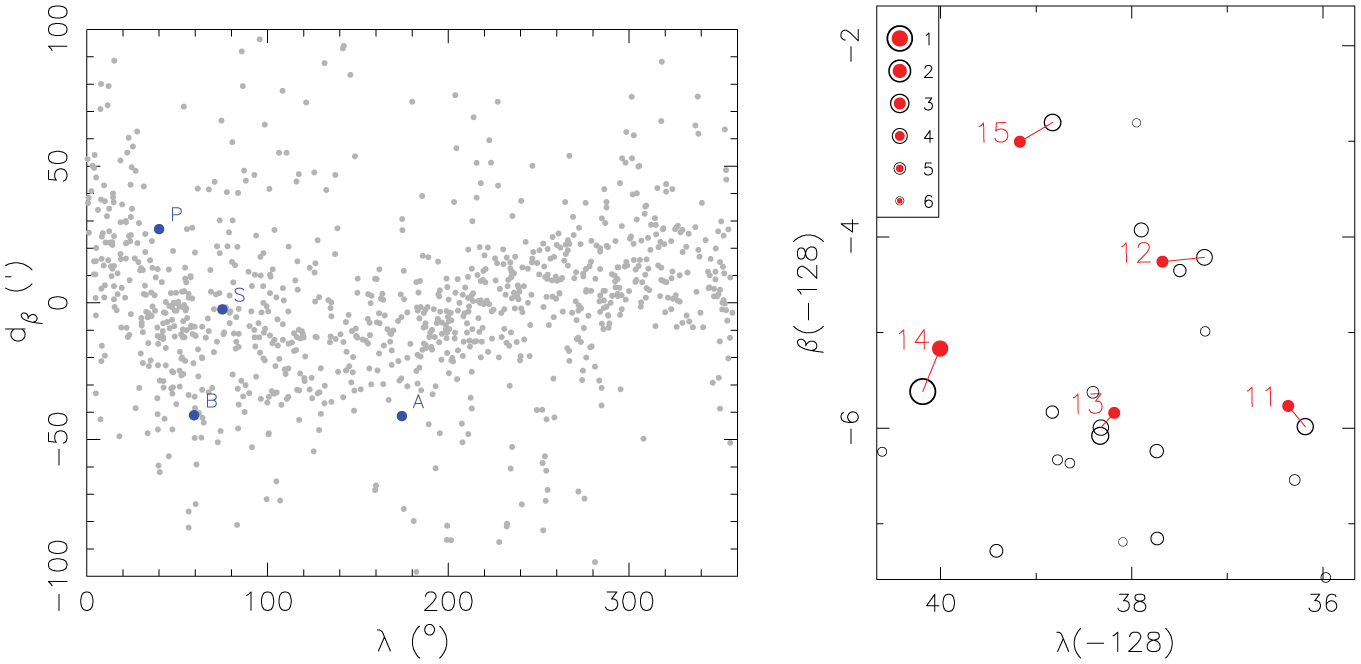
Left: differences
Table 2 shows that the values we compute with the obliquities given by Halley are close to the values he gives, but not identical. Halley indicates that his
The effect of a wrong value for the obliquity depends on the celestial position, in particular on the ecliptic longitude. It is smallest for Arcturus, and largest for Sirius.
None of the displacements in latitude
Turning to the comparison of star positions from Flamsteed and Brahe, we see that use of the correct value for the obliquity in 1601,
We conclude that according to modern criteria, the latitude differences found by comparing star positions from the epoch of Halley (presumably from Flamsteed) with those in the catalogues of Ptolemaios and Brahe provide no evidence for proper motion. Halley ignored measurements errors, and this is what led to his seemingly positive result.
Occultation of Aldebaran by the Moon: Halley
Halley’s second argument is the occultation of Aldebaran by the Moon on 11 March 509, described and analysed by Boulliau.
5
The inclination of the lunar orbit to the ecliptic causes a monthly oscillation of the position of the Moon around the ecliptic. The inclination of the rotation axis of the Earth with respect to the ecliptic causes a daily oscillation of the direction to the Moon as seen from a particular location – the daily parallax. The combined effect of these two oscillations is illustrated for Athens in Figure 2. The figure shows that the daily variation in topocentric latitude of the Moon due to the daily parallax
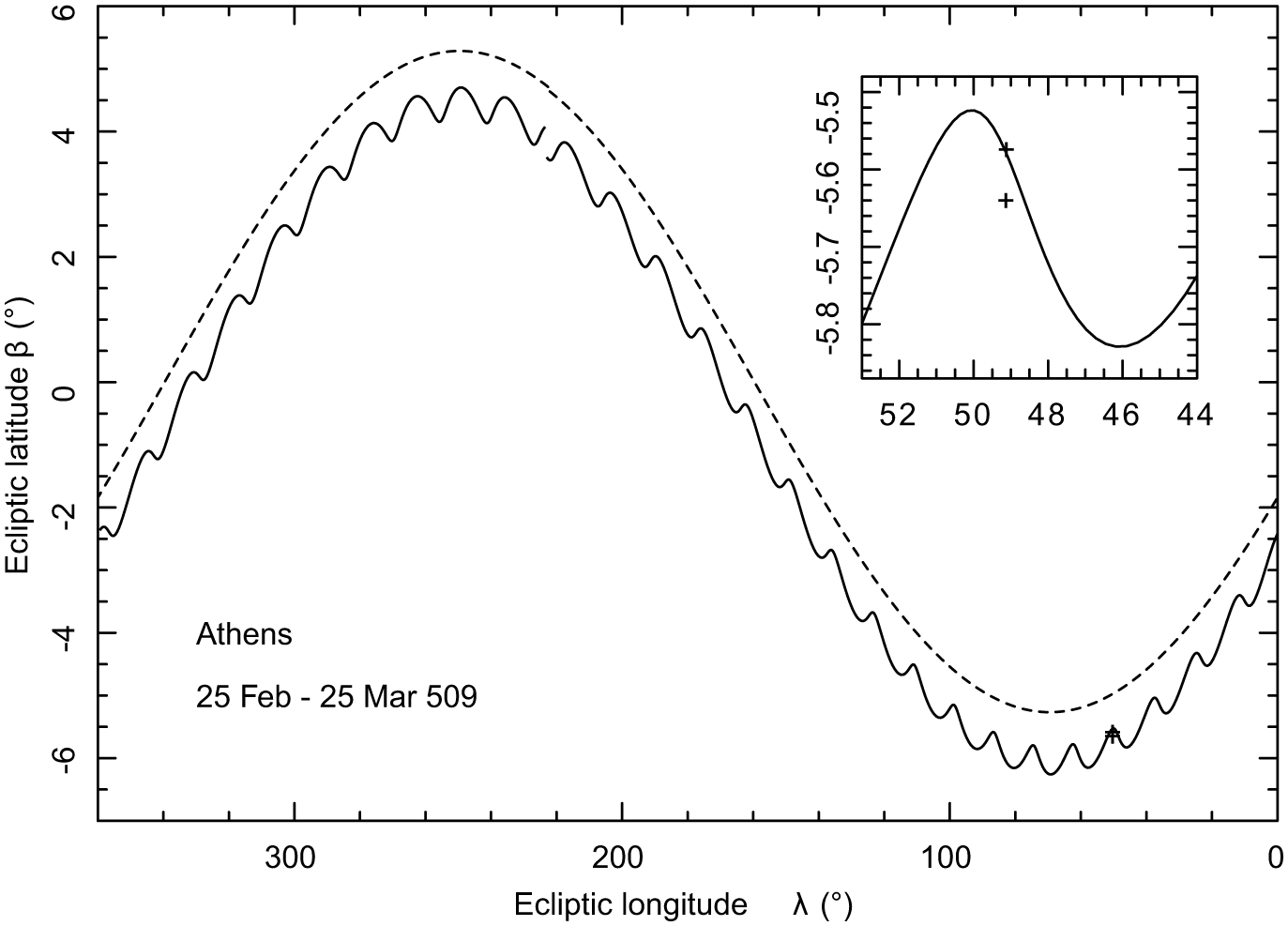
Motion of the Moon along the sky for the period of a month centred on 11 March 509.
Whereas Halley was very interested in lunar motion, his systematic observations of the Moon and analysis of his own and earlier (in particular Flamsteeds) data only started after 1720. Before that he computed tables of lunar positions based on Newton’s theory. Whereas these appeared more or less satisfactory for the observations at hand, the theoretical predictions worsened rapidly in the next 18-year cycle. 20 This implies that Halley could not compute the position of the Moon on 11 March 509 with sufficient accuracy to decide whether there was an occultation. The brevity of his report indicates that he did not perform such a computation – even if he did, it is clear from modern insight that the resulting uncertainty was too large to allow significant conclusions. We return to this below.
It is more likely that Halley based his conclusion on the text by Boulliau. 5 Boulliau prints a Greek text from the astronomer Heliodorus, and provides a Latin translation. We translate from the Greek (see Appendix 1).
On 15 to 16 Phamenoth 225, I saw the Moon following the bright [star] from the Hyades, after the lighting of the lamps, by at most half a finger, and it appeared to have occulted it, because the star was next to the bisection of the convex circumference of the illuminated part. The true Moon then was at
The Egyptian date corresponds to 11 March 509, a finger in ancient astronomy corresponds to 5′, and the lamps were lighted after dusk. After performing the required computations Boulliau concludes that in fact no occultation took place. He took 7:20 p.m. as the local time for earliest visibility in Athens, and used a time difference between Athens and Hven (Uranienborg) of 45 minutes, close to the correct value of 44.1 minutes. We list his numbers in Table 3. Boulliau does not mention a latitude for Aldebaran, but we may assume that he used the value
Geocentric and topocentric positions of the centre of the Moon on 11 March 509 for an observer in Athens according to Boulliau
5
(Bo) and according to our modern computations for Athens (At, coordinates
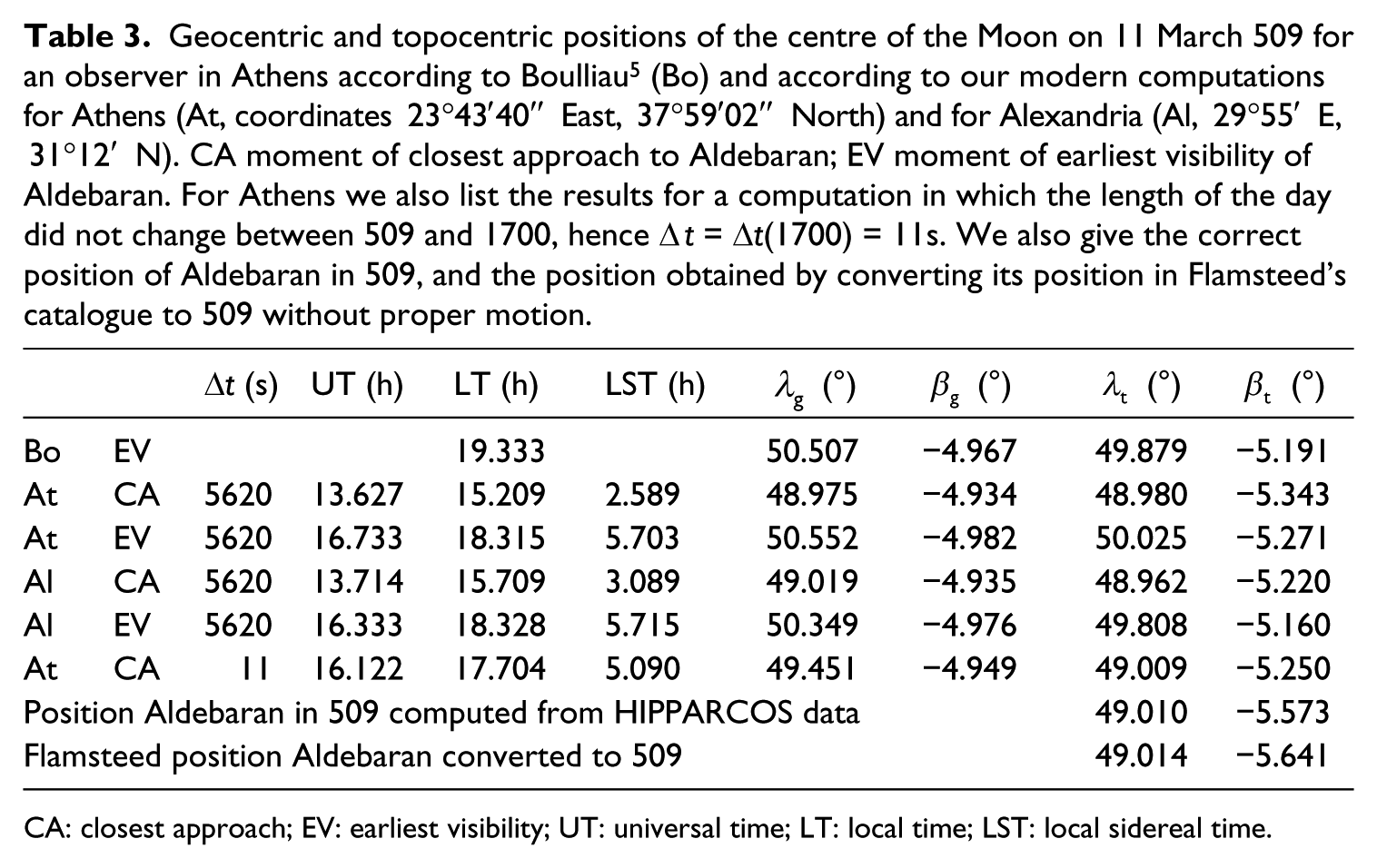
CA: closest approach; EV: earliest visibility; UT: universal time; LT: local time; LST: local sidereal time.
Halley will have noted that the position of Aldebaran according to Flamsteed is
Occultation of Aldebaran by the Moon: modern
In our analysis of the possible occultation of Aldebaran by the Moon, we discuss three problematic aspects of the computation by Boulliau and – if he made one independently – by Halley. The first is the slowdown of the rotation of the Earth, which was unknown in the seventeenth century. This implies that the time elapsed since 11 March 509 is shorter than one would estimate based on the length of the day near 1700 A.D. Boulliau and Halley were not aware of this. We investigate this aspect by comparing correct calculations with those for a constant rotation speed of the Earth. The second aspect is the question where the occultation was observed. The Greek text does not mention this, and Boulliau and Halley assumed that it was in Athens. Neugebauer 9 argues on the basis of the career of Heliodorus, that the observation of the occultation was made in Alexandria. We investigate this by making calculations both for Athens and for Alexandria. The third aspect is the reliability of the Greek text. We’ll discuss this as we proceed.
We start by computing the relative positions of the Moon and Aldebaran, for observers in Athens and in Alexandria, on 11 March 509, at two moments: the moment of closest approach and the moment of earliest visibility of Aldebaran in the evening. To obtain the dynamical time JDE, we add ∆ t = 5620 s to the Julian Day JD (Morrison and Stephenson, 21 the uncertainty in ∆ t is 140 s).
We compute the geocentric position and apparent diameter of the Moon using the fits made to the numerical integration of ELP/MPP02.
22
To find the topocentric position and diameter of the Moon, we compute the Mean Stellar Time at Greenwich from the dynamic time, correct it for nutation, and convert it to the Local Stellar Time at Athens. From this and the geocentric position of the Moon we compute the daily parallax, and add it to the geocentric position to obtain the topocentric position and apparent diameter. Our results are listed in Table 3 and shown in Figure 3. The visible limiting magnitude at the position of Aldebaran depends on its distance to the horizon, Sun, and Moon.
23
We determine the instance when this limiting magnitude equals that of Aldebaran (
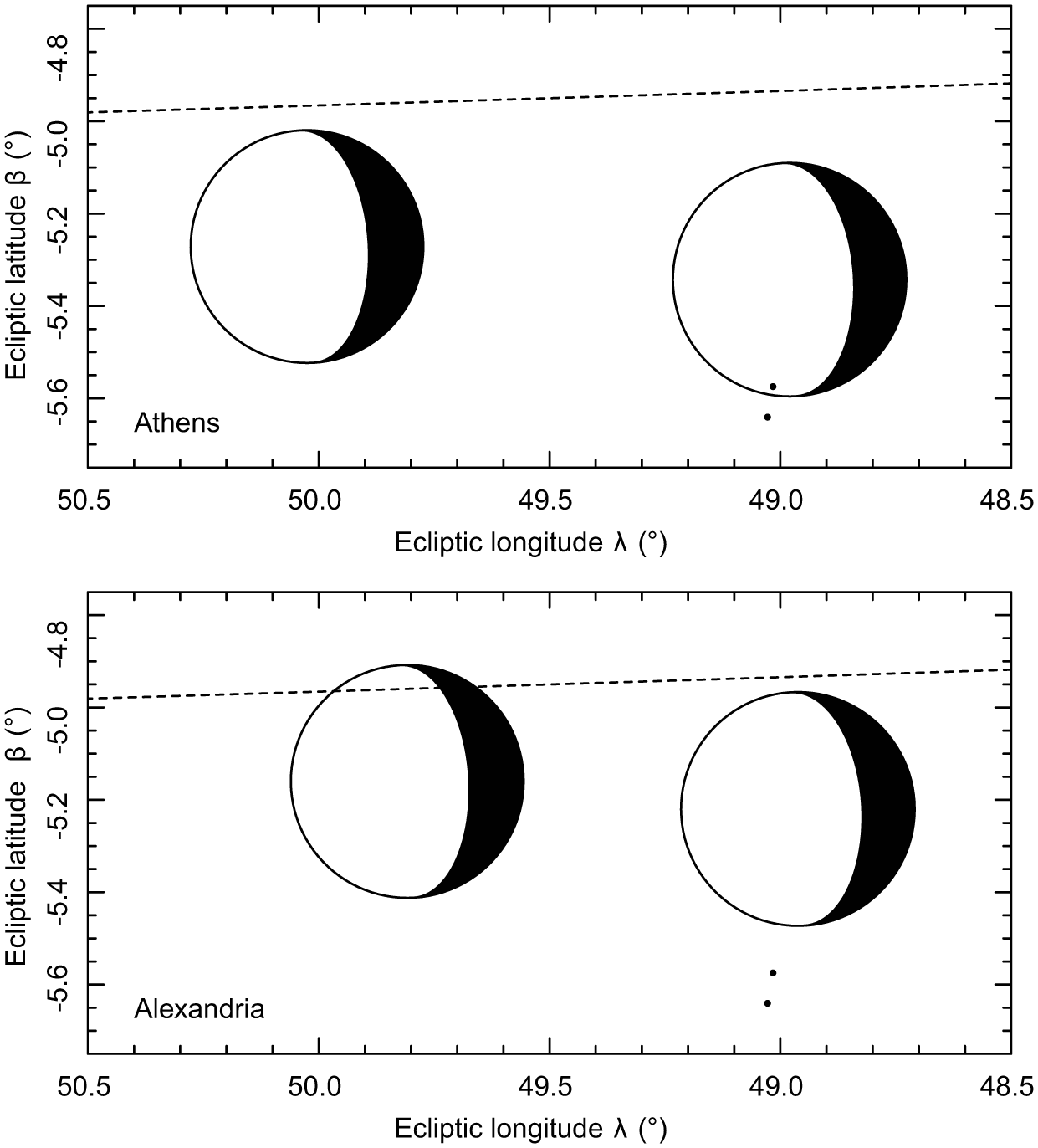
Relative positions of the Moon and Aldebaran at the moment of closest approach and at the moment of first visibility of Aldebaran for Athens (top) and for Alexandria (bottom) on 11 March 509, computed with modern knowledge. The black crescents correspond to the illuminated part of the Moon. The upper position of Aldebaran is the correct one, the lower position is computed assuming no proper motion between 1690 and 509. The dashed line indicates the geocentric position of the centre of the Moon.
It does not follow that Halley proved the proper motion of Aldebaran with this argument. The accuracy required to prove or disprove the occultation of Aldebaran in 509 was well beyond reach for Boulliau, Halley, or their contemporaries: at closest approach Aldebaran was just 1.4′ within the limb of the Moon. For example, Halley was not aware of the slowdown of the rotation of the Earth. If we repeat our computation for ∆ t = 11s, ignoring the slowdown of the rotation of the Earth between 509 and 1700, we find a topocentric latitude in Athens for the Moon about 6′ further North, which implies there is no occultation of Aldebaran.
Cassini
Jacques Cassini 6 in 1738 investigated the possible proper motion of stars. He notes that Brahe decided that the comparison of modern measurements of star positions with those made by ancient Greek astronomers does not provide evidence for proper motion, whereas Halley decides it does. Cassini concludes that only comparison between modern observers can be trusted; as we have seen above, this conclusion is correct.
Picard and Jean Dominique Cassini, the father of Jacques Cassini, made accurate measurements of Arcturus in their study of precession. Jacques Cassini compares these, and in particular the measurement of the ecliptic latitude of Arcturus by Richer in 1672 in Cayenne, with his own measurement 86 years later in Paris (see Table 1), and finds a change in latitude of
Ecliptic latitudes used by Cassini 6 to derive the proper motion of Arcturus.
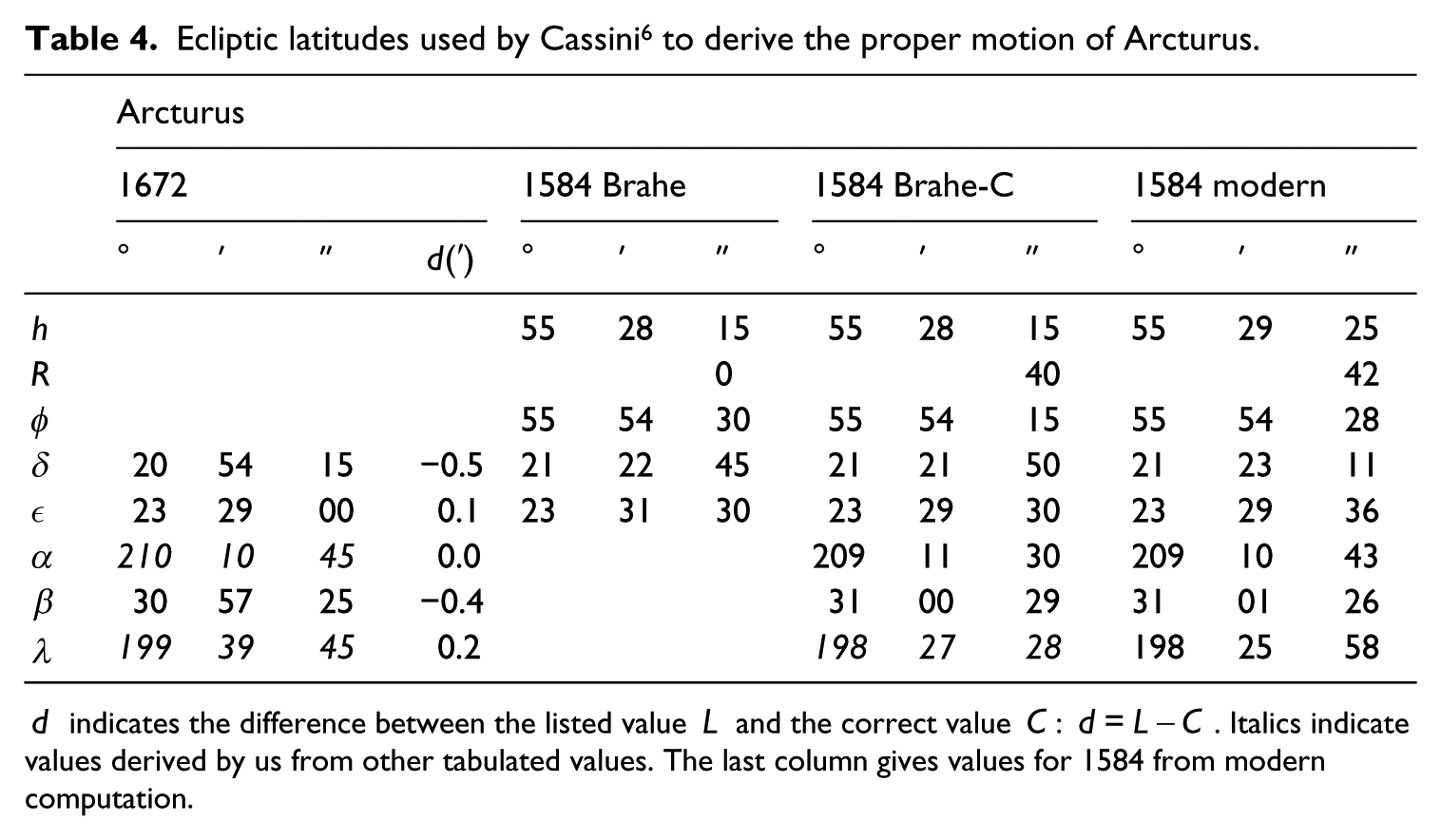
Cassini proceeds to redetermine from Brahe’s altitude measurements the latitudes of Sirius “near the end of the 16th century” and of Aldebaran in 1589. From his results, shown in Table 1, Cassini concluded that these stars showed no significant proper motion in latitude. He drew the same conclusion for other stars from the differences he found between his own measured latitudes in 1738 and the (redetermined) latitudes from Brahe’s measurements. These differences (and the values according to modern computations) are 20″ for Antares (66″), 8″ for
Finally, Cassini considers the pair
Ecliptic latitudes for Altair and
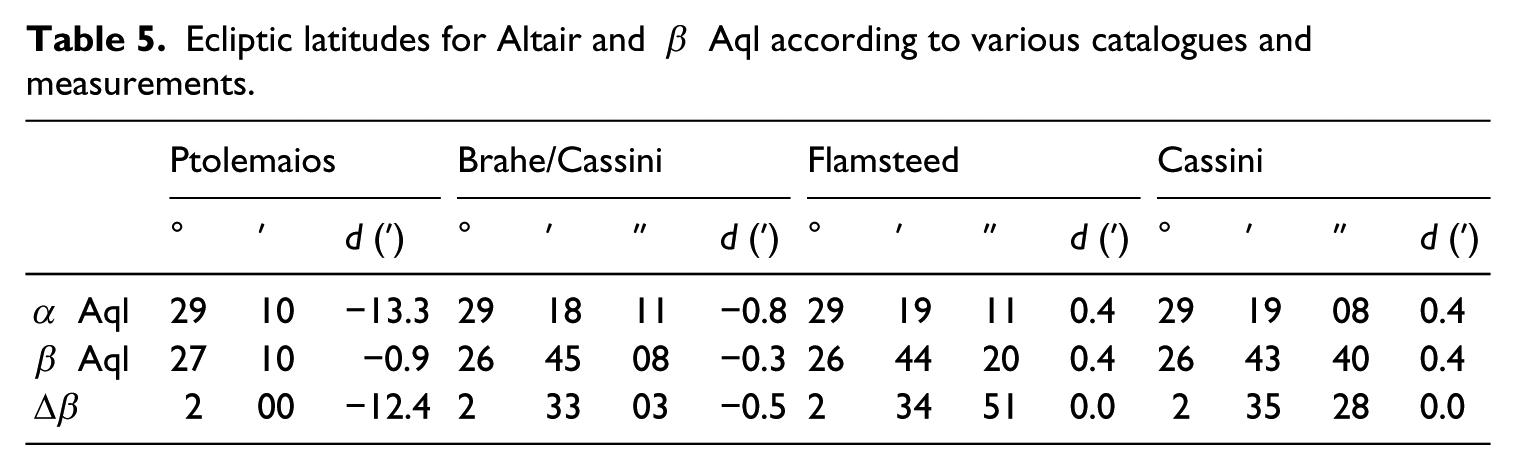
We can see here that Cassini is not consistent in his trust in numbers from Ptolemaios: where these confirm the trend between his time and (the revised) Brahe, he accepts them, but when they do not, as for Aldebaran, he concludes that this “shows that the ancient observations are not sufficient for research of this type.” In the cases of Arcturus, Sirius, and
From the above numbers, we see that the accuracy of the latitudes redetermined from Brahe’s data by Cassini is generally better than
Discussion
Halley is not the first astronomer who mistook measurement errors for proper motion. In comparing contemporaneous observations with earlier star catalogues, the eighth-century Chinese astronomer I-Hsing found north–south movements for 10 asterisms. 25 From the magnitude of the displacements, 4 to 5°, it is obvious that, like Halley, I-Hsing discovered position errors rather than proper motion.
Occultations of Aldebaran by the Moon in Alexandria do occur, but not on 11 March 509. An almost central occultation of Aldebaran by the Moon occurred on 12 February 509, about 7 o’clock local time in the morning. The occultation on 7 April 509 occurred well after Aldebaran became visible, after midnight. These occultations do not fit the description by Heliodorus. If his description fits a real occultation in Alexandria, it was not 1 month before or after the date given. In any case, the text by Heliodorus does not prove proper motion of Aldebaran.
Halley took the latitudes given by ancient astronomers and by Brahe too much at face value, and as a result interpreted their measurement errors as evidence for proper motions. In contrast, Cassini followed Brahe in questioning the reliability of the latitudes given by Ptolemaios, and decided they were too uncertain to be used as evidence for proper motion. By redetermining the latitudes derived from meridional altitude measurements by Brahe, Cassini halved the uncertainty in these latitudes, and thus gave significant proof of the proper motion of Arcturus, while invalidating the results of Halley.
Footnotes
Appendix 1
The Greek text about the apparent occultation of Aldebaran by the Moon is printed by Boulliau 5 using many ligatures which “more often dismay than enlighten” the modern reader, to paraphrase Ingram. 26 We therefore give a transcription kindly provided by Dr Frederik Bakker from the Center for the History of Philosophy and Science at Radboud University.
Here <τε> is an emendation necessary for the verb form to be grammatically correct, and the question mark indicates a sign which is difficult to read in Boulliau. This sign is followed by ' and is translated by Boulliau as “half”, which implies that it represents either
Acknowledgements
The authors thank Dr Frederik Bakker from the Center for the History of Philosophy and Science at Radboud University for his invaluable advice on the interpretation of Latin and Greek texts, and Dr Robert van Gent for pointing to relevant references.
