HuygensC., Oeuvres complètes de Christiaan Huygens (23 vols, The Hague, 1888–1950), xviii, 665. Actually Marin Mersenne had already expressed a negative opinion on Galileo's argument, cf. MersenneM., Harmonie universelle (Paris, 1636), 145, and the discussion in MacLachlanJ., “Mersenne's solution for Galileo's problem of the rotating Earth”, Historia mathematica, iv (1977), 1977–82.
2.
Cf. GalileiGalileo, Le opere di Galileo Galilei, edizione nazionale, edited by FavaroAntonio (20 vols, Florence, 1890–1909; hereafter: Galileo, Opere), vii, 214–44, and the translation by Drake, in GalileiGalileo, Dialogue concerning the two chief world systems, transl. by DrakeStillman, 2nd edn (Berkeley and Los Angeles, 1967), 188–217.
3.
Cf. KoyréA., Galileo studies, transl. from the French by MephamJ. (Hassocks, Sussex, 1978), 195, and the original French, Études galiléennes (Paris, 1966), 268.
4.
SheaW., Galileo's intellectual revolution (New York, 1972), 140–1; ClavelinM., La philosophie naturelle de Galilée (Paris, 1996; 1st edn, Paris, 1968), 244–53; MacLachlan, “Mersenne's solution for Galileo's problem of the rotating Earth” (ref. 1); GaukrogerS., Explanatory structures: A study of concepts of explanation in early physics and philosophy (Atlantic Highlands, NJ, 1978), 189–98; ChalmersA.NicholasR., “Galileo and the dissipative effect of a rotating Earth”, Studies in history and philosophy of science, xiv (1983), 1983–40, p. 321; YoderY., Unrolling time: Christiaan Huygens and the mathematization of nature (Cambridge, 1988), 35–41; HillD., “The projection argument in Galileo and Copernicus: Rhetorical strategy in the defence of the new system”, Annals of science, xli (1984), 1984–33; FinocchiaroM. (ed.), Galileo on the world systems: A new abridged translation and guide (Berkeley and Los Angeles, 1997), 179–95; and idem, “Physical-mathematical reasoning: Galileo on the extruding power of terrestrial rotation”, Synthese, cxxxiv (2003), 2003–44, p. 234. Negative conclusions, on the basis of a reconstruction of Galileo's argument according to Newtonian mechanics, were also reached by PalmieriP., in “Re-examining Galileo's theory of tides”, Archive for history of exact sciences, liii (1998), 1998–375, pp. 281–94. It is important to realize that Galileo gives several other counterarguments to the extrusion effect, which have been analysed in detail especially by Maurice Finocchiaro and by A. Chalmers and R. Nicholas (references above): A physical counterargument comparing the extrusion along the tangent with fall along the secant; another physical counterargument contrasting how extrusion depends on linear speed and how it depends on the radius; and two other mathematical counterarguments: One claiming that on a rotating Earth extrusion is mathematically impossible because the ratio of an exsecant to the corresponding tangent segment tends toward zero, the other claiming that it is impossible because the ratio of one exsecant to another (at twice its distance from the point of tangency) tends to zero.
5.
Hill, “The projection argument in Galileo and Copernicus” (ref. 4), 133, for example.
6.
DrakeS., “Galileo and the projection argument”, Annals of science, xliii (1986), 77–79.
7.
“Though there is presumably a rhetorical dimension to all argument meant to persuade, there must always be a basic distinction between honest argument and conscious deception. I have argued that Galileo crossed the line in the case at hand”, Hill, “The projection argument in Galileo and Copernicus” (ref. 4), 133.
Cf. SiebertHarald, Die Große kosmologische Kontroverse: Rekonstruktionsversuche anhand des Itinerarium exstaticum von Athanasius Kircher SJ (1602–1680) (Stuttgart, 2006); see especially the discussion on pp. 132–54.
12.
Galileo, Dialogue concerning the two chief world systems (ref. 2), 188.
13.
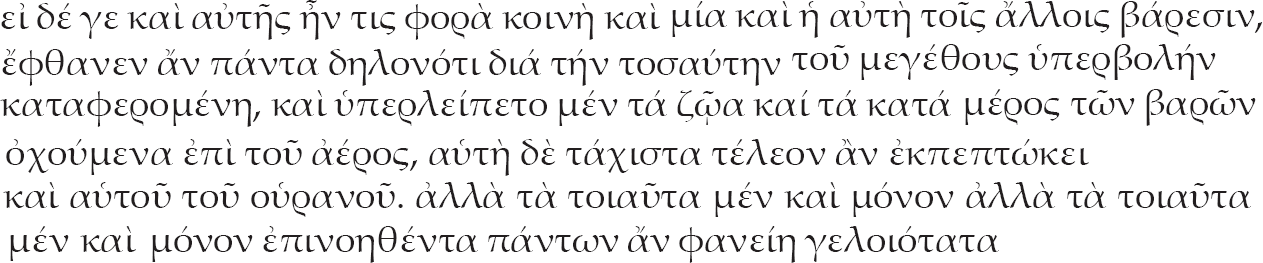
Ptolemy's Almagest, transl. and annotated by ToomerG. J. (Princeton, NJ, 1998; first edn, London, 1984), 44. Cf. the Greek text in Heiberg's edition: . Cf. Ptolemy, Syntaxis mathematica, ed. by HeibergJ. L., Part 1, Books 1–6 (Leipzig, 1898), 23–24. We may notice that even the great Heiberg shied away from translating the Almagest, commenting at the end of his preface to the 1898 edition, “interpretationem meam sive Latinam sive linguae recentioris in tanta rerum difficultate addere ausus non sum; de re videant astronomi, si interpretationem desideraverint” (ibid., p. vi). It is ultimately for the astronomers to tackle the issues raised by Ptolemy's text!
14.
I wish to thank James Lennox for translating the passage and sharing with me his insights into the semantic complexities of the original Greek.
15.
Ptolemy, Omnia quae extant opera (Basel, 1541), 7. The whole passage is rendered as follows, “Quod si communis caeteris ponderibus singularisque motus ipsi quoque inesset, patet quia propeter tantum (sui magnitudine) excessum universandum deferetur, praeveniret caeterisque relictis in aerem animalibus, dico aliisque ponderibus, ipsa velocissime extra coelum quoque ipsum excideret. Verum haec ridiculosissima omnium intellectu videntur” (ibid.). The translation was first published in a 1528 edition. Cf. R. De Vivo's Introduction, in Della PortaG. B., Claudii Ptolemaei Magnae constructionis liber primus, ed. by De VivoR. (Naples, 2000; first edn, Naples, 1605), pp. viiiff.
16.
PortaDella, Claudii Ptolemaei Magnae constructionis liber primus (ref. 15), 84. The whole passage is rendered as follows, “Si vero et ipsius esset aliqua latio communis, et una et eadem aliis ponderibus, praeoccuparet utique omnia, videlicet ob tantum magnitudinis excessum deorsum lata, et relinquerentur quidem et animalia et vecta in aere secundum partem ponderum, ipsa et celerrime postremo cecidisset et ab ipso coelo, sed talia quidem et tantum excogitata maxime omnium ridicula viderentur” (ibid.).
17.
On the solid nature of the celestial orbs in the period spanning the late Middle Ages to the Renaissance and the seventeenth century, see GrantEdward, “Celestial orbs in the Latin Middle Ages”, Isis, lxxviii (1987), 153–73; GoldsteinB. R.BarkerP., “The role of Rothmann in the dissolution of the celestial spheres”, The British journal for the history of science, xxviii (1995), 1995–403; GoldsteinB. R.HonGiora, “Kepler's move from orbs to orbits: Documenting a revolutionary scientific concept”, Perspectives on science, xiii (2005), 2005–111; and more generally GranadaM. A., Sfere solide e cielo fluido: Momenti del dibattito cosmologico nella seconda metà del Cinquecento (Milan, 2002).
18.
Ptolemy, Almagestum Cl. Ptolemei (Venice, 1515), 4. The whole passage is rendered as follows: “Quo si terre et reliquorum corporum gravium que sunt preter eam esset motus unus communis: Terra propter superfluitatem sue molis et gravitatis vinceret omnia gravia que sunt preter ipsam: Et inferius iret. Et remanerent animalia et relique species gravium sita in aere. Et terra velociter omnino caderet: Et pertransiret celum solum. Tamen imaginari hoc et eius simile est derisio et illusio imaginantis ipsum” (ibid.). I have preserved the Latin morphology of the 1515 printed Latin, only expanding the abbreviations. Cf. FavaroA., “La libreria di Galileo Galilei”, Bullettino di bibliografia e di storia delle scienze matematiche e fisiche, xix (1886), 219–90, for the catalogue of Galileo's library, in which the 1515 edition of Ptolemy's Almagest is listed.
19.
Ptolemy, Omnia quae extant opera (ref. 15), 6; and Ptolemy, Almagestum Cl. Ptolemei (ref. 18), 4. Della Porta repeats George of Trebizond's title almost verbatim, “Quod terra neque motum progressivum aliquem facit”. Cf. Della Porta, Claudii Ptolemaei Magnae constructionis liber primus (ref. 15), 83.
20.
Copernicus's rendition of Ptolemy is as follows: “Si igitur, inquit Ptolemaeus Alexandrinus, terra volueretur, saltem revolutione cotidiana, oporteret accidere contraria supradictis. Etenim concitatissimum esse motum oporteret, ac celeritatem eius insuperabilem, quae in xxiiii. horis totum terrae transmitteret ambitum. Quae vero repentina vertigine concitantur, videntur ad collectionem prorsum inepta, magisque unita dispergi, nisi coharentia aliqua firmitate contineantur: Et iam dudum, inquit, dissipata terra caelum ipsum (quod admodum ridiculum est) excidisset, et eo magis animantia atque alia quaequnque soluta onera haud quaquam inconcussa manerent.” N. Copernicus, De revolutionibus orbium coelestium, Libri VI (Nurenberg, 1543), ff. 5r—v. I agree with Siebert's suggestion (Die Große kosmologische Kontroverse (ref. 11), 138) that here the meaning of excido should be that of “demolish” since the sentence is constructed with an accusative. Siebert renders the passage as follows: “Und schon lngst, sagt er, hätte die zersprengte Erde das Himmelsgwölbe selbst (was völlig lächerlich ist) zerstört …” (p. 134, and discussion in footnote 6). As for excido in the sense of “fall out”, on the other hand, I found that when it is intended to mean “fall out” then it is generally constructed with a prepositional phrase and an ablative, not with a direct object expressed in the accusative form. Siebert comments: “Die ptolemischen Ausdruck ‘extra coelum excidere’ verkürzt er [i.e., Copernicus] in ein ‘coelum excidere’, wodurch ‘excidere’ nicht mehr ‘herausfallen’ (ex+cadere) bezeichnet, sondern sich in dieser transitiven Verwendung trotz gleicher Schreibung als ein anderes Verb entpuppt (excaedere), welches die Bedeutung hat von ‘heraushauen, aufbrechen, zerstören’” (p. 138). Hill, too, in “The projection argument in Galileo and Copernicus” (ref. 4), 112–15, discusses at length Copernicus's reasons for interpreting Ptolemy's passage in such a way. A referee suggested a further, broader interpretative possibility in terms of “rhetorical” strategy. I report his suggestion almost verbatim. “Copernicus makes a very personal appropriation of Ptolemy's argument. With an intentional deformation of the Almagest text, he explains (in De revolutionibus I 8, at f. 5v), that if the supposed violent Earth's rotation were to disperse all things not firmly bound together, and eventually bring the terrestrial globe itself to disintegrate and fall out the heavens (a consequence not imaginated by Ptolemy), then it is even more obvious (and this is a consequence Ptolemy should fear), that, due to the ever increasing speed of their violent circular motion, the heavens would become more and more immense, if not infinite, in being driven away from the centre. This being so, Copernicus's use of Ptolemy is to be understood not as the result of a faulty reading of the Almagest passage (either in Greek, or in one of its Latin translations), but the product of a rhetorical strategy.” I thank the anonymous referee for the suggestion.
21.
“Considerando Tolomeo questa opinione, per distruggerla argomenta in questa guisa…. E finalmente, essendo il moto circolare e veloce accommodato non all' unione, ma pi tosto alla divisione e dissipazione, quando la terra così precipitosamente andasse a torno, le pietre, gli animali, e l' altre cose, che nella superficie si ritrovano, verriano da tal vertigine dissipati, sparsi e verso il cielo tirati; così le città e gli altri edificii sariano messi in ruina.” Galileo, Opere (ref. 2), ii, 223–4.
22.
“… et aggregantur mota: Et stant fixa in medio ex sustentatione et coangustatione vel fulcimento et impulsione eorum ad invicem ab omnibus partibus equaliter et similter.” Cf. Ptolemy, Almagestum Cl. Ptolemei (ref. 18), 4.
23.
See ClaviusC., In sphaeram Ioannis de Sacro Bosco commentarius (Rome, 1585).
24.
Various editions of the Commentary appeared in 1570, 1581, 1585, 1593, 1596, 1601 and 1607, and also in 1611 (as the third volume of the Opera mathematica).
25.
“Praeterea, si terra tanta celeritate circa axem mundi volueretur, ut videlicet circuito expleret spacio 24. horarum, sicut quidam fabulantur, omnia aedificia corruerent, et nulla ratione diu consistere possent.” See Clavius, In sphaeram Ioannis de Sacro Bosco commentarius (ref. 23), 196. Clavius does not mention Ptolemy, however. Cf. James Lattis's comment, “Clavius's apocalyptic vision of collapsing buildings is not a recitation of anything found in Ptolemy…” (Between Copernicus and Galileo: Christoph Clavius and the collapse of Ptolemaic cosmology (Chicago, 1994), 121).
26.
Clavius, In sphaeram Ioannis de Sacro Bosco commentarius (ref. 23), 196.
27.
OngW., Orality and literacy: The technologizing of the word (London, 1988), 38.
28.
An analogous situation can be described in a case which has puzzled Galileo scholars for a long time, i.e., the myth concerning the formation of planets that Galileo explicitly attributes to Plato, for example, in the Fourth Day of Two new sciences. Fabio Acerbi, in a paper summarizing the status quaestionis of this little Galileo mystery, has shown that in Galileo's text there is a marked correspondence of themes and syntactic structures with Timaeus 38c 7–8, 38e 3–6, but it is impossible to pin down precise textual references to Renaissance editions of Timaeus, in both Greek and Latin, potentially available to Galileo. AcerbiF., “Le fonti del mito Platonico di Galileo”, Physis, xxxvii (2000), 359–92. Though Acerbi does not take this possibility into consideration, I suggest that we are here, once again, in the presence of a typical effect of orality-shaped modes of appropriation of written material; hence the loss of precise correspondences between texts.
29.
The text of La Galla's dissertation (in Latin) has been re-published partially, together with all Galileo's postils, in Galileo, Opere (ref. 2), iii, 311–99.
30.
Galileo, Opere (ref. 2), iii, 345.
31.
Galileo, Opere (ref. 2), iii, 346.
32.
RiccioliG. B., Almagestum novum (2 vols, Bologna, 1651), ii, 432–3.
33.
Riccioli, Almagestum novum (ref. 32), ii, 433. However, the quotation from Ptolemy is introduced by Riccioli with the possibly adversative “Ptolemaei autem verba lib. 1 cap. 7 fuerant…”, which might suggest that he saw a certain discrepancy between Copernicus's reading and Ptolemy's original passage. On the other hand, it has been suggested that Riccioli, traditionally portrayed as a staunch anti-Copernican, might in fact have harboured doubts about the geocentric model of the universe. Cf. DinisA., “Was Riccioli a secret Copernican?”, in BorgatoM. T. (ed.), Giambattista Riccioli e il merito scientifico dei Gesuiti nell' età barocca (Florence, 2002), 49–77, espec. pp. 59ff. Therefore one might read his self-effacement in the historical reconstruction of the extrusion effect as part of a conscious rhetoric of ambiguity.
34.
Galileo, Opere (ref. 2), xvi, 330–4. The letter was written in 1635 and first published by Gloriosi himself, in GloriosiG. C., Exercitationum mathematicarum decas tertia (Naples, 1639), 146–51. This fascinating document has not been studied in detail so far. On Gloriosi, see NapolitaniPier Daniele, “Galileo e due matematici napoletani: Luca Valerio e Giovanni Camillo Glorioso”, in LomonacoF.TorriniM. (eds), Galileo e Napoli (Naples, 1987), 159–95. Cf. also PalmerinoC. R., “Una nuova scienza della materia per la Scienza nova del moto: La discussione dei paradossi dell' infinito nella Prima Giornata dei Discorsi galileiani”, in FestaE.GattoR. (eds), Atomismo e continuo nel XVII secolo (Naples, 2000), 275–319, pp. 284–6, for a few comments, in passing, on the angle of contingence, in relation to her claim that there is a certain similarity between Galileo's letter and his solution to the Rota Aristotelis paradox (published later on in Two new sciences). Finally, see BoyerCarl B., “Galileo's place in the history of mathematics”, in McMullinE. (ed), Galileo: Man of science (New York, 1967), 232–55. Boyer's article contains a brief discussion of Galileo on the angle of contingence, but Boyer sees in Galileo's reasoning only an anticipation of the concept of “the order of an infinitesimal”, an opinion which, in my view, is anachronistic.
35.
“… certo mio discorso che gran tempo fa mi passò per la fantasia”, Galileo, Opere (ref. 2), xvi, 331.
36.
“… angolo sia l' inclinazione di due linee che si toccano in un punto e non son poste tra di loro per diritto”, Galileo, Opere (ref. 2), xvi, 331.
37.
Galileo, Opere (ref. 2), xvi, 331–2.
38.
The controversy was prompted by Euclid's Proposition 16, in Book III of the Elements. “The straight line drawn at right angles to the diameter of a circle from its end will fall outside the circle, and into the space between the straight line and the circumference another straight line cannot be interposed, further the angle of the semicircle is greater, and the remaining angle less, than any acute rectilinear angle.” Cf. Euclid, The thirteen books of the Elements, transl. and ed. by HeathThomas, 2nd edn (3 vols, New York, 1956), ii, 37. An important Renaissance episode in the controversy was the debate between PeletierJacquesClaviusChristoph. Cf. MaierùL., “In Christophorum Clavium de contactu linearum Apologia: Considerazioni attorno alla polemica fra Peletier e Clavio circa l' angolo di contatto (1579–1589)”, Archive for history of exact sciences, xli (1990), 1990–37. For a detailed study of that episode, and more generally, on the history of the controversy, see Heath's comments, loc. cit., ii, 39–43.
39.
PeletierJ., In Euclidis Elementa geometrica demonstrationum libri sex (Lyons, 1557), 73–78; Commentarii tres (Basel, 1563), 28–48; In Christophorum Clavium De contactu linearum apologia (Paris, 1579), 3r–9v; and De contactu linearum, commentarius (Paris, 1581).
40.
Galileo was familiar with Clavius's edition of Euclid's Elements, in which the résumé was republished together with Clavius's response (PalmieriP., “The obscurity of the equimultiples: Clavius' and Galileo's foundational studies of Euclid's theory of proportions”, Archive for history of exact sciences, lv (2001), 555–97). In fact Clavius quotes Peletier's comments in the latter's edition of Euclid verbatim. Cf. ClaviusC., Commentaria in Euclidis Elementa geometrica (Hildesheim, 1999), facsimile edition of the first volume of Christophori Clauii Bambergensis e Societate Iesu Opera mathematica V tomis distributa (5 vols, Mainz, 1611–12), 117.
41.
“Cum igitur omnis angulus in pluribus punctis non consistat, quam uno” (Clavius, Commentaria in Euclidis Elementa geometrica (ref. 40), 117). An interpretive caveat is necessary, however. For the passage continues as follows: “fit ut punctum A tam sit ineptum angulo constituendo, quam modo erat punctum sectionis E, linearum rectarum.” It seems difficult to reconcile the punctiform view with the claim that point A is “inept” to form an angle. I owe this insight to Curtis Wilson.
42.
Clavius, Commentaria in Euclidis Elementa geometrica (ref. 40), 119.
43.
Clavius asserted that “… quemvis angulum contactus, etsi ab Euclide minor ostensus est omni acuto rectilineo, dividi posse in partes infinitas”. Clavius, Commentaria in Euclidis Elementa geometrica (ref. 40), 119.
44.
Galileo, Opere (ref. 2), xvi, 332ff.
45.
Galileo, Opere (ref. 2), xvi, 334.
46.
See GalileiGalileo, Two new sciences: Including centres of gravity and force of percussion, ed. by DrakeStillman (Madison, 1974), 249–52, for the ballistic tables. Folio 122v, Manuscript 72, is preserved in the National Library at Florence. The sheet was published in Galileo, Opere (ref. 2), viii, 432. It is now also available on-line, retrievable at: http://echo.mpiwg-berlin.mpg.de/content/scientific_revolution/galileo.
47.
Galileo, Opere (ref. 2), viii, 432.
48.
Cf. a classic treatise, such as, for example, BesantW. H., Conic sections (London, 1895), 154, for an example and a discussion. It can be easily seen, for instance, by writing the polar equation of a parabola.
49.
KnorrW., The ancient tradition of geometric problems (New York, 1993), 335.
50.
Archimedes, Archimedis Syracusani philosophi ac geometrae excellentissimi Opera (Basel, 1544), 59. In the Commandino edition, we find “omnia conoidea rectangula sunt similia”. See Archimedes, Opera Archimedis Syracusani philosophi et mathematici ingeniosissimi (Venice, 1558), 27v.
51.
Galileo, Dialogue concerning the two chief world systems (ref. 2), 188ff.
52.
Ibid., 197.
53.
Ibid., 200–1.
54.
Hill, “The projection argument in Galileo and Copernicus” (ref. 4), 121.
55.
Ibid., 122.
56.
Ibid., 123.
57.
Galileo, Dialogue concerning the two chief world systems (ref. 2), 201–2.
58.
Galileo's proportional reasoning is a form of reasoning based on the principled manipulation of ratios and proportions, according to the rules set forth in the fifth book of Euclid's Elements. As for Galileo's use of Euclidean proportionality, a considerable body of literature is now available, which allows us to understand most of its technical aspects better. Cf. ArmijoC., “Un nuevo rol para las definiciones”, in MontesinosJ.SolísC. (eds), Largo campo di filosofare: Eurosymposium Galileo 2001 (La Orotava, Tenerife, 2001), 85–99; DrakeS., “Velocity and Eudoxan proportion theory”, Physis, xv (1973), 1973–64 (reprinted in DrakeS., Essays on Galileo and the history and philosophy of science (3 vols, Toronto, 1999), ii, 265–80); idem, “Galileo's experimental confirmation of horizontal inertia: Unpublished manuscripts”, Isis, lxiv (1973), 1973–305 (reprinted in Drake, Essays, ii, 147–59); idem, “Mathematics and discovery in Galileo's physics”, Historia mathematica, i (1974), 1974–50 (reprinted in Drake, Essays, ii, 292–306); idem, “Euclid Book V from Eudoxus to Dedekind”, Cahiers d' histoire et de philosophie des sciences, n.s., xxi (1987), 1987–64 (reprinted in Drake, Essays, iii, 61–75); FrajeseA., Galileo matematico (Rome, 1964); GiustiE., “Aspetti matematici della cinematica Galileiana”, Bollettino di storia delle scienze matematiche, i (1981), 1981–42; idem, “Ricerche Galileiane: Il trattato ‘De motu equabili’ come modello della teoria delle proporzioni”, Bollettino di storia delle scienze matematiche, vi (1986), 1986–108; idem, “Galilei e le leggi del moto”, in Galileo Galilei, Dicorsi e dimostrazioni matematiche intorno a due nuove scienze attinenti alla meccanica ed i movimenti locali, ed. by GiustiEnrico (Turin, 1990), pp. ix–lx; idem, “La teoria galileiana delle proporzioni”, in ContiL. (ed.), La matematizzazione dell' universo: Momenti della cultura matematica tra ‘500 e ’600 (Perugia, 1992), 207–22; idem, Euclides reformatus: La teoria delle proporzioni nella scuola galileiana (Turin, 1993); idem, “Il filosofo geometra: Matematica e filosofia naturale in Galileo”, Nuncius, ix (1994), 1994–98; idem, “Il ruolo dela matematica nella meccanica di Galileo”, in TenentiA., Galileo Galilei e la cultura veneziana (Venice, 1995), 321–38; PalladinoF., “La teoria delle proporzioni nel Seicento”, Nuncius, vi (1991), 1991–81; and PalmieriP., “The obscurity of the equimultiples” (ref. 38). For a general treatment of the various aspects of the Euclidean theory of proportions I have relied on: I. Grattan-Guinness, “Numbers, magnitudes, ratios, and proportions in Euclid's elements: How did he handle them?”, Historia mathematica, xxiii (1996), 1996–75; SasakiC., “The acceptance of the theory of proportions in the sixteenth and seventeenth centuries”, Historia scientarum, xxix (1985), 1985–116; SaitoK., “Compounded ratio in Euclid and Apollonius”, Historia scientiarum, xxxi (1986), 1986–59; and idem, “Duplicate ratio in Book VI of Euclid's Elements“, Historia scientiarum, l (1993), 1993–35. RoseP. L., The Italian renaissance of mathematics: Studies on humanists and mathematicians from Petrarch to Galileo (Geneva, 1975) is an extensive, immensely erudite survey of Renaissance mathematics in Italy from a nontechnical point of view. Cf. also SyllaE. D., “Compounding ratios: Bradwardine, Oresme, and the first edition of Newton's Principia“, in MendelsohnE. (ed.), Transformation and tradition in the sciences: Essays in honor of I. Bernard Cohen (Cambridge, MA, 1984), 11–43.
59.
Galileo, Dialogue concerning the two chief world systems (ref. 2), 202–3. Emphasis is mine.
60.
Ibid., 203. I have slightly altered Drake's translation. Emphasis is mine.
61.
Riccioli, Almagestum novum (ref. 32), 429. Emphasis is mine.
62.
Cf. KeplerJ., Opera omnia, ed. by FrishC. (8 vols, Frankfurt A. M., 1858–70), vi, 183–4; and BoulliauI., Philolai, sive dissertationis de vero systemate mundi (Amsterdam, 1639), 20–21.
63.
Once again, however, Riccioli pairs the Galileo reference with a “balancing” reference to the Commentary on Aristotle's Meteorologica by Niccolò Cabeo (1586–1650), who squarely opposes Galileo on centrifugal force.
64.
The history might reveal interesting insights not only about seventeenth-century astronomy but also about seventeenth-century natural philosophies; for example, William Gilbert thought the extrusion argument to be “frivolous” and of “no moment”. See GilbertW., De mundo nostri sublunari philosophia nova (Amsterdam, 1651), 161–2. Antonio Rocco (1586–1652), an Aristotelian natural philosopher who attacked Galileo's Dialogue in 1633, thought the argument to be of no value and “di niun momento e falso”, qualifying it with almost the same words as Gilbert's (Galileo, Opere (ref. 2), vii, 682).
65.
Hill, “The projection argument in Galileo and Copernicus” (ref. 4), 133.





 .
.