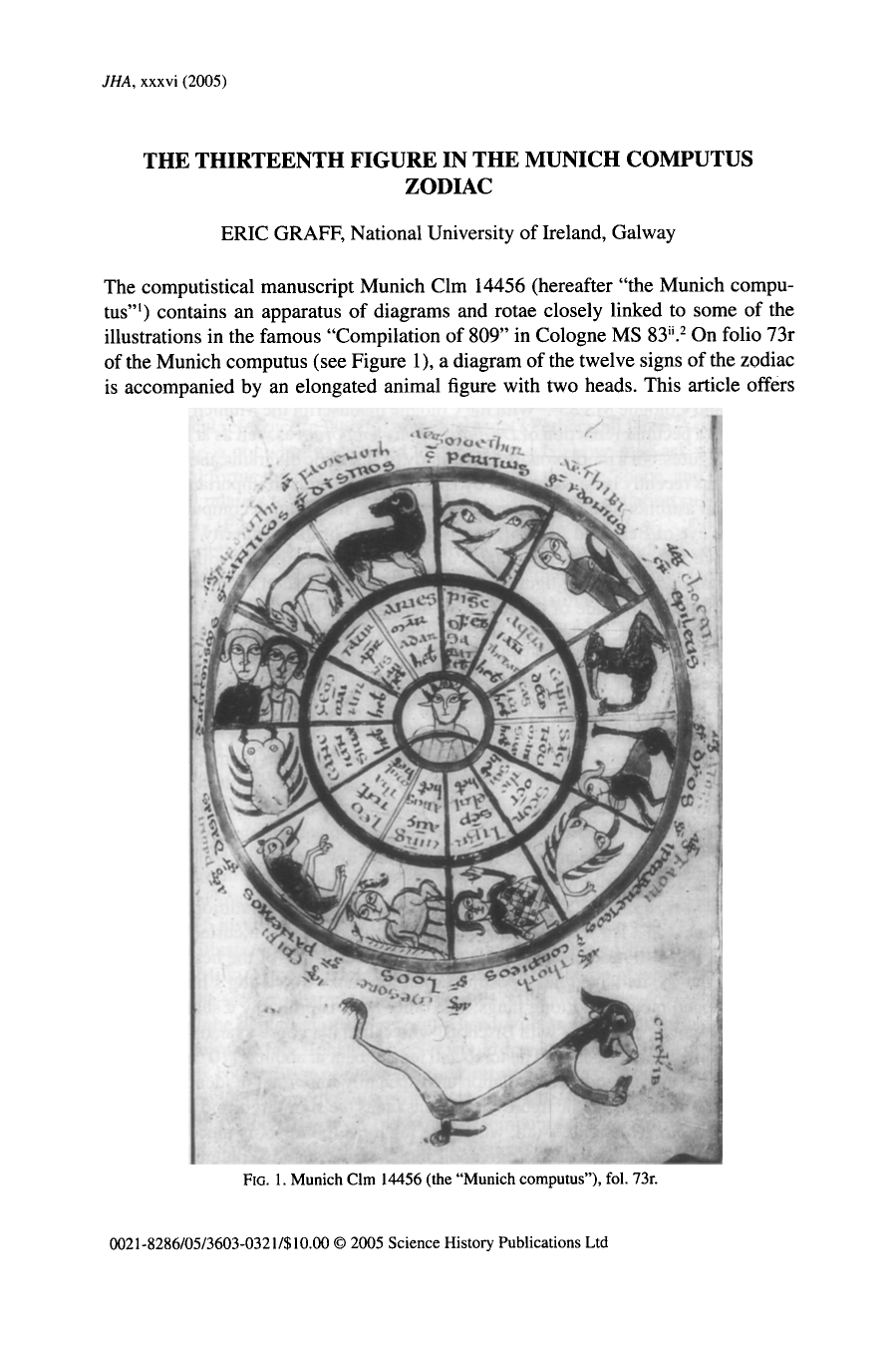
The phrase “Munich computus” often refers exclusively to ff. 8–46 of Munich Clm 14456. Nevertheless, the name is used here as shorthand for the codex as a whole, since this note argues implicitly for the interconnectedness of the manuscript's contents.
2.
The literature on the Munich computus is still remarkably thin, considering its importance as a witness of the computus in the seventh century: CarolusHalmLaubmannG. (eds), Catalogus codicum Latinorum bibliothecae Regiae Monacensis IV.2 (1876; repr. Wiesbaden, 1968), 175; for a partial edition and discussion, see KruschBruno, Studien zur Christliche-mittelalterlichen Chronologie I: Der 84-jährige Osterzyklus und seine Quellen (Leipzig, 1880), 10ff.; Bartholomew MacCarthy (ed. and transl.), Annals of Ulster 4 (Dublin, 1901), pp. lxvii-lxxxiii; SchwarzEduard, Christliche und jüdische Ostertafeln (Abhandlungen der königl. Gesellschaft der Wissenschaften zu Göttingen, phil.-hist. Kl., N.F., viii/6 (1905)), 89–104; KenneyJames F., Sources for the early history of Ireland, i (New York, 1929; repr. Dublin, 1979), 223, š59; KruschBruno, Studien zur Christliche-mittelalterlichen Chronologie, ii: Die Entstehung unserer heutigen Zeitrechnung (Abhandlungen der Preußischen Akademie der Wissenschaften, philol.-hist. Kl., viii, Jahrgang1937 (Berlin, 1938)), 58; Dáibhí Ó Cróinín, “An Old-Irish gloss in the Munich computus” in Early Irish history and chronology (Dublin, 2003), 131–2, originally printed in Éigse, xviii (1981), 289–90; KnutSchäferdiek, “Der irische Osterzyklus des sechsten und siebten Jahrhunderts”, Deutsches Archiv für Erforschung des Mittelalters, xxxix (1983), 357–78; McCarthyDanielCróinínÓ Dáibhí, “The ‘lost’ Irish 84-year Easter table rediscovered”, Peritia, vi-vii (1987–88), 227–42; and many individual citations in MauraWalshÓDáibhí Cróinín (eds), Cummian's letter De controversia paschali and the De ratione conputandi (Toronto, 1988). Short descriptions of the illustrations can be found in Katerina Bierbrauer, Katalog der illuminierten Handschriften der Bayerischen Staatsbibliothek, i: Die vorkarolingischen und karolingischen Handschriften der Bayerischen Staatsbibliothek (2 vols, Wiesbaden, 1990), š111; Daniel McCarthy, “Easter principles and a fifth-century lunar cycle used in the British Isles”, Journal for the history of astronomy, xxiv (1993), 204–24; and McCarthyDaniel, “The author of the Latercus paschal cycle of the insular Celtic churches”, Cambrian medieval Celtic studies, xxviii (1994), 24–49. A critical edition of the Munich computus is currently being prepared by Immo Warntjes at the National University of Ireland, Galway.
3.
JonesCharles W., “The ‘lost’ Sirmond manuscript of Bede's ‘computus'”, The English historical review, lii (1937), 204–19, p. 213, and Bedae pseudepigrapha: Scientific writings falsely attributed to Bede (Ithaca, NY, 1939), 48–49. References to the manuscripts of the Disputatio Chori et Praetextati are taken from DáibhíÓ Cróinín (ed.), Disputatio Chori et Praetextati: A seventh-century Irish epitome of Macrobius’ Saturnalia (unpublished).
4.
In Cologne 83ii the rota on f. 81r calculates the lunations in hours, points, minutes, moments, and atoms, and bears the text “ebdomada habet dies vii, horas clxiiii, puncta dclxxii, minuti īdclxxx”; the same text and a similar rota can be found on f. 71r of the Munich computus. Cologne f. 81v carries the same solar diagram (indicating the hours of sunlight at the solstices and equinox) as can be found on Munich f. 70v. The luni-solar calendar drawn on Cologne f. 83v is very closely related to the one on Munich f. 72r. Two of the Munich computus diagrams (an Isidorian “zones of the Earth” drawing from 73v and a peculiar “ratio septizodi” table with personifications of the planets on f. 74r) also bear close resemblance to those found on Karlsruhe MS Augiensis fragm. 107, f. 1r–1v. This fragment was once part of the famous “Karlsruhe Bede” MS Augiensis 167. While a full analysis of the Munich computus diagrams would be illuminating for several reasons, it falls well outside the scope of this article.
5.
ObristBarbara, “La représentation carolingienne du zodiaque: À propos du manuscrit de Bâle, Universitätsbibliothek, F III 15a”, Cahiers de civilisation médiévale, xliv (2001), 3–33. For plates from the Munich computus (ff. 72v and 73r), see Figs 8 and 9, p. 10.
6.
BischoffBernhard, Die südostdeutschen Schreibschulen und Bibliotheken in der Karolingerzeit, i (Wiesbaden, 1974), 196: “eine phantastische Ausgeburt der Laune des Regensburger Zeichners ist aber wohl die groteske Figur am unteren Rande von Bl. 73r mit der Beischrift ‘CPEKIB’: An einem schmalen langgestreckten Leib sitzen zwei Köpfe, die einander anblicken, der eine vielleicht der eines Hundes, der andere der einer Gans”.
7.
The names of the months are matched in the same way as in Bede's De temporum ratione XIIII (ed. by JonesC., De temporum ratione liber: Bedae opera didascalica, ii (Corpus Christianorum Series Latina CXXIII B, Turnhout, 1977)), 327–9; thus the sign of Taurus (from the outside in) reads: “aeg. Farmuthi, gr. Xanticos, [the illustration], Taurus, Aprilis, Nisan heb.” A full transcription of the text of the zodiac follows at the end of this article, and shows that although Bede's work may have provided the rationale for matching the Greek (i.e. Macedonian), Egyptian, and Hebrew names of the months, it could not have supplied the pairing of these names with the Sun signs, for the Munich computus signs differ from Bede's by a month (Jones (ed.), op. cit., XVI, pp. 332–3). For a discussion of Bede's innovation in the correlation of months, see JonesC., “Polemius Silvius, Bede, and the names of the months”, Speculum, ix (1934), 50–56.
8.
These divisions may be intended to refer to the Egyptian seasons Shemu (low-water), Akhet (flood), and Peret (emergence), but if so the identification appears to be off by one month, as Shemu should begin with Pachons, here identified with May, and not with Farmuthi, or April.
9.
See Bischoff's description cited above (ref. 6).
10.
Since the principal concern of De stella nova was the observation of a supernova in the foot of Ophiucus, Kepler naturally took great care to present the figure in such a way as to be clear about which foot contained the new star (the right foot in Kepler's illustration). The question regarding Ophiucus's orientation is an old one which, as I suggest below, may have arisen from textual difficulties in classical sources.
11.
The first step toward making such a link is naturally to identify a visual standard in the medieval sources. In a recent article (“Les manuscrits du De cursu stellarum de Gregoire de Tours et le manuscrit, Laon, Bibliothèque municipale 422”, Scriptorium, lvi (2002), 335–45) Barbara Obrist provides a description of the text of Gregory of Tours's De cursu stellarum found in Laon MS 422, in which she compares the Laon drawings to those in Cologne 83ii: “Les onze figures qui se répartissent sur ce texte relèvent en partie de la même tradition picturale que la série de figures de la grande compilation d'astronomie et de comput de Cologne, Erzbischöfliche Dombibliothek, 83 II, achevé en 805 sous l'épiscopat de l'archevêque Hildebald” (p. 344). It may be hoped that the shared relationship with Cologne 83ii will provide an avenue for further research. Elsewhere in the same essay, Obrist offers another possible analogue for the visual style in the Munich computus. Noting the similarity between Laon 422 and the Psalter of Stuttgart, Obrist cites the serpent-bearer as an example: “L'analyse stylistique des figures humaines des constellations qui accompagnent le De signis caeli (fol. 26v–30v) semble corroborer cette datation: Elles partagent en effet certains traits stylistiques avec les personnages…. Le Serpentaire, par exemple (fol. 27r) … offrent le même type de pectoraux trés arrondis que ceux du Christ crucifié du psautier” (p. 345). If we accept the stylistic proximity of Laon 422 and Cologne 83ii, and recall the shared textual features of Cologne 83ii and Munich 14456, then we might profitably ask whether any stylistic traits are common to Munich 14456 and the Stuttgart Psalter (Württemberg. Landesbibl. MS Bibl. fol. 23).
12.
The text is from ViréGhislaine (ed.), Hygini De astronomia (Stuttgart, 1992), 105, 1. 195. Unless otherwise stated, I have provided working translations for the purposes of this article.
13.
Some manuscripts of Hyginus invert the word-order to read as a simple prepositional phrase versus caput. The classical usage was perhaps derived from ad caput versus, as at Hyginus, AstronomiconIII. xi, inclinatus ad caput uersus. So, for example, Oxford MS Bodley F.III.14, fol. 151r.
14.
These formal changes include the turning of the serpent's traditional head to face Ophiucus, the creation of a second head in the constellation Serpens Cauda, and perhaps even the turning of the serpent-bearer's head (and body) to face the opposite direction. The serpent's head is turned against the face of the serpent-bearer in the Leiden Aratea (Leiden, Universiteitsbibl. MS Voss. Lat. Q. 79) and in the early printed text of Hyginus (printed by Erhard Ratdolt in 1482 with original woodcuts). This arrangement is also found in Manilius (Astronomica I, II. 334–5), but violates the older narrative tradition that the serpent reaches for the constellation Corona. The association of Ophiucus with Aesculapius the physician never resulted in the visual representation of two heads, but might be connected to the arrangement of two serpents on the caduceus. The reversal of the body of Ophiucus probably owes more to a confusion of perspective (viewing from above or below) than to any textual discrepancy.
15.
This reading was first suggested by Bischoff, Südostdeutschen Screibschulen (ref. 6), 196.
16.
This scribal correction may be an attempt to read the label from left to right, making “specub(-us)”, which would describe the gulf between the heads rather than the heads themselves. Reading in reverse, “buceps” makes little change from “biceps”.
17.
By observing the rising of Sirius, the Dog Star, just before the Sun, the ancient Egyptians could predict the beginning of the season of inundation, the yearly Nile floods that enriched the river basin. Now Sirius is not a part of the constellation Serpens, but rather of Canis Major. In the Munich computus, however, the beginning of Thoth is identified not with July (as would have been the case in the ancient world) but with September. On the equivalency of Egyptian and Latin months among medieval computists see Jones, “Polemius Silvius” (ref. 7), 50–56.
18.
See the succinct description of developments in the Egyptian calendar in B. Blackburn and L. Holford-Strevens, The Oxford companion to the year: An exploration of calendar customs and time-reckoning (Oxford, 1999), 708–11.
19.
See CróinínÓ D., “The Irish as mediators of antique culture”, in ButzerP. L.LohrmannD. (eds), Science in Western and Eastern civilization in Carolingian times (Berlin, 1993), 46, n. 37, where he cites Alcuin, Pseudo-Alcuin, and a Bedan commentator, all of whom mention this custom of reckoning from September. For the passage from the commentary on Bede, see below. For Alcuin's identification of a year beginning in September with the custom of his Irish students, see SavageJ. J., “An Old Irish gloss in Cod. Laur. XLV, 14”, Zeitschrift fur celtische Philologie, xvii (1928), 371–2.
20.
The origin of this commentary in the Irish schools is re-affirmed on the basis of the manuscript evidence by John Contreni, “John Scottus and Bede” in History and eschatology in John Scottus Eriugena and his time (Leuven, 2002), 91–140; see especially pp. 124–5, where the role of the Irish schoolmaster Martin of Laon is discussed.
21.
Both the text and commentary are printed in Jones (ed.), De temporum ratione (ref. 7), 349.
22.
The translation of Bede's text is from Faith Wallis, Bede: The reckoning of time (Liverpool, 1999), 68.
The Irish Computus lists the following types of year: “annus ciuilis, annus naturalis, annus iubileus, annus bissextilis, annus lustralis, annus olimphiadis, annus quod dicitur aera, annus solaris, annus communis, annus embolismus, annus breuis, annus magnus” (quoted from an edition in progress at the National University of Ireland, Galway; a portion of this text, ending imperfectly before this passage, is printed as “De divisionibus temporum” in Patrologia Latina, xc, coll. 655–64).
25.
Alcuin's pointed reference to the decennovenal (nineteen-year) cycle makes it clear that he is concerned not just about the (civil) calendar year but specifically about the ramifications of September-reckoning for the proper maintenance of the (ecclesiastical) lunar cycle. By taking September as the year's beginning, these students changed the contours of the lunar calendar, especially in the final year of the cycle. In the accepted reckoning, the nineteenth year included the saltus lunae (the “leap of the moon”, whereby a day is dropped from the lunar calendar in order to bring it into line with the solar calendar) in November. Deviation from this reckoning could upset the transition from one decennovenal cycle to the next, altering the epacts, and thereby falsifying the data used in the Easter calculus.
26.
The recipient of Alcuin's letter was identified as “an Irish cleric” by Savage, “An Old Irish gloss” (ref. 19), 371. Though the letter is addressed to Charlemagne, this identification was probably made on the assumption that the Irishman Dungal, who was master of the Palace School, was the implied target of the sarcasm in the disparagement of “pueri vestri”. In a personal communication, Dáibhí Ó Cróinín notes that Alcuin's references to Egyptian boys in his correspondence were once taken literally (cf. C. Gradara, “I ‘Aegyptiaci pueri’ di Alcuino”, Roma e l'Oriente, ix (1915), 83), but affirms that these boys were “court students who had imbibed Irish teaching on the subject of the computus”.
27.
KruschB. (ed.), Georgii Florentii Gregorii episcopi Turonensis De cursu stellarum ratio, qualiter ad officium implemendum debeat obseruari (Monumenta Germaniae Historica, Scriptorum Rerum Merovingicarum, i (reprinted Hanover, 1969)), 404–22, š33, p. 419.
28.
Visibility determined using the software Redshift 5 (Focus Multimedia, 2003); since the Munich computus was copied in a Carolingian milieu in the early ninth century, I have used a simulation of the latitude of Rome in the year 800.
29.
Krusch (ed.), op. cit. (ref. 27), š20.
30.
In 1985 in the journal Nature, Gregory's reference to “robeola” was posited as a medieval reference to Sirius, which some astronomers thought had changed its colour from red to white over the course of the last millennium: W. Schlosser and W. Bergmann, “An early-medieval account of the red colour of Sirius and its astrophysical implications”, Nature, cccxviii (1985), 45–46. This identification of Gregory's September star with Sirius was refuted by S. McCluskey and separately by R. H. van Gent in Nature, cccxxv (1987), 87–89. Both of these writers defend the traditional identification of Gregory's stars, in which “robeola” is equated to the reddish-orange star Arcturus.
31.
It is questionable whether the computist was aware of the reformed nature of the Alexandrian calendar, which had fixed the beginning of the year at 1 Thoth without regard to the observed rising of Sirius. Evidence that the Irish computists had some knowledge of the Sothic period of 1461 Egyptian (= 1460 Julian) years (i.e., the “great year” of the Egyptians, in which the heliacal rising of Sirius moves backwards through the whole calendar by one-quarter day per year and returns to its place on 1 Thoth) can be garnered from the text of the Munich computus at f. 23r: “Annus plenus de bissextis in mille cccctislx continetur.” B. Mac Carthy first cited this passage, explaining that “The (apparently Hibernian) full year = 1460 is 365 × 4” (Annals of Ulster IV (ref. 2), p. clxxviii), and demonstrating how the annus mundi in a.d. 689 (i.e. a.m. 5890) contained four “full years” plus 50 additional years. Mac Carthy's note on the bissextus, which is the means by which the solar year could be prevented from slipping versus the Roman calendar, does not extend to a recognition that the origin of the full year is not Hibernian, but instead derives from the reform of the Alexandrian calendar enacted by Caesar Augustus. The reform, which would add a sixth epagomenal day every four years, had first been urged by Ptolemy III in the “Canopus decree”, but was initially rejected by the priests who managed the calendar. Cf. Blackburn and Holford-Strevens, op. cit. (ref. 18), 709.
32.
The abbreviations aeg. and ae. used in this register should be expanded to read “aegyptiace”, “in Egyptian”.
33.
The abbreviations gr. and g. in this register stand for “grece”, “in Greek”.
34.
The abbreviation heb. is used for “hebraice”, “in Hebrew”.
35.
The use of ‘ω’ here is the only distinctly Greek letter on the page except for the ‘π’ that appears in the label for the animal figure in the lower quarter.