




Abstract
The Carthusian monastic tradition, characterised by solitude and silence, has endured for more than nine centuries, largely unchanged, in the changing world. This article explores the theme of enclosed contemplative monastic contribution to the world based on textual analysis of an anonymous Carthusian monk’s poetry (written in the period 1964–2024) as well as other contemporary and early monastic literature. The study identifies two themes regarding monastic contribution: (1) the silent witness of eternity and of the Divine to the secular world; and (2) prayers of intercession. In addition, the monastic enclosed contemplative traditions appear to challenge modern society through some of their countercultural elements. Paradoxically, seen from the ancient monastic perspective, patience and hiddenness may prove more influential than short-term attention-seeking, and silence may contribute more to the world than the noise of social and other media.
Introduction and Research Material
The Carthusian Order traces its origins to the year 1084 when Bruno of Cologne and his six companions founded the first monastery in France. The Prologue of the Statutes of the Carthusian Order outlines their vocation to seek union with God in silence and solitude: To the praise of the glory of God, Christ, the Father’s Word, has through the Holy Spirit, from the beginning chosen certain men, whom he willed to lead into solitude and unite to himself in intimate love. In obedience to such a call, Master Bruno and six companions entered the desert of Chartreuse in the year of our Lord 1084 and settled there; under the guidance of the Holy Spirit, they and their successors, learning from experience, gradually evolved a special form of hermit life.
1
Today, there are sixteen male and five female Carthusian monasteries worldwide. 2 The Carthusian strictly enclosed contemplative way of life combines the ideal of eremitical life of solitude and silence with some elements of communal coenobitical monasticism. This is reflected in their daily recurring horario that alternates between communal and private prayers as well as dedicated periods of work and study in the cell with some time reserved for meals and sleep.
Within Catholic monastic traditions, Carthusians are considered among the most austere with statutes that remain relatively unchanged from their medieval origins. The ancient monastic path of prayer in solitude and silence, cultivated by the early desert fathers, still marks the lived experiences of Carthusians of modern times. The Carthusian way of life has remained relatively unknown through centuries, which likely follows from their distinct separation from the world, as written in their Statutes: “Since our Order is totally dedicated to contemplation, it is our duty to maintain strictly our separation from the world.” 3 However, the rigour of their enclosure is relaxed a little in order to receive the visit of parents and other relations each year for two days. But apart from this, Carthusians are to avoid visits from friends and conversations with seculars, unless some inescapable necessity is imposed on them by the love of Christ. 4
It is, therefore, understandable that Peter Nissen, in his 2014 article on Carthusians, speaks of an “enforced outsider-hood” and an inaccessibility that seems to enhance our fascination with the Carthusian world. 5 He notes that historians, art historians, theologians, literary scholars and others who study the Carthusians remain no more than outside observers. Participant observation, one of the key research strategies in cultural anthropology, is not feasible in the Carthusian world. 6 However, it could be argued that in the age of excessive focus on social media one’s “right to be forgotten” should be respected by researchers and others with interest in monasticism. This right applies to all individuals and, in particular, to those whose desire is to lead a solitary life in silence.
As for external sources, Nissen provides a comprehensive survey of books written about Carthusians. 7 Among the recent works, he emphasises the importance of the international success of Into Great Silence (2005) by Philip Gröning which was filmed at Grande Chartreuse. The story behind the film production highlights the relative inaccessibility of the Carthusian Order. When Gröning in 1984 asked for permission to shoot film scenes in the monastery, his request was turned down. Only in 1999, fifteen years later, did he receive a message from the prior of the Grande Chartreuse with the final permission. 8
To complement Nissen’s survey of external sources on Carthusians after 2014, it is worth mentioning Tim Peeters’s book When Silence Speaks (2015), a well-researched overview of Carthusian spirituality. 9 In addition, a significant Carthusian component is found in Robert Sarah’s The Power of Silence (2017) 10 and Nicholas Diats’s A Time To Die (2019). 11 Another recent source is Report from Calabria (2017) by an anonymous Catholic priest who wrote the book during his stay at the Carthusian Charterhouse in Calabria, Italy. 12 He notes, from this perspective, a misunderstanding about monasticism: “Some critics of the Catholic Church reject the cloistered monastic life as inhumane (although their appraisal might be different if they ever actually talked to a monk or a nun).” 13 It is indeed possible that modern societies no longer have sufficient knowledge or understanding of the ancient monastic traditions. It is also true that very few have the opportunity to speak to cloistered monks and nuns, due to the strict separation of enclosed contemplative way from the secular world.
Where does this leave us if we still wish to gain a better understanding of the Carthusian spirituality? Literature seems the best avenue forward, and nine centuries of texts written by the Carthusians certainly provides a rich legacy. This also offers a historical setting against which the Carthusian tradition can be researched today. Despite the challenge of relative inaccessibility, the ancient spiritual heritage justifies an interest in the contemplative way as it is lived today.
In light of this, it is noteworthy that a Carthusian monk, Brother A., has recently granted permission to research the corpus of his poetry. In line with the Carthusian tradition, the living authors of this Order typically remain anonymous or sometimes publish under a pseudonym. Br A. is, therefore, designated as the singular identification to distinguish this particular monk-poet from the other contemporary Carthusian authors who also use the generic name “A Carthusian.”
Respecting the Carthusian tradition, biographical information about Br A. is limited to details that can be derived from his works. Br A.’s first poems originate from 1964 which coincides with his entry into St Hugh’s Charterhouse, likely in his twenties. He writes in English, his mother tongue, and has stayed in the same Carthusian community in England for six decades. Some of the Carthusian monk-poet’s works have been published and translated externally; some are self-published by St Hugh’s Press of the monastery. 14 Br A.’s poetry has not yet been widely researched, apart from a comparative study by Anna Maksjan, a researcher of English Literature, whose topic dealt with the mystical dimension of his poetry. 15
The Carthusian author’s corpus of poetry covers six decades of poems written in the period 1964–2024. It consists of thirty-three collections in booklet format consisting of over two thousand poems (2,026). Br A. retains the copyright for his original texts but has granted permission for their use in scholarly research. The entire corpus of poems was systematically catalogued in February 2024–January 2025 using initial textual analysis for various categories, themes, references, and keywords.
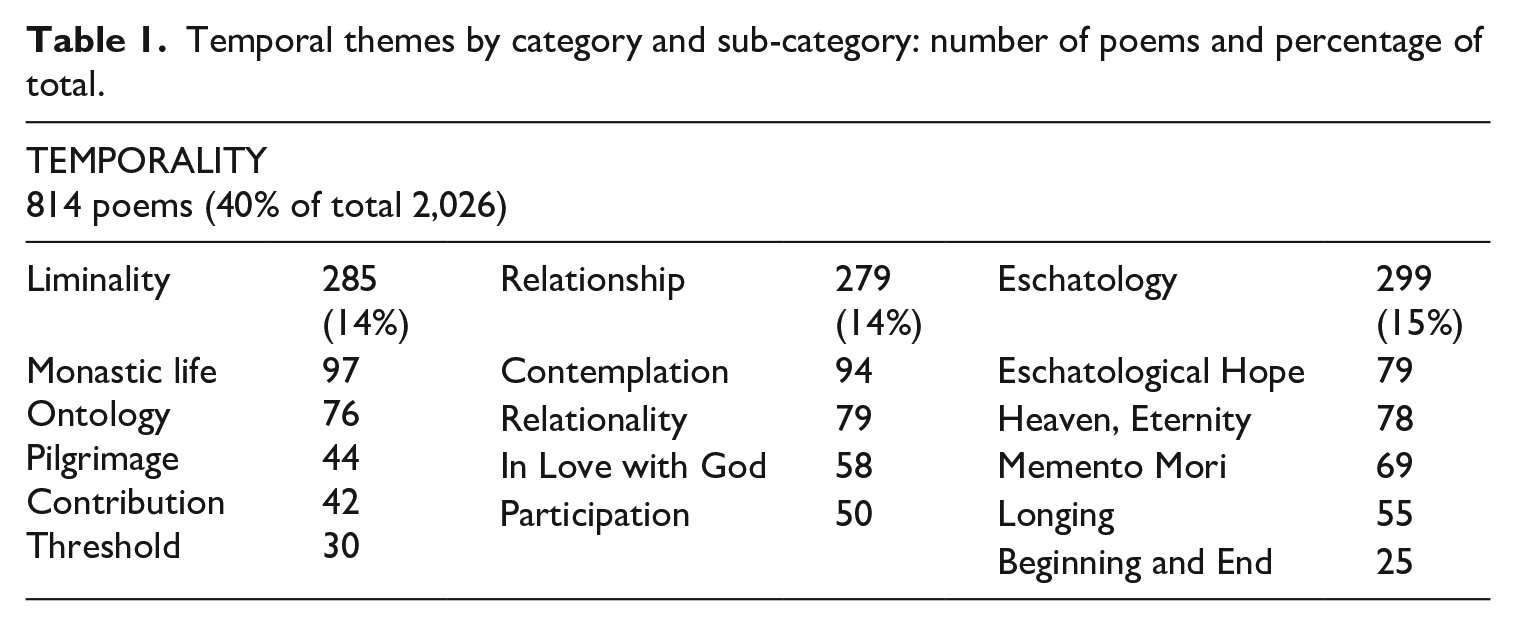
The initial textual analysis of this corpus of poems was conducted at three levels. Level 1 Textual Analysis constituted the classification between temporal and non-temporal themes. Regarding temporality, the classification follows broadly the framework (liminality, relationship, eschatology) proposed in a recent previous study on Catholic contemplative enclosed monastic traditions. 16 This initial classification indicates that 40% of these poems contain a temporal dimension, which is determined through a reference, direct or indirect, either to temporality (past, present, future) or eternity. The distributions of these categories and subcategories are shown in Table 1. It should be noted that a poem that has been classified under the main theme “Temporality” can be included in one or more sub-categories.
Temporal themes by category and sub-category: number of poems and percentage of total.
The other themes without a specific temporal perspective (60% of the total) cover a broad range of topics. The most frequent themes are: Salvific Plan (394 poems); Nature (265); Secularisation (247); Virgin Mary (239); Compassion (181); Reading and Writing (179); Prayer (165); Crucifixion (159); Humility (157); and Friendship (154). These categories are not exclusive, and a poem can be classified under multiple themes. In addition, Level 1 Textual Analysis included the systematic identification and recording of various keywords, dedications, literature references, as well as motivations for writing poetry.
Level 2 Textual Analysis consisted of a preliminary investigation of thematic ideas based on frequency and further organisation of texts by sub-categories. The preliminary interpretation of poetic metaphors and allegories was initiated at this phase.
Level 3 Textual Analysis involved the selection of the main topics within the broader themes as well as further analysis of relevant texts. This level aimed at structured presentations of the recurring themes and ideas. This involved, for example, contextualisation of Br A.’s poetry within Carthusian and Catholic monastic traditions as well as Christian theology.
Monastic “Contribution” forms a sub-category of “Liminality” which is classified under the main theme “Temporality.” This subcategory consists of forty-two poems among the nearly three hundred poems classified under “Liminality.” The current paper aims to explore the liminal and temporal aspects of enclosed contemplative contribution in the context of ancient and modern monastic texts.
Monastic Contribution
Early Christian ascetics, as argued by Colleen McDannell and Bernhard Lang, renounced the world to indicate that the proper direction of human life was to be lived towards God. The celibate ascetic bridged the metaphysical gap between the human and the divine. However, a somewhat different approach emerged through the late Augustine thinking. The ascetic was still there to point the direction toward God but at the same time, the role evolved towards standing between the world and the deity and becoming a channel of divine grace for society. 17 We note here two aspects of monastic contribution: (1) indicating the direction to God as witnesses of eternity; and (2) becoming intermediators, or channels of divine grace, between the world and the Divine through intercession for the world.
Charles Taylor, in his analysis of medieval Christendom, notes certain distinctions and tensions between two kinds of goals: (monastic) self-transcendence in total transformation and (secular) human flourishing in ordinary life. He argues that over time, a sort of equilibrium developed based on complementary functions in the Latin Church where the celibate clergy fulfil priestly and pastoral functions for the laity, which in turn supports the clergy while monks pray for all; mendicant Orders preach; others provide alms, hospitals and similar works of charity. 18 From the temporal perspective, Taylor argues further that people who are in the saeculum are living the life of ordinary time in contrast with those who have turned away from secular time to live closer to eternity. A parallel distinction exists between temporal and spiritual: the first is concerned with things in ordinary time; the second with the affairs of eternity. 19 “Saeculum” and the adjective “secular” thus came to be used in Latin Christendom as a temporal meaning of ordinary time (the time which is measured in ages), against “higher time” (God’s time, or eternity). By extension, “secular” can refer to the affairs of this world, temporal affairs which contrast with the affairs of the City of God, which are “spiritual.” In general, clergy and monks belong to the “spiritual” group, but there is an additional distinction between secular and regular clergy. The latter are monks, living separately from the world, under monastic rules; the former are parish clergy, ministering to their flocks, and so “in the world.” 20 It can be suggested that Taylor’s work, likewise, points towards two distinct aspects of monastic contribution: (1) through their separation from the world the monks become witnesses of God’s time and the affairs of eternity; (2) their separation from the world means that they have the time and vocation to pray for all.
These two distinct temporal elements of monastic contribution—intermediation and witnesses of eternity and the Eternal—manifest themselves also through the spatial separation of the monastery and the secular world. In Lausiac History, Palladius of Galatia (c. 363–ca. 420/430) writes about an occasion when he was tempted to leave the monastery due to his lack of progress. He then went to see Macarius of Alexandria who advised him to say to his thoughts: “For Christ’s sake I am guarding the walls.” 21 According to W.K. Lowether Clarke, the monastery, at that time, represented a protecting wall interposed between the enemy and the people of Egypt who lived their life in the world, exposed to many temptations. The monks’ prayers were helping to guard that wall. From this, Clarke argues that if we view prayer as the noblest activity of human nature, we can believe that God separates some for a life of prayer. And thanks to the protecting wall of the prayers of the separated ones, the mass of humankind dwells in greater security. 22 Kallistos Ware, referring to the same Palladius’s story, suggests that the idea of guarding the wall for the early Christian ascetics would mean defending against the demons using prayer as a means. This is because deserts were a place where God could be met face-to-face (as Moses did in the desert of Sinai), but at the same time the desert was a place where the demons dwelt. According to Ware, the solitary, in withdrawing to the desert, had a double aim: to meet God and to fight the demons. In both cases, he goes out to discover God and to achieve union with him through prayer; and this is what also helps others. Equally, the devil with whom he enters into combat is the common enemy of all humankind. Therefore, there is nothing selfish in his act because every prayer he offers and every victory that he gains protects his fellow Christians. 23
Eastern Orthodox scholar John Chryssavgis also writes about the ascetics’ role in praying for the salvation of the whole world citing Letter 569 of the sixth-century hermit Barsanuphius about the ascetics who “stand before the shattered world, keeping the whole world from complete and sudden annihilation.” 24 Similarly, another Eastern monastic author, John Climacus (c. 579–649) in The Divine Ladder of Ascent defines prayer as a “dialog and a union of man with God” and follows this with: “Its effect is to hold the world together.” 25
According to Olivier Clément, a French Orthodox theologian, the Christian idea of prayer that preserves the world from decay and transforms it at a cosmic dimension, is profoundly rooted in the Old Testament. In addition, the Talmud teaches that the world is preserved thanks to the intercession of the thirty-six just men of Israel, who are renewed from generation to generation, and who daily receive the Shekhinah, the presence of God. A similar doctrine is found in Shiite Islam, where the apotropaic prayer of the saints and their hidden suffering preserve the universe and hold back the hand of destiny. 26 This indicates that the Abrahamic religions seem to share an idea of a small group of dedicated religious faithful whose role it is to pray for the world.
The early task of Christian monasteries as “guardians of the wall” and “intercessors for the world” has endured until today, as contemporary cloistered Carmelite sisters explain on their website: The monastery walls not only guard against the world so peace, prayer and holiness can blossom, but they also stand as the towers of a fortress where spiritual war is waged against sin and evil. Carmelites taste of struggle as much as they taste of the sweetness of contemplation and spiritual joy. They live an austere life of penance and renunciation to make reparation for the sins of us all and to implore God’s pardon. They ask Heaven’s blessing upon our lives, and they continually beg for the salvation of our souls.
27
William Harmless, SJ, in his study of the early Desert Christians, noted that high walls were the most distinctive feature of a Pachomian monastery. The walls served as a visible boundary that separated the monastery from the outside world. 28 In summary, it can be argued that monastic buildings impose boundaries that mark a separation from their external surroundings but, simultaneously, they remind the secular societies about the religious and temporal values that the monastery represents. We can then suggest that the monastery walls provide (1) invisible protection through intercession and prayer; and (2) visible external testimony of eternal and transcendental values.
Silent Intercession for the World
Intercession for others was part of the ascetic practice from the very beginning. One of the Desert Fathers, Abbot Isaac (d. 383), for example, included prayers of intercession as one of the four types of prayers in his teaching, as he instructed monks to offer intercessions for others “making request either for those dear to us or for the peace of the whole world.” 29 Kallistos Ware, in his study on early solitary ascetics, concludes that the Desert Fathers helped others not through active works of charity, nor writings and scholarly research, nor yet primarily through giving spiritual counsel, but simply through their continual prayer. The motive behind the solitary ascetic’s withdrawal was to seek union with God; and this prayerful union supports and strengthens his fellow humans, even though he knows nothing about them and they, on their part, are unaware of his very existence. Ware suggested that ascetics essentially help their fellow humans not so much by anything that they do but rather by just being what they are. 30
It seems somewhat paradoxical to consider simultaneously the strict monastic enclosure and the closeness that the solitary professes towards all fellow human beings. George A. Maloney offers an explanation for this in his study of Russian Orthodox monk Nil Sorsky (c. 1433–1508). He discusses the eremitic and hesychastic tradition in which the hermits embraced fraternal charity through their presence but, also, simply through their existence. Their “visible” separation had to be understood in the light of their faith and their love for God and people. The solitaries withdrew from the others to be more united to them because they believed that by focusing their efforts to unite themselves with God, they became more united also to the other children of God. These monks, therefore, searched for silence and solitude, not because they were self-centred but because by being completely centred on God they were able to relate to their fellow beings more purely and intensely. 31 In this context, George Maloney cites the sixth-century Abbot Dorotheus of Gaza who presented a simple analogy of a circle. Dorotheus asked his audience to imagine a circle with a centre and rays springing from that centre. The farther these rays are from the centre, the farther they are from each other. And conversely, the closer they get to the centre, the closer they get to each other. In this analogy, the circle is the world; God is the centre and the rays are people’s paths. Therefore, in the same way, Abbot Dorotheus suggests, to the extent that the saints progress towards the centre, aspiring to draw closer to God, they draw closer to God and to each other in the same proportion. The same happens when we distance ourselves from the centre. When we are at the exterior (at the circumference) and do not love God, we are also far from our neighbour. But when we love God and draw always closer to him in divine love, we are united to all (our brothers and sisters) in the same love. 32 Therefore, Maloney suggests, this approach implies that every progress in perfection made by a member of the Mystical Body of Christ has a salutary effect on the Body as a whole, and on each of the individual members who make up that Body. 33
How does Br A., the Carthusian monk-poet approach the theme of prayer and intercession in his poetry? In “A Sower Went Out To Sow,” a poem dedicated to a fellow Carthusian, Br A. speaks about the prayers of intercession which are their shared task. He reflects on the “mind-boggling” amount of people who live and have lived on our planet. “Yet, each is loved by God singly as if the others did not exist.” 34 He concludes that this vast number of human beings amounts to a deep Christ-likeness across ages. And just at the present moment, the task of prayer has been entrusted to the current generation of monks: “This fantastic labour has been passed to us. We insert our prayers, our ardent desires to secure the immense sanctification of every seed sown, the greatest love burning, the song or songs to praise the Sower who sowed so deep . . .” 35 In another text, the Carthusian author likens monastic efforts to those of a farmer who sows the seeds and leaves the outcome to divine knowledge: “It’s God who knows-it-all; the seasons come and go; he sees to that; our little act of sowing in childlike trust pleases him; our will’s engaged, our heart is in it.” 36
Br A. also considers the monastic contribution as a task to rescue souls as fishermen of people. Here the contemplatives, however, are not fishermen but humble dragnets that are used in fishing while Jesus himself is the Fisher of Hearts. Indeed, the closer to “nothing” the dragnet is, the better it is at catching fish. Therefore, The less we are, the more incompetent we feel, the better he can use us. We cleave to him convinced our nothingness will not frustrate his loving. His death in the eyes of the powers that be was a total failure and yet in the eyes of God spelt success: Scripture was fulfilled and all were saved. Our nothing’s divinely willed . . .
37
In “The Coal Face,” we find a similar theme of humble and invisible work, but within a very different environment. Here the monk likens himself to a coal miner chipping away in the dark: The tunnel has grown long and deep Yet all I see is the coal face, Glittering anthracite In the dim flame. Nothing to see for my years Chipping away at the face; Nothing new, no drama in the dark. Yet it is my place, my home In the present scheme of things. I see nothing for my work, No results, no fire blazing Against the fearsome winter; No happy faces lit in its brightness Grateful I chipped away the coal Here in the tunnel. I did not expect it. It is my route home; Hoping against hope in the dark, Working by faith’s dim light I’m convinced the tunnel has a point . . . We chip away in the dark For no measured reward, no pearl However precious, no gold however Weighty. No. Faith refers to non-finitude; The unmeasured boundlessness of God Cannot be earned: He is Gift. At the end of my narrow tunnel There’s no fair wages, no pension, No age of ease, Nothing measurable: Only the Gift Itself and he is Love.
38
“The Coal Face” carries rich monastic symbolism. The solitary hiddenness and darkness of the coal mine are only dimly lit by faith. Despite the “unknowing” and lack of visible results, the monk is convinced that his “chipping away” in the routine of monastic life has a point and a destiny. From the visible and material perspective, the work appears unrewarding. But the monk sees beyond the finite conditions, above the “present” scheme of things. He does not expect any measurable and temporal recognition from his efforts. His only point of reference is God himself who is an unmeasured Gift and boundless Love. The monk keeps on chipping away faithfully in the dark, “hoping against hope” and in blind faith that God, the precious and infinite eternal Gift, will be his reward at the end of the tunnel.
Br A. considers the monastic contribution similar to the vital infrastructure that runs under a city in hidden channels. With their invisible, but valuable, role the Carthusians participate in the apostolic mission of the Catholic Church. Accordingly, hidden beneath the City (the secular world) is a vital (monastic) world that . . . thrives despised, unrecognized, unsung, yet in mysterious ways it purifies the air, provides a vision more sure than grief. exists, silent, inward, plunged in awe, of faith in God in humble hearts that pray intensely the City turns from sin and grief. underpins the human scene: the grace of Jesus, crucified outside the walls, inviting to Paradise beyond all grief . . .
39
The references to being “despised, unrecognized and unsung” are worth noting here because thematically they reflect the monk-poet’s humble disposition that is required to perform God’s work. These are related to the metaphors such as being close to “nothingness” like a dragnet used in fishing, or the hidden, but valuable infrastructure under the city. This disposition is associated with internal and external perceptions, which Br A. discusses in “Rags,” where he suggests that enclosed contemplatives might feel tempted to seek the world’s approval through their ascetic way of life. In this poem, dedicated to a fellow monk, he writes: “We love human approval: others must think us good, must see the rags we wear, must hear the prayers we trumpet forth, must see our features lean, must see the stylite high in the clouds.” 40 But, he continues, the monastic mission is beyond short-term vision and instant results. It requires humility and endurance under trials, steady and slow growth in virtue. The goal glimmers further ahead and above, even if it does not crown the monk (or the external observers) with immediate satisfaction. 41 From Br A.’s perspective, therefore, monastic life is more than meets the eye. It is a “waiting game” where supernatural wisdom grows through marching with hidden steps towards ageing and death: “Love not rags nor silence, love not to be lean but to gleam with supernatural wisdom. Love rather the waiting game, the hidden steps revealed marching the wary sand. Love time’s camouflage, the seed slain, the wheat’s ear bending with heavy grain . . .” 42 This patience and slow progress characterises the transformational monastic journey.
Even if the humble monastic mission at times appears associated with inner feelings of unworthiness, and disregarded as worthless by others, it is still carried out by prayerful hope and trust. Regarding his monastic vocation, Br A. abandons himself to God’s hands with hope in his mercy. Nevertheless, occasional moments of self-doubt arise, as perhaps felt in “The Great Pass By” where the contemplative author wonders whether it would be preferable to take a more direct action to help people in the world. Here, Br A. presents himself with a critical question: is he only passing by his brothers and sisters in their plight? My deep troubling as I pass through life is, am I passing by? I know my little patch, my duties, my work, a familiar place and sky. All’s kept in order. I sleep and rise. The day appears as kestrels cry. But all the evils that torture men and men who torture men outcry the birds and awaken me in tears. I turn to duties; I am passing by the other side. I have no time to stoop, to attend, to fortify butchered humans reduced to numbered dirt. I’ve joined the conspiracy of inertia: we trundle by and glace away for fear we see their plight, an invitation to love and care. Sly complicity of cruel indifference: “Am I my brother’s slave?” “They” crucify the weak, “they” cleanse the human race, kill their offspring. And I? I’m opposed but uninvolved: guilt gnaws my heart . . .
43
The poem remains somewhat inconclusive, perhaps implying tension or a moment of self-doubt. The monk-poet observes the cruel and violent secular world from the relative safety and predictability of monastic life. He is troubled by the disregard for human dignity and the threat to the sanctity of life that he sees in the outside world. His sentiments seem to oscillate between compassion for the human plight and doubts about his inaction. Br A. also feels the desire to convert the whole world but understands that it is not within his power, and leaves his efforts in God’s hands: I’m aching to draw the world to you, Jesus, reigning from your throne, the Cross! But even the few I know, a handful, how can I turn their hearts riveted to things That pass to gaze on you, to catch that glance Of love burning for them through depths of pain? And all the billions more in every age, What can one mortal do? Your steadfast love Dispels my gloom, your final word’s my hope: “Father forgive!” We know not what we do . . .!
44
Br A.’s poetry reveals deep compassion and anguish over secularisation and its negative impact on modern societies and the resulting terrifying disregard for the sanctity of human life. It appears that the monastic contribution to the world is not always understood or appreciated externally, as Br A. notes in his poem titled “Harwin”: “We drink of the world’s disdain, incomprehension,” but his inner peace relies on the conviction: “So favoured is each by God, so loved, our peace is unassailable.” 45 This realistic “possibility of being ignored and misunderstood” is also noted by Ignatius De Pont, a Catholic priest who, in this context, cites a letter of Pope Paul VI addressed to the Cistercians in 1968: “Contemplative life is too deep in the inner life of God for the world to understand it . . . Be simply what you are: God will make your light shine in the eyes of men.” 46
After nearly six decades in the monastery, in his eighties, Br A. looks back and reflects on the ways of the world. He acknowledges that most people “take the common road: work, marriage, children, pension, death. It has an innate logic so little more is asked.”
47
Gently and compassionately he compares this path with the monastic way that he has followed: The few who break beyond it live in a different world and dare not speak shattering false assumptions. Man must be left in matter/time or cause annoyance to him, become a bore. The best one can achieve is praying ceaselessly and placing the world in God’s compassionate heart . . .
48
Witnesses of Eternity
The Catholic Church document Lumen Gentium (1964), regarding the religious state, makes a clear association between temporality and the witness role that the religious fulfil within the Church: The people of God have no lasting city here below, but look forward to one that is to come. Since this is so, the religious state, whose purpose is to free its members from earthly cares, more fully manifests to all believers the presence of heavenly goods already possessed here below. Furthermore, it not only witnesses to the fact of a new and eternal life acquired by the redemption of Christ, but it foretells the future resurrection and the glory of the heavenly kingdom.
49
An anonymous Carthusian, with reference to Lumen Gentium, suggests that within the Church, the religious are witnesses of the transcendent dimension of God’s Kingdom; laity of its immanence in the world. The entire Church together then becomes Light of the Nations, lumen gentium, the sign for the world of God’s salvation.
50
Pope John Paul II, addressing the Carthusian Order in 1984, as he commemorated its ninth centenary, associated the apostolic mission of the Church with the stability of the contemplative tradition: Mankind needs to seek the absolute, and to see it confirmed, as it were, by a living witness. It is your task to show them this. For their part, those sons and daughters of the Church who devote themselves to the apostolate in the world, in the midst of changing and transient things, need to rest in the stability of God and His love. This stability they see manifested in you who, during this earthly pilgrimage possess it in an especial way.
51
The Pope refers to the universal search for the absolute amid the flux and uncertainty of the changing and transient world. Humankind is on a spatio-temporal earthly pilgrimage. This dynamic motion contrasts with the stability of the Carthusian monastic tradition. The apostolate of the monks and nuns within the Church is to point towards the Absolute. They become living witnesses of the peaceful rest that is found in the stability of God and his love. The British church historian Diarmaid MacCulloch, likewise, points towards the monastic stability claiming that specifically in the turbulent times of the ninth and eleventh centuries in Europe, the Benedictines regulated communal life; their liturgy and architecture represented order and reassurance for lay people who viewed monasteries as modelled like the City of God, an image of heaven.
52
Equally, an anonymous contemporary Carthusian author notes that monastic life has often arisen and flourished in times of confusion and chaos as it can propose a lifestyle based on gospel values without compromise. He acknowledges the “considerable cultural distance” that currently separates Carthusian communities from the contemporary scene, yet he is convinced that the Church and the world need this witness.
53
Another anonymous contemporary Carthusian author outlines the temporal meaning of the Carthusian tradition which testifies to the world that is “excessively absorbed in earthly things” about the Divine and the eternal joys: Making him who is the exclusive centre of our lives through our Profession, we testify to a world, excessively absorbed in earthly things, that there is no God but him. Our life clearly shows that something of the joys of heaven is present already here below; it prefigures our risen state and anticipates in a manner the final renewal of the world.
54
The monastic temporal and eschatological focus on the eternal and the transcendent, therefore, can deliver a counter-cultural message of hope in an age of despair and fear. As a study on temporality by Carmelite Sister Lucie Rivière, OCD suggests, monastic communities may become a source of hope in a world where the “culture of death” has limited the human life-horizon to chronological time dimension (chronos). This is because contemplative monastic traditions cross the transient “wear and tear of time” and fix their gaze on the kairos dimension of time with perseverance. 55
Similarly, addressing cloistered nuns in Bologna, in 1997, Pope John Paul II related the meaning of the monastic enclosure to the proclamation of the primacy of God and the pre-eminence of contemplation, and the eternal: Your life, with its separation from the world expressed concretely and effectively, proclaims the primacy of God and is a constant reminder of the pre-eminence of contemplation over action, of the eternal over the transitory.
56
The enclosure is here an image of a concrete and effective proclamation of the primacy of God and is also associated with the temporal dimension. The enclosed contemplatives are witnesses of the eternal and absolute, and ultimately, of the Eternal himself. Turning to Br A.’s writings, “Pillar of Fire” considers monks as witnesses of eternity and of the Divine to the world that is “excessively absorbed in earthly things”: Jesus, make me a Pillar of Fire! All of us the greatest fire Reaching to the sky! Then The world will exclaim, “They have life! They have hope, a future in God While we but gnaw the bone of death!”
57
The monk-poet hopes that their testimony, silent but visible and perceptible (as the light and warmth of fire), will radiate the message to people who travel to death without hope. The enclosed contemplatives wish to give evidence to the secular world that it is possible to have life, hope and a future in God. The prayer in Pillar of Fire continues with a stark request: Jesus, all my mundane pains Make them drops of martyrdom I’ll never attain. But drop by drop, That’s within my reach; the cold, The heat, the hassle; the anxiety I feel for man’s salvation; my death.
58
It is worth highlighting the lines “Jesus, all my mundane pains / Make them drops of martyrdom / I’ll never attain.” The radical monastic “renunciation unto death”—solitude, asceticism, and suffering—has traditionally been understood as a form of “bloodless” or “white” martyrdom. Carmelite Thérèse of Lisieux (1873–1897), for example, employs such language frequently, and she often associates martyrdom and suffering directly with the monastic calling to save souls, as she does in a letter written in 1889 to her sister Céline: our mission is to forget ourselves and to reduce ourselves to nothing . . . We are so insignificant . . . and yet Jesus wills that the salvation of souls depends on the sacrifices of our love . . . life will be short, eternity will be without end . . . Let us make our life a continual sacrifice, a martyrdom of love, in order to console Jesus.
59
While martyrdom is of thematic interest for the Carthusian writer, there are only two poems with a thematic overlap between “Contribution” and “Martyrdom.” “Pillar of Fire,” quoted above, is one of the two texts. Even here, the monk-poet rather seems to downplay the prospect of martyrdom although he believes that it can be reached gradually and progressively, “drop by drop.” While bloodless martyrdom is not completely absent in Br A.’s writing, the majority of references to martyrdom in his poetry relate to Christian martyrs in Church history.
In a different, lighter tone, “Waiting for Dogot” presents a delightful metaphorical composition of a faithful dog (the monk) that has been left waiting in a hidden alcove (a monastery). The idea of a dog relates not only to the title but also to a drawing of a dog that Br A. has included next to this text in The Golden Heart, the 2023 collection of poems.
It seems like ages I’ve waited here But faith’s so powerful thing in me I will not move an inch. It’s here In a hidden alcove he’s stationed me And here I’ll stay till doomsday. Perhaps I’m meant to guard a precious gem That easily gets lost; perhaps I’m meant to be a signpost, a jewel Of eternal beauty sparkling beyond Our senses but glimpsed by heart in love (Who lives by deeper reasons beyond) With him whose awesome name is Love . . .
60
There are three allegorical elements to note in this text. Firstly, the monk suspects that “Perhaps I’m meant to be a signpost” (the witness role). Secondly, his faithful waiting is indicated by “I will not move an inch,” and “here I’ll stay till doomsday” (monastic stability) and thirdly, the object of waiting is referenced as “him whose awesome name is Love” and “who lives . . . beyond” (the Divine).
Conclusions
Monastic contribution, in these texts, is associated with intercession for people in the world as well as silent witnessing of eschatological hope. The monastic contribution may be silent and hidden, but having been called to witness in this special way, the enclosed contemplatives put their faith in God’s grace. As the Carthusian author repeatedly emphasises in his poetry: ultimately, the work is God’s.
In this article, we have identified liminal and temporal aspects of monastic withdrawal that contribute to the secular world which the enclosed contemplatives have left. We also pointed out some countercultural perspectives that are associated with the monastic contribution to the world. Paradoxically, seen from the monastic perspective, patience and hiddenness may prove more influential and enduring than short-term attention-seeking. And, silence may contribute more to the world than the noise of social and other media.
Footnotes
Funding
The author received no financial support for the research, authorship, and/or publication of this article.

Data Availability Statement
Data will be available upon reasonable request.
1
2
The Carthusian Order website:
3
Statutes, Book I, Chapter 3:9.
4
Statutes, Book I, Chapter 6:9.
5
Peter Nissen, “Carthusian Worlds, Carthusian Images: The Fascination of Silence and Inaccessibility,” Studies in Spirituality 24 (2014): 143–54: 146.
6
Ibid., 145.
7
Ibid., 143–51.
8
Ibid., 143–44.
9
Tim Peeters, When Silence Speaks: The Spiritual Way of the Carthusian Order (Darton, Longman and Todd, 2015).
10
Robert Sarah, The Power of Silence: Against the Dictatorship of Noise, trans. M. Miller (Ignatius Press, 2017).
11
Nicholas Diat, A Time to Die: Monks on the Threshold of Eternal Life, trans. M. Dudro (Ignatius Press, 2019).
12
A Priest, Report from Calabria: A Season with the Carthusian Monks (Ignatius Press, 2017).
13
Ibid., 100.
14
A Carthusian, “O Bonitas!” Hushed to Silence, ed. Robin Bruce Lockhart (Gracewing, 2001); and A Carthusian, The Silence of the Lotus: Collected Poems 1964–2008 (Analecta Carthusiana (257), Institut für Anglistik und Amerikanistik, Universität Salzburg, 2009).
15
Anna Maksjan, The Mystical Dimension of the Poetry of John Bradburne and the Carthusian (Institut für Anglistik und Amerikanistik, Universität Salzburg, 2007).
16
Riitta Hujanen, Monastic Perspectives on Temporality: Time is a Mirage (Palgrave Macmillan, 2023), 67–78.
17
Colleen McDannell and Bernhard Lang, Heaven: A History (Yale University Press, 2001), 67–68.
18
Charles Taylor, A Secular Age (Harvard University Press, 2007), 43–44.
19
Ibid., 55.
20
Ibid., 264–65.
21
Palladius of Galatia, Lausiac History, trans. W.K.L. Clarke (Aeterna Press, 2014), Ch. 18.
22
Introduction by W.K. Lowether Clarke in Palladius of Galatia, Lausiac History, 13.
23
Kallistos Ware, “The Way of the Ascetics; Negative or Affirmative?” in Asceticism, eds, Vincent L. Wimbush and Richard Valantasis (Oxford University Press, 1998), 3–15:7.
24
John Chryssavgis, In the Heart of the Desert: The Spirituality of the Desert Fathers and Mothers (World Wisdom, 2008), 120.
25
John Climacus, The Ladder of Divine Ascent, trans. C. Luibheid and N. Russell (Paulist Press, 1982), 274.
26
Olivier Clément, Transfiguring Time: Understanding Time in the Light of the Orthodox Tradition, trans. J. Ingpen (New City Press, 2019), 173.
28
William Harmless, Desert Christians: An Introduction to the Literature of Early Monasticism (Oxford University Press, 2004), 125.
29
John Cassian, Conferences (First Rate Publishers, 2016), Conf. 9, Ch. 13.
30
Ware, “The Way of the Ascetics; Negative or Affirmative?” 3–15: 6–8.
31
George Maloney, La spiritualité de Nil Sorskij: L’hésychasme Russe (Abbaye de Bellefontaine, 1978), 219–20.
32
Ibid., 220–21. Translation mine.
33
Ibid., 221. Translation mine.
34
“A Sower Went Out To Sow,” in Wandering in the Mountains (St Hugh’s Press, 2016), 69.
35
Ibid., 69.
36
“He Knows Not How,” in Audacity of Faith (St Hugh’s Press, 2018), 48.
37
“A Dragnet,” in Audacity of Faith, 42.
38
“The Coal Face,” in Iron Jungle of Hate (Analecta Carthusiana (257), Institut für Anglistik und Amerikanistik, Universität Salzburg, 2009), 187.
39
“The Undercity,” in Eyes Darker than Wine (St Hugh’s Press, 2011), 9.
40
“Rags,” in The Silent Heart (St Hugh’s Press, 2012), 66.
41
Ibid., 66.
42
Ibid., 66.
43
“The Great Pass By,” in Zeroman (St Hugh’s Press, 2002), 28.
44
“Harwin,” in Stillness (St Hugh’s Press, 2020), 7.
45
“In A Lawless Time” in The Outlaw (St Hugh’s Press, 2002), 35.
46
Ignatius De Pont, On Being a Contemplative (Darlington Carmel, 1988), 12.
47
“The Inane Cycle,” in Man: the Enigma (St Hugh’s Press, 2021), 68.
48
Ibid., 69.
49
Dogmatic Constitution on the Church Lumen Gentium, Chapter VI, 44.
50
Un moine chartreux, Vers la maturité spirituelle (Presses de Renaissance, 2016), 207.
51
John Paul II quoted in Robin Bruce Lockhart, Halfway to Heaven: The Hidden Life of the Sublime Carthusians (Thames Methuen, 1985), 138.
52
Diarmaid MacCulloch, A History of Christianity: The First Three Thousand Years (Penguin Books, 2010), 359.
53
A Carthusian, The Spirit of Place: Carthusian Reflections (Darton, Longman and Todd, 1998), 79.
54
A Carthusian, The Wound of Love (Darton, Longman and Todd, 1994), 239.
55
Lucie Rivière, Un Temps Supérieur à l’Espace: La Vie Cloîtrée selon Thérèse d’Avila (Éditions du Carmel, 2018), 36.
56
Congregation for Institutes of Consecrated Life and Societies of Apostolic Life, Verbi Sponsa: Instruction on the Contemplative Life and on the Enclosure of Nuns (Libreria Editrice Vaticana, 1999), fn. 60.
57
“Pillar of Fire,” in The Road to Agapē (Analecta Carthusiana (257), Institut für Anglistik und Amerikanistik, Universität Salzburg, 2009), 282.
58
Ibid., 283.
59
Thérèse of Lisieux, Letters: General Correspondence 1877–1890, trans. J. Clarke (ICS Publications, 1982), 588.
60
“Waiting For Dogot,” The Golden Heart (St Hugh’s Press, 2023), 46.