




Abstract
Pope Francis’s two social encyclicals and his addresses to Cardijn movements reveal that he reinterprets and goes beyond the see-judge-act method. The pastoral spiral and the Ignatian pedagogical paradigm better describe the dynamics of his social teaching. Furthermore, reading Francis solely through a see-judge-act lens obscures important aspects of his teaching. Elements of his post-Cardijn approach include: a wholistic and inclusive approach to experience; respect for the agency of all; seeking understanding through encounter, listening and dialogue; flexible and open-ended processes; the integration of spirituality at every stage; and the use of new language that communicates effectively with contemporary pluralist societies.
Keywords
Pope Francis’s two social encyclicals and his addresses to Cardijn movements reveal that he reinterprets and goes beyond the see-judge-act method. The pastoral spiral and the Ignatian pedagogical paradigm better describe the dynamics of his social teaching. Furthermore, reading Francis solely through a see-judge-act lens obscures important aspects of his teaching. Elements of his post-Cardijn approach include: a wholistic and inclusive approach to experience; respect for the agency of all; seeking understanding through encounter, listening and dialogue; flexible and open-ended processes; the integration of spirituality at every stage; and the use of new language that communicates effectively with contemporary pluralist societies.
Several scholars have shown that the see-judge-act method as popularised by Joseph Cardijn and the Young Christian Workers, engaged by the liberation theology movement, and utilised by the bishops of Latin America, has influenced Pope Francis’s approach to his social teaching. 1 Others have demonstrated the influence of the Argentine theology of the people on his teaching, or highlighted the inspiration of St Francis of Assisi. 2 Ignatian spirituality can also be seen to influence his approach. 3 Nonetheless, it is not uncommon for Catholic social ministry organisations and school teachers to read and present Francis’s social teachings solely through the lens of the see-judge-act formula. 4 Furthermore, although Curran has demonstrated the diversity of the theological, ethical and ecclesial methodology of the modern social teachings, some organisations and educators present see-judge-act as the method of Catholic social teaching. 5 Given the influence of such organisations and educators on how Catholic social teaching is understood, it is worth considering whether Francis’s social teaching follows a see-judge-act approach or not, and whether see-judge-act has become canonical in the sense of being the official method of social teaching, together with the implications of reading Francis’s teaching solely through the lens of the see-judge-act formula. This paper argues that reading Francis in this way may hinder reception of aspects of his teaching that reflect other influences, or which reinterpret, re-express, or even go beyond the see-judge-act formula.
Rather than examining Cardijn’s thought in detail, we note there are a diversity of contemporary interpretations of the see-judge-act method that may be consciously or unconsciously adopted and identify that not all modern papal social teaching documents have engaged with the see-judge-act method. Next, we examine whether Francis’s two social encyclicals follow a see-judge-act method, and then consider what Francis’s addresses to Cardijn movements reveal about his current stance in relation to the see-judge-act formula. We will reflect on what might be missed if Francis’s social teachings are read only through the lens of see-judge-act, and on the limitations of the method for the generation of social teaching today. Finally, elements of a post-Cardijn approach to Catholic social teaching for the 21st century will be proposed.
The See-Judge-Act Method
Born in Belgium in 1882, Joseph Cardijn is best known for founding the Young Christian Worker movement with its inductive see-judge-act method of social inquiry undertaken by young workers themselves beginning from reflection on lived experience and oriented to action. As Pennington shows, the method has roots in Aristotelian phronesis and Thomas Aquinas’s description of the virtue of prudence; 6 meanwhile, Stefan Gigacz has demonstrated the influence on Cardijn’s approach of French social Catholicism and especially the democratic lay movement Le Sillon. 7
Cardijn saw the truth of faith, that is the ‘eternal and temporal destiny’ of young workers made in the image and likeness of God, as being contradicted by the truth of experience, that is the actual lived reality of young workers marked by injustice and suffering. Responding to this contradiction, Cardijn proposed the truth of method, that is the need for organised transformative action. 8 Thus young workers were to learn ‘to see the problem of their temporal and eternal destiny; to judge the present situation, the problems, the contradiction, the demands of an eternal and temporal destiny; to act with a view to the conquest of their temporal and eternal destiny . . .’ 9
John XXIII, the first Pope to refer to the see-judge-act method in a social encyclical, summed up Cardijn’s approach in the following way: The teachings in regard to social matters for the most part are put into effect in the following three stages: first, the actual situation is examined; then, the situation is evaluated carefully in relation to these teachings; then only is it decided what can and should be done in order that the traditional norms may be adapted to circumstances of time and place. These three steps are at times expressed by the three words: observe, judge, act.
10
Since Cardijn’s death in 1967, the Young Christian Worker movement has continued to interpret his insights and articulate their method. As Kevin Ahern recounts, conflict within the movement emerged in the 1970s culminating in the withdrawal of some national movements from the International Young Christian Worker and the establishment in 1986 of an alternative international coordination structure recognised by the Holy See. At the heart of the division was ‘disagreement over how to balance commitments to justice and inclusiveness with ecclesial identity’. 11 Hence the Review of Life and Worker Action of the International Young Christian Workers and the International Coordination of Young Christian Workers’ description of the Review of Life in its Declaration of Principles provide different interpretations of how the see-judge-act method should be understood and enacted. 12
Which version of the method are Catholic organisations and educators drawing on when they reference the see-judge-act formula? The answer is likely to vary according to context. My observation from providing formation for Catholic social ministry organisations, parishes and schools, and university teaching is that in Australia their understanding of the see-judge-act method is rarely derived from directly accessing Cardijn’s own thought, or the documents of either branch of the Young Christian Worker movement, but rather from educational materials from non-Cardijn organisations, templates used by other teachers, and a direct interpretation of the plain sense of the words see, judge and act. Systematic research into the understandings of the see-judge-act method and its place in Catholic social teaching operative among staff of Catholic organisations and educational institutions, and the sources they are based on, is warranted. This paper responds to my observation of understandings of the method among Catholic social ministry organisations and schoolteachers.
Is See-Judge-Act the Method of Catholic Social Teaching?
John XXIII’s Mater et Magistra endorsed the see-judge-act method, but the encyclical’s own method is deductive, urging Catholics not just to know but also to apply the Church’s social teaching. 13 John XXIII insists that Catholic teaching ‘regarding the social life and relationships of [human beings] is beyond question for all time valid.’ 14 Nonetheless he also advocates the see-judge-act method as a practical suggestion, suitable particularly for young people. 15 This appears to be inductive, beginning with the consideration of specific cases; however, John XXIII clearly expects that in the judgement or reasoning of the second stage the laity will receive judgement from papal teaching rather than proceeding from consideration of specific cases to make general conclusions. 16 John XXIII is not ‘canonising’ see-judge-act as a method of generating Catholic social teaching but rather recommending it as a method of ‘putting into effect’ such teaching ‘lest what they [young people] have learned be regarded merely as something to be thought about but not acted upon.’ 17 His reference to laity ‘reducing these teachings to action’ reveals a deductive understanding of the see-judge-act method as an encouragement to apply universal principles to the issues that have been ‘seen’. 18 Neither does Pacem in Terris follow the see-judge-act formula even though it introduces the language of signs of the times to the modern teachings.
Stefan Gigacz demonstrates the influence of Cardijn and his supporters on the methodology of Gaudium et Spes and several other documents of the Second Vatican Council, 19 and Paul VI clearly used a see-judge-act method in his social teachings. However, claiming that see-judge-act has become the method of the modern teachings ignores or misunderstands social teaching from the long pontificate of John Paul II and that of Benedict XVI. See-judge-act was not the dominant methodology of their teachings. 20 Francis’s social teaching has returned to an inductive and historically conscious methodology, but does he use, re-express, reinterpret, or go beyond a see-judge-act method?
We will argue that Francis’s two social encyclicals reveal that he draws on, reinterprets, and possibly goes beyond a see-judge-act method. 21 Francis starts from faith, proceeds via dialogue, adopts a wholistic approach to experience, and follows a non-linear path. The pastoral spiral and the Ignatian Pedagogical Paradigm may better describe the dynamics of his social encyclicals than see-judge-act.
Laudato Si’
Elsewhere I have paid insufficient attention to the significance of the introduction to Laudato Si’ and claimed that Francis’s methodology begins with a contemplation of reality. 22 In fact it begins by invoking St Francis of Assisi and rehearsing previous modern social teaching on ecological concerns. Francis also acknowledges contributions from other Christians, especially Patriarch Bartholomew, and from other religions. His first step is introducing his resources and dialogue partners. 23 Thus Curran argues Francis has changed the basic framework of contemporary social teaching documents by placing this teaching ‘in the larger context of religions and all people working together to bring about fraternity, justice, and peace in the world.’ 24 Francis does not just teach about dialogue, he teaches in dialogue.
In chapter one Francis offers a contemplation of creation, then moves to reflection on faith sources in chapter two, then to analysis of key themes in chapter three. After this he goes back to wisdom sources—including faith sources—synthesizing wisdom from different sources to set out an integral approach to ecology in chapter four. Then Francis moves in chapter five to some general lines of approach, and finally in chapter six he focuses on ecological education and spirituality as the heart of the Church’s response. This is not a simple see-judge-act progression although each of those elements are present, often in more than one chapter. His method is iterative and dialogical, considering multiple perspectives and approaches. Francis even flags in the introduction that he will be moving back and forth, taking up and re-examining ‘important questions previously dealt with’ especially in relation to ‘a number of themes which will reappear as the Encyclical unfolds’ and that ‘these questions will not be dealt with once and for all, but reframed and enriched again and again.’ 25
While Francis’s reflection on what is happening to our common home might be considered a ‘see’ moment, 26 those familiar with the Spiritual Exercises of St Ignatius of Loyola may also recognise an echo of the Second Week’s Contemplation on the Incarnation. 27 Francis’s emphasis on hearing the cry of the earth and the cry of the poor rather than just looking at the world may remind them of Ignatius’s encouragement in the prayer of the senses to use all our senses to be attentive to God’s self-communication and call to us in and through all things. 28 Furthermore, other inductive approaches, such as the pastoral spiral, that attend to experience in a more explicitly wholistic way, may come closer to describing Francis’s approach in Laudato Si’ than the see-judge-act formula.
The pastoral spiral is informed by the see-judge-act method, liberation theology and Ignatian spirituality. It attends to the moments of experience, analysis, theological reflection, and response. Initially presented by Joe Holland and Peter Henriot as a circle or cycle, it has been adapted in ways that emphasise its open-ended and ongoing nature and this is reflected in the use of the term pastoral spiral. 29 While the Bishops of Latin America and the Caribbean have employed a see-judge-act approach, the Federation of Catholic Bishops Conferences of Asia have preferred the pastoral spiral. 30 It is typically presented as an ordered sequence of moments, it can also be (and is) used in a more dialogical or integrative way.
Rather than using ‘seeing’ in a metaphorical way to include hearing the cry of the earth and the cry of the poor or feeling united with all that exists, 31 it seems clearer to describe the introduction and chapter one of Laudato Si’ as a presentation of experience, including the spiritual experience reflected in the Church’s response to date.
Fratelli Tutti
In Fratelli Tutti Francis also begins with the inspiration of St Francis of Assisi and introduces a key dialogue partner—this time the Grand Imam Ahmad Al-Tayyeb. 32 He recounts the story of St Francis and the Sultan to illustrate St Francis’s dialogical approach and vision of a ‘fraternal society.’ 33 His choice of the language of ‘fraternity’ and ‘social friendship’ signals an ethic of care and relationship. 34 The emphasis is on being called by love rather than driven by duty or the application of principles to make judgements. Fratelli Tutti is less about observing and analysing things for the sake of action, than drawing near, engaging in dialogue, and developing friendship. These dynamics are central to Ignatius’ approach in the Spiritual Exercises and are often summed up in Ignatian spirituality by the term accompaniment. 35
Chapter one describes several trends that hinder our sense of belonging to one human family, along with signs of hope and could be considered part of a seeing stage, however Francis continues to describe reality in later chapters too. Chapter two provides an extended social reading of the parable of the Good Samaritan. Chapters three and four draw on faith and other wisdom sources to present a vision of an open world animated by universal love. Together chapters two, three and four present a vision, set out resources for judgement, and articulate some positions. In chapters five, six and seven, Francis addresses the need for a better kind of politics, calls for dialogue and social friendship, and advocates for a renewed culture of encounter. Chapter five is especially indebted to the theology of the people. These three chapters combine seeing, judging and general orientations for action. Chapter eight is devoted to the role of religion in serving fraternity, justice and peace in the world and is more clearly a call to action by people of faith.
The most striking element of the methodology of Fratelli Tutti is its commitment to encounter, dialogue, listening with an open heart, and accompaniment as a way of proceeding. 36 Francis both advocates and exemplifies a culture of encounter and dialogue in Fratelli Tutti. As Curran notes, Francis ‘writes from the Christian perspective that inspires him but also enters into “dialogue among all people of good will”’ and ‘insists on dialogue with other religions, which means they can learn from one another and thus contribute to a universal aspiration to fraternity.’ 37
Fratelli Tutti rejects relativism while affirming the importance of an historically conscious approach that attends to multiple perspectives and experiences. Francis says that ‘no one can possess the whole truth or satisfy his or her every desire’ and so we need a ‘dialogic realism’ in which we remain faithful to our own principles while recognising that others also have the right to do the same. 38 Such hospitality towards all people, their experiences and perspectives is a core part of the content of the encyclical and is reflected in its methodology. For example, it quotes the teachings of a range of bishops’ conferences and especially honours the contribution of Grand Imam Ahmad Al-Tayyeb. Francis presents himself as both teacher and learner.
Encounter, listening, dialogue and accompaniment move beyond ‘seeing’. Instead of centring the agency of the ‘seer’, Francis’s approach acknowledges that all the people and groups involved are knowledge-rich and theologically insightful. No one is cast as the object of the gaze of ‘militants’ leading movements, or the subject of instruction by the hierarchy. 39 Francis’s approach respects the reality that Deep is calling to Deep in each person and group, or as Ignatius indicates in the Spiritual Exercises, God deals with us directly. 40
All the elements of a see-judge-act approach are present in Fratelli Tutti; however, analysing its content through these categories does not draw out and give prominence to the encounter and dialogue at the heart of its content and way of proceeding. As a Jesuit with significant experience in education Francis would be aware of the Ignatian Pedagogical Paradigm, 41 a model for all forms of educational service offered by Jesuits. 42 Its main elements are a cycle of experience, reflection and action which take place in and are informed by a context and are followed by evaluation. 43 It has also been reinterpreted, used in a more dialogical way, and re-presented as a spiral. A new interpretation and presentation of the Ignatian Pedagogical Paradigm from Loyola University Chicago’s Faculty Center for Ignatian Pedagogy is less directional or ordered and more integrative. 44 It depicts context as the background for the three overlapping circles of experience, evaluation and action that co-exist in the centre of the framework while reflection is overlain in the centre. They note that is not a static element or the subject of one stage in a process and therefore ‘must be under on-going consideration’. Likewise, the ‘processes of taking action based on what we have learned while evaluating the effect of our experience and action on ourselves and those around us are in continual interaction with one another’ and the ‘glue that forms and informs those connections is the practice of reflection.’ 45 This interpretation of the Ignatian Pedagogical Paradigm may offer a more sophisticated description of the dynamics at play in Francis’s social teachings as a corpus, and of the iterative nature of reflection in his social encyclicals.
Francis’s Addresses to the Cardijn Movements
Because Jorge Bergoglio was the national chaplain of the Young Christian Workers in Argentina from 1973 to 1979 some conclude that he is a ‘Cardijn Pope’. However, Bergoglio was also the Provincial of the Jesuits in Argentina and Uruguay during those years and his Ignatian formation and reflection on his mistakes as a leader at that time have also profoundly influenced his pontificate. 46 Francis’s addresses to the Cardijn movements can help us to understand his current stance in relation to their method.
In meetings with Catholic Action and Young Christian Worker groups Francis has affirmed their use of the see-judge-act method. He reflects on the method, sometimes substituting the words ‘observe’ or ‘look’ or even ‘memory’ for see, and often substituting the word ‘discern’ for judge. Moreover, he supplements the key terms ‘see’, ‘judge’ and ‘act’ with Ignatian language and concepts. For example, meeting with leaders of the Catholic Action movement in France on 13 January 2022 he reflected on the ‘see’ stage but added: The pedagogy of Catholic Action always begins with a moment of memory, in the strongest sense of the term: an anamnesis, that is to say the fact of understanding with hindsight the meaning of what one is and what was experienced, and to perceive how God was present at every moment.
47
Attention to memory, reflection on experience, and seeking God in all things, are typical of Ignatian spirituality. Hence the Ignatian Pedagogical Paradigm begins not from ‘seeing’ but from reflection on experience in context. 48 At the International Forum of Catholic Action in December 2022 Francis stressed listening, appearing to replace ‘see’ with ‘listen’. He appealed to participants firstly to ‘listen to the real men, women, elderly, young people and children, in their contexts’ with ears open to newness and a ‘Samaritan heart’. Secondly, he called them to ‘listen to and see the signs of the times’, and finally he said that ‘to make this possible, we need to listen to the voice of the Spirit’. 49 These are hallmarks of social discernment and the synodal path to which Francis is inviting the Church. Francis’s final blessing of the 2022 Catholic Action Forum participants also reformulated the see-judge-act approach, praying for them the grace of ‘the boldness to know how to listen, the serenity to discern and the courage to proclaim with life and starting from life.’ 50
Using the language of another and praising what is good in their efforts in order to ‘enter through their door’ while being sure to ‘come out our own’ is a strategy advocated by St Ignatius of Loyola when trying to win someone over: We may lead others to good by praying or agreeing with them on a certain good point, leaving aside whatever else may be wrong. Thus, after gaining [their] confidence, we shall meet with better success. In this sense we enter [their] door with [them], but we come out our own.
51
In these encounters Francis esteems and affirms movements in their use of the see-judge-act method but he does not propose the method as normative for all social action—or teaching. Note for example how Francis’s October 2021 message to the popular movements does not reference the see-judge-act method at all. 52 In his words to the Cardijn movements Francis seems to be gently encouraging the ongoing development of the see-judge-act method even if it means re-expressing the three iconic words.
(Mis)Reading Francis Through a See-Judge-Act Lens
What might we miss by reading Francis’s teachings only through a see-judge-act lens, especially one that lacks connection to its primary sources and lived history?
Emphasis, Expression, Tone and Style
The lens of the see-judge-act method does not bring into focus the importance of the shift in emphasis, expression and tone, style and approach of Francis’s social teachings compared with Benedict XVI or John Paul II. His pastoral sensitivity in the presentation of existing teachings, humbler, less judgemental tone, and more dialogical stance that invites and engages in conversation, are part of his message. The shift in tone, style and approach is less about what Francis sees, or the judgements that he makes, than about how he attends to experience, especially that of those most excluded, and how he reaches positions and articulates orientations for action. To cast encounter and dialogue merely as techniques of seeing obscures their importance.
Demonstrating Encounter and Dialogue
As we have seen, encounter and dialogue are crucial to Francis’s method and not just examples of the content of his teachings. Francis is transforming the way in which primacy is exercised through his respect for the principle of subsidiarity. There is a circularity between his social teaching and that of bishops’ conferences, and circularity has become a byword in the synodal process. 53 This process has integrated conversation in the Spirit, which the Jesuits’ General Congregation 36 presents as ‘an essential tool that can animate apostolic communal discernment’. It involves ‘an exchange marked by active and receptive listening and a desire to speak of that which touches us most deeply . . . with the objective of choosing the path of consolation that fortifies our faith, hope and love.’ 54 Conversation in the Spirit within the Society of Jesus was initiated by St Ignatius himself. It does not sit neatly within a ‘judge’ stage because the exchange among participants may challenge each one’s ‘seeing’, experience and understanding. 55
Elevating Spirituality
Francis’s teaching has elevated attention to the role of spirituality in the social teachings.
56
If we read his teachings solely through a see-judge-act lens we may not notice that his social encyclicals begin from the motivation and inspiration of a faith that calls us to respond to social and ecological issues, and that he weaves theological reflection throughout his teaching documents. One of his key calls to action is a renewed spirituality as evidenced in the final chapters of Laudato Si’ and Fratelli Tutti. This characteristic of his teaching owes more to Ignatian social discernment than to the see-judge-act formula. Catholic social teaching may be seen as practical theology, and it embodies a spirituality of social discernment that seeks God in all things. Peter Henriot explains: It is the very ordinariness of God’s action in history that is so extraordinary—and compelling for us to ‘read’, to discern, in the signs around us. . . Discernment done with a social foundation, a social purpose, and a social consequence becomes a way of sharing in God’s action in history.
57
Let us turn now to limitations of a see-judge-act method for the development and interpretation of Catholic social teaching today.
Limitations of a See-Judge-Act Method for Contemporary Catholic Social Teaching
Cardijn’s method was developed to help young workers to act, in other words as a method of bringing to life Catholic social teaching. It doesn’t necessarily translate well for the purpose of developing social teaching, especially in the context of the effort to become a more synodal church. 58
Experience is More than Seeing
Cardijn instructed young workers to begin with what they themselves could see, centring the agency of young workers as the ones who would see, judge and act. While Cardijn’s young workers were to undertake action in relation to the injustices that they themselves suffered, those responsible for church teaching are differently positioned. They must attempt to consider all relevant experience, and the more universal the scope of their teaching authority, the greater the range of experiences they must engage. A specific challenge for ‘seeing’ by the magisterium is its gendered nature. If an all-male hierarchy casts its gaze on the experience of women and girls, how is their agency to be respected?
Encounter, listening, and dialogue are more helpful ways of describing how those with teaching responsibility might be attentive to the experience of all those who are affected by an issue or situation, especially those who are the most excluded. These approaches are inherently mutual and reciprocal respecting the agency and insight of all participants. The bishops of Asia have found them particularly suitable for their culturally and religiously plural contexts. Dr Estela Padilla describes how the Federation of Asian Bishops Conferences’ Office for Theological Concerns goes about its work: Once a matter is identified for reflection, the theologians ask how the matter is experienced and understood ‘by our neighbours’. Only after hearing from neighbours who are poor, who are from the many cultures of Asia and from different religions, do the FABC theologians turn to Christian and specifically Catholic wisdom sources. The dialogue begins with listening.
59
The Federation of Asian Bishops Conferences has been pursuing this triple dialogue—with the poor, the cultures, and the faiths of Asia—since 1974 and are now speaking of creation as a fourth dialogue partner in the new way of being Church in Asia. In their approach, wisdom for authentic Christian living emerges through discernment of the dialogue among multiple perspectives and experiences.
While ‘see’ may be used in an expansive and metaphorical way as shorthand for understanding experience, this may obscure or at least de-emphasise the importance of listening, feeling, drawing near, and touching in embodied encounter, which Francis stresses. Both the pastoral spiral and the Ignatian Pedagogical Paradigm refer explicitly to experience rather than employing ‘see’ in a metaphorical way. This communicates unambiguously a wholistic approach that embraces all the senses, making space for the examination of all dimensions of life including the spiritual, and allowing for different ways of knowing.
Is the Religious Dimension Just a Stage?
James Hug’s arguments for the inclusion of the religious dimension in every step of the pastoral spiral ‘to do justice to reality and to direct social change in fruitful directions’ are also valid for the see-judge-act method. 60 Faith experiences and beliefs are part of the social reality, and they also shape how different people and groups see, experience, and make sense of the world. They should be addressed in ‘seeing’ or attending to experience. Asking analytical questions about an issue or situation may reveal that ‘religious beliefs, values, institutions, and structures shape, motivate, legitimate, and/or sustain the current situation’ thus they should be included in analysis or judging. 61 Hug suggests that the theological reflection stage of the pastoral spiral—and we could also say the judge stage of the see-judge-act method—‘becomes a confrontation or a dialogue of theologies.’ 62 One might ask whether the theology underlying the status quo is an authentic expression of faith that can guide transformative action or if a more authentic theological foundation for action is needed. Hug says that in the action stage ‘it will most often be necessary to include corrective theological and pastoral activities designed to expand religious awareness, responding to the specific religious focussing of experience and limiting of analysis brought about by the inadequate and inappropriate theologies supporting the unjust status quo.’ 63 This is exactly what Pope Francis does in his social encyclicals.
Who Are We to Judge?
Today the word ‘judge’ can be confused with being judgemental and can evoke a triumphalist Church that sees itself as having the answers—and the right to pass judgement on others. It is unhelpful language for a Church whose moral authority has been deeply undermined by its own failure to protect children and vulnerable adults from abuse by people whom the church itself placed in positions of trust and leadership. This is a sign of the times, or as Massimo Faggioli puts it ‘a fact of history that a credible presentation of the faith cannot dismiss without losing its credibility’. A humbler language avoids giving the impression of deducing a single correct answer or position and more clearly makes space for feelings, the will and imagination as well as cognitive processes.
In my work in parishes, schools, Catholic organisations, and movements, and in my university teaching, I observe that the way in which many people use the see-judge-act method appears to be encouraging—or at least not challenging—an essentialist approach to Catholic social teaching which reduces it to a collection of universal principles which are didactically applied to specific situations at the ‘judge’ stage. Behaving in this way implies that all necessary wisdom is already summed up in a few universal principles that are already fully understood, and that the tradition is basically a cognitive exercise in the logical application of knowledge. Doing so risks missing the detail and nuance of the substantive content of relevant teaching documents. 64 Many people using a see-judge-act approach restrict Catholic social teaching, and indeed any engagement with faith sources, to the ‘judge’ stage of the process. With Hug I suggest that Scripture and the social teachings can—and should—also shape our experiencing, analysing, and responding.
Reading the Signs of the Times
The see-judge-act formula conflates analysis and theological reflection under the ‘judge’ stage and does not provide adequate processes for theological reflection or social discernment. Theological reflection is something more than ‘judging’ alignment with predetermined principles or positions. It implies a contemplative, rather than merely analytical, gaze. If we understand Catholic social teaching as simply a collection of essential principles, it is easy to miss the fact that it expresses and encourages a socially engaged spirituality. It proposes a way of understanding God, the world, and one’s place in it, expressed in values, attitudes, motivations or dispositions, commitments, and practices. It is about the praxis of Christian living in society and places faith sources and other sources of human wisdom in dialogue with reality for the sake of generating wisdom to guide Christian living. In the process it also generates insight into the meaning of faith sources, helping the tradition to develop. 65
Ignatian spirituality suggests that to discern God’s action in history, we need to pause, to be still, silent, take a long loving look at reality, and notice our own interior movements; to contemplate our world, not just look at or analyse it. Henriot reminds us that ‘God’s action in history is “discernible” through carefully paying heed to one’s feelings, causes of deepest movements, desires rooted in values, and steps towards action.’ This is not simply a cognitive exercise ‘it is also affective and effective: affective in the sense of touching the deepest of our values and strongly motivating our responses. Effective in the sense of organising our responses with planning, execution, and evaluation.’ 66 The see-judge-act method does not in itself provide adequate theological or spiritual tools for this.
Elements of a Post-Cardijn Approach for the 21st Century
We will now consider how the methodology of Catholic social teaching might be further developed beyond the see-judge-act formula. Reflecting on Francis’s approach to social teaching we can identify the following characteristics of a post-Cardijn approach for the 21st century: new language, integrating spiritual practices, a more explicitly wholistic and inclusive approach to experience, and the use of open-ended, dialogical, and integrative processes.
Method or Model?
The see-judge-act method could be thought of as a model rather than a method. Barbara J Fleischer suggests that a model provides an image of the elements involved whereas a method describes the dynamics, outlining the stages or phases through which the process proceeds. 67 Thus Fleischer explains that the model developed by the Loyola Institute for Ministry Extension program ‘is drawn largely from the work of Tracy’s revisionist model of practical theology, with further adaptations’ while ‘the method relates broadly to Lonergan’s four levels of consciousness . . . again with adaptations.’ 68 Sarah C. DeMarais has shown how this method is used by the Institute to teach Catholic social teaching enabling their students to engage with, apply, and share Catholic social teaching in capstone unit projects and in their ministries. 69 Similarly, this experience suggests that the element ‘judge’ of the see-judge-act model might be supplemented and supported by more adequately articulated methods of theological reflection and social discernment appropriate to the context in which the model is being used.
Simple or Simplistic?
Simplicity is a strength of the see-judge-act formula, and in my observation a key reason for its enduring appeal to schoolteachers and Catholic organisations. In any model or method there is a tension between simplicity and sophistication. Different audiences and purposes are better served by different levels of complexity and detail. The longevity of the see-judge-act approach is testament to it striking the right balance for its intended audience and purpose. The reinterpretation, extension, and further specification of the method, including through the pastoral spiral, speaks to the changing nature of the contexts, audiences, and purposes to which the method has been put. A method designed for the young, often illiterate, industrial workers of the early 20th century does not best serve the development or interpretation of Papal social teaching in the 21st century. A post-Cardijn model drawing on this legacy appears to be emerging in the approach of Pope Francis. His conversations with the movements inspired by Cardijn help us to see the direction in which he is developing the tradition.
New Language
The Australian Cardijn Institute claims that the Dicastery for Promoting Integral Human Development has been restructured along see-judge-act lines; however, the language used to name the Sections of the Dicastery—‘listening and dialogue’, ‘study and reflection’, and ‘communication and restitution’—reformulates and goes beyond see-judge-act in a way that reflects Francis’s approach to social teaching and promotion of synodality. 70 The Dicastery itself, in line with Praedicate Evangelium, describes this new structure as working ‘in a synodal manner.’ 71 Is this simply a new expression of see-judge-act or a sign of the emergence of a new approach in the Dicastery most linked to the generation of papal social teaching? In either case, it signals appreciation of the need to go beyond the three iconic words and embrace new language better adapted to contemporary pluralist societies. Meanwhile, the Latin American and Caribbean response to the Document for the Continental Stage of the Synod on Synodality speaks of integrating the see-judge-act method and that of spiritual conversation and re-expresses its stages as seeing/listening/contemplating, judging/discerning/interpreting, and acting/responding/projecting. 72
Integrating Spiritual Practices
Jim Shepperd describes the use of a see-judge-act approach by Basic Communities as a method of discernment, drawing connections with Ignatian spirituality. 73 Recounting the story of the establishment of Anawim House by a Basic Community in British Columbia he notes the critical importance of engaging the homeless people as discerners of action together with the Basic Community. 74 Shepperd advocates a synthesis of the see-judge-act method and Ignatian spirituality in which the data gathering of the ‘see’ stage becomes the input for communal discernment in which the group tries to find the call of the Holy Spirit using the Rules for Discernment offered by Ignatius in the Spiritual Exercises. This process of judging/discerning will then generate collective action. 75
We can draw three lessons for reinterpreting see-judge-act from Shepperd’s reflections. Firstly, if ‘judging’ is to lead to effective action as well as embodying respect for the agency and self-determination of the people most affected, spelling out explicitly the need for encounter and dialogue in this process will be helpful. Secondly, if judgement is to be more than a cognitive exercise in decision making or didactically applying established principles from Catholic social teaching to realities, spelling out our procedure will be helpful. Thirdly, if our action is to be a faith response, we need to employ spiritual practices such as Ignatian methods of discernment.
A More Wholistic and Inclusive Approach to Experience
A post-Cardijn approach will adopt a more explicitly wholistic and inclusive approach to experience, engaging all the senses and as many as possible of the people and groups affected. It will respect the agency of all parties involved rather than beginning with a unidirectional gaze whether on the part of ‘militants’ or teachers. It will seek understanding through encounter, listening and dialogue. Listening appreciates the ‘other’ as a subject with knowledge and insight to share. Encounter and dialogue are inherently mutual and reciprocal and can provide starting points for both social teaching and social action.
Open-ended, Dialogical, and Integrative
A post-Cardijn approach will avoid giving the impression of being a linear three-step process or closed cycle and embrace more flexible, open-ended, dialogical, and ‘circular’ or integrative approaches. For instance, the spiritual dimension would be integrated throughout rather than relegated to a single stage or moment in its methods. It would need to be open-ended because next steps depend on what emerges in processes of listening and discerning. Such an approach is humble, embracing uncertainty and trusting in the Spirit. A model of the key elements might look something like Figure 1.
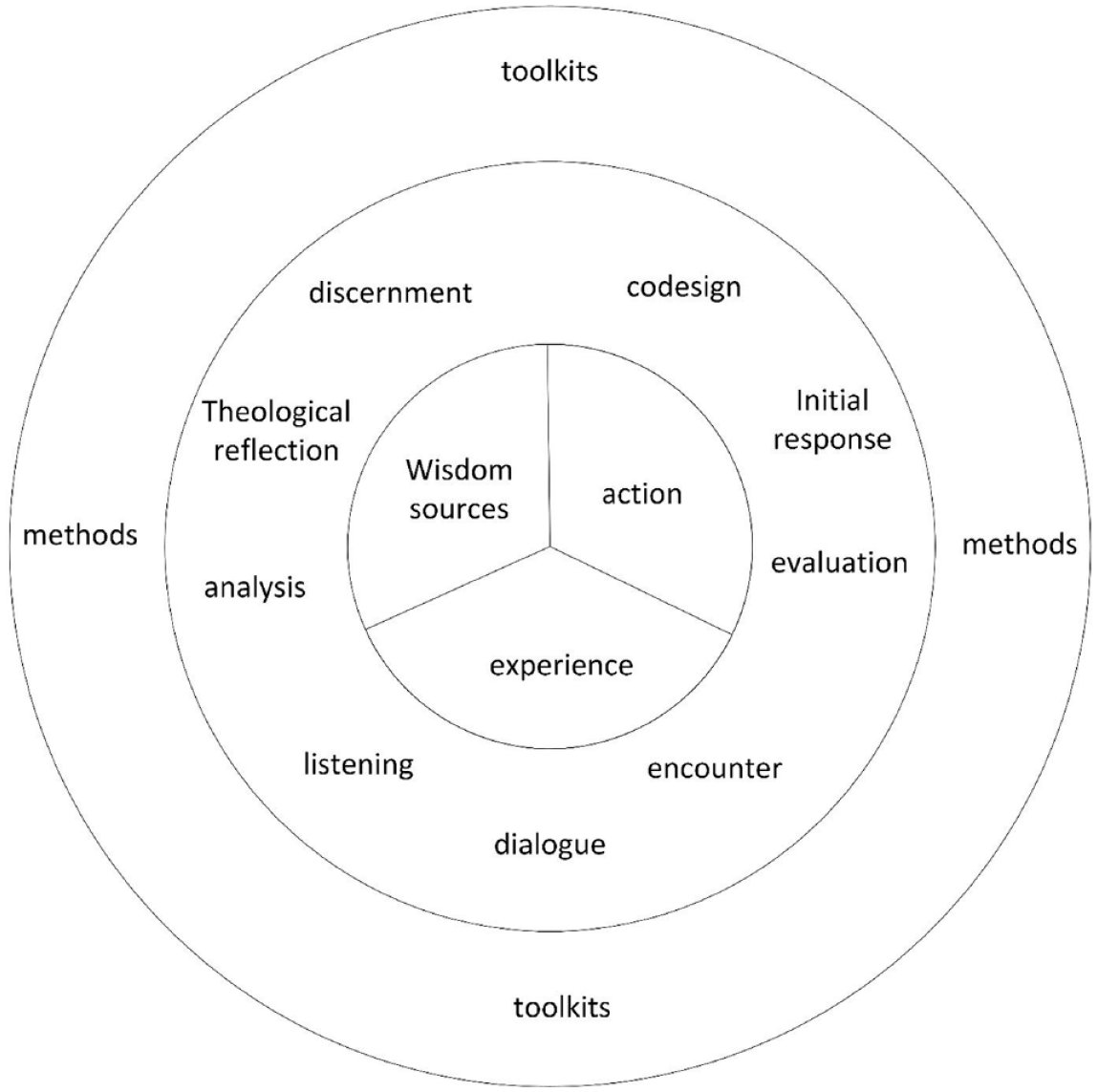
A Post-Cardijn Model of Social Thought and Action.
The innermost circle includes the core elements of experience, wisdom sources and action. The next ring indicates processes, while the third ring could specify toolkits and methods for linking the core elements and processes. The general method might move in a spiral or cycle from 1. Being attentive / attending to experience to 2. being intelligent / understanding structures and processes to 3. being responsible / discerning in faith to 4. being loving / initial action response to 5. being open / evaluation and then to 6. being committed / deeper attention to (new) experience, and so on, as in Figure 2.
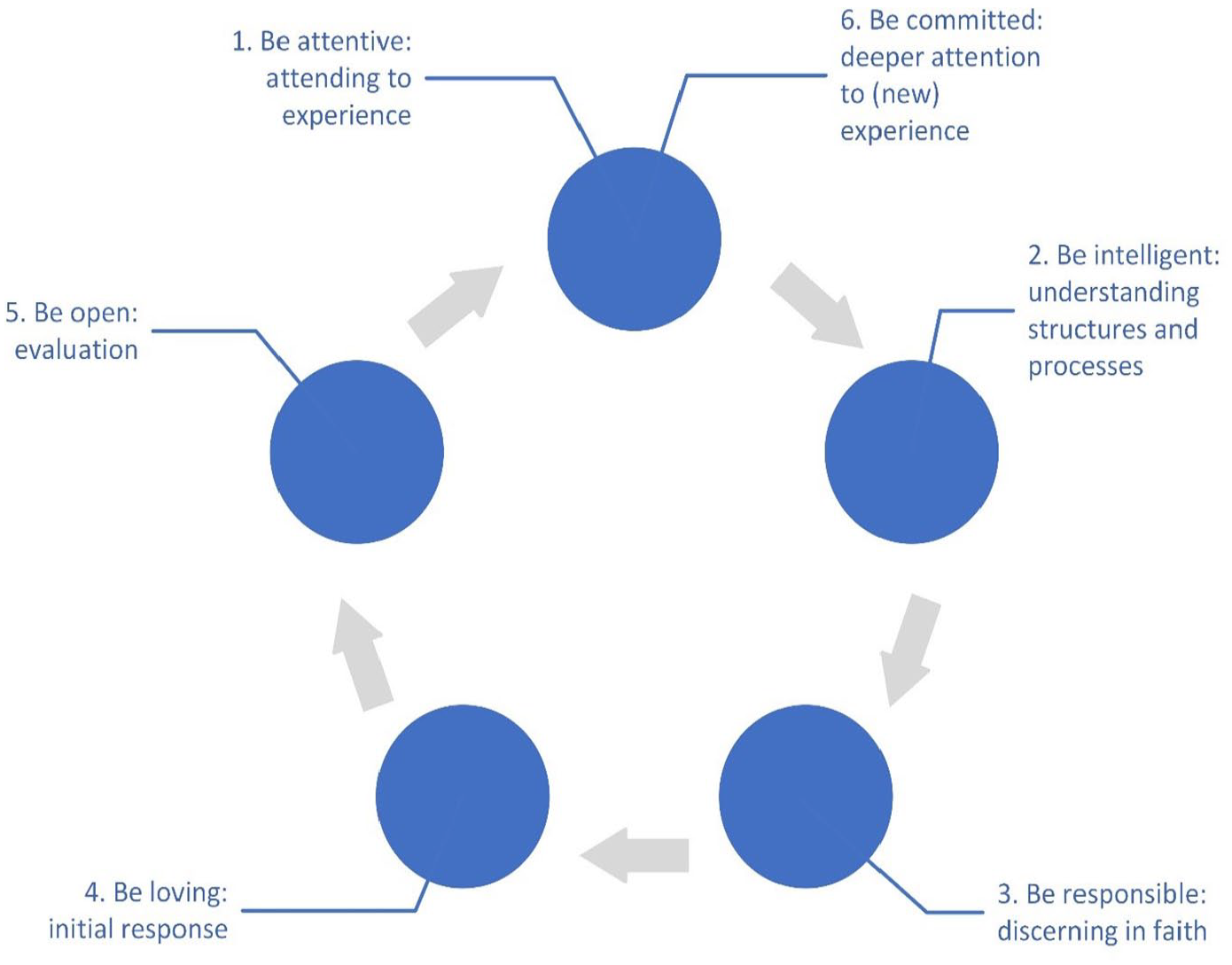
A Post-Cardijn Method of Social Thought and Action.
Conclusion
This article argues that Pope Francis’s social teaching is post-Cardijn; it is inductive and is informed by, but reinterprets and goes beyond, the see-judge-act approach. The pastoral spiral and the Ignatian Pedagogical Paradigm better describe the dynamics of Francis’s social teachings than the see-judge-act formula. They attend to experience in a more explicitly wholistic way than see-judge-act and can be used in a less directional, ordered, and more ‘circular’ or integrative way. Interpreting Francis’s way of proceeding through the traditional see-judge-act formula is like pouring new wine into old wineskins. Maria Cimperman reminds us that ‘if we see only what we have already done or experienced, we cannot imagine something new.’ 76 Rather than reading Francis backwards through the lens of the see-judge-act formula, we can read his teaching as leaning forward into an emerging new approach. It is time for new wineskins. This article proposes several characteristics of a post-Cardijn approach: a wholistic and inclusive approach to experience; respect for the agency of all; seeking understanding through encounter, listening and dialogue; flexible and open-ended processes; the integration of spirituality at every stage; and the use of new language that communicates effectively with contemporary pluralist societies.
Footnotes
Funding
The author received no financial support for the research, authorship, and/or publication of this article.
1
Guillermo Kerber, ‘Latin American and Ecumenical Insights in Laudato Si’,’ The Ecumenical Review 70.4 (2018): 627–36. https://dx.doi.org/10.1111/erev.12389; Joao Decio Passos, ‘Pope Francis: Updating Puebla in the Era of Conciliar Aggiornamento,’ International Journal of Latin American Religions 5 (2021): 315–29.  ; Gerard Whelan, ‘The Theological and Pastoral Method of Pope Francis,’ Rivista di Teologia dell'Evangelizzazione 22.43 (2018): 89.
2
Juan Carlos Scannone, ‘Pope Francis and the Theology of the People,’ Theological Studies 77.1 (2016): 118–35; Ethna Regan, ‘The Bergoglian Principles: Pope Francis’ Dialectical Approach to Political Theology,’ Religions 10 (2019): 670, https://dx.doi.org/10.3390/rel10120670; Charles E. Curran, ‘Pope Francis’s Social Encyclicals and the Social Teaching of the Church,’ Journal of Catholic Social Thought 19.2 (2022): 181–203, .
3
4
See for example Catholic Charities USA, ‘See-Judge-Act: The Foundational Pastoral Method of Laudato Si’,’ https://www.catholiccharitiesusa.org/stories/see-judge-act-the-foundational-pastoral-method-of-laudato-si/; Patricia Hindmarsh, ‘The Pope’s Revolution: The Implications of Laudato Si’,’ Concerned Catholics Canberra/Goulburn, 27 November 2020 Online Meeting. https://static1.squarespace.com/static/5930ee9129687f4cfdcebf6a/t/5fc350ecfa04221c718a2d77/1606635757825/201126+-+PAPER+-+Laudato+Si+-+Patricia+Hindmarsh.pdf; and Maryknoll Office for Global Concerns, ‘Fratelli Tutti: See Section,’ https://www.youtube.com/live/_1YLAvT9LHQ?si=P3kGvx1CZ-YtdDsP; ‘Fratelli Tutti: Judge Section,’ https://www.youtube.com/live/4wIj3LOUE1I?si=JukP_yyYRp4RmqZ0; ‘Fratelli Tutti: Act Section,’ .
5
See for example Marie Cooke, ‘LSM Core Value: Being Prophetic,’ https://laudatosimovement.org/news/lsm-core-value-being-prophetic/; Catholic Social Services Australia, ‘Catholic Social Teaching,’ https://cssa.org.au/resources/catholic-social-teaching/; Catholic Prison Ministries, ‘Catholic Social Teaching,’ ; Charles E Curran, Catholic Social Teaching 1891–Present: A Historical, Theological, and Ethical Analysis (Washington, DC: Georgetown University Press, 2002).
6
7
Stefan Gigacz, The Leaven in the Council: Joseph Cardijn and the Joicist Network at Vatican II (Melbourne: Australian Cardijn Institute Cooperative Ltd, 2021), 33–34.
8
9
Ibid.
10
John XXIII, Mater et Magistra, 1961, §236.
11
Kevin Ahern, Structures of Grace: Catholic Organisations Serving the Global Common Good (Maryknoll, NY: Orbis, 2015), 75.
12
International Young Christian Workers, ‘Review of Worker Life and Action,’ https://joci.org/en/who-are-we/documents-fondamentaux-de-la-joci-2/82-rvao-2.html; International Coordination of YCWs, ‘Declaration of Principles,’ , 26–29.
13
Mater et Magistra, §226.
14
Mater et Magistra, §218.
15
Mater et Magistra, §236–237.
16
For example, he says at §236: ‘then, the situation is evaluated carefully in relation to these teachings.’
17
Mater et Magistra, §237.
18
Mater et Magistra, §238.
19
Gigacz, The Leaven in the Council, 196–251.
20
Curran, ‘Pope Francis’s Social Encyclicals and the Social Teaching of the Church,’ at 183.
21
Examination of Francis’s 2023 apostolic exhortation Laudate Deum has been excluded limiting the scope of the paper to the more authoritative social encyclicals.
22
Sandie Cornish, ‘Laudato Si’: Making the Connections,’ Asian Horizons 4 (2015): 613–14.
23
Francis, Laudato Si’, (2015), §10.
24
Curran, ‘Pope Francis’s Social Encyclicals and the Social Teaching of the Church,’ 185.
25
Laudato Si’, §16.
26
For example, Kerber, ‘Latin American and Ecumenical Insights in Laudato Si’,’ 629.
27
St Ignatius of Loyola, The Spiritual Exercises, trans. L.J. Puhl, The Spiritual Exercises of St Ignatius: A New Translation Based on Studies in the Language of the Autograph (Makati City, Phillipines: St Pauls, 1987), §101–9.
28
Ibid., §247.
29
The pastoral circle was first presented in Joe Holland and Peter J. Henriot, Social Analysis: Linking Faith and Justice, Rev. and enl. ed. (Maryknoll, NY: Orbis, 1983). Twenty-five years later Frans Jozef Servaas Wijsen, Peter J. Henriot, and Rodrigo Mejia, eds The Pastoral Circle Revisited: A Critical Quest for Truth and Transformation (Maryknoll, NY: Orbis, 2005), celebrated the myriad ways in which the method had been utilised, adapted, and expanded. In Asia the method is more often known as the pastoral spiral.
30
The FABC’s use of the pastoral spiral is first spelt out explicitly in FABC Office for Human Development, ‘Final Reflections of the Seventh Bishops’ Institute for Social Action,’ in For All the Peoples of Asia, eds Gaudencio Rosales and C.G. Arevalo (Quezon City: Claretian, 1986), 231. It was later used for the structuring of some meetings, including the Eighth Plenary Assembly of the Federation in 2004 as reported by the Union of Catholic Asian News https://www.ucanews.com/story-archive/?post_name=/2004/08/23/spiral-process-at-fabc-assembly-helps-bridge-bishoplaypeople-gap&post_id=24607.
31
Laudato Si’, §11, 49.
32
Francis, Fratelli Tutti (2020), §1–5.
33
Fratelli Tutti, §3–4.
34
The words fraternity or fraternal appear 73 times, the expression ‘social friendship’ appears 12 times and word friendship on its own a further five times. Meanwhile the word solidarity and the expression ‘unity of the human family’, which are more common in the modern social teachings, are used 26 times and only once respectively.
35
See for example Alan Harrison, ‘Accompaniment in Education,’ in Ashleigh Callow et al., Accompaniment in Education in the Tradition of St Ignatius: Papers from a Colloquium on Jesuit Education Campion Hall Oxford April 2012 (London: The Jesuit Institute, 2012), 9–12.
36
The word ‘dialogue’ appears 25 times in Laudato Si’ and 49 times in Fratelli Tutti.
37
Curran, ‘Pope Francis’s Social Encyclicals and the Social Teaching of the Church,’ 186.
38
Fratelli Tutti, §221.
39
International Council VII of the Young Christian Workers, Review of Life and Worker Action (Brussells: International Secretarait of the YCW, 1975), 2–3 makes clear that it is the militants and workers of the YCW who do the seeing, and John XXIII’s reference to the Cardijn method in Mater et Magistra makes it clear that the judgement to be exercised by young lay people should be an application of church teaching.
40
St Ignatius of Loyola, The Spiritual Exercises, §15.
42
43
Ibid., 8.
44
45
Ibid.
46
47
Reported at https://www.vaticannews.va/en/pope/news/2022-01/pope-francis-be-effective-apostles-rooted-in-the-word-of-god.html with the full text at .
48
David L. Fleming, What is Ignatian Spirituality? (Chicago: Loyola, 2008), 19–23.
49
Francis, Message to the International Forum of Catholic Action (Rome: L’Osservatore Romano Weekly Edition in English, 2 December 2022).
50
Ibid.
51
52
53
54
55
56
Michael J. Crosby, ‘Spirituality,’ in New Dictionary of Catholic Social Thought, ed. Judith A. Dwyer (Collegeville, MN: Liturgical, 1994), 917–20.
57
Peter J. Henriot, ‘Social Discernment and the Pastoral Circle,’ in The Pastoral Circle Revisited: A Critical Quest for Truth and Transformation, eds Frans Jozef Servaas Wijsen, Peter J. Henriot, and Rodrigo Mejia (New York: Orbis, 2005), 15–26 at 16.
58
59
Federation of Asian Bishops Conferences Workshop, Cambodia, January 2020.
60
James E. Hug, ‘Redeeming Social Analysis: Recovering the Hidden Religious Dimensions of Social Change,’ in The Pastoral Circle Revisited: A Critical Quest for Truth and Transformation, eds. Frans Jozef Servaas Wijsen, Peter J. Henriot, and Rodrigo Mejia (New York: Orbis, 2005), 196–210.
61
Ibid., 204.
62
Ibid., 208.
63
Ibid., 209.
64
For discussion of the pitfalls of relying solely on the principles of Catholic social teaching see Sandie Cornish, ‘Beyond Principles Alone,’ in Shadow of the Cross: Catholic Social Teaching and Australian Politics, ed. Greg Craven (Redland Bay, QLD: Kapunda, 2021), 81–98.
65
66
Henriot, ‘Social Discernment and the Pastoral Circle,’ 15.
67
68
Ibid., 26.
69
70
Australian Cardijn Institute, ‘Vatican Dicastery Restructures Along See-Judge-Act Line,’ Australian Cardijn Institute, 19 September 2022, https://australiancardijninstitute.org/vatican-dicastery-restructures-on-see-judge-act-line/; Dicastery for Promoting Integral Human Development, ‘Presentation of the New Structure of the Dicastery,’ 1 September 2022, .
71
Ibid; Francis, Praedicate Evangelium, 2022, § 4.
73
Jim Shepperd, ‘“See, Judge, Act” and Ignatian Spirituality,’ The Way 56.1 (2017): 102–11.
74
Ibid., 107.
75
Ibid., 108–11.
76
Maria Cimperman, Social Analysis for the 21st Century: How Faith Becomes Action (Maryknoll, NY: Orbis, 2015), 128.