




Abstract
In the face of continued debates about Christian supersessionism with regard to Judaism, this article revisits two texts which have been thought to display the harshest anti-temple attitudes in the New Testament: Stephen’s speech in Acts 7, and the Letter to the Hebrews. Many scholars believe these two texts are connected, and a perceived anti-cultic attitude forms one of the key alleged similarities between the two. The article first examines shared lexical and conceptual points between the two texts, affirming their proximity. It then examines each text’s cult attitude in turn. Stephen portrays the temple as divinely given yet always subordinate to God’s heavenly presence. Hebrews frames deficiencies in the Levitical cultus as divinely intended in light of the heavenly tabernacle. These texts therefore do not condemn but instead relativize Israel’s earthly sanctuary/ies, in keeping with themes in Israel’s Scriptures, and thus should not be regarded as supsersessionist.
The question of Christian replacement or supersessionist stances towards Judaism remains a live one for Christian theology. 1 The concern is an enduring one, in part because of the apparently anti-Jewish stance of a number of texts in the New Testament. One important subset of the wider issue is the Christian attitude towards Jewish institutions, and especially the temple and sacrificial cult. A number of scholars have begun to question conventional interpretations through close re-readings of a range of texts. 2 For example, Jonathan Klawans re-evaluates the apparently anti-cultic stance of Jesus’ Last Supper as the extension or application of temple significance, and views his temple clearing action as a dispute with the authorities not with the cult per se. 3 Yet Klawans does not completely exonerate the New Testament of supersessionism. He regards Stephen’s speech in Acts 7 as thoroughly anti-temple because it makes ‘the assertion that God dwells only in the heavenly temple, and not in any earthly one’, which amounts to an ‘exceptional rejection of traditional Jewish theology’. 4 Similarly, the Letter to the Hebrews ‘lays out a clear, supersessionist approach in its contrast between the old order and the new’, where ‘earthly models become irrelevant’; the ‘antitemple, antisacrificial, and antipriestly polemics here are simply unmistakable’. 5
In the history of scholarship, Acts 7 and Hebrews have often been connected, and their alleged anti-cultic attitude is a key point of contact. 6 To broach the question of their potential supersessionist outlook, then, one must first establish whether they are related. In the first section of this article I will demonstrate that there are strong grounds for connecting the two. This increases the likelihood of shared features in their attitude towards the cult. 7 I then examine the cult attitude of each text in turn. 8 I argue that, despite a difference with regard to the end of the cult, there is an overlap in the cultic perspective of both texts, which should be described in terms of relativization rather than replacement. Recognizing this mode of argumentation, and its rootedness in Israel’s Scriptures, has a contribution to make to a theological response to the problem of supersessionism.
Connecting Stephen and Hebrews
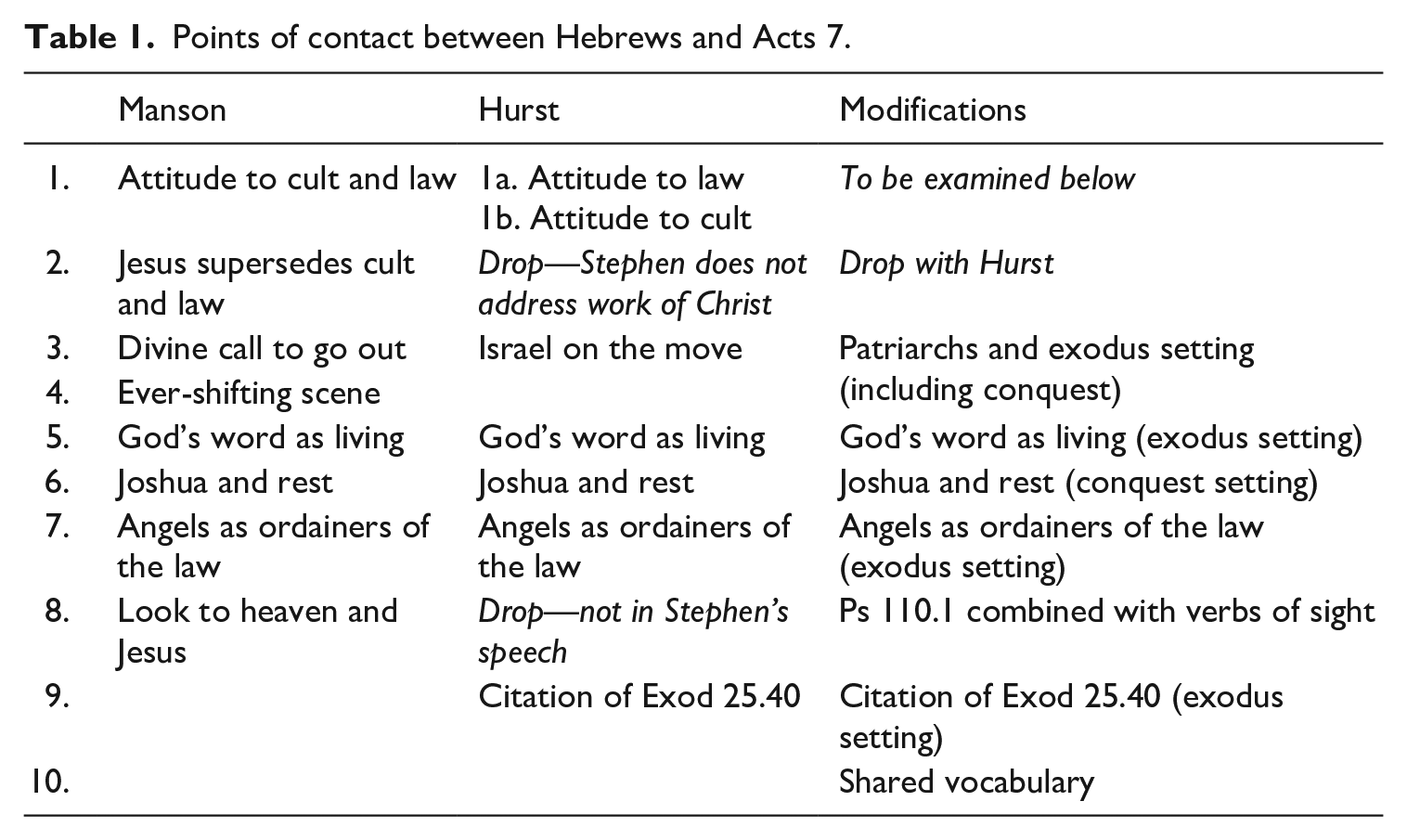
The work of two scholars at either end of the second half of the 20th century provides a helpful categorization of the connections between Stephen and Hebrews. William Manson’s Baird Lectures offer a reconsideration of the historical setting of Hebrews on the basis of the Stephen episode, which he considers the ‘key to the Epistle’. 9 He identifies eight points of contact between Hebrews and Acts 7, 10 as follows:
Shared attitude to the Jewish cult and law
Declaration that Jesus means to change or supersede these
The divine call to ‘go out’
Stress on the ever-shifting scene in Israel’s life
God’s word as ‘living’
Allusion to Joshua in connection with the promise of God’s rest
Angels as the ordainers of the law
Looking to heaven and to Jesus 11
In his monograph on Hebrews’ background of thought, appearing some four decades later, Lincoln Hurst discusses each of these in greater detail than Manson, and I use his treatment of the points of contact to structure my evaluation here. 12
1. For Manson, both Stephen and Hebrews hold that the law has been superseded, and call the church to leave the temple and Jewish institutions. 13 Hurst allows that, while law and cult cannot be fully separated, they merit distinct treatment. He suggests that for both texts the law is ‘of divine origin and valid for its time’; and the temple is in danger of being treated as ‘final and ultimate’ when it was intended to be ‘earthly and provisional’. 14 It is noteworthy that Manson and Hurst agree that Stephen and Hebrews share a similar attitude towards law and cult, whilst differing in their articulation of that attitude. As this is the point of contact that this article will examine in detail below, no further comment needs to be added here.
2. Hurst dismisses the claim that Christ supersedes law and cult in both texts, on the basis that it is not made explicit in Acts 7 (Jesus features in Stephen’s speech only at the very end, as ‘the just one’, 7.52). 15 I would add that Hebrews, too, does not make an explicit claim that Jesus supersedes law and cult, though it possibly comes close at Heb 10.9 (‘he [Jesus] removes the first to establish the second’), which will be treated below. Whatever is made of that verse, Hurst is right that this cannot be a point of contact given its absence from Acts 7.
3–4. Hurst combines Manson’s third and fourth points and defends them against critiques that Acts does not valorize movement over fixity and that Hebrews is more concerned with cultic access than forward movement. He concludes that they ‘agree sufficiently in their picture of the people of God as pilgrims’. 16 A little more space needs to be given to the reservations: below I will critique the frequent claim that Stephen’s speech valorizes movement and dynamism over static fixity. And with regard to Hebrews, against Käsemann’s emphasis on the pilgrimage motif, it is important to note that the letter uses wilderness traditions to highlight the imminent urgency of decision rather than an ongoing wandering state. 17 Nevertheless, in the light of Hebrews 11 as well as 3.7–4.13 we can recast this point not as ‘Israel in motion’ (pace Hurst) but as a striking shared interest in the nomadic motif and the wilderness setting in connection with the patriarchs and the exodus.
5. The notion of God’s word as ‘living’ is perhaps less significant but remains nevertheless a point of contact. Hurst assesses potential parallels in 1 Pet 1.23 and John 6.63, 68 as insufficiently close, which heightens the uniqueness of this connection. 18 We can in addition note the wilderness context for both references, with ‘living oracles’ (λόγια ζῶντα, Acts 7.38) given to Moses at Sinai, and ‘the word of God is living’ (ζῶν γὰρ ὁ λόγος, Heb 4.12) forming the climax to the extended treatment of the wilderness generation as a negative example for Hebrews’ audience. Furthermore, in a comparison that builds on the Sinai theophany, Hebrews’ audience hear the speech of Jesus’ lifeblood and of the living God (12.22–25).
6. With regard to Joshua and rest, Hurst notes the similarity of thought in subordinating the land into which Joshua brings the Israelites to a transcendent, divine rest. He also identifies four interconnected themes, which occur within a few verses of each other: rest, hearing, defect of heart, and the Spirit (Acts 7.49–51; Heb 4.7–11. 19 This point should be connected with points 3–4, extending the shared exodus interest to the conquest as well. In this collocation of motifs Hebrews and Acts 7 distinguish themselves from other references to isolated aspects of the exodus, as for example in 1 Cor 10.
7. Although a number of texts refer to angels as mediators of the law (as well as Acts 7.38, 53; Heb 2.2, cf. Gal 3.19; Jos. Ant. 15.136; Jub 1.27–29), Hurst contends that ‘only in Acts 7 and Hebrews is this notion set in the context of disobedience’. 20 This is then a point of contact, albeit a lesser one, and again one which finds its setting in a wider discourse on the exodus.
8. Manson connects Stephen’s heavenward gaze at Jesus (ἀτενίσας, θεωρῶ, Acts 7.55–56) with ‘looking to Jesus’ in Heb 12.2 (ἀφορῶντες used cohortatively following τρέχωμεν). Hurst rejects this as ‘not very convincing’, because he holds that Hebrews’ similarities relate ‘to the thought embodied in the speech of Acts 7’, and not the narrative action that follows. 21 Here I take no view on the extent to which Luke reproduced or shaped source material for the Stephen episode, 22 or composed it afresh; yet, if sources were involved, the speech may have come together with or separate from an account of his death. The vision of Jesus in heaven at God’s right hand is coherent with material in the speech that highlights the appearance of God’s glory to individuals such as Abraham and that identifies heaven as God’s true dwelling place. This does not prove that the account of Stephen’s death must be considered together with his speech, but it adds internal, thematic weight to an association in Luke’s text as we have it, which entirely conceivably stems back to sources as well. 23 As for Hebrews, the 12.2 reference indicates a similar notion: while the imagery is athletic, Jesus’ position as victor is seated at the right of the heavenly throne. This point is made several times throughout the letter, alluding to or citing Ps 110.1. Moreover, Heb 2.8 states that ‘we see [ὁρῶμεν] the one made lower than angels for a little while—Jesus’, and that he is ‘crowned with glory and honour’, the kind of accolade that would be accorded to a victorious athlete as well as entirely fitting for one whom the reader already knows to be seated at God’s right hand (1.3). While Ps 110.1 is the most-cited Old Testament verse in the New Testament, it is usually quoted or paraphrased in a statement of the fact of Jesus’ heavenly session, but rarely in conjunction with verbs of sight. Indeed, the only other place in which we find this combination of motifs is in Jesus’ trial in Mark 14.62//Matt 20.21–23, but here as a future prediction in the mouth of Jesus himself: ‘you will see the Son of Man seated at the right hand’. (Luke omits the claim ‘you will see’, perhaps because he reserves the privilege—or at least the event—of seeing for Stephen.) The use of Ps 110.1 of believers’ present vision of Jesus at the right hand is then a distinctive shared point of contact between Hebrews and Acts 7, related to the thought of Mark 14.62.
9. To Manson’s eight points, Hurst appends a ninth: the citation of Exod 25.40 (Acts 7.44; Heb 8.5), which is unique to these two writers in the New Testament, both of whom develop it in the context of God’s spiritual nature. 24 More can be said: the term σκηνή is used to denote the wilderness tabernacle only in Acts 7 and Hebrews in the New Testament, 25 and the term τύπος referring to a heavenly pattern (following Exod 25.40 LXX) is likewise found only in Acts 7.44 and Heb 8.5. This connection will be important in the discussion below, as it relates to the question of attitude to the temple, and yet again it underscores the significance of the events of the exodus for both texts.
10. In addition to Manson’s and Hurst’s observations, there are further shared vocabulary items worth noting. 26 These do not stand alone but serve to strengthen the connections mentioned above. That Moses’s mother sees his ‘beauty’ or ‘nobility’ (ἀστεῖος) and hides him for three months is found in Exod 2.2, and paraphrased in both Acts 7.20 and Heb 11.23, and only in these places in the New Testament, using the term found in the Septuagint. The term ‘hand-made’ (χειροποίητος) referring to the tabernacle or temple is found only in Acts 7.48, Heb 9.11 (negated), 24, and Mark 14.58 (which also contains the negated form ἀχειροποίητος). 27 Like the use of Ps 110.1 in association with verbs of sight, noted above, this is another point shared only between Mark’s trial material, Acts 7, and Hebrews. A few more minor terms can be noted: Abraham’s ‘inheritance’ (κληρονομία) is mentioned only in Acts 7.5, Gal 3.18, and Heb 11.8. The exodus from Egypt (Αἴγυπτος) is mentioned only in Acts 13.17 and Jude 5 outside Acts 7 and Hebrews, while the specific title ‘Pharoah’ (Φαραώ, rather than ‘king’, βασιλεύς) is found only in Acts 7, Hebrews, and Rom 9.17. Furthermore, Acts 7.45 and Heb 4.9 are also the only two places in the New Testament which use the Greek form ‘Jesus’ (Ἰησοῦς) to denote Joshua son of Nun. These salient lexical terms, either unique to Acts 7 and Hebrews or shared with only one or two other New Testament texts, further indicate the close link between the two. Finally, whilst statistical analysis without reference to semantics is a somewhat blunt tool, it is nevertheless striking that over half of the vocabulary of Acts 6.1–8.3 is shared with Hebrews, 28 whereas for the rest of Acts (excluding 6.1–8.3), only 28 percent of lexical terms are shared with Hebrews. 29 The same analysis using only speeches—to mitigate against the effect of difference in genre (narrative vs epistolary/homiletic)—reveals a slightly smaller but still substantial gap: speeches in Acts (excluding Stephen’s) share 44 percent of their vocabulary with Hebrews, over against a 62 percent match for Acts 7.2–53. 30
Manson’s and Hurst’s treatment of the points of contact is, then, largely vindicated and in places strengthened, as summarized in Table 1 below. Acts 7 and Hebrews stand in some kind of significant relation to one another, a relation which goes beyond their use of the Old Testament (and the LXX specifically), and beyond their reference to common early Christian tradition. Their proximity justifies considering together the cult attitude of both texts.
Points of contact between Hebrews and Acts 7.
Stephen and Israel’s Sanctuaries
As noted at the outset, Stephen’s speech is widely considered one of the starkest anti-temple passages in the entire New Testament. In this section I evaluate the attitude to the cult in Acts 6.1–8.3. I will (1) examine the nature of the charges and Stephen’s defence, (2) critique the view that the speech distinguishes tabernacle and temple to the detriment of the latter, and then address the references (3) to the tabernacle’s origins and (4) to God not dwelling in earthly sanctuaries. Luke’s wider view of the temple, 31 whether in Acts or in his Gospel as well, must be left aside for reasons of space. I must also largely leave aside the difficult question of whether Luke has drawn on source material, and if so to what extent he has shaped it to his purposes, in constructing the Stephen episode. 32
1. Stephen is accused of blaspheming against Moses and God (Acts 6.11), and is formally charged with speaking against the temple (‘this holy place’) and the law, saying that Jesus will destroy the temple and change Mosaic customs (6.13–14). Luke’s designation of Stephen’s accusers as false witnesses (μάρτυρας ψευδεῖς, 6.13) indicates that he does not believe the charges stand; one must assume either that what follows exonerates Stephen or, if it does not, that Luke has failed to be consistent. In his speech, Stephen honours God (e.g. 7.2), vindicates Moses (e.g. 7.20, 35), and upholds the law (7.38; indeed, his audience are the ones who fail to keep the law, 7.53). Although he makes no comment on the charge relating to Jesus—about whom he says little beyond describing him as the murdered just one (7.52)—it can be inferred that he does not believe Jesus will change the law. We are left, then, with the temple charge alone: that Stephen speaks against it, and that Jesus will destroy it. It seems more likely that Luke thinks Stephen innocent of this charge alongside the others, but it is not impossible that Acts is inconsistent, failing to harmonize Stephen’s speech with its juridical setting. 33
2. As we turn to what Stephen says about Israel’s sanctuary, a noteworthy view is that Stephen vindicates the tabernacle but condemns the temple, usually on the basis of a contrast between the dynamic mobility of the former and the static institutionalized fixity of the latter. 34 Yet this position does not stand up to scrutiny. The conjunction δέ in 7.47 does not mark a sharp contrast between tabernacle and temple: it either functions conjunctively, indicating Solomon’s temple as an additional or final item in a list, or (more likely) marks a minor contrast between David, who intended to find a dwelling for God (7.46), 35 and Solomon, who actually put this into effect. 36 It bears little weight next to the more emphatic ‘but’ (ἀλλά) in the following verse (7.48) which draws a contrast between these earthly sanctuaries and God’s true dwelling place. It is, further, hard to identify positive evaluations that correlate only with location outside the land: Israel’s idolatry and faithlessness is as much a feature of the exodus generation as of their descendants who kill the prophets; and the designation ‘made by (human) hands’ (χειροποίητος, 7.48), whatever value is attached to it, applies just as much to the tabernacle as to the temple. Moreover, the goal of the people of God in their transitory state throughout 7.2–47 is the land of Israel, in order to fulfil God’s promise that they will worship him ‘in this place’ (7.7), just as, conversely, the consequence for idolatry is exile (7.43). Tabernacle and temple are not subject to distinct evaluations but instead stand or fall together. 37 The distinction Stephen makes with respect to Israel’s sanctuary is not so much mobile/static as heavenly/earthly.
3. What then is Stephen’s attitude towards the earthly cult? The notion that he condemns it as idolatrous is based on the citation of Amos 5 and the use of the term ‘hand-made’ (addressed below). Stephen summarizes the golden calf incident and glosses it by quoting Amos 5.25–27, which accuses Israel of idolatry. The differences between the Hebrew Masoretic Text and the Greek Septuagint do not change this general thrust, but the Greek translation uses two significant terms, reading םככלמ תוכס as ‘tent(s) of Moloch’ (τὴν σκηνὴν τοῦ Μολοχ) rather than ‘Sakkuth your king’ (NRSV), and using ‘image’ (τύπος) in the sense of idol. 38 These two terms are particularly salient in the context, with ‘tent’ (σκηνή) standing for Moloch’s sanctuary here and for the tent of testimony in the following verse, and ‘image’ (τύπος) for idols and then for the divinely given pattern of Exod 25.40. This reuse of identical vocabulary is taken to indict Israel’s sanctuary as idolatrous: ‘By inference, innuendo, and insinuation, the temple of Solomon (and its successors) is drawn into the belly of the golden calf.’ 39 Yet the order of Stephen’s speech indicates the exact opposite. He first recounts the Israelites’ idolatry in the golden calf incident—which takes place precisely while Moses is receiving the law and instructions about the tabernacle—then condemns it using Amos. 40 Next, he moves immediately to rule out the inference that might be drawn from the terminology of Amos 5 LXX (namely, that he is thereby condemning the tabernacle), and does so via an approving reference to the divine command of Exod 25.40, which distinguishes idolatrous images (τύποι) from a divinely revealed pattern (τύπος) and the tent (σκηνή) of Moloch from the tent (σκηνή) of testimony.
4a. As to the term χειροποίητος, while this does, as commentators are quick to point out, largely denote idols in the Septuagint, 41 this is not its basic meaning. Literally ‘hand-made’, it indicates that something is caused by humans rather than by God or nature. In Philo this term (along with its synonym χειρόκμητος), is used to denote idolatry (generally: Decalogue 51, 66; golden calf: Moses 2.165; Posterity 166), but also frequently describes disasters caused by human action (for example, famine, Spec. Laws 3.203; shipwreck, 4.154; inflictions, Embassy 107) as well as objects made by humans (for example, musical instruments, Unchangeable 25; artificial seas made by King Xerxes, Dreams 2.118). 42 On two occasions Philo describes the temple as made by humans (Moses 2.88; Spec. Laws 1.67): in both cases the designation indicates a contrast with the cosmic temple but in neither case is any criticism of the earthly temple intended. Rather, the emphasis falls on correspondence alongside the intrinsic superiority of the universe or heavens as the true temple. In this light, Stephen’s claim is not that God does not dwell in idols or idolatrous sanctuaries—such a claim is hardly worth making in a first-century Jewish context—but that he does not dwell in any structure made by humans. 43
4b. Even without the link to idolatry, however, Stephen’s statement appears categorical in its condemnation of tabernacle and temple alike. Thus Klawans, quoted in the introduction, understands Stephen to be saying that God dwells only in heaven, and not in any earthly sanctuary. Yet this inference takes at face value and thus overreads a common Semitic idiom whereby relative contrasts are stated in absolute terms. Multiple examples could be given but two will suffice: Hosea’s statement that God desires ‘mercy, not sacrifice’ (Hos 6.6; cf. Matt 9.13; 12.7) could hardly have meant to his first hearers that God does not in fact desire sacrifice as well, simply that he prioritizes mercy. So also Jesus’ saying that what goes into a person ‘cannot defile’, only what comes out (Mark 7.18–23//Matt 15.11–20), is not a denial of purity laws 44 but a dramatic way of highlighting the importance of ethical behaviour (see also 1 Pet 3.21). In a similar way, when Stephen affirms that God does not dwell ‘in hand-made places’ (ἐν χειροποιήτοις), he is not denying divine presence of some form in Israel’s sanctuaries, but emphasizing divine transcendence and location in heaven. This affirmation, moreover, is of a piece with the whole tenor of Solomon’s inauguration of the temple in 1 Kings 8; in particular, the presupposition of his extended prayer is that when people pray at or facing the temple, God will hear from heaven. 45
The contrast Stephen draws requires not only that heaven is superior to earthly sanctuaries but also that it corresponds to them as a divine dwelling place—in other words, a temple. That heaven is the true temple is implied by references to God’s glory (7.2), throne (7.49), house and resting place (7.49), and also by Jesus’ priestly posture standing at God’s right hand (7.55–56). 46 By drawing attention to God’s transcendent location in the heavenly sanctuary so emphatically, Stephen implies that his audience has neglected this reality, focussing too much on the earthly sanctuary, to the exclusion or limitation of the true sphere or extent of God’s location and activity. This is one further instance of the unfaithfulness of those he is addressing. That is to say, it is subordinate to the direct charge, which emerges only in 7.51–53, that they are stubborn, oppose the Holy Spirit, persecute and kill the prophets culminating in Jesus, and do not keep the law. 47 It is this charge, and not Stephen’s temple discourse, that prompts the crowd’s angry reaction, and only following his claim to see Jesus at God’s right hand is Stephen physically accosted and ultimately stoned. 48
Stephen’s speech locates the temple in both salvation-historical and cosmological terms: it was divinely given under Moses, has accompanied the people throughout their time outside and within the land, and yet is not and never has been the prime locus of God’s being, and therefore should not be taken as such to the detriment of heaven. The chief focus of the Stephen episode, however, is not the temple but the failure of his addressees, which he connects to a long scriptural record of disobedience, resistance, and idolatry by some within Israel’s history.
Hebrews and the Tabernacle(s)
Like Acts 7, Hebrews is widely regarded as opposing core Jewish institutions. Yet some scholars have begun to re-evaluate its stance. For example, Richard Hays reassesses his own earlier reading of Hebrews as a supersessionist foil to Paul, instead proposing that it evinces ‘new covenantalism’, and states that Hebrews ‘criticizes nothing in the Mosaic Torah’—though he adds the caveat ‘except for the Levitical cult’, 49 and thus still regards Hebrews as anti-cultic in some measure. Alongside Hays, a number of other assessments have been offered. For some, Hebrews does attack the old covenant, but does so incoherently. 50 For others, more needs to be said about the positive function of Levitical sacrifices or other Jewish practices. 51 A significant line of interpretation seeks to exonerate Hebrews by reading it not as anti-temple polemic before AD 70, but rather as consolation following the temple’s destruction. 52 I am sympathetic towards this position, and I agree that the dating of Hebrews pre- or post-70 makes a substantial difference to how exactly the letter’s argument is to be construed in its original setting. Nevertheless, in the discussion below I set aside questions of dating, for three reasons: (i) Hebrews cannot ultimately be located more precisely than within the likely parameters of AD 60–90; (ii) whether pre- or post-70, Hebrews’ setting remains the broader stream of first-century Judaism(s); (iii) on its own terms the theological nature of the claims Hebrews makes is based not on whether or not the temple is standing, but on its interpretation of Scripture in relation to the Christ event. 53
The statements Hebrews makes about the Levitical cult in the context of its wider argument about the first covenant can be grouped into two broad categories. They either (1) describe some kind of inherent deficiency in the law, priesthood, or sacrifices, or (2) posit a change that has come about in the light of the new covenant of which Christ is high priest and mediator, in terms variously translated as change, disappearance, abrogation, or abolition.
1a. Some of the language that is commonly taken to highlight a deficiency in the first covenant is in fact simply descriptive. Indeed, all of Hebrews’ evaluation of the Levitical cult occurs in its expository not its exhortatory sections. 54 In part we have to reckon here with a long history of mistranslation. A particularly egregious example is the rendering of νέκρα ἔργα (Heb 9.14) as ‘useless rituals’ in the NIV margin, when the phrase refers not to anything specific to the old covenant but rather to sinful deeds, common to all humanity, from which the conscience needs cleansing. By a similar token, the mortality of the priests (7.8, 23; 8.2) is a mundane fact (cf. 9.28) which becomes noteworthy only in comparison with the enduring life of Melchizedek and Christ. The same can be said of the priests’ sinfulness, which requires them to sacrifice for themselves as well as for others (7.28), an observation unremarkable in itself, but which beside Christ’s sinlessness makes the latter stand out. The word ‘flesh’ (σάρξ) in Hebrews describes physical existence, with none of the negative theological connotations it bears in Paul: hence the δικαιώματα σαρκὸς in 9.10 are regulations pertaining to the body, not ‘carnal ordinances’ in a value-laden sense, just as the ἐντολή σαρκίνη of 7.16 is not a ‘fleshly’ or sinful commandment but one regarding physical descent. With respect to 7.16 Barnard notes, ‘Hebrews defines the law in question as a specific commandment concerning the hereditary determination of priests, and, out of respect for that law, develops the notion of a heavenly priesthood in the order of Melchizedek.’ 55
Turning our attention to cultic space, the terms ὑπόδειγμα/ὑποδείγματα (8.5; 9.23), σκία (8.5; cf. 10.1), ἀντίτυπα and χειροποίητα (9.24) are often taken to denote a pejorative assessment of the earthly tabernacle, as reflected in translations such as ‘a mere copy’ (9.24, NRSV). Although there are echoes of Platonist language in these terms, they are used in ways which disrupt Platonist conceptuality: in 10.1 the shadow the law possesses (σκία) is contrasted with the true form (εἰκών), whereas for Platonism both terms signify derived realities. Conversely, ὑπόδειγμα is a synonym for the key Platonist term παράδειγμα, eternal patterns or ideas, yet in Hebrews it denotes the earthly tabernacle. These terms are used in Hebrews to establish the key notion of correspondence between the heavenly and earthly tabernacles. 56 The former is the ‘type’ (τύπος, 8.5, citing Exod 25.40) to which the latter corresponds as ‘antitype’ (ἀντίτυπα), shadow, and sketch. The notion of such a correspondence is a commonplace by the Second Temple period with roots in the Old Testament and in ancient Near Eastern thought, and far from constituting an automatic critique of earthly sanctuaries often serves to validate them. 57 Here we can also note Heb 13.10 which describes the believers’ altar as one ‘from which those who serve (at/in) the tabernacle have no right to eat’; this might appear to be exclusionary of the Levitical priests but in fact nobody ate of the Yom Kippur sacrifice which is in view here, as is made clear in 13.11. 58
1b. Setting aside the above terminology, there remains language that describes a deficiency in the Levitical cult. This highlights the weakness and ineffectiveness (ἀσθενής, ἀνωφελής, 7.18; ἀσθενεία, 7.28) of the commandment and priesthood in relation to their inability to perfect anything (τελείωσις, τελειόω, 7.11, 19, cf. 28). Such language is however limited in domain to the Levitical priesthood and the commandment concerning genealogy (cf. 7.18 with 16), not the law as a whole, 59 and the scope of the perfection that the cult offered is specified in the following chapters: its sacrifices were unable to perfect the conscience (9.9, cf. 14) or to remove sins (10.1–2), because animal blood cannot remove sins (ἀδύνατος, 10.4). In the process of making these statements, Hebrews affirms that these sacrifices were effective for external purification (9.10, 13).
2a. We turn next to language which identifies a particular change that has come about in the Christian dispensation. In 7.12 the change in the priesthood entails a change in the law as well. As we have seen, this relates primarily to the regulations regarding physical descent, which Hebrews works around on the basis of Melchizedek’s non-genealogical priesthood—and by this very move the author demonstrates his respect for the Scriptures, rather than violating or disregarding the Levitical regulation. The terminology μετατίθημι, μετάθεσις can refer to removal, change, translation, or transformation (including of Enoch, 11.5, and ‘shakeable things’, 12.27). 60 Clearly there is no question of removal here given that priesthood is not removed but rather perfectly exemplified in Christ. ‘Transformation’ is appropriate to the surpassing excellence of the Melchizedekian priesthood expounded in Hebrews 7, 61 but even if this term is resisted, the language of ‘change’ need not be dismissive of the old order and regulation. Heb 7.18 similarly speaks of the annulment or setting aside (ἀθέτησις) of this earlier genealogical commandment.
2b. The other two statements of change are more extensive in their scope. In Hebrews 8 we find an extended quotation of the new covenant passage from Jeremiah 31, after which the author isolates and emphasizes the word ‘new’ (8.13), drawing the implication that the first covenant is thus made old (παλαιόω, γηράσω) and therefore near to disappearing (ἀφανισμός). It is clear from the context (8.1–5; 9.1–10) that interest in covenant relates primarily if not only to its cultic aspects. The common translation of παλαιόω as ‘made obsolete’ (e.g. NRSV, NIV, ESV, NASB) risks bringing in a pejorative assessment to what is essentially descriptive and inferential: if there is a new covenant, there must be an old one as well. The statement that it is ‘near to disappearance’ (ἐγγὺς ἀφανισμοῦ) need not imply that its end has occurred or is imminent, but it is the clearest statement up to this point in the letter that the previous dispensation, at least in its cultic aspect, has a limited lifespan. In this it is similar to 10.9, which in interpreting Ps 40.7–9 states that ‘he [Jesus, cf. 10.5] abolishes [ἀναιρεῖ] the first [τὸ πρῶτον] in order to establish the second [τὸ δεύτερον]’ (NRSV). As ‘first’ and ‘second’ are neuter singular, they cannot denote covenant or tent (which are both feminine) as they have done previously in Hebrews 8–9. Instead, they refer to ‘the first/former (thing)’, that is the sacrifices of Ps 40.7 (Heb 10.6, 8), and ‘the second (thing)’, the obedience to God’s will which Jesus perfectly exemplifies (Ps 40.9; Heb 10.7, 9–10). Yet this is not an opposition between obedience and sacrifice: rather, it is through his obedience to the divine will that Jesus offered his body and thus sanctified his people (10.10). 62 The question of scope is again important, and it would seem that the former sacrifices do not sanctify (10.10, 14), perfect (10.14), or take away sins (cf. περὶ ἁμαρτίας, 10.6, 8 with περιελεῖν ἁμαρτίας, 10.11, ὑπὲρ ἁμαρτιῶν, 10.12). This last point is reinforced a few verses later when Hebrews closes this section by re-citing part of Jeremiah 31 before concluding ‘where there is forgiveness of these, there is no longer any sin offering [προσφορὰ περὶ ἁμαρτίας]’ (10.18).
We can see, then, that Hebrews comments extensively on the cultic space, system, and personnel of the Levitical dispensation. In various ways these comments have been misconstrued: some language is not pejorative but descriptive, while other statements are more constrained in their scope than interpreters and Bible versions have allowed. Nevertheless, Hebrews does present a clear statement of the limitations of the Levitical system: its personnel are sinful, weak, and mortal; its sacrifices can purify outwardly but do not reach the conscience or remove sins; its sanctuary is based on a heavenly pattern but does not give access to heaven itself. This is not an attack on cultic thought patterns in general; 63 on the contrary, Hebrews vindicates these by affirming that the new covenant has heaven as its sanctuary, and Jesus as high priest and sacrificial victim. But it is a demotion of the Levitical system in the light of these ultimate realities. This reassessment is carried through by careful attention to Scripture, and has both salvation-historical and cosmic aspects. In terms of cosmology, Melchizedek has been made like the Son of God, and although he is not explicitly stated to be angelic or glorified that is a possible interpretation; certainly the Son himself is exalted above angels. More explicitly, heaven itself is the true tabernacle set up by the Lord (8.2), greater and more perfect and not made by humans (9.11, cf. 23–24). As for history, the Levitical system arose after Melchizedek and after the heavenly type, and the superiority of the latter two is shown by their enduring nature and the authorization by a key figure from Israel’s past (Abraham’s tithe to Melchizedek; Moses’s receipt of instructions for the tabernacle). Supremely, Hebrews’ understanding of time is impacted by the Christ event, which has inaugurated the last days and which shows that the former cultic dispensation, which had a beginning, also has an end. In this regard, it is only by derivation from sustained reflection on Christ that much of this assessment of the Levitical cult can emerge: not so much ‘solution entails plight’, but ‘full solution entails provisionality of previous solution’. Through a reading of Israel’s Scriptures, this provisionality is understood to be part of the divine plan, revealed only through and following the Christ event.
From Replacement to Relativization
Neither Hebrews nor Acts 7 presents the Israelite cult as simply replaced by Christ, the church, or the Christian dispensation. They do consider it to be relativized, but this relativization is rooted theologically in their reading of Israel’s Scriptures as much as in the Christ event. In order to characterize these texts’ overarching cult attitude, it is helpful to think in terms of what Jon Levenson describes as ‘infrastructure’ and ‘superstructure’. ‘Infrastructure’ denotes the actual instantiation and implementation of particular institutions, whereas ‘superstructure’ is ‘the cultural heritage shared by all factions of a society’. 64 Both Stephen and Hebrews make particular claims about cultic infrastructure whilst at the same time revealing their commitment to temple superstructure. In this they circumscribe the earthly cult without opposing cultic thought, practice, and reality per se. The same is true of other Second Temple cultic critiques, perhaps most famously in the Dead Sea Scrolls, although there the target is the purity of the temple under its current administration, whereas neither Stephen nor Hebrews mentions this at all.
Stephen’s focus is the faithlessness and idolatry of a subsection of those who purport to follow God, which limits their vision to the earthly temple in ways that risk excluding the heavenly temple and ultimately God himself. Hebrews, although conscious of potential fault and faithlessness among God’s people, focuses more categorically on the Levitical cult. It does this via more extensive christological reflection than we find in Acts 7, but also via fuller scriptural argumentation. Both texts reaffirm the Old Testament theme that the earthly sanctuary is spatially subordinate to and derivative from God’s cosmic dwelling place. They also concur in locating earthly sanctuaries temporally within part of (and not all of) the divinely superintended history of salvation. Hebrews’ christological reflection pushes its argument further than Stephen in this regard, speaking explicitly of the end of this dispensation, whereas Stephen—although Luke is aware of Jesus’ prediction of the temple’s destruction—does not comment on it. In this respect it is tempting to wonder whether Hebrews is also reflecting on the temple’s actual destruction in AD 70, though this can only remain a speculation. Whether or not Hebrews postdates the temple’s destruction, it appears to relate to Stephen’s speech—or to sources that underlie it—as a fuller development. If this is the case, then Hebrews’ cultic reflections, even if written post-70 and catalysed by the destruction of the temple, are not de novo but are rooted in an earlier cult attitude displayed by Jesus’ followers.
For the contemporary discussion of supersessionism three significant implications can be drawn. First, if these two texts are related, a non-supersessionist reading of one reinforces such a reading of the other, and vice versa. Secondly, if Acts 7 and Hebrews are not in fact supersessionist, then these two important parts of the Christian scriptural canon can no longer be used to undergird replacement theologies. Instead, they represent further resources for Christian thinking, teaching, and preaching to articulate a nuanced and appreciative attitude towards ancient Jewish institutions. Thirdly, and most significantly, these texts model an appropriate mode of argumentation, via thoughtful engagement with Israel’s Scriptures, through which they reach their conclusions. Rabbinic Judaism following the destruction of Herod’s Temple found ways both to honour the central importance of cult (as for example in the extensive Mishnah tractates on cultic matters) and to recognize the relativization of its actual practice in favour of other forms of service alongside Torah and loving-kindness (m. Avot 1.2). In a parallel way, Christian thought such as that found in Acts 7 and Hebrews honours the cult and its importance through close attention to Israel’s Scriptures, whilst also circumscribing the significance of earthly sanctuaries through cosmological and salvation-historical considerations which are drawn in large part from those same Scriptures.
Footnotes
Funding
The author received no financial support for the research, authorship, and/or publication of this article.

1
In the Roman Catholic Church, the Vatican II document Nostra Aetate marked a key post-Holocaust turning point. On this, and several statements of John Paul II on Jewish-Christian relations, see Konrad Szocik and Philip L. Walden, ‘The Attitude of the Catholic Church toward the Jews: An Outline of a Turbulent History,’ Numen 64 (2017): 209–28. For a taxonomy of kinds of supersessionism see R. Kendall Soulen, The God of Israel and Christian Theology (Minneapolis, MN: Fortress, 1996).
2
Note, e.g., the monograph series ‘New Testament after Supersessionism’, and Stanley E. Porter and Alan E. Kurschner, eds, The Future Restoration of Israel: A Response to Supersessionism, McMaster Biblical Studies 10 (Eugene, OR: Pickwick, 2023).
3
Jonathan Klawans, Purity, Sacrifice, and the Temple: Symbolism and Supersessionism in the Study of Ancient Judaism (Oxford: Oxford University Press, 2006), 213–41.
4
Ibid., 242. Shelly Matthews is more tentative, but agrees that Stephen’s speech has ‘an anti-temple slant’ which confirms the witnesses’ accusation, Perfect Martyr: The Stoning of Stephen and the Construction of Christian Identity (Oxford: Oxford University Press, 2010), 3, 68.
5
Klawans, Purity, Sacrifice, and the Temple, 243. For a book-length version of this assessment, see Lloyd Kim, Polemic in the Book of Hebrews: Anti-Judaism, Anti-Semitism, Supersessionism? Princeton Theological Monograph Series (Eugene, OR: Wipf & Stock, 2006).
6
See Craig A. Evans and Donald A. Hagner, eds, Anti-Semitism and Early Christianity: Issues of Polemic and Faith (Minneapolis, MN: Fortress, 1993), and esp. David L. Tiede, ‘‘Fighting against God’: Luke’s Interpretation of Jewish Rejection of the Messiah Jesus,’ in Anti-Semitism and Early Christianity: Issues of Polemic and Faith (1993), 102–12; Robert W. Wall and William L. Lane, ‘Polemic in Hebrews and the Catholic Epistles,’ in Anti-Semitism and Early Christianity: Issues of Polemic and Faith (1993), 166–98.
7
Not all scholars think the texts share a cultic outlook. E.g., Eyal Regev states that ‘Hebrews’ attitude toward the Temple and the Law can hardly be equated with Luke’s Stephen [. . .] Stephen views the Tabernacle positively as the sanctuary that is prescribed by the Law [. . .]. In contrast, Hebrews points to its limitations.’ The Temple in Early Christianity: Experiencing the Sacred, AYBRL (New Haven, CT: Yale University Press, 2019), 278–79.
8
I use ‘cult attitude’ as a catch-all term, recognizing that Hebrews speaks explicitly only of the wilderness tabernacle, and Acts 7 of both tabernacle and temple.
9
William Manson, The Epistle to the Hebrews: An Historical and Theological Reconsideration, The Baird Lecture 1949 (London: Hodder and Stoughton, 1951), 23. For historical reconstructions of the background to Acts 7, see Marcel Simon, St Stephen and the Hellenists in the Primitive Church, Haskell Lectures 1956 (London: Longmans, Green, 1958); C.F.D. Moule, ‘Once More, Who Were the Hellenists?’ Expository Times 70.4 (1959): 100–102; Martin Hengel, ‘Zwischen Jesus und Paulus: Die »Hellenisten«, die »Sieben« und Stephanus (Apg 6, 1–15; 7, 54–8, 3),’ Zeitschrift für Theologie und Kirche 72.2 (1975): 151–206; Rudolf Pesch, E. Gerhart, and F. Schilling, ‘“Hellenisten” und “Hebräer”: zu Apg 9,29 und 6,1,’ Biblische Zeitschrift 23.1 (1979): 87–92; Martin Hengel, Earliest Christianity (London: SCM, 1986), 71–80; Paul Trudinger, ‘Stephen and the Life of the Primitive Church,’ Biblical Theology Bulletin 14.1 (1984): 18–22; James D.G. Dunn, Unity and Diversity in the New Testament: An Inquiry Into the Character of Earliest Christianity (London: SCM, 1990), 268–75; N.H. Taylor, ‘Stephen, the Temple, and Early Christian Eschatology,’ Revue Biblique 110.1 (2003): 62–85. From an historiographical perspective, Todd Penner is agnostic on whether the Stephen episode is historical or not, In Praise of Christian Origins: Stephen and the Hellenists in Lukan Apologetic Historiography, ESEC (New York, NY: T & T Clark International, 2004), 331. Shelly Matthews is more sceptical and focuses instead on rhetorical construction of identity, Perfect Martyr, 18–19.
10
The focus is primarily on Stephen’s speech and death, but ‘Acts 7’ is used as a shorthand evoking the wider context of 6.1–8.3.
11
Manson, Hebrews, 36.
12
L.D. Hurst, The Epistle to the Hebrews: Its Background of Thought, SNTSMS 65 (Cambridge: Cambridge University Press, 1990).
13
Manson, Hebrews, 32–34.
14
Hurst, Hebrews, 95, 97.
15
Simon describes Stephen’s speech as ‘“Moseocentric” much more than Christocentric’, St Stephen, 45.
16
Hurst, Hebrews, 98–100.
17
Ernst Käsemann, The Wandering People of God: An Investigation of the Letter to the Hebrews, trans. Roy A. Harrisville and Irving L. Sandberg (Minneapolis, MN: Augsburg, 1984); contrast Albert Vanhoye, ‘Longue marche ou accès tout proche? Le contexte biblique de Hébreux 3,7–4,11,’ Biblica 49 (1968): 9–26.
18
Hurst, Hebrews, 100–102.
19
Hurst, 102.
20
Hurst, 103 (emphasis original). Although transgressions are mentioned in Gal 3.19, Hurst’s point stands in that in Acts and Hebrews the reference to angels underscores the gravity of not keeping the law/neglecting salvation, whereas in Galatians it contrasts mediated with unmediated revelation.
21
Hurst, 103 (emphasis original).
22
Alongside the different style of Stephen’s speech, many see signs of divergent sources in the way that the episode seems to switch from a judicial setting (6.12–7.1) to a mob lynching (7.54–58a) and back to a judicial setting (7.58b).
23
For an argument that Stephen’s final words should be considered together with his speech, see Janusz Kucicki, The Function of the Speeches in the Acts of the Apostles: A Key to Interpretation of Luke’s Use of Speeches in Acts, BIS 158 (Leiden: Brill, 2018), 89–90.
24
Hurst, Hebrews, 104.
25
‘Tent/tabernacle of testimony’ (σκηνή τοῦ μαρτυρίου, Rev 15.5) denotes the heavenly sanctuary.
26
David Allen offers a fuller comparison of Acts 7 with Heb 11 specifically, including linguistic parallels, Lukan Authorship of Hebrews, NAC Studies in Bible and Theology 8 (Nashville, TN: Broadman & Holman, 2010), 143–50.
27
The ‘house not made by hands’ (οἰκία ἀχειροποίητος) in 2 Cor 5.1 denotes the human body on the analogy of a sanctuary.
28
228 of 415 lexical items (55 percent) are shared with Hebrews. Allen calculates nearly 90 percent match in token frequency between Acts 7.1–60 and Hebrews, and a 70 percent match in type frequency, Lukan Authorship of Hebrews, 143–44.
29
533 of 1926 lexical items.
30
364 of 833 lexical items (including all speeches given by Christians and the letter from the Jerusalem council) over against 184 of 297.
31
For a rejectionist reading see e.g. John H. Elliott, ‘Temple versus Household in Luke-Acts: A Contrast in Social Institutions,’ in The Social World of Luke-Acts: Models for Interpretation, ed. Jerome H. Neyrey (Peabody, MS: Hendrickson, 1991), 211–40; Frances M. Young, ‘Temple Cult and Law in Early Christianity: A Study in the Relationship between Jews and Christians in the Early Centuries,’ New Testament Studies 19 (1973): 325–38, here 333–38. For a positive evaluation see e.g. Steve Walton, ‘A Tale of Two Perspectives? The Place of the Temple in Acts,’ in Heaven on Earth: The Temple in Biblical Theology, eds. T. Desmond Alexander and Simon J. Gathercole (Carlisle: Paternoster, 2004), 135–49; Michael Bachmann, Jerusalem und der Tempel: die geographisch-theologischen Elemente in der lukanischen Sicht des jüdischen Kultzentrums, BWANT 109 (Stuttgart: Kohlhammer, 1980); Regev, The Temple in Early Christianity. For a more ambivalent evaluation see e.g. Geir Otto Holmås, ‘“My House Shall Be a House of Prayer”: Regarding the Temple as a Place of Prayer in Acts within the Context of Luke’s Apologetical Objective,’ Journal for the Study of the New Testament 27.4 (2005): 393–416; Daniel Marguerat, ‘Du temple à la maison suivant Luc-Actes,’ in Quelle maison pour Dieu?, Lectio Divina hors série, ed. Camille Focant (Paris: Cerf, 2003), 285–317; Philip Esler, Community and Gospel in Luke-Acts: The Social and Political Motivations of Lucan Theology, SNTSMS 57 (Cambridge: Cambridge University Press, 1987), chap. 6; C.K. Barrett, ‘Attitudes to the Temple in the Acts of the Apostles,’ in Templum Amicitiae: Essays on the Second Temple Presented to Ernst Bammel, JSNTSup 48, ed. William Horbury (Sheffield: JSOT Press, 1991), 345–67.
32
For an argument that the speeches unify the argument of Acts see Marion L. Soards, The Speeches in Acts: Their Content, Context, and Concerns (Louisville, KY: Westminster John Knox, 1994). For the verdict that Stephen’s speech ‘fits perfectly into Luke’s narrative’, see Kucicki, Speeches, 98.
33
For Luke’s consistency in this regard, see Graham N. Stanton, ‘Stephen in Lucan Perspective,’ in Studia Biblica 1978, III. Papers on Paul and Other New Testament Authors, JSNTSup 3 (Sheffield: JSOT Press, 1980), 345–60. Contrast Matthews, Perfect Martyr, 70; Soards, Speeches in Acts, 58.
34
Manson, Hebrews, 35; Simon, St Stephen, 51–57; Deok Hee Jung, ‘Fluid Sacredness from a Newly Built Temple in Luke-Acts,’ Expository Times 128 (2017): 529–37; Albert L.A. Hogeterp, ‘Reading Stephen’s Speech as a Counter-Cultural Discourse on Migration and Dislocation,’ Open Theology 7 (2021): 289–316; Marguerat, ‘Du temple à la maison,’ 306; see also the scholars cited by Edvin Larsson, ‘Temple-Criticism and the Jewish Heritage: Some Reflexions on Acts 6–7,’ New Testament Studies 39 (1993): 379–95, at 389–90. Most scholars who make this distinction see mobility as the desirable quality; by contrast, Taylor criticizes the tabernacle because it ‘conferred no permanent sanctity, privilege, or centrality in the cosmos on any particular place’, ‘Stephen, the Temple, and Eschatology’, 77. It seems the value or otherwise of mobility and fixity exists in the eye of the beholder rather than in Stephen’s speech.
35
The term σκήνωμα in itself could denote either temple or tent, and in this context likely refers to the temple, Dennis D. Sylva, ‘The Meaning and Function of Acts 7:46–50,’ Journal of Biblical Literature 106 (1987): 261–75, at 263–67; also Craig C. Hill, Hellenists and Hebrews: Reappraising Division within the Earliest Church (Minneapolis, MN: Fortress, 1992), 70–73; Steve Smith, The Fate of the Jerusalem Temple in Luke-Acts: An Intertextual Approach to Jesus’ Laments Over Jerusalem and Stephen’s Speech, LNTS 553 (London: T&T Clark, 2017), 169–70, who largely follows Sylva.
36
Peter Doble, ‘Something Greater than Solomon: An Approach to Stephen’s Speech,’ in The Old Testament in the New Testament: Essays in Honour of J. L. North, ed. Steve Moyise, JSNTSup 189 (Sheffield: Sheffield Academic Press, 2000), 195–96.
37
So also Larsson, ‘Temple-Criticism and the Jewish Heritage,’ 388–94.
38
This is the only place where the Septuagint renders םלצ with τύπος, normally using εἰκών or εἴδωλον. Differences between Acts 7.42–43 and Amos 5.25–27 LXX are not treated here as σκηνή and τύπος occur in both.
39
Richard I. Pervo, Dating Acts: Between the Evangelists and the Apologists (Santa Rosa, CA: Polebridge, 2006), 189.
40
Stephen is concerned about idolatry: the idolatrous attitude of the Jerusalem leadership towards the temple rather than the temple worship in itself; so Smith, Fate of the Jerusalem Temple, 173–76.
41
For the meaning ‘idols’, see Lev 26.1, 30; Isa 2.18; 10.11; 19.1; 21.9; 31.7; 46.6; Jdt 8.18; Wis 14.8. In Dan 5.4, 23; 6.28; Bel 1.5 it occurs attributively with εἴδωλον; in Isa 16.12 it denotes Moab’s sanctuary.
42
Philo’s usage gives the lie to Craig Keener’s assertion that χειροποίητος is ‘virtually a technical term in Greek-speaking Judaism for idols’, Acts: An Exegetical Commentary (Grand Rapids, MI: Baker Academic, 2012), 1416.
43
The connection of χειροποίητος with χείρ and ποιέω in Acts 7.41 is not sufficient to suggest the nuance ‘idolatrous’, given that the same two terms occur with reference to God’s action in the Isaiah quotation (Acts 7.50). For Sylva, this connection constitutes Stephen’s defence against the temple charge, ‘Acts 7:46–50’, 270–72.
44
Mark’s gloss (‘cleansing all foods’, 7.19b; cf. Rom 14.20) suggests he took it this way, but this is not what the saying implied in its original setting.
45
On the connections with 1 Kings 8, see Sylva, ‘Acts 7:46–50’, 265–67.
46
Allen, Lukan Authorship of Hebrews, 248–50; David M. Moffitt, ‘Atonement at the Right Hand: The Sacrificial Significance of Jesus’ Exaltation in Acts,’ New Testament Studies 62 (2016): 549–68. Contra Smith, The Fate of the Jerusalem Temple, 180.
47
So also Sylva, ‘Acts 7:46–50’, 272–74. Hogeterp rightly characterizes Stephen’s critique as against a mindset ‘rather than the ancestral tradition per se’, though I differ from his assessment of Israel’s migrant status as the key part of that mindset, ‘Stephen’s Speech as a Counter-Cultural Discourse’, 305.
48
So also Kucicki, Speeches, 97–100.
49
Richard B. Hays, ‘“Here We Have No Lasting City”: New Covenantalism in Hebrews,’ in The Epistle to the Hebrews and Christian Theology, eds. Richard Bauckham, Daniel R. Driver, Trevor A. Hart, and Nathan MacDonald (Grand Rapids, MI: Eerdmans, 2009), 151–73, here 154; also Jody A. Barnard, ‘Anti-Jewish Interpretations of Hebrews: Some Neglected Factors,’ Melilah 11 (2014): 25–52, here 40.
50
Clark M. Williamson, ‘Anti-Judaism in Hebrews?’ Interpretation: A Journal of Bible and Theology 57 (2003): 266–79; A.J.M. Wedderburn, ‘Sawing off the Branches: Theologizing Dangerously Ad Hebraeos,’ Journal of Theological Studies 56 (2005): 393–414.
51
Benjamin J. Ribbens, Levitical Sacrifice and Heavenly Cult in Hebrews, BZNW 222 (Berlin: de Gruyter, 2016), esp. 149–63; Barnard, ‘Anti-Jewish Interpretations’; Nicholas J. Moore, Repetition in Hebrews: Plurality and Singularity in the Letter to the Hebrews, Its Ancient Context, and the Early Church, WUNT 2.388 (Tübingen: Mohr Siebeck, 2015), 154–57, 178–88; ‘Sacrifice, Session, and Intercession: The End of Christ’s Offering in Hebrews,’ Journal for the Study of the New Testament 42 (2020): 521–41.
52
Marie E. Isaacs, Sacred Space: An Approach to the Theology of the Epistle to the Hebrews, JSNTSup 73 (Sheffield: JSOT Press, 1992); Pamela Michelle Eisenbaum, ‘Locating Hebrews within the Literary Landscapes of Christian Origins,’ in Hebrews: Contemporary Methods—New Insights, ed. Gabriella Gelardini (Leiden: Brill, 2005), 213–37; Gabriella Gelardini, Verhärtet eure Herzen nicht: Der Hebräer, eine Synagogenhomilie zu Tischa be-Aw, BIS 83 (Leiden: Brill, 2007); and most recently Kenneth Schenck, A New Perspective on Hebrews: Rethinking the Parting of the Ways (Minneapolis, MN: Fortress Academic, 2019), esp. 93–125.
53
See further Andreas-Christian Heidel, who likewise rejects speculative historical constructions in favour of a ‘text-immanent’ approach, Das glaubende Gottesvolk: Der Hebräerbrief in israeltheologischer Perspektive, WUNT 2.540 (Tübingen: Mohr Siebeck, 2020), 18–32.
54
Wall and Lane, ‘Polemic in Hebrews,’ 173. The exhortations are, moreover, positively framed with regard to Christ, and never directed against the temple cult, Schenck, New Perspective, 97.
55
Barnard, ‘Anti-Jewish Interpretations,’ 38 (emphasis original). So also Wall and Lane, ‘Polemic in Hebrews,’ 173–74.
56
Against a Platonist reading of this terminology, see L.D. Hurst, ‘How “Platonic” Are Heb 8:5 and Heb 9:23f,’ Journal of Theological Studies 34 (1983): 156–68.
57
See e.g. Wis 9.8; LAB 11.15; 2 Bar 4.2–6; Philo, Spec. Laws 1.66. So also Klawans, Purity, Sacrifice, and the Temple, 242 and passim.
58
The call to ‘go out of the camp’ to Jesus (13.13), which might allude to leaving Jerusalem and the temple, is perhaps better understood as a reference to Roman society and its norms. The ‘lasting city’ (μένουσα πόλις, 13.14), plausibly alludes to Rome (the mansura urbs).
59
On the distinction between ἐντολή and νόμος see Barry Joslin, Hebrews, Christ and the Law: The Theology of the Mosaic Law in Hebrews 7:1–10:18, Paternoster Biblical Monographs (Milton Keynes: Paternoster, 2008).
60
It is equally possible in Heb 12 to envisage a transformation of shakeable things into an unshakeable state as to declare them necessarily inferior and worthy only of removal. On potential Platonist language in Hebrews see Wilfried Eisele, Ein unerschütterliches Reich: Die mittelplatonische Umformung des Parusiegedankens im Hebräerbrief, BZNW 116 (Berlin: de Gruyter, 2003). For a destructionist reading of the cosmic imagery in Heb 12 which nevertheless does not imply a repudiation of creation, see Edward Adams, The Stars Will Fall from Heaven: Cosmic Catastrophe in the New Testament and Its World, LNTS 347 (London: T&T Clark, 2007), 182–99.
61
Barry C. Joslin, ‘Hebrews 7–10 and the Transformation of the Law,’ in A Cloud of Witnesses: The Theology of Hebrews in Its Ancient Contexts, eds. Richard Bauckham, Daniel Driver, Trevor Hart, and Nathan MacDonald (London: T&T Clark, 2008), 100–17.
62
On the priority of sacrifice here see Benjamin J. Ribbens, ‘The Sacrifice God Desired: Psalm 40.6–8 in Hebrews 10,’ New Testament Studies 67.2 (2021): 284–304, esp. 290–96.
63
Contra Wedderburn, ‘Sawing off the Branches.’
64
Jon D. Levenson, ‘The Temple and the World,’ Journal of Religion 64.3 (1984): 275–98, here 297.