




Abstract
Jordan Peele’s horror movie, Us, takes moral ambiguity to its logical extreme by creating a world, or, rather, two worlds, in which good and evil mirror each other on multiple planes—the narrative, the visual, the spatial, the racial, the ethical—and by its use of a biblical verse—Jer 11:11. The Wilsons, who inhabit “our” world, view the “Tethered”, who inhabit a nether world, as evil insofar as they have emerged from the shadows to terrorize and kill them. The Tethered, however, view the humans as evil, insofar as they take for granted the ability to enjoy and act in the world. Like the prophet Jeremiah, the film draws the audience’s attention to its own iniquity—and the consequences.
Keywords
In film as in real life, Bibles, biblical citations, and biblical narrative paradigms are often taken as markers of basic goodness if not always moral perfection. After his prison break, Andy Dufresne, the wrongly imprisoned protagonist of The Shawshank Redemption (Frank Darabont, 1994) quotes a slightly modified version of 1 Corinthians 13 in a letter to his newly-released prison buddy. In Dead Man Walking (Tim Robbins, 1994), Sister Helen Prejean engages in a Bible-quoting contest with a prison guard in her efforts to prevent the execution of a death row inmate. Even flawed characters most often do the right thing once they realize what that is. 1 Walt Kowalski, the churlish racist protagonist of Gran Torino (Clint Eastwood, 2008), poses in cruciform and allows himself to be killed in order to save the life and protect the future of his teenage Hmong neighbor, Tau.
As Antonio remarked in Shakespeare’s The Merchant of Venice, however, “The devil can cite Scripture for his purpose.” 2 Modern American feature films provide ample evidence of morally ambiguous and downright evil characters who use the Bible for their own purposes. We might think of the unrepentant gangster, Ben Wade, in 3:10 to Yuma, who quotes the book of Proverbs when it suits him, or the slaveholders in the nineteenth-century American South who, historically and in films such as 12 Years a Slave (Steve McQueen, 2013), quoted from the Bible to support the enslavement of Black people. 3
Jordan Peele’s 2019 horror movie Us takes this moral ambiguity to its logical extreme by creating a world, or, rather, two worlds in which good and evil mirror—or perhaps collapse into—each other to the point of infinite regress. The mirroring takes place on multiple planes —the narrative, the visual, the spatial, the racial, and the ethical—and in its use of the Bible. 4
The film draws on the Bible in two main ways. First, the film alludes to biblical persons and motifs, especially a character named Abraham, and a self-described savior figure. 5 Second, and more striking, it tantalizes its viewers by visually referring to Jer 11:11 without ever quoting it. In what follows, I will argue that these biblical references and allusions provide clues to the film’s messages. These messages, in turn, are integrally related to the mirroring around which the film’s temporal frame, plot, and characters are structured. After a brief description of the film, I will discuss its multiple mirrorings, which provide a framework for considering the movie’s biblical references and allusions. (Spoiler alert! It is impossible to discuss the film without revealing its twists and turns. You have been warned.)
The central characters in the movie are the four members of the Wilson family: parents Adelaide and Gabriel Wilson, their teenage daughter Zora and younger son Jason. Early into their annual beach holiday in Santa Cruz, the Wilsons are confronted, and then attacked, by four doppelgangers, dressed in red and carrying gold scissors. The doppelgangers belong to a subterranean group called the Tethered. Each member of this group is connected psychically and emotionally to a human who lives above ground. Not only the Wilsons but their friends the Tylers, and all other residents of their vacation town are similarly targeted, and most are killed. The Wilsons manage to kill their own doppelgangers and escape, but not after an astonishing truth is revealed.
The event that propels this plot occurred in 1986, when Adelaide, then known as Addy, was a child of eight or nine. While on vacation at their summer home in Santa Cruz, Addy and her parents went to the beachfront amusement park. Addy’s mother asked her husband to watch Addy for a few minutes while she went to the restroom. But as her daddy became absorbed in a game of whack-a-mole, he took his eyes off his daughter. Bored, Addy wandered away from the amusement park towards the beach, and from there down some stairs. Intrigued by what appeared to be a funhouse, she moved towards the entrance, dropping her blood-red candy apple in the sand. The funhouse was called Vision Quest, and its sign beckoned: “Find yourself.” [Figure 1]. Once inside she wandered through a dark forest landscape. A mechanical owl suddenly appeared and then disappeared into a fake tree. As the eerie sounds got louder and louder, Addy’s eyes grew bigger and bigger, and her breathing became ragged.
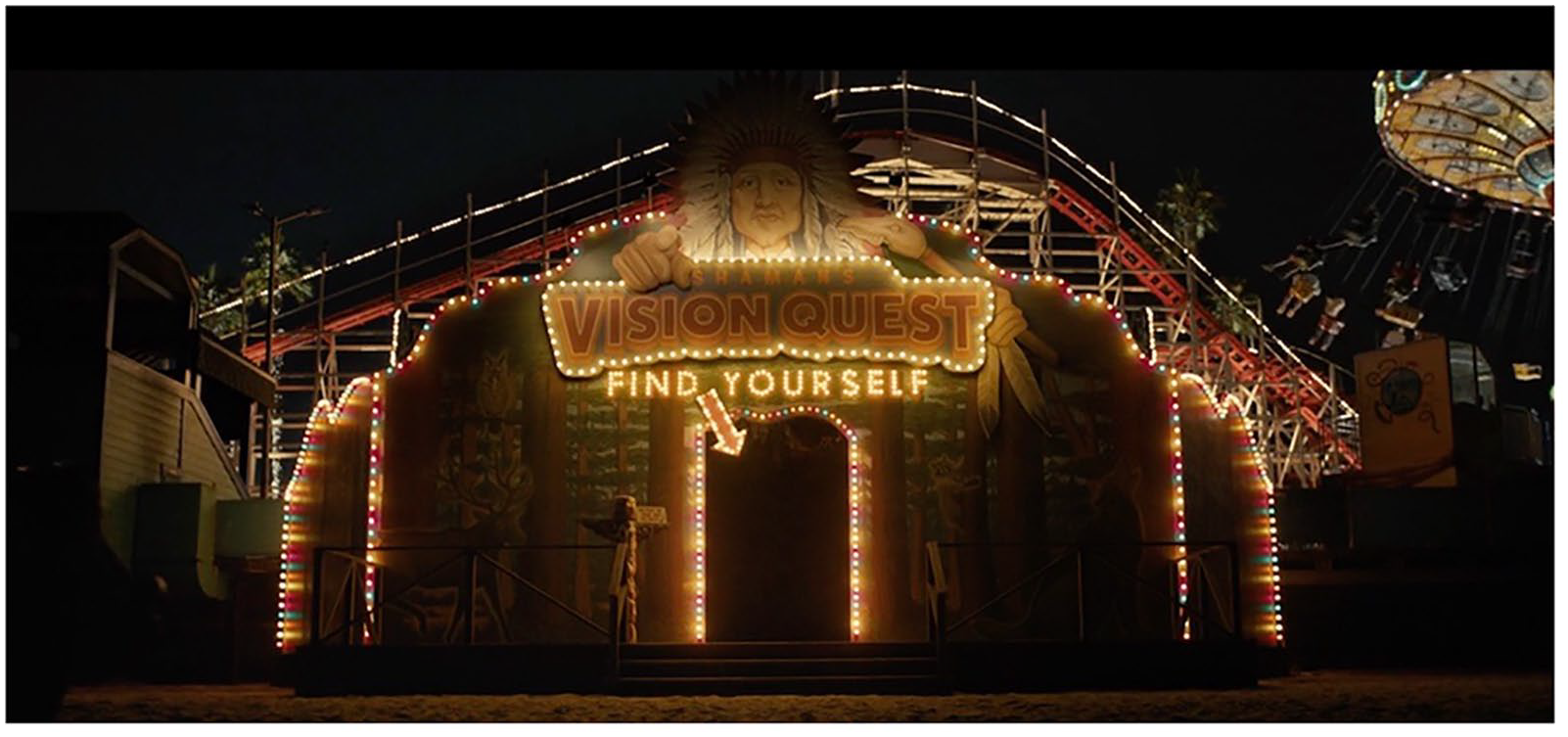
Vision Quest Funhouse.
Suddenly the lights went out. Addy began to panic, but then she saw a red exit sign. She hurried in that direction but found herself in a maze of mirrors with no way out. Now intrigued, she walked around slowly. As she walked, she whistled the nursery rhyme, “The Itsy Bitsy Spider.” She was shocked to hear a distorted version of the song being whistled back at her. We the viewers then see what seems to be another Addy, with her back to us. Addy’s eyes widen as the camera does a quick cut to the close-up of a rabbit. Has Addy quite literally found herself, or, perhaps, another self? The main plot unfolds as a direct consequence of this traumatic event, whose significance is only gradually revealed to the viewer, and to the now-grown Adelaide.
Us is a straight-up horror movie, done with Jordan Peele’s typical panache, and his unique sense of humor and sharp social critique. The film employs the conventions of the horror genre—dark spaces, scary music, haunted houses, surprise twists and turns, psycho-killers—to create an eerie vision of our world and its underbelly. 6 Of special significance is the doppelganger motif, itself a staple of horror movies, as is the use of ordinary objects, such as scissors, baseball bats, and fireplace pokers, as weapons. 7 These conventions create fear in the viewing audience, and thereby also prompt reflection on the frightful aspects of our own society to which we may be oblivious.
Mirroring
The interconnected motifs of twinning, doubling, and mirroring pervade this film on all levels, including characterization, visual imagery and symbolism, and the narrative structure. As in a fun-house, the doubles, both human and inanimate, are distorted images of one another. The mirroring traps viewers in a cinematic funhouse of infinite regression where we can no longer distinguish between the “real” person or object and its mirror image(s).
Characters
The mirroring is most obvious with respect to the characters. It is evening, a few hours after the Wilsons have arrived at their vacation house in Santa Cruz. The house had belonged to Adelaide’s parents, and it is where they were staying when the young Addy had wandered away from her father that fateful night in 1986. The adult Adelaide feels uneasy and wants to go home. She tells Gabe about meeting her double in the funhouse: “She tried to kill me. She tried to choke me. I got away; I ran as fast as I could. My whole life I’ve felt like she’s still coming for me.” 8
Immediately, the lights go out, and Jason, their son, says: “There’s a family in our driveway.” 9 Four people are standing in a straight line in the driveway, staring at their home. [Figure 2]. Like the Wilsons, this family has two parents, a teenage girl, and a younger boy. They gradually advance and, despite Gabe’s efforts, they make their way into the house.
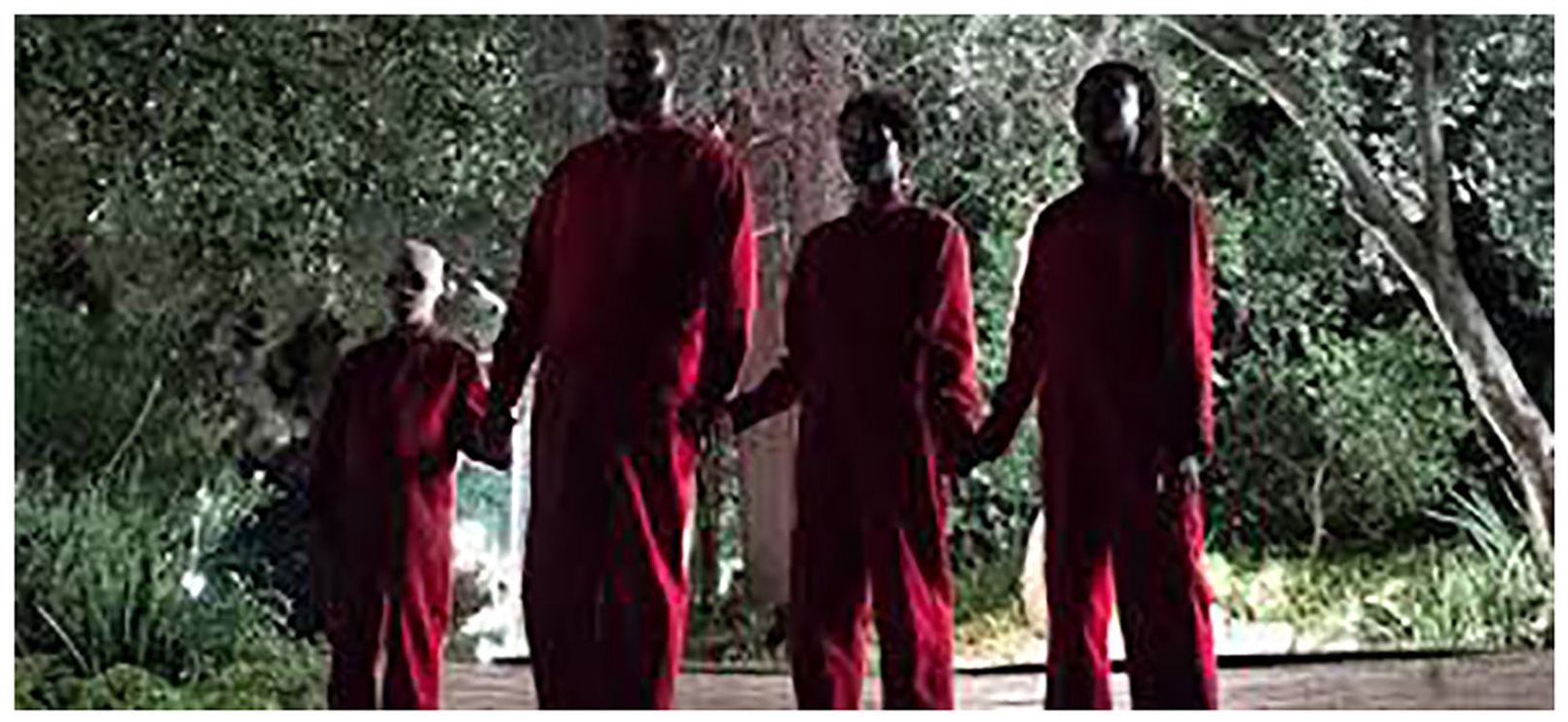
The Doppelgangers.
The Wilsons are shocked to see that this red-clad family mirrors their own. 10 Yet despite their uncanny resemblance to the Wilsons, these strangers differ in several ways: they are uniformly dressed in red; each has some exceptional, even superhuman, powers; and each is armed with large gold scissors.
Visual and Aural Images
The mirroring involves not only people but also animals, objects, and songs. The rabbits that inhabit the tunnels and serve as food for the Tethered are mirrored in the small stuffed rabbit that Adelaide cherished as a girl. The adult Adelaide comes across it again at the vacation home and looks at it fondly. Later, Red, Adelaide’s double, decapitates the toy rabbit with her giant scissors; in the final scene, Jason is cradling a live rabbit in his lap as his mother drives the family out of town in a hijacked ambulance, leading us to wonder what he knows and who he is.
The ambulance itself is mirrored in the toy ambulance with which Jason plays in his room in the vacation house, and which figures in one of his attempts to flee from his dangerous Tethered counterpart, Pluto. Actual ambulances appear briefly at several points, including the final scene in which the family drives away in an ambulance from the carnage wrought by the Tethered.
The scissors carried by the Tethered are, in essence, twinned knives, shiny like mirrors, that also recall the mirrors in the funhouse that establish the mirroring theme in the first place. These scissors are foreshadowed by a very brief scene early in the film in which two teenagers are flirtatiously playing “Rock, Paper, Scissors.” Strangely, they land on scissors each and every time. “What the hell?” exclaims Glen, presciently.
The “Itsy Bitsy Spider” song, associated with the young Adelaide, is repeated ominously, in distorted fashion by Addy’s young double in the funhouse. The adult Red repeats it later, as the film reaches its climax. This and the other doubled examples not only create narrative coherence but also represent the mirroring motif around which the entire film is built.
Most important for the film’s structure is the imagery associated with a historical event, the 1986 fundraising campaign entitled “Hands Across America.” In an early scene, the old-fashioned television in the vacation home owned by Addy’s parents is playing an advertisement for this event. A breathlessly excited woman explains that “this summer, six million people will tether themselves together to fight hunger in the United States…” forming a “four-thousand mile long chain of good Samaritans standing hand in hand…from sea to shining sea.” 11
How exactly this campaign was to alleviate hunger is unclear. But the principal image—a paper cut-out of stick figures holding hands— [Figure 3] is a major motif in the film. At the beach, the young Addy is wearing a Hands Across America T-shirt, which she later covers with the oversize Thriller T-shirt that her father had won for her. The rear windshield of the adult Wilsons’ car has a decal representing the family as stick figures. Towards the end of the film, Red uses her scissors to create a paper chain of people holding hands that resembles the advertising for Hands Across America. [Figure 4] And, most horrifyingly, once the Tethered have succeeded in killing most of the town, they form a red-suited chain that mimics the ad precisely except for the change in color. [Figure 5] The screenplay describes the scene: “In the near distance, a line of people hold hands, facing away from her [Adelaide]. The line extends from the water’s edge to past the amusement park and into the distance.” 12
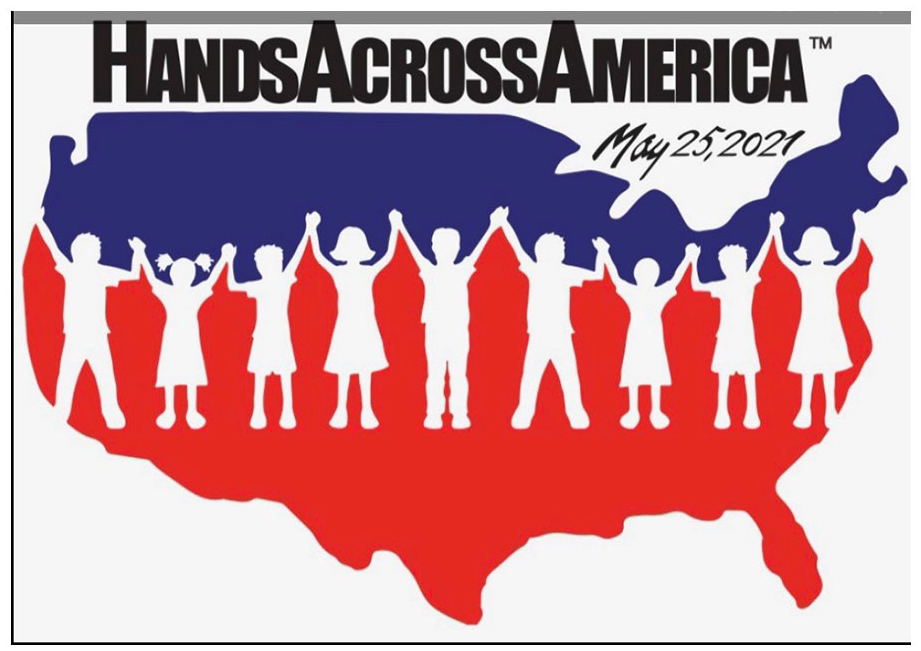
Hands Across America poster, 1986.
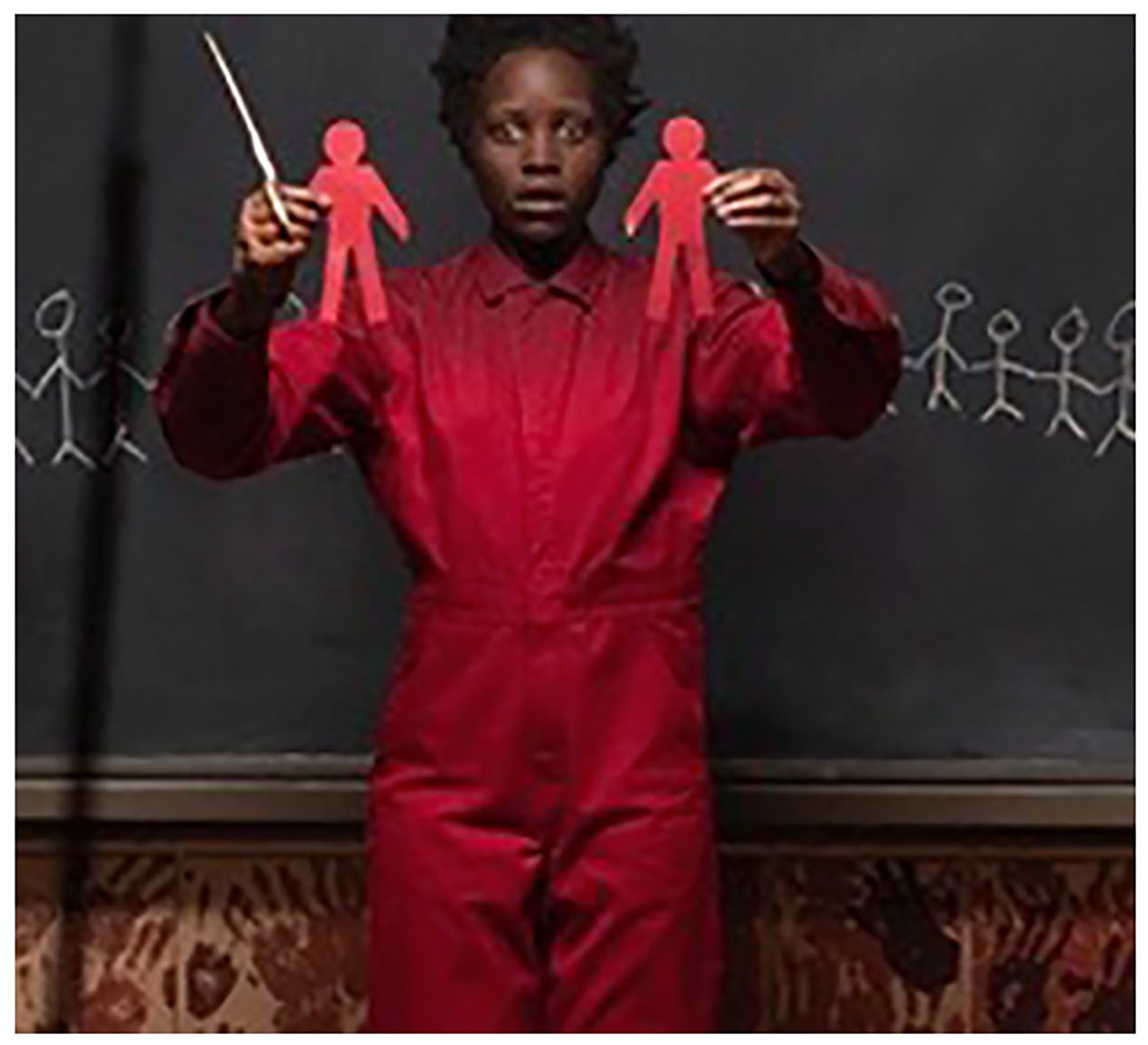
Red’s red paper chain.
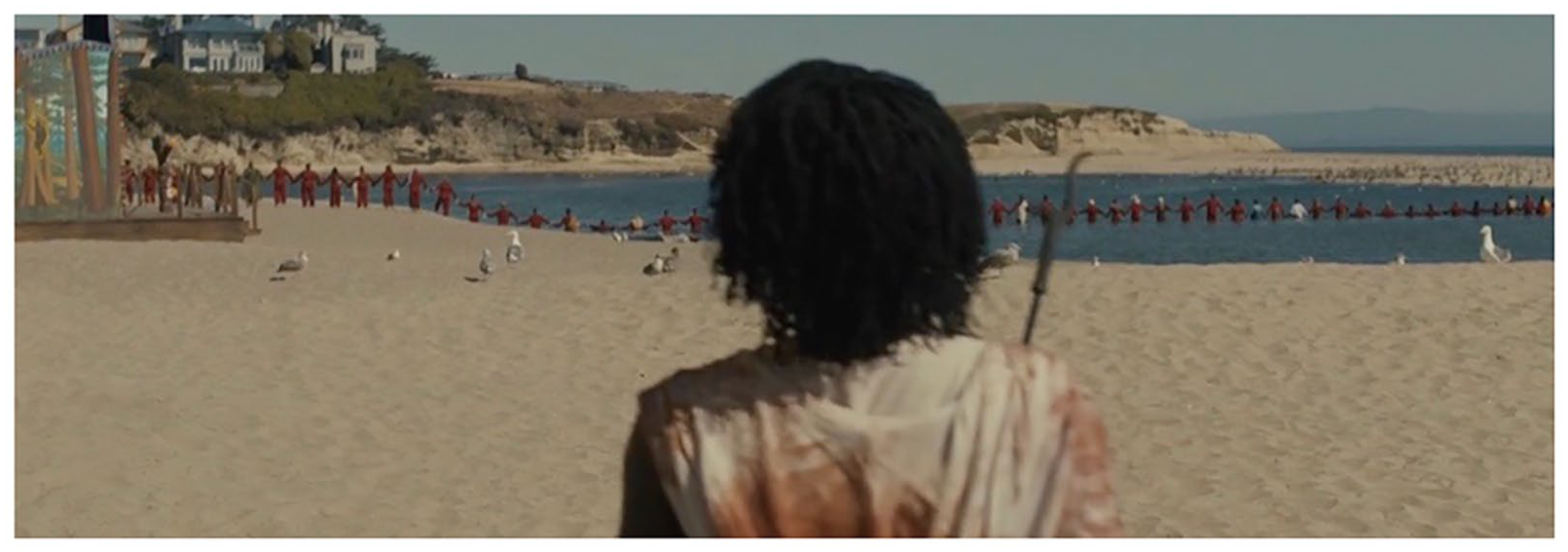
The Tethered’s Hands Across America.
Distortions
As already noted, the film’s mirroring does not involve a straightforward, one-to-one correspondence between the “real” object and its image. Rather, the images are distorted and deceptive, much as they were in the funhouse in which Addy first encountered her double. The real and toy ambulances, and the real and toy rabbits resemble one another, but are not identical in size or function. The game of Rock, Paper, Scissors and its strange outcomes are brought to life with the Tethered, who threaten the Wilsons with scissors and cannot be destroyed by rocks or distracted by offers of paper (money). The funhouse, which appears in both the past and present time frames, seems the same but its name has changed from Vison Quest to Merlin’s Forest. [Figure 6] The former evokes indigenous traditions, whereas the latter invokes King Arthur and the Knights of the Round Table, perhaps mirroring a process whereby the British usurped and colonized Indigenous lands and people. 13
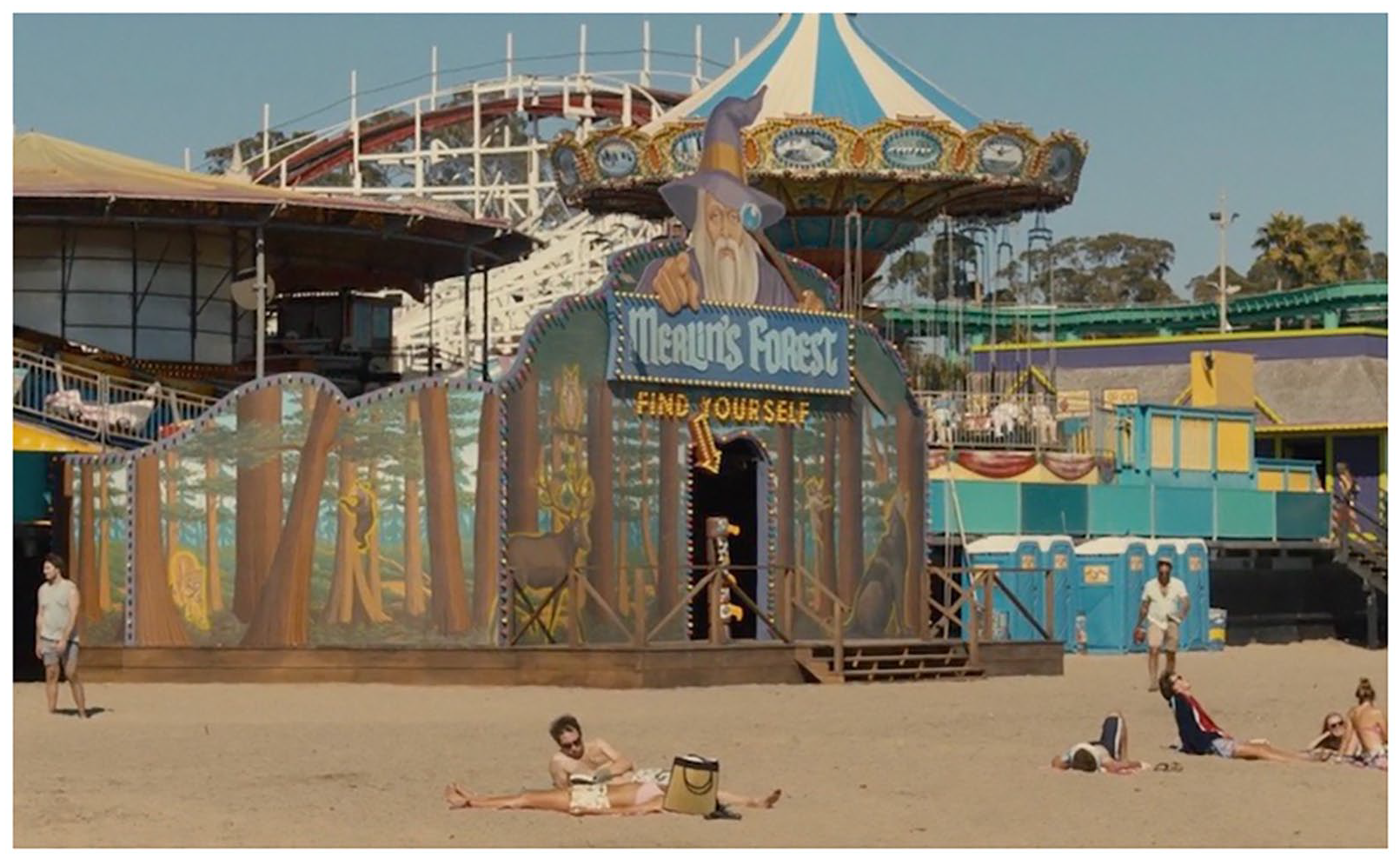
Merlin’s Forest.
The Wilsons’ doubles are a distorted version of the Wilsons themselves. Among the Wilsons, according to Peele, Adelaide is the leader, Gabe is the fool or clown, Zora is the warrior, and Jason is the wizard. 14 Their Tethered twins play these same roles, but in distorted, exaggerated, ways. Red is the leader of her family, and not only of her family but of the entire congregation of the Tethered, numbering in the millions. She alone of all the Tethered is capable of human speech, though her voice is raspy—a distortion of Adelaide’s own melodic voice. Gabe’s double is Abraham, who, unlike Gabe, resembles a clown in his appearance but is deadly in his behavior. Zora’s double is the sadistic Umbrae. Zora runs track and field, but Umbrae can run circles around her. Jason’s double is Pluto, a facially scarred pyromaniac. Whereas Jason plays constantly, one might say obsessively, with a small lighter that is out of butane, Pluto can create conflagrations seemingly without effort.
A less obvious mirroring is that between the Wilsons and their friends the Tylers, with whom they get together at the beach. This relationship too is distorted. Here the mirroring is not quite complete. This is not only because the Tylers have twin daughters—doubled girls, so to speak— whereas the Wilsons have an older daughter and younger son, but also because the Tylers are white, whereas the Wilsons are African American.
(Con)Fusing Identities
Part of the fun of funhouse mirrors is the momentary confusion between the real and its reflection. Addy, and we viewers along with her, experienced this confusion when she initially saw herself, and then a real girl, in the Vision Quest. In its deployment of the mirroring motif, Us plays with this confusion in its portrayal of relationships.
Although they the Wilsons and the Tylers are friends, the relationship is not without its tensions. Gabe senses that Adelaide doesn’t like the Tylers very much, and she does not deny it. “They drink too much,” she says, and Zora and the twins don’t get along. Gabe, for his part, has a “bro” relationship with Josh but is also envious of him and striving to keep up with Josh’s acquisitions. After Josh bought a boat, Gabe bought one too, though, as Jason teasingly points out, Josh’s was probably better. After their day at the beach with the Tylers, Gabe was upset. He said to Adelaide: “You saw their new car, right? He had to do it. He just had to get that thing to fuck with me too.” 15 When the lights went out, Gabe wished they had a generator like the Tylers do. A later scene set inside the Tylers’s house shows that it is far grander than the Wilsons’s vacation home.
This initially seems like simple one-upmanship, illustrating Josh Tyler’s white privilege and Gabe’s envy. Later, however, the dynamic shifts. When the Wilsons run to the Tylers’s home to escape their doubles, they see that the Tylers too have been attacked by their Tethered doubles. Whereas the Wilsons survive, the Tylers succumb, though not without some resistance. In the ensuing chaos, the Wilsons take the Tylers’s boat, then they hole up in the Tylers’s home, and, finally, take their car. If the doubles intend to kill their above-ground humans and take over what they see as rightfully theirs, the Wilsons, in keeping with the film’s distorted mirror-ings, kill the Tylers’s doubles and take over the Tylers’s possessions, at least temporarily. The Wilsons and the Tylers are therefore not only distorted doubles of each other, but in the chaos of the Untethering, the Wilsons meld into, or perhaps take over, the Tylers’s lives, or, at least, their material lifestyle.
The central example of fusion and confusion, however, is that of Adelaide and Red. From the outset, there is a strange, if deadly, affinity between the two women that goes beyond their physical resemblance and their ability to express maternal love. As we learn from Red, that long ago encounter in the funhouse did not simply involve a brief meeting. What really happened was that Addy and her double changed places.
In a flashback, we learn what happened. After encountering her above-ground double in the Vision Quest, the young Red chokes Adelaide unconscious (damaging her larynx, resulting in her hoarse voice), drags her underground, and traps her there with the Tethered. When Addy awakens, she clutches at her throat and then realizes that she was handcuffed—tethered—to a bunkbed. She then watches in horror as Red puts on her Thriller T-shirt. As Red walks away, she looks back mockingly at Adelaide.
The camera then cuts to Red, now impersonating Adelaide, in the back of the car, listening to “her” mother admonishing “her” father for letting Adelaide wander off. It is pouring rain, as predicted by the weather reporter in the first scene. The young Red smiles smugly to herself. The camera cuts quickly back to the present day, as Adelaide realizes the truth: she is the original Red. She is the one who chained Addy— now known as Red—to the bed and left her there. And now Addy— called Red—is taking her revenge on Red for leaving her behind. In the final scene, Red/Adelaide drives her family away in an ambulance. She looks and smiles at her son Jason, sitting beside her. Jason looks back and smiles enigmatically. Does he realize who his mother is?
Many other questions remain. Did Red, now living as Addy, remember what had happened? Brief flashbacks suggest some awareness. When the young Addy’s mother chews out her father for leaving her unattended, and, later, when her parents worry about their daughter’s sudden personality change—she no longer speaks very much, nor does she engage with her parents—we catch the girl with a sly and knowing smile on her face. The adult Adelaide, however, speaks and behaves “normally;” and she has a close and loving relationship with her husband and children. She is anxious, however. As she confides in Gabe, she lives in fear that the girl she met in the funhouse will pursue her in order to kill her. As indeed she does.
The Bible in Us
Jeremiah 11:11
Like doppelgangers and haunted houses, the Bible, biblical motifs, and biblical citations, appear frequently in horror movies. 16 Us is no exception. Jordan Peele himself associates Gabe’s Tethered counterpart, Abraham, and Abraham’s daughter Umbrae, the shadow girl who was born laughing, with the biblical Abraham and his son Isaac who brought laughter to Sarah (Gen 21:6). 17
Viewers may or may not pick up on these particular allusions. But one biblical verse that they will surely connect to this film is Jer 11:11. In the early part of the film, as the young Addy wanders away from her father at the amusement park, she sees a scruffy man standing around. He is holding a battered cardboard sign that simply says “Jeremiah 11:11.” [Figure 7] Later in the film, when the Wilson family is at the beach, Jason walks off looking for the bathroom, just as Addy’s mother had done that fateful evening in 1986. He sees this same man, now bloodied, [Figure 8] being loaded into an ambulance, clutching the same cardboard sign. The man and the sign are points of continuity and connection between the past and present time frames between which the film toggles.
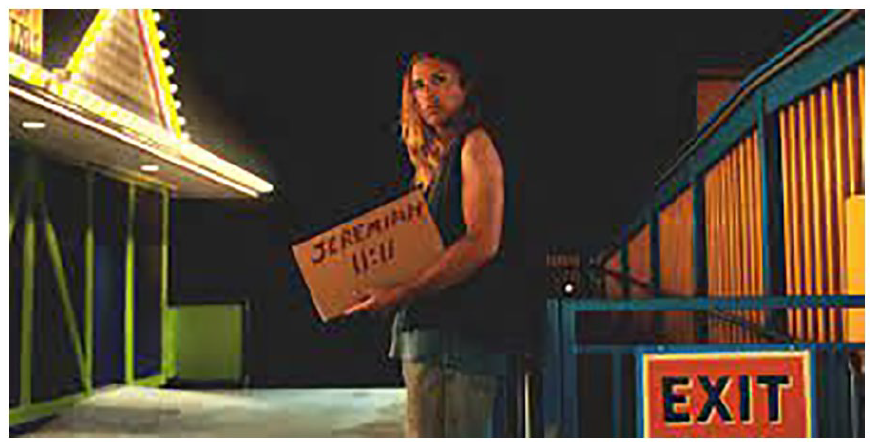
Jeremiah sign in 1986.
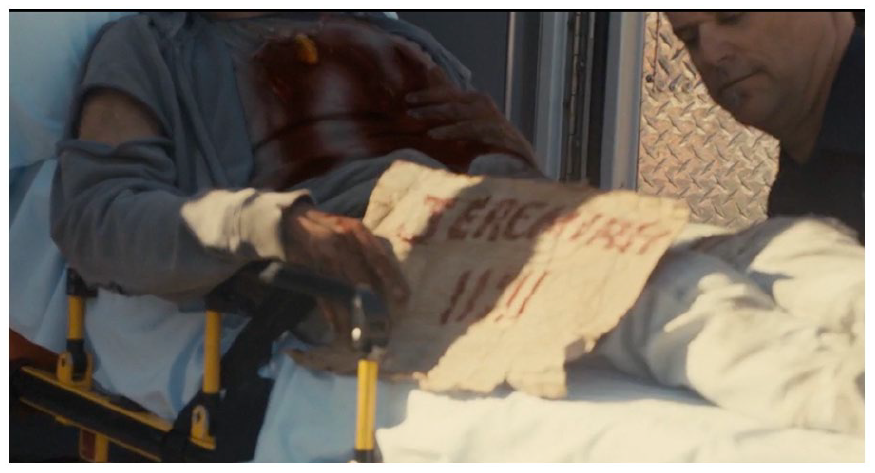
Jeremiah sign in the present.
The Jeremiah citation does not appear elsewhere in the film. The verse itself is not mentioned in the dialogue, nor is its content quoted or mentioned in the film. Nevertheless, numerous visual and aural allusions to the verse prevent us from overlooking it. When the young Addy visits the amusement park with her parents in 1986, her father wins a T-shirt for her. The T-shirts are arrayed in numbered boxes. When her father asks Addy which one she would like, she immediately says: “Number 11.” Number 11 is an oversized Thriller T-shirt, referring to the Michael Jackson song. The two lowercase “Ls” in “Thriller” also look like the number 11. 18 During another scene, the ambient sound includes a radio play-by-play of a baseball game announcing an 11:11 tie in the seventh inning. In Jason’s room at bedtime, a brief shot focuses on the time on a clock radio, [Figure 9] which reads 11:11. 11:11— four straight lines—is also evoked by the decal on the back windshield of the Wilsons’s car [Figure 10], the shadows made by the Wilson family [Figure 11] as they walk along the beach on a sunny day, and by the doppelganger family [Figure 12] as they stand outside the Wilsons’s vacation home.
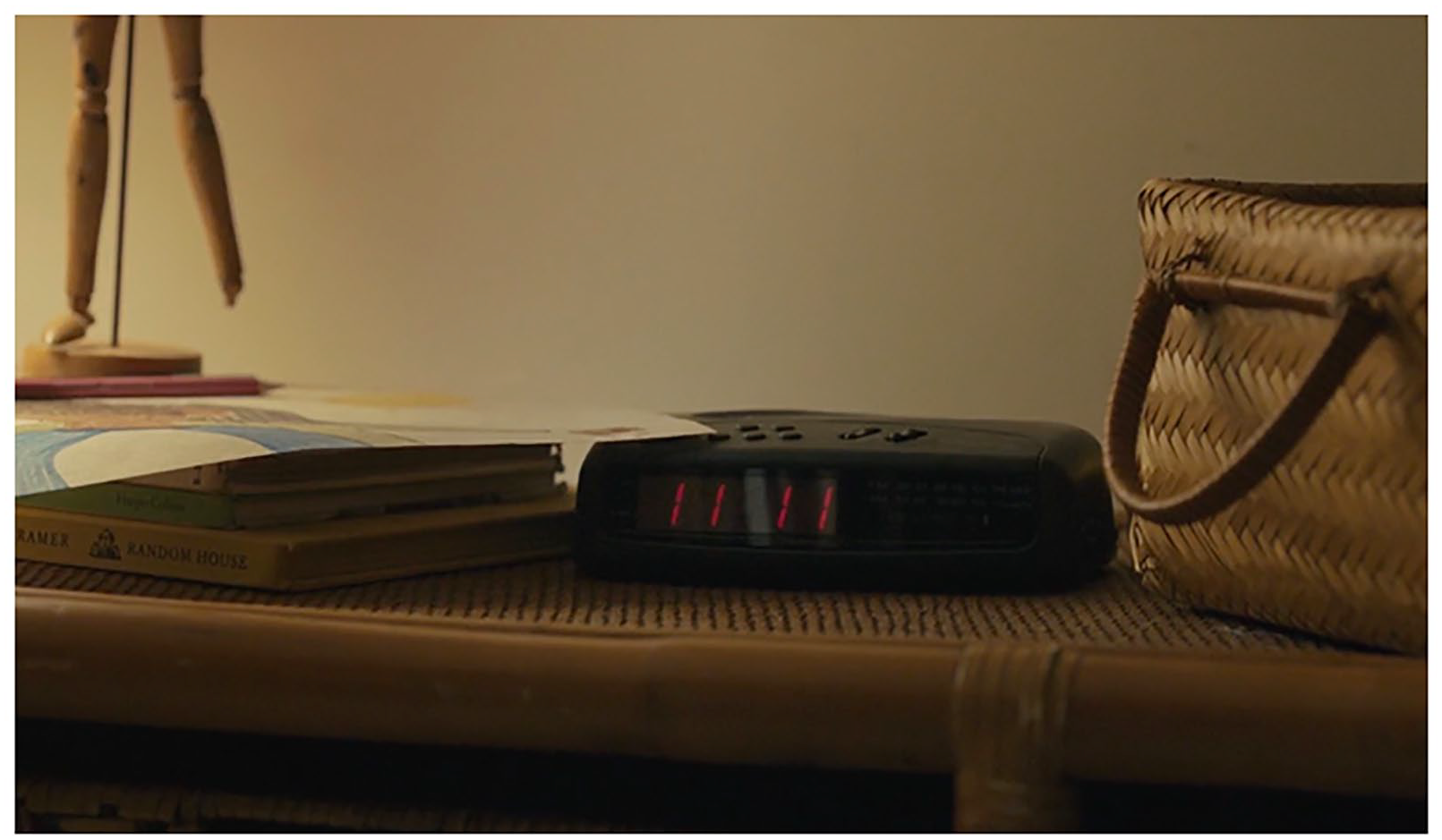
Clock reading 11:11 pm.
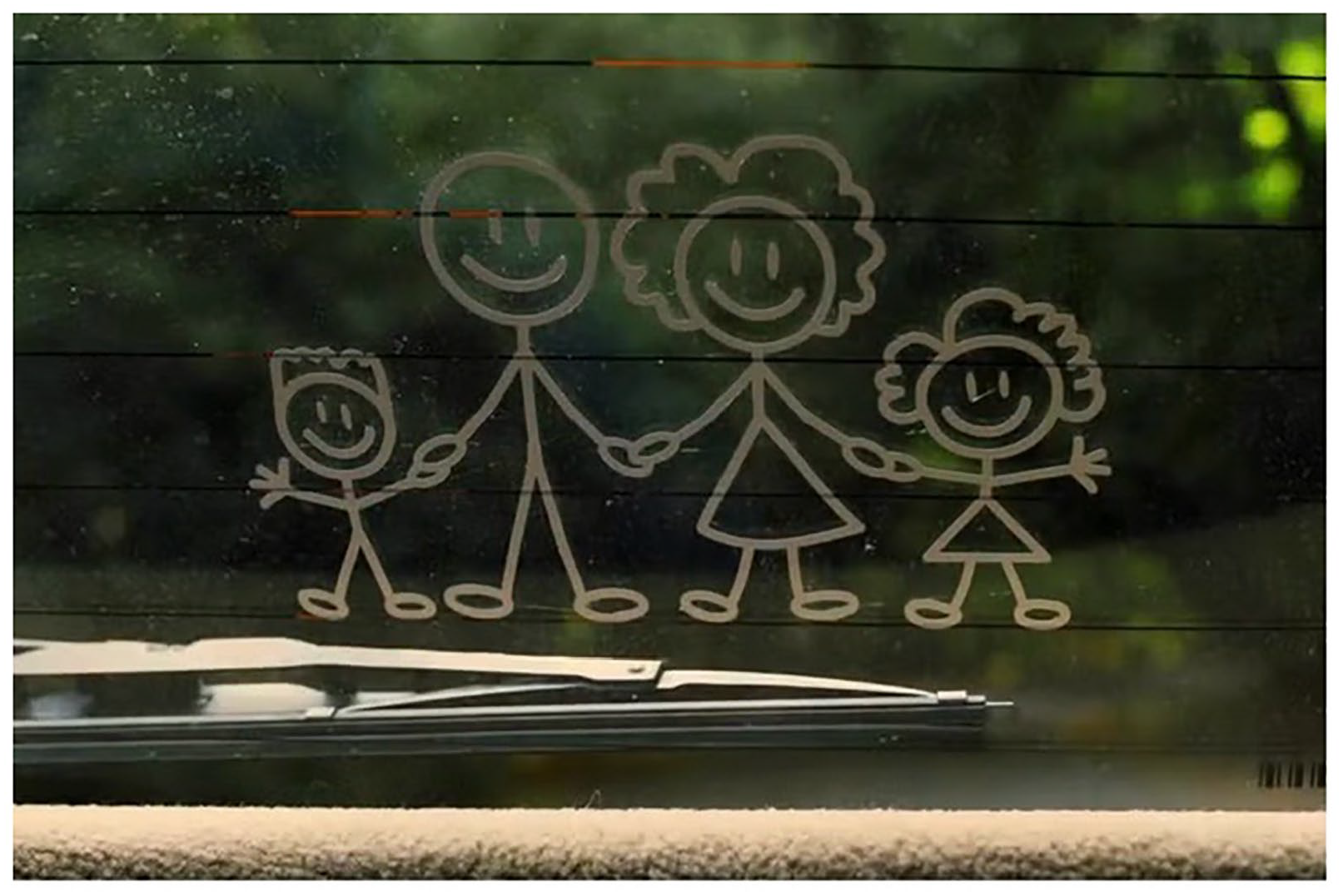
Happy family decal.
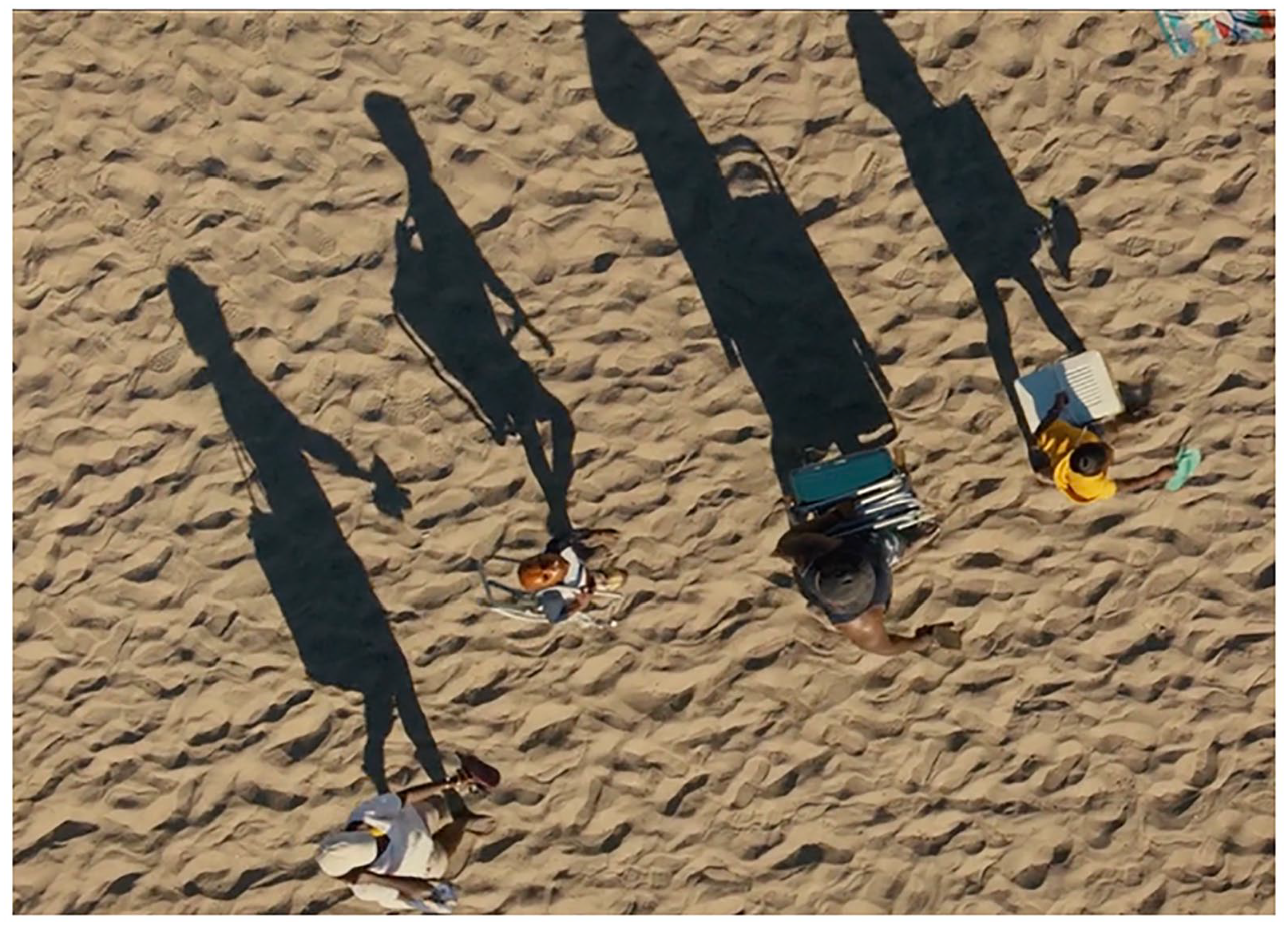
Wilson family shadows.
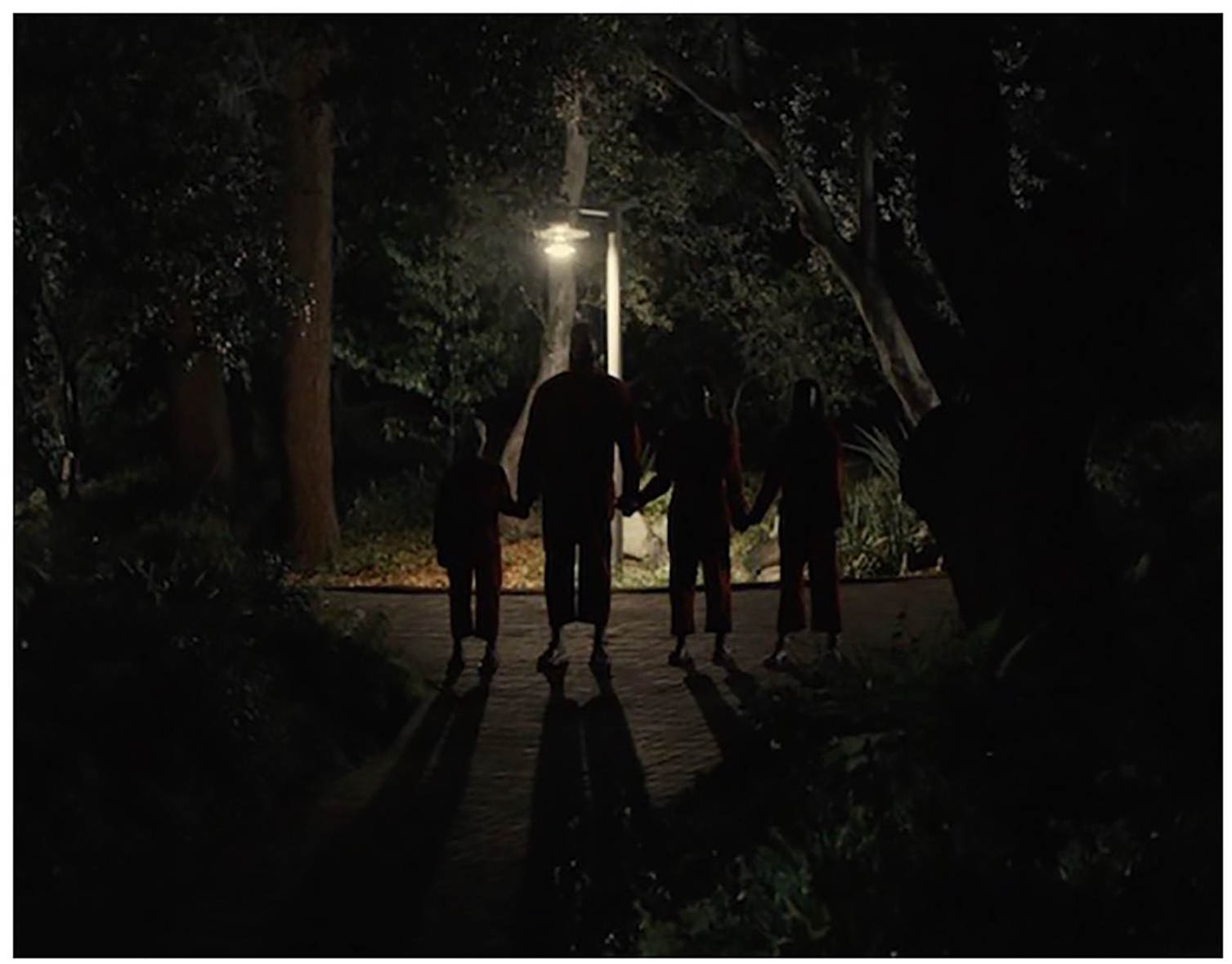
Tethered family shadows.
These visual and aural references imply that the important thing about Jer 11:11 is not what it says but the way its visual form evokes the mirroring that lies at the heart of the film. It all turns on the colon. And yet, given the complexity and playfulness of Peele’s films, it is unlikely that Peele has chosen this verse solely for its visual appearance.
The text of Jer 11:11 reads as follows: “Therefore, thus says the LORD, assuredly I am going to bring disaster upon them that they cannot escape; though they cry out to me, I will not listen to them”. Asked about the relevance of this passage to the film, Peele says that the verse “represents Red’s voice, this war cry of sorts.” 19 Brooks expands on this idea: “In the bible, the quote spoke of the Lord bringing evil upon the people they can’t escape, and their screams for help would go unheard. Similarly, Red did the same with her evil that took the form of the Tethered. It’s a powerful concept that perfectly blended into the idea of class, privilege, and making real change versus the illusion of change.” 20
This reading makes sense. Yet it is important to look at the biblical context in which this verse appears. The verse is part of a long divine invective against the treacherous people of Judah and Jerusalem. These people “refused to heed my words; they have gone after other gods to serve them; the house of Israel and the house of Judah have broken the covenant that I made with their ancestors” (Jer 11:10). For these iniquities, the Lord will punish them: “[T]he young men shall die by the sword; their sons and their daughters shall die by famine; and not even a remnant shall be left of them…” (Jer 11:22-23). This passage, in toto, would appear to describe the movie’s main plot, in which the Tethered bring upon their doubles a disaster that they cannot escape. In this reading, their lethal scissors become the swords that will kill the young men according to Jer 11:10, and the near-complete slaughter fulfils the promise that “not even a remnant shall be left of them” as per Jer 11:23.
But in the movie’s mirrored world, the verse can be read in two directions. From the point of view of the Wilsons, the Tylers, and other town residents, they are surely the victims whose lives are destroyed by the Tethered who have risen from the deeps with giant scissors in hand. But Red’s (or the real Adelaide’s) brief explanation of the Tethereds’s origin suggests that the Tethered also saw themselves as victims, of a failed plot that “they”— the government?— had concocted. This explanation points to a prior disaster: the creation and subsequent abandonment of the doppelgangers.
In their final encounter in the tunnels deep below the earth’s surface, Red explains to Adelaide that “it was humans that built this place. I believe they figured out how to make a copy of the body, but not the soul. The soul remains one, shared by two. They created the Tethered so they could use them to control the ones above. Like puppets….but they failed, and they abandoned the Tethered. For generations the Tethered continued without direction. They all went mad down here. And then… there was us.”
This double disaster, and double victimization—of the above-ground humans and “us” the Tethered—complicates not only the significance of Jer 11:11 but also the name of the movie itself. In Red’s speech, “us” clearly refers to the Tethered. But in keeping with the mirror motif, the Tethered also insist that we—the film’s viewers as well as the above-ground humans in the movie—look in the mirror, that is, into our mirrored selves, to understand our true nature. This is implied by the melding of the adult Red and Adelaide, and by the violence of which all the Wilsons proved themselves capable when threatened by the Tethered and their scissors.
Horror movies do not just aim to strike terror in the hearts of their viewers, but also “to depict the unthinkable, to materialize the immaterial.” 21 This aim gives horror a political and social dimension: what is “being made imaginable are the lived social realities that many in society refuse to see.” 22
This point suggests an additional level of meaning. Perhaps the “Us” in Us refers to the U.S., a government that created the inequities that seem endemic to American society, and beyond, and that created the Tethered in the first place. When Gabe asks Red “what” they are, she replies: “What are we?…We’re Americans.” In this same vein, Richard Brody views the references to Jer 11:11 as allusions to the idea of “a distinctively American vision…of national destiny.” 23
The Tethered can therefore be seen as a shadow society evoking the American past, when Black human beings were enslaved—tethered—to White masters and thereby prevented from exercising agency in their own lives. Peele himself insists that this film, in contrast to his 2017 film Get Out, is not directly about race. 24 For Richard Newby, however, the horrors experienced by the Wilson family resonate with his own experience as a Black man. In his view, race, in particular, and especially the theme of Black survival, is this movie’s subtext, even if unintentionally so. 25
Red as Christ Figure
According to Peele, however, Jer 11:11 and the allusions to the Abraham and Isaac of Genesis are not the only biblical motifs in Us. Peele sees Red as a messianic figure who saves the Tethered by leading them out of the tunnels to subdue and kill the people to whom they were attached. Hints to this effect can be seen in the ubiquitous rabbits, which, for Peele, were meant to evoke “a dark Easter of sorts,” and in the scene of Pluto’s death, in which he stretches out his arms in cruciform position as the fire (hellfire?) consumes him. 26 [Figure 13]
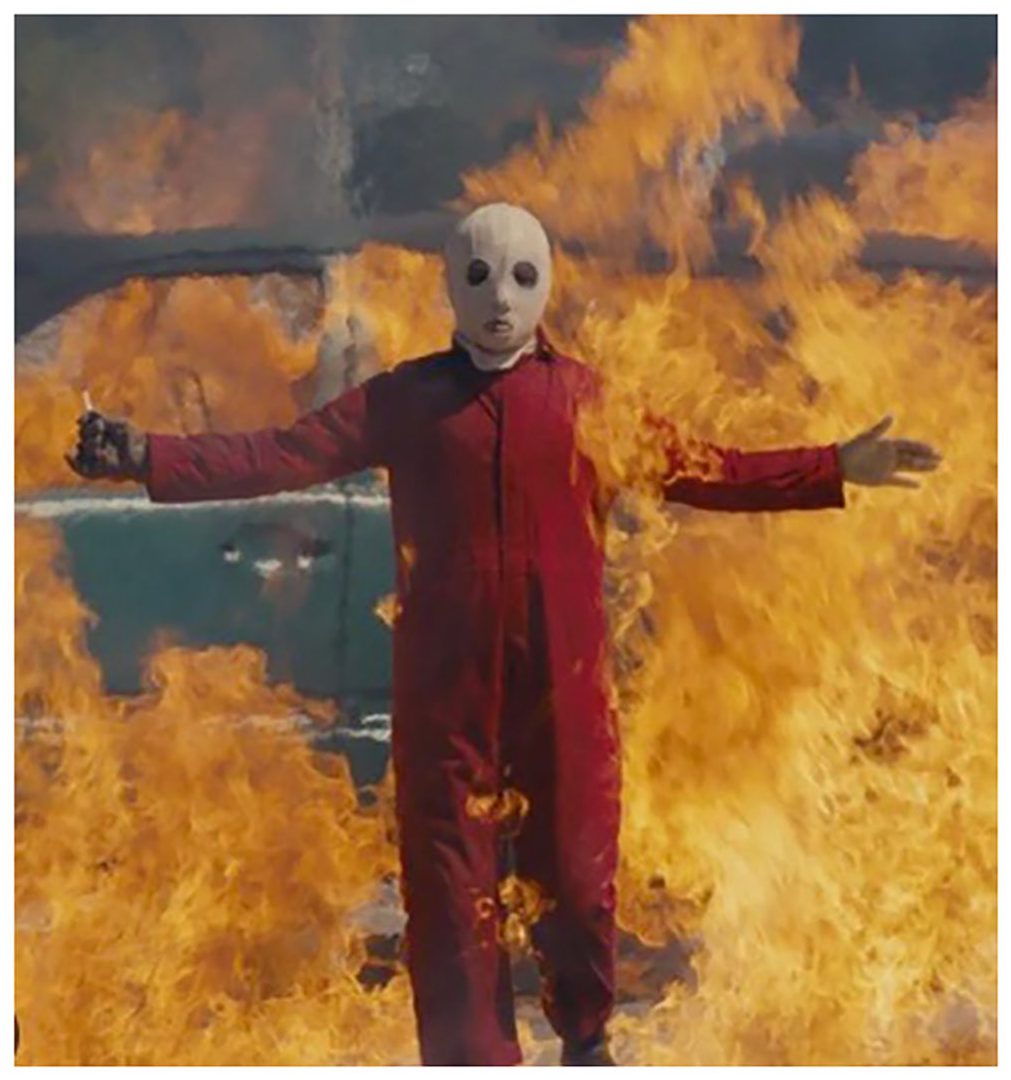
Pluto in flames.
Red sees her salvific mission in salvific, divinely mandated terms. Red hated the girl to whom she was connected with a fierce intensity. But “one day she realized that she wasn’t being punished by the girl at all. She was being tested by God.” 27 She had a vision of a “line of blood on the soil that stretched as far as I could see….During this vision God spoke to me. He said, ‘the only way for a soul to truly be free is to sever the tie.’… I call it “The Untethering.” 28
The plan began to gel when Red and Adelaide were fourteen. Adelaide (above-ground) had been a talented ballet dancer, and Red had no choice but to mimic her actions. In Adelaide’s crowning performance, she danced a pas de deux, but without a partner. In fact, Red was her partner in this dance, though Adelaide was not aware.
Red traced the fateful moment to this dance. “Years after we met, the miracle happened. That’s when I saw God, and he showed me my path. You felt it too. The end of our dance the Tethered saw that I was different, that I would deliver them from this misery….I found my faith and I began to prepare. It took years to plan. Everything had to be perfect. I didn’t just need to kill you. I needed to make a statement that the whole world would see.” 29
At this point Red holds up the red paper chain that she has been cutting. It takes the shape of four people holding hands. She continues: “It’s our time now. Our time up there.” Red cuts away two of the figures until only two are left. Are these Red and Adelaide, tethered together? Adelaide kills Red, now understanding fully what has happened, but also, in effect becoming Red, or reverting to Red, and enacting the punishment that Red had hoped to exact on her. She weeps, and then laughs. 30
This Christ-figure theme may add an additional layer of meaning to the script’s carefully timed use of the expletive “Jesus.” First it is Kitty who exclaims, “Jesus” when an errant fris-bee lands perfectly on one of the polka dots on her towel. This is just one of a series of strange coincidences that both Kitty and Adelaide have noticed. 31 Then, moments before the Tethered appear in their driveway, the Wilsons’s lights go out. Gabe explodes: “Jesus. We lost power.” He then immediately falls into his man-of-the-house mode, adding, “I’m gonna fix it.” Little does he know that, for the moment at least, the above-ground humans have lost their power to the Tethered. 32 The third and final instance is the Tylers’s version of Gabe’s exclamation. Suddenly their lights go out too, and Kitty exclaims: “Jesus. The backup generator went on and we’re trying to figure it out.” Both Gabe and Kitty urge their alarmed children to go back to sleep. Sometimes a “Jesus” is just a cry of frustration or anger. But, if we accept Peele’s own description of Red as a messianic figure, each of these three cases is a prelude to the “end times” for humans and salvation for the Tethered.
Conclusion: Good and Evil
Yet what sort of Christ figure goes about saving her people by killing off all those whom she has resented? With her focus on violence, Red herself is a distorted mirror image of the conventional Christ figure that appears in so many American films. 33
This observation returns us to the issue of moral ambiguity with which we began. At the outset the ethical focus is clear. The Wilsons are normal Americans; the Tethered are their evil twins. Not only do they threaten the Wilsons’s lives, but they are also not tethered by the social restrictions on behavior that rein the Wilsons in. This judgment is reinforced by the screenplay, which refers to the Wilsons’s Tethered doubles as the “Bad Family, as when, in one scene, “the fire backlights the “Bad Family.” The “Bad Son” shuffles to Red’s side and sits like a dog. She strokes his masked head.” 34
The Tethered are powerful, and Red is positively diabolical, though she shows attributes of care and compassion towards her children. It seems almost impossible to defeat this Tethered family, and all the other Tethereds that are busy killing their above-ground human counterparts. And yet, as our multi-layered reading of Jer 11:11 suggests, it is simplistic to label the Tethered evil and the humans good; both share the capacity for good and evil, and exemplify the blurred boundaries between them. The Wilsons kill their doubles with glee and gusto and do the same to the Tylers’s Tethered family. In a sense, the Tethered have untethered the Wilsons from the behavioral constraints of “normal” society. In the end we see that Adelaide (the “real” Red) responds to Red’s (the “real” Adelaide’s) tale of the Tethered, not with understanding and compassion, but with the determination to kill off her double before she herself is killed.
The multiple mirroring in this film complicates our moral evaluation of the characters, and our understanding of Jer 11:11 as a commentary on the film’s plot. The humans view the Tethered as evil insofar as they have emerged from the shadows seemingly unprovoked to terrorize and kill them. The Tethered, however, view the humans as evil, insofar as they enjoy and indeed take for granted the ability to act in the world, free from the constraints of their shadow replicants. The hostility between Red and Addy is born of envy, but the situation leading to the disaster was created by the government and its insidious project.
Given that the Tethered are doomed to imitate, in distorted fashion, the actions of the humans to which they are tied, perhaps their murderous scissor-wielding is also a distorted mirroring of the multiple ways in which humans unthinkingly climb over and kill the souls and spirits, if only sometimes the bodies, of others in order to enjoy their freedom, their cars, their houses, and their iPhones. Like Jeremiah, the film, or perhaps its creator, is engaged in a prophetic exposition intended to draw the audience’s attention to its own iniquity, and the consequences of continuing in their unthinking ways.