



Abstract
This article advocates for interdisciplinary perspectives in the study of remote borderland areas. Highlighting the strong overlaps between International Relations Theory (IRT) and border studies, it argues that transnational dynamics are evident in border regions that are characterized by multiple forms of remoteness. More specifically, it shows that borders are a critical object of transnationalism. Viewing transnationalism as a liberal strand within IRT, it is contended that transnationalists and post-modern border scholars can find common ground to sharpen their understanding of cross-border dynamics in remote locations. Focusing on the border between Tajikistan and Afghanistan as a case study, the article offers insights into how interdisciplinarity can inform transnational relations. This approach can serve as a foundation for further research aimed at stressing interdisciplinary dialogue in international studies.
Keywords
Introduction
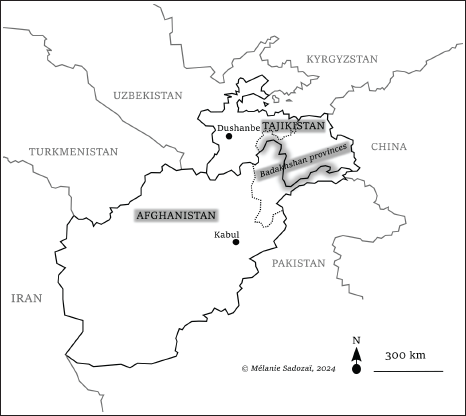
This article argues that border studies and International Relations Theory (IRT) are compatible in the study of borders located in remote areas. Drawing upon the scholarship of both fields and applying it to the remote borderlands between Tajikistan and Afghanistan in the mountainous region of Badakhshan spanning both countries (see Figure 1), 1 and utilizing empirical research, the relevance of the border as an IR object of study is highlighted. More broadly, the aim of this article is to advocate for interdisciplinary perspectives in international studies.
The links between border studies and IRT have been largely treated through a state-centric perspective. While borders receive attention in various social science fields, their unique meaning lies at the core of international relations analysis, and they are, in fact, its ‘founding dynamic’ (dynamique fondatrice) (Postel Vinay, 2011). With a sensitivity to both fields, it is possible to provide a satisfactory account of how borders experience international, and in this case, transnational phenomena. By examining remote borderland regions, insights can be gained into the foundational dynamics of transnational relations. This article adopts both a transnationalist perspective and an interdisciplinary approach to explore cross-border dynamics, specifically focusing on the border between Tajikistan and Afghanistan. Transnationalism in IR emphasizes the role of non-state actors and their interdependent interactions. This theory is particularly relevant for uncovering the intricate dynamics of the Tajikistan–Afghanistan border, such as forms of transnational solidarity. By concentrating on the influence of non-state actors and the significance of their symbiotic inter-relationships, this article demonstrates that borders are critical to IR, extending beyond a state-centric perspective.
This argument is outlined in three parts. The importance of border studies and IRT in promoting interdisciplinary perspectives in the study of remote borderlands is first introduced. Then, definitions of transnationalism in IRT are discussed, the majority of which stress the place of borders in this school of thought and how this vision echoes post-modern approaches in border studies. Finally, these definitions are used to reveal the transnational resource-producing interactions along the border between Tajikistan and Afghanistan supported by an international non-state actor.
The Epistemological Context: Engaging Interdisciplinary Perspectives in the Study of Border Regions
The Pitfalls of a Single Discipline-oriented Approach
In the early 2000s, Newman (2006, p. 183) outlined how border studies could be interdisciplinary, or ‘multidisciplinary’ in his own words, by providing a systematic account of the ways in which a common discourse on borders could be created, calling for ‘crossing the disciplinary divide and to learn each other’s border language’. In the same vein, Brunet-Jailly (2005, p. 642) also lamented that few researchers succeeded in integrating the diverse theoretical debates on borders, as each social science discipline tends to prioritize its own epistemological perspectives.
As late as in 2012, border scholars Wilson and Donnan (2012) pleaded for interdisciplinarity in border studies, 2 arguing that this perspective was indispensable in the analysis of border processes. According to them, border studies could no longer be constrained to a single discipline given ‘the dynamism of life and work at borders and among border peoples, and the changing dimensions of global political economy’ (Wilson & Donnan, 2012, p. 12). Pursuant to this call, border studies today can fully be considered an interdisciplinary field (Kolossov, 2015; Kolossov & Scott, 2013; Wilson, 2023). The objective of contemporary border studies is to ‘weave an analytical fabric to capture and merge elements of a multiform object which constitutes more than a mere limit of international sovereignty’ (Amilhat Szary, 2020, p. 20).
The notion of borders is a crucial theme in global interactions and remains central to international studies. Although borders were considered a marginal topic for decades, they emerged as a key issue in the 1990s (Anderson, 1997, p. 1; Wilson, 2023), coinciding with the interdisciplinary shift in border studies (Bringa & Toje, 2016, p. 5). The idea of borders has since permeated the social sciences, with each discipline offering its unique perspective and definition (Postel Vinay, 2011). However, political science, and IRT in particular, is insufficient to fully capture the complexity of border phenomena. As Gottman (2007, pp. 1–2) wrote, ‘international relations and geography have the same and unique reason for being: the variety of space which serves as a habitat for humanity’, thus emphasizing the need for dialogue within the social sciences. For Morin (2003, p. 7), the concept of the border is inherently a ‘migratory’ (migratrice) notion, carrying significance across disciplines and schools of thought.
The Benefits of an Interdisciplinary Perspective
Indeed, the conceptual frameworks of political science have proven limiting in studying data deriving from empirical research conducted at the border between Tajikistan and Afghanistan in a high-altitude context. Acknowledging the shortage of theoretical tools necessary to interpret first-hand fieldwork data, this study scrutinized the contributions of the social sciences and humanities to seek solutions ‘outside the discipline’ (Labeyrie cited by Morin, 2003, p. 6) and beyond the confines of political science. This interdisciplinary approach has gained traction among border studies scholars. Therefore, this study of the Tajikistan–Afghan border does not limit itself to a single discipline, building upon House’s (1982, p. 7) statement:
There is the maximum outgoing relationship with cognate social science disciplines, often using common concepts, methodologies, or techniques. This is a clear recognition that, given the complexity of Borderlands problems, no discipline alone may provide solutions, but each and every subject has a distinctive contribution to offer.
In this article, conceptual frameworks from IR and border studies are integrated with an ethnographic method typically employed by sociologists, geographers and anthropologists. This interdisciplinary approach mitigates the tension between theory and empirics, enabling a more comprehensive analysis of the subject matter based on the practicalities of fieldwork.
Most importantly, by drawing on political geographer Agnew’s (1994) concept of the ‘territorial trap’, and anthropologist Scott’s (2009) notions of distance and friction of terrain in combination with IRT, the transnational dynamics and remoteness in the shared borderlands of Tajikistan and Afghanistan are examined. Although these concepts are traditionally associated with geographical studies of borders, they prove to be valuable for IR scholars as well.
According to Agnew (1994, p. 53), ‘the geographical division of the world into mutually exclusive territorial states’ has fundamentally shaped the discipline of IR. Agnew (1994, p. 53) argues that the term ‘international relations’ in itself implies a focus on interactions between ‘territorial states’ as opposed to ‘processes going on within state territorial boundaries’. Consequently, in this classical understanding of international relations, states and societies are considered interconnected only within their respective boundaries, and any dynamics occurring outside these formal limits are viewed solely in relation to other states. Agnew further asserts that ‘even when rule is territorial and fixed, territory does not necessarily entail the practices of total mutual exclusion which the dominant understanding of the territorial state attributes to it’ (Agnew, 1994, p. 54). This idea was captured in the notion of a ‘territorial trap’, highlighting the limitations of viewing borders solely as rigid, state-defined lines. Instead, it encourages us to consider the fluid and dynamic nature of borders, and this holds true in regions characterized by remoteness and transnational interactions. For instance, the Tajikistan–Afghanistan border is not just a demarcation line but a space where various non-state actors, such as local communities and transnational networks, interact and influence each other.
Only a few years later, IR transnationalist thinker Rosenau (1997, p. 123) highlighted the irrelevance of fixed and established territorial units in understanding the international system, as multiscalar interactions transgressed them:
Having long been mired in the presumptions of territoriality, we have few guidelines for proceeding to comprehend how the habits of peoples and the impulses of organizations will respond to conditions in which the spatial, temporal, and functional foundations of global life are undergoing turbulent transformations.
Rosenau effectively elucidates the complexities involved in reinterpreting international dynamics as encapsulated in Agnew’s concept of the ‘territorial trap’. Both scholars recognize the permeability of political boundaries and advocate for moving beyond the Westphalian framework traditionally employed in IR. It can be posited that the transnationalist paradigm offers a viable alternative to circumvent the pitfalls of the territorial trap, which is elaborated in the second section.
Another useful perspective is offered by Scott (2023), who, reflecting on his academic and intellectual journey as a trained political scientist, advocates for interdisciplinarity in the field. His work, based in a remote mountainous zone in continental Southeast Asia known as ‘Zomia’,
3
illustrates how the unique topography of high mountain settings creates a multifaceted distance between political centres and the territorial periphery, thereby redefining power management. It is not merely the metric distance but the topography that hinders the state’s ability to extend political control in those regions. Scott introduces the concept of ‘friction of terrain’ to comprehend political space and the challenges of state-making in these remote peripheral upland regions. ‘Friction of terrain’ considers political space and the difficulties of state-building in these terms:
Owing to the friction of terrain, there are locations that are virtually inaccessible even to a nearby (as the crow flies) state […] Location, in this context, is but one of many possible forms by which marginality to state power finds expression. As we shall see, physical mobility, subsistence practices, social organization, and settlement patterns can also be deployed, often in combination, to place distance between a community and state appropriation. (Scott, 2009, pp. 182–183)
Discussing the political control of peripheral regions that benefit from the friction of terrain and altitude, Scott (2009, p. 61) observes, ‘we can begin to appreciate the degree to which much of the population, and most especially the hill peoples, were, though never untouched by the court centres of the region, hardly under their thumb’. This distance described by Scott between the political centre and mountain dwellers had been explored closely in the case of Muslim Ismaili communities of the Bamiyan region in Afghanistan by Canfield (1973, p. 11), who stated that ‘the effect of distance is not to be understood as linear distance but effective distance’. As will be discussed, these observations are applicable to Badakhshan’s borderlands where the friction of terrain has historically fostered a sense of defiance towards central authorities, thus strengthening loyalty to alternative forms of authority, including transnational ones.
Scott’s conceptualization of Zomia is used here in a limited way, focusing on his definition of distance as experienced by upland areas and the friction of extending state power. While Zomia is an ecological zone characterized by remoteness and ruggedness of terrain, it is also defined by the agency of its inhabitants, who actively attempt to avoid the state. Scott adopts a localized logic that does not necessarily account for the involvement of transnational actors, like it is the case in Badakhshan, which could not operate without the approval of the two nation-states of Tajikistan and Afghanistan. His perspective on distance introduces nuances to state-centrism, highlighting the necessity of considering borders not merely through territorial delineations. To this extent, his understanding of Zomia can also be extended to Badakhshan, when, reflecting upon his decade-long work, he writes that national borders do not suffice to capture cross-border relations:
I quite understand that the boundaries of nation states demarcate political units of great power, and are there for major actors in international politics; but to privilege these often quite artificial lines drawn between contesting colonial powers is not helpful in understanding the subsistence and needs of people who may live across international boundaries, but who share an environmental setting in common with their neighbors. (Scott, 2023, p. 3–5)
The Interaction Between Transnationalism and Borders
Borders (Studies) and IR
In IRT, borders are fundamentally recognized as international constructs as they delineate the separation between two territorial entities, define the extent of sovereign authority and ensure territorial integrity. However, this discipline predominantly examined borders within the context of nation-state interactions, thereby perpetuating a conventional attitude.
Traditionally, this scholarship treats borders as inherent components of the nation-state, generally overlooking the potential of transnationalist perspectives in the conceptualization and study of borders. For instance, Ullah and Kumpoh (2018), in questioning whether borders reflect international relations, adopt a macro-level perspective, arguing that borders, as points of contact between neighbouring countries, determine the nature of their relationships. This interpretation neglects a multiscalar approach to the interactions among various actors within the international system. Consequently, borders are perceived merely as instruments of states. According to Starr and Most (1976), the border is significant to ‘the nation’. They contend that interactions between ‘nations’ are influenced by their geographical proximity. These interactions are predominantly exemplified by classical realist themes such as war, alliances and diffusion. While this perspective was well-suited to the 1970s understanding of border studies, which had a limited grasp of transnational phenomena, Starr (2002) later reiterated a similar viewpoint even after the field experienced substantial changes due to major geopolitical upheavals. Advocating for a reconsideration of borders in international relations, Starr underscores IR as the study of relations between nation-states within the context of potential conflict or peace. Here again, interactions’ are understood not just in relation to ‘nations’ but also ‘states’ or ‘decision makers, referring to those who ‘choose certain policy options’ (Starr, 2002, p. 245).
Critical authors have imagined borders differently in IR, even though they recognize the power of a dialogue between transnationalism and border studies. Focusing more on the political geography aspects of border framing, Sankaran (2003, p. 404) points to the ‘hegemonic story told about borders’ marked by an obsession to see them as places that create otherness and are ‘encoded as a discourse of danger’. This compelling critique of the prevalent geopolitical perception of borders as sites of violence would have been enriched by a discussion on alternative perspectives that transcend state-centric viewpoints. For instance, Vaughan-Wiliams (2016, p. 11) challenges the conventional acceptance of borders within the discipline, which the author describes as being limited to ‘a static, ahistorical, territorial given’. In this view, the border is no longer a still line but ‘it effectively becomes a verb’ (Vaughan-Wiliams, 2016, p. 23) and the role of practices and individuals along borders matters. Yet, what is lacking is an exploration of how incorporating these movements and peoples into the analysis of border phenomena effectively bridges the fields of IR and border studies. While not overlooking the transnational paradigm, Moraczewska (2010, pp. 329–330) adopts a realist view and considers ‘the state and its borders’ as ‘an important actor’ in international relations’. All of these writings only superficially address the role of transnationalism in the study of borders and fail to argue convincingly that transnationalism offers an alternative perspective to traditional border studies.
The View from IR
For transnationalists, all actors in the international system, whether state-affiliated or not, are interconnected through relationships of interdependence that transcend borders (Rosenau, 1990, pp. 114–140). Although no scholar of IR has explicitly stated so, IR literature implies that borders are essential to defining an entity as ‘transnational’. Even Aron, despite being a committed realist, introduced the concept of transnationalism to IR in the 1960s. He characterized a transnational society not only as a historical process, but also as the manifestation of various elements ‘which go beyond borders’ (Aron, 2004, pp. 113–114).
Later, Nye and Keohane (1971, p. 331) offered the following definition of transnationalism: ‘Contacts, coalitions and interactions across state boundaries that are not controlled by the central foreign policy organs of governments’. Risse-Kappen (1995, p. 3), advocating for more analyses of international relations through a transnationalist perspective, suggested considering transnational relations as being ‘regular interactions across national boundaries when at least one actor is a non-state agent or does not operate on behalf of a national government or an intergovernmental organization’. Allès (2016, p. 4) described transnationalism as being ‘a social phenomenon characterized by the increased relevance of cross-border interactions’. Notably, a study analyzing the 50 most recent articles and books on transnationalism as of 2020 provides a comprehensive definition of the concept: ‘Connectedness across borders, the formality/informality of frequent cross-border activities and practices, and the high intensity and degree of cross-border exchanges are the main characteristics of a transnationalism “from below,” concerning individuals and civil society’ (Tedeschi et al., 2022, p. 604).
Rosenau (1997) provides the most satisfactory account yet of how borders capture the complexity of multiscalar processes of transnational relations under the concept of ‘fragmegration’. Fragmegration describes the dual movement of fragmentation and integration, between the forces pushing for globalization and those for localizing dynamics. Essentially, borders are loci of these simultaneous processes. Rosenau uses the term ‘frontier’ to describe the increasingly blurred and dynamic boundary between domestic and international politics. The ‘frontier’ is not a static boundary but rather a dynamic and permeable zone where domestic and international affairs converge and mutually influence one another. This ‘frontier’ symbolizes the intricate and interconnected domain in which governance, policy-making and societal issues transcend national borders, becoming integral components of a broader global framework. While the ‘frontier’ in this context is not primarily territorial, Rosenau clearly emphasizes its permeability and the extent to which it is traversed, functioning more as a space where political webs and networks interweave. Considering these definitions, it is evident that the IR transnationalist approach elucidates the dynamics that mobilize a diversity of actors across borders and that transnationalists see the border in relation to a wide array of actors rather than the state in priority.
This lexical overview of transnationalism reveals that borders are an integral component of the concept, and the linkage between the two remains critical. Even though these definitions highlight the essential connection between transnationalism and borders, they primarily reflect an IR attitude. The study and understanding of transnationalism are fragmented across various fields, particularly in migration studies (Partes et al., 2014; Vertovec, 2011), which provides its own definition of what constitutes transnationalism. Nevertheless, the dynamics described by IR transnationalists resonate with the debate in border studies, which considers borders ‘as active forces and processes impacting a wide array of domestic and international concerns’ (Diener & Hagen, 2009, p. 1199).
The View from Border Studies
Classical approaches to borders in political science, which dominated between the 1930s and the 1970s, were predominantly characterized by a realist paradigm. These approaches conceptualized borders as fixed demarcations between territorial states, with territory serving as the fundamental element delineating a society and a nation. These perspectives neglected the significance of connections and circulations at, along and beyond national boundaries. The Westphalian framework, which underpinned this view, regarded borders as political institutions designed to function as defensive instruments against external threats (Anderson, 1996). Within this framework, borders were essentially perceived as lines of contact between states (Prescott, 1987). This classical approach is primarily applicable to the study of borders at the state level. Consequently, when examining transnational phenomena encompassing a diverse array of actors, it becomes imperative to integrate classical approaches with contemporary perspectives on borders. These contemporary perspectives, often referred to as the ‘post-modern’ trend in border studies, constitute ‘a manifestation of the increasingly interdisciplinary character of contemporary social science’ (Kolossov, 2005, p. 613).
Since the emergence of post-modern paradigms in the 1990s, border studies authors have argued that borders are no longer perceived as mere lines of demarcation but as places of communication and mobility (Günay & Witjes, 2017), thereby encapsulating transnational phenomena. This perspective has deconstructed the reification of the state, a core tenet of realist paradigms in IR. It advocates for a viewpoint that shifts from the centre to the periphery, emphasizing the periphery itself (Agnew, 1994; Feyissa & Hoehne, 2010; Scott, 2009; Van Schendel, 2013). The post-modern ‘policy, perception and practice’ (PPP) approach corresponds substantially to a synthesis of theoretical developments from the 2000s and traditional approaches that have not lost their relevance. As Kolossov (2015, p. 52) explains, ‘the approach is a combined analysis at different spatial levels’, building upon three compatible aspects:
Practice of cross-border activities: the focus is on all types of actors and activities that rely on the border regime, whether open or closed. Border policy, considered at different levels: the state, international institutions or legal structures, govern cross-border flows and negotiate the function of borders, either acting as barriers or as contact zones. Perception of the border: this notion relates to the way borders and borderlands are viewed, as well as the relations between neighbouring states and regions, and cross-border cooperation (Kolossov, 2005, pp. 625–627).
In this view, borders are not confined to being political boundaries asserting the sovereignty of a state entity. Instead, borders are considered at multiple levels, encompassing networks and cross-border actors. Borders witness exchanges and interactions between two sides. According to the PPP approach, the state cannot be the primary and most significant actor in border dynamics, and interactions are of paramount importance. This resonates with the view of IR transnationalism.
The close ties between transnationalism and post-modern border studies approaches raise the question of ‘reconceptualize[ing] political space so that it connotes identities and affiliations […] as well as territorialities’ (Rosenau, 1997, p. 5). In the transnationalist understanding, identities are shaped by cross-border relations and micro–macro interactions. Political boundaries play a crucial role in defining identities, as they are often transgressed. Rosenau (1997, p. 125) explains that when identity matters for individuals, it may involve territorial attachments that extend beyond national boundaries; conversely, if identity is less relevant, individuals may prioritize factors such as ‘their occupations, social values, spiritual commitments, or professional affiliations than an attachment to their homelands’. Borders are transgressed, highlighting how these transnational identities challenge national ones. Moreover, the theoretical integration of transnationalism and border studies centres the relationship between localizing and globalizing phenomena. Thus, border studies and IR incorporate a variety of processes occurring along borders, providing a robust framework for analyzing those unfolding in remote borderland regions.
The Tajikistan–Afghanistan Border: A Transnationalist Phenomenon
Remoteness Offering Incentives for Cross-border Contacts
Cross-border relations between Tajikistan and Afghanistan in the Badakhshan region (see Figure 1) illustrate the relevance of bridging IR and border studies. This borderland region is inhabited by religious and linguistic minorities. While the majority of Afghans and Tajikistanis are Sunni Muslims, most of the borderland dwellers in Badakhshan follow the Ismaili branch of Shia Islam, 4 comprising approximately 230,000 people (approximately 2% of the national population) in Tajikistan (Agency on Statistics under the President of Tajikistan, 2022) and nearly 200,000 people in Afghanistan (Kreutzmann, 2015, p. 355) (approximately 0.5% of the national population). In both countries, these groups do not speak their respective national languages as their mother tongue but one or multiple languages of one sub-group of Indo–European languages (Eastern Iranian), commonly referred to as ‘Pamiri’ languages after the name of the mountain range they inhabit.
Their settlements are located in a distinct topographical environment, characterized by remote mountainous terrain, which isolates them from the capitals of Dushanbe in Tajikistan and Kabul in Afghanistan, a set-up that is conducive to making cross-border contacts necessary. Most residential areas along this border, marked by the Pyanj River, are situated at elevations exceeding 1,000 m above sea level. In Tajikistan, a single main road, the M41, connects the border villages to the rest of the country, requiring at least 12 hours to reach the capital Dushanbe, via a rugged and bumpy route ‘exposed to rockslides, avalanches and floods’ (Sadozaï & Blondin, 2022, p. 292) at various times of the year. In Afghanistan, decades of war and the absence of development assistance have made the border villages less accessible, even from the regional economic centres. Remoteness is not only the result of the terrain itself but also that of economic and political marginalization (Mostowlansky, 2022). According to Kanji et al. (2012, p. 356), any village in Afghanistan’s Badakhshan province located more than a 4-hour walk from regional economic centres is considered remote. 5 Echoing Scott (2009), they consider that walking time is a more relevant measure of accessibility in this region than kilometric distance, which fails to consider the poor quality of roads and reduced travel speeds. Walking distance from economic centres expresses the lack of development opportunities for villages classified as remote. According to this classification, most of Badakhshan province’s villages located along the border qualify as remote.
Following Scott’s theorization of territory and power, the borderlands of Tajikistan and Afghanistan are characterized by the friction of terrain, preventing the central state from fully controlling these parts of the national territory and reinforcing physical inaccessibility and remoteness. Morrison (2021) uses Scott’s description of increased friction when describing the control and administration of the region by Tsarist Russia at the end of the 19th century. More than a century later, while it was reduced by the efforts of the Soviet authorities to make the region accessible, the friction is still demonstrable. However, on Tajikistan’s side of the border, the state is not completely absent, as is visible in its increasing presence in cracking down on manifestations of discontent when civilians pacifically protest (Mostowlansky, 2022).
The remoteness of the Tajikistan–Afghanistan border has preserved historical relations that qualify as transnational. These relations are comprised of collective actors and individuals who are not state-affiliated. As Aron (2004) and other contemporary transnationalist scholars have pointed out (Tedeschi et al., 2022), transnational dynamics are historical phenomena. While the borderlands of Tajikistan and Afghanistan have followed different trajectories in contemporary times, they both underwent the yoke of centralized powers in pre-colonial and colonial times. Before the border was formally demarcated in the late 19th century, the people of Badakhshan had resisted the rule of foreign and distant powers that overlooked these communities at the edges of their territories (Beben, 2023). It is not until the early 20th century that the history of Badakhshan’s borderlands stopped being that of a struggle to contest centralized powers, at least for the populations incorporated into the Soviet Union. Since the end of the Union of Soviet Socialist Republics (USSR) in 1991, borderlanders living in Tajikistan’s Badakhshan have once again been left behind by a new central power. In Afghanistan, domestic turmoil and war initiated in 1973 have isolated Badakhshani communities even more from the rest of the country. In addition to being isolated by the constraints of high mountain topography, borderland populations of Badakhshan have also been disregarded by central powers due to their linguistic and religious identity. In this context, Scott (2009, p. 47) argues that the many-sided distance of settlements explains the development of certain relationships:
The standard modern maps, in which a kilometer is a kilometer no matter what the terrain or body of water, are therefore profoundly misleading in this respect. Settlements that may be three hundred or four hundred kilometers distant over calm, navigable water are far more likely to be linked by social, economic, and cultural ties than settlements a mere thirty kilometers away over rugged, mountainous terrain.
Borderlanders have reacted to the distance that separates them from their respective economic and political centres by making use of their proximity to territories across the border. As an isolated minority living in the territorial margins disregarded by the national metropoles, borderlanders have developed strategies based on connections beyond the national boundary with the support of a non-state actor working towards transnational solidarity.
The Role of a Non-state Actor in Supporting Cross-border Connections
When applied to the Tajikistan–Afghanistan border, Agnew’s (1994) conception of international interactions, as outlined in the first section, demonstrates that borders should not be perceived merely as lines of territorial and national demarcation but rather as spaces of contact, circulation and exchange, viewed through a non-state-centric lens. From a transnationalist perspective, non-state actors promote borders as bridges and spaces of interaction, without undermining their fundamental role in delineating national territories. By emphasizing a more localized scale of analysis and considering various types of actors, Agnew underlines the risk of adopting a realist vision of international relations, which may diminish transnational dynamics. Here, Agnew’s argument aligns with the call of IR transnationalists.
Considering Agnew’s argument, there is no denying that transnational phenomena are occurring in the borderlands of Badakhshan. To mitigate the challenges of physical, political and economic remoteness for borderland communities, a development organization has been facilitating cross-border connections between Tajikistan and Afghanistan since the late 1990s. This organization, the Aga Khan Development Network (AKDN), is a non-state actor presided by the leader of the Ismaili community worldwide, referred to as the ‘Imam’ or the ‘Aga Khan’. As described in point 6.4 of the Ismaili Constitution, the unified framework governing worshippers worldwide, the AKDN is a set of institutions and agencies founded by the Imam to achieve the ‘social conscience’ of Islam (Aga Khan IV, 1998, p. 16). The AKDN is a transnational actor in essence insofar as it operates as a development agency in countries where Ismailis live and promotes economic liberalization and globalization. Steinberg (2011, p. 61) goes as far as defining the AKDN as the ‘sociopolitical glue’ that links dispersed individuals to the Ismaili transnational complex and represents the intermediary that allows them to make contact on a global scale, beyond national boundaries.
In order to reconnect Ismailis, including those in Tajikistan and Afghanistan, the Imam shaped a core principle of Ismailism, that of ‘universal brotherhood’, which is transnational in its essence. The preamble of the Ismaili Constitution, which comprises the basic principles of guidance of the community, states that the concept encompasses the allegiance of the worshipers (murid) to the Imam by ‘unit[ing] all Ismaili Muslims worldwide in their loyalty, devotion, and obedience to the Imam’ (Aga Khan IV, 1998). Interestingly, the Ismaili Constitution underlines that ‘it is distinct from the allegiance of the individual murid to his land of abode’ (Aga Khan IV, 1998). By setting aside the worshippers’ allegiance to the Ismaili community from that of their ‘land of abode’, the universal brotherhood transgresses national borders while still acknowledging their presence. This is a crucial example of how fragmegration disturbs the validity of the national border under the notion of ‘imagined communities’, as understood by transnationalists. These communities exist while the nation-states still function and rule society, but ‘the mental and emotion predispositions necessary to establish them (imagined communities) are sufficiently widespread to foster hope that the imagined can be transformed into the real’ (Rosenau, 1997, p. 129). The imagination is reinforced by the historical legacy of the pre-existence of the communities over the creation of the national border, and, in the case of Badakhshan, to even the creation of Tajikistan as an independent nation-state.
To deliver on the principle of ‘universal brotherhood’ and instil a sense of imagined communities, the Imam, through the AKDN, spurred cross-border projects in Badakhshan since the end of the 1990s. Badakhshan borderlands, and the Pamirs, hold a particular significance in the transnational agenda of the AKDN as the majority of the population is Ismaili, while the Ismailis are minority groups in all other parts of the world (Mostowlansky, 2022). Cross-border connections have materialized in different ways. The most prominent examples are the seven bridges spanning the border, constructed to facilitate pedestrian, and in some cases, truck and automobile crossings. Adjacent to four of these bridges, cross-border market infrastructure enables residents from both sides to overcome economic disparities; consumers can purchase unique goods or other items at lower prices than in their own country, while merchants enjoy higher profits. Furthermore, cross-border healthcare programmes provide impoverished Afghan patients with the opportunity to receive medical treatment in the neighbouring country without the need for a visa, and Tajikistani doctors cross the border on a daily or weekly basis. Another example can be seen in the energy infrastructure providing electricity produced in Tajikistan to Afghan villages, as well as irrigation systems sharing water across the border. The use of this cross-border infrastructure facilitates the micro-level interactions of individuals in the borderland environment. By funding and implementing most of these programmes, the AKDN has slowly replaced the central states of Tajikistan and Afghanistan in providing the basic needs of the people (Mostowlansky, 2018; Steinberg, 2011). Through the promotion of shared practices in border traversal and the facilitation of various contacts, cross-border initiatives have strengthened the transnational Ismaili identity. This reinforcement has been achieved through the cultivation of imagined communities, and the border has become a resource to revive a Pamiri identity permeating the national boundary (Sadozaï, 2021). These borderlanders are neither at one end of the identity spectrum described by Rosenau nor the other. They are located in the middle of the continuum, insofar as they have a sense of belonging to the transnational Ismaili complex, transgressing boundaries while being attached to their homeland in the Pamirs.
As a transnational actor working to improve the everyday life of borderlanders, the AKDN has also become a legitimate source of authority, in addition to the critical religious authority borne by the Imam. The Imam’s development intervention generated a sense of care among local populations neglected by the central authorities and enhanced their devotion to him. In the borderlands of Badakhshan, both the Imam and the AKDN have gained power and loyalty from the people, who disregard the central state as the primary authority structure, by performing as a functionalist authority to maintain social order within their community (Parsons, 1963). This legitimacy, bound in the Constitution, originates from adherence to the norms and values propagated by the Imam and shared by the community. While the members of civil society do not adhere to all the standards and values, in particular the nationalistic ones, imposed by the centrifugal powers in Dushanbe and Kabul, they do accept those of the Ismaili institutions, considering them as legitimate sources of authority. These actors also affect identity sentiments of these border communities, who feel distant from the central state but closer to their neighbours on the other side of the border, due to similar linguistic and religious features (Sadozaï, 2021). The structures stemming from the AKDN function to guarantee the Imam with the necessary means to accomplish his task as head of the Ismaili transnational community (Poor, 2014, p. 80), which is connected beyond national borders.
As previously discussed, transnationalists posit that actors influence one another, and that the micro and macro levels are interdependent (Keohane & Nye, 2012; Rosenau, 1997). Rosenau (1990, p. 143) conceptualizes the micro–macro relationship as a juxtaposition of ‘and’ rather than ‘against’, exemplified by phrases such as ‘people and their community’ or ‘actions and their results’. Micro actors circulate in the macro world, serving as the ‘channels’ through which macro-level continuities are initiated and sustained (Rosenau, 1990, p. 120). From these assertions, two observations emerge: first, there is an intersection between scales, and second, the state is neither the sole nor the primary actor in understanding world dynamics. Even while transnationalism theorists seldom prioritize religious actors in their research, Allès (2016) has shown that these actors are symptomatic of transnational phenomena that come into tension with, but do not obliterate, the central state. The presence of the AKDN in the borderlands of Badakhshan has been contingent upon the permission granted by the authorities of Tajikistan and Afghanistan, underscoring the necessity of interaction. As Badie and Smouts (1999, p. 71) assert, ‘transnational actors obviously need state interlocutors’. These actors must comply with each other’s agendas and cannot operate independently. Simultaneously, the state dictates the border regime, whether open or closed, thereby influencing cross-border practices. Despite the involvement of a non-state actor, the Tajikistan–Afghanistan border remains subject to this policy, with the central state retaining its authority over the border regime. This interdependence of actors at the border reflects both the PPP approach to borders and the transnationalism paradigm.
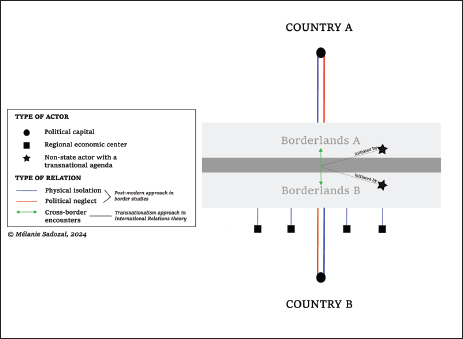
Further drawing on Rosenau’s model of micro–macro interactions in globalizing and localizing contexts, the Tajikistan–Afghanistan border exemplifies how individuals’ weak sense of loyalty to their national state can bolster international organizations, by surpassing jurisdictional borders. Cross-border, and thus transnational, interactions can redirect ‘the legitimacy sentiments on which new structures and processes get founded as people respond to new loci of authority and evolve new conceptions of territory’ (Rosenau, 1997, p. 122). Inhabitants of the border between Tajikistan and Afghanistan located in Badakhshan are distant from political centres, which have neglected these territorial peripheries. Consequently, the remote mountainous environment has fostered cross-border connectivity supported by a non-state agent. Not only has this agent supplanted the state in addressing the needs of the population and become a legitimate source of authority, but it has also promoted cross-border activities between Tajikistan and Afghanistan. Figure 2 maps these cross-border interactions. The blue and red lines indicate the isolation of the borderlands from their country of allegiance, while the green arrow represents all the cross-border resource-producing activities spurred by the AKDN, an international organization with a transnational agenda.
These observations align with the definition of transnationalism ‘from below’, which pertain to ‘cross-border […] activities, practices, and behaviours that are meaningful, affect the identity and sense of belonging of people, and are carried out on a regular (not exceptional) basis in the everyday lives of individuals’ (Tedeschi et al., 2022, p. 615).
Conclusion
This article aimed to demonstrate the applicability of transnationalism, as conceptualized in IRT, in analyzing cross-border dynamics in remote contexts. While they may look peripheral, the borderlands of Badakhshan serve as a privileged observation point, illustrating how localizing and globalizing processes, along with micro–macro linkages—here, the transnational and transborder cooperation structures of the AKDN impacting everyday life at the border—can transcend established territorial and jurisdictional barriers. The dynamics observed along this border underscore the relevance of IR transnationalism for border studies as both fields emphasize the power of non-state actors and the interactive relations between micro-orientations—at the border—and macro dynamics—at the transnational scale. They also reveal that cross-border connections formed in zones of remoteness shape alternative structures of loyalty.
In addition, resorting to work on borders produced in other fields such as political geography (Agnew, 1994) or anthropology (Scott, 2009; Van Schendel, 2013) helps explain how authority and loyalty unfold in remote borderlands. This article has argued that an interdisciplinary perspective is beneficial for studying remote borderlands. More importantly, integrating transnationalism with border studies perspectives across various social science disciplines enhances the analysis of regions characterized by their remoteness from political centres.
In the conclusion of a collaborative volume examining the borders of South Asia from the perspective of non-state actors, anthropologist Van Schendel (2013) advocates for the ongoing exploration of new concepts to better understand the complexity of border dynamics. This article aims to contribute to this endeavour within the fields of border studies and IR. In a broader context, this approach can assist scholars across different regions and disciplines in comprehending the evolution of international society. It is hoped that this interdisciplinary approach in international studies will facilitate the replication of such findings and the continued testing of theory in other remote, mountainous borderlands across the Global South and beyond.
Footnotes
Acknowledgments
I would like to thank my informants in the Tajikistan/Afghanistan borderlands, as well as the two anonymous reviewers of this paper.
Declaration of Conflicting Interests
The author declared no potential conflicts of interest with respect to the research, authorship and/or publication of this article.
Funding
The author received no financial support for the research, authorship and/or publication of this article.
