



Abstract
This article studies the way the US government through the Central Intelligence Agency, the Washington Post and the New York Times approached in tandem the development of rockets in Argentina and in two African countries (Zaire and Libya) during the last stretch of the Cold War. A qualitative analysis is carried out from primary government and journalistic sources, looking at how the media acted alongside the government and the intelligence community, providing the same information and a very similar interpretation of the facts, building common sense and a geopolitical imaginary. This is a geopolitical analysis of the construction of imagery of the dangerous identity of the OTRAG and the Cóndor II in the 1970s and 1980s. The conclusions show that both cases were construed as a geopolitical identity on non-core countries that ended in pressures, the projects be terminated, managing to build a sense by which the economic and political interests of the United States were projected hegemonically as universal interests.
Introduction
The international press tends to frame technological development in non-traditionally developed countries as potentially dangerous. International political actors are perceived and represented influencing the policies adopted for certain countries, international rules that should be adopted, expectations over countries as responsible players in international politics, the technologies states could have or develop without jeopardizing the so-called international community, that have hegemonic standards about what is good and what is wrong in international behaviour. These case studies contribute to understanding the limitations that the issue of technological development imposes on non-hegemonic international actors, from the perspective of the construction of a common sense, which makes them a threat. Pressures that hinder the development of technology and reinforce the global status quo sustain this as common sense.
This article studies how the developments of rocket technology in Argentina and Zaire towards the end of the Cold War were framed and recounted in the American newspapers of international reach: the Washington Post and the New York Times: a perspective from the United States. It qualitatively shows how the media acted in tandem with the government, providing the same information and interpretation of events, and therefore, played its part in the manufacture of meaning. This paper takes a geopolitical approach to analysing the construction of the German Orbital Transport und Raketen AG (OTRAG) in Zaire and the Cóndor II in Argentina in the 1970s and 1980s was dangerous. Its potential combat use triggered alarms; the development was called irresponsible and dangerous. Argentina and OTRAG had their secret development of an intermediate-range missile with dual purposes, and the country was treated as proliferating, threatening, and defiant to the international system. In both cases of analysis, the development of space technology was resisted and visualized as such in the international press.
The original contribution this article makes is to show how a political agenda on cutting-edge technologies is built, studying two paradigmatic cases of rocket developments in non-core countries. OTRAG and Cóndor are two relevant and textbook cases in which technology development in non-core countries is depicted as a threat, regardless of the peaceful purposes and the political alliances at the time. In fact, OTRAG was a German company, and European enterprises have invested in the Argentinean Cóndor project, all of them Western Allies to the United States in the Cold War. Some technologies are regarded as dangerous in a hegemonic cosmovision, parallely reinforcing the idea of responsible use of technologies, the necessity of global regulation to guarantee international security, and finally, consolidating the position of the countries that have the right to have it, and the ability to regulate such industries. The Soviet Union and other communist countries were strategic rivals and its technological advances were often dangerous to national security, either missilistic or nuclear (Gaddis & Nitze, 1980; Payne, 1994; Peoples, 2008; Schmid, 2018). Otherwise, the USA would not only be surpassed technologically but also militarily. However, ‘Third World’ countries did not represent a survival threat. The alleged security issues against such developments were about technological hegemony and avoiding competition. Bringing the discussion to the present, as it was in the East–West confrontation, global powers constrain technology development of semi-peripheral states for monopoly and status quo reasons (Blinder, 2015, 2022).
I posit the following questions: How were OTRAG and the Cóndor constructed as threats on the Media? Do they have interpretative links with the CIA? How does technology as such become the subject of geopolitics? In this research, I analyse the discourses regarding peripheral technological developments in order to trace how they construct the idea of threat. The basis is the USA’s intelligence agency’s international politics vision. Analysing discourses on the media, the technological developments in the Global South countries connote cultural hegemony about how these countries are conceived, and what the hegemonically established idea about the global good is. The securitization of the agenda described in mainstream and progressive newspapers shows us how they reproduce the world status quo.
On the basis of technology case studies, this article will address the way sources securitize the development of space technology that non-core states produce. I first develop the theoretical framework based on a geopolitical approach and the main arguments regarding the debate over the construction of threats. I understand geopolitics as a research agenda that studies the construction of different political dimensions and their representations. In this sense, a geopolitical approach securitizes different geographical areas and countries through the construction of dangers and threats that occur there and that are potentially political topics of the national and international agenda. The objective is to intervene through analysis, speeches and interpretations of government, media and cultural elites. A critical geopolitics approach inquires into who benefits from that kind of focus and what other views of geopolitical explanation of national or international politics, responding ‘to geopolitical narratives by examining the geographical knowledge portrayed by those narratives and how they represent the world’ (O’Lear, 2020, p. 195). Those narratives are, for the sake of this article, the construction of some technological developments in certain states as threatening and dangerous. I then explain the relation between space technology and international relations, and the construction of danger regarding political interests tied to technological monopolies. Finally, I analyse the empirical material of the New York Times and the Washington Post regarding the OTRAG and Cóndor cases, explaining the political motives that fostered a securitized focus, while constructing actions as threats, imagining potential dangers of technological developments.
This article offers an inductive argument and qualitative analysis of primary sources from the US government, the press and other key actors, analysing discourses of how journalists build up the story. The primary sources are those published on the OTRAG and Cóndor cases in both newspapers and the declassified secret CIA documents. Methodologically, the reason for selecting these two papers is that they are two of the most important newspapers in the United States, a world power in the years analysed and they dealt with the case studies of OTRAG and Cóndor II. It deals with newspapers of reference and global reach, and they are characterized as liberal and progressive. These newspapers reproduce in their written reports, colonial stereotypes about the cases analysed and build a conservative geopolitical imagery that is very similar and aligned with that of the US government, the military and intelligence establishment. The tandem action of these selected primary media sources with elements of the US government does not necessarily imply a direct relationship. Given the complex world that the black box of intelligence and diplomacy means, not all information can be accessed. However, similar information, readings and interpretations can be observed with the selected press. I have used interviews with relevant actors and academic sources to reconstruct the history of development in Argentina and African countries (Zaire and Libya).
OTRAG and Cóndor
OTRAG, a private company, set out to develop rocket launchers with alternative and cheaper systems to those existing until then in the state-monopolized space market. It was founded in 1975, the first company whose purpose was the commercial development of rockets. It had its base of operations set up in Shaba, Zaire (now Katanga Province, Democratic Republic of the Congo). The logistics and assembly of the test centre generated a European technological enclave in the African heartland, in which they had two successful rocket tests. President Mobutu and a large military-government entourage attended the third test, which was unsuccessful. After Soviet and French pressure, according to journalistic reports at the time, the company left Zaire and moved to Libya, conducting further successful test launches (Gounaris, 2019; Karp, 1995, p. 119; Oyewole, 2017, p. 189). However, in 1987 they left the country and Qaddafi’s government nationalized all its assets (Schwehm, 2018). In the 1970s, German engineers from MBB created the OTRAG group, an engineering company dedicated to the construction of medium-range ballistic missiles in Libya (Calvo Calvo, 2018).
According to a news investigation from the late 1970s, OTRAG was an entrepreneurial project, a Volksrocket (people’s rocket) where there was a market niche. OTRAG ‘has challenged both the Soviets’ implacable opposition to private enterprise in space, as well as the entrenched government monopolies like NASA and ESA’ (Zuckerman, 1978). There was also the journalistic information that with the involvement of the Central Intelligence Agency (CIA) and Federal Germany, this company was testing ballistic missiles that were banned after the defeat of the Third Reich. The journalist said ‘the Swedish newspaper Dagens Nyheter reported that the West German aerospace company Dornier is working on a cruise missile and that one of its subsidiaries is headed by Manfred Kayser, brother of OTRAG president Lutz Kayser’ (Zuckerman, 1978).
As it is specified in Figure 2, the development of the Cóndor II missile began towards the end of the Malvinas War during the military dictatorship (1976–1983) and continued throughout the democratic government of R. Alfonsín (1983–1989) and the beginning of Menem’s (1989–1999). It was a project of the Argentine Air Force that, after having lost much of its firepower in combat, decided to develop a deterrence capacity to reach the islands. The military, the then National Commission for Space Research, and other state agencies intervened in the project. It was carried out with companies from West Germany, France and Italy. Behind these European countries were Egypt, Iraq and Libya (Karp, 1995, p. 116), so around the 1990s and after the disappearance of the Soviet Union, direct pressure from the United States began to discontinue the project, which finally materialized. The cancellation of the Cóndor was the result of foreign pressure and of the economic crisis that blocked it. Some scholars argued that external financing from European companies (arguably in place of Egyptian and Iraqi funds) was used. As a result, the United States began pressuring to stop the project. And so it was, but not because it renounced national sovereignty, but due to budget restrictions that hyperinflation caused (Blinder, 2022, pp. 331, 408).
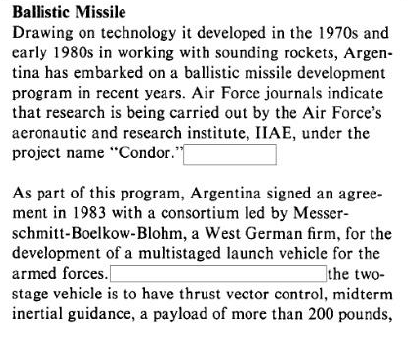
The investing private companies were MBB and the Italian chemical company SNIA, a high-rank Air Force Officer involved in the Cóndor explained. It was a sensitive technology, so I asked the officer about the degree of control the various states had over these items companies traded with. The brigadier explained that the project was for dual use, they chose to build at ‘La Falda del Carmen facilities where we had the Cóndor I, in 1984. That was the end of what was contracted with the MBB and the SNIA’ (Argentine Air Force Brigadier, 2011). Another retired brigadier in charge of the project assured that ‘the idea was to create a myth in such a way as to be dissuasive and to gain respect as a country’ (Argentine Air Force Brigadier, 2010). This brigadier insisted that the idea was not to have a weapon of mass destruction, but rather to develop technology for the country:
if you analyze the guidance systems we had, which were used by commercial airplanes, a thousand kilometers away, it did not give a probable circular error, so it was thought that it had to have a warhead. Was the [National] Atomic Energy Commission going to lend itself to make a nuclear warhead? I do not think so. It must have been thought of, and it was undoubtedly part of the myth. (Argentine Air Force Brigadier, 2010)
The accessed declassified reports describe a situation in which the German rocket company is the one that has all the capabilities and it is the Zaire or Libyan governments that would have used it, without local absorption capabilities. The case in Argentina is different according to the declassified sources and interviews carried out, as well as the information from the United States. There were home-grown local capacities but, as an interview with a former diplomat from the US Embassy in Buenos Aires explains, Argentina was not economically able to sustain a plan to produce missiles and launchers. But if Argentina invested a lot of money, for 10 or 15 years, it is possible that it could dispute a part of the market, but he did not believe that it could be sustained (Simon, 2010). He admitted the country’s technical capacity, but noticed shortcomings in sustaining long-term capital-intensive investments.
Threats and Dangers
Threats and dangers are socially constructed (Rousseau, 2006, pp. 3–4). According to Wendt (1999, p. 264), the logic of Hobbesian anarchy is enmity and is based on subjective images or perceptions. Odysseos (2002, p. 410) describes ‘a Hobessian depiction of the international environment, an ethos of survival as the relationality established by the acceptance of the dangerous ontology’. Among states under the realist logic, the others are dangerous because of ‘the irreducible uncertainty about the intentions of others, security measures taken by one actor are perceived by others as threatening’ (Snyder 1997, p. 17). From a geopolitical perspective, we can see how this construction of threat is sustained from an epistemic realism (Dodds & Sidaway, 1994, p. 518), by an inherently interstate logic, which attributes characteristics to states and their behaviour (Agnew, 1994, p. 56), and which constitutes a geopolitical imagination (Agnew, 1998), a strategic discourse of ‘us’ and ‘them’ (Dalby, 1998, p. 298).
The construction of threats has been conceptualized in security studies, especially as a criticism of mainstream approaches to the international agenda, dwelling on the idea that reality does not exist as an objective entity, but as constructed discourses (Buzan & Hansen, 2009; Buzan et al., 1998; Peoples & Vaughan-Williams, 2021; Watson, 2011). The political agenda is framed on the construction of threats, choosing and characterizing enemies as the ‘other’ either domestic or foreign in political discourse according to several scholars (Battaglino, 2019; Innes, 2010; Mustapha, 2011; Nathanson, 1988; Stengel, 2019; Yuan & Fu, 2020). Klein’s work shows the making of strategic thinking regarding identity and the post-Soviet scenario (Klein, 1994). In a post-positivist approach, Weldes (1999) and Mutimer (2000) argue that the threat is socially constructed. The very idea of proliferation is a political construct. Edwards tied discourses and technologies, explaining how technology, institutions and culture shaped the others through representations and practices of knowledge (Edwards, 1996). Campbell (1992) explains that the ‘world exists independently of language, but we can never know that (beyond the fact of its assertion), because the existence of the world is literally inconceivable outside of language and our traditions of interpretation’. This interpretation of reality is performative and has political consequences.
Flint states that ‘a sense of place had to be disseminated to the public, both the “goodness” and morality of one’s own country, but also the threat and depravity of other countries’ (Flint, 2006, p. 24), enveloping foreign policy decisions. Knotted to the idea of geopolitical imagination, Agnew (1998) explains the characterization of the others as different and potential threats. The danger of otherness in technology issues is that the proper use of technologies by a ‘we’ is different from a ‘them’ which, according to the perception and construction of their geopolitical codes, could be taken as dangerous or as a threat. This hides a hegemonic binary reading of politics, understood as a world of good and bad. Media and other social agents such as academia and diplomacy build a common sense mapping world politics, friends and foes.
In this sense, as a part of the theoretical baggage of studying the international arena, geopolitics is ‘where identities are formulated, represented (…) [and] about the crucially important power to define danger’ (Dalby, 1998, p. 295). In Dalby’s words ‘Geopolitics is a way of organizing and looking at space, of conceiving and representing it’ (Dalby, 2009, p. 234). This representation is about political power and order. Due to the social nature of the construction of threats, a group of people, ‘experts’, describe and define such world, ‘the culture of the experts, who are the designators of threats as well as the directors of societal responses to such designated threats’ (Dalby, 1998, p. 296), and ‘about the construction of enemies’ (2008, p. 424). Thus, this article analyses these cases in terms of those representations.
Experts and specialists from the academic and technical world and specialized journalists have always associated the production of space technology to speeches from the field of defence or related to international politics. This technology is generally considered dangerous and connected to geopolitics as a concept of power. It implies a Great Game where artefact and technological knowledge play a central role as an instrument of power relations. Since geopolitics has been seen for so long as a militaristic practice monopolized by state elites and experts, this has obliterated other subaltern voices opposed to the dominant hegemonic understanding of the so-called statesmen, geopolitics being a discourse of experts with justifying visions of power politically studied.
Strategic Technologies and International Politics
As there are sensitive issues to national security, both the OTRAG case and the Cóndor II became the subject of US intelligence geopolitical representations. The journalistic information analysed in this article matches the way they approach the developments in Argentina and African countries, the information they provide, the vision of the world and the potential dangers. The CIA, as an example of how the intelligence community analyses security issues with a similar perspective to progressive journalism, has made reports on OTRAG and Cóndor II that were based on press publications or on the agency’s own sources. These documents show interactions that stand out as a national security alert, between European companies and countries considered Third World, technology transfer alerts, spurious business and the threat of proliferation of nuclear or chemical weapons. The description made throughout these documents advances practical geopolitics that builds practical reasoning and geopolitical discourses from a governmental information powerhouse that provided both geopolitical discourses and practices.
The media agenda and the national and international political agenda compose geopolitics. They manufacture discourse. In this sense, the agenda-setting concept suggests that the media does not tell us what to think, but rather what to talk about. The concept of framing allows us to understand how the media provides a focus and an environment in which a journalistic story is outlined, they influence how audiences understand or evaluate a story (Aruguete, 2011; D’Angelo & Kuypers, 2009; Goffman, 2006; Lee et al., 2008; McLeod & Shah, 2014; Reese et al., 2001; Weaver, 2007): there is a choice of how to tell the story, what is important, whose intentions are good, those who have hidden agendas, who act responsibly and who does not.
The studies of international relations from different international policy approaches (Adler & Barnett, 1998; Davis, 1993; Farrell, 2002; Gartzke & Kroenig, 2009; Hymans, 2006; Lavoy, 1993; Monteiro & Debs, 2014; Nacht et al., 2021; Schneider, 1994; Snyder, 1990; Thayer, 1995; Waltz, 2012) have analysed these paradigmatic cases of nuclear proliferation. Technology produces results beyond itself, over society. Technology is a social creation since it is constructed for an objective, in a certain context (MacKenzie, 2012; MacKenzie & Wajcman, 1985). The case of nuclear technology is key and has been widely studied. From a realist perspective, great powers have nuclear weapons, this can be read pessimistically or optimistically. Either more actors with nuclear capability is something negative because it generates uncertainty, incentives for preventive attacks or accidents or it is something positive because it increases the cost of conflict (Kroenig, 2009, p. iii; Mearsheimer, 2001, p. 372; Waltz, 2012, p. 465). The powers have a realistic view of nuclear weapons because they consider them an instrument of power, and an instrument that justifies the geopolitical order. And as such, it is best while you can, to restrict the number of players with nuclear military capability.
According to Mearsheimer (2001, p. 3) ‘Great powers (…) have little choice but to pursue power and to seek to dominate the other states in the system’.
For their own survival, nuclear powers must consider every State with nuclear weapons, as a potential threat (Kissinger, 1957): “Foreign policy henceforth will have to be framed against the background of a world in which the ‘conventional’ technology is nuclear technology” (Kissinger, 1957, p. xi).
Thus, the emergence of new states with disruptive strategic capabilities, power attributes the realist would say, would be the object to the policy or the more powerful nations which seek to influence the situation. ‘International politics shape and influence foreign policies of small states rather than the reverse’ (Gvalia et al., 2019, p. 2), and ‘the realist world is effectively reduced to a map of “great powers” where small (in the sense of “weak”) states are little more than moving parts in shifting alignments’ (Berenskötter, 2018, p. 15).
Solingen (1994) explains that there is a relationship between political economy and decisions in the nuclear sector, arguing that countries with liberal policies denuclearize and adhere to international control regimes, while nationalist ones are more reluctant to proliferation control. Solingen has extensively studied different cases of countries with nuclear industry (Wan & Solingen, 2017), and among other cases, the Argentine case (Solingen, 1996). However, this approach was criticized because the text ignores the pressures on developing countries such as Argentina that seeks to join the nuclear market (Hurtado, 2015). Indeed, these limitations of the international system are what has been assessed as Nuclear Apartheid (Biswas, 2001; Maddock, 2010; Raghunath, 2010).
The diplomatic pressures (Steiner, 2004) over any technological strategic development such as nuclear development may be direct or indirect. The objective is to avoid weapon development as well as restricting development (Cowen, 2010; Cupitt, 2000; Khan et al., 2022; Paarlberg, 2004; Ramesh & Weiss, 1979, p. 42; Silver et al., 2019). Certain technological developments, such as nuclear and defence, can be strategic for the development of an entire national industry (Weiss & Ramesh, 1983, p. 253). The same is true of rocket technology, which, as a dual-use technology, can be used either to launch a payload into space, for civil or military purposes or to launch a conventional or nuclear payload: there are pressures on its development so that there are no international threats, as well as keeping a hand over the civil and military markets (Early, 2013; Karp, 1984; Karp, 1988; Lumpe, 1993; Mistry, 2002; Mistry, 2003; Nolan & Wheelon, 1990; Nye, 1992).
As Hurtado explains, starting in the 1950s, ‘a varied collection of pressure mechanisms were deployed from nuclear technology exporting countries—mainly from the US—to obstruct the development of a group of semi-peripheral countries’ autonomous nuclear capabilities’ (Hurtado, 2015, p. 1). In this article, Hurtado analyses the construction of terror of nuclear proliferation that
was used by US foreign policy to build up and protect an oligopolistic nuclear market. Spread by the press and by some prestigious social science sectors from the US and some European countries, a persistent and dense discourse production went on over several decades to the bizarre practice of ‘calculating’ the alleged hidden intentions of those semi-peripheral countries which aspired to dominate as many technologies of the nuclear fuel cycle as possible. (Hurtado, 2015, p. 1)
The pressures on countries like Argentina to prevent the development of strategic technologies such as nuclear have been going on for decades, regardless of whether the developments are totally peaceful or not. It is about the power status quo and technological monopoly. These technological objectives are sought and achieved, constructing readings of a world of allies and enemies, of friendly countries and potentially dangerous countries, and a geopolitical reading is created that, in Dalby’s (2008) terms, builds threats, explains world politics, and creates the international order.
‘Experts’ produce discourses through the local and global debate on technologies, and impose how and where these debates should go (Vara, 2019), they install agendas that lead to the crystallization of power by imposing legislation (Delvenne et al., 2013). Experts find danger in the developments of semi-peripheral countries, but the concept of ‘nuclear proliferation was born impregnated with multiple political ambiguities which stem from the selective meanings assigned by core countries to every technology which they considered to be strategic’ (Hurtado, 2015, p. 14). Hurtado and Souza (2018, pp. 128–129) show that the discussions about the uses in the development policy of strategic technologies, such as nuclear technology and ‘green’ technologies, today, conceal a policy of the central economies to promote their economies while cooperating with peripherals they transfer the business, costs and control over them. A Latin-American International Relations journal published an academic article showing the way great power discourse and policies seek to control and contain non-core states such as Argentina, Brazil and India, and their nuclear development. Peaceful cooperation was offered to dissuade and restrict military use and impose control over civilian markets (Sábato & Ramesh, 1980).
As the case of nuclear development, the state diplomacy of the central powers, intellectuals and dozens of prestigious think tanks of the West have written articles demonizing the acquisition of technology from countries like Argentina and Zaire. They have treated the OTRAG as a case of German colonialism (Kalamiya, 1979), and the Cóndor as a representative case of untrustworthy countries (Blinder, 2022). An example is the Bulletin of the Atomic Scientists that, explaining the benefits of an international regime, shows Argentina, naming this country on a par with North Korea—which reinforces the image of danger, published:
Yet, the MTCR is not without success stories, like that of Argentina’s Cóndor ballistic missile (…). And some missile nonproliferation failures can even be seen as successes for the MTCR. North Korea’s trade in its grossly outdated Scud missiles is possible only because interested buyers cannot get access to more modern alternatives, even illicitly. (Chankin-Gould & Oelrich, 2005, p. 38)
I also find from the same publication a mention of OTRAG as a producer of ballistic missiles for the Third World, which is described as ‘frantic’ (Karp, 1988, p. 19).
The developments of OTRAG and Cóndor were also discussed in the US Senate, being presented with the information provided and analysed by the CIA. Senator Bingaman gave a speech in which he pointed out that Germany and other European companies are accused of providing logistics and critical components to Libya (in the OTRAG case), and Argentina is singled out as a producer of ballistic missiles, in a context of empty state coffers, democracy under strain and corruption. Although the information is not exact, Argentina never sought to have nuclear weapons (Hurtado, 2014), the information they sought to obtain is introduced to the floor (Senate, 1989, pp. 15003–15004). Even though both cases had potential dual use as any space industry, they were considered dangerous for the international community for the potential export of ballistic missiles. Thus, they were reflected in the press in tandem with the intelligence community or American politics. OTRAG and Cóndor were described in the press with scepticism as dubious projects, with hidden intentions and a lack of accountability and control. The implication was the need for international oversight, accomplishing the rules of the game and avoiding proliferation.
Intelligence Community
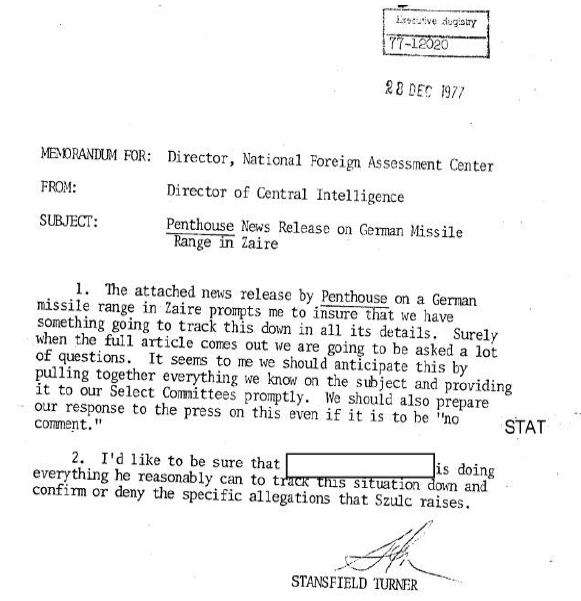
As it is shown in figure 1, in the declassified CIA documents on OTRAG, the information is collected first from journalistic sources. Then, with different information gathering and analysis techniques, the CIA reports information concerning international security. In the declassified documents on the Cóndor, the information appears to come only from internal sources. However, the assessments and characterizations are very similar in both intelligence and journalistic documents.
The CIA wrote a document elucidating that West Germany (as a State) ‘has taken over 100,000 square miles area of Zaire where it is secretly testing the cruise missile and the intermediate range ballistic missile’ (CIA, 1977a, p. 4) quoting Penthouse magazine. The intelligence dossier explains how the CIA and the Bundes Nachrichtesdienst, the German spy agency, tracked this evidence. The dossier informs how the French government—as a partner of Germany—and the Soviets and the Polish officials—as Warsaw Pact members—were worried and followed this development as a possible security threat, involving the military industry of Germany and France and its plausible use as a guided missile, not as a satellite launcher (CIA, 1977a). A memorandum signed by the director of the CIA, Stansfield Turner, describes and analyses the Penthouse article, worrying about the 300 million support of the military budget appointed by Bonn. The memorandum concludes that such a vast territory of the African country is needed for cruise missile testing rather than for space activities (CIA, 1977b). Tuner produced another memorandum for Secretary of State Vance, assessing the concerns of OTRAG in Zaire without released secret content, but highlighting that the information was published in the leftist publication Jeune Afrique in Paris (CIA, 1978).
More than a year later, another dossier described the OTRAG project, explaining that the company was established in the tax haven of Liechtenstein and set up offices in France. According to the report, OTRAG had contact with guerrilla groups in Algeria. According to the brief, the Soviet KGB was concerned with German rearmament (CIA, 1979). About two years later, an intelligence report analysed the OTRAG Jarmah rocket development site in Libya and the weapons development project. They studied the technology transferred from Zaire to Libya. Those facilities had all the essentials for the production of rockets. The document has several pages crossed out to keep it secret (CIA, 1981a). Lastly, it reproduces a report transcribing a CBS radio program, mentioning the danger of guided missiles, the transfer of weapons from Germany to Libya, and the threat to world security (CIA, 1981b).
A secret intelligence report on the Cóndor examines the political situation of the fledgling democracy. The report assesses that Argentina faces difficulties and restrictions in the world weapons market. The report maps out every arms production facility in the country. After a detailed description of the Argentine weapons systems, it analyses the Cóndor project and reaches the conclusion that, given the Western restrictions and the country’s economic situation, ‘Argentines are years away from successfully developing and deploying an operational ballistic missile system’ (CIA, 1985, p. 19).
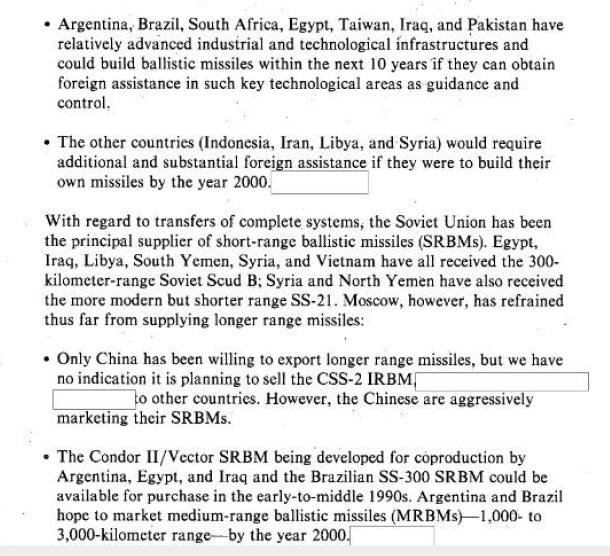
An intelligence assessment of Egypt estimated that this country was producing a medium-range missile that ‘is similar or identical to Cóndor II’ (CIA, 1988a, p. iii). This report assessed that Egypt has an industrial base to produce such technology, and that this missile ‘will substantially enhance Cairo’s deterrent and retaliatory capabilities’ (CIA, 1988a, p. iv), pointing out the muddle to international security, especially to US allies such as Israel. The report shows technical and financial assistance to Argentina, suggesting an axis weapons developers of dangerous states, tying Argentina to the Middle-East conflict. As it is affirmed in Figure 3, another intelligence report from the same year assessed that Argentina among other nations ‘by the year 2000 at least 15 developing countries will either have produced or be able to build ballistic missiles that will contribute to regional instability and could threaten the interest of the United States and its allies’ (CIA, 1988b, p. 3).
At the beginning of the 1990s, Iraq was the United States’ main international concern regarding security and international threats. The Soviet Union was about to collapse, and in January, the United States started the Gulf War against Saddam Hussein and his invasion of Kuwait. Iraq was regarded as proliferator state, having the infrastructure to develop missiles and weapons of mass destruction, acquiring it from Argentina’s Cóndor II. According to the CIA, Iraq started the construction of ‘its own Cóndor II production facilities in mid-1987. Over the next two and a half years, we believe Iraq continued to fund the development of the missile in Argentina, while seeking and acquiring materials needed to produce the Cóndor II in Iraq’ (CIA, 1990a, p. 1). That was the destination of the technology transfer of the Cóndor II and the relation between South America and the Middle-East (CIA, 1990b, 1990c). Such a read of world affairs would be found in the Washington Post and the New York Times, having a diffuse line of sources and geopolitical interpretations.
Washington Post
The Washington Post portrayed OTRAG and the Cóndor as dangerous and proliferating developments. The geopolitical imaginary of two Third World countries: Argentina and Zaire, presents them as seeking capacities that do not correspond to their degree of power, without making it explicit. But it is implicit in the danger, the discovery of practices behind the back of the international community, the economic capacity to sustain the project, or even the danger represented by the irresponsibility of the acquiring country, and of Germany that transfers the technology, as well as its underlying colonialism.
OTRAG and its development attracted the Washington Post’s attention, the article quotes US government sources and on 14 December 1977, it states the following:
West Germany ‘is secretly testing the cruise missile’ with U.S. approval on a huge test side it has leased in Zaire, Penthouse magazine reported yesterday. The Central Intelligence Agency, Defense and State departments all denied any involvement with a German firm’s space activities in Zaire, while the West German embassy said no cruise missile testing was going on there. The Soviet Union last August formally protested to the Boon government the alleged West German military base in Zaire Bonn responded then that the activity consisted of a private German firm trying to develop a cheap rocket for launching weather satellites. (Washington Post, 1977)
Another article titled ‘Rocket Firm’s Third World Ties Test Bonn’s Patience’ claimed that Bonn diplomacy was concerned with the activities of the German company shrouded in mystery. After linking it to countries whose geopolitical and imaginary characterization, they attributed to the Third World, the company was looking for other launch sites, among which it included Argentina. The data released reflect and reinforce prejudices against third parties who enter space business, against countries linked to terrorism during the Cold War. In addition to that, incorporating the South American country in the text reinforces its characterizations as ‘proliferator’ attributed to that State, which, as we have seen, is not accurate.
A West German rocket company that is a thorn in the side of the Bonn government and is currently linked to Col. Muammar Qaddafi of Libya is negotiating for another test launch site far away from the Libyan Sahara, where it now operates. The company has a reputation for mystery. (Graham, 1981)
The article claimed that OTRAG ‘has been an embarrassment to Bonn, which does not approve of West German firms experimenting with rockets that have potential military use. OTRAG has always maintained that it is not involved in any kind of military research’ (Graham, 1981). Along the line of ‘a company out of control’, they go on to argue: ‘Reports continue to circulate linking OTRAG with military designs’ (Graham, 1981). For the leaders of the OTRAG project, the intelligence services of Israel and other nations were behind all the rumours published in the international press. It is striking that the Israel, UK and US intelligence services were also mentioned by the Argentine military as saboteurs of the Cóndor project.
Regarding the Cóndor, the Washington Post published that after an active policy of the United States seeking to cancel technology transfer to the ‘Third World’, whose geopolitical connotation evokes images of instability, underdevelopment, poverty, categories that as a whole do not reflect the Argentina of those years, with a wide middle class and an industrial country. ‘Egypt has ended its participation with Iraq and Argentina in a project to build a ballistic missile that embroiled the Egyptians in a plot to smuggle rocket technology out of the United States’ (Ottaway, 1989). Another article called ‘Winking at proliferation’ noted that:
Bush administration this summer has missed a major opportunity to slow the spread of missiles in the Third World (…). Among the nations and projects listed in the original Commerce Department tally but dropped from the final list are: Egypt’s upgraded Scud and Cóndor II missiles; Iraq’s Scud-B, Al-Husayn, Al-Abbas, Cóndor II and Tammuz missiles, and Al-Abid rocket; Israel’s Jericho I and II missiles and Shavit space launcher; Libya’s upgraded Scud and Al-Fatah missiles; and Syria’s upgraded Scuds. Also dropped were Argentina’s Cóndor I and II missiles and Alacran rockets. President Carlos Menem pledged to end the Cóndor II program, but it remains an active component of his nation’s unneeded space-launch program. (Milhollin & White, 1992)
New York Times
Regarding the OTRAG case, an article dated 29 April 1978 titled ‘Private German Rocket Base in Zaire Stirring Rumors’ described the case as ‘unusual’, reporting that both the United States and the Soviet Union (who called OTRAG German spear, according to the report) saw it as problematic for a third actor to develop rockets.
The company, known as OTRAG, the acronym of its name in German, says that it wants to use the 39,000-squaremile territory in northern Shaba Province—an area a tenth the size of Zaire—to test and deploy a low-cost launching system for commercial satellites. This explanation has failed to calm Zaire’s neighbors, including Angola, Tanzania and Zambia, where there are fears that the project may be of a military nature. There is no evidence that the rocket range, a sparsely inhabited zone of undulating plateaus, thick growth and river valleys in the southeastern corner, is being used for anything other than what the company says it is. The first test rocket was launched last May and another is due shortly. Nonetheless, because the area is among the most inaccessible on the continent, because space technology often blends into military activities like reconnaissance and because the Otrag zone stands at the strategic center of Central Africa, rumors about its purpose persist. (Darnton, 1978)
The article recounts other versions with a colonial vision consulted about the project whose sources have indicated that it could be a cover for other activities, such as the exploitation of gold, large airfields or a communications network. The musings would be due to the contract that grants large territorial extensions for development.
For an annual rental of $ 50 million—payable after OTRAG is paid in non-Zairian currency by its first customer—the company has exclusive use of the territory and the right to take all measures that it deems necessary for the exercise of full and complete power ‘until the year 2000’. (Darnton, 1978)
The New York Times published on 6 June 1978, based on a Reuters cable, that it had failed a test in Zaire, which did not adjective or rate the development or the protagonists involved: ‘A West German rocket company carried out its third experimental launch in Zaire today, but the rocket rose only a few yards before plunging to the ground as President Mobutu Sese Seko watched’ (New York Times, 1978).
Later on, 11 March 1981, another piece of news pointed at the opacity of development, reproducing the same issues the US government itself and geopolitical imaginations could use about any development in an African country. In the title, he described it as enigmatic:
A West German rocket company, whose opaque activities led to its expulsion from Zaire after complaints by other African governments and the Soviet Union, is asserting that it has successfully launched a suborbital rocket from a new test site in Libya’ (Vinocur, 1981). For several years, one of the most important Third World leaders taken as an antagonist by Western countries was the Libyan Gaddafi who was associated with identifiers such as terrorism or revolution. Likewise, the article cited an OTRAG statement in quotation marks as if it were ironic, since the rocket’s capacity makes it inherently dangerous. ‘Col. Muammar el-Qaddafi had given it facilities at Sebha (…) The statement gave no details about the test, but it said the company was now able to offer use of ‘the smallest type from our rocket family as a science research rocket at a price level defying competition’. (Vinocur, 1981)
The article cites a previous one from Penthouse magazine that stated according to the article, ‘highly reliable informants in Washington and Western Europe said the Zaire base was used to test cruise and intermediate-range ballistic missiles’ (Vinocur, 1981). It can be seen how, despite the fact that the orbital use objectives communicated by the German company itself are quoted verbatim; the conclusions are those of government informants from the Western powers. An article, later on in 12 September 1981, was titled: ‘U.S. uneasy over military potential of commercially produced rockets’. The Reagan administration, which had boosted competition with the Soviets and the market as an efficient allocator of the economy’s resources, ‘has become concerned that rockets being developed commercially for ostensibly peaceful purposes could also be used to deliver nuclear or chemical warheads’ (Miller, 1981a).
The sources used, NASA and the intelligence community, warn of the potential use for war. Once again, there is a construct of danger on those who develop strategic technologies. However, the sources affirm that private companies could compete in the space market, but it entails a security danger to be controlled by the United States.
Company representatives say their objective is to develop rockets that could lift into orbit satellites with telecommunications or other peaceful equipment more cheaply than NASA and thus contribute to the commercial use of space technology. But American officials are concerned about the possible use (…). (Miller, 1981a)
However, the New York Times goes on to state that what is worrying is the transfer of technology or the ability of considered-dangerous-countries, such as Libya, to have their own capability to technologically scale up and produce ballistic missiles (Miller, 1981a).
Finally, the latest New York Times piece recounts that OTRAG withdrew from Libya due to international pressure, in the same way that happened with the Cóndor in Argentina. The hazard of the project and the transfer of technology to countries that could use it irresponsibly against the international order were highlighted that ‘Otrag’s activities (…) sparked protests from the United States and Western European governments. American intelligence reports suggested last fall that the company was using its ostensibly peaceful rocket program to mask efforts to sell military technology’ (Miller, 1981b).
According to US intelligence consulted for the article, the project was intended to have a nuclear or chemical payload. When they left Zaire, they sought to settle in Brazil for a new test site but it was denied. ‘Suspicion about the company’s rocket project was heightened by the fact that Libyan military officials, including those connected with Libya’s atomic energy program, were in charge of much of Otrag’s operations, according to the intelligence reports’ (Miller, 1981b).
In an opinion piece titled ‘Beware the Cóndor’, the New York Times linked a French guidance system called Sagem with Argentina and Iraq, pointing at the triangulation of money. Statements by the US government singled out manoeuvres that made this technology dangerously dual use. Therefore, they construct Argentina itself as dangerous. Furthermore, they fixed the idea that the Argentine government developed missiles with atomic capacity. The Cóndor II is classified as Iraqi, and would have ‘the capacity to obliterate the U.S. Sixth Fleet and the capitals of Syria and Turkey would satisfy any dictator’s power drive’ (New York Times, 1990). This statement, which was not true, however, positions the South American country in a dense network of meanings that place it at the same level as several countries considered dangerous and subject to sanctions and intervention: ‘Note that this Cóndor warhead is not so big: that suggests it is designed to deliver a nuclear bomb rather than poison gas’ (New York Times, 1990).
On 13 May 1991, the New York Times published an article that highlighted that then-President Menem was waging a battle against his Air Force subordinates to gain control over everything related to the Cóndor. The article, using unspecified diplomatic sources, published that the government apparently has so little control over the project (Nash, 1991a). The item emphasized that the United States made requirements and that the Argentine counterpart was reluctant to collaborate. It was not, according to the newspaper, two sovereign states at the same level, but one forced to collaborate with the destruction of its own technological development. The author points out that this bilateral issue is ‘the most sensitive issue between the United States and Argentina’ (Nash, 1991a), due to the links with the Persian Gulf, which requires Argentina not to end up being a dangerous exporter of missiles, which must be subject to continuous scrutiny. The Argentine government itself is taken as not completely collaborative by pointing out that Menem proposed to reuse the Cóndor for civil space technology, which is unacceptable, according to US military experts (Nash, 1991a).
Nash’s news piece constructs Argentina as a country with obscure intentions, which in order to achieve its objectives carries out contraband and all kinds of untrustworthy actions towards the United States, which only sees the South American country as a hub for the interests of Egypt and Iraq in the Middle-East. On 30 May 1991, the New York Times published again that Argentina’s Defense Minister said that the country’s secret ballistic missile program, the Cóndor II, would be ‘deactivated, dismantled, reconverted and/or rendered unusable’ goes a long way toward meeting the US demands the project be destroyed (Nash, 1991b), and that all material would be transferred from the Air Force to the civil space agency. The publication pointed out that total civilian control was necessary, suggesting that military development generates uncertain destiny and dangerous use of the launcher, reinforcing the ideas attributed to the geopolitical imagination about the Third World.
Military implications aside, the moves seem intended to show that President Carlos Saul Menem is firmly in control of the armed forces, whose ranks have produced four attempted coups since democracy was restored in Argentina in 1983. Diplomats said that if the Government followed through, there would be little chance that the technology and missile parts, developed by the Argentine Air Force since the mid-1980s with the financial aid of Iraq, could be used for military purposes in the future. (Nash, 1991b)
An opinion piece published that year assured that the decision to end the Cóndor II was ‘not only wise but brave’ (New York Times, 1991). It described a chaotic and unstable national situation in which the military impeded the democratic process. The way to impose civilian control over the military was to adopt liberal policies, open up to the United States, which at that time was standing as the only global superpower (New York Times, 1991). A year later, the New York Times published again about this Argentine technological development, making a direct connection with Saddam Hussein’s Iraq, who at that time was the other ‘evildoer’ chosen by the US government, whose actions in the international system altered world peace (Nash, 1992). This is consistent with information from the State Department and the CIA, later declassified.
The article published another piece two years later, the title was: ‘Argentina Gives Missile Parts to U.S. for Disposal’, and it pointed out that the destruction of the whole project was due to its danger: ‘medium-range missiles could have eventually been used to deliver biological, chemical and nuclear warheads within a 500-mile range’ (Nash, 1993).
Conclusions
All the discursive constructions that generate a geopolitical imagery and imagination about these developments and these countries seek to limit their space development. When the New York Times or the Washington Post, with the same arguments, acting in tandem as the CIA or any other government body, claim that they want to set limits to the proliferation weapons of mass destruction and to guarantee international security, they are ensuring that weapons that may challenge the United States’ military superiority, or that of its main corporations’ market niches are not produced. Sábato and Ramesh explain that discourses and policies of coercion or international cooperation are placed at the service of these objectives. The (ideal) discourses have a substance of material interests on which they are based. They are the ‘national interests’ that are the result of interests of companies, bureaucracies and governments. They are interests whose objective is to control the space market and military supremacy.
Geopolitical discourses manufacture meaning. Argentina was never a ‘proliferating’ country; it was construed as such in practical geopolitics and popular geopolitics. Zaire was a recently decolonized country, with institutional problems and surrounded by armed civil conflicts. It did not, however, acquire ballistic missiles or nuclear weapons. Neither did Libya. Both cases are the construction of a sense of power within the international system, shaped by the United States and its allies. The result was that both projects were completed. OTRAG, a company of one of the main European allies of the United States in the Cold War, had to suspend their activities. Despite the fact that it was West German, it did not generate the confidence of policymakers. With Cóndor II, the development of a Western-allied state during the conflict against the Soviets, there were also diplomatic pressures, various intelligence dossiers, and notes in the press that made Argentine dangerous, unruly in the world order: a proliferator.
The declassified CIA reports present plenty of information about OTRAG and the Cóndor that had never been analysed together before. They link the missile to Iraq and Egypt through technical and political data. Also, they show the development of the missile and convey how despite the decided policy of alignment with Washington, certain political sectors of Argentina were reluctant to abandon the Cóndor II entirely. They also introduce a lot of information about the development of OTRAG, the French, the Soviet pressures and the uncomfortable role of the German government that had a prosperous industrial economy but depended on the approval of the United States in matters considered strategic, such as space.
The construction of the geopolitical imagination, representations and threats in both cases: by the government and the media shows that they act by creating common sense, a way of interpreting reality that suggests that they act together, politically pressuring, pointing out and denouncing developments in space technology as dangerous. Thus, they reproduce geopolitical interests and a hegemonic status quo, where the United States through its government and the press show ‘the other’ as dangerous, proliferating and unreliable. Seen from the reverse, it tells us how these speeches state the world, as it should be: its particular interests as a nation—technological and security monopoly—are presented as the interests of all global actors.
Space technology was considered strategic in the context of the Cold War, and as such was subject to regulations, and to the management of diplomacy and politics between States. The Space Race, which took place in parallel with that of atomic energy, had the United States and the Soviet Union as its axis. The appearance of third parties in this technological acquisition game demanded resources from governments that we see published in the press, in unison with the US CIA’s own declassified information. This implied, from an analytical geopolitics framework, that the voices published in the press and the intelligence community—the intellectuals who analysed the OTRAG and Cóndor cases discussed in this article—securitized any attempt at autonomous development by third parties trying to slide into this business, and their view of realistic international politics, seeking to re-establish the balance of power.
A final issue that rises from reading these two technological trajectories in Africa and South America. It is impossible to think of complex and strategic technology projects without considering the management of technology policy within the dimension of the geopolitical reading from governments and other power factors. I have discussed the press, how it feeds on information secretly produced by espionage, and how intelligence organizations also feed on what is spread to the general public in the press. Also, how government expert knowledge is generated, leading to the dissemination of a vision of certain technological developments and countries as dangerous, the potential dual uses of technology, which becomes, on the one hand, a barrier for new actors to have access to technologies, and on the other hand, the inherently conservative and status quo character that securitizes through the creation of threats and dangers in the geopolitical imaginary.
Footnotes
Declaration of Conflicting Interests
The author declared no potential conflicts of interest with respect to the research, authorship and/or publication of this article.
Funding
The author disclosed receipt of the following financial support for the research, authorship, and/or publication of this article: This work was supported by the National Council for Scientific and Technical Research (CONICET), Argentina.
