




Abstract
A growing literature demonstrates that ideology shapes international relations. But just how does ideology have its effect? This article develops an integrated model of mediators and moderators of the impact of ideology on foreign policy. Specifically, it hypothesizes that ideologically motivated perceptions of threat and national power sequentially mediate the impact of individual-level ideologies on foreign policy preferences, and that in/out-group social categorization processes moderate the relationship. We interrogate these propositions with three plausibility probe case studies. The conclusion discusses which aspects of the model were best supported by the plausibility probes—and suggests hypotheses for future causal testing.
I refuse to believe that a little fourth-rate power like
North Vietnam doesn’t have a breaking point.
—Henry Kissinger (1969; cited in Burr & Kimball, 2006)
Power politics (German: Machtpolitik) approaches to international relations (IR)—from classical realism (e.g., Morgenthau, 1948/1985) to the realpolitik Henry Kissinger practiced while leading US foreign policy under Presidents Nixon and Ford in the 1970s, to structural (e.g., Waltz, 2000) and offensive (e.g., Mearsheimer, 2001) realism—have long held that states that act on sentiment or ideology, rather than the dispassionate pursuit of national power, will perish. An influential variant argues that states balance against threat rather than power (Walt, 1987). Michael Barnett (1996) has argued, however, that ‘balance of threat’ approaches largely reduce threat to power: nations fear more powerful nations. They too, therefore, fall within the power-centric Machtpolitik school of IR.
An equally lengthy liberal IR tradition argues that ideological differences between states powerfully shape war and peace. Immanuel Kant (1795/1983) and later ‘Democratic Peace’ theorists (e.g., Doyle, 1983; Russett, 1994) argue that democracies do not usually fight each other because of their shared liberal values of compromise and non-violence. Mark Haas (2005) uses case studies from the French Revolution to the end of the Cold War to argue that how leaders perceived the ideological distance between each other shaped perceptions of mutual threat—and cooperation/conflict. Michael Desch (2007–2008) has argued in his provocative ‘America’s Liberal Illiberalism’ that liberalism at home promotes illiberal foreign policies. And scholars have begun exploring the micro-foundations of the democratic peace, such as the underlying drivers of both international amity and enmity among democratic publics (Gries et al., 2020).
Another IR literature strongly suggests, furthermore, that ideological differences within states also shape foreign policy (for a review, see Gries & Yam, 2020). Conservative/right-wing governments are generally more war-prone. US Republicans usually take a tougher line on foreign affairs than Democrats do (Dueck, 2010; Gries, 2014). Electing right-wing leaders is associated with state aggression (Bertoli et al., 2019). Right-wing legislators in Europe vote more frequently to support military deployments (Wagner et al., 2018), and to increase military budgets (Bove et al., 2017), than left-wing legislators do. Left-leaning governments favour foreign aid, while right-leaning governments favour military spending (Wenzelburger & Boller, 2020).
These partisan differences in foreign policy are rooted in ideological differences. Liberal and conservative Americans are systematically divided in their views of foreign countries and international organizations—and both the means and ends of US foreign policy (Gries, 2014). In the West, conservatives/the right are more likely than liberals/the left to oppose immigration (Gries, 2016; Homola & Tavits, 2018; Stewart et al., 2019; Zmigrod et al., 2018), prefer excluding refugees (Van Prooijen et al., 2018) and support lethal drone strikes (Ceccoli & Bing, 2018). They are also more tolerant of enemy collateral casualties (Schori-Eyal et al., 2019).
There are widespread exceptions, however, to the rule of tougher conservative/right foreign policy preferences. In the USA, over the past several decades, it is Republicans who have become more pro-Israel, while Democrats have become more critical (e.g., Carter, 2006; Cavari & Freedman, 2020; Mearsheimer & Walt, 2007). In Europe, anti-Americanism is more consistently located on the left than the right, with conservative governments more likely to adopt friendlier US policies (e.g., Ray, 2011). And while South Korean conservatives feel cooler than liberals do towards North Korea, and support attacking it more, they feel warmer than South Korean liberals feel towards Japan and the USA (KINU, 2020).
So, just how does political ideology shape foreign policy preferences? One review (Martill, 2017) rightly notes a dearth of scholarly attention to causal mechanisms. What mediators best account for ideology’s impact? Specifically, do perceptions of threat and power, so central to longstanding Machtpolitik approaches to IR, play a significant role?
And how should exceptions to the rule be understood? Under what conditions are conservatives more likely to prefer the firmer policy? What, in short, are the major moderators of the impact of ideology on foreign policy?
And finally, most work on ideology and foreign policy has emerged out of the inductive empirical study of the USA and Europe. How well can these theories travel beyond the West?
This article mines extant literatures in psychology and IR to develop a unified model of the major mediators and moderators of the impact of political ideology on foreign policy. Specifically, it hypothesizes that ideologically motivated perceptions of threat and power sequentially mediate the impact of individual-level ideologies on foreign policy preferences. This literature suggests that perceptions of threat/intentions are both causally prior to, and carry greater causal weight than, perceptions of power. This reverses Machtpolitik approaches to IR which argue both that (a) power shapes threat and (b) power is the more powerful driver of foreign policy.
Our integrated model also suggests that in/out-group social categorization processes moderate the impact of ideology on foreign policy preferences. Specifically, it is only when conservatives within a country view a foreign country as truly ‘foreign’—not included within in-group boundaries—that greater average conservative threat sensitivities kick in, driving desires for tougher foreign policies. When the foreign country is included within the in-group, however, greater conservative loyalty may drive desires for friendlier foreign policies.
We explore these propositions with three plausibility probe case studies spread out over a decade and across three continents, suggesting that the model, properly contextualized, may well travel beyond the West. Plausibility probes are an intermediary stage in theory development between hypothesis generation and rigorous testing (Eckstein, 1975; Levy, 2008). They utilize illustrative case studies, selected to maximize variation. Our three case studies are based on nationally representative surveys implemented in the USA in 2011, the UK in 2014 and South Korea in 2020, maximizing variation between them in both time and place. Within each case, variation is further maximized by exploring subcases where the impact of political ideology differs the most dramatically. For the USA, we focus on how ideology polarizes foreign policy preferences towards France (which liberals love and conservatives hate) and Israel (which conservatives love, while liberals are ambivalent). For the UK, we hone in on ideology’s opposing impacts on policies towards France and the USA. In South Korea, we focus on the impact of ideology on US policy preferences. By maximizing variation both between and within our three case studies, these plausibility probes seek to generate robust hypotheses worthy of future time-consuming experimental and other causal tests.
But first, who cares? Why develop an integrated model of the mediators and moderators of the impact of political ideology on foreign policy preferences? Do individual-level ideologies and their attendant worldviews even shape state-level foreign policies? Recent scholarship overwhelmingly supports the micro–macro linkage, both directly through the decisions political elites make and indirectly through the influence of public opinion on those same elite decision-makers. First, the direct impact: Foreign policy elites are socialized within the same national contexts as their fellow citizens and share with them similar ideologies and their attendant international attitudes. For instance, over the past half century, ideological polarization has uniquely predicted how individual US Senators vote on foreign policy, beyond the effects of the usual jockeying for partisan advantage (Jeong & Quirk, 2019).
Second, ideology also has an indirect impact on foreign policy via public opinion, further tightening the micro–macro link. An early longitudinal analysis of survey data revealed that changes in American public opinion on international affairs regularly preceded changes in US foreign policy (Page & Shapiro, 1983). Mechanisms of causation were soon sought in the same ‘political responsiveness’ that characterizes the making of domestic policies in democracies: Self-interested politicians, attuned to the ‘electoral connection’, are responsive to the international attitudes of those who elect them (Aldrich et al., 2006). Democratic publics also select (through voting) political leaders who deliver foreign policies that align with their own ideologically shaped preferences (Tomz et al., 2020).
In short, there is substantial evidence that individual-level policy preferences shape state-level foreign policies. This exploration of how political ideology shapes foreign policy preferences, therefore, contributes to a growing literature on the psychological micro-foundations of IR (e.g., Kertzer & Tingley, 2018).
We begin with a proposed model of the mediators and moderators of the impact of political ideology on foreign policy preferences, briefly reviewing the psychological and IR theories and research from which it was created, including social categorization, ideology, stereotyping and motivated reasoning. We then turn to our three plausibility probes. The first examines how American conservatives generally view foreign countries as more threatening and less powerful than liberals do—and desire tougher foreign policies towards them. It first takes the case of conservative Francophobes and liberal Francophiles as a strong case of the general pattern. It then explores the major exception to the rule: greater liberal than conservative desires for tougher Israel policies. Many American conservatives, it appears, do not view Israel as ‘foreign’ at all, but as one of ‘us’. The second case study crosses the Atlantic to the UK but similarly finds that the British right tends to view foreign countries, like France, as more threatening, but less powerful, than the left do—and to advocate firmer foreign policies. But the pattern reverses on US policy, with the British left viewing the USA more suspiciously and desiring a firmer US policy. A brief third case study travels across Eurasia to South Korea, where a 2020 nationally representative survey includes measures of liberal-to-conservative political ideology that cohere and, like in the UK, reveals that conservatives are less likely than liberals to view the USA suspiciously, or to reject cooperation with the USA. The conclusion discusses which aspects of the model were best supported by the plausibility probes—and suggests hypotheses for further testing.
Mediators and Moderators of Ideology’s Impact on Foreign Policy: An Integrated Model
Figure 1 combines extant empirical findings and theories in IR and psychology into an integrated model of the mediators and moderators of ideology’s impact on foreign policy. We begin with the direct relationship, bottom centre, and proceed clockwise around the flowchart.
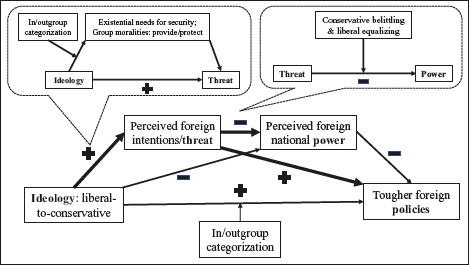
As noted above, there is overwhelming empirical evidence in both qualitative and quantitative studies of foreign policy and IR that conservatives/the right generally prefer tougher foreign policies than do liberals/the left. We thus anticipate an overall positive (+) direct relationship between (conservative) ideology and (tougher) foreign policies. 1
Moderators
But what about exceptions to the rule, when liberals desire tougher foreign policies than conservatives? We propose that in different national historical and sociopolitical contexts, specific in/out-group social categorization processes will moderate the impact of ideology on foreign policy preferences. ‘Self-categorization theory’ (SCT; e.g., Perdue et al., 1990; Turner, 1987) describes the mechanisms and consequences of social identification, such as depersonalizing and self-stereotyping oneself into salient social in-groups (such as gender, race and nation) and homogenizing out-groups. Categorizing the self as part of a larger ‘we’ or ‘us’ is done through contrast against salient others: ‘them’.
Individuals vary substantially in how they define ‘we’ and ‘them’ in different social contexts. The ‘readiness’ or ‘relative accessibility’ of pre-existing personal values and needs interact with the ‘fit’ of salient social categories (Oakes, 1994). Comparative fit entails the categorization of individuals into distinct groups to the extent that intragroup differences are seen to be smaller on average than intergroup differences within the salient comparative context. Normative fit refers to how meaningfully the relevant social categories distinguish between ‘us’ and ‘them’ (Turner et al., 1994).
Drawing on SCT, we suggest that categorizations of ‘us’ and ‘them’ in the international context (i.e., national identity) will also be variable, fluid and context dependent—and that ideology may shape both the ‘readiness’ and ‘fit’ of different national in/out-group categorizations. Ideologically motivated interactions of readiness and fit will shape when liberals or conservatives are more likely to include specific foreign countries within their national in-groups.
Sequential Mediators
Extant research in psychology strongly suggests that the perception of threat should mediate the relationship between ideology and foreign policy preferences, and between ideology and perceptions of power. Based on this literature, the top-left of Figure 1 anticipates positive (+) relationships between conservatism and the perception of threat from threat to tougher policies, and, against Machtpolitik, a negative (–) relationship between perceived threat and power. We begin with the proposed sequence and then discuss each relationship in turn.
Susan Fiske’s influential stereotype content model (SCM) maintains that stereotypes and their attendant intergroup emotions are the products of assessments of an out-group’s warmth or intentions (IR, read: threat) and competence (IR, read: power). For instance, the elderly are typically stereotyped as friendly (high warmth) but incapable (low competence), so pitied. The rich, by contrast, are commonly stereotyped as capable (high competence) but unfriendly (low warmth), so envied (e.g., Cuddy et al., 2008).
Critically for IR, the SCM further maintains that judgements of an out-group’s warmth/intentions (threat) are both causally prior to judgements of competence (power)—and more consequential (hence the thicker line in Figure 1 from threat to policy than from power to policy). Approaching another individual or group, we first ask, ‘Do they intend to help or harm us?’ Only then do we ask, ‘Can they carry out these intentions?’ We do not, as power politics approaches in IR suggest, start with the latter ‘How powerful?’ question. ‘From an evolutionary perspective’, Cuddy et al. (2008, p. 89) argue, ‘The primacy of warmth makes sense because another’s intent for good or ill matters more to survival than whether the other can act on those goals’.
This functionalist logic is well supported by empirical research on stereotyping. For instance, at the individual level, evaluations based on warmth tend to be strong and stable, while those based on competence are weaker—and often dependent upon accompanying warmth information (Wojciszke et al., 1998). This is why threat precedes power in our serial mediation model, rather than the other way around (as power politics approaches in IR would suggest).
Threat
That ideology powerfully shapes how threatening foreign countries are perceived to be (Figure 1, left) is overdetermined by extant theories in social and moral psychology. First, in social psychology, John Jost and his colleagues have long argued that conservatives are more threat-sensitive than liberals (e.g., Jost et al., 2009). There is an ‘elective affinity’, Jost (2017, p. 184) argues, ‘between needs to reduce fear and threat, on one hand, and conservative ideology, on the other’. A recent metanalysis of 134 samples across 16 countries revealed significant positive correlations between perceptions of threat and conservatism (r = 0.12–0.31). Exposure to threatening events like terrorist attacks, furthermore, was associated with ‘conservative shift’ at both individual (r = 0.07–0.14) and aggregate (r = 0.29–0.66) levels of analysis (Jost et al., 2017).
Second, moral and evolutionary psychologists have explored the underlying drivers of ideological differences in threat sensitivity. Liberals adhere to a group-based morality of social justice, a prescriptive, approach-based moral motive to ‘provide’. Conservatives, by contrast, uphold a group-based morality of social order, a proscriptive, avoidance-based moral motive to ‘protect’ (Janoff-Bulman, 2009). Provide/protect group moralities shape threat perception: Liberal social justice fosters cooperation to improve group welfare, while conservative social order facilitates coordinated responses to threats (Janoff-Bulman & Carnes, 2016, Studies 1 & 2).
Natural selection may favour societies that balance both group moralities, allowing them to thrive in both high- and low-threat environments (Janoff-Bulman & Carnes, 2016, Study 3). When the world is dangerous, it is adaptive to be threat-sensitive. In the absence of danger, however, excessive threat sensitivity can become maladaptive, wasting resources on unnecessary defences and forfeiting opportunities for beneficial intergroup cooperation.
For IR, this substantial scholarship in social, moral and evolutionary psychology suggests that ideologically motivated differences in existential needs for security, and in group moralities to provide or protect, together powerfully mediate the relationship between ideology and threat perception as the magnified call-out at the top left of Figure 1 reveals.
The call-out also suggests that the moderating effect of in/out-group social categorization on the relationship between ideology and foreign policy discussed above has its effect on this link in the mediation model. In specific bilateral contexts, liberals and conservatives may define ‘we’ and ‘them’ differently, motivating their perceptions of national threats. The general tendency for conservatives to perceive other countries as more threatening will not apply if the country in question is seen as one of ‘us’.
Power
Might ideology also shape the very perception of national power, subsequently shaping foreign policy preferences? ‘If you are a hawk in your attitude toward other nations, you probably think they are relatively weak and likely to submit to your country’s will’, Nobel Prize-winning cognitive psychologist Daniel Kahneman (2011, p. 103) speculated a decade ago. ‘If you are a dove, you probably think they are strong and will not be easily coerced’. Given that conservatives are more likely to be foreign policy hawks, and liberals doves (e.g., Dueck, 2010), might conservatives, counterintuitively, be more likely than liberals to see foreign countries as weak?
Figure 1 anticipates negative (–) relationships between conservatism and the perception of foreign countries as powerful, and between perceived power and tougher policies (we are less inclined to attack the powerful). The thinner lines indicate that we anticipate the mediated relationship between ideology and foreign policy to be weaker through perceived power than through perceived threat.
The call-out at the top right of Figure 1 further suggests that conservative ‘belittling’ and liberal ‘equalizing’ biases 2 together contribute, counterintuitively, to a negative (–) impact of perceived threat on perceived power. Where power politics approaches in IR suggest a positive (+) impact of power on threat, we reverse both the causal direction and its valence: Rather than fear more powerful nations, we are motivated to dismiss the power of those we are suspicious of.
First, conservatives (vs liberals) may be more motivated to belittle the power of threatening others, making them more responsive to desired applications of force. In a fascinating pair of experiments, Holbrook and colleagues recently found that American and Spanish conservatives were more likely than liberals to view individual terrorists as less physically formidable (Study 1: height; Study 2: overall body size/muscularity), and thereby more easily defeated through force. Importantly, this ‘Gulliver effect’ was mediated by confidence that each country could use force to thwart terrorism (Holbrook et al., 2017). In another experiment, conservatism significantly predicted perceiving an in-group ally fighting against ISIS as relatively more intelligent than an ISIS terrorist (Holbrook et al., 2018). For IR, this psychological scholarship suggests that conservatives (more than liberals) may be more ideologically motivated to belittle the power of threatening foreign countries.
Second, an emerging psychological literature suggests that a morality of social justice may motivate liberals to equalize group differences. For instance, in a moral dilemma forcing a participant to sacrifice an individual for the greater good, White liberals (but not conservatives) were significantly more likely to sacrifice an individual with a stereotypically White name than one with a stereotypically African American name (Uhlmann et al., 2009). Desires to rectify social injustice may also motivate liberals to discount evidence of innate group differences because of their perceived moral implications (Anomaly & Winegard, 2020), elevating subordinate groups.
Similarly, White liberals (but not conservatives) ‘competence-downshift’ with African–American (but not White) interaction partners. While well-intentioned, patronizing behaviours like ‘dumbing-down’ diction inadvertently reinforce stereotypes of African–Americans as unintelligent (Dupree & Fiske, 2019, p. 600). If liberals ‘competence-downshift’ their own behaviours when interacting with groups that they like but perceive as weak/victimized, might they also ‘competence-upshift’ in their assessments of those same out-groups? For IR, might liberals (vs conservatives) be motivated to ‘power-upshift’ their assessments of the national power of foreign countries that they view favourably, equalizing IR?
In short, nascent work in psychology suggests that conservative belittling and liberal equalizing biases together strengthen a negative correlation between the perceived intentions/threat and power of foreign countries.
In sum, this literature review and our flowchart suggest three hypotheses.
H1: Perceived intentions/threats mediate the relationship between ideology and foreign policy preferences. H2: In/out-group social categorization processes moderate the impact of ideology on foreign policy preferences. H3: Ideologically motivated perceptions of threat are (a) causally prior to, (b) more consequential than and (c) negatively related to perceptions of power.
We now turn to our three plausibility probe case studies to explore whether survey data support these hypotheses.
Study 1: US Liberals, Conservatives and the World
YouGov implemented a US Internet survey for us in spring 2011. They used a ‘sample matching’ methodology (see Ansolabehere & Rivers, 2013) to generate a representative national sample of 1,000 adults, first matching them on gender, age, race, education, party identification, ideology and political interest, and then weighting the final dataset to match the full US general population on age, gender, race, education and religion.
The survey included questions measuring each of the four variables in our model: ideology, intentions/threat, national power and foreign policy. First, we operationalized political ideology with responses to two questions that cohered extremely well. Our survey asked, ‘Do you consider yourself to be more liberal or conservative?’ Participants selected a point on an unmarked (0–100) placement ruler anchored by ‘very liberal’ on the left and ‘very conservative’ on the right. YouGov also provided responses to a similar item that their panellists had earlier answered during routine updating of their demographic profiles. The two items were standardized and averaged, creating a unidimensional liberal-to-conservative ideology scale of outstanding internal reliability (r = 0.86, α = 0.93), attesting to the remarkable consistency of ideological self-placement among the US public (Gries, 2017).
Second, following Fiske’s SCM, we used warmth/favourability to measure ‘intentions/threat’. Our YouGov survey asked, ‘On a 0° to 100° “feeling thermometer,” with 0° meaning a very cold, unfavourable feeling, 50° meaning neither warm nor cold, and 100° meaning a very warm, favourable feeling, how do you feel about the following countries?’ The 15 countries were Brazil, China, England, France, Germany, Haiti, India, Iran, Israel, Japan, Mexico, North Korea, Pakistan, Russia and South Korea. The average American felt slightly cold/unfavourable towards the 15 countries overall (M = 45.54°, SD = 14.20).
Third, we operationalized national power with separate question grids about the military and economic power of the same 15 foreign countries. ‘Compared to most countries, how powerful do you think the following countries are militarily/economically?’ On a 1–7 Likert scale from ‘extremely weak’ to ‘extremely strong’, the average country was seen as neither militarily weak nor strong (M = 4.30, SD = 0.67) and neither economically weak nor strong (M = 4.04, SD = 0.66). Haiti was seen as the weakest (M = 1.99, SD = 1.25) militarily and China as the strongest (M = 5.61, SD = 1.14). Haiti was also perceived as the weakest economically (M = 1.83, SD = 1.18) and China as the strongest (M = 5.60, SD = 1.19). A perceived ‘comprehensive national power’ scale was created by averaging these assessments for each of the 15 countries. The mean foreign country was seen as neither weak nor strong (M = 4.17, SD = 0.61), with Haiti (M = 1.91, SD = 1.13) the weakest and China (M = 5.60, SD = 1.60) the strongest.
Fourth and finally, foreign policy preferences towards the same 15 countries were measured with the question, ‘Should the US government adopt friendlier or tougher foreign policies towards the following countries?’ Response choices were on a 1–7 Likert scale from ‘much friendlier’ to ‘much tougher’. Overall, Americans desired neither friendlier nor tougher foreign policies (M = 4.08, SD = 0.76), with the friendliest polices towards the UK (M = 3.03, SD = 1.28), and the toughest towards Iran (M = 5.50, SD = 1.42).
Did ideology divide American perceptions of foreign threats, power and foreign policy preferences? As anticipated in Figure 1, ideology correlated positively (r = 0.24, unless otherwise noted, all ps <.001), with foreign policy preferences towards the 15 countries as a whole. At the individual country level, conservatism was positively associated with tougher policies towards 10 countries, friendlier policies towards two (the UK and Israel, a remarkable r = –0.42) and was uncorrelated for three.
Ideology exhibited the even stronger and positive relationship with perceived intentions/threat anticipated in Figure 1. Overall, conservatives viewed the 15 countries as much more threatening than liberals did (r = 0.33). Of the 15 countries, 14 correlated positively, with Mexico and France tied at the top (r = 0.39). Israel was the sole exception, with conservatives feeling much warmer towards it than liberals did (r = –0.33).
Finally, across all 15 foreign countries, ideology correlated with perceived comprehensive national (military and economic) power negatively (r = –0.23): Conservatives (vs liberals) viewed them as substantially less powerful. At the individual country level, conservatives viewed 14 of the 15 countries as less powerful than liberals did, with the absolute size of the correlation for France (r = –0.33) the largest. As the epigraph from Henry Kissinger suggests, conservatives often appear motivated to belittle the power of countries they wish to dominate.
There was an important exception to the rule, however: The correlation between ideology and perceived power was positive for Israel (r = 0.12)—conservatives viewed Israel as slightly more powerful than liberals did. Given the dramatically opposed effects of ideology on American evaluations of French and Israeli intentions and power, and policy preferences, we decided to explore these two extreme cases as plausibility probes.
Conservative Francophobes and Liberal Francophiles
The French Revolution is the godless antithesis to the founding of America.
—Ann Coulter (2011, p. 129)
How does ideology shape American attitudes towards France? In addition to the feeling thermometer item for France, our YouGov survey also included two 7-point dis/agree items derived from Fiske’s SCM.
I feel admiration/respect towards France. (reverse coded) I feel irritated/annoyed by France.
The three items were standardized and averaged together, creating a robust (α = 0.85) scale of perceived French intentions/threat. We can, therefore, be more confident that our mediation analyses will not simply correlate measurement error, reducing the likelihood of type II error.
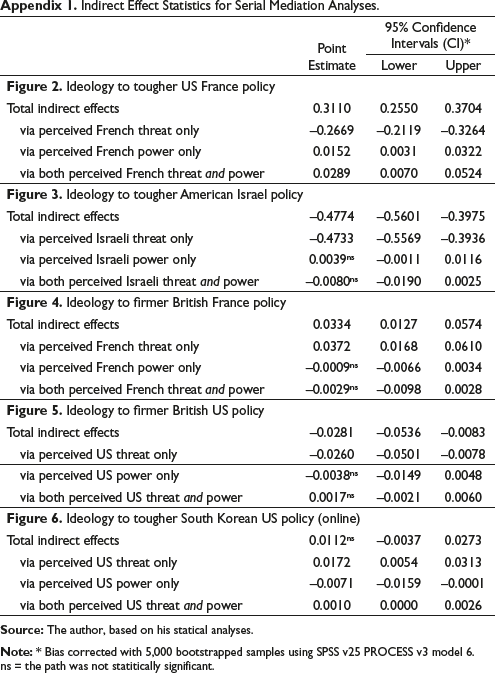
Figure 2 displays a flow chart in which perceived French threat (three item scale) and national power (two item) sequentially mediate the relationship between ideology (two item) and policy preferences towards France (single item). Mediation analysis revealed that all three indirect paths were statistically significant, together reducing the direct effect (β = 0.22) to non-significance (β = –0.01, p =.79).
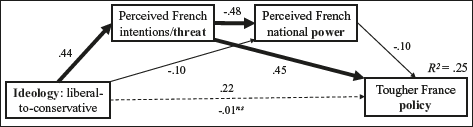
Importantly, the path via perceived threat alone accounted for a remarkable 24% of the 25% of variance in policy preferences captured by the model. The two indirect paths through perceived French national power, though statistically significant, only contributed 1% of unique variance. In short, greater average American conservative (than liberal) desires for a tougher France policy were overwhelmingly accounted for by their vastly greater antipathy towards France.
So why do American liberals and conservatives perceive French intentions so differently? The magnitude of the effect (β = 0.44, Figure 2, left) suggests that it is overdetermined. In general, as noted above, greater conservative than liberal needs for security, and a group morality of social order, predispose them to feel cooler/warier towards all foreign countries. In the case of France, specific dimensions of American ideology appear to heighten such ideological predispositions (Gries, 2014). For instance, while cultural conservatives (e.g., the Christian Right) view France, particularly Paris, negatively as a symbol of atheism and hedonism, cultural liberals are more likely to view France positively as a beacon of progressive values like tolerance. Economic ideology furthers divides Americans over France, with business conservatives averse to its redistribution of capital and economic liberals drawn to the French social welfare state. In short, American images of France as ‘secular’ and ‘socialist’ likely sharpen in/out-group boundaries between America and France for conservatives but blur them for liberals, further polarizing their feelings towards France—and policy preferences.
The path from perceived French intentions to national power (β = –0.48, Figure 2, top centre) was both extremely large and negative: Greater perceived threat was associated with much less perceived power. This finding turns the core power politics claim in IR that nations fear the powerful on its head. How should it be interpreted? As the epigraph above from pundit Ann Coulter suggests, American conservatives may belittle France and its power, motivated to dominate a country they do not like. The Republican decision to rename French fries as ‘freedom fries’ in the US House cafeteria in 2003, following French opposition to Republican President George Bush’s ‘War on Terror’, is similarly suggestive of a conservative impulse to belittle the French. Motivated to equalize group differences and seek diplomatic solutions, American liberals, for their part, may power-upshift a France they view as friendly and cooperative.
David or Goliath? Conservative and Liberal Views of Israel
To stand against Israel is to stand against God.
—Reverend Jerry Falwell (1980)
It will be a tragedy—for the Israelis, the Palestinians, and
the world—if peace is rejected and a system of oppression,
apartheid, and sustained violence is permitted to prevail.
—Former Democratic President Jimmy Carter (2006)
Of all 15 countries measured in the US survey, only Israel exhibited a negative correlation between ideology and intentions (r = –0.33) and between ideology and power (r = –0.12). And the relationship between ideology and foreign policies was only negative for the UK (r = –0.12) and Israel (r = –0.42). Compared to liberals, in short, American conservatives viewed Israel much more favourably, as slightly more powerful, and desired a much friendlier Israel policy.
What can we learn from this major Israeli exception to the rule of greater conservative suspiciousness and toughness? In addition to the feeling thermometer item for Israel, our YouGov survey also included the same two 7-point dis/agree items derived from Fiske’s SCM that were used for France.
I feel admiration/respect towards Israel. (reverse coded) I feel irritated/annoyed by Israel.
The three items were standardized and averaged together to create a robust (α = 0.88) scale of perceived Israeli intentions.
In addition to the friendlier-to-tougher foreign policy item, our YouGov survey also included two 1–7 dis/agree items.
Our government should adopt a more supportive and obliging foreign policy towards Israel. (reverse coded) The US government should implement a more severe and uncompromising policy towards Israel.
The three items were averaged together into a ‘tougher Israel policy’ scale of excellent internal reliability (α = 0.88).
Figure 3 displays the results of a statistical analysis in which perceived Israeli intentions/threats (three item) and national power (two item) sequentially mediate the relationship between ideology (two item) and Israel policy preferences (three item). Only the indirect effect via Israeli intentions was statistically significant, alone accounting for a remarkable 45% of the variance in Israel policy preferences. The two paths running through perceived Israeli power were not statistically significant.
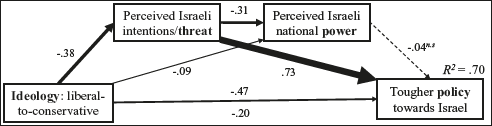
How should this powerful mediating role of perceived Israeli intentions be interpreted? As the first epigraph above from Reverend Jerry Falwell suggests, one reason may be greater biblical literalism on the religious right: According to the Book of Revelation, the Israelites must occupy the land of Palestine before Christ’s Second Coming. This contributes to an affinity for Israel among fundamentalist Christians. ‘We are indivisible, we are bound together by the Torah’, televangelist and founder of Christians United for Israel (CUFI) John Hagee declared at the American Israel Public Affairs Committee (AIPAC) annual meeting in 2007. ‘The roots of Christianity are Jewish. We are spiritual brothers’. For many fundamentalist Protestants, Israelis and Americans are one—reversing the general pattern of greater conservative suspiciousness towards foreigners.
The conservative view of America as a ‘New Israel’ also has a libertarian dimension: (Israeli) freedom resisting (Arab) tyranny. ‘I stand before you today, in solidarity, as an Israeli of the heart’, then House majority leader Tom DeLay (R-Texas) declared to the Israeli Knesset in 2003. ‘The solidarity between the United States and Israel … is the universal solidarity of freedom’. Greater libertarianism thus appears to contribute to more secular American conservatives viewing Israel as less ‘foreign’: more ‘we’ than ‘them’, so deserving of full American protection.
Supporting this interpretation, our YouGov survey also included two patriotism items, ‘I love my country’ and ‘I am proud to be American’ (r = 0.85). Feelings towards Israel (r = 0.25) and England (r = 0.17) were the only ‘foreign’ countries patriotism correlated positively with. Ideologically motivated social categorization appears to lead many conservatives to merge American and Israeli identities.
American liberals, meanwhile, appear more likely to view Israel as oppressing the Palestinians, so distance themselves from Israel and feel more coolly towards it. As the second epigraph above from former US President Jimmy Carter suggests, many liberals view the fate of Palestinians in the West Bank and the Gaza Strip as akin to apartheid: separate and decidedly not equal.
Although perceived Israeli power did not mediate the relationship between ideology and policy, there was a strong negative relationship (β = –0.41, Figure 3, top centre) between perceived threat and power. Greater warmth towards Israel is associated with a conservative overestimation and/or liberal underestimation of Israeli power. The former is reminiscent of the experimental finding reported above that conservatism predicted overestimations of an ally combatant’s relative intellect (Holbrook et al., 2018). Viewing Israel as a close ally, American conservatives appear to ‘upshift’ their assessments of Israeli power.
A liberal underestimation of Israel power is reminiscent of the finding that White liberals (but not conservatives) are significantly more likely to sacrifice an individual from a dominant than a victim’s group (Uhlmann et al., 2009). Liberal coolness towards an Israel seen as oppressing the Palestinian people could contribute to a ‘liberal belittling’ of Israeli power. ‘A morality of obedience and authority contributes to a conservative view of Israel as David and the surrounding Muslim world as Goliath’, writes Peter Gries (2015, p. 56). ‘Moralities of compassion and justice, by contrast, contribute to a liberal view of the Palestinians as David resisting an oppressive Israeli Goliath’. Perhaps desires that a Palestinian David prevail motivate liberals to belittle the power of an Israeli Goliath.
In sum, Study 1 reveals that, in general, American conservatives, higher on existential needs for security and motivated to protect social order, are much more suspicious of foreign countries than liberals are—and desire tougher foreign policies towards them. This general tendency is accentuated in cases like France, where ideologically motivated images of France as ‘secular’ or ‘socialist’ heighten intergroup boundaries for conservatives while blurring them for liberals. When conservatives blur inter-nation boundaries, such as viewing America as the ‘New Israel’, however, the general rule of greater conservative threat sensitivity does not apply, and conservatives desire the friendlier policies.
Study 2: The British Left, Right and the World
Can our model travel across the Atlantic? In spring 2014, YouGov was hired to implement an Internet survey in the UK. They first matched British adults on gender, age and ideology using a frame constructed from the 2011 Eurobarometer. The final sample of 1,000 adult British citizens was then weighted to match the full UK general population on age, gender and education.
Our UK survey included similar questions to the US survey, measuring each of the four variables in our model: ideology, intentions/threat, power and foreign policy. First, political ideology was measured with responses to two left–right questions that cohered extremely well (r = 0.85) after standardization. ‘When it comes to politics, do you consider yourself more to the “left” or “right”?’ Respondents selected a point on an unmarked (0–100) ruler anchored by ‘more to the left’ and ‘more to the right’. YouGov also provided answers to their separately gathered (1–11) profile question, ‘In political matters, people talk of “the left” and “the right.” How would you place your views on this scale, generally speaking?’
Second was ‘intentions/threat’. The UK survey asked, ‘Country feeling thermometer. How do you feel about the following countries? (1 = very cold, unfavourable; 11 = very warm, favourable)’ of 21 foreign countries: France, Germany, Poland, the USA, China, Japan, North Korea, South Korea, India, Pakistan, Israel, Russia, Brazil, South Africa, Spain, Italy, Turkey, Cuba, Australia, Namibia and Vietnam. Transformed into a 0°–100° thermometer, the average Briton felt rather coolly towards the 21 foreign countries overall (M = 41.62°, SD = 14.69°), with Australia (M = 65.84°, SD = 22.36°) the warmest and North Korea the coolest (M = 15.80°, SD = 18.94°).
Third was perceived power. The UK survey included a single item, ‘How economically powerful are the following countries? (1 = very weak; 7 = very strong)’. The eight foreign countries were France, Germany, the USA, China, Japan, Brazil, Russia and India. They were perceived, on average, to be strong economically (M = 4.73, SD = 0.82), with the USA the strongest (M = 5.66, SD = 1.23) and Brazil the weakest (M = 3.61, SD = 1.22).
Fourth and finally, foreign policy preferences towards 15 foreign countries were measured with the question, ‘What foreign policy stance should the British government adopt towards the following countries?’ (1 = ‘very conciliatory’ and 7 = ‘very firm’). The average Briton desired the firmest policy towards North Korea (M = 5.06, SD = 1.90), and the most conciliatory policy towards Germany (M = 3.95, SD = 1.55), though this was right at the scale midpoint.
Did ideology divide Britons in their views of foreign threats, power and foreign policy preferences? Again consistent with Figure 1, conservative ideology correlated positively (r = 0.10) if weakly with firmer foreign policy preferences towards the 15 foreign countries as a whole, and towards 10 individual countries (France the most, r = 0.20), more conciliatory policies towards just one (Israel, r = –0.09), and was uncorrelated for four. Overall, the British right prefers tougher foreign policies than the British left, consistent with our model.
Ideology also exhibited the mostly positive relationship with perceived intentions/threat anticipated in Figure 1. Overall, the British right viewed the 21 foreign countries as more threatening than the left did (r = 0.13). Of the countries, 15 correlated positively, with Cuba (r = 0.25) and France (r = 0.20) the strongest, just two negatively (Israel and the USA) and four were uncorrelated. The average member of the British right (vs left) tends to see foreign countries as more threatening.
Finally, ideology only correlated with the perceived economic power of one of the eight foreign countries: France (r = –0.07, p =.03). The average correlation for the eight countries was negative but not significant (r = –0.04, p =.18).
Given the opposed effects of ideology on British attitudes towards France and the USA, we decided to explore them further.
Britain’s Francophile Left and Francophobe Right
Figure 4 displays the results of a statistical analysis in which perceived French intentions and economic power sequentially mediate the relationship between ideology (two items) and policy preferences. Only the indirect effect via perceived French threat was statistically significant and accounted for nearly a quarter (23%) of the direct effect. Greater desires for a firmer France policy on the British right (vs left) were partially accounted for by their greater antipathy towards France. Assessments of French power had no effect on policy preferences.
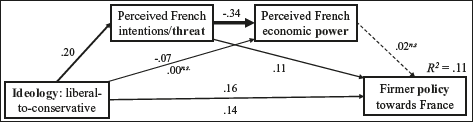
Perceived French economic power was, however, strongly and negatively (r = –0.39) associated with perceived French threat, again reversing the conventional Machtpolitik wisdom that people fear powerful countries. Indeed, another mediation analysis with perceived power as the dependent variable revealed that the negative correlation (r = –0.07, p =.03) between ideology and power was reduced to non-significance (r = –0.00, p =.96) when mediated by perceived threat. The British right (vs left) viewed France as less (vs more) powerful because they saw France as more threatening. Either the British right belittled the power of a France it disliked and wished to dominate or the British left boosted the power of a France it liked.
These findings are consistent with our model: The British right (vs left) wanted a firmer France policy, and this was best explained by motivated perceptions of threat—not perceptions of power.
Anti-Americanism Left and Right?
What the [Americans] want to see... is a confident free-trading Britain able to do its own deals.
—Boris Johnson (cited in Elgot, 2018)
What can we learn from the American exception to the rule? Anti-Americanism in Europe often unites the left and right. In post-war Britain, conservatives were alarmed by the threat US mass culture posed to ‘civilized’ British values, while the left decried the effects of global capitalism (embodied by the USA) on working-class British communities (Wilford, 2007, pp. 23–43).
It is thus unsurprising that there was no direct relationship between ideology and US policy preferences in our 2014 UK data. Mediation analysis is nonetheless justified for theory development (see Rucker et al., 2011). Figure 5 reveals a significant indirect effect via perceived US intentions: The British left was more ambivalent about American intentions than the British right, contributing to desires for a firmer US policy. And once again, perceived US power had no impact on policy preferences (r = 0.03, p =.31).
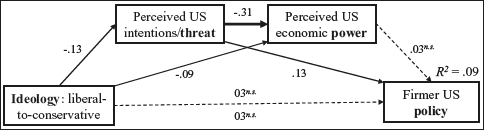
Self-categorization processes may best explain this US exception: why the British left felt cooler and the right warmer towards the USA (r = –0.13, p <.001). On the left, Labour antipathy towards the USA became more visible under the Trump administration. ‘Theresa May should not be rolling out the red carpet for a state visit to honour a president [Trump] who rips up vital international treaties, backs climate change denial, and uses racist and misogynist rhetoric’, Jeremy Corbyn declared on 26 April 2019.
The British and American right, for their part, frequently see themselves in each other. ‘Good man, [Boris Johnson], he’s tough and he’s smart’, Donald Trump declared in 2019. ‘They call him “Britain’s Trump”’. As the epigraph above from Boris Johnson suggests, the British right often saw itself and found affirmation for Brexit in Trump’s ‘America first’ rhetoric. In short, the British right appear more likely than the left to include the USA in their in-group ‘we’, accounting for the US exception to the rule of greater right wariness towards the foreign.
Study 3: South Korean Liberals and Conservatives
Can our model travel beyond the West to Asia? The Korea Institute for National Unification (KINU) has been conducting annual surveys on unification and North Korean issues since 1992. The 2020 KINU survey was conducted through face-to-face interviews from 20 May to 10 June. Sampling on gender, age and region, 1,003 South Korean adults participated, resulting in sample with a ±3.1% sampling error.
The 2020 KINU survey included items measuring each of the four variables in our model: ideology, intentions/threat, power and foreign policy. First, political ideology was directly measured with: ‘On a scale of 0 to 10, where 0 is the most liberal, 5 is moderate, and 10 is the most conservative, where would you place yourself?’ (매우 진보를 0, 중도를 5, 매우 보수를 10이라고 할 때, 자신의 이념성향이 어디에 가깝다고 보시나요? 0에서 10 사이의 숫자로 답해 주십시오.) There were also two 0–100 ‘very negative’ to ‘very positive’ thermometers for the major conservative (United Front) and liberal (Democratic) political parties in South Korea: ‘How do you feel about the following major political parties in Korea?’ (귀하는 우리나라의 주요 정당에 대해 어떻게 생각하십니까? ‘매우 부정적’은 0점, ‘호의적이지도 부정적이지도 않음’은 50점, ‘매우 호의적’은 100점이라고 했을 때, 귀하의 호감도를응답해주십시오.) Subtracting the latter from the former created a ‘favours the conservative party’ score. It was averaged together with the liberal-to-conservative item, creating a two-item conservatism score which cohered well (r = 0.54), suggesting that a unidimensional liberal-to-conservative ideology scale is meaningful in at least some countries in East Asia.
Second was intentions/threat: KINU measured South Korean feelings of dis/like towards North Korea, South Korea, China, Russia, Japan and the USA on an 11-point scale: ‘How much do you like or dislike the following countries on a scale of –5 to 5, where –5 is ‘strongly dislike’, 0 is ‘neither like or dislike’ and 5 is ‘strongly like?’ (귀하께서는 ___을 얼마나 좋아하는지 혹은 얼마나 싫어하는지 -5점에서 5점 사이의점수를 매겨주십시오. -5점은 매우 싫어하는 것을, 5점은 매우 많이 좋아하는 것을의미합니다.) The average South Korean liked South Korea (M = 3.15, SD = 1.57) and the USA (M = 0.97, SD = 1.93) the most and Japan the least (M = –2.52, SD = 2.02).
Third was national power: The 2020 KINU Unification Survey asked participants to assess the military and economic power of the same six countries on continuous 1 = ‘very weak’ (매우약함) to 7 = ‘very powerful’ (매우강함) scales. ‘For this question, we are not interested in your personal beliefs. Instead, how powerful do you think the typical South Korean thinks that the following countries are militarily/economically?’ (귀하께서 보시기에, 일반적인 한국 사람들은 아래 각 국가들의 군사력이 어느 정도로 강하다고생각합니까?) Averaging the two items together for each country created a national power scale. In 2020, South Koreans viewed the USA as the strongest (M = 6.15, SD = 0.78) and North Korea as the weakest (M = 2.20, SD = 0.58).
Fourth was foreign policy. The KINU survey was limited in terms of policy questions, but it did include one 5-point dis/agree item about cooperation with the USA: ‘South Korea needs to actively cooperate with the USA to help maintain the USA–led global order, not only in matters related to the Korean peninsula but also on other international issues’. (한국은 한반도 주변 문제뿐만 아니라 다른국제문제에서도 미국 주도의 세계질서 유지에적극적으로 협력해야 한다.) The average South Korean somewhat disagreed (M = 3.41, SD = 0.83).
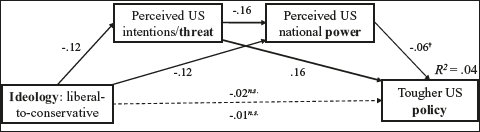
Did ideology shape South Korean attitudes towards foreign countries? Conservatives liked the USA (r = 0.12) and Japan (r = 0.13) more than liberals did, but disliked North Korea (r = –0.15) more. There was no correlation between ideology and intentions/threat for China and Russia. Conservatives viewed the USA (r = –0.10), Russia (r = –0.11) and China (r = –0.08, p =.01) as less powerful than liberals did, and there was no correlation for Japan and North Korea.
Figure 6 is a final path model in which perceived threat and power sequentially mediate the relationship between ideology and policy. As in the British US case (Figure 5), there was no direct relationship between ideology and policy. All three indirect paths, however, were statistically significant. The path via perceived threat alone, importantly, explained seven times as much variance in policy preferences than did the two paths through perceived power. Once again, perceived threat trumped perceived power in shaping foreign policy preferences.
Conclusion: How Ideology Shapes War and Peace
Taking a deep dive into psychology and IR, we proposed an integrated model of major mediators and moderators of the impact of political ideology on foreign policy. We then conducted three plausibility probes of the model with nationally representative survey data from the USA (2011), the UK (2014) and South Korea (2020). By maximizing variation both between and within our case studies, we hoped to generate hypotheses worthy of further exploration.
H1: Perceived intentions/threat mediate the relationship between ideology and foreign policy preferences. Strongly supported. Across all three empirical case studies, conservatives generally viewed foreign countries as more threatening than liberals did and subsequently desired tougher policies towards them. This is consistent with work in psychology on greater conservative needs for security (e.g., Jost, 2017) and a protective group morality of social order (e.g., Janoff-Bulman & Carnes, 2016) among conservatives.
H2: In/out-group social categorization processes moderate the impact of ideology on foreign policy preferences. Supported. Across our case studies, exceptions to the H1 rule of greater conservative threat perceptions and tougher policies appeared to be driven by a blurring of the boundaries between in- and out-groups (e.g., Turner, 1987). For instance, when US conservatives (vs liberals) view America as a ‘New Israel’, Israel is incorporated within the US ‘we/us’ and is viewed favourably, and friendlier policies are preferred.
H3: Ideologically motivated perceptions of threat are (a) causally prior to, (b) more consequential than and (c) negatively related to perceptions of power. Partially supported. H3A was supported by theory, but not our data. All of our plausibility probes used cross-sectional data, so we cannot make strong claims about causal direction. H3B was supported. In all of our mediation models, threat consistently trumped power in predicting foreign policy preferences. Indeed, in most models, perceived power had no effect on foreign policy preferences at all once motivated perceptions of threat were accounted for. H3C was supported. In all of our empirical case studies, perceived threat and power were substantially and negatively related to one another. Against reductionist power politics approaches that assume a positive relationship—states fear more powerful states—we found that greater perceived threat was associated with less perceived power. This supports Kahneman’s intuition that when we are hawkish towards a country, we will belittle its power to justify our hawkish policy preferences towards it.
The data did not support, however, our proposed conservative belittling and liberal equalizing mechanisms. The ‘Gulliver effect’ (Holbrook et al., 2017) may be ideologically neutral: Conservatives have a greater tendency to belittle the power of most foreign countries, which they usually view as more threatening than liberals do. But when the boundary between in/out-group is blurred, such as with Israel for US conservatives, and the USA for British and South Korean conservatives, conservatives may engage in motivated power-upshifting. And when in/out-group boundaries are hardened, such as with Israel for US liberals, belittling biases may motivate liberal power appraisals. In/outgroup categorization processes can lead both liberals and conservatives to fall prey to either equalizing and belitting biases in approaisng power.
Additionally, the 2020 Korean plausibility probe suggests that when measures of liberal-to-conservative ideology cohere outside of the West, their effects on foreign policy preferences are similar.
Future Directions
H1 was well supported empirically, and is overdetermined theoretically, so is the least in need of follow-up study. Ideology powerfully shapes foreign policy preferences (and subsequently IR) by motivating our assessments of threat.
H2 was supported but requires greater theoretical elaboration and empirical testing. In the international context, how exactly does ideology motivate the interaction of psychological ‘readiness’, on the one hand, and the comparative and normative ‘fit’ of national in/out-group categories, on the other? In other words, how does ideology shape the perceived ‘foreignness’ of other countries, distinguishing ‘us’ from ‘them’?
H3A could not be interrogated with our cross-sectional data. Experimental, longitudinal or other causal designs are needed to confirm that perceptions of national threat are causally prior to perceptions of national power, as SCM findings in other domains strongly suggest.
H3B was well supported—pit against one another, perceptions of threat consistently trump power as a predictor of policy preferences—so does not require urgent attention.
H3C was the most substantially and consistently supported. Given its counterintuitive nature—we do not fear the powerful, we belittle those we fear—H3C perhaps deserves the most sustained attention to counter the reductionist power-centrism of much realist IR. More attention can also be paid to whether ideology directly drives the belittling ‘Gulliver effect’—or if it is an indirect consequence of ideologically conditioned threat assessments.
Further non-Western plausibility probes are also warranted.
Returning to the opening epigraph, the motivated belittling of Vietcong power and resolve Henry Kissinger articulated likely contributed to the American quagmire in Vietnam. To maximize peace in the 21st century, and minimize conflict, a better understanding of how ideology motivates liberal and conservative appraisals of both threat and power remains urgently needed.
Indirect Effect Statistics for Serial Mediation Analyses.
Data Availability
Replication data is available from the author.
Footnotes
Declaration of Conflicting Interests
The author declared no potential conflicts of interest with respect to the research, authorship and/or publication of this article.
Funding
The author received no financial support for the research, authorship and/or publication of this article.
