



Abstract
The aim of this study is to determine the perceptions of social work undergraduate students about homeless people. In this qualitative research study, a phenomenological approach and metaphor analysis technique were used. The data were analysed by the metaphor analysis method, and categories and themes were formed. Metaphors were collected in seven categories: emotions, nature, animals, objects, street, disadvantaged groups and negative attitudes. While some of the metaphors emphasised the characteristics of individuals, others emphasised structural inequalities. Students liken homeless people to disadvantaged groups. This is followed by metaphors related to nature, negative attitudes and animals, respectively.
Introduction
Organising private life outside the home environment, preferring or being forced to live without a home, is a situation that disturbs people and societies. Homelessness is increasing day by day as a multidimensional, variable and conceptually uncertain social public health problem with socio-economic and political effects (Ersin and Baş, 2021; İlhan and Ergün, 2010; Özdemir, 2010), and the number of homeless people is increasing. For example, according to the U.S. Department of Housing and Urban Development (2022), it has been reported that more than half a million people experience homelessness in the USA in any one day. According to Tsai et al. (2017) the majority of the US society spends a period of their lives homeless, even for a short time. Today, more than 20 percent of the world’s population lives in inadequate housing, and according to United Nations data, more than 100 million people are homeless (Başer, 2020).
Since the socio-economic, political and cultural conditions of each country are different from each other, the perspectives on homelessness are also different (Crane et al., 2006; O’Flaherty, 1996; Salhi et al., 2017). Therefore, conceptual unity has not been achieved in research on homelessness and homeless people (Nies and McEwen, 2022). In the most basic sense, homelessness is the lack of a regular, permanent sleeping place at night (Acar et al., 2022; Genç, 2023; Nies and McEwen, 2022; Plumb, 2000). According to Simmel (2009), homelessness is the issue of people living in common areas in metropolitan cities and unable to meet their housing needs due to poverty. Giddens (2012), on the other hand, expresses homelessness as a natural consequence of social exclusion and conceptualises it as being away from daily life practices. While individuals who are deprived of these opportunities are defined as homeless, they usually continue their lives on the streets, on the beach, in transport terminals and abandoned buildings (Macknee and Mervyn, 2002; Yağan, 2009).
Although there are many reasons for homelessness, reasons such as family relationships, insufficient/low income, addiction, criminal history, mental and physical illnesses can be counted major ones (Acar et al., 2022: 353; Çakmak and Gökgöz, 2023; Ersin and Baş, 2021: 44; Farrell et al., 2003; Hope and Young, 1986; Milburn et al., 2017; Özkazanç-Dinçer, 2020; Rice et al., 2008; Roth and Bean, 1986; Schanzer et al., 2007). For these and similar reasons, homeless people face many psycho-social and physical problems compared to other individuals in the society (Çabuk et al., 2023; Davila et al., 2018; Fazel et al., 2014; Ferguson et al., 2015; Hewett et al., 2011; Hwang, 2001; Korkut-Owen and Demirbaş-Çelik, 2018; Özkan-Kıranç, 2020; Slesnick et al., 2018). In solving these problems, there is a need for multi-service applications that include comprehensive support beyond emergency response and shelter provision (Ji, 2006). The homeless people who struggle to solve these problems have extremely limited access to services. The negative perceptions, attitudes and behaviours of professionals towards the homeless may cause them to refrain from service requests. In addition, when homeless people access services, they might then withdraw due to serious distrust of service providers (Liu and Hwang, 2021).
Homeless people carry a potential risk for other segments of the society both because they are individually disadvantaged and because they live on the street. As a profession that cares about social integration and the well-being of disadvantaged groups, social work makes important contributions in this field. It is important that social workers are equipped to perform this important task for society. In order to perform such an important task that affects the society so much, it is important that social work professionals are equipped. The education received by social workers/social worker candidates (students) should allow them to learn their profession correctly and professionalise (Payne, 2020).
The education that social work students will receive is important in terms of their perceptions, attitudes and behaviours towards client groups (Arif et al., 2013; Barron, 2008; Green and Repetti, 2015; Tsai et al., 2015; Wilkins and Balakrishnan, 2013; Wright et al., 2015). Homeless people are one of the social groups that are deprived of their rights within the demographic structure and experience many problems in multiple ways. Since they are disadvantaged, they are the natural interlocutors of the social work profession. Therefore, the perceptions and attitudes towards homeless people of students who will be social workers in the future are an important issue to study (Bassuk et al., 1984).
The aim of this study is to examine the views of social work students about homeless people through metaphor analysis. Metaphor analysis is a way of extracting meaning from concepts or texts and is used to illuminate the subject studied through intuition (Pitcher, 2013; Schmitt, 2005). In this context, the focus of the research is to reveal the attitudes and perceptions of social work undergraduate students towards the homeless.
Method
This study was structured according to a phenomenological design, which is a of qualitative research approach. Phenomenological design focuses on phenomena that the person is aware of but does not have an in-depth and detailed understanding of. Relevant phenomena can emerge as experiences, events, perceptions, concepts, orientations and so on. Although people encounter them during the day, this does not mean that they have adequately grasped them (Yıldırım and Şimşek, 2016). Phenomenological studies reveal how people define, perceive, experience and characterise this phenomenon by emphasising the ‘phenomenon’ to be researched (Tekindal and Uğuz Arsu, 2020). For this reason, a phenomenological design can be preferred in studies where the researcher aims to gain in-depth knowledge about a phenomenon or event (Çarpar, 2020). A metaphor is a linguistic structure used to express a situation, relationship and similarity that cannot be expressed exactly (Güneş and Fırat, 2016). In studies where metaphor analysis is conducted, metaphors are revealed through one or more questions to which open-ended answers will be given (Yıldırım and Şimşek, 2016). The information obtained from the participants in the metaphor analysis, which has the goal of ‘understanding understanding’, reveals their unique expressions and more personal data (Güneş and Fırat, 2016).
Working group
In this study, the participants were determined by convenience sampling, which is one of the non-random sampling methods. Convenience sampling aims to prevent loss of time, money and labour (Büyüköztürk et al., 2018). The original sample consisted of 332 volunteer students from Sakarya University’s Department of Social Work. However, since 30 sets of data were invalid, the number of participants studied was 302.
Data collection
The questionnaire created by the researchers included questions about socio-demographic characteristics, educational status and a single question about homeless people. The question related to the relevant social group was ‘In my opinion, homeless people are like . . .. Because…’ Before the data were collected, the participants were informed about the metaphors. In order to understand the related study, the students were asked: ‘In my opinion, the elderly are like plane trees. Because they are both rooted and experienced.’ In this context, the participants were asked to write the ‘first’ metaphor that came to their minds about the homeless.
Analysing the data
The data obtained were evaluated through descriptive and metaphor analyses. IBM SPSS Statistics 21 package programme was used for frequency distribution of categorical variables and descriptive analysis of other numerical descriptive data. Metaphor analysis was carried out in four stages:
Coding of data,
Determination of main themes,
Classification of codes and main themes and
Analysing the data (Yıldırım and Şimşek, 2016).
The metaphors reported by the participants were separated according to their themes, and each metaphor was evaluated under a specific theme. Frequencies were obtained for the metaphors classified according to metaphor analysis and percentage values were calculated. The themes classified were evaluated under seven headings according to their content. These are: emotion, nature, animal, object, street, disadvantaged group and negative attitude. Each metaphor was analysed one by one by the researchers and the categories were finalised by placing them under the most appropriate theme according to their content. In order to better understand each theme, examples are given using the participants’ metaphors.
Results and analysis
In this section, first, the information about the socio-demographic characteristics of the social worker candidates is presented numerically. Ninety-two percent of the participants were women, and 8% were men; 25% of the participants were 1st year, 22% were 2nd year, 29% were 3rd year and 24% were 4th year students. The majority of the participants (89%) defined their economic status as medium.
Half of the participants (50%) stated that they rarely encountered homeless people, 31% stated that they sometimes encountered homeless people and 12% stated that they never encountered homeless people. In addition, although 65% of the participants had not taken an undergraduate course on homelessness, 35% stated that they had taken an undergraduate course in this field. More than half of the participants (56%) stated that they had previously obtained information about homeless people from different sources.
Metaphors produced by prospective social workers
As a result of the study, it was seen that 193 different metaphors were produced by the participants. The metaphors frequently produced by the participants are as follows: scattered/dried leaves/orphan tree (34), baby/child (23), dark/black (14), turtle/snail without shell (9), mirror (7), book/book without cover (5), ghost (4), nothing (3), nomad (3), broken/broken item (3), puzzle piece (2) and wind (2).
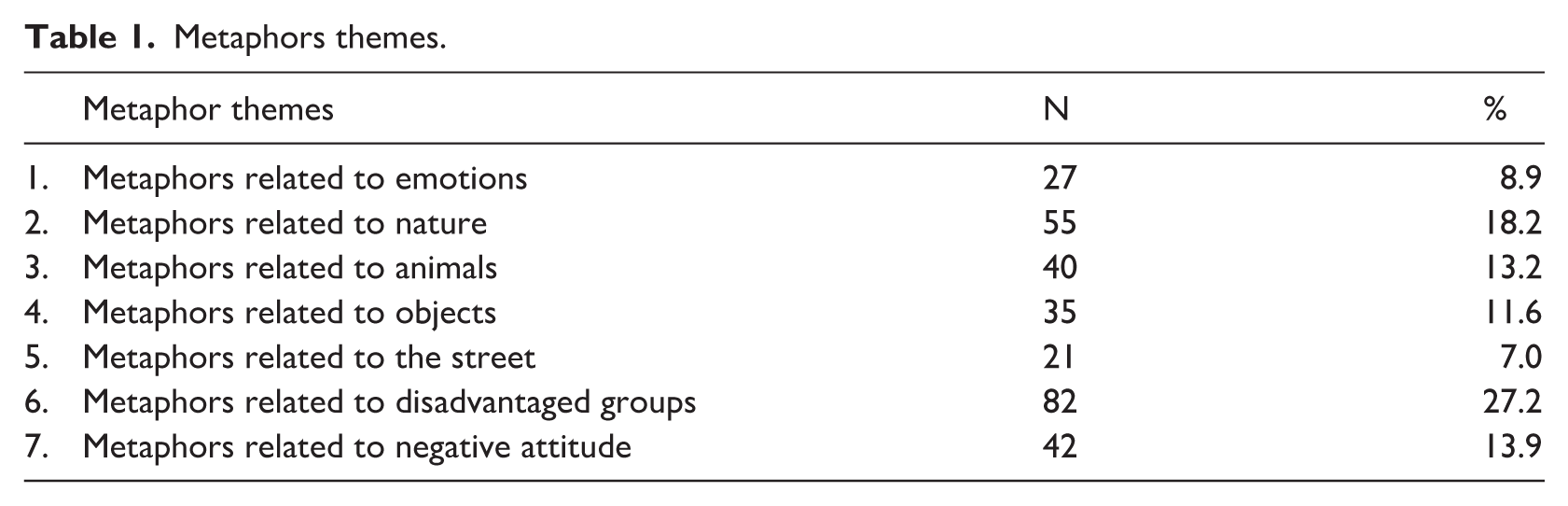
According to Table 1, in the first six themes, there are metaphors where the participants recognise the negativities related to homelessness, emphasise the need for shelter of the homeless and that the problem experienced is system-related. In the seventh metaphor group, it is seen that the participants blame people for the problem of homelessness or have negative attitudes and perceptions about the homeless. In this context, it is seen that 86.1% of the participants are upset about the problems experienced by the homeless and criticise social policies for this situation, while approximately 1 in every 10 participants (13.9%) has a negative attitude towards the homeless.
Metaphors themes.
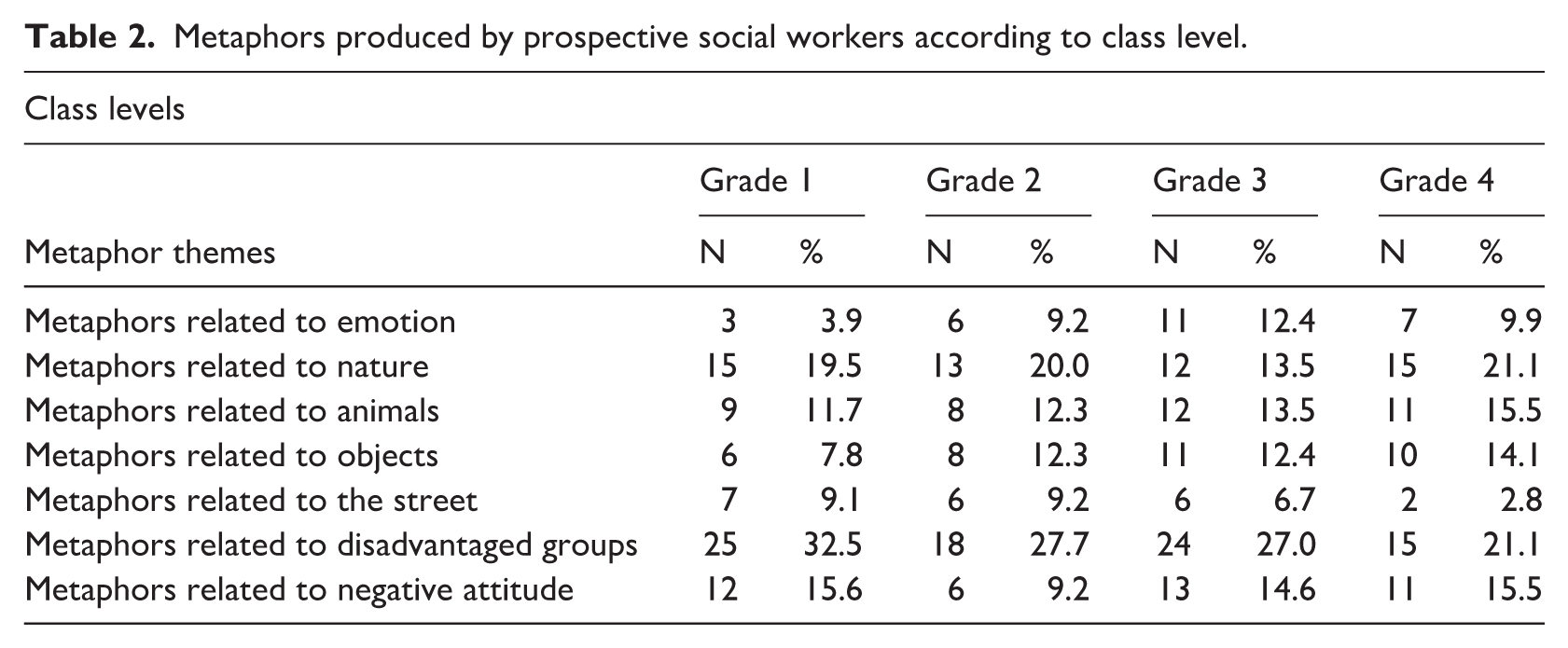
According to Table 2, when the metaphors related to the homeless are analysed at the class level, the participant group that feels sorry for the situation experienced by the homeless, criticises the system for this situation or focuses on the deprivations experienced by the homeless consists of second grade students (90.8%). This rate is followed by first graders (88%), third graders (85.4%) and fourth graders (84.5%), respectively. Although inclusive attitudes towards homeless people are at the forefront at every grade level, the fact that those expressing the most negative attitudes are senior students is among the unexpected results of this study. It is thought that this situation is due to the fact that first- and second-year students evaluate the problems experienced on the axis of ‘compassion’ because they do not have sufficient knowledge, skills and values of the social work profession. On the other hand, it can be said that third- and fourth-grade students evaluate the situation at the level of individual, system and social policy while examining social problems, and therefore criticise all three structures. Nevertheless, it is thought that studies are needed to include different groups in social work education and to reduce negative attitudes towards these groups.
Metaphors produced by prospective social workers according to class level.
Theme 1: Metaphors related to emotions
In 27 of the metaphors produced by the participants, homelessness was likened to emotions. Among these emotions, loneliness and helplessness were mostly used. Some of the metaphors produced under this theme are as follows: To me, homeless people are like loneliness. Because they are the people who stay on the street when everyone goes home (P82). In my opinion, homeless people are helpless because everyone wants a shelter, it is a need and if they cannot provide it, they are helpless (P225). In my opinion, homeless people are desperate. Because if there was another possibility, they would not prefer this situation (P258).
Theme 2: Metaphors related to nature
Elements of nature were utilised in 55 of the metaphors produced by the participants. Some of the metaphors produced under this theme are as follows: In my opinion, homeless people are like plants that are doomed to rot. Because they do not have a family and social environment to water them, that is, to support them (P13). It is like a leaf blowing in the wind because generally it is the lonely and idle people who are blown away in social life, so to speak. Different from people who have a material and spiritual family, who belong to a place, spontaneous, on the basis of interest, in order to close some emotional or material deficits, social environment can be acquired. There are not very healthy relationships and behaviours (P24). To me, homeless people are like a dried up tree because their dried up and scattered leaves need to be watered, but they need to be healed from the root in order to grow green again (P144). In my opinion, the homeless are like a tree that has shed its leaves in autumn. Because there are no ties, roots and branches left to hold on to. It could not withstand the cold and harsh living conditions brought by life and broke off from its branch. Wherever the wind blows, the leaf is scattered there. Because there is no tree left to take care of it (P192). Like a cactus. Because they usually stay away from social life. While trying to protect themselves, they stay away from people and at the same time people stay away from them (P279).
Theme 3: Metaphors related to animals
In 40 of the metaphors produced about the homeless, the homeless were likened to animals. Some of the metaphors under this theme are as follows: In my opinion, homeless people are like a turtle without an outer shell because when they are in a narrow, unprotected and insecure situation, they are as helpless as a turtle without a shell on its back and are open to all kinds of dangers (P113). In my opinion, homeless people are like a turtle without a shell. Because turtles have difficulty in surviving without their shells and they feel peaceful and safe thanks to their shells. Homeless people also feel unprotected without a home (P122). To me, homeless people are like snails without a shell because they have no home to live in (P224). To me, homeless people are like stray dogs. Because when I think of a homeless person, I see them as cold, damaged (violence, etc.), lonely, excluded and an event that touches our conscience and compassion (P284). It is like a stray animal because it is constantly under threat (P318).
Theme 4: Metaphors related to objects
In 35 of the metaphors analysed within the scope of the study, homeless people were likened to various objects. Some of the metaphors produced under this theme are as follows: In my opinion, homeless people are the shampoo left at the bottom of the bottle. Because people either don’t care about it or fill it with water to reach it and lose its value (P7). It is like a missing piece of the jigsaw puzzle, because it is a missing piece for society, we must ensure that they participate in society in a healthy way, are not excluded, have material and moral values like individuals with normal families etc. (P33). In my opinion, homeless people are like a broken part of the machine. Because they could not be a part of the rotating wheel, they were excluded and stigmatised (P145). To me, homeless people are like a patched sweater. Because I believe that what people struggling in the difficult conditions of the street think about is not their clothes but their struggle for life (P260). For me, homeless people are like a mirror. Because they reflect the selfishness and character structure of the society (P98). For me, homeless people are like a mirror because they reflect the deficiencies in a country’s society (P307).
Theme 5: Metaphors related to the street
In 21 of the metaphors analysed, the homeless were likened to the street/street elements. Some of the metaphors under this theme are as follows: It is like a map. Because their homes are on the streets, they know everywhere (P67). For me, homeless people are like street lights because they are recognised at night (P89). They are like the real owners of the world because they are in charge of all the streets (P298). Homeless people are like dead ends because new problems arise as they try to cope with the problems (P300). To me, homeless people are no different from stones on the street. Because they are defenceless. Someone may take them by the hand and make their lives better (like painting a stone), while others may not care at all and push them with the tip of their foot (P316). It is like a street lamp that is not lit. Because they exist to illuminate the darkness, but no one can come to help to fix them, maybe they are not even noticed among all the street lamps (P331).
Theme 6: Metaphors related to disadvantaged groups
In 82 of the metaphors produced by the participants, homeless people were likened to disadvantaged groups. Some of the metaphors under this theme are as follows: To me, homeless people are like ghosts. Because in remote corners they are not recognised or even ignored by most people (P27). In my opinion, homeless people are like babies. Because they are the masses that should be treated as delicate as babies and their needs should be met even if they cannot tell their needs. It is necessary to support healthy individuals in every aspect for the society (P28). To me, homeless people are like orphans. Because I think they are completely excluded by the society (P74). To me, homeless people are like cold. Because they are far away from family warmth, home warmth, warm behaviour of society and other people, hope and trust (P108). To me, homeless people are like the colour black. Because black colour swallows everything and makes it look like it does not exist. Even though the homeless exist in society, they act as if they don’t exist. They swallow and hide themselves. It destroys its existence (P140). In my opinion, homeless people are like people who are pushed out of the society because the fact that they are homeless separates them from the people who live under one roof and discrimination continues in this way (P230).
Theme 7: Metaphors related to negative attitude
In 42 of the metaphors, analogies containing negative attitudes towards the homeless were made. Some of the metaphors under this theme are as follows: It is like a chronic disease. Because the remedy is known but it does not get better (P32). To me, homeless people are like beggars. Because mostly poor people live on the streets (P36). To me, homeless people are like Afghans because they both smell (P213). To me, homeless people are like odours because I don’t think they do proper body cleaning (P252). It is like an infertile soil because it does not benefit itself, nor does it benefit the flowers (children) to be planted on it, and it cannot raise them in a healthy and beautiful way (P291).
Discussion
Homelessness is not only an economic problem but also a multifaceted social and public problem with psychological, social and cultural dimensions (Hinton, 2017) as one of the major threats to the general welfare (Duncan et al., 2022). Psychological traumas, domestic problems, violence, health problems, economic deprivation, low level of education, lack of self-realisation, substance abuse, mental illnesses, unemployment and inadequate housing supply are the main factors that cause people to become homeless. (Balun and Şişman, 2022; Çakmak and Gökgöz, 2023; Horsell, 2002; Işıkhan, 2006; Morton, 2020). These reasons can be caused by individual, interpersonal or structural reasons (Raitakari, 2020) is emphasised. This situation shows that homelessness is a problem that needs to be analysed from different angles.
The unfavourable living conditions of homeless people cause them to suffer poor physical and mental health early (Duncan et al., 2022; İlhan and Ergün, 2010). For example, alcohol and drug abuse and mental health problems are very common among homeless people (Mantell, 2023; Thurman et al., 2022). Homeless people experience vulnerability, negative self-perception, hopelessness, health problems, problems of access to health services and social exclusion. (Herman and Manuel, 2017). For this reason, homelessness is within the field of study of many professions and disciplines. One of the professions and disciplines that develop and implement interventions to solve the problems experienced by homeless people is the field of social work.
In this study, in which the perceptions about homelessness of social work students, who are expected to work directly with the problem of homelessness in the field, were examined through metaphor analysis, metaphors produced by university students about homelessness were grouped under seven themes: 27 of the metaphors as ‘metaphors related to emotions’, 55 of them as ‘metaphors related to nature’, 40 of them as ‘metaphors about animals’, 35 of them as ‘metaphors about objects’, 21 of them as ‘metaphors about streets’, 82 of them as ‘metaphors about disadvantaged groups’ and 42 of them as ‘metaphors about negative attitudes’.
Homeless people often experience loneliness and despair (Rokach, 2010; Somerville, 2013). In this study, loneliness and helplessness were the most frequently used metaphors under the theme of ‘metaphors related to emotions’. In the literature, there are studies in which homeless people are likened to snails and turtles (Aronson, 2021; Dumbleton, 2005). Similarly, in this study, it is seen that the participants preferred metaphors such as street animals, turtles and snails in ‘metaphors related to animals’. In ‘metaphors related to the street’, the participants likened the homeless to street elements such as maps, dead ends, street lamps, stones and the owner of the streets. In a similar metaphorical study, it is seen that homelessness is described as ‘dead-end street’ or ‘rock pile’ (Raitakari, 2020). This shows that the metaphors related to the homeless are concentrated on metaphors such as helplessness, loneliness and dead-end streets.
There are negative perceptions about homeless people in society (Akyıldız, 2022; Küçük, 2018; Yeter, 2018). A large part of society resents homeless people and is indifferent to their plight (Kooken et al., 2014). People avoid communicating with homeless people because they find them dangerous, which causes them to remain uncertain and unknown, and images of them as dirty, dangerous, disturbing, substance addicted and mentally ill (Ostrow, 1995; Seo et al., 2021) become permanent. Participants described homeless people with metaphors such as mould, disease, beggar, darkness in ‘Metaphors related to negative attitude’. Homeless individuals constitute a vulnerable group at risk of accidents, diseases, harassment and attacks (Sipahi and Aslan, 2021). In ‘metaphors related to disadvantaged groups’, metaphors such as vulnerable child, baby, marginalised, ghost and cold were used.
There is a negative perception that the situation homeless people are in is due to their personal characteristics and that they prefer this life (Feen-Calligan, 2008; Knecht and Martinez, 2009). In this study, the participants’ negative metaphors about the homeless are similar to the views expressed in another study conducted with university students that the homeless are ‘lazy’, ‘not working enough’ individuals and the negative perceptions of nurse candidates who have never provided services to homeless individuals about the homeless (Kooken et al., 2014; Phillips, 2015).
When we look at the metaphors produced by university students about the homeless, it is seen that there are references to structural problems such as helplessness, devaluation by society, inability to adapt to society and marginalisation by society, which are caused by the system rather than homeless individuals. In metaphors such as lazy, useless, disease and mould, the personal characteristics of the homeless people come to the fore as the reason for their situation. It is seen that the participants who stated the phenomenon of homelessness in a negative way by referring to personal characteristics are especially fourth-grade students. Similarly, when the perceptions of social work students in China on human welfare values such as rights, social justice and fair resource distribution were measured, it was observed that the most negative statements were given by senior students (Lou et al., 2006). It is thought that this situation is due to the fact that fourth-grade students have developed their knowledge in the field of social work; they can look at the problem in a multidimensional way with the dimensions of knowledge, skills, values, system and policy.
Conclusion and recommendations
Homelessness is a problematic situation in terms of individual and social welfare. Homelessness caused by individual, interpersonal or structural reasons brings along inappropriate living conditions, health problems, negative self-perception and social exclusion. One of the professions and disciplines that play an active role in solving the disadvantages experienced by this group is social work. The perceptions and attitudes of social workers, who are professionals in their field, towards the homeless are important in terms of putting their professional knowledge into practice and designing appropriate intervention programmes for the homeless. In this study, which was carried out to determine the perceptions of university students about the homeless, it was seen that the metaphors produced were related to emotions, nature, animals, objects, streets, disadvantaged people and negative attitudes.
Loneliness, helplessness, scattered leaves, rootless tree, unwatered flower, street animals, turtle, snail, mirror, patched sweater, old item, missing piece of the puzzle, map, dead end, street lamp, stone, owner of the streets, mould, disease, beggar, darkness, defenceless child, baby, marginalised, ghost and cold were the prominent metaphors. While some of the metaphors emphasised the characteristics of individuals, others emphasised structural inequalities.
The perceptions and attitudes of the professional staff in this field towards the homeless are important for the success of the practices aimed at enabling the homeless to continue their lives independently, ensuring their social cohesion and empowerment. In this context, students should be encouraged to include homelessness and street life in their curricula and to gain field experience in social responsibility projects for the homeless. In addition, it is recommended that the same study be repeated with different study groups in order to provide more data to the literature.
According to these results, it is considered important for social worker candidates to prepare theoretical/practical course contents that will direct students’ attitudes and perceptions towards homelessness and homeless people positively and increase their knowledge and experience through social responsibility projects in which students will actively participate.
Supplemental Material
sj-docx-1-isw-10.1177_00208728261424202 – Supplemental material for Metaphorical analysis of social worker candidates’ perceptions of homeless people
Supplemental material, sj-docx-1-isw-10.1177_00208728261424202 for Metaphorical analysis of social worker candidates’ perceptions of homeless people by Yusuf Genç, Hülya Yildiz, Cengizhan Aynaci, Zeynep Atalay and Hüseyin Zahid Kara in International Social Work
Footnotes
Acknowledgements
The authors thank the participants for their sincere and open communication.

Ethical considerations
A permission letter dated 02.02.2023 and numbered 54 was obtained from the Ethics Committee of Sakarya University in order to carry out this research.
Funding
The authors received no financial support for the research, authorship, and/or publication of this article.
Declaration of conflicting interests
The authors declared no potential conflicts of interest with respect to the research, authorship, and/or publication of this article.
Data availability statement
Statement on the use of generative AI
The authors declare they did not use artificial intelligence tools at any stage of the preparation of this article.
Supplemental material
Supplemental material for this article is available online.