




Abstract
While research has explored challenges faced by transnational social workers, the role of language testing and policy requirements remains underexamined. This article draws on a doctoral longitudinal study exploring professional identity development among international social work students and graduates in Australia, with a focus on English language policies. Findings highlight three key themes: (1) a sense of othering and powerlessness, (2) language testing as a barrier and stressor and (3) increased vulnerability and financial burden. By addressing this gap, the study makes a unique contribution to the limited research on how English language testing and policies shape professional identity in a globally mobile profession.
Introduction
International migration, driven by complex factors such as economic conditions, demographic trends and political climates, has become a significant component of global economic development and population growth (United Nations Department of Economic and Social Affairs, Population Division, 2024). Professionals in healthcare trained overseas and international students in higher education are often classified as high-skilled migrants, who are widely welcomed by countries around the world for their contributions to the local economy and their role in addressing skills shortages in host nations (Rajan, 2022). With the rise in global mobility, social workers have more opportunities to cross borders and practise professionally in countries outside their own (Bartley and Beddoe, 2018). In the context of social work being fundamentally a ‘language-centred activity’ (Harrison, 2006: 402) and social workers being ‘language workers’ (Hall and Valdiviezo, 2020: 17), language barriers and communication challenges are commonly experienced by migrant social workers during their transition into practice in host countries (Hussein, 2014; Peter et al., 2022). Notably, due to cultural factors, regional language variations and differences in terminology used within social work practice (Hakak et al., 2022; Simpson, 2009; Sims, 2012), these challenges may arise regardless of the dominant languages spoken in these social workers’ home and host countries.
Social workers practising outside their home countries or where they obtained their social work qualifications have been described as ‘migrant’ (Hussein et al., 2011), ‘transnational’ (Bartley and Beddoe, 2018; Peter et al., 2022), ‘international’ (Hanna and Lyons, 2014), ‘cross-border’ (White, 2006), ‘overseas’ (Simpson, 2009), ‘overseas-qualified’ (Fouché et al., 2016) and ‘internationally-qualified’ (Sims, 2012). However, the complex nature of their international mobility defies such single descriptors that reflect only their migrant status, country of qualification or context of practice. Similarly, the term ‘international graduates’ refers to social workers who completed their qualifying education as international students and may or may not remain in the host country to practise as professional social workers (see Battaglia et al., 2023, 2024; Yao and Flynn, 2025a, 2025b). In this article, given the fact that no single term captures an internationally mobile social worker, various terms are used to reflect the nuances of social work practice in the age of global mobility.
While migrant-receiving countries are becoming more linguistically diverse, monolingual policies and a strong preference for English remain prevalent in the so-called Anglophone nations (Harrison, 2006; Lucas, 2016; Matsuda and Duran, 2013). For instance, all prospective migrant social workers must demonstrate ‘high standards of English proficiency’ (Healy, 2018: 210) to qualify for skilled migration to Australia, even though, as of 2021, more than a quarter of Australia’s population was born overseas, and 22.8 percent spoke a language other than English at home (Australian Bureau of Statistics, 2022). As highlighted by Harrison (2006), the Victoria Climbié Inquiry in the United Kingdom illustrates the increasing complexity of social work practice in a linguistically diverse society where vulnerable populations may face additional barriers to access mainstream support due to limited competence in the dominant language of English. Bi-/multi-lingual social workers are uniquely positioned to support linguistically diverse populations, drawing on their lived experiences as members of ethnic and linguistic minority communities and of communicating in a lingua franca, such as English, which they often use as an additional language (Hall and Valdiviezo, 2020; Harrison, 2007). However, a monolingual lens, which often frames limited proficiency in the dominate language as a barrier or personal deficit (Harrison, 2007), means that bi- and multilingualism often remain unrecognised or devalued within social work, a profession that otherwise advocates for diversity (International Federation of Social Work [IFSW], 2025).
Even though social work is increasingly recognised as a global profession (Bartley and Beddoe, 2018), individuals seeking to practise in a new country face multiple challenges. For instance, transnational and migrant social workers in Canada have reported a lengthy immigration process and difficulties in obtaining recognition of foreign credentials from the regulatory bodies (Brown et al., 2018; Pullen Sansfaçon et al., 2014), which can negatively affect social workers’ employability in the host countries (Hussein et al., 2011). These negative experiences may also affect migrant social workers’ professional identity, which is shaped by lifelong professional socialisation and a sense of belonging (Moorhead et al., 2025).
Furthermore, with most literature on transnational social work focusing on individuals who migrate as already-qualified professionals (Bartley and Beddoe, 2018), there remains limited understanding of the experiences and perspectives of those who complete their social work education abroad prior to pursuing skilled migration (Battaglia et al., 2023, 2024). A meta-ethnographic review conducted by Yao (2021) highlights the multifaceted impact of language on professional identity among international social work students. In particular, English proficiency was identified as a critical factor influencing the development of professional identity within this cohort. To fully consider social work as a global profession, it is essential to explore how language is positioned within the profession, particularly through the use of English language testing in contexts like Australia, where colonial legacies and Whiteness continue to influence social work practice (Healy, 2018; Vincent, 2023) and intersect with the institutional racism faced by migrant social workers, contributing to their exclusion from full participation in the profession (Harrison, 2018). To contribute to this area of understanding, this article explores the question: ‘What factors influence international students’ sense of professional identity during social work education and as they transition into practice?’ with particular attention to the impact of English language policies on this cohort within the context of Australian social work.
The Australian context
In 2010, the Australian government established the National Registration and Accreditation Scheme, along with the Australian Health Practitioner Regulation Agency (Ahpra), to regulate health professionals in 10 disciplines (Healy, 2018). Although the scheme has expanded over the years and currently regulates practitioners in 16 health disciplines, such as medicine and psychology (Ahpra, 2025a), certain professions, including social work and dietetics, remain self-regulating in Australia (Healy, 2018). In 2021, the South Australian Government introduced a Social Work Registration scheme (Social Workers Registration Board of South Australia [SWRB SA], n.d.), which had not commenced at the time of this publication. Once commenced, it would make social work a registered profession in the state of South Australia, while it remains unregistered across the rest of Australia.
As the profession’s peak body, the Australian Association of Social Workers [AASW], publishes the Code of Ethics (AASW, 2020a) and Practice Standards (AASW, 2023a), which both adhere to the IFSW’s (2025) global definition of social work and highlight social work as a profession committed to respect for persons, social justice and empowerment of people. The AASW also publishes the Australian Social Work Education and Accreditation Standards (AASW, 2024), which are used to accredit all qualifying social work programmes in Australia. According to the standards, all admitted students must demonstrate sufficient English proficiency to participate in academic study and engage effectively in practice-based learning. International students are additionally required to achieve a minimum score of 7.0 or higher in each component of the International English Language Testing System (IELTS) Academic test (listening, reading, writing and speaking), or its equivalent, before commencing a qualifying programme, unless they have previously completed their final year of high school (Year 12) or a higher qualification in English (AASW, 2024). All graduates of these accredited programmes, regardless of their academic or linguistic performance or their Australian citizenship status, are eligible for the AASW membership (AASW, 2025a).
Individuals seeking to migrate to Australia as social workers are required to obtain a positive skills assessment from the AASW, which is the nominated assessing authority for the social work profession (AASW, 2025b). This skills assessment involves a distinct process, fee and set of criteria, including international qualification assessment and English language requirements (AASW, 2019a, 2025b), and is separate from the AASW membership eligibility. In the 2021–2022 and 2022–2023 reporting periods, the AASW completed 769 and 764 international qualification assessments, respectively (AASW, 2022, 2023b). The majority of applicants were either overseas-qualified social workers or international graduates who had completed an AASW-accredited programme in Australia (AASW, 2022). These figures represent an increase compared to pre-COVID years – 701 assessments in 2018–2019 (AASW, 2019b) and 711 in 2019–2020 (AASW, 2020b) – indicating a sustained interest and demand for skilled migration within the Australian social work profession.
As part of the skills assessment, prospective migrant social workers must fulfil the terms of the AASW’s English Language Policy (AASW, 2019a) and demonstrate English language proficiency via the IELTS Academic. They are required to achieve a minimum overall score of 7.0 in one or two sittings within 6 months, with no component score below 6.5 in each test and at least 7.0 in each of the four components (listening, reading, writing and speaking) from one or two tests. Their test results ‘must be obtained within three years prior to submitting for an AASW qualification assessment’ (AASW, 2019a: 1).
The AASW English language policy is applicable to all prospective migrant social workers, including international graduates who completed an AASW-accredited social work course in Australia and whose English skills were assessed prior to their admissions to the AASW-accredited programmes and who automatically gain eligibility for the AASW membership upon their course completion. Under the policy, exemptions are given to those who have completed their secondary education with English as the medium of instruction in Australia, Canada, New Zealand, the Republic of Ireland, South Africa, the United Kingdom or the United States of America and have completed at least 3 years of full-time tertiary study (bachelor’s degree or higher), which was taught and assessed in English in one of the countries listed above (AASW, 2019a).
Nearly two decades ago, Harrison (2006, 2007) advocated for greater linguistic diversity in Australian social work, highlighting the link between colonisation and the global dominance of English, as well as the continuing privileges enjoyed by native English speakers in an era of globalisation and international mobility. More recently, Papadopoulos (2017, 2018) cautioned ethical issues arising when the process of professional recognition acts as a gatekeeping mechanism, where additional English language requirements are imposed in the skills assessment but not included in the criteria for professional membership in general. Despite the concerns raised, the AASW English language policy and its implications receive little scholarly attention (Papadopoulos, 2017, 2018) which may reflect the Anglo-majority within the Australian social work profession, who have ‘failed to appreciate the significance of language issues because they are not directly affected by such concerns’ (Harrison, 2007: 80).
The use of the IELTS for English language testing has long functioned as a gatekeeping mechanism for immigration to Australia (Hawthorne, 1997; Read, 2022). This has raised ethical concerns regarding cost to test takers (Frost, 2021; Hawthorne, 1997) – with test takers currently charged between AUD$475 and $545 per test (IDP IELTS, 2025) – profits for testing authorities (Hamid et al., 2019a, 2019b) and a deficit-focus of migrants with non-English-speaking backgrounds (Frost, 2021), affecting social cohesion (Hoang and Hamid, 2016). Similarly, the widespread use of IELTS testing in both academic and non-academic settings has drawn significant criticism (Roever and McNamara, 2006), especially as research across the globe identifies inconsistent scoring and questionable validity and reliability of the test results, including commonly applied validity periods (Hamid et al., 2019a, 2019b; Pearson, 2019; Read, 2022). For example, Pilcher and Richards (2017: 14) warn that IELTS, which is designed to assess ‘decontextualized and neutralized’ English, is unsuitable for evaluating contextual language preparedness, including social work professional interaction (Grieve et al., 2023). Frost (2021) notes the current use of language testing for immigration lacks credibility and risks de-skilling prospective migrants who prioritise testing over professional employment. Read (2022: 692) adds that using IELTS for non-academic purposes is ‘ill-advised’ especially with the inconsistent validity of the test results across all four IELTS components. This draws attention to what Roever and McNamara (2006) describe as the social and political functions of language testing to differentiate insiders/outsiders within a group, where language tests, including IELTS, are used by the government and professional organisations to meet their own needs (Read, 2022).
Papadopoulos (2018) argues that the process of recognition, in the context of skilled migration and international mobility, constitutes a form of social work practice, and the professional associations conducting these assessments are bound by the same ethical principles underpinning the profession. However, the use of English language testing in the context of professional recognition has received little attention (Harrison, 2018). As Healy (2018: 215) observed, within the self-regulatory model, powerful groups tend to ‘serve their own interests rather than those of the vulnerable with whom they are practicing’. It may be argued that, without scrutiny, the current language policy risks simply serving the interests of the Anglo-majority in Australia as well as the native English speakers who ‘hold a privilege position on the world stage’ (Harrison, 2006: 409).
Compared to the English language requirements set by the Australian Government Department of Home Affairs (2025), Ahpra (2025b) and other self-regulating professional bodies such as Dietitians Australia (n.d.), the AASW’s policy provides fewer pathways and only one test option (i.e. IELTS Academic) for demonstrating English language proficiency. The AASW also imposes more stringent IELTS score requirements for prospective migrant social workers than many other professional bodies in Australia. As an example, while social workers must achieve a minimum IELTS score of 7.0 in writing (AASW, 2019a), medical practitioners and psychologists registered with Ahpra (2025b) are only required to attain a score of 6.5. Furthermore, although the AASW conducts skills assessments on behalf of the Australian government, its language policy does not align with immigration policy, which recognises the skills of prospective migrants in 58 community languages used in Australia (National Accreditation Authority for Translators and Interpreters, n.d.). This likely reflects the unexamined dominance of English and ‘more covert forms of linguistic discrimination’ (Harrison, 2007: 80) within the social work profession in Australia. It also demonstrates the profession’s tendency to review diversity outwardly, that is, ‘as a facet of the community demanding specific skills for culturally competent social work practice’ (Battaglia and Flynn, 2020: 16), rather than inwardly.
While the Australian context highlights the impact of colonial legacies and Whiteness, the AASW’s English language requirements for applicants with an AASW-accredited social work qualification differs from the approaches adopted by the SWRB SA and registration bodies in other predominantly Anglophone countries. To be more specific, the SWRB SA considers all social workers seeking registration ‘to have the English language proficiency necessary to protect the health and safety of the public’ (SWRB SA, n.d.: 17) if they have completed their qualifying education in Australia. Similarly, the Social Workers Registration Board in New Zealand and Social Work England in the United Kingdom accept the completion of a qualifying social work degree delivered and assessed in English as sufficient evidence of English language competence (Social Work England, 2025; Social Workers Registration Board, 2024). In Wales, social workers qualified outside of the UK are required to demonstrate their proficiency in either English or Welsh through one of four approved pathways (Social Care Wales, 2026).
Exploring the rationales behind the varying English language requirements across social work professional bodies in predominantly Anglophone countries is beyond the scope of this study. However, given Harrison’s (2018) observation of a tendency in Australia to view cultural and linguistic differences as problematic, it is important to understand how the AASW’s current language policy affects those who are subject to it as they learn and develop as social workers in Australia.
Methods
This article presents findings from a subset of interview data drawn from the first author’s doctoral research, a longitudinal study exploring professional identity development in international social work students and graduates in Australia. Ethics approval was granted by Monash University Human Research Ethics Committee (Project ID 21913).
Thirteen participants enrolled as international students in an AASW-accredited social work qualifying programme consented to participate in early 2021. All participants articulated an intention to seek Australian permanent residency after their course completion. Among them, 12 participants intended to seek skilled migration as social workers and were required to undertake the AASW skills assessment for migration purposes. This article reports findings from the interviews conducted with these participants.
Data collection was conducted at approximately 6-month intervals between 2021 and 2023. Interviews were carried out at three key stages: (1) while participants were international students enrolled in social work programmes; (2) upon completion of their qualifying education; and (3) as newly qualified social workers in Australia, approximately 6 to 12 months after completing their courses. The semi-structured interviews explored participants’ perspectives and experiences of learning to become social workers in Australia. Participants were encouraged to reflect on and elaborate upon the factors that positively or negatively influenced their journeys.
Eight of the 12 participants and the first author shared at least two common languages (English and Mandarin). To enhance communication and enable both the researcher and participants to fully utilise their linguistic resources, translanguaging (García and Wei, 2014 [2013]) was employed during the interviews. This approach allows bi- and multilingual speakers to move fluidly between languages in conversation. The strengths of the translanguaging interview technique employed in this research are significant, particularly in light of the challenges associated with English language dominance and the limited recognition of linguistic diversity within the social work profession, as previously outlined.
Date extraction and coding was conducted by the first author, who reviewed the transcriptions of 41 interviews conducted with 12 participants planning to seek skilled migration to Australia as social workers. Identification of relevant data was completed using the Microsoft Word ‘advanced find’ function for the keywords ‘AASW’, ‘English’, ‘IELTS’, ‘skills assessment’ and/or ‘skilled migration’ in English and Chinese. The search identified 29 interviews which included discussion of the AASW’s English language requirements and were included for this current study. Braun and Clarke’s (2022) six phases of reflexive thematic analysis were then applied to guide the data analysis, undertaken manually by the first author. The analysis aimed to identify recurring themes and systemic issues in participants’ experiences and to deepen understanding of how their professional identity development intersected with the AASW English language policy.
The authors acknowledge that our respective backgrounds and lived experiences may influence the research process, including data collection and analysis. In particular, the first author is a former international student and a practising migrant social worker with over 10 years of professional experience in Australia. She is also a member of culturally and linguistically diverse communities, uses English as an additional language and undertook three IELTS tests, both Academic and General, as an international student and skilled graduate in Australia between 2006 and 2011. The first author’s lived experiences and positionality signal the ethical and methodological challenges associated with the researcher’s insider status and sharing characteristics – such as ethnicity, language or nationality – with participants (Ryan, 2015). To uphold ethical standards and strengthen the study’s trustworthiness, the research employed strategies including careful boundary management throughout the research data collection, prolonged engagement and member checking (Flynn and McDermott, 2024). The first author also engaged in reflective journaling, regular supervision and presented preliminary findings at conferences to enhance reflexivity and credibility.
Findings
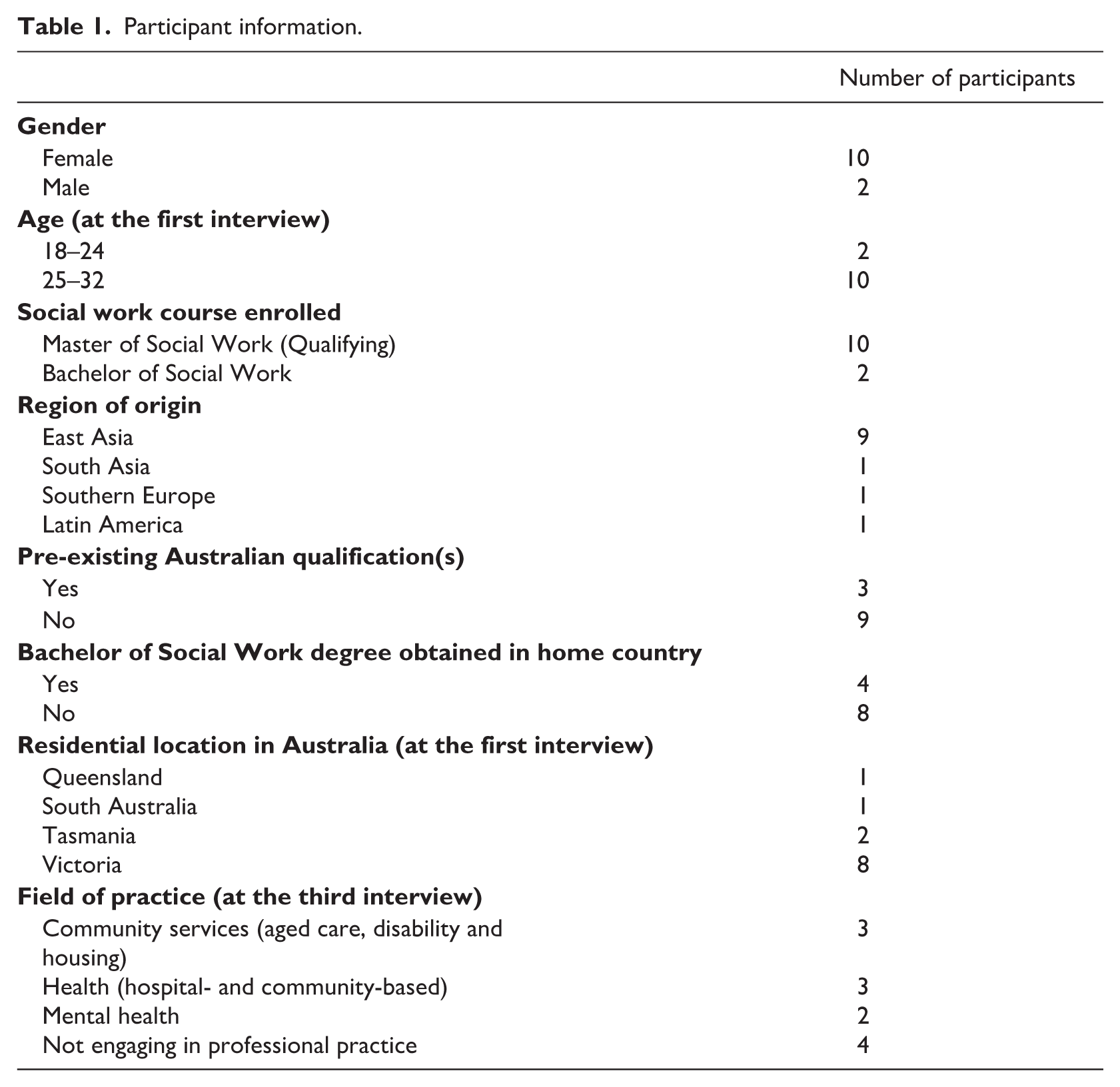
This study explores how the AASW’s English requirements impacted on the professional identity development of 12 international students and graduates as they sought to become social workers in Australia. Table 1 provides an overview of the participants’ backgrounds. Approximately 6 months after completing their social work education, four participants had not entered professional practice and were instead employed in hospitality, retail and cleaning services in Australia. Due to the small sample size and the need to maintain anonymity, no further identifying details are provided, and numerical codes are used to minimise the risk of re-identification.
Participant information.
Thematic analysis of the interview data identified the following three themes, which are discussed below: (1) Sense of othering and powerlessness, (2) Language testing as a barrier and stressor and (3) Increased vulnerability and financial burden.
Sense of othering and powerlessness
A sense of othering associated with the current AASW language policy was communicated through participants’ observations of the distinct language requirements imposed on social work graduates seeking skilled migration in Australia. P8, P9 and P12 noted that their peers, either enrolled as domestic students or not pursuing the AASW skills assessment, were not subjected to the same level of scrutiny regarding their English language proficiency as they had been. P12 reflected on how this policy shaped their sense of professional identity as an emerging social worker in Australia, while P9 questioned whether there is a hidden agenda underpinning the AASW’s current approach to English language requirements: It feels like one extra barrier we [international students] need to cross in order to be considered worthy . . . it’s extra paperwork that I have to prove that I can do what I want to do, or whatever I say that I can do. (P12, first interview) Other [English speaking] countries do not require [IELTS Academic] four 7.0s . . . The AASW requires IELTS Academic 7.0 in writing . . . I really doubt if this is required in professional practice . . . If this is a requirement for everyone [including domestic students], then fair enough. However, is this policy really to assess our English skills . . . or to make it harder [for skilled migration]? (P9, third interview)
Adding to the sense of othering was the frustration and powerlessness associated with the repeated testing required under the AASW’s Australian Social Work Education and Accreditation Standards (AASW, 2024) and English language policy (AASW, 2019a). P5 critiqued the necessity to re-sit an IELTS test, despite meeting the English language requirement before commencing the qualifying social work education, due to the previous test results being considered as ‘expired’.
I did have good scores the previous time . . . and I’ve been living in an English-speaking country for the past two years of my life. It’s frustrating that I have to do the exam again. (P5, second interview)
Although the participants considered the AASW’s language policy to be unfair and excessive, they conjointly expressed a sense of powerlessness in making a change as international students and graduates in Australia: It is what it is. (P5, second interview) I feel angry. Not every native English speaker will be able to achieve IELTS 7.0, and how could the association ask us who use English as an additional language to meet this standard? . . . However, I am powerless. (P9, second interview) If we put into the background that we have been studying the Masters for two years, that should tell that we know the language and we are proficient in that language structure to actually perform in that career. What I know is that it’s a requirement I have to fulfill if I am going to pursue the thing I want to pursue. It’s an extra step. It’s an extra process to endure. But then again . . . just accept it. (P12, first interview)
Language testing as a barrier and stressor
As all 12 participants completed an AASW-accredited social work degree, the only obstacle preventing them from obtaining a positive skills assessment was meeting the AASW’s English language requirements. The participants described IELTS as ‘the only barrier’ (P2, P6) or ‘the big boss’ (P11) they needed to overcome during their initial transition to practise as newly qualified social workers. This was despite the fact that most had already secured professional roles within 6 months of completing their qualifications, including positions as social workers in government agencies.
The significant role that IELTS plays in international graduates’ skilled migration and participation in Australian social work was evident, with P1, P8, P9 and P10 choosing to prioritise IELTS preparation over pursuing professional employment. These participants were found to be unemployed or underemployed during their first year as newly qualified social workers. Similarly, at the conclusion of data collection, P6 and P11, employed as a Case Manager and Social Worker, respectively, intended to transition into new roles or practice settings to support their professional development. However, both chose to prioritise preparing for the IELTS over career advancement, as their eligibility to apply for skilled migration as social workers depended solely on achieving the required IELTS scores. P6 also described the stress associated with sitting the IELTS and their decision to take time off work to prepare for the test as a newly qualified social worker.
I applied to have four Mondays off at my workplace to study for IELTS . . . I am worried about the time, the associated cost, and the impact on my work. (P6, third interview)
Increased vulnerability and financial burden
As discussed earlier, all 12 participants were required to re-sit the IELTS for their skills assessment, despite having completed an AASW-accredited qualifying degree. This requirement was due to the AASW’s English language policy limiting test validity to 3 years. The repeated testing requirement the participants faced for their social work education and transition to practise in Australia exposed them to increased vulnerabilities.
I was very traumatised by sitting in the IELTS tests before commencing my study. It’s like an endless hole, not knowing when I could achieve the goal. (P6, third interview)
Participant 1, who was working in a professional role at the time of their fourth and final interview, shared how the experience of repeatedly testing and failing to achieve the required score negatively affects their sense of worth: I felt completely defeated because of IELTS, feeling ashamed of myself. (P1, fourth interview)
The AASW’s repeated testing requirement imposed on the participants as qualified social workers created a ‘vicious cycle’ (P9, fourth interview) as the participants shifted their focus to address the competing demands between English language testing and entering professional workforce, a key stressor compounded by the restricted visa timeframe and finances. As previously discussed, the opportunity cost of sitting an IELTS tests had led four participants to postpone professional employment seeking and the high cost of IELTS tests added further stress to the participants. P10’s experience described below provides some insight into the financial burden faced by the participants under the current AASW’s IELTS requirements: I sat the IELTS four or five times and started to question whether I could ever meet the requirements . . . I always missed 0.5 in writing . . . so I went all in. I flew to Melbourne, like having a two-week bootcamp. I had taken two or three more tests there. I thought I’d done poorly one day, so I immediately booked another one. While I was sitting that next test, the results came out – and I had passed. (P10, third interview)
Discussion
The voices of the 12 participants demonstrate that the AASW’s current English language policy contributes to a sense of othering and powerlessness among international students and graduates in Australia. The language testing requirements present a systemic barrier for international graduates seeking to enter the Australian professional workforce or pursue career advancement. Given the importance of professional socialisation and a sense of belonging in shaping professional identity in social work (Moorhead et al., 2025), these findings raise concerns about the negative impact of the policy on the professional identity development of this cohort.
The AASW’s current emphasis on prospective migrant social workers’ English competence suggests that the profession continues to view a multilingual world through a monolingual lens (Harrison, 2007), which is found to have negatively affected international students and graduates in this study. Harrison (2006) cautions that the unchallenged dominance of English reflects the enduring legacy of colonisation, compromising the linguistic rights of both Indigenous and migrant communities, along with their access to power, participation and employment, which was experienced by these 12 participants. The findings of this study, echoing the ethical concerns raised by Papadopoulos (2017, 2018) draw attention to whether the AASW’s current approach to English language requirements and testing is aligned with the profession’s commitment to social justice and diversity, as outlined in the AASW Code of Ethics (AASW, 2020a) and Practice Standards (AASW, 2023a).
The study’s findings further highlight the gatekeeping role of the IELTS in Australian social work, aligning with existing critiques of its use in the country (Papadopoulos, 2017, 2018; Read, 2022). The testing requirement places a significant financial and emotional burden on social workers from culturally and linguistically diverse communities who use English as an additional language. Although the current AASW English language policy offers some exemptions, these primarily benefit prospective migrant social workers from English-speaking countries – namely, Australia, Canada, New Zealand, the Republic of Ireland, South Africa, the United Kingdom and the United States – who already hold a privileged status on the global stage (Harrison, 2006).
Under the AASW’s current English language policy, international graduates from non-Anglophone countries face additional barriers to accessing and actively participating in the social work profession in Australia. This leads to concerns about the potential risks perpetuated by the policy, as it may exacerbate the very vulnerability and marginalisation of the populations for which the profession seeks to advocate and support. The colonial and White-dominated history of the profession further warrants a closer examination of the language policies adopted by regulatory and professional bodies in the so-called Anglophone countries beyond the context of Australia. Such scrutiny is essential to promote equity and meaningful participation across all ethnic communities, including those for whom Englilsh is an additional language.
The findings of this study indicate that Australia-qualified social workers who wish to transition into practice in Australia as international graduates are required to navigate an exceptionally challenging environment shaped by the AASW’s English language requirements. To deepen understanding of how language and language policies influence and intersect with social work as a global profession, the authors recommend further research into language policies currently implemented by social work professional bodies internationally. Constituting another key recommendation of the study, the challenges reported by participants highlight the need for the AASW to urgently review its language policy and engage in consultation with key stakeholders, including experts in language testing for other professional and regulatory social work bodies in Australia and abroad.
The exploratory nature of this study allowed for in-depth understanding of the experiences of 12 research participants in 29 interviews. Given the linguistic diversity within both the profession and the studied population, the study offers only a partial understanding of how language and language policies influence professional identity in social work. Although existing literature indicates migrants’ non-English-speaking backgrounds are likely to be perceived as a personal deficit in Australian workplaces (Frost, 2021; Harrison, 2007), the timeframe available for this doctoral research did not allow for continued interviews with participants after their full entry into the professional workforce in Australia. Further interviewing or research could provide deeper insight into international graduates’ perceptions of the AASW’s English language requirements and the relevance of these policies to their professional practice and identities. Despite these limitations, this study offers unique insights into how the AASW’s language policy, specifically its English language testing requirements, affects international students and graduates seeking to become social workers in Australia. This is a relatively underexplored yet important issue in an era marked by globalisation and increasing international mobility.
Conclusion
This study explores how language and language policies influence professional identity with a focus on international students and graduates in Australia. Findings show that the AASW’s current language policy negatively affects this cohort, creating a sense of othering and powerlessness. A strong professional identity, fostered by a sense of belonging and rooted in empowerment, must be fully enacted for social workers to effectively support and advocate for others. The AASW’s English language testing requirements add additional barriers and stress during the participants’ social work education and transition to practice. The testing requirements also increase vulnerability and financial burden, highlighting the significant consequences of the current AASW English language requirements on individuals with non-English-speaking background seeking to contribute to the Australian social work profession.
Despite growing diversity in migrant-receiving countries such as Australia, the social work profession continues to demonstrate limited appreciation for linguistic diversity, maintaining a strong focus on scrutinising English language proficiency through repeated testing requirements imposed on international students and graduates. The voices and experiences shared by the 12 participants in this study exemplify how the social work language policies risk marginalising individuals and preventing international students and graduates from contributing their cultural and linguistic strengths to enrich and bolster the social work workforce. This study addresses a significant gap in the literature concerning the role of language and language policies in social work, highlighting the need for further research to explore how such policies shape the profession both in Australia and globally.
Supplemental Material
sj-docx-1-isw-10.1177_00208728251398481 – Supplemental material for Othered by language: The impact of English language testing on international students and graduates in Australian social work
Supplemental material, sj-docx-1-isw-10.1177_00208728251398481 for Othered by language: The impact of English language testing on international students and graduates in Australian social work by Hui-Yu Yao and Averil Grieve in International Social Work
Supplemental Material
sj-docx-2-isw-10.1177_00208728251398481 – Supplemental material for Othered by language: The impact of English language testing on international students and graduates in Australian social work
Supplemental material, sj-docx-2-isw-10.1177_00208728251398481 for Othered by language: The impact of English language testing on international students and graduates in Australian social work by Hui-Yu Yao and Averil Grieve in International Social Work
Supplemental Material
sj-docx-3-isw-10.1177_00208728251398481 – Supplemental material for Othered by language: The impact of English language testing on international students and graduates in Australian social work
Supplemental material, sj-docx-3-isw-10.1177_00208728251398481 for Othered by language: The impact of English language testing on international students and graduates in Australian social work by Hui-Yu Yao and Averil Grieve in International Social Work
Footnotes
Acknowledgements
The authors gratefully acknowledge Associate Professor Catherine Flynn for her valuable feedback on the manuscript.

Ethical considerations
Ethics approval granted by Monash University Human Research Ethics Committee on 28 January 2021 (Project ID: 21913). Recruitment commenced on 10 February 2021. All participants provided written informed consent via email prior to their first interview, with ongoing written consent confirmed through email before each subsequent interview.
Funding
The authors received no financial support for the research, authorship and/or publication of this article.
Declaration of conflicting interests
The authors declared no potential conflicts of interest with respect to the research, authorship and/or publication of this article.
Data availability statement
The data supporting this study are not publicly available due to the confidential and sensitive nature of the qualitative interviews and to protect the privacy of participants.
Supplemental material
Supplemental material for this article is available online.
Declaration of the use of AI (artificial intelligence) tools
The authors used ChatGPT (free version), Grammarly (free version) and Microsoft Copilot (powered by OpenAI’s GPT-4 model and integrated with Microsoft services) to assist with proofreading and formatting reference lists. These AI tools were employed solely to enhance the clarity, grammar and flow of the writing, as well as to support reference formatting. They were not used for any other aspect of the research process.