




Abstract
Several studies have reported that non-hegemonic fathers who are clients of welfare services are undertreated compared with mothers. This issue is examined here from a previously unexplored angle by comparing perspectives of two groups of social workers from different cultures and working spheres in Israel and Germany. Transcripts of in-depth, semi-structured interviews with 14 German and Israeli social workers were analysed using a qualitative method of content analysis. The findings showed that unique aspects of practice were evident in each country according to its specific demographic and cultural contexts and social workers’ idiosyncratic gender socialisation, feminist approaches and world views.
Introduction
The notion of integrating fathers into intervention by welfare services initially emerged in the 1990s in Western countries, such as those in North America and Europe, in a context of violence against women, which instigated the development of programmes targeting violent men (Brown et al., 2009). Another contributing factor was the rising divorce rate and changing family structures, which prompted concern about the potential effects of fathers’ absences on their children’s welfare and development (Maxwell et al., 2012). Thus, by the beginning of the 21st century, a dichotomous view of fathers as posing a risk to their families or as a resource was apparent within the social services (Featherstone, 2009).
Fathers’ involvement in childcare is reported to have cognitive, behavioural, health and educational benefits for their children (Tully et al., 2017). Children with fathers who are present and involved tend to do better in school and have healthier self-esteem and self-concepts. They are also more likely to exhibit empathy and pro-social behaviours while avoiding high-risk behaviours (Heinrich, 2014). Conversely, the research suggests that compared with children with present fathers, children in households with absent fathers are more likely to use drugs, have increased educational needs and exhibit more health, emotional and behavioural problems (Horn and Sylvester, 2002). From a professional perspective, greater engagement of fathers in the family’s intervention benefits the welfare system and the social work discipline, by contributing to more effective family-oriented social work interventions (Brewsaugh et al., 2018).
Yet, despite these consistent findings, fathers’ involvement in family welfare services remains low. Comprehensive statistical data are hard to obtain, but studies of various welfare states consistently show that almost universally, social work interventions rarely include fathers, and they focus mostly, if not exclusively, on mothers (Featherstone, 2013; Scourfield et al., 2015). This finding has been reported specifically in Israel (Halpern et al., 2021), and it also seems to apply to Germany (Sabla-Dimitrov and Ristau, 2021). However, transnational comparisons are still a gap in the research.
Gender constructions of fatherhood in welfare services
As mentioned above, welfare services are universally targeted at women and children and are also incompatible with the traditional breadwinning role of fathers. For example, men’s long work hours conflict with the operation times of the services (Ewart-Boyle et al., 2015). The vast majority of social workers are women, and as women, they experience a power struggle in which the female worker, who holds professional and regulatory power, faces the male client, who holds patriarchal power (Bundy-Fazioli et al., 2009). Men also often express distress, anxiety, fear and depression differently from women (Baum, 2015). Although male and female social workers may involve fathers differentially, this topic is beyond the scope of this study. The above discussion shows that a substantial part of social workers’ difficulty in working with fathers stems from gender differences.
At the same time, studies have shown that men fear social workers, who often hold sexist and stigmatic conceptions of fathers (Philip et al., 2018). In addition, mothers often position themselves as gatekeepers between the social services and fathers, sometimes going as far as to avoid identifying the father (O’Donnell et al., 2005). Their reasons may include fear of a parent with a history of violence, concern about losing custody to the father, unwillingness to share responsibility for the children or fear of losing benefits attached to single-parent status (Maxwell et al., 2012).
Another important aspect, which turns out to be the focus of this article based on the results, is the influence of feminist ideologies on social work practice, in particular with fathers. Much has been written on feminism and social work, with emphasis on the importance of adopting a radical a feminist practice as resistance to neo-liberal trends (Pollack and Rossiter, 2010), understanding how a feminist perspective could improve the working relationship with men (Cavanagh and Cree, 1996), and, more recent studies, on possible disadvantages of incorporating liberal feminist privilege into practices with people living in poverty and/or refugees (Wendt and Moulding, 2016). However, as far as we know, no international comparison has been made on feminist approaches among social workers with regard to working with fathers. This aspect is important in order to deepen and understand the different nuances of feminism within social work practice.
Transnational and intersectional aspects of fatherhood in the context of welfare services
The lack of a transnational perspective is especially problematic, considering the importance of ethnic, cultural, socioeconomic and other intersectional factors when inquiring into fathers who are clients of family welfare services (Brewsaugh et al., 2018; Brown et al., 2009; Dominelli et al., 2011; Featherstone, 2013; Gupta and Featherstone, 2015). Besides the category of fatherhood, the substantial influence of intersectional elements requires a comparative study to grasp these differences and their impact. A comparative study of Israel and Germany, as countries with diverse demographic contexts, hence similar but also different, may yield important insights.
Gender and the cultural constructions of fatherhood are well-studied topics and will only be mentioned briefly given this article’s focus on fatherhood in the context of family welfare services. In Israel, minority groups of fathers are mainly Jews with an immigration background (such as from Africa, Muslim countries or the Soviet Union), ultra-Orthodox Jews and Palestinians. These groups are often stigmatised and judged for their parental functioning, with little consideration given to the consequences of their structural position within society (Strier and Perez-Vaisvidovsky, 2021). In Germany, scholarly works on the cultural aspects of fatherhood focus mainly on immigrants and refugees, mostly those with Muslim backgrounds, and their encounters with German parenting norms and cultural expectations (Tunç, 2021).
A brief comparison of social work’s institutional context in Israel and Germany is warranted (a comprehensive comparison and analysis of these differences relating to fathers is discussed in another paper). In both countries, social workers are considered professionally qualified after they receive an academic degree. In Germany, social work can be studied as social pedagogy (Sozialpädagoge) at university, or social work (Sozialarbeit) in a professional institution (Fachhochschule). In Israel, social work is taught at universities or colleges, and focuses more on psychotherapy or community work, whereas in Germany, the focus is on education or preventive work. In both countries, the social services operate under the respective federal governments, and specific welfare laws are aimed at protecting children and helping families (Textor, 1995; www.gov.il/he/departments/molsa).
Finally, the lack of a comprehensive theoretical and comparative framework is a notable gap in the scholarly literature on fathers and social work. Previous studies have identified numerous elements that reduce fathers’ engagement as well as sexist and gendered beliefs held by social workers (Brewsaugh et al., 2018; Philip et al., 2018). However, no explicit explanation, or international comparison, that accounts for connections, mutual influence and counter dependencies among transnational and intersectional elements has been offered. Therefore, this study seeks to bridge the above gaps and offer a new perspective on the role social workers hold in treating fathers with regard to specific cultural and political climates. The main actors in this study are, clearly, social workers. We shall demonstrate how powerful and impactful their position towards fathers is. Their willingness/unwillingness to involve the father shapes the entire treatment the family receives, therefore affecting mothers’ and children’s well-being. Nonetheless, social workers are also influenced by the macro level of culture and gender norms, as will be elaborated in the discussion. Hence, addressing those spheres is essential to encourage change and greater involvement of fathers in the social services. The latter can be measured by higher rates of fathers being a central part of the treatment, as reported by social workers.
The choice to compare Israel and Germany is mostly coincidental. To some extent, it stems from the historical affinity of social work between the countries (Konrad, 2022), and, as mentioned above, is a good starting point for a much broader international literature based on the learning developed across welfare-country contexts.
Methodology
Research Questions were as follows:
What are the perceptions of social workers, and what are their working habits, attitudes and actual interactions (or lack of them) with fathers?
Are there any specific ideas or norms that guide social workers in their work with fathers?
What are the differences, or similarities, between two culturally different groups of social workers and clients in Israel and Germany?
It is noteworthy that the study’s findings prompted a revision of the original research questions, noted above. Specifically, they highlighted the importance of grasping how feminist agendas influence father–social worker dynamics and of social workers’ self-reflection in different countries based on the unique ideals, images and stereotypes that could impact their practice in particular cultural-psycho-social and demographic settings.
Ethical approvals by the institutions in charge of this research review board were obtained, as well as informed consents (verbal) from all respondents, who were chosen through convenience sampling. Texts relating to specific clients, the social workers’ names and the locations of their departments were anonymised to avoid disclosure of identifiable data.
In-depth semi-structured interviews were conducted by the first author, in parallel, with seven German social workers and seven Israeli social workers during 2020–2021. Interviewees were selected using convenience sampling, when the inclusion criteria is solely being a social worker in family welfare departments. Accordingly, departments and social workers willing to participate in the study were selected. In Israel, interviewees were all from middle-class socioeconomic status. Interviews were conducted in Hebrew, with interviewees recruited from three family welfare departments. In Germany, all interviewees were born in Germany, and interviews were conducted in English (not the interviewees’ native language) with six women and one man from Der Allgemeine Soziale Dienst (ASD), the equivalent of Israeli family welfare services, in two different regions. In both countries, these services, provided by trained social workers, deal with families in distress resulting from children’s severe psychosocial problems and/or educational problems. Most interviews in Israel and Germany were conducted online, and lasted approximately an hour. They consisted of questions on the daily practices and case descriptions of working with fathers and families, and aimed at understanding the social workers’ perspectives on involving fathers as well as their daily routines and actual practices.
In both countries, two interviews were initially conducted and analysed in a pilot study. Thereafter, the remaining interviews were conducted. All the interview transcripts were anonymised by changing any personal data, as promised to the participants, and stored privately by the first author for 6 months. Interviews were analysed using a qualitative method for tracing the social workers’ unique perceptions and world views regarding fathers. The transcripts were first read and analysed using a qualitative narrative method described by Shkedi (2005). The following categories were identified in the Israeli interviews as obstacles to involving fathers: Feminine dominance in social work, low priority given to engaging with fathers, reaching out for fathers as a central obstacle and lack of tools for addressing fathers.
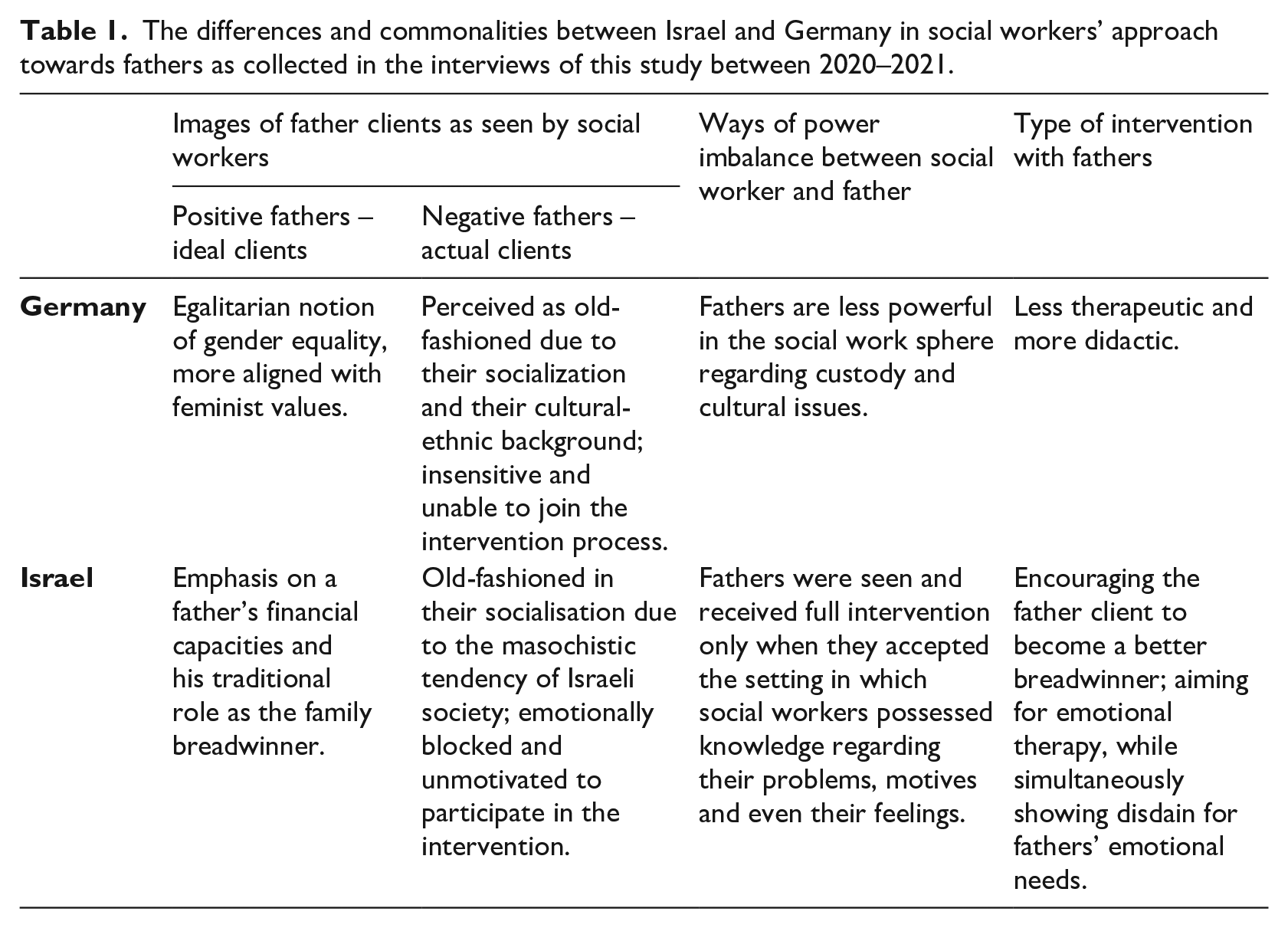
Next, the German interview transcripts were divided into categories identified in the Israeli interview transcripts above. However, this analysis did not yield sufficient in-depth conclusions. Therefore, a ‘second order’ analysis was conducted with the help of other researchers (Shkedi, 2004) drawing on qualitative content analysis (QCA; Graneheim et al., 2017). On the axis of the two-dimensional model of QCA epistemological approaches, namely, phenomenological description versus hermeneutic interpretation, the former was more prevalent in the initial analysis of the interview content, which focused on manifest content and concrete descriptions. During the second round of analysis, an approach of maintaining distance from the text was adopted with more abstract descriptions and interpretations and an abductive approach. The second-order analysis revealed that feminist ideologies and gender expectations of social workers were highly dominant in their work with fathers, even though the interview guide did not focus on these aspects. Therefore, the findings and following discussion will focus on those issues as follows, and is also summarised in Table 1.
The differences and commonalities between Israel and Germany in social workers’ approach towards fathers as collected in the interviews of this study between 2020–2021.
Findings
Images of the ideal father
Social workers in both groups explicitly or implicitly conveyed a certain image of the type or characteristics of the ideal father, associated with positive and highly appreciative expressions. By contrast, they portrayed common father clients using concrete case descriptions or general statements. These portrayals mostly contrasted with the ideal father image, although in very few and exceptional cases of fathers categorised as ‘good clients’ or ‘successful intervention’, they matched the ideal. The characteristics of the different father images were related to emotional, behavioural and familial aspects as well as economic roles and general attitudes towards the intervention, the welfare system or the individual social worker.
An egalitarian versus a masochistic trend
The interviews in both countries conveyed an ideal father image with some differences. In Germany,
They [the ideal fathers] are softer, open-minded, can talk about their own feelings, childhood, kind in their marriage . . . the mother and father share . . . [equally in] looking after the children and [providing] money. (Germany, 3)
The egalitarian notion of gender equality and the ideal of men who are more aligned with feminist values matched the sociological or social policy perspective of most interviewees in Germany regarding their wish to change gender roles and strengthen fathers’ involvement. However, this desire for social progression calls attention to the reality, wherein father clients are perceived as old-fashioned in their socialisation, being unable to fulfil this utopic desire and keep pace with the new trend of increased fathers’ involvement:
Fathers do more. . . than fathers of the older generations. . . . We have more and more fathers, of course, who want to take responsibility of their kids but quite often say ‘I can’t do it’ . . . because they are also socialised that way. (Germany, 4)
In Israel, father clients were also described as more old-fashioned in their socialisation. However, the masochistic tendency of Israeli society as a whole was strongly emphasised by the social worker as the reason:
The problem is in the education and messages [conveyed] in the Israeli society; that a man has to be strong and macho. In the welfare client population, I don’t see any change in that aspect. (Israel, KY2)
If the German social workers deemed a father who demonstrated active parenthood, emotional capacity and equality with the mother within the household as a good father, the Israeli social workers placed much greater emphasis on a father’s financial capacities and his traditional role as the family breadwinner, As demonstrated by one of the interviewees when she talked about a good father in her eyes,
He bought them [his children] everything that was needed because the mother had no money. (Israel, A1)
The disappointing father in reality
In both countries, only a few interviewees acknowledged the stigmatizing and judgemental approach of social workers towards fathers:
Social workers judge the father all the time; as abusive, not caring enough . . . even when he made all the efforts he could. (Israel, A5) I really do my best not to be stigmatising but it’s always a challenge. If you look at some statistics, they are more violent. (Germany, 6)
The different images of ideal fathers in both countries were compared, mostly as contrasts to common father clients, who were not very involved in the intervention. Most of them were judged negatively relative to the above images of an ideal father or in opposition to the mother’s maternal functioning, as discussed further on.
There were also some differences in this respect. For example, in Germany, while fathers were expected, perhaps like women, to be emotional and soft, the discourse about them was at times harsh and judgemental, with frequent use of generalisations and very few expressions of empathy. The common father client was judged as insensitive, unintelligent and unable to join the intervention process in stark contrast with the ideal father image mentioned in the German interviews:
It’s also the fault of themselves when they are acting like idiots because they are very insulted. (Germany, 3)
In Israel, social workers tended to determine that
With fathers, it is very hard to talk [about] emotions, about the intervention or the process. (Israel, A7)
Interestingly, when fathers did express emotions, they were also described negatively if these emotions did not match their expected role:
They [father clients] are very unbalanced. They are overwhelmed and flood you with information and [are] very manipulative. (Israel, B4)
The main gap, however, was between the image of the ideal father as a potent man and the main breadwinner and the common father client, who was viewed as economically impotent:
It was hard to handle him [the father] because it was obvious that he didn’t function. . . . He was not a working man. She was working and he wasn’t. (Israel, KY2)
Paradoxically, even in cases of hardworking fathers who were breadwinners there was no need to make an effort to involve them:
When I come [for a house visit], the father is sleeping because he did [a] night shift . . . so he won’t be interested to sit and talk (Q: And do you try to involve fathers?) A: In this case it won’t do any good. (Israel, O2)
Non-powerful fathers
The analysis revealed different ways in which this power imbalance between the female social worker and the male client manifested in each country.
In general, and in both countries, interviewees depicted women within the sphere of family welfare services as being more powerful, since this is a context in which most practitioners, as well as leaders, are women. In Germany, it seems that the legal aspect of custody plays a major role in fathers’ lack of power. Mothers have a preliminary advantage when it comes to custody, as described in the interviews, whereas fathers are included mostly when they share custody. Therefore, mothers were typically granted custody, had legal power and were the gatekeepers who decide if the social worker can get to know the father. Eventually, social workers in Germany become reluctant to challenge or appeal against mothers and their ultimate power:
The mother has . . . sole custody. That [means] the father, he doesn’t have any rights. (Germany, 6) If the mother doesn’t want to involve the father, it’s also hard for us to involve him. (Germany, 2)
The only exceptions were immigrant fathers from Arab countries, in which fathers were described as the more dominant partners who hold power in the family:
If there is a Muslim background, they are more [likely to] stick to cultural . . . and also, yeah, these old ideas about family and about the man being the head of the family. (Germany, 6)
However, the cultural-ethnic affiliation and the allegedly powerful patriarchal position of the father within the family lead to a certain perspective on their parenthood:
On the Arab side, it’s very old-fashioned and very hard to find new solutions for families. (Germany, 3) In our region, we have a lot of people from Arabic countries and from African countries. They are socialised [such] that it’s not the father’s job to care for the family and to go with the kids to the doctor or things like that. (Germany, 4)
Nonetheless, when a cultural gap was present when working with mothers, social workers treated them with greater respect and caution:
I had huge difficulties with Caribbean mothers, and I had criticised their parenting. I mean, that is the worst thing I could do to this particular culture group. So, you have to find a way because they feel they are being discriminated [against] everywhere. (Germany, 7)
In Israel, however, custody was not such a central issue. This could be because unlike their German counterparts, family social workers do not handle divorce disputes. Also, in the Israeli interviews, the element of immigration was less prominent, perhaps because of the different demographic contexts of welfare clients in Israel. Arab populations are mostly treated by Arab social workers. This group was investigated but was not part of the sample discussed in this article.
Nevertheless, fathers were seen and received full intervention only when they accepted the setting in which social workers possessed knowledge regarding their problems, motives and even their feelings:
The father felt that there was a great injustice . . . done to him . . . that only his wife was being heard. I treated him for six years. We first recognised that when he screamed; this means he is afraid. And he shouts . . . but actually he is dying of fear. (Israel, KY1)
Educational approach towards fathers
The above findings lead to another aspect. In Germany, it seems that the gender perception of men, in accordance with feminist approaches that expects fathers to take equal responsibility to mothers, leads to a certain type of intervention, which is less therapeutic and more didactic. As described earlier, the social worker tries to fit client fathers into the ideal father category that she has in mind, encouraging them to adhere to a certain feminist model:
To give them something like a ‘Vorbild’ [role model]. They learn something from someone else. Because many fathers, they don’t have a model like this. (Germany, 7)
In the Israeli interviews, as mentioned above, a different gender expectation is prevalent. Accordingly, the father’s financial capacity contributed significantly to his worthiness in the eyes of the social worker and thus to his success as a breadwinner. Thus, the social worker’s educational task was to help the father become a better breadwinner, rather than a better father/spouse. This gender approach clearly contradicts the German interviewees’ feminist expectation of equal parental participation:
If [the father] comes and asks for a fridge, probably the financial management is not so good . . . so we want to see how we can improve [the father] to be better financially. (Israel, O1)
Nonetheless, fathers who required educational work that is not financial and which related to parental and emotional aspects, especially when these weaknesses were revealed:
He [the father] received a lot of parental mentoring . . . a very weak, hesitant and knowledgeless father, [who] was very afraid [of] talking to the children. . . . I felt some kind of dependence on his side that I would tell him what to do and how . . . being a father naturally was not there. (Israel, B4) Our difficulty as women [social workers] [is] to bear crying and [the] strong emotions of men. There was [a father] . . . he just sobbed on the phone . . . and it turned my stomach inside out . . . because he is a man. (Israel, KY1)
This paradox wherein social workers perceive their role to include educating fathers or conducting emotional therapy with them, while simultaneously showing disdain for their vulnerability, is aligned with a previously mentioned finding regarding gender perceptions and images social workers hold. Less ‘masculine’ and more emotional fathers are viewed with suspicion according to the prevailing masochistic model in Israeli society. Economically or emotionally dependent fathers are scorned or reduced to dependent, irresponsible children, which leads to a paternalistic educational intervention:
So, I called him [the father] and asked him, ‘what are you doing? What is this nonsense?’ . . . I went to them for a house visit, I explained why he needed to calm down, and that this was not a way to behave. (Israel, O1)
Discussion
This study analysed social workers’ perceptions about working with fathers in family welfare services. It revealed an advancing understanding of their beliefs and world views relating to gender and interventions with fathers, and demonstrated the important role that feminist ideologies and gender expectations of fathers play in social workers’ attitude towards fathers. Moreover, it compared two culturally different groups of social workers and working spheres in that regard. By doing so, it sought to bridge existing gaps identified in the scholarly literature and to examine comparative and intersectional aspects of working with father clients of family welfare services in two Western countries with different welfare regimes: Israel and Germany.
Beyond the expected outcome, adherence to scholarly literature, of not involving fathers and undermining their significance compared with mothers in both countries, the findings demonstrated similarities and commonalities. But more importantly, they illuminated specificities in each country relating to idiosyncratic gender socialisation, cultural influences and, strikingly, different feminist approaches among social workers which influence their working habits with fathers. In other words, images of the ideal father and attitudes towards the common father client differed in each country. Consonant with the reviewed literature, the findings showed that social workers’ gender bias within welfare services constituted barriers and potential reasons for fathers’ lack of involvement. However, this article is innovative by emphasising the importance of understanding how feminism is adopted and influenced social workers differently in each country.
Through its exploration of the intersectional prism and its comparison of two culturally differing social work environments, this study has provided a deeper analysis and theoretical explanations for fathers’ limited involvement. As mentioned above, these explanations focus on the presence or absence of feminist agendas and ideals, the gap between the image of the ideal father and the actual father client in each unique demographic context and the association between the feminist approach and professional practice and interventions with fathers. This contrasts with the claim in previous studies that the less sexist social workers are, the more likely they are to involve fathers (Brewsaugh et al., 2018), but adheres with studies emphasising the complex influence of gender social expectations on social workers and the need for a radical feminist approach (Sands and Nuccio, 1992; Scourfield, 2002). Nonetheless, this study produced a complex picture, entailing other intersectional elements. A feminist or non-patriarchal attitude, by itself, is insufficient to prompt a radical change of increasing involvement of fathers. This failure can also be attributed to a more traditional and less radical feminist ideology.
The discourse of hegemonic masculinity, originated in men’s studies (Connell, 1982), was not, in the past, aligned with the second wave of American feminism or the feminist liberation movement. The concept recognises masculinity as a dynamic practice that varies across time, society, culture and the individual, legitimises men’s dominant position in society and justifies the subordination of the common male population and women, and other marginalised ways of being a man. However, liberal feminism did not emphasise the social norms which shape men’s experiences and role in society, and was focused on achieving equality between men and women and combating discrimination against women (Silverstein, 1996). Feminist theorists who identified with this stream resonated most strongly with the emphasis on sharing parental duties within the private sphere of the family and household unit, and father–child bonding (Ruddick, 1983).
This scholarship can be seen as pro-fathering, encouraging male parents’ proactiveness in alignment with feminist goals of gender equality and positive outcomes for men, women and children (Pleck, 2010; Woo and Raley, 2005). However, these ideas apply mostly to middle-class, heterosexual, and White fathers and families, while excluding other forms and different shades and marginalised representations of masculinities (Inhorn, 2004), as studies have only recently begun to explore fatherhood (Randels, 2020; Strier and Perez-Vaisvidovsky, 2021). As noted by Doucet and Lee (2014), there are still gaps in feminist thinking on fatherhood in relation to intersectional prisms, such as colonialism, state policies, racism and class-based inequalities.
This study has attempted to touch upon these gaps that were highly prominent in the interviews conducted in both Germany and Israel, but in varied aspects. In both countries, an internal contradiction was apparent regarding the expectations from fathers, which are aligned with the contradictory myth of masculinity within the wider society. According to this ideal, literature describes the ideal man who must be aggressive but not violent, sensitive but not too emotional, healthy and a feminist as well as a breadwinner and active and smart (Shor, 2000).
In our study, we found an interesting paraphrase of this ideal. In Germany, the main expectation from father clients was that they be emotional, communicative, caring for their children and sharing parental duties with the mother. These expectations (and their disappointment) fit very well with the abovementioned liberal feminist agenda of parents’ equality, and in one way, they contrast with the image of non-German fathers, who are mostly immigrants from Arab countries.
In Israel, the main expectations of father clients (and, conversely, disappointments) are related to being successful breadwinners and demonstrating mental resilience. Most of the father clients were struggling with poverty and difficult life circumstances and did not fit the above ideal. Hence, Israeli social workers were less affiliated with the liberal feminist stream of egalitarianism, adhering more closely to the traditional patriarchal model of relations between the sexes.
However, even though the two groups of social workers held opposing perceptions regarding gender socialisation and the expectations of fathers, which are important to trace and understand idiosyncratically, both groups adopted a distancing and often disrespectful approach towards fathers, leading to minimal efforts to reach out to them and a preference for working with mothers. Poverty or ethnicity appeared to play a similar role in undermining fathers within family social workers’ practices.
The findings of this study, in adherence with the literature, showed that poor fathers who also belong to ethnic minorities, are often viewed as failures, either as fathers or as non-masculine men (Collins, 2000). Negligent Black fathers, for example, were stigmatised as being promiscuous, predatory and violent and blamed for the social ills of communities of colour (Battle, 2018). Certain welfare programmes targeted at fathers draw on a discourse that characterises them as worthy fathers and, by implication, worthy men, providing role models more than money for children (Randels, 2020). Such programmes, described in the literature, resonate strongly with the findings of this study on German social workers’ expectations but less with those of Israeli social workers, who strongly emphasised fathers’ breadwinner role, as described above. However, both groups of social workers adhered to a discourse that asserts that fathers play an essential role in their children’s positive development, thereby encouraging responsible fathering. Indeed, the father clients in this study were often blamed for not being responsible enough.
This finding could also be explained with reference to the notion of fear, which is related to power. Lorber’s (1994) definition of hegemonic masculinity entailing economic success, racial superiority and visible heterosexuality is very similar to expectations of ideal fathers among social workers in both countries. Nonetheless, this study demonstrated that hegemonic and non-hegemonic masculinity are culturally relative and fluid concepts.
In the eyes of German social workers, non-hegemonic fathers are culturally and ethnically different, dominant, patriarchal men, who mostly hail from Arab countries. Paradoxically, in the eyes of Israeli social workers, hegemonic fathers are closer to the Arab patriarchal image that German social workers find distasteful, whereas non-hegemonic and ‘less worthy’ fathers more closely resemble German hegemonic fathers, who express their vulnerabilities. Cheng (1999) argued that the dominant group needs to find a way to justify its dominance by making other masculinities inferior. Any alternative masculinity is perceived as a threat to hegemony and the status quo.
Social workers in this study recoiled from fathers who displayed violence or, conversely, weakness (either emotional or economic). In Germany, drawing away from patriarchal men was more prominent in relation to the reservation of culturally and ethnically non-hegemonic fathers, mostly from Arab countries, who were labelled as patriarchal. In Israel, resentment was mostly directed against fathers who expressed their weakness but also against those who were ‘too aggressive’.
However, this feminine power entails an inherent trap. Women have power only because they adhere to their traditional gender roles as social workers (caregivers), mothers, those who ask for help (are helpless) or those cooperating with the social worker (differing to the regulatory and authoritative system).
Thus, in both countries, it seems that social workers only allegedly hold power over fathers. In reality, there is a lack of significant professional knowledge, which could improve working skills, intervention outcomes and self-confidence. Social workers should better understand the different challenges that father clients may face, which intersect with other excluded affiliations (such as being an immigrant and poor). Several questions arise: for example, have social workers grasped the tension between the traditional breadwinner ideology and new father ideals that emphasise the importance of fathers being emotionally present for their children? Do immigrant and refugee fathers experience disruption to their provider role as being detrimental to their identities (Este and Tachble, 2009)? Do low-income fathers demonstrate that breadwinning as well as nurturing are motivational factors to be good fathers (Edin and Nelson, 2013)?
Conclusions
Evidently, prevailing liberal and second-wave feminist ideas of how a father should act, feel and talk have shaped and influenced the attitudes of social workers towards fathers and their working relationship with them. This conclusion emerged in two different Western countries. In Germany, the immigrant client is perceived as patriarchal, and thus in opposition to the ideal of the new father, who shares the parental role with the mother. In Israel, socioeconomic characteristics play a major role in defining father clients. Notably, living in poverty marks fathers as less functional and thus in opposition to the ideal of the father as the full breadwinner.
The findings of this study explicitly show that social workers failed to understand these complex and meaningful nuances of their clients’ intersectional affiliations, despite working in varied cultural and demographic contexts. They did not acknowledge how ethnicity, poverty and affiliation to a certain class impact men’s access to resources and opportunities and therefore their parenting abilities. Moreover, they did not acknowledge how being constantly judged by social workers, and being part of an unequal power relationship with social workers, could impact their parental self-esteem. Therefore, despite holding different gender perspectives and feminist approaches, social workers in Israel and Germany demonstrated a lack of self-reflection on their gender approaches and specifically on the gap between the ideal father image and their expectations and the ‘real’ fathers with whom they work.
The findings further highlight the importance of acknowledging the unique perceptions, expectations and apparently inevitable disappointments of social workers that shape the power imbalance between them and father clients within family welfare services. It is also necessary to examine how they hinder feminist ideals and images. Furthermore, it is important for social workers to advance their understanding and knowledge of the unique characteristics, challenges and difficulties that may be experienced by the particular fathers with whom they work, with their specific ethnocultural backgrounds and socioeconomic status.
It is to be hoped that uncovering and understanding the unique expectations that social workers have of fathers and the constraining ideologies that may influence them in these differing demographic and cultural settings could increase their self-reflection on their habitual methods of working with fathers. Consequently, the father–social worker relationship could be improved. Moreover, the importance of comparing two different countries is reflected in the findings, which demonstrated different approaches used for different client groups. It is important to expand comparative research on fathers in family welfare services to other Western as well as non-Western countries. Professional education, training and socialisation, as well as social work organisational cultures, would also benefit from reflection on intersectional aspects in treating fathers and should adopt anti-oppressive practice issues which benefit fathers.
Finally, this study’s limitations should be noted. The German interviews were conducted by a researcher who was a cultural outsider and not in the interviewees’ native language, whereas the Israeli interviewees and interviewers shared the same language and culture. This difference between the interviewees in the two groups could have affected their ability to open up and feel comfortable about expressing themselves. In addition, contrasting with the analysis of the Israeli family welfare services, with which the researcher was familiar, the analysis of the German interviews lacked a comprehensive familiarity with and understanding of the German family welfare services system. Moreover, the sampling of social workers in both countries was not entirely reliable or representative, as specific social workers were chosen by the departments’ managers. Hence, further studies encompassing a larger group of social workers and entailing collaboration with a local German team are required.
Footnotes
Acknowledgements
The authors wish to thank all the interviewees who agreed to take part in this study.
Funding
The author(s) disclosed receipt of the following financial support for the research, authorship and/or publication of this article: The study was supported by the Minerva foundation for post doc researchers.
